




Abstract
This article critically examines how the policy of funded nursery places for ‘disadvantaged’ two-year-olds in England opens up economic and political spaces in readiness for increased governance. The government introduced funded nursery places in September 2013, which aimed to promote disadvantaged children’s educational outcomes, narrow the attainment gap and encourage parental employment. Using a Foucauldian policy genealogy, the article sets out the ways in which funded nursery places constitute and deploy techniques for governing ‘disadvantage’ – specifically, how ‘disadvantage’ is constructed as a ‘problem of the population’, which, in turn, is productive of particular subjectivities and practices. The article traces how funded nursery places construct a particular ‘disadvantage’ through ‘experts of truth’, evidence-based policy, regimes of quality and neurobiology in preparation for the next phase of nursery at the age of three. These processes establish ‘disadvantaged’ two-year-olds as governable objects and therefore subject to the increased formalization of early experiences. The close links between ‘disadvantage’ and ‘readiness’ discursively provide conditions of possibility for technical and instrumental practice that is driven by a global hegemonic rationale in human capital. Although the analysis is focused in the English context, these developments have wider global implications in relation to school readiness and early education reforms across countries that are reaching into ever younger spaces.
Keywords
Introduction
Early childhood education and care (ECEC) is increasingly positioned globally as strategic for new possibilities in early intervention and tackling social and economic ‘disadvantage’. In England, funded nursery places (FNP) for ‘disadvantaged’ two-year-olds were introduced in September 2013, which aimed to promote educational outcomes, narrow the attainment gap and encourage parental employment. This article critically examines how the policy of FNP deploys ‘disadvantage’ as an economic and political construct of readiness within ECEC. Using a Foucauldian genealogy of FNP, this article explores how policy constitutes and activates ‘disadvantage’ through readiness technologies in establishing ‘knowable, calculable and administrative’ objects (Miller and Rose, 1990: 5). It responds to an urgent need for critical policy methodologies in ECEC, as Wood (2017: 111) notes, on ‘power relations, the extent to which different voices and perspectives are represented, and the ways in which ECEC communities contest policy and its effects’. This article examines the effects of an economistic construct of ‘disadvantage’ on two-year-olds and their families – specifically, the effects of how ‘disadvantage’ is constructed as a ‘problem of the population’ (Foucault, 2009), which, in turn, is productive of particular subjectivities and practices. The genealogy further traces how FNP set in place human technologies which are productive of a particular human capital in ‘readiness’, a form of techno-capital, which reimagines disadvantaged two-year-olds as ‘abilities-machines’ (Foucault, 2010). From a neo-liberal standpoint, ECEC is increasingly commodified as ‘childcare services’, ‘whether as the object of social investment, to be purchased as a means to high returns . . . or as the object of market transactions between parent-consumers and provider-business’ (Moss, 2014b: 67). Critical policy approaches have engaged Foucauldian thinking to problematize policy processes, ranging from genealogies of governmentality in Queensland’s preschool education (Ailwood, 2004, 2008) to in-depth genealogical study combined with ‘network ethnography’ in the discourse of ‘quality’ (Hunkin, 2016, 2018), investigation into university-qualified ECEC teachers’ perceptions of regulation in Australia (Fenech and Sumsion, 2016), and global neo-liberal ‘new politics of parenting’ (Simpson et al., 2015). Studies such as Barron and Taylor (2017) anchored their engagement with neo-liberal ‘readiness’ by using heterogeneous theoretical rhizomatic ‘lines of flight’. On the global policy front, the Organisation for Economic Co-operation and Development’s controversial International Early Learning and Child Well-Being Study, which assesses early learning outcomes among five-year-olds, generates serious critical debates on the intensification and spread of the neo-liberal demands of school and nursery readiness on younger children; with it, comes increasing uniformity, comparability and narrowing of ECEC (Moss et al., 2016; Moss and Urban, 2017). In light of these wider global concerns about the effects of neo-liberalism in ECEC, this article sets out the ways in which ‘disadvantage’ reforms and readiness techniques are targeting ever younger ages, and how this produces abilities-driven subjectivities in an increased formalization of early learning experiences.
Foucault’s concept of governmentality is useful as an analytical tool for investigating policy technologies of governance. Governmentality refers to a continuum which extends from political government right through to forms of self-regulation in leading and controlling the ‘conduct of conduct’ of subjects. Foucault describes ‘governmentality’ as the ensemble formed by institutions, procedures, analyses and reflections, calculations and tactics that allow the exercise of this very specific, albeit very complex, power that has the population as its target, political economy as its major form of knowledge, and apparatuses of security as its essential technical instrument. (Foucault, 2009: 108)
Dahlberg and Moss (2005: 19) highlight a crucial aspect of governmentality in the way the state constructs self-governing and willing subjects through practices working ‘directly on us, steering us towards desired behaviour. But they also work through us, acting on our innermost selves’, conducting our own conduct in ways that conform to the dominant regime. In this article, the term ‘technology’ refers to mechanisms deployed ‘to shape, normalize and instrumentalize the conduct, thought, decisions and aspirations of others in order to achieve the objectives they consider desirable’ (Miller and Rose, 1990: 8). Rose (1999b: 52) uses the term ‘human technologies’ to describe how governing techniques understand and mobilize human capacities through ‘an assemblage of forms of practical knowledge, modes of perception, practices of calculation, vocabularies, types of authority, forms of judgement, architectural forms, human capacities, non-human objects, and devices’. The approach to policy assemblage regards FNP as ‘an ensemble formed by apparatuses and devices for exercising power and intervening upon particular problems’ (Rose, 1999b: 19) – or, as Foucault (2010: 19) suggests, ‘the coupling of a set of practices and a regime of truth . . . that effectively marks out’ reality. Together, these conceptual tools offer productive ways of examining the conditions of possibility (but not all and not definitively) of how pre-given ‘universals’ such as ‘disadvantage’ and ‘readiness’ are woven into power relations and, importantly, of questioning how these ‘categories have come to be assembled in different ways in different spaces and times, and with what effects’ (Savage, 2019: 12).
Policy genealogy
A Foucauldian policy genealogy is a way of writing ‘the history of the present’ (Foucault, 1991). It begins by focusing on an immediate problem and then tries ‘to see it in its historical dimension; how this problem turned out to be the way we perceive it today’ (Tamboukou, 1999: 213). Here, rather than settling for the ways in which ECEC has historically represented ‘disadvantage’, I move the focus to one of an analytics of power, which asks: ‘How can this deployment of power, these tactics and strategies of power, give rise to assertions, negations, experiments . . . and theories, in short to a game of truth?’ (Foucault, 2006: 13). It does not look for the origins or coherence of FNP. Rather, an analytics of power in the Foucauldian sense is about strategies and practices which emphasize policy as process rather than policy as outcome. Genealogy productively opens up critical spaces of inquiry by problematizing the power effects of policy. Here, the term ‘critical’ refers to a way of examining the social world whereby reality is understood as constructed, shaped by various forces that claim to be natural and ‘common sense’. Problematization challenges universal values and assumptions, which could potentially lead to new ways of thinking and practice. Therefore it is argued that by disrupting pre-given policy categories, a policy genealogy presents a way of resisting and contesting power effects, towards creating greater political awareness with practitioners of ‘how not to be governed like that’ (Foucault, 1994: 265).
As a starting point, I mapped a historical timeline of policy development of FNP (1997–2015). No significant FNP-related policies were published after 2013; the first tranche of 130,000 FNP was implemented in September 2013 and the second in September 2014. Policies were included from the Department for Education, the Department of Health and the Department for Work and Pensions which specifically refer to ‘disadvantage’ and policy rationalities that identify and support ‘disadvantaged’ two-year-olds and their families. This approach recognizes that policies are constitutive of economic and political rationalities within a wider discursive field of prevailing economic, social and cultural contexts. The aim of the timeline is to give a heuristic overview of the reforms in contextualizing particular events in relation to FNP, and does not claim to provide a definitive account of ECEC policy. A sample of policies has been selected based on their relevance, objectives, and the ways these reforms referenced the provision of FNP and ‘disadvantage’. Table 1 summarizes the relevance of the eight documents selected for analysis. The documents were searched, manually coded and themed in connection to ‘disadvantage’, two-year-olds, parents, childcare, economistic terms (i.e. poverty, employment, investment, accountability, market and choice) and related terms (i.e. skills, knowledge, experts, expertise, risk and readiness). Thus, what is presented is biased by the study’s focus on economico-political rationalities, and offers an analysis of the way(s) ‘disadvantage’ is constructed and governed by policy technologies in relation to Foucault’s approach to governmentality. As an exploratory device to help trace the construction of ‘disadvantage’, first, I draw on Foucault’s (2009) notion of ‘milieu’ in denoting a disadvantage space for ‘action at a distance’. A ‘milieu’ appears, as a field of intervention, as the medium in which to activate mechanisms in varying precision in rendering ‘disadvantage’ amenable to certain kinds of actions . Second, I attend to the role of language as an ‘intellectual technology’ for rendering reality amenable to certain kinds of action, where ‘language, in this sense . . . involves inscribing reality into the calculations of government’ (Miller and Rose, 1990: 7). Braun and Clarke’s (2006: 79) approach to theoretical thematic analysis is then used to identify, analyse and report patterns (themes) within the data and, following Foucault, the theory-driven coding prioritized ‘how’ questions. The work involved iterative reading, repeated keyword searches and manual recoding in ‘constant comparison’ (Glaser and Strauss, 2017).
A summary of the selected ECEC policies for analysis in relation to FNP and ‘disadvantage’.
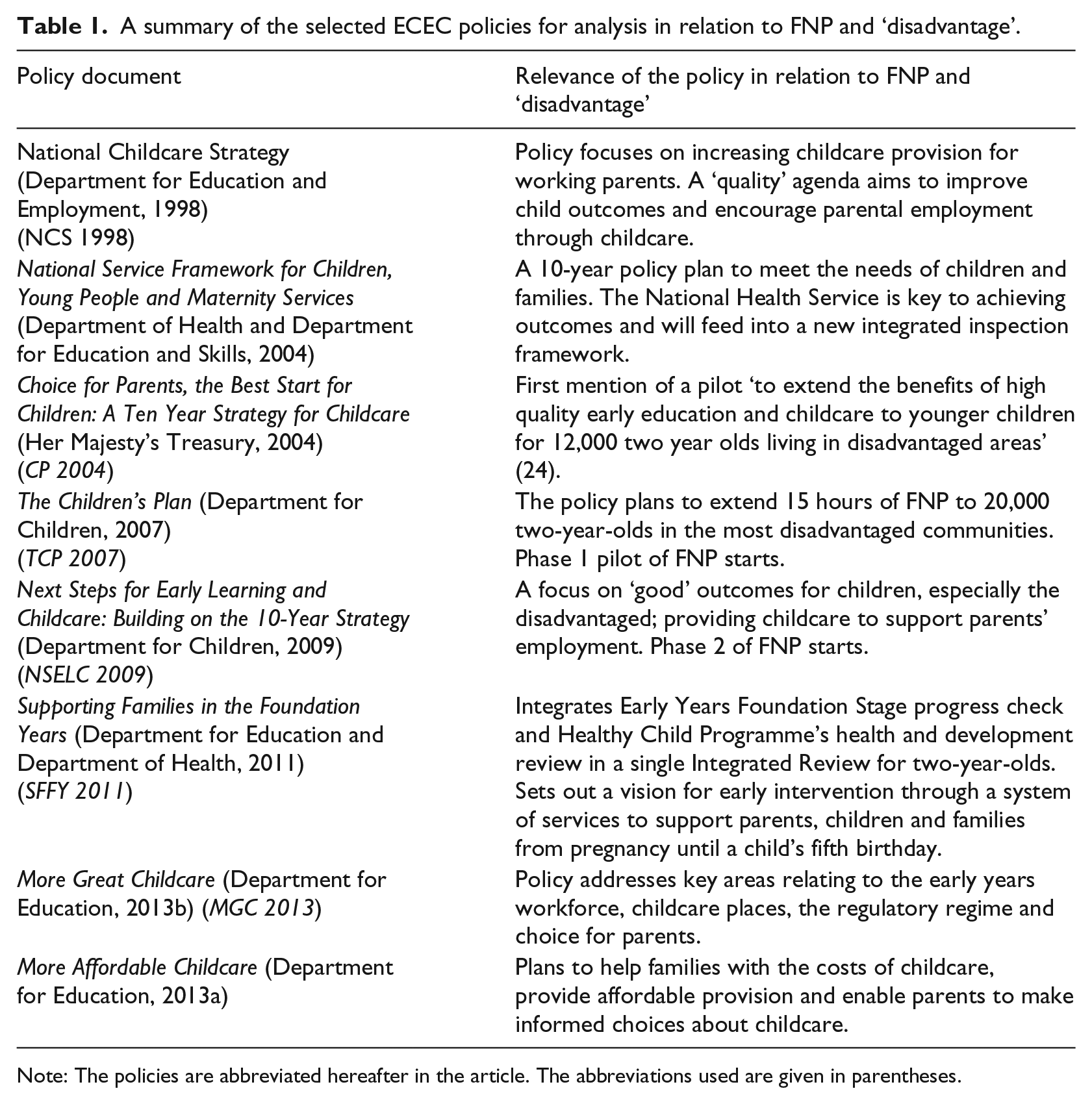
Note: The policies are abbreviated hereafter in the article. The abbreviations used are given in parentheses.
In what follows, I provide a brief outline of FNP roll-out in England. FNP were first introduced as a pilot ‘to extend the benefits of high quality early education and childcare . . . for 12,000 two year olds living in disadvantaged areas’ (Her Majesty’s Treasury, 2004: 24). In 2006, 32 local authorities offered 13,500 places from 7.5 to 12.5 hours per week for 38 weeks. A wide range of different types of families was targeted, and each local authority could choose how it implemented the scheme. After the initial roll-out, an additional 32 local authorities were funded in 2008, increasing provision to 15 hours per week (Department for Children, 2009). Later, as part of the Coalition’s Fairness Premium (2010), 20% of the ‘most disadvantaged’ children (130,000 places) became eligible for 15 hours per week for 38 weeks from September 2013, increasing to 40% from September 2014 onwards (Department for Education, 2013a). The eligibility criteria are largely means-tested based on income and Department for Work and Pensions benefits. Thus, the benefits-based criteria constitute a new objectivity that is productive of new economic norms in the classification of ‘disadvantage’. In the case of FNP, a particular ‘disadvantage’ is framed within a series of economic and social problems that are concerned with poverty, such as unemployment, housing and public health issues. To this end, the next section discusses the ways in which policy technologies spatialize ‘disadvantage’ as an economic and political space. In doing so, these techniques construct ‘disadvantage’ as a ‘problem of the population’ (Foucault, 2009).
‘Disadvantage’ as a ‘problem of the population’
In 1999, then British New Labour prime minister Tony Blair committed to eradicating child poverty within 20 years and identified social exclusion ‘as something that is transmitted inter-generationally’ (Clarke, 2006: 700). The rhetoric of investing ‘in our children’ was linked to breaking the cycle of disadvantage so that ‘children born into poverty are not condemned to social exclusion and deprivation’ (Blair, 1999: 16). Plans to pilot FNP were initially announced in CP 2004. ECEC is increasingly viewed as a site for future capital, educational outcomes and employability, and for preventing or ameliorating economic, social and health ills among children, families and communities. CP 2004 reinforces an official view of ECEC, especially for children under three, as ‘childcare’ and pledges support for a childcare system where: • parents are better supported in the choices they make about their work and family responsibilities; • childcare is available to all families and is flexible to meet their circumstances; • childcare services are among the best quality in the world; and • all families are able to afford high quality childcare services that are appropriate for their needs. It is against these objectives of choice, availability, quality and affordability that the Government’s vision is framed. Availability of childcare plays an important role in tackling disadvantage and child poverty. (Her Majesty’s Treasury, 2004: 4)
A hegemonic rationality of ‘choice, availability, quality and affordability’ defines a particular system of childcare which is directed towards parental employment and ‘tackling disadvantage and child poverty’. Indeed, a hegemonic rationality ‘cannot imagine any other way to justify and evaluate preschools’ (Dahlberg and Moss, 2005: 6). The term ‘disadvantage’ predicates the idea that economically poor children are disadvantaged by their backgrounds – what Field (2010: 22) calls ‘class-based differences’. In this sense, the idea behind FNP is to prepare two-year-olds for nursery when they turn three. This move institutes a form of nursery readiness, which includes self-care and a list of ‘essential skills’. By emphasizing the ‘benefits’ of preschool education for children, CP 2004 takes into account earlier criticisms (Ward, 2004) that New Labour’s plans, as laid out in NCS 1998, were directed primarily at adult workers rather than children, where supporting parental employment was a key political agenda. CP 2004 signals another phase in New Labour’s political agenda for ECEC policy by making ‘a particular case for subsidising childcare costs of parents with low earnings [in order to] support parents’ links with the labour market as well as directly improving disadvantaged children’s outcomes’ – in particular, ‘parents with low earning power’ and ‘mothers returning to the workplace’ (Her Majesty’s Treasury, 2004: 10). New Labour moved to both increase parental choice and, if sometimes reluctantly, more closely regulate it (Ball, 2013: 150). As the question of expansion was urgent, New Labour pursued a market approach by opening the field to all providers which met certain standards, such as school-based provision in nursery classes, day nurseries, playgroups and childminders (Moss, 2014a: 348). Clearly, ECEC is assembled as components within a managed market – as the state’s assemblage of social and economico-political tools in tackling predefined outcomes that are framed as ‘important economic benefits’ to ‘break the cycle of disadvantage . . . improve children’s educational outcomes . . . support parental employment’ and, in so doing, ‘increase the productive capacity of the nation’ (Her Majesty’s Treasury, 2004: 5–6).
However, for a particular neo-liberal assemblage to work, the state needs active, self-managing economic subjects who can conduct their selves in a process of ‘governing without governing’ (Rose, 1993: 298). Olssen argues that the process requires the economization of social values and relationships within a ‘grid of homo economicus’ (Foucault, 2010), and the intensification of human capital theories: The state will see to it that each one of us makes a ‘continual enterprise of ourselves’ (Gordon, 1991) in what seems to be a process of ‘governing without governing’ (Rose, 1993). The state seeks to assure then the conditions for . . . modern ‘new right’ theories such as ‘Human Capital Theory’. (Olssen, 1996: 340)
That is to say, a particular type of childcare is required to be organized in terms of economic and political objectives in order to function in a neo-liberal assemblage. It is to be a new human capital technology which is productive of perpetually self-governing subjects. Within this context, childcare has moved up the policy agenda as the neo-liberal answer to ‘tackling disadvantage and child poverty, and supporting social mobility and equality of opportunity’, in particular for ‘the poorest and most disadvantaged children and families’ (Her Majesty’s Treasury, 2004: 4–5). ‘Parental employment is the key route out of poverty and disadvantage. Growing up in a workless household and/or in poverty can have a significant negative effect on a child’s development’ (Her Majesty’s Treasury, 2004: 68). By targeting unemployment as a ‘problem of the population’, policy technologies produce regimes of truth which form particular social and political reality in order to essentialize intervention – for example, children growing up in a ‘workless household and/or poverty’ necessitate government intervention. I now turn to how these processes of ‘disadvantage’ relate to notions of ‘readiness’ and ‘normality’ in relation to the construction of ‘disadvantaged’ two-year-olds through SFFY 2011, a policy which integrates education and health services for early intervention from pregnancy until a child’s fifth birthday.
A technology of normality and early intervention
In 2011, the Department for Education and Department of Health jointly published SFFY 2011, which regards families as ‘the most important influence in the early years’ (4). Child development and neuroscience are linked to ‘school readiness’ and ‘children’s life chances’, whereby children ‘should be ready to take full advantage of the next stage of learning’ by age five, and have ‘laid down foundations for good health in adult life’ (4). Notions of normality, which dominate ECEC policies, involve ‘a valuation of scientific truth and expert authority’ in relation to what is desirable or the outcomes to be achieved (Rose, 1999a: 133). Thus, normality implies that deviations from ‘those norms could, in some circumstances, be returned to them’ (Rose, 1999a: 76). It is argued that power–knowledge relations which permit such statements to emerge and be legitimated as truth rest on the notion that, in order to function in neo-liberal society – that is, to be governable – a child must be normalized. On this account, SFFY 2011 deploys government-commissioned reviews – the Marmot review (Marmot et al., 2010), Field (2010) review, Allen (2011a, 2011b) report, Munro (2011) review and Tickell (2011) review – to endorse processes in making ‘life’ thinkable and knowable, and to ‘strengthen the arguments for investment and reform in the foundation years’ (Department for Education and Department of Health, 2011: 11). Young children are rendered amenable to particular, multiple and, in some cases, different forms of intervention. As a provision for childcare, FNP entail more than setting up nurseries, a curriculum, a workforce and resources. They require a technological inculcation of a form of life that requires assembling together ‘types of knowledge, forces, capacities, skills, dispositions and types of judgement’ (Rose, 1999b: 52) for children and adults. The various government reviews above present new possibilities for knowledges about the family and the child to be joined up and assembled in a process of co-production and information-sharing with parents, professionals and experts in early education and health. These discursive mechanisms make it possible to imagine FNP as governable spaces in which they make ‘new kinds of experience possible, produce new modes of perception’ (Rose, 1999b: 32). In the next section, I discuss integrating technology as part of discursive mechanisms that manage and govern individuals in creating possibilities for early intervention.
Integrating technology in making ‘abilities-machines’
The Integrated Review for two-year-olds is an education and health assessment which combines the Early Years Foundation Stage progress check at age two and the Department of Health’s health and development review into a single review. It aims to bring together different expertise and knowledge in education and health for the government’s vision of early intervention (Department for Education and Department of Health, 2011). Settings are required to prepare a statutory Early Years Foundation Stage progress check at age two as a checkpoint of ‘essential baseline skills’ for parents on whether their child is on track to master school readiness before formal school. The skills were initially outlined in the Field review as: to sit still and listen; to be aware of other children; to understand the word no, and the borders it sets for behaviour, and to understand the word stop . . . to be potty trained and able to go to the loo; to recognise their own name; to speak to an adult to ask for needs; to be able to take off their coat and tie up laces; to talk in sentences; and, to open and enjoy a book. (Field, 2010: 22)
Power–knowledge networks between the home, education and health are thus integrated and strengthened through the relations invested in FNP. The government regards FNP as ‘an important stepping stone for families’ – as a first contact with nurseries and then engaging with parents ‘in their child’s experience and helping them understand how they can support their children’s learning and development’ (Department for Education and Department of Health, 2011: 29). As a site for integrating technologies between the home, education and health, the question to ask is: What does policy make of ‘disadvantaged’ two-year-olds? When framed in economic and political terms as human capital investment, the question becomes: What constitutes capital investment that forms an ‘abilities-machine’ within a neo-liberal society? Foucault (2010: 244) suggests that ‘everything . . . can be analysed in terms of investment, capital costs, and profit . . . on the capital invested’. Thus, the assemblage of educational investment is broader than ‘simple schooling or professional training’; it comprises ‘the set of cultural stimuli received by the child’ that contributes to the making of human capital, which includes the parents’ own human capital and the home learning environment (Foucault, 2010: 229). Paradoxically, it seems that the wider the scope of educational investment, the narrower the possibilities for imagining early years for young children. The two-year-old’s life is institutionalized within an enterprise society, down to the fine grain of its (enterprising) texture, made up of a network of relationships with the child’s parents, family, peers, household and multiple institutions. New norms for the disadvantaged child optimize an ‘abilities-machine’ that produces returns on educational investments. The child is invested as a part of society’s grid of human capital – a techno-capital machine ready for ‘homo economicus as entrepreneur of himself, being for himself his own capital . . . his own producer’ (Foucault, 2010: 226).
The assemblage of FNP productively renders the family visible as a field of action. Family members include ‘mothers and fathers . . . grandparents and the wider family make a vital contribution too’ (Department for Education and Department of Health, 2011: 35). The family is thus strategic to the development of the child, utilized as environmental ‘interactions’ to be ‘structured, organised, and managed to produce the optimal outcome’ (Rose, 1999a: 203) in realizing the child’s ‘full potential’. Parental support is offered in the form of pedagogical programmes, which, in turn, regulate the relationships of both parents and children, and surveil the conduct, relations and communication of parents and children: evidence-based parenting programmes (which include such elements as relationship support, co-parenting, child development and advice on how to support their children’s learning with simple activities in the home) . . . helping them to support their children’s good behaviour and communication skills, and to prevent problems developing later on. (Department for Education and Department of Health, 2011: 42)
Pedagogical tasks are merged, managed and evaluated with parental household duties in new parenting and home environment norms. Parents might want to be seen as ‘good’ parents; in this case, they actively bind themselves to a subjective form of power constituted as the ‘best judges for their family’ and the ‘best decision makers’ (Her Majesty’s Treasury, 2004: 7). However, at the same time, these parents submit their selves as governable subjects in the sense of being subjected to power. The remaining sections of this article focus on FNP as productive of truth-generators in relation to the work of ‘experts of truth’, evidence-based policy, the discourse of ‘quality’ and neurobiology knowledge.
‘Experts of truth’
Rose’s (1999b: 30) notion of ‘experts of truth’ draws attention to the ways in which new forms of subjectivities are produced through the exercise of government which depends on experts’ notions of ‘normality and pathology, danger and risk, social order and social control’. These techniques of authority (truth) can be observed in different ways. For example, in TCP 2007, it is indeed striking that the words ‘experts’ and ‘expertise’ are mentioned 70 times in the 169-page document in referencing ‘expert groups’, ‘expert parenting advisors’, ‘policy experts’, ‘subject expertise’, ‘sharing of expertise’ and ‘expertise of our national panels’: Our expert groups told us that the best way to achieve world class standards is a system in which all children receive teaching tailored to their needs and which is based on their ‘stage not age’. (Department for Children, 2007: 53) As our experts highlighted, the curriculum should help children move seamlessly from nurseries to schools, from primary to secondary and then to work or further and higher education. (54)
However, it is unclear what the specifics of focus or function of expertise are about; instead, the language is descriptive and aspirational, utilizing values such as ‘high quality early years education’ (8), ‘world class standards’ and ‘all children receive teaching tailored to their needs’. Parents are enlisted to do ‘the best for their child’ (6). The policy plans to provide ‘two expert parenting advisers in every local authority; and put parents’ views at the heart of government by creating a new Parents Panel to advise us on policies affecting parents’ (17). Significantly, parents and the home environment are integrated as new possibilities for sites of pedagogical norms and surveillance in relation to the norms of responsibility to one’s child.
Evidence-based policy
As part of New Labour’s modernizing agenda, evidence-based policy was seen as central to the ‘what works’ approach. CP 2004, TCP 2007 and NSELC 2009 draw extensively on research from the UK and the USA as evidence to support investment in ECEC services. For example, a key source for the impact of preschool provision on child development is the Effective Provision of Pre-School Education (EPPE) project (Sylva et al., 2010), with its extensive influence on particular regimes of quality, measurement and effectiveness in relation to ‘high-quality’ settings, the home learning environment and pedagogical practices. Early parenting is considered an ‘important predictor’ of children’s cognitive and social/behavioural development at age 11, and therefore flagged as significant to young children’s outcomes (Sylva et al., 2010): ‘Evidence from long-term studies in the US and UK shows that in the early years the quality of early learning and childcare is second only to parenting in determining children’s outcomes’ (Department for Children, 2009: 39). Ages seem particularly crucial, even for very young children, for precise technical application. NSELC 2009 cites EPPE in supporting preschool for children between two and two and a half, but not before the age of two: access to formal care before the age of three is beneficial. The benefits to cognitive outcomes are greater for children starting in pre-school between two and two and a half, compared with over three year olds but the research finds no additional benefits to starting before age two. (Department for Children, 2009: 71)
CP 2004 stresses the importance of ‘high quality childcare’ in supporting disadvantaged children from the age of two, citing Early Head Start from the USA as evidence: [The] Early Head Start programme from the USA, which targets young disadvantaged children, found significant positive effects of high quality childcare for both child development and parental wellbeing. EPPE also shows the relative gain for disadvantaged children is greater as they are starting from a lower base. (Her Majesty’s Treasury, 2004: 8)
However, Penn et al. (2006) are highly critical of the wide assumptions (based on the US evidence) disseminated by UK politicians, policymakers and early childhood activists that early childhood interventions are effective and bring returns in the order of seven dollars saved for every one dollar spent. They argue for the reading of ‘the specific population in these studies’ in terms of policy transference: In view of their overwhelming focus on crime reduction, and their problematic targeting of African-American communities . . . their outcomes do not reveal very much about the processes involved, and their contexts are not generalisable. These studies are of relatively little use in policymaking outside the US. (Penn et al., 2006: 30)
In this regard, technical processes in early intervention offer prefabricated solutions that are atemporal and stripped of local knowledge and geographical context. Instead, Moss (2014b: 28) argues that US studies (and similarly EPPE studies) require careful contextualizing and interpreting, rather than being uncritically championed as the ‘bearers of universal and timeless truths’.
The regime of ‘quality’
‘Quality’ is the most over-used and under-conceptualised of words in early childhood education, sprinkled liberally and indiscriminately throughout policy papers, journal and magazine articles and conference presentations, often to the extent of seeming meaningless. (Moss, 2014b: 22)
The term ‘quality’ is used extensively in 264 instances throughout the 83-page CP 2004. It is interesting to trace how the language of ‘quality’ has evolved since the introduction of the NCS 1998, which reflects ‘intuitive practice’ (Claxton, 2000) and ‘emotional labour’ (Osgood, 2012) in relation to standardized technical applications for effecting predetermined outcomes: ‘Good quality care isn’t merely about caring for children, but about introducing them to the joys of imaginative play, a love of books and a diverse and exciting range of sporting activities’ (Department for Education and Employment, 1998: 4). The NCS 1998 highlights ‘variable quality’ as requiring urgent address: ‘There is no definition of standards for good quality childcare which is recognised and applied across all childcare settings. There are gaps and inconsistencies in the system of regulation’ (5). At present, MGC 2013 champions the role of Ofsted (the Office for Standards in Education, Children’s Services and Skills) as the sole arbiter of quality (Department for Education, 2013b; DfE 2013b). Ofsted asserts that the rising quality in ECEC provision is due to its increasingly rigorous inspection and regulation regime; by August 2017, 94% of providers on the ECEC register were ‘good’ or ‘outstanding’, which was the highest proportion since the register was established in 2008 (Ofsted, 2017). In a Foucauldian sense, policy technologies construct and assemble a particular regime of ‘quality’ in order to discipline and normalize ‘disadvantaged’ provision; as CP 2004 suggests: ‘high quality group early years settings from the age of two can help children from disadvantaged backgrounds make up ground with their peers’ (Her Majesty’s Treasury, 2004: 8). ‘Quality’ imposes homogeneity in provision and practice in order to produce particular predetermined outcomes. At the same time, it demands individualized assessments for every child to measure their gaps and to determine specific interventions. Thus, regimes of technical ‘quality’ in ECEC mean that discipline is no longer simply ‘an art of distributing bodies . . . but of composting forces in order to obtain an efficient machine’ (Foucault, 1991: 164). This is a new mechanical demand that disciplines the two-year-old FNP child into becoming an ‘abilities-machine’ (Foucault, 2010).
Neurobiology and parenting
As funding for children’s services was steadily reduced (Bate and Foster, 2017), the Coalition government drew on neuroscience to justify a concomitant narrowing down of support and intensification of particular interventions, as Gillies et al. argue: Efforts to regulate the minds and brains of children became more assertive and explicitly targeted on disadvantaged mothers of under-2-year-olds . . . early intervention was firmly directed at those viewed as most likely to raise problem children. (Gillies et al., 2017: 35)
Through claims of evidential knowledge informed by ‘new brain research’, NSELC 2009 promotes early brain development as a foundation for a child’s ‘future learning, behaviour and health’, ‘school readiness’ and successful ‘long-term achievement’: A child’s early experiences will determine whether their developing brain provides a strong or a weak foundation for all future learning, behaviour and health. Early development of cognitive, social and physical abilities not only affects their school readiness, but also has the potential to affect their long-term achievement, through their school lives and into adulthood. (Department for Children, 2009: 70)
Through linking brain development to early care and future outcomes, brain science is thus requisitioned as a strategy to exploit policy-created possibilities. This has particular significance for the government’s role in securing what Facer (2011: 103) calls ‘future proofing’. Parenting is portrayed as holding the key to a child’s future outcomes and, crucially, parenting styles decide if a child lives a life of ‘great opportunity’ or ‘great vulnerability’: The importance of early years for brain development and setting off on the right path to lead to successful future outcomes means that this period of a child’s life can be one of great opportunity, or of great vulnerability. For example, harsh parenting styles and low levels of stimulation are strongly associated with negative outcomes later in life, and neglect in early childhood can alter the physical and functional development of the brain. (Department for Children, 2009: 70) New research into brain development, attachment and the impact of stress in pregnancy confirms our view that pregnancy and the first years of life are the most important formative stage. Good health in this stage and services that work with parents, are critically important. (Department for Children, 2007: 31)
Informed by neuroscience, the need to intervene is now understood to mean from pregnancy. As Gillies et al. note: New Labour laid the groundwork for this neurobiologized approach through their construction of parenting as a pressing problem. With disadvantaged parents already marked out as failing their children it was a short step towards viewing this in terms of biological inferiority. (Gillies et al., 2017: 48)
Webs of representation (words, images, texts, tables, inscriptions, etc.) constitute a particular body of knowledge – for example, the front cover of the Allen (2011a) report utilizes images of ‘brain neglect’, the ‘normal brain’ and gold ingots. As Gillies et al. (2017: 57) argue: ‘The iconic image of the “loved brain” next to the “neglected brain” that introduced this [report] is one of the most powerful representations of the pre-frontal cortex “black hole” claim’. Lowe et al. (2015: 208) argue that the idea of children as just the outcome of parental actions is overly deterministic: ‘the parenting/brain nexus . . . suggests that disadvantaged children need better trained parents rather than services’, in view of extreme cuts in welfare, health and education. The development of ‘neurocultural’ discourse is increasingly focused on brains and parenting skills, and decontextualized rather than being concerned with children’s embodied everyday complex experiences and the people in their lives.
Conclusion
Using a policy genealogy to target ‘disadvantage’ as a ‘problem of the population’, this article has traced how FNP set in place ‘readiness’ technologies which see disadvantaged two-year-olds as ‘abilities-machines’ (Foucault, 2010). When viewed in the wider context, ECEC policies are increasingly deployed to solve social and economic problems through early intervention (Moss, 2014b; Penn, 2017). These processes are driven by an increasingly economistic ‘hegemonic globalisation’ in human capital (Campbell-Barr and Nygård, 2014), which inscribes instrumental and technical practice to achieve predetermined and standardized outcomes (Moss, 2014b). Here, the construct of disadvantage is closely linked with ‘readiness’ technologies in the increased formalization of early years experiences for younger children, specifically for ‘disadvantaged’ two-year-olds. Through ‘experts of truth’, evidence-based policy, regimes of quality and neurobiology, FNP offer a one-size-fits-all formal provision which is dislocated from local contexts. What matters in neo-liberal discourse is a ‘readiness’ to prepare for the next phase of nursery education at age three – that is to say, rather than FNP as a universal and child-based right independent of parental employment, a means-tested provision is likely to be more effective and efficient in bringing ‘disadvantaged’ subjects into a regime of readiness underpinned in economic and political terms. Education and health assessments bind children, parents and practitioners within an integrated grid of power–knowledge that drives particular processes in making ‘life’ thinkable and knowable. Within this context, ECEC has moved up the policy agenda as the neo-liberal answer to ‘tackling disadvantage and child poverty, and supporting social mobility’ (Her Majesty’s Treasury, 2004: 4). This article argues that early experiences need to engage with children’s everyday realities, in particular for the under threes and their families. There is little known about how FNP and their readiness pedagogy impact on ‘disadvantaged’ two-year-olds and their families. Thus, I would argue that the wider concerns and dominance of school-readiness debates must include and understand the extent to which ‘readiness’ is reaching into and governing ever younger spaces. Otherwise, we risk subsuming the experiences of ‘disadvantaged’ younger children.
Footnotes
Funding
The author received no financial support for the research, authorship and/or publication of this article.
