




Abstract
School leadership plays a critical role in providing appropriate and sustainable curriculum practices. However, there remain significant knowledge gaps in understanding early childhood curriculum leadership in Chinese contexts. In order to examine early childhood curriculum leadership in such contexts, this study analyses and interprets data from interviews with leaders in five Chinese kindergartens. Data from classroom observations and curriculum documents are used to supplement the interviews. The evidence indicates that, in each of the Chinese kindergartens, (1) early childhood curriculum innovations led by the curriculum leaders evolved through stages from imitating imported models to innovating practices; (2) the leaders played various roles in different stages of the early childhood curriculum innovations; and (3) the leading process in early childhood curriculum innovations involved critical events along the action research cycles. The characteristics of early childhood curriculum leadership are drawn from these cases to develop a multistage integrated model. Finally, the implications of the findings are discussed to inform the enhancement of early childhood curriculum and early childhood curriculum leadership practices in Chinese societies and beyond.
Keywords
Early childhood leadership is receiving increasing attention within the worldwide discourse and praxis of accountability and quality improvement in early childhood education (Rodd, 2006; Sims et al., 2015). Successful leadership is deemed a pivotal factor that helps to create an environment in which teachers can be professionally supported, and this in turn leads to school-based professional development, improved curriculum practices and optimal child learning experiences (Huber and Muijs, 2010; Kangas et al., 2016). Although it is commonly agreed that leadership is the key to accountable and quality service delivery in early childhood settings (Hadfield et al., 2012), exploring the elements of successful early childhood leadership remains a worthwhile research pursuit. It is worth noting that the quality of early childhood education is multifaceted and inevitably depends on culture and context. As Ebbeck (2002: 3) reminds us, ‘it is essential that cultural realities be taken into any consideration of quality when it comes to human services’. In other words, regarding high-quality early childhood education as optimal for child development is a valid perspective, but not the only perspective, as views on child development and the quality of education are culturally specific (Ebbeck, 2002). Therefore, this study endeavours to investigate early childhood leadership in Chinese kindergartens with a focus on curriculum change, as curriculum is the core of early childhood education and successful leadership. Specifically, it explores early childhood curriculum leadership which aims to promote context-dependent, school-based curriculum innovation that meets local needs (Male and Palaiologou, 2015; Yang, 2018).
Leadership matters in early childhood
Leadership normally refers to the use of power in human communication within the structure of an organisation (Cardno, 2006; Hackman and Johnson, 2013). Leadership is about change and the changing process if its influence is being taken into consideration (Rodd, 2013), and it is always involved in planning and implementing change in early childhood settings (Davis, 2012). Coleman et al. (2016) have identified three common challenges faced by leaders of high-performing early childhood centres, including dealing with change, ensuring positive outcomes for children, and promoting the visibility and value of leadership. In order to address these challenges, leaders were found to perform eight core behaviours: (1) embracing a clear vision to promote the development of children and support their families; (2) engaging with families; (3) driving improvement based on evidence; (4) performing strategic business skills; (5) facilitating open communication; (6) encouraging integrated working; (7) motivating and empowering colleagues; and (8) pursuing lifelong learning (Coleman et al., 2016). These behaviours are in accordance with the categories of effective leadership practices identified by Siraj-Blatchford and Manni (2007). The journey of leading change in early childhood settings has been further presented in a model with two dimensions: (1) leaders’ behaviours and attitudes – being cooperative, supportive, culturally sensitive and reflective, as well as valuing staff – and (2) leaders’ tasks – situational analysis, self-identification of leadership and management roles, and the endeavours for planning and implementing change through stages (Davis, 2012). A national survey conducted in the USA has demonstrated five competency areas that are considered important for successful early childhood leadership, including professional learning, effective relationships, shared responsibility, data use and effective communication (Bruns et al., 2017). Chan (2018) also found that systems thinking, reflective thinking, flexible thinking, network-building, continuous professional development and the development of contextual intelligence are important components in successful early childhood leadership in Hong Kong kindergartens. However, the emphasis of tasks and core abilities in the early childhood leadership model tends to be static instead of dynamic, and may fail to reflect the contextual complexity of early childhood leadership in reality.
Kagan and Hallmark (2001) identified aspects of early childhood leadership and suggested a different construct – a kind of shared or joint leadership to enhance collaboration and collective success. This construct aligns with the global trend of advocating ‘distributed leadership’ (Ebbeck and Waniganayake, 2003), which aims to mentor and model the interactions between levels and stakeholders (Heikka, 2014; Sims et al., 2015). This construct also perceives effective leadership as decentralised and socially constructed, instead of top-down (Sims et al., 2015). The sharing of power among stakeholders is assumed to promote active participation in decision-making and quality improvement (Ho, 2012). However, although being widely advocated, distributed leadership is questioned as being inefficient when stakeholders’ ongoing reflection and discussion disappear (Grint, 2005), and when there are conflicts between social involvement in decision-making and traditional hierarchical cultures (Ho, 2012).
Research has demonstrated that the influence of key individuals matters in the real situation of leadership (Gronn, 2008; Ho, 2011). For example, Ho (2011) found that the principals in two Hong Kong preschools would act as role models, school managers and mentors for curriculum and pedagogy, while other stakeholders – such as teachers, support staff and parents – tended to follow the principal’s guidance. In order to better understand ‘how leaders recognise and contextualise their actions as a result of highly complex and dynamic work practices’ (Bøe and Hognestad, 2017: 133), the concept of hybrid leadership, composed of both positional (solo) and distributed (shared) leadership, has been proposed and used to examine pedagogical leadership in early childhood education (Bøe and Hognestad, 2017; Gronn, 2008). Hybrid leadership reframes a leader’s roles to practice both expert authority and power-sharing (Bøe and Hognestad, 2017). Ho (2012) found that the marketisation of early childhood education in Hong Kong had shaped the performance of early childhood leadership to be centralised, while government policy (e.g. performance indicators) had been encouraging the distribution of power between leaders and teachers. Different motives and demands might have led to a hybrid status regarding the performance of early childhood leadership in Hong Kong. In order to better explore the contextual influences on early childhood leadership, there is an urgent need for methodological advancements to facilitate in-depth analysis and interpretation. It is worth noting that Nuttall et al. (2018) have used the concept of ‘double stimulation’, extracted from Vygotskian-inspired theories such as the expansive learning theory (Engeström, 2001; Engeström and Sannino, 2010), to assist the process of system-level development (i.e. a collective zone of proximal development) by resolving problems through the development of new practices in the early childhood leadership context. More studies of this kind, examining contradictions and their resolution in diverse contexts, are important for shedding light on the complex, dynamic nature of early childhood leadership practice.
Although leadership is crucial to service delivery in early childhood settings, to date there have been surprisingly few studies on early childhood leadership in Chinese societies. Little is known about how leadership is performed in Chinese kindergartens and whether there is a trend of curriculum decision-making through a distributed or hybrid leadership style in Chinese contexts. Given the importance of contextual influences on leadership, it is significant to explore how leadership is enacted in diverse contexts to facilitate international dialogue on the essential elements of early childhood leadership and their influence across contexts (Sims et al., 2018). In order to address the knowledge gap, this study examines early childhood leaders’ perceptions of curriculum leadership in Chinese contexts.
Curriculum leadership
Curriculum leadership, which is closely linked to the concept of pedagogical leadership, describes leadership that influences the core tasks in schools – teaching and learning (Cardno, 2006). Kagan and Bowman (1997) highlighted pedagogical leadership as being one of five styles of early childhood leadership. Kagan and her colleagues regarded pedagogical leadership as a way to reflect on problems in practice to shape classroom inquiry so that educators could improve what and how to teach young children (Kagan and Bowman, 1997; Kagan and Hallmark, 2001). Although similar to the concept of pedagogical leadership, this study further conceptualises ‘curriculum leadership’ as an integrated concept to include the other four types of leadership as proposed by Kagan and Bowman (1997): namely, community leadership (considering the needs of particular communities), administrative leadership (requiring organisational and communication skills), advocacy leadership (building on a vision and long-term plan) and conceptual leadership (aiming to renovate or reform within broader social change). This conceptualisation of curriculum leadership is retained to emphasise pedagogical leadership as the core leadership responsibility, and further points out an effective and inclusive solution to the traditionally isolated and deficient understanding of early childhood leadership. An inclusive concept of curriculum leadership would matter in both children’s and teachers’ learning and development (Heikka, 2014), and support early childhood curriculum reforms.
Curriculum leadership incorporates curriculum management to encompass the planning, monitoring, review and development of an educational programme, as well as the enhancement of the school culture and resource allocation (Lee and Dimmock, 1999). In examining the curriculum leadership in two Hong Kong secondary schools, Lee and Dimmock (1999: 466) interpreted a school leader’s roles as ‘figurehead, group leader, liaison, information provider, spokesperson, innovator, resource winner, resource allocator, disturbance handler, negotiator, appraiser, staff development facilitator and curriculum manager’. With regard to the early childhood sector, Rodd (2013) described a leader as a supervisor, mentor, coach and deputy, although little empirical evidence is given to support these descriptions. In addition, she also asserted that early childhood leaders tended to have special duties, such as encouraging action research to enhance quality practices, engaging families and communities in partnership, protecting and promoting children’s rights, and planning for leadership succession (Rodd, 2013). Kangas et al. (2016) found that, in Finnish early childhood settings, different agents work together to enhance ongoing reflective interaction, daily pedagogical practices and the administrative culture. Radical innovations had been replaced by a step-by-step process which could better respect each participant’s voice. Based on the extant literature on curriculum leadership, this study has gone further by conducting an empirical examination of early childhood curriculum leadership in Chinese contexts, thus revealing its developmental stages and perceived roles.
Context of the study
Most kindergartens in Hong Kong and mainland China provide early childhood education services for children aged three to six. Although Hong Kong and mainland China have separate early childhood education systems under the political umbrella of ‘One County, Two Systems’, they are closely related in terms of their shared Chinese culture and early childhood curriculum reforms (Li and Wang, 2017; Li et al., 2016; Yang et al., 2017). In this study, Hong Kong is regarded as part of China and a city that is highly comparable to its neighbour Shenzhen, a coastal city in mainland China.
Kindergartens in both Hong Kong and mainland China have been greatly influenced by the progressive philosophy of education originating from Euro-American societies since the 1980s (Yang and Li, 2018a). Child-centredness has been advocated in Hong Kong’s official kindergarten curriculum guide since 1996 when its first version was published (Education Bureau, 2018). Likewise, educational authorities in mainland China have launched progressive early childhood curriculum reforms since 1989 when the document Regulations on kindergarten education practice was issued by the National Education Committee (the former Ministry of Education; Li and Chen, 2017). Ideas such as play-based learning, individualised learning and an integrated curriculum have been promoted in the reforms, while many curriculum models and approaches – such as Reggio Emilia, the Project Approach and the HighScope curriculum – have been imported from Euro-American countries (Li and Chen, 2017). In this study of early childhood curriculum transformation in Hong Kong and mainland China, kindergarten principals’ early childhood leadership has played a key role in putting new ideas and models into practice at the school level.
Early childhood curriculum leadership can be better understood against the background of a school-based curriculum development initiative. School-based curriculum development has been advocated as a decentralisation and empowerment movement of early childhood curriculum decision-making in many Chinese societies (including Hong Kong and mainland China) since the turn of the millennium (Gopinathan and Deng, 2006; Li, 2005, 2006). However, because of the lack of effective guidance and support, most Chinese early childhood educators have to ‘ride a blind horse’ during school-based curriculum development (Yang and Li, 2018a, 2018b). Therefore, school leadership plays a critical role in providing appropriate and sustainable curriculum practices to enable policy implementation. Despite this, there are significant knowledge gaps in terms of early childhood curriculum leadership in Chinese contexts, although considerable curriculum innovations in Chinese kindergartens have been examined by recent studies (e.g. Yang and Li, 2018a, 2018b). It is true that most Chinese early childhood leaders learn to lead by themselves, with little or no mentoring support. Scant knowledge about early childhood leadership has been available in Chinese societies because of the lack of research. Chinese leaders have had to cope very much on their own with the great challenges of early childhood curriculum reforms over the past decades. In order to explore the contemporary practices of early childhood curriculum leadership in Chinese contexts, this multiple case study mainly interprets data from interviews with the principals/directors of five Chinese kindergartens.
The Planning, Experimentation and Reflection model and cultural-historical activity theory
This study employs the Planning, Experimentation and Reflection model to explain the process of curriculum leadership (Law et al., 2007). According to this model, the first step is to plan and design a new set of learning activities with a supporting arrangement. Teachers try out these plans in the second step, usually with peer observations. Finally, in the third step, there is always a discussion to reflect collectively and individually on the curriculum implementation. An improvement is then achievable for the curriculum practices in the coming rounds of action (Law et al., 2007). An action-research kind of curriculum leadership has also been presented along the spiral line of curriculum renewal to achieve positive change, build a collaborative culture and satisfy diverse needs (DeMatthews, 2014). Thus, whether this model could be applicable in explaining the dynamic process and complex roles of early childhood curriculum leadership became the focus of this study.
In addition to the Planning, Experimentation and Reflection model, cultural-historical activity theory was also used to support the analysis of the dynamic and complex performance of early childhood curriculum leadership in the case studies. Cultural-historical activity theory has two major subtheories – namely, activity system analysis and expansive learning theory (Engeström, 2000, 2001). The activity system is often depicted as a triangle with seven nodes: subject, object, outcome, tools, rules, community and division of labour (Engeström, 2000). Applying the activity system model to this research, children are the objects and curriculum developers such as principals and teachers are the subjects. The object is transformed into the outcome with the help of mediating tools. According to expansive learning theory, the curriculum transforms qualitatively along spiral learning cycles (Engeström, 2001). Subjects tend to question established practices when they experience tensions in an activity system; as a result, they will adjust their motives to resolve the tensions (see the model of the expansive learning cycle in Engeström (2001) and Engeström and Sannino (2010)).
In activity system analysis and expansive learning theory, contradictions are central to the analysis and interpretation of a particular phenomenon. According to the cultural-historical activity theory framework, contradictions are ‘historically accumulating structural tensions within and between activity systems’ (Engeström, 2001: 137) and ‘the driving force of transformation’ (Engeström and Sannino, 2010: 5). In this study, great attention was paid to examining the contradictions of the motives or demands within and between the related activity systems along the cycles of expansive learning to understand early childhood curriculum leadership in Chinese contexts. Accordingly, this study aims to explore the dynamic processes and complex roles of early childhood curriculum leadership in Chinese kindergartens with the following two guiding questions:
How did Chinese early childhood leaders lead in their school-based curriculum innovations?
What were the roles and responsibilities perceived to be related to school-based curriculum leadership in Chinese early childhood settings?
Methods
This study comes from a larger research project on early childhood curriculum innovations in modern China. Two Chinese cities – Shenzhen and Hong Kong – were studied from a comparative perspective, as they have different political systems. All kindergartens in Hong Kong are privately run and most are non-profit-making kindergartens (Yang et al., 2017). As a neighbouring city of Hong Kong, Shenzhen shares the same situation, with private kindergartens being the dominant type of early childhood programmes (Yang, 2018). Within such a marketised context of early childhood education, the examination of Chinese leaders’ roles in their school-based curriculum development and school improvement processes is the focus of this article.
School and leader profiles
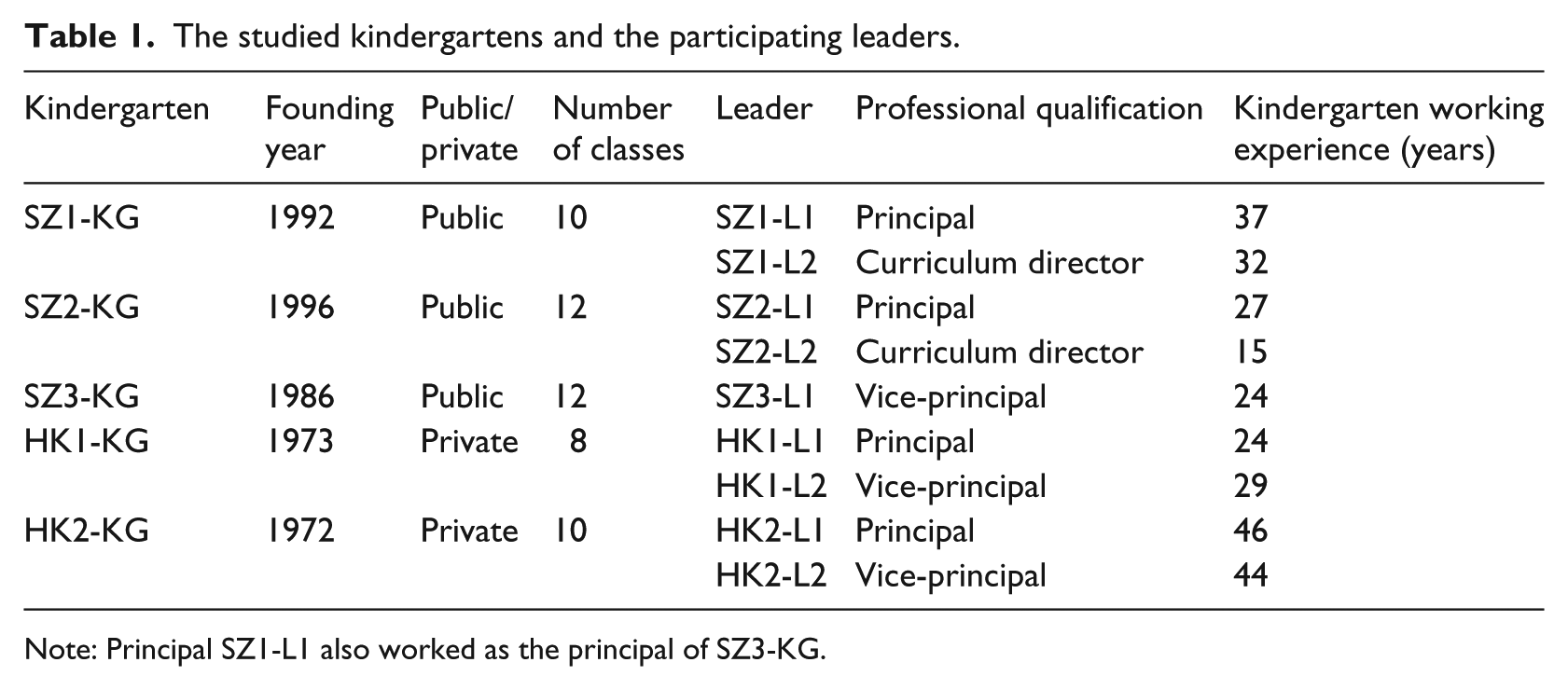
Five kindergartens were purposively selected through criteria-based sampling from a pool of Chinese kindergartens in Shenzhen and Hong Kong. The selected kindergartens were required to be (1) local and registered; (2) non-profit-making; and (3) serving children aged three to six. All five kindergartens had their own school-based curricula (for more information on the kindergartens, see Table 1). The construction and implementation of these curricula would not be possible without curriculum leadership, which is the focus of the present study.
The studied kindergartens and the participating leaders.
Note: Principal SZ1-L1 also worked as the principal of SZ3-KG.
Principals play an important role in leading high-quality curriculum innovations (DeMatthews, 2014), which is especially true in Chinese kindergartens (Ho, 2011). Accordingly, nine principals/directors from the five kindergartens in Shenzhen and Hong Kong were interviewed by the researcher after receiving their consent. All of the interviews lasted for more than 50 minutes. Table 1 also shows their professional qualifications and experience in kindergarten education.
Data collection and analysis
The ‘Policy on research integrity’ and ‘Operational guidelines and procedures of the Human Research Ethics Committee’, issued by the researcher’s university, were referred to during the data collection and analysis. The research project had been submitted to and approved by the Human Research Ethics Committee prior to the data collection.
Audiotaped interviews were used as the major approach to addressing the research questions about the functioning of curriculum leadership in the kindergartens under investigation. Specifically, individual semi-structured interviews were conducted with the assistance of a protocol that was developed in advance. The questions that were asked centred on the participating leaders’ perceptions of the early childhood curriculum, the processes of leading an early childhood curriculum with details, and their analyses or explanation of the strategies used in leading early childhood curriculum innovations. Mandarin was used during the interviews with the Shenzhen leaders, while Cantonese was used during the interviews with the Hong Kong leaders. All of the interviews were transcribed into written Chinese afterwards.
In order to analyse the interview transcripts, open coding and axial coding were used based on grounded theory (Corbin and Strauss, 2014) and the constant comparative method (Boeije, 2002; Glaser, 1965). The researcher went through all the transcripts three times in order to become fully familiar with the information reported by the leaders. Then, he tried to label the transcripts sentence by sentence using proper themes. Based on the emerging themes, he compared the narratives of those similar or related themes and combined some of them to determine the final list of themes. In order to better organise and interpret the themes, both the theoretical tools and the research questions were used as a reference in generating categories from the themes. Finally, diverse groups of themes came out from the coding and categorisation to delineate the curriculum leaders’ leading stages and roles during early childhood curriculum innovations.
In order to establish the methodological triangulation and trustworthiness (Creswell, 2014; Yin, 2013), curriculum documents and non-participant observations were also used to triangulate against the interview analyses. All available curriculum documents – such as each school’s curriculum monograph, relevant papers written and/or published by the school, school-based curriculum guides and lesson/activity plans – were collected by the researcher with the informed consent of the principals and teachers. In addition, in order to understand how the leaders’ descriptions had been implemented in practice, non-participant observations were conducted for a week in each kindergarten, with advance notification and consent from the principals and teachers. Both classroom observations and target-child observations were conducted to determine the learning environment, daily routine, materials, learning experience and more. The researcher went back to the leaders when he found new insights from the documents and observations for further illustrations.
Findings and discussion
Consistent with the Planning, Experimentation and Reflection model, the findings of this study are presented with evidence along the line of curriculum leadership and evolution from the beginning stage to the implementation stage and, finally, the reflection stage. The tensions emerging in the stages are analysed and discussed by referring to cultural-historical activity theory to describe and explain how early childhood curriculum leadership was performed throughout school-based curriculum development in the case-study kindergartens.
Beginning: need state
This study revealed that the beginning stage of early childhood curriculum leadership worked to prepare for the coming curriculum implementation. According to the interviews, the preparation included both idea renovation and curriculum planning. The trigger was the presence of ‘curriculum awareness’, as repeatedly claimed by the participating leaders.
Curriculum awareness
Curriculum awareness means that the leaders could understand the importance of curriculum to school development. This awareness would then allow for follow-up curriculum leadership and construction. Both SZ1-L1 and SZ2-L1 said that they had learned the concept of ‘curriculum’ during the late 1990s, and had recognised its importance as the whole ecosystem for young children’s learning since then. SZ3-L1 commented that SZ1-L1, who had directed their kindergarten for five years, had a very strong awareness of and clear direction for curriculum development. This awareness drove them to reform the kindergarten’s original curricular practices to align them with the new round of national early childhood curriculum reform, which advocated child-centredness and active learning. This finding is consistent with the experience shared by Glatthorn et al. (2012: 280): ‘Principals need to become aware and knowledgeable about new approaches to curriculum supervision. They have to know how to write and direct curriculum’.
Leading notions
New values were introduced with the requirement of changes. The leaders tended to be pioneers in promoting progressive notions among the teachers. Among these progressive ideas, differentiated instruction was found to be the consensus shared by the participating leaders. From the very beginning, the leaders had oriented children’s differentiated learning as the direction of curriculum development. For instance, HK1-L2 stated that the new curriculum aimed to respect and scaffold each child’s strengths and weaknesses in learning. The pace and choice of learning content could be different for each child in the new curriculum. HK2-L1 shared the same sentiment, stating: I believe every child is different. If I [as the teacher] teach them the same thing, the absorption of each child is not the same. So, we cannot require them to learn exactly the same thing with the same standards. What to learn depends on the children themselves.
The leaders described differentiated instruction as the key to children’s active learning, and the right solution to traditional pedagogical malpractices. They also tried to influence their teachers’ thinking while leading their professional growth and curriculum implementation.
Questioning, borrowing and planning
Prior to the implementation of a new curriculum, the leaders led the teachers to question their traditional practices. Consistent with expansive learning theory, questioning is the first step to allow a new learning cycle that aims for change (Engeström and Sannino, 2010). Curriculum developers including principals and teachers started to question or criticise some aspects of existing curricular practices. The same narrative was reported by all the participating leaders that there were traditional curricular and pedagogical practices in their kindergartens which created uniform learning experiences for children, without valuing children’s interests and multiple intelligences, and tended to be subject-based (i.e. fragmented in children’s learning experience) whole-class teaching with an academic focus (i.e. completely uniform academic requirements for children) in the classroom. SZ1-L1 described the situation at the time as follows: Before 2000, our kindergarten mainly used subject instruction and area activities. Subject-focused teaching split the knowledge system and failed to encourage [children’s] initiative and [teachers’] appreciation of children’s [multiple] learning styles. The area activities did not establish a reasonable system for children either.
Similarly, HK1-L1 said: ‘In the past, [thematic activity] was fragmented. Now, it is conducted using the [integrated] form of story. The past teaching was poor without a thread to link [various activities] in a series’. All of these less than satisfactory curricular practices were waiting to be improved. Solutions came from other models, naturally, when the leaders sought external assistance from curriculum experts. They tended to agree with imported western curricula such as the Montessori method, Project Approach, HighScope curriculum and Reggio Emilia approach. These curriculum systems seemed to provide an operational framework for reference. In order to achieve a curriculum upgrade and school improvement, they conducted their own curriculum planning by referring to these well-established models. HK2-KG was a typical example. According to HK2-L1 and HK2-L2, HK2-KG’s curriculum was planned to embrace a hybrid structure with diverse approaches: Spiritual education is the core of the curriculum, while thematic activity forms its overall structure. The HighScope approach ensures the breadth of the curriculum, and the emphasis on the Project Approach achieves its depth. Play is the major channel through which children learn.
Based on the overall structure, the leaders would further lead their senior teachers to design detailed learning activities. Corresponding to the approaches and activities, a system of curriculum objectives was set up to allow the follow-up delivery of curricular aims and content, with the expected outcomes being achieved.
Implementation: from imitation to innovation
Various curriculum models and approaches were simultaneously introduced by the leaders to carry out their school-based curriculum development; therefore, multiple cycles of action research and leadership were occurring to adapt the different models and approaches. Curriculum leadership throughout the implementation stage seemed more dynamic and complex because of the overlapping and blending of numerous action research cycles. However, common themes emerged from the interviews to systematically reveal the roles of curriculum leadership mainly played by the leaders.
Transplanting, tailoring and integrating
The evidence indicated that, in each of the case-study kindergartens, the school-based curriculum development led by the leaders evolved through stages, from imitating diverse models to innovating practices through localisation and harmonisation. As stated by SZ1-L1: ‘There is no development without a reference. Even creation is based on the previous innovation … This is our multi-integrated curriculum; its development is the most difficult’. Likewise, other participating leaders admitted that their curricula would be integrative after learning from and absorbing others’ models or approaches. This process was named as huicui (荟萃) in Chinese. The concept of huicui could refer to the process through which exquisite objects are gathered together for a common purpose. Linked to the Chinese philosophical idea of Zhongyong, which could be generally understood as ‘eclecticism’ (Yang and Li, 2018b), the concept of huicui is useful to further explain Chinese leaders’ motivation to get the best things from diverse curricula. As stated by SZ2-L1: I came across a lot of curriculum theories and also did the curriculum practices. Based on these [experiences], I came up with our own model … For example, the thematic inquiry we did starting in 1998 was learning from the western Reggio Emilia, HighScope and Montessori curricula. In fact, I have integrated the advantages of these curricula.
The process of huicui in curriculum leadership coincides with the findings of previous studies on school-based curriculum development in Chinese kindergartens that multiple foreign curricula tended to be tailored and adapted for local needs (e.g. Li, 2006; Yang and Li, 2018a).
Professional learning community
This study found that leaders tended to create a professional learning community composed of teachers, parents and experts to support the professional development of staff. Professional development events were highly related to curriculum implementation, including external training, research projects and the establishment of a curriculum group/team, as well as school-based experience-sharing and lesson study. Both formal and informal professional development was valued by the leaders to enhance their teachers’ professionalism during the process of curricular innovations. The importance of professional development was made clear by SZ2-L2: Teacher training is the most important. If the teacher gets less training in the aspect of teacher–child interaction, he/she will find it more difficult to see the child’s development. We encourage senior teachers to share their experience with young ones, through which those senior ones could also learn from sharing. Still, we need some experts to train [our teachers] more thoroughly because the teachers who develop to a certain level will encounter bottlenecks. Also, long-term training will be more effective than occasional training, and it’s the best if the training is relevant to our own curriculum.
SZ2-L2 actually emphasised formal and informal types of training for both junior and senior teachers to support their curriculum implementation. This sentiment is consistent with Glatthorn et al.’s argument that: If staff development has helped teachers change their perceptions of a subject, develop the materials to be used in implementing the new curriculum, and acquire the skills needed to deliver it, then it is quite likely that the written, the taught, the tested and the learned curricula will be in much closer congruence. (Glatthorn et al., 2012: 282)
Aside from professional training, the leaders paid close attention to teachers’ motivation. Teachers’ motivation was deemed to be the catalyst for curriculum success. The leaders did motivate teachers and provide them with curriculum support. This support covered the dimensions of time and space, materials, rules and interpersonal relations. This finding was confirmed by HK1-L2: We need to provide enough curriculum resources for teachers … Based on what we support, teachers can have more choices [in delivering a curriculum] … If you ask the teacher to do new practices without giving them resources, they will be very laborious.
The leaders’ role in motivating and supporting teachers seemed more typical when teachers encountered difficulties in implementing the curriculum. It was the tension between expected innovations and existing barriers that required more guidance from leaders. As described by the leaders, curriculum experts were normally invited to introduce new ideas and theoretical knowledge. Following a curriculum diagnosis, these experts might also provide possible solutions for the kindergarten. In addition, curriculum leaders would assess the gap between their staff’s professional status and the new demands, and then introduce possible training programmes.
Constructing the curriculum repository
The participating leaders mentioned the need to develop curriculum materials for their use. These materials included children’s learning materials, activity plans and teachers’ teaching materials. The evidence indicated that there were three major approaches to building up the repository of curriculum materials – namely, creation, adjustment and sharing. With regard to the creation of curriculum materials, HK2-L1 stated: We do not use toys. We only use learning instruments. All of them were developed by the teachers themselves. The teachers who created these instruments were laborious as they initially had to learn many new things. For example, in the science area, [you want the children] to play with water, but how? Teachers should use a lot of books, as well as time, to get some ideas [for developing the materials].
However, the pure creation of new materials seemed rare as the kindergartens tended to learn from existing curricula. There was another problem regarding the borrowing of imported materials. When other materials were used in the local context, there was the need to adjust them for the new demands of the stakeholders and culture. SZ1-L2 gave the following example: We learned from the Montessori, but it has very few materials. Even many of its materials are not suitable for China’s real situations. Like the materials we bought, those for language learning are inappropriate as they use English letters [instead of Chinese characters]. Also, there were no materials for social learning, while the materials for science learning were inadequate. We had to change children’s experience into sets of operational materials; this process was really painful.
Adjustment is also needed to adapt old learning materials to current needs. SZ2-L2 told us that they had adjusted all the lesson plans that were used in the past to become materials for children’s operation in the current learning centres. Although those lesson plans shared the same learning content as the learning materials, teachers spent time and energy in transforming their form from a lesson to an instrument for children’s active learning. This shift also reflected the changing notions of curricular and pedagogical practices from teacher-directed teaching to child-initiated learning.
Furthermore, collective efforts were valued by the leaders, who encouraged teachers to share their ideas and materials. HK2-KG would document all the activities conducted by the teachers for others’ and future reference. Likewise, HK1-L2 described that they asked teachers to show other colleagues what they had done in their class regarding project-based activities. This kind of presentation would then facilitate the collegial sharing of resources and information. All of the leaders made the curriculum open to allow for the sharing of curriculum materials across different classrooms. HK1-L2 gave the following example: ‘Children in the next class can play wall games designed by teachers in other classes. After this class has completed five learning materials and five by another class, children in each class can have access to playing ten materials’.
Educating and receiving parental support
It seems common for Chinese parents to be academically focused rather than fully accepting the contemporary early childhood education ideas promoted by kindergartens. This study found that the curriculum leaders had done a lot of work to relieve the tension between parents’ and teachers’ beliefs. They had to convince parents why their curriculum would work to support children’s learning. HK2-L2 commented: There is a meeting for new parents at the beginning of a new semester. We will introduce our curriculum to parents that no writing task will be assigned at the age of three, as [HK2-KG] is not an academic school … We’ll show them how their kids are happy to learn. So, parents have begun to share the same educational beliefs with us. In addition, there are many opportunities for parents to visit our classes. For example, children can ask their parents to accompany them for a day. Then parents will experience children’s daily curriculum. They will know that children really learn through play.
SZ1-KG would invite its new parents to attend a meeting where principal SZ1-L1 would specifically introduce the kindergarten’s curriculum. Parents could then communicate with the leaders to understand the professional practices in the kindergarten. It is also true that parents were allowed to participate in some of the festival activities in the kindergarten. In addition, to facilitate curriculum implementation, some of the parents were invited to be volunteer teachers or workers in the kindergartens – they gave talks to the children or helped to make learning materials for a particular class. All of these channels of family–school communication and cooperation were made available by the curriculum leaders.
Reflection: stabilisation
As revealed in this study, curriculum leadership in Chinese kindergartens tended to align closely with the Planning, Experimentation and Reflection model, from questioning to reflection. Continual reflections were conducted to ensure the curriculum’s quality and establish the curriculum system.
Quality assurance with teacher autonomy
The leaders worked to ensure the quality of the curriculum implemented by the teachers. However, too much top-down monitoring limits teachers’ autonomy in curriculum decision-making. For example, HK2-KG required the class teachers to submit their project plans for the director’s review before they could put them into practice. The leaders would also evaluate the curriculum quality by themselves to see whether the implementation fidelity was high. Meanwhile, a more flexible mechanism of curriculum evaluation was employed by the leaders to lessen the side effects of outcome-based evaluation. In fact, relating to motivating staff, teacher autonomy was valued by HK2-L1: Themes can be extended to different projects in different classes … We do not want to use the published package because we do not want our teachers to follow existing plans without their own thinking … Giving teacher autonomy is also a way to respect children because the overall development of children in each class is different.
Class-based teaching was mentioned by the participating leaders as best fitting children’s development. SZ2-L1 also offered similar ideas regarding curriculum leadership: We never say which class is the best. We never do such kind of competition … Our curriculum itself is very open and the children are autonomous. I hope the teachers are autonomous, too; therefore, the teachers’ work is done through the cultivation of autonomy.
Furthermore, the interviewees mentioned that teachers’ optimal performance required a reasonable division of labour. As SZ3-L1 stated: I feel that teachers have a lot of paperwork. For example, if a child has a portfolio and there are more than 40 children in each class, plus the home-contact manuals and case records for young children, the teachers would have a lot of work to do. Then we think of relieving the burden on the teachers. For example, if we do the same theme in the same grade, we will prepare the activities in a group to reduce teachers’ workload on average; therefore, the teachers can concentrate on observing children and creating learning-area materials. We do this to regulate the workload of each teacher.
By balancing curriculum quality and teacher motivation, leaders can actively monitor curriculum implementation while encouraging teacher autonomy.
Establishing the curriculum system
Finally, the notions, theories, structures, methods, content and culture were gone through by the leaders to establish the curriculum system. This study found that all of the case-study kindergartens had written a curriculum booklet or monograph. The structure and basic elements of their curriculum were clarified and presented comprehensively. From the leaders’ perspective, it was the documentation that would allow the professional learning community to revisit the processes of curriculum development and reflect on the present curriculum for further improvement. In addition, it was also the stage of reflection and documentation set up for teachers’ experience-sharing and knowledge exchange with outsiders. A high-quality, comprehensive curriculum system was deemed to be the core of their kindergarten education in the modern era of the marketisation and corporatisation of early childhood education services (Lim, 2017; Yang, 2016).
Implications and limitations
This study is pioneering research that focuses on early childhood curriculum leadership as contextualised within the complex changes of early childhood curriculum policies and reforms. It is based on school leadership studies and extends the line of early childhood pedagogical leadership while opening new ground for exploring how leaders can lead in the quality improvement of the early childhood curriculum. It could also fit in the field of school-based curriculum development in early childhood education to provide substantial implications for research, policies and practice.
Leaders as ‘learning architects’
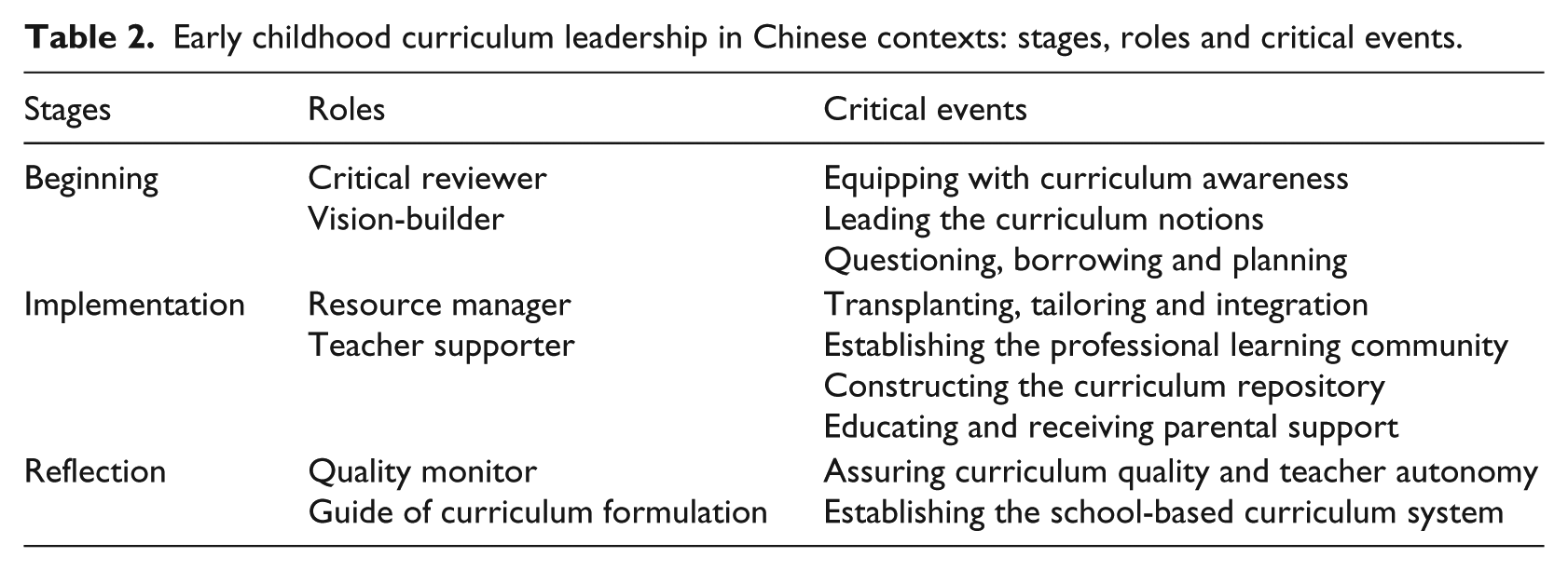
Leaders are deemed to be the ‘learning architects’ for schools (Senge, 1990). This is especially true when their curriculum leadership is centred on understanding their leading role in curriculum development as a learning activity system and process of expansive learning, according to cultural-historical activity theory (Engeström, 2000, 2001). This study reveals that the leaders played various roles in different stages of school-based curriculum development, including those of critical reviewer and vision-builder in the beginning stage, resource manager and teacher supporter in the implementation stage, and quality monitor and guide of curriculum formulation in the reflection stage. This finding echoes the perceptions of the principal’s role unveiled by Lee and Dimmock (1999) – that the principal would perform relevant roles such as information provider, innovator, resource winner, resource allocator, disturbance handler, negotiator and staff development facilitator. Other than the leaders’ roles in the different stages, this study has also shown how various agents, other than principals, can be involved in early childhood curriculum leadership – namely, teachers, children, parents, policymakers and experts. This again corroborates the findings in previous studies (e.g. Lee and Dimmock, 1999; Rodd, 2013). However, this study is unique in clarifying the stages, roles and characteristics of curriculum leadership and management in both public and private early childhood settings, specifically within Chinese contexts. These efforts are meaningful to better understand early childhood leadership as praxis in public and private settings within a marketised early childhood system.
A Chinese model of early childhood curriculum leadership
This study enriches the area of research through documenting school leadership in local early childhood settings. The Chinese model of early childhood curriculum leadership described and analysed in this study can be better understood if it is put in the context of local reform movements, as well as the pushes and pulls of western influences on Chinese culture and early childhood education systems (Lin et al., 2018). Chinese traditions and values in education have been used to localise those Euro-American educational ideas such as constructivism and developmentally appropriate practice that have been imported over the last decades. Chinese early childhood practitioners have struggled to resolve the tensions between the global and the local, western and Chinese, and even universalism and relativism through the process of contextual and cultural appropriateness (Li and Chen, 2017). Although leadership is closely related to the worldwide discourse of quality improvement, it should be reaffirmed that quality is a contested and multifaceted concept. What principals do with teachers and parents, what teachers do together, and what curricular and pedagogical changes are needed to achieve ‘quality’ should be examined and interpreted in a context-dependent way. In this study, the characteristics of curriculum leadership were drawn from the cases to develop a multistage integrated model for understanding early childhood curriculum leadership in Chinese contexts (see Table 2).
Early childhood curriculum leadership in Chinese contexts: stages, roles and critical events.
As indicated in this Chinese model, early childhood curriculum leadership involves both positional (solo) and distributed (shared) leadership forms, which aligns with the conceptualisation of hybrid leadership found by Bøe and Hognestad (2017) to involve continuous negotiations between solo and shared leadership forms. This model is also consistent with the theory of ‘leading and learning together’ (Sergiovanni, 2015). Although greatly influenced by personal qualities, the principals’ leading process in school-based curriculum development involved some common critical events along the action research cycles. A model of early childhood curriculum leadership is further summarised in Figure 1, based on the findings of this study and extant literature (Ding, 2001; Huang et al., 2016).
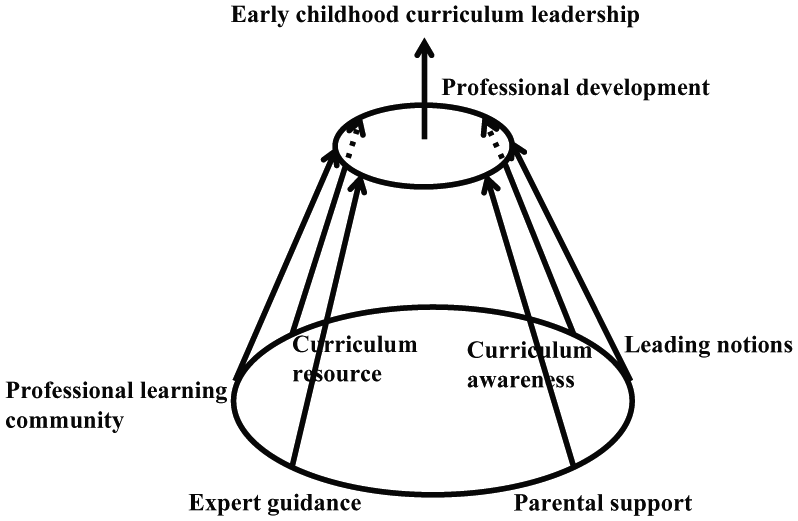
A Chinese model of early childhood curriculum leadership.
As shown in Figure 1, which aligns with the findings revealed by this study, curriculum awareness, leading notions (e.g. child-centredness), the curriculum resource (e.g. the repository), the professional learning community (including teacher autonomy), expert guidance and parental support all contribute to promoting teachers’ professional development while performing early childhood curriculum leadership in a particular setting.
Limitations
First and foremost, despite providing an in-depth description and interpretation of early childhood curriculum leadership in Chinese contexts, any generalisation of the findings of this qualitative case study to other situations should be made with caution. However, the detailed context-dependent analyses may provide substantial theoretical and methodological implications for other ethnic groups. Second, the participating leaders’ perceptions of quality or curriculum quality were not obtained in this study. The conceptualisation of quality from the perspective of early childhood leaders merits future research as it may be highly related to their curriculum leadership. Third, there is a lack of data from other leadership agents, such as teachers, parents and external examination authorities, in this research project. Because early childhood leadership seems to involve multiple persons with high interdependence (Heikka, 2014), more attention should be paid to the interactions between different activity systems and the distribution of school leadership when examining early childhood curriculum leadership and innovations in the future. Finally, although cultural-historical activity theory has been used as the theoretical tool for elucidating leadership in this study, it should be pointed out that this process is a heuristic, and data-driven categories have been heavily relied on to present the findings. Cultural-historical activity theory potentially seems to be a powerful analytical tool for understanding leadership practice in early childhood settings. This is also supported by Nuttall et al. (2018: 89), who contend that cultural-historical activity theory can help us to see leadership as the ‘work that influences the collective cultural norms of the entire field’. However, concepts of cultural-historical activity theory such as contradiction and the cycle of transformation seem to be difficult to anchor in the analysis of a complex and dynamic phenomenon such as leadership practice. This issue is in need of more research endeavours to better evaluate the effectiveness of the cultural-historical activity theory framework for understanding early childhood leadership in diverse contexts.
Footnotes
Acknowledgements
This article arose from the author’s PhD research project in the Faculty of Education at the University of Hong Kong. The author would like to express his gratitude to Professor Hui Li, who provided enormous support and guidance during his PhD research. Thanks also go to the participating principals for their involvement and insights. Finally, the author would like to thank the editors and anonymous reviewers for their valuable critiques on the manuscript.
Funding
The author(s) received no financial support for the research, authorship, and/or publication of this article.
