




Abstract
This study employed an inductive qualitative approach to understanding the effects of local culture on early childhood curriculum development in two Hong Kong kindergartens. A triangulation of interviews, observations and documents was established, and cultural-historical activity theory was employed as the theoretical framework. The results indicated that local culture played an important role in early childhood curriculum development. First, the two cases learned from diverse models and approaches during the transformation of their curricula, resulting in contradictory demands and motives. Then, these contradictions were, in turn, resolved by the local culture to achieve curriculum hybridisation and innovation, as well as inherit the culture. Such findings provide valuable implications for early childhood professionals to integrate social and cultural diversity into curriculum development and to localise imported curricular practices so as to ensure a good fit between the curriculum and the local context.
Keywords
Introduction
Culture is the set of ideas that define the beliefs and behaviours of individuals and groups of people in a society, which exist in both visible (e.g. artefacts) and invisible (e.g. customs) forms (Hofstede, 1980; Stephens, 2007). Meanwhile, curriculum can be viewed as an activity system of teaching and learning that evolves over time. The role of culture in early childhood curriculum (ECC) development has caused widespread concern since the dominating discourse and praxis of developmentally appropriate practice was criticised and even rejected at the turn of the millennium (Dahlberg et al., 1999; Moss et al., 2016; Tobin, 2005, 2011; Tobin et al., 1991, 2009; Yang and Li, 2019a, 2019b). Nowadays, scholars tend to agree that culture shapes early years learning and development (e.g. Dahlberg and Moss, 2005; Li et al., 2016; Lin et al., 2018). However, very little is known about how and why it influences ECC. Hong Kong is the ideal arena to uncover the underlying mechanism of cultural influence on ECC as it has promoted school-based curriculum development (SBCD) in the field of ECC since 2000 (Li, 2005). SBCD needs full participation, democracy, teacher autonomy, professionalism and decentralisation, which are relatively absent in Chinese kindergartens and traditional Chinese culture (Li et al., 2016; Yang and Li, 2019b). Therefore, in this study, we endeavour to understand the role of traditional culture in ECC development in two Hong Kong kindergartens.
The influence of culture on curriculum
Research on the cultural aspects of curriculum tends to regard the educator as a ‘bearer of dominant cultural ideologies’ (Moore, 2000: 91) who delivers the local traditional culture to students through teaching styles and curriculum content. However, the influence of culture on curriculum may not always be top-down, and cultural change can happen through a bottom-up approach once the educator has more consciousness about the education system and dominant culture (Moore, 2000). Using a multicultural perspective, Gay (2000) argued that curriculum content should be culturally relevant to students with different cultural backgrounds. However, curriculum content was narrowly defined as ‘textbook’ in Gay’s analyses, which is not suitable for ECC as it usually employs hands-on experiences as content. It remains to be addressed whether culturally relevant and diverse content has been used in ECC, and what kind of ‘culturally sensitive curriculum development’ (Gervedink Nijhuis et al., 2013: 228) has happened, especially in non-western societies.
Jipson (1991) found that the dominant developmentally appropriate practice guidelines for ECC often failed to acknowledge the role of culture. Smith (1996) argued that the goals of ECC were determined by cultural requirements rather than child development, and children should construct their cultural understanding in the local context. Spodek and Saracho (1996) further compared ECC across different cultural contexts and argued that ECC’s role in transmitting local culture was inevitable. The content of ECC thus reflects the dominant values and ideologies of a particular society. This major finding has been revealed in many other anthropological, sociological and educational studies (e.g. Marsh, 2000; Tobin et al., 1991, 2009; Yang and Li, 2018a, 2018b). However, instead of only following the dominant culture, many early childhood researchers have argued that ECC should disrupt these dominant discourses to embrace diversity and multiculturalism (e.g. Brooker, 2005; Hennig and Kirova, 2012; Marsh, 2000; Pacini-Ketchabaw and Schecter, 2002). Aligned with Rogoff’s (1998) sociocultural view of child development from three planes of influence, Fleer (2002) and Edwards (2003) identified three lenses – personal, interpersonal and community/institutional perspectives – for planning the education of young children. Based on the linkage between culture and curriculum as revealed in the existing literature, this study aims to explore the possible influence of culture on modern curriculum innovations conducted in Hong Kong early childhood settings.
The local culture in Hong Kong
Hong Kong is a Special Administrative Region of China and an international metropolis shaped by multicultural forces. This section briefly reviews the origin and development of Hong Kong’s local culture to understand the possible relationship between the local culture and ECC development.
Chinese traditional culture
Hong Kong is an international Chinese city and has thus substantially inherited Chinese cultural values. The term Confucian heritage culture, which is often used as a synonym for Chinese traditional culture (Ng, 2019), will be adopted in this study. Research has shown that early childhood education (ECE) practices in Confucian-heritage societies such as Hong Kong and mainland China differ explicitly from those in Euro-American countries (Liu and Tobin, 2018; Tobin et al., 1991, 2009). For instance, Li (2004) found that Hong Kong early childhood teachers had to cope with the Confucian heritage culture’s tradition that requires classroom discipline, even though they were asked to implement a child-centred approach. In Confucian heritage culture, the purposes of learning are to perfect oneself morally and achieve social status and honour (Li, 2010). Respect and humility are also believed ideally to embody the self-perfecting process in Confucian thought (Li, 2010). Students should be humble and respectful to knowledge and teachers (Li, 2010; Li and Wang, 2004). These traditional Chinese values still have far-reaching effects on ECE (Yang and Li, 2018b, 2019b).
British colonial culture
Hong Kong became a colony of the British Empire in 1842 and reunited with China in 1997 under the ‘One Country, Two Systems’ political umbrella. The new system allows Hong Kong to retain its own administrative, economic, legal, educational and even postal systems (Yang et al., 2017). It is undeniable that the British colonisation of over 150 years has greatly influenced Hong Kong’s sociocultural values and systems. As early as 1873, Hong Kong children received education in missionary schools, which implanted Christianity in many of the Hong Kong people’s belief systems (Adamson and Li, 1999). Christianity has been prevalent in Hong Kong since the mid-20th century (Chan, 2004). Christianity pervades ECE practices regarding the transmission of its common faith, especially in Christian kindergartens. However, the possible influence of Christianity as a religion on ECE is rarely studied. Therefore, it is difficult for us to identify and interpret this strand of cultural/religious features in ECC and its impacts on children’s ways of thinking and behaving. Nevertheless, western ideas of the Enlightenment have been transplanted into Hong Kong society to emphasise individualism, rationality and secularism since the colonial period (Burke and Segall, 2011).
Although numerous empirical studies have examined early childhood teaching and learning in the Hong Kong context (e.g. Li, 2013; Li, 2012; Li, 2004), little is known about the impact of culture on ECC development. The present study focuses on the case of Hong Kong, a city where East meets West, to unveil the influence of culture on ECC innovations.
The evolution of early childhood curriculum and school-based curriculum development in Hong Kong
Hong Kong kindergartens normally provide half-day programmes (about three hours per day) for three-to-six-year-olds, and some run whole-day programmes (Yang et al., 2017). Young children are enrolled in three levels of class according to their age: nursery (K1, ages three to four), lower kindergarten (K2, ages four to five) and upper kindergarten (K3, ages five to six) (Education Bureau, 2015). No official curriculum guide was in place until 1982 when the Llewellyn visiting panel proposed the direction of ECC – ‘learning through play’ – for ECE in Hong Kong (Hong Kong Government, 1982). The first detailed curriculum guidelines – Guide to the Pre-primary Curriculum – were published in 1996 (Curriculum Development Council, 1996). Since the 1990s, the government has favoured Euro-American pedagogy through the widespread promotion of a child-centred approach to the curriculum (Li et al., 2012). The second edition of the guidelines was published in 2006, incorporating constructivist learning theory into the curriculum framework (Curriculum Development Council, 2006). Contemporary notions of developmentally appropriate practice have thus become integral to the beliefs and practices of ECE in Hong Kong (Rao et al., 2010). The third edition of the guidelines was released in 2017, with an emphasis on promoting SBCD in kindergartens (Curriculum Development Council, 2017).
SBCD has become an international trend since the 1970s, with the great shift from curricular decisions made by central government to those made by individual schools (Skilbeck, 1984). SBCD was introduced into the ECE sector from 1994 and has been greatly promoted since 2008, following the phases of importing and adopting western curricula (1997–2002) and adapting imported curricula with significant innovations (2003–2007) (Yang and Li, 2018b). For instance, western curriculum models and approaches such as the HighScope curriculum and Project Approach have been widely adopted in Hong Kong kindergartens (Li, 2005). Other newly developed local curriculum models have also become popular in Hong Kong kindergartens, such as the Story Approach to Integrated Learning (Li and Chau, 2010). In addition to using existing, well-developed curriculum sets, many kindergartens in Hong Kong have launched SBCD as an approach to teacher empowerment, professionalism and quality improvement (Li, 2006). Imported curricula have thus been adapted and localised in the process of SBCD. Chen et al. (2017) studied the ‘Hong Kong style’ of the Project Approach and found that the underlying mechanisms were contextually and philosophically driven. Contextually, there were real challenges, such as time pressure and curriculum demands, parental expectations for academic success, professional competence, emotional tensions and culturally driven pedagogical beliefs. Philosophically, these challenges were confounded by a set of different cultural beliefs about early education and a long-held tradition of practising teacher-directed Chinese pedagogy. However, there is still a dearth of research on how culture may influence curriculum development in Hong Kong kindergartens.
Using cultural-historical activity theory as a theoretical framework
We used cultural-historical activity theory (CHAT) to conceptualise ECC as an activity system (Engeström, 1999, 2001). Based on CHAT, a curriculum can be regarded as ‘a collective, artefact-mediated and object-oriented activity system, seen in its network relations to other activity systems’ (Engeström, 2001: 136). We thus interpreted the transformation of ECC by focusing on understanding the motive–goal–instrumental conditions at an institutional level rather than individual behaviours (Rogoff, 2003).
An activity system qualitatively transforms along spiral learning cycles. According to the model of expansive learning cycles (Engeström, 1999), subjects tend to question and deviate from established practices when tensions in an activity system become more serious (Engeström, 2001). In some cases, this situation develops to the point where it can lead to change. When new challenges or possibilities are embraced, activity objectives or motives are adjusted to exceed the previous mode of activity (Engeström, 2001; Engeström and Sannino, 2012). By historically accumulating structural tensions within and between activity systems, contradictions may facilitate or hamper the achievement of goals (Engeström, 2001). Contradictions are necessary but insufficient sources of expansive change in an activity system (Engeström and Sannino, 2010). Only when contradictions are treated in such a way that a new emerging object is identified and becomes a motive are they turned into real driving forces of expansive learning (Engeström and Sannino, 2010). Based on the processes of expansive learning in response to systematic contradictions, we can investigate the activity of ECC innovation in the context of local culture and SBCD initiatives by examining the meaning-making of participants. One of the advantages in using CHAT as a theoretical tool for this study is to intentionally interpret the contradictions in the activity system of ECC as the principals and teachers participated in SBCD. Educators’ understanding of the motive object of curriculum development will be interpreted and linked to their cultural values or the meanings that inhere in the ECC practices and artefacts. Accordingly, this case study used CHAT as a theoretical framework to understand the effects of local culture on ECC through examining SBCD in two Hong Kong kindergartens. Specifically, the following questions guided the study:
What were the educators working on regarding SBCD in the two Hong Kong kindergartens?
How did the case-study kindergartens negotiate contradictions in the process of developing their curricula?
What was the role of culture in the curriculum innovations, as reflected in the educators’ beliefs and practices?
Methodology
We used a case-study method to provide an extensive and in-depth description of the social phenomenon of SBCD in early childhood settings. The nature of the case is the interpretation and implementation of SBCD in kindergartens. A case-study approach was employed in this study for three main reasons: (1) there is little control of behavioural events involved; (2) the study is mainly exploratory in nature with a focus on the relationship between culture and curriculum change; and (3) the study focuses on contemporary real-life events in which the boundaries between phenomena and context seemed to be unclear (Yin, 2014).
Settings and participants
In order to explore and compare SBCD, we chose two kindergartens in Hong Kong which could be informative cases and were willing to participate in the research. First, we required the kindergartens to be local and registered. Second, the children had to be between three and six years old. All of the kindergartens that met these criteria were identified from the kindergarten profiles available on the Education Bureau (EDB) website. For our final selection, the third criterion was that the kindergarten should have its own school-based curriculum, to ensure it had gone through SBCD. Therefore, we consulted with senior educators and referred to official assessment profiles, and finally chose two kindergartens – HK1-KG and HK2-KG – as the cases (see the school information in Table 1). They also provided convenient sites for our data collection. The cases selected for the study were non-profit-making kindergartens with a majority of Chinese staff and over 50% of the class teachers in each kindergarten having more than 10 years of teaching experience. The majority of the children were from families with a middle socio-economic status.
School information.
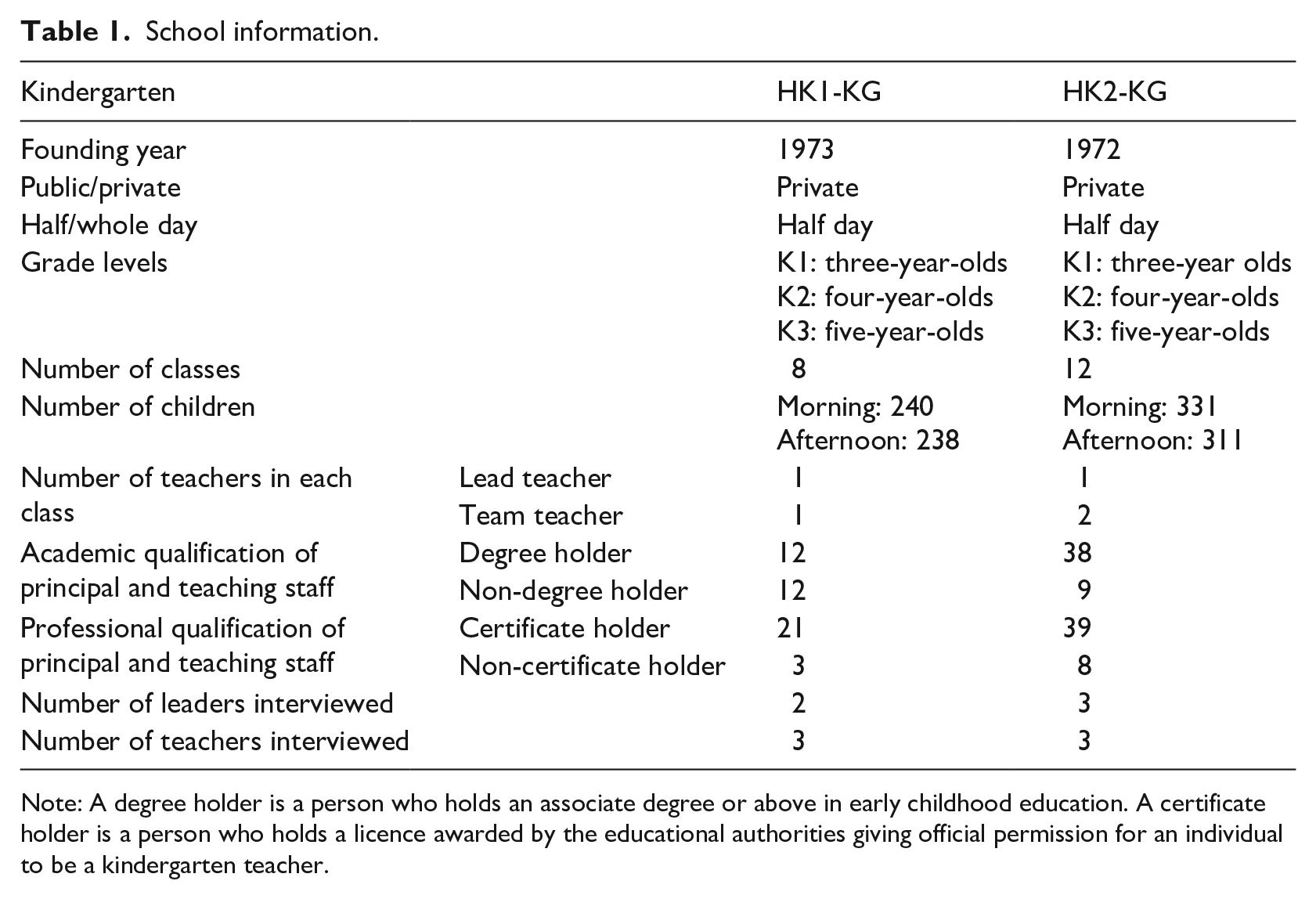
Note: A degree holder is a person who holds an associate degree or above in early childhood education. A certificate holder is a person who holds a licence awarded by the educational authorities giving official permission for an individual to be a kindergarten teacher.
In order to examine SBCD in each kindergarten, the first author interviewed two/three curriculum leaders (i.e. principals or directors) and three lead teachers from the participating classes (we randomly selected one class from each grade, resulting in three classes from each kindergarten; see Table 1). All of the participating teachers were degree and certificate holders. After notifying the participants and obtaining their consent, classroom and target-child observations were conducted.
Data collection
In the process of the data collection and analysis, we referred to the ‘Policy on Research Integrity’ and the ‘Operational Guidelines and Procedures of the Human Research Ethics Committee’ issued by the University of Hong Kong. The research project was submitted to the university’s ethics committee for approval before the data was collected. In order to achieve data triangulation, we gathered data from multiple sources (Yin, 2014), including interviews, observations and documents.
Interviews
In order to gain a contextual understanding of the curriculum followed in the kindergartens before the observations, the first author interviewed the principals or directors for 60–90 minutes each, using a semi-structured interview protocol. Information was elicited on the objectives of the kindergarten’s curriculum and its philosophical/theoretical bases, approaches and content, and influencing factors. Following the observations, the first author interviewed the three lead teachers from the participating classes for 45–60 minutes each. We developed a semi-structured interview protocol drawing on insights gained from the observations and document analysis to encourage the teachers to report on children’s daily activities and their daily pedagogical practices, learning content and related resources, and their assessment of the curriculum’s quality and children’s developmental outcomes. All of the interviews were conducted and audiotaped in Cantonese, with advance notification and consent from the participants.
Observations
After obtaining the informed consent of the principals and teachers, the first author observed the participating classes for one week to explore the daily routine in the kindergartens. The daily routines of the children in the two kindergartens can be seen in Table 3. A familiarisation period was arranged before the formal observation to enable the teachers and children to become accustomed to the presence of the camera and/or observer (HK2-KG only allowed on-site observations). Each classroom was continually observed for two to four hours (three hours on average) on each observation day. Each class was observed for two half days (one morning session and one afternoon session), giving approximately 36 observation hours for the six classrooms. In addition to the classroom observations, the first author conducted target-child observations to record the daily routines of individual children for 40 minutes per day. Each child was observed for two days. The observations were conducted throughout the day (morning and afternoon, indoors and outdoors), resulting in 32 observation hours for 24 children.
Documents
Various types of curriculum documents were collected as supplementary data, including the information available on each kindergarten’s official website, formal curriculum documents used by the teachers, teaching materials (e.g. lesson plans, schedules, books, children’s work), other curriculum materials provided by the interviewees, and field notes written and collected by the first author.
Data analysis
All of the interviews were transcribed in Chinese. The interview transcripts were then analysed using open coding and axial coding (Corbin and Strauss, 2014). Consistent with Creswell’s (2014) guidelines for qualitative data analysis, the following procedure was carried out:
Reading transcripts: we became familiar with the reported and recorded data collected from the curriculum developers through deep reading.
Coding transcripts: we started to label portions of each transcript relevant to the research questions, including the features of the studied curricula, the processes of curriculum development, and the reasons or forces behind these, as explained by the curriculum developers. For example, one participant (Principal HK1-L1) stated during the interview: ‘No homework, no pressure. But you cannot survive. If you asked me whether we ask kids to write [Chinese characters], I have to say, “Yes, we do!” . . . I should ensure they can survive [in the future]’. This statement was coded as ‘direct academic learning’. A list of codes was generated afterwards.
Constructing themes: the constant comparative method was used in this step (Boeije, 2002; Brown and Englehardt, 2017). The coded data was analysed by comparing the data to combine some of the data and decide on the final set of themes. The themes with narratives were further identified from the coded data to present the processes and tensions present during curriculum transformation. We identified themes both inductively from the data and deductively, as inspired by CHAT.
Tabulating the themes and categories: a tree structure was used to group the themes with links. Categories then emerged from the themes to better illustrate the mechanism of and tensions within the SBCD under investigation.
Interpreting the findings: both the themes and the categories constructed from the data were interpreted by referring to the theoretical framework of CHAT as well as the research questions. Therefore, we can describe and explain how ECC innovation was achieved through SBCD in the two kindergartens under study.
In order to analyse the observation data, we first logged and organised the video data and HK2-KG’s on-site photographs and field notes (Fleer, 2008, 2017). We then interpreted and described the data from a thematic level (Fleer, 2017; Hedegaard, 2008) to find meaningful patterns related to the research aims and develop new theoretical relations to the CHAT framework. We analysed and compared the data to filter common themes about children’s approaches to the curriculum activities, differences in these approaches that were related to contradictory motives, and the activity setting, comprising the intentions and arrangements of the teachers. Finally, an analysis of the documents was conducted to help clarify and complement the analyses from both the interview and observation data. The authenticity and accuracy of the documents was determined by referring to the checklist presented by Merriam (2009: 122). Examples of the questions include: ‘What is the history of the documents?’; ‘Is the document complete, as originally constructed?’; and ‘Who was/is the author?’ After confirming the authenticity and nature of the documents, we read them repeatedly and checked with the interview and observation data in order to come to an accurate and holistic understanding of the data.
In order to ensure the trustworthiness of the findings, we used the following techniques (Creswell, 2014):
Member checking: two of the participants (one principal and one teacher) from each kindergarten were interviewed again to check that their opinions remained consistent with their responses in the initial interviews and with the researcher’s interpretations.
Peer debriefing: this was conducted by a doctoral student majoring in ECE to check that the codes and themes accurately represented important parts of the interview, observation and document materials.
Inquiry auditing: a senior researcher assumed the role of inquiry auditor and was responsible for ensuring that the processes of data collection and analysis were sufficiently rigorous for a multiple-case study.
A cross-case analysis was conducted to aggregate the findings across the two cases. As Yin (2014: 148) commented: ‘In a multiple-case study, one goal is to build a general explanation that fits each case, even though the cases may vary in their details’. When comparing the evidence across the two cases, the explanatory propositions were refined to unveil the common ground.
Results and discussion
School-based curricula supporting the retention of culture
In this section, we use the theory of the activity system (Engeström, 1987) as the primary lens to frame our decisions about the kinds of themes and categories to be presented in terms of describing what the educators were working on and how they interpreted the various curriculum activities and tools. In this way, we attempt to explain the motive–goal–instrumental conditions of ECC innovation at the institutional level.
Learning objectives
Learning-objective themes emerged from the data, including the different dimensions of a child’s holistic development according to the educators’ beliefs (see Table 2). For example, moral education was repeatedly emphasised by the Hong Kong educators. They reported that morality should be paramount in what they taught children. This expectation is consistent with the Confucian tradition and was made clear by the principals of the two kindergartens:
I always tell parents that if your child has good moral etiquette, if they know how to be grateful, their parents will get the most direct reward. . . . I said, ‘Your child might be excellent enough to study at Peking or Tsinghua University [in the future]. If they couldn’t recognise and repay their parents’ love, what does it mean to you?’ (HK1-L1) Regarding moral education, we want our kids to learn how to care for their peers. . . . We can tell our kids what to do and let them know how to care about people and how to help others. This is all about morality. (HK2-L2)
Learning objectives, activities and tools of the curriculum in each kindergarten.
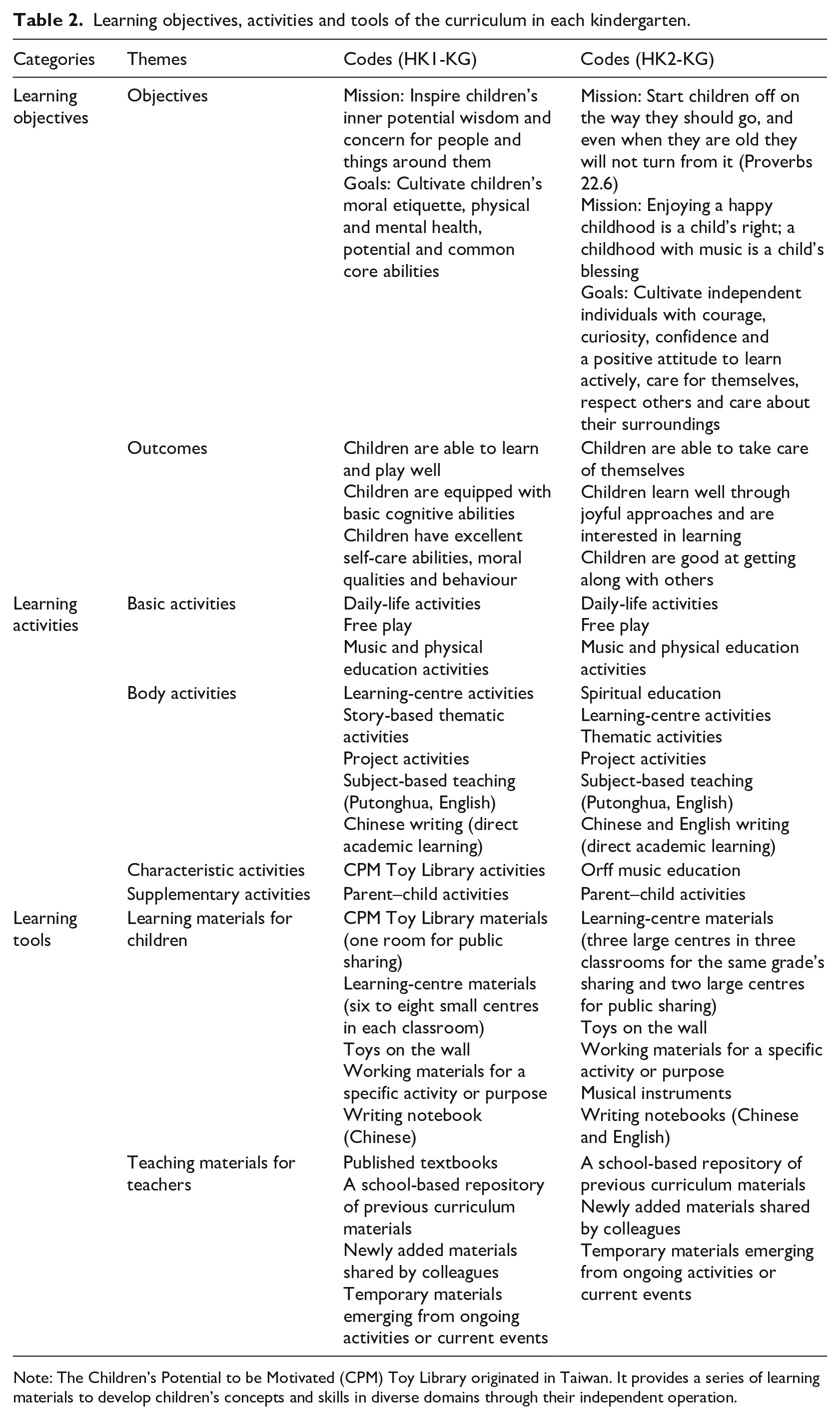
Note: The Children’s Potential to be Motivated (CPM) Toy Library originated in Taiwan. It provides a series of learning materials to develop children’s concepts and skills in diverse domains through their independent operation.
Principal HK1-L1 emphasised the idea of ‘filial piety’ (孝) – one of the most important virtues in Chinese traditional culture – when providing moral education for children. The concept of filial piety refers to the virtue and duty of respect and care for one’s parents and elderly family members (Chang and Kalmanson, 2010), and is a core moral value of Chinese culture.
The academic dimension of children’s development was mentioned much less by the participants during the interviews. However, the academic dimension was explicitly put into practice in the two kindergartens. We observed that academic learning accounted for a considerable amount of the daily schedule in the two settings (see Table 3). The inconsistency between the reported and enacted practices regarding early academic learning could be explained from at least two perspectives. On the one hand, the teachers might implicitly believe in the values of academic learning in the early years, which aligned with the traditional emphases on moral perfection and preparation for future achievement in the local culture. On the other hand, it might be the Chinese educators’ practice of the ‘Doctrine of the Mean’ (Zhongyong or 中庸), inherited from ancient Chinese culture, whereby they insisted on the significance of early academic preparation but intentionally avoided the contradictions in their own educational narratives when they reported to the researcher for his recognition and appreciation. We will present more interpretations of the curricular practices by specifically drawing on the notion of the Doctrine of the Mean in the latter part of the results and discussion section.
Children’s daily schedule in the two kindergartens.
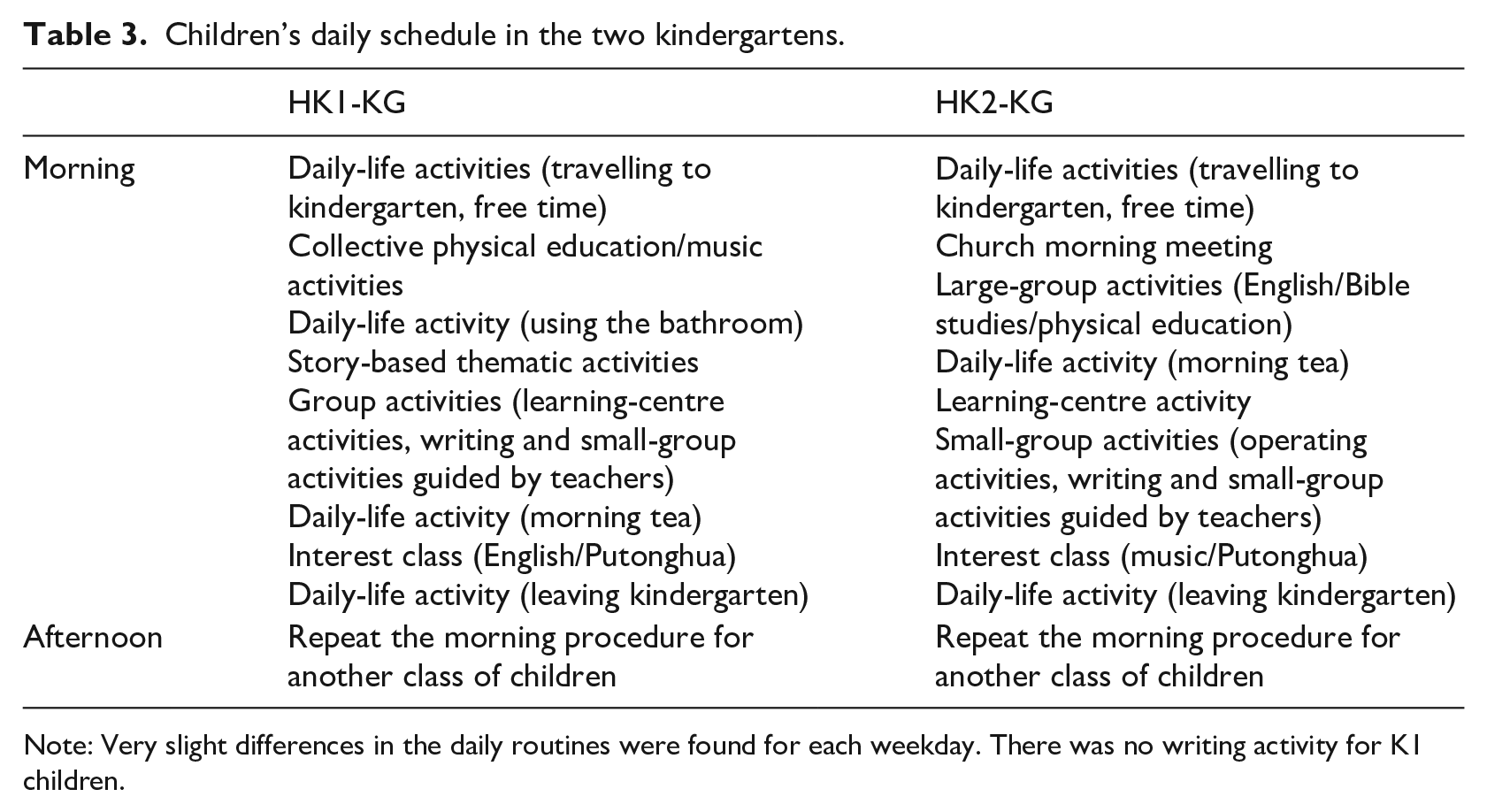
Note: Very slight differences in the daily routines were found for each weekday. There was no writing activity for K1 children.
Also, the curricular activity systems were found to focus on cultivating good habits in young children (see the objectives and outcomes in Table 2). These habits should be guided, required and even trained by adults to prevent children from developing bad habits. Teacher HK2-T2 made the following remarks when she talked about teaching children good habits:
We must begin to cultivate their self-care habits from K1 if they have [learned good habits] since K1. They do not need to spend much time [learning habits] any more. If good habits have not yet been learned till K3, there will be no chance, as primary school will not teach these little habits such as hand-washing, towel-folding, etc.
In the two kindergartens, children were expected to be active and self-regulated, and to embrace balanced and holistic development. The following statements by Principal HK1-L1 illustrate this finding:
Our kids can learn well and play well. . . . Just like drama, they stand up to perform very well. While in the CPM Toy Library [i.e. a particular learning centre providing a series of learning materials], they operate the materials and study quietly. They will shift to be active if they go to other rooms, like cooking for fun.
As we can see, Hong Kong early childhood educators tend to expect their children to broadly develop in social (moral), life-skill and academic dimensions. They want to cultivate active children who are self-regulated and good at learning and socialising. This is also reflected in the activity arrangements in the curricula.
Learning activities
In the two curricula, the teachers arranged children’s daily schedule (see Table 3) and the activities they participated in (see Table 2) with the carrying out of rules (i.e. regulations and cultural norms) and a division of labour (i.e. a division of tasks and power). In each of the kindergartens, children could participate in individual, small-group, large-group and whole-class activities every day; however, they only had roughly 30 minutes of free time and limited space for free activity, according to our observations. The limited time for free activities such as free play and child-directed learning-centre activities was associated with the Hong Kong educators’ beliefs and the contextual environment in which they were situated. First, teacher directedness was valued as playing a role in enhancing children’s learning. The Hong Kong educators seemed to worry that if they gave children too much time for self-directed activities, the functioning of adult guidance would be missing. As mentioned by Principal HK1-L1: ‘If you don’t give children [text]books, parents would find it difficult to understand [and might complain about] what the school [here ‘school’ refers to their kindergarten] has taught their children’. Also, there was a shortage of both indoor and outdoor space for children’s free play and exploration in these Hong Kong kindergartens, as they were located in tower blocks in urban areas (Chow et al., 2001).
During their free time, children could engage in some free play without teachers’ guidance (see Table 3). They did have other kinds of ‘play’ in the daily routines; however, they played to learn some pre-academic knowledge using learning materials developed by the teachers (Rao and Li, 2009). In addition, the children had to spend a certain amount of time in direct academic learning, such as numeracy, Chinese writing and sometimes English writing.
The arrangement of academic learning is related to educators’ implicit beliefs. The purposes of Chinese learning, such as the desire for upward mobility, are the bases for their expectations and practices. In the two kindergartens, academic learning was believed to be essential for the school readiness of young children, as reported by the principals and teachers. Also, we found that principles of the HighScope preschool curriculum were integrated into the two curricula. For example, learning centres and group activities were available in both curricula. The ‘plan–do–review’ practice was also an integral part of the daily routine in the two kindergartens. Borrowed approaches were seen to supplement traditional academic learning and subject-based teaching. The two kindergartens had developed multiple types of activities (see Table 2) which ensured that their curricula could fully support children’s holistic self-improvement, which is always the major pursuit of educators in the Chinese culture.
Learning tools
The study revealed two main types of mediating instruments adopted by Hong Kong teachers to promote children’s learning (see Table 2): (1) learning materials for children and (2) teaching materials for teachers.
The Hong Kong educators have made efforts to develop instruments to meet children’s needs and activate their motivation to learn. The approach of play-based learning was carefully considered when designing learning tools for the children. These learning tools, as we observed, emphasised delivering pre-academic knowledge and skills for children through their independent operation. In addition, teacher HK2-T2 discussed the tools for teaching (lesson plans):
We have an outline for each unit. As the director of our grade [K2], I will unify what K2 kids should learn in the learning area of Chinese, what they should learn in the learning area of mathematics, and music, etc. Teachers will take this outline of learning content to develop their class timetable. . . . Actually, we have accumulated lesson plans over many years, but we will not merely follow them. Instead, we try to revise them every year to improve them.
A school-based repository of curriculum materials (particularly lesson plans) was of great value to the teachers. In order to ensure the effectiveness of the curriculum’s implementation, the accumulated and published teaching materials were revised and improved continually with input from the teachers’ professional community. These improved materials thus ensured the quality of the children’s learning.
Transformation of the curricula serving the inheritance of culture
We then employed the theoretical lens of expansive learning cycles (Engeström, 1999) to gain an in-depth understanding of the curricular practices within the process of change and transformation. We constructed a thick description of the processes of SBCD to narratively interpret the analyses of the interviews and documents. Specifically, an analysis of the participating educators’ concerns related to cultural values was conducted to demonstrate the inevitable influence of Chinese culture on Hong Kong educators’ curriculum decision-making. These major concerns (i.e. implicit guidelines) related to cultural values, shared by the principals and teachers, include but are not limited to the following:
The curriculum should prepare children for academic success and the achievement of social status and honour through learning knowledge and skills in the early years. We narratively describe an excerpt of the processes during SBCD in HK1-KG here to illustrate and demonstrate this cultural concern. In 2005, HK1-KG imported a new approach – the CPM Toy Library, with a series of learning materials from Taiwan. The CPM Toy Library aims to make textbook knowledge become boxes of joyful toys, and learning becomes games integrated with knowledge. The Toy Library provides 923 boxes and 56 series of learning games, mainly covering mathematics and Chinese. It enables children to learn basic academic knowledge through playing games. It is argued that acquiring knowledge and skills in the early years prepares children for school and future success.
The curriculum should enhance children’s holistic learning and development. Since the beginning of the 1990s, thematic activities had been carried out in HK2-KG to establish a systematic content of activities in the areas of cognitive, mathematical, communicative, socio-emotional, sexual, spiritual, environmental, artistic, creative and physical development. The teachers collaborated to develop hundreds of activity plans. The design of a comprehensive content system for HK2-KG’s curriculum may be illustrative of this concern to enhance children’s holistic learning through providing a quality curriculum.
The curriculum should improve children morally by delivering stories and teaching virtues. In 2006, the Story Approach to Integrated Learning (SAIL) curriculum was imported and integrated into HK1-KG’s school-based curriculum (SBC), aligning with this concern. Although SAIL was developed in Hong Kong, it was new for HK1-KG. The SAIL curriculum is an integrated curriculum that uses stories as a framework and adopts transdisciplinary teaching approaches. Diverse themes and activities have been included in SAIL to enhance children’s diversity and morality while smoothing their transition to primary school by improving their language and literacy.
The curriculum should integrate diverse approaches for children’s holistic learning. Both HK1-KG and HK2-KG had promoted the integration of various methods to develop their curricula. Here are the narrative excerpts of HK2-KG’s SBCD, which may demonstrate this concern. Since 1997, both the practice of plan–do–review and learning areas from the HighScope curriculum had been implemented in HK2-KG. The teachers had adjusted children’s daily routines to include the whole process of plan–do–review. In addition, the teachers in each grade had established shared language areas, knowledge areas and interest areas for the children (one area in one classroom). The teachers had also collaborated to set up shared spaces for all classes, including an exploration area, a simulation area, a visual arts room, a music room, a reading room and a natural playground. The children were encouraged to learn individually in the language, knowledge, interest, exploration and simulation areas. Also, the teachers carried out group teaching for children to learn collectively. The group-teaching subjects changed every day and mainly included theme-based activities, music activities, physical activities, Chinese, numeracy, English, Putonghua, Bible studies and project inquiry.
Aside from these implicit guidelines, the early childhood educators, including principals, teachers and parents, were found to be the main stakeholders in the community of SBC activity systems under investigation. How did they collaborate to build up a supportive community to promote early childhood learning and cultural inheritance? The following quotes from the participating educators’ reports help to deepen our understanding of the development of these ECC innovations:
Each of our themes is related to moral education. For example, if we teach ‘family’, we may use some pictures to communicate with our kids about how to fulfil filial piety at home. . . . ‘Do you help your parents?’ ‘What kind of methods can be used to make the family happy?’. . . We will also extend from the family to the community. ‘How can you care for the elderly?’ ‘How can you do valuable things for elders?’ (Teacher HK1-T1) As a teacher, if you want others to respect you, you must first know how to respect others. We rely on the belief in spiritual education. . . . We also talk about relevant things in the morning and noon meetings. Parents are invited to tell a story in class every Monday. We may talk about morality on Tuesday. Social information may be discussed on Wednesday, such as where there has been an earthquake recently and how we can pray for the refugees. We may also launch some donations of toys and clothes. We may talk about physical health on Thursday. We do praise to worship our heavenly Father and sing poetry on Friday. Every day we have a theme, and our themes are well balanced. (Director HK2-L3)
The above indicate that Chinese traditional culture (moral education), religion (e.g. Christian education) and relationships in the community (respect for each other) are crucial to achieving the desired outcomes of early childhood learning through the curriculum. In alignment with CHAT, interwoven cycles of expansive learning during SBCD require coordination and balance. The two kindergartens tried their best to welcome and embrace diverse philosophies, tools and methods in developing their curricula – especially learning from imported curriculum models – which is consistent with the findings shown in Yang and Li (2018a). Moreover, contradictions between imported and traditional practices further stimulated the educators’ endeavours to implant Chinese values into their current curricula in order to localise the imported notions and approaches (Yang and Li, 2019a).
The Doctrine of the Mean: negotiating contradictory motives
This study revealed that school-based curricula (SBCs) in the two kindergartens embraced ‘curriculum hybridisation’ – a school-based fusion of diverse curriculum approaches – which is in alignment with the findings in a recent case study of a Chinese kindergarten (Yang and Li, 2018a). Effectively integrating and balancing different models is found to be a challenge when promoting SBCD, while the interwoven cycles of expansive learning might require further coordination and balance. This was made clear by Director HK2-L3:
How to balance all the things we want to develop? A few years ago, we also said that our curriculum is very rich with so many approaches. However, we only have 3.5 hours every day for our kids. In what kind of ways should we give so many things to the kids?
The above shows that the Hong Kong kindergarten teachers had tried their best to embrace diverse philosophies and methods in developing their curricula in a humble way, yet how to successfully mix and match the ‘ingredients’ of diverse approaches in their kindergarten by resolving contradictions was still a goal to be achieved and a problem that required further effort to overcome. Contextual realities, such as time limitations and parental expectations, were reported by Chen et al. (2017) to explain why Hong Kong kindergarten teachers failed to implement the Project Approach with high fidelity in the local context. This finding also aligns with Gupta’s (2013) analysis of how a socially and culturally constructed ECC reflected the hybridisation of various influences and discourses. Thus, in the context of Hong Kong, curriculum hybridisation and localisation as practised in the two case studies should be regarded as culturally appropriate and socially sensible (Chen et al., 2017).
The critical finding of ‘curriculum hybridisation’ in theorising the processes of SBCD in Hong Kong kindergartens is somewhat consistent with the recent study by Yang and Li (2018a), which indicated that SBCs might evolve through the steps of imitation, absorption and integration in a Chinese kindergarten. SBCD in the two Hong Kong kindergartens was consistent with the statement by Tan (2017) that a Confucian-heritage-culture-inspired curriculum is holistic, broad-based and integrated. This study also revealed that the historical transformation of SBCs in the two kindergartens went through a period of negotiating contradictory motives to achieve a status of balance, which may be a step towards achieving harmony between new and old values or between diverse approaches. This is consistent with the findings of Yang and Li (2018a), which used the Confucian philosophy of the Doctrine of the Mean to explain why and how curriculum innovations were promoted in a Chinese kindergarten. The Doctrine of the Mean is the title of one of the Four Books (四書, sishu) of Confucian philosophy in ancient China (Yang and Li, 2018a). Its goal is to ‘maintain balance and harmony from directing the mind to a state of constant equilibrium’ (Tsze-sze and Legge, 1893: webpage). Cheung et al. (2003: 108) stated that the Doctrine of the Mean would ‘seek to elect an optimal and harmonized course of action, amidst conflicting forces within an interaction context’. According to Li (2005: 50–51), the Doctrine of the Mean has the meaning of ‘being rational, being balanced, advancing with the times and sticking to what you believe in [合乎理性,不偏不倚,與時俱進,和而不同]’. As found in the two Hong Kong kindergartens, whether intentionally or not, the educators acted as active agents to negotiate with various stakeholders, such as parents and educational authorities, and meet their needs using the strategy of harmonisation. These practitioners have insisted on mixing and balancing different curricular approaches, as well as retaining fundamental Chinese values in their curricula. Although it is difficult to tell whether the balance between imported approaches and traditional practices is an external requirement or an internal identity, we could conclude that the contradictory motives in SBCD might have been continually negotiated by the early childhood practitioners with the explicit or implicit aim of achieving the Doctrine of the Mean in the two Hong Kong kindergartens. This complex process is shown in Figure 1 to illustrate the cultural inheritance and development in ECC development/innovation.
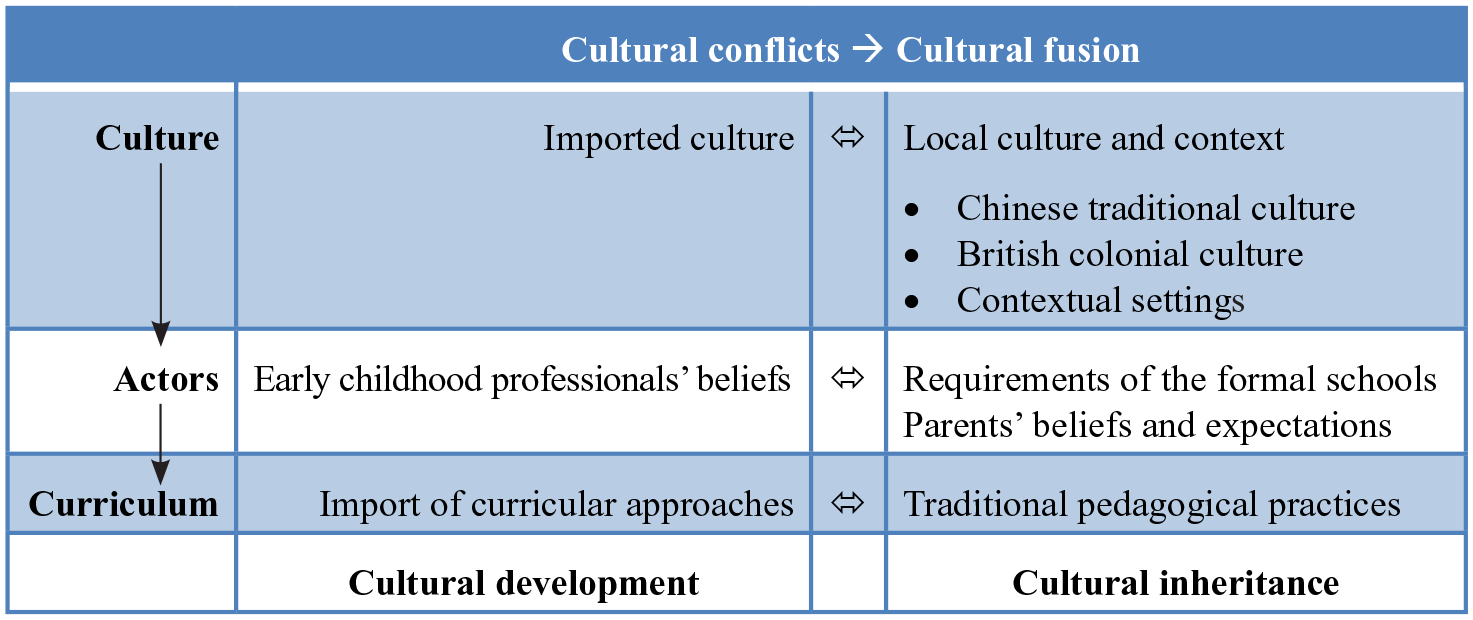
The role of culture in ECC development in Hong Kong.
Conclusion
This study aims to understand how the local culture may shape ECC by examining SBCD in two Hong Kong kindergartens. It revealed that the power of culture in shaping curriculum innovations is remarkable. The SBCD in the two cases was firmly rooted in Chinese cultural values, and utilitarianism, elitism and a strong desire for upward social mobility were the invisible but strong forces that drove the development of ECC in Hong Kong, in addition to the contemporary notions of ECE. In order to promote children’s learning, the teachers worked as ‘agents of change’ (Priestley et al., 2012: 191) to inherit traditions, resolve contradictions and achieve curriculum hybridisation and innovations.
Similar to Yang’s (2019) study on curriculum leadership, this study successfully uses CHAT (Engeström, 1987, 2001) to analyse thoroughly the qualitative transformation of ECC in a specific cultural context. This study, therefore, contributes to the literature by showing that there is a moral purpose to ECE when depicting the complex and dynamic transformation of ECC in Hong Kong, which is a case of East Asian contexts. The contribution of this in-depth case study is thus novel and provides a good example for future empirical research in understanding ECC from a cultural-historical perspective. The cultural contexts and elements of ECC should be on any future ECE research agenda.
Although this case study is firmly rooted in data from multiple sources and yields consistent findings, it has certain limitations. First, the cases were selected using criteria-based purposeful sampling, so caution must be taken in generalising the findings to other situations. Second, the study focused on SBCD without deeply analysing other related activity systems, such as families. As two or more activity systems are interconnected when they have a partially shared object (Engeström and Sannino, 2010; Sannino et al., 2009), future research could investigate how other related activity systems, including families and primary schools, may be interdependent activity systems affecting ECC. In Confucian-heritage contexts, the tension between professional accountability and parents’ demands is also worthy of future research endeavours. Third, as this study focused on examining cultural influences, observation played an important role in collecting the data. However, only one week of classroom and target-child observations was conducted. In future research, extensive longitudinal field observations would ensure the credibility of the data interpretation related to cultural issues and even support quantitative analysis to address how effective SBCD is in achieving the desired outcomes in a specific cultural context. Last but not least, this study has relied heavily on data-driven categories to describe the findings, on top of using CHAT as the theoretical tool, which is a reasonably heuristic process. The multi-voicedness of ECC with multiple traditions and interests, which is usually multiplied in networks with other related activity systems such as families (Engeström, 2001), makes it challenging to use CHAT concepts as the anchor in the analysis of ECC innovation. This issue needs more research to reflect on and apply CHAT concepts in the ECE field, given the fact that there is a dearth of early childhood studies using CHAT as an analytical tool (available studies include Nuttall et al., 2018, 2019).
Nevertheless, this study serves as a valuable reference for ECE practitioners to propel school-based curriculum innovations with cultural and contextual specificities. It inspires early childhood professionals to integrate social and cultural diversity into curriculum development and localise imported curricular practices, so as to ensure a good fit between the curriculum and the local context.
Footnotes
Acknowledgements
The authors thank Dr Xunyi Lin for helping with the data analysis. They also wish to thank the teachers and children who took part in the study.
Conflict of interest
The authors declare that they have no competing interests.
Funding
The authors received no financial support for the research, authorship and/or publication of this article.
