



Abstract
The authors take up the guest editors’ invitation to address the difference that posthumanist and feminist ‘new’ materialist theories make and why this matters politically and ethically. Alongside events from an early childhood (kindergarten) classroom, the authors engage with current conversations which build on and extend Kimberlé Crenshaw's theory of intersectionality with post-philosophies by scholars who identify as Black feminist, Women of Colour feminist, queer theorist, Chicana and/or Indigenous scholars. In an iterative, slow thinking-making-with-reading, this contemplation brings intersectionality and post-philosophies into conversation to explore diffractive-affirmative possibilities for social and curricular (re)shapings. The authors create a philosophical playground to think identity and subjectivity when engaging with these theories both with/in classroom events and with/in their own co-constituted scholarly and teacherly becomings. The authors set forth several potentially generative frictions in teaching and researching environments.
Keywords
The kindergarten classroom is a flurry of activity as students trickle back from library class to find their teacher, Tara, and the visiting researcher, Erin, hoisting a table into the air, shuffling hurriedly across the room with the weight. The students halt at the door, incredulous. Eyes grow big, exclamations spill out: ‘Whoa, you moved the tables! What are we gonna do?’ ‘Just a moment’, Tara requests, ‘until it is safe to come in’. ‘Hey!’ students relay down the hall. ‘Something's happening! Everything's moved!’
The physical field of the classroom is reshaped. As Tara invites students to the carpet to sit, Erin hurriedly splays out colourful scraps of paper in a variety of shapes and sizes. Brought forward to display in the making-together event, these previously cast-off pieces now become scraps of relational connection.
Students vibrate in their circle spots as Erin, a former art teacher, introduces many possibilities for shaping scraps into three-dimensional space. As examples take shape to lift from the table, students nearly lift off the floor with excitement, full of connections to their own and others’ ideas. Boing! Those who were hesitant towards alphabetic literacies are eager to engage with generating and sharing stories in experimentation and making.
***
As scholars1 who find much hope in feminist ‘new’ materialist2 and posthumanist theories because of the central focus on ethics and justice in the relationships that make our world, we share our experiences from teaching and researching together in Tara's kindergarten classroom (five- and six-year-olds). We are fascinated with how identities and subjectivity are shaped and shifted, and we turn our attention to becomings of lively literacies in the relations of people, materials and ideas. As we follow the (re)shapings of literacies with/in the classroom,3 we note the ways in which they ‘stick with us’ in relational scholarly (re)shapings. We choose to follow the (re)shapings of computers, book-making, creatures and costuming because these sites of literacies provide a theoretical playspace to (re)think identity and subjectivity.
We engage with current conversations that build on and extend Crenshaw’s (1989, 1991) theory of intersectionality with post-philosophies by scholars who identify as Black feminist, Women of Colour feminist, queer theorist, Chicana and/or Indigenous scholars (e.g. Keating, 2013; Nash, 2011, 2019; Puar, 2012, 2017). We hope to shake the ontological ground on which (literacies) expectations and paths are set and mind-bodies restricted as intersectionalities sometimes become fixed labels of categorisation in the classroom. We see posthumanist and feminist ‘new’ materialist theories as a means not to diminish the child, but rather to nuance complexities and relations, and thereby prominently recognise children as fully (in)human in a lively (powered) world.4 Giving children space-time-inspiration to work with materials allows us, as teachers and researchers, to witness many aspects of becoming (literacies) and for students to move and be/know/do in ways which defy stereotypical notions of (potentially) reductive intersectional labelling.
We (re)turned to (re)think the happenings of Tara's classroom even as we were dispersed by a global pandemic: COVID-19. Research practices shifted and we had many conversations and questions concerning what and how our inquiry practices happen(ed) during this unprecedented time. We each carried happenings from the classroom into our own pandemic lives in various ways. As we continually (re)turned to our collective thinking, we also (re)turned to the work of Jasbir Puar. These words specifically were a refrain to our thinking-writing this manuscript: [I]ntersectional identities and assemblages must remain as interlocutors in tension … intersectional identities are the byproducts of attempts to still and quell the perpetual motion of assemblages, to capture and reduce them, to harness their threatening mobility. (Puar, 2007: 213). Subject positioning on a grid is never self-coinciding; positioning does not precede movement but rather it is induced by it; epistemological correctives cannot apprehend ontological becomings; the complexity of process is continually mistaken for a resultant product. (Puar, 2012: 50)
Puar, we believe, gets to the heart of what we hope to explore in our inquiry-writing of this manuscript: How do we think-with identity politics and theories that focus on justice and the equity of humans and at the same time think-with post-philosophies, to think subjectivity in different, justice-oriented ways in a lively, more-than-human powered world? These tensions beg space for (re)shapings. We acknowledge that we are deeply ingrained in humanist-logics beliefs and practices, and yet at the same time we aim to (re)think these logics to invite and create new worlds oriented in more-than-human logics. These ideas help us think-with the ethics and justice of intersectionality theory and at the same time open to post-inspired thinking on subjectivity and world-making.
We acknowledge critiques from scholars who wonder where identity politics, social justice work, and critical theories and pedagogies fit in post-philosophies, such as posthumanism. These discussions prompt us to read and think more, (sometimes) with scholars outside of (early) education who are pushing against or extending intersectionality theories (e.g. AnaLouise Keating, Jennifer Nash, Jasbir Puar), alongside those calling for critical posthumanities (e.g. Rosi Braidotti). In feminist ‘new’ materialism, we see space for critical concerns and relational possibilities which very much matter to individual bodies. We find Puar's work especially helpful as she embraces and welcomes theoretical frictions as productive spaces of thinking and being.
Together with our own tensions in doing inquiry and the happenings of the classroom, this article is structured in a playful way. This playful structure and writing relates to how we do inquiry together. Rather than a preset research question and/or methodology, our practice of thinking-writing or doing inquiry together is emergent (see Kuby, 2017, 2019). Candace (a university faculty member) and Tara (an early childhood/elementary teacher) have co-researched together since 2010. Erin, a doctoral student of Candace, joined the research project during the 2019−2020 school year.
Collectively, we write-with theory to demonstrate the tensions, frictions and movements that were the coming-to-be of this article. We begin the article with a section on ‘boingy’ and how that came to be in Tara's classroom, which connects to the vignette above. We then share our thinking on what ‘boingys’ make possible in relation to the theoretical ideas of Puar. Sections from Tara's classroom illuminate our thinking-with data in (re)shaping events that also continue to shape our attentions and thoughts. We weave classroom literacies throughout and alongside what we call ‘Pushes & Pulls’. These are interludes to elucidate our tensions in teaching and researching (in italics). All of these sections may be read forwards, backwards or in (re)turn, as they were continually (re)visited in our research practice. After the classroom examples and Pushes & Pulls, we write about identity as eventness, inspired by several scholars’ thinking of identity and post-philosophies. This article follows the threads and scraps of possibility both in the (re)shapings of classroom spaces (and all they entail) and in research. Thus, sections of theory thinking-writing pull out our pedagogical interactions as well as push us as teachers and researchers. We end with a section titled ‘Frictional matterings’ to continue to affirmatively, and diffractively, work the tensions that surfaced in our thinking-writing.
Becoming boingy: (re)turn to playful (re)shapings
What can happen when we learn to see and interact with possibilities? (Re)turning to the opening vignette, Erin is careful to keep things ‘open’. She folds, cuts and shapes flat scraps to showcase dimensional possibilities for the students, encouraging them not simply to replicate but also to fold these tools for physical (re)shapings of their own stories – to take shape with new ideas. The textural and dimensional qualities of these materials, previously relegated to trash and recycle bins, bounce and shape still more ideas. Students were surprised and enamored with the potential of what I quickly culled from the recycle bin, old magazines, scraps under the die-cut machine. The same bits which beckoned me, and the simple techniques demoed, visibly set off ideational ‘sparks’ for students, evidenced by their bouncing-yet-attentive bodies and faces alit with possibilities. Their joy was such a treat to share, especially after witnessing some of their hopes and dissatisfaction with representing stories and ideas. The big crescendo was when I introduced what I called a ‘Boingy thing’, originating with my own former 2nd- and 3rd-graders. Tara's students nearly bounced out of their seats as they saw the dynamic potential of the double accordion-folded paper. It springs up and can be pressed down to propel further still. Suddenly, everyone realized they had a story to tell. (Erin, analytic memo, July 2020) After Erin showed the students how to make a ‘boingy’, students literally started to boing ideas around the room. Lenny brought his stories to life with a football boinging from his foot and through a field goal. Another student, who often appears stuck as a writer, coloring with a single blue crayon and no clear direction, is also drawn to the boingy. Over a couple of days, she co-authors a story about adventures with her brother. Each page, she carefully folds paper to add a ‘boingy’ to her narration. As the students share their books with the class, even more ideas began to boing. (Tara, teacher anecdote, early October 2020)5
Ideas kept boinging, throughout the year and beyond, for the students and ourselves. The boingy became both an inspiration and a tool to think through philosophies, praxis and pedagogies. We know that time, space and materials are productive for students. We see the dynamic relations they create, the excitement they inspire, the generative and enticing ways in which they shape. We see friendship-making, perceived barrier-overcoming, and skills being desired rather than simply measured, required or forced. Yet perpetual questions remain: How do we protect and advocate for the happenings of this boingy space? How might we respond or (re)present it to compel movement in other spaces and events?
Grids and boingy things: what they make possible
Grids happen. The first sentence of Puar’s (2012: 49) article, ‘“I would rather be a cyborg than a goddess”: Becoming-intersectional in assemblage theory’, draws on Brian Massumi's writing: ‘Massumi is not interested so much in how grids happen but rather interested more in how they can “un-happen, or not happen”’. How might the positioning of identities as fixed, static, un-happen?
We think-with boingy as we (re)turn to grids, intersectionality and Puar's writing. Erin finds herself envisioning and sketching a gridded matrix (see Figure 1) like a tax table, the intersections of which predict certain non-negotiable, scheduled outcomes. Often in educational systems, teaching and students are approached in this way.
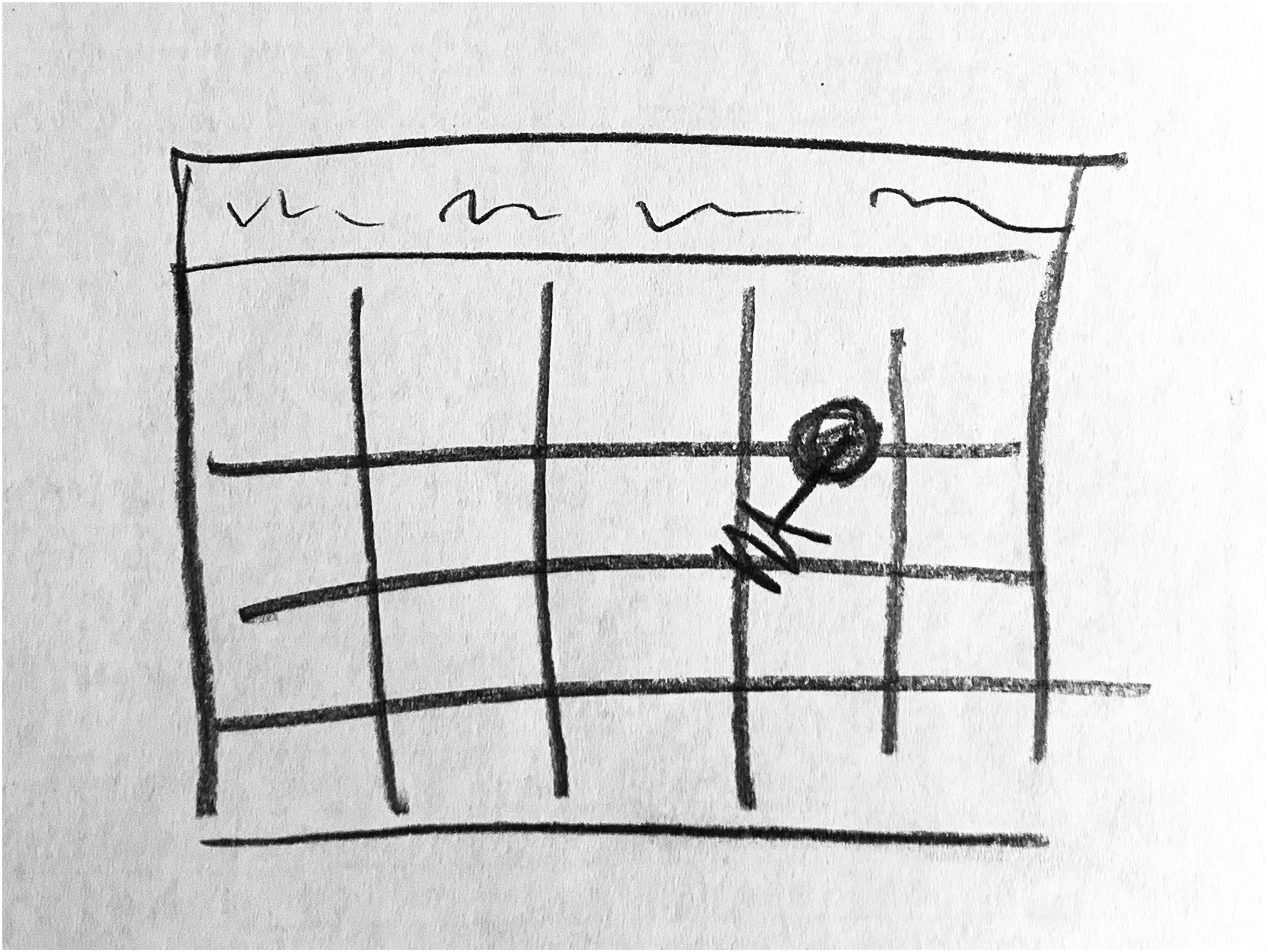
Gridded matrix.
Erin considered a push pin, as illustrated in Figure 1, ‘pinning down’ students to a certain fixed point on a grid: a ‘non-writer’, ‘troublemaker’ or ‘low achiever’ – predicted outcomes.
We think-with Puar's writing on intersectionality inspired by post-philosophies to wrestle with how we acknowledge that children are pinned down in violent and destructive ways both historically and currently while also allowing children room in schools to become differently or ‘unpinned’. The boingy, busting-the-grid thinking-sketching prompted us to resist static ways of pinning identities on a grid. We pause to consider how identities related to race, gender and dis/abilities, as well as additional reductive labels, produce children and literacies. Intersectionality, as a metaphor, Puar (2012: 59) asserts, ‘is a more porous paradigm than the standardization of method inherent to a discipline has allowed it to be’. Erin considers many of her former students from the upper grades – many who seemed to be ‘pinned’ to similar points on the ‘standard’ intersectional grid – who were labelled as ‘struggling reader’ or ‘struggling writer’, and what these identities seem to do/produce for children: defeat; fixedness; pressing down. With this in mind and Puar's and Massumi's inspiration, we think grids in early childhood/literacies – not only identity(ies) grids (e.g. often as binaries such as boy/girl, black/white, etc.) but also curricular grids; grids such as test grids, labels grids, sorting and tracking grids, level-books/children grids, curriculum-script-guide grids, and so forth. These grids – and how we interact with them – matter in how we think of identities and subjectivity, and thus we are motivated to ask: How can these early literacies grids un-happen, not happen or happen differently?
Grids (can also) open space for teachers/researchers to imagine otherwise. What if we did not have tracking and sorting grids, levelled books, children grids and testing grids? Or what if we did have grids but held on loosely – expecting movement rather than resignation? Could grids help us pin down a glimpse of now that does not pin students into permanent perceived outcomes? How might supportive pinnings open up sites of possibility rather than fixed trajectories, becomings that resist gridlock and instead support blooms? What if the curricular-identities grids are not necessarily a binary – ‘bad’ versus ‘good’? Rather, what might a both/and logic produce for children/literacies? Is it possible for test scores and labels to support a ‘split temporality of the present as both what we are ceasing to be and what we are in the process of becoming’ (Braidotti, 2019: 52)? Inspired by the quote by Puar (2012) towards the beginning of our article, we think of how intersectional identities (and grids) are ‘byproducts of attempts to still and quell’. How are we quelling children/literacies?
Hence, we are thinking beyond intersectionality or ‘after intersectionality’, inspired by Nash’s (2019) book title. This is not at all to say that intersectionality is unimportant, rather that a static matrix need not define students or pin them into rigid positions on a grid. A post-intersectional perspective opens up possibilities to shift the focus to relational becomings with materials and each other. Boing! Brief pinning-downs with the intent to propel.
Pushes & Pulls: research-writing stuckness
Stuckness. That is what this article has felt. Start. Stop. Go. Back in March we had some movement. Then some breaks. Now back at it. Rereading our abstract is exciting and I long for the time to get into the writing for this. We’ve been thinking/talking/reading for some time – we have a lot to say – let’s just write. Last year was a bit different – getting IRB [institutional review board] permissions [for a new school district], new [research] technologies in the classroom, then a pandemic hit. So, our research practices feel different. We don't have the same amount or types of data as in past research project years. Yet I think we have much to say based on our abstract and reading of new ideas, like from Puar. I think maybe we should each write a little about creatures, airplanes, and costuming … then think-with that writing and any ‘data’ we might pull in – then also put it in conversation with Puar, Nash, Keating and others on intersectionality.
(Candace, research notes, 20 April 2021)
What about all of the questions we’ve already been asking? (In the classroom, our meetings, our teacher hearts?) The events and exchanges with students to which we constantly return?
We keep bouncing back to the same encounters, the same researcher/teacher tensions. I was instantly smitten; I saw students’ faces between visits, fist-pumped as I typed field notes about students’ literacy desirings6 as they grew in boingy interactions with traditional writing, ideas, and each other.
(Erin, research notes, summer 2021)
Computers and books
It was the start of daily writing time and a handful of students took out their ‘computers’. A student took out the laptop made from black construction paper from their writing folder and opened the screen. The screen was blank. So was the keyboard. The students started to whisper: ‘Let's look at our Chromebooks’.
Before long, the (paper) computers were set next to the Chromebooks. The students were moving around the room to look at each other's computers and Chromebooks.
Do you have a white crayon?
Let's add a space bar.
Don't forget the power button!
I’m going to add letters … an R for my name!
What's this button?
For the next 15–20 minutes the students copied the layout of the keyboard from their Chromebooks to their ‘computers’ (see Figure 2). Other students used marks to act as the placeholders for each button.
Power off! It was the end of our writing time. The students closed their ‘computers’ and put them in their writing folders until the next day.
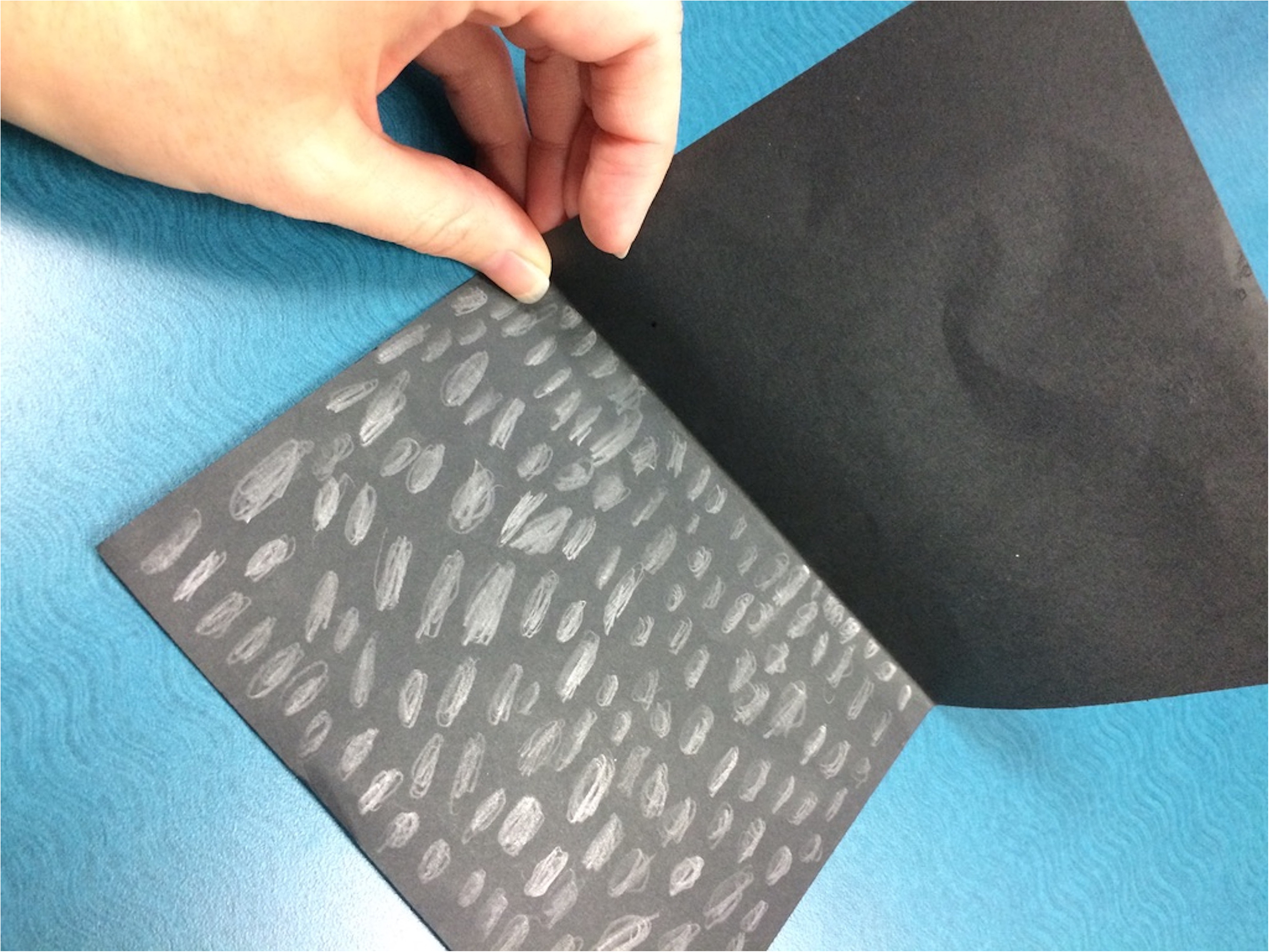
Paper ‘computer’.
Over the next few days, the students set out their ‘computers’. At times, the classroom felt like a manufacturing company as the students worked to make ‘computers’. At other times, groups of students sat at their tables, doing important work at their ‘computers’, typing away at their customised keyboards.
***
Across the room, Abrianna sat, hesitant to write, at least with school-valued literacies. She often wrote notes to her mom, using words familiar to her, such as ‘Mom’ and ‘I love you’. But one day, later in the year, she started to copy the book Woosh! (Melser et al., 1985).
Abrianna got several pieces of paper, folded them, and cut them to match the size of the smaller book. Then,
In this process, Abrianna became more excited about writing time and more confident as a writer. She sometimes chose to work on the book at other times in the day. She had a purpose during writing time. There was no brainstorming or questioning ‘What am I going to write today?’ Instead, she had confidence in her purpose; shifted into position, she started to emerge as a writer. Rather than hanging back, she bounced right in.
Pushes & Pulls: (re)presentation
There is friction in representation. Always. Honoring/exploiting, affirming/restricting always partial views, and what they produce. What harm might sharing labels do? Might sharing demographics and labels pin students down, reify stereotypes, a/effect narratives? There is tension in the weight of representation – yet might it help to share and celebrate the positional movement that is possible when we make space for dynamic learning and relations?
How much does caring for the child necessitate attention to the pinnings of the past, present, future? What might it produce to recognize positions, even as we seek to resist them in the motion of events?
In the (re)shapings and emerging of mobile positions, need we erase the subject(s) to center subjectivity? Educational labels and assessments, much like intersectionality, create tensions of both possibility and potential harm. On one hand, the ‘label’ may ‘pin down’ a glimpse of becoming-in-motion, in order to discern where additional support, space, or attention foster possibilities for movement; on the other, labels serve to pin individuals into place. We resist these flattenings. Temporary pinnings may help ‘boing’ students onto new trajectories; yet we must take care to tend and release these pinnings for productive movement. Dynamic relationships with materials/teacher/researcher/students … all are (re)shaping movement which resists pinning down.
(Erin, analytic memo, spring 2021)
Creatures and costumes
As the students were asked to clean up, Josh came to the meeting area with his hands folded sneakily in his lap. He had a new accessory for each finger.
Over the next few days and even weeks, other students huddled with Josh to admire, discuss, disperse and keep writing. Each time they returned to our meeting area wearing (and sneaking) bracelets and rings. Some tucked newly crafted swords into backpacks.
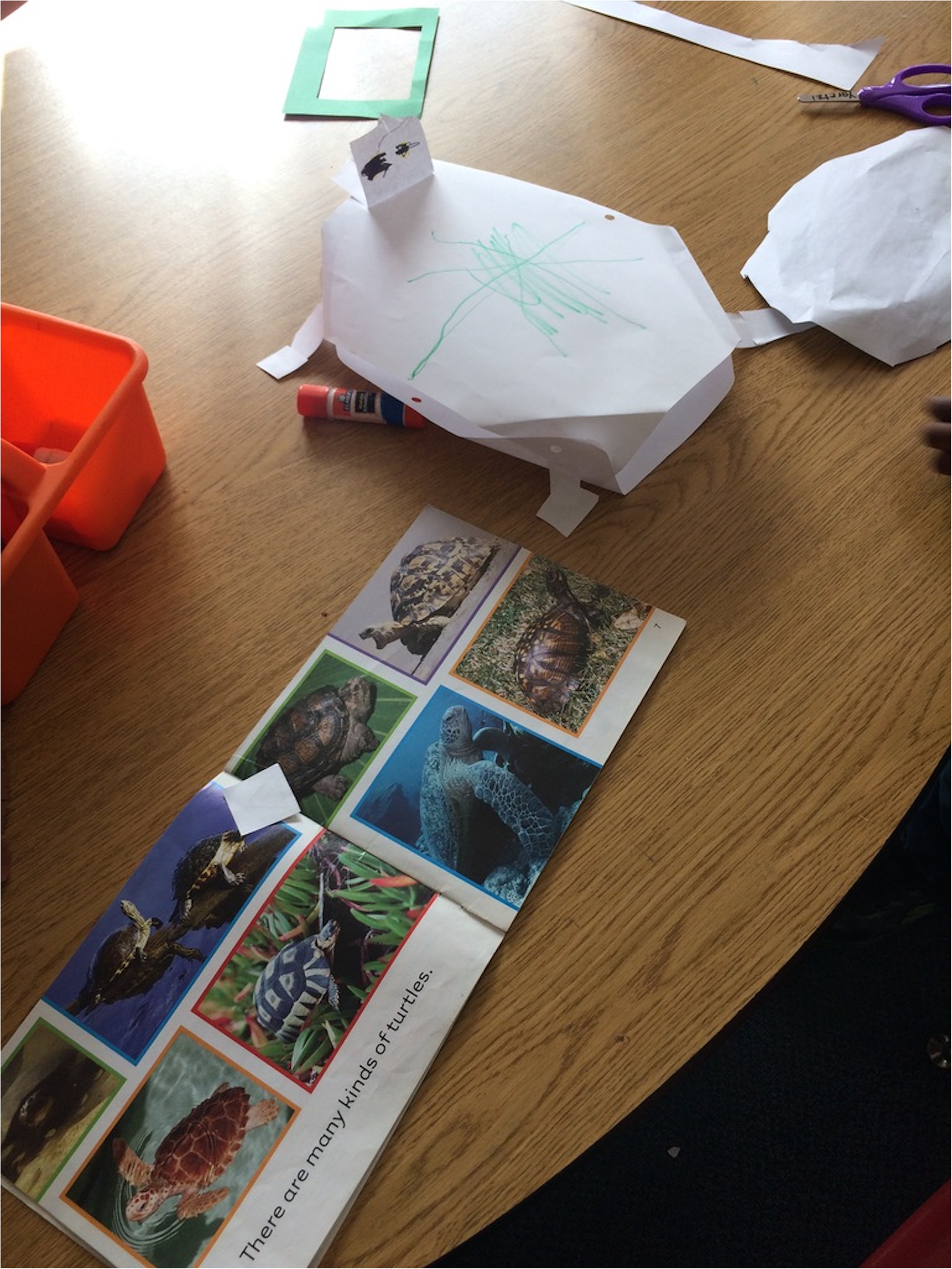
Jamar's three-dimensional paper turtle.
Pushes & Pulls: playful (re)shaping of literacies
Tara: What if all they are doing is making costumes?
Candace: Is that all that they are doing? Making costumes?
Tara: They need to be able to form letters and write.
Candace: What is happening as they make costumes or 3D animals?
They/we need time.
They/we need space.
They/we need materials.
They/we need time to be a writer.
These types of questions, sometimes unspoken, and when spoken often only meant for reflection, have been a part of Candace and Tara's collaborative research partnership from the beginning in 2010. The tension of ‘being a writer’ is real. However, what is often internal dialogue (example above), heard even when Candace is not physically present, helps Tara embrace students’ boingy-ness and to pose her own questions to boingy-ness. We keep coming back to the students and to our own pressures and tensions as teachers and researchers.
Pushes & Pulls: pinning down
Tara: Even before the school year starts, teachers often
start to gather information about their students.
Erin: If we’re not careful as teachers/researchers,
data can begin to pin students down.
Candace: An outburst in the hallway can (negatively) label a student
for all of the classrooms in earshot.
A red triangle on a data report
can identify a student as needing intervention.
Having a blank piece of paper at the end of writing time
can be thought of as resistance.
What if, instead of focusing on the pinning down
of students and data and objectives,
we embraced the ‘boingy’?
Pinning down students or labelling them is often reductive
and does not consider their subjectivity or coming-to-be.
As teachers/researchers, there is possibility in asking: What does the outburst/data/blankness tell us? But also: What does it not tell us?
What information might be missing?
Identity as eventness: intersectionality and beyond
We are grateful for the ways in which Crenshaw’s (1989, 1991) writings on intersectionality highlight the intersecting ways identities position and produce people. We are also drawn to scholars who extend Crenshaw's work in conversation with post-philosophical concepts. These scholars collectively point to opportunities to think- with/beyond intersectionality. Nash (2011: 5) describes intersectionality as an identitarian project and questions intersectionality's institutionalisation in practice as ‘intersectionality is inextricably linked to the production and maintenance of identity categories’. Puar (2012: 52) points to the method of intersectionality: ‘emptied of specific meaning in its ubiquitous application and yet overdetermined in its deployment, intersectionality always produces an Other, and the Other is always a Woman of Color’. We believe that bodies are more. Relations are more; they are not just an/Other, but a both/and – both unique and historicised and interconnected. Drawing on Indigenous feminist Chicana writings, Keating (2013: 6) highlights how oppositional politics built on identity categories of either/or logics keep us ‘locked into our already-existing opinions … in an inflexible ontological framework’ which ‘defines truth in narrow, rigid terms’. She explains that binary thinking limits activist-scholars in numerous ways and encourages us to consider relational threshold theories which foreground human (and more-than-human) interconnectivity while also attending to difference(s).
Identity and subjectivity are not interchangeable synonyms, although often we hear them used as such: Identity labels or categories are phrases often found in scholarship on social inequalities which is rooted in a Cartesian logic of binaries that perpetuates Othering (e.g. black/white, rich/poor, male/female, struggling reader/proficient reader). This philosophical orientation allows for one to stand outside of the Other. Or said another way, not be response-able for the perhaps inhuman ways Others are positioned and their lived realities. (Kuby & Gutshall Rucker, 2020: 17) ‘We’ – the dwellers of this planet at this point in time – are interconnected, but also internally fractured. Class, race, gender and sexual orientations, age and able-bodiedness continue to function as significant markers in framing and policing access to normal ‘humanity’. (Braidotti, 2019: 53)
These writings point to Puar's main argument: No matter how intersectional our models of subjectivity, no matter how attuned to locational politics of space, place, and scale, these formulations may still limit us if they presume the automatic primacy and singularity of the disciplinary subject and its identitarian interpellation. (Paur, 2017: 206)
Therefore, we must think identity and subjectivity differently: as movement, as boingy, as possibility, as eventness. Inspired by Braidotti’s (2019: 33) writing on critical posthumanities, ‘[s]ubjectivity is not restricted to bound individuals, but is rather a co-operative trans-species effort that takes place transversally, in-between nature/technology; male/female; black/white; local/global; present/past – in assemblages that flow across and displace the binaries’. While we are not quick to replace binaries (or identity categories) with something else that will normalise and perhaps do harm, we do aim to displace them in the hope of being, doing and producing a world differently.
Puar (2012), inspired by Deleuze and Guattari’s (1987) writing on assemblage, problematises a model that produces a constant order (i.e. fixed identity categories, labels, curriculums) to establish variations (i.e. intersections), favouring instead to foreground ‘variation to variation’ and hence the eventness of identity (58). Bodies and the liminality of bodies cannot be captured by intersectional subject positioning; (re)positionings and the liminality of learning cannot be pinned down by standard measurements. As teachers and researchers, perhaps we often write (and teach, think, analyse) children into static, concrete identities with the hopes of ‘fixing’ them. Drawing on Crenshaw’s (1989) writing, Puar (2012: 59) argues that ‘identification is a process; identity is an encounter, an event, an accident … Identities are multicausal, multidirectional, liminal; traces aren't always self-evident’. Identities are doings – a verb rather than fixed categories of Othering. As Braidotti inspires: The point of encounter or assemblage of the critical posthumanities acknowledges the porous nature not only of their institutional boundaries but also of their epistemic core, which gets redefined in terms of relational capacity. The driving force for knowledge production is therefore … the modes of relation these discourses are able and willing to open up to. (Braidotti, 2019: 44)
We embrace this invitation, alongside Keating's (2013) invitation to think-with threshold (relational) theories, to consider: What do the modes of relation between intersectionality and post-inspired subjectivity open up for educators?
What does it produce to maintain identity categories ? What happens when we think of humans in terms of labels and ranked positions? Or when we operate in oppositional ontological positions of either/or? How are children positioned as learners by educational theories built on identitarian politics? Inspired by scholars such as Braidotti (2019), Truman (2019), Murris (2016) and Snaza (2019), we acknowledge that children are not always seen as fully human and yet children with differing, particularly intersecting, identities may be seen as more or less fully (in)human than others. As Patel (2019) reminds us, while we need categories or labels in order to name and advocate for rights towards better lived realities, such categories can also serve as essentialising, fixed and static. Despite the critical intentions of intersectionality theory, identity categories in practice can also do harm. We are cautious to label positions and also curious about what intersectional thinking can produce in learning spaces. Puar (2012: 50) writes that ‘intersectionality as an intellectual rubric and a tool for political intervention must be supplemented – if not complicated and reconceptualized – by a notion of assemblage’. We agree. We need to supplement our current beliefs on intersectionality. We find so much about intersectionality important, necessary, challenging and critical in how we understand and live-into teaching children in a lively, more-than-human powered world. We want to honour these experiences and yet are hesitant to slip into the possibility of fixing children into ‘an’ intersecting identity label(s). What we hear from the scholars above is that the very identitarian politics that are intended to alleviate Othering have become operationalised, in some cases, to cause ongoing harm.
Frictional matterings
We enter this final section with invitations to think-with us as interlocutors in tension, continually (re)shaped by the interplay of experience, event-ness and theory. Puar's writings model for us an invitation to read and write with friction or to see what happens when different concepts and living in the world come into being together. Friction invites generativity to create affirming spaces. We wonder, alongside Puar, what intersectionality theory(ies) have produced for the academy? For people? For activist and/or research spaces? For our world? For our schools? While we are not claiming that early years teachers and/or schools have narrow or fixed ideas of children because of intersectionality theory, we do see practices in educational spaces that continue to pin down children. We hope that this article is a space to imagine what might happen if we think intersectionality alongside/with other perspectives on subjectivity and identity. What follows are generative frictions.
Frictional mattering: invitations as more-than-human with/in a human-centric space and the myth of a single curriculum trajectory
In a sense, children are looking to educators for permissions to be(come). They should not have to, and we should not have to offer these permissions but, as educators, we do enact power with/in a lively world – power to create space for explorations, to invite students’ interests and lines of inquiry with/in material enchantments, to spur the foment of ‘generative relational encounters and knowledge production’ (Braidotti, 2019: 51).
Students are positioned as the tellers of ideas, to pursue and apply multiple dimensions in experimental ways: Abrianna as confident writer, Jamar as caring maker, Josh as generous trendsetter. Materials beckon students to come and play; to bring thoughts, emotions and experiences into this arena; to personally connect with collaborative wonderings, readings and learnings. Said another way, the actual materials – paper, tape, glue, etc. – in relational processes with children, teachers, schools and so forth produce agency to undo students’ intersectional fixedness in the minds of others.
Why are literacies – costuming, computer-making, three-dimensional creatures, copying books – not happening and embraced more in classrooms? When students resist being pinned down by standard lesson plans, resistance is often perceived as disruptive to scripted curricular resources. Teacher manuals seldom (if ever) show three-dimensional creatures or paper shapings as examples of student writing. It is difficult to pin down student progress measured by a predetermined rubric when their writing moves, literally tailor-made to fit the event (e.g. Josh's costumes), possibly because it is unclear where students are going when students/materials move in unexpected or unknown directions. Even after more than 10 years of teaching and thinking literacies differently, Tara still has tension as this happens. Shifting the script is messy, tense and frictional. Perhaps that is exactly what educators need to do – lean into the (productive) tension. We challenge ourselves and students, and even you, the reader, to embrace the boingy and resist the pinning down – because this matters. It could change what school looks like for students, teachers, writing and … and … and ….
Frictional mattering: pinning down (response and resistance to) a binary humanist logic
This notion of pinning down seems to stem from a very humanist logic. The notion of the standards that all children need to know at particular dates, times or ages, in a particular order, is centred in a mind logic that splits from the body. We would also argue that most literacy curricular materials are often thought of in a humanist logic with a scope and sequence of what skills should be learned and by when. This humanist logic centres on children and predetermined benchmarks that originate (often) in western, white, man logics (see Snaza, 2019; Truman, 2019). Engaging in various post-philosophical concepts has opened up for us a response to a humanist logic of standards/curriculum. We advocate for resisting binaries such as mind/body or alphabetic/multimodal literacies that set up oppositions or a versus mindset. Rather, we find it generative to think that, yes, children need to know alphabetics and also they need multimodal literacies together – not either/or logics, but a both/and.
Frictional mattering: world-making and going off script
We acknowledge that some of the ideas in our article might create friction for readers – disagreements. We come back to the ethics and justice of our work: why it matters that we (re)think literacies. The rethinking of intersectionality with post-philosophical concepts forces us to reconceptualise publics and world-making, for early literacies and beyond. Nash's work inspires us as it beckons us to practise love as a labour of actively reorienting the self, to be configured in new ways that might be challenging. Thinking in new ways about children and literacies may be difficult, challenging, frictional, but we must enact a radical ethic of care (Nash, 2011; Puig de la Bellacasa, 2017) to imagine new publics and ways of being, learning and knowing together.
Nash (2011) writes of world-making as going off script together. Only through a willingness to table the gridded curriculum, to respond to students and make space for personal connections in the present, can we imagine or enact difference. When Tara and Erin went off script together to reshape the classroom for the initial ‘boingy’ lesson and workshop time, as described in the opening vignette, the event created new publics. Literacies proliferated and propelled in boingy ways as students’ self-perceptions, knowings and relations with/in the class were affirmed. The weights and oppression of social realities similarly require us to go off script as researchers; this shapes how we engage ‘data’ analyses, (re)presentation and thinking/writing practices. The ‘Pushes & Pulls’ precipitate, (re)turn to and elucidate tensions, which give a window onto our frictions, resistances and messiness in the becoming of this article, even as they propel us to imagine new publics and possibilities.
Frictional mattering: suspending an attachment to the present
Nash (2011: 18) writes that ‘intersectionality relies on an attachment – perhaps even a cruel attachment – to the present’. How do we focus on the present while imagining be(com)ing otherwise? Nash reminds us that black feminist love-politics is about the here and now, and yet it is also about moving on towards a future unfolding: Black feminist love-politics suspends this attachment to the present, recognizing that changing the grammar of our contemporary political moment will not remove us from the script that is always already in place … dream of a yet unwritten future … It is a critical response to the violence of the ordinary and the persistence of inequality that insists on a politics of the visionary. (Nash, 2011: 18)
Suspend – how might we, as early years educators, respond to the inequities, violence and (joyful) mundane everyday moments with ‘a politics of the visionary’? It must involve back and forth, space(s) to push and pull.
Both Puar and Nash point to the speculative future, that which ‘has yet to be known, seen, or heard’ (Puar, 2017: 216) and the ‘yet unknown’ (Nash, 2011: 16). Even as we (re)turn, we hold out hope for our students (past, present and future) and our world. In this future not yet known, we – collectively, relationally in this more-than-human world – must make space to imagine, to keep the child in (frictional) play.
Footnotes
Declaration of conflicting interests
The authors declared no potential conflicts of interest with respect to the research, authorship and/or publication of this article.
Funding
The authors received no financial support for the research, authorship and/or publication of this article.