




Abstract
This study discusses the differences between parents’ childhood games and their children’s game preferences. Four hundred and nineteen parents were surveyed to determine their play experiences as children as well as their children’s play experiences today. The results of the study indicate that there is a gap between the time spent outdoors by parents in their childhood and their children. Today, most children spend time indoors, usually playing computer games. The activities and games preferred by the children differed from those of their parents. Although the parents preferred mostly group games requiring group cooperation, competition between groups and physical activity, the children preferred more individualized activities such as cycling and playing in the park. The factors hindering children from playing outside are considered. Although most parents indicated that playing outside is beneficial for their children, they prevented their children from playing outside for reasons such as the dangers of being hit by a car or abduction.
Introduction
Games can be defined as entertainment with rules that enable individuals to have a good time while developing skills and intelligence. However, when games are considered in terms of child development, it is not appropriate to define games only as a means of ‘entertainment’. Games are as old as human history and have survived to the present day (Huizinga, 1995). Although games have a long history, documents mentioning games date back to only the 11th century, and scientific research on games is limited to the last century. With increasing amounts of scientific research conducted in the field of early childhood education, the amount of research focusing on games with children has also increased (Koçyiğit et al., 2007). In spite of the increasing amount of research, games and toys are areas that should continue to be scientifically explored.
In Turkey, the foundations of research focusing on children’s games and toys were laid in the 1930s with studies in the fields of folklore, psychology, and children’s education and development. Research in the field of folklore generally comprises compilations looking at traditional children’s games and toys, and this research was pioneered by the work Old Children’s Games in Anatolia, written in 1934. In the compilation work published by Gazi University’s Turkish Folklore Research and Application Centre 2007 which is Traditional Children’s Games Having Survived in Turkey, a total of 144 children’s games that are cultural heritages were reported. Through such works, researchers can follow the cultural changes that games and toys have undergone. Children have played these games using materials that are readily available in daily life, such as cloth dolls, beads, buttons, reels, hoops, iron and wooden sticks, ropes, belts, matchsticks, tiles, tissues, marbles, plastic pipes, swings, bottles, toys made of wood, stones, mallets, pegs and earth.
In parallel with the changing and developing world, games played by children have also been changing. Traditional games and toys have been generally replaced by toys made mostly of plastic and developed by the toy industry. While cloth dolls and metal cars used to be popular toys, today remote-controlled cars, dolls, robots and computer games have become more popular among children. Although these toys characterized by technology can contribute to the cognitive development of children, they can limit their social lives (Yavuzer, 1993).
Technological innovations, industrialization and urbanization have changed the areas where children play games, as well as the types of games played. There are two main reasons for this. First, changes in toys have led children to play in closed areas. As technological toys are not suitable for playing with in open areas, children generally play games at home and on computers. Second, technological changes, industrialization and urbanization have resulted in population growth and, accordingly, the construction of more houses. With increasing numbers of people, the neighbourhood culture of the past has been lost, and people have adopted lifestyles that alienate them from each other. Due to the security problems that can be experienced in such settings, families prefer their children to play in closed rather than open areas. Although this makes children physically secure, it cannot protect them from the social threats posed by technological toys. Children, who used to play in the streets, their gardens, empty sites between houses, parks and school playgrounds, are now restricted to closed areas. Children, who used to interact with their peers in open areas, now make virtual friends in online games.
Children’s games are not only about entertaining children; they have other important functions in children’s lives such as bridging the internal and external worlds of children. Throughout history, children have played games imitating adults and assuming their roles (e.g. mother, father, teacher). By playing group games, children can experience many skills required in social life, such as taking responsibility, job-sharing, competing and problem-solving (Moore and Wong, 1997; Rivkin, 1995). Games enable children to develop language skills, communication skills, societal awareness and social behaviours. Games played in open areas provide children with opportunities to explore the society in which they live, enabling them to learn about the world. Games have rules and children have to obey these rules to play them; thus, by playing, they can prepare for living in society as an individual.
Emotional sharing in children’s games is of great importance for the future psychological health of society. Children can experience many emotions, such as happiness, joy, sorrow, fear, anxiety, a grudge, hatred, love, dependence, independence and separation while playing games (Akandere, 2003). Hence, games are ways for children to learn about life. While playing, children are often very happy. Children’s emotional states can change very rapidly (Sargın, 2001). While crying, they may suddenly start to laugh, and vice versa. Children can learn how to control their feelings via games. While playing, children can reveal conflicts and problems without feeling the pressure of adults and the external world, and express their emotions. Many negative experiences of childhood can be overcome through games.
Games also contribute to the physical development of children. Playing with materials such as mud, water and sand or using different play materials for games develops children’s fine motor skills. While playing, children run, jump, hop and climb, developing their muscles and bones (Cooper et al., 1999; Noland et al., 1990). Games played in open areas also support the functioning of the nervous system and the brain, and can improve children’s learning skills (Gabbard, 1998; Hannaford, 1995; Jenson, 2000). For the healthy development of children, games are as indispensable as nutrition, love and care.
There is a limited amount of research investigating the games and toys preferred by parents and their children. Investigating changes in the preferences of parents and children over time can help to determine long-term trends. The purpose of this study is to identify the game preferences of primary school children and their parents when they were children.
Method
Parents were invited to complete a questionnaire adapted from Clements (2004). The items included the following:
Age of parents
Current residence of parents
Parents’ residence when children
Number of children
Features of sites where parents played as children (closed/open)
Time spent playing outside by parents during childhood
Games played by parents in open/closed areas as children
Benefits of playing in open areas for parents
Features of sites where their children play
Time spent by their children playing outside
Games played by their children in open/closed areas
Benefits of playing in open areas for children
Obstacles preventing children from playing outside
Items related to their children’s game-related experiences followed items aiming to elicit parental childhood experiences. Permission to undertake the study was granted by the Directorates of National Education and the principals of the schools visited. Meetings with parents were then held, where they were informed about the study and invited to complete the questionnaires. The questionnaires were completed at home, returned to the school principals, and then collected by the researchers.
Study group
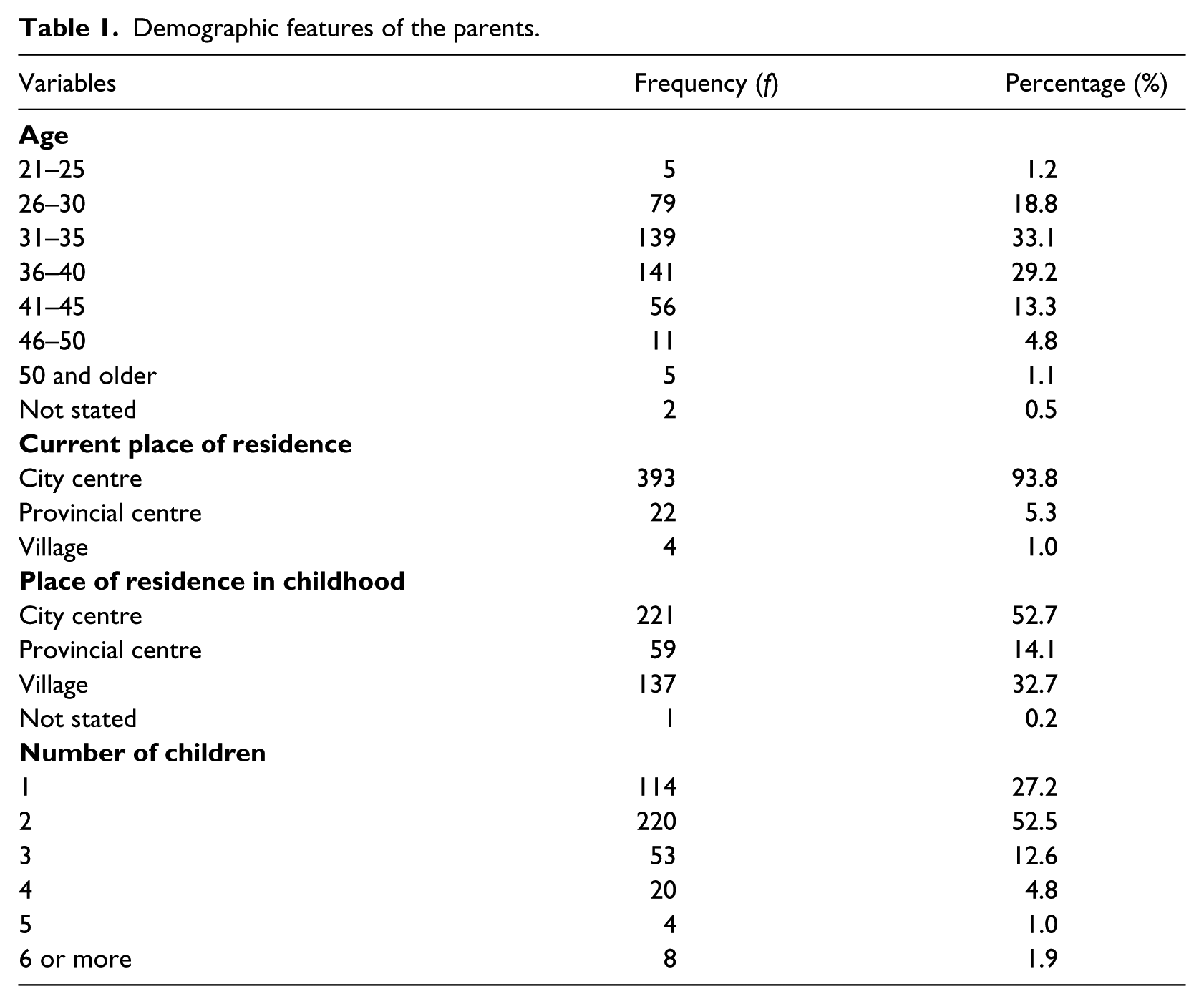
A total of 419 parents of children attending primary school participated. Their ages ranged from 21 to 63. Most parents were in the age groups 31–35 (f = 139; 33.1%) and 36–40 (f = 141; 29.2%). When the parental responses to their current place of residence were examined, 393 lived in city centres, 22 lived in provincial centres and 4 lived in villages. Responses to their place of residence as children revealed that 221 lived in city centres, 59 in provincial centres and 137 in villages. Most parents had one child (f = 114; 27.2%) or two children (f = 220; 52.5%) (see Table 1).
Demographic features of the parents.
Findings
Amount of time spent playing outside by parents as children was more than their children
Parents were asked how many hours they spent playing outside when they were children and the amount of time their children spend playing outside. Most parents (395; 94.3%) stated that they spent more time playing outside than their children, and that they used every opportunity to play outside after school and at weekends. The other parents (24; 5.5%) stated that they spent less time playing outside when they were children than their own children. When asked how many hours per week were spent in open areas when they were children, the responses ranged from 1 to 84 hours. Fifty participants (11.9%) stated that they spent 6–10 hours per week playing outside; 63 (15.0%) spent 11–15 hours; 32 (7.6%) spent 16–20 hours; 51 (12.2%) spent 21–25 hours; 65 (15.5%) spent 26–30 hours; and 47 (11.2%) spent 31–35 hours. The amount of time spent outside by their children ranged from 1 to 54 hours. Of the participating parents, 158 (37.7%) stated that their children spent 1–5 hours playing outside per week; 117 (27.9%) said that their children spent 6–10 hours playing outside; and 64 (15.3%) stated that their children spent 11–15 hours per week playing outside. Figure 1 shows that the amount of time spent by children playing outside is much less than that spent by their parents in their childhood.
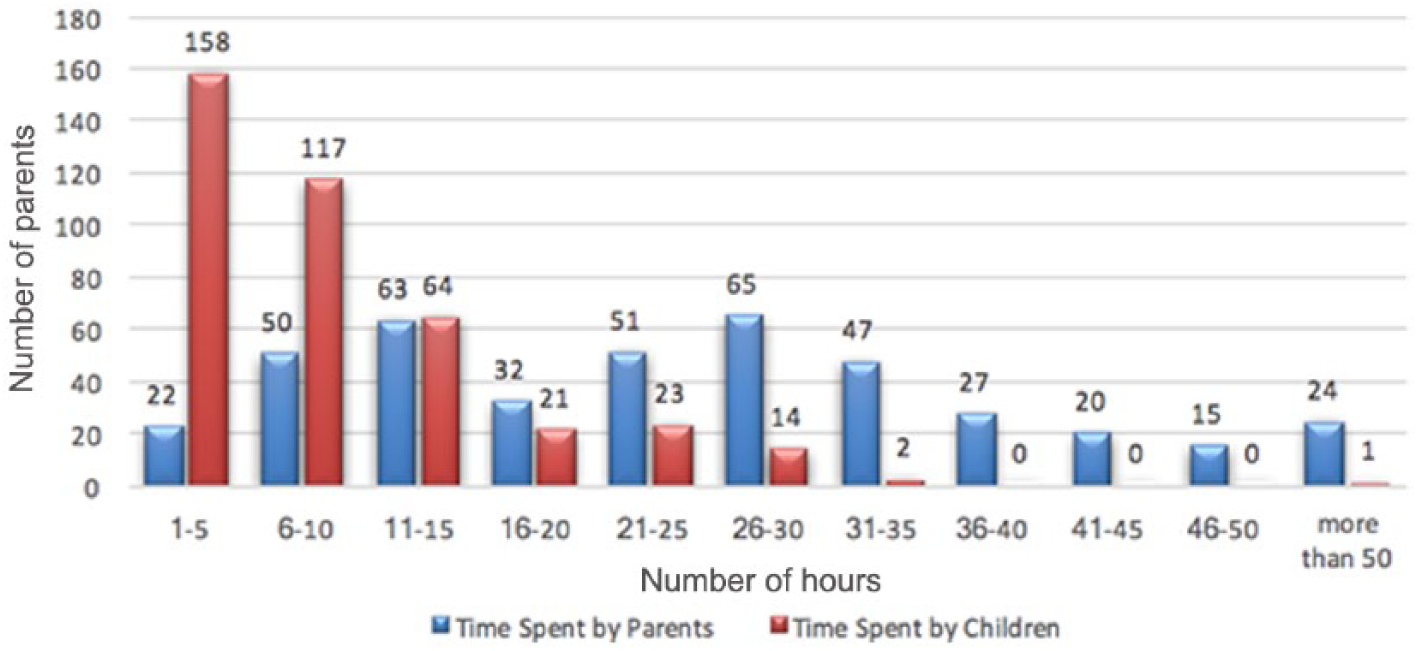
Amount of time spent by the parents and their children playing outside.
Changes have occurred in the amount of time spent outside by children. Today’s children spend less time playing outside than their parents. This might indicate that children are more passive than their parents and spend more time in closed areas such as their homes. This could result in some physiological (e.g. obesity; see Dietz, 1999; Pica, 2003) and psychological concerns (e.g. aggression, loneliness, poor communication skills).
Activities and games engaged in by children differed from those of their parents
When the games played by the parents were examined, a total of 55 different games was detected. Among these games, those most frequently mentioned are shown in Table 2.
The most commonly played games by the parents in open areas.
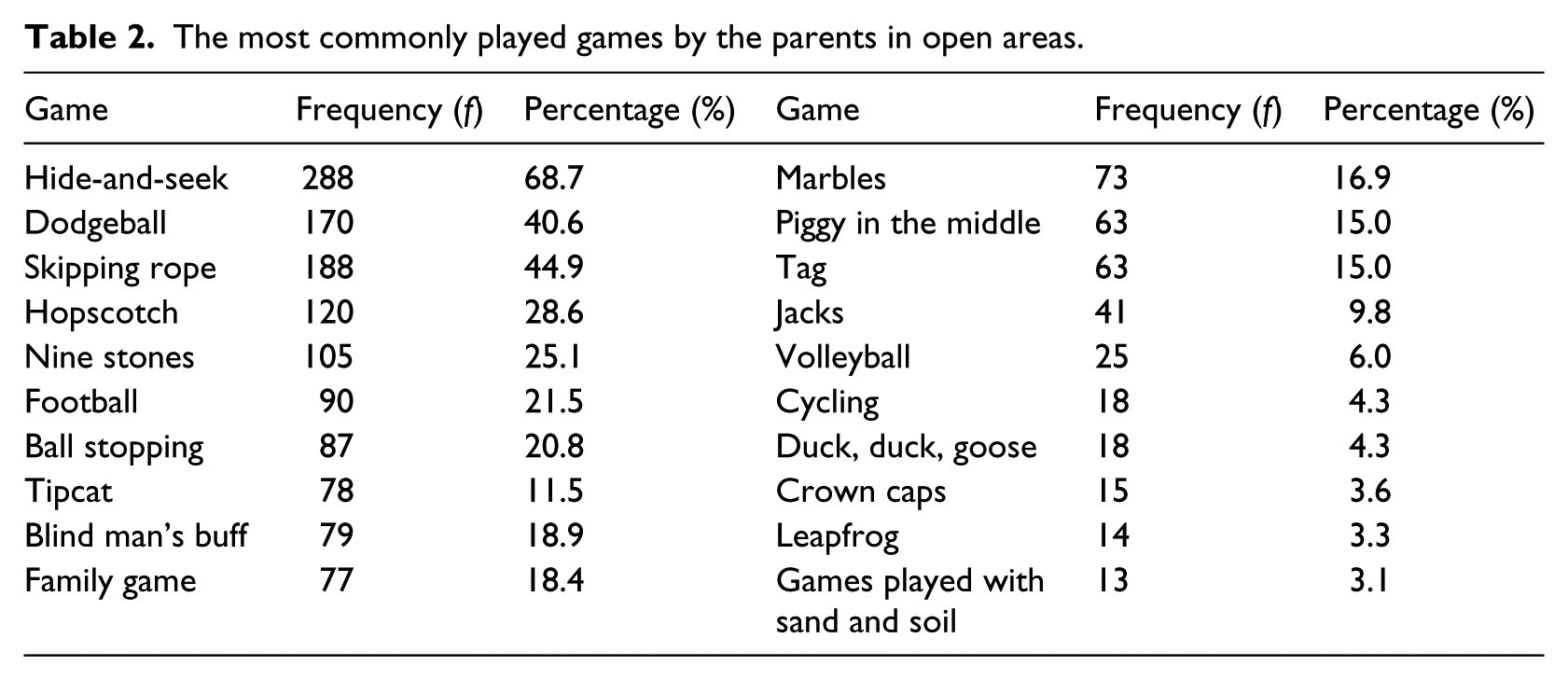
Table 2 shows that the games played by the parents were mostly group games requiring cooperation among group members to win, and that most involved between-group competition and physical activity. Nine (2.1%) parents stated that they played with toys outside. Most of these games required simple materials that were easily available. Although not played as commonly as those in Table 2, other traditional games played by parents during their childhood that were mentioned included: lover (f = 3; 0.7%), I saw the moon (f = 6; 1.4%), tally stick (f = 1; 0.2%), dahlia (f = 1; 0.2%), cone (f = 1; 0.2%), well-digging (f = 3; 0.7%), bone with milk (f = 2; 0.5%) and leapfrog (f = 14, 3,3%).
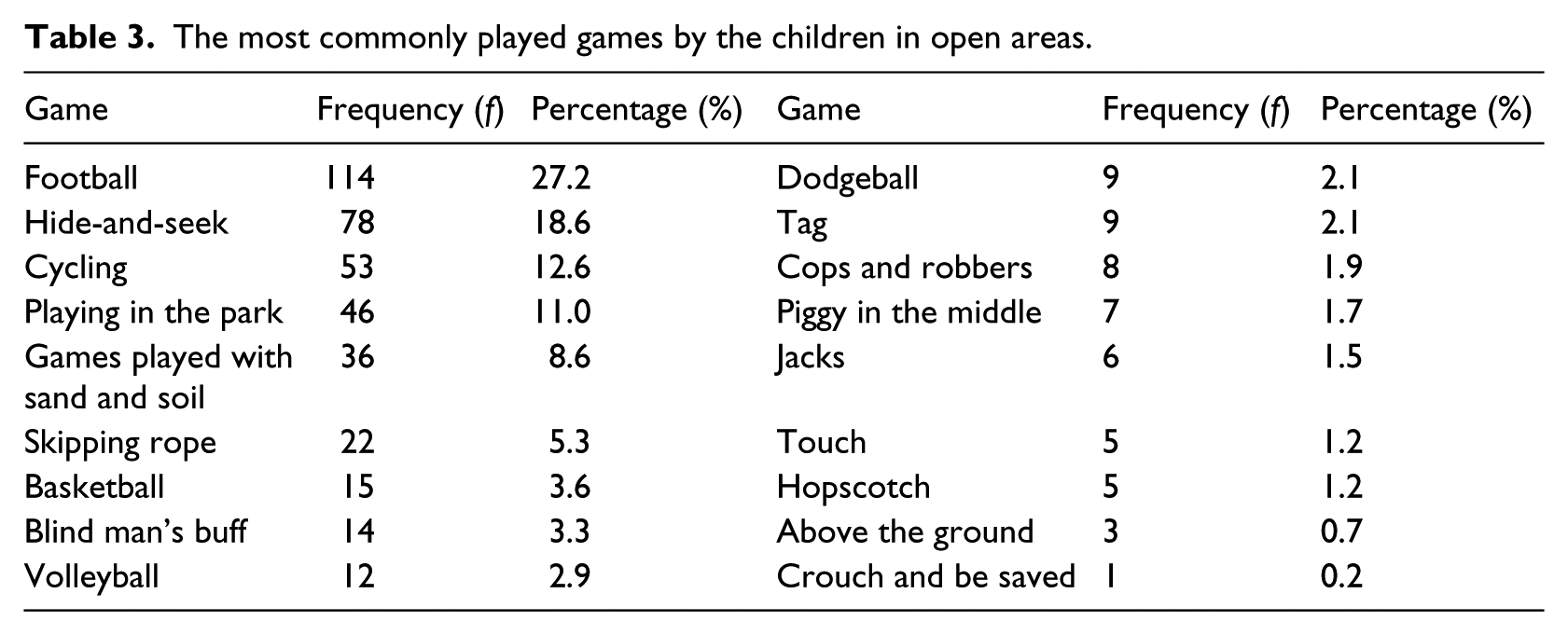
The children played 18 different types of games in open areas (Table 3); compared with the number of games played by their parents, this number is quite small. Football was the game most commonly played by the children (f = 114; 27.2%), and the frequency of cycling (f = 53; 12.6%) and playing in the park (f = 46; 11.0%) was notable. The increase in cycling could be related to the children’s preference for more individualized games than their parents. The increased frequency of playing in the park can be associated with the increasing number of parks and parental desire for children to play in more secure places. With the increase in population levels, the perception of the neighbourhood has changed over time; cities are crowded with high buildings and, due to the increasing amount of traffic, streets are no longer play areas. Although there are some similarities between the games preferred by the parents and the children, the decrease in the number of traditional games played by the children is worrying.
The most commonly played games by the children in open areas.
Today’s children spend most of their time in closed areas
While 92.4% (f = 387) of the parents stated that they spent most of their time outside when they were children, 74.0% (f = 310) of their children spent most of their time in closed areas. The parents indicated that they played a total of 39 games in closed areas, with the most preferred being family games (f = 182; 43.4%), playing with toys (f = 35; 8.4%) and hide-and-seek (f = 21; 5.0%). Less popular were jacks, blind man’s buff and hiding a ring. The number of games played by their children in closed areas was 18. The children spent most of their time playing computer games (f = 208; 49.6%), but also painted and played with Lego, and played family games, Monopoly and ludo. The variety of the games played by children was much smaller than the games played by the parents when they were children. The toys and games preferred by children in closed areas provide clues about their daily lives. Preferences for computer games and other more passive games may be an indication of sedentary living.
Many factors hinder children from playing outside
Children spent most of their time indoors, mainly in a passive manner. The parents indicated that there were many factors preventing children from playing outside (Table 4), with the most common being fear of the child being run over by a car (f = 234; 55.8%). Parents worried that children might fall, get lost, pick up bad habits or become ill. Fear of child abduction was also frequently expressed (f = 227; 54.2%), with trusting strangers a problem.
Factors preventing children from playing outside.
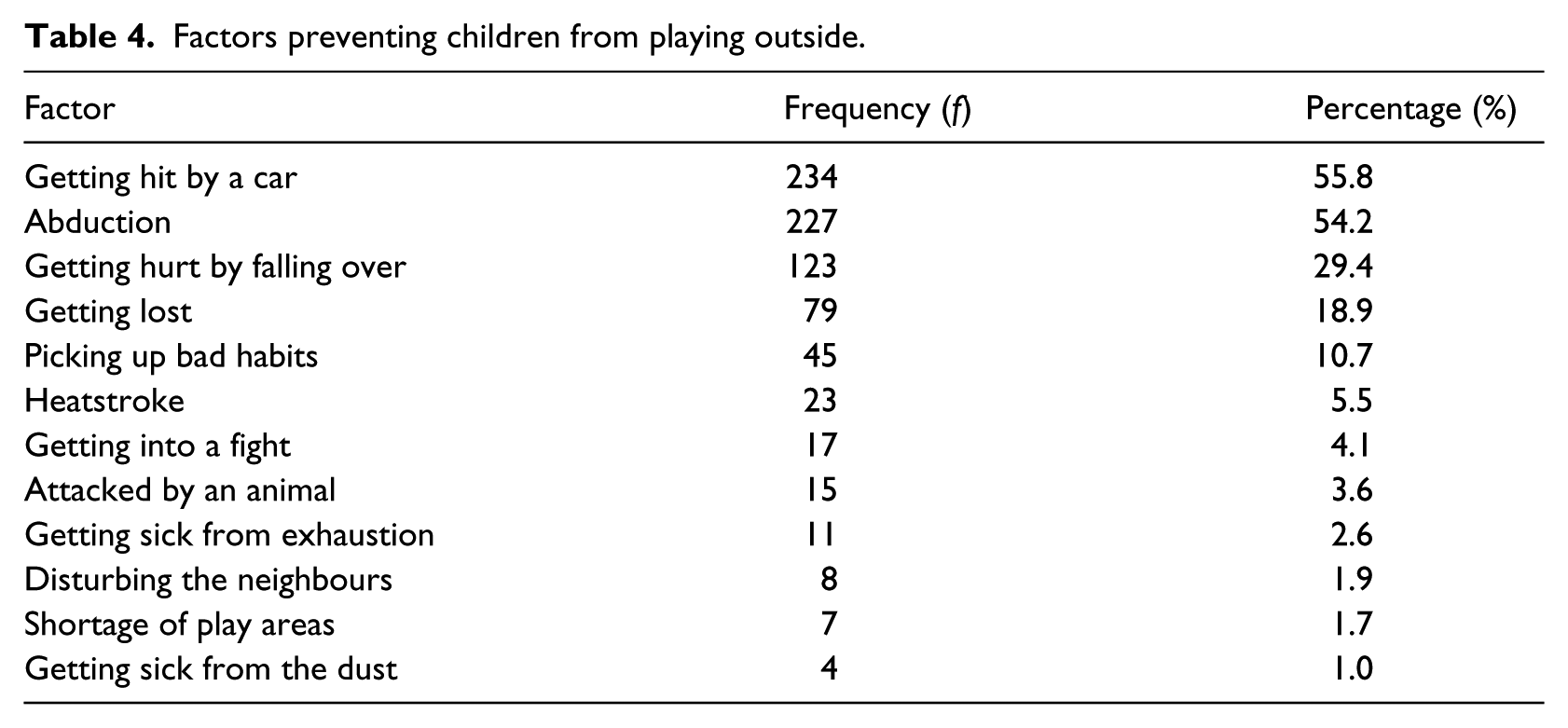
These results are important for parents, teachers and policymakers. Although parents worried about their children playing outside for security reasons, games played indoors can involve dangers. Some computer game, Internet and television content involves violence or bad habits/behaviours. Keeping children indoors does not necessarily mean that they are physically or psychologically secure. Teachers and policymakers could attempt to make open areas (school playgrounds, parks and streets) secure for children.
Parents think that playing outside will benefit their children
When the parents were asked whether playing indoors or outdoors would benefit their children, 93.8% (f = 393) responded that playing outside would be beneficial (see Table 5). The parents stated that, when playing outside, children can breathe clean air, be more physically and psychologically healthy, and develop better social communication skills. They consume more energy and thus feel less stressed and sleep more comfortably. As the games played outside are usually fictional, they can enhance children’s creativity. Culture transfer from generation to generation is also realized with games played outside.
What is more beneficial for children – playing inside or outside?
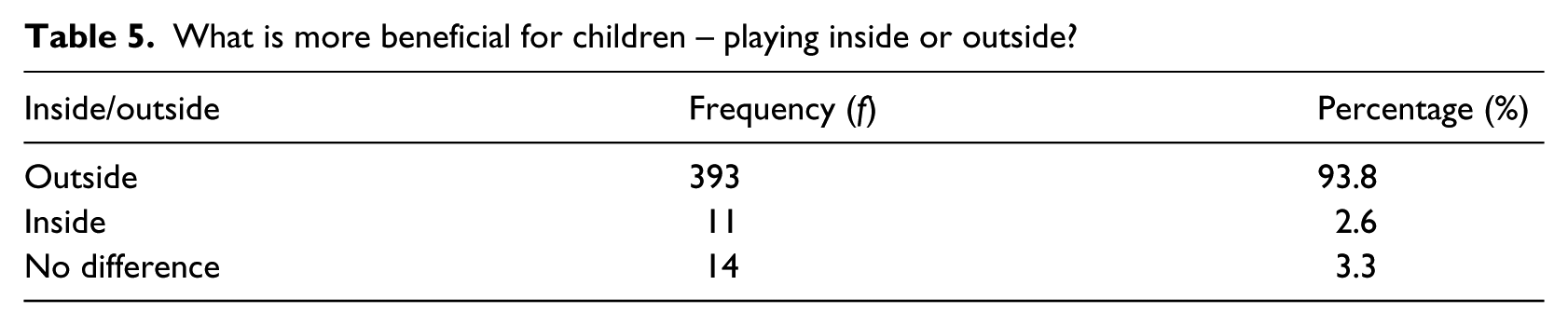
Although most parents stated that playing outside was more useful for children, little time was spent outside.
Results and discussion
Dramatic differences occurred between the time spent and the variety of games played by the parents as children in open areas and the time spent and the variety of games played by their children in open areas. Most indoor time was spent playing computer games, which is quite worrying. Children introduced to technology at early ages can be technologically literate and competently use different technological tools at later ages. Ironically, hands that cannot hold pencils can play any type of game on touch-screen tablets, mobile phones and computers. While computer games can improve children’s problem-solving, creativity and critical thinking skills, they might weaken their communication skills and result in some psychological harm. Time spent on computers can also affect children physically in terms of sedentary lives, and can potentially reduce communication between family members.
Games in cities and the fact that games played indoors differed from games played outside could be considered within the context of rapid urbanization. In addition to school gardens and parks, streets could be included as sites for play, although parents opposed them because of traffic and security issues. Due to its physical features and closeness to the home, the street is an important source of innovation and an attractive place for children to play.
Playing outside is useful for physical and spiritual development, and empty spaces could be allocated for children to play and parks built between neighbourhoods. Spaces could be allocated for children to use bicycles and skateboards, and safety precautions could be instigated, including teaching children about protective behaviours. Physical activity could also be increased in schools.
Footnotes
Funding
The authors received no financial support for the research, authorship, and/or publication of this article.