




Abstract
Historically, ‘free play’ in many European heritage communities has been a valued practice. However, political imperatives have challenged these beliefs and necessitated a more academic curriculum to raise standards, resulting in a ‘push-down’ curriculum. By contrast, many Asia-Pacific communities have increasingly included play in their curricula and discussed the benefits of imagination and creativity. Contradictions and tensions associated with the differing perspectives on the value of play present themselves when families move countries. This is evident in some international schools, where a diversity of families and differing play and academic practices interact. In order to understand this complex problem, cultural-historical theory was drawn on to investigate three expatriate families as the children transitioned into a Malaysian international school context. An analysis of digital video recordings (90 hours) of everyday life of the children at home and in school, and interview data of parents and teachers, found that an increase in a child’s academic competence was associated with a change in motive orientation in the family home from play to learning. Unexpectedly, play practices in the home turned into academic learning activities, which the authors have termed a ‘push-up’ curriculum, supporting the learning agenda of the international schools.
Introduction
The Organisation for Economic Co-operation and Development’s review of early childhood research and policy practices across a broad range of countries suggests that whilst the benefits of play are recognised, the relation between play and learning is not well understood. The review suggests that naming and segregating different types of play such as social, pretend and object play for different developmental purposes may lead to play being situated outside of the curriculum (Organisation for Economic Co-operation and Development, 2012: 92). The Organisation for Economic Co-operation and Development draws attention to the lack of research and the diversity of views on play, including differing play practices afforded across countries when conceptualising play and learning together (e.g. Ridgway et al., 2015). Some countries have sought to combine play and learning through using explicit names, such as China, where the term ‘eduplay’ is used (Rao and Li, 2009), Singapore, which has ‘purposeful play’ (Sim, 2015), and Sweden, where the ‘play-learning child’ is discussed (e.g. Pramling Samuelsson and Asplund Carlsson, 2008). Other countries have specifically foregrounded play as ‘child-initiated’ or ‘adult-guided’, and play as ‘technicist/policy-driven’ (see Wood, 2014) in order to clarify the relations between play and learning.
There appears to be a growing tension globally surrounding the need for a renewed focus on play in Western contexts (Dahlberg and Moss, 2008), where academic achievement in the early years is foregrounded (Bodrova, 2008). However, a new focus on play in the Asia-Pacific region has been noted, where academic achievement has always been important. It seems that most governments require quantitative assessment of performance in the early years, which relates to the amount of investment provided for early childhood education (e.g. the British National Curriculum’s Foundation Years and Key Stage 1). However, these results-based systems focus on literacy and numeracy skills (Thompson and Raikes, 2007), and are the antithesis of play-based pedagogies, which focus on learning through child-led creativity and imagination. Bodrova (2008) argues that a challenge exists for early childhood educators in Western contexts to teach academic skills to increasingly younger ages, with less time for creative and imaginary play, whilst in some Asia-Pacific countries the challenge is how to introduce play into an academic curriculum (Rao and Li, 2009).
Concerns about what constitutes a play-based program that also supports learning have been on the rise. Research by Christie and Roskos (2006) questions the academically oriented preschool programs, arguing that they do not guarantee future long-term academic success and may instead increase challenging social and emotional issues in some children. In addition, concentrating on academic skills ‘undermines the development of children’s creative skills … social participation and sharing’ (Pui-Wah et al., 2015: 1840). What is evident in the European heritage and North American literature is a technicist/policy-driven approach to play and curriculum (Wood, 2014). This is less well understood in the Asia-Pacific region because of what we have termed the ‘push-up’ curriculum, where play practices in the home turn into academic learning activities, resulting in support for the learning agenda of the international schools.
Despite the growing interest in children’s play and learning, most studies concentrate on Western perspectives of play, and little is understood about how playful learning is being introduced in regions such as the Asia-Pacific. Only a few studies highlight the culturally specific nature of play (see Goncu et al., 2007) or argue against the universal view of play (see Wood, 2014). When taken together, these studies suggest that there are not only different perspectives of play, but also differing play practices in preschools within and across countries. Little attention has been directed to finding out how children experience play in the Asia-Pacific region, and even less is understood about how children who move into these regions and attend international schools experience a playful learning program, where differences rather than similarities of views on play and learning are likely.
In order to better understand this complex problem, we studied the playful learning experiences of young expatriate children and their families who had recently arrived in Kuala Lumpur, Malaysia. The current study, which forms part of a larger research project, seeks to examine motives in relation to play and learning at home and in the international school. The cultural-historical concepts (Vygotsky, 1987, 1998) of motives and demands (Hedegaard, 2002) were drawn on to understand the dynamic changes in play practices observed in the family home as a result of the more formalised play practices encountered by children as they entered school for the first time.
Separating home and school play and pedagogy
In existing studies that provide the background for the present research, four key research outcomes are evident. First, there is extensive cultural-historical literature that discusses the importance of the family in the child’s early years (Hedegaard et al., 2008; Ridgway et al., 2015) and different values afforded to play in homes and across cultures. This literature acknowledges the role of the family and the significant role adults have in supporting learning and development (Fleer, 2015). Siraj-Blatchford et al. (2002) synthesise findings of historical studies and, combined with their longitudinal research, found that parents have an advantage in their pedagogical practice in the home. The parent has knowledge of the child’s interests and experiences, which may initiate positive pedagogical exchanges. Further, at home, the child has agency over her/his learning and the parent may be a source of information for the child’s interests. By contrast, Maddock (2006) found that when parents are play partners with their children, they have a purpose in mind, often linked to their own agenda, emphasising the unequal relation between the parent and the child. Parmar et al. (2014) cite cultural differences in the way play is valued in the home. For example, Euro-Americans in the study value play for its educational benefits. By contrast, Asian-American parents in Parmar et al.’s study held little value for play, instead taking on the role of educator and directing their children to structured academic learning. Wong and Fleer (2012) support these findings in their study of Hong Kong families with children growing up in Australia. These studies provide commentary on the importance of play for some families, and the different values afforded to play and learning in homes across cultures.
Second, the varying values afforded to play in relation to learning across homes are mirrored in early childhood centres and schools. There are studies based in schools that focus attention towards the challenges that educators may have when taking into consideration the child’s past learning and whether or not play is valued in the home (e.g. Brooker, 2002). The differing perspectives on the value of play at home and school may prevent some children from experiencing the same or similar values across these institutions (Maddock, 2006). Adding to this are teacher expectations, which influence the curriculum (Brooker, 2002), and whether learning is play-based or is presented with a structured academic focus. According to Pramling Samuelsson and Johansson (2006), play and learning in schools have traditionally been viewed as unrelated. Play has been viewed as a free and joyful experience for children, with little educational value, where educators are not usually involved. By contrast, learning is structured, organised by the educator and presented through learning-focused activities. In a more contemporary view based on Vygotsky’s (1966) cultural-historical theory, play and learning are inseparable (see Fleer, 2015; Ridgway et al., 2015).
Third, it has been noted that in Western literature there is some evidence to show the importance of continuity between the home and early years setting in supporting children’s learning (Billman et al., 2005). For instance, in a study of children as young as three moving into a new country and attending an international school, parents initially found it challenging to support their children at home and school while organising family life in the new country (Adams, 2014). Initially, there was little continuity between the home and school; the constant changes in the family situation contrasted with the routines of the classroom (Adams, 2014). In other literature, there is a focus on the importance of a positive partnership between families, schools and communities, which provides positive learning experiences (Hand and Wise, 2006; Siraj-Blachford et al., 2002). Billman et al. (2005) discuss the importance of open communication between parents and the teacher: when parents know the content of the curriculum, they are better able to support the child’s learning by encouraging discussion at home. However, this may prove challenging if families are moving into a country where communication channels between the home and school are not well established.
Finally, these studies collectively suggest the importance of close relations between the home, teachers, school and community to avoid cultural dissonance (Ali, 2008; Billman et al., 2005) or tension due to possible differences between the practices and values of the home and the school. Brooker (2002: 11) argues that this type of tension may cause a ‘mismatch or discontinuity’ between the home and the school. According to some researchers, many children adjust successfully to the disparate situation (Hand and Wise, 2006). By contrast, Ali (2008) suggests that dissonance can have a negative influence on children and their relationship with their parents, as it may instigate conflict and confusion within the family (see Hedegaard, 2011). Billman et al. (2005) suggest that communication be open between educators and parents, and that teachers need to develop, preserve and continually work on relationships with parents for the child’s learning to be optimised. Studies focused specifically on the alignment in practices between home and international schools for families moving countries could not be found. More research is needed in this area in order to ascertain how the alignment of play and learning practices in the home and the early childhood international school supports or provides an added challenge for families who move countries.
Positioning the study
The central aim of the current study was to examine the changing motive orientation of the children in relation to play and learning, and the effect this has on the families and children at home. The research has therefore been framed to investigate the following two questions: How do adults create the conditions for their child’s play and learning at home during their international transition into Malaysia? How does everyday life across institutions (home, school and after school) affect a child’s motive orientation to play or learn?
Central concepts guiding the study design
The theoretical origins of the current study are based on Vygotsky’s cultural-historical system of concepts for conceptualising child development (Vygotsky, 1987, 1994, 1998) and the contemporary concepts of motives and demands (Hedegaard, 2002; Hedegaard and Chaiklin, 2005) as analytical concepts for understanding how a change in motive orientation can signal a change in a child’s development. A cultural-historical reading of motives foregrounds the child’s intentions in the context of experience and practices found in the home and school settings (Hedegaard, 2002; Hedegaard and Chaiklin, 2005). This concept is useful for the present study because it makes visible the intentions of the child in the different practice settings of the home or school, which may create new possibilities for a child’s changing motive orientation.
Hedegaard and Chaiklin (2005: 64) have conceptualised motives as ‘the dynamic relation between person and practice [where] motives are conceptualised as culturally created through practice’ – as we might see when children enter school and change their orientation from play to learning. In the context of this study, a child’s original orientation from playing at preschool through a play-based learning curriculum to being positioned as a schoolchild learning to read through a structured academic-focused phonics program at age three could lead to a new motive for learning. In this theoretical perspective, when moving across settings (home to school), a child may develop different motives (Leontiev, 1978), where there is a need for a child to prioritise participation in various activities, leading to a new motive orientation. The child’s earlier motives do not disappear, but are rearranged. Motives are dialectically related to play and learning.
A motive orientation is focused on intentions, needs and desires for particular actions (Hedegaard and Chaiklin, 2005). This includes the dynamic situations found in local practice such as classrooms, where a teacher may orient a child towards a new learning goal (Hedegaard, 2008). Hedegaard et al. (2008) draw attention to children’s motives through an example in which an educator introduces oil and water to children playing in a sandpit. The children direct their attention towards an imaginary scenario of cooking ‘meat’ (leaves) with the oil. The teacher asks the children to mix the oil and water in order to find out what occurs. The children mix the oil and water as requested by the educator and quickly refocus their attention to play, cooking the ‘meat’ with the oil. The children’s motives are directed towards using the oil in an imaginary situation to cook the ‘meat’, whereas the educator is directed towards the children learning about the scientific concept of oil floating on water. In this example, the children’s motive is to play and the children expand their experience with cooking oil. However, the resulting activity did not support the type of scientific thinking that was framed by the educator.
Chaiklin (2012: 212) argues that concepts like motive and motive orientation are not ‘the property of a person, or something that drives, causes, or determines action’. Rather they are culturally constructed in families and communities, illustrating the possibilities of an individual and collective motive orientation. When different motive orientations are planned as part of school practices, which are potentially different to those experienced as part of the family routine, a dynamic context emerges that can create cultural dissonance. Examining the child’s intentions and actions as part of the practice traditions experienced across school and home can give new insights into understanding the outcomes of the pedagogical conditions created in international schools and the affect this may have on home practices.
The child’s ‘interest in a situation is the beginning point for the development of a child’s motive’ (Hedegaard, 2002: 21), combined with the ‘demands [of] the institutional practice’ (Hedegaard et al., 2008: 20), which support the child to form a new motive orientation through participation. As a child enters a new social situation such as an international school, a new motive orientation may develop (Hedegaard and Chaiklin, 2005). Therefore, a child’s changing motive orientation is interwoven with changes in social relations, new activities, the demands inherent in the changing situations, and the child’s developing cognitive capacity (Hedegaard and Chaiklin, 2005). The child’s intentions in the new practice tradition of attending an international school at the age of three, examined through the analytical lens of the child’s interest in the learning program and/or formal play practices, give insight into the child’s motives and how the teacher or families create the conditions for developing a new motive orientation towards formalised learning.
Sample
The larger study sites consisted of international schools, playgrounds, swimming pools, outdoor markets and the homes of expatriate families who had recently relocated to Kuala Lumpur, Malaysia. In total there were five families, seven teachers and three principals involved (Adams, 2014; Adams and Fleer, 2015). Observations of three families form the basis of the present report. These children and families were chosen as it was the children’s first experience entering into full-time school; only these three families are included in Table 1. There were socio-economic similarities between the families, as the fathers all worked as managers for multinational companies. Due to work commitments, including travel, the fathers were mostly absent during the data-gathering. The mothers were positioned as the main caregivers for the children. Further, it was challenging for the mothers to obtain work visas due to the arrangement between the Malaysian government and the multinational companies that employed the fathers.
Participants’ summary.
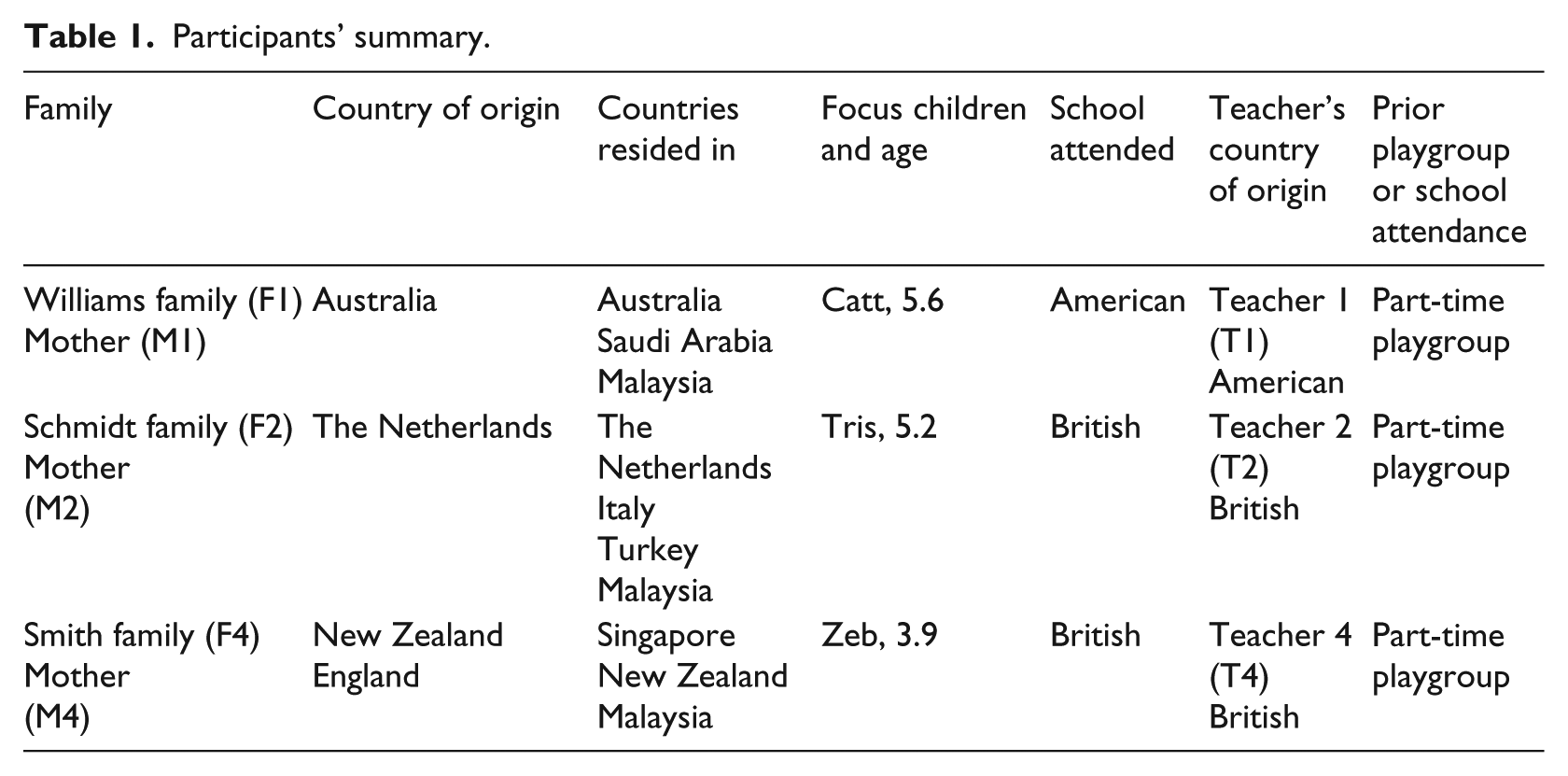
When choosing a school, all of the families cited ease of access to the school, either by school bus or family car, as a major determining factor. In addition, Family 1 (F1, Catt’s family) were Australian and chose the American international school, as the two older siblings had had some challenging issues occur at their previous school, which was based on the British curriculum. Family 2 (F2, Tris’s family) chose the British school, as the parents wanted Tris to learn English. Family 4 (F4, Zeb’s family) chose the British school, as the mother originated from England and had experienced the British education system. The families expected their values and cultural expectations of a play-based curriculum to align with the practices in the school, with no demands for structured learning in class or at home (interview data, M1, M2 and M4). In contrast, the children’s acceptance into the schools followed a process of interviews and individual assessments, and there was a structured academic curriculum in the classrooms. In order to support children’s ‘school readiness’ (Thompson and Raikes, 2007) and to meet the demands of some academically focused clientele, homework sheets and online learning tasks were provided in the ‘welcome to school pack’ (interview data, T1, T2 and T4).
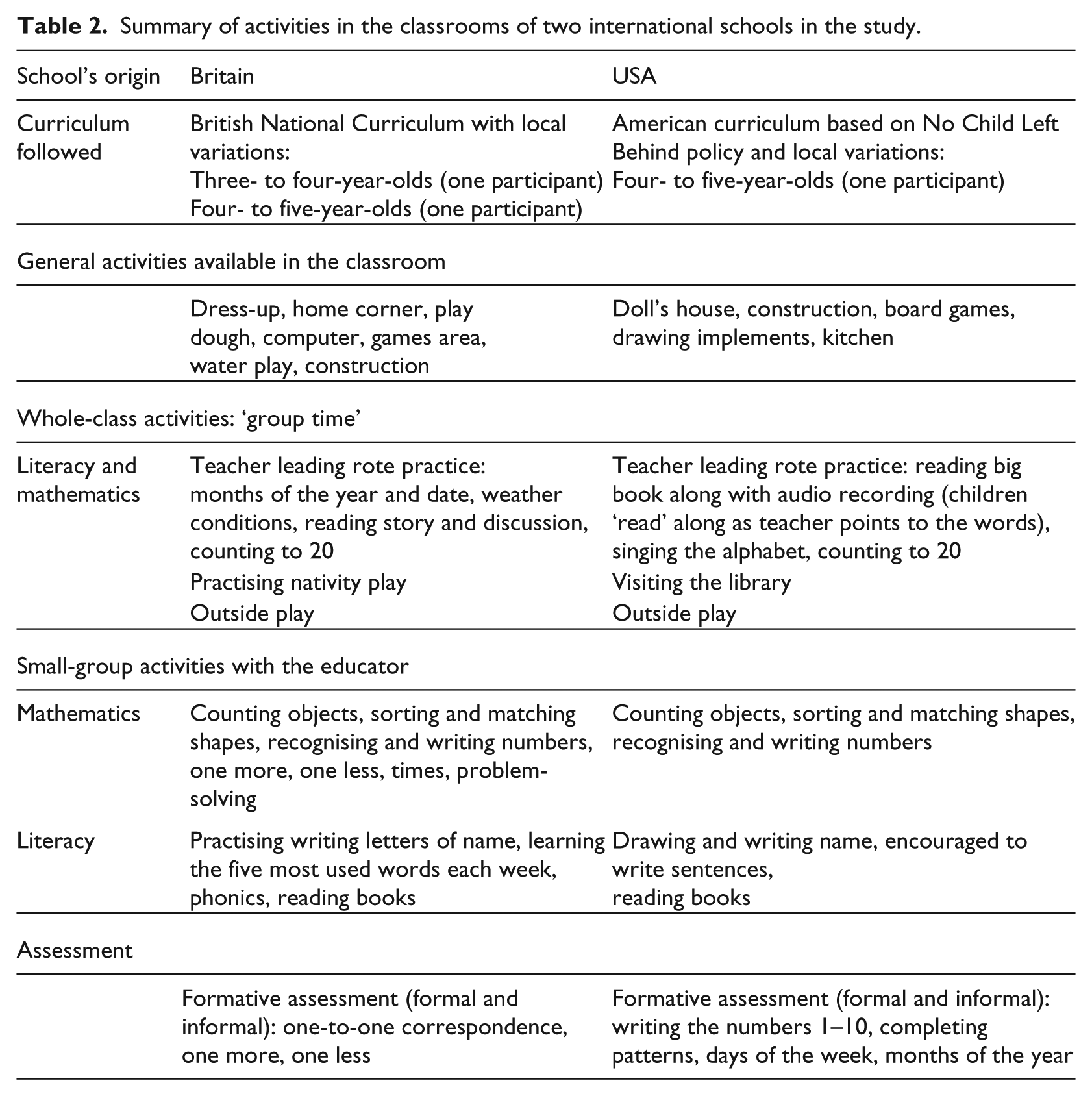
The American international school followed an American curriculum, based on the No Child Left Behind policy (United States Department of Education, 2016). This curriculum has regular standardised achievement testing with the aim of improving standards of reading and writing. The British school followed the British curriculum (Department for Education [DfE], 2013), and at the time of data collection, each child from age three was assessed on five subjects, including mathematics and literacy (T4 interview data). Both the American and British schools welcomed local Malaysian students. In order to accommodate Malaysian education laws, each local student practising Islam was required to study agama (‘religion’), Bahasa Melayu (the ‘Malay language’), history and geography from the first year of entrance.
Strict ethical protocols were followed from the initial stages of the study, which included obtaining research approval from an ethics committee, obtaining informed consent from the participants, and using pseudonyms to protect the anonymity and confidentiality of all the participants. All of the families were provided with options to withdraw from the study at any time.
Data-gathering
The larger study included video observations, still images and field notes of the everyday life of five families experiencing relocation in Malaysia, and were collected over six months. The researcher followed the everyday life of the child at home and school using a digital video recorder and an iPhone. Interviews with parents, teachers and principals were also gathered. A total 90 hours of data were collected and transcribed verbatim.
Data analysis
Data analysis occurred through a three-stage approach, as proposed by Hedegaard et al. (2008). The initial stage was common-sense interpretation, where the data was organised and details were provided in written form. Here, the data extracted depicted the focus child’s or adult participant’s intentions, desires or needs that were made explicit through actions or verbal utterances. This was followed by situated-practice interpretation, which linked play in various settings (home and school) together. Conceptual patterns were sought across the research sites.
This led to thematic interpretation, where the empirical data was connected with the research aim, and theoretical concepts were used to extract relations and patterns in the data (Hedegaard et al., 2008). Hedegaard et al. (2008: 61) suggest that the subsequently developed data categories are ‘a dialectic between the aim of the research, the theoretical preconditions and the concrete material’.
Findings and discussion
The following vignettes are taken from the interview data sets gathered from the focus participants’ mothers. In addition, video vignettes of the children across settings were constructed to highlight the type of play and structured learning that occurred. Three central findings from this study are presented. The initial finding focuses on the importance of play in relation to the parents’ pedagogy in the home. The second finding is centred on the demands and tensions in the home. The third finding speaks to the child’s motive orientation changing from play to learning, where parents changed their pedagogy at home and began to support their children’s academic learning through introducing structured playful activities that aligned with the demands of the school.
Play as a pedagogical tool to support learning in the home
In the homes of the focus participants, each family (F1, F2 and F4) valued the importance of play (Maddock, 2006) and used a playful pedagogy to support children’s general development (Siraj-Blatchford, 2002). Parents wanted their children to participate in free play and organised everyday play activities. Parents held the view that their children were learning as they played and participated in everyday activities (interview data, M1, M2 and M4). This finding is supportive of Robertson et al. (2015), who argue that pedagogy is culture-specific and is adapted according to traditions and societal situations. It is reflected in the following parents’ statements:
They’re five years old, they are still young and like to play, and I think spontaneous play is important … In Holland before six they just play. Well, of course they learn while playing. (M2, parent of Tris, aged 5.2 years) He’s in preschool. I think it should be about play … I quite like his imaginative play; he likes pirates. We do cooking, construction things … like with the car track. When he has been good, he gets to choose board games to play with me after his sister has gone to bed … We do lots of things where he is playing and learning at the same time. (M4, parent of Zeb, aged 3.9 years)
In the focus families, the parents know their child’s interests and have knowledge of the child’s experiences, which is part of the play pedagogy in the family, directed at learning (Siraj-Blatchford et al., 2002). The parents build traditions through playful negotiations, exchanges, experience, routines and expectations with their children. The parents’ play pedagogy highlights the possibility of creating motives to participate by offering playful negotiations, which may also have a learning motive (Hedegaard and Chaiklin, 2005). However, an important consideration is the agency the child is encouraged to develop. For example, while eating lunch, the following vignette was recorded:
[Sitting on a stool at the kitchen bench eating lunch. High-pitched, rapid, playful sing-song voice] Please can I have my cake now? Please can I have my cake now!
You can have your cake once you have eaten your tomatoes and some of your greens.
[Looking at content of plate, pursed lips, brows knitted] Owww nooo!
[Sing-song, happy voice] I will do you a deal … eat all of your tomatoes and … [Zeb looks up, smiling] How old are you?
Three!
Three green bits – ok?
No.
Oh well, I will eat your cake then [smiles and nods].
[Zeb appears to be thinking, eyes narrowed, elbows on bench and chin resting on hands] I have a deal – [deep breath] I have a deal …
Ok, what’s your deal?
[Sitting up, smiling, eyes wide, looking at mother] We have to ROOOLLL the tomatoes into our mouths.
Ok … ?
And then eat the beans whole and then I can have lots of cucumbers.
Ok. Actually, before I agree, what do you mean roll the tomatoes? … Oh, ok. Do you mean the insides of the tomatoes?
Yes! [Nodding head up and down in an affirmative action, whole body joins the movement]
Ok, yes. You can eat just the insides of the tomatoes if you eat all of the green bits.
[Holds a tomato between thumb and finger and squeezes inside of tomato into mouth; frowns] They’re so juice.
You mean they have juicy bits.
[Places whole tomato in mouth and closes eyes, rolls head left to right with eyes closed and stretches out arms, chews tomato].
The playful negotiations are an important pedagogical tool and are an example of negotiations found in all families across the data sets.
Demands and tension created in the home
The second finding centred on the common theme of tension created in each home due to the homework and structured academic focus of each curriculum in the international schools. The homework policy and the academic focus for the three- to five-year-olds at the international schools created demands on the parents. The high academic standard in the children’s new classroom caused concern for the parents. For example, M2 expressed concern with the educator, as her child was not school-ready as he had not completed formal number or letter work: ‘Education-wise he was a bit behind. For example, most kids could write already. He could write his name and that’s the only thing he could write’.
In addition, each parent questioned their child’s educators regarding expectations of homework, the level of academic standard and academic positioning in comparison to others in the class (interview data, M1, M2 and M4). Further, tension was exacerbated when observing and talking to other parents and learning of their philosophy on education. The mothers commented that some children in the class were made to complete homework and supported with extra tutoring. For example:
I was worried in the beginning when we got this homework from school with website links and a big bag with exercises. I heard all the others had done all of the things and I thought, ‘Gosh, I’m a bad mother’, because we had not opened it. … I think Asian parents stimulate their children even more than Western parents do … they really want their kids to be able to write at three years old. (interview data, M2) They [other children in the class] learn numbers and letters instead of enjoying the story … they [other parents] choose very specific apps for the iPads so their children learn how to count, how to recognise letters and numbers, instead of playing just for fun. At home we read stories and we play together and with other children. If he were in New Zealand, he wouldn’t be doing anything like what he is doing here. (interview data, M4)
The tension parents discussed originates with the demands of the school, other parents and their personal expectations, which highlights the different values between play and learning in the home and school (Brooker, 2002). Further, it is the mothers’ understanding of the way other parents ‘help’ or ‘make’ their children complete the homework and engage with structured learning through the use of iPad apps. The three mothers stated that they had little time for structured homework in the home and that play was the main focus (interview data, M1, M2 and M4). This reinforced the motive orientation directed towards play (Hedegaard, 2002) in each participant’s home.
Supporting the child’s developing orientation towards a learning motive
Many of the play activities undertaken in the home supported the child’s dominant play motive and integrated a learning motive through social interaction, dialogue and playing together – for example, cooking, board games, construction with building bricks and car tracks, or free play with and without adult involvement. However, as the children routinely attended school, completed their homework and were introduced to structured learning, including formative assessments (see Table 2), the child’s motive orientation in the home seemed to change from play to learning (Hedegaard, 2002).
Summary of activities in the classrooms of two international schools in the study.
In the home, parents commented that their children were learning academic skills more quickly than expected and parents routinely completed reading homework (M2, M4) with their children. One parent explained how the progress and achievement the child made created enjoyment and the child wanted to read more:
He sees the progression he is making; this makes him want to learn more. I saw that in the beginning when he just started to read. He couldn’t remember the ‘b’, ‘d’ and ‘e’ and he got a bit frustrated. Then suddenly he made quick progress and now he loves to learn more and more and now he can really read … but he can really read books now … so I think that they realise that they are making progress. (interview data, M2)
M4 stated that she completes reading together with her child and he seemed to be learning quickly:
I mean, we do read the phonics books now [that] he can and [the] things that they send home with him to do … He learns so quickly it is unbelievable. Leaps and bounds. And again I don’t know the ages or stages or if this is appropriate, or if it is partly to do with school. (interview data, M4)
M1 noted that her daughter had started to write independently:
Catt managed to write ‘I love you’ from different letters she saw around the house. I don’t know where that came from. I email the teacher to see how I can help to teach Catt at home, so I do things here that match what happens in the school. (interview data, M1)
Although the parents agreed that play was important and was the main focus in the home, as the children started reading and showing an interest in spelling and writing independently, the parents also began to actively encourage and support the child’s efforts to read and write. These examples illustrate two points. The first is the demands of the academic curriculum and the way a changing social situation changes a competent child, who, in turn, begins to change their environment (Vygotsky, 1994) and, in this instance, the parents’ focus (from play to learning) in the home without playful negotiation. The second point illustrated is the way parents begin to support their children’s learning by reading books supplied by the school with their child (M4), aligning home practices with school practices.
Discussion
During the initial data-gathering visits, the focus participants’ interactions and activities revealed the importance and value afforded to play (Maddock, 2006) as a pedagogical tool in the family home. In many instances across the data sets, play was integral to each adult and child’s interactions. There were two main examples drawn from the data gathered that revealed play was used as a pedagogical tool in the home. First, each mother recognised that the children enjoyed playing and learned through play (interview data, M1, M2 and M4). Second, playful negotiations with words and actions during everyday activities such as eating lunch or cooking were a common occurrence throughout the data (video data and interview data, F1, F2 and F4).
Combined, these two examples further develop our understanding of play in the three family homes in the current study and emphasise the value of play as a pedagogical tool in the everyday lives of the participants. Throughout the data sets, each child was involved and encouraged to participate in the activities. For example, while cooking, Zeb was asked to use a measuring cup, take the flour out of a canister, crack an egg or mix ingredients. In instances like this, the children initiated playful moments through explaining the movements in their imaginary situations: ‘I am using this wooden spoon as a tail to flick the flour over there into that other bowl’ (video data, Zeb, F4). Similar to Maddock’s (2006) findings, the parents supported the play by supplying objects to play with. Further, similar to the teachers in Pramling Samuelsson and Johansson (2006) research, the parents in the current study rarely entered into the imaginary situation with the child. The parent created conditions for playful exchanges and the child developed play within the activity, implying a play motive orientation.
In some instances, the parent instigated playful verbal negotiations when the potential for tension or conflict arose as the parent’s and child’s intentions differed. For example, Zeb’s mother wanted him to eat tomatoes and greens prior to eating cake. However, Zeb’s intention was to eat cake. The mother playfully negotiated with Zeb, who happily joined in the banter. The playfulness was signalled by the varying tone of each participant’s voice (high-pitched, sing-song voice) and the exaggeration and stress on certain letters, such as when Zeb said ‘ROOOLLL the tomatoes’, coupled with his exaggerated movements, such as nodding his head, which spread to moving his whole body. These actions show an embodiment of the child’s actions and words that signals further playfulness. Zeb’s mother is a dietician and it is important that her children eat healthy food daily, which is a reason for using playful negotiations. Further, playful negotiations also provide a way for the mother to strengthen family traditions and values, and avoid conflict or ‘meltdowns’ (interview data, M4). The negotiations emphasise the adult’s agenda behind the play (Maddock, 2006).
Further, using play as a pedagogical tool, the parent creates conditions for the development of the child’s motive orientation towards play (Hedegaard, 2002, 2011). The playful negotiations illustrate that the child’s play motive is not solely an element of the individual, but is socially constructed, as the parent also has an agenda. The parent presents the activities within the child’s social situation (Hedegaard, 2011), emphasising the cultural construction of motives in families (Chaiklin, 2012). However, motive orientations are also dynamic relations between person and practice (Hedegaard and Chaiklin, 2005), which change as children move into full-time schooling (Hedegaard, 2011) and experience new activities in new settings.
Moving countries creates inherent conflicts and tensions within everyday family life (Adams and Fleer, 2015). The different situations occurring concurrently generate various levels of demands on participants where several motives may be created, resulting in tension and conflict (Leontiev, 1978). For example, it is inferred from the data sets that some mothers place demands on their children to complete homework, which creates the conditions in everyday life for developing a learning motive (Hedegaard, 2002). However, if the child wanted to play with their mother and friends, as well as completing homework, this may create tension and conflict. This example highlights three possible motive orientations of the child – to learn, to play and to be social. All occur concurrently and are created through various demands in the child’s social situation of development.
Hedegaard (2002) argues that children develop a learning motive through participating in school-directed activities, and it is the child’s interests that initiate development of their motivation. Therefore, it is what the child brings to the situation, combined with the activities offered in the school and the reciprocal interaction between the two, that supports conditions for a learning motive to develop. These activities can include school practices that are taken home, such as homework (Hedegaard, 2011), further supporting the development of a learning motive. However, this is dependent on the interests that the child has. For example, according to M2, initially Tris found reading at home challenging, as ‘[h]e couldn’t remember the “b”, “d” and “e” and he got a bit frustrated’. However, over time, combining the academic structure in the school, the demands of homework, the mother creating conditions for Tris to read at home and Tris’s desire to read supported the development of a learning motive. Tris’s mother commented: ‘suddenly he made quick progress and now he loves to learn more and more and now he can really read’ (interview data, M2). This is an example of a parent working towards forming a close relation between the home and the school, and actively changing the initial dissonance that occurred (Ali, 2008). In addition, it is an example of the ‘push-up’ curriculum, where the school learning, combined with homework, has changed the focus of the mother and the child from play to completing homework and learning how to read.
The need for schools to introduce academic curricula eventuates from political imperatives, which have generated a ‘push-down’ curriculum in many Western education contexts (Bodrova, 2008). However, synthesising the literature and current research, it appears that some parents agree with the ‘push-down’ curriculum and actively seek out schools that provide academic learning from a young age and encourage homework for their children, substantiating the value of learning from a young age in some families (Parmar et al., 2014). This contrasts with other families, such as the three in this study, who value play as a pedagogical tool in the home. The ‘push down’ places new demands on educators, who are positioned between the government, families and children attending early childhood educational institutions. The present study has shown that, in the three families who enrolled their children in international schools in Malaysia, a ‘push-up’ effect is also possible, where the academic learning program influenced families and was reinforced through homework activities, resulting in demands that actively began to change the child’s motive and the family pedagogy.
Through the ‘push-up’ curriculum, the parents in this study supported the children’s changing motive orientation from play to more structured learning as the parents experienced the children’s motive to learn, combined with the progressive improvement in the children’s learning (M1, M2 and M4). It is inferred that this ‘push-up’ curriculum was initially instigated through the demands from the international schools for more academic learning, resulting in a new pedagogical practice at home. The motive of the children, who were initially directed towards playing, appeared to change in the home, becoming redirected towards learning. The parents’ changes in their home practices were initiated and reinforced by the changing intentions of their child, combined with meeting the demands of the school curriculum, as seen in Figure 1. New possibilities are created for children as they meet with contradictions between the demands of the institution and the motives and competencies they have (Wong and Fleer, 2012). These new possibilities change the child and the parent in relation to play. The changes support the initiation of a learning motive, which is separate from a play motive. This in turn changes the value of play as a pedagogical tool for the participants of the current study.
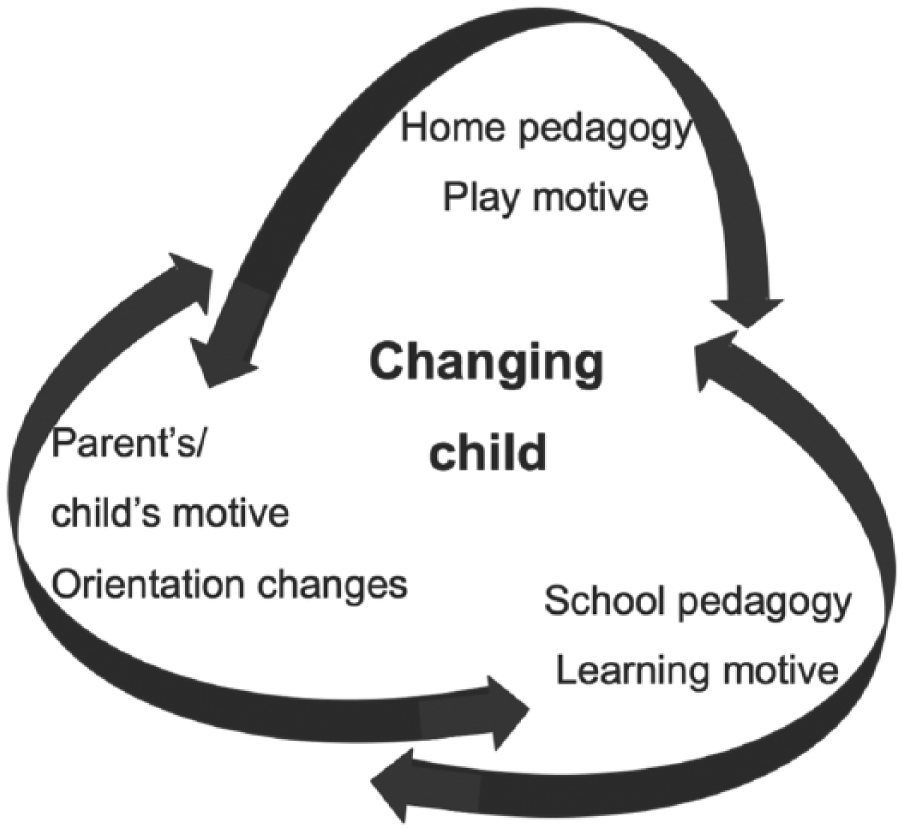
The relation between the changing parent/child motive orientation.
Conclusion
In the current study, it is argued that the ‘push-down’ curriculum or the introduction of increasingly structured learning curricula at a young age resulted in the introduction of a ‘push-up’ curriculum in the family home. The practices of the school influenced and changed the family pedagogy and, together, the ‘push-down’ and ‘push-up’ curricula created new conditions in play and learning for the young children who experienced school for the first time in an international context. Therefore, play and pedagogy remain contemporary issues in early childhood education, with the quest of governments to implement skills-based learning that is easily quantified, measured and compared in competitive global markets. Rather than provide answers, this study has resulted in more questions, and one in particular stands out: Where is education heading for our youngest children not only across the Asia-Pacific region, but also in other Western contexts?
Footnotes
Funding
The author(s) received no financial support for the research, authorship, and/or publication of this article.