



Abstract
This article seeks to contribute towards an unsettling of dominant framings of quality pedagogical practices. The author puts to work the figure of the modest witness as a way of storying everyday pedagogical encounters in childhood settings that might refigure quality in practice as materialized more-than-human becomings. Working within the particular context of British Columbia, Canada, the author’s particular orientation is towards emergent interferences to child-centred orientations in everyday practices of art-making and multispecies encounters in relation with a local mountain forest. Through descriptive visual and textual accounts of small stories, the author experiments with foregrounding implicated, responsive and messy practices-in-question that bring hopeful possibilities for reimagining quality in practice without the enclosures of fixed and final resolutions.
(Dis)articulations of quality
Quality remains a powerful signifier in Canadian early childhood education, often imbued in universalized, modernist and deficit constructions of children, and articulated through prescriptive ‘best practices’ and ‘minimum standards’ approaches (Moss and Dahlberg, 2008; Pacini-Ketchabaw et al., 2014). In British Columbia, Canada, where my work is located, understandings of children’s school readiness have become increasingly coupled with quality, using technologies of evaluation such as the Early Development Instrument to generate public scholarship that classifies the ‘vulnerabilities’ and ‘absent qualities’ of educational settings and neighbourhoods (Guhn et al., 2007).
These conceptions of quality leave little room for the sociomaterial contingencies, intricacies and uncertainties that come together to shape articulations of quality in everyday practice within specific contexts (Dahlberg et al., 2007; Osgood and Giugni, 2015; Pacini-Ketchabaw and Pence, 2011). One such aspect of the sociomaterial that actively participates in shaping (im)possibilities of quality practice is relations with the more-than-human others that co-inhabit early childhood places. Accordingly, the purpose of this article is to contribute to reimaginings of quality through methodological and pedagogical orientations with a focus on more-than-human entanglements in everyday encounters. My emphasis on the more-than-human is inspired by post-human theorizations and Indigenous ontologies of the inseparability of humans from their more-than-human relations and responsibilities (Barad, 2007; Haraway, 2008; Le Grange, 2012; Martin, 2007; Tuck, 2014). These enmeshments bring ethical and political considerations that are of particular urgency in current times of planetary damage.
My intent in this article is to contribute reorientations that might spur different kinds of dialogue about meaningful articulations of quality practices, whereby situated quality practices are seen as always-in-motion. I do this through stories drawn from my work as a pedagogista, 1 where, over a three-year period, I have been immersed in the everyday lives of early childhood educators and young children in group-care settings located on the campus of a university in British Columbia, Canada on unceded Coast Salish territories. 2 In this role, I spent several hours a week at each of the childcare centres, working alongside educators with children, and three hours a month facilitating discussions on theory/practice with the educators. A central intent of this work has been to reconceptualize practices by bringing them into conversation with post-foundational perspectives that question, contextualize and politicize taken-for-granted understandings of quality. 3 Accordingly, this article presents a necessarily partial account of everyday practices in inquiries that productively complicate what counts as quality. I present situated sociomaterial visual and textual ‘small stories’ of everyday pedagogical encounters that move away from familiar anthropocentric modes of explanation and away from interpretations of my role as a pedagogista as facilitating normative quality practices with young children. Instead, I situate this work as messy, implicated and more-than-human entanglements that refigure quality as ongoing processes of becoming in everyday life (Osgood and Giugni, 2015).
In the particular context of this work, my focus here is on encounters with a mountain forest that surrounds the childcare centres and has become an important part of our pedagogies. Within the intricacies of everyday encounters with this forest and its more-than-human inhabitants, this article stories possibilities for educators to consider what different practices, perspectives and responses might be provoked ‘beyond quality’ (Dahlberg et al., 2007; Pacini-Ketchabaw et al., 2014). I story attempts to trouble colonizing developmental enactments of quality by shifting the gaze away from a focus on the individual child’s progressive learning. Instead, I foreground creative possibilities for making visible and ethically responding to the entanglements of everyday practice with environmentally damaged places (Nxumalo, 2015a, 2015b, 2016).
Unsettling quality through performative witnessing
In this article, I emphasize storied descriptions rather than definitive interpretations of quality early childhood education practices, as a gesture towards a political ontology that seeks to notice the multiplicities present in and enacted through different everyday practices (Mol, 2002; Tsing, 2011). This echoes what Viveiros de Castro et al. (2014) describe as ‘a technology of description … designed in the optimist (non-sceptical) hope of making the otherwise visible’. In order to help me do this, alongside textual performative stories, visual images and pedagogical narrations from practice, 4 I place intentionalities, effects and theoretical aspects of figurations of witnessing (Haraway, 1997) that resonate with particular everyday encounters.
The refigured modest witness helps me to unsettle transcendent unmediated truths (such as the dominant quality truths discussed in the previous section) and to locate pedagogical practices within politically oriented contingencies and contestations that preclude an innocent self-invisible location (Haraway, 1988, 1997). Working with the contention that practices of figuration do not simply reflect reality, but ‘“turn” what they figure’ (Timeto, 2011: 161), the descriptive accounts I present here resonate with the contradictions, leakages, resistances and hopeful potentialities that have emerged in practice. In other words, witnessing is not put to work to ‘tidy up’ and cleanse what quality practice could or should be. On the contrary, the contention here is that this ‘figuration is no protection from disorder’, as it works within and produces places of doubt, tension and a lack of clarity about meanings and articulations of quality in practice (St. Pierre, 1997: 281).
I inhabit my becomings as a pedagogista through the refigured witness by describing particular entangled interferences of modest witnessing that orient towards interruptive meaning-making of everyday practices (Haraway, 1988). The modest witness, then, is useful as an epistemological and ontological perspective from which to bring a telling, or witnessing, of everyday pedagogical practices, whereby I do not sit in transcendence outside of that which I narrate, where I am not the sole (human and more-than-human) narrator of these stories, and where many unpredictable, unsettling and unresolved questions are thrown up.
There is an element of performativity to witnessing (Haraway, 1997). Practices of witnessing perform worldings that interrupt what is considered important and ‘present in everyday life’ (Hunt, 2014: 6). In this article, I present images from everyday practice that might be inhabited as performative imagery which interruptively diffracts (Barad, 2003) everyday pedagogical practices elsewhere, considering what else might be happening, might be noticed and might be important to think with further beyond passive representations of educational quality. Typically, in practices of documenting early childhood pedagogies, 5 images are used with a focus on what (individual) children are doing and learning (Rinaldi, 2006). This is not to disregard the importance of making children’s learning visible. However, my focus here is to work with images in ways that seek out ‘otherwise’ ways for meaning-making beyond the singular focus on the child and quality indicators, such as defined learning outcomes (Dahlberg et al., 2007). Materializing witnessing through performative images brings different kinds of questions and perspectives to our pedagogical practices and complicates meanings of quality. For example, performative images unsettle solely discursive/linguistic/anthropocentric determinations of what counts as quality (Barad, 2003). This imagery brings attention to the performativities of more-than-human assemblages (Barad, 2011) as vibrant participants with children and educators in refiguring quality-practices-in-the-making.
The remainder of the article interruptively engages quality practices through ‘small stories’ of encounters between children and more-than-human others articulated as material-discursive practices of witnessing place specificities, cross-species socialities, damaged landscapes and watery becomings. I conclude on the mattering of these stories for refiguring quality practices as always-in-motion, in-question and in-relation with children’s immediate more-than-human worlds.
Attuning to place specificities
[T]he stories we need now are not the big heroic ones, but rather smaller stories that help us rethink our big questions in richer veins. (Rose, 2014)
Witnessing brings attention to place specificity and geopolitical situatedness – a partial and located point of view (Haraway, 1988, 1997; Hunt, 2014). This forest and its more-than-human co-inhabitants, which hold past–present traces of colonial logging and waste accumulations, are companion witnesses in this article: they are ‘meaning-making figure[s]’ (Haraway, 2008: 5) that orient my storytelling. Refiguring what is seen as mattering-presences in these forest encounters has been an ongoing experimentation in articulating everyday practice in ways that unsettle the ease with which anthropocentric and child-centred ways of seeing are enacted. These practices have also sought to unsettle recurring descriptors of everyday forest pedagogies in relation to innocent, anthropocentric and colonizing understandings that fit neatly into normative quality practice identifiers such as ‘belonging’, ‘ownership’, ‘discovery’, ‘learning about’ and ‘free exploration’ of an untouched natural environment. For instance, what is unsettled in our pedagogical practices by presencing the forest trail and the ancient tree stumps as witnesses to colonial logging histories (Nxumalo, 2015a)? How does English Ivy materially and semiotically entangle forest–child–educator–bodies in settler colonial inheritances? How does the mundane yet unexpected presence of an abandoned desk in the forest clearing unsettle ‘nature’ pedagogies-as-usual (see Figure 1)?
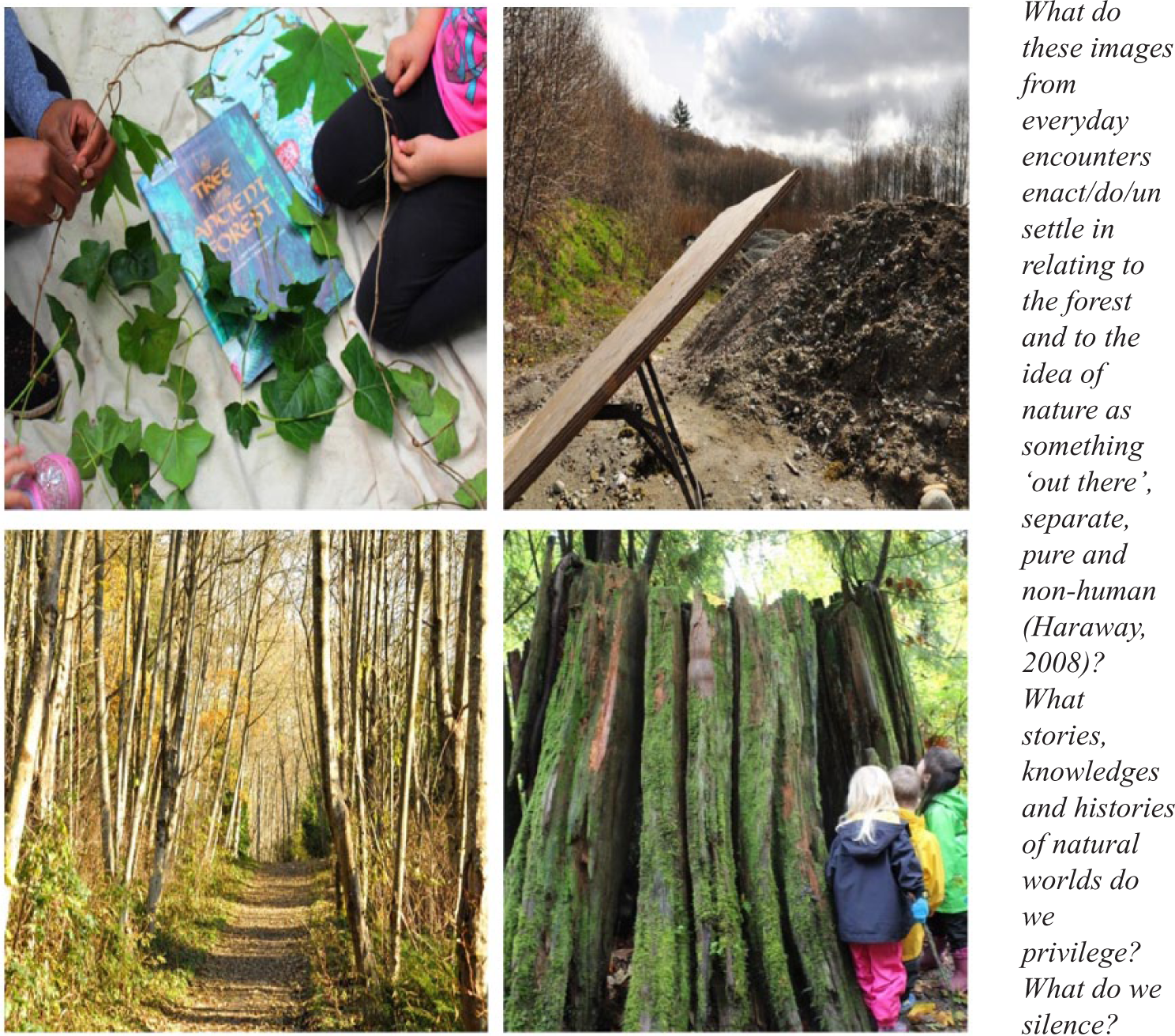
Forest encounters: noticing and responding to more-than-human worldings.
Even as I attempt to focus on the specificities of more-than-human worldings and relations in my work with children and educators, I continue to struggle with how I might continually enact ‘learning to learn without the tools of human exceptionalism’ (Haraway, 2014b) as foundational to early childhood pedagogies. Many questions emerge in discussions of the forest encounters with educators. These questions bring tensions to our dialogues as we think with place, British Columbia forests and forest pedagogies as contested and political. Perhaps these questions, alongside the everyday more-than-human encounters that inspired them, might be seen as quality-practices-in-motion and quality-practices-in-question: What might it mean to engage in forest pedagogies that entangle ethics and politics, as well as the vibrancies and materialities of the forest? How might we make meaning of the forest with children in ways that acknowledge this place as Indigenous Coast Salish territory? What might it look like to begin to consider the tensions, entanglements, accountabilities and response-abilities (Haraway, 2008) that Indigenous and settler colonial knowledges of place might bring to our work with young children? What assumptions about place do we bring to our pedagogical encounters?
Witnessing cross-species socialities
Our location amidst a forest inhabited by many plant and animal species, including black bears, moss, mushrooms, English Ivy, deer, raccoons and coyotes, has offered a rich place in which to apprehend and think with what Donna Haraway (2003: 4) terms non-innocent ‘co-habitation, and embodied cross-species sociality’. For example, a family of raccoons that co-inhabit this place have become a regular presence at the childcare centres. The raccoons often enter the play yards, climbing the trees in the yard, running along the wooden fence that separates the childcare centres, and making creative use of toys left outside by the children. Raccoons and children have become attuned to their co-presences, watching each other through classroom windows and skylights, and from the treetops and playground below. Through attention to everyday raccoon–child encounters, and the mutual child–animal curiosities that have emerged, we have begun to consider the ethical potentialities of paying attention to the nuanced ways in which more-than-human species story particular places in-relation with humans (Nxumalo et al., 2015; Van Dooren and Rose, 2012). However, this is not to romanticize raccoon–child relations. Raccoon–child–educator encounters remain frictional, and educator responses to raccoons remain contradictory. An important source of this contradiction is some of the safety measures enacted by educators to maintain ‘safe’ boundaries between children and raccoons (Pacini-Ketchabaw and Nxumalo, 2015). These safety measures are part of adherences to quality standards set by British Columbia childcare licensing regulations. However, amidst the messy tensions created by regulated quality standards, ‘uncontrollable’ raccoons and unpredictable raccoon–child encounters, educators have also begun to respond to raccoon–child mutual affectivities in creative ways. We have begun to challenge ourselves to take seriously the effects of our and children’s responses to these Indigenous animals’ presences in this place, and to create invitations for children to productively relate to raccoons – both real and imaginary – in multiple ways (see Figure 2).
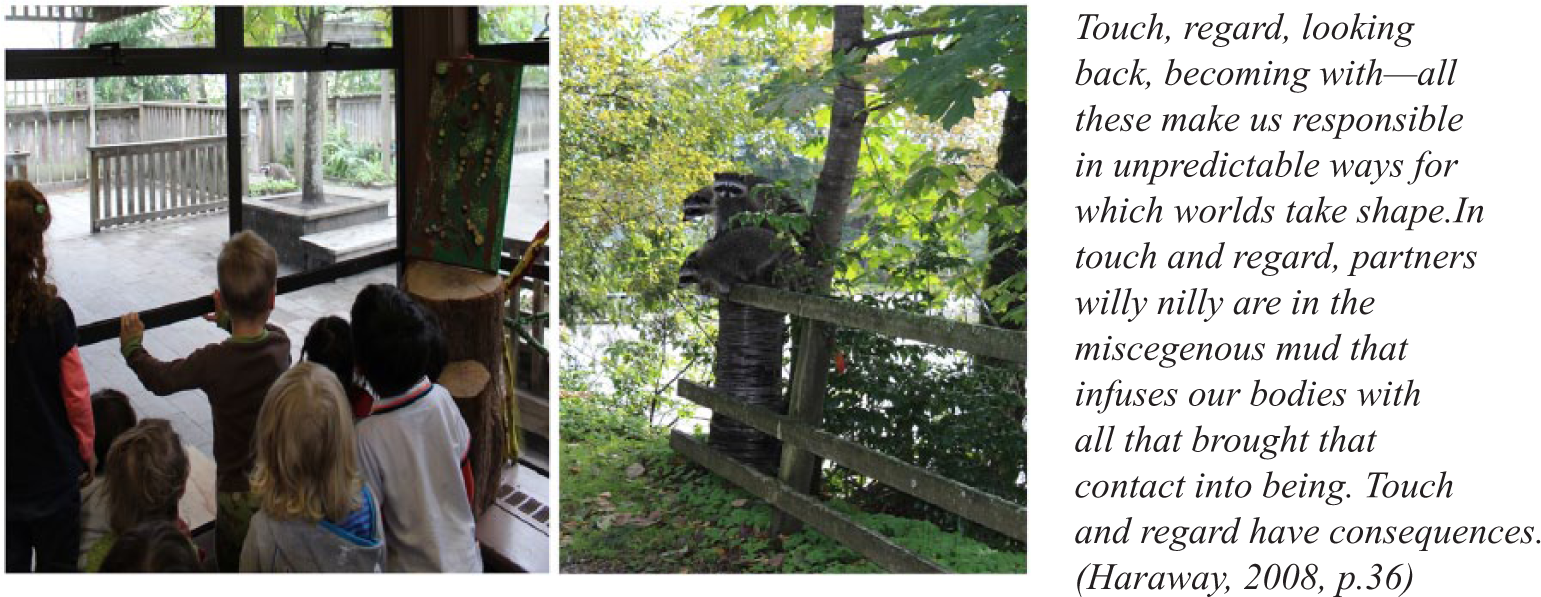
Raccoons–children: mutual curiosities at the childcare centre.
As part of this work, I share and discuss with educators scholarly literature from the environmental humanities that offers us questions and perspectives to think with in relation to everyday multispecies relations in early childhood pedagogies. We engage in ongoing dialogues of questioning what an ethics of living-with, responding-to and relating-to might mean for the plant and animal species we encounter with children – particularly those, such as raccoons, that are not easy to live-with.
Frictional raccoon–educator encounters, risky raccoon–child connections, affective raccoon–child mutual curiosities, and children’s learning with raccoons are impossible to contain within dominant anthropocentric quality measures. Such measures might, for instance, question what children have learned about raccoons, and might focus on normative quality indicators such as children’s safety when encountering raccoons. The art encounters shown in Figure 3 might be interpreted in terms of children’s physical, social, emotional and cognitive development (Kind, 2010). Such interpretations, while not necessarily wrong, silence the matterings of child–raccoon affectivities or the matterings of children learning to co-inhabit with more-than-human others in more ethical ways. Such interpretations also silence the active participation of raccoons–children–educators–paper–charcoal–light–images–memories–shadows, and more, in these matterings. Attention to raccoon–child cross-species socialities entangles us in inequitable arrangements of living and dying well (Haraway, 2012), bringing important critical questions and ongoing (always imperfect) responses-in-practice.
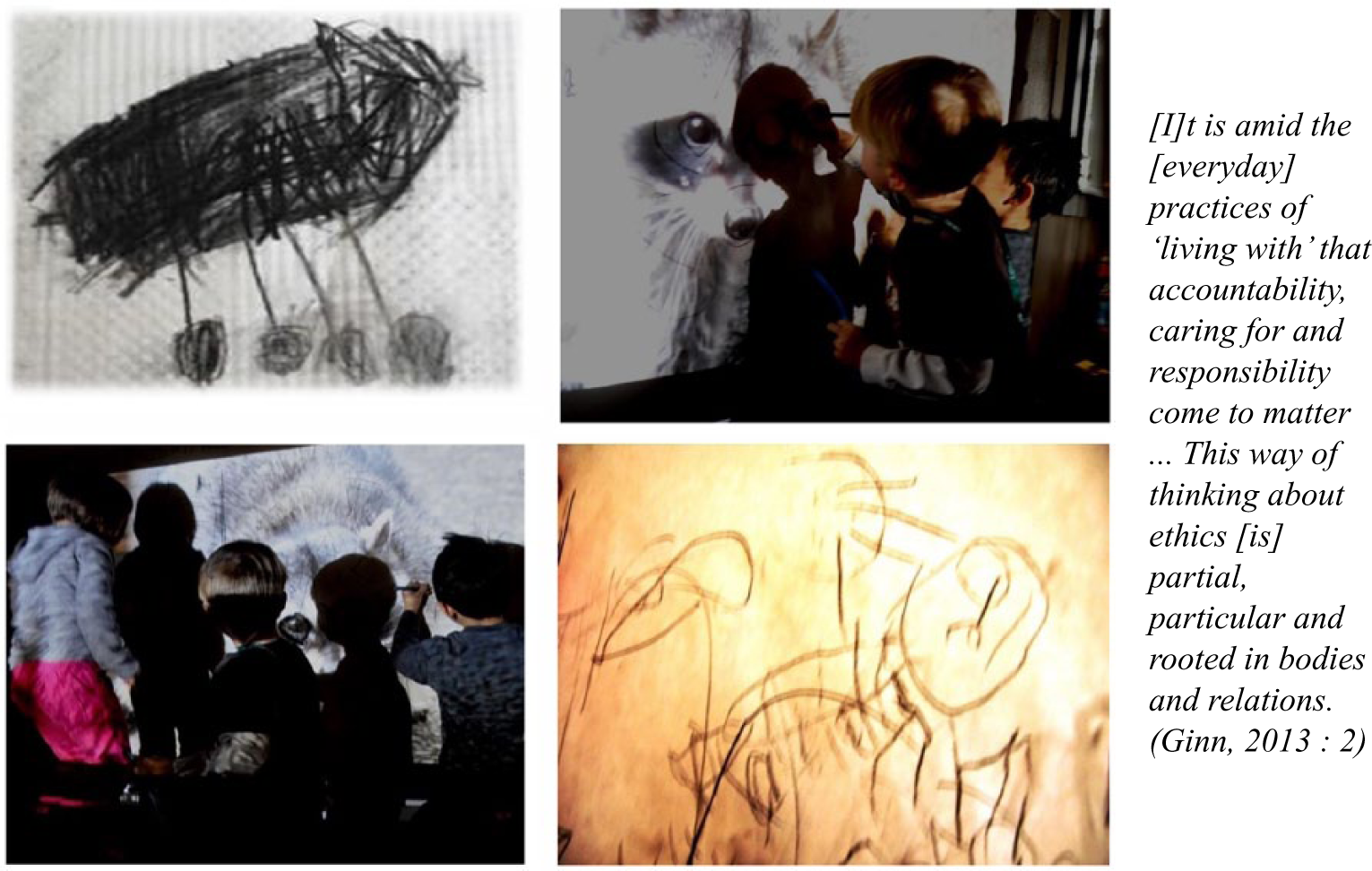
Raccoon–child drawing assemblage.
Witnessing damaged landscapes
As an invitation for children and educators to come to ‘know forests’ in multiple and creative ways, I set out paint and brushes on a drop cloth on the floor and tape a large piece of paper on the wall, where I project images of paintings depicting damaged land and water by Coast Salish artist Lawrence Paul Yuxweluptun (Burying Another Face of Racism on First Nations Soil (1997) and Usufruct (1995)). Below are images and my perspectives from a pedagogical narration I share with educators:
The shadows on the screen seem to create another way for the painting and the children to become entangled … Some children experiment with moving their bodies to create different shadows on the painting … I wonder what meanings might be made of these entanglements with the ‘stories’ told by the painting? Multiple meanings emerge as the children paint. Chinese New Year emerges … as ‘dragons’, ‘lions’ and ‘fireworks’ become a part of the forest as children paint … Discussions of ‘A bear coming to eat me up’ emerge … I wonder what meanings can be made of these frictional connections? Yuxweluptun’s work provides critical perspectives to relating-to the forest. For instance, he brings attention to environmental destruction and contested territories. He also engages with Indigenous perspectives of land such as its inherent vibrancies, cosmologies, histories, socialities and materialities, rather than as a ‘mute’ landscape or romantic wilderness. What might it mean for us to begin to encounter the forest in some of these ways with children? I also wonder what different, perhaps unfamiliar, ways of relating to the forest the children are already learning about and engaging with in this encounter? For instance, some children notice that the forest has ‘eyes’, and some children begin to paint faces in the trees – perhaps echoing the vitalities in Yuxweluptun’s painting? I wonder what other possibilities might emerge for shifting the familiarity of ‘nature’ or the ‘forest’ to the unfamiliar? What other possibilities might emerge for multiple ways for us to ‘see’ and relate to the forest?
Discussions of this pedagogical narration with educators bring multiple contradictory perspectives, interpretations and questions. Uncertainties emerge as I return to setting out the painting provocation each day and as the multiplicities of children–educators–paint–paper–forest images, and more, assemble together and move apart in different ways each time. In addition to Yuxweluptun’s images, we experiment with painting-with different ‘interruptive’ forest imagery that the children respond to, such as images of clear-cut British Columbia forests. Each painting experience brings different ‘flights’, movements and intensities (Deleuze and Guattari, 1987) for the human and more-than-human bodies assembled together, at times in ways that trouble me as they seem disconnected from the performative provocations of colonized and damaged landscapes posed by Yuxweluptun’s images and the clear-cut forests. Entangled amidst these emergent multiplicities-in-practice and contradictory perspectives of the painting encounters in discussions with educators, I question my intentionalities and remain uncertain of the desired interruptive effects. These moments bear witness to refiguring quality pedagogical practices as ‘experience and experiment of the possibility of the impossible’ (Derrida, 1992: 41). The assemblage of damaged forest/water images–paint–projector–children–pedagogista–educators, and more, is within a place of impossibility – impossibility of predetermined and measurable quality outcomes, and impossibility of transcending colonial relations with the forest. At the same time, amidst this impossibility, openings for possibility emerge, such as the possibilities of relating to the forest differently – possibilities enacted by the active material presence of damaged British Columbia forests and waterways imagery in the room. Contested and damaged forests (Figure 1) and forest imagery (Figure 4) as witnesses interrupt and complicate our everyday practices beyond quality. Forests as contested sociomaterial issues of concern (Latour, 2004) come to matter in our pedagogies, spilling over children’s learning and educators’ practices in ways that cannot be neatly explained by discourses of quality, even as we remain unsure about how to respond to the ethical dilemmas these contestations bring to the anthropogenic colonial worldings inhabited in this particular place.
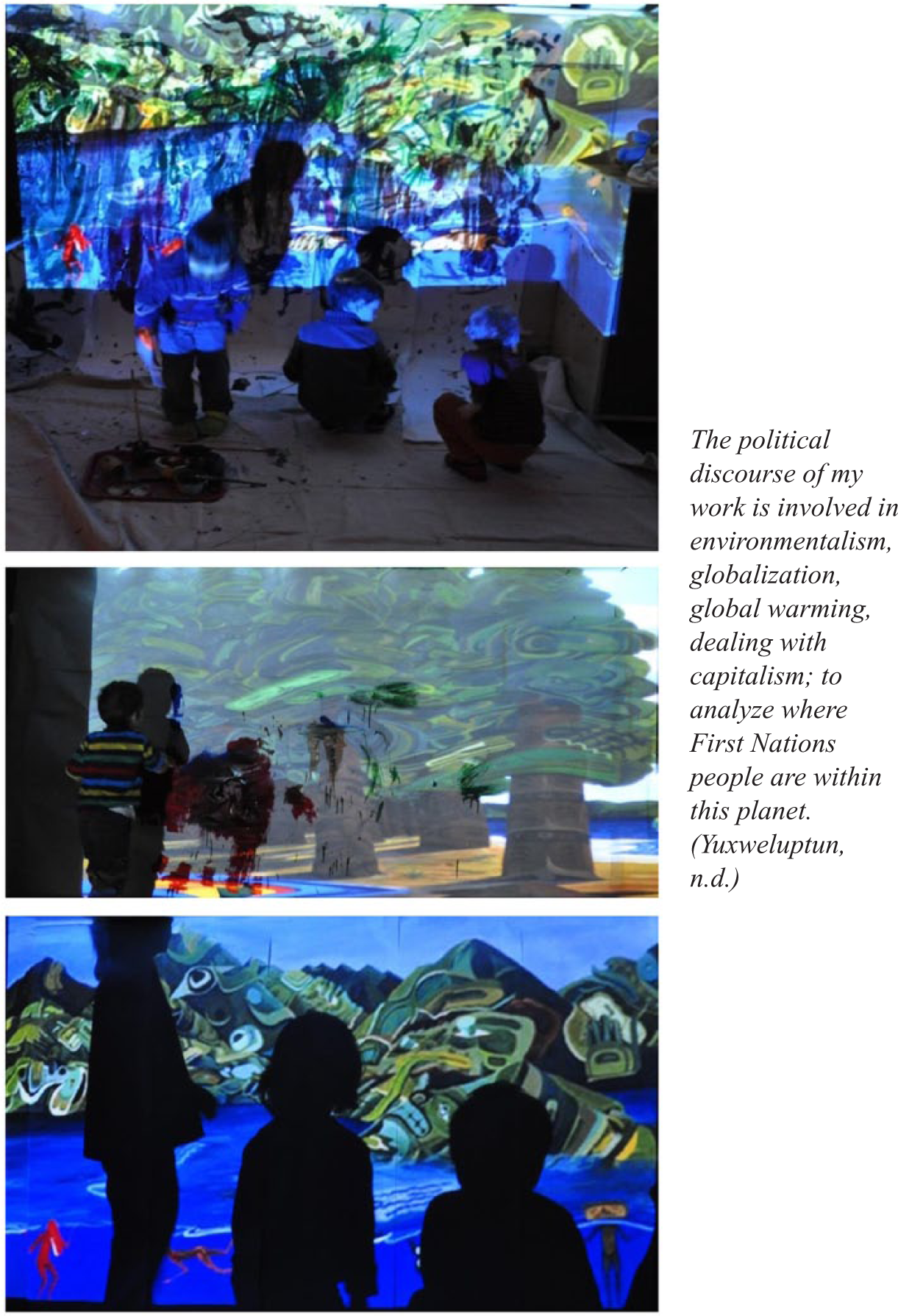
Forest painting encounters.
Mapping watery becomings
Figurative acts of witnessing are creative material-semiotic ways of mapping relations of knowledge, practice and place in ways that counter monolithic views of the world, such as a singular view of what counts as quality (Haraway, 1992, 1997). Next, I story an illustrative example of pedagogical encounters that might be seen as enacting material, literal and metaphorical mappings of contested territories. While these encounters – marked by elusiveness – refuse to be neatly represented as quality pedagogical practices, they might be seen as experimental gestures towards refiguring quality practices as lived–affective–performed–productive interferences in colonizing more-than-human relations.
In one childcare centre, we have been working on an inquiry with children on thinking with water for several months. Educators have been experimenting with possibilities for relating to water and watery places with children in ways that engage with water’s liveliness and move away from ‘ways of seeing’ water solely as a resource. Relating to anthropogenically damaged watery places emerges as part of this inquiry through encounters with a nearby wetland waste-dumping ground, named ‘frog-pond’ (Figure 5) by the children. Noticing the persistence of plant and animal life amidst abandoned waste in this waterway in the forest brings difficult questions and uncertain responses as educators continue to grapple with what interruptive and responsible ways of encountering waste with children might look like beyond neo-liberal technologies of waste management (Hird, 2014).
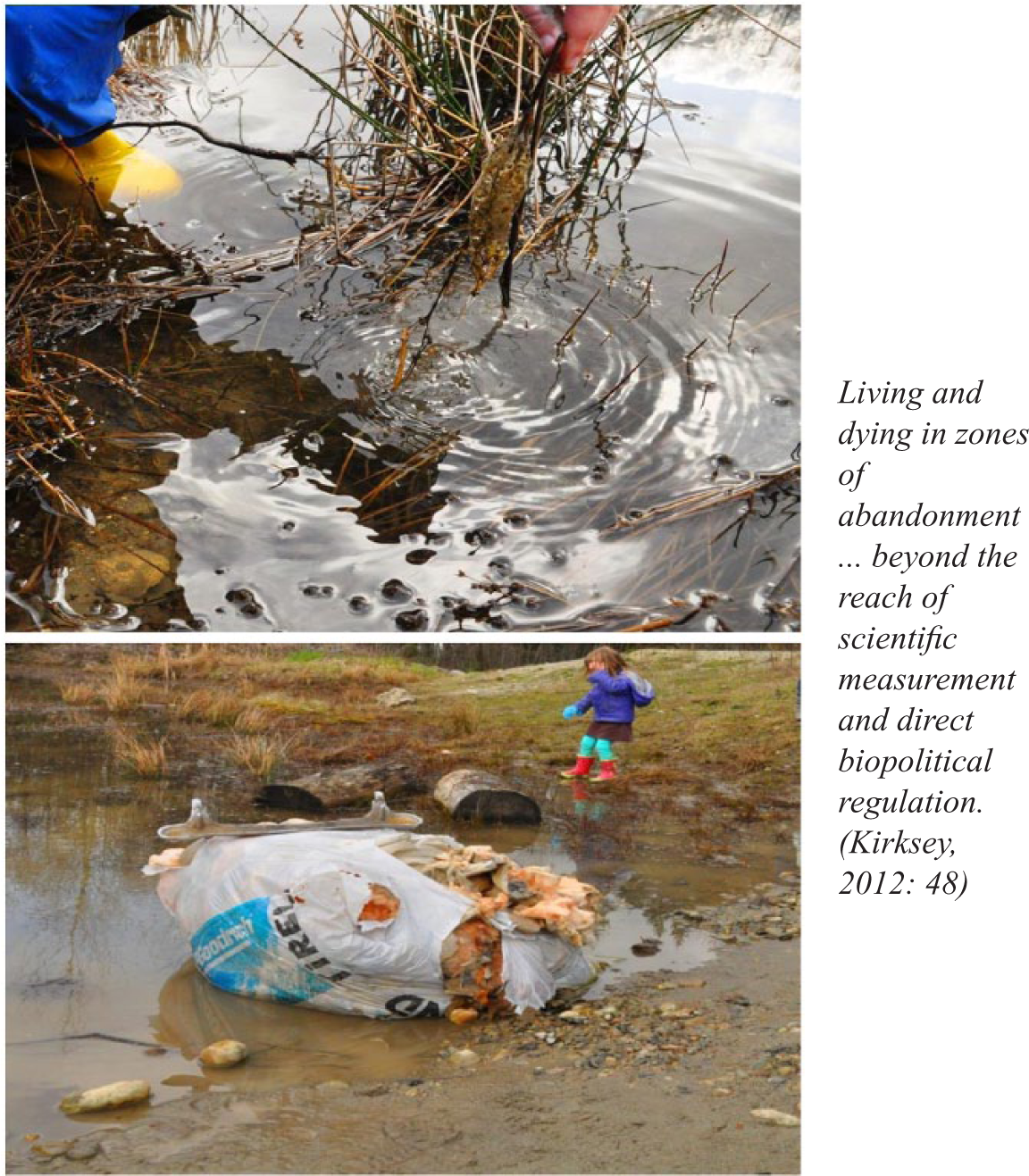
Wetland–waste–child assemblage.
I share with educators the idea of thinking of our work with children as ‘re-storying waters’, drawing inspiration from Vancouver poet Rita Wong (2011), who challenges us to think with water in ways beyond objectification and commodification, and suggests instead to think-with water in ways that are creatively inspired and focus on ethics and multiple relationalities. We find a local waterways map and wonder if it might be of interest for children to experiment with creatively, mapping ‘watery places’. Below are excerpts from our email correspondence, intermingled with pedagogical experiences at one of the childcare centres:
[Educator]: I think it will be interesting to draw a water map of [the childcare setting]. I wonder what children know about water, where it is, and how they are connected … I think this exploration will give our children opportunity to reflect on their image of water and relate it to their everyday lives at [the childcare centre]. [Fikile]: I think ‘mapping watery relations to place’ has really interesting possibilities – Cecilia Chen (2010, 2013) has interesting ideas in there that we could think with further. I resonate with her idea of creating shifts away from mapping as simply a neutral representational practice and instead seek a ‘generative approach to mapping, [where] we may shift topographic practices away from efforts to claim territory and to fix water as abstract resource, and towards collectively authored place-making practices that will help us to thoughtfully negotiate our relations with each other and with the environment’ (Chen, 2010). She suggests seeking multiple, creative ways to map our messy ‘relations to watery places’; ways that generate multiple understandings of place, such as mapping practices that incorporate changes over time (e.g. seasonal/history), multiple names, multiple stories, multiple senses (including sound), multiple performative interpretations of place, and maps from different human and more-than-human perspectives. The educator decides to begin by inviting children to collaboratively draw a map of water-spaces in and around the childcare centre. Drawings of ‘a puddle on the grass’ … ‘water bottles’ … ‘ice in the fridge’ and ‘water going all the way to the forest’ emerge … Children are also invited to draw while they are outside. ‘It’s the puddles we jump in’ … ‘our blood is water’ are some of the meanings that emerge as children, paper, coloured markers, water, educators, sky, and many other more-than-human things come together in these moments (Figure 6).
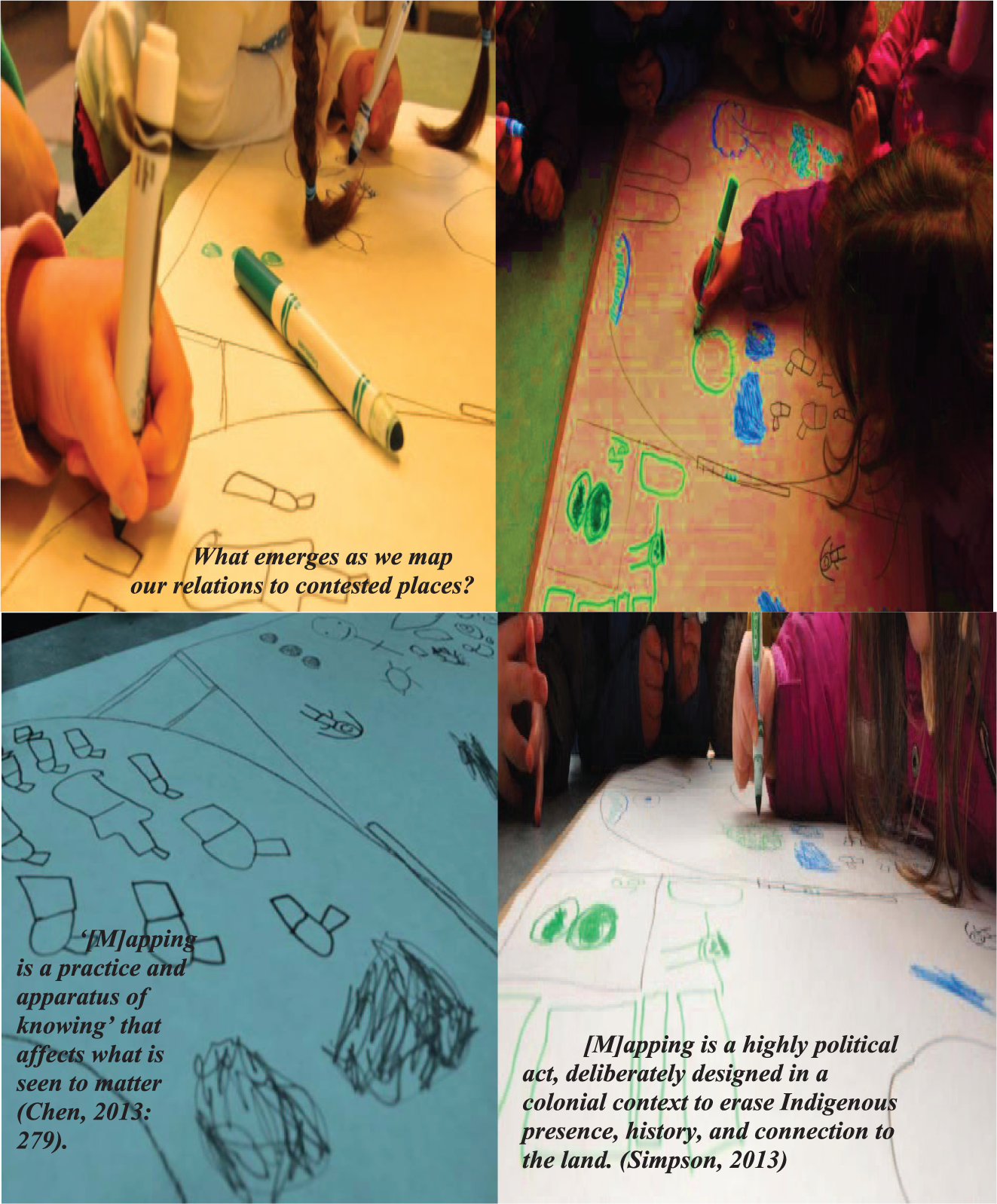
Mapping watery relations assemblage.
Revisiting these ‘mappings’ provokes new thinking, which I share with educators:
[Fikile]: What other possibilities for mapping water and water-relations in this place might emerge? I thought children’s drawing of their bodies as watery was wonderful to witness as an articulation of our inextricable relationalities/entanglements with water. Are you planning to invite children to map water around the campus, such as in the forest? I wonder if it might be interesting for children not only to ‘place’ where water is, but to begin to ‘story’ these maps as well? For example, I’m wondering about invitations for children to create ‘water stories’ of their water relations in this place. Here are some more ideas from Cecilia Chen’s (2013) work that might be interesting for us to think-with in connection with these and future practices of mapping: Encouraging experimental ‘mapping processes’ that generate ‘collective authorship [and] multiple interpretations’ (292) … Generating an evolving community of maps – multiple inter-related maps and multiple maps of the same ‘watery place’ to produce multiple perspectives … Mapping what we can’t necessarily see (such as the children’s ‘watery’ self-portraits) … Disrupting ‘colonial cartographic practices’ (290) by considering the exclusions and inclusions generated by each map.
The children and educators continue drawing water maps, both individually and collaboratively. After several weeks, the inquiry dissipates as children’s and educators’ interests shift away from water and mapping. Despite this dissipation, the tensions brought by interrupting our conventional understandings of children’s mapping as representational learning (a common marker of quality) remain. Witnessing interruptive questions and perspectives alongside maps and damaged watery places invites messiness and uncertainty into our pedagogical practices. This messiness is not easily resolved and resists containment by the ending of our mapping experimentations and waste–wetland encounters.
Living immanent quality-in-practice: Aporias and fissures
This article has put more-than-human perspectives to work in refigurings of quality as specifically situated within everyday practices that are always uncertain and in-question. I have put performative witnessing to work as a figuration for attending to everyday practices within the particular context of childcare settings located amidst a mountain forest on Coast Salish territories. I have experimented with performative imagery and textual ‘small stories’ of the everyday with a focus on intentionally decentring children’s developmentally based learning – a typical normative ‘big story’ of quality practices in early childhood education. Instead, I have storied practices of witnessing place specificities, cross-species socialities, damaged landscapes and watery becomings. These context-specific stories illustrate inescapable aporias and cracks within everyday practices – practices that continuously leak outside of the abstractions and child-centred learning that commonly count as quality early childhood education. The pedagogical encounters presented in this article suggest that refiguring quality-in-practice as emergent, more-than-human and always-in-process requires inhabiting possibility within impossibility (Derrida, 1992). This is illustrated by the unresolved questions and tensions that have emerged and resided alongside hopeful interruptions, imaginaries, possibilities and relations. My suggestion is that refiguring quality-in-practice might include taking up creative pedagogical and methodological approaches towards noticing our implicated relationalities in a world where humans are not the only actors (Haraway, 2014a; Van Dooren, 2014). In this perspective, refiguring quality involves ongoing grapplings with the ethical knots that entangle practice with more-than-human relations. As I have alluded to in this article, these grapplings might include productively inhabiting questions of who and what lives and dies well within particular damaged and colonized lifeworlds.
While I have been working closely with the childcare centres that I describe in this article for several years, I see this work as only a beginning – as ongoing tentative experimentations in ‘learning how to be worldly, how to respond, [and] how to practice respect’ (Haraway, 2008: 281–282) amidst uncertainty and complexity. As responsible witnesses, we (more-than-human co-inhabitants, children and educators) are immersed in ongoing processes of learning to respond to what emerges in the midst of messy quality-practices-in-motion. While I bring no smooth resolution to the question of what counts as quality practices in early childhood education, as a modest witness I remain simultaneously implicated, troubled and hopeful (Haraway, 1997) about what these unsettling everyday encounters might produce.
Footnotes
Declaration of conflicting interests
The author declares that there is no conflict of interest.
Funding
This research was funded by a Doctoral Fellowship from the Social Sciences and Humanities Research Council of Canada.