




Abstract
Purpose:
This article aims to subvert the nature/culture and subject/object divides that structure the dominant Western educational research paradigm by stepping beyond an exclusively human conversation and activating our ecological imaginations in the face of intensifying anthropogenic climate change.
Design/Approach/Methods:
Informed by animist ecofeminist philosophies, the river dialogues emerged from a climate action research field trip to the Athabasca oil sand mines in Alberta, Canada. They perform a “more-than-human” mode of narrative engagement with “nature in the active voice.”
Findings:
Despite the epistemological separations of Western-style education, I conclude that we can still find ways to dialogue and learn with the nonhuman world and thereby to stimulate our ecological imaginations.
Originality/Value:
This article showcases innovative more-than-human narrative methods and offers a collaborative alternative to the human-centric conventions of educational research and pedagogy.
Keywords
If our species does not survive the ecological crisis, it will probably be due to our failure to imagine and work out new ways to live with the earth, to rework ourselves and our high energy, high-consumption, and hyper-instrumental societies adaptively … We will go on in a different mode of humanity, or not at all.
The task of rethinking our interdependent futures beyond the horizons of the modern Western paradigm necessarily involves shifting educational research beyond the human-centric preoccupations and structuring Cartesian dualisms that stunt our research imaginations (Silova & Rappleye, 2015; Silova et al., 2020). This is because the dualisms that pervade the research methods and pedagogies of modern Western-style education entrap us within the bifurcating business-as-usual of setting all-knowing human subjects apart from known-about others (human and nonhuman). In the process of separating humans off from the rest of the world, dualistic thinking reiterates the presumption of exclusive and autonomous human subjectivity and agency and obfuscates how all lives, fates, and futures (including those of the nonhuman) are mutually determining and entangled.
These same structuring dualisms and human-centric preoccupations have even more dire implications in these precarious times of cascading geo/biospheric earth systems collapses. Central to these collapses are anthropogenic global warming and mass extinctions, which have been brought about by the kind of human-supremacist thought and action that presumes that we can endlessly exploit the earth’s finite resources with impunity. Such delusions of human separateness from and dominion over the rest of the world deny the interdependencies of life on earth and distort our imaginings about our place and agency within it. As the opening quote from Val Plumwood (2007a) suggests, if we cannot find another mode of imagining and living, we may not survive the ecological crisis that our myopic self-serving actions have wrought upon the earth. All of this begs the pressing question: What can those of us involved in the business of education do to redress this situation?
In line with this special issue, one thing we can do is to establish dialogues across different philosophical traditions that either disrupt the dualistic premises of the modern Western paradigm from within or engage with nonbinary worldviews that lie beyond it. Such conversations affirm that there are diverse ways of knowing, being, and learning that exceed the privileged binary modes perpetuated by Western-style modern education systems. These non-binary philosophical traditions can support educational researchers to forge connections instead of rehearsing divisions (see, for instance, Auld & Rappleye, in press; Sevilla, 2015; Takayama, in press; Takayama et al., 2017; Zhao, 2016). Another binary-breaking move we can make, one which simultaneously supplements and enriches our conversations with each other and expands our research imaginations, is to cross the subject/object divide between humans and the rest by entering into a dialogue with the world around us. This is the more-than-human move that I am making in this article (see also Silova, 2020).
To illustrate this move, I draw upon a climate action field trip I undertook with colleagues from the Common Worlds Research Collective in April 2019, 1 in which we dialogued with the upstream and downstream places we visited along the Athabasca River in Alberta, Canada. For those of us who took part, these river dialogues were an embodied, emplaced, and interactive mode of thinking and learning with the river, not just about it. They were also highly affective encounters that incited our ecological imaginations. I have a few motivations for recounting these river dialogues in this article. Firstly, I want to provoke our research imaginations about the possibilities for relational more-than-human methods and pedagogies that exceed a singular human-centric notion of agency. Secondly, I want to step beyond an exclusively human conversation about the state of the world. And thirdly, I want to spark the kind of planetary-scale ecological imaginations we all need to cultivate, if humankind is to survive the precarious times ahead.
The original purpose of this climate action field trip was to visit the infamous bitumen tar sands oil mining industrial complex in northern Alberta. But it didn’t take us long to realize that to reach our destination, our road trip over the Canadian Rocky Mountains, across Alberta’s extensive plains, and on into the remote subarctic north followed the watershed of the Athabasca River. In other words, our journey to the tar sands mines was also a downstream river journey. So we took the opportunity to think creatively with the river itself, and with some key ideas from Val Plumwood, a renowned Australian critical ecofeminist philosopher. 2 As a way of materially figuring what we were doing, seeing, and feeling, we crocheted shapes of the shifting landscape as we drove through it. We also read aloud passages from Val’s works. As we drove further and further downstream into territories that felt increasingly geographically and emotionally remote from our lives, our long road trip started to feel like a journey to the shadowlands—to one of those despoiled, usually out of sight and out of mind, forgotten places that Val called “shadow places” (Plumwood, 2008). In honor of our asphalt road trip to this bitumen tar sands destination, and our feminist more-than-human theoretical framings and methods, we called this road trip the BITCHumen salon. 3
It was Val’s lifelong project to hammer home the danger of “hyperseparating” ourselves off from the rest of the world, as if we were somehow outside of nature and thus “ecologically invulnerable” (Plumwood, 2009). Addressing those of us well-schooled in the dualisms of modern Western knowledge systems, she warned us not to believe the maxim that humans are the only beings (or entities) who exercise intentional agency and not to be hoodwinked by the concomitant illusion of human autonomy. She also urged us to resist entrapment in the progress narratives that propel the quest for human mastery and control over nature (Plumwood, 1993)—pointing out that these same progress narratives that once justified colonial invasion are still driving our “commodity economies” (Plumwood, 2007a). Near the end of her life, when the full and sobering significance of human-induced climate change was gaining traction under the rubric of the Anthropocene, Val insisted that the root of the problem is our inability to fully exercise our “ecological imaginations” in the face of hegemonic human-centric progress narratives (Plumwood, 2007a). She was unequivocal that we will have no future unless we can “see past the post-enlightenment energy, control and consumption extravaganza” (Plumwood, 2007a) and recognize that we’re an integral part of the same ecological systems that sustain our lives (Plumwood, 2007a, 2009). Such recognition, which can only be gleaned through an inseparable “ecological imagination,” was foundational to her vision for the “different mode of humanity” that we so urgently need to grasp and pursue (Plumwood, 2007a).
Val’s own “ecological imagination,” which was intensely lived as well as thoroughly philosophized, continues to inspire the scholarship of many feminists associated with the environmental humanities. For instance, Katherine Gibson et al.’s (2015) introduction to the edited collection Manifesto for Living in the Anthropocene uses Val’s prophecy “We will go on in a different mode of humanity, or not all” (Plumwood, 2007a) as a springboard into detailing the kind of ethics that are required for a different mode of living in the Anthropocene. Paraphrasing Val, they explain that this entails two shifts: Firstly, repositioning ourselves unambiguously within the environment; and secondly, repositioning the nonhuman within the cultural and relational ethical domains previously deemed exclusively human. 4 They also suggest that we need to cultivate new modes of attentiveness in order to notice and learn from what is going on in the lively, interactive, and agentic world around us (Gibson et al., 2015). This accords with Val’s insistence that nature is never passive and inert and that humans are not the only intelligent, narrative subjects engaged in world-changing agentic relations (Plumwood, 2009). In order to communicate this, Val urged us to write “nature in the active voice” (Plumwood, 2009) in a manner that recognizes the animacy of all “earth others” and enters into dialogue with them.
Within Val’s distinctively critical form of ecofeminism, however, recognition of the earth’s animacy or what she also referred to as the “materialist spirituality of place” (Plumwood, 2002, pp. 218–235, my italics) should never preclude a critical awareness of the social power relations that are inscribed on places and affect their inter-relationships. To simultaneously appreciate the earth’s animacy and the politics of place relations, Val proposed journeying as a way of stepping outside of our everyday instrumentalist relationship to place and entering into a “dialogical” mode of “multiple place-encounters” (Plumwood, 2002, p. 233).
Upstream river dialogues
Our river journey dialogues begin upstream, high in the Canadian Rockies, when we drive across the Athabasca Pass and register that from now on, we’ll be following the watershed of the Athabasca River all the way to our distant Fort McMurray destination. Once inside Jasper National Park, we turn off to the Athabasca Falls tourist site. It’s here that the headwaters of the Athabasca River launch their epic breakaway journey from the Columbia Icefield, and head off downstream, well over 1,000 km, to the Peace-Athabasca wetland delta, and ultimately out into the Artic Sea (see Figure 1).
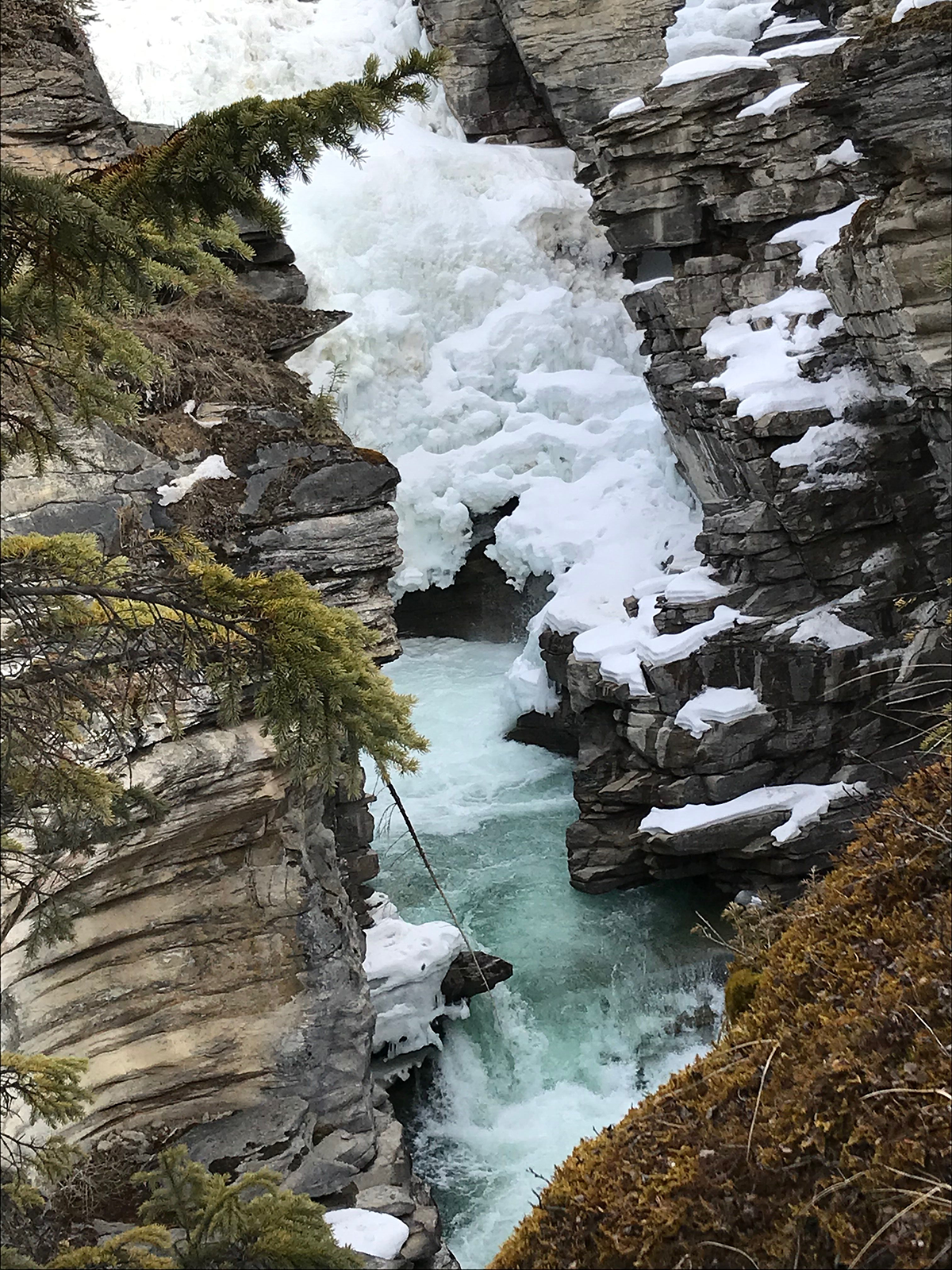
Headwaters of Athabasca River. Author's photograph.
At such close quarters to their melting glacial source, the Athabasca River headwaters are pulsing with the release of stored energy. It’s palpable in the reverberating roar of falling waters and in the electrifying ionized charge of moist air. We breathe in deeply, savoring the stimulating and invigorating atmosphere. It’s impossible not to be animated by it, at an embodied molecular level as well as an imaginative one. But, it’s also impossible to step outside of our settler-colonial imaginings about awe-inspiring wild places such as this, which are pre-cultivated by the romantic wilderness discourses of modern Western environmentalism. 5
This is brought home by the ubiquitous national park signage, which directs us to pay reverential homage to pristine, pure nature, and to the potency of this place. It describes the river as a timeless creator, gouging out rock holes and sculpting canyons and encourages visitors to view the waterfall as “a natural work of art.” And so we do. Peering down the swirling icy falls at the rocky facia, where water collides with resistant quartzite and yielding limestone, we contemplate the shape-shifting force of grinding ice, water, and rock (see Figure 2).
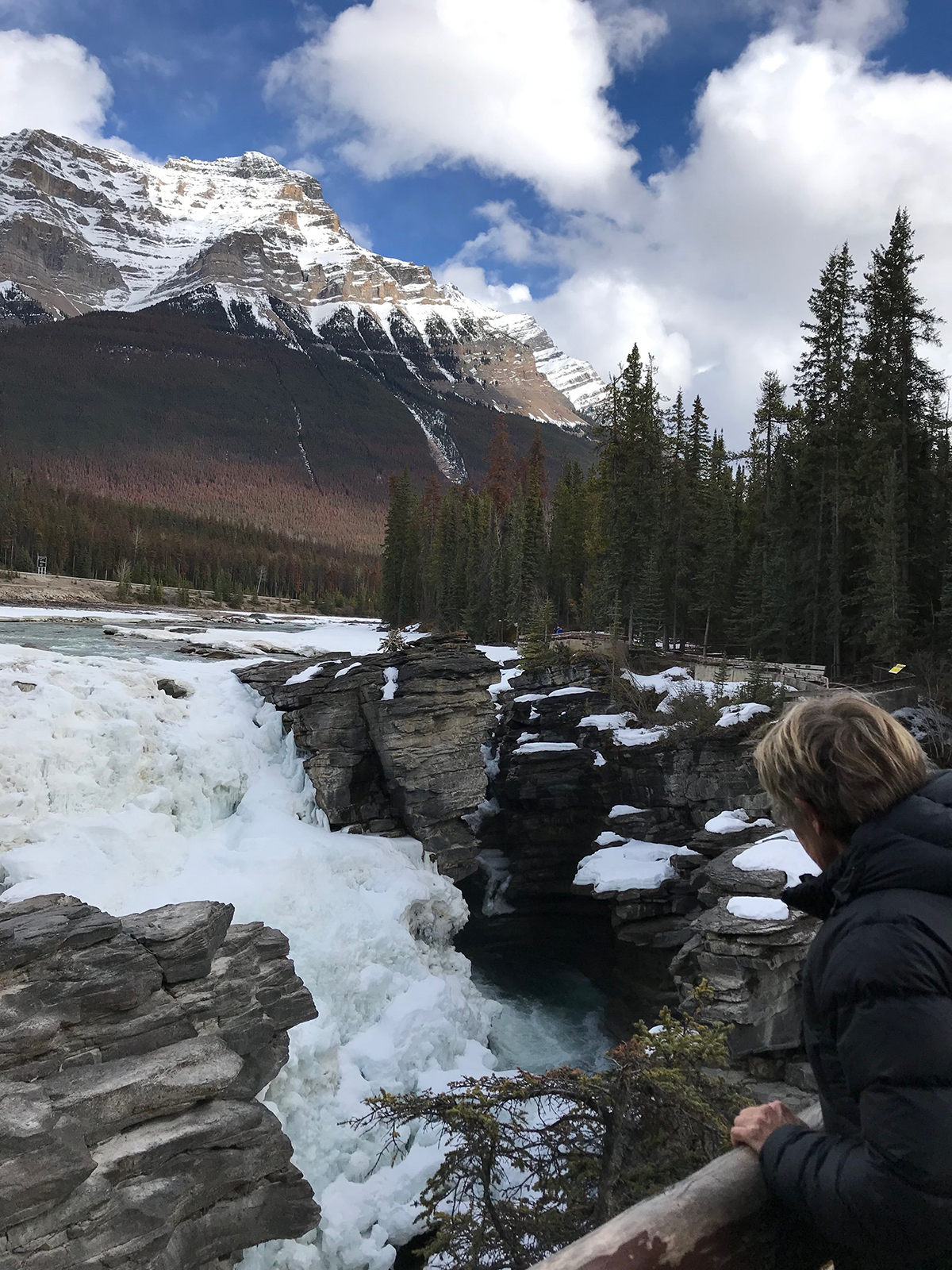
Peering down the falls. Author’s photograph.
The material evidence of the river’s potency is there before our eyes. The rocky cliffs are punctuated by the deep circular holes of the river’s past water courses. Like palimpsests, they reveal the layers of dynamic water–stone relations on a geological scale that dwarfs human temporality, creativity, and agency (see Figure 3). Another sign warns that the river’s agency far exceeds our own and can be lethal. “Athabasca Falls Kills. Step off the trail and you risk your life.” Counter-posed to the ultimate delusion of individual human will, the sheer force of this raw nature is not to be messed with. We are unequivocally reminded that it deserves our deferential respect.
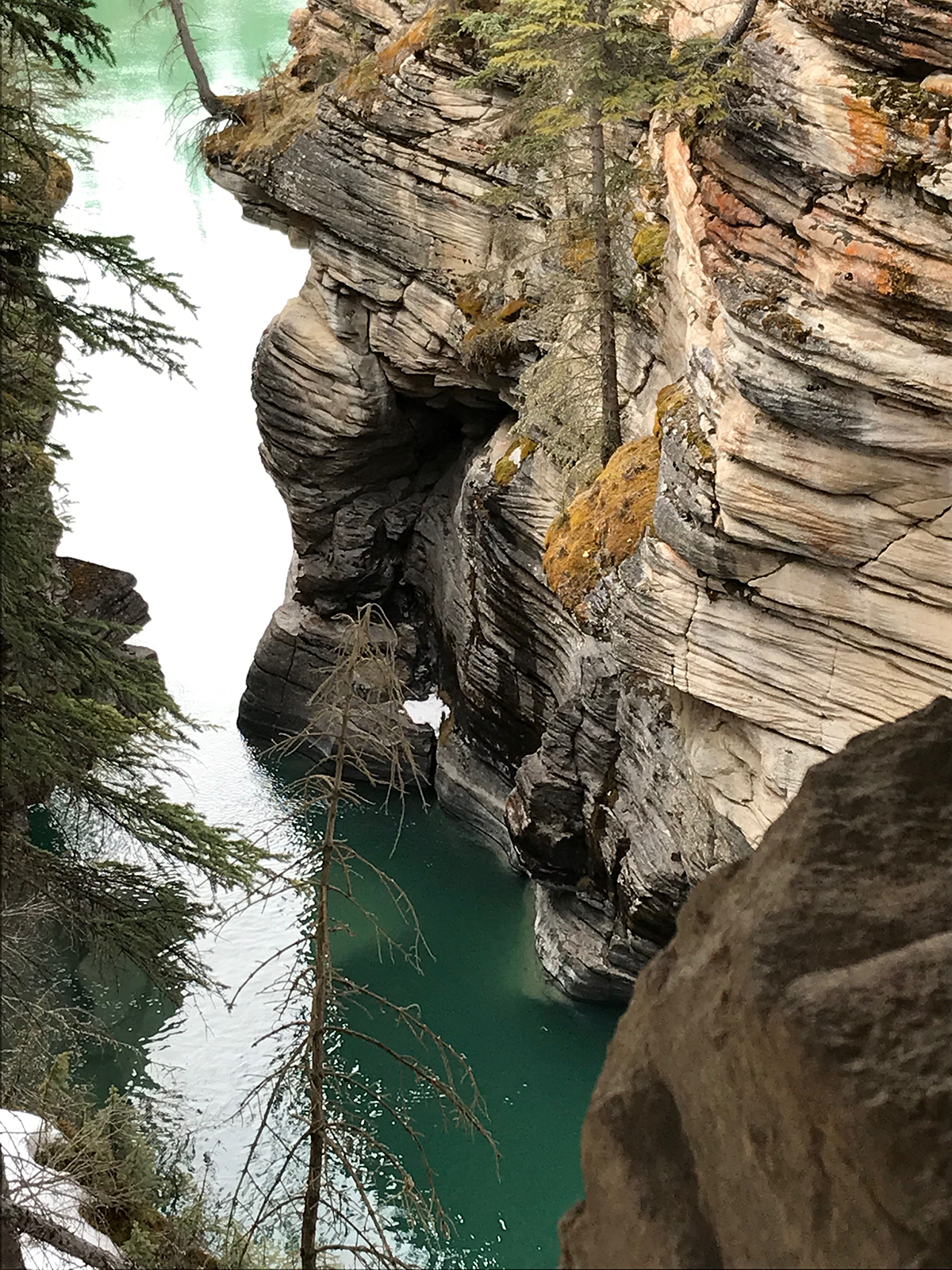
River's rocky cliffs. Author's photograph.
Culturally mediated or not, hyper-elemental wild places like Athabasca Falls can help us to grasp a geological sense of force and scale, if only momentarily. The expansive geo-scalar affect of such places can displace us, providing a vital correction to the grandiose conceits of human-centrism. An essential part of cultivating an ecological imagination is recalibrating our sense of human time and agency within the so-much-bigger-than-us story of life on earth. But beyond the majestic spectacle and narratives of these kinds of revered wild places, it’s much harder to get our lives and agency into such modest perspective, let alone hold onto it. The real challenge is learning how to sustain this heightened ecological imagination, maintain humility, and resist overinflating our own importance within the course of our everyday lives. 6
On the edge of the Athabasca Falls, it doesn’t take much to convince us of our puny status and more-mortal vulnerability. We keep a respectful distance from the surging waters and turn our attention to the small herbivorous plants and cryptogamic covers growing on the surrounding trees and rocks (see Figure 4). It’s intriguing that such tiny, unassuming symbiotic organisms thrive so quietly and unobtrusively in the misty microclimate of this loud, exuberant, and showy place. The intricacies of their spritely textures and vibrant colors draw us in, and we examine them closely. We collect a few moss and lichen sprigs in our small crocheted bitumen salon bags 7 to take with us on our road-trip. They’ll serve as mementos of the river’s irrepressible life-giving spirit and of the respect attributed to it at this highly elevated, high energy, and protected site.
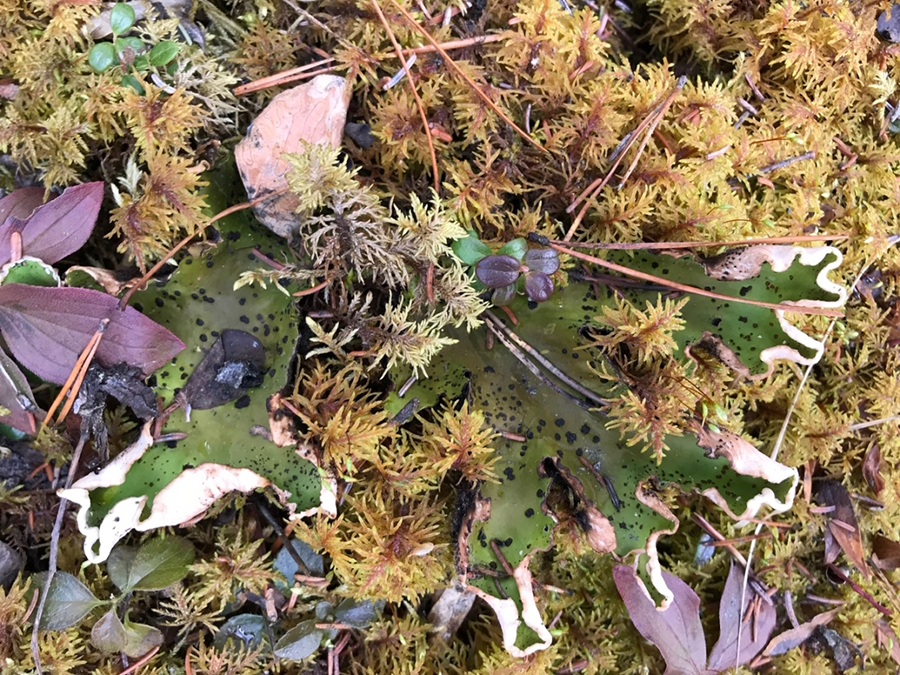
Small herbivorous plants. Author's photograph.
Downstream river dialogues
Once we leave the Rocky Mountains, the landscape changes dramatically. Very quickly, we’re in the flat, big-sky lands of the Plains Cree. The highway parts company with the Athabasca River, which flows in the same general direction but further to the west. Even though we won’t see it again for another 700 km or so, we’re still journeying along the Athabasca River Basin. We travel through the central aspen parklands, and on into the vast low-lying boreal forests that cover northern Alberta.
On the surface, these boreal forests look deceptively unexceptional (see Figure 5). But underground, they’re rooted in densely fibrous peat bog muskeg soils that sink and store vast amounts of carbon. By sequesting carbon, they help to maintain the steady-state atmospheric and climate conditions that have enabled the flourishing of human life on earth throughout the Holocene. They have high planetary ecological value. 8 Just below the peat lies an equally vast reservoir of tar sands. This is a mixture of sand, clay, water, and the oily bitumen that carries a radically different kind of value—the kind that appeals to the immediacy of the fossil fuel hungry global commodity markets. 9
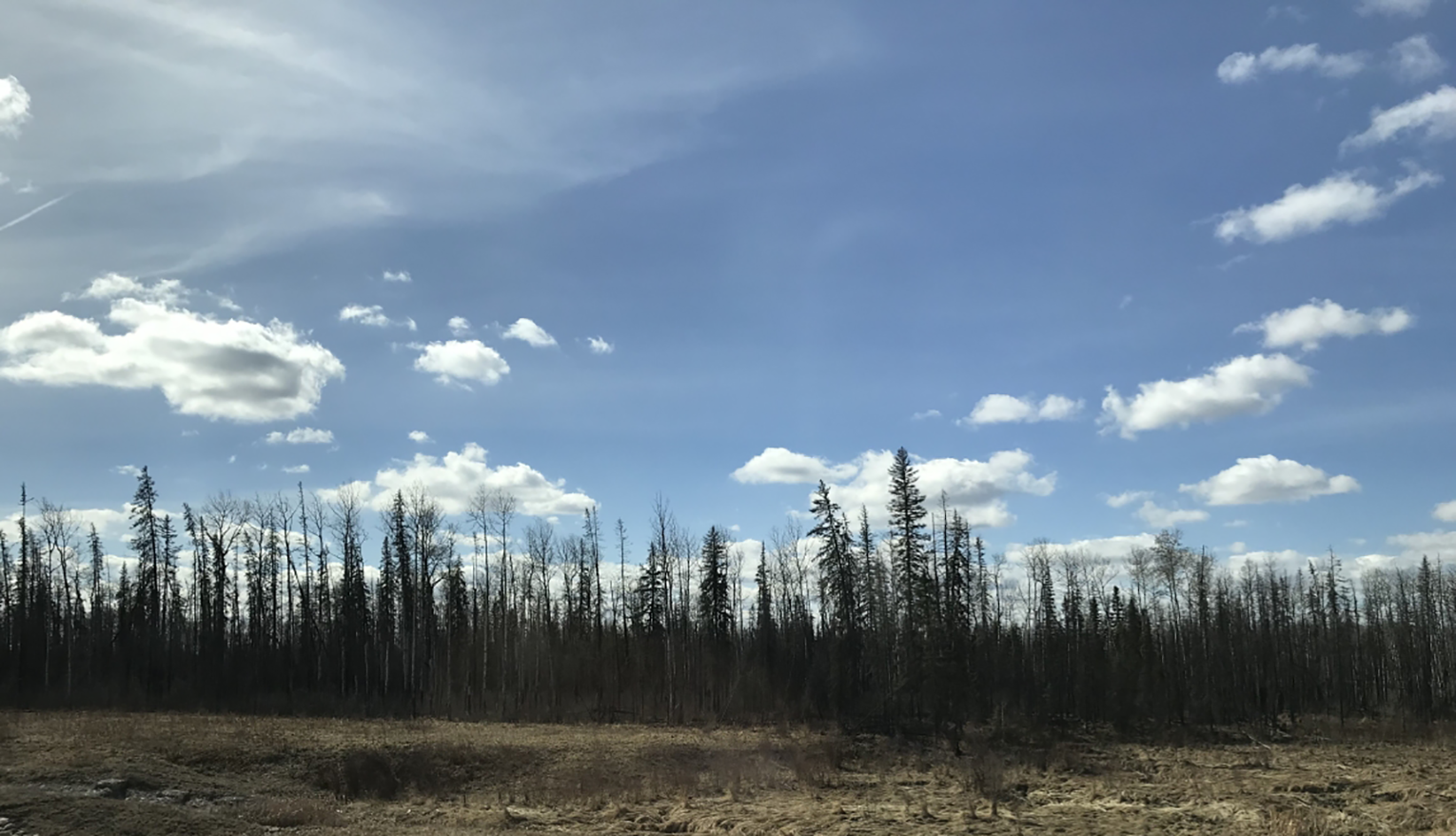
Boreal forests. Author's photograph.
With the dramatic change in landscape comes a dramatic change in the ways in which nature is conceived and narrated—from an awe-inspiring creative and agentic-protected upstream wilderness to a downstream, extractable, and profitable natural resource. As the glorified nature wilderness narratives of the national park morph into “energy, control and consumption extravaganza” scripts (Plumwood, 2007a), any deserving recognition of the vital carbon-storing ecologies of the northern boreal forests is muted by much louder and prouder declarations about the impressive world-scale of the bitumen sands mining operations, their capacity to produce impressive quantities of crude oil, and in the process to generate impressive amounts of revenue for Alberta and the nation. 10 BIG OIL imagination is muscling in.
Filling up at the fuel pump, we notice that Husky oil company brands its diesel and petroleum as “mother nature’s fuel” (see Figure 6). Is this reference to Mother Nature, as an evocation of “all-things-good,” supposed to reassure us that burning oil is pure and natural, and assuage our environmental consciousness? It’s a significant moment for registering the strong pull toward celebrating all things oil and dissociating from the environmental damage caused by its extraction and combustion. Greenwashing and dissociation are to become the signature of the downstream leg of our journeying. We remind ourselves, in the face of this pull, that there is no outside. Our road trip imprints its own ecological footprint. The BITCHumen salon is a fossil-fueled journey.
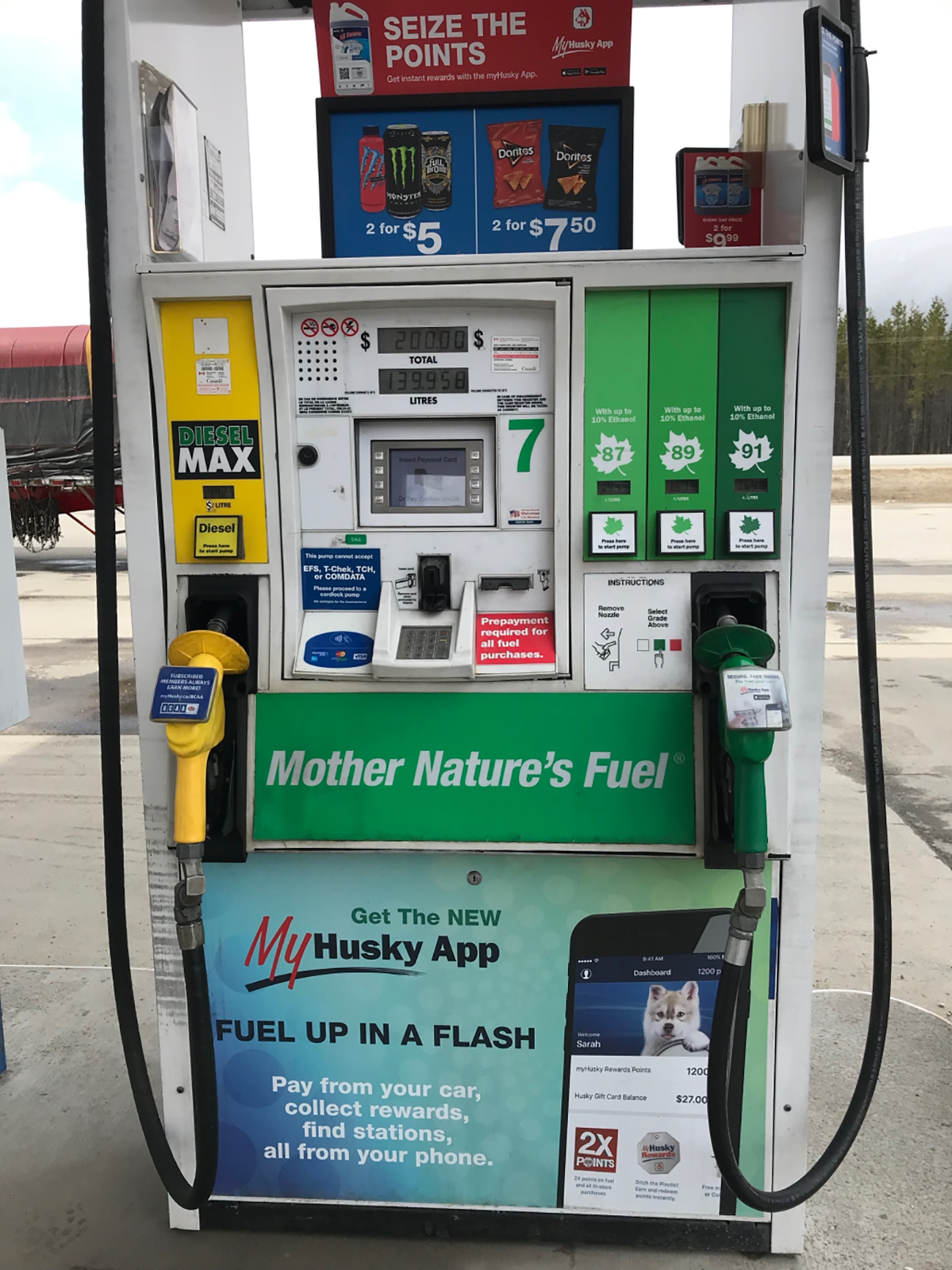
Husky Fuel Pump. Author's photograph.
The final leg of our northward journey along Highway 63 is increasingly tense (see Figure 7). We’ve heard this route is tagged locally as “the Highway of Death” because it’s a hot spot for vehicle accidents. The highway will take us as far as Fort McMurray, the mining town that services the Athabasca tar sands mining region, which is reputedly the largest single industrial complex on earth (Polidor et al., 2014). We’ve seen the confronting satellite views on Google maps, which confirm the massive scale of the mining operations and attest to the presumptuous dominion of Man-over-nature. They also test our ability to hold onto the human de-centering and de-exceptionalizing perspectives that were so easy to grasp at the Athabasca Falls. The sharp and sobering irony of traveling along the bitumen surface of the “Highway of Death” toward one of the largest and most toxic industrial mining complexes on earth is really weighing in now. It also feels uncannily like the “Highway of Death” is becoming a metonym of the much larger journey that humanity is on—toward extinction in the Anthropocene. We take it easy as we pass a regular stream of road train tankers, transporting their sticky, flammable cargo south.
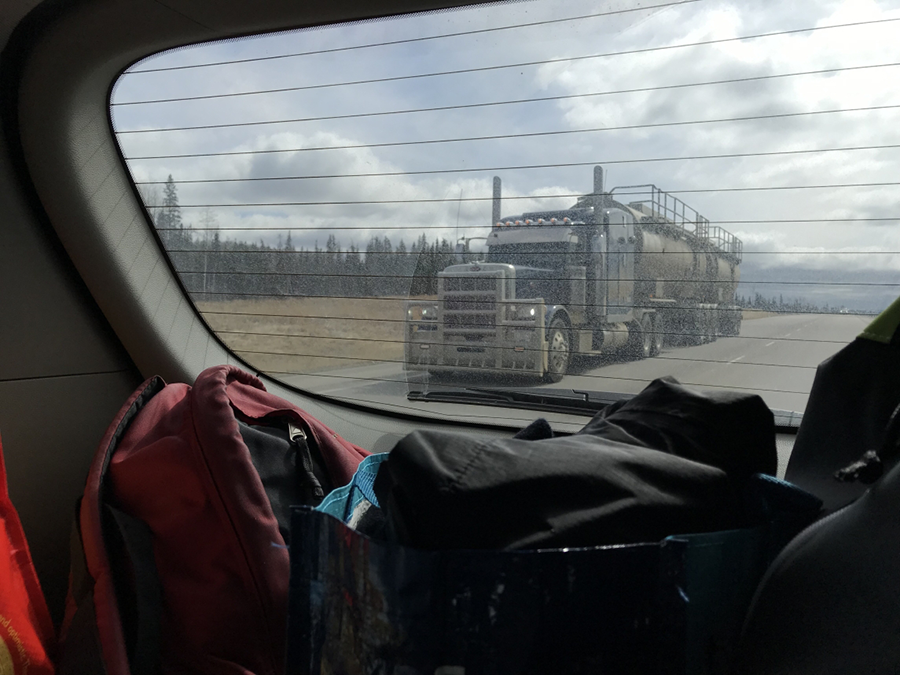
Driving along the “Highway of Death.” Author's photograph.
We finally reconnect with the Athabasca River when we reach Fort McMurray (see Figure 8). We’ve been looking forward to seeing it again, but we’re also a bit apprehensive that its potent youthful energy might be depleted after its long journey through industrial–agricultural lands. Will we still be able to feel its material power and spirit? But even more than this, we’re trepidatious about the fact that immediately downstream from here, its waters will be commandeered as an indispensable resource for mining and processing the bitumen tar sands. It’s mid spring—ice “break-up” time. Awaking from its winter freeze, the river is starting to flow again. Locals tell us it can be a dangerous time, as large chunks of cracking melting ice can suddenly jam together, burst out of the water, and trigger flood waves. It’s reassuring to be reminded that despite its impending reduction to resource-for-Man’s-dominion-over-nature, this river is still an unpredictable and indifferent force to be reckoned with, and those who live alongside it register their vulnerability to its seasonal vicissitudes.
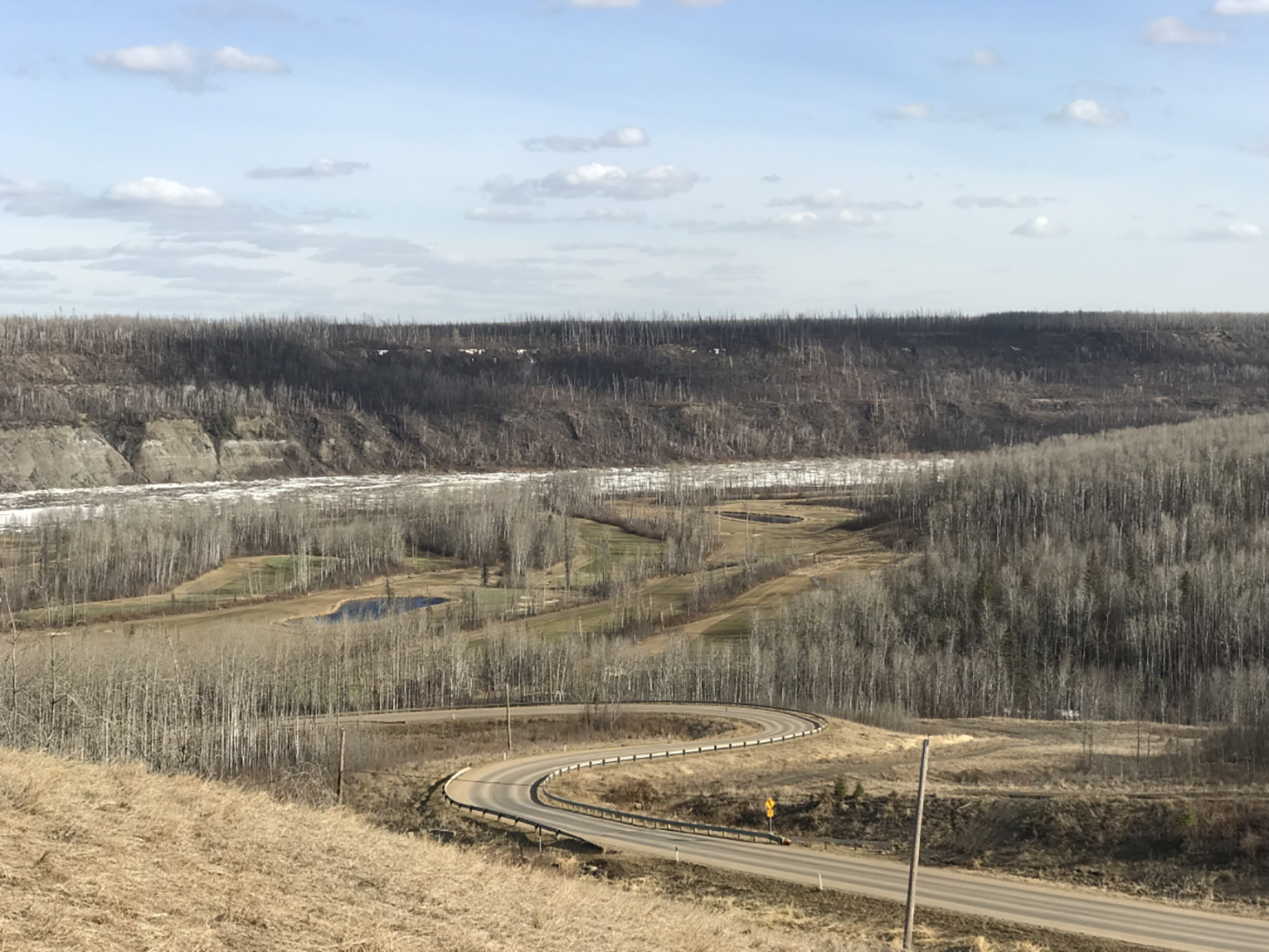
Reconnecting with Athabasca River at Fort McMurray. Author's photograph.
We trek across a golf course to access the river. Standing on these downstream banks, everything is still. Today, at least, there’s no perceptible action—no cracking to be heard. Large icebergs are pushed up all along the banks (see Figure 9). They’re black, grimy, and motionless, and even though they have an impressive monumental presence, they do make the river seem rather wasted. We throw the once fresh and spritely mountain sprigs, mosses, and lichens that we collected upstream at the waterfall out over the grimy icebergs. We’d always intended to return them to the river downstream. It is a way of affirming the river’s temporal and spatial continuities, reminding ourselves that it is still the same river, no matter how differentially it might be regarded and treated by humans along its course. It’s also a small way of acknowledging its affect upon us. We sing a river song that we composed in our hotel room the night before—it’s an ode to the Athabasca’s animacy: Athabasca waters, Athabasca flow, What have we done to your life-force now? Where does your spirit go? Large icebergs on the river banks. Author's photograph.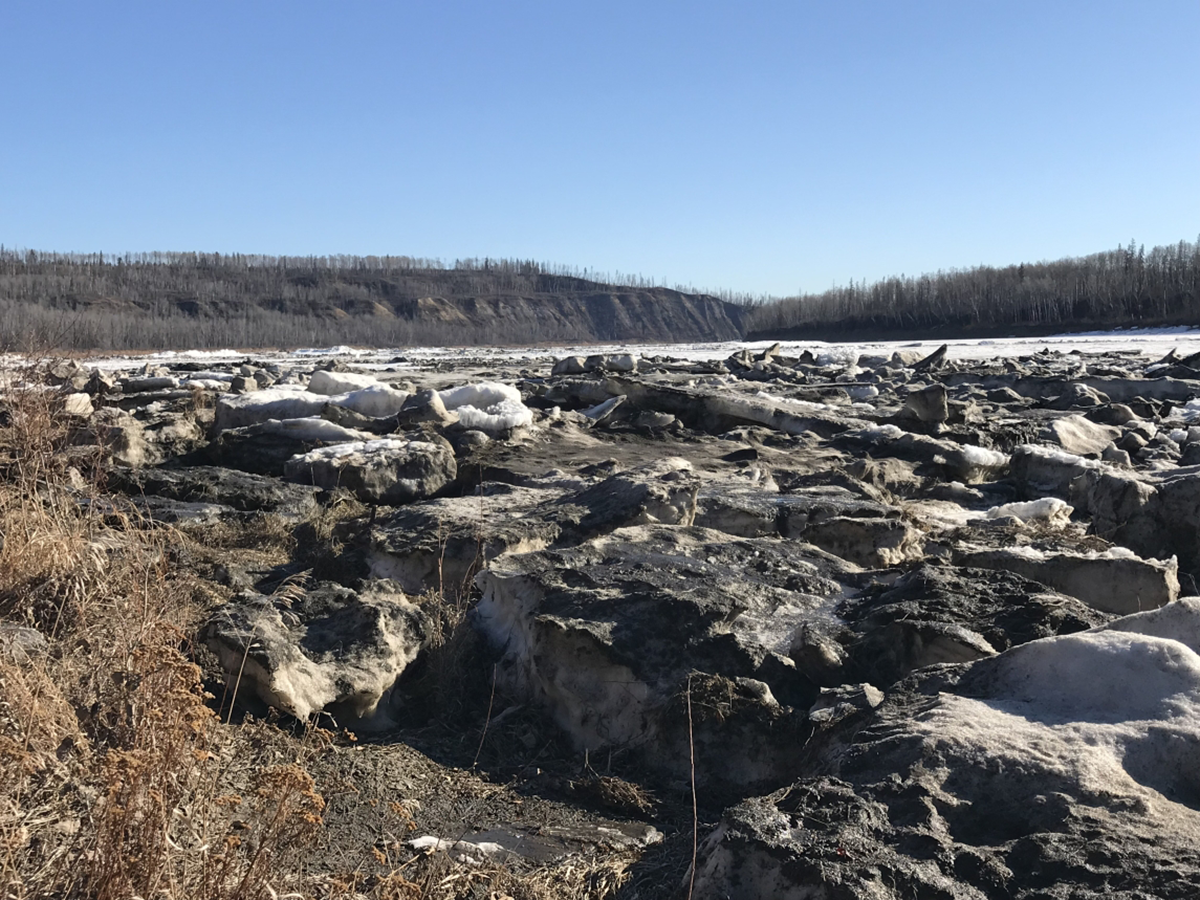
As we prepare ourselves for an aerial view of the Athabasca River flowing through and “resourcing” 11 this mega industrial complex, we remind ourselves how back in Jasper National Park, the wild headwaters of this same river are sanctified for their unfettered potency, and the entire river system is celebrated for its regional ecological significance and heritage status. We’re intrigued by the bizarre disconnect—whereby the same river can be narrated as an agential creator worthy of respect and protection at its wilderness tourism source, and further downstream in the rural industrial and mining zone, narrated as an essential and exploitable resource for the fossil fuel economy. It seems so schizophrenic. How does this splitting off and dissociating work? Will we be able to resist the split ourselves and still dialogue with the river “in the active voice,” in the blasted tar sands shadowlands?
The morning of our aerial tour is clear and still. We ask the pilot to follow the Athabasca River’s course through the mining complex and fly us over the tailing dams and surface mines. One of the major regional environmental concerns voiced by environmental watch and research groups 12 is the inordinate amount of water drawn out of the river system. 13 This is because the use of water is essential for extracting bitumen from the tar sands and, then, for refining it into transportable crude oil. As a result, a far greater proportion of water is used for the various stages of mining and processing than crude oil is produced. 14 Of even greater environmental concern is the vast quantity of river water diverted to dilute, sink, and store the toxic slurries of heavy metal waste in massive tailing dams. 15
From a distance, these lethal cesspools could be mistaken for enormous blue–green lakes, especially the largest which are still semi-frozen (see Figure 10). We fly down lower for a closer look. Pipes protrude out into the water from the white sandy edges, emitting an evil-looking oily black slick. Some of the largest lake-like tailing dams are completely covered in black sludge (see Figure 11). 16
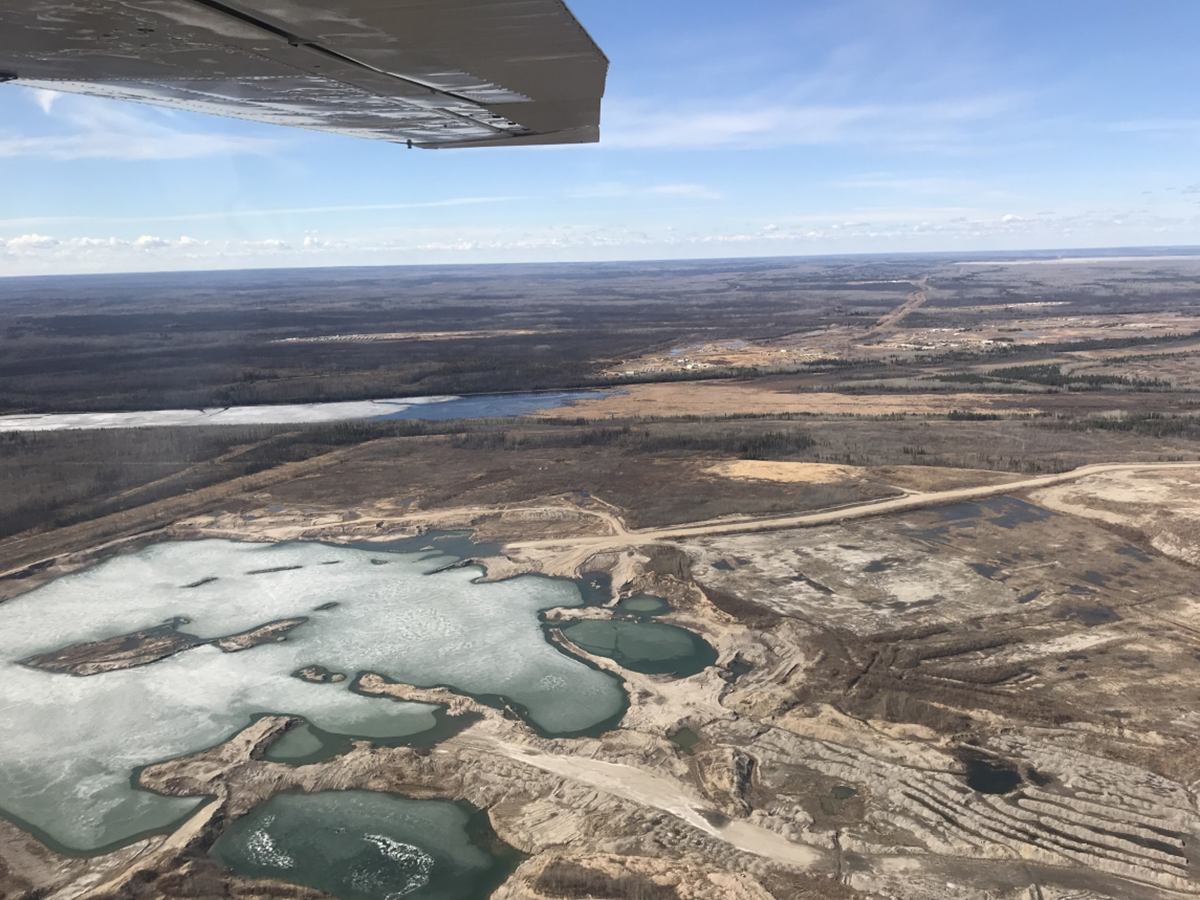
Semi frozen tailing dam. Author's photograph.
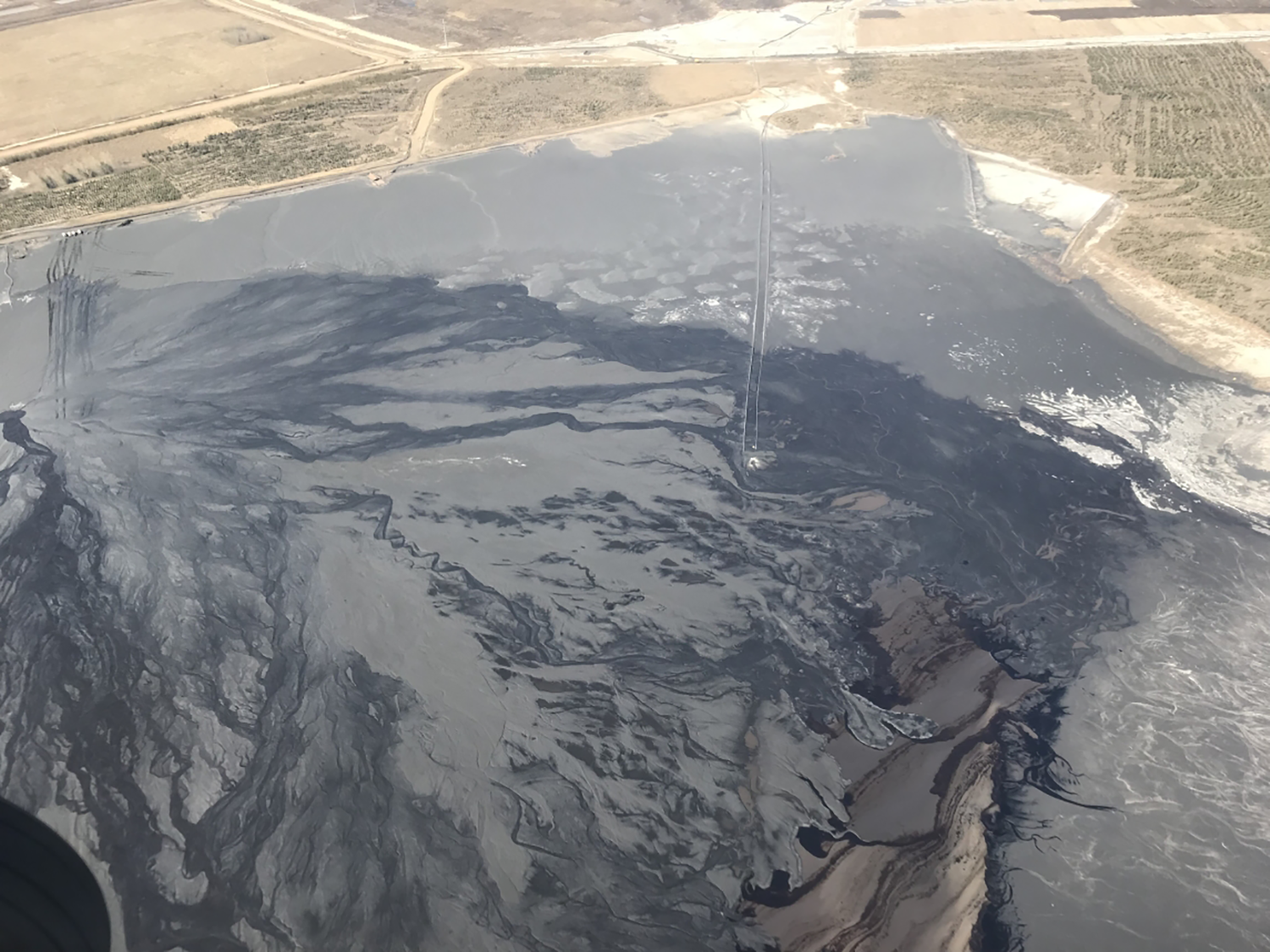
Black sludge on tailing dam. Author's photograph.
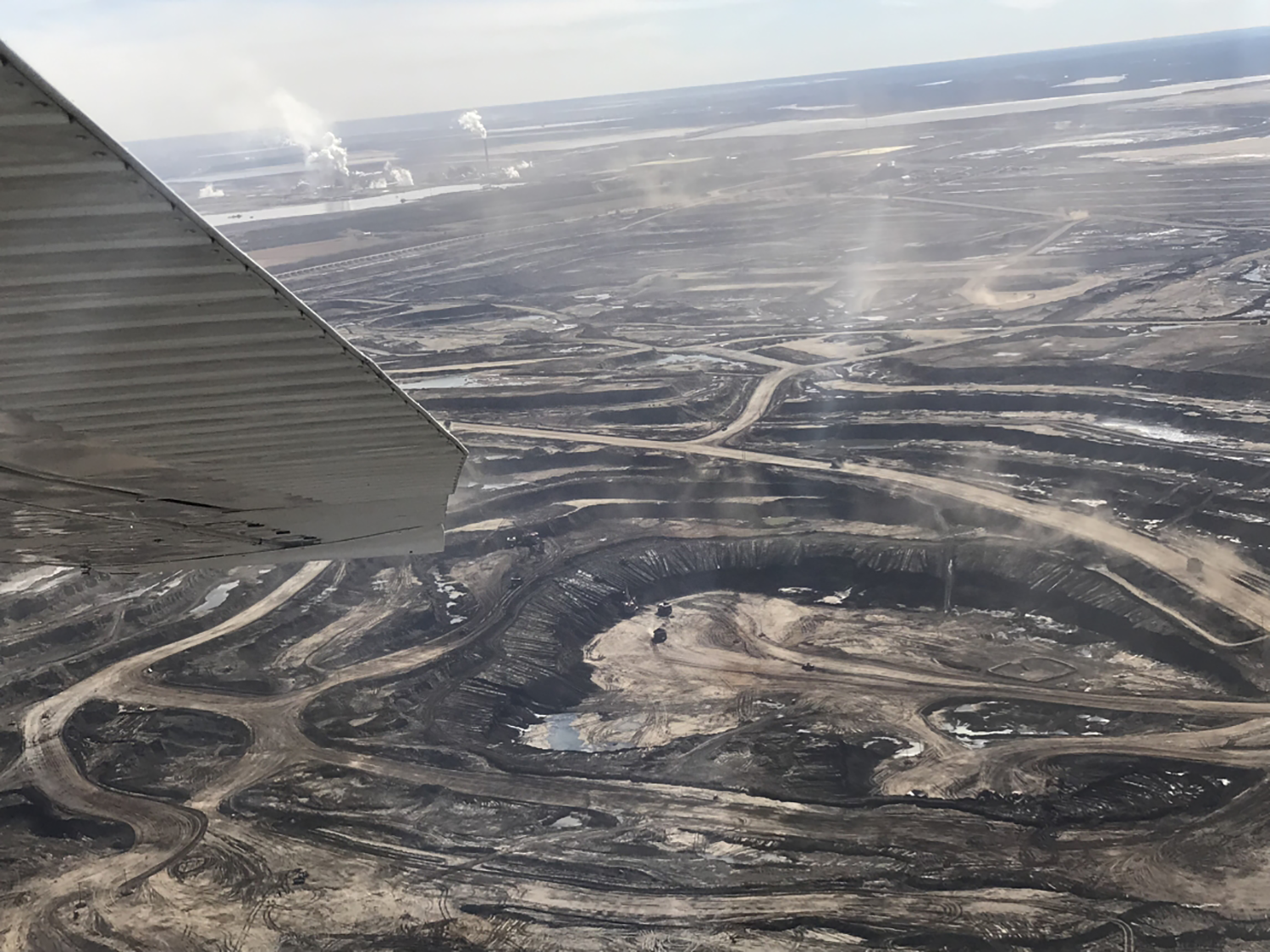
At another point, we fly over a patchwork of ominous bitumen settling ponds and wonder if and how waste like this will ever be remediated (see Figure 12). The entire surface of this mine-scarred landscape is riddled with remnant pools of contaminated water—large and small, green and black, frothy and oily—like pockets of acne on the desecrated skin of the earth (see Figure 13). From above, it looks like this skin is being relentlessly scraped away and blackened by nonstop moving lines of worker ants. But these are the battalions of huge diggers and earthmoving trucks, robotically exposing, shoveling, hauling, and crushing the substrata of tar sands. 17
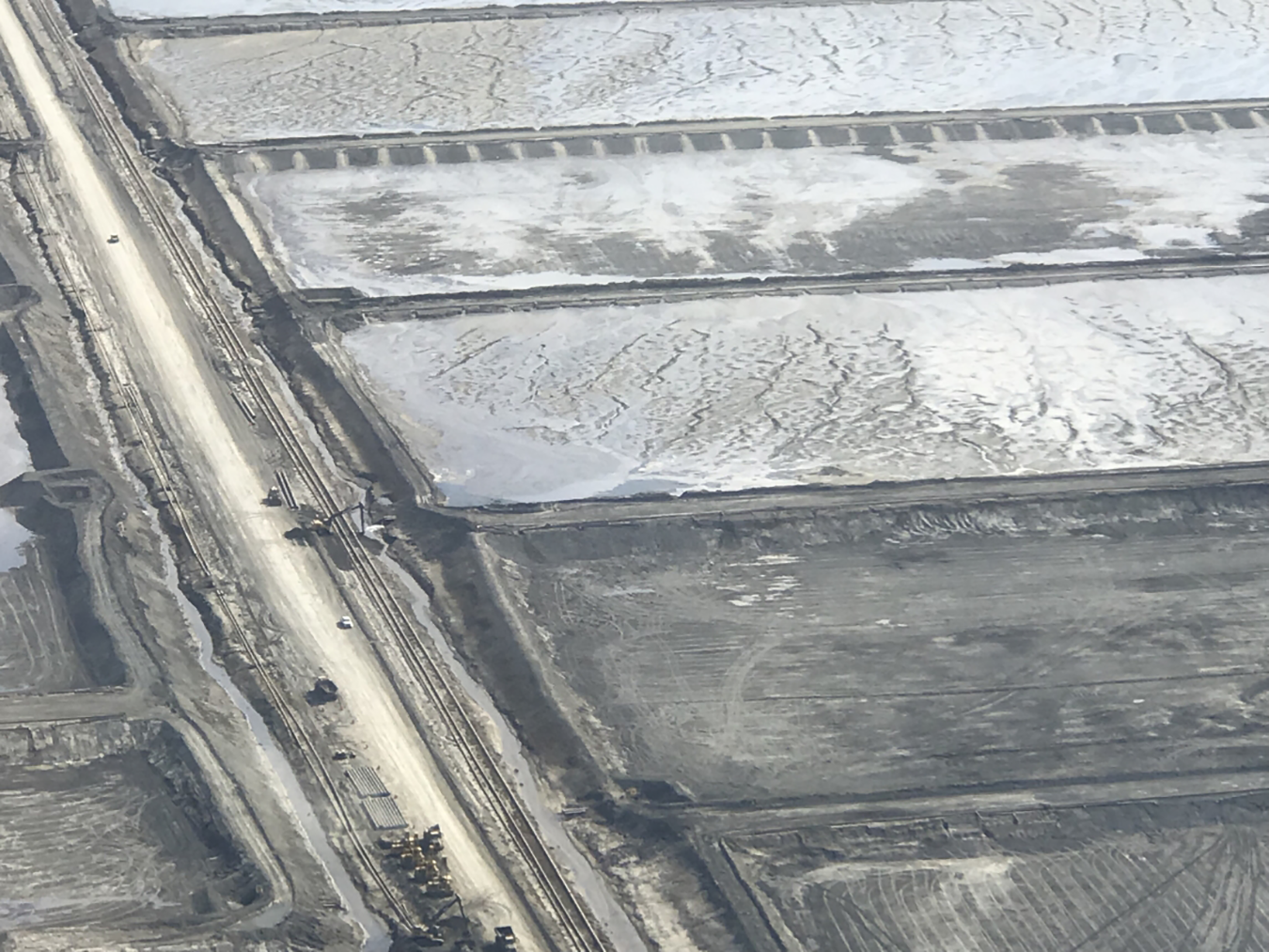
Bitchumen settling ponds. Author's photograph.
Contaminated water across landscape. Author's photograph.
We take a final look at the ravaged river, flowing uncomfortably close to a toxic luminous green tailing lake, as it heads off back into the boreal forest and downstream toward the First Nations Fort McKay settlement (See Figure 14). The pilot tells us that another mega mine is proposed to be built further downstream. It will be even larger than the existing ones. 18
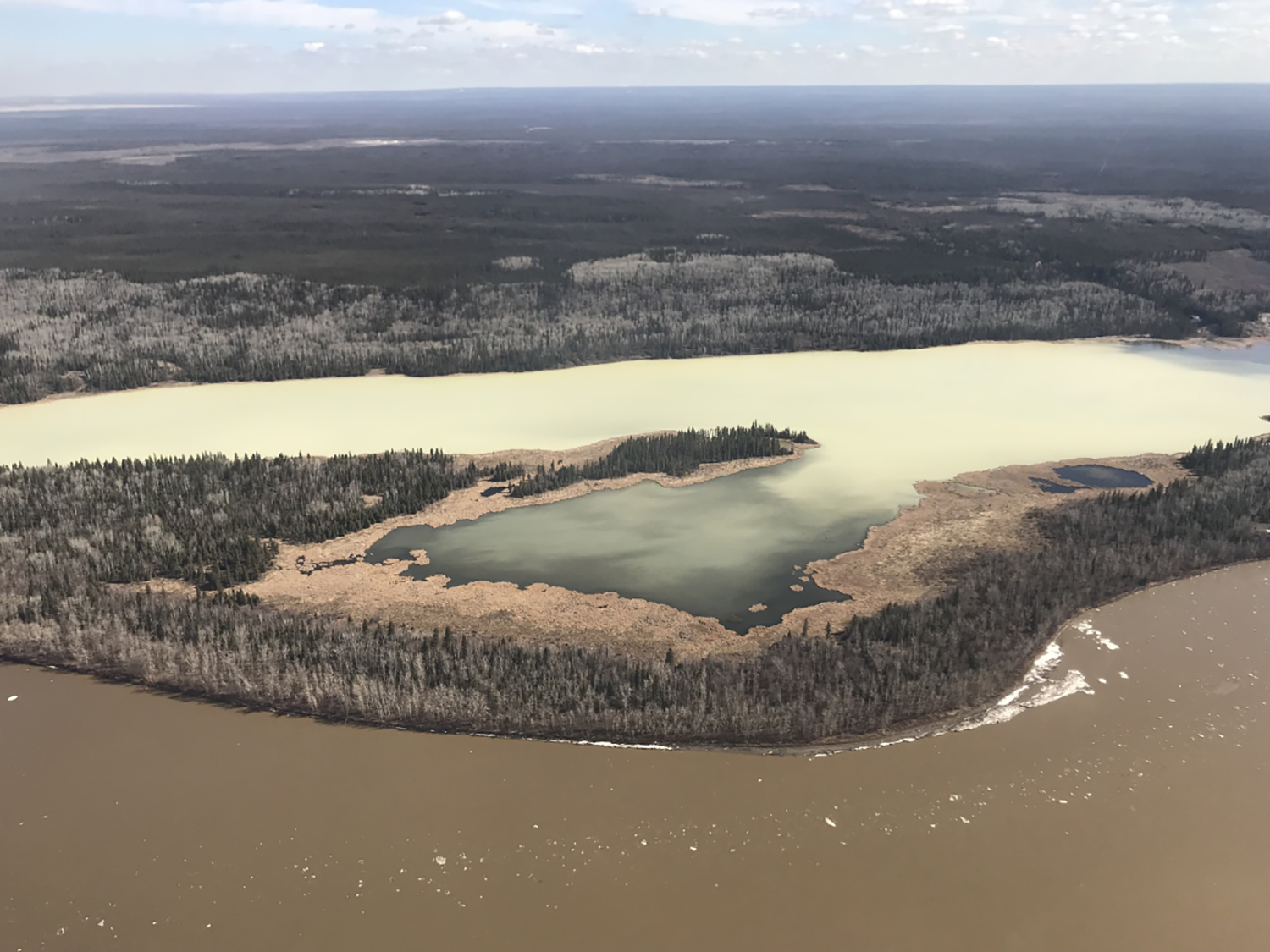
River flowing next to toxic green tailing lake. Author's photograph.
Heading back toward Fort McMurray, we fly over the massive Syncrude refinery and the towering sulfur stack that belches a white cloud of noxious gas into the air around us (see Figure 15). 19 These emissions from the Athabasca industrial complex bear enormous environmental costs, not only to the immediate watershed region but to our rapidly warming planet. Extracting and refining crude oil from bitumen tar sands is far more resource and energy intensive than more convention forms of oil mining. This not only makes it the most expensive form of crude oil production but also the dirtiest and thus most carbon footprint heavy. 20 Reeling from the apocalyptic sights of this blasted landscape, we register the sheer material–semiotic force of the extravaganza BIG OIL imagination, fueled by its big industrial machines and big revenue dreams. At this critical time of international carbon emission reduction targets and agreements, there’s a clear link between the brazen physical force of BIG OIL extraction from the surface of the tar sands and the concomitant brazen imaginative force of denial of any problems associated with the exponentially increasing greenhouse gas emissions produced by them. 21
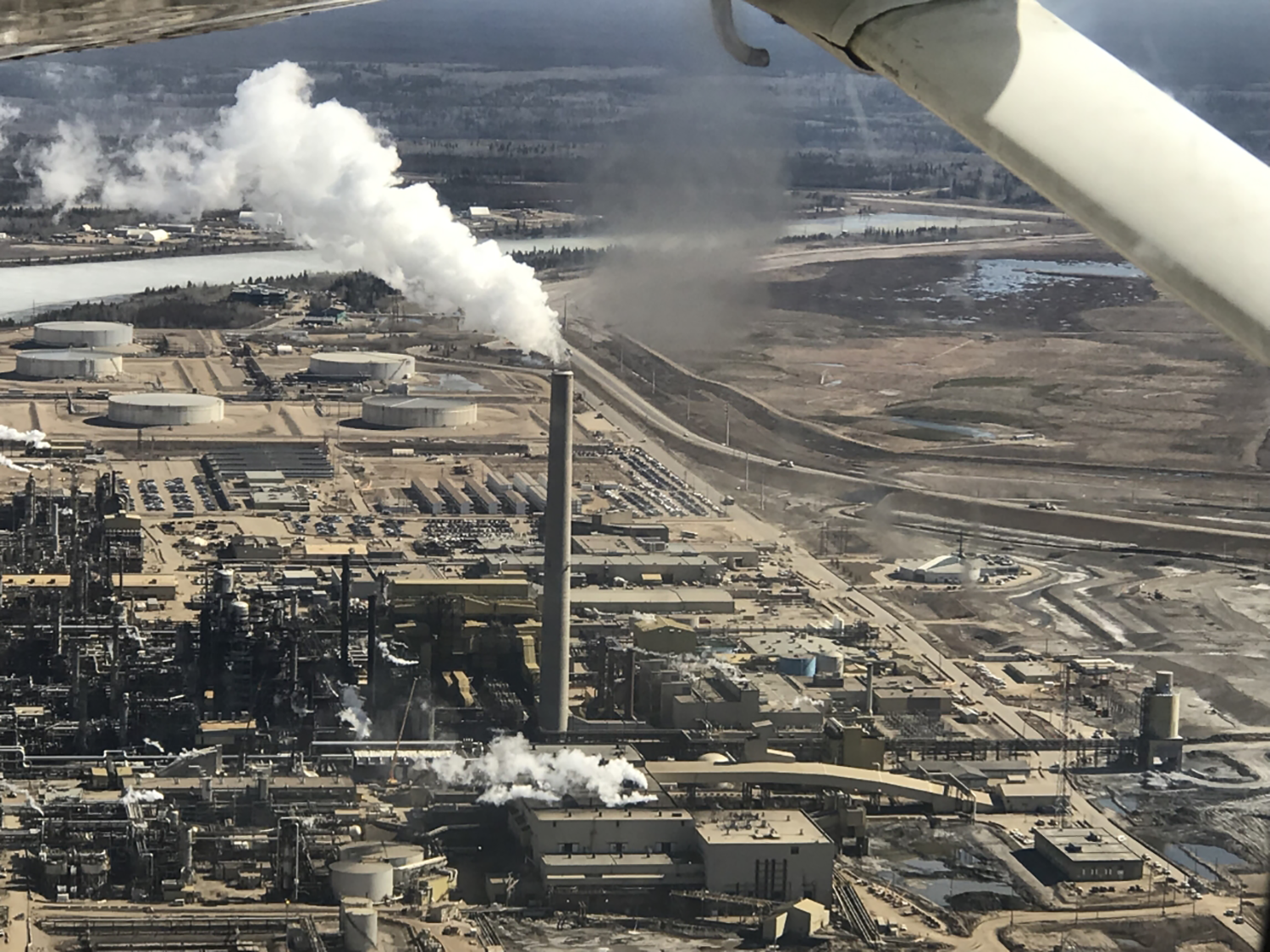
Syncrude sulphur stack. Author's photograph.
Denials can take unexpected forms. In a paradoxical twist, this same BIG OIL imagination is increasingly appropriating and projecting the veneer of good environmental citizenship. 22 The brazen reverse logic seems pertinent to the question of exactly how splitting off and dissociating works under the guise of responding to climate change. Suncor Energy, for instance, which operates the largest and most profitable tar sands mining operation in the Athabasca region, is heavily invested in showcasing its credentials as a sustainability leader in the energy corporate world. On the front of its website, it declares: “We create energy for a better world.” Suncor’s vision is to be trusted stewards of valuable natural resources. Guided by our values, we will lead the way to deliver economic prosperity, improved social-wellbeing, and a healthy environment for today and tomorrow (Suncor, 2019a). As a final irony, one of the core values it espouses is to “Do the right thing. The right way, with integrity” (Suncor, 2019a). Suncor has a number of stated sustainability goals, including “addressing climate change” by “reducing emissions while providing the energy the world needs” (Suncor, 2019b), and a “commitment to water stewardship” that takes a “watershed approach” (Suncor, 2019c). It seems we should be grateful for the patronage of this mining corporation who can do it all. Not only does it cater for humanity’s consumptive energy needs (which are never questioned) but it also (righteously) assumes responsibility for determining the needs of the environment. In this script, the environment is only ever a collection of “valuable natural resources,” completely separate from us (humans) but there for our use. It has no voice or agency of its own. Mute and passive, it actually needs “trusted stewards” like patronizing mining companies, to look after it.
There’s lots of hyperbole in and around Fort McMurray about environmental sustainability. The message we are consistently getting is that this town is full of good caring citizens doing good things for the environment. This completely baffled us at first. We certainly didn’t anticipate it. But narratives are powerful interpellators (even seemingly deranged ones that cast bitumen mining as a form of sustainability) and Suncor’s appropriative rhetoric goes a long way to explaining where such imaginings are coming from and how they work. Fort McMurray is effectively a mining company town. Not only do the majority of Suncor’s workers live here, but the company has also strategically partnered with local Indigenous organizations, runs community engagement and development programs, and sponsors local initiatives and events. As a result, Suncorp’s greenwashing script that their “sensitive” BIG OIL operations are leading sustainability is writ large upon the town’s imaginary.
A perfect example of this is the Suncor-sponsored annual Fort McMurray carnival. “Sustainival” (as it’s called) proudly proclaims itself “the world’s first green midway,” which “celebrates energy literacy, sustainability and clean technologies,” ostensibly because “the rides are powered by [unidentified] renewable energy’ (Sustainival, 2019).
At this family fun day event, even young children are drawn into the BIG OIL-as-sustainability imaginary. In the cheerful, brightly colored “Road Yard,” they’re enticed to have a great time riding the mini diggers and trucks on the mining “Convoy Train,” while presumably starting to develop their early “literacy” in “sustainable energy.” Not only does this ride help Fort McMurray children identify as future mine workers, but it also helps them to dissociate from the material environmental impact that these mines are having. It seems that the pedagogies of splitting and dissociating via the BIG OIL imagination begin in early childhood. And this particular brand of it teaches children that they can have it all—they can be today’s good stewards of an abstracted and exteriorized environment, even as they prepare themselves to be tomorrow’s miners of the boreal tar sands.
Shadowlands further downstream
The material effects of the dissociative BIG OIL imagination that are so starkly apparent in the razed mining zone don’t end there. The shadowlands continue on downstream with the contaminated water flow, well into the lowest reaches of the Athabasca watershed where the river merges into the Peace-Athabasca Delta. This is the world’s largest and most ecologically significant inland wetland (Athabasca River Basin Research Institute, 2017). It is also part of the World Heritage listed Wood Buffalo National Park, which has been attributed the status of “Outstanding Universal Value” on several grounds, including the scale of carbon sequestration afforded by its immense peat wetlands (UNESCO, 2019). In recent years, this status has been threatened by submissions claiming that “world heritage values are not being met” because of the adverse effects of tar sands mining upon the watershed. A significant reduction in the volume of downstream water flow and the seepage and leaching of toxic heavy metals from the tailings dams have been named as two most significant issues, and the Canadian Government has been asked to “step up conservation efforts” in order to preserve its world heritage status (Weber, 2018b). It seems pertinent that this now-threatened downstream wilderness area is far beyond the well-worn nature tourism track of its upstream Rocky Mountain counterpart. And it seems tragic that even a world heritage site of “outstanding” and “universal” ecological value can become a shadowland when it lies downstream from the largest industrial mining complex on earth, largely out of sight and out of mind of the mining and tourism industries alike.
The lands and waters downstream of the mining complex are neither out of sight nor out of mind of the Mikisew Cree, Chipewyan Dene, and Dunne-za peoples however. These are their ancestral, territorial lands. Most Aboriginal people from the isolated northern area of the Athabasca watershed now live in the small First Nations and Metis settlements of Fort McKay and Fort Chipewyan. These shadowland communities bear the full brunt of pollution from the mines. Fort McKay is on the Athabasca River and only 60 km downstream from the mines—close enough to see and smell the sulfur smoke stacks. The Fort McKay community of around 700 Aboriginal people is in the frontline of extreme air and water pollution. There are reports that residents are compelled to stay indoors when sulfur levels are high, and they have been importing bottled water for years as river water is unsafe to drink (Polidor et al., 2014). The Fort Chipewyan community of around 1,100 Aboriginal people is still further downstream, on the shores of Lake Athabasca. This primarily hunting and fishing community no longer eats the fish from the lake, having experienced outbreaks of rare cancers associated with heavy metal toxicity (Polidor et al., 2014).
Over the last decade, Alberta First Nations people have been unsuccessfully calling for a moratorium on tar sands mining, for a full public inquiry into its environmental and health impacts, and for systematic and thorough testing of waters downstream of the mines. They’ve drawn attention to the cumulative adverse effects of water contamination and to the fact that the Canadian Government is breaching its constitutional obligations by ignoring the threats to the environment and to public health (Droitsche & Simieritsch, 2010, pp. 3–6). The only plausible explanation for the inaction seems to be the geographical, cultural, and political isolation and marginality of these small, shadowland Indigenous communities. “If Fort MacMurray was downstream from the oilsands plants, there would be more of an uproar. But it’s not. So nobody else but the First Nations seems to care about the water in the river” (Melanie Dene, Mikisew Cree First Nation, cited in Steward, 2015).
One organization that does care is Keepers of the Athabasca, an alliance of Indigenous and environmental groups that lobbies for government intervention. In lieu of any government initiatives to conduct comprehensive downstream water quality testing, they’ve organized community-based water monitoring programs in Fort McKay and Fort Chipewyan to ascertain how much contaminated groundwater is seeping into the Athabasca watershed (Keepers of the Athabasca, 2019). Keepers of the Athabasca also accuse the provincial government of breaching First Nations, Aboriginal, and Treaty rights because of their failure to consult with Athabasca Aboriginal people about issues that affect their lands and waters and because of the negative impacts of tar sands mining on their land- and water-based livelihoods (Keepers of the Athabasca, 2018, 2019).
The sustainability rhetoric conjured up by the BIG OIL imagination appears to be nothing more than a strategy for obfuscating, minimizing, or simply repudiating the destructive costs of tar sands mining worn by the downstream Athabasca Indigenous peoples and riverine ecologies. By narrowly framing nature as a resource to be exploited and managed by humans, this BIG OIL imagination precludes any comprehension of the river’s animacy and of Indigenous peoples’ originary and inseparable kinship relations with it. It seems that Alberta’s provincial government is eons away from recognizing, as Athabasca Aboriginal people do, that this river is a living entity and the bringer of all life. In the current oil-dominated political economic environment, it would be inconceivable for the Albertan government to concede that a river understood by its Indigenous people as a living ancestral being is entitled to legal protection and should not be treated as a tradable commodity.
But beyond the myopic, colonizing proclivities of the BIG OIL imagination, such legal recognition is possible. This is precisely what happened on the other side of the world in March 2017, when the Aotearoa New Zealand Government passed the groundbreaking Te Awa Tupua Act, recognizing and affirming the “inalienable connection” between the Whanganui River and Māori Whanganui Iwi (its human tribe or family) and granting the river the same legal rights as a person (New Zealand Government, 2017). 23 Yet another important aspect of this determination was the recognition that, as an ancestor, the Whanganui River is the rightful inheritance of future generations of Māori Whanganui Iwi (Cheater, 2018; Waitangi Tribunal Report, 1999). For Māori, however, as for other Indigenous peoples such as the Fort McKay and Fort Chipewyan First Nations, the inheritance of ancestral lands and waters is not just a right, but more importantly an essential life-giving familial relationship with reciprocal obligations and responsibilities. 24 Within this reciprocal logic, it is inevitable that when people can no longer care for their ancestral rivers, lakes, mountains, and forests and protect them from harm, they are also harmed.
On an educational journey toward a planetary-scaled ecological imagination
There are important ecological lessons to be learned from Indigenous understandings of the reciprocal responsibilities that are part and parcel of our life-giving land and water inheritance. Even those of us who are culturally, geographically, and temporally disconnected from our ancestral lands still inherit the responsibility to care for the places that sustain our everyday lives. But on a rapidly transforming planet now thoroughly traversed and inscribed by the ubiquitous, carboniferous global capitalist economy, where exactly are these places that sustain our lives? And flowing from this complex web of place relations, where do our responsibilities and obligations begin and end?
One thing is certain. As Val insisted, a singular focus on the responsibility and care for our own backyards is not enough. She stressed that monogamous place relationships are an inadequate basis for the planetary-scale ecological imagination that humanity now needs for its very survival. She encouraged us to cultivate a “multiple place consciousness” that includes some knowledge and sense of responsibility for those faraway shadow places that are connected with ours, support our lives at home, and implicate us in uneven global capitalist networks of natural resource exploitation and commodity exchange (Plumwood, 2008). No places are outside of these commercial relations, including those protected wild places, such as the Athabasca Falls that we visited in Jasper National Park, which are revered as “special” because of their aesthetic appeal as pristine, unpeopled “natural” places. 25
Val warned of the dangers of privileging any kind of favored places and setting them “apart from and above other places, in terms of care and priority.” She identified this tendency to divide off and differentially value places as consistent with the Cartesian epistemological tradition of “privileging … a mind which is dependent on but unaware of a maternal, material body it is depleting” (Plumwood, 2008). Noting that the same dissociative effects of the mind/body dualism are also played out in the idealized/devalued place dualism that pervades contemporary consumer societies, Val surmised that it is these splits and dissociations that “frustrate place discourse as a genuine ecologically-aware discourse” (Plumwood, 2008).
Reflecting back upon this BITCHumen salon journey from my homelands in southeastern Australia, the Alberta tar sands mining shadowlands feel even more geographically distant. But at the same time, the lessons I’ve learned from this dialogical journey with the Athabasca River feel pedagogically prescient, immediate, and pertinent. As the scale and reach of the manifold ecological crises continue to unfold, 26 the widespread dithering and delay of so many key governing bodies is as wilfully reckless as any individual oil company’s disingenuous pitch to justify their last-ditch scramble for fossil fuel profits as a form of environmental stewardship.
Increasingly, it is young people across the world who are drawing upon ecological truths to declare a climate emergency and call the rich and powerful to account. The rapidly growing international movement of school students striking for urgent climate action 27 is emboldened by the evidence of catastrophic anthropogenic global warming and fed up with their governments’ dithering, delay, and disingenuity. They are directly challenging adults in positions of power to care more about the future of our one living planet than about the profits from unending economic growth. 28 This challenge is also pertinent to the field of education. Entrapped within the force field of neoliberal productivity agendas, education has been increasingly interpolated as an investment in the “human capital” necessary to grow our national economies and compete in the global marketplace. As the striking students teach us, the speed of anthropogenic climate change underscores the urgent need for education to stop being part of the problem and become part of the solution—to dismantle the hegemonic narrative of education as economic progress and development and to reframe education as an ecological learning journey toward more sustainable futures.
However, we cannot make this shift without also tackling the Cartesian subject–object dualisms that are foundational to Western-style education. These dualisms not only split us off from the rest of the world that we “study” from an assumed-to-be transcendent position, 29 but they also privilege mind over matter and humans over nature. In short, they scaffold the dissociative logics that firm up all kinds of schizoid denials. A prime example is the self-proclaimed educational message of “Sustainival” in Fort MacMurray that teaches children that “good” bitumen oil mining is an act of environmental stewardship. Perhaps we might expect such trickster pedagogies from a greedy BIG OIL imaginary, but anthropocentric appropriations of environmental discourses are also present within the field of education itself. As a number of environmental education scholars have argued, since the UN Decade of Education for Sustainable Development, neoliberal education policies have effectively sidelined broader environmental concerns by reinterpreting sustainability in predominantly economic terms (e.g., Kopnina & Cherniak, 2016; McKenzie et al., 2015). Moreover, because of its investment in the anthropocentric belief that agency and learning are an exclusive and intentional human capacity, Western-style education struggles to concede that we might learn directly from the animate world around us. Unlike Indigenous pedagogies that move from the premise that we are indebted to the lands and waterways as the animate entities that make our human lives possible (Cheater, 2018; Poelina et al., 2019), formal Western education has to work hard at relinquishing its hold on human exceptionalism. There are lesson to be learned from Indigenous people’s reciprocal relations with their lands and waters and from the students’ demands.
Despite the epistemological separations of formal Western-style education, we can still find ways to connect and learn with the nonhuman world. Circumventing the structuring dualisms that trip us up is the first step toward recognizing that we are always already a part of the earth’s interdependent ecologies. In this article, I have described how my colleagues and I engaged with Val’s notions of journeying to shadow places and dialoguing with nature as means of expanding and deepening our ecological imaginations. The BITCHumen salon road trip definitely enabled a series of very differently affective, dialogical and, above all, highly pedagogical place encounters. This confronting journey allowed us to witness the damaging effects of divisive and disavowing carboniferous politics upon interconnected places. But we had more than Val’s wise words to guide our thinking. As our more-than-human narrative subject and interlocutor along the way, the Athabasca River indelibly impressed upon us the calamitous stakes at play when forces of nature collide with the shadow place politics of BIG OIL. While a journey such as this might exceed the bounds of standard classroom education, we all inhabit places that are connected to other shadow places. We have much to learn from dialoguing with them.
Footnotes
Acknowledgements
Many thanks to Veronica Pacini-Ketchabaw, Narda Nelson, Randa Khattar, and Lesley Instone—my common worlds research colleagues on this field trip—for sharing the journey. Thanks also for supporting my narrative strategy of using the collective “we” in the river dialogues in this article. Special thanks to Lesley and Narda for their feedback on an earlier version of the article and to my colleagues Steve Shann and Mary Macken-Horarik for their sustained enthusiasm and encouragement during the writing process.
Declaration of conflicting interests
The author(s) declared no potential conflicts of interest with respect to the research, authorship, and/or publication of this article.
Funding
The author(s) received no financial support for the research, authorship, and/or publication of this article.