




Abstract
This paper theorizes legibility—the potential for an environment to be interpreted by an agent—as a central mechanism for the possibility of culture. I critically evaluate the concept of legibility and explicate the mechanisms by which it underpins social and cultural practice. I define legibility and its role in the flow of meaning in social interactions and environments, where it has four functions: it mediates, rationalizes, organizes, and discriminates. I then show that legibility is not specific to “modern” or large-scale social environments, examining the phenomena of surveillance, preference capture, and opacity of explanation, each of which I argue are integral to culture in any form. We then interrogate the value of scrutability in social processes and evaluate the claim that legibility regimes threaten people's “original” preferences. We argue that scrutability is deceptive and “original preferences” are illusory. We find that legibility regimes are foundational to the very possibility of culture. The arguments are supported with reference to diverse empirical examples including conversation, house design, menstruation signaling, domestic manners, algorithm-based decision-making, human emotions, witchcraft accusations, and games, drawing on original field research in the uplands of central Laos as well as secondary sources.
Introduction
The concept of legibility is perhaps best known in anthropology from critique of the “high-modernist” techniques that states employ to measure and manipulate populations in large-scale schemes such as infrastructure, education, and taxation. According to that critique, legibility is a “modern” tool that imposes on “traditional” forms of knowledge and social practice. The terminological distinction between “modern” and “traditional” in relation to legibility is from Scott (1998). My use of scare quotes around these terms signals that I reject any implication of teleology, succession, or similar grand narrative or myth around culture change, whether that be the triumph of the modern or the romance of some native “state of nature” (Scott, 1998: 7).
Scott's use of “traditional” emphasizes local “practical knowledge” that state-imposed “formal schemes of order” tend to ignore or dismiss. While the diverse sociocultural forms discussed in this paper are coeval and intertwined (Crehan, 2002: Chapter 3; Fabian, 1983), in the cases that Scott describes, forms of “traditional” practical knowledge were historically prior, in place (not implying that they are timeless, fixed, or bounded) when they were disrupted by “modern” impositions of state control via power-wielding legibilities. Those “modern” schemes have two important hallmarks: (1) they operate at very large scales—often affecting millions of people—and (2) they are implemented through technologies of literacy. Legibility works by introducing mechanisms of simplification, surveillance, preference capture, and opacity, thus disrupting the kind of “practical knowledge” and small-scale sociality that inheres in the “traditional” social settings that Scott (1998) discusses. More recent analyses have made similar arguments in relation to the new technological movements enabled by machine-learning (“AI”) algorithms (Farrell and Fourcade, 2023).
In this paper, I theorize the concept of legibility (defined as the potential for an environment to be interpreted by an agent) and find that it is not a “modern” phenomenon connected exclusively to the institution of state, but is in fact foundational to the very possibility of culture (defined as a semiotic infrastructure for social coordination within a group). This suggests the following syllogism:
Legibility implies simplification, surveillance, preference capture, and opacity. All sociocultural systems depend on legibility. Therefore, all sociocultural systems imply simplification, surveillance, preference capture, and opacity.
Below, I explore this hypothesis and conclude that it is correct. Finally, if Scott's argument cannot be about legibility per se (because legibility is necessary to any sociocultural system), this raises the question of what, then, is special about “high-modernist” legibility in particular. With regard to Scott's critique, we conclude that deleterious effects of legibility become more pronounced when sociocultural schemes operate at the great scales that are characteristic of state power, as states typically seek to govern millions of people at a time. Thus, high-modernist legibility is a scale problem, not a legibility problem.
The paper is organized as follows. I begin by establishing some theoretical grounding, explicating the relationship between culture and human agency as a function of the need to achieve coordination in human affairs. I then explicate the concept of legibility and illustrate its properties and the mechanisms by which it underpins social and cultural practice. I summarize the critiques of “high-modern” and “high-tech modern” legibility, phenomena that interfere with semiotic processes, often pirating and exploiting legibility in ways that exercise power differentials. I then make the case that these effects of legibility are not confined to the “modern,” but that surveillance, preference capture, and opacity are inherent to all sociocultural systems. This is followed by a concluding discussion.
Culture and coordination
The first step is to define what I mean here by “culture” and how it relates to legibility. In a nutshell, I will argue the following. The primary function of culture is social coordination; social coordination is necessarily achieved by semiotic processes; semiotic processes are only enabled when interpreters can “read” their environment, that is, under conditions of legibility.
Anthropologists have defined culture in a multitude of ways and with a plethora of caveats and cautions. Culture is an abstraction that we never directly observe (Radcliffe-Brown, 1940: 2). It permeates both the physical domain of “reality” and the ideological domain of “values” (Kroeber, 1952: 152–166). It can be viewed as adaptive, symbolic, systematic, cognitive, and more (Keesing, 1974). Given its complexity and ambiguity, some would even have us avoid speaking of culture at all (Kuper, 1999). But we need the concept because it refers to something real, as evidenced by the simple observation that within a continuing group of people, members of the group “are capable of communicating and interacting with one another without serious misunderstanding and without needing to explain what their behavior means” (Peoples and Bailey, 2000: 17). That is possible because people coordinate their activities and understandings around common codes and values.
The fact that cultures have “their own logics” does not mean that they are “whole” or “bounded” (Crehan, 2002: 66). With their “fluid and shifting” boundaries (Crehan, 2002: 49), cultures resemble ecological systems with “unruly complexity” (Taylor, 2005) of diverse patterning at multiple scales (Levin, 1992). 1 Like ecologies, cultural systems are neither closed nor rigidly ordered (while also not entirely chaotic). The “confederal, overlapping, intersecting networks” of sociocultural systems (Mann, 1986: 17) are not to be understood “in isolation from the larger political, economic and social contexts” in which they are found (Crehan, 2002: 4). Thus, “the entities studied by anthropologists owe their development to processes that originate outside them and reach well beyond them” (Wolf, 2001: 312). Still, recognizable cultural systems exist and can range in scale from the highly local level of small social groups and specialized subcultures to an all-encompassing “global ecumene” (Hannerz, 1992: 217ff). Seen in these ecological terms, culture is grounded in a dynamic of contact. We see “not sociocultural wholes subsequently brought into relationship, but rather systems already constituted relationally, entering new relations through historical processes of displacement” (Clifford, 1997: 7). Through “an accommodation of discrete parts, largely inflowing parts, into a more or less workable fit” (Kroeber, 1948: 287), cultural complexes cohere.
The centripetal forces that create this “workable fit” and coherence among the discrete parts of a culture arise from the functional demands of social coordination. Individuals use shared “standards” of culture “to guide their mutual dealings” (Goodenough, 1961: 523). In interaction, people “are heterogeneous in many ways and yet must quickly reach a working understanding” (Goffman, 1983: 9). That working understanding is typically achieved with reference to the common ground of shared culture, once famously defined as “whatever it is one has to know or believe in order to operate in a manner acceptable to its members” (Goodenough, 1957: 167). Crucial to this definition is not just a psychological component (what people “know or believe”) but also a social component (what is “acceptable”). The “acceptability” of behavior presupposes not just the absence of surprise or sanction in response to the behavior, but also that people will readily recognize what is occurring in the first place. That is, what is occurring should be legible to participants. And insofar as coordination is successful, the shared practices and understandings that facilitate success will tend to be reproduced and reinforced.
As an infrastructure for social coordination, culture is both enabling and constraining. This naturally implicates the exercise and maintenance of political power. 2 Power is relevant here because it relates centrally to claims about legibility in “modern” state practice (Scott, 1998). Power has been theorized in many ways (Avelino, 2021). Power can be defined most generally as “the ability to pursue and attain goals through mastery of one's environment,” both in a collective sense (serving shared goals) and a distributive sense (exerting power over others, who may resist) (Mann, 1986: 6). The concept of political power is more specific than, and at least as vexed as, the concept of culture. It arguably does not denote a single “stable causal capacity” but rather bundles together certain features, including differential “access to resources” and “the ability to use force” (Menge, 2018). These two elements of distributive power are hallmarks of “the permanent, institutionalized power of some over the material life chances of others” (Mann, 1986: 38), especially in state practice. But power is not only “centralized in state structures,” it is also “maintained in daily practices of citizens” (Bouchard, 2011: 184).
A central thread of interest for anthropologists in thinking about power at any scale is ideology (Eagleton, 1991; Mullins, 1972), which has obvious links to culture: “Domination is seen as inseparable from ideas, from control of the knowledge that serves the interests of political power, and also (on occasion) of dissent and resistance to that power” (Niezen, 2018: 1). The confluence of culture, ideology, and power is captured in Gramsci's notion of hegemony (Gramsci, 1971), under which people are “not ruled by force alone, but also by ideas” (Bates, 1975: 351). 3 Hegemony works by “spontaneous consent” (Gramsci, 1971: 12) and “collective acceptance” (Menge, 2018: 31ff) of a prevailing mindset, with the result that people are “effectively disabled from any alternatives” (Litowitz, 2000: 541). This force can be framed positively, for example, as “an organization of agents that provide intellectual and moral leadership” (Kurtz, 1996: 107) or as “co-operative shaping” in cultural formation (Williams, 1977: 112). But mostly, hegemony is framed in negative terms of domination, oppression, and subordination of an insidious kind: “the enemy is so diffuse that it cannot be found—nobody is in charge, nobody commands, yet we all seem to follow the same patterns” (Litowitz, 2000: 542). Seen this way, hegemony can provide a way for states to rely less on the use of force to gain compliance. This may seem to echo Hannah Arendt's suggestion that power and violence “are opposites; where the one rules absolutely, the other is absent” (Arendt, 1969: 56). But if this implies that power is peace, such a “peace” is upheld by signs that force is never far away. This is illustrated in many village settings by the sight of guns carried by agents of the state (see Figure 1).

(a) Nakai District Government official accompanying the author on fieldwork with government-issued pistol tucked into the back of his trousers. Near Mrkaa Village, Laos, 8 August 2006. Photo by N. J. Enfield. (b) Mrkaa village militia member carrying a government-issued rifle. Downstream Mrkaa, Laos, 12 August 2006. Photo by N. J. Enfield.
Legibility and the flow of meaning
Moving now from the broad vistas of “culture” and “power,” let us zoom in on our special interest here: legibility and its role in sociocultural systems.
To develop a theoretical understanding of legibility, we adopt a neo-Peircean theory of meaning as an underlying framework for understanding culture (Enfield, 2009b, 2013; Kockelman, 2005). A central feature of this theory is the existence of agents capable of perceiving and interpreting their environment. Meaning arises whenever an agent responds to some event or feature of a context in such a way that goes “beyond the evidence given.” In a simple example, you hear footsteps in the dark; the sound allows you to infer that there is someone walking, even though you can’t see them. Or in an example involving language, suppose you are a surgeon's assistant; the surgeon utters the word “scalpel” and you respond by passing a scalpel. You have responded to what is objectively just a noise—the sound of the word “scalpel”—with an action that makes sense in terms of what that noise “stands for”; namely, the surgeon's need for a specific tool. In a non-linguistic example, suppose you board a crowded bus; unable to get a seat, you reach up to hold onto one of the straps hanging from above, to get a hold and maintain balance on the moving vehicle. The straps are designed and installed for precisely that purpose, and your “reading” of this purpose is evidence in your interpretation of the environment and subsequent action. These simple cases illustrate the three-part semiotic process: a sign (e.g., the sound of footsteps, the word scalpel, the sight of the bus strap) gives rise to an interpretant (the inference that someone is walking there, the action of passing the scalpel, the action of reaching up to grab the bus strap), which makes sense in terms of some object (thing or idea) that the sign “stands for” (in these cases, the presence of someone walking, the device that we call a scalpel, and the intended purpose of the bus straps, all of which are inferred “beyond the evidence given” in the sign).
Note that this is not a linguistic theory of culture. It is a general theory of meaning, as applicable to language as it is to socioculture more broadly (Kockelman, 2005, 2006a, 2006b). A central virtue of the theory is that it leads naturally to the view that culture is dynamic, interactive, and distributed. Semiotic processes generate flow. “Signs grow” (Merrell, 1996). The flow from perception to interpretation to action is driven ever forward and outward by the following simple mechanism inherent to the semiotic process: Every interpretant is also a sign.
Because an interpretant is available to be interpreted as a sign in turn, this creates sequences of contingent interpretation. For example, if a surgeon's assistant responds to the word “scalpel” by passing a lancet, this interpretant can be seen as a sign of error or misunderstanding and can be corrected in the next move (e.g., the surgeon says, “No, a scalpel”). Sign-interpretant chains are similar to what Sperber has called cognitive causal chains (Sperber, 2001). But importantly, the chains are not only cognitive, they are also behavioral and physical. Their flow tacks between the features of environments, the minds of agents, and the actions of agents. Appearances cause inferences; inferences cause actions; actions cause appearances; and so on indefinitely. That is the flow of meaning.
The flow of meaning presupposes both the passage of time and a spatialized network or surface as the environment in which flow occurs. 4 In the sociocultural domain, that network includes the social relationships and material infrastructures that enable, and are created by, social interactions. When meaning flows through a network, diverse forces may generate, facilitate, impede, regulate, direct, or shape that flow. A semiotic-flow model of meaning provides a mechanism for generating the flow that instantiates cultural practice and formation at both micro and macro scales. We are concerned in this paper with a key device in the anatomy of flow that regulates how these forces act at any scale. The device is legibility.
The flow of meaning begins with perception. For example, a villager of Mrkaa, in upland central Laos, walking in the forest notices that the fruits of a pulêêq faj tree (Baccaurea ramiflora) have changed color. From this perception flow any number of interpretants, that is, responses that make mindful inferences from appearance. In this example, the interpretant may be a thought in the agent's mind (“those pulêêq faj fruits are ripe and ready to eat”) or an action they perform, such as picking some fruit and taking it home to share with family. The perception and subsequent “reading” of the environment point to legibility as a relation between a feature and an agent. By “feature,” I mean a sign in the neo-Peircean sense, defined earlier: anything that has an appearance to an agent and that can generate a mindful interpretation by that agent. Legibility is this environment–agent relationship. It allows an agent to ascribe meaning or value to a feature that it “reads.” 5 Because legibility triggers actionable inference, it has a stop/go function in the flow of meaning.
Here is a simple example. During fieldwork in Mrkaa, I had a flashlight that was operated by holding the head and twisting it. Mrkaa villagers were accustomed to flashlights with visible buttons or switches. My device was legible to them as a flashlight but had no readable information about how to turn it on. This lack of legibility blocked the potential flow of action for villagers who wanted to operate the light. They had to ask for advice before they could proceed.
Another example is from the flow of conversation. At each step in dialogue, we need to know what's being said; otherwise, we risk losing the thread, or more importantly, we risk failing to keep up our side of the joint commitment of interaction. If what you say is illegible—for example, if I don’t hear clearly—the main-track flow of our project will be blocked. This would then need to be repaired with interactive devices like “Huh?” (Dingemanse and Enfield, 2024), which then reset and reopen the flow of conversation.
In social life, we rely on the flow of meaning to get things done. If we can align flow in our dynamic networks of meaning, we can reduce uncertainty and gain some degree of agency. Legibility is a key part of this process.
My goal so far has been to establish a causal understanding of legibility by identifying its role as valve and filter in the distributional infrastructure for the flow of sociocultural meaning. Legibility is a condition for enabling flow through the networks of meaning that constitute our social lives, at scales ranging from informal interaction to state-engineered schemes. Let us now articulate more explicitly the anatomy of legibility. We define four key characteristics:
Legibility mediates. A legible feature links an agent (who perceives, interprets, and responds to that feature) and an object (whatever is inferred from that feature). Legibility rationalizes. The actionable appearance of a feature can be given as a reason for action. Legibility shapes and organizes. Decisions are made based on legibility, in turn changing the horizon for action; when legibility is shared, coordination emerges. Legibility discriminates. Because legibility is for certain interpreters, it can select some agents and exclude others.
We now flesh out these aspects of legibility.
Legibility mediates
In a world of agents, perceiving an environment is not enough for useful action. One must be able to read that environment. Legibility is the relation between an agent and the appearance of some feature of an environment they are interpreting, where that relation provides for actionable inference, as we have outlined in terms of the semiotic process. The triadic model of meaning—with its three key elements: sign, interpretant, and object—captures the idea that appearances lead dynamically to inferences, new knowledge, and new action. Legibility becomes visible when we include a necessary fourth component of the semiotic process, namely, the perceiving/instigating agent (Enfield, 2013: 39; Kockelman, 2013).
Legibility mediates between sign, agent, and object. It determines an agent's ability to respond mindfully to a sign by inferring a relation between it and some object. By mediating in this way, legibility enables and fuels a dynamic interaction between environment, agent, and action. In large part, this dynamic interaction is the enactment of culture, whether it be through our interactions with others, our comportment in relation to the residential and technological world, our emotional experience, or our processes of thought and interpretation.
Legibility rationalizes
We have described how social behavior is grounded in the semiotic process by which appearances give rise to mindful inferences that in turn create responses and actions. But social behavior does not automatically lead to higher-level sociocultural order. For that, we need norms. Norms are meta-semiotic mechanisms that orient us to features of our sociocultural environment, for example, through verbal explanations of social behavior. Norms render selected behaviors abliminal (meaning that the behaviors are noticed only when norms are deviated from) and inference-vulnerable (meaning that when behaviors deviate from normative expectations, this generates inferences that rationalize that deviance) (Enfield and Sidnell, 2022: 21–24 and passim). Thus, expressions of surprise or sanction occur when actions are perceived as inapposite (Gilbert, 1990, 2014; Stivers et al., 2024). In response to such expressions of surprise or sanction, an agent may provide justifications or rationalizations, which often invoke legibility. For example, in our case of a villager picking fruit: suppose that another villager hears of this and finds it surprising, as it seems too early in the year for that fruit to be ready. The picker might respond by invoking legibility, giving the fruit's color as evidence that it is in fact ready to pick.
Thus, norm-grounded expressions of surprise or sanction have two functions in the regimentation of culture. First, they register that an event or action was unexpected. Second, they characterize what about that thing is off or unexpected. This introduces a constant low-level turbulence to the flow of meaning that serves the critical functions of (1) reminding participants that a tightly constrained band of “normal” activity is regularly infringed upon and requires vigilant defense and (2) creating opportunities for discourse that both explains and reproduces prevalent cultural logic (which also provides openings for negotiation and change in cultural cognition and practice). For example, people often use emotion terms—a well-known site of significant cultural diversity—when explaining why a person has acted unusually. In another example, people often react to the unexpected by making the “normal” explicit: for example, English speakers who witness public incidents involving gunfire often use the idiomatic phrase At first I thought (Jefferson, 2004); for example, “At first I thought it was a car backfiring but then I saw people running and I realized it was gunfire.” Idioms like At first I thought… explicitly contrast our default expectations against exceptional departures—which require special explanation—in cases where the legibility of signs (e.g., loud bangs) is unclear or ambiguous.
Legibility shapes and organizes
As we have noted, legibility serves a go function for semiotic flow. But more than simply enabling flow to occur, legibility shapes and organizes that flow by nudging agents toward patterns of attention/noticing and interpretation/response. Consider, for example, the flow that occurs in a sample fragment of everyday conversation among Mrkaa village women. One woman interjects to say naaj, piin sulaaq “Aunty, pass some leaf,” requesting corn husk to roll a cigarette. The result of her verbal action is that the next bit of interactional flow should come from the aunty (who was directly addressed) and not someone else, and should address the request for leaf (not some other matter). Accordingly, the response does both: the aunty responds by saying sulaaq quu kuloong lêêh “the leaf is inside up there (in the house).” In turn, the first woman responds by getting up to go inside and retrieve the leaf. We see on the surface a chain of actions (Figure 2).

Chain of interdependent actions in a household interaction.
But this illustration of surface actions elides the cognition involved in any such sequence of social behavior. Figure 3 is an illustration closer to Sperber's cognitive causal chain (Sperber, 2006: 438), with flow tacking between private cognitive processes (lower line) and public actions (upper line).

Chain of interdependent actions, with linking perceptions/inferences made explicit.
This illustrates the core idea of sign-interpretant chains in the flow of meaning. Legibility is contained in the arrows that point down to the right.
Thus, in the dynamics of social action, each move is a burst of flow that heeds features of its context and creates new contexts in turn, setting conditions for subsequent bursts of flow. Legibility enables and shapes flow at each juncture. Whatever can currently be perceived and “read” makes action possible and both nudges and constrains the directions in which action may go. Clearly, then, legibility is a powerful mechanism in the flow of socially contingent and coordinative practice. Its power can be framed positively, as an “organizer of activity” (Lynch, 1960: 4), or negatively, as a “condition of manipulation” (Scott, 1998: 183), echoing the alternative framings of cultural hegemony, noted earlier. But seen neutrally, legibility is simply part of the logic of communication as an interplay between agents who want to guide each other's behavior, whether for cooperation or competition (Krebs and Dawkins, 1984: 381). An architect who has designed a house is effectively guiding others’ behavior every time people orient to the position of a doorway, just as those who walk through a doorway are effectively reading the intentions of the architect, as long as the design is legible to them. This shaping/organizing dynamic is observed not only in the legibility of material infrastructure but in all domains of culture, from technology to ritual to conversation.
Legibility discriminates
Recall that legibility is always legibility for some interpreting agent or agents. In this sense, legibility discriminates. It has the power to select and exclude. A simple example is the discriminating function of a language. When you speak language X, you include those who know the language and exclude those who don’t. Another example is in automated decision-making, where legibility is calibrated for machines, not humans. People may be read in ways they cannot read themselves. Say a person's credit rating is determined by an algorithm that draws on massive, complex, and distributed data (Garcia et al., 2024). They may be unable to access an explanation because the algorithm is blocked to them for proprietary or security reasons. But also, because of its exceedingly complex computational nature, the decision can’t readily be explained to a human, nor could it be readily understood by them (Pasquale, 2015; Farrell and Fourcade, 2023). But the decision satisfies the lending institution's agents (possibly also machines), who respond by refusing to lend. For the consumer, the decision may be devastating, and they are aggrieved when it cannot be explained. Unable to know their own legibility, they are robbed of agency, with clear moral implications (Pasquale, 2015).
In sum, legibility is central to semiosis and social coordination and is crucial to the management of information and appearances. This is because signals can only succeed if they are designed to adequately anticipate how they will be “read” by an intelligent agent (Krebs and Dawkins, 1984; Morton, 2017). To succeed in social coordination and action, either as creators of environments or as readers of those environments, we are required to take legibility into account. The more we are able to do so, the greater our agency (Kockelman, 2007). At a higher scale, being part of a community means sharing in large and complex legibility regimes, otherwise known as cultures.
Now that we have introduced these features of the anatomy of legibility, we turn to the critique of legibility as a tool of state/corporate exploitation and control.
The critique of legibility under high- and high-tech modernism
In a prominent critique of state schemes, Scott defines “high modernism” as “the aspiration to the administrative ordering of nature and society” (Scott, 1998: 88; see also 4–5). Scott critiques “an imperial or hegemonic planning mentality that excludes the necessary role of local knowledge and know-how” (Scott, 1998: 6) by focusing on regimentation, simplification, and quantification of the social environment for legibility by state actors. He outlines a three-step method that states employ: first, create common units of measurement; second, count and classify (people, land, trees, etc.); and third, arrive at synoptic facts that are useful for state purposes.
This method is framed as harmful, mostly because it fails to capture local, “traditional” wisdom, with a range of deleterious effects. But Scott notes that its outcomes are not all bad. “Combining several metrics of aggregation, one arrives at quite subtle, complex, heretofore unknown truths, including, for example, the distribution of tubercular patients by income and urban location” (Scott, 1998: 81). Other researchers find that state-implemented legibility plays a role in “resolving the problem of free-riding [i.e., when individuals draw disproportionately on common-pool resources] in collective action settings” (Lee and Zhang, 2017: 118). The equivocal nature of high-modern legibility—neither inherently negative nor positive in impact—makes sense given legibility's nature as a foundational condition for social processes to occur at all. To be sure, under conditions of “modernity,” in which class-based inequalities may thrive, such processes are especially vulnerable to capture and exploitation by states and other wielders and brokers of power. But the essential mechanism of legibility as a coordinative mechanism does not in itself entail negative outcomes.
In the wake of high-modernism, Farrell and Fourcade define high-tech modernism as “the application of machine learning algorithms to organize our social, economic, and political life” (Farrell and Fourcade, 2023: 225). The two modernisms (high and high-tech) “share common roots as technologies of hierarchical classification and intervention” (Farrell and Fourcade, 2023: 226). Those technologies are found across all areas of society, from the algorithms that determine our credit ratings based on the legibility of our digital traces to the fitness-tracking devices for which “steps per day” is the legible measure standing in for overall health (see below). Seeing that legibility is “a matter of classification,” Farrell and Fourcade gloss high-tech modernism as a regime of categorization and standardization that turns “rich but ambiguous social relationships into thin but tractable information” (Farrell and Fourcade, 2023: 226). This is seen as a problem for two reasons. It ignores what people know and use as their own reasons for action in the absence of the measuring technology. And as noted earlier, the legibility regime is made illegible, or unintelligible, to those affected by its decisions.
Opacity is not the only issue. Another problem is that when we become aware of a legibility regime, it can interfere with our behavior. In his analysis of UK state controls on money, economist Charles Goodhart stated that “any observed statistical regularity will tend to collapse once pressure is placed upon it for control purposes” (Goodhart, 1984: 96). The principle has since been applied to the measurement of behavior more broadly, as Strathern points out in relation to the “audit explosion” in higher education and its spawning of “a new cultural apparatus of expectations”: “When a measure becomes a target, it ceases to be a good measure” (Strathern, 1997: 308). 6 Suppose that a group of academics is told that their research performance will be measured by the number of journal articles published. They respond not by creating more (or better) research output but by using workarounds such as mutually sharing authorship in order to attain more author credits and breaking papers down into smaller parts in order to publish more separate articles, thus “increasing output” on the chosen measure while otherwise not actually increasing it.
The examples we have just reviewed all involve the hijacking of legibility by semiotic interception (Kockelman, 2010). A measure is introduced, and the signs that it creates are responded to in ways that redirect the flow of meaning from what certain agents may have expected or desired, changing the value of the behaviors involved, the orientations of the actors, and the significance of their responses. The agency of those involved may be reduced as a result. This may be because those agents lack access to, or awareness of, their own legibility. Or it may be that they come to accept and adopt new preferences and goals that are introduced by the new measure.
Taken together, these concerns about semiotic interception and legibility-hijacking point to potential harms. One is the reduction of agency and associated increases in asymmetry of knowledge and power in social settings. The other is opportunity cost, caused when people are enticed to pursue new and different goals. In the next section, we explore these issues more deeply as we focus on a core claim of this article: that legibility is not specific to “modernity” but is foundational to all sociocultural systems.
Legibility has never been modern
The critiques surveyed in the last section frame semiotic interception as a “modern” problem. They point to three mechanisms that attach to legibility and create potentially negative outcomes. The first mechanism is surveillance: We are being monitored, read, and measured at every turn, by states, corporations, and now machine-learning algorithms. The second is preference capture: entities beyond us give us targets to pursue, which in turn impose costs. People's “original preferences” are lost (it is argued) when replaced with new preferences that are introduced by exogenous legibility regimes. The third is opacity: We are subject to readings that we cannot explain or truly understand. Furthermore, modernity-focused critiques of legibility point to things that are lost. One of these is scrutability, lost when legibility regimes become opaque to their subjects. 7
I argue that none of these problems are unique to “modernity.” Nor are they necessarily problems. To evaluate critiques of “modern” legibility regimes, we need to understand them from a deeper and broader socio-historical perspective. In the rest of this section, we address the phenomena just listed—surveillance, preference capture, opacity, and scrutability—and we argue that they are not limited to “modernity” but are ubiquitous, occurring wherever sociocultural systems are found.
Surveillance is ubiquitous
Scholars of twenty-first-century information technology are especially concerned with surveillance and its perceived impositions on personhood and agency. It is argued that online information-gathering is compromising the possession of self that comes with custodianship of information about our own lives (Aboujaoude, 2012). Commentators note that big tech is “reading us all everywhere, all the time” (Alegre, 2022).
This may be true, but being read everywhere and all the time is a feature of any society. Anyone who has spent time in a small village knows this. 8 It is not that privacy is threatened by “modernity.” Indeed, individual privacy is a distinctly “modern” value and is hardly universal (van der Geest, 2018). In upland Laos, as in so many small-scale social settings, when a person goes to their fields or returns, pays a visit or receives one, buys new clothes or tools, has success in hunting or fishing, or travels away from home, everyone in the village will know.
Let us go beyond this simple point about societal scale and go deeper into the ubiquity of legibility regimes in the context of surveillance, regardless of how “modern” the sociocultural context is. Our example is menstruation.
The Kri-speaking society of Mrkaa Village is characterized by the “heaviness,” or burdensome strictness, of their traditions (Enfield, 2009a; Zuckerman and Enfield, 2022). An emblem of this “heaviness” is the use of menstruation huts. Because these are a rare phenomenon in Laos, the huts are not legible to most outsiders. To visitors not familiar with local norms, a menstruation hut resembles an animal hutch or small grain store. But that is not what makes them interesting here. To understand the legibility regime of Mrkaa menstruation huts, we need to start with the biological phenomenon of menstruation itself and the legibility of the human female reproductive cycle.
The biological evolution of menstruation is a story about surveillance, obfuscation, and semiotic interception. The human female reproductive cycle combines concealed ovulation with loss of estrus, implying sexual receptivity at any time. Human ovulation “is well concealed from male partners,” a fact that in our evolution “functioned to draw males into longer consortships by depriving would-be philanderers of accurate information about fertility” (Power and Aiello, 1997: 156). Subsequently, “one reproductive signal has been amplified in the course of human evolution—menstrual bleeding which is unusually profuse in women” (Profet, 1993; Power and Aiello, 1997: 157). Human menstruation evolved as a high-value signal “of impending fertility to attract and retain male support” (Power and Aiello, 1997: 158). That is, when a woman menstruates, this is legible as a signal that she is not pregnant and could become pregnant in the coming month. The argument from biological evolution is that a committed male who wants to ensure paternity will be more attentive in this context.
Thus, the semiotic logic of menstruation is to disclose one piece of information (fact of impending fertility) and obscure another (timing of impending fertility). Many societies have developed local cultural practices that further manipulate this legibility regime. Some practices are designed to occlude information about who among a group of women is menstruating. One example is the formation of female cosmetic coalitions, in which women collectively apply similar cosmetic markings, typically red in color, to obfuscate information about fertility, arguably to women's advantage (Knight et al., 1995; Power and Aiello, 1997). Other practices amplify the menstruation signal. This is a function of menstruation huts. They are legible to villagers as maximally public and minimally ambiguous signals of a woman's imminent fertility (Power and Aiello, 1997: 167) (Figure 4).

A grandmother delivers roasted cassava to her daughter and grandchildren, who are staying in a menstruation hut until the daughter's period is over. The daughter can leave the hut but cannot ascend to her usual home and kitchen, as she is ritually required to remain “on the ground” (quu qatak). Upstream Mrkaa, 8 August 2006. Photo by N. J. Enfield.
One reason that commentators may find menstruation huts unsettling or even distasteful is that they so radically invert the privacy accorded to bodily functions and fluids in “modern” contexts. 9 When a woman is confined to a hut, the whole village sees. But importantly, she knows who sees, and she knows what it means to them. This is the logic of norm-based social order, where public behavior is designed to heed the ubiquity of others’ attention to how we and our actions appear (Garfinkel, 1967; Goffman, 1959; Sacks, 1972). So the issue with high-modernist and high-tech-modernist legibility regimes is not that they “embed surveillance into everything” (Farrell and Fourcade, 2023: 232). Sociocultural contexts everywhere embed surveillance into everything. The problem in “modern” contexts is not that we are being watched. It is that we are being watched by agents who we cannot understand and who we may not even be aware of. 10
To illustrate, let us continue with our consideration of the legibility of imminent fertility, but in the “modern” consumer environment, where signs of menstruation can be intercepted for entirely different purposes than those that mattered in ancestral environments. One such purpose is corporate profit. The global market for feminine hygiene products is valued at more than $25 billion. 11 Period-tracking apps are handy for users, but the recording of information has unanticipated consequences. The period-tracking app Flo is alleged to have “informed Facebook when a user was on their period or if they intended to get pregnant,” 12 enabling targeted advertising to those users. An established business model for smartphone apps is to sell information so that products can be marketed in real time to people who are likely to want them (Alegre, 2022: 247–253). A different but equally alien purpose for intercepting information about fertility is law enforcement in jurisdictions where abortion is illegal. Data from a period-tracking app could be subpoenaed by state authorities seeking prosecution for illegal abortions. This possibility has led some women to stop using them.
These “modern” semiotic interceptions of the legibility of menstruation are only possible in the digital information age, where internet connectivity broadens the scope of our actions’ legibilities far beyond our horizons. But again, a problem of high-tech modernism must be understood against baseline networks of legibility and interceptions of meaning. In the menstruation case, the problem introduced by twenty-first-century information technology is not the mere fact that women's fertility status is publicized, but that the identities, methods, and purposes of the interpreting agents are hidden. In this domain, surveillance and vulnerability to semiotic interception occur wherever we find language and culture.
Preference capture is ubiquitous
Legibility in human affairs is bound up in normative considerations. Norms help us solve coordination problems by establishing group commitments. New norms are incorporated into established normative frameworks in a dynamic that creates cumulative, adaptive cultural systems (Tomasello, 1999). Technology illustrates this most clearly. New inventions solve old problems (e.g., cars allow us to go farther, faster), but then they introduce new problems to be solved (cars won’t run without fuel or charge). This leads to new inventions, new problems, new goals, and more new inventions, in a cycle of path dependence (Arthur, 1994).
A corollary of the historical cumulation of cultural norms is that people inherit preferences from outside of themselves. When children are socialized into their native sociocultural setting, they inherit a framework for agency that sets detailed terms for their freedoms and constraints on action. I have elsewhere described the mundane case of an elderly Kri man in Mrkaa village who chides his nieces during a formal occasion, as they move toward the “upper” section of the house, a breach of etiquette given their low social station (Enfield, 2009a). The nieces are made to go the long way, along the “lower” edge of the house, as befits the manners of the occasion. Two things are important here. First, over time, the correct behavior becomes viscerally ingrained, as deeply as anything else that defines members’ sense of self. People come to feel in their gut where in the house they should be and where they should never be. But as deeply and subjectively held as this value may become, it was given to them by others. This and the thousands of other arbitrary associations in our cultures and languages have come down through the accidental histories we happen to be a part of. Second, not only does an elder's rebuke teach the youngsters which behavior is correct, as we see with norm-regimenting behavior more generally, it reminds them that their behavior is always monitored and subject to sanction. That knowledge is key to what makes them competent members of their group (Garfinkel, 1967; Goffman, 1959; Sacks, 1972). Being a functional social agent and member of a culture means being able to design actions in a way that anticipates such surveillance and its interpretive background.
When new legibility regimes give people new values and preferences, some analysts interpret this to mean that people's “original” or “real” values and preferences are captured and supplanted. Consider the following statements (emphases added):
– “Our values are, at first, rich and subtle” (Nguyen, 2020: 201). – High-modernist schemes denude our formerly “rich but ambiguous social relationships” (Farrell and Fourcade, 2023: 226). – “What is subject to inspection is the auditee's own system for self-monitoring rather than the real practices of the auditee” (Power, 1994: 28).
What are these “real,” “rich,” “subtle,” and “ambiguous” starting points that are compromised by “modern” legibilities? I do not dispute that values can be simplified. In fact, I am arguing that this is inescapable. But in-place (including “traditional”) values and preferences that may appear from a “modern” perspective to be rich, subtle, and ambiguous are in fact already highly rarefied relative to the conceivable richness of any individual's experience-grounded stock of knowledge and value. 13
This rarefication or selectivity is, I am arguing, a general feature of culture as a public infrastructure for coordinating semiotic flow. Culture presents us with a “selective version of a shaping past and a pre-shaped present” (Williams, 1977: 115, emphasis added); human social experience involves “an ordering of men and the objects of their existence according to a scheme of cultural categories which is never the only one possible, but in that sense is arbitrary and historical” (Sahlins, 1985: 145, emphasis added). These “arbitrary and historical” processes of cultural selection, narrowing, and shaping take place in the diachronic timescale, at rates that are not experience-near, and that are hard to detect at the ontogenetic scale of the human lifespan. To more easily see the dynamic in action, we can illustrate the phenomenon of value capture at short timescales through the example of games.
Games offer temporary and clearly bounded sets of goals and measures for human activity, creating—for the duration of the game—a similar dynamic to the one that applies historically in the introduction of high-modernist bureaucratic schemes. In games, we know exactly what we are doing and why we are doing it. And when we are done, we know exactly how well we have done. Games offer us a momentary respite from the value confusion of the world. (Nguyen, 2021a: 415)
The upshot is this. There are no original preferences, no “real,” untouched, rich and subtle values. Every person operates within a historically shaped sociocultural context, and every such context captures only a fragment of the possibility space for human preferences and values. Every cultural system contains legibility regimes based on “thin but tractable” information, again to borrow Farrell and Fourcade's way of describing high-tech modernist regimes specifically. I agree that high-modernism and high-tech modernism share common roots “as technologies of hierarchical classification and intervention.” But this is just because they are cultural in kind. As we have discussed, culture, most broadly, is a technology of classification and intervention for coordination. And given the radical multiplicity and diversity of sociocultural systems of knowledge and practice—whether “modern” or “traditional”—there is nothing uniquely rich, real, or original about any of them.
There is, therefore, no baseline for high-modern preference capture that is not in itself already the outcome of preference capture. By definition, wherever sociocultural systems exist, people have acquired shared preferences from arbitrary histories, and these shared preferences function as coordination devices by virtue of the fact that they are shared (Schelling, 1960). And given that individuals show some variation in their preferences, then the more shared a value is across a social group, the less likely it will be to correspond to any one individual's “real” preferences. At base, when individuals have acquired community-defining shared preferences in the process of socialization, they are embodying the ontogeny of preference capture. By their nature, all legibility regimes, all forms of culture, whether “modern” or “traditional,” are mechanisms for, and outcomes of, preference capture.
Opacity is ubiquitous
When a decision or action is taken, people often want to know the reason, especially when the observed behavior is surprising or sanctionable (Garfinkel, 1967; Scott and Lyman, 1968). Reasons often invoke inference-generating appearances: I picked the fruits because I saw that they were ripe; I chided those children because they were in the wrong place; I detained him because he was acting suspiciously. These examples of reason-giving all appeal to matters of legibility: what can be “read” from appearances and measures (for examples of this in a study of interaction in Russian, see Baranova and Dingemanse, 2016).
It is natural to expect that when reasons are given, these should make sense to us. As noted, this expectation is not met in high-(tech-)modern contexts of semiotic interception, as when machine-learning algorithms produce “incomprehensible bespoke categorizations” (Farrell and Fourcade, 2023: 233) or where state schemes’ bureaucratic methods are opaque to the citizens who are subject to them (Scott, 1998). Critics of digital algorithm regimes urge that “important decisions about our financial and communication infrastructures be made intelligible” (Pasquale, 2015: 218). That seems reasonable. But there are two problems. The first is that an intelligible explanation is not necessarily a correct one. The second is that the human capacity for understanding has limits, meaning that certain explanations may be correct but incomprehensible. Let us consider these in more detail.
The first problem is simple. There is a difference between reasons or explanations that are complete and accurate versus those that people find satisfying. Just because someone finds a reason intelligible or otherwise satisfying doesn’t make it a good reason. At the limit, reasons can function solely by virtue of being packaged as reasons, even when they have zero content. This was demonstrated in an experiment conducted in a 1970s photocopy center, where people would queue to make copies (Langer et al., 1978). The experimenter asks to cut in. One strategy is simply to ask, “May I use the Xerox machine?” Another is to ask and add a reason: “May I use the Xerox machine, because I’m in a rush?” The experiment found that people comply more often when a reason is given. In a third condition, the experimenter gives an empty (“placebic”) reason: “May I use the Xerox machine, because I have to make copies?” Perhaps surprisingly, people complied with this empty-reason request at the same rate as they complied with the real-reason request. This shows that what people consider to be a satisfactory reason can in fact be vacuous. It is enough merely that a reason be given.
Another kind of example concerns folk explanations for natural phenomena that do not explain those phenomena but that people nevertheless find intelligible and acceptable (indeed, often more intelligible and acceptable than the real explanations). For example, the lunar eclipse (caused when the earth passes between the sun and moon, casting a shadow that darkens the moon's surface when it would otherwise appear full) is variously explained as a cosmic beast such as a frog, jaguar, or squirrel eating the moon, an act of healing by the moon's wife, a feud between the moon and the sun, among many more explanations. They are not accurate accounts of the phenomenon, but they are so intelligible and satisfying to us that they can persist for millennia.
The second problem is that some true and accurate explanations might simply be beyond our limits of understanding (McGinn, 1993). If we ask for the reasoning behind an algorithm-based credit-rating judgment (Garcia et al., 2024), we may be faced with a chain of information and events so enormous that the explanation “may simply provoke complexity that is as effective at defeating understanding as real or legal secrecy” (Pasquale, 2015: 8). Thus, an explanation can be accurate or true, but because it is opaque to us, we naturally find it unsatisfying. Equally, as noted, a reason may be false or incomplete, but because it is easy to understand, it is accepted. Here is the problem. “Accountability requires human judgment” (Pasquale, 2015: 213). But if a true account is beyond our ken, how can we insist that it be “made comprehensible”? Reality is mostly incomprehensible to us, while narratives that reference cultural categories are precisely the opposite. Thus, after a mass shooting, we might ask: Why did he kill those people? Answers might be: He was evil; He was angry; He was radicalized; He was ill. All of these, citing cultural categories encoded in a language (in this case, English), are of the kind that people find intelligible and satisfactory, though none tell us much of substance. That is, their oversimplifications introduce the “seductions of clarity” (Nguyen, 2021b). They are off-switches for the mind (Enfield, 2022: 196). The more intelligible the narrative feels, the more it satisfies us, independent of its true explanatory value.
Let us return to the explanatory reasoning around menstruation huts in Kri society. When I ask Mrkaa villagers why women are required to stay “on the ground” (quu qatak) when they are menstruating, the simple answer is given without hesitation: Hanq kềềl “It's sanctioned.” The Kri word kềềl means something like sanction, taboo, or spiritual law. Used as a reason for action, it is a flow-blocking, sequence-closing, thought-terminating cliché. A placebic reason, it explains little but satisfies nevertheless. An alternative explanation of menstruation taboos in Mrkaa would draw on evolutionary biology, for example, as in Strassman's analysis of Dogon practices on Mali's central plateau. Because Dogon menstrual taboos “advertise female reproductive status to husbands, affines, and other observers,” they serve as a mechanism for defending against cuckoldry (Strassmann, 1992: 89). Similar logic is advanced to explain menstruation practices worldwide, based on the biopolitics of fertility under competing motivations of men and women in relation to reproduction (Power and Aiello, 1997). But it is not clear that these kinds of explanation would satisfy the average Mrkaa villager. Instead, opacity is tolerated and indeed actively fostered.
Scrutability does not equal understanding
The complement of the case against opacity is the case for scrutability. This could mean two things: (1) a demand that we understand the truth that underlies appearances and (2) a demand that explanations should give us a feeling of clarity that satisfies us, whether or not those explanations are complete or correct. Human emotions provide a useful illustration.
Emotions are more complex than we can imagine or comprehend. Their neural substrate contains billions of neurons and trillions of synapses (Herculano-Houzel, 2009), an order similar to the numbers of parameters and connections in machine-learning models that generate credit ratings and lending decisions. Imagine that somebody explains an emotional reaction by giving you a printout that details a networked sequence of billions of neurons firing. This would be as unintelligible as trying to explain a lending decision by stating every step in the training of a generative-AI credit-rating algorithm. To solve this problem, humans have evolved radically simplified explanations of emotion, encoded in our tiny sets of labels for emotion categories, words like angry in English, toska in Russian (Wierzbicka, 1992, 1999), liget in Ilongot (Rosaldo, 1980), song in Ifaluk (Lutz, 1988), or fiu in Tahitian (Enfield and Zuckerman, 2024: 558; Levy, 1973), among thousands more (see Russell, 1991; Wierzbicka, 1999, inter alia). These emotion-category labels provide thin but tractable off-the-shelf conceptual packages that can serve as locally satisfying explanations for human behavior. Complete causal descriptions of emotion events would be so complex and experience-distant that they couldn’t possibly satisfy people's need to explain human action. Instead, what satisfies us are the simplified cultural scripts encoded in our languages. These categories and scripts develop historically through processes of selection in sociocultural networks using the sieves of subjective human cognition and coordinative action. 15
If people find folk explanations satisfying, it is because of the inherent anthropocentrism of legibility in human affairs. If something is not comprehensible to the human mind, it cannot simply be made intelligible. There will need to be some “categorical violence” (Farrell and Fourcade, 2023: 228). But there are limits that no amount of force can overcome, assuming, as we must, that reality is not “constrained by what the human mind can conceive” (McGinn, 1989: 366). Because legibility is always for an interpreting agent, it must be selectively calibrated to that (kind of) agent. What's intelligible to a given agent is only a narrow band of the reality that the agent inhabits. This points to the inherent selectivity and limitedness of legibility, helping to explain why cultures are only subsets of the full possibility space of sociocultural meaning.
This has ethical implications. Farrell and Fourcade argue that “conscious agency is only possible when people know about the classifications: the politics of systems in which classifications are visible to the public, and hence potentially actionable, will differ from the politics of systems in which they are not” (Farrell and Fourcade, 2023: 228). But it is not enough that an actionable classification merely be visible. This is because, as we have just discussed, classifications that are visible and that satisfy us may not in fact capture reality accurately or wholly. A striking example of this is the near-universal phenomenon of diagnosing illness as a sign of sorcery.
It is hard to imagine anything more soul-destroying than being punished for a crime you didn’t commit. This happened to Chiara Signorini, a sixteenth-century peasant woman in Modena, Italy (Ginzburg, 1989). In 1518, she was brought before the inquisition on accusations of witchcraft. A landowner, Margherita Pazzani, was suffering paralysis in her limbs. Chiara and her husband were tenants on Pazzani's land. Pazzani had driven them off the land. “Seized by anger she cursed Lady Margherita, and afterwards Lady Margherita fell sick” (Ginzburg, 1989: 4). Chiara is arrested and brought before the court, terrified. She is tortured, confesses, but then retracts. She is peppered with leading questions by the inquisitorial vicar. Desperately trying to save herself, she incriminates herself instead. The court concludes that Chiara should be burned at the stake, but because of her penitence, sentences her instead to life imprisonment, in servitude at the hospital Cha de Dio in Modena.
Lady Margherita's illness was taken by the authorities to be an actionable sign of witchcraft. This is semiotic interception, as described earlier: an agent (Chiara's accuser) perceives something in the environment (Margherita's illness) and intercepts it, choosing to take it as a sign of Chiara's capacity for witchcraft and harmful intent. Chiara disputes the interpretation. To a medical professional, Margherita's symptoms may be legible as signs of an underlying biological cause. But here is the problem. Chiara's accuser is not a medical expert wielding knowledge, but a corrupt person wielding power. That the evidence is thin does not matter. Nor does it matter that the claim is false. 16 The putative legibility of appearances is sanctioned instead by the legitimized force of the inquisitorial state.
A very similar story took place almost exactly 500 years later in the area of Mrkaa in upland central Laos. 17 A Bru-speaking woman named Thaj lived with her husband and eight children in the ethnically mixed village of Vang Ree, a few hours’ walk downstream from Mrkaa village. Over a period, several village children fell ill. Some died. This is not unusual in Laos, where the rate of infant mortality in 2012 was more than 20 times that of Finland. 18 Thaj was accused by some Vang Ree villagers of having caused the illnesses and deaths. She was accused of being possessed by a kind of malevolent spirit (known as kmuuc poop in Kri). Beliefs and practices around these spirits are widespread in Laos and Thailand, where accused people are often driven out of their village. 19
Thaj describes the moment she finally decided to heed calls to leave the village of Vang Ree. She was visited by Caan Than, the man in charge of the local government administration and militia of her village cluster. “Caan Than held a gun to me.” In the video recording, she gestures with both hands, depicting Caan Than's government-issued Kalashnikov (Figure 5).
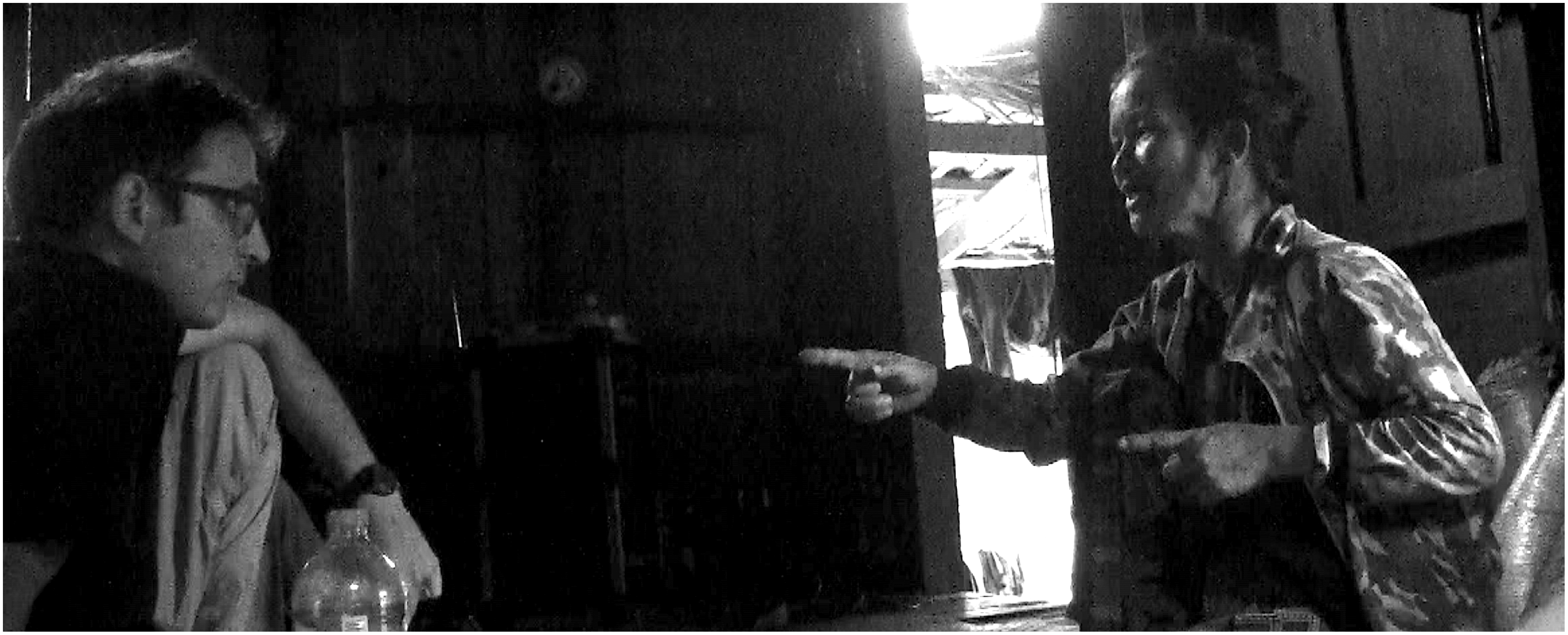
Screenshot from video interview with Thaj, as she voices Caan Than’s threat to shoot her if she does not leave her prior village of residence. Interview and video recording by CHP Zuckerman (pictured to left of frame). Mrkaa, 14 July 2018.
“He told me, ‘Do not stay here. If you stay, I’ll shoot you dead right now.’” 20 Thaj then moved, with her husband and children, to an ungoverned section of the right bank of the Nam Noi River, just up from the downstream hamlet of Mrkaa. She has lived there with her family ever since. She is safe, but laments the lack of connection to the village, and, especially, her children's access to schooling.
Now put yourself in the position of people like Chiara and Thaj. Dominant people have upended your life. They have used force, aided by the state. They have provided reasons for their actions that counterfactually invoke the legibility of appearances, namely illness in non-kin near you, intercepting those appearances and hijacking them as signs of your alleged supernatural malevolence. Their explanations, in the form of assertions of witchcraft and spirit possession, are soothingly intelligible and flow-terminating. But their false simplicity hides true complexities. What seems clear is in reality opaque, a smokescreen. In a cautionary passage about the ethical dangers of inscrutability in algorithm-based decision-making, legal scholar Frank Pasquale could be writing about the local dynamics behind the fates of powerless women like Chiara in late medieval Italy or Thaj in twenty-first-century Laos: “Opacity creates ample opportunities to hide anticompetitive, discriminatory, or simply careless conduct behind a veil of technical inscrutability” (Pasquale, 2015: 163).
The point holds for any sociocultural system in which we (i.e., any member of the system) are “confined by rules whose purpose or origin we often do not know and of whose very existence we are often not aware” (Hayek, 1973: 11); that is, all known sociocultural systems. As we have seen, people may have little knowledge of the complexities they face, and what is more, people are often satisfied by explanations that may bear little resemblance to reality. Farrell and Fourcade describe “multidimensional classifications” produced by high-tech modernism (such as the two thousand or so Netflix viewer categories into which we are binned but know nothing of) that create a “new politics” (Farrell and Fourcade, 2023: 227). But if we broaden our scope, beyond the realms of high-(tech-)modernism, then we see that no form of sociocultural life is exempt from the winnowing mechanisms of “multidimensional classification,” as manifest most obviously in the categories of language and other symbolic systems. This is the basic nature of sociocultural systems, from words to ritual practice to social statuses and beyond.
The difference between high-tech modernism and human social life more broadly is not, then, that the causal bases of meaning are inscrutable or “hard for human minds to grasp.” That is already true of both the individual psychology and collective society that form the infrastructures for meaning's flow. How, then, do we appear to grasp these things? The answer is by relying on the simplifications of cultural categorization and ideology, both of which provide rules of thumb for dealing efficiently with complex worlds. The mechanism is the same one that gives bureaucracy and computation their force, namely, “the power to classify” (Farrell and Fourcade, 2023: 226).
The political critique of “high-(tech-)modernism” is that a simplifying system of classification is being imposed upon people whose reality is richer than the sorting scheme can capture. Hence, the scheme reduces people's agency and introduces inequalities of power. Accordingly, Scott writes of “the hegemony of the categories” (Scott, 1998: 375). Here, he is referring to “modern” categorizations such as the occupational labels that are quantified in censuses. But this hegemony of categorization—and associated tyranny of legibility—is not exclusive to high-(tech-)modernism. The infrastructures of coordination that we call cultures and languages are fundamentally category-grounded, and so are, by definition, simplifying systems.
Discussion and conclusion
Legibility opens channels of semiotic flow. It directs people's attention to appearances in our environments, and it frames our subsequent inferences and actions in response. We then become subject to what might be termed Garfinkel's Law of Incorrigible Legibility: the fact that in the social realm, our behavior will always be “read” by others, whether we like it or not, and not always in the ways we might want or expect (Garfinkel, 1952: 367). 21 A person's social agency consists, in part, in heeding the implications of this conservative law, that is, in deliberately avoiding behaviors that may invite unwanted inferences. The trade-off is that such heeding reduces our flexibility, and hence our agency (Enfield, 2017; Kockelman, 2007). Indeed, I would suggest that the self-constraint involved in shaping one's actions for interpretability by others under a legibility regime can play a causal role in upholding hegemony in Gramsci's sense, whereby power comes, in part at least, from consent (cf. Crehan, 2002: 102; Williams, 1977: 108–114).
A tyranny of legibility—a culture—will be all but invisible to those who “spontaneously consent” to it, but it is keenly seen and felt by outsiders, misfits, and anyone uncomfortable with dominant social norms. Gender norms are an oft-invoked example: a “grid of legibility” surrounds gender in society (Butler, 2004: 42), a “tyranny of legibility of sexual difference” (Braunschweig, 2023: 9). Other examples we have discussed in this paper illustrate how sociocultural meaning is directed, captured, and often pirated through a mechanism of flow capture that not only exploits legibility but combines it with the asymmetrical distribution of power. This conception of legibility can help, I would argue, with thinking through how to agentively engage with culture change in the current world situation, with its unprecedented scales of organization and flow. It allows us to understand logics of surveillance, preference capture, and opacity of explanation in terms of an underlying logic of culture as an infrastructure for social coordination. In a world where signs are moorings for coordination, an understanding of the anatomy of legibility will be crucial in understanding when and how our access to those moorings can be appropriated and exploited by those in power, or alternatively, harnessed for collective benefit.
I have argued that the powers of legibility are “ancient,” and that they are present wherever culture is found. But as many have shown, they are especially salient in practices of quantitative measurement employed in state and corporate schemes. “Thus it is critical to probe beneath the apparent truthfulness and objectivity of quantified knowledge to understand the social and political life of indicators and their histories” (Merry, 2016: 33). Merry's statement about modern quantitative indicators holds for cultural categories and social norms most generally. We can and should probe beneath them, understand their histories and their sociopolitical effects, see which forms of flow they generate and which they impede. Indeed, probing beneath sociocultural indicators and their histories is one way to define the very mission of anthropology (Urban, 2001). But an indicator doesn’t have to be quantitative or otherwise “modern” to be used for power, influence, or preference capture. A social group doesn’t have to be large-scale or state-run for its categorizations and rules of thumb to denude rich personal knowledge.
The upshot is that we should not confuse specific critiques of high-modernist legibility—state uses of quantified indicators in organizing society at large scales—with general critiques of legibility or measurement in all social affairs. Consider the legibility regimes that we all must negotiate at the micro level of everyday social interaction (Goffman, 1983). The face-to-face “interaction order” that Goffman describes is the opposite, in terms of scale, to the “state schemes” that Scott (1998) critiques. Yet as Goffman outlines, despite the lack of quantitative measures and the bottom-up nature of our interpersonal interactions, we all engage in “people-processing encounters” in which the “impression” a person makes will “affect their life chances” (Goffman, 1983: 8). “Everyone,” says Goffman, “is a gatekeeper in regard to something”: Thus, relationships such as friendships and marital bonds “can be traced back to an occasion in which something more was made of an incidental contact than need have been.” This works because every culture “seems to have a vast lore of fact and fantasy regarding embodied indicators of status and character, thus appearing to render persons readable” (Goffman, 1983: 8).
The phrase rendering persons readable, which Goffman uses to describe how we “process” our associates in interaction, defines the universal cultural logic of legibility. Because of the inherent pressures, contingencies, and exigencies of social interaction, mutual understandings are only as detailed as they need to be for purposes of coordination: in interaction, “what we get is somebody's crudely edited summaries” (Goffman, 1983: 9). Again, Goffman's turn of phrase would be at home in a critique of state schemes. His “crudely edited summary” is a synonym for Scott's “abridged map,” which references the simplifications contained in census data, cadastral documents, and other “givens of modern statecraft” (Scott, 1998: 3). Social agency at any scale requires the use of abridged maps and crude summaries as working rules of thumb for people-processing in social coordination.
If Scott's critique is not about legibility per se, what is the issue with “high-modernist” legibility in particular? I suggest that the harms of high-modern legibility arise not from legibility but from the attempt to formally monopolize the creation, control, and interpretation of signs within large populations. A census, a cadastral map, a register of names, are all signs created intentionally to be legitimately read in later contexts. To be sure, this rides on the underlying logic of strategic sign-making that characterizes micro-level social behavior: rituals, promises, initiations, threats, justifications, and many more interpersonal social actions are designed to establish and ratify semiotic landmarks to be coordinated around later. But state power takes this to a higher level. State power is often described as a monopoly of the legitimate use of force, as Weber famously put it. But “legitimacy,” and the associated “spontaneous consent” from the populace that potentially obviates the need for state violence ever coming to the surface, owe their power to the control of semiotic flow. The corollary of the monopoly on legitimate use of force is the monopoly on legitimate claims on meaning (Mann, 1986: 22). One way to understand this would be as a monopoly on the legitimate claim to correct interpretation, that is, a monopoly on sign-interpretant relations (and thus also a claim over rights and duties to engage in semiotic interception). This is most visible in the domain of law, but it can also be seen in the hegemony of norms. Those in power can declare what is “the correct interpretation” of, or response to, some behavior, often with serious consequences (e.g., imprisonment for a crime).
Now, to conclude. Critiques of modern legibility have focused on what is lost or erased by processes of “crude editing” for “people-processing.” But we can also focus on what is created and gained. The relative simplicity of sociocultural maps is what makes cooperation and interaction possible at all. Such maps provide landmarks we can efficiently coordinate around. Legibility regimes make sociocultural life possible. So, we are offering a description, and not a critique, when we say that all encounters are people-processing encounters, all cultural categories are crudely edited summaries, and all sociocultural systems are legibility regimes.
Footnotes
Acknowledgements
I am grateful for helpful input and support from the editor and anonymous reviewers. I also thank Chip Zuckerman, Weijian Meng, Gus Wheeler, Jack Sidnell, Camilla Power, and Paul Kockelman for valuable input.
Data availability statement
No data were reported.
Declaration of conflicting interests
The author declared no potential conflicts of interest with respect to the research, authorship, and/or publication of this article.
Ethical approval and informed consent
All primary research reported on here was conducted with ethical approval from the University of Sydney Human Ethics Committee.
Funding
The author disclosed receipt of the following financial support for the research, authorship, and/or publication of this article: This work was supported by an Australian Research Council Discovery Project (DP170104607).
