



Abstract
Racial segregation and violent crime are both important predictors of jurisdiction-level criminal justice outcomes, yet little research has examined their influences on front-end detention patterns and how they may interact to shape local punishment practices. The current study uses official sources and Vera Institute of Justice data spanning 1496 decennial county-years (374 counties from 1980 to 2010) to examine the independent and combined effects of county-level racial segregation and violent crime on pretrial detention rates. Drawing on group threat and minority neglect arguments, we find that high segregation levels are associated with neglect, especially in violent areas. Reduced segregation between Black and White populations, however, is linked with increased punishment, particularly in areas with high levels of violence.
Introduction
Racial segregation continues to impact communities throughout America (e.g. Massey and Tannen, 2015; Sharkey, 2013). These enduring patterns have wide-ranging consequences, reinforcing inequalities across various facets of life, including employment opportunities (Farley, 1987), access to quality housing (Liska and Bellair, 1995), economic well-being (Massey, 1990), health and healthcare access (White et al., 2012), educational opportunities and outcomes (Massey et al., 1987), and exposure to violence (Krivo et al., 2009). These structural inequalities also extend to the criminal justice system. Some research has shown that counties with higher levels of racial segregation often exhibit weaker punitive responses, while increasing racial heterogeneity is linked to harsher responses to crime (e.g. Beckman and Wang, 2022; Williams et al., 2025).
The burdens of segregation are not shared equally. A robust body of research shows that Black individuals—particularly those residing in highly disadvantaged and segregated neighborhoods—experience disproportionately higher rates of violence relative to their White counterparts (Peterson and Krivo, 2005, 2010; Sampson and Lauritsen, 1994, 1997). Further, research demonstrates that residential segregation can exacerbate these conditions by isolating Black communities from resources, concentrating disadvantage, and limiting economic and social advancement opportunities (e.g. Peterson and Krivo 1993, 1999; Quillian, 2017). In contrast, segregation often benefits White Americans, who are more likely to reside in more affluent neighborhoods characterized by lower crime rates (Beaulieu and Continelli, 2011; Krivo et al., 1998, 2009; Quillian, 2003).
Scholars have also explored how segregation may interact with other contextual factors—such as concentrated disadvantage—to shape crime patterns and, in response, criminal justice responses. For instance, work by Peterson and Krivo (1999) found that heightened disadvantage resulting from segregation partially explains the relationship between segregation and Black homicide rates. 1 Feldmeyer (2010) extended this work, demonstrating that racial and ethnic segregation from Whites not only increases disadvantage but also contributes to higher homicide rates among Black and Latino populations.
While work has begun to disentangle the complex relationships between contextual factors and crime patterns, far fewer studies have investigated how these features may interact to shape social control, including criminal justice responses (Pinchevsky and Steiner, 2016; Sutton, 2013; Vaughn et al., 2023; Williams, 2016; Williams and Rosenfeld, 2016). This is a significant omission, given research showing that both segregation and violence have independent effects on criminal justice system outcomes, and emerging evidence suggests they may also operate interactively. Understanding these dynamics is critical in light of research documenting the systematic neglect of disadvantaged minority communities. As Krivo et al. (2009: 1768) note, minority communities located in highly segregated areas are often “targets of neglect and disinvestment by city officials, banks, and other authorities,” which can further compound disadvantage. This work suggests that neglect may be particularly likely when crime is concentrated in Black areas that are physically and socially isolated from Whites and therefore less visible or politically salient (e.g. Miller, 2013).
The current study examines how racial composition and violence interact to shape local punitive outcomes, focusing specifically on pretrial detention rates in large U.S. counties. Pretrial detention is a critical yet often overlooked stage of the criminal justice process—a point at which prosecutorial and judicial decisions, bail-setting practices, and the ability to pay bail can determine whether a person remains incarcerated before trial. These decisions have substantial implications for downstream effects (see e.g. Lowenkamp, 2022), yet aggregate-level studies of pretrial detention in broader social contexts remain rare.
To address this gap, our study utilizes a unique longitudinal dataset that merges official governmental sources and data from the Vera Institute of Justice, capturing 1496 decennial county-years from 1980 through 2010, encompassing 374 counties over a three-decade period. These data allow us to explore how county-level structural factors, namely racial segregation and violent crime, jointly influence the growth in pretrial detention rates, which we interpret as a measure of local punitiveness. By focusing on structural contextual factors and pretrial detention, our work sheds light on potential group threat-related explanations of county-level variability in the use of pretrial detention, furthers our understanding of minority neglect, and demonstrates the theoretical importance of exploring interactions between community features in criminal case processing studies.
Literature review
Recent scholarship has turned attention toward the relationships between racial composition, segregation measures, and the responses by criminal justice actors. Much of this research is grounded in group threat theory, which posits that as the size or visibility of minority groups increases, members of the dominant group—typically Whites—perceive their economic, political, and social power to be under threat (Blalock, 1967; Krysan et al., 2009; Liska, 1992). Growing minority populations will not only raise the alarm among majority residents; they will lead majority group members to shift their policy preferences and take actions to preserve their group's dominance (e.g. Olzak, 1992).
Within the context of criminal justice, group threat theory suggests that minority population growth or segregation decreases will blur racial boundaries, leading majority residents to demand more punitive criminal justice responses to reinforce existing power structures (e.g. Wang and Mears 2010). 2 These demands are often reflected in the decisions of criminal justice actors who must be responsive to the political and social expectations of their communities. As Baum (2009) argues, criminal justice actors often align their behavior with the preferences of their constituents in an effort to appear legitimate (Rubin et al., 2024). Due to their “continuing socialization and participation within that community” (Cook, 1977), their decisions will reflect community preferences. Criminal justice actors will respond more punitively to those they encounter so long as their constituents demonstrate a desire for such harsh treatment, ultimately resulting in higher rates of punishment.
In addition to segregation and racial composition, scholars have recently begun examining how other community-level features, such as violent crime, shape criminal justice outcomes. Much of this work focuses on how areas with high community violence levels see more punitive and aggressive policing, including higher rates of civilian stops and uses of force (Lee et al., 2014; Petrocelli et al., 2003). In jurisdictions where violence is high, criminal justice actors are argued to adopt more punitive practices to signal control, satisfy public expectations, and reduce perceived risks to the community (Albonetti, 1991; DeMichele et al., 2019; Williams et al., 2025). 3 When aggregated, these punitive decisions should translate into jurisdiction-wide increases in punishment. Indeed, empirical research supports the notion that higher violent crime caseloads (Johnson, 2006) and elevated crime rates (Helms and Jacobs, 2002) are associated with more severe criminal justice outcomes, including pretrial detention, sentence severity, and incarceration (but see Cooney and Burt, 2008; Kleck and Jackson, 2017; Williams et al., 2022). Overall, then, large or growing minority populations, breakdowns in segregation, and heightened crime can be expected to elicit heightened levels of perceived threat and more formal social control.
Our understanding of these relationships is complicated by research demonstrating pervasive minority neglect by criminal justice actors in segregated, disadvantaged Black communities that bear the brunt of violence in America (Leovy, 2015; Rios, 2011; Vaughn, 2020). In addition to being disproportionately subject to unwarranted harassment and heightened surveillance on the streets, these communities are in many ways disregarded and underserved by institutions charged with ensuring safety and justice, particularly when it comes to dealing with serious violence (e.g. Rios, 2011). Work in this area suggests that segregation operates to further isolate minority communities from majorities, causing them to experience not only worsened violence and other public health outcomes, but also extreme levels of neglect and disinvestment by public institutions and authorities (Massey and Denton, 1993). In communities that are racially isolated, law enforcement and other justice system actors may fail to intervene effectively in response to violent crime, resulting in a form of systemic abandonment. We can therefore expect leniency, rather than severity, to characterize the most violent minority areas, so long as barriers placed by segregated remain intact.
Taken together, these strands of research point to the need for a more nuanced understanding of how community characteristics interact to shape criminal justice outcomes. While segregation, racial composition, disadvantage, and violence can be important indicators of criminal justice punishment independently, we have yet to explore potentially significant interactions between segregation and violence. Exploring these interactions will likely help to account for the mixed findings described above. In particular, we might expect that jurisdictions with high crime and increasing racial heterogeneity represent a “double threat,” where fears about safety and status converge, prompting criminal justice actors to respond with elevated levels of formal social control (e.g. Feld, 1991; Sampson and Laub, 1993; Wang and Mears, 2010). Conversely, areas that are heavily segregated may continue to experience neglect, even in the face of elevated violence, so long as the perceived threat to majority interests remains low.
Current study
While we can expect punishment to vary based on the racial and ethnic contexts of an area, the work that has been done on race and punishment can be improved. Little attention has been paid to the influence of county-level contextual factors on upstream criminal justice system outcomes, including pretrial detention. This is an important gap, as early stages of criminal case processing are those during which criminal justice actors wield the most discretion and have the power to shape later outcomes (Vaughn et al., 2023; Williams and Rosenfeld, 2016; Wu, 2016). 4 A recent analysis of 143 effect sizes from 57 studies of pretrial detention effects revealed that detained defendants face more severe outcomes, with pretrial detention having moderate impacts on convictions, guilty pleas, and dismissals and the most pronounced effect being an increased likelihood of incarceration (St. Louis, 2024). The research also found pronounced jurisdictional differences, underscoring the need for studies that consider differences across communities. Moreover, few have attended to potential interactions between community contextual factors such as racial demographics and violence, hindering our knowledge of the joint influence of these factors. We must comprehensively investigate structural features and their potential influences—alone and in combination—on rates of punishment to gain a more accurate and complete understanding of criminal justice punishment.
The current study explores the independent and combined influences of county-level features on pretrial detention. In addition to examining the effects of county-level segregation, violence, and other contextual features on pretrial detention, we explore whether county-level racial segregation and violence have combined influences on punishment. In line with group threat and minority neglect frameworks, we hypothesize that low levels of Black–White segregation and high violence rates will threaten majority groups and be positively related to punishment. In examining the interaction between segregation and violence, we hypothesize that high levels of violence occurring in areas with greater racial heterogeneity will be met with more punitive responses, as Whites feel their power and safety are threatened by minorities (Black, 1976; Chiricos et al., 1997; Forman Jr, 2017; Miller, 2013; Soss and Weaver, 2017). On the other hand, violence that occurs in violent and largely segregated and predominantly minority areas should be neglected, as it is perceived to be isolated from and therefore of little concern to the powerful majority.
Data and methods
The current study utilizes decennial county-level data from 1980 through 2010. These data are drawn from the U.S. Census Bureau, U.S. Bureau of Labor Statistics, U.S. Bureau of Justice Statistics (BJS), and the Federal Bureau of Investigation (FBI), as well as the Vera Institute of Justice. The sources are described in detail below. We also limit our analysis to counties with a population of 100,000 residents or more in all decennial timepoints (defined as a Metropolitan Statistical Area by the U.S. Census Bureau) for several reasons. First, measures of segregation in smaller counties can lead to unreliable and biased estimates due to the high variance in demographic composition and higher margins of error (Tabb et al., 2024). Second, using larger counties allows for a greater deal of representativeness in structural segregation patterns as larger, urban counties are characterized by higher levels of racial and ethnic diversity (Farrell and Lee, 2011; Frey and Myers, 2005). Third, this follows the analytical strategy of prior work investigating residential segregation and violent crime (Krivo et al., 2009, 2015; Shihadeh and Flynn, 1996). Removing remaining counties that were missing data on key variables resulted in a final sample size of 1496 county-years. 5
Dependent variable: Pretrial detention rate
Our outcome of interest is county-level Pretrial Detention Rate, measured as the number of (unconvicted) persons incarcerated in jail while awaiting their trials on 30 June of a given year, per 100,000 county residents. The data for this measure were compiled by the Vera Institute of Justice (2020), in which Vera culled the data from the Annual Survey of Jails and Census of Jails captured by the BJS. The measure allows us to capture shifts in the use of pretrial detention relative to the county's population over time and across counties, consistent with recent work exploring macro-level relationships of pretrial detention (Ranson et al., 2023; see also D’Alessio and Stolzenberg, 2002). 6 To account for temporal ordering of the predictor variables, as well as any sizeable fluctuations in pretrial detention rates from year-to-year, we utilize a three-year average following each decennial timepoint. For instance, the pretrial detention rate in year 1980 is the average rate across years 1981, 1982, and 1983.
Independent variables
The current study aims to explore the influence of racial demographics, alone and in interaction with violent crime, on county-level pretrial detention. Using data from the U.S. Census Bureau, we measure both racial composition and segregation, as both have been shown to affect punishment (e.g. Williams et al., 2025). Percentage Black is measured as the percent of Black residents in each county, respectively. Given the non-linear nature of percentage that has been found in prior punishment literature, we include a squared term (e.g. Wang and Mears, 2010). While percentages allow us to capture the relative size of the minority populations, a measure of residential segregation provides a better indicator of how minorities are spatially dispersed across a county, which is arguably a better measure of group threat (Feldmeyer and Cochran, 2018; King and Light, 2019). We therefore include a measure of Black-to-White Segregation using the index of dissimilarity (D), defined as the proportion of one group (Black residents) that would need to move into the other group's (White residents) census tract to have even distribution throughout the larger geographic area. These measures range from zero to one, with higher scores representing increased segregation. For ease of interpretation, we multiply (D) × 100.
To examine the role of violence alone and in combination with racial segregation, data were drawn from the FBI's Uniform Crime Reports: County Level Arrests and Offenses Known from the Inter-university Consortium for Political and Social Research. Each county-year's Violent Crime Rate combines its murder, rape, robbery and aggregated assaults per 100,000 residents. 7
Control variables
Criminal justice actors have been shown to be impacted by additional features of their communities. We therefore control for several additional county-level measures, all of which are provided by the U.S. Census Bureau. Criminal justice actors have been found to act disproportionately punitively toward those situated in areas with high levels of concentrated disadvantage (e.g. Parker et al., 2005; Rodriguez, 2013; Wooldredge, 2007; Wooldredge and Thistlethwaite, 2004). To examine the role of concentrated disadvantage on pretrial detention, we include a composite measure of Disadvantage—a principal component score that includes the percentage of female-headed households, percentage of households below the poverty threshold, percentage of residents that are unemployed, and the percentage of residents with less than an ninth grade education—with a Cronbach's alpha of .68 (Barnes et al., 2013; Sampson et al., 1997). 8 , 9 Criminal justice decision-making in rural areas tends to be harsher than in urban areas (Myers and Talarico, 1986), likely because they are less bureaucratic overall and characterized by lower caseloads, fewer and less-trained workers, and less hierarchal (Hagan, 1977). To account for urbanicity (or population density) of a county, we include Percent Urban, measured as the percentage of persons with urban status in the county. We further control for Percent Male 18–24, measured as the percentage of residents that are male between the ages of 18–24, as this demographic has been found to be perceived as the most threatening and is at the highest risk of more punitive criminal justice intervention (Steffensmeier et al., 1998; Wooldredge, 2012). We also include a control for Population, which is log-transformed to account for skewness. Lastly, we include dummy variables to account for Year and potential issues with time heterogeneity.
Analytical strategy
The current study relies on time-series cross-sectional (panel) data of counties over time. Given the structure of the data, we employ county-level fixed effects regression models to estimate the effects of racial segregation and other county features on pretrial detention rates. Fixed effects regression models are useful for measuring changes over time within entities (county) and ideal for dealing with unobserved county-level heterogeneity by holding constant time-invariant factors that differ across counties. As mentioned, our models include year indicators to account for potential issues with time heterogeneity, and we account for temporal ordering issues by calculating the average of our dependent variable three years after the decennial time-points for our explanatory factors.
Our analytical strategy unfolds over multiple stages. We first explore the independent effects of violent crime, concentrated disadvantage, and other contextual features on pretrial detention rates (Model 1). Model 2 includes our Black-to-White residential segregation measure to estimate the independent effect of segregation on pretrial detention rates. Model 3 incorporates the interaction term for violent crime and racial residential segregation. With the exception of the interaction term for violent crime and racial residential segregation and the log-transformed population measure, coefficients across models can be interpreted as a one-unit increase in the explanatory variable being associated with an expected one-unit change in county pretrial detention rates, while holding constant all other variables in the models.10,11,12
Results
Descriptive statistics for the pooled sample are presented in Table 1. We provide the overall means and standard deviations, as well as between- and within-county standard deviations to highlight variation across counties (between) and over time within counties (within). For instance, Black-to-White residential segregation has an overall mean value of 52.13, suggesting that the average county over the period examined has a relatively moderate level of segregation, in which 52% of Black residents would need to relocate to White neighborhoods to reach equal residential distribution across the county. The overall and between-county standard deviations suggest that while Black-to-White residential segregation substantially varies across counties, the change within counties is less notable. Conversely, county-level factors such as violent crime and pretrial detention rates have relatively greater within-county standard deviations compared to other measures such segregation, indicating more temporal change within counties for these measures, although their within-county variation remains smaller than the corresponding between-county variation. Figure 1 illustrates the variation in pretrial detention rates across counties over time. As shown, the interquartile range—the span between the first and third quartile—and the median pretrial detention rate both increased in 1990 and 2000 from the prior decade, as did the distance between the minimum and maximum whiskers. By 2010, it appears that most of the growth and variation in pretrial detention rates had stabilized.
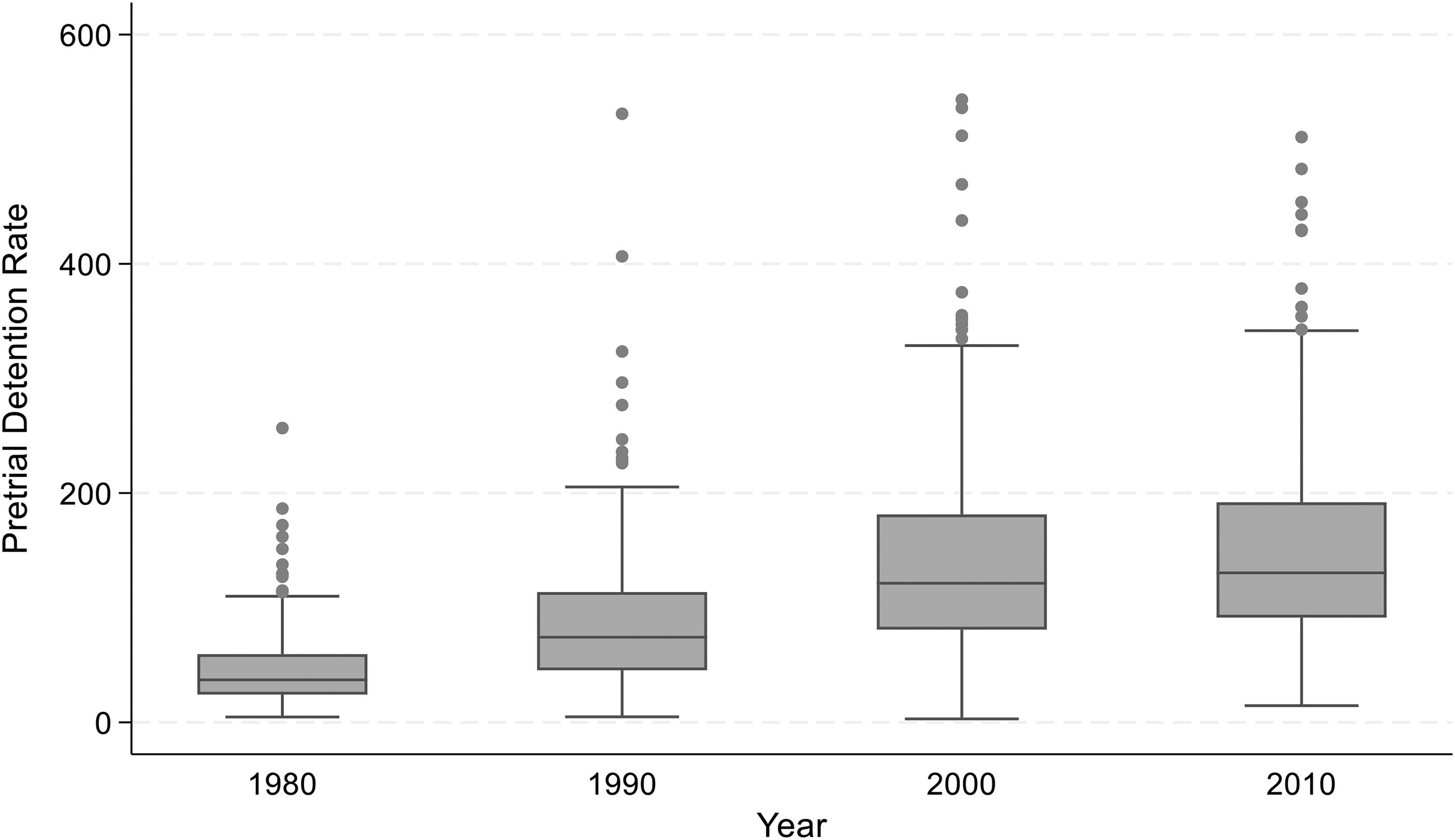
Box plot of county-level pretrial detention rates over time.
Descriptive statistics (N = 1536).
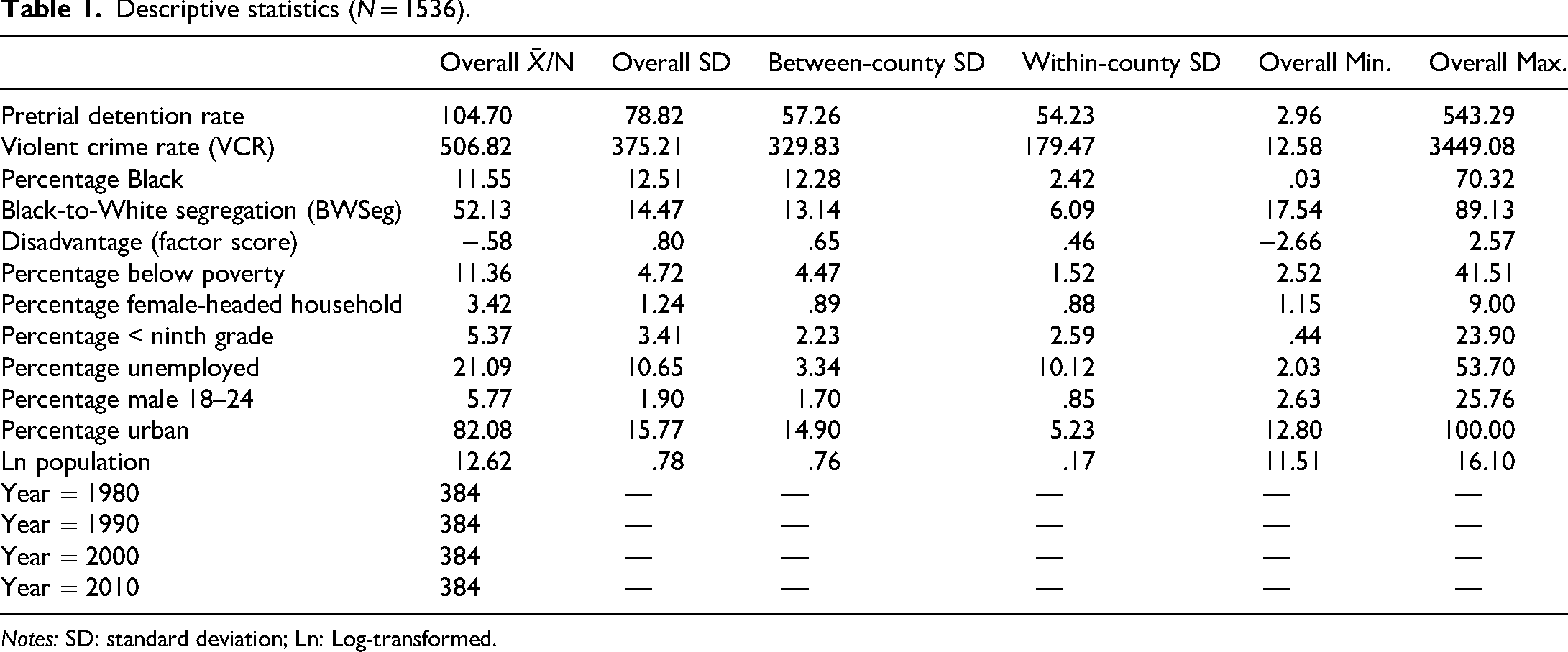
Notes: SD: standard deviation; Ln: Log-transformed.
Table 2 provides the regression estimates of the predictors of county-level pretrial detention rates. Specifically, it provides the estimates for the independent effects of county-level features (Model 1), estimates of independent effects of racial segregation and violent crime (Model 2), and the estimates of the interaction between racial segregation and concentrated disadvantage (Model 3). Several key findings emerge.
Fixed effects estimates of the determinants of pretrial detention rates (N = 1536).
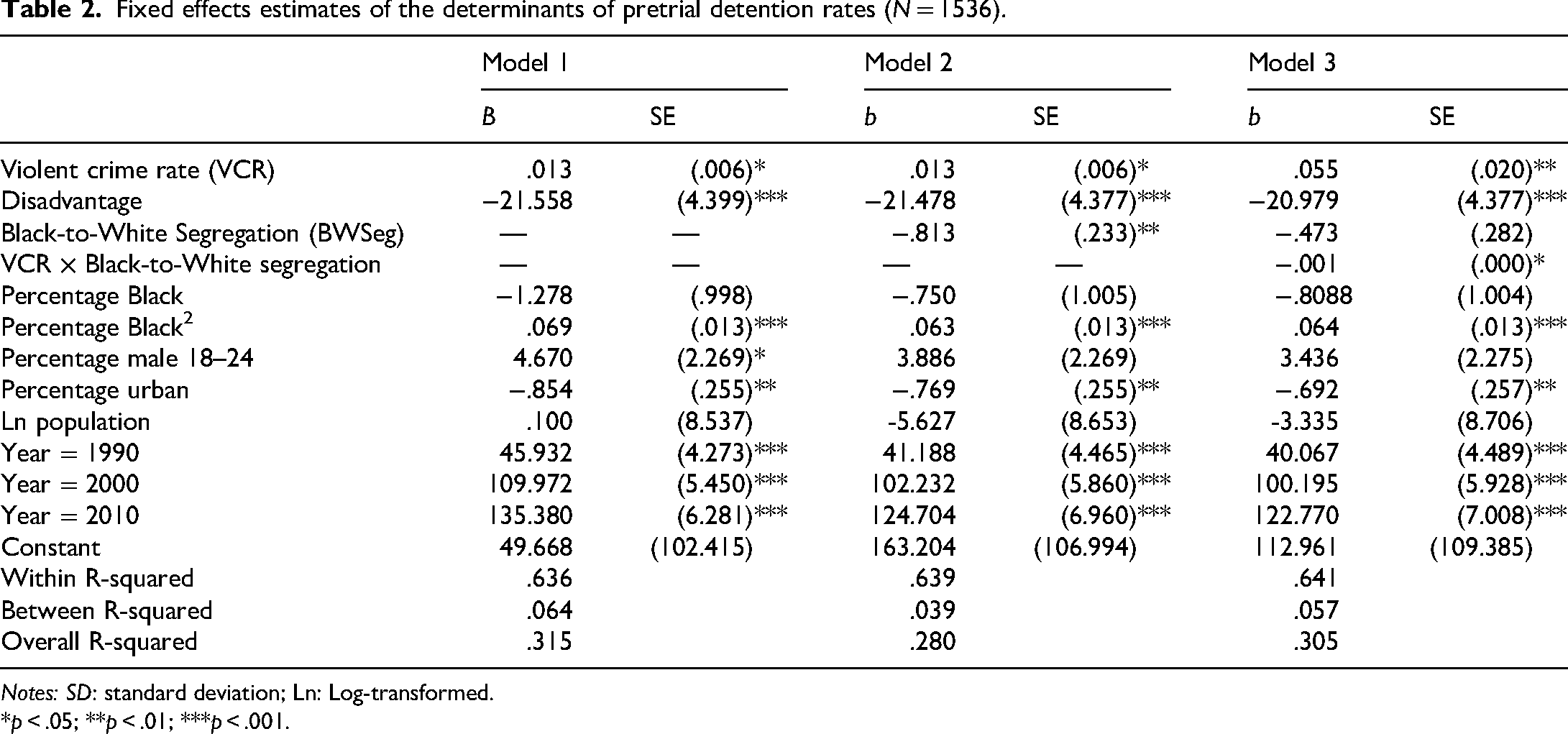
Notes: SD: standard deviation; Ln: Log-transformed.
*p < .05; **p < .01; ***p < .001.
Model 1 presents the baseline effects of concentrated disadvantage and contextual control variables on pretrial detention rates. As shown, violent crime has a strong, positive relationship with pretrial detention rates; a one-unit increase in violent crime is associated with a .01 unit change in pretrial detention rates (p = .043). While this effect appears relatively small, it is worth noting the range in violent crime rates. That is, a one standard deviation increase in violent crime rate equates to just over a five-unit increase in pretrial detention rates. The results further show that both concentrated disadvantage (p < .001) and the percentage of the county that resides in the urban area (p = .001) are associated with significantly lower pretrial detention rates. We also find that percentage Black has a nonlinear effect on pretrial detention. Specifically, when percentage Black is low, there is no significant effect on pretrial detention; however, once the relative size of the Black population reaches a threshold, it begins to have a significant and positive effect on pretrial detention rates.
Model 2 introduces Black-to-White residential segregation, and results show a strong, negative relationship between Black-to-White segregation and pretrial detention rates, with a one-unit increase in Black-to-White residential segregation corresponding with a .81 unit decrease in pretrial detention rates (p = .001). That is, as counties become more racially segregated, the relative size of the pretrial detention population decreases. However, increases in the relative size of the Black population lead to an exponential growth in pretrial detention rates, as indicated by the percentage Black squared term (p < .001). The results also suggest that increases in county-level disadvantage are associated with decreases in pretrial detention rates; a one-unit increase in disadvantage is associated with an expected decrease of nearly 21 pretrial detainees per 100,000 county residents (p < .001).
Most germane to the current study is the interplay between county-level residential segregation and violent crime on pretrial detention rates. As shown in Model 3, the interaction between Black-to-White residential segregation and violent crime suggests that violence has a strong, positive association with pretrial detention rates when segregation is at its lowest levels (p = .033). However, as county-level segregation increases, the effects of violence are diminished, such that counties experiencing the highest levels of segregation and highest levels of violent crime have the lowest predicted pretrial detention rates. This relationship is illustrated in Figure 2.
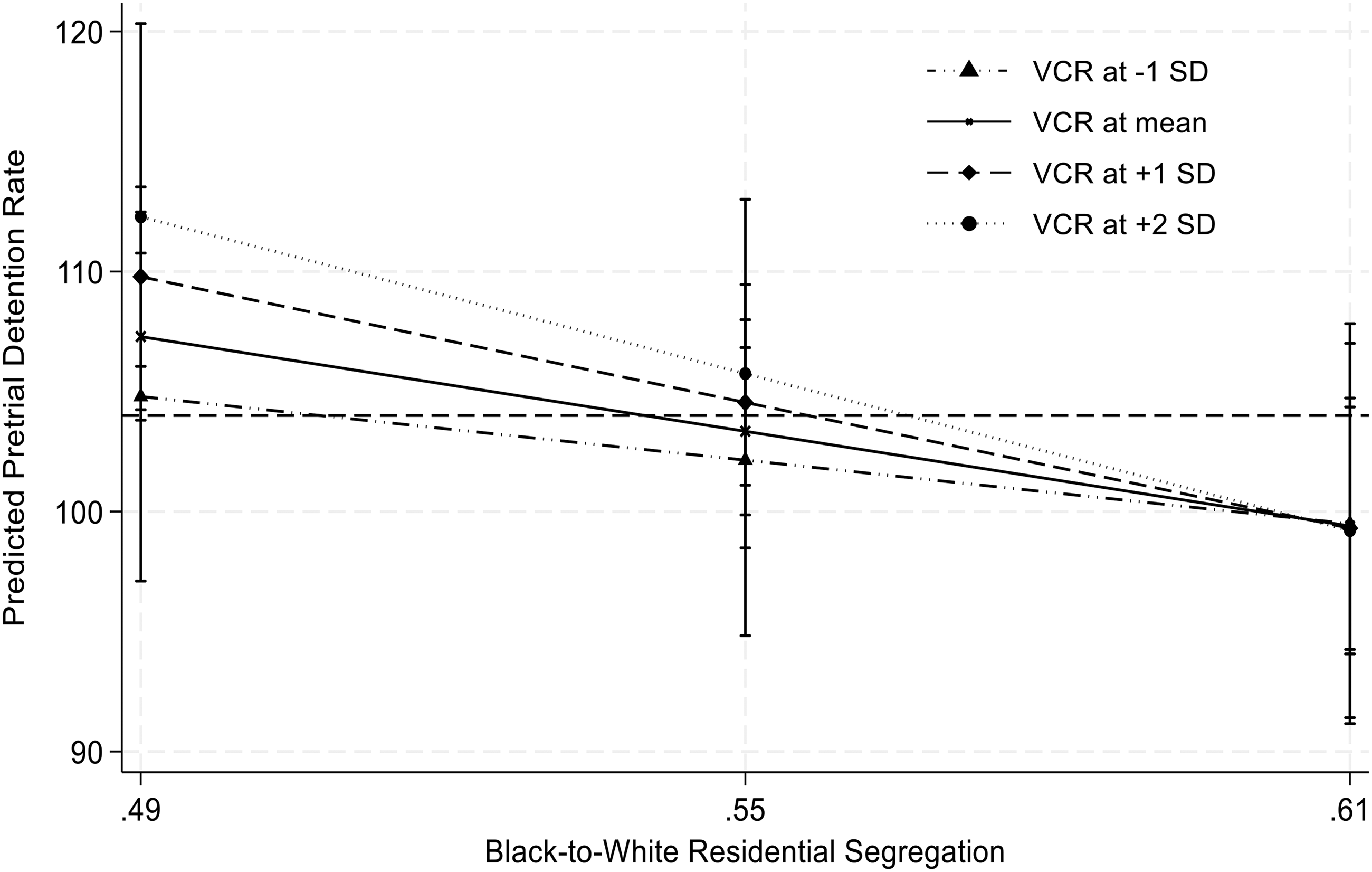
Predicted pretrial detention rates as a function of Black-to-White segregation and violent crime with 95% confidence intervals.
Discussion
While a large body of research has explored the structural correlates of violence and interactions between structural features that lead to increased violence (see Peterson and Krivo, 2005 for a review), comparatively less attention has been paid to how these structural contexts shape early criminal justice outcomes. Understanding early case processing is important given prior research showing that disparities in punishment emerge in the earliest stages of case processing (Vaughn et al., 2023), and that early decisions have cumulative effects on downstream outcomes, such as incarceration and sentencing length (Harrington and Spohn, 2007; Tartaro and Sedelmaier, 2009). The current study contributes to this growing literature by turning our attention to aggregate impacts of county-level structural influences—specifically racial segregation, violent crime, and concentrated disadvantage—on pretrial detention, a pivotal early stage decision that has been shown to significantly shape later criminal justice outcomes, including incarceration (Oleson et al., 2016; St. Louis, 2024).
Our findings generally align with both group threat and minority neglect frameworks. In line with group threat theory we find that increases in a county's percentage of Black residents are associated with increases in pretrial detention rates. Similarly, as an area becomes less segregated—indicating growing racial heterogeneity—pretrial detention rates increase. Further, and consistent with prior research, we find that violent crime is positively associated with pretrial detention rates. Interestingly, and somewhat counter to prior work, we find that counties characterized by high levels of concentrated disadvantage actually exhibit lower pretrial detention rates, challenging the notion that “court officials perceive areas of disadvantage as high risk and dangerous for youth” (Rodriguez, 2013: 189). While we are unable to speak directly to the perceptions of court actors nested within counties, our results suggest that court actors may not be deciding cases in ways that align with these perceptions. Instead, they may be neglecting those in highly disadvantaged areas.
Our main contribution lies in analyzing the interaction effects between segregation and violence. We find that the relationship between violent crime and pretrial detention is conditioned by levels of segregation: in counties with higher segregation, the positive effect of violent crime on detention weakens, and in highly segregated, high-crime areas, pretrial detention rates are lowest. This finding is consistent with prior work showing that high-crime Black neighborhoods are neglected by public institutions, including criminal justice systems (Sharkey, 2018; Tonry, 1996; Vaughn, 2020). It also supports the idea that majority group members—and, by extension, the criminal justice system actors who reflect their concerns—become more responsive only when violence threatens to spill into more racially integrated spaces. While recent individual-level research suggests that minority defendants are neglected by criminal justice actors unless they pose a threat to White victims (Vaughn et al., 2023); our results suggest that this neglect may also be operating at the county level, in that violence prompts harsher punishment only when it is perceived as threatening to White-dominated communities.
Overall, our findings provide further evidence for the utility of group threat and minority neglect perspectives, which predict that dominant majorities—and the institutions they control—will neglect minority groups and issues that disproportionately affect them (i.e. violence) until they begin to feel threatened. High segregation signals neglect, but as segregation lessens and racial heterogeneity increases, violence may become more salient to criminal justice actors, prompting more punitive decision-making. In other words, the effects of crime are likely to be felt most acutely in places with lower-than-average levels of segregation.
Our study has limitations that future researchers should address. Like most research drawing on group threat theory, our study cannot establish causal relationships or specify the mechanisms that account for our findings. Future research utilizing stronger causal designs is needed to determine whether, for instance, segregation is related to harsher punishment preferences and ultimately higher punishment rates due to perceived threat and fear, as seems to be the case with violence (e.g. Chiricos et al., 2001). Our reliance on county-level pretrial rates also makes it difficult to disentangle whether these patterns reflect differences criminal justice decision-making or broader population dynamics. Additionally, because our analysis is limited to large counties, it is unclear whether these patterns hold in smaller jurisdictions, where measures of segregation are often less stable (Tabb et al., 2024). Future work should examine these associations across county types. Moreover, we echo concerns about the reliability of UCR violent crime data at the county-level (Maltz and Targonski, 2002), which may impact the interpretation of findings related to violent crime. Finally, our analyses are limited to examining two racial groups, one case processing outcome, and a single interaction term, which leaves important questions unexamined. Future research should be done to unpack these findings across other racial and ethnic groups and criminal case processing outcomes, particularly given recent work suggesting that the effects of segregation between Black and White residents and Hispanic and White residents on pretrial decision-making outcomes are nonlinear and contrasting and that the effects of variables such as violence depend on pretrial outcome (Williams et al., 2024). While our work suggests that criminal justice punishment is dependent on levels of racial segregation, violence, and concentrated disadvantage, more work needs to be done to examine the effects of different structural contexts—alone and in interaction with one another—on pretrial detention and a range of other criminal justice decisions.
Despite these limitations, our results suggest that policymakers and criminal justice system actors would be well-advised to attend to the ways in which segregation levels may be directly and indirectly influencing constituents’ concerns and, ultimately, criminal justice system operations. Those working in highly segregated areas, and especially those that suffer from violence, should attend to potential issues concerning minority neglect, while those situated in areas that are desegregating should be prepared to deal with increasing support for harsher criminal justice policies among residents and the effects that this may have on criminal justice operations. Pretrial risk assessment tools have recently been developed to assist judges with objectively assessing defendants’ likelihood of failing to appear pretrial and committing crime while awaiting trial. If used correctly, these tools may help buffer against the influence of local constituents’ punitive preferences, particularly in desegregating counties characterized by high levels of violence. Our findings underscore the importance of considering not just structural features in isolation, but how they intersect to shape patterns of social control in the early stages of criminal case processing.
Footnotes
Acknowledgments
Thanks to Jiji and Buddy.

Author contributions
Joshua collected the data from publicly available sources. Joshua and Paige planned analyses together and Joshua conducted analyses. Paige and Joshua wrote the manuscript.
Funding
The authors received no financial support for the research, authorship, and/or publication of this article.
Declaration of conflicting interest
The authors declared no potential conflicts of interest with respect to the research, authorship, and/or publication of this article.
Data availability
All of the data utilized for the current study are publicly available, and for the purpose of transparency, we are open to sharing our data management and analysis code.
Ethical considerations
The data used in this study are publicly available and no ethical approval was required.
Consent to participate
Not applicable.
Consent for publication
Not applicable.