



Abstract
As many U.S. cities face year-over-year growth in homeless populations and a continuous dearth of affordable housing, municipalities like Los Angeles increasingly “manage” homelessness through punitive systems of criminalization, policing, and invisibilization. While scholars have documented the punishment regime inflicted on unhoused people, less research has focused on the private citizens, often organized as mutual aid groups, who intervene to counteract—and help encampment residents survive—this regime. Drawing on in-depth interviews with mutual aid helpers and encampment residents in Los Angeles (n = 24), we examine how some private citizens work to redress the harms of displacive, destructive, and sometimes deadly encampment sweeps while supporting the basic needs of unsheltered Angelenos. These helping efforts are frequently met with arrests, citations, immigration consequences, restrictions on movement, and threats of further punitive action. This article also shows how helpers assess the legal, physical, and psychosocial consequences of these repressive measures when deciding whether and how to continue their mutual aid work. Through risk mitigation strategies, helpers—individually and collectively—learn to diffuse, divert, and deflect risk and thus overcome the City's attempted repression. We conclude with a call to dismantle the expanding punishment regime that now, through the criminalization of helping, targets those who support unhoused communities.
Keywords
Introduction
A record number of people in the United States—roughly 771,480—are experiencing homelessness, marking a staggering 18% increase from 2023 to 2024 (U.S. Department of Housing and Urban Development [HUD], 2024). 1 California has the nation's largest unhoused (187,084; 24% of the U.S. total) and unsheltered (123,974; 45% of the U.S. total) populations (HUD, 2024). The City of Los Angeles has the highest number of unhoused residents in the state and unsheltered residents in the nation. As of 2024, over 45,250 residents of Los Angeles are experiencing homelessness, with approximately 15,975 (35%) living in temporary shelters (“sheltered”) and 29,275 (65%) living outdoors in tents, vehicles, and other makeshift shelters (“unsheltered”) (Los Angeles Homeless Services Authority, 2024). Point-in-time counts are widely considered systematic underestimations, as they often occur on a single winter night and overlook unsheltered residents staying in secluded areas or hidden-in-plain-sight vehicles as a survival strategy (Flanigan and Welsh, 2020; Smith and Castañeda-Tinoco, 2019).
U.S. municipalities like the City of Los Angeles increasingly “manage” homelessness through a complex, punitive regime of criminalization. Municipalities employ “quality-of-life” policies and enforcement practices to target the behaviors and visibility of unhoused individuals (Herring, 2019; Wacquant, 2009; Welsh Carroll et al., 2023). A defining activity of this regime is encampment “sweeps,” “cleanups,” or what Cohen et al. (2019) call “clearance with little or no support.” Hallmark characteristics of these sweeps include: providing advance notice only a few days in advance, if at all; requiring residents to remove all belongings or risk forfeiture; offering scant resource referrals, if any; and establishing physical barriers to prevent residents from returning (Cohen et al., 2019; Roy et al., 2022; Talbot et al., 2024; Welsh Carroll et al., 2023).
In Los Angeles, Municipal Code (LAMC) 41.18 prohibits “sitting, lying, sleeping, or storing, using, maintaining, or placing personal property, or otherwise obstructing the public right-of-way,” while LAMC 56.11 bans the “storage of [excess or unattended] personal property” in “any public area.” These ordinances are primarily enforced through encampment cleanup programs like LA Sanitation and Environment's Comprehensive Cleaning and Rapid Engagement (CARE/CARE+) program, 2 which has an annual budget exceeding $60 million (City of Los Angeles, 2024). In response, some private citizens—some operating as individuals, others as organized mutual aid groups—work to redress the harms produced by the displacive (Roy et al., 2022), destructive (Goldshear et al., 2023), and deadly (Barocas et al., 2023) sweeps while also supporting the basic needs of unsheltered Angelenos.
A growing body of scholarship documents the punishment regime, characterized by the criminalization, policing, and invisibilization of poverty, inflicted on unhoused people (Beckett and Herbert, 2010; Chang et al., 2022; Herring, 2019, 2021; Herring et al., 2020; Martino et al., 2025; Wacquant, 2009; Welsh Carroll et al., 2023). However, far less research has examined the private citizens who intervene to counteract this regime—their motivations, perspectives, and the personal impacts of their efforts. This has become increasingly topical in Los Angeles, as recent amendments to LAMC 41.18 (2021) and 56.11 (2022) enhance penalties for “unlawful conduct,” defined as willfully resisting, delaying, or obstructing a City employee from enforcing these sections, or willfully refusing to comply after being requested by an authorized City employee. While all other violations of these ordinances are enforceable only as an infraction or citation (up to $250.00), “unlawful conduct” is classified as a misdemeanor, punishable by up to six months in jail, a fine of up to $1000.00, or both.
This article seeks to answer the following questions in the context of encampment sweeps: How do Angelenos conceptualize their work with unhoused residents, and what tactics do they use to support them? How do municipalities like the City of Los Angeles interact with these helpers? How do helpers navigate these interactions? Drawing on semistructured interviews with mutual aid helpers and encampment residents in Los Angeles (n = 24), we present the perspectives and lived experiences of those criminalized for acts of “resistance.” In doing so, we argue that the punishment regime inflicted on unhoused residents, through the criminalization of homelessness, has been extended to individuals and groups that support unhoused communities, through the criminalization of helping.
Our data reveal that when citizens interpret the City's intent behind encampment sweeps as the invisibilization of homelessness through displacement, incarceration, and death, some are compelled to intervene. Often, citizens coordinate these efforts through mutual aid groups, which aim to support unsheltered residents before, during, and after encampment sweeps. However, their helping efforts are frequently met with arrests, citations, immigration consequences, restrictions on movement, and threats of further punitive action against both encampment residents and mutual aid helpers. In response, helpers strategically assess the legal, physical, and psychosocial ramifications of these repressive measures when determining whether and how to continue their participation. Additionally, helpers often deploy risk mitigation strategies to diffuse, divert, and deflect risk, overcome repression, and continue the work.
This article contributes to scholarship on the punishment of homelessness (e.g. Beckett and Herbert, 2010; Chang et al., 2022; Herbert et al., 2018; Herring, 2019; Herring et al., 2020; Wacquant, 2009; Welsh Carroll et al., 2024), mutual aid as collective resistance (Anastasi, 2023; McDowell, 2019; Spade, 2020), state repression of resistance (Hager and Krakowski, 2022; Jones, 2020; McAdam, 1986; Oliver, 2008), and risk mitigation strategies of private citizens experiencing state repression (England, 2025; Honari, 2018; McAdam, 1986; Rabii, 2023) by examining the intersection of these processes within a single locale.
Literature review
Invisibilization of homelessness
The punitive turn in U.S. punishment policy over the last several decades is reflected in homelessness policy, marked by an increased reliance on punitive responses to homelessness, or what Wacquant (2009: 295) calls “forcibly ‘disappearing’ the most disruptive of [the poor].” To “invisibilize” homelessness, municipalities expel unhoused individuals from “contested” public spaces like downtown districts (Beckett and Herbert, 2010) and contain them within “tolerated” areas like skid rows (Herbert et al., 2018). Unsheltered individuals navigate a blurred boundary between private and public life, as both unfold in public spaces, making them vulnerable to policies that restrict life-sustaining behaviors and target their visibility (Herring, 2019; Welsh Carroll et al., 2023, 2024).
Complaint-oriented policing, driven more by concern about visible poverty than by police discretion, relies on spatiotemporal and bureaucratic burden-shuffling (Herring, 2019) to invisibilize homelessness. A cycle of “pervasive penality,” where frequent interactions with officials rarely lead to arrest but still inflict material and psychological harm (Herring et al., 2020), is carried out across cities like San Francisco (Herring, 2019), Los Angeles (Roy et al., 2022), San Diego (Welsh Carroll et al., 2023), and San Jose (Chang et al., 2022).
Spatiotemporal shuffling creates barriers to social and medical services, housing, and employment. For instance, move-along and stay-away orders force individuals away from areas with service providers, pushing them into less visible, more hazardous spaces (Chang et al., 2022; Flanigan and Welsh, 2020). Additionally, citations for noncompliance often escalate into fines, revoked driver's licenses, and arrest warrants, ultimately rendering individuals ineligible for public housing and behavioral health services (Herring, 2019; Herring et al., 2020).
Bureaucratic shuffling often occurs through interagency encampment sweeps that forcibly displace unsheltered individuals and dispossess, destroy, and discard their survival supplies (e.g. food, water, medicine, blankets, and ID/benefit cards). Sweeps provoke reliance on theft for survival, erode ontological security and trust within encampment communities, and increase self-policing and interpersonal violence (Chang et al., 2022; Goldshear et al., 2023). Fear of dispossession is so profound that individuals often prioritize safeguarding their belongings over seeking medical care, attending appointments, maintaining employment, or even using public restrooms (Herring, 2019; Herring et al., 2020; Qi et al., 2022). Sweeps are also associated with increased rates of overdose, emergency hospitalization, morbidity, and mortality (Barocas et al., 2023; Meehan et al., 2025; Qi et al., 2022).
According to Martin v. City of Boise (2018), enforcing “quality-of-life” laws without adequate shelter constitutes cruel and unusual punishment. Consequently, municipalities like San Francisco began weaponizing shelters by reserving shelter beds for “shuffled” individuals and degrading conditions to discourage long-term stays (Herring, 2021). This fuels a punitive cycle of criminalization and invisibilization that churns bodies between shelters, sidewalks, and jails (Cracknell, 2023; Meehan et al., 2025; Schneider, 2023; Yarbrough, 2023) and dispossesses belongings upon entry into each dehumanizing setting (Herring, 2019, 2021). From sweeps to shelters, burden shuffling stigmatizes and punishes unhoused people by framing them as a “problem” to be “addressed” yet invisibilizing them through practices that further entrench their precarity (Chang et al., 2022; Herring et al., 2020; Martino et al., 2025; Welsh Carroll et al., 2023).
Following the U.S. Supreme Court's decision in City of Grants Pass v. Johnson (2024), municipalities are no longer obligated to ensure the availability of shelter beds or to offer shelter placements during encampment sweeps. The data presented in this article were collected before this ruling and, therefore, capture experiences and perspectives shaped by the legal landscape at that time.
Mutual aid as collective resistance
While acts of helping are extensively studied, much of the literature centers on charitable “volunteering” coordinated by third-sector organizations (e.g. nonprofits, churches, service clubs) and government agencies (Lichterman and Eliasoph, 2014; Wilson, 2000). Volunteer motivations are commonly rooted in personal fulfillment (Hustinx, 2014) or the pursuit of belonging and camaraderie (Lichterman and Eliasoph, 2014). As volunteering often serves self-oriented ends, recipients are commonly reduced to broad, depersonalized categories, such as “the needy,” “the hungry,” or “the disadvantaged,” which become interchangeable targets of charity (Lichterman and Eliasoph, 2014).
In contrast to depersonalized benevolence, mutual aid is theorized as a cooperative and reciprocal exchange of practical, emotional, or financial support grounded in “collective care” and “solidarity” (Kropotkin, 1902; McDowell, 2019; Spade, 2020). It is rooted in broader resistance to capitalism, carcerality, and other systems of oppression (McDowell, 2019; Spade, 2020). In practice, mutual aid often manifests as coordinated responses to public health crises (e.g. the AIDS/HIV epidemic, COVID-19 pandemic) and natural disasters (e.g. Hurricane Maria, LA County wildfires) (Halley, 2021; Mitchell, 2025; Spade, 2020).
The Black Panther Party's Free Breakfast Program, established in 1968 as part of its anticapitalist “survival programs” to redress harms intensified by the “War on Poverty,” exemplifies mutual aid as a direct response to state neglect and violence (Anastasi, 2023). In turn, the “repressive state apparatus” sought to discredit the group and suppress its efforts, often through police harassment at breakfast sites (Anastasi, 2023). This underscores how mutual aid efforts that explicitly resist state oppression and capitalist exploitation are often targeted by the very institutions that create the conditions necessitating such care.
State repression of resistance and risk mitigation
Resistance can be defined as the refusal to comply with authority or those in power, or the disruption of governance, domination, or oppression (Lilja, 2022). Acts of resistance have historically been met with legal, physical, and psychosocial forms of repression—primarily coordinated and carried out by state actors. For as long as states have repressed resistance, private citizens have developed risk mitigation strategies to protect themselves and their communities while challenging state power.
Legal repression aims to restrict civil liberties and criminalize dissent, thereby delegitimizing oppositional movements (Jones, 2020). In Atlanta, “Stop Cop City” activists protesting the destruction of protected forests and construction of a police training center were indicted on racketeering and domestic terrorism charges (Bruce and Shamsi, 2023).
Physical repression includes police brutality, arrests, restriction of movement, and extrajudicial killings to intimidate and incapacitate activists (McAdam, 1986; Oliver, 2008). During the Civil Rights Movement, sit-in demonstrators were arrested, fined, and jailed (Morris, 1981), while Selma marchers were beaten, arrested, and tear-gassed by police (Legal Defense Fund, n.d.). More recently, USC and UCLA administrators authorized local and campus police to deploy rubber bullets, batons, flashbangs, and arrests against students advocating for divestment from Israel, citing “trespassing” on their own campuses (Kaleem and Jany, 2024). In Georgia, state troopers shot and killed environmental activist Tortuguita during a raid on Weelaunee People's Park (Rosario, 2023).
Psychosocial repression involves the surveillance and stigmatization of dissenters, framing them as threats to societal stability (Hager and Krakowski, 2022). In the 1960s, the FBI monitored anti-Vietnam War student activists and used informants to undermine organizing efforts (Friedman, 2005). These repressive measures often demobilize movements, as activists deem the personal risk of resistance to outweigh the perceived efficacy of their actions. In his case study of Freedom Summer of 1964, McAdam (1986) highlights a critical distinction between “low-” and “high-risk/cost activism,” and describes how early Freedom Summer volunteers were kidnaped and killed, while later volunteers faced beatings, bombings, and arrests. Perception of high risk affected the recruitment of future Freedom Summer volunteers and fractured solidarity among Black Southerners and white Northerners (McAdam, 1986). Institutionalized repressive measures also erode the long-term mobilizing power of oppressed voices. Oliver (2008) argues that the surveillance, criminalization, and punishment of Black communities have effectively stifled their potential for dissent, calling for further research into how crime control functions as a mechanism of repression.
McAdam (1986) also indicates that individual participation in high-risk/cost activism is driven by preexisting civic participation and strong interpersonal ties. In a more intimate context, Rabii (2023) analyzes “the talk” Muslim parents give their children to prepare them for racialized discrimination and to teach risk mitigation strategies (e.g. management of emotions and of body movements) for safely navigating interactions with law enforcement. Additionally, queer and transgender communities have long maintained mutual aid practices to keep community members safe in hostile and discriminatory systems, including homelessness (England, 2025) and the criminal-legal system (Spade, 2020). Across diverse contexts, scholars consistently observe that private citizens adopt strategic and pragmatic tactics to mitigate risk and maximize survival, even in the face of state repression.
This article builds on scholarship on homelessness, mutual aid, and (responses to) state repression by examining how the City of Los Angeles—a local government that has invested millions in sweeps and shelters—responds to individuals who resist the invisibilization of homelessness by supporting those who are forced to live outdoors. This article presents the perspectives of those criminalized for such acts of “resistance,” offering new insights into how mutual aid helpers assess the legal, physical, and psychosocial threats of state repression and deploy risk mitigation strategies to overcome this repression.
Methodology
The first author (NG) conducted all data collection activities described here, with research design guidance, analysis support, and overall mentorship from the second author (MWC). All research activities were approved by the authors’ university Institutional Review Board (protocol #HS-2021-0269). Between July 2022 and January 2023, NG conducted semistructured interviews with two groups in Los Angeles, CA: mutual aid organizers engaged in helping unsheltered residents at encampments (n = 17), and individuals residing in these encampments (n = 7). To protect participant confidentiality, names of individuals, locations, and organizations have been replaced with pseudonyms or vague descriptors, except for government officials, public agencies, and programs.
This research project developed out of NG's own mutual aid work with unsheltered communities and grassroots organizers in the Los Angeles neighborhood where he grew up and currently resides. NG recruited interview participants through in-person contact and social media, using purposive and respondent-driven sampling techniques (Patton, 2014).
To accommodate varying literacy and technology access levels and to protect interviewees’ privacy as much as possible, NG conducted recruitment, informed consent, and interviews verbally, in person, by phone, or via video call. With participant consent, interviews were audio-recorded and followed a semistructured protocol to ensure consistency across key topics while allowing flexibility in follow-up questions. Interviews, which averaged one hour, covered participants’ living circumstances, survival and mobilization strategies, views on City practices and grassroots organizing, and demographic background. All participants received a $25 gift card for their time, regardless of interview completion. Recordings were transcribed and thematically analyzed (Braun and Clarke, 2006) using MAXQDA. NG led the analysis of all interviews, while NG and MWC met weekly to review the coding process, ensure coding consistency and trustworthiness, and refine the coding framework as necessary.
The study sample included 24 participants: 17 organizers/helpers (16 housed renters and one unhoused) and seven encampment residents. Racial demographics included 10 White (41.7%), five Black (20.8%), two Asian (8.3%), one Latinx (4.2%), and six multiracial (25%) participants. Gender identities included 10 female (41.7%), nine male (37.5%), and five genderqueer (20.8%) participants. The mean age was 39.8 years, with a range from 25 to 67. Participants lived or helped at encampments across multiple Los Angeles neighborhoods and City Council districts, including Harbor City (Council District 15), Echo Park (CD 1 and 13), Van Nuys (CD 6), Palms (CD 5), Venice/Mar Vista (CD 11), and West Adams/Mid-City (CD 10).
While the highest concentration of both sheltered and unsheltered homelessness is in Downtown LA's Skid Row, a “tolerated” area, this article largely draws on data from participants in neighborhoods that function as “contested” areas. For this article, “contested areas” are defined by the increasing presence and intensifying tension of four groups: (a) unsheltered residents who develop encampment communities, (b) housed residents who lodge complaints about these encampments, (c) mutual aid helpers who support encampment residents, and (d) the City (i.e. elected officials, agencies, and workers), whose actions both respond to and influence these dynamics. These contested areas are in neighborhoods spanning the city's southern, western, northern, eastern, and central regions (Figure 1) and vary widely in resident demographics, including racial composition, income levels, and housing costs. They also fall under different LA City Council districts, whose members hold varied positions on homelessness, sweeps, and policing; yet all of these neighborhoods are ultimately governed by the same municipal code, police force, and mayor.
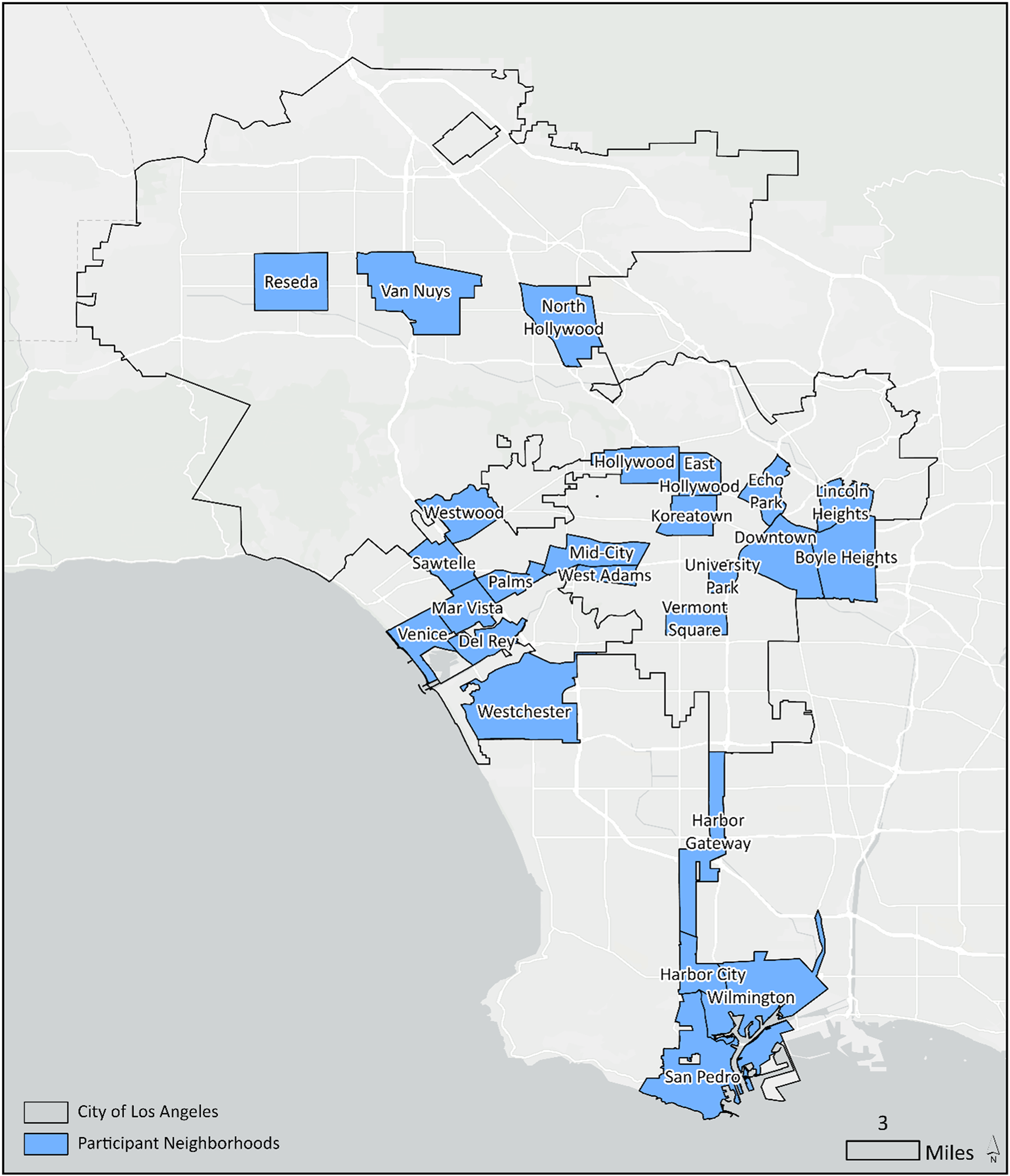
Map of participant neighborhoods.
Findings
Drawing on interview data, we present an exploratory typology of ways private citizens respond to perceived harms produced by encampment sweeps in the City of Los Angeles. Interviewees also share that their mutual aid work has been met with repressive responses from the City, forcing some helpers to reassess whether they can continue participating in this work. Our findings conclude with the voices of helpers who choose to persist in mutual aid in the face of repression and how they deploy risk mitigation strategies to diffuse, divert, and deflect risk away from themselves and encampment residents. These strategies lessen the burden of criminalization, reduce burnout, and sustain participation in mutual aid.
Recognizing invisibilization, choosing to intervene
Echoing Wacquant's (2009) observation that governments often seek to disappear—rather than solve—social problems, participants consistently concluded that City policies (e.g. LAMC 41.18, 56.11) and practices (e.g. CARE/CARE + cleanups) are designed to criminalize, punish, and erase unsheltered residents. Blake (Harbor Care Collective) succinctly captured the City's approach: “It's about disappearing the problem, not addressing it.” Another participant elaborated: At root, they know that their response is not about actually solving it; it's about using it to expand policing and move poor people out of public space […] Its intention is truly to disappear the poor from public space. […] It's disappearing people. It's also a very visible punishment for people just for being poor. It's just making people's lives miserable because of that. (Abby, Coalition for Renters Rights)
Participants observed that invisibilization of homelessness occurs through multiple means, including displacement (i.e. “shuffling” into shelters, motels, hospitals), incarceration, and death. Many felt that anti-homeless laws and sweeps reflect a broader capitalist logic that prioritizes the punishment of poverty: The logic of capital and capitalist systems […] is like, “We gotta do something with surplus populations or people who we don’t consider to be productive,” so every solution has to do with elimination, displacement, incarceration […] You have to be in a cage or warehouse somewhere if you don’t meet a certain standard. (Nyah, Culver Community Care)
Several participants, like Brandon (Mid-City Mutual Aid), witnessed firsthand the devastating consequences of practices that move people “out of sight, out of mind.” MK (Westside Empowered) reflected, “My one friend passed away, my other friend is in jail, and it feels that was the end goal. […] People with power and money in this city just want these unsightly problems to go away.” They then described how sweeps perpetuate marginalization: As a mutual aid volunteer, I see how when someone loses their phone in a sweep or has to relocate after a sweep and can’t take their belongings with them, it exacerbates the danger that person could be in and cuts them off from community. No matter the result, whether they go to jail, move to a new encampment, or move to a hotel, sweeps push people further to the margins; these people are already very marginalized in multiple ways. (MK)
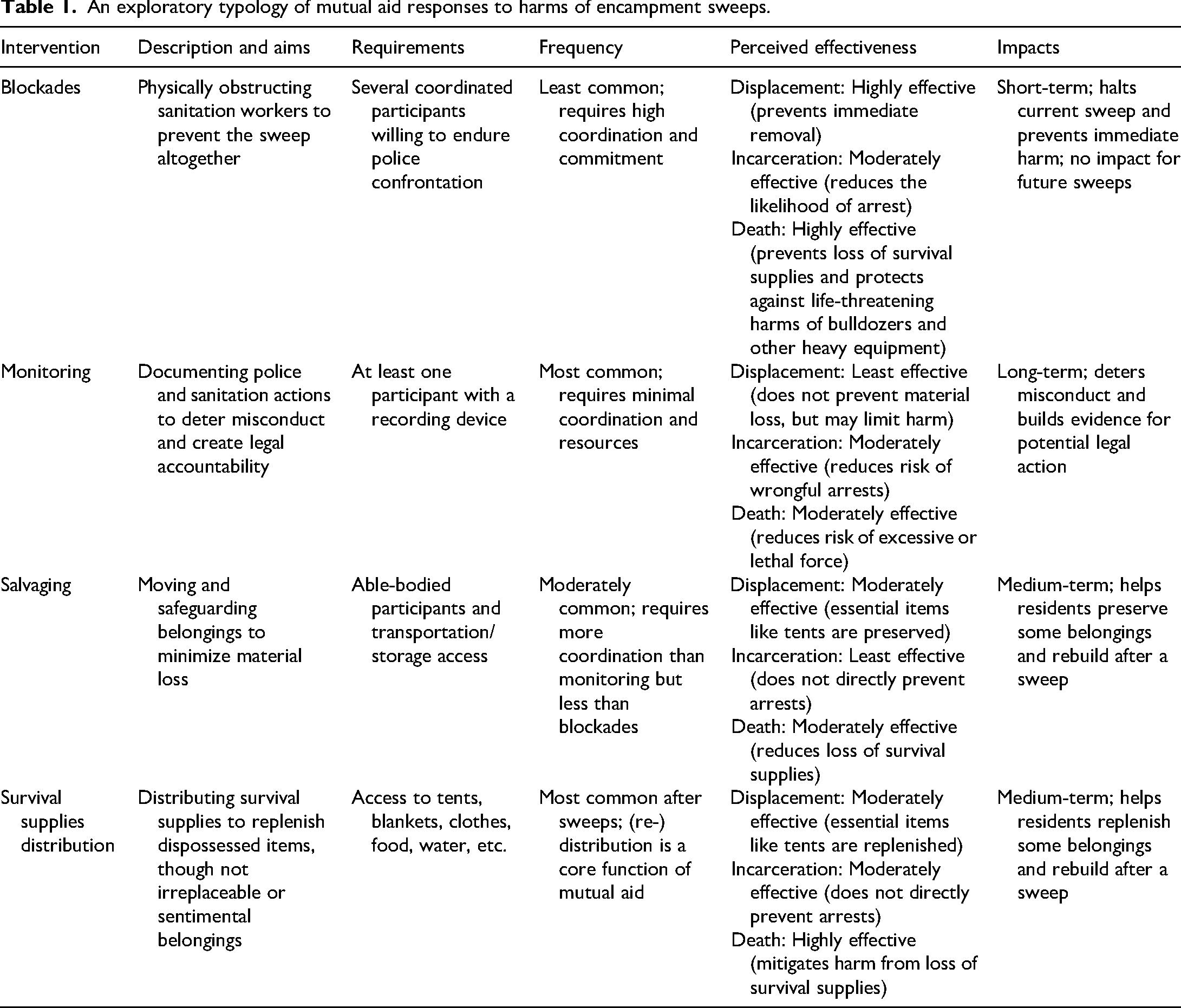
Recognizing invisibilization as a deliberate outcome of City policy compelled helpers to intervene—to help keep residents in their encampment communities, out of jail, and, at the very least, alive. While participants described several interventions, four emerged as the most common in the interview data: blockades, monitoring, salvaging, and survival supplies distribution (Table 1). Helpers consistently identified these strategies as serving the dual purposes of redressing harm caused by the City and supporting encampment residents.
An exploratory typology of mutual aid responses to harms of encampment sweeps.
Targeting helpers, heightening risk
While not explicitly prohibiting helping behaviors, LAMC 41.18 and 56.11 define “unlawful conduct” with vague terms like “obstruct,” “delay,” and “resist.” During sweeps, sanitation workers and police officers serve as “street-level bureaucrats” (Lipsky, 1980) with broad discretion in interpreting and enforcing these terms. This section illustrates how agents of “the City” expand the punishment regime inflicted on unsheltered residents (i.e. the criminalization of homelessness) to heighten the legal, physical, and psychosocial risk faced by mutual aid helpers (i.e. the criminalization of helping).
During sweeps, sanitation workers and police officers often use yellow caution tape to designate a “working zone” and establish a boundary between compliance and resistance. Madi (Harbor Care Collective) explained, “Once the caution tape is up, you’re not allowed to go into that area as a witness, volunteer, or supporter.” Miles (Harbor Care Collective) added, “Between 8 AM and 9 AM, sanitation will tape off the zone and be like, ‘You can’t cross the line, you risk arrest doing that.’”
Crossing the tape involved a range of legal risks: some participants described receiving a citation and fine, while others recounted being arrested on a misdemeanor charge and having to appear in court. One participant described the blatant targeting of helpers: In our area, they really target people for helping other people. They know somebody in a wheelchair or with a broken hand isn’t going to be able to move stuff on their own. We’ve had over eight arrests […] of people who are unhoused or are supporting people who are dealing with a sweep. […] People were very much targeted for helping each other. They don’t want people helping each other. […] If you get there after the tape is set up, they don’t let you cross. That's a big thing; that's the deterrent. (Camila, Valley Community Aid)
In some Council districts, this targeting is endorsed by Councilmembers and their staffers, who urge police to arrest anyone who crosses the tape to salvage belongings. One helper recounted, They wouldn’t let us take anything. Our stuff was on the sidewalk behind the yellow tape, and two staff members from [Councilmember] Joe Buscaino's office told police that if we cross the line to help our friends move their stuff, they should arrest us. […] She stood there and said, “If you cross under this line, we will have you arrested.” I told her, “I’m just trying to grab her stuff. Why do you care?” She went into this long diatribe about how “these people need to downsize.” (Blake)
Compliance with the yellow tape did not always shield helpers from targeting, as several participants recalled instances where police instigated confrontations despite helpers remaining compliant outside the “working zone.” During these interactions, officers often exercised their discretion to impose penalties beyond those prescribed in LAMC 41.18/56.11. As Miles explained, “We all know they trump [the charges] up as much as possible. […] They’re like, ‘Oh, you resisted arrest, or you did this.’ They put that type of crap on top of it.” Police misconduct described by participants included exaggeration and intimidation: My partner was arrested for supposedly resisting arrest, and they were pulled behind the line. Someone grabbed them from the other side of the police tape, and that charge was resisting arrest. Typically, during sweeps, people are arrested for 56.11, which is delaying or obstructing a City employee. (Camila) I have had a police officer pull out their weapon. We were up against a wall with someone I do harm reduction with, and [the officer] was like, “I fear for my life.” It was the worst, most terrible thing. […] The police officer, who had backed us into a corner, told us he feared for his life. […] People doing sweep defense are encountering intimidation and violence from cops. (Nyah) A cop pulled [Birdie] into him, knocking his own body camera off, and he was like, “You assaulted me!” (Blake)
In these instances, legal risk escalates from low-level violations of LAMC 41.18/56.11 to more serious felony charges, while physical and psychosocial risks also intensify in the face of such misuse of power.
While the aforementioned examples occurred during sweeps, within or at the yellow-tape perimeter, participants also recounted instances in which helpers were targeted prior to, after, or even physically away from the sweep site. As one participant recalled, On this particular day, it was clear that the idea was to get people out. For that sweep, a comrade had shown up like five minutes before me, and when I showed up, they were being handcuffed by the police for jaywalking across the street from one end of the camp to the other, which is obviously absurd but also a clear targeting of people who are present. (Abby)
Other helpers mentioned returning to their cars with parking citations or even being stopped by police shortly after a sweep. Each of these punitive tactics heightens the physical (e.g. excessive force), legal (e.g. citations), and psychosocial risk (e.g. harassment and threats) associated with helping.
Moreover, participants described that the punishment of helpers also occurred indirectly by targeting encampment residents. For example, some helpers explained how repeated sweeps at the same encampment counteracted the effectiveness of their efforts: They will come back and wait until the one time that we’re not there. They’ll just wait us out because we’re all volunteers. […] One blockade is not going to cut it; it just means the cops are going to come back and fuck over people the next day. (Abby) They use the sweeps to prevent us from making any meaningful change in these people's lives because they’re uprooted every few weeks. (Birdie, Harbor Care Collective)
One helper explained that while their blockade proved effective in the short term, the especially destructive sweep conducted the following week, after which residents exposed to an extreme heat wave were hospitalized, ultimately undermined its long-term impact and generated feelings of guilt among helpers: We successfully blockaded the first day of enforcement […], and that required over 100 people who showed up, including people who may not have known the community but brought their love, stood out there, and blocked the street for 8 hours. […] In retaliation, the police showed up at 4 AM the next week and threw away everybody's shit. It was horrible, and I felt really responsible. […] People were without their belongings during a weekend that was the hottest weekend on record in the Valley. […] We had to take people to the hospital because people were dying of heat exhaustion, and they had nothing since all of their stuff had been taken away in that retaliatory sweep. (Camila)
Here, Camila draws an explicit connection between helping efforts by mutual aid groups and the City's intense response, which many participants interpret as “retaliatory.” Camila elaborates on this connection by describing how, in addition to the previously mentioned “retaliatory sweep,” a week later, the City targeted a nearby encampment without proper notice on the same day as their “successful” blockade: The City was so hellbent that they went to a smaller encampment and targeted somebody that they knew had been hospitalized, and they said that person had abandoned their property. Even that day, when we were able to resist, they targeted somebody else. (Camila)
Camila and others who participated in the blockade also felt responsible for this destructive sweep, because their presence at the larger encampment left the City actors free to target another encampment while the helpers did not have the capacity to intervene there simultaneously.
In addition to “retaliatory sweeps,” City inaction, or what some participants described as “false alarms,” also undermined the well-being of residents and efforts of helpers. In particular, several participants described how the City would post notices for an upcoming sweep, and helpers and residents would prepare, but the sweep would never take place. One helper explained that such unpredictability adds to the trauma and instability caused by sweeps: The posting of [notices] and then not doing the sweep is almost as fucked up; it contributes to how fucked up it is when there is a sweep because the inconsistency […] makes people unable to predict any quality of their life, which is so destabilizing. (Abby)
Moreover, participants interpreted the City's reluctance to provide clear, consistent, and timely notices of sweeps as constituting “obfuscation.” For instance, some participants mentioned that notices were posted haphazardly on fences or poles, often out of sight from the encampment. Other participants said that, despite direct requests for ample public notice, schedules were often provided to helpers a few hours before or even after a sweep, hindering their ability to mobilize timely interventions. One helper recounted, The City Council and their staff know about these sweeps two weeks ahead of time, but they’ve refused to willingly give them to the public. We’ve had to threaten litigation, so it comes out 24 hours before. One time, we didn’t get the CARE sheets until 7:40 AM, and that sweep started at 6 AM. As far as I could tell, the City's actually not interested in being transparent, especially if they have a schedule two weeks ahead of time. They refused to just say, “In two weeks, the expectation is you shouldn’t be here because we’re gonna clean.” Part of the reason is that they don’t really have anything to offer. In those two weeks, we would really organize, mobilize, and be like, “This is ridiculous. You had two weeks to figure out where people are going to go.” They can’t do that on their end, so they just obfuscate and try not to let us know. (Nyah)
While most City actions described by participants were carried out by police officers, sanitation workers, and other street-level bureaucrats, participants also considered comments and decisions by elected officials relevant to the dynamics of encampment sweeps. For example, multiple participants interpreted the City Council's decision to postpone a vote on vastly expanding 41.18 enforcement zones as “retaliatory” and even “repressive” when it coincided with citywide sweeps targeting encampments known for strong resistance, effectively forcing helpers to choose between actively resisting the sweeps or speaking during public comment. Inside the LA City Council chambers, unsheltered residents and their supporters chanted “Repeal 41.18,” prompting then-City Council President (now-disgraced) Nury Martinez to direct LAPD officers to clear the room. When the chamber later reopened with only Council members, staff, and media present, Martinez addressed the largely empty room: What's even more disturbing is that so many of the speakers that spoke about this very issue, that claim to care about this very issue, don’t even look like the very people that are on the streets or the communities in which some of us have been trying to house people […] or the very people that even send their kids to our schools or the kids that go to school. […] The people who got here today, this morning, to speak on this issue have absolutely no idea […] what poverty looks like or what it feels like or what it feels like to go hungry or what it feels like to know […] how you’re going to make the rent each month, no idea what that feels like. But being accused of criminalizing homelessness or criminalizing poverty is just insulting. (Regular City Council Meeting - August 2, 2022)
For many participants, Martinez's explicit disdain for helpers—branding their actions, claims, and character as “disturbances, disrespect, and unabashful [sic] privilege”—reinforced their belief that the City deliberately targets helpers for resisting the invisibilization of homelessness. More specifically, participants concluded that the City's punitive actions reflect a repressive strategy to “break people down,” rendering acts of helping so “high risk” that they ultimately deter action. Despite the heightened legal, physical, and psychosocial risk, many helpers persisted in their efforts while navigating an increasingly punitive landscape—one that now includes their own criminalization.
Mitigating risk, overcoming repression
The City's repressive measures carry significant collateral consequences (e.g. incarceration, deportation, financial hardship, and psychological strain) that helpers must evaluate in deciding whether and how to continue their mutual aid work. For example, one helper, who was detained and charged with felony resisting arrest and battery on an officer, reflected on how their open case has altered their role during sweeps: If somebody didn’t want to move, I used to try to defend their spot for as long as I could, and that delayed sanitation for long enough that other people had time to move. I don’t do that anymore because I have an open [felony] case from doing that. […] After I got arrested, it's definitely been a challenge. One of the movement lawyers was like, “Don’t even go down there,” and I was like, “We’re getting evicted.” […] I leave that up to other folks, but I used to do it. I can’t get arrested while out on bail; that's the only issue. The cop that arrested me arrested me falsely and will do it again to get me locked up. So, I don’t even try anymore. (Birdie)
The risk and repercussions of re-arrest forced Birdie to reassess their role, balancing the constraints of their felony charges while learning other ways to help. As Abby put it, “It's not cool to be arrested; it forces us to be more strategic.” Rather than fully disengaging, legal risks often prompt helpers to adopt more cautious, strategic approaches that minimize the potential of arrest.
Camila, who reflected on a successful sweep blockade followed by a devastating sweep that left encampment residents hospitalized, repeatedly expressed, “I felt really responsible. […] It's a moral injury that has left people feeling very powerless and very hopeless about anything getting better because now you’re targeting people for trying to help another person.” Despite these negative emotions, Camila remained motivated: “It's some wins and a whole lot of losses. For us, we continue to show up, but you just have to get used to being losers and losing a lot. Nothing has prepared me for that level of loss. […] We just want to support people in whatever ways they choose to resist, fight, or just live another day.”
The consequences of the City's repressive measures were also felt and assessed differently by helpers with precarious living circumstances or immigration statuses. Every helper interviewed was either unhoused or a renter. Nyah noted, “We’re all renters, and it's super precarious […] We’re also organizing against our own abandonment.” Several helpers were also students, gig workers, unemployed, or precariously employed, meaning that fines and fees could exacerbate financial hardship and psychological strain for those already facing economic instability.
For Yazan (Harbor Care Collective), a helper with “nonimmigrant status,” the legal risk associated with helping compelled them to alter their role during sweeps: “I tend to interact with cops and sanitation workers as little as possible because I’m an immigrant currently undergoing immigrant procedures, so I’m in a very delicate place.” Yet, this vulnerability also fostered “a sense of camaraderie” with unhoused residents that motivated them to continue helping. Yazan explained, “We’re both hated [and prosecuted] by the government, so let's work together to prevent that.”
Instead of ceasing their mutual aid work, many helpers learn different ways to participate. For instance, participants often stressed the importance of having “power in numbers,” in which helpers work and move in pairs, or use a buddy system to diffuse risk (e.g. risk of harassment or arrest) across multiple individuals rather than concentrating it on a single helper: We have a strategy. First, you never go up to the police by yourself. You always have to have a partner; otherwise, you are vulnerable to the cops taking advantage of you. Second, we have a liaison who is preferably a white man. Again, we don’t let them go alone. We usually bunch up as a group around the police and show them there's a group of people here; if you arrest one person, you need to arrest five, so maybe don’t. (Yazan)
Leveraging privileged identities also serves as a strategic risk mitigation tool. This may involve assigning helpers with privileged identities to liaise with police, divert attention away from the encampment, or take on frontline roles that involve direct contact with officers. Meanwhile, other helpers focus on tasks that involve less police interaction, such as packing and moving belongings, consoling distraught residents, safeguarding relocated items, or being present only before or after police arrive to assist with preparation (pre-sweep) and rebuilding (post-sweep). These strategies divert risk away from helpers with marginalized identities and toward those with privileged identities: We have different roles. I’m not a yelling-at-police person. I have a great friend who shows up as a distraction. He's an out-of-control housed person, just yelling on the side. It's an awesome tactic because he's a white dude losing it on the police. It's a lot, but it is better than our Black folks doing it. (Nyah)
Participants also emphasized how sweep monitoring, particularly filming the police, served as a protective measure for both encampment residents and helpers. Several participants noted that “copwatching” deflects risk away from helpers and onto police officers and other City workers by creating the possibility that misconduct will be documented and used as legal evidence (Stuart, 2011). As helpers explained, If the cops are there, we should never have our back to them and film them if they’re doing something. […] Filming them is a measure of protection. (Blake) People are usually on their best behavior when they’re being recorded, especially city workers. […] I monitor in case anything illegal does happen, and we need evidence for it. (Martin, Harbor Care Collective)
Despite these mitigation strategies to diffuse, divert, and deflect risk, the threat of punishment is never entirely eliminated, since police can easily negate these tactics by calling for backup, disregarding privilege, or continuing their actions despite being monitored/filmed. Nonetheless, participants emphasized that these strategies—learned and shared among helpers—lessen the burden of criminalization, reduce burnout, sustain participation in mutual aid work, and, at least for the time being, overcome the City's repression.
Discussion
These findings demonstrate how the “punishment regime” inflicted on unhoused residents (Herring et al., 2020; Welsh Carroll et al., 2023) has extended to individuals and groups that provide mutual aid to unhoused communities. Agents of “the City” have criminalized helping, and in doing so have created another tool for invisibilizing and punishing homelessness (Herring, 2019, 2021; Wacquant, 2009).
The criminalization of helping, as evidenced in this article, demonstrates the lengths to which the City goes to facilitate the invisibilization of homelessness. Thus, the survival and continued existence of homelessness in public spaces can be reinterpreted as an everyday act of resistance against invisibilization. This aligns with research in Indigenous, disability, queer, and gentrification studies that conceptualize existence and visibility as resistance (Butler-Rees, 2023; Candipan, 2019; Egner, 2023; Wolfin, 2023). These findings contribute to the literature on volunteering and mutual aid by highlighting the motivations, perspectives, and experiences of the private citizens who intervene to counteract the punishment of homelessness.
Moreover, the interviews reveal that the City's repressive measures did not immediately demobilize helpers, and therefore did not result in absolute repression. Instead, the legal, physical, and psychosocial ramifications of these punitive actions were endured, evaluated, and negotiated by those targeted for helping. Through risk mitigation strategies, helpers learned—collectively and individually—to diffuse, divert, and deflect risk and thus overcome repression. The criminalization of helpers served as a motivator and point of solidarity among the criminalized subjects. Therefore, this article aligns with past research on how resistors assess the risk associated with participation (McAdam, 1986), make choices about whether and how to continue (Honari, 2018), and view their targeting as a motivation for collective action (Ayanian et al., 2021).
Limitations and future research
This study included only helpers who were currently engaged in ongoing mutual aid efforts, potentially introducing a survival bias. Future research should examine burnout among individuals who disengaged from helping: Does it lead to permanent or temporary inaction? How do helpers decide whether to take a break or stop altogether? How do they decide to return?
Additionally, while this article focuses on helpers working with coordinated mutual aid groups, some interviews and past observations reveal that encampment residents often help their encampment neighbors during sweeps. Future research should center the lived experiences of unsheltered helpers who are uniquely vulnerable to the criminalization of both homelessness (their existence) and helping (their neighborliness).
Moreover, while this article asks how the City responds to helpers, it does not include insights from law enforcement, sanitation, or other municipal workers who are tasked with carrying out these responses. We know from Lipsky (1980) that, due to their discretion in implementing policies, these frontline workers are policymakers. Simon (2007) further shows that these policies demonstrate a mode of governing through crime control. Future research should interrogate these dynamics by exploring the perspectives of state actors involved in homelessness management to further contextualize helpers’ experiences and perceptions of retaliation introduced in this article.
Although this study focuses on Los Angeles, it speaks to broader West Coast dynamics. Cities such as San Francisco and Portland also have sizable unsheltered populations, particularly in contrast to East Coast cities with more extensive shelter systems like New York City (Herring, 2014; HUD, 2024). As a result, these municipalities also rely on “quality-of-life” laws and encampment sweeps to “manage” unsheltered homelessness (Hennigan and Speer, 2019; Herring, 2019; Welsh Carroll et al., 2023), suggesting that the punishment regimes documented here may operate similarly across the West Coast and in other cities across the United States with large or growing unsheltered populations. Future research should examine how these dynamics vary across municipalities with differing shelter, policing, and political contexts.
Since the conclusion of data collection, recent events warrant consideration in future research. First, in City of Grants Pass v. Johnson (2024), the U.S. Supreme Court overruled Martin v. City of Boise (2018) and held that municipalities may enforce anti-camping laws even when no shelter is available. Second, a new ordinance in Fremont, California, criminalizes “causing, permitting, aiding, abetting or concealing” an encampment (Kendall, 2025). Third, in October 2024, journalist Lexis-Olivier Ray was detained by LAPD officers for crossing the yellow tape while documenting an encampment sweep (L.A. TACO Staff, 2024). Fourth, Mahmoud Khalil, Rümeysa Öztürk, Mohsen Mahdawi, Badar Khan Suri, and Yunseo Chung, among others, have been detained, deported, or risk deportation for their participation in protesting against the genocide in Gaza (Aminy, 2026). Fifth, in Minnesota, ICE agents killed Renee Nicole Good while she served as a legal observer and killed Alex Pretti while he filmed an enforcement operation; and in several states, ICE agents have also shot, pepper sprayed, pulled over, arrested, harassed, threatened, face-scanned, and told numerous individuals—some organized as mutual aid groups supporting immigrant neighbors who are being targeted by ICE's dragnet raids—who were observing or recording their operations that they were being entered into a database of “domestic terrorists” (Bier, 2025; Collier et al., 2026; Duret and Bogan, 2026). These events suggest an increasingly punitive landscape that proliferates the invisibilization of homelessness, the surveillance and criminalization of helping, the repression of resistance, and the weaponization of immigration enforcement and anti-homeless laws alike to suppress free speech and sidestep accountability.
Policy implications and recommendations
Punishment is not a solution to homelessness; in reality, punitive responses to people without housing thwart efforts to end homelessness. To dismantle the underpinnings of this expanding punishment regime, municipalities must repeal anti-homeless laws like LAMC 41.18 and 56.11 that justify not only encampment sweeps but also punitive actions against helpers. Given the persistent lack of affordable housing, restrictive shelter policies, and the criminalization of homelessness, people will continue to exist outside. Therefore, municipalities should prioritize nonpunitive, nondisplacive spot cleanings with proper notification and procedures. Further, as both unhoused residents and helpers call for, water, sanitation and hygiene (“WaSH”) resources like drinking water, toilets, menstrual supplies, and handwashing stations should be provided. The provision of WaSH resources would further support a clean, healthy public environment for all, regardless of housing status (Welsh Carroll et al., 2024). Finally, municipalities cannot continue to invisibilize social problems through complaint-oriented strategies (Herring, 2019, 2021) and must instead address root causes through housing-first strategies that prioritize safety and stability.
Conclusion
As the targeting of homelessness and helping intensifies across municipalities in the United States, helpers continue to do what the City fails to do: keep people alive. While this article has outlined only a handful of strategies for helping, risk mitigation, and survival, countless others unfold daily in encampments across the nation—often beyond formal organizing. Staying ahead of this evolving punishment regime requires meaningful connection, strategic knowledge-sharing, and continued care for those abandoned by the state. This article demonstrates that the criminalization of mutual aid and helping is, at its core, the criminalization of care, compassion, and solidarity; of “aiding and abetting” survival; and the criminalization of life itself.
Footnotes
Acknowledgments
NG presented preliminary findings from this study at the 2023 Annual Meetings of the American Sociological Association and the Society for the Study of Social Problems in Philadelphia, PA. NG is grateful to Shawn Flanigan, Chris Herring, and Hank Johnston for their generous guidance on the larger project that informed this article, and to Carina Rodrigues for her insightful comments on early drafts. We also thank the editorial team and anonymous reviewers for their careful reading and constructive feedback. We would like to acknowledge everyone who entrusted their stories to us—we hope to do them justice in our writing.

Ethical approval and informed consent statements
This study received ethical approval from the San Diego State University Institutional Review Board (HS-2021-0269). To preserve the anonymity of participants, we obtained comprehensive oral informed consent from each participant in lieu of written consent (signatures). Participants received a copy of the written consent document to keep, along with a comprehensive list of local resources (e.g. for housing, food, health care, and social services).
Consent for publication statement
Not applicable.
Author contributions
Nicolas Gutierrez III: project conceptualization, methodological design, data collection, data analysis, and writing and revising manuscript draft and Megan Welsh Carroll: project conceptualization, methodological design, data analysis oversight, and writing and revising manuscript draft.
Funding
The authors received no financial support for the research, authorship, and/or publication of this article.
Declaration of conflicting interests
The authors declared no potential conflicts of interest with respect to the research, authorship, and/or publication of this article.
Data availability statement
The interview data generated and analyzed during the current study are not publicly available due to confidentiality issues and a lack of consent from participants to share raw data externally.