




Abstract
In Australia, vagrancy and public order laws have been used to criminalise homelessness since colonisation. Such laws have never provided an effective deterrent against ‘offending’ because most crimes committed by homeless people are survival-related or otherwise associated with their homeless status. It is generally agreed that a welfare-oriented rather than a punitive approach is needed if these ‘crimes’ are to be prevented, however the perspectives of homeless people on this subject remain largely unknown. We undertook a national study where we asked homeless individuals and criminal law practitioners to comment on whether and how criminal law processes could respond more appropriately to the ‘offending’ behaviour of homeless people. Practitioners viewed criminal law interventions as an opportunity to connect homeless individuals with the services they required. However, the homeless participants were not supportive of mandated social service intervention. They eschewed a criminal identity and wanted state actors to leave them alone.
Introduction
Since colonisation, criminal law responses have been used to regulate the behaviour of ‘vagrants’ in Australia (Walsh, 2003, 2011). 1 Vaguely expressed laws inherited from Britain, that prohibited vagrancy and imposed ‘public order’, cast a wide net over those who did not conform to colonial social ordering (Kimber, 2013). Enforcement of these laws was directed towards ‘civilising’ social groups that were considered ‘undesirable’ (Kimber, 2013: 82) and ‘protecting’ others from ‘criminal contagion’ (Nettelbeck, 2018: 539). In practice, they variously served to monitor, control and exclude the convict underclasses and ‘the natives’. Criminal offences like trespass, unlawful camping, loitering and ‘public nuisance’ are still used to criminalise homeless individuals in Australia today, along with other offences that criminalise survival-related activities, such as begging. 2 Laws that define certain behaviours as criminal only when they are conducted in public space, such as offensive behaviour, swearing and public intoxication, are still touted as ‘protective devices’, yet their practical effect is to ‘criminalise the poor’ (Kimber, 2013: 543).
Of course, Australia is not unique in its punitive approach to destitution; ‘anti-homeless legislation’ is common the world over (Amster, 2003; Baker, 1990; Cooper, 2016). Criminal law responses to homelessness are justified by conceptions of homeless people as disordered, threatening and ‘ugly’ (Herring, 2019; Johnsen and Fitzpatrick, 2010; Lundberg, 2021; Speer, 2019). The ‘respectable’ public are presented as potential victims of ‘scary’ homeless people, and this sense of ‘riskiness’ is used to justify the regulation, control and exclusion of homeless individuals from the public spaces where they live and socialise (Duff, 2014; Parnell, 2023). In fact, research has consistently indicated that criminal offending by homeless people is usually victimless and survival-related (Smith, 1994; Waldron, 1991; Walsh, 2011), and that those who are homeless are much more vulnerable to victimisation than members of the general public (Heerde and Hemphill, 2016; Menih, 2020). Nevertheless, when the ‘civilised’ public encounter visible manifestations of homelessness, it is the police, rather than welfare or social service agencies, they call upon for ‘help’ (Herring, 2019; Speer, 2019) and police are limited in their capacity to respond in a non-punitive way.
Consensus is emerging that criminalising homelessness is unfair and ineffective as a deterrent (Herring, 2019; Stuart and Beckett, 2021). Compassionate, therapeutic approaches to the policing (Murphy, 2009; Stuart and Beckett, 2021) and sentencing (Binder, 2012; Troeger and Douds, 2021) of homeless people have been trialled in some locations, but such initiatives are rarely mainstreamed. There is growing advocacy and scholarship calling for the decriminalisation of crimes that disproportionately impact upon people experiencing homelessness (Justesen, 2023; OHCHR, 2023) yet laws that criminalise poverty and homelessness remain on the statute books.
In undertaking this research, we wanted to better understand the views, perceptions and experiences of those who participate in the criminalisation of homelessness – those who criminalise, and those who are criminalised. We were conscious that discourses are not necessarily universal, but can be particularised to certain standpoints. The perspectives of professionals are likely to be shaped, and validated, by their individual disciplines, and may differ from the perspectives of those with lived experience. We actually know very little about the motivations and intentions of front-line decision-makers who implement the laws and policies that criminalise poverty and homelessness (Cooper, 2016). There is also limited empirical evidence on how homeless people themselves experience or perceive the criminal law interventions that regulate their behaviour in public spaces (Diamond et al., 2021: 18; Robinson, 2019: 49). In this article, we examine qualitative interview data obtained during a national study in Australia on homelessness and criminalisation. Our findings reveal how legal professional discourses on the needs of people experiencing homelessness are at variance with the perspectives of homeless people themselves. People experiencing homelessness see no legitimate role for criminal law processes in their lives – their suggestion is that we ‘back off’ from criminalising homelessness and stop ‘making’ them ‘illegal’.
What is Criminalisation?
For the purpose of this study, we defined criminalisation as any process ‘through which conduct comes to be or to be treated as criminal’ (Duff, 2014: 224) or by which ‘certain people’ are defined as ‘criminal or potentially criminal’ (Millie, 2011: 278). Criminalisation is the product of an interplay between criminal law legislation, police practices and judicial decision-making (Brown, 2013; Duff, 2014) and involves a range of actors who execute different functions within the process: legislators, police officers, lawyers, judicial officers and corrective services officers (Brown, 2013; Duff, 2014). These actors and agencies are often collectively referred to as ‘the criminal justice system’. However, in practice, they operate within ‘semi-autonomous domains’ rather than ‘as a unified system in pursuit of an agreed and uncontradictory set of principles and aims’ (Brown, 2013: 609–610). For this reason – and because those who are criminalised tend not to consider ‘the system’ as ‘just’ (Basten et al., 1982) – we will not use the phrase ‘criminal justice system’, and will refer instead to ‘criminal law processes’.
Definitions of ‘criminal’ are ‘morally ambiguous’, governed by context, values and politics (Ashworth and Zedner, 2008: 2; Brown, 2013: 610; Millie, 2011: 279), and Australia's colonial past strongly influences contemporary conceptions of ‘the criminal’. Criminal laws were historically used to exclude and oppress Australia's Indigenous peoples, and to maintain social control over the convict underclass, and this legacy remains (Anthony, 2013; Walsh, 2011). Indeed, in two Australian states (Victoria and Queensland), the ‘Vagrants Acts’ were not repealed until this century and were replaced by laws with modern phrasing but the same effect (Walsh, 2003; 2011). In the US, use of the criminal law to ‘purify’ the streets and ‘banish’ social problems is often referred to as ‘quality of life policing’ (Herring, 2019: 772). In Australia, equivalent practices are known as ‘public order policing’; the express goal is to prevent a ‘breach of the peace’ and ‘maintain decorum’ (Coleman v Power (2004) 220 CLR 1). Criminal law responses to visible displays of destitution are still influenced by paternalistic notions such as ‘disciplining’ the homeless and exercising ‘care and control’ over Indigenous peoples (Clarke and Parsell, 2020; Cunneen, 2001).
In recent years, regulation of homeless people has expanded beyond the criminal law to include new civil mechanisms of social control. Additional powers allowing police to ban, move on, search and confiscate items have been introduced, and private surveillance officers (security guards, transit officers and council officers) have moved in to regulate semi-public spaces (Clarke and Parsell, 2020; Farmer, 2017; see also Crawford, 2003: 486; Herring, 2019; Pratt and Miao, 2019). These mechanisms are touted as ‘non-punitive’, indeed move on powers and banning orders were introduced as alternatives to arrest (Farmer, 2017; see also Bowling and Phillips, 2007; Herring, 2019; Young and Petty, 2019). Yet we include these within our conception of criminalisation because they are ‘decidedly coercive’ (Beckett and Herbert, 2008: 20). Their use often results in criminal charges anyway, either as a result of the interaction or when a civil order is breached (Ashworth and Zedner, 2008: 29; Brown, 2013: 607; Duff, 2014: 7).
Homelessness in Australia
The Australian Bureau of Statistics defines homelessness in terms of ‘houselessness’, specifically, the state of living in a dwelling that is inadequate, has no tenure or only tenure that is short and not extendable, or does not allow the person to have control of or access to space for social relations (Australian Bureau of Statistics, 2023). Census data indicates that homelessness has been increasing in Australia over the past decade (Australian Bureau of Statistics, 2023). Almost 123,000 people were counted as homeless during the 2021 census, a rate of 48 per 10,000 people (Australian Bureau of Statistics, 2023). During the COVID-19 pandemic, unprecedented funding levels allowed non-profit housing organisations to meet demand for housing for the first time (Parsell et al., 2023). However, since then, rental prices have risen sharply and visible homelessness now exceeds pre-COVID levels (Pawson and Parsell, 2022).
Australia's ‘homeless’ are not a homogenous group (Zufferey and Kerr, 2004: 346) and mainstream definitions of homelessness can be criticized for ‘over-simplifying’ individuals’ circumstances (Memmott and Nash, 2016). The fastest growing cohort of homeless Australians is older women (Australian Bureau of Statistics, 2023), many of whom are couch-surfing or sleeping in their cars (Petersen, 2015). Further, census data indicates that around a third of all homeless people are young people aged 12 to 24 years, although this is likely to be an underestimate as young homeless individuals are highly transient and are often counted as ‘visiting’ rather than homeless on census night (Flatau et al., 2013).
Homelessness is subjectively experienced; not all homeless individuals associate ‘home’ with one place, or indeed with shelter at all, and not all people without shelter consider themselves to be homeless (Zufferey and Kerr, 2004: 346–347). This is particularly so of Australia's Indigenous peoples. Indigenous peoples comprise around 20% of homeless Australians, but only 3% of the population (Australian Bureau of Statistics, 2023).
Moreton-Robinson (2003: 36) observes that Indigenous Australians have effectively been made ‘trespassers in our own land’ as a result of their dispossession, dislocation and removal from their homelands. Indigenous conceptions of ‘home’ are rooted in ongoing ontological connections to Country, and western notions of ownership are ‘incommensurable’ with this (Moreton-Robinson, 2003: 23). For Indigenous peoples, therefore, ‘homelessness’ may take on different meanings.
Definitional debates aside, those who do identify as homeless report high levels of interaction with criminal law processes (Diamond et al., 2021; Walsh, 2011). Qualitative studies conclude that most homeless individuals have experienced contact with police, and more than half have spent time in prison (Cooper, 2016; Gonzalez et al., 2018; Quirouette et al., 2016; Robinson, 2019; Zufferey and Kerr, 2004). Homeless persons’ passage through the revolving doors of courts and prisons has been acknowledged for decades, even centuries (Foscarinis, 1996; Kushel et al., 2005). We wanted to learn more about the lived experience of criminalisation from different perspectives. While this study is focused on homeless peoples’ experience in cities across Australia, our findings have relevance for other Western countries where similar trends in homelessness and criminalisation are occurring.
The Study
Approach
Our study was the first national qualitative study on the criminalisation of homelessness in Australia. We undertook interviews with people experiencing homelessness and criminal law practitioners in 10 cities across the country: all of the state and territory capital cities and two regional centres. 3 The criminal law practitioners we interviewed included lawyers (specifically, lawyers who deliver legal services to people experiencing homelessness), judicial officers (specifically, those who preside over arrest courts, and before whom homeless individuals on minor charges are likely to appear), front-line police officers, and corrective services officers. Not all groups at each location consented to be interviewed; in particular, several police services and corrections departments decided not to participate.
We were conscious that people experiencing homelessness are a vulnerable population group, whose lives are stressful and chaotic. Participating in research may be experienced as burdensome and potentially traumatic. Unlike Herring (2019) and Schneider (2023), we were not able to commit to an extensive period of immersive ethnographic research. Australia is geographically vast, and to enable us to obtain data from individuals all over the country, we decided to undertake once off face-to-face interviews. We agree with Dempsey et al. (2016) that face-to-face interviews are appropriate when undertaking sensitive research, however we also note the views of Menih (2020) and Melville and Hincks (2016), who discuss the importance of ensuring vulnerable participants are interviewed in a supportive environment by trusted interviewers.
We decided to partner with a community legal service in each city that delivered housing-related legal services, and we took their advice on how to approach interviewing homeless people. We decided that the academic researchers would conduct the interviews with criminal law practitioners, but community legal service staff would conduct the interviews with homeless people. 4 They invited clients at their outreach locations to participate, exercising their discretion on who to ask. They felt confident in this approach because it enabled them to provide advice, assistance and referrals immediately if required. We developed an interview schedule collaboratively, with participation from all of the community legal services we partnered with, and the same interview schedule was used at each location. The schedule included questions about: the association between homelessness and crime; the role that police, courts, lawyers and corrections play in the criminalisation of people experiencing homelessness; and how the criminal law system could improve its responses. We encouraged the interviewers to take a conversational approach, and we endorsed the use of a yarning methodology with Indigenous participants which focuses on developing trust and sharing stories and ideas rather than interrogating participants (Bessarab and Ng’Andu, 2010). Matching questions for the criminal law practitioners were devised based on the questions developed for the homeless participants, so every participant in the project was asked to comment on the same issues.
There were some limitations associated with this approach. We allowed each community legal service to recruit their own interviewers, and they varied in experience and how they approached the task. Taking a conversational approach to the interviews also imported the risk of biased and leading questions, although this was somewhat addressed by using the same interview schedule across the study. In hindsight, a further limitation of our study was that we did not interview health, housing and community service providers. Several homeless participants discussed the role played by these services in their criminalisation and exclusion, and it would have been useful to canvas the perspectives of these workers to obtain another viewpoint. It is also important to note that all of the practitioner participants self-selected into the study, and it is likely we attracted a certain sub-set within each group.
Participants
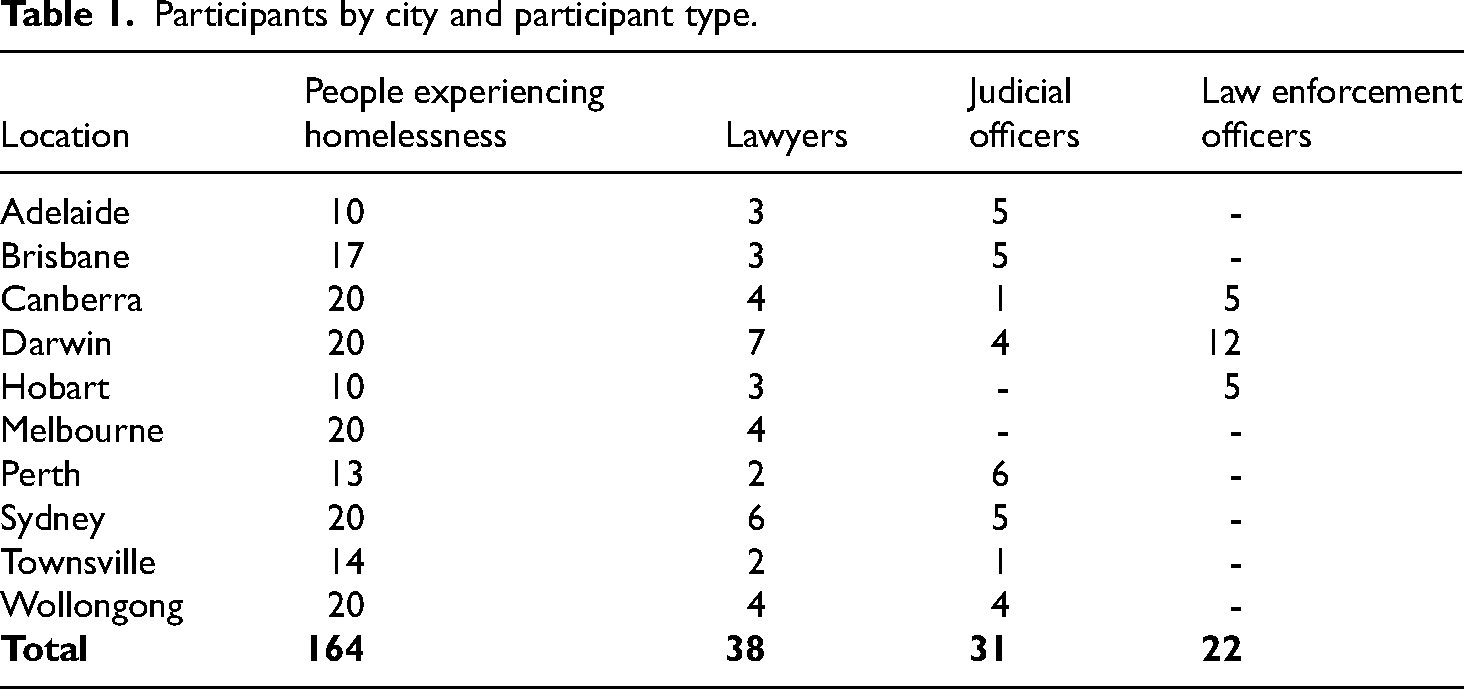
For the homeless participants, we limited eligibility to clients who were either currently homeless or homeless within the last year, over 18 years of age, and had capacity. All homeless participants were remunerated with a grocery voucher. Whilst our aim was to conduct interviews with 20 homeless people in each city, the COVID-19 pandemic interrupted participant recruitment in some locations. Across the 10 cities, we interviewed a total of 164 people with lived experience of homelessness (see Table 1 for location breakdown).
Participants by city and participant type.
Our community legal centre partners advised us to limit the number of questions that might be seen as intrusive, so our demographic questions were presented to participants as optional. As a result, demographic information was not available for all participants, however 34 participants were recorded as female, 68 were recorded as male, and 38 were recorded as Indigenous peoples. Age information was available for 93 (57%) of participants: 6% were aged 18–24 years; 29% were aged 25–34 years; 41% were aged 35–49 years; 22% were aged 50–64 years; and 2% were aged 65 years and above. The interviews with homeless people averaged around 20 min duration. Most of the interviews were individual (one-on-one) interviews, however four of the interviews with Indigenous people (n = 9) were conducted in small groups in accordance with the participants’ preference.
We considered it important to maintain participants’ privacy and respect their right to control their own information (Kukutai and Taylor, 2016), however the lack of demographic information available to us meant that we were not able to make definitive findings on the experiences of Aboriginal and Torres Strait Islander Australians.
We interviewed a total of 91 criminal law practitioners: 38 lawyers, 31 judicial officers and 22 police and corrective services officers (‘law enforcement officers’; see Table 1). Notably, some of the law enforcement officers had performed both roles (policing and corrections) during their careers and were able to speak to both experiences. The practitioner interviews ranged from 20 to 80 min duration. Most of the practitioner interviews were conducted in person, however some were conducted over the phone where travel was prevented due to climate events and the COVID-19 pandemic. All interviews with the lawyers were group interviews, all interviews with judicial officers were individual interviews, and the police and corrective services officer interviews were a combination of group and individual interviews depending on participants’ preference. We did not collect demographic information for the practitioner participants.
Data Analysis
All the interviews were audio recorded and transcribed by a professional transcription service. We then conducted a reflexive thematic analysis of the transcripts in accordance with Braun and Clarke's (2022) methods. We collaboratively developed a list of broad categories for analysis (e.g. police powers, sentencing, mental illness, suggestions for reform). We then compared data relating to each category within and between the participant groups (Glaser and Strauss, 2017). Codes were ascribed to the data in each category for each participant group, and themes were generated from these codes.
In what follows, we discuss the themes generated from the interview transcripts with supporting quotes from participants. We use quantifying language to indicate the prevalence of the themes across the dataset (Braun and Clarke, 2022: 141–142). Our analysis is based around two key topics: why people experiencing homelessness find themselves interacting with criminal law processes, and what the proper role of criminal law processes is in regulating the behaviour, and lives, of homeless people.
Homelessness and Criminal Offending
Predictably, the most prominent theme across the interviews was that being homeless made people vulnerable to criminalisation, however this is a wide theme that requires unpacking. Importantly, participants said that most ‘crime’ committed by homeless people was survival-related, aimed at securing food and shelter. This was reflected in the offences they said they were charged with: shoplifting of food, trespass, begging, loitering, fare evasion, and offences associated with sleeping in a vehicle. Other common charges derived from the criminal law process itself, like obstruct police, failure to follow a police direction, failure to appear in court and breaches of orders.
Conceptions of ‘the Criminal’
Several homeless participants said they had no choice but to engage in criminal offending, for example, many said they had to choose between stealing and begging to provide themselves with necessary items such as food and clothing. This is consistent with previous research, which has found that the charges homeless people receive commonly result from attempts to obtain shelter or food, and that homeless individuals seldom demonstrate ‘criminal intent’ or view themselves as ‘criminal’ (Diamond et al., 2021; Gonzalez et al., 2018). Faced with only ‘criminal’ options for engaging in survival-related activities, individuals must adapt their moral code to suit their straightened circumstances (Booth and Coveney, 2007:51; Kyprianides et al., 2021).
The homeless people we interviewed had different views on which ‘crimes’ were most morally reprehensible and these judgements influenced their ‘criminal’ behaviour. For example, one participant said, ‘in my case, when I asked for money, it was because I didn’t want to go into a shop and steal underwear’; whereas another remarked, ‘I steal from corporations, not people … I paid tax, I’m sure I can steal a loaf of bread’. Booth and Coveney (2007: 48) similarly observe that homeless individuals differ in their ‘internal grading’ of offences. Yet, once individuals conclude that an activity is necessary for survival, their focus shifts towards evading law enforcement officers and avoiding detection (Kyprianides et al., 2021; Murphy, 2009).
The practitioners confirmed that people experiencing homelessness often receive charges for engaging in life-sustaining activities. The lawyers observed that when homeless people are charged with ‘public space offences’ there is ‘always… a presenting need’ and judicial officers said the stealing charges they saw usually arose out of ‘genuine necessity’. The police officers said that they were often called out to incidents where homeless people had committed ‘minor’ or ‘petty’ offences related to ‘the circumstances that they find themselves in’, where ‘all they’re trying to probably do is stay warm, stay out of the weather, or try and hide themselves’. The police officers we interviewed said move-on directions did not provide a solution because ‘they’ve got nowhere else to go, so they tend to keep on coming back’, and stealing charges did not act as a deterrent because ‘what else are they going to do? They need to eat and they don’t have money’.
Several homeless participants described being ‘harassed’ and ‘targeted’ by police and said they had frequent, often daily, contact with police. Many said they had been arrested and charged, but the most common complaint was that they were constantly being ‘pulled up’ and questioned. One said: ‘you can't even sleep anywhere without the police just going, “excuse me, move along”. Do you know what I mean? Like where are you meant to go?’ Several participants said they understood that police officers were ‘just doing their job’ and they acknowledged that often officers approached them to conduct a ‘welfare check’ (to see if they were alright). However, they experienced these interactions as intrusive, unnecessary and ‘annoying’. One homeless participant said: You don’t want to be asked questions just because you’re wandering around… the police pull me up and they’ll ask my name and why am I walking? And I feel a little bit annoyed because it's a free world. I can walk down the street if I want to. There's no reason to suspect that I was a criminal.
Visibility and Aesthetics
It is often said that homeless persons’ visibility in public space generates higher levels of police contact and consequential criminal law involvement (Cooper, 2016; Young and Petty, 2019). In our study, participants from all groups suggested that homeless individuals’ visibility in public space contributed to their high rate of criminalisation. Several homeless participants believed that if they had housing, they would be able to avoid criminal charges because ‘basically what people get to do in their loungeroom we do in public’. One said: ‘the reason why I’m getting stung so much is because I’ve got no home’. Homeless participants described the great lengths they went to avoid the police and the public gaze. They described hiding (on trains or in the bush), staying clean and keeping their surroundings neat and tidy to stay invisible. Many said they made an effort to be ‘polite’, ‘cooperative’ and ‘respectful’ to police, but they still struggled to avoid high levels of surveillance. The practitioners agreed that people experiencing homelessness were more likely to attract police attention simply because they were living their lives in public. One of the lawyers remarked: whatever they do is open to the world. So they don’t have the ability to close the curtains and sit there and chuff on their bong if that's what they want to do, or have a bottle of wine if that's what they want to do on a Friday night, or they want to have a mental breakdown and sit on a seat and cry. It's all there for everyone to see.
Homeless participants in all cities described receiving criminal charges for ‘sleeping rough’, loitering or ‘just sitting’, while ‘well-dressed people in the park’ and ‘other people who are just standing outside’ were not similarly targeted. Homeless participants felt they were being actively discriminated against because they appeared ‘dirty’, ‘rough’ ‘tatty’, ‘like a hobo’. One homeless participant explained: You know, you can’t sit there, or you can’t sit there, you know, you’re not allowed to sit there. Whereas if Jimmy Bloggs was in a f[-ing] suit, and he had a briefcase there, and he was sitting down, reading, they wouldn’t bat an eyelid.
Selective Enforcement or Reactive Policing?
Millie (2011) has observed that ‘criminal’ behaviour engaged in by homeless people is often tolerated when engaged in by others, and many of our participants characterised this as ‘discrimination’. For example, Indigenous participants reported frequent charges for public intoxication and remarked that ‘white people drink as well in public and they don’t get harassed’. They also felt that they were more vulnerable to criminal charges for cultural reasons. One said: ‘family all meet in the park… It's a traditional thing. You wouldn’t understand. Black fella thing. We all meet at one place’. The lawyers said that their clients were ‘targeted’, ‘harassed’ and ‘picked on’ by police. The lawyers said that police officers ‘target the park areas where homeless people live’, ‘patrol constantly’ and conduct frequent searches. One said: ‘[W]e don’t let people sleep rough, almost. We police them to the point where they end up in custody and in the criminal justice system as if that's somehow preferable’. Judicial officers felt that wide police powers opened the door to discriminatory application of the law. One said: ‘by being given the powers that they actually have which are very generous, it means that the Aboriginals [sic], mentally ill, etcetera, those in the bottom rungs, are heavily policed’.
It is well-established in the literature that laws that are framed in a ‘vague and elastic’ way, and powers that can be exercised in the absence of a crime or evidence of a crime, facilitate selective enforcement (Ashworth and Zedner, 2008: 31; Crawford, 2003; Millie, 2008). Bronitt and Stenning (2011: 321) note that discretionary powers can be justified by law enforcement as necessary to ensure they remain responsive to community attitudes. Consistent with this, the law enforcement officers we interviewed suggested that their interactions with homeless people were prompted by calls from members of the public. They said they felt pressured to intervene and described themselves as being in a ‘catch 22’ situation. One police officer said: ‘whether it's right or wrong, the general public have an expectation [that police will] keep the streets fairly tidy’. Another police officer said: You see old mates asleep in the front foyer on a cold, miserable, wet day. He's not hurting anyone, he's not causing a scene – but then the owner will come along and say, “well, I don’t want him there”. Well mate, how about a bit of compassion? I mean, he's not hurting anyone, he's not causing a scene. Just let him stay while the weather's bad. “Well, no, I want him to move on, I don’t want him here.” … I can’t see one positive in any of that process.
Criminal Law Responses to Homelessness
The most important and original finding of this research is that practitioners and homeless people offer profoundly different suggestions on how (and whether) ‘the law’ should respond to the ‘problem’ of homelessness. The legal practitioners suggested that whilst criminalising homeless people is not ‘best practice’, the ‘crisis’ of a criminal charge can, and should, be leveraged to facilitate service engagement and promote defendants’ rehabilitation. The law enforcement officers agreed but said this was not their responsibility. The homeless participants, on the other hand, just wanted state actors to leave them alone.
Self-Legitimation: ‘Try and Address Those Needs’
The legal practitioners emphasised the complexity of homeless individuals’ lives and observed that they were highly vulnerable and in need of support. The lawyers said that most of their homeless clients experienced mental illness, drug and alcohol dependence, trauma and victimisation, ‘creating a spiral of poverty and disadvantage’. They said that ‘a holistic, comprehensive approach to addressing someone's legal and non-legal needs is the way to get the best outcomes’. The judicial officers also observed that homelessness was ‘intertwined’ with a range of other issues, particularly mental illness and drug use. In fact, many made comments along the lines that ‘rarely would you see homelessness in isolation. It's usually a combination of homelessness, unemployed, drug or alcohol, so substance abuse problems, anger management problems’.
Quantitative studies around the world have revealed a strong association between the criminalisation of homelessness, drug use and mental ill health (Mitchell et al., 2023; Payne et al., 2015), however we acknowledge that emphasising the ‘pathology’ of homeless people can lead to an ‘unsophisticated’ representation of them – not all homeless people fit the stereotype of being mentally ill drug users (Farrugia and Gerrard, 2016: 270; Lundberg, 2021: 124). The homeless people that lawyers and judicial officers tend to encounter are more likely to fit the stereotype. As Lundberg observes (2021:120), their ‘disordered’ appearance, and subsequent characterisation as an ‘undesirable presence in public spaces’, is likely to have contributed to their criminalisation and in turn brought them to the attention of lawyers and judicial officers (see also Amster, 2003).
Importantly, this framing of homeless people as having ‘complex needs’ influenced lawyers’ and judicial officers’ construction of criminal law processes as potentially therapeutic. The lawyers and the judicial officers said that, as a result of the myriad challenges homeless people face in their lives, criminal law processes should respond therapeutically towards them, by initiating assessments and making referrals to connect them with the services they needed instead of charging them. One of the lawyers remarked: [I]n a perfect world, the police who are out there every day should be the first point of contact for rough sleepers… getting to know who's there, generally pointing them in the direction of the right support services or things that might be able to help… that's what public space policing should be about. if someone is regularly ending up in court as a result of being homeless, then surely, we should be working with that person to try and end their homelessness? And if that's going to be the solution then that's better than jail or any other penalty.
Many of the judicial officers spoke favourably about specialist courts for homeless people.
Several judicial officers supported the establishment, or expansion, of specialist lists to enable therapeutic interventions to be delivered under a case management model. They felt that the ‘big stick’ of the court could be used to ‘get real change’ in individuals’ lives, and that courts could become a ‘hub’, where services were brought together to promote individuals’ rehabilitation.
Members of the legal profession, therefore, had a tendency to look toward their own disciplines, institutions and discourse structures to find a ‘solution’ to the ‘problem’ of homelessness. These perspectives may be seen as self-legitimating, indeed Cox and Gripp (2022) recently observed a similar tendency amongst prosecutors. By seeing criminal law processes as potentially therapeutic, members of the legal profession can justify their own actions and ‘assert their moral worth’ (Cox and Gripp, 2022: 659), and judicial officers can ‘convince themselves that the authority vested in them is morally appropriate’ (Akoenski and Tankebe, 2020: 23). As legal academics, we came into this research with similar biases. Much of our own work has focused on the capacity and potential of the law to respond in a rehabilitative way to address rather than perpetuate the structural disadvantages faced by vulnerable clients. During this research, we realised there is a risk that our own professional discourses can impose ‘a power of constraint upon other forms of discourse’ (Foucault, 1972: 219).
Burden-Shifting: ‘We’re not Welfare People’
The judicial officers spoke of the need for more ‘compassionate policing’, or ‘good community coppering’. They expressed dismay at ‘the amount of times homeless people were coming before the court, charged with very minor and insignificant offences, largely trespass … just to find somewhere relatively safe to sleep’. They said that police ‘should be trained to identify people who need [assistance]’ and be ‘able to take people to places where they can get shelter’ instead of arresting them.
The law enforcement officers we interviewed recognised the need for ‘alternative options to divert people out of the criminal justice system’ but they said, ‘it's probably not our role to lead that’. They were willing to ‘direct somebody as best we can to help’ but said they ‘rely on the community services system to step in and take it from there’. One said: ‘we’re not welfare people. We can’t spend the days and weeks that it may take to take someone from that position and put them in a new position’.
Some of the police officers said that lawyers should take greater responsibility for finding housing and other services for their clients. Others noted that the decisions of courts influenced their responses, and that if the threshold for proving an offence was higher in court, police would not ‘charge people for things that we can’t solve in other ways’. However, like the law enforcement officers, the judicial officers felt they had ‘very limited scope [to properly] address these complex issues’. The judicial officers emphasised the ‘traditional function’ they had to perform: to ‘do sentencing and finalise matters’. One judicial officer said: ‘[The] court sometimes is being looked to solve a whole raft of social problems. We don’t have the levers and tools to do that … you’re constantly frustrated in terms of, what can I appropriately do?… I can’t fix it”’.
The professionals, therefore, tended to minimise their own role in the criminalisation process. Each of the practitioner groups we spoke to felt limited in their powers, resources and training to respond appropriately to the problem of homelessness, and this has been observed elsewhere (Diamond et al., 2021; Johnsen and Fitzpatrick, 2010: 17). Herring (2019: 788) observes that professionals can engage in ‘burden shifting’, that is, ‘unload[ing] undesirable work’ onto one another. Consistent with this, the prevailing view amongst our practitioner participants was that mental health, hospital and other social services are ‘failing’ people who are homeless, by excluding them from services, and allowing them to ‘fall through the cracks’ and land in the criminal law space. We cannot empirically evaluate this claim, as we did not interview social service providers. However, when Roy et al. (2020) interviewed social and health workers, they found that many admitted to using police as a ‘last resort’ to deal with aggressive clients and supported legally mandated treatment to bring about behaviour change (see also Johnsen and Fitzpatrick, 2010: 1716). Like law enforcement officers, they too felt pressure from the community to ‘respond’ to the ‘offending’ behaviour of people experiencing homelessness, and expressed ‘helplessness and dismay’ that specialist services were not always available to them (Roy et al., 2020: 8). This is consistent with our earlier comments about professional discourses. Practitioner groups may ‘appropriate’ an area of experience ‘as its exclusive area of jurisdiction and expertise’ (Saks, 2021: 60; citing Fournier, 2000: 69), allowing them to ‘minimise their role in determining outcomes of the criminal justice system’ and justify their own practices (Cox and Gripp, 2022: 659).
Lived Experience: ‘Stop Making Us Illegal’
Unshackled by professional discourses, homeless people themselves had very different views on the role of the criminal law in responding to homelessness. Their view was that the criminal law had no role to play: they said they should simply be left alone. They insisted they were ‘not doing any harm’ and ‘not hurting anybody’, so there was no need for them to interact with criminal law processes at all. They claimed that it was ‘the system’ that was ‘making [them] illegal’, not their behaviour. They agreed that if people are ‘drunk’ and ‘mucking up’, ‘the police have got to intervene because they’re pissing the public off or doing the wrong thing’, but they said that most often when police intervene ‘you’re not doing anything wrong, you’re not breaking the law, you’re just minding your own business’. As one participant simply remarked: ‘just because some people are homeless, it doesn’t mean they are criminals’.
Homeless people did not look to criminal law practitioners to solve their welfare needs. Indeed, they did not consider them to be qualified for the task. One of our homeless participants said: It's like asking a mechanic to bloody cook you a meal… they’re police officers, they’re not psychiatrists or they’re not psychologists… they’re being told things they’re not trained to understand or trained to deal with, and so they’re using whatever training they have to combat – it's just like the wrong tools for the job… It's not even a policing issue. It's a social issue which should involve a lot more doctors as opposed to judges and magistrates. I have court-ordered anger management. Originally, I was told I was too angry for one of the anger management programs, which made me laugh my ass off. I’m just like, “okay, so this is court-ordered anger management and I’m supposed to come and get some assistance for my anger management, but you can’t help me because I’m too angry?” That is the biggest oxymoron I have ever heard in my life. Then that just made me angry. But I’m glad I made you laugh.
Several scholars have remarked that expanding social controls over individuals’ lives through bail conditions, supervised orders and treatment plans can set homeless people up to fail because their circumstances simply do not allow for compliance (Braithwaite, 2021: 39; Cooper, 2016; Quirouette et al., 2016). Like Herring (2019: 784), we found that homeless individuals do not want to be ‘policed into services’. In fact, many described negative experiences they had had with health and welfare services in the past, and some said their interactions with social service providers had actually facilitated their criminalisation because they had called police ‘on’ them, when they ‘threatened suicide’ or ‘needed mental help’. Others said they had been turned away by social and community services, or had been ejected for failing to adhere to behavioural conditions or the spiritual rules of faith-based services. Some chose not to access crisis accommodation services because the rules were too strict, or because they felt unsafe there due to the high rates of drug use and mental illness. For some, simply having to retell their story was experienced as intrusive and traumatic. One remarked: ‘They want you to sort of sit down with them and pour your fucking life out in front of them… and people don’t like re-living parts of their lives anyway, at the best of times’.
Robinson has argued that ‘coercively shepherd[ing] people into social services’ employs a ‘false language of compassion’ (2019: 47; see also Herring, 2019: 773; Murphy, 2009: 306), and our findings support this view. Several scholars have similarly observed that ‘ostensibly caring practices’ can be transformed into actions that ‘discipline the poor’ when the goal is behaviour change (Clarke and Parsell, 2020: 1629; Herring, 2019:771; Johnsen et al., 2018; Kyprianides et al., 2021:672). Ultimately, the homeless participants we interviewed insisted they needed housing, not programs. Some went so far as to say they ‘used’ the criminal law system to access ‘housing’ in prison (Schneider, 2023). Some said they had committed offences so they would be taken into custody, or had decided not to apply for bail so they could stay in prison. Several homeless participants said that prison provided a ‘break’ from their addictions and a ‘holiday’ from struggling to provide themselves with the necessities of life. One simply concluded: ‘jail's better than being on the streets’. Of course, we emphasise that ‘choosing’ prison over homelessness is not a ‘choice’ in any real sense. Rather, custody represents the least-worst option for these people, which is a sad indictment on the Australian social welfare system.
Backing off from Criminalisation
The criminalisation of survival-related behaviours, coupled with the selective enforcement of general laws against people who ‘look’ a certain way, calls the legitimacy of a criminal law response to homelessness into question. One of our participants remarked that it was the law that ‘made’ homeless people ‘illegal’. This accurately summarised the perception of many others that it was them, rather than their behaviour, that was being targeted by the criminal law. If the behaviours they engage in are defined as ‘criminal’ based on aesthetic judgements rather than because they cause harm to others, then their definition as ‘criminal’ should be questioned.
‘Backing off’ from criminalising homelessness is not necessarily a naïve suggestion. Some jurisdictions are moving towards decriminalisation of offences typically associated with homelessness. Indeed, in 2023, two Australian states (Queensland and Victoria) repealed their begging and public intoxication offences. However, this is not a national or global trend: anti-homeless laws are proliferating in Europe, for example (see Justesen, 2023; Teller et al., 2023). The populist view seems to be that failing to respond punitively to the ‘problem’ of homelessness will result in higher rates of homelessness, and more criminal activity amongst homeless people (Pratt and Miao, 2019), yet this is not supported by research (Berk and MacDonald, 2010). Some argue that individuals may ‘choose’ homelessness as a lifestyle if the threat of criminal sanction is removed, but this ‘choice’ is mediated by the complexities and inadequacies of housing and welfare systems (Murphy, 2009). We found that those who ‘choose’ homelessness are often those who ‘simply cannot tolerate the difficulties of navigating the system’ (Murphy, 2009: 320; Johnsen et al., 2018).
By repealing crimes associated with homelessness, and thereby removing custody as a housing option, alternative approaches that address the concerns of both the community and those experiencing homelessness may be explored. Approaches that aim to permanently end homelessness, by offering stable, safe and secure accommodation, as well as the wraparound services necessary to maintain it, can fulfil both objectives of restoring a ‘hospitable environment’ to the middle-class public and meeting homeless individuals’ survival needs (Clarke and Parsell, 2020; Speer, 2019). Such approaches are also less expensive than custody and heavy-handed policing (Cunneen, 2023; Parsell et al., 2016). What we learned is that service delivery should focus on individual choice and self-determination (Braithwaite, 2021). Individuals should not be policed into services or coerced into housing that is not suitable for or desired by them.
Like the lawyers and judicial officers we interviewed, our own tendency has been to look for solutions within criminal law processes or legal services, rather than regarding these systems as contributing to the problem. On reflection, we realise that our legal academic background has both shaped and validated our own discourses, imposing ‘a power of constraint upon other forms of discourse’ (Foucault, 1972: 219). This is consistent with Foucault's (1972: 227) views on the judicial system's role in ‘the subjection of discourse’ to uphold the legal discipline. Ignoring the role that material deprivation plays in ‘crime’ necessarily means that attempts to regulate or control it will be thwarted. No matter how therapeutic legal interventions may be, a lack of affordable housing and other necessities will act as a barrier to successful program completion (Braithwaite, 2021; Roy et al., 2020; Quirouette et al., 2016).
Conclusion
In this study, we found that there were differing views between ‘criminalisers’ and ‘the criminalised’ on what role the criminal law could, or should, play in regulating the ‘problem’ of homelessness. Whilst the plea from homeless people is to ‘back off’, criminal law practitioners’ instinct is to lean in. Practitioners overwhelmingly said they wanted to ‘help’ homeless people, and they felt that criminal law processes could be used to deliver much needed support and assistance to them. They called for compassionate policing and rehabilitative sentencing options aimed at bringing about positive changes in individuals’ lives.
We found common discursive qualities among lawyers and judicial officers in relation to people experiencing homelessness, and distinct perspectives again amongst law enforcement officers. We then contrasted them with the experiences and views of people with lived experience of homelessness. People experiencing homelessness articulate interactions with the law enforcement system that are not comprehended institutionalised discourses. We learned that professional expertise – that of practitioners or indeed academics – cannot be a substitute for lived experience in research because it is constrained by its discursive boundaries. As Zuffrey and Kerr (2004: 349) observe, since most of us (practitioners and academics) have not experienced homelessness, it is impossible for us to ‘know’ what it is like. Service users are ‘experts in their own lives’ (Zufferey and Kerr, 2004: 351) and interventions fail when they proceed ‘without listening to the truly disadvantaged’ on what they want and what they think will work for them (Braithwaite, 2021: 42).
The practitioner participants in our study continued to place ‘hope’ in collaborative initiatives between law enforcement, courts and service providers to divert or deliver rehabilitative interventions to people experiencing homelessness (see also Roy et al., 2020: 11). Yet we agree with Roy and colleagues that the role played by ‘poverty and material conditions’ in ‘criminal justice involvement’ is often missing from these narratives (2020: 11). Roy and colleagues wonder if this is because they consider these factors to be outside their control – ‘beyond their reach and outside their mandate’ (2020:12). Our findings tend to confirm this, but we would add that professional discourses do seem to constrain other forms of discourse (Foucault, 1972: 219). We, as researchers, had not come to terms with the mundane everyday policing, unrelated to charges or orders, that police dispensed on people experiencing homelessness. We had not foreseen the will of people experiencing homelessness to have the state out of their lives.
We interviewed people who were currently or very recently homeless. Future research should focus on ascertaining the perspectives of those with lived experience of homelessness who are no longer homeless or criminally involved (Robinson, 2019: 62). Future research should also seek to involve the ‘hidden homeless’ (Kyprianides et al., 2021: 687) who do not engage with services at all. A more detailed analysis is also needed of the intersection between the criminalisation of homelessness and ‘racialized criminalisation’ (Herring, 2019: 795). Whilst our study did not allow for firm findings to be made about the experience of Aboriginal and Torres Strait Islander peoples, it is clear that the legacy of colonisation remains in both the criminal laws that regulate the lives of people who live in public spaces, and the manner in which those laws are enforced (Cunneen, 2023). If it is ‘the system’ that ‘makes’ homeless people ‘illegal’, then ‘backing off’ may represent a legitimate option for reform.
Footnotes
Acknowledgements
The authors thank Lucy Cornwell, Sienna McInnes-Smith, Kate Hearnden, Maddy Waldby and Marnie Ball for their excellent research assistance.
Declaration of Conflicting Interests
The authors declared no potential conflicts of interest with respect to the research, authorship, and/or publication of this article.
Funding
The authors disclosed receipt of the following financial support for the research, authorship, and/or publication of this article: This work was supported by the Australian Research Council Linkage Project Scheme.
