




Abstract
State repression covers several and many aspects such as wrongful detention, harassment, intimidation, torture, beating, and killings within state boundaries. This study adopted a desk survey qualitative research design to document state repression acts during five presidential elections. Secondary and primary data were gathered from Uganda Electoral Commission presidential elections results, African Elections Database, and Inter-Parliamentary Parline database. This was augmented by interviews carried out with purposively selected political activists from different political shades and members of civil society organizations. The data collected from documentary reviews and interviews were thematically analyzed using the content analysis method. The findings were that successive presidential elections won by National Resistance Movement (NRM) were characterized by state repression acts amounting to human rights abuse such as torture, denial of political gatherings, wrongful arrest, and detention, intimidation, and killings. Drawing from the study findings, the conclusion is that NRM has used state institutions to repress opposition to shield its regime and to lure mass support to remain in power, undermining democratic dispensation it restored in the country.
Introduction
The 1996 to 2016 presidential elections in Uganda were characterized by widespread violence, chaos, irregularities, and human rights abuses engineered by security forces (Human Rights Watch Report, 2021; Kayemba et al., 2020). The main objective of this study is to interrogate the trend of these elections, the nature of state repression that manifested into human rights abuses, and the institutions that functioned as vanguards of National Resistance Movement (NRM) to dominate the political space in Uganda for decades. Article 1 of the 1995 Constitution of the Republic Uganda states that all power belongs to the people who shall exercise their sovereignty in accordance with the constitution; the people shall express their will and consent on who shall govern them and how they should be governed through regular, free and fair elections of their representatives or referenda. (The 1995 Constitution of the Republic of Uganda)
Therefore, elections provide solid fertile ground for people to exercise their fundamental right to participate and influence decisions on matters that affect them. This practice is built in classical and contemporary political theory. Ancient great political thinkers such as Jean Jacques Rousseau and many others assert that a better society to live in should be under the general control of the “general will” of the people (Rousseau, 1968). This kind of society has roots in the politics of the ancient Greek City-states. In these City-states, all people could gather at a common city square and deliberate on matters of public interest and reach conclusion with the opinion of all the people. This has been the dream of successive governments in Uganda to build such a society through a representative democracy.
After NRM had established institutions of democracy, including the constitution, Uganda transited in electoral democracy. This was NRM’s fulfillment of ushering in fundamental change it promised on assuming power. Since then, Ugandan has witnessed five democratic elections in which both old and new political parties presented candidates in presidential and parliamentary elections, respectively. In these elections, Ugandans elected and renewed those leaders they wished to run the affairs of the country on their behalf. However, there has been an increasing state political repression and militarization as a result of the police action while dealing with government critics and opponents in the periods of elections, leading to brutality and human rights abuses (Curtice & Behlendorf, 2021).
According to DeMerit (2016), state political repression refers to the use of threats, arrests, restricting political activities, and physical coercion or at worst killing by established state institutions such as security agencies to subdue and undermine the integrity of individuals to protect the incumbent political objectives. Davenport (2007) defined state repression as the use of actual physical force or threat utilized by the state against an individual(s) or group of individuals to prevent them from engaging in activities that challenge it. State repression can also be understood as a situation where state security agencies are involved in violence targeting individual(s) to suppress their activities. Consensus can be drawn from these definitions that state political repression could be generally understood as deliberate sanctions or acts of threats imposed by the state to deny opposition accessibility to and maintain its super control of state power. In Uganda, opposition leaders and their supporters have been subjected to state repression where they were repeatedly arrested, detained, and charged with numerous charges ranging from inciting violence to treason. Generally, there has been a clampdown on opposition activities by police and other security organs such as the army/military in the country.
This study attempts to answer these questions: What has been the trend of presidential election results in Uganda from 1996 to 2016 and the factors responsible for this trend? What kind of violence and human rights abuses has often been experienced before and during democratic elections in Uganda? These questions pose the foundation of this study. The study argues that the trend of presidential election results from 1996 to 2016 was not a result of the free and fair election but rather an outcome of state violence and political repression to favor the incumbent NRM government. To retain dominant control of state power, NRM used the centrality of security agencies such as the police and the army, including access to state economic resources to weaken the opposition and win subsequent elections.
Problem Statement/Justification
Elections are one of the key pillar indicators that promote the legitimacy and credibility of the government in a democratic society (Garner et al., 2020). It provides an opportunity for those people who wish to contest for various political positions at different levels to mobilize and motivate their potential supporters to participate in electoral processes (Davenport, 2007). This implies that democratic institutions positively contribute to democratic dispensation and reduce political leaders’ coercive repressive behavior, which inflicts human rights abuses (Tonya, 2016). In Uganda, institutions that are consistent with democratic dispensation in the country have been established to secure a democratic society where citizens are constitutionally given socioeconomic and political freedoms. However, drawing from election observer missions, human rights, and civil society reports, there is a drawback in the democratic dispensation that was restored in Uganda by NRM when it came to power in 1986, which became effective in 1996 (EISA Election Observer Mission Report, 2016; European Union Election Observation Mission Report Uganda, 2016; Uganda Human Rights Commission Report, 2011; Human Rights Watch, 2021, 2011, 2009, 2006, 2001, 1999). Ugandans continue to demand remarkable freedom and respect for human dignity which the NRM government seems to be violating using state repression to crackdown opposition (Hennessy, 2016). Iqbal (2021) stresses that in subsequent general elections, the opposition accused the NRM of using state repression to undermine dispensation and freedom of the opposition to participate in the political processes in the country. Fundamental freedom such as freedom of assembly, association, and speech was increasingly being curtailed by police using Public Management Act, Preventative Detention Act, and Communication Act (Amnesty International, 2014; Siegle & Cook, 2021). These legal instruments give powers to security such as the police to target those who may be perceived as government critics to declining NRM legitimacy (Vokes & Wilkins, 2016). Against this background, the study seeks to shed light on the trend of presidential election results from 1996 to 2016, the nature of democratic elections, and the political structure that has seemingly fostered one dominant party in Uganda since the 1996 elections.
Theoretical Framework for Analysis
The institutional theory was adopted as a framework for analysis to inform the study. This theory explains how institutional structures, including defined rules, policies, and practices supported by coercive enforcement means, can indirectly or directly influence political outcomes (David et al., 2019). It assumes that institutions shape the attitude and behavior of people. It also assumes that the government in power is ever happy to claim that elections they hold reflect people’s opinion; therefore, they are credibly appropriated. The theoretical explanations also are based on assumption that the incumbent government provides political space that allows citizens and other political actors to challenge the regime, but by and large, all economic and political institutions such as the national treasury and security are under direct unquestionable control of the incumbent head of state. Therefore, the incumbent is more likely to perpetuate himself in power using repressive government institutions such as the security agencies and the constitution. Thus, the incumbent president increases his chance to obtain a super victory by reducing threats gathered by the opposition using any means at its disposal. As controversial as these assumptions may be, it is worth investigating, given the fact some leaders seem to hide behind democratic institutions to confirm their undemocratic doing. These assumptions are derived from ideas of the institutional theory.
During elections, according to Hall and Taylor (1996), the incumbent government uses state structures such as laws and election violence against the opposition whenever it suspects that it may lose an election. Hafner-Burton et al. (2016) in their study confirmed that election violence credibly helps the incumbent government to reduce competition against it and doubles its chance to win an election. Gandhi and Lust-Okar (2009) argued that the incumbent manipulates electoral processes and uses state repression to weaken the opposition not to effectively compete against it. Magaloni (2006) pointed out that if the incumbent government does not manipulate elections processes, elections stand out to be an institution that can provide an opportunity for the opposition to peacefully change the government or maintaining a status quo. This suggests that a government in power that does not wish to hand over power uses democratic institutions such as elections to determine their worthiness and guard against uncertainty. Gedes (2006) states that the incumbent leader who has the ambition to remain in power organizes elections without adhering to rules of a free and fair electoral game and is not willing to accept the outcome of the election if defeated and relinquish power to the winner.
Besides, as the incumbent government has a monopoly over the use of state resources, leaves it with soft ground to reduce the opposition’s ability to effectively challenge it. A study by Rozenas and Zhukov (2019) emphasized that the incumbent government strongly relies on repression to coerce citizens and opposition to cross to and being loyal to support its regime. This increases citizen political participation in democratic processes such as voting either against or in favor of the regime (Zhukov & Tolibova, 2018). Specifically, Rozenas (2020) argues that state repression encourages citizens to engage in activities that oppose the regime. Other literature contends that when the opposition is increasingly becoming stronger to threaten the democratic incumbent government, the incumbent uses actions that prevent activities opposition from effectively challenging it to sustain its life span (Slantchev & Matush, 2020).
Arguably, the incumbent government survives on a tactical threat to the masses to keep them submissive and showing them how dangerous it is to vote the opposition into power. The government in power controls the election process to ensure it wins elections to remain in power (Sa & Sanches, 2021). The central argument of this article proposes that the NRM government’s behavior to retain power does whatever it can to ensure that there is an electoral body in place that serves its interests while maintaining weak oppositions through harassing and intimidating them and elections institution, which is vulnerable to its manipulation. The result of this relationship renders the opposition weak and makes electoral processes vulnerable to manipulation. This has for a long time paved way for the NRM regime to peddle its dominance and influence over electoral processes to have an excellent result. Also, it maintains weak ties between election managers and opposition as it is practically little or no transparency safeguards in the electoral processes on one hand while keeping a strong tie between the electoral body and its regime on the other hand. This kind of relationship gave the NRM regime freedom to determine how electoral processes would favor its position by appointing those believed will stick and act as instructed. This undoubtedly gave the electoral body a dominant role in managing elections in the interest of the appointing authority (NRM). This, in a way, created room to increase its chances of victory in elections. Furthermore, the performances of opposition in democratic elections in Uganda can partly be explained by NRM political behavior. Arguments raised in the next section after the methodological approach were based on the assumption that Uganda’s Election Commission plays an impartial role between incumbent and opposition in the management of elections and that the incumbent government is more interested in its regime survival.
Review of Related Literature
A flourishing empirical body of literature on democracy acknowledges and emphasizes the existence of liberal institutions such as elections that give people freedom, equality, and justice to choose candidates of their choice but at the same time fails to protect and promote fundamental human rights significantly (Holzer, 2018). But it is interesting to know that there are two opposing views about elections as a principle tenet of democracy. The first view is advanced by some writers who claim that those holding elections but do not wish to leave power perpetuate electoral fraud and political repression using state institutions to weaken or eliminate potential opposition to win elections (Magaloni, 2006). This view stresses that competitive elections organized under institutions strictly managed in favor of the incumbent are a veritable tool that enhances the chances of the incumbent to manipulate them and hang onto state power (Robinson & Torvik, 2009). The second view as presented by scholars like Morgenbesser (2017) argues that state repression is less experienced during elections organized by a government with authoritarian tendencies under multiparty politics to gather legitimacy and clear its image before the local and international community. He stresses that this provides a potential market for the opposition to sell their political ideas to bring about a peaceful democratic transfer of power from one government to another when citizens are allowed to choose their government representatives freely. Some studies that confirm and support either of the two opposing views are reviewed.
Shen-Bayh (2018) argued that democratically elected governments that consider staying in power than expected use government institutions such as courts to restrict opposition from accessing political power through democratic processes. Oliver and Ostwald (2018) stressed further that the incumbent government, which is in control of state institutions, influences citizens’ political behavior in its favor. This is a clear testimony that the incumbent government utilizes government resources at the expense of the opposition for its survival in power. Honari (2018) maintains that besides using state institutions, it has been stated also that the incumbent government employs state repression to suppress the active political participation of its challenger.
Another study revealed that elections are key instruments used by the government in power to divide and create “loyal opposition” (Magaloni, 2006). Arguing along this line, Luo (2018) observed that the incumbent government increases its political influence by luring opposition and independent candidates to join the ruling government to protect its acceptability both locally and internationally. According to Mesfin (2008), this undermines the democratic value of multiparty politics that gives voters political identity based on their political decision. In this context, Maltz (2007) argued that most presidential elections in Africa are won through the tactical manipulation of government institutions. Similarly, Schedler (2002) and Carey (2010) stressed the same view that an incumbent government manipulates public institutions to its advantage to any possible challenger to keep itself onto state power. In the same vein, Greene (2007) further argues that a government that does not wish to relinquish power by democratic means utilizes repression that ranges from physical intimidation to psychological torture to weaken the opposition. In the same lens of argument, Davenport (2007) found that repression was a reliable way to eliminate opposition-threatening behavior during the democratic election.
In Uganda, there is evidence showing that the NRM government has used repression against the opposition. According to Human Rights Watch report, NRM has used extra force as well as Public Management Order Law to deny opposition to hold any gathering aimed at sensitizing citizens to empower them about their obligation in a democratic society. In June 1998, Democratic Party (DP) and Uganda People’s Congress (UPC) Youth League public lecture gathering held in Tororo and Islamic University in Uganda, respectively, intended to discuss “The Land Act: Winners and Losers” were forcefully dispersed by police without clear justification (Human Rights Watch, 1999). Sources such as Kitunzi (2020), Biryabarema (2020), and Grasse et al. (2020) pointed out that the Police together with its sister security agencies have stopped political meetings and dispersed opposition supporters using tear gas and firing rubber and live ammunitions and arresting many for flouting government directives. Although the 1995 constitution gives citizens a right to express their opinion on matters of national importance, the police and other government security organs demand that people should seek their permission before they gather to discuss issues they think deserve their attention. Shreds of evidence show that there were many arrests in different parts of the country sanctioned by the NRM government as a tactical move to ban political activities by the opposition and limit their freedom of association and assembly. What is clear from the findings of this report is that there is a tendency by the government to deny people their right to gather together and express their opinion on matters that concern them when it is organized by opposition politicians.
Many studies have considered elections as a fundamental principle tenet of democracy that brings government holding state power to compete with opposition for power democratically (Mesfin, 2008). Hence, democratic elections provide a favorable healthy ground to transfer power from one government to another when leaders in power are ever willing to relinquish power if defeated in an election (Levitsky & Lucan, 2020). On the contrary, there are also scientific studies that have discredited elections on account that a government, which is not ready to leave power, rather use state repression to prevent the opposition from taking over the government (Frederic, 2020). In this context, we argue that there is political maneuvering behind the curtain of democratic practices that goes unmentioned especially during a democratic election as a result of government super control over the entire election process. However, those studies on elections and repressions in Uganda are inconclusive on human rights violations during the election period. The political repressions that have unfolded shortly before, during, and after elections in Uganda are seeds of human rights abuses. But the kind and practices of these human rights abuses have been given little or no attention, this article attempts to close this gap.
Methodological Approach
The article relied on secondary and primary data collected from the 1996 to 2016 general elections. These elections were considered on account that a number of state repression acts were registered during these elections based on the documents reviewed. The study relied heavily on these documents. Therefore, the analysis was based on data gathered from Uganda Electoral Commission presidential elections results, and African Elections Database, as well as election observers’ reports on elections in Uganda and human rights and media reports (Doebber, 1999; Ries, 1999). These documents contained cases of acts of arrests, harassment, intimidation, violence, and threats in which security was involved and amounted to human rights abuse. Much attention is devoted to interpreting how these elections have been vehicles for human rights abuse and a mechanism to elongate NRM and Museveni in power.
Besides, interviews were conducted with key informant political activists purposively selected on account that they had solid basic knowledge on the study topic. These were drawn from NRM, opposition, security operatives, electoral officials, and members of civil society organizations. Key informants were asked about the kind and severity of violence security personnel meted against political actors during elections and whether there was respect for human rights at the time. Description of the human rights abuse was captured from both documents and interviews. Although the research was mainly qualitative, it unavoidably utilized some numerical descriptive statements from 1996 to 2016 election results to present the trend of presidential election results. The study revealed the state repression acts which amounted to human rights violations which occurred during the election period. The textual document data were analyzed by reading through the text to identify and understand the act of human rights violation. All the documentary reviews were reliable credible sources as earlier stated.
The Trend and Nature of Presidential Election Results in Uganda 1996–2016
The NRM government is now on the list of the longest serving government not only in Uganda but in Africa. It has been in power for 35 years and it is registered to run for the presidency in the 2021 general election. Although, the return to democracy in Uganda in 1996 came with renewed tantalizing hope for democratic governance, and for over 35 years (six terms), Ugandans overwhelmingly voted for NRM (Kakuba, 2011). This government has been using elections to harass and intimidate leaders of the opposition and their supporters supposedly to deter them from challenging its power. This is something that has persistently made the opposition question the validity of the election results. Evidence from the findings suggests that the absence of a presidential term limit promoted conflicts between the ruling government and the opposition. Perhaps what should not go unmentioned is that in Africa, the presence of a presidential term limit is not a deterring factor for a democratically elected government to engage in authoritarian tendencies. For example, the Tanzanian government, democratically elected government under President Pombe Magufuli, severally has been accused of intimidating, harassment, and abuse of rights of the opposition and journalists, including activists (Gavin, 2019).
The 1996 Presidential Elections
Before Uganda transited into the democratic election in 1996, NRM had stayed in power for 10 years without organizing a democratic election to hand over power to civilians although it had earlier indicated that it would only stay in power for 4 years but extended it for another 5 years. This long stay was justified on the ground that it had to establish government institutions and laws that would support the dispensation of democracy. Interesting to know is that after the completion of the constitution-making instead of handing power to civilians, Museveni opted to contest for the 1996 presidential election. This defied the earlier promise of NRM made that it would hand over power to democratically elected civilian government after establishing democratic institutions. Interestingly, NRM has now ruled Uganda for over three decades. Table 1 presents the 1996 presidential election results. In the year 2001, election was held to mark the second democratic election under the NRM leadership. Table 2 presents the 2001 election results.
The 1996 Presidential Election.

Source. Electoral Commission Presidential Elections Results, 1996.
The 2001 Presidential Election.

Source. Electoral Commission presidential Elections Results, 2001.
Judging from Table 1, it is clear that NRM won the election well above 70%. This suggests that NRM had the overwhelming majority of support from the voters. Therefore, it can be safely said that despite NRM had already stayed 10 years in power, people still wanted its continuity.
The 2001 Presidential Election
The 2001 presidential election was the first in which the opposition showed real competitive challenges to the NRM government. The main challenger Forum for Democratic Change (FDC) managed to poll 27.82% of the total votes. In this election, NRM, the ruling government, declined from 75.5% in 1996 to 69.33% in 2001.
The 2006 Presidential Elections
Like the 1996 and 2001, the 2006 election results put the NRM in the winning position with 59.26%, whereas a close challenger FDC garnered 37.39% as shown in Table 3.
The 2006 Presidential Elections.

Source. Electoral Commission presidential Elections Results, 2006.
Note. NRM = National Resistance Movement; FDC = Forum for Democratic Change; DP = Democratic Party; INDEP = Independent; UPC = Uganda People’s Congress.
The 2011 Presidential Election
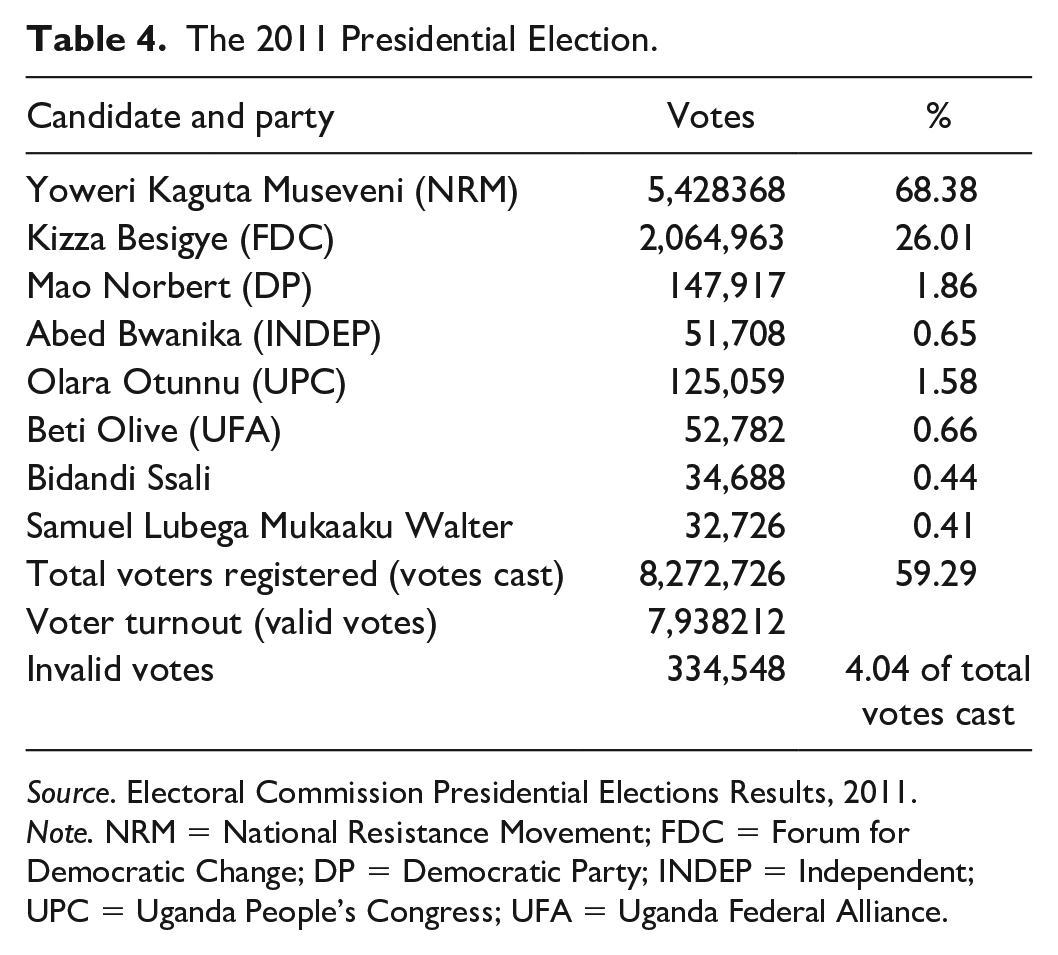
In this election, there was an improvement by NRM compared with the 2006 elections. It won this election with majority votes as shown in Table 4. This improvement was attributed to several factors such as disunity among the opposition parties, improvement in the security situation in the north, and the impact of creating new districts (Kakuba, 2011).
The 2011 Presidential Election.
Source. Electoral Commission Presidential Elections Results, 2011.
Note. NRM = National Resistance Movement; FDC = Forum for Democratic Change; DP = Democratic Party; INDEP = Independent; UPC = Uganda People’s Congress; UFA = Uganda Federal Alliance.
Judging from Table 4, NRM won the 2011 presidential election by 68.38%, with a close rival FDC obtaining 26%.
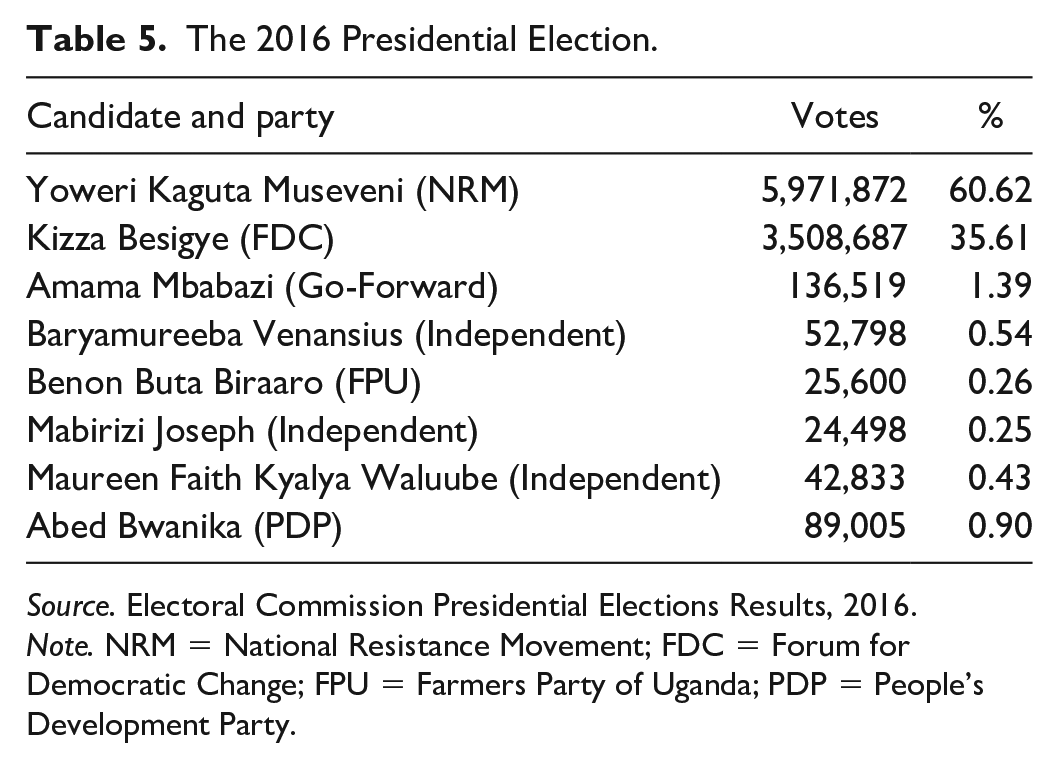
It can be observed from Table 5 that there was an improvement in the performance of the main challenger (FDC) rising from 26.01% to 35.62% and a decline in the incumbent NRM from 68.38% to 60.62% of the votes cast.
The 2016 Presidential Election.
Source. Electoral Commission Presidential Elections Results, 2016.
Note. NRM = National Resistance Movement; FDC = Forum for Democratic Change; FPU = Farmers Party of Uganda; PDP = People’s Development Party.
Looking through presidential election results presented earlier, it is clear that NRM enjoyed super victory in these elections. There are many and several factors that can explain it as reported by the key informants. First, money has taken firm root in the electoral politics of Uganda. Election campaigns have become increasingly so costly in terms of both money and materials. It was revealed by respondents that in every election, NRM designed standard vote-buying techniques in the name facilitation of electoral campaign process to its candidates. They stressed that this had helped NRM to monopolize political power. One key informant respondent specifically said, “the best strategy used by candidates clamouring for political position during elections is to give potential voters whose support is needed what they want in form of gift tokens so that they can vote them.” This corroborates Schedler’s finding that “violence (voter intimidation and money) vote-buying are common means to prevent citizens from voting their genuine preferences” (Schedler, 2009: 384).
It was also reported by respondents that tactically, the ruling NRM maximizes state resources in their campaign to achieve its favorable election outcome. This was because NRM enjoyed a monopoly over the control of state resources. Therefore, it was inevitable it used it as the most veritable strategy to win elections at different levels of government. In this context, the Commonwealth Observer categorically criticized the ruling NRM for commercializing the electoral process and politics in general in Uganda. They specifically state, “the magnitude of resources that were deployed by NRM, its huge level of funding to its participation in the election, created an unlevelled playground.” This was a tactical means to ensure it won elections. It is arguably with confidence that national resources have become the primary vehicles particularly for those leaning to and in government for strengthening and keeping people who are neck-deep in poverty into loyalty to vote for those who give them something for their survival. By and large, this suggests that those with political power and economic resources made the system accountable to themselves rather than the system. This has remarkably worked well for NRM to win elections.
Human Rights Violation Perpetuated During Elections
To understand, assess, and appreciate the undemocratic practices witnessed in the election period in Uganda, one needs to have a firm background of NRM under the leadership of Museveni, which has ruled Uganda for more than 35 years. It turned into a competitive regime in 1996 after ruling for 10 years, and since then, it has won successive elections to enjoy dominance of political power in the country. But these victories were challenged in courts of law for being marred by state repression targeting the opposition. Table 6 provides a summary of these practices as mentioned by election observer reports and key informants.
Forms of Human Rights Abuse Before, During, and After Elections.

Source. Human Rights Report, 2011.
Of all the human rights abuses in Table 6, detention beyond the mandatory 48 hr and torture of political detainees were on top of the list with 21.5% and 34.8%, respectively, accounting for 56.7% (Uganda Human Rights Commission Report, 2011). These acts left the opposition with a limited chance to perform better during elections. Key informants revealed that besides torture and arbitrary/wrongful detention, human rights violations such as threats of beatings, violent arrest, personal humiliation, intimidation, death threats damaging of property, and stripping naked unfolded during the election process. They further mentioned that many of those arrested were held “incommunicado” while others were produced before courts of law and remanded. One respondent reported that “the police arrested many people without bothering to follow the formal legal procedures.” They stressed that unlike in the Arab world where provided security to huge opposition masses took to the streets to denounce the ruling government, and maintained law and order, in Uganda, the military and the police were quick at firing tear gas to disperse rallies of the opposition candidates and discouraging any demonstration they organized to express their displeasure. They mentioned that innocent people were injured and others killed by tear gas and live bullets respectively released by security operatives. In that regard, the activities of the opposition attracted few people because many were scared to come out in big numbers for fear of tear gas and beatings, let alone being shot. This finding corroborates with Greene’s (2007) study finding that a government that does not wish to relinquish power by democratic means utilizes repression that ranges from physical intimidation to psychological torture to weaken the opposition. The 1996 presidential election attracted three presidential candidates contesting without official leaning on any political party. But Paul Ssemogerere was backed by an interparty political alliance (DP and UPC). It is argued that two candidates Ssemogerere and Mayanja were denied free access to the mass media, and generally, the electoral commission was ill-prepared to administer the electoral processes (Human Right Watch, 2006). This rendered the opposition a weak ground to effectively reach the people to gather their support. Interesting to note is that in every general election since 1996, the opposition has persistently threatened the rule of the NRM government. In turn, despite winning majority votes, NRM has increasingly engaged repressive activities to weaken its opponents. Data obtained reveal that all presidential elections held since 1996 have not been adhering to these core values set to promote democracy. This created a basis for serious questioning about the impartiality of the Electoral Commission. The Universal Declaration of Human Rights clearly states that enforcing human rights protection is a fundamental issue in a democratic dispensation. In this context, it incorporated it and many other international treaties consider it. This is based on the fact that democracy provides liberty and freedom to citizens.
In the 2001 elections, NRM with this decline in support, NRM exhibited an intention to put the credible competitor presidential candidate Rtd. Col. Dr. Kizza Besigye behind bars on several charges, including rape. Respondents mentioned that some political activists, especially the opposition, were arrested on fabricated vague cases just to intimidate and mount pressure on them to inappropriately challenge the incumbent. This narration is consistent with Naluwairo who stated that after the 2001 election, Rtd. Col. Dr. Kizza Besigye and others were jointly charged with terrorism before Military General Court Martial (Naluwairo, 2006). It was alleged that Rtd. Col. Dr. Kizza Besigye had raped his maid. He was arrested and remanded at Luzira prison. The case was brought to court but Rtd. Col. Dr. Kizza Besigye was acquitted of the case after the court found that it was based on falsification and fabrication (Amutuhaire & Ssekalo, 2006).
It is interesting to know that the support of NRM declined during the 2006 elections. The opposition gave NRM a tough time to let the masses re-elect it and it had to use every possible means available to retain power. The international observer mission (the European Union) in their report states that although NRM won this presidential election through bypassing the electoral laws, it is argued that many voters were disenfranchised: “the principle of equal universal suffrage, transparency of the vote, and secrecy of the ballot was undermined by multiple voting, ballot-box stuffing in some areas” (European Union Observer Mission Report, on Presidential and Parliamentary Elections 2006). The 2011 election in Uganda was held without much widespread political repression and resentment from the people. But more demonstrations were organized in different parts of the country with frequent ones taking place in the Capital City and Business District, Kampala, after the poll. This election fell short of democratic confidence from the opposition as a result of their dissatisfaction. Key informants interviewed, especially from the opposition, expressed that they were not satisfied with the whole election process. They said that their plea to have electoral reforms and to disband the electoral commission before the election had not been considered. Civil society organization and opposition key informants reported that activist for change under the leadership of the main challenger to NRM Rtd. Col. Dr. Kizza Besigye was denied their peaceful “walk to work” demonstration by the police to challenge NRM victory in the 2011 election and its weakness to manage the economic crisis in the country. This revelation is supported by Carey (2010) who found that a regime that does not want to relinquish state power is likely to resort to state repression to resist any force threatening its political power.
The re-elected NRM government interpreted these demonstrations as a threat to its power and took belligerent action to crush them using the police. But this swift move by the government restricted the Alliance for Change (A4C) opposition pressure group activities and declared it an illegal pressure group. But the opposition just changed its name from A4C to For God and My Country (G4C) and continued to organize demonstration campaigns to demand a for change. According to Human Rights Watch report, the police shot nine people dead in its effort to crack down on A4C political activities (Human Rights Watch, 2011). The report stresses that this act in itself was a crime committed by the police with impunity when trying to quell charged demonstrators. The police have been disregarding these basic freedoms, which are entrenched in the 1995 Constitution of the Republic of Uganda. This undermined the constitutional provision, which guarantees fundamental freedoms (Ibid).
There is no doubt that although NRM won the election by majority votes, the “walk to work” campaign threatened its re-election legitimacy for the fourth term in office. The NRM government responded by denying opposition ground to stage its political rallies and demonstrations. Data obtained from key informants indicated the police and the army used legal instruments arbitrarily to restrict and shoot at political activists’ political gatherings, particularly the opposition aimed at laying strategies to freely challenge the ruling government. Respondents emphasized that riot police dispersed any political rally organized by the opposition in Kampala and other parts of the country. They said this resulted in many people being beaten up, tortured, and arrested to instill fear in the mind of the opposition although torture of any form and denial of a peaceful demonstration are prohibited by the constitution of Uganda. One key informant said police cells are home to many dignified leaders of the opposition and their supporters. It is perhaps important to mention that the opposition and their innocent supporters suffered severally in the hands of the riot police in the process of struggling for their political rights. Respondents said that police violence against citizens during the election period partly showed that the police seem to have little or no sense of knowledge about human rights. One respondent stated that when electoral commission commences elections process in the country, the political environment becomes that of fear and intimidation to those who stand to oppose the status quo; the police and other security agencies start to act like they are an arm of the NRM ruling party; their violent acts during election campaigns targeted opposition.
One member of the civil society reported that electoral violence that occurred in the subsequent elections in Uganda was a result of the security’s failure to act impartially in their line of duty. These findings corroborate with an earlier study carried out by Robinson and Torvik (2009) that found that politicians who fear being removed from the political position they are holding during elections were likely to use violence to eliminate those contesting against them and their supporters.
Although it is a constitutional mandate for every Ugandan citizen to stage peaceful demonstrations to express their feelings about what affects them in the country, they were brutally beaten up and arrested. This inhuman treatment is denounced by the international community, rights bodies, and local civil societies such Development Network of Indigenous Voluntary Association (DENIVA). They condemned police brutality against the peaceful opposition demonstrators and asked for punitive action against those errant security persons. It is suggestive here that when the government lacks a neutral security force, unfavorable treatment of those who challenge it significantly takes shape during the election. In other words, the NRM government’s fear, which perhaps captures the mind of many, is that the opposition is considered dangerous and keeps the police restless because of its activities.
Arguably, the administration of election as a fundamental pillar of democracy in Uganda has not been impressive. It had been associated with undemocratic practices on many occasions. Indeed, throughout the different elections conducted since Uganda transited to democratic rule in 1996, the NRM government has to some degree used repression as a tool to deal with the perceived opposition threat to enhance its chances to win elections. The opposition and their supporters were subjected to beatings, tear gas, and other forms of methods to frustrate their political struggle. For instance, the leader of the FDC, a close rival of the ruling NRM government, Rtd. Col. Dr. Kizza Besigye suffered from the spray of substance purported to pepper spray into his eyes during one of the multiple arrests he went through. It is interesting to note that although the police are meant to keep law and order, they always acted contrary to it. Hence, this resulted in a violation of citizen political rights. For example, the police shot and killed innocent people they were meant to protect. This finding supports the view that elections under NRM were characterized by several and much political coercion and violence (African Research Institute, 2017).
Democratic elections in Uganda were characterized by instigated violence and human rights abuses as listed in Table 5 (Amnesty International, 2011). Notably, the military, the police, and a group of local men popularly known locally as “kiboko squad” beat innocent opposition leaders and their supporters while attending their political rallies in addition to firing tear gas to disperse them (Amnesty International, 2011). The actions of the security agencies threatened the opposition members from exercising their fundamental political rights and it left the opposition with no option but to seek legal redress. In that regard, the 2001 and the 2006 elections were successfully challenged in courts of law. The “court found that presidential elections were riddled with intimidation, violence, voter disenfranchisement, and other irregularities including inaccuracies in counting and tallying of votes” (Human Rights Watch, 2009). In this context, the Supreme Court ruled that there were irregularities such as inaccurate counting and tallying; however, they argued that these were not significant enough to change the outcome of the election results (Murison, 2013).
Before the 2011 election, Human Rights Watch in its report of February 2010 intimated that free and fair elections could not be realized because it questioned the ability of the Electoral Commission (Human Rights Watch, 2001). It stressed that there was a public outcry that the Election Commission had little capacity to run the electoral process in the interest of the electorates. Therefore, it was necessary to carry out some electoral reforms to suit the interests of all the stakeholders. In the Presidential election in 2016, brutal behavior was present. During interaction with the respondents, one respondent said “the Police is partisan it serves the interest of NRM their activities is to prevent the gathering of opposition always and firing tear gas at innocent Ugandans.” Respondents stressed that Police brutality and excessive use of force to prevent opposition gatherings were common during campaigns and in the postelection period. They mentioned that the police fired live ammunition and tear gas to prevent opposition leaders and their supporters to access mass media and excessive policing of opposition activities. This study finding confirms earlier findings of repression tendencies reported in Davenport’s (2007) study that the incumbent government responded by repression to any force that threatened peace and stability within its territorial boundaries.
However, some respondents, particularly NRM political activists, reported that NRM’s repressive behavior during the election was shaped by the attitude and perception toward the regime. They stressed that NRM’s victory in the successive election in 1996 was attributed to its firm enthusiastic effort to promote and strengthen its political ideology of patriotism, nationalism, socioeconomic transformation, democracy, and Pan-Africanism. They mentioned that NRM pursued a broad-based democratic system guided by these aspects of its ideology to allow all citizens, including those who oppose it, to enjoy their fundamental socioeconomic and political rights. They insisted that NRM democratic practices guided by its ideology had provided an enabling political environment aimed at empowering all Ugandans irrespective of their political divides.
The study revealed that the nature of institutional design in the country explains why the opposition has remained weak in every election. Respondents stated that the amendment of the 1995 constitution which removed the presidential term limit has brought huge obstacles to the opposition. This has made it difficult for opposition parties to win an election against the NRM government to gain access to the center of political power in the country. This provided evidence that democratic practices introduced by NRM came without improvement in the behavior of the government in terms of the distribution of power and values of democracy from the previous undemocratic governments in the country. Worthwhile noting further is that although Uganda is under obligation to implement Inter-Parliamentary Union charter, institutions such as the Police and Uganda People’s Defence Forces (UPDF) undermined the principle of being impartial while policing the elections (European Union Election Observation Mission Uganda General Elections Report, 2011). The Electoral Commission failed to carry out adequate civics education to voters to provide them with the necessary civic competence capacity to actively participate in the democratic processes in the country.
Findings also indicate that the worst threat to the NRM has been the growing effort by the opposition to remove it from power through democratic elections and their constant demand for the NRM government to adhere to the values of free and fair elections. But to counter this growing force, the police operated outside the law. They subjected many people to torture, extortion, and, in distant cases, judicial killing through their excessive use of force. In this way, many opposition members have had to pay a heavy price for challenging the NRM government. For instance, Col. Dr. Kizza Besigye (leader of FDC), DP President Norbert Mao, and many other leading opposition leaders have had to be kept behind the bars by NRM leadership for engaging in democratic activities such as peaceful demonstration (walk to work). The NRM branded the “walk to work” demonstrations as a threat to peace and stability in the country and that it was prudent to restrict the activities of the opposition. In this regard, opposition leaders and their supporters were accused of trying to challenge the legitimacy of the elected NRM government and were violently dispersed whenever they attempted to continue engaging in “walk to work” demonstrations or hold rallies.
The study revealed that there were political violence assaults perpetrated by the security organs against the opposition. In that regard, the opposition suffered detention without charge, arbitrary detention, publicly and consistently denial of fundamental political freedom, and delay in accessing justice. This has downgraded democratic principles and the promotion of political rights in the country. The law and rules of electoral games in Uganda were less enforced. Despite the fact, the 1995 constitution grants equal rights to all citizens, several laws are biased against the opposition in the electoral process. The acts of the NRM government have often breached the fundamental rights contained in Article 29 of the 1995 constitution when the Ugandan security forces violently suppress citizens enjoying these rights. The constitution also states that these rights are considered to be inalienable and not granted in any way by the state (Article 20). This was confirmed by Foundation for Human Rights Initiative (FHRI) that vote-rigging, intimidation of electorates, and ballot staffing were rampant during elections (FHRI, 2008). These served as a means to create a favorable environment for NRM to prevail over the opposition. To fully strengthen its position to control the opposition, the NRM government imposed a ban on any public protest or demonstrations organized in the city center.
The security organs in Uganda since NRM came to power have remained as a private institution under the strict control of Museveni, the president. In this way, the police and the army during election periods are ordered to intimidate, harass, and detain whoever is deemed a serious threat to the NRM government. This threat has discredited revenue imperatives on the strength and legitimacy of NRM. Makara (2010: 84) stresses that The NRM has used the state apparatus to frustrate the activities of the opposition political parties. Police in Uganda have gained notoriety for dispensing opposition party assemblies on the pretext that they have not secured police permission to assemble. The police and other security agencies have been staffed by mainly military personnel, who seem not to perceive themselves as servants of the state but as agents of the ruling party and its leadership.
This is an indication that NRM was out to use Machiavelli’s style of politics to remain in power. Although NRM brought about wide public participation in politics, it violated the constitution is established, denying people freedom of assembly and expression that build a democratic system. It is argued that the political power gathered by NRM seems to give it a license to engage in illegal acts to suppress the opposition. This is in a way violates Article 70 of the constitution. One can be tempted to argue that the NRM government has abused the rights of citizens particularly those who critique the NRM government in many ways during elections, contrary to rule of law. This may suggest that these repressive actions exhibited by NRM show that it hides behind democratic institutions to perpetuate its position to stay in power. In this context, the Human Rights Watch report points out that NRM political undertakings were hostile to democracy (Human Rights Watch, 1999). It denied its competitors to freely carry out their political activities. Okuku (2002: 41) in his work on the democratization process in Uganda confirms that Museveni under his NRM has “used state machinery to obstruct a transparent and fair electoral process.” This demonstrates that the processes of these elections were marred by fraud and manipulation implying that democratic dispensation was compromised.
Conclusion
This article has tried to provide a discussion on the trend of election results from 1996 to 2016, and the nature of state repression that manifested into human rights abuses, highlighting institutions used to support NRM to remain dominant in the electoral democracy in Uganda. The study showed that the election framework under NRM has to a greater extent enjoyed mass support, but common to these elections as discussed above is that they were marred by harassment, intimidation, and violence—most notably, illegal arrest and detention of key opposition leaders and their supporters on fabricated charges as well as irregularities in the election process. This placed democratic dispensation in the country in a questionable position. The study further uncovered those elections in Uganda since 1996 were challenged in the courts of law on account that they did not merit the basic principles of the democratic process. They were characterized by political repression where the state used the police and other security agencies to restrict the opposition activities claiming that they undermined peace and security in the country (Friedrich Ebert Stiftung, 2001). To this end, the NRM government used the power of incumbency and control of coercive mechanisms to manipulate government institutions to undermine the power of the people to remain in power for more than two decades.
The NRM government needs to get back to its original mission, which was embedded in the Ten-point program. The core value of restoring rule of law and democracy that made many Ugandans willingly sacrifice their scarce resources, including their lives in the 5-year guerrilla war, needs to be re-energized to shape the politics in the country. The promise NRM under the leadership of Museveni made to the people at the time of assuming power in 1986, which attracted overwhelmingly support from the people, is increasingly fading. There is a need to strengthen democratic institutions such as the electoral commission, political parties, and judicial system to handle electoral complaints because democratic accountability can only work efficiently and effectively through strong credible institutions. It is also pertinent that steps are taken to stop the police and other security agencies from executing their cardinal role unprofessionally when policing elections and managing demonstrations that arise during the election period to avoid human rights abuses such as harassment and intimidation, among others. This seemingly creates an absence of free and fair democratic ground. Therefore, there is a need to extend massive civic education to all stakeholders to provide them with sufficient knowledge about elections and guard against undemocratic practices that manifest during the election period.
Footnotes
Declaration of Conflicting Interests
The author(s) declared no potential conflicts of interest with respect to the research, authorship, and/or publication of this article.
Funding
The author(s) received no financial support for the research, authorship, and/or publication of this article.
