




Abstract
The voluminous legal literature on plea bargaining in criminal court in the United States is largely devoid of empirical foundation and condemnation of the procedure typically rests on a priori moral judgments or juridical reasoning without clear purchase on the daily realities of prosecution. This article plugs this knowledge gap by documenting and dissecting a single episode of felony bargaining over one case based on a three-year ethnography of the workaday world of prosecutors, public defenders and judges in two county courts of northern California. Far from being mechanical, the production of the guilty plea entails skilled and complex juridical work exploring myriad facets of the case, including facts, the criminal profile and social personality of the defendant, the past and probable future arc of his conduct and the many parameters of punishment. This coordinated effort to achieve a modicum of substantive justice challenges the conventional view of negotiated justice as a cruel and thoughtless “assembly line” trampling over the rights of the defendant. The metaphor of the “swirl”—a buzz of activity and a complex dance-like spiraling movement engulfing the defendant—is more apt to convey the mix of diplomacy and confrontation that produces guilty pleas. Capturing the ins-and-outs of prosecutorial labor as it happens in the county criminal court is indispensable to painting a realistic and conceptually articulated picture of the penal state.
The voluminous legal literature on plea bargaining in criminal court in the United States, which dominates research on the topic, rides on theoretical modeling, normative arguments, psychological postulations, experiments with vignettes, media reports and personal anecdotes. It is focused on outcomes but ignorant of process; yet knowledge of the latter is essential to understanding the options considered, the paths (not) taken and the results achieved. Shockingly, no one has systematically documented negotiated justice as it actually happens in the bowels of the courthouse since Douglas Maynard's Inside Plea Bargaining: The Language of Negotiation (1982). Maynard applied Conversation Analysis to a small body of data (transcripts of 52 misdemeanor cases discussed in open court backed by three months of fieldwork), highlighting the linguistic microstructure of the exchanges between prosecutors and public defenders haggling in the courtroom. He disclosed the informal social norms and tacit rhetorical rules governing the fabrication of the “facts” of the case and its negotiated resolution. Forty-some years later, the flowering scholarship on plea bargaining deals not with judicial reality but with paper prosecutors working in a courthouse of the imagination.
Plea bargaining is a negotiation between the prosecutor and the defense attorney (acting as the agent of the defendant) in which the former offers reduced charges and a lenient suggested sentence in exchange for the latter pleading guilty (or “no contest”). The prosecutor benefits by eliminating the risk of a negative outcome and economizing resources since he avoids litigation and obtains a definitive conviction (the plea typically cannot be appealed later); the defendant benefits by receiving a “discount” on punishment and an early resolution of his case (1). Every guilty plea deal must be approved by the sentencing judge, who is not bound by the recommendation of the prosecutor. In most cases, however, approval is pro forma since the judge presumes that the attorneys who negotiated the plea know the case best.
The stakes of bargaining vary with the gravity of the offense. A felony is a serious or violent criminal offense (such as murder, rape, armed robbery, residential burglary and narcotics trafficking) liable to at least one year of prison, but typically resulting in probation or jail time. It is a graver offense than a misdemeanor, liable to a maximum of one year of jail time and a fine (petty theft, DUI, simple assault, drug possession, trespassing, etc.) but typically resulting in probation or no punishment at all other than bureaucratic hassle and marking (2). In the California penal code, a wobbler is an offense (such as grand theft, commercial burglary, domestic violence or assault with a deadly weapon) that may be charged either as a misdemeanor or as a felony depending on the circumstances and profile of the defendant
Some 95 percent of felony cases that resolve in cities in the United States are resolved by way of a guilty plea, according to data compiled by Brian A. Reaves, Felony Defendants in Large Urban Counties, 2009 (2013). Indeed, the trial by jury has been a rarity for nearly a century now. This matters beyond the United States as many countries have recently imported or adapted American-style procedures of negotiated justice (3).
1.-I embed plea negotiation in the flow of daily work in the District Attorney's office and the courthouse in Rethinking the Penal State: The 2024 Adorno Lectures (2026), chapter 3. The modalities and degree of involvement of judges in plea bargaining vary from county to county and even with the personality of the judge. King and Wright document what they call “The Invisible Revolution in Plea Bargaining: Managerial Judging and Judicial Participation in Negotiations” (2016). Based on interviews with 100 judges and attorneys in 10 states, they find that the intervention of judges include “grant-funded problem-solving sessions complete with risk assessments and real-time information on treatment options; multicase conferences where other lawyers chime in; settlement courts located at the jail; settlement dockets with retired judges; full-blown felony mediation with defendant and victims; felony-court judges serving as lower court judges; and more” (p. 325).
2.-This is demonstrated by Issa Kohler-Hausmann in Misdemeanorland: Criminal courts and Social Control in an Age of Broken Windows Policing (2018).
3.-George Fisher retraces Plea Bargaining's Triumph: A History of Plea Bargaining in America (2003). Máximo Langer offers a panoramic account of its diffusion in “Plea Bargaining, Conviction Without Trial, and the Global Administratization of Criminal Convictions” (2021).
Plea bargaining in the scholarly imaginary
This is not to say that empirical students of the court have not been concerned about plea bargaining—quite the opposite. The foundational studies of Malcolm Feeley's The Process is the Punishment (1979) and Nardulli et al.'s The Tenor of Justice (1988), as well as their perceptive predecessor, Milton Heumann's Plea Bargaining: The Experiences of Prosecutors, Judges and Defense Attorneys (1978) and Pamela Utz's Settling the Facts: Discretion and Negotiation in Criminal Court (1978), include rich analyses of negotiated justice but they rely largely on second-hand accounts of haggling, not on direct observation of its concrete course. The same applies to more recent monographs such as Issa Kohler-Hausman's Misdemeanorland (2018), which treats the process and outcome of judicial activity in the aggregate from a bureaucratic standpoint; Matthew Clair's account of Privilege and Punishment in criminal court (2020), which centers on the experience of misdemeanor defendants as captured through interviews; and Mona Lynch's study of federal prosecutors at work, Hard Bargains (2016), which shrewdly mixes methods but does not include observational data on bargaining as it unfolds because she focused on proceedings in the open court whereas negotiations took place in its closed backstages.
Revealingly, the comprehensive tome A System of Pleas: Social Sciences Contributions to the Real Legal System edited by psychologist Vanessa Edkins and criminologist Allison Redlich in 2019, the most ambitious social scientific treatment of the topic to date, contains not a word detailing the run of real plea negotiations hammered out in real time. The editors aim to “create a picture of the current U.S. criminal justice system as it really is” but, to mention just one glaring yet characteristic lacuna, the chapter on prosecutors rolls out the “simplest framework possible,” namely, rational choice theory, applied to fictitious court puppets operating in a timeless social vacuum. Instead of prosecutors of flesh and blood embedded in the “courtroom workgroup,” 1 one encounters a suite of mathematical equations of mechanical interactions that have no connection with negotiated justice as it plays out in and about the courthouse. Idem for the comprehensive Oxford Handbook of Prosecutors and Prosecuting (2021) edited by Ronald Wright and colleagues: the chapter on plea bargaining lists but two references of ethnographic studies on the topic, one of which is Maynard's, 2 and provides no description or analysis of an actual negotiation, its distinctive features and recurrent properties as a dynamic system of social and juridical action.
Finally, a state-of-the-art discussion of “The Psychology of Guilty Plea Decisions” by Rebecca Helm just published by the Annual Review of Law and Social Science (2024) is characteristic of this blindness to reality. It rides on a consensual picture of what scholars of criminal court imagine plea bargaining to be like, inferring process from output and legal procedure. All the investigations covered are experimental studies disconnected from actual penality—one of these studies ask college students to play the role of academic cheats faced with the option of pleading guilty or not before a campus conduct committee! The article introduces theories of cognition that make sense on paper but can be problematic in the phenomenological labyrinth and emotional pressure cooker of the court. More problematic still, Helm envisions bargaining as a transaction taking place between two isolated actors, the prosecutor and the defendant, omitting the crucial role of the defense attorney who mediates and decisively shapes the process as well as the intercession of the judge, the family and buddies of the accused, cell mates and jailhouse lawyers, and the offices and colleagues with which court attorneys on both sides continually consult. 3
This lack of factual on-the-ground knowledge of plea bargaining has not prevented rights lawyers and legal scholars from issuing shrill condemnations of the procedure—set against the alternative of an idealized “fair trial” taken as the doxic touchstone of “justice.” For instance, in Pleading Out: How Plea Bargaining Creates a Permanent Criminal Class (2022), law professor Dan Canon offers “a blistering critique of America's assembly-line approach to criminal justice and the shameful practice at its core: the plea bargain,” but, again, he offers no observational data to back up this condemnation. In Punishment Without Trial: Why Plea Bargaining is a Bad Deal (2021), his fellow law faculty Carissa Hessick laments the well-known fact that the bedrock constitutional right to a trial has “all but disappeared thanks to the unstoppable march of plea bargaining.” She contends that this “has undermined justice at every turn” and made the legal system over into “a ruthlessly efficient mass incarceration machine.” 4 But, again, the book is striking for what it does not offer: direct evidence on the phenomenon as it unfolds in its concrete everyday setting. 5 Finally, the legal jeremiads over plea bargaining forget to stress one side of the bargain: the overwhelming majority of defendants are demonstrably guilty—a veteran public defender recently turned judge estimates that about 3 percent are factually innocent—and they are getting a steep “discount” on punishment as charges are reduced or dropped and sentences adjusted downward. They would have everything to lose by going to trial where they would pay the full punishment set by criminal law.
This does not mean that plea bargaining cannot or should not be critiqued on deontological, pragmatic and legal grounds for being coercive, opaque, capricious, unaccountable, etc., as well as for forcing innocent defendants to plead guilty, weakening deterrence, reinforcing legal elitism, marginalizing victims, smothering the moral message of the trial, bypassing appellate court, undermining public trust in justice—to cite the usual suspects. 6 There are plenty of chinks in the armor of negotiated justice, just as there are in justice by trial, many of which are exactly symmetrical and blissfully overlooked by the detractors of plea bargaining. My point here is that such a critique should start from a solid evidentiary basis and not from scholarly supputations.
A few legal scholars are former prosecutors or defense attorneys who have a professional grasp of plea bargaining in action because they have sat on one or the other side of the negotiating table. Even though they have not carried out (or published) methodical observation of plea bargaining live, their past hands-on expertise “dealing cases” informs their research and lends realism and nuance to their substantive arguments. They are easy to spot upon reading their publications because they generally eschew the cardboard caricatures that dominate legal and social science scholarship on prosecutors. An exemplary illustration is Kay Levine and Ronald Wright's subtle portrayal of “Prosecution in 3-D” (2012) showing the central role that office architecture, culture and history play in determining the tenor and course of prosecution—a collective dimension that is sorely lacking in the literature.
As one who has long advocated a carnal or enactive brand of ethnography, 7 I am very sympathetic to inquirers who mix practical and scholarly knowledge of an institution. But there remains a fundamental schism separating first-hand experience (Erlebnis), however deep, and systematic observation taking on the character of an experiment (Erfahrung), that is, deploying instruments of objectivation not given to the practitioner. Being one is not a sufficient warrant for claiming to know one. 8 Folk knowledge and analytic knowledge belong to two different epistemic registers; to be useful, the former needs to be checked, reworked and encompassed by the latter. So much to say that systematic scrutiny is essential to acquiring a realistic grasp of plea bargaining as a rule-governed “situated activity system” in Erving Goffman's sense (as elaborated in Encounters: Two Essays in the Sociology of Interaction [1961]).
Moreover, many former prosecutors who write on plea bargaining were federal prosecutors and not state or county prosecutors, and these are two different professional worlds, as different as tennis and ping pong are as racquet sports. To simplify, federal prosecutors operate largely as solo actors who handle very few cases which they have cherry-picked. They spend months or years investigating complex matters with the support of specialized staff and multiple law-enforcement agencies; they rarely appear in court; and they have at their disposal a menu of brutal penalties giving them immense leverage over the defendants (as documented by Mona Lynch in Hard Bargains: The Coercive Power of Drug Laws in Federal Court [2016]). County prosecutors in mid-sized and large jurisdictions handle massive caseloads in rush-mode; they make scant recourse to investigation due to resource limitations and the press of time; in urban counties, they work in teams and make daily appearances before the judge; they take on crimes of all sorts as they come and they do not carry as big a penal stick. 9 In short, federal prosecution is judicial slow-cooking, county prosecution judicial fast-food.
In this “note from the field,” I dissect a single episode of haggling over a single case drawn from the live observation and recording of ten plea bargaining sessions with Julius Atkins, a black mid-career prosecutor tasked with negotiating all felony pleas in the western region of San Pedrito county in coastal northern California. 10 I conducted five in-depth interviews and repeated shorter interviews with Julius, shadowed him for a full week in his daily round in court and exchanged regularly with him and his colleagues in the course of a three-year ethnography of “The social life of the county criminal court.” The ten negotiation sessions, carried out in a small windowless room inside the District Attorney's office, itself located inside a downtown courthouse, translate into 20 hours of recordings; they cover 330 cases involving a half-dozen public defenders and two dozen private attorneys; they yielded some 600 pages of printed text from which I excerpt five for the sake of brevity, clarity and granularity. They are amplified by the observation and the recording of 17 additional negotiation sessions at both the pretrial and trial stage in three other courthouses.
This article is based on an ethnography of the workaday world of criminal court protagonists carried out over 30 months in two urban counties of northern California entitled “Fast Food Justice: The Social Life of the County Criminal Court.” In the first county I call San Pedrito, I gained access by working as an intern in pretrial services (a division of the court tasked with ascertaining the social ties and standing of the defendant at arraignment so the judge can determine whether to release him or remand him in custody while his case is being processed) and by following up close the proceedings of a “homeless court” (a community extension of the court designed to allow homeless people to clear up low-level legal entanglements). After months of protracted and patient diplomatic work, I obtained permission from the head District Attorney, the head Public Defender and the Presiding Judge to conduct interviews and observations in the county's four courthouses.
I used three techniques of data production. First, I carried out direct observation of conduct in the courthouse at large as well as in the courtrooms where a variety of hearings took place: arraignment, pretrial, probation revocation, law and motion, preliminary examination, trial, sentencing and restitution. But activities in “open court” are largely bureaucratic and ceremonial: they consist mainly in entering onto the record deals and decisions hammered out behind the scenes (1). Crucially, I gained access to the “backstages” of the courtroom, including the judges' private chambers, corridors, witness rooms and plea negotiation chambers where the actual socio-legal work is carried out.
Second, I conducted in-depth, semi-structured interviews lasting an average of 2.5 hours with 100 prosecutors, 100 public defenders, 22 private defense attorneys and 12 judges. The interviews with court attorneys covered their social backgrounds and biographies from birth to law school, their occupational interests and trajectories, their everyday tasks and relations with other court protagonists, and their professional aspirations and judgments as to the state of justice in the county and the country. The purpose was to obtain the data needed to reconstruct the social and professional habitus of the attorneys or judges interviewed (2).
The third technique consisted in shadowing prosecutors and judges in their everyday rounds as well as to follow court actors in their offices, at professional trainings, retirement functions, office parties and swearing-in ceremonies. It is in the course of shadowing prosecutors tasked with plea bargaining that I was able to access the closed negotiation chambers to observe, take notes on, and record negotiation sessions (3). I conducted live observation of 37 negotiation sessions in six settings located in three courthouses at both the pretrial and the trial stage. The sessions lasted two or three hours and involved a total of five prosecutors, dozens of public defenders and private defense attorneys, and covered nearly a thousand cases.
The methodological approach guiding my fieldwork draws on the sociological epistemology of Pierre Bourdieu and is best characterized as thick construction, by opposition to both the “thick description” of Clifford Geertz (1973) and the “grounded theory” of Glaser and Strauss (1967) (4). It grants a formative role to theory in data production; stresses the embeddedness of agents in multiscalar social spaces; and recommends the triple historicization of the protagonists observed, the microcosm in which they evolve and the categories and techniques used by the analyst. It stresses that the distinctive task of the ethnographer is to carry out a construction squared: an analytical (scientific) construction of the folk (ordinary) construction of reality.
1.-Most ethnographies of the court are in fact ethnographies of the courtroom which take “the view from the gallery” and, for this reason, miss most of the pertinent action, as revealed by Matt Travers's panorama of “Court Ethnographies” (2021).
2.-Habitus is a dispositional concept elaborated by Pierre Bourdieu, for instance, in Le Sens pratique (1980, in English, The Logic of Practice, 1990). It refers to the durable and transposable schemata of perception, appreciation and action acquired through the sum total of one's social experiences.
3.-I describe the setting and social structure of the negotiation chamber in detail in chapter 3 of my book Rethinking the Penal State: The 2024 Adorno Lectures (2026).
4.-Barney Glaser and Anselm Strauss, The Discovery of Grounded Theory: Strategies for Qualitative Research (1967).
5.-See Loïc Wacquant, The Poverty of the Ethnography of Poverty ([2023] 2025a), pp. 139–168. For a methodical comparison of thick construction with thick description, grounded theory, the extended-case method and abductive theorizing, see my “Plea for ‘Thick Construction’” (2025b), the contributions to the symposium on that article by Josh Seim, Neil Gong and Katherine Jensen and my reply, “Catching the ‘Epistemological Virus’: A Response to the Critics of Thick Construction” (2025c).
The dominant scholarly, journalistic and popular view of plea bargaining is that it is an assembly line that churns out deals in bulk, mechanically and identically, in pursuit of speed and efficiency without regard to the specifics of cases and to the necessary detriment of defendants. This understanding solidified in the 1970s with the first studies of criminal courts and was given official play in the 1972 Supreme Court decision Argersinger v. Hamlin, which used the metaphor in its consideration of the judicial processing of indigent misdemeanants. 11 It was challenged by Malcolm Feeley in The Process is the Punishment (1979), who found that the treatment of low-level cases was hasty but nonetheless individualized, following what in Weberian term constitutes substantive as opposed to formal law.
But, with the gargantuan expansion of the penal state over the ensuing three decades, the image of the court as a cold assembly line solidified again and now dominates legal scholarship. For instance, Stephanos Bibas's influential The Machinery of Criminal Justice [2012]) deplores the fact that American justice has turned into an impersonal bureaucracy churning out masses of cookie-cutter plea deals that make individualized justice impossible, marginalizes defendants and victims alike, and effaces the moral tenor of penality. In her panorama of research on “Misdemeanors” in the Annual Review of Law and Social Science (2015), Alexandra Natapoff confirms this view when she lists among the “the structural and theoretical issues” raised by the judicial handling of low-level offenses “its assembly-line quality, high rates of wrongful conviction, and powerful influence over the system's class and racial skew.” “Assembly line” figures among the article's six keywords.
Ethnographic scrutiny reveals the opposite to be the case at the felony level, that is, matters liable to result in prison time and thus subject to serious negotiation. 12 The metaphor of the swirl is closer to reality—a buzz of activity and a complex dance-like spiraling movement engulfing the defendant. Unlike the assembly line, which reduces agents to robots and process to rote and rigid repetition whose uniform results are known in advance, the swirl calls our attention to the fluid, dynamic and partly unpredictable course of the intermingling strategies of prosecutor and defense attorney (and, often, judge) that produce the plea, whose final terms are not mechanically predetermined—which creates room for judicial diplomacy or confrontation. In the transcript that follows, we see how the prosecutor and the public defender haggle at some length over a great many facets of the case, including many routinely omitted by extant legal scholarship: the facts and circumstances surrounding the offenses, the social ties and identity of the defendant (is he a gang member, with what degree of involvement, or just a hustler?) as well as his family responsibilities (he allegedy “puts food on the table”), his criminal record (starting with his juvenile misdeeds), the nature and category of the offenses (misdemeanor or felony), what charges to drop (several counts of drug offenses will be dismissed without much discussion), and the nature and range of the appropriate sentence (diversion, probation or prison, if prison how many years and to be served where?), as well as the probable future arc of the criminal conduct of the defendant.
The prosecutor and public defender faintly consider whether the case might go to “PX” and never remotely envision taking the case before a jury. (PX is court lingo for “preliminary examination,” a hearing typically lasting a couple of hours during which the prosecutor must convince the judge that there is enough evidence for the case to go forward on the path toward felony trial.) Guilt is assumed as a matter of course and not an item for discussion, and everyone in the courthouse knows well that, in this county, trials concern only very serious or spectacular crimes in any case—mostly murders, rapes and child sexual assaults. The notion that plea bargaining occurs “in the shadow of the trial,” a cornerstone of legal scholarship on the topic, 13 as elaborated for instance by William Stuntz in his landmark tome The Collapse of American Criminal Justice (2011), is a scholarly fiction with little purchase on judicial reality in the guts of the criminal court in San Pedrito county.
From assembly line to swirl: Hammering out a real deal
The episode anatomized in this article is the fourth and last pretrial hearing during which district attorney (DA) Julius Atkins and public defender (PD) Felix Garzón discuss the case of Jorge Sanchez (who will earn the moniker “The Kid”). 14 They could not resolve it thus far and a date for preliminary examination has been set, making this hearing the last chance to strike a deal before the case moves toward the trial stage. The brute facts are not in dispute: the matter hinges on characterizing the defendant and his social ties, and therefore the seriousness of the crime and the likelihood of its reiteration. In a last-ditch attempt, Garzón is pitching for a wildly unrealistic offer (misdemeanor and diversion to a mentoring program) in order to get a better one than the two years of prison on the table. But he must gradually concede higher and higher implied punishment as his run of arguments falls flat. He exaggerates the young age of the defendant by repeatedly calling him “The Kid” (age, class and place, not race, are the most salient and consequential variables in felony negotiations); spotlights his frail and unthreatening physique (height, weight, long hair, no tattoos); 15 invokes the police's opinion of him as unthreatening; sketches a miserabilist portrait of his family, playing on the valiant immigrant trope; insists that the Kid does not want to escalate his criminal behavior, which he concedes as resulting from economic necessity; and that the Kid himself will be at risk behind bars.
(16 December 2016, tape VN520764). DA Julius Atkins is a mid-career African-American attorney in his late forties who has a low tolerance for narcotics offenses and gang activity on account of growing up in a poor black neighborhood where local drug dealers created a climate of suffusive fear. He is sociable, respectful of the mission of the defense bar and a “straight shooter,” which in court lingo means honest, forthright and reliable. Attorney Felix Garzón is a Latino beginner PD in his early thirties (novice public defenders are called “puppy PDs” and novice DAs are called “baby DAs”) who likes to mix assertiveness and humor and is reputed for his gift of gab and nonstop banter.
The two attorneys know each other well; they like and esteem each other; they maneuver in ways that allow them to maintain their ongoing relationship (whose proximity is signaled by the usage of “bro” and “dude” as terms of address). They have haggled over three dozen cases together already over the past few months, and the carry-over from past negotiations helps to make this one more fluid. 16 Julius and Felix connect on grounds of subaltern ethnicity and based on “coming from the streets”—they both have an organic knowledge of street culture and criminality from being raised in a dispossessed neighborhood. This explains the speed, tone and direction of the negotiation, stamped by cordiality despite tension, calculation and emotion, exasperation and sarcasm, humor and shared relief in the end.
That morning from 9am to 11am, Julius negotiates a total of 31 cases (a light day, the usual load is in the 50 s), involving 4 public defenders and 12 private defense attorneys (from four different cities), as well as one private investigator and four line DAs assigned to “prep” cases for preliminary examination intervening at some point during the conference. 17 PD Garzón is the third attorney to take his turn at the negotiation desk opposite Julius in the small windowless room in which three or four attorneys can sit (notebook and tape recorder in hand, the sociologist occupies the second chair near the desk) while another two or three stand in the door frame, chatting in hushed tones. Felix has seven cases to discuss, including defendants accused of running a “chop shop,” dealing marijuana in a public park, driving “under the influence” of alcohol with three prior DUIs, and a woman who is failing to pay her restitution and whose previous plea deal must consequently be revisited.
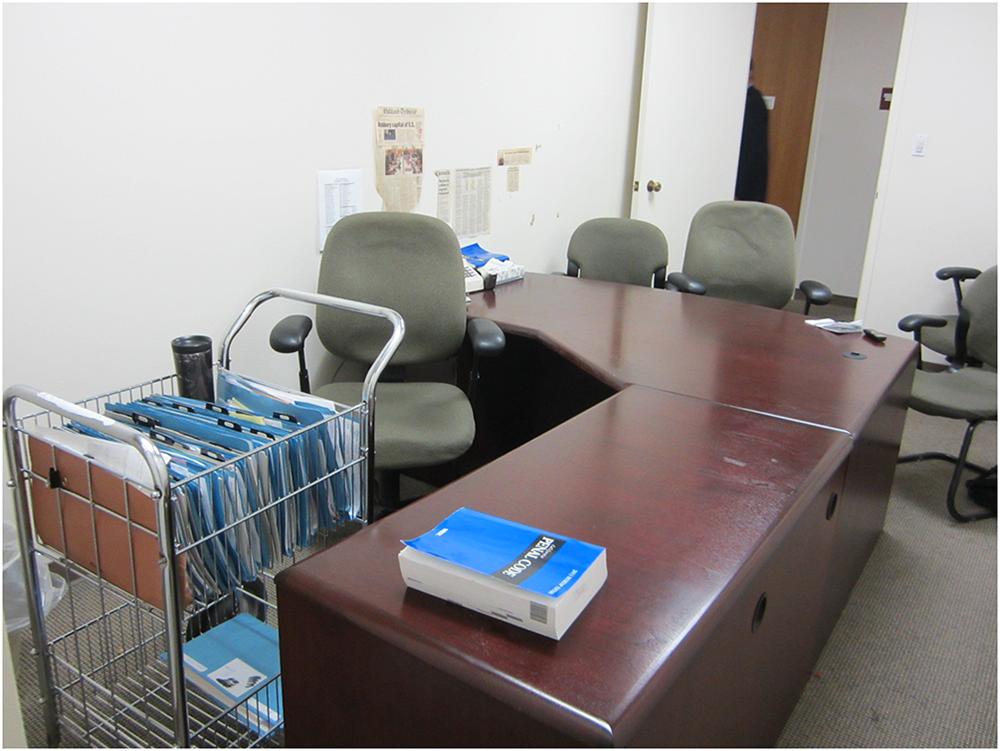
Felix chooses to haggle over the more serious case first. The defendant Jorge Sanchez (“the Kid”) was arrested in possession of multiple guns and ammunition (including a semi-automatic rifle), cocaine and methamphetamine, and a scale (suggesting “possession with intent to distribute” instead of simple possession).
18
He is suspected of being a gang member and has a record of multiple gun possession convictions as a juvenile. He has been in custody awaiting the resolution of his case for eight weeks. The starting point: PD Garzón wants to get him into a diversion program on a misdemeanor (meaning he would serve at most six months in the local jail, close to his family). DA Atkins wants to send him to prison for two years on a felony gun conviction (meaning he would serve about a year and a half in state prison, far away from his loved ones). What follows is the full transcript of their exchanges on this case, very minimally edited for readability.
19
PD Garzón: Oh, Julius. (DA Atkins: Alright, [chuckles] alright) Let's talk about Jorge. DA Atkins: Jorge… what's Jorge's last name? [10:00] PD Garzón: [sighs] Sanchez, this is DA Atkins: [pause] [mumbling] No, but lemme see what's going on. [reading from notes] “Sister said she’d be here for PX…” PD Garzón: I mean, sister doesn’t necessarily want to come in, but she will. [9 seconds] This is the little kid with the long hair. DA Atkins: Why did I do… PD Garzón: Oh, you’re asking DA Atkins: [delighted to find the information in the file] Ohhh, the PD Garzón: Yeah, he's not, he's not in the Nort— DA Atkins: You can’t get into Mentor Diversion with guns, first of all. PD Garzón: [conceding] Okay, alright, well let's, I mean, let's— DA Atkins: And secondly, he's a PD Garzón: No, he's not, Julius, DA Atkins: I already told you he was! PD Garzón: He's not! DA Atkins: He is! [both raise their voices] PD Garzón: He's not! DA Atkins: He is! PD Garzón: How do you know? DA Atkins: Because I know! PD Garzón: He's not, you can DA Atkins: He PD Garzón: DA Atkins: [adamant] He's a gang member. [PD Garzón chuckles in frustration] He's got… four guns, six magazines, one's an PD Garzón: [gently] I know, I know, but DA Atkins: [drawing the words out for emphasis] Nooo, no—what do you want? [door opens and closes, secretary Raquel enters, drops new files and leaves] PD Garzón: Could we do CTS [Credit for Time Served] at R&S [Report and Sentencing], put him on five years’ probation? DA Atkins: [pause] [emphatically] PD Garzón: [pause to recalibrate] How ‘bout CTS at R&S, term of probation is we get him in a mentor program? DA Atkins: PD Garzón: No, a program, not the mentor program, but— DA Atkins: This guy's a gang member, (PD Garzón: [wearily] He's not a gang member) and he's got an arsenal—he has PD Garzón: [5 s] Look, this is the kid, I talked to him, I’m like—you know, remember, this is the one, I’m like, “Oh, he's taking the heat for the fam,” I’ve seen the guns, Julius— DA Atkins: Dude, he's a gang member, (PD Garzón: He's not a gang) and that's the weapon. PD Garzón: [bleating] DA Atkins: [sarcastically] Yeah, I’m making it up, [chuckles] (PD Garzón: Yeah!) making it up. PD Garzón: Look, are his homies, are some of DA Atkins: I’m sorry, dude, I know you have different, um… my, part of PD Garzón: He's never hurt anybody. (DA Atkins: [pause] He's, he's) DA Atkins: He's got three gun cases, and he's got four guns with him right now! (PD Garzón: I agreed) And how old is he? PD Garzón: He's 18, 19 years old, he's a kid! DA Atkins: [flabbergasted] Wow, you’re kidding me, right? PD Garzón: No, I’m dead serious! (DA Atkins: No) [frankly] Listen, Julius, DA Atkins: Do you know when his first gun case was? PD Garzón: It was probably when DA Atkins: [aghast] Yeah! PD Garzón: Agreed! Yes, he needs to, DA Atkins: [firmly] No. He's gonna do something— (PD Garzón: He hasn’t [sighs]) I’m sorry. PD Garzón: He hasn’t done anything! DA Atkins: PD Garzón: You know, watch the—there's the video of him talking to the cops, even APD [Alphaville Police Department] is like, “Dude, you don’t look like the gangbangers that come up in here.” He lives on, dude— DA Atkins: He's got [inaudible, sounds like “war chip”?] four guns, I mean, like— PD Garzón: He's got three gun cases, as a juvie, agreed, now he's an 18 year old, DA Atkins: But see, that's— [15:00] PD Garzón: Doesn’t know any other options, Julius, DA Atkins: He's a gangbanger— PD Garzón: He's not a gangbanger, he hustles, he hustles, he hustles and DA Atkins: PD Garzón: No you don’t—how do you know this? [alarmed] DA Atkins: Who told you he was never jumped in? PD Garzón: He told the cops he's never been jumped in, and trust me, this is a kid that like, like, he wanted, wants to be in the gang, like if he could, if he could credibly claim that he's in, he probably would. But he knows he can’t say to a cop, like, “Yeah, I got jumped in,” because if word gets out that he actually claimed to be jumped in when he actually hasn’t, that's an ass-whooping three times, three times a day! [pause] Cops thought he was in on some crazy stuff, they grilled him for an hour, and he's like, “I don’t know anything, man, I just,” you know, yeah man, he's— DA Atkins: And PD Garzón: He's not a menace, (DA Atkins: He is!) he's not a menace, Julius. DA Atkins: [firmly] He's a menace, bro. PD Garzón: [pleading] He's helping, he pays, he helps pay rent, puts food on the table, DA Atkins: I’ll tell you right now… and PD Garzón: Are you cool with, you wanna do 16 months? DA Atkins: How are you gonna get 16 months? On the gun, (PD Garzón: Yeah, you’re like) on the PD Garzón: Yeah, I think so. [pause] DA Atkins: I don’t think we can keep him local on any of those charges but the drug charges, and I’m not letting him plead— (PD Garzón: Yeah, you want him) PD Garzón: DA Atkins: [5 seconds] [sighs] I’ll tell you, PD Garzón: I hear you, this is the one, remember I told you to just look at him when he comes into court— (DA Atkins: No, I did look at him!) Yeah, you saw, you gave me the nod like you were, like, it's not—I mean, you were like, “Yeah, that is a kid—that DA Atkins: He's a, you know what? He's in it, dude, he's all— PD Garzón: No, DA Atkins: He's, PD Garzón: DA Atkins: But see, here's the thing, Felix: like, he's like, he's doing this [tapping the desk for emphasis] PD Garzón: [pleading] He doesn’t know anything different, Julius! DA Atkins: But that's not my— [emphatically] PD Garzón: DA Atkins: My job is to PD Garzón: [resigned] I hear ya, I hear ya. DA Atkins: [8 s] Yeah, that's, um, you wanna try to do the 29820? (PD Garzón: For 16 months?) PD Garzón: I think so. Can I, I mean, but I mean, DA Atkins: There's no way to—I think that's state prison, right? PD Garzón: Yeah, I mean, can we just— DA Atkins: (surprised) You’ve got a PX? PD Garzón: Yeah, we’ve got a PX date, so maybe we, you know, we take it, DA Atkins: No, we’re not gonna… I mean, PD Garzón: Alright, so then, so then, so then how do we keep him— DA Atkins: I don’t think you can, I think you gotta— [20:00] PD Garzón: No, DA Atkins: No, that's not the way this works! (PD Garzón: Well, okay) I mean, what does he do, he does, um, 8 months on 16,
26
right? (PD Garzón: Mhm, mhm) so by the time you—he's been in custody since October, right, (PD Garzón: Right) so R&S wouldn’t be ‘til the middle of January, so that's what, five? PD Garzón: Yeah, so gimme, lemme get a Report and Sentencing date in February. DA Atkins: Um, I’m fine with that, if you do it today [meaning, close the deal and enter the guilty plea], we can—if judge is okay, I’m okay.
27
PD Garzón: Okay, alright. (DA Atkins: Alright) Alright, alright. DA Atkins: So PD Garzón: Alright, alright. (DA Atkins: Alright) [exhales dramatically] Whew!
Later that afternoon, PD Garzón comes into courtroom A12 where Julius is sitting at the prosecutor's desk facing the judge handling motions and the entry of pleas. With a few whispered words to not disturb the proceedings, he tells Julius that his client has accepted the deal. Later that afternoon, the Kid, clad in his orange jail uniform, is brought from the holding pen into the glass cage next to the judge's elevated bench. In a droning tone, the judge reads him the script for the “waiver on plea of guilty or no contest” and asks him is he is making this plea “knowingly, intelligently, and voluntarily” (as the legal formula has it). The Kid utters a sullen “yes.” The case is resolved. Next.
The social logic of concession
The transcript documents how the present case was negotiated, and its outcome prefigured, in light of previous cases in which Julius had taken in due consideration factual information brought up by Felix to revise his offers. PD Garzón was forced to make a series of concessions that gradually acknowledged the charges and brought him closer to the position of DA Atkins. But, in the end, thanks to his skillfulness and persistence, he got the latter to come down and he extracted a very favorable deal in total: the count of ammunition possession was dropped, along with all the drug charges, and the suggested prison sentence was cut to the lower term for a single charge. The “exposure” of the Kid based on the initial complaint was in the vicinity of six years of reclusion, disregarding gang affiliation (which would tack on up to four additional years of prison to be served consecutively). 28 He is being sent to “state” on a 16-month sentence, which means he will serve 11 months with “good time credit” of 33 percent. He has already sojourned some two months in remand detention, so he has 9 months left to spend behind bars. In the end, the Kid got an 85 percent “discount” on his baseline theoretical punishment (11 months instead of six years); the prosecutor got rid of a case before PX and thus economized resources (in time and person-power) and obtained a certain conviction since, by pleading guilty, the defendant waives his right to an appeal. 29
This banal episode reveals how prosecutors engage in “character construction,” not just at the charging stage (as documented by Bowman et al. 2024), but during plea negotiation as well and that this construction is not a solitary exercise but an interactional achievement in which the skills and maneuvers of the defense attorney involved matter. It moreover reveals the different philosophies of punishment that inform the negotiating strategies of the prosecutor and defense attorney. The DA seeks to narrow the scope of bargaining to focus retrospectively on the offense(s) as a cluster of objective facts; he stresses the imperative of public safety and the need to prevent the reiteration or escalation of criminal conduct based on individual responsibility. The penological principles guiding him, tacitly or explicitly, are just desert and incapacitation. 30 The PD seeks to broaden the scope of negotiation to focus prospectively on the offender as a complex social being bearing a history, individual and collective, involved in problematic conduct that is accountable in terms of social adversity. The penological principle guiding him is straightforward rehabilitation, the amelioration of the defendant to reduce the likelihood of recidivism. The clash between these two visions animates haggling whenever and wherever county prosecutors and defense attorneys sit at the negotiation table.
Age and class, inflected by immigration, play out openly in plea bargaining. There is also a contest in projected masculinity going on between the two attorneys: in order to minimize the defendant's perceived dangerousness, PD Garzón rhetorically emasculates him by turning him into a clueless late adolescent incapable of doing serious harm in spite of material indications to the contrary, whereas DA Atkins builds him up into an up-and-coming gangster deserving to “graduate” to state prison. As for the Kid, there is no doubt that he would be shocked—even insulted—to hear himself being described as a bumbling juvenile and a mere “hustler” if he is, or aspires to be, a card-carrying member of the Norteños for whom serving time is an expected lifecycle event and a badge of honor.
Not every plea negotiation is as meticulous, lengthy and involved as this one final pretrial hearing sealing the fate of the Kid over an 11-minute stretch—a case was discussed every four minutes on average that one morning. Not every public defender is as skilled and dedicated as Felix, who clearly invested a lot of time and energy investigating his client's background and conduct. Not every prosecutor is as indulgent and willing to revise his position as he learns more information as Julius. 31 But the signal value of this exchange between them is that it enables us to see in slow motion and in long form, as it were, what most prosecutors and defense attorney strive to achieve together in a shorter span in rush mode and in an abbreviated format: to tailor the “deal” to the case and thereby achieve a modicum of substantive justice despite the relentless press of the caseload.
In places like Alphaville, the main city in San Pedrito county, with a high violent crime rate centering on the black hyperghetto, the court must devote its scarce resources, in personnel and space, to serious cases and so the DA's office makes “low offers” (meaning offers favorable to the defendant) on run-of-the-mill felonies such as the Kid's in order to get rid of them quickly and “clear the docket.” There are no doubt more punitive counties, with more aggressive DAs, more time-starved PDs and more severe judges leading to grossly lopsided results. 32 But the data presented in this paper should suffice to cast doubt on the picture of plea bargaining as a uniformly cruel and thoughtless assembly line routinely churning out maximum punishment and ruthlessly trampling over the rights of the defendant drawn by legal scholarship devoid of empirical foundation.
These data cover the resolution of felonies but the metaphor of the swirl provides an intriguing conceptual vehicle for reconsidering the handling of misdemeanors as well (see Kohler-Hausmann [2022] on the judicial treatment of subfelonies). It may be that, for lower offenses, the swirl works too, or that the swirl and some amended variant of the assembly line are both congruent at the same time for different types of cases, or that these two images anchor two poles of a continuum along which prosecutors travel depending on the nature of the case. Attorneys on both sides commonly engage in “triage” to manage their caseload and they differentiate between “routine” and “customized” cases—to borrow a distinction used by Douglas Maynard in his study of the “language of negotiation” (1984). 33 We can expect also that the swirl applies only to some district or state attorney's offices and not others if their policy is to make definitive offers upfront with very narrow margins of negotiation, for instance. Only empirical inquiry at ground level that includes direct observation of plea bargaining as it happens—and not just reconstructed ex post—can tell us. There is every reason to expect to find diversity and heterogeneity in plea bargaining congruent with the peek “Inside the Black Box of Prosecution” across the land offered by Megan Wright et al. (2020). 34
This diversity shows up within the DA's office in San Pedrito county, as it would within all but the smaller offices. A veteran prosecutor I call Max Silver who later read the extended excerpt of negotiation dissected above indicated that it was a well-chosen case to display the dynamics of bargaining: “I liked the back and forth. They are listening to each other.” Then he opined that he would have offered a different plea deal, letting the defendant serve a shorter sentence in jail, rather than sending him to prison upfront, but keeping him on a penal leash via felony probation for a period of five years. If, during that period, the Kid committed another crime, he would be arrested, automatically kept in custody and liable to the whole sentence of 6 years (“the years hanging over his head” is the vernacular expression) through an accelerated “probation violation” procedure that does not require filing a new charge. 35 In other words, the plea offer would be, take less punishment now but risk higher punishment later (“a red carpet into prison”). The rationale behind Max's offer is to maintain leverage over the defendant to exert deterrence and ensure public safety as needed via what amounts to delayed incapacitation.
DA Max Silver explains: “What I would’ve done is, let's put it this way: if I am looking at the end, it's 16 months in prison, which is eight actual months, all right, if that's all the prison I’m getting, and most of them they’re not going to go to a real prison—gun cases do. But anyway, I’d say oh no-no-no, I’m not doing that: I’m going to put you on probation for whatever years, serve six months in jail and come out on probation for five years. Now, if you mess up, I get to give you that time. I get to give you time off your probation violation without even a trial. Six months, I’ll give you six months. I’m telling you, you’re going to have a scarlet letter for a while. If you mess this thing up, you’re going to get hit hard. So I’ll give you a chance, but you have to know that what you’re giving me is a red carpet into prison if you fuck this up and do this again. I’ll give you a chance to change your life. I’ll give you a chance: ball's in your court. If you mess this up, you’re going, do we have a deal? They just gave him a 16 months. You do eight months and you’re done, I’m not doing that.”
This episode illustrates that every guilty plea bargain—like every decision from a judge at trial, it should be noted—necessarily entails an element of subjectivity. It also shows how the court flings its dragnet forward in time, a dimension of plea bargaining consistently missed by both qualitative and quantitative studies of negotiated justice. It also reveals a little known paradox of criminal adjudication in county court: it may be materially advantageous to a defendant to willfully stay behind bars. Faced with this mundane choice, spend limited time in jail or prison now but be free of penal tutelage upon release or get released immediately only to risk higher custodial punishment later, most defendants discount the future and pick the second option, much to the chagrin of their defense attorneys who knows full well that their clients will very likely reoffend.
Capturing the ins-and-outs of prosecutorial labor and criminal defense maneuvering as they happen in real time in county court, the main engine of criminal processing, is indispensable for drawing a realistic and conceptually articulated picture of the penal state. The latter is not some grand monolith suited only for philosophical disquisition in the lineage of Thomas Hobbes and historical theorizing in the wake of Max Weber. It is a complex system of objective positions, strategic action and collective meanings involving skilled agents embedded in multilayered social relations flowing in time, agents who effectively rewrite criminal law under constraint at ground level as they jointly hammer out its signification, deployment and consequences. The microscopic portrait drawn by following plea bargaining in actu, which calls for replication in other counties that will introduce patterned variety, both complements and challenges the macroscopic vision of the institution, function and history of punishment in advanced society.
Footnotes
Acknowledgments
I am grateful to the prosecutors, public defenders, private defense attorneys and judges in San Pedrito county and Carnival county who took me under their wings and taught me the ropes of criminal law in action during my nearly three years in the field, and who must remain anonymous as per my promise of confidentiality. I would like also to thank Javier Auyero, Vanessa Barker, Rogers Brubaker, Jenae Carpenter, Randol Contreras, Isaac Dalke, Faith Deckard, Malcolm Feeley, Jason Ferguson, David Garland, Milton Heumann, Julien Larregue, Máximo Langer, Kay Levine, Mona Lynch, Chris Muller, Sonia Paone, Josh Page, Annick Prieur, Fatinha Santos, Heather Schoenfeld, Victor Lund Shammas, Jonathan Simon, Michael Tonry and Robert Werth for their readings, reactions and suggestions on earlier versions of this article. I am also grateful for the constructive criticisms of the journal's two anonymous referees.

Funding
The author received no financial support for the research, authorship, and/or publication of this article.
Declaration of conflicting interests
The author declared no potential conflicts of interest with respect to the research, authorship, and/or publication of this article.