



Abstract
Public opinion about legal financial obligations (LFOs) is under-researched, despite the fact that LFOs are one facet of the “shadow carceral state” that interacts with poverty and financial precarity to significantly constrain the lives of people with criminal records. Furthermore, attitudes toward poverty have also been largely overlooked as a potential predictor of punitive attitudes. To begin to fill these knowledge gaps, we analyze data from a national sample of the American population using both experimental and nonexperimental methods. We find that people's support for criminal justice fees, both in general and in the case of a hypothetical offender, is shaped not just by their broader attitudes toward punishment, but also—with notable consistency—by their perceptions of and attitudes toward people who experience poverty. We discuss the implications of these findings for both the sociology of punishment and sociolegal studies.
Keywords
Introduction
Poverty, punishment, and revenue generation: An under-studied link
Many theorists have long argued that “public punitiveness” fueled American politicians’ “tough on crime” policies that, in turn, gave rise to mass incarceration (Beckett, 1997; Beckett and Sasson, 2003; Garland, 2001; Simon, 2007). Recent studies verify an empirical link between fluctuation in the public's level of support for harsh punishments and the extent and severity of criminal punishment in the USA (Duxbury, 2021; Enns, 2016). Likewise, many scholars have drawn links between macro-sociological theories of punishment and the study of public opinion by highlighting common predictors. For example, influential theories posit that mass incarceration and the carceral state are a modern system of racial control, the successors of the earlier systems of slavery and Jim Crow segregation (Alexander, 2012; Wacquant, 2001), and individual-level evidence shows that racial attitudes are among the strongest and most consistent predictors of public support for harsh punishments (Cullen et al., 2021; Unnever and Cullen, 2010). Some theorists argue that mass incarceration is a response to concerns about rising crime and broader breakdowns in social order (Garland, 2001; Simon, 2007), and some evidence suggests that people's concerns about the state of morals and society predict their attitudes toward punishment (Tyler and Boeckmann, 1997). Politicians’ disagreements over criminal justice policy often stem from their disagreements about whether crime is caused by individual failings or social problems (Beckett, 1997; Beckett and Sasson, 2003), and studies likewise show that people's attributions for crime are a strong predictor of punitiveness (Cochran et al., 2003; Cullen et al., 1985; Sims, 2003; Wozniak, 2016, 2023).
Despite the depth and rigor of prior research on punitive views and their socio-political contexts, we argue that there is a notable gap in the public opinion literature. Scholars are increasingly theorizing that systems of formal social control are inextricably intertwined with state revenue generation. This relationship stretches back to the profit generation of slavery and the subsequent convict leasing system (Blackmon, 2012; Page and Soss, 2021), but it has taken on a renewed importance (and infamy) in the modern era as neoliberalism has become the hegemonic framework for most social policies. Neoliberalism, which argues that free market principles should organize not just businesses but all aspects of state and society, has contributed to the elimination of government regulation, the protection of private property and capital, and minimal taxation (Brown, 2015; Harvey, 2007). In the realm of crime and punishment, as neoliberal policymakers cut taxes over the course of the 1980s and 1990s, states and localities expanded their use of the criminal justice system to extract revenue from arrested persons in the form of fines and fees.
People who are processed through the justice system are frequently charged a wide variety of fees and other types of legal financial obligations (LFOs). Examples include charges for a defendant's state-provided defense attorney, court processing fees, and “pay to stay” fees that charge inmates for their own incarceration. The extent to which states extract money from convicted persons ebbed and flowed in relation to periods of prosperity versus austerity throughout U.S. history (Kirk et al., 2020), but the sheer scope of LFOs imposed upon people with criminal records vastly expanded alongside the rise of mass incarceration (Albin-Lackey, 2022; Aviram, 2015; Harris, 2016; Katzenstein and Waller, 2015; Lynch, 2009; Martin et al., 2018; Wacquant, 2009).
Beyond the criminal justice system proper, the civil legal system and bureaucratic agencies are now involved in the monitoring and sanctioning of people with criminal convictions in a variety of ways, often without any of the due process protections that are (ostensibly) found in the criminal legal system (Miller and Stuart, 2017). Scholars have referred to this vast web of power that flows outside the criminal justice system as “interventionist” or “covert” modalities of penal control (Kaufman et al., 2018) or a “shadow carceral state” (Beckett and Murakawa, 2012). Many scholars argue that this tactic shifted the fiscal burden of maintaining the state away from middle-class and wealthy people toward people experiencing poverty who are targeted by police, probation officers, and other agents of the justice system (Gilmore, 2007; Harris, 2016; Page and Soss, 2021).
To justify this profound shift in revenue generation, neoliberalism reinforced the social and political framing of both crime and poverty as problems driven by the “unruly poor” (Soss et al., 2011: 32). This conjoined emphasis tapped into public fear of crime and animus towards those who violate the meritocratic American norms that everyone is capable, through hard work and adherence to capitalist ideals, of rising above poverty. People who break the law and violate norms of economic prosperity are labeled with an “indelible seal of unworthiness” (Wacquant, 2009: 313). Garland (2001: 196–197) argued that “large sections of the middle and working classes see themselves as victimized by the poor,” who they increasingly view “as members of a culturally distinct and socially threatening ‘underclass,’ in which all of the pathologies of late modern life are concentrated.” Scholars argue that neoliberalism is the habitus of contemporary American society, and its ideologies about deservingness and poverty are accepted by most citizens (Brown, 2015; Harvey, 2007).
This body of research posits that revenue extraction, poverty governance, and criminal justice are not separate systems in modern America; they are inextricably intertwined (De Giorgi, 2017; Gilmore, 2007; Harcourt, 2010; Schept, 2015; Wacquant, 2009). The shadow carceral state is one mechanism by which neoliberal politicians advance their goals of reducing taxation for wealthier citizens and shifting the fiscal burden of maintaining the state onto the backs of people suffering from poverty. And yet, attitudes toward poverty and the people who experience it have been profoundly overlooked as a potential correlate of Americans’ support for criminal justice policies and practices. In a notable exception, Brown and Socia (2017) demonstrated that people's animus toward the poor is a significant predictor of their punitive attitudes, even controlling for other strong predictors of punitiveness like racial resentment.
Theorizing public attitudes toward criminal justice revenue extraction
Brown and Socia's (2017) study suggests that American attitudes toward poverty are part of the story of American punitiveness, but there is much we do not know. Compared to studies of public attitudes toward “traditional” criminal sentences, far fewer works assess public knowledge about the “collateral consequences” of the shadow carceral state, such as deprivations of rights, denial of eligibility for public benefits, and the imposition of interest-laden debts. Some qualitative studies have found that members of the general public are unaware that collateral consequences of a criminal record exist, and when informed, express the opinion that such policies are likely to be counterproductive to rehabilitation and reintegration (Heumann et al., 2005; Immerwahr and Johnson, 2002). Emerging survey evidence indicates that public support for various collateral consequence restrictions is mixed, at best (Johnston and Wozniak, 2021; Link and Ward, 2022; Wozniak et al., 2025), and support for collateral consequences would seem to conflict with Americans’ generally declining punitiveness (Enns, 2016; Ramirez, 2013) and relatively strong support for granting former offenders second chances (Burton et al., 2020; Cullen et al., 2000; Ouellette et al., 2017).
In contrast, while public support for punitive criminal punishments began declining in the 1990s, public belief in the U.S. as a meritocracy continued to increase (Mijs, 2021). The belief that anyone can be upwardly mobile through hard work and determination is associated with stronger feelings of animus toward the poor (Hoyt et al., 2021). This animus is likely rooted in people's causal attributions for poverty—their beliefs about whether poverty is caused by social forces largely beyond people's control or by people's own inadequacies, bad choices, and bad character (Homan et al., 2017).
Politicians have reflected or stoked public attitudes toward the poor in order to justify their support for criminal justice fees and other “legal financial obligations.” Many policymakers frequently argue that LFOs are not punishment (Beckett and Murakawa, 2012; Harris, 2016). Instead, they discuss LFOs using the language of the civil legal system, arguing that the state suffers pecuniary harm at the hands of people who want to “consume” state services without paying for them (Fernandes et al., 2022; Friedman et al., 2021). This language mirrors the hallmark welfare “reform” of the 1990s that required people to work in order to receive welfare benefits (Soss et al., 2011). Thus, some political framing inconsistently presents LFOs as both punishment and a thing apart, a consequence for a criminal act or a means of recouping state revenue from undeserving people who are forcing worthy taxpayers to fund the justice system.
We know very little about the American public's opinions about fees, either in terms of public support for charging fees or in terms of the correlates of support or opposition. Burch (2011) summarized a few polls conducted by the Roper Center in the 1980s and 1990s which found that over 80% of Americans supported garnering inmates’ wages in order to offset the cost of their incarceration. We are aware of only two polls that have measured American public support for LFOs in the twenty-first century, both of which were conducted for the Fines and Fees Justice Center (FFJC) in 2020 and 2022. Both polls indicated that more than two-thirds of Americans believe that the general public should pay for the criminal justice system, including majorities of self-identified Democrats, Republicans, and Independents. About three-quarters of Americans judged pay-to-stay fees, revenue fees added onto traffic tickets, and prosecution fees to be somewhat or very unfair (“Broad Consensus for Fines and Fees Reform,” 2021; Metz et al., 2020). None of these polls assessed the factors that shape public attitudes toward fees.
This study is partially exploratory in nature since virtually no existing empirical evidence shows which of the public's identities and beliefs may predict variation in support for fees. Since fees hold a liminal status within the practice of punishment in America—being both tied to the criminal justice system but also extending beyond it—Page and Soss (2021) argued that the relationship between “traditional” forms of punishment and LFOs should be treated as an empirical question, not assumed a priori. As such, we postulate that two types of factors are likely to predict support or opposition to fees.
If the public perceives the imposition of fees to be part-and-parcel of criminal punishment, then it stands to reason that the same constellation of factors that predict support for punishments like incarceration and the death penalty—factors such as racial resentment and religious and political beliefs—would also predict variation in support for fees. It also stands to reason that support for fees may be a function of support for punishment; the higher a person's support for punitive punishment, both in general and in specific cases, the higher his or her support for fees. Accordingly, we propose the following hypotheses:
H1: Typical predictors of punitiveness will also predict variation in support for criminal justice fees. H2: General and specific support for punitive punishment will predict variation in support for criminal justice fees.
However, fees are monetary in nature, and as we explained, many politicians talk about fees like they are part of the neoliberal welfare system's emphasis on recouping revenue from undeserving poor people, not part of punishment itself. If the public shares this perspective with some politicians, then it stands to reason that people's attitudes toward poverty will shape their support for fees, above and beyond their attitudes toward punishment. Americans who believe that people who experience poverty are lazy and unwilling to work hard to improve their situation express greater animus toward the poor and greater support for work requirements to receive welfare (Applebaum, 2001; Gilens, 1999; Homan et al., 2017; Katz, 2013). Consistent with this literature, we posit that people's beliefs about the causes of poverty will fuel feelings of animus toward people experiencing poverty. This animus may, in turn, predict support for fees, which leads us to our third and fourth hypotheses:
H3: Attributional attitudes toward people experiencing poverty will predict variation in support for criminal justice fees. H4: Animus toward the poor will mediate the relationship between attributions for poverty and variation in support for criminal justice fees.
Since exceptionally little prior empirical work addresses public attitudes toward criminal justice fees, there are no standard measures. To answer the research questions of this study, we wrote original survey questions designed to assess public attitudes toward two facets of the debate about criminal justice fees. First, large proportions of people who are processed through the criminal justice system are indigent (Rabuy and Kopf, 2015). LFO debt is often financially crippling for convicted persons (and their families) and interferes with their efforts to secure stable housing and pay their bills upon returning to their communities (Harris, 2016; Middlemass, 2017; Slavinski and Pettit, 2022). Since states typically charge interest, it can take debtors years to pay off their LFOs. For these reasons, scholars have referred to LFOs as “predatory” (Page and Soss, 2021) and a form of state “seizure” (Katzenstein and Waller, 2015) that significantly exacerbates concentrated disadvantage in the USA (Pager et al., 2022; Pleggenkuhle, 2018). We wrote one survey question designed to measure public preferences for the range of state responses to LFO debt—whether such debt should be canceled, whether people should be given payment plans that do or do not charge interest to pay off their LFO debt, or whether a person should be incarcerated until they or their family can pay off their LFO debt.
Second, as we have discussed, many politicians endorse criminal justice fees as a means of offsetting the costs of the criminal justice system to “worthy” taxpayers by requiring “unworthy” convicted persons to pay for a portion of the costs of their own criminal justice system processing and punishment (Fernandes et al., 2022; Friedman et al., 2021). We wrote a question to measure whether people believe a hypothetical offender should pay a fee to offset the cost of his criminal justice supervision (probation or imprisonment). This question assesses the degree to which the mass public embraces neoliberal politicians’ belief that the cost of state services should be borne by individuals who use those services, not taxpayers en mass (Soss et al., 2011). Together, our hope is that these original measures will give us a better sense of public attitudes toward some of the central—and deeply problematic—practices in the imposition of criminal justice fees.
Methods
Data
The data for our project were collected from a population-matched national sample as part of the 2020 Cooperative Election Study (CES) administered by YouGov (Schaffner et al., 2021). The methodology entails using a synthetic sampling frame based on high-quality probability samples (e.g. the American Community Survey) along with matching and weighting to develop a sample of opt-in panelists that approximates the socio-demographic, ideological, and geographic characteristics of the U.S. population (Ansolabehere and Rivers, 2013). In the 2020 CES, the sample-matching variables were age, race, ethnicity, gender, education, voter registration, and region; additional variables were used for weighting (e.g. religion and Presidential vote choice). The 2020 CES response rate (AAPOR RR1 for “internet/specifically named persons”) was 61%. The CES included a validation check to ensure sample quality. The sample accurately represents both national and state-level voting patterns; analyses of the CES data tend to generalize, and resultant predictions are consistently among the most accurate (Ansolabehere and Schaffner, 2014; Graham et al., 2021; Simmons and Bobo, 2015). The data and codebooks are archived at Harvard University. 1
Dependent variables
We refer to our first dependent variable as global support for criminal justice fees. We wrote this measure to assess public preferences regarding an aspect of fees that is identified as very controversial by scholars and activists—what to do with people who lack the financial means to pay their imposed fees. The question was: “People convicted of crimes can be required to pay additional fees to the court in addition to their sentenced punishment. What do you think should happen to people who are too poor to pay their court fees when they are convicted?” There were four response options: (1) “their debt should be forgiven”; (2) “they should receive a zero interest payment plan”; (3) “they should receive a payment plan, but should have to pay additional interest on their debt”; and (4) “they should be jailed until their family or friends can pay the debt for them.” In our main analysis, we chose to dichotomize this variable for several reasons. First, only 3.5% of respondents (N = 35) chose response option four (jail)—too few to reliably model this response category on its own. Second, because the last three response options all indicated degrees of support for the justice system extracting money from impoverished defendants, we combined these three options to generate a dichotomous measure coded “0” for respondents who preferred to forgive the debt (i.e. not engage in predatory financial extraction) and “1” for those who wanted the fee to be paid. In sensitivity analyses, we combined the third and fourth response categories and reran the models to ensure that our core findings were not an artifact of our choice to dichotomize the global support variable.
The second dependent variable is a measure of specific support for imposing a fee. It followed an experimental vignette which had a between-subjects 24 factorial design. We designed the experiment to separate the influence of crime type from defendant moral character on people's judgments. The vignette described the case of a criminal defendant who plead guilty, randomizing the defendant's employment status (employed or unemployed), work ethic (hardworking or lazy), and offense type (nonviolent [identity theft] or violent [robbery]). The defendant's race (Black or White) was randomized using validated names (Gaddis, 2017) with paired pictures from the Chicago Face Database (Ma et al., 2015) (see Wozniak et al., 2022 for more information). After reading the vignette, respondents chose a sentence for the described defendant.
Although this experiment has been used in previous work to examine punitiveness (Wozniak et al., 2022), which is a control variable in our analysis (see below), it was also followed by a question about fees. Specifically, respondents who believed the defendant should receive a sentence more severe than community service—and almost all (>93%) respondents believed so and selected either a term of probation or imprisonment—were subsequently asked if the defendant should “have to pay an additional fee each year that would partially cover the cost to taxpayers of his [supervised probation/imprisonment]?” There were two response options: 0 = no, 1 = yes. This question captures one of the many different types of criminal justice system fees (Harris, 2016), and it evokes a common rhetorical justification for fees employed by some politicians that echoes the neoliberal politics of welfare (Fernandes et al., 2022; Friedman et al., 2021; Soss et al., 2011).
Independent variables
The key independent variables are attributions for poverty. They are measured with multiple items (12 items each) asked as part of two question sets adapted from Homan et al. (2017). One set of questions measured how important (0 = very unimportant, 5 = very important) respondents thought various factors were for “explaining why Americans who are NOT born poor BECOME POOR during their lifetime?” A second set of questions asked about the importance (0 = very unimportant, 5 = very important) of these same factors for “explaining why Americans who are BORN poor REMAIN poor during their lifetime?”
In each question set, six items described internal or dispositional causes: (1) “failure to set goals”; (2) “personal irresponsibility”; (3) “lack of ambition”; (4) “weak morals”; (5) “making bad choices”; and (6) “lack of effort.” Across the two sets of questions, the responses to the six items (12 items total) loaded together on a single factor (loadings: .71‒.85), and thus we averaged them to create an individual attributions index (α = .95). Another six items (12 items total) loaded together (loadings: .66 to .80) across the two question sets, which specified structural causes of poverty: (1) “lack of opportunity”; (2) “failure of society to provide good schools”; (3) “big corporations exploit their workers”; (4) “prejudice/discrimination in hiring”; (5) “being taken advantage of by the rich”; and (6) “lack of public services.” 2 We averaged responses to them to construct the structural attributions index (α = .94). These measures are similar to individual and structural attributions for criminal behavior variables that have been employed in prior criminological studies (Cochran et al., 2003; Cullen et al., 1985; Sims, 2003; Wozniak, 2016).
Mediating variables
Our theoretical expectation is that poverty attributions will indirectly influence support for criminal justice fees, which fall disproportionately on impoverished Americans (Harris, 2016), by fostering animus toward people who fall in the margins of neoliberal, capitalist countries. We measured animus in two ways using measures included in the common content portion of the CES (that we did not write as part of our original, team module survey content). First, we measured neoliberal animus with an item that asked whether respondents supported or opposed requiring “able-bodied adults 18‒49 years of age who do not have dependents to have a job in order to receive food stamps.” This policy change was the hallmark of neoliberal efforts in the 1990s to discipline ostensibly lazy people into labor market conformity before receiving public assistance (Soss et al., 2011). Second, we measured neoliberal coldness with two reverse-coded feeling thermometer items asking how respondents felt (0 = very warm, 100 = very cold) toward: (1) “people who use welfare benefits”; and (2) “people who use unemployment benefits”—two classes of people who violate neoliberal norms of productivity. Because the two coldness items were strongly correlated (r = .64), we averaged responses to them. To test for mediation, we standardized and combined the neoliberal animus and neoliberal coldness items to create a single measure that we refer to as underclass resentment.
Control variables
To identify factors that influence support for fees above and beyond general punitiveness, we control for punitive attitudes in two ways. First, in the models predicting global support for fees, we include a common measure of punitiveness adapted from the General Social Survey: “In general, do you think the courts in this area deal too harshly or not harshly enough with criminals?” Responses were coded: 1 = too harsh, 2 = about right, and 3 = not harsh enough. Second, in the models predicting specific support for fees, we control for the respondent's preferred punishment for the defendant described in the vignette. This measure consisted of ten ordered punishments, ranging from supervised probation of 1 to 11 months up to 25 years or more in prison. 3
The next three control variables capture respondents’ ideological characteristics along racial and political lines, which are consistent predictors of punitiveness (Cullen et al., 2021; Gerber and Jackson, 2016; Unnever and Cullen, 2010). We use a five-item standardized mean index (loadings: .702 to .884, α = .917) to measure racial resentment (e.g. “Irish, Italians, Jewish and many other minorities overcame prejudice and worked their way up. Blacks should do the same without any special favors”; “Generations of slavery and discrimination have created conditions that make it difficult for blacks to work their way out of the lower class.”). We use a four-item standardized mean index to measure authoritarianism (loadings: .727 to .802, α = .849) (e.g. “Respect for authority is something all children need to learn”; “People should never curse the founders or early heroes of their country.”). We use a two-item standardized mean index to measure right-wing political views that combined respondents’ partisan identification and political ideology (r = .683, α = .812), with “not sure” coded as independent (4%) and moderate (7%), respectively.
We also control for respondents’ fear of crime and religious views (Applegate et al., 2000; Grasmick and McGill, 1994). Fear of crime is a three-item standardized mean index that captures how afraid respondents are of falling victim to both violent and non-violent crime (loadings: .469 to .819, α = .750). The two measures of respondents’ religious views capture: 1) their overall religiosity, via a three-item standardized mean index of prayer frequency, church attendance, and the self-reported importance of religion in their lives (loadings: .748 to .852, α = .861), and 2) their religious affiliation (1 = born again Protestant, 0 = other).
Finally, we control for respondents’ socio-demographic characteristics. We include controls for race (1 = non-Hispanic White, 0 = other), gender (1 = male, 0 = female), age (in years), education (1 = no high school degree, 6 = post-graduate degree), income (1 = under $10,000, 16 = $500,000 or more), 4 employment status (1 = unemployed, 0 = other), marital status (1 = married, 0 = other), urbanicity (1 = city residence, 0 = other), and region of residence (1 = south, 0 = other).
Analytic strategy
We weighted the data based on the sampling weights provided in the CES. Table 1 provides the unweighted and weighted descriptive statistics for all variables used in the analysis. For ease of interpretation and to facilitate straightforward tests of mediation, we estimate linear probability models (Mood, 2010). Given that our key dependent variables are dichotomous, however, we also estimated supplementary models using logistic regression. The main findings were similar. Multicollinearity is not problematic in any of the estimated models (all variance inflation factors [VIF] are low [<3.5] with a mean VIF of 1.62).
Unweighted and weighted descriptive statistics.
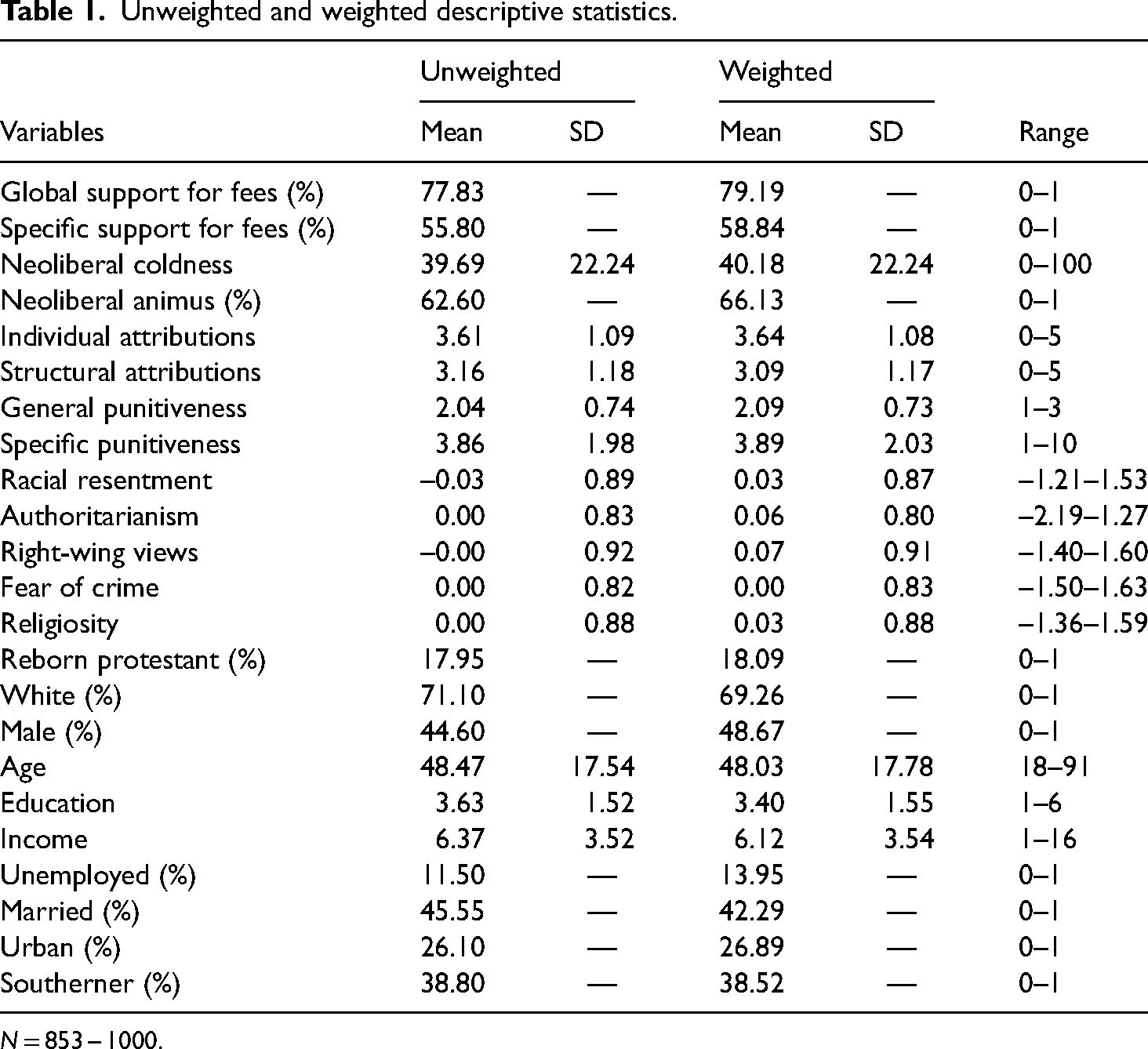
N = 853 – 1000.
Results
Explaining neoliberal animus and coldness
To establish the fundamental components of our theory, we first explore the relationships between attributions for poverty, neoliberal coldness, and neoliberal animus, which together comprise the mediating factor in later stages of our analysis. Figure 1 presents the respective regression results. The first model in Figure 1 regresses neoliberal coldness on poverty attributions and the controls. As hypothesized, individual attributions are positively associated with coldness (b = 2.791, p = .007), whereas structural attributions are negatively associated with coldness (b = −3.818, p < .001). These are sizable relationships. Indeed, if all the control variables are removed (not shown), the attribution scales by themselves explain about 14% of the variation in neoliberal coldness. Notably, besides attributions, respondents’ income and (un)employment status are also significantly associated with their feelings of coldness toward people on welfare and people experiencing unemployment, and those relationships are both in logical directions (b = .597, p = .037 and b = –5.652, p < .020, respectively).
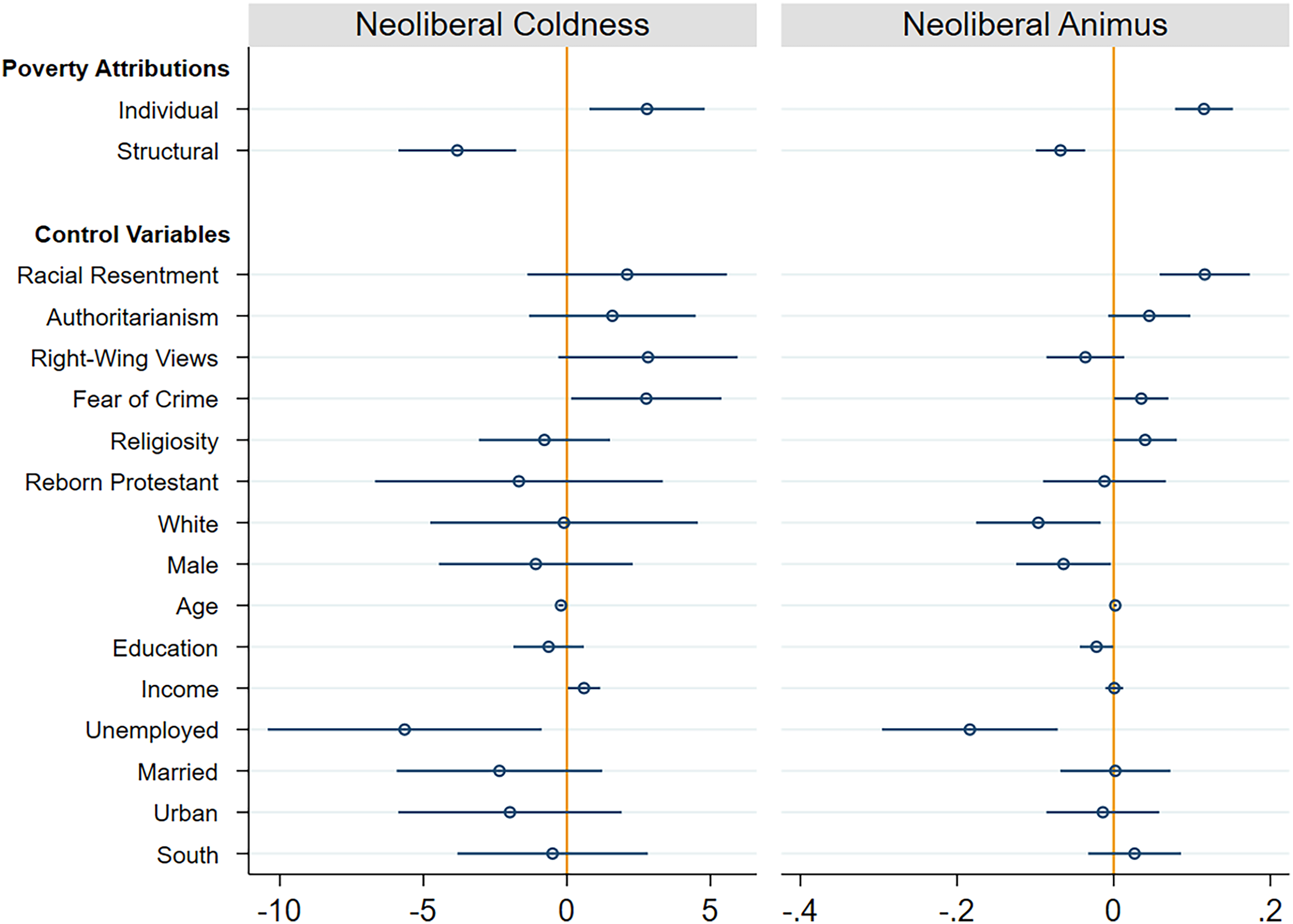
Regression models predicting components of underclass resentment.
The second model in Figure 1 shows the regression results for neoliberal animus—that is, the belief that an able-bodied adult should be required to remain employed to receive food stamps. Again, individual attributions are positively related (b = .115, p < .001) and structural attributions are negatively related (b = –.068, p < .001) to neoliberal animus. If we remove all the control variables, poverty attributions alone explain about 26% of the variation in neoliberal animus. Income is not a significant predictor of neoliberal animus, but employment status does have a similar relationship as to neoliberal coldness, such that unemployed respondents tend to exhibit less neoliberal animus (b = –.184, p < .01).
Explaining support for criminal justice fees
Figure 2 shows the regression results for global support for fees. The first model excludes the mediator, underclass resentment (a standardized scale that combines neoliberal coldness and animus), whereas the second includes it. In the first model, which explains about 21% of the variation in the dependent variable, we see that only individual attributions, not structural attributions, are significantly associated with greater global support for fees (b = .046, p = .006). Additionally, general punitiveness (b = .070, p = .002) and authoritarian beliefs (b = .071, p = .014) are both positively and significantly associated with global support for fees, whereas men tend to be less supportive (b = –.071, p = .023).
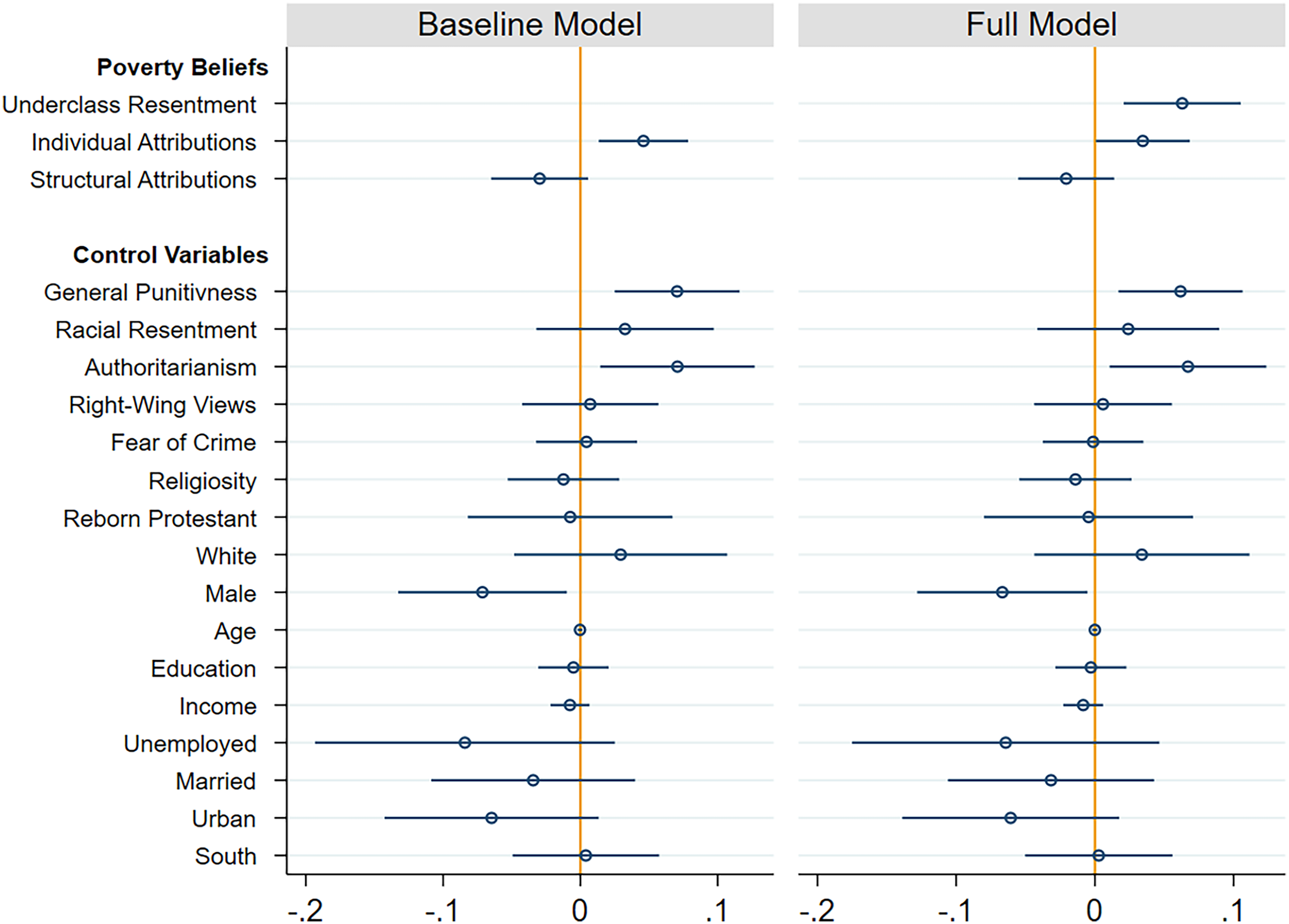
Regression models predicting global support for fees.
The second model in Figure 2 introduces the mediator, underclass resentment, which is significantly and positively related to global support for fees (b = .063, p = .003). Additionally, the results in this model reveal that the coefficient for individual attributions is reduced by more than 20% after the inclusion of individual attributions (from b = .046, p = .006 to b = .035, p = .045), which is consistent with mediation. A formal test for mediation confirms that individual attributions have a significant indirect relationship with global support for fees through underclass resentment (b = .011, p = .008). If the models are estimated using logistic regression instead of linear regression, this indirect relationship remains positive and statistically significant (b = .081, p = .019). We report additional sensitivity analyses in the supplemental online appendix in which we reran our models employing a modified, three-category operationalization of the global support for fees dependent variable. The results of these sensitivity analyses were largely consistent with the findings we present here.
Are similar results obtained when we focus on specific support for criminal justice fees—that is, requiring a specific defendant in a particular case to pay fees? Figure 3 answers this question. In the first model, which excludes the mediator, we see that individual attributions are positively and significantly related to specific support for fees (b = .059, p = .009). Unlike in Figure 2, which focused on global support, here there is no significant relationship between specific punitiveness (the respondent's chosen sentence for the defendant described in the vignette) and specific support for fees. Regarding the experimental factors in the vignette, only crime type was significantly related to specific support for fees. Respondents were less likely to support imposing a fee on a person convicted of robbery than identity theft (b = –.086, p = .047). Regarding control variables, racially resentful respondents are significantly more supportive of fees (b = .117, p. = 004), whereas males tend to be less supportive (b = –.092, p = 017). This model explains about 21% of the variation in specific support for fees.
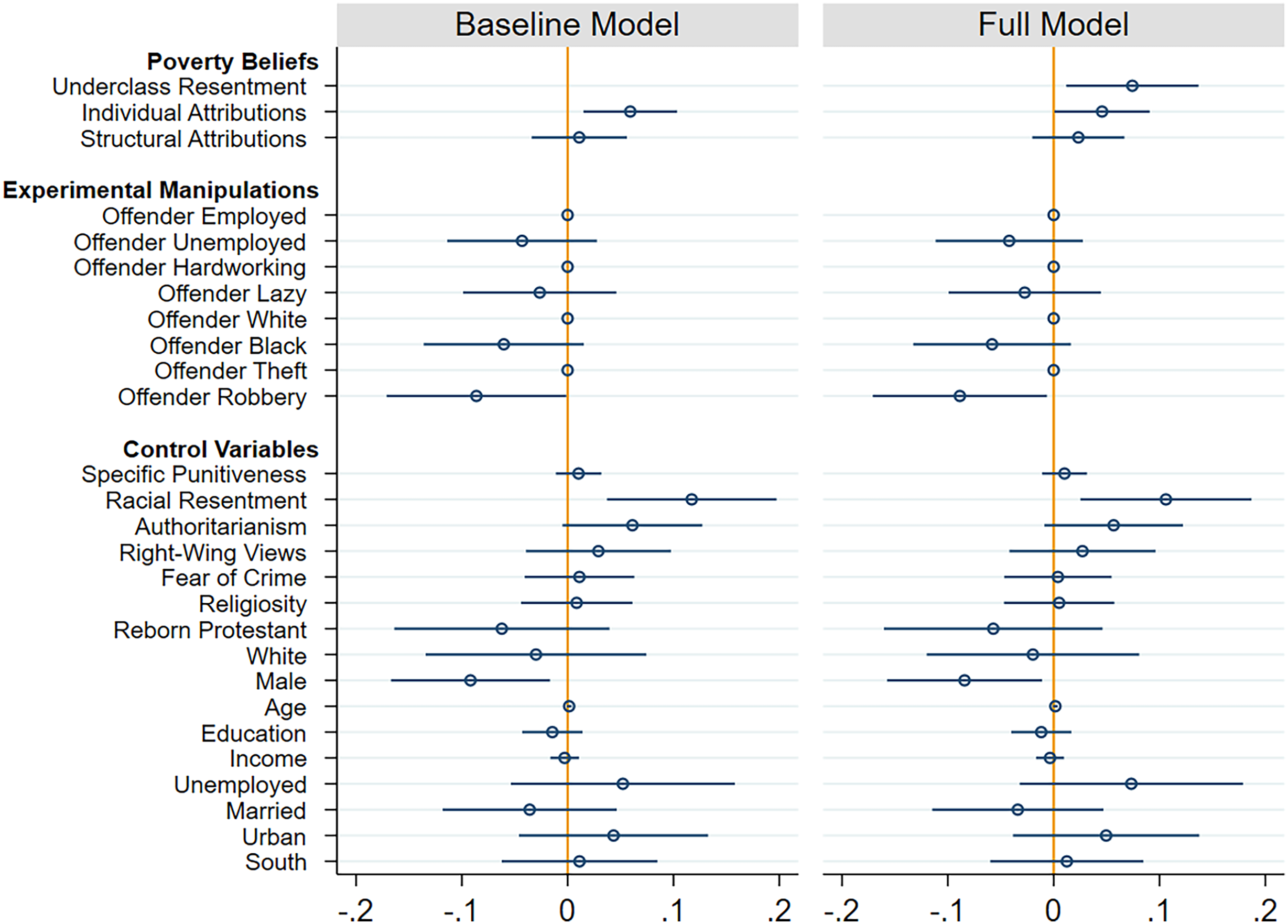
Regression models predicting specific support for fees.
To test our mediation hypothesis, the second model in Figure 2 incorporates the measure of underclass resentment. It is significantly and positively related to specific support for fees (b = .074, p = .020). Additionally, its inclusion reduces the coefficient for individual attributions by over 20% (from b = .059, p = .009 to b = .046, p = .046), which is consistent with mediation. A formal test for mediation confirms that individual attributions have a significant indirect relationship with specific support for fees through underclass resentment (b = .013, p = .026). When the models are estimated using logistic instead of linear regression, this indirect relationship remains positive and statistically significant (b = .067, p = .025).
Discussion
Scholars call attention to the ways that the shadow carceral state spreads coercive, penal-esque power throughout the civil legal system, administrative state, and private institutions, further entwining punishment, poverty, and social control in American society (Beckett and Murakawa, 2012; Friedman, 2021; Kaufman et al., 2018). Despite this fact, the role of public opinion in the politics of the financial facets of the shadow carceral state is undertheorized and underexamined. Through a case study of public opinion about criminal justice fees, we sought to better understand the politics and public legal consciousness around this field of power. We began with the premise that aspects of LFOs are like “traditional” criminal punishments but other aspects of LFOs are more like neoliberal poverty governance. We responded to the call made by Page and Soss (2021) to treat the relationship between LFOs and punishment as an empirical question to be investigated rather than assumed a priori. Our findings suggest that the American public's attitudes towards fees have relatively more to do with neoliberalism and their attitudes toward people experiencing poverty than they do with their beliefs about appropriate criminal punishment.
The relationship between punitive attitudes—that is, support for harsher punishment—and support for fees was inconsistent in our analysis. Respondents who believed that courts do not sentence harshly enough were also more likely to express support for convicted persons, in general, to pay fees to the courts rather than have their LFO be forgiven. In contrast, there was no significant relationship between the punishment respondents chose for the defendant described in our experimental vignette and their support for requiring that defendant to pay a fee to offset the cost of his punishment to taxpayers. This suggests that Americans may see a relationship between punishment and the imposition of criminal justice fees in the abstract, but that relationship is not the primary determinant of people's judgment about fees when presented with a specific, individual offender's case. In fact, whereas Americans consistently endorse harsher punishments for people convicted of violent crimes (Cullen et al., 2000; Sanderson et al., 2000; Wozniak et al., 2022), our data suggest that Americans might be more likely to endorse imposing a fee upon a person convicted of a nonviolent crime of theft than they are upon a person who committed an act of violence—even robbery, which also has a monetary motive.
Furthermore, many facets of people's beliefs and identities that are consistently related to their support for traditional punishments in prior studies were inconsistently related to their support for fees. Right-wing, conservative-leaning political views and affiliations, religiosity and born-again identity, and fear of crime were not significantly related to either general or specific support for fees, controlling for other factors. Racial resentment, one of the strongest and most consistent predictors of punitiveness (Cullen et al., 2021; Unnever and Cullen, 2010), was significantly related to respondents’ likelihood of supporting a fee for the specific defendant in our crime vignette but not their general support for fees, in the abstract. Overall, our findings suggest that traditional punitive attitudes and their typical correlates are related to public support for criminal justice fees, but they do not provide a consistent key to understand the contours of American attitudes toward this specific collateral consequence.
In contrast, resentment toward people experiencing poverty and a desire to discipline welfare recipients into labor market conformity were the most consistent predictors of both general and specific support for criminal justice fees in our results. Affirming our hypotheses, feelings of coldness toward people experiencing poverty and/or unemployment predicted support for requiring employment as a condition of welfare receipt, which in turn predicted greater support for fees across all our models. Since the first stage of our analysis revealed that people who were, themselves, unemployed and attributed poverty to structural forces felt less coldly toward the poor, our findings are broadly consistent with Unnever and Cullen's (2009) theory of empathetic identification and punitiveness. It seems that people who have experienced or been closer to poverty themselves are less likely to hold neoliberal attitudes and support imposing fees upon people with criminal convictions. Of course, the inverse is also true. Our findings indicate that neoliberal animus toward the poor is a powerful factor that can help us understand variation in support for criminal justice fees across the American populace. This finding is consistent with Brown and Socia's (2017) evidence that animus toward the poor is also a strong predictor of traditional punitive attitudes alongside racial resentment.
Our findings suggest that Americans’ support for fees and their support for tough punishment are related, but distinct, cognitive spheres. Our evidence does not point to a simple story that people who endorse harsher punishment of criminals will also uniformly endorse the imposition of fees. Rather, our evidence supports scholars’ critiques about the capacious nature of the shadow carceral state. Americans’ support or opposition to charging convicted persons fees appears to have been forged less by the “tough on crime” politics of the past forty years (Beckett, 1997; Beckett and Sasson, 2003; Garland, 2001) than by the rise of neoliberalism as a hegemonic ideology during that same time period (Brown, 2015; Harvey, 2007; Wacquant, 2009). It appears that one is best able to predict a person's support for fees not by understanding his or her broader attitudes toward crime and criminals, but rather by understanding his or her broader attitudes toward poverty, the people who experience it, and the welfare state (though this is a relative judgment; both cognitive dimensions matter). This finding suggests that policymakers who frame criminal justice fees not as punishment for a crime, but rather as a means for the state to recoup funds from undeserving people, may perceive that this argument yields electoral reward among a portion of American voters (Fernandes et al., 2022; Friedman et al., 2021).
This paper contributes to both the sociology of punishment and sociolegal studies. Criminal justice fees hold a liminal position in the American legal landscape. According to the words of some jurists and policymakers, fees are both of the justice system and apart from it, punitive but not punishment (Beckett and Murakawa, 2012; Fernandes et al., 2022; Friedman et al., 2021; Harris, 2016). Our study responds to Levitsky, Kahn Best and Garrick's (2018) call for sociolegal scholars to devote more attention to the study of distributional law and policy—here the “predatory” policies that extract resources from the poor in order to reduce costs for wealthier Americans (Katzenstein and Waller, 2015; Page and Soss, 2021). Our findings speak to debates about American legal consciousness (Chua and Engel, 2019). Our data suggest that Americans whose legal consciousness was influenced by the experience of or proximity to poverty are more likely to oppose fees, whereas the legal consciousness of Americans who are more distal to poverty is powerfully shaped by the sociolegal habitus of neoliberalism that endorses upwardly redistributive policies that benefit the “worthy” taxpayer at the expense of the “undeserving” poor. Just as politicians have allowed coercive penal power to seep beyond the criminal legal system, it seems that citizens’ beliefs about facets of the “shadow carceral state” are a function not of purely retributive or due process-centric logic, but rather a function of their wider beliefs about disadvantaged groups in American society (Schneider and Ingram, 1993).
Many important questions remain unanswered. LFOs are imposed in a wide variety of ways in the United States (Harris, 2016; Martin et al., 2018). Our dependent variables measured only two aspects of fees (the relationship between fees, poverty, and debt and fees to offset criminal justice supervision via probation or imprisonment). Public perceptions of and attitudes toward the myriad other facets, manifestations, and impacts of LFOs present a clear avenue for future scholarship. Likewise, future research should devote attention to clarifying the relationship between criminal justice fees and fines as punishment in Americans’ minds; the nature of our data and measures leaves open the possibility that some of our respondents conflated the two types of financial sanctions. Still, given that so little prior empirical information about American public perceptions of fees exists, we hope that our study begins a process that will eventually yield more standardized measures.
Supplemental Material
sj-docx-1-pun-10.1177_14624745251336392 - Supplemental material for Public opinion about the shadow carceral state: A study of support for criminal justice fees
Supplemental material, sj-docx-1-pun-10.1177_14624745251336392 for Public opinion about the shadow carceral state: A study of support for criminal justice fees by Kevin H Wozniak, Justin T Pickett and Elizabeth K Brown in Punishment & Society
Footnotes
Declaration of conflicting interests
The authors declared no potential conflicts of interest with respect to the research, authorship, and/or publication of this article.
Funding
The authors disclosed receipt of the following financial support for the research, authorship, and/or publication of this article: This work was supported by College of Liberal Arts Dean's Research Fund Grant and a Joseph P Healey Research Grant, both from the University of Massachusetts Boston.
Data availability

Supplemental material
Supplemental material for this article is available online.
Notes
References
Supplementary Material
Please find the following supplemental material available below.
For Open Access articles published under a Creative Commons License, all supplemental material carries the same license as the article it is associated with.
For non-Open Access articles published, all supplemental material carries a non-exclusive license, and permission requests for re-use of supplemental material or any part of supplemental material shall be sent directly to the copyright owner as specified in the copyright notice associated with the article.
