




Abstract
Within the neoliberal era, the university's form and function have shifted. These shifts necessitate an unraveling of the synergies of institutions of higher education with carceral institutions. Building from the scholarship of the “college-prison nexus” and the “academic-prison symbiosis,” this paper converges on the criminology department's role within these synergies. Based on an analysis of department websites and the introductory course syllabi of English-speaking criminology departments in Canada (n = 50), I interrogate the methods used to advertise to students. I identify six markers of entanglement that are part of how departments market themselves in the neoliberal era to the student–consumer. These markers include career prospects, field placements, faculty research, pracademics, job training, and dual/bridging degrees. Utilizing these markers as a departure point, I analyze these indicators of relationships that exist between the university and the carceral apparatus. In doing so, I interrogate how these relationships can (re)produce carceral logics and systems and offer the university an articulated pathway of survival through carceral intrenchment.
Introduction
On May 25, 2020, George Floyd became the 504th person to be killed by police in the United States in 2020 (Mapping Police Violence, 2020). Floyd's murder—along with countless other Black and Indigenous victims of police violence 1 —served as a catalyst to worldwide uprisings that demanded changes to the racist violence of policing. When it was revealed that two of the police officers—J. Alexander Kueng and Thomas Lane—responsible for Floyd's murder were graduates of the sociology department 2 at the University of Minnesota, the cloak of invisibility was torn off, exposing the intimacies the discipline has with the “state's most violent tendencies” (Brown and Schept, 2017: 441).
In a tweet directly calling out the complicity of the department of sociology at the University of Minnesota, Dr Amber Hamilton wrote, “if you actively market your courses to folks who want to be in law enforcement, you have to accept the consequences down the line. When those officers kill/abuse/main citizens, you can’t shy away from your role in that” (Kelsky, 2020 emphasis mine). Highlighted within this indictment is the way departments such as at the University of Minnesota have used marketing strategies that identify their strengths and relevance to those seeking policing careers. DeKeseredy and MacLean (1993: 361 emphasis mine) asses that “at many U.S. institutions of higher education, at almost every Canadian university and community college, no social scientific discipline attracts more students than criminology.” However, criminology does not just passively attract students, departments (and the universities they are housed in) engage in advertising tactics and marketing strategies. The neoliberalization of higher education that articulates the “student-as-consumer” has seemingly made these approaches increasingly common and important to how departments might approach attracting students. Disentangling this approach to marketing and its reliance on the continued expansion of carcerality requires further analysis. As the university increasingly becomes entrepreneurial, the marketing tactics it employs have become more aggressive, and these tactics can be indicative of the “survival strategies” a university is tapping into (Pizarro Milian, 2017: 54).
In this paper, I take up the Canadian 3 context to provide a framework of analysis to interrogate how these survival strategies reveal the synergies that exist between criminology departments and carceral systems. In doing so, I extend previous conceptualizations of how the university and carceral systems are linked (see Johnson and Dizon, 2021; Oparah, 2014) and bridge sustained critiques of the discipline of criminology for its role in carceral expansion (see Cohen, 1998; Jackson, 2020; Schept et al., 2014) to develop a specific framework of analysis that situates the discipline of criminology within the current neoliberal-carceral university. Previous work has made clear that the university offers credentials and therefore legitimacy to employees of the carceral state (Oparah, 2014) and that criminology, in particular, is at the ready to staff its institutions (Schept et al., 2014). However, absent from these interrogations is a systematic analysis of criminology departments wholesale and the tactics used within these reproductions. As such, I focus on how the criminology department takes up its role with attentiveness to the material and ideological manifestations of the production of knowledge and labor that (re)produce carcerality. To do so, I identify six markers of entanglement—career prospects, field placements, faculty research, pracademics, job training, and dual/bridging degrees—that are part of how departments market themselves in the neoliberal era to the student–consumer. In identifying these markers of entanglement, I argue that these approaches to marketization simultaneously work to benefit the university and reproduce the carceral state apparatus.
The neoliberal (carceral) university
Incredible attention has been paid to the current era and contours of the neoliberal university, articulating the university as a corporate enterprise (Brown and Carasso, 2013; Fisher et al., 2016; Giroux, 2014). These articulations span much of the globe and draw our focus to the casualization of academic labor, the increasing presence of corporate interest on campuses, the reduction of state funding, ballooning tuition fees, and the “increased surveillance and repression of activists and scholars” (Hampton, 2020: 26). These shifts impact students, faculty, staff, and the communities in which university campuses are erected (Baldwin, 2021). Wendy Brown (2015: 181) argues that market rationality has saturated the landscape of the university, converting higher education “from a social or public good to a personal investment in individual futures” changing both the nature and purpose of higher education. As such, the “role of the university as an institution is now up for grabs” (Readings, 1996: 2). To situate higher education within neoliberal discourses of personal investment generates a vantage point into the methods that departments and schools use to bring students through their doors—these become calculated processes and rationalizations.
Though the neoliberal framing of the university is necessary and apt, the dehumanizing violences of the “racial and colonial foundations” of higher education seemingly “exceed the effects of the academy's neoliberalization” (Rodriguez, 2012: 809). As such, the neoliberal university is a foundationally settler colonial institution (Hampton, 2020)—“an arm of the settler state” (emphasis in original Grande, 2018: 47). In this vein, many have extended the articulation of the university as a corporate enterprise, to articulate it more specifically and pointedly as a “corporate-imperial university” (Webb, 2018: 96). In this framing, universities as institutions are bound within the network of state apparatuses that exert control, surveillance, and violence within our lives (Seigel, 2018; Webb, 2018). These frames remind that the academy has never “stood apart from” enslavement, dispossession, or genocide (Grande, 2018: 28). 4
To further specify these conceptualizations scholars have articulated what is variously termed the “police-education nexus” (Seigel, 2018: 123), “college-prison nexus” (Johnson and Dizon, 2021), or “academic-prison symbiosis” (Oparah, 2014). This framing demonstrates that these spaces are “linked and mutually reinforcing” (Oparah, 2014: 99, 109). Imperatively, if we are to articulate the impacts of neoliberalism on the university, we must hold central the expansive penal state, as a “constituent ingredient” (Wacquant, 2009: 308). Within this symbiosis or nexus, Oparah (2014) identifies four key ties between the prison industrial complex (PIC) and the university: (1) monetary investments (such as endowments); (2) the production of the workforce (such as credentialing employees of the PIC); (3) data collection (including the violent and dehumanizing (mis)use of incarcerated people as research subjects); and (4) the knowledge production that sustains and legitimates the system.
The university at large can and should be understood as culpable within these framings. Yet, specific disciplines may engage in certain roles or regularities that require persistent attention. Walcott (2020: 405) argues that universities “are important sites for the reproduction and normalization of the security state,” with anti-Blackness foundationally embedded in disciplines such as sociology and criminology. As such, much of this work has focused on the specifics of criminology as a discipline. It is here where we must focus our attention now.
Criminology and the state
Criminology has been taken to task by scholars since its conception. As a discipline it has a “complicated past and polemical present” (Cohen, 1998: 6). Though criminology as a discipline and within each university department remains a contested space, and its liberatory potential consistently sought after (Agozino, 2003; Brown and Schept, 2017; Freidman, 2021; Piché, 2016), its complicity in “serving the technocratic aims of a neoliberal state” is well documented (Hathaway, 2015: 171). Nonetheless, there is always ongoing resistance, and disruption to these orientations and violences—I will return to these in the discussion.
Foucault (1977) characterizes and locates criminology as a legitimizing discipline—serving to normalize and extend the reach of penal power. This recognition of the birth of criminology as directly tied to the birth of the prison has contributed to a significant amount of scholarship and interrogation that articulates the discipline's active role in carceral expansion (Cohen, 1998; Hillyard et al., 2004; Jackson, 2020; Muhammad, 2019; Neocleous, 2000; Schept et al., 2014). For many within the discipline, criminology has long been identified as a “science of oppression” (Lynch, 2000: 1) that “thrives on and produces death” (Kitossa, 2020a: 91), and that is “hell-bent on being of utility to the state” (Cunneen and Tauri, 2019: 365). Criminologists—like other violence workers—are “leeches” needing crime for sustenance and survival (Cohen, 1998: 46). Importantly, these incisive assessments of criminology are hardly new. Nils Christie (1977) along with other abolitionists of the preceding generations offered us an urged pause to not just the expansion, but the entire existence of criminology. Despite these implorations, the growth of the discipline in the twenty-first century has kept “pace with the expanding criminal justice systems around the world, providing them with both a vital source of legitimacy and a steady supply of labor” (Jackson, 2020: 95). These central functions and productions—legitimacy and labor—are fundamental to situating the current criminology department's engagement with the state's carceral apparatus.
Knowledge production and knowledge diffusion are central roles of the university, but research is a political activity (Brickey, 1989). The knowledge produced by scholars is never just situated in “the ‘pure’ academic world” (Cohen, 1998: 183 emphasis mine). No such place exists. But, in the case of criminology, knowledge is also situated in the state's “crime control apparatus” (Cohen, 1998: 183) or “social control apparatus” (Brickey, 1989: 44) creating an “endogenous alliance between knowledge production and state governance” (Friedman, 2021: 3). The criminology department, situated in the broader university, exists within knowledge networks of the state and industry working to be responsive and adaptive to the identified needs of the carceral state. This has become an increasingly entrepreneurial role of the university in the neoliberal era.
For criminology, there is a credibility offered by the discipline (Brown and Schept, 2017). Confronting this credibility unravels examples that range from pronounced and immeasurable racist violence such as the “superpredator” label and projection created by Princeton University criminologist John DiIulio (Brown, 2020), to the abonnement of the principles of social science from some evidence-based policing scholars (Walby, 2021), to the “morally contaminated” (Walters, 2008: 41) administrative criminology, funded and driven by the state's interests. Throughout the existence of the discipline, criminologists were “authorized to imagine tremendous violence and to invent ways to make that imagination reality, and their labors were informed by the awareness that the state they served would assert its prerogative to levy violence…using the products of their research” (Seigel, 2018: 127).
Marketization pressures have pushed higher education to become “synonymous with training for ‘employability’” (Levidow, 2002: 228). These pressures have greatly impacted disciplines such as criminology, as the commodification and corporatization of criminology has been recognizable for decades with a notable shift to more applied programs and teaching (Frauley, 2005; Huey, 2011). Market-led criminology (Walters, 2003) that takes a “commodified and career-oriented approach” (Farrell and Koch, 1995: 52) is morphing into a “consumable product” of vocational training for a criminal justice career (Huey, 2011: 75). The vocational relevance of a criminology degree aligns with the needs of the state (Hill and Robertson, 2003) fulfilling its intended role as the eager producer of the workforce. Huey (2011: 94) raises the concern that when criminology departments continue to promote entry into the criminal justice system for its students upon graduation, this demand for jobs “can be filled only by an expanding penal complex.” Austerity measures and the restructuring of the university put pressure on the university through the retraction of adequate funding, leaving departments and scholars to operate as entrepreneurs to bring in funding (Chunn and Menzies, 2006). Criminology has tapped into a lucrative approach that cements its place within the neoliberal carceral state. The graduating youth who enter the labor market are “dependent upon the criminal justice industrial complex for employment” (Schept et al., 2014: 103). As departments continue to utilize this approach, it can also become part of how they market themselves, forge their identities, and advertise to potential students. Though the discipline of criminology continues to evolve in the ways it engages with the carceral state, its history, particularly in the Canadian context demonstrates fundamental continuities.
Criminology in Canada
Tracing the history of Canadian criminology to its birth as a department in 1951 at the University of British Columbia (Parkinson, 2008) reveals much about the co-constitutive and unabashed relationship between the discipline and institutions of carcerality. This department developed as a place to train “workers in the correctional field” for a newly opening prison (Parkinson, 2008: 590). The core tenets underpinning the development of criminology institutes would be to train the staff of the criminal justice system (Potts, 1962) and “serve a real purpose and solve real problems” through providing “a sound body of knowledge for practitioners” (Markson and Hartman, 1962: 14, 15). The growing call for criminology institutes across Canada accompanied the expanding carceral apparatus. As Szabo (1962: 32) explains, “the rapid development of the federal penitentiary and probation systems is accompanied by a rapid increase in the requirements for qualified personnel for the administration of criminal law and the execution of punishment.” Criminologists took up this role with fervor, and “by the late sixties, university-located criminologists had become an important element in the infrastructure of social control” (Ratner, 1984: 147).
This historicizing account of criminology's roots situates some of the evolutions of the discipline. Canadian criminology has in some instances taken up the reflexive project of acknowledging these foundations and ushering in concerns for the future of the discipline (Chunn and Menzies, 2006; Hogeveen, 2011; Hogeveen and Woolford, 2006; Martel et al., 2006; Menzies and Chunn, 1999; Ratner, 1984). Much of this self-reflection, or soul searching, has been produced by critical, radical, and abolitionist scholars in the discipline. To be clear, critical criminology has deep roots in this country (DeKeseredy, 2011). Despite none of the four original centers of criminology having radical roots (Chunn and Menzies, 2006), both collective and more fragmented productions of critical scholarship are abundant. For instance, the birth and early home of the journal Critical Criminology was at Ontario Tech University (DeKeseredy, 2011). Currently, there are many within the discipline working to destabilize, disrupt, and interrogate the violences of carcerality. This work is necessary. Moreover, it is imperative to note that disciplines, and individual departments are not settled spaces—they remain fluid spaces, where people, ideas, and funding impact the shapes taken (Abott, 1999; Greenberg, 2013; Jochelson et al., 2013; Landau and Varma, 2013). Ongoing tensions, complexities, and at times polarizing differences constitute the contemporary Canadian criminological landscape.
Methods
The study of academic departments and disciplines is a firmly sociological endeavor (Abott, 1999; Bourdieu, 1988). As is the critical study of higher education. Contemporary scholarly endeavors have addressed the ways that universities engage in a competition of sorts for students (Barton et al., 2010; Pizarro Milian, 2017). Scholars have sought to understand how universities and specific departments market and promote themselves to constituents (Bartles et al., 2015; Blanco and Metcalfe, 2020; Bolan and Robinson, 2013; Davidson, 2015; Hejwosz-Gromkowska, 2019; Lažetić, 2020; Missaghian and Pizarro Milian, 2019; Pizarro Milian, 2017; Pizarro Milian and Davidson, 2018; Pizarro Milian and McLaughlin, 2016; Puddephatt and Nelsen, 2010; Saichaie and Morphew, 2014). University websites are a key tool of how universities market and brand themselves, hoping to communicate their advantage for a student and their tuition dollars.
I conduct a content and discourse analysis of the course websites, promotional material, and introductory syllabi of every English-language criminology department in Canada (n = 50) to interrogate some of these methods of marketing. The field of criminology is “not easily defined” (Doyle et al., 2011: 287) and there is not consensus about what the boundaries of criminology 5 in fact are. Given the messiness (Ericson, 2003) of the field, I have opted to select departments where criminology constitutes an area of study. As such, this accounts for departments where criminology is a stand-alone department, those where it is a multi-discipline department, those where criminology is a stream within a broader department (often sociology), as well as those where criminology is taught as course topics. The program breakdown is as follows: Criminology (n = 10), Criminology and Criminal Justice (n = 3), Criminal Justice (n = 4) Criminology and Socio-Legal Studies (n = 1), Criminology & Justice (n = 1), Justice Studies (n = 1), Police & Justice Studies (n = 1), Sociology & Criminology (n = 1), Sociology, Anthropology & Criminology (n = 1), Sociology & Legal Studies (n = 1) Sociology and Anthropology (n = 5), Sociology & Social Anthropology (n = 1), Sociology (n = 20). 6
Markers of entanglement
Johnson and Dizon (2021: 518) conceptualize the “college-prison nexus” and identify the consideration of criminal history for admissions, campus police, student conduct codes, and campus crime alerts as four examples of how colleges and universities “exert carceral state power.” In this paper, I adopt a similar approach by focusing on just some of the ways that criminology departments reveal their existence within the nexus of carcerality. Though there are numerous nodes of entanglement that exist within this synergy, in this paper I highlight six of these that proliferate criminology departments and the tactics used to market to students. I characterize these as markers of entanglement. As such, I extend the work of the “college-prison nexus” (Johnson and Dizon, 2021) by shifting the lens from how universities exert carceral power within their operations, to articulate how this carceral power is also reproduced within the context of the university, particularly the criminology department. Similarly, this conceptualization extends, the “academic-prison symbiosis” (Oparah, 2014) by focusing on the nodes of labor and knowledge production to articulate the specific ways criminology systematically works to preserve these roles and ensuring its survival. Markers of entanglement are nodes of the co-constitutive relationship between the university and carceral institutions that emphasize a congruent benefit in the investment in carceral futures. This framework allows a conceptualization of the reinforcing nature of these interactions to more directly articulate the benefit not just for the preservation of carceral systems, but also for the university itself.
These markers of entanglement are highlighted to interrogate some of the most frequent concerns and those that have particular relevance within the neoliberal university landscape. They reveal some of the significant ways that criminology as a discipline moves past the point of passive complicity, to act as an active co-constitutive force within how carceral systems and logics can be (re)produced. Given the centrality of the production of labor and of legitimating knowledge I pay particular attention to the methods used by departments within their advertising and public-facing communications that emphasized these roles and characterized them as what made them advantageous for student learning and career trajectories. As such, I identify six key markers of entanglement: career prospects, field placements, faculty research partnerships, pracademics, job training courses, and dual/bridging degrees. Though departments often exhibit multiple markers (see Figure 1), I now turn to outline each of these.
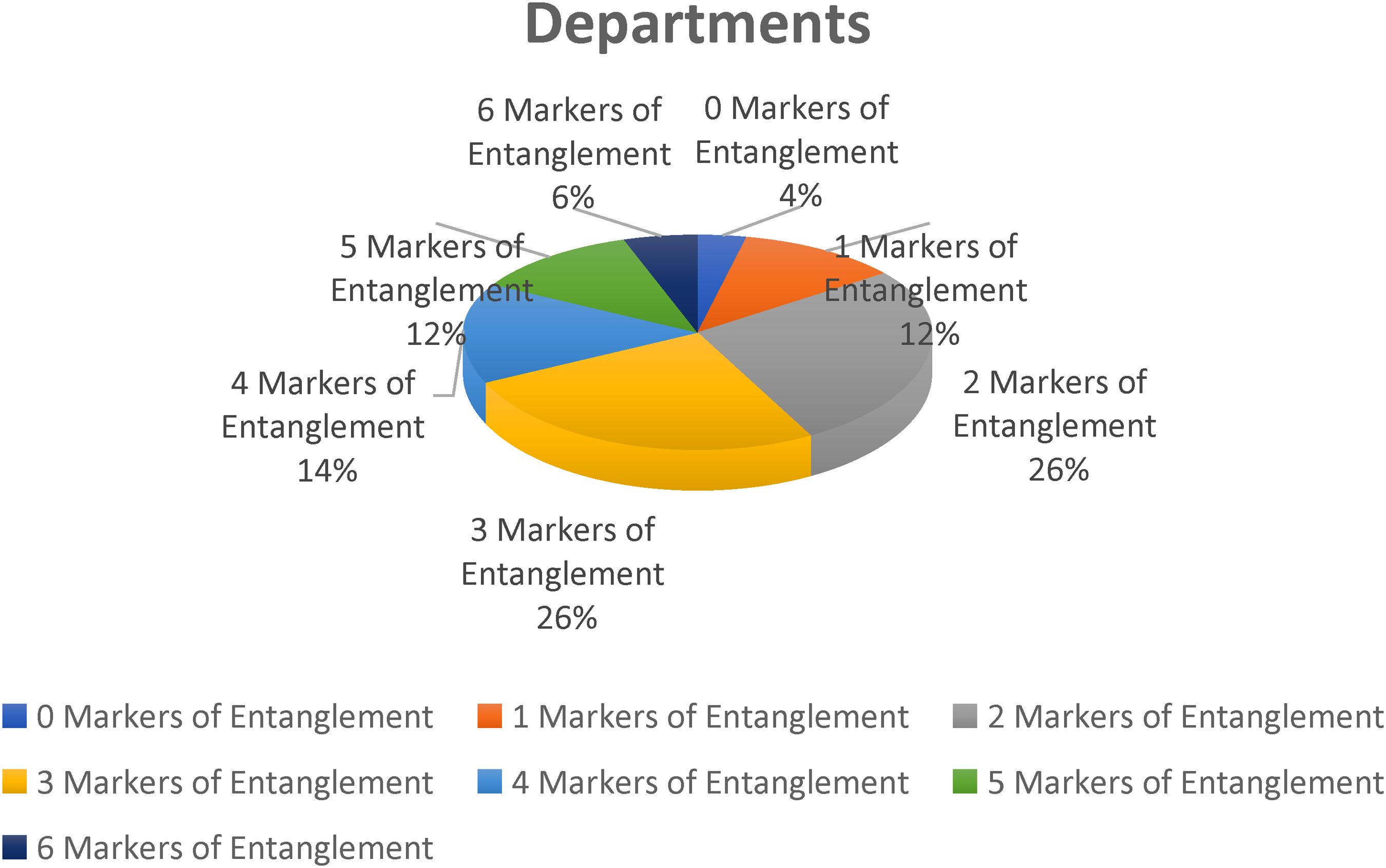
Percentage of departments exhibiting the number of markers.
Career prospect
Emphasizing the job prospects that a degree prepares you for has been a concerted shift within the corporate-enterprise university, where higher education is an investment with hopeful payoff (Huey, 2011). For criminology, the labor market is a key site revealing where the marketization of the university and the corporatization of criminology synergize with the expansive carceral apparatus, consistently emphasizing employability and “re-constructing” faculty as “service providers” (Menzies and Chunn, 1999: 295). When departments position themselves as suitable, and even advantageous, for gaining careers within criminal justice, they are utilizing a specific tactic to attract students to their program doors. Within the Canadian context, there is a consistent self-characterization that a criminology degree prepares someone for these lines of work.
Job prospects remain central to how the student-consumer selects their program. As such, it is unsurprising that 92% of all departments (as depicted in Figure 2) feature this sort of claim within their promotional material and their course web pages. Trent University's Criminology department shares the “Police Officer” as the featured career path, including the expected salary “$26.45–$55.00/h,” that there are currently 80,100 jobs in Canada, and that there are 23,100 jobs expected in the next 10 years. At times departments will also list specific criminal justice agencies, such as the local police force. Some departments will also highlight recent graduates’ current careers, sometimes including short video interviews where the alumnus shares how the degree prepared them for their current role.
Number of markers of entanglement across departments.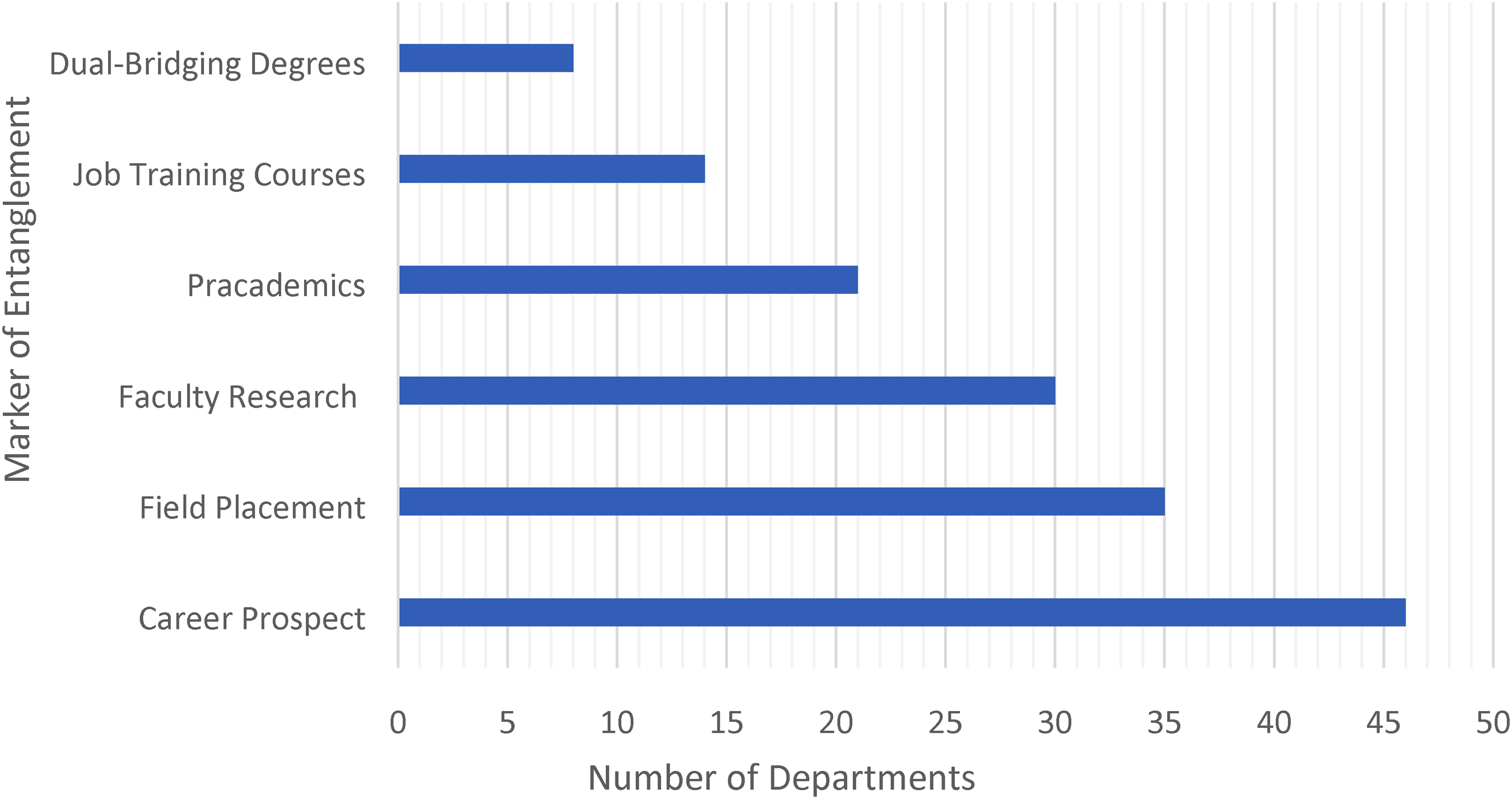
Field placement
Arguably one of the most hotly contested aspects of the criminology degree in recent times is the field placement. A field placement (practicum, co-op, or otherwise termed) is an experiential learning opportunity for students often where they work with an agency or organization in the community for course credit. In part, much of the recent fervor has been driven by the 2020 decision of the Institute of Criminology and Criminal Justice at Carleton University to end field placements with police and prison entities. 7 This decision was polarizing within the criminological landscape, as some applauded it, others levied harsh criticism. Haggerty (2020) deemed this move a form of “academic isolationism,” noting the importance it served not only in his own intellectual development but the experiences of hundreds of other students throughout the decades of its existence. These opportunities have been critiqued for the “cheap labor” they provide and the shoring up for future employment (Chunn and Menzies, 2006: 673).
Field placements have a long but varied history within the Canadian criminology landscape. At some institutions, these have been part of programs for decades, whereas others have only just been created. Currently, 70% of departments offer this type of opportunity for students. 8 Many programs highlight the benefits these hold for students, especially those who are seeking careers in the criminal justice field. For instance, the University of Alberta's sociology department states “Your field placement or experiential learning opportunities will increase your prospects for various types of employment after graduation…Often, these field placements lead to employment in the criminal justice system upon graduation.” For many prospective and current students, this would undoubtedly be reassuring.
Research partnerships
Scholars have long argued that the discipline of criminology performs as an “intellectual prosthesis for the state” (Brown and Schept, 2017: 442). However, there has been particular attention paid to what is often deemed administrative criminology or corporatist criminology (Carlen and Phoenix, 2018). In this case research is produced via lucrative contracts with various state agencies and at times private actors (Kitossa, 2020b). Several critiques have been levied at this approach to scholarship, arguing that it serves state interests, that there is a lack of theory, and that it is profitable (Brickey, 1989) which can generate “intellectual collusion that is akin to corruption” (Walters, 2007: 232). Scholars engaged in these partnerships offer important insights, “engaging in research partnerships with stakeholders, like the police…was appealing to us because it meant that our future research with the police was more likely to be funded, and our status as academics elevated” (Sanders and Langan, 2021: 252).
The faculty working in a department and the substance of what they do can be of particular importance for department marketing, particularly hoping to appeal to current practitioners who are seeking credentials (White, 2001). Sixty percent of departments have at least one faculty member who engages in research partnerships with criminal justice agencies and state actors. Sometimes, the work of these scholars is positioned as providing students with insights into institutions of interest, such as police culture. At times, the lucrative grants that scholars hold are advertised, purportedly indicating the strength of research opportunities available to students. Queen's sociology department indicates that one faculty member “has held formal research partnerships with over 20 police services in Ontario.”
Pracademics
Another strategic approach that departments use to market themselves as “the place to be” is by highlighting who teaches the classes and the expertise that is brought into classrooms. Some departments focus on identifying and emphasizing how some faculty members are current or former criminal justice practitioners. This is meant to provide insights into the field that otherwise would not be possible. Presently, 42% of departments have faculty that are current or former practitioners within the criminal justice field. Within this group, occupations range from law enforcement, crown attorneys, to corrections officers. For instance, a faculty member at Nipissing's School of Criminal Justice “was formerly an instructor and the coordinator of mental health training at the Ontario Police College” and “held various positions including police officer, probation and parole officer, and college teacher.”
Scholars critical of this endeavor have raised concern about its existence and frequency. Jackson (2020: 97) argues that personnel within these institutions are “largely indistinguishable,” as “exchanges of personnel make this most explicit, with the academic-cop and the cop-academic now a growing presence in the corridors of both the university and police state.” However, the supposed advantage of learning from pracademics is communicated in a practical manner, as faculty are meant to be engaged with the same career paths students hope to enter.
Job training
“You can even practice making arrests on your classmates!”—is an excerpt from a promotional video on the homepage of Guelph-Humber's Justice Studies. Many programs put a concerted amount of effort into ensuring that they communicate what they offer for students in terms of job preparedness, including practical and applied skills. The emphasis on applied skills and training is central to the neoliberal university (Huey, 2011), whereas the emphasis on applied skills of criminal justice is a beacon of the neoliberal-carceral university.
Although not every department emphasizes these aspects of their curriculum, 28% of departments have some sort of job training, or practical-oriented courses within their curriculums. Courses are offered in areas such as interviewing techniques, investigative techniques, or professional ethics. “Investigative Interviewing” at Memorial Sociology or “Professional Development” at Kwantlen Polytechnic's Criminology department are examples of these courses. Whether all of these courses so boldly practice carcerality as if it were a joyous task, as Guelph Humber's video communicates, is unclear. What is evident is that departments across the country are eager to bring students into their classrooms on the grounds that they will provide skills needed to work in the criminal justice field.
Dual/concurrent/bridging degrees
For some departments, emphasizing the varied pathways prospective students can take are a central feature of how the program communicates its advantage to students. In this way, the emphasis on dual, concurrent, and bridging programs often is communicated to students who are seeking carers in the criminal justice field, as these are meant to provide a more defined pathway. The emphasis on these options can be situated within the broader neoliberal shifts of higher education that underscores the value of credentialing (Huey, 2011), and the pushes for police professionalization (Seigel, 2018).
Currently, 16% of programs have these offerings within their curriculums. Some programs offer the ability to concurrently complete both an undergraduate degree (i.e., a Bachelor of Arts) as well as earn a college diploma (often Police Foundations) within a four-year time frame. Other departments such as Lakehead University's Criminology department, there is a specified pathway for students who already hold a Police Foundations diploma that would allow them to earn their undergraduate degree in half the time, it usually takes.
Discussion
In this paper, I interrogate the ways that criminology departments advertise and market themselves to prospective students. In doing so, I identify six markers of entanglement that permeate these promotional avenues. These markers of entanglement are revealing of the ways that the symbiosis between the university and carceral institutions operate, and how they can be strategically employed. I conceptually develop an approach to interrogating this symbiosis that focuses on some of the ideological and material manifestations that have received less attention in these discussions.
An enormous part—in size and scope—of how criminology markets itself, is by demonstrating the ways it carves a straightforward and advantageous pathway to employment within the criminal justice field. Unaccounted for in these claims, is a confrontation with the consistently expanding carceral apparatus and the violences that can be brought with it. Even though those seeking criminal justice careers are said to be “altruistic” (Collica-Cox and Furst, 2019: 2092) and undoubtedly some hope to make a difference, 9 it remains imperative to assess how the continued creation of new positions within the criminal justice field perpetuates what so many are fighting to dismantle. Criminology departments continue to lean on carceral expansion as a survival strategy in the neoliberal landscape of higher education. In this way, it seems that the university too plays a role in carceral expansion through the continued promotion of its growth.
The markers of entanglement I focus on in this paper complicate some of the existing critiques that have been levied at criminology departments. There are long-standing concerns that programs are “at risk of becoming too aligned with criminal justice agencies” (Griffiths and Palys, 2014: 15) or that there is potential for departments to become “non-academic training grounds for future agents of social control” (DeKeseredy, 2011: 67). For instance, the University of Winnipeg's criminal justice department has been called “insufficiently academic” (Jochelson et al., 2013: 12), a critique that undoubtedly has been levied at others as well. However, the concerning nature of criminology is not if it is “sufficiently academic.” Whether a department leans heavier into academic or applied approaches to criminology is not necessarily what contributes to its participation in carceral violence wholesale. Applied approaches in some ways can be the more visible examples of what this looks like—but they certainly do not have the monopoly on (re)producing carcerality.
Nonetheless, the university's criminology department is a contested space. The field of Canadian criminology is multifaceted and complex. It serves a multitude of roles, driven by varying motivations and incentives. Some claim that departments can house it all, and that it is this big-tent approach that shields a department from critiques of acting as a “handmaiden to the state” (Griffiths and Palys, 2014: 28–29). As stated earlier, there are scholars across the country whose work challenges and interrupts the violences of carcerality. In articulating these markers of entanglement, I want to make clear that this work is not erased. Importantly, what is included on a website or promotional material, and what is not, is indicative of the features that a department or university identifies as the strengths or attractive qualities of itself. In some senses, this can work to construct certain interpretations of a department that may not present its full, nuanced, and at times contradictory scope. Consider that, students at Bishop's University's sociology department can participate in an internship at the Centre for Justice Exchange, but the incredible work done here is not centered in the department's promotion. Or consider that the journal Radical Criminology is homed at Kwantlen Polytechnic. However, there is no information about this on the department's webpage, or throughout its promotional material. Contrastingly, sometimes these are visible on webpages and promotional material, such as the University of Ottawa's Department of Criminology that highlights a few research initiatives such as the Carceral Studies Research Collective and the Journal of Prisoners on Prisons. Certainly, these must be understood as sites of resistance (Clarke et al., 2017).
The transformative and transgressive potential of these spaces remains unsettled. Some scholars argue that the symbiosis of the university and the PIC erodes “the progressive and liberatory potential of public education” (Seigel, 2018: 123). It is important to attend to the ways the institutional constraints of the corporate university impact the subversive and transformative potential and actualities of what is produced within its bounds. The ways that these are constrained, limited, or can be co-opted serves as lessons. Many scholars point to the ability of the university and the state to neutralize more radical assertions (Cohen, 1998). We must remember that “institutions of higher education have a vested interest in keeping scholarship ‘objective’ (mystifying), ‘nonpolitical’ (nonsubversive), and ‘academic’ (elitist)” (James and Gordon, 2013: 216). The university can take the critiques we levy at it, and fold this into “the university's mission of marketing itself, especially to the tuition-paying consumer” (Maldonado and Meiners, 2021: 70). This too requires tenacious resistance.
Conclusion
With the increasingly neoliberal shape of the university, the persistent fears of further budget cuts, and concerns about enrollment numbers it is not entirely surprising that criminology departments use several indicators of proximity, relevance, and utility to criminal justice careers. Within this paper, I develop further understandings of how the university and carceral systems are linked, with a particular focus on criminology departments through a systematic analysis of six markers of entanglement. The criminology department not only produces the workforce and legitimizing knowledge of the carceral state, but by analyzing websites, promotional material, and syllabi, I argue that it also repurposes these productions to serve its own ends within its marketization efforts. It is imperative to note that although these data are rich, there are limitations. There is no standard format department websites and syllabi took, as some contained much more detailed information than others and had been updated regularly, as well, I cannot speak to the intentions of the departments, nor those who comprise them. Future scholarship should continue to interrogate these relationships, with a close eye to the financial and material ways they are sustained.
The persistent and frequent use of these marketization efforts demonstrates how seductive and lucrative it can be for criminology departments and universities to offer a supposed pathway to the criminal justice field. In this way, the production of labor and knowledge is self-serving, but certainly not inherent or necessary. An analysis of these efforts suggests that departments have made an investment in carceral futures. Though it remains unsettled if a divestment from carceral futures could be actualized within these spaces, those who see this urgency may consider what a criminology department may look like that is oriented toward disrupting the presumed permanency of carcerality, instead of embracing it.
Footnotes
Declaration of conflicting interests
The author declared no potential conflicts of interest with respect to the research, authorship, and/or publication of this article.
Funding
The author received no financial support for the research, authorship, and/or publication of this article.
