




Abstract
Safe and consistent access to water, sanitation, and hygiene (WaSH) resources is an internationally recognized human right. Yet in the U.S., access to public toilets, handwashing facilities, potable water, and menstrual supplies is grimly limited, especially for unhoused people. This article develops the concept of “sanitation justice” and argues for its urgent consideration alongside calls for racial, gender, social, and environmental justice. We advance this argument via a case study analyzing three novel data sources on WaSH access in San Diego, California's second-largest city, with a focus on public restrooms: geospatial data on facility locations, infrastructure assessments, and interviews with unhoused people on their restroom needs and challenges. We present a conceptual model, informed by the prior literature and our data, for visualizing how deliberate sanitation deprivation in the U.S. urban environment functions as a punishment regime inflicted on city residents, unhoused residents especially, to the detriment of public health and safety. As our data show, WaSH access is the most basic way governments can support not only public health but also social and economic mobility. We conclude with a vision of sanitation justice that centers the voices of those most affected by sanitation deprivation.
Keywords
Introduction
Public bathrooms have never been mere symbols or representations, even though some sociologists then and now treat them this way. They are about erecting and maintaining very real and clearly demarcated social boundaries that categorize, and then separate, bodies in absolute terms—male bodies from female bodies, trans bodies from biologically determined bodies, white bodies from Black bodies. To deny someone access to a public bathroom is to make that person disappear, to erase their public presence. (Simon, 2021: 205)
Safe and consistent access to water, sanitation, and hygiene (WaSH) resources is an internationally recognized human right (United Nations, 2023; Verbyla et al., 2021). Yet in cities and rural communities across the U.S., one of the richest nations in the world, public WaSH resources are at an all-time low, with serious consequences to public health, safety, and basic dignity (Banks, 2020; Yuko, 2021). Ironically, U.S. federal funding of WaSH research is almost exclusively focused on international contexts (McGraw, 2020) despite grim conditions domestically. Chronic neglect of WaSH infrastructure in the U.S.—especially public restrooms—has created conditions for repeated outbreaks of preventable diseases, with people experiencing homelessness among the most acutely affected (Hochbaum, 2020).
Layered on top of decades of disinvestment in and neglect of public infrastructure more generally, public restrooms have fallen prey to the contradictory discourses that U.S. municipal leaders employ to frame policy choices around homelessness and public space. “Ending” or “solving” homelessness is named a top priority, yet policy actions are focused on punishment, removal of services, and “clean” or even “sexy” streets (Durham, 2021)—all of which necessitate the erasure of poverty while stifling the social and economic mobility and wellbeing of people experiencing homelessness. Cities accomplish this by framing unhoused people as environmental contaminants to be literally and figuratively swept away (Bonds and Martin, 2016; Flanigan and Welsh, 2021). Housed residents and community leaders tolerate or even enable WaSH deprivation because they perceive public restrooms as homeless-serving facilities and regulate them as such, while having the privilege to access private restrooms themselves. (Hochbaum, 2020). For unhoused people, WaSH access is a matter of life and death. While necessary for all humans to address basic bodily functions, people experiencing homelessness are especially reliant on public facilities and among the most vulnerable to myriad harmful outcomes when basic WaSH resources are unavailable (Ballard et al., 2022; Flanigan and Welsh, 2021; Novick et al., 2022).
This paper develops the concept of “sanitation justice” and makes the case for its urgent consideration alongside calls for racial, gender, social, and environmental justice. We propose that sanitation justice is “the principle that all people and communities have safe, consistent, and dignified access to clean water for drinking, handwashing, and bathing; toilets; menstrual hygiene supplies; and trash disposal.” Building on the work of environmental and health justice scholars who have illuminated how environmental structural violence produces not only individual-level risks and poor health outcomes, but also broader risks to public health (Calderón-Villarreal et al., 2022; Pellow, 2018), we show that sanitation injustice is concentrated in communities subject to other forms of environmental and health injustices, with a focus on people experiencing homelessness. We further demonstrate that sanitation deprivation is not only allowed to persist but is deliberately justified by policy makers via framing unhoused people as environmental contaminants and sources of pollution to be eradicated (Bonds and Martin, 2016) rather than vulnerable people in need of supportive resources including consistent and unobstructed access to WaSH resources.
We advance this argument via a case study analyzing three novel data sources developed and collected in San Diego, California—the eighth-largest U.S. city with the fourth-largest population of people experiencing homelessness. Our empirical data include: geospatial data on restroom facility locations; a comprehensive infrastructure assessment of the health and safety features of public restrooms; and structured interviews with unhoused San Diegans. These data allow us to examine the difficulty of accessing WaSH infrastructure, the daily health and safety risks posed by lack of WaSH access, challenges to basic dignity, and perpetuation of stigma produced by the deliberate absence of public restrooms. Building from prior research, we expect that San Diego does not merely neglect WaSH infrastructure; but also actively impedes public access to WaSH resources. In doing so, urban environments are transformed into hostile, dangerous spaces for vulnerable people, jeopardizing the public's health. Throughout the paper, we assert that San Diego's struggles with this issue are not unique, but representative of those confronted across the U.S. in this economic moment.
Wash deprivation in the U.S. context
Across the U.S., the number of public restrooms has declined for decades (Banks, 2020; Yuko, 2021). The COVID-19 pandemic accelerated this decline, with restrooms that were closed during stay-at-home orders slow to re-open, if at all (Brown, 2020). Simultaneously, private businesses like Starbucks are closing their restrooms to public access (Aratani, 2022). This is a widespread issue gaining visibility across the U.S. On TikTok and Instagram, social media influencer Teddy Siegel rates New York City's restrooms and interviews New Yorkers on their restroom experiences, many of them harrowing (Got2GoNYC, 2023). Advocates and reporters in Los Angeles have for years worked to shed light on woefully inadequate WaSH access, especially in high-population areas, noting that California's largest city only has 14 permanent public restrooms for its nearly 4 million residents (Los Angeles Central Providers Collaborative, 2017; Tu, 2022). Community advocates from Portland, Maine to Boston, Massachusetts and Seattle, Washington (e.g., Bennett, 2024; PHLUSH, n.d.; Saligrama, 2023) are recognizing not only that the gradual disappearance of public restrooms signifies a “hardening” and privatization of public spaces (Mitchell, 2011, 2020) but also that many groups of people are impacted by their absence.
An estimated one million people in the U.S. lack consistent access to WaSH resources, the vast majority of whom lack permanent housing (Capone et al., 2020). Restricted access to WaSH resources—including potable water, toilets, handwashing facilities, menstrual hygiene supplies, and trash disposal—can harm health, spread infectious disease, increase stigma and exposure to police violence, and deprive people of basic dignity (Boden et al., 2023; Calderón-Villarreal et al., 2022; Novick et al., 2022). People may engage in “holding it,” or delaying urination and/or defecation due to lack of toilet access, which can be a precursor to a variety of health complications. “Holding it” is associated with an increased risk of infections of the urinary tract, bladder, and kidneys (Hardacker et al., 2019) alongside overactive bladder and incontinence (Reynolds et al., 2019). Dehydration is also a common risk, as many unhoused people have limited access to water (Calderón-Villarreal et al., 2022) and may restrict fluid intake to reduce the frequency with which they need to relieve themselves.
While basic sanitation is a universal need, people who lack stable housing are especially reliant on public WaSH resources to meet their daily basic needs and are the hardest hit by poor health and social outcomes when they are unavailable (Ballard et al., 2022). Unhoused people are most impacted when infectious disease outbreaks occur due to the lack of WaSH resources (Peak et al., 2020). They are most likely to experience stigma and discrimination (Ballard et al., 2022) and disproportionately encounter police violence when forced to complete basic bodily functions in places not meant for it (Calderón-Villarreal et al., 2022; Riggins, 2021). Unhoused people often have significant health concerns and vulnerabilities that make consistent restroom access particularly important, including communicable diseases, cardiovascular disease, and kidney disease (Flanigan and Welsh, 2021; Novick et al., 2022). Of note, risk of homelessness, and, in turn, WaSH deprivation, disproportionately affects disabled people; people of color, including indigenous peoples; gender-expansive populations, including members of the LGBQ+ and transgender communities; people fleeing domestic violence; and people impacted by the criminal legal system (Carroll et al., 2022a; National Alliance to End Homelessness [NAEH], 2024; Soucy, 2024).
Sanitation justice is environmental justice
From the racial segregation of public space under Jim Crow laws (Simon, 2021) to the fight for accessible restrooms during the disability rights movement (Serlin, 2010) and reckonings around gender equality (Griffin, 2009), 1 to current panic regarding transgender bathroom access (Bagagli et al., 2021; Hardacker et al., 2019; Lerner, 2021), access to WaSH resources and public restrooms specifically have been enduring tools of social control and exclusion. As historian Bryant Simon puts it, “Public bathrooms have played a unique role in modern societies … Those fighting for equality brought their struggles to the public bathroom door” (2021: 201).
Lack of access to WaSH resources is not a unique phenomenon but one that adds to a long list of environmental inequities underpinned by social, political, and economic decisions. The distribution of WaSH resources is not unlike other built environment features that support individual and community health, such as inequitable access to urban green space, healthy foods, clean drinking water, and quality pedestrian infrastructure including sidewalks (Wolch et al., 2014). Each of these have been recognized as environmental justice issues with public health consequences.
Critical environmental justice scholarship illuminates how these issues, born out of late-stage capitalism, are inextricably linked to “the intertwined crises of antiblackness, white supremacy, and racial injustice more broadly” (Pellow, 2021: 391; see also Pellow, 2018; Pellow et al., 2022). In other words, ecocide cannot be separated from genocide; governments and corporations—in the name of “free markets” and “shareholder profits”—will continue to plunder our natural environment. This comes at the expense of people who not only have contributed the least to climate change (e.g., political/decision-making power, generation of greenhouse gasses), but who are also disproportionately and adversely affected by the effects of it. We argue here that sanitation justice is an essential component of broader environmental justice concerns.
People without permanent housing, by virtue of their housing status, exist in public space and are vulnerable to restrictions on how public spaces and resources can be accessed. As of the writing of this article, anti-homeless laws have proliferated in the U.S. in recent years (Selbin et al., 2016), 2 and the U.S. Supreme Court is set to consider the legality of municipal ordinances that prohibit sleeping in public spaces. 3 Herring et al. (2020) call this “pervasive penality,” which results in unhoused people seeking shelter in hidden and/or remote locations like freeway underpasses and waterways to avoid police contact. It impedes social and health services and outreach workers’ ability to locate clients who may be in the process of getting housing. This elevates risk on multiple fronts: infectious disease due to lack of hygiene and sanitation; injury or death due to vehicles; deaths due to cold or heat exposure. 4 These risks are different in congregate shelter situations, in which theft, interpersonal violence, conflicts with staff, and infectious diseases spread in crowded conditions (Flanigan and Welsh, 2021; Leibler et al., 2017).
Recent scholarship (Calderón-Villarreal et al., 2022) on homelessness and sanitation in the broader binational Tijuana-San Diego region integrates a structural violence framework with an environmental injustice perspective to illuminate how poor health outcomes are mediated by the built environment and the social forces controlling urban spaces. This work highlights how human rights to WaSH resources are routinely violated for those living along the Tijuana River Canal (El Bordo). Local police view the people who take refuge along El Bordo as “pollution to be ‘cleaned,’” resulting in routine brutality (Calderón-Villarreal et al., 2022 citing Bonds and Martin, 2016). Survival strategies are further restricted by police violence that pushes people into even more dangerous settings, such as being forced to interact with fecally-contaminated water, while suffering from skin infections, dehydration, and diarrhea (Calderón-Villarreal et al., 2022). Just a few miles from El Bordo, the environmental structural violence may play out differently, but a key theme is consistent: the framing of unhoused people as dirty, deviant, and carriers of disease, when the built environment is purposely constructed to produce that outcome (Flanigan and Welsh, 2021). Indeed, Bonds and Martin (2016) show that “when homeless people are viewed as a kind of pollution, city policies develop that diminish their access to the urban environment and the resources it provides.” In other words, the absence of high quality, safe, and freely accessible WaSH services, alongside a robust law enforcement regime (e.g., move-along orders, tickets, fines, arrests) enacted by police agencies and a growing set of non-police actors (e.g., sanitation and environmental services workers), form a deliberate punishment apparatus that U.S. cities deploy daily to demonstrate that they are “battling” homelessness.
Structural violence, punishment, and WaSH access in San Diego
We provide public restrooms, but people still defecate on the sidewalk. Let me be clear: not in my city. If you do, I expect our police department to hold you accountable.
–Todd Gloria, Mayor of the City of San Diego, April 13, 2023 (Grabish and Hill, 2023)
In San Diego and cities across the U.S., WaSH resources from trash disposal to toilets and handwashing facilities have become tools of punishment, social control, and exclusion. While the disappearance of WaSH resources affects many people, unhoused people are especially burdened. Scholars have recently defined the pervasive nature of the criminalization of homelessness as “consistent punitive interactions with state officials that rarely result in arrest but that do real material and psychological harm, reproducing not only homelessness but also deepening racial, gender, and health inequities among the urban poor” (Herring et al., 2020). This punishment regime has been conceptualized as part of a “shadow carceral state” in which institutions outside of the criminal-legal system replicate the same carceral logic as jails and prisons (Beckett and Murakawa, 2012; Herring, 2019). In essence, these annexed institutions (e.g., housing, sanitation, social services) import the “waste manager” roles of police, parole, and probation (Lynch, 2001) and apply it to “homelessness management”—with devastating consequences. Indeed, as Herring (2019) reflects on his fieldwork, “most individuals I spent time with on the streets feared the sanitation teams more than the police, due to the former's ability to confiscate and destroy property, which was viewed as a punishment worse than arrest” (19).
As examined in this current study, this cycle of punishment extends to WaSH deprivation: access to potable water, toilets, handwashing facilities, menstrual hygiene supplies, and trash disposal are purposefully restricted, thereby operating as tools of social control and labeling, with unhoused people punished and stigmatized most frequently and severely.
Twenty-eight percent of all people experiencing homelessness in the U.S. reside in California, including more than half of all people sleeping outdoors (51% or 113,660) (U.S. Department of Housing and Urban Development, 2021). This unsheltered population stays in places not meant for human habitation such as on sidewalks, in tent encampments, in parks, along rivers or other waterways, and in vehicles (U.S. Department of Housing and Urban Development [HUD], 2021), and has limited and highly variable WaSH access (Capone et al., 2020; Flanigan and Welsh, 2021; Verbyla et al., 2021). People living in congregate shelters and other emergency housing situations also struggle with WaSH access, especially during the day when residents may not be allowed to use shelter facilities (Hochbaum, 2020: 219). Overall, unhoused Californians experience worse access to water and toilets than is required by international standards for refugees and internally displaced people (Environmental Law Clinic and Environmental Justice Coalition for Water, 2018).
San Diego, the second largest city in the state of California, is a critical case in the fight for WaSH justice. Like many U.S. cities, San Diego—whose tagline is “America's Finest City”—is seeing rapid growth in homelessness due to worsening inequalities associated with housing affordability and availability. The COVID-19 pandemic only accelerated these trends. By one recent metric, San Diego is the most expensive place to live in the entire U.S. (Menezes and Schmiedeberg, 2023). The 2023 point-in-time count, conducted annually in January, shows a staggering 35% increase in homelessness over the prior year in the City of San Diego (San Diego Regional Task Force on Homelessness [RTFH], 2023).
San Diego is repeatedly an epicenter of preventable infectious disease outbreaks directly linked to inadequate WaSH access: open defecation increases risk of transmission of infectious diseases such as hepatitis A and shigella 5 (Conaughton, 2021; Dehaven, 2017). Unhoused San Diegans have been most severely impacted: an outbreak of hepatitis A in 2017 killed 20 (more than a dozen of whom were unsheltered) and sickened nearly 600; and a shigella outbreak in 2021 sickened more than 50 people, all experiencing homelessness (Peak et al., 2020). As we write this manuscript, San Diego is experiencing another “uptick” in hepatitis A cases not yet deemed to be a full outbreak (Halverstadt, 2023a, 2023b). Five San Diego County Grand Jury reports—including one released in May 2023—have issued dire warnings about the likelihood of additional communicable disease outbreaks due to a severe lack of public restroom facilities and have called on local governments to immediately increase restroom access (San Diego County Grand Jury, 2023).
Being unhoused in San Diego is “a daily game of Russian roulette” (Saslow and Schaff, 2023). The city has reacted to increases in visible homelessness by eliminating and securitizing public space (discussed in general by Mitchell, 2011, 2020)—including closing public restrooms while repeatedly ignoring public health warnings about doing so (Ross, 2021)—all while using a robust policing regime to displace, cite, and arrest violators (Carroll et al., 2022a; Herring et al., 2020). Homelessness advocate Michael McConnell documents the daily encounters that unsheltered San Diegans have with local law enforcement, ranging from citations and arrests to encampment sweeps—which in one horrifying instance resulted in a sleeping individual almost being crushed to death as their tent was hurled into the back of a trash truck (Gee, 2018; McConnell, 2023). In another incident that made national news, an unhoused Black man named Jesse Evans was violently assaulted by SDPD officers for the suspected offense of public urination (Riggins, 2021). This law enforcement activity is directly connected to public perceptions of unhoused people as a population to be erased from sight (Hochbaum, 2020) and a contaminant to be eradicated (Bonds and Martin, 2016). Housed residents of affluent San Diego neighborhoods have protested the existence of unhoused people in their neighborhoods and thwarted proposals for more public restrooms in parks based on the argument that it will attract more unhoused people (Halverstadt, 2022). Yet despite all the labeling and blame piled upon people experiencing homelessness, including by San Diego's Mayor, their viewpoints are largely ignored in media and policy discourses (Felner et al., 2020, 2023).
Data and methods
Founded in 2020, the Project for Sanitation Justice 6 is a transdisciplinary action research collaboration among academic researchers (professors and students in diverse fields of study including urban planning, criminal justice, public administration, social work, public health, and environmental engineering), community advocates, and service providers. We use a community-based participatory research (CBPR) approach in which community and academic partners equitably collaborate on pragmatic, action-oriented research to advance health and social equity (Cacari-Stone et al., 2014). The project aims to empower local communities to make data-informed decisions to improve access to WaSH resources, including public restrooms. This work builds on 18 years of public restrooms advocacy by Think Dignity, a San Diego non-profit organization that advances basic dignity for people experiencing homelessness.
Our case study analysis draws on (and triangulates where appropriate) data from three sources collected by the Project for Sanitation Justice:
Public restroom spatial database development and verification (where do public restrooms exist?); Comprehensive field assessment or “toilet audit” of public restroom facilities (how accessible are existing restroom facilities, and what health, safety, and access features do they have?); and In-depth structured interviews with unhoused people on their WaSH needs (what are the experiences of people who are most reliant on public restroom facilities?).
Each of these data sources, including the design, collection, and analytic approaches employed, have been described in detail elsewhere (see: Swayne et al., 2023); we briefly describe them as follows: (1) Starting in 2020, our team compiled, categorized, and mapped all public restrooms in San Diego County
7
See Figure 1 for a screenshot of our public web map. To our knowledge, this is among the first U.S.-based public restroom web maps (for other U.S. examples, see Hoerner, 2021; Saligrama, 2023); (2) Once public health restrictions related to the COVID-19 pandemic started to lift in 2021, our research team developed two comprehensive field assessment (“toilet audit”) tools to allow us to: verify that restroom facilities exist in locations we mapped; confirm that each facility met our inclusion/exclusion criteria;
8
and holistically assess the health, safety, and accessibility features of these facilities. In-person verification of facilities allowed us to develop a more accurate count of public restrooms compared to prior efforts (e.g., Hochbaum, 2020; Wall, 2021); and (3) from April to July of 2022, the academic research team worked closely with Think Dignity to conduct structured interviews with unhoused residents of Downtown San Diego (n = 62). Thirty-four percent of our interview participants identified as Black or African American; 32.3% White; 11.3% Hispanic or Latine; 8% American Indian or Native American; 3.2% Asian; 1.6% Native Hawaiian or other Pacific Islander; and 6.5% chose “Other” as a racial/ethnic identity. Less than one-fifth (19.4%) identified as female, 67.8% identified as male, 1.6% as nonbinary, and 1.6% as trans male. For sexual orientation, 79% of respondents identified as heterosexual, 4.8% as gay or lesbian, 3.2% as bisexual, and 3.2% chose a different identity. The mean age of respondents was 52 years old. Over 40% of participants reported living with a physical disability. These demographics—particularly gender
9
and age—are consistent with recent official counts of people experiencing unsheltered homelessness in the region (San Diego Regional Task Force on Homelessness [RTFH], 2023) as well as a recent statewide study of homelessness (Kushel et al., 2023). Our sample is more racially and ethnically diverse, for reasons we attribute to the locations of our data collection as well as our community-partnered recruitment efforts (see Carroll et al., 2022b; Swayne et al., 2023 for more information about these methods).
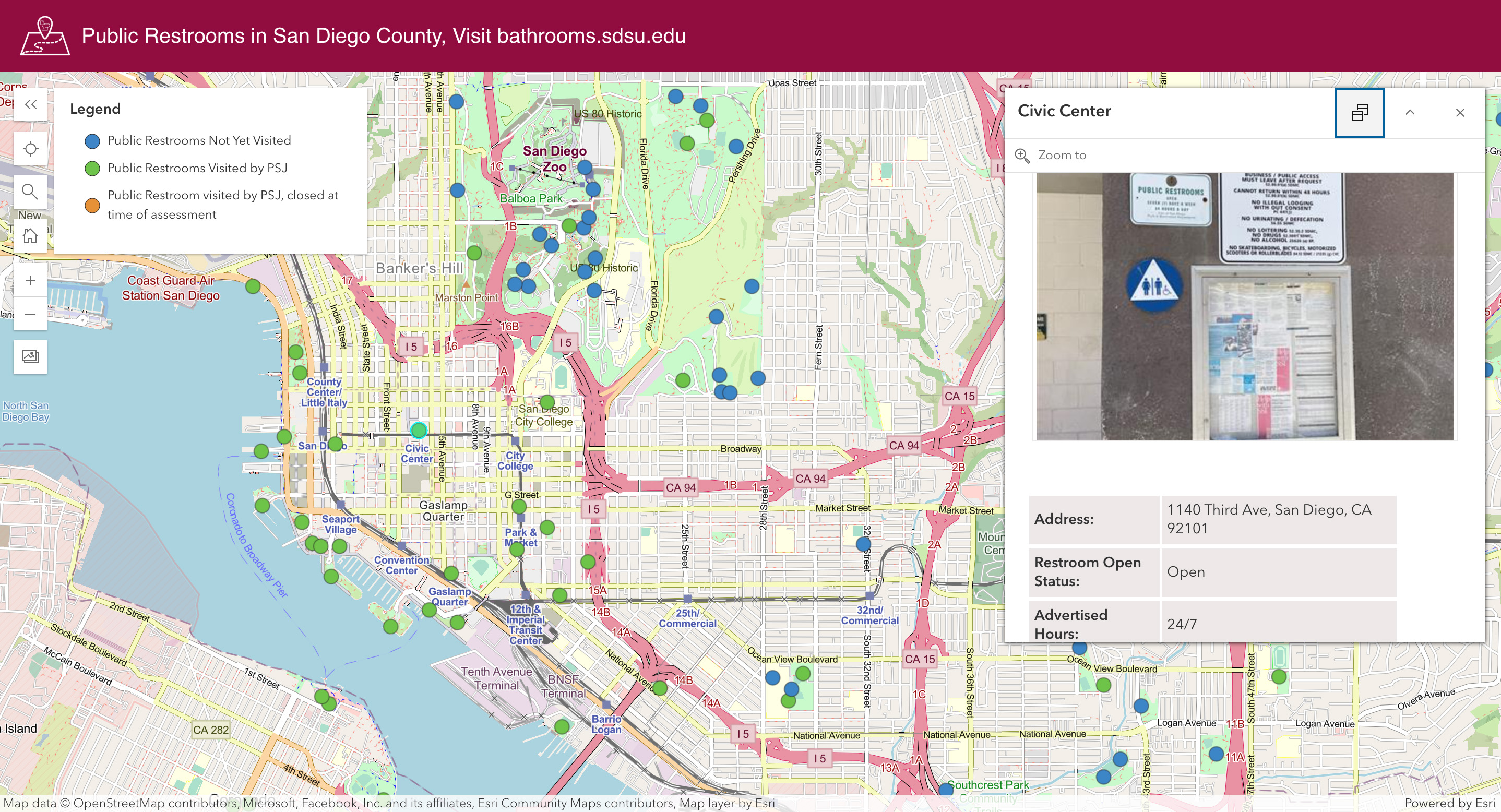
Screenshot of the Project for Sanitation Justice ArcGIS online web map of public restrooms, focusing on downtown San Diego.
All interviews took place at Think Dignity's mobile showers and storage center events where potential interviewees were receiving services and resources. On each day of interviews, which spanned eight different outreach events across the summer of 2022, our research team set up a shade tent, table, and chairs as a gathering place for potential interviewees. We offered bottled water, face masks, hand sanitizer, personal wipes, snacks, and dog treats for participants with animal companions. Interviews lasted an average of 30 min and consisted of questions regarding respondents’ restroom usage needs and behaviors, their health and safety priorities when accessing public restrooms, their major health concerns, and the survival strategies they employ when WaSH resources are unavailable. Interviewees received a $25 gift card of their choice as thanks for their participation. All human subjects activities described here were determined to be exempt from ongoing review by the San Diego State University Institutional Review Board.
Study findings: WaSH deprivation is punishment
Our analysis of three data sources illuminates six forms of punishment directly resulting from WaSH deprivation:
Restricted access to and lack of information about where WaSH resources exist; Poor quality of available WaSH facilities; Barriers at public WaSH facilities and discrimination at private ones; Forced self-regulation when one has limited access to WaSH resources, especially toilets (e.g., “holding it,” restricting intake of fluids and/or food); Threat of criminalization and risk of police violence that permeates WaSH-related decisions for unhoused people; and lastly, Elimination of dignity when one is forced to relieve oneself in a place not meant for it leads to further stigmatization of sanitation-deprived people as unsanitary.
Figure 2 provides a novel conceptual model, informed by the prior literature and our data, for visualizing how deliberate sanitation deprivation in the U.S. urban environment functions as a punishment regime inflicted on city residents, and unhoused residents especially.
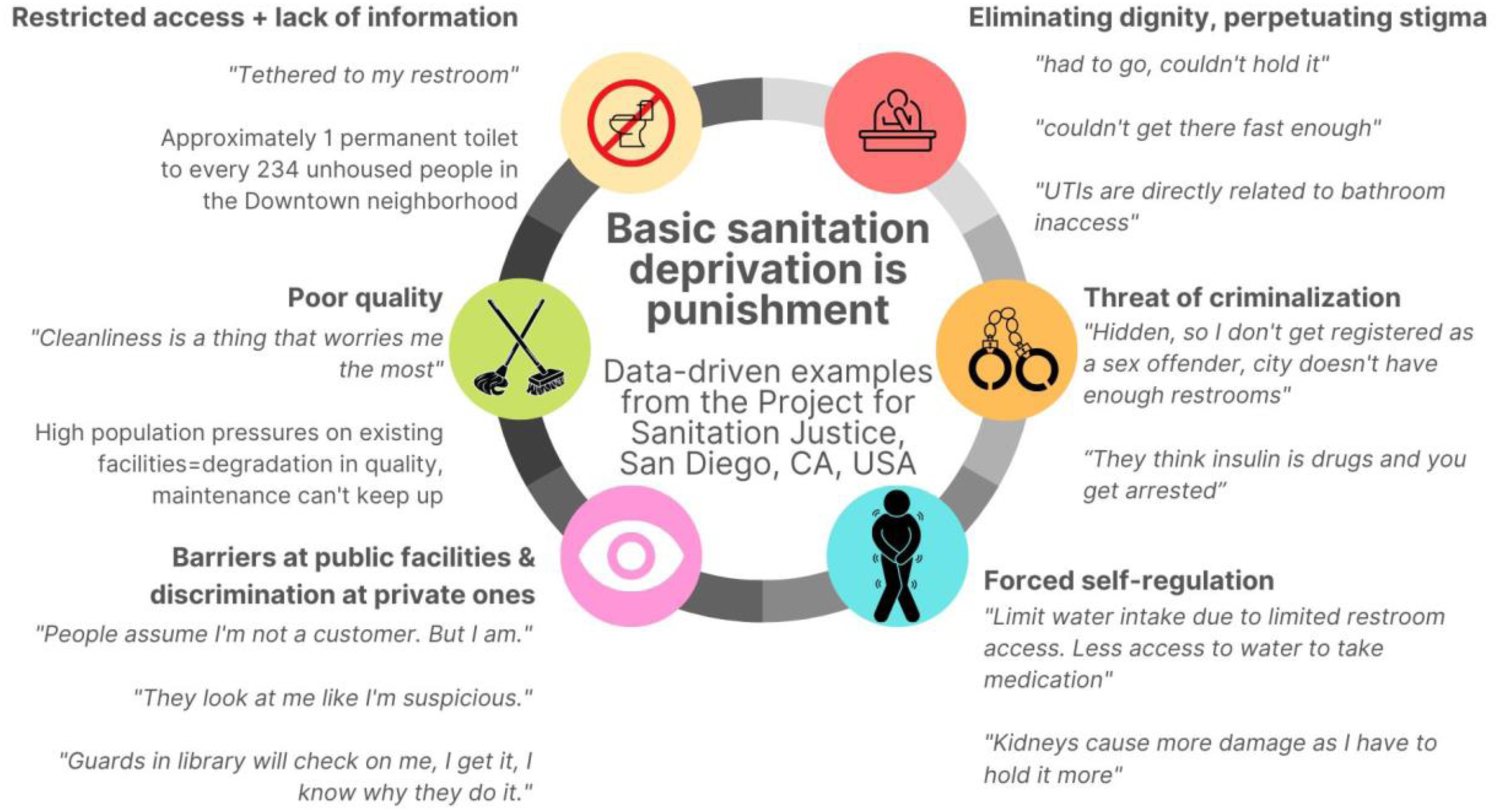
Visualizing sanitation deprivation as punishment: data-driven examples from San Diego, CA, USA.
Restricted access to and lack of information about where WaSH resources exist
Our data highlight very low availability of public WaSH resources, especially restrooms, in San Diego. Almost half of San Diego County census tracts do not have a public restroom (Carroll et al., 2022b). These tracts represent a total population of approximately 1.5 million residents. While many tracts have portions of land dedicated solely to housing and private business activities, all tracts without a public restroom have some land area dedicated to non-residential uses including shopping centers, industrial and commercial areas, public services, medical centers, schools, parks, and other mixed uses. Within the Downtown San Diego neighborhood, there are 22 permanent public restrooms shared by a total housed population of over 37,000. Our public web map shows where restroom facilities exist (see Figure 1). The City of San Diego also publishes a web map for public restrooms, however, this resource is not consistently maintained and restrooms that are shown as “open” online are often closed without public notice or updates to the web map. Indeed, multiple interviewees reported finding that the “bathroom is locked when [it is] supposed to be open 24/7.” One participant shared trying to access a public restroom and being told that the facility is “out of order,” which they knew to be untrue. Data from our public restroom infrastructure field assessment also demonstrate restricted access: hours of operation are often not posted, are unknown, and/or actual availability does not match posted signage.
WaSH access in San Diego is extremely limited overnight. Only two Downtown public restroom facilities are open 24 hours (h) a day, 7 days a week, providing a total of 9 toilets as confirmed by our research team. On average, 1565 San Diegans lived unsheltered in the Downtown neighborhood during 2023 (Downtown San Diego Partnership, 2024). The overnight toilet ratio is approximately one permanent toilet to every 174 unsheltered residents. This does not include everyone else who relies on these facilities. The other 20 permanent public restrooms in Downtown San Diego are open an average of 10 h per day. Participants mentioned that overnight access is sparse at best and they need restrooms that are “open more hours especially later in the evening.” Finding a restroom is a particular challenge, when asked how they find a facility we were told they “wing it,” or take “everything into [their] own hands.” One respondent mentioned that even if they can find a bathroom, “getting there is the hard part.” Once a restroom is located and unlocked for use the facility is “only open certain hours.” Lastly, this WaSH-deprived environment has the effect of restricting freedom of movement for some. An interviewee described being “Tethered to my restroom.” It is an “adventure” to be away from the facility and he must “hope” that he “makes it” back before he “needs to go.” Interviews with unhoused San Diegans paint a picture of a population highly reliant on public WaSH facilities, with 66.1% of those surveyed reporting that they use public restrooms on a daily basis. Our respondents stated that they need restroom “proximity” and “better hours of operation” for facilities. This population also experiences the most direct forms of punishment when WaSH resources are unavailable.
Poor quality of the facilities that do exist
As demonstrated in the first step of the conceptual model, the few public WaSH facilities that are available/accessible experience very high population pressures: too many people relying on too few facilities means inevitable degradation in quality, and regular maintenance cannot keep up with demand. Public restroom field assessment showed severe deficiencies in the resources available in restrooms, with low provision of resources like hot water (only available at 1 of 22 facilities), menstrual products (available at 4 of 22 facilities but free of charge at only 2 locations), and baby changing stations (at 7 of 22 facilities).
From interviews with unhoused San Diegans, we gain a clearer view of what public WaSH facilities look and feel like: “Dirty bathroom,” “long lines” no “door handles”, “they smell really bad and don’t maintain them daily.” Since people experiencing homelessness are viewed as waste it is accepted that they do not deserve clean, accessible public facilities. Interviewees told us that they need “sanitizer to prevent infection” and that they “needed to wash hands and couldn’t.” One participant told us that “Cleanliness is a thing that worries me the most”; they understand that they may be placing their health in danger by using these unclean spaces provided to them but they have no other options.
Even when restrooms are available, some participants choose open defecation because of the lack of privacy coupled with the poor restroom quality outlined above: “Not private,” there are no “door handles,” or worse, “Wide open, there are no doors.” One participant we spoke to summed it up when they said they would like a “Restroom … that is safe and clean.” When asked what safety features they would like to see more of in public restrooms, several interviewees told us that they regularly use restrooms without stall doors, much less functioning locks on those doors. One interviewee said they need, “Secure lock on door. Bolt locks.” Another mentioned they need “a way to secure my personal belongings while using restrooms.” Restricting access to one's belongings forces the dilemma between caring for their biological needs or risking their limited and valuable possessions being stolen. When they cannot watch their belongings their health is directly affected. One participant said they would like it if “Nobody [was] messing with people using [the] bathroom” and another said, “Anyone can get in if they want to or [be] waiting for me outside.”
When asked what supplies they would like to see more of in public restrooms, multiple participants mentioned that having WaSH supplies (e.g., toilet paper, soap) in restrooms makes them feel safer because it indicates the space is monitored and maintained. One interviewee asked for “brushes to clean the toilet with,” suggesting that they would even clean the bathroom themself if they just had the tools. Other participants wanted “brooms by trash” and “spray sanitizer.” These kinds of remarks are not uncommon among unhoused people and indicate just how much people are willing to do for themselves, especially if it helps them battle stigma simultaneously. Figure 3 shows examples of facilities that match the narratives of our interviewees, including low stall doors with no privacy, toilet paper available only on the exterior of stalls, and no doors on urinal or toilet stalls.
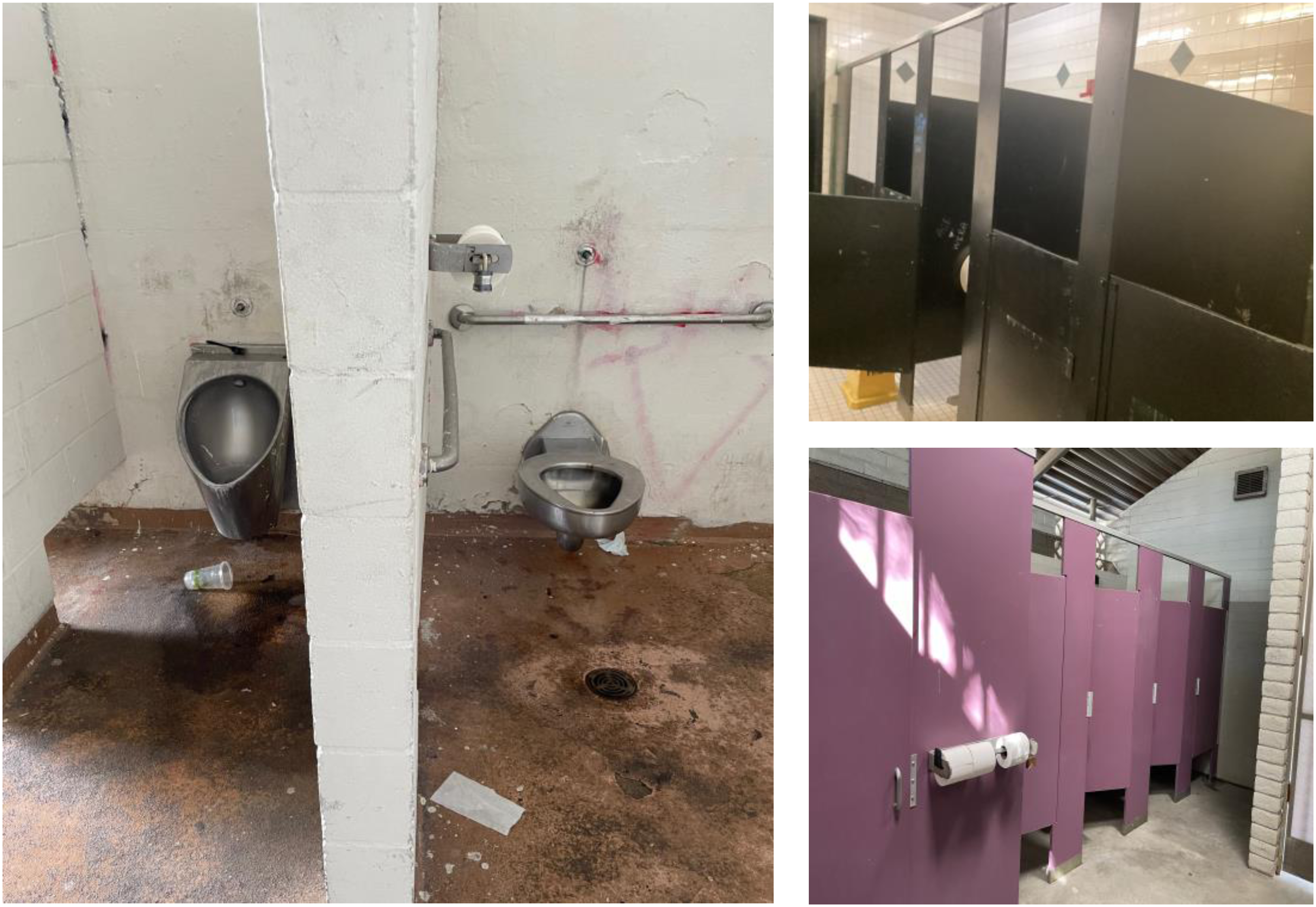
Lack of privacy and poor quality of existing facilities, including no stall doors, stall doors of reduced height, and toilet paper mounted outside of stalls.
Barriers at public facilities and discrimination at private ones
Data gathered via the public restrooms infrastructure assessment provide visuals on what this discrimination looks and feels like. Figure 4 shows the typical excessive rules—including many that are specifically targeted toward unhoused people, which our research team has repeatedly observed being enforced. At some locations, including a central transit hub in downtown San Diego, restroom users must pass through airport-like security to access WaSH facilities, while at San Diego's Amtrak station, no public facilities are offered at all.
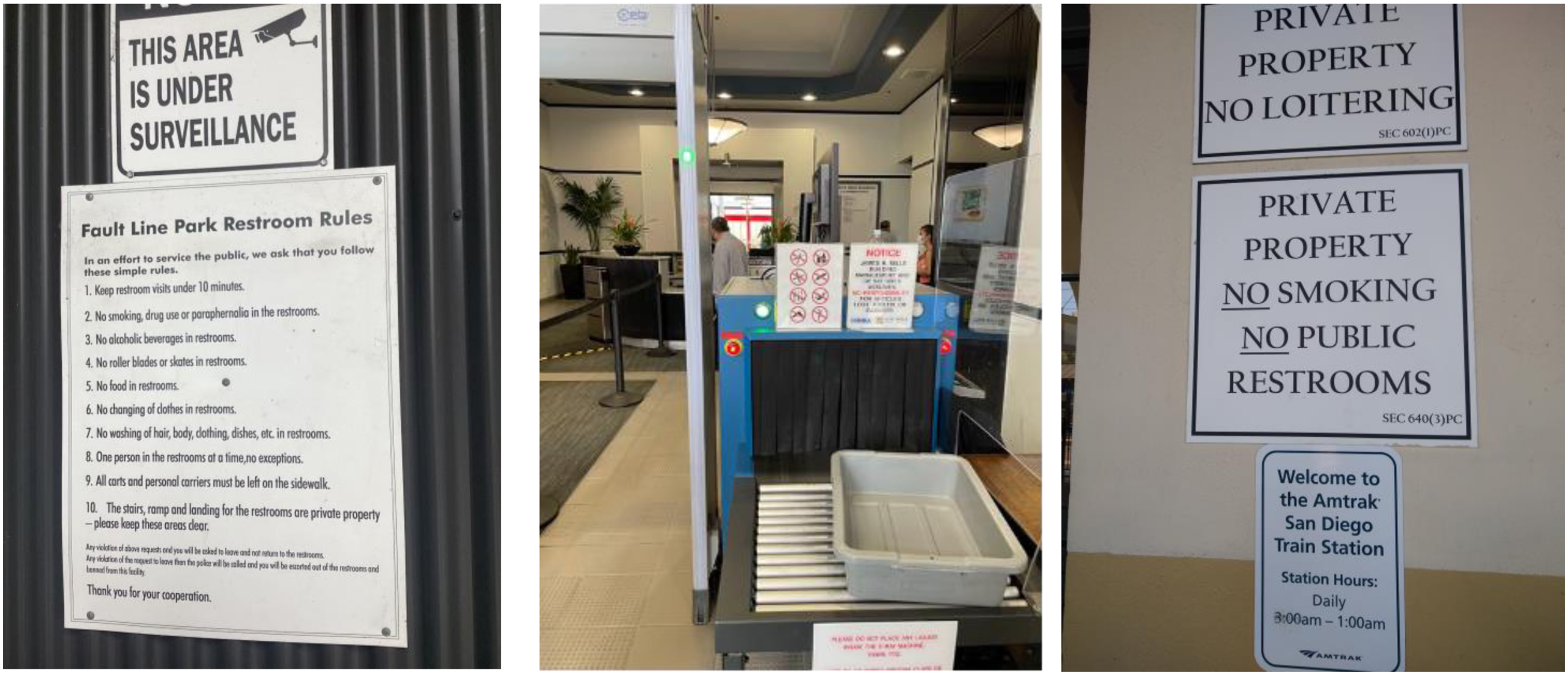
Restrictive signage and security at restrooms.
Because the network of public WaSH resources is so sparse, unhoused people also rely on private businesses to meet their basic needs. Across both public and private facilities, half (50%) of the unhoused San Diegans we interviewed reported experiencing stigma and/or overt discrimination when trying to use a restroom. Nearly one-third (29%) reported being turned away by a staff person or security guard based on their appearance; 26% could not access a private business restroom because they had to be a customer; and 16% could not use a restroom because they could not bring their belongings into the facility with them. Participants described feeling “judged” by people in stores and at some subjectively-accessible public restrooms—as one person put it, “they look at me like I’m suspicious.” Another respondent described a sense that private businesses “pick and choose who can use a restroom.” One participant said, “people assume I’m not a customer. But I am.” Another participant told us that the person who controls access to the restrooms she uses accuses her of being a “druggie” and once asked if she was “gonna OD” in the restroom. Another interviewee told us, “Guards in the library will check on me, I get it, I know why they do it,” showing awareness of the stigma applied to them. These narratives reinforce the many and diffuse ways that inequity and discrimination, especially toward those experiencing homelessness, place additional barriers on access to WaSH resources.
Forced to “hold it”
Thus far, we have shown the formidable barriers that anyone would encounter in trying to access public WaSH facilities. However, these barriers are acutely felt by people experiencing homelessness. This section focuses on what unhoused people told us they do when WaSH facilities, especially restrooms, are unavailable. We find that forced self-regulation can take the form of holding in urine and/or feces, dehydration, and withholding food or even medications. In one heartbreaking narrative, one older white male participant told us he stops eating and drinking by 4 pm every day because he does not have access to a restroom where he stays overnight. Others mentioned that “UTIs are directly related to bathroom [in]access,” and that they are concerned about kidney damage as “I have to hold it more.” Difficulty accessing restrooms may cause unhoused people to stop taking prescribed medications—either because the medication caused them to use the restroom more, or because they lacked consistent access to water to take their medications. One participant shared that they curb “water intake due to limited restroom access” and that they have “less access to water to take medication.” These findings underscore the ways that lack of access to restrooms, especially overnight, functions as a self-reinforcing punishment mechanism in which marginalized members of a community are forced to choose between “holding it” and/or restricting intake of fluids, medications, and food or risk the social and legal consequences of relieving oneself in a non-restroom location.
Threat of criminalization and police violence related to sanitation and health
Simultaneously, people experiencing homelessness are hyper-aware that they are stigmatized, stereotyped, and labeled by authorities, especially by law enforcement officers who are often first responders to homelessness-related calls. In one devastating narrative, an interviewee described being a witness to a shooting and that the “police officer was telling other officers not to bother to give CPR to homeless because they are trash.” In other instances, participants described important health resources that are regularly lost in encampment sweeps, and/or items that are misidentified by officials, leading to criminalization. For example, one participant told us that where they stay, “no water [is] available, [the police] think insulin is drugs and you get arrested.” These experiences directly intersect with a lack of access to WaSH resources. For example, asked where they urinate and defecate when a restroom is unavailable, one respondent told us they go somewhere “hidden, so I don’t get registered as a sex offender, city doesn’t have enough restrooms.”
Eliminating dignity, perpetuating stigma
In this section, we rely primarily on our interviews with unhoused San Diegans to highlight the lack of dignity when one is forced to relieve oneself in a place not meant for it and how this leads to further stigmatization of WaSH-deprived people as dirty or unsanitary. The unhoused people we spoke with are highly reliant on public restrooms when they are available—both built permanent facilities and portable toilets. In response to the question, “On a typical day, where do you go when you need to use the restroom? Select all that apply,” two-thirds (66%) of respondents stated they use a permanent public restroom on a typical day, 44% stated that they use a portable toilet, and 21% use a private business restroom; 33% of respondents told us that on a typical day, they have to practice open defecation “in the bushes,” or using a bucket, cup, bottle, plastic bag, or other container for their bodily waste. Overall, interviewees described permanent public restroom structures as more consistently available and generally more “dignified” when compared to portable toilets. However, interviewees noted—and this is confirmed by our field assessment—that portable toilets tend to have more frequent and consistent maintenance as a result of how they are contracted out by the City. However, portable toilets also tend to be deployed during public health crises and then removed when the crisis is over, making these facilities difficult to depend on (Felner et al., 2020, 2023; Murphy, 2019).
When asked the reasons why they practice open defecation, nearly three-quarters (74%) of interviewees provided “no bathroom nearby/too far away” as a reason, stating, for example, “had to go couldn’t hold [it],” and “emergency situation.” Interviewees also noted other reasons for practicing open defecation, including “safety concerns” or “staying safe” (8%), “too dark at night” (6%), and “too tired” (6%). Several participants described practicing open defecation even when a restroom might be available to them because of discrimination they knew they would encounter. One interviewee described wanting to avoid “confrontation” with the gatekeepers at a restroom they would otherwise use.
Another commonality across many of our interviewees was that their health status makes consistent restroom access even more crucial. Eighty-five percent of survey participants reported having one or more chronic health conditions. The people we interviewed described being forced to practice open defecation or urination out of urgent necessity—as one person put it, “couldn’t get there fast enough.” Some said it was because they were “sick” or had “stomach problems.” Another respondent told us that due to kidney damage “coupled with my weak immune system makes me wary of using public bathrooms.” These narratives offer insight into the lived experience of the compounding health inequities that unhoused people are forced to endure due to WaSH deprivation.
Interviewees emphasized the need for privacy when practicing open defecation to preserve what little dignity they have left. Respondents stated that they will go “anywhere with privacy,” “between cars,” “can in our tents, seal the bag up, and throw it away,” “secluded place,” “pee in [a] cup in my tent,” “dump in … sewer,” and “plastic bottle.” One interviewee described how they plan ahead to pick up bags they find in the street for when they need to go: “Keep bags on me, pick up bags from the street, throw it in the trash.” These responses highlight both the desperation and resourcefulness of people confronting WaSH deprivation.
Discussion and conclusion
To quote Kimberlé Crenshaw (2016), the urgency of intersectionality is that “if we can’t see a problem, we can’t fix a problem.” The data presented here paint a grim picture of sanitation injustice in “America's Finest City.” Now the problem is visible. The urgency and power to address this injustice will come from intersectional coalitions who understand that sanitation justice is environmental justice; it's racial justice, reproductive justice, disability justice, and gender justice. Lastly, sanitation justice is a critical form of justice for people waiting for permanent affordable housing—a wait that can last nearly a decade in some situations (Center on Budget and Policy Priorities, 2021).
As our data-driven conceptual model demonstrates, it is increasingly impossible to address one's basic bodily functions while existing in public, and unhoused people—who are also disproportionately likely to be members of other marginalized groups—are most affected by this sanitation-deprived environment. In the Downtown neighborhood of San Diego, we estimate an overnight toilet ratio of 1 permanent public toilet to every 174 unsheltered San Diegans. This violates basic sanitation standards established by international health and human rights organizations (Capone et al., 2020; United Nations, 2023; Verbyla et al., 2021) yet is viewed as an acceptable situation in U.S. cities like San Diego. When public restrooms do exist they are deficient in basic health and safety features. Unhoused people face discrimination and other barriers to accessing WaSH resources and public restrooms especially. The constant threat of criminalization, police “sanitization,” and lack of access to WaSH forces the unhoused community to live in a state of persistent anxiety (see Portillo et al., 2023, 2024). Due to this chronic distress, people experiencing homelessness are forced to self-regulate in various detrimental ways (e.g., holding urine and/or feces, dehydration, not taking needed medication). This self-regulation is not only harmful to individual and public health but it also degrades basic human dignity and perpetuates stigmatization of WaSH-deprived people. WaSH deprivation is part of a robust punishment regime inflicted upon a growing number of people due to their lack of permanent housing.
This study contributes novel and actionable knowledge about WaSH needs in urban environments. For example, we note that our sanitation ratio findings for the Downtown neighborhood differ significantly from the prior sanitation ratio estimated by Hochbaum (2020) via a city survey and public records requests (one bathroom to every 27 unhoused individuals). We attribute this to: (a) our local team was able to spend many hours visiting restroom facilities; (b) the number of San Diegans experiencing homelessness has increased since Hochbaum's work; and (c) our ratio is only for the Downtown neighborhood, where a high proportion of the overall homeless population stays due to the concentration of services there.
To move our communities toward achieving a vision of sanitation justice, voices that are typically marginalized in infrastructure conversations must be put front and center: as one of our unhoused interviewees put it, “get more feedback from folks on the streets.” When we asked unhoused San Diegans what they needed, one respondent declared, “someone who speak[s] to you with respect.” Another participant summarized why the need for more public WaSH resources is so urgent: “It is a dignity and humanity issue.” The people we interviewed associate cleanliness of their body and personal space with a sense of normality and dignity, and currently neither are available to unhoused San Diegans with any consistency.
The Mayor of San Diego denies that the city has a deficit of public restrooms and has stated that punishment will be swift and certain for those performing a necessary bodily function in places not meant for it. This outlook causes us to ask, if the City of San Diego advertises public restrooms and then not only fails to deliver on said promise but also uses deliberate deprivation to further punish those who lack access to WaSH resources, who then is guilty of the “crime” of open defecation? Punishment and dignity cannot coexist. The current WaSH infrastructure in U.S. cities including San Diego operates at such a deficit that it works at cross-purposes with municipal leaders’ publicly stated goals of ending homelessness by helping unhoused people gain independence through permanent housing. As our data show, WaSH access is the most basic way governments can support not only public health and well-being but also social and economic mobility. For individuals forced to exist in hostile public spaces, the short time they spend in a restroom may be the only part of their day where they feel protected from the harshness of the outside world. As they navigate unfriendly and often dangerous environments, public restrooms may offer brief instances of safety and privacy that housed individuals take for granted.
This study has limitations that must be addressed through future research. Due to the high rates of police contact reported by our study participants, alongside similar findings by scholars working in other locations (Calderón-Villarreal et al., 2022; Portillo et al., 2024) we strongly suspect that criminalization (arrests, tickets, move along, and stay away orders) disrupts WaSH access and further harms the health of persons experiencing homelessness, but a closer examination of these dynamics is needed for full understanding. Our Downtown San Diego sample of interviewees predominantly identified as male and heterosexual, which means we did not learn as much about menstrual health concerns (Boden et al., 2023) or the specific needs of gender-expansive populations including transgender people (Bagagli et al., 2021; Lerner, 2021), as we had hoped. Additional work is urgently needed to understand these groups’ needs, given recent federal court decisions and legislation that restricts their rights and threatens their health and safety. Additionally, this research focused on a dense urban area; future research should seek to understand how WaSH access is experienced by unhoused people in suburban and rural areas (Ballard et al., 2022). Relatedly, our sample of interviewees primarily identified as unsheltered, meaning they are living outdoors and/or in vehicles. More work is needed to understand the WaSH access experiences of people living in emergency shelters, which typically deny access to residents during the day.
However, enough is known about WaSH deprivation to take action toward sanitation justice now. WaSH facilities must be viewed as essential public goods and invested in as such. This means, to start, that communities need many more public restroom facilities, and those facilities need to be free of charge, safe to access, clean, and stocked with basic health and hygiene supplies. Experts and civic leaders alike must work to disentangle harmful stereotypes about unhoused people, particularly those who are born out of chronic WaSH deprivation, to foster community acceptance of public restrooms. This means drawing direct connections between infectious disease prevention, basic dignity, and access to WaSH resources rather than punishing the most vulnerable members of our society.
Footnotes
Acknowledgments
The authors first want to thank the staff and leadership of Think Dignity for their tireless efforts to ensure the basic dignity, health, safety, and well-being of people experiencing homelessness: Mitchelle Woodson, Executive Director; Merlynn Watanabe, Director of Community Engagement & Communications; Christine Lopez, Director of Impact Services; Danny McCray, Transitional Storage Center Site Supervisor; and Howard Diggs, Intake Specialist. We additionally thank the many guests of Think Dignity's programs who shared their experiences and observations of WaSH (in)access in San Diego with us—this work would not be possible without your critical insights. We thank Aidan Carroll, Rafael Chavez, Nicolas Gutierrez III, and Sara Rodrigue for their support in early bathroom mapping efforts and project conceptualization. Lastly, we thank Nicole Kaufman and Chez Rumpf for their insightful feedback on early versions of this paper.
Declaration of conflicting interests
The authors declared no potential conflicts of interest with respect to the research, authorship, and/or publication of this article.
Ethics statement
The San Diego State University Institutional Review Board (SDSU IRB) reviewed all research activities reported herein and deemed them to be public health surveillance activities exempt from on-going review. For the survey, the research team obtained comprehensive oral informed consent from each participant, and this was witnessed by two members of the research team. To preserve the anonymity of participants, we did not obtain written consent (signatures). Participants received a copy of the written consent document to keep, along with a comprehensive list of local resources for shelter, food, health care, and social services.
Funding
The authors disclosed receipt of the following financial support for the research, authorship, and/or publication of this article: The authors received support from the San Diego State University (SDSU) Emergency Funding for Student Assistance with Research, Scholarship, and Creative Activities (RSCA) Award (2021); the SDSU Summer Undergraduate Research Program (2021, 2022); SDSU's Rapid Response and Seed Grants Programs; and SDSU's School of Public Affairs. No grant numbers available. The funders had no role in study design, data collection, analysis, decision to publish, or preparation of the manuscript.
