




Abstract
The decision to release is a defining feature of the carceral experience: at once a necessary function of a dynamic penal system, and a highly contested form of symbolic communication where the anxieties and contradictions of contemporary penality begin to coalesce. In this paper I argue that the institutions we rely upon to make these determinations in a fair, consistent and efficient manner are under increasing strain. Drawing upon insights from historical institutionalism, I seek to show that the parole board model of discretionary decision-making that first emerged during the highwater mark of mid-twentieth century penal modernism has proved remarkably resilient to reform, but is slowly fracturing into a more complex, multi-layered prison release landscape. I explore the implications of this gradual historical transformation and conclude this paper with a call for new ways of thinking about prison release as an increasingly interconnected sphere of penal governance.
Introduction
The decision to release is a defining feature of the carceral experience: at once a necessary function of a dynamic penal system, and a highly contested form of symbolic communication where the anxieties and contradictions of contemporary penality begin to coalesce. Over time, a myriad of penal practices have developed to manage this decision-making discretion in ways that are consistent with broader political, penological and administrative aims (van Zyl Smit and Corda, 2018). However, as I seek to show here, the institutions we have relied upon for more than a generation are under increasing strain. The decision to release is now highly contested and a bewildering array of penal developments continue to destabilise existing decision-making structures with significant implications for the humanity, fairness and effectiveness of the penal system (see Freiberg et al., 2018; Padfield, 2020; Reitz and Rhine, 2020)
While by no means exhaustive, this general picture suggests that an ascendant ‘parole populism’ (Moffa et al., 2019) has eroded the rights of prisoners and relegated the careful work of rehabilitation to the imperatives of an all-encompassing public protection. Moments of crisis, such as the Worboys case in England and Wales, or the Dutroux scandal in Belgium, continue to undermine public confidence in the parole system (see Fitzgerald et al., 2021), while a host of previously excluded policy actors are now ‘pressing in’ on prison release decision-making with growing assuredness (Annison, 2020: 11). Release from prison is subject to a plethora of licence conditions (Padfield, 2019) and parole boards are now firmly established within a broader apparatus of risk management, community supervision and control (Barry, 2021; Hannah-Moffatt and Yule, 2011). The extraordinary growth of indeterminate sentencing in some jurisdictions has seen the locus of sentencing discretion move ‘downstream’ from the criminal courts (Rhine et al., 2017) and an expanding cohort of recall prisoners has renewed longstanding concerns about executive overreach and the limits of the liberal democratic state (Padfield and Maruna, 2006).
In this context, the decision to release has become the subject of intense public scrutiny and marked differences can now be observed in the recent developmental trajectories of English-speaking and European penal systems (see van Zyl Smit and Corda, 2018). The United States has experienced a troubling increase in the number of prisoners serving life sentences without parole (Seeds, 2021). While in Australia a series of legislative initiatives have restricted the discretion afforded to state-level parole boards, promoted the use of ‘no body no release’ clauses and, in some cases, resulted in the use of emergency legislation to prevent the release of certain named individuals (Moffa et al., 2019). In many European jurisdictions the direction of travel has been altogether less punitive, but no less consequential. In the early 2000s, Denmark, Finland and Sweden acted upon recommendations from the Council of Europe by introducing judicial systems of release for life-sentence prisoners (Schartmueller, 2019: 392). More recently, the Republic of Ireland has passed legislation that will place the parole board on a statutory footing and, it is hoped, signify a long-term shift towards a more continental rights-based approach (Griffin, 2018).
In this paper I want to argue that these examples of contemporary institution building should be of considerable interest to academic researchers and must be understood as important objects of study in and of themselves, rather than the simple corollary of legal powers, individual actions or political calculation. That greater analytical sensitivity to these meso-level dynamics can open up new vistas for the study of prison release and the institutional dilemmas that shape policy and practice. How do we account for the complex picture of continuity and change that characterise the recent histories of so many local, state level and national parole boards? How do we explain the patchwork of decision-making structures that now define the day-to-day administration of prison release in many jurisdictions? What are the likely consequences of recent attempts at institution building and how is the role of the state changing with respect to prison release decision-making?
In seeking to answer this broad constellation of questions, I draw upon recent theoretical insights from historical institutionalism, an established political science research tradition, that starts from the basic proposition that it is more enlightening to study human interactions in the context of: (a) rule-based structures that are themselves human creations, and (b) sequentially, as life is lived, rather than by taking analytical snapshots of these interactions at any one point in time (Sanders, 2006: 39). My central claim is that the parole board model of discretionary decision-making that first emerged during the highwater mark of mid-twentieth century penal modernism has proved remarkably resilient to reform, but is slowly fracturing into a more complex, multi-layered prison release landscape defined by the interactions between four institutionalised decision-making styles I characterise here as: administrative-bureaucratic, non-executive committee, legislative pre-commitment and judicial body. That over time, this gradual transformation is producing new and poorly understood ‘institutional mosaics’ of decision-making authority (Orren and Skowronek, 1994) that occupy an uncertain position at the intersection between citizen and state, the prison and the community, the past, present and possible futures of the individual life course (see Dagan, 2022)
This line of argument will proceed as follows: First, I begin to sketch out a theoretical framework for the study of prison release in historical institutional perspective. Second, I locate the decision to release within a broader historical context associated with the decline of penal modernism, and a series of crises that have destabilized the penological assumptions upon which many parole boards were founded. Third, I survey the emerging contours of a more fluid and multi-layered prison release landscape before turning in the fourth section to examine the implications of this gradual historical transformation. I conclude that prison release can no longer be understood in conventional terms as a problem to be solved by government but must now be viewed instead as an increasingly complex site of governance that invites us to ‘fracture’ the penal state (Rubin and Phelps, 2017) and reflect upon the interconnectivity of the prison release system as a whole.
Methodological note
Data for this study was drawn from the authors detailed historical study of early release in England and Wales (see Guiney, 2018), supplemented by an extensive literature review of recent published work relating to parole, parole boards, prison release and prison recall. Where comparative research exists, international examples are used to illustrate key theoretical claims and provide a richer account of how the institutional dilemmas of contemporary prison release achieve contingent expression at a local, national and supranational level (see e.g. Rubin and Phelps, 2017; Seeds, 2021). This research strategy helps to ground the paper and situate key claims within a broader international context. However, there are limitations to this approach. The uneven coverage of existing (English language?) research means that it has not been possible to systematically analyse recent developments in Eastern Europe, Asia, Latin America, Africa, or the Caribbean. This necessarily limits the generalisability of this work which, at this stage, is presented with particular reference to the distinct institutional mosaics, and layered structures of decision-making authority, that are slowly taking shape in many English-speaking jurisdictions.
Thinking institutionally: historical institutionalism and the decision to release
Theorising the decision to release
While the public contestation of crime continues to focus, to a significant extent, upon the ‘front end’ crime control capabilities of the state, there is now growing recognition that the way prison release discretion is exercised can have very significant implications for the scale, scope and reach of the penal system (Fitzgerald et al., 2021; Rhine et al., 2017). In a recent contribution to the literature, Reitz and Rhine (2020) demonstrate that discretionary release is central to the story of American mass incarceration and state-level parole boards now wield considerable power within contemporary penal policymaking. A varied punishment and society literature has located prison release within a broader sociological context associated with the new penology (Feeley and Simon, 1992), penal populism and the social construction of dangerousness (Annison, 2020). While a series of careful empirical studies have illuminated the slow professionalization of paroling authorities (Paparozzi and Caplan, 2009), the evolving logics of parole supervision (Barry, 2021), and the subjective experience of captive populations as they confront the new pains of indeterminacy (Crewe et al., 2017).
In many instances, academic lawyers have been at the forefront of contemporary research and policy debate (see e.g. Griffin, 2018; Freiberg et al., 2018; Padfield, 2020; Rhine et al., 2017). A varied public law literature continues to scrutinise the quality of prison release decision-making, and the extent to which parole boards possess the necessary capacities to discharge the responsibilities of a court. Legal commentators have reflected upon the implications of international human rights commitments and common law principles of due process and the right to a fair trial (Reitz, 2020). In parallel, researchers working within the socio-legal tradition have - on those rare occasions when research access has been granted – sought to illuminate the everyday routinized practices of parole board decision-making (see e.g. Hood and Shute, 2000), and the central importance of parole board culture in both catalysing and resisting global trends in the use of punishment (Dagan, 2022; Griffin, 2018; Ruhland, 2020).
Why institutions matter
While these intersecting research agendas have greatly advanced our knowledge of prison release law, policy and practice, they are not without limitations. Burke (1984: 49) once observed that a ‘way of seeing is always a way of not seeing’ and these varied literatures often pay insufficient attention to the meso-level dynamics that help shape the explanatory puzzle of contemporary prison release. Liberal democratic systems of government depend, not only upon macro-structural dynamics and the motivations of individual actors, but the design of institutions. That in order to understand how governments really work we must look beyond the formal legal-administrative institutions of the state to consider the organisational settings that structure everyday social, political and economic life. As Hall and Taylor (1996: 947) remind us, institutions are ‘… not just formal rules, procedures or norms, but the symbol systems, cognitive scripts, and moral templates that provide the “frames of meaning” guiding human action’.
Thinking institutionally can therefore help us to explain why it is that parole boards change markedly over time whilst at the same time presenting an outward appearance of stability and permanence with respect to their formalised rules, powers and operating procedures (see King, 2018; Padfield, 2019). This way of seeing draws attention to the diversity of international decision-making practices that are characterised as ‘parole’ (van Zyl Smit and Corda, 2018), and invites us to look beyond the parole board as a monolithic actor to consider the proliferation of internal decision-making practices that now encompass expedited reviews ‘on the papers’, oral hearings and judicial appeal mechanisms (Padfield, 2020). Moreover, institutional analysis can provide a more precise vocabulary for describing the spatial dimensions of criminal justice and the small but perceptible shifts in organisational tone and culture that prisoners, victims and practitioners experience as they progress through what Aviram (2020: 9) has described as a succession of ‘performative spaces’. As Herzog-Evans has observed (2019: 188), the decision to release must be understood as the final step along an interconnected ‘penal continuum’ that encompasses the ‘front-end’ decisions of a sentencing judge and the ‘back door’ determinations of parole boards, probation officers and other street level penal bureaucrats (see also Dagan, 2022).
The building blocks of historical institutionalism
To date, the phenomena outlined here have been explored from a broadly legal or sociological disciplinary standpoint but, as I seek to show in the analysis that follows, historical institutionalism offers an additional, and complementary, analytical point of departure for scholars seeking to (a) understand the forces that drive institutional creation, adaptation, and longevity, and (b) to make sense of how parole boards shape, and are in turn shaped by, the evolving aims and techniques of penal policy. A comprehensive review of this literature is well beyond the scope of this paper (see e.g. Fioretos et al., 2016; Guiney, 2018; Sanders, 2006), however, it is possible to identify three conceptual building blocks of the historical institutionalist tradition that are particularly relevant in this context.
First, historical institutionalism is closely associated with the concept of path dependency. This basic idea suggests that what happens at an early stage in a causal sequence will affect possible outcomes at a later point in time (see Rubin, 2021). On the one hand, work in this field has drawn attention to both the long-term influence of positive and negative feedback mechanisms that alter the ‘switching costs’ of moving from one developmental pathway to another (Pierson, 2004). While on the other, recent research has explored the creative potential of ‘critical junctures’, such as the 2008 global financial crash, where these normal structuring conditions are loosened, and a broader range of policy options become imaginable (Karstedt et al., 2019). In this respect, path dependency offers a sophisticated theoretical repertoire that underscores the importance of timing and sequence, the disruptive effects of historical contingency, the potential for ‘large’ consequences to flow from ‘small events’ and the ‘stickiness’ of institutional trajectories that, once established, can be very difficult to reverse.
Second, recent iterations of historical institutionalism have sought to overcome the structuralism of early theoretical perspectives that emphasised stability and stop-go periods of ‘punctuated equilibrium’ (Steinmo et al., 1992). As Mahoney and Thelen (2010) observe, institutions are, by their very nature resilient to external shocks and, in this context, change is likely to be defined by a long-term process of ‘gradual transformation’ as the political coalitions of support that underpin existing institutional arrangements shift and reconfigure. In practice, these temporal processes can take a number of distinct forms:
Layering: New rules, ideas and narratives are introduced on top of, or alongside, existing institutional practices. Drift: The formal rules of an institution remain stable, but the external operating environment shifts in ways that alter their practical application. A lack of institutional maintenance may result from ‘inertia’ or a deliberate process of political neglect. Displacement: New institutions replace an existing set of arrangements that were meant to perform the same task. Conversion: New purposes become attached to old institutions which are ‘redirected’ or reinterpreted in novel ways. (Mahoney and Thelen, 2010: 14–15)
Third, historical institutionalism draws upon inter-disciplinary insights from economics, sociology and organisational studies to explain how institutions constrain individual actors and shape policy outcomes (Hall and Taylor, 1996). In this respect, it can be helpful to think of institutions as ‘processes’, rather than ‘things’ (Goodin, 1996: 19) that exist to simplify human interaction. As Lowndes and Roberts (2013: 47–60) helpfully summarise: formal rules organise how power is constituted, exercised, legitimated and controlled. Informal practices and standard operating procedures reduce complexity and create uniform, routinized and predictable patterns of behaviour. Narratives and storytelling rituals support individuals to distil, mobilise and act upon a collective understanding of the organisational settings they inhabit (see also Annison, 2021).
Institutional change: parole, penal policy and the crises of penal modernism
It is perhaps the defining contribution of the sociology of punishment tradition that penal practices are not simply an unproblematic response to crime trends, but inexorably bound up with the transformation of broader social, economic and political structures (see e.g. Simon, 1993: 5). While supporting the broad thrust of this argument, the theoretical tools assembled here offer a number of important clues for thinking about how institutions interrupt and mediate this process across the broad sweep of historical time. In this section, I draw upon insights from historical institutionalism to explore how the parole board model of discretionary decision-making locked in many of the ideational assumptions of penal modernism and in so doing projected these ideas into the future in ways that have become increasingly at odds with the evolving aims and techniques of penal policy in many English-speaking jurisdictions.
Parole boards and penal modernism
It is testament to the power of institution building that the parole boards first established more than half a century ago remain synonymous with the decision to release. We quickly become used to the way things are and this can confer a concreteness upon arrangements that are in fact contingent, fleeting and unresolved. Throughout the late-nineteenth century a suite of penal practices, including the ticket of leave system, remission and the prerogative of mercy evolved to expedite the release of those sentenced to imprisonment by the courts (Guiney, 2018: 55–61). Viewed in Weberian terms, this administrative apparatus began to place the decision to release upon a more systematic bureaucratic footing. However, it is clear that by the mid-twentieth century these practices were ill-suited to the emerging aims of penal modernism and the insoluble problem of how to exercise penal power ‘rationally’ (Simon, 1993). This question generated considerable policy debate in the decades following 1945 and it was in this context that the parole board model of decision-making emerged as the most promising institutional counterpoint to a ‘modern’ system of parole premised upon the following ideational, epistemic and governmental assumptions:
Penological support for indeterminate sentences and the personalisation of punishment. Deference to authority and those who offer ‘expertise’. Optimism about the transformative potential of criminological research and knowledge. A bureaucratic system predicated upon the assembly of detailed casefiles and decision-making on the papers. A paternalistic system where prison release conceptualised as a ‘privilege’ rather than a ‘right’. Limited institutional access for prisoner families, victims or the general public.
Of course, these assumptions were by no means universally accepted. Discretionary parole was the subject of considerable contemporaneous criticism from sentencing judges, prison governors and politicians (Guiney, 2018). However, they were sustained, initially at least, by a powerful coalition of support that gave official expression to the policy ambitions of ‘penal welfarism’ (Garland, 2001) and a broad disposition towards the governance of crime Loader has described as ‘liberal elitism’ (2006: 568). While it is now generally accepted that these established power structures began to unravel in the final decades of the twentieth century, the key point to note here is that the parole board model of decision-making has proved remarkably resilient to these broader macro-structural shifts, and it is this institutional legacy that is key to understanding the crises of contemporary prison release.
The crisis of administration
The administrative demands placed upon the institutions of prison release increased significantly in the second half of the twentieth century. In part, this reflects the basic challenge of administering a penal system at scale at a time when criminal justice budgets have failed to keep pace with significant prison expansionism (Reitz and Rhine, 2020: 285). However, the crisis of administration also reflects the growing complexity of contemporary sentencing frameworks. In many English-speaking jurisdictions a general process of ‘violence realignment’ (Seeds, 2017: 600) has significantly altered the offender / offence profile of the general prison population, while a long-term shift towards greater conditionality in release arrangements has swelled the recall prison population and accelerated the ‘revolving door’ between prison and the community (Padfield and Maruna, 2006). In many instances, these administrative challenges have been exacerbated by a series of victims’ rights initiatives and new forms of dangerousness legislation. In California, the introduction of Proposition 9, also known as Marsy's Law, has altered parole board proceedings since 2008 with the effect that lifers denied parole must now wait a presumptive period of fifteen years before the parole board will reconsider their case, unless there is clear and convincing evidence that an extended deferral period is unjustified (Aviram, 2020: 26).
The crisis of legitimacy
At a time when English-speaking societies have become less deferential towards those in positions of authority and less trusting of penal expertise, parole boards have often struggled to resolve a longstanding and systemic legitimacy deficit. There remains a lack of clarity about how decision-making discretion is organised and, by extension, what prisoners, prisoner families, victims and the general public can legitimately expect from this process (see Fitzgerald et al., 2021).
In this context, parole boards have often sought to legitimise their work by appealing to their decision-making performance. Senior parole board members frequently invoke statistics relating to the serious further offending rate (SFOs) and this is particularly common during periods of crisis and scandal when ethical considerations, such as the false positive rate or the treatment of indeterminate prisoners repeatedly denied parole, are subordinated to questions of public protection (Moffa et al., 2019). More generally, parole boards have been heavily influenced by the principles of new public management and even a cursory review of parole board annual reports reveals that legitimacy is often framed in overwhelmingly managerialist terms with reference to key performance indicators, risk management and value for money considerations (Paparozzi and Caplan, 2009).
In contrast, a series of hard-won legal, political and social movements have compelled parole boards, with varying degrees of success, to reframe their work in ways that better reflect the competing legitimacy claims of procedural justice. Penal policy-makers have often proved resistant to research findings that highlight the importance of voluntary rule compliance and, in this context, change has often been exogenous, with demands for reform emanating from outside the system (van Zyl Smit and Corda, 2018). For example, in England and Wales, a series of high-profile legal cases have cast doubt upon the independence of the Parole Board 1 and reaffirmed the right of prisoners to an oral hearing in all parole and recall cases. 2 In the landmark case of re Lawrence 3 , the Californian Supreme Court placed important limits upon the decision-making discretion of both the parole board, and state governor, thereby creating justiciable legal standards that continue to be relied upon by prisoners in judicial review proceedings (see Aviram, 2020: 31–35).
The crisis of ideas
As crime control has emerged as a less certain field (Garland, 2001), penal policymakers have struggled to articulate a clear strategic vision outlining the purpose(s) and function of prison release. Parole, as originally conceived, was justified on the basis of a ‘recognisable peak’ in an individual's rehabilitation where the interests of the community were better served by the careful reform and reintegration of the offender in the community rather than their continued incarceration (Guiney, 2018). This grand policy narrative often diverted attention away from more prosaic penal policy concerns (Shute, 2003: 385), but the crises of prison release outlined above have stripped penal policymaking of its early optimism and inhibited the formulation of a clear strategic vision that connects everyday policy and practice with broader penological ideas. In this less certain climate, the decision to release has become imbued with all the anxieties and contradictions of late-modern penality; the management of risk (Barry, 2021; Hannah-Moffat and Yule, 2011), fear of dangerous ‘others’ (Annison, 2020); the disruptive influence of penal populism (Moffa et al., 2019) and the challenge of reconciling parole with a retributivist sentencing philosophy premised upon moral ‘desert’, proportionality and truth in sentencing (Dagan, 2022).
Institution building: mapping the contours of contemporary prison release
Intercurrence and the institutional mosaics of contemporary prison release
When taken as a whole, the crises of prison release have destabilised the institutions that were built during the high-water mark of mid-twentieth century penal modernism. However, this process did not result in the immediate abolition of parole boards nor the creation of radically different decision-making structures. Too much political, financial and human capital has been invested in existing institutional arrangements and, in many cases, the switching costs associated with wholesale reform were neither desirable nor practicable. Instead, institutional change has been defined by layering, drift, displacement and conversion (Mahoney and Thelen, 2010). New ideas, techniques and policies have been layered upon existing frameworks (see Rubin, 2016). Policy makers have disinvested from certain organisational capacities and re-directed resources elsewhere within the penal system. Administrative innovations from cognate spheres of public policy have been adapted through an ongoing process of bricolage and policy transfer.
Orren and Skowronek (1994) characterise this gradual process of institutional creation, reproduction and change as ‘intercurrence’ and call for greater analytical sensitivity to the distinct institutional ‘mosaics’ and layered structures of authority that accumulate within all mature systems of government over time. Since the 1970s the demands placed upon the institutions of prison release have changed markedly (van Zyl Smit and Corda, 2018). Successive phases of problem-solving activity have attempted to address the crises of prison release outlined above and, over time, this has contributed to the development of a more complex, multi-layered institutional landscape that is defined by the interactions between four institutionalised decision-making styles I characterise as: administrative-bureaucratic, non-executive committee, legislative pre-commitment and judicial body (see Table 1).
Contemporary prison release and its institutional arrangements.
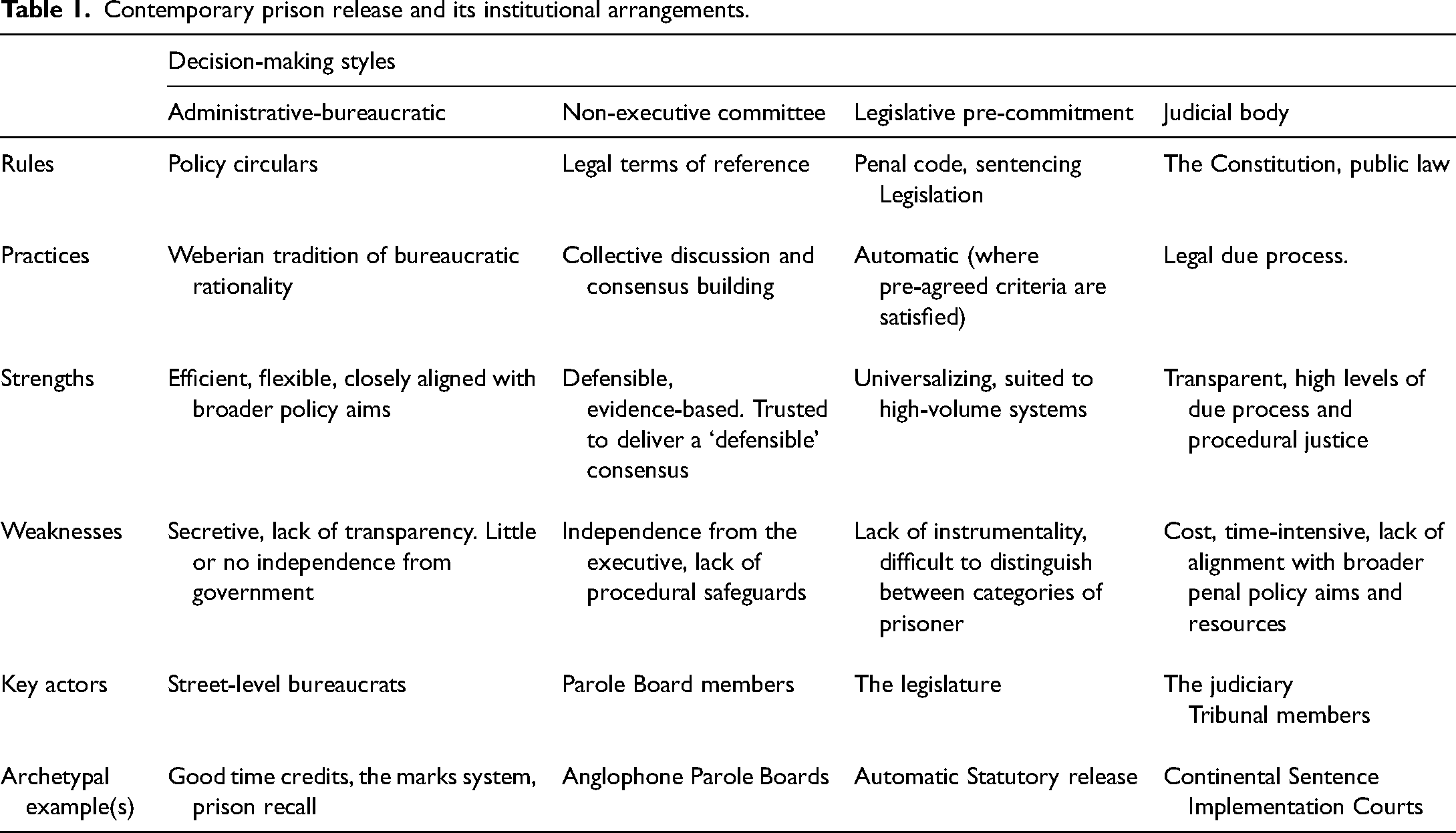
Each of these institutionalised decision-making styles is defined by a unique history, internal logic and administrative rhythm (Seeds, 2021). In some instances, these decision-making styles have been incorporated within the existing formal legal-administrative structures of the parole board. While elsewhere new institutional practices have been grafted upon existing sentencing arrangements and now operate alongside parole board decision-making. For example, in Canada, prisoners denied parole by the National Parole Board (NPB) become eligible for statutory release after completing two-thirds of their sentence. At this point in time the law requires that the offender be released and placed under community supervision unless board members can establish that the individual is highly likely to commit serious further offences (Hannah-Moffat and Yule, 2011: 169).
Administrative-bureaucratic
A decision-making style with origins that can be traced back to the creation of the modern nation state. In complex systems of government, street-level bureaucrats wield considerable discretion on behalf of sovereign authorities that: (a) must out of necessity delegate some decision-making power to junior officials and (b) are not privy to the ‘facts on the ground’ in every case (Lipsky, 1980). In keeping with the Weberian tradition of bureaucratic rationality, decision-making is largely rule-based, and heavily circumscribed by policy circulars, codes of conduct and statutory instruments. Bureaucracies are hierarchical in design and confer structured discretion upon those who hold specified positions of seniority, such as Prison Governors or Parole Officers. For this reason, administrative-bureaucratic release mechanisms, such as the American system of ‘good time credits’ (see e.g. Aviram, 2020: 20), are often closely aligned with the requirements of prison discipline, incentives and earned privileges, and the need for administrative ‘safety valves’ that can be activated during periods of emergency (Shute, 2003: 836). While there has been a long-term shift away from administrative-bureaucratic decision-making as the primary release mechanism for most prisoners, this decision-making style has arguably moved even further ‘downstream’ of the courts and is now closely associated with community supervision and a growing number of prison recall cases (Padfield and Maruna, 2006).
Non-executive committees
The non-executive committee was perhaps the major institutional innovation of penal modernism (Hawkins, 1983). Non-executive committee structures were layered upon existing administrative-bureaucratic systems of government where it was felt that the exercise of discretion required specialist expertise to arrive at a ‘right’ or ‘defensible’ consensus in complex cases. Decision-making is non-executive in so far as parole board members have no responsibility for the day-to-day administration of the penal system and decision-making authority is exercised in accordance with formally prescribed terms of reference. In some cases, non-executive committees are purely advisory, as is currently the case in the Republic of Ireland (Griffin, 2018), while in Canada the parole board is independent of the Canadian Correctional Service and government ministers have no statutory authority to give direction to the Chairperson (Hannah-Moffat and Yule, 2011: 152). Moreover, as Reitz (2020: 2754–2762) observed in a recent review, there remains significant state level variation in the proportion of a sentence that is subject to parole boards discretion within the American federal system of government.
While procedural justice and due process are likely to be important considerations for policy makers, who are required by law to comply with established public law principles and standards, non-executive committees are embedded within the administrative apparatus of the state and their performance is therefore closely linked to the administrative rhythms of government and the delivery of broader strategic aims, such as public protection or the rehabilitation of prisoners (Kemshall, 2013). The key point being that some executive control is traded for access to the perceived benefits of arm's length decision-making, and it is for this reason that non-executive committees do frequently arrive at release decisions that may be politically embarrassing for government.
Legislative pre-commitment
Legislative pre-commitment grew in popularity in the 1970s as policy-makers began to wrestle with the administrative challenges of prison expansionism and the growing influence of the ‘just deserts’ movement (van Zyl Smit and Corda, 2018). Here, decision-making authority is orientated towards general populations, or prisoner sub-cohorts, rather than individuals. For this reason, legislative pre-commitment is closely associated with determinate sentencing frameworks where prison release decisions are made on the basis of transparent, consistent and universal criteria that are made known to prisoners at the point of sentence. Statutory release schemes can reduce the overall period of time spent in prison, but there is nothing in principle that prevents legislative pre-commitment from being used to impose whole life tariffs in the most serious cases (Seeds, 2021).
This is both a major strength and weakness of legislative pre-commitment. For while automatic release schemes are well calibrated to high volume systems where there is insufficient time to review applications on a robust case-by-case basis, their universalizing quality often means they are less well suited to forms of instrumental decision-making which (rightly or wrongly) seek to distinguish between prisoners on the basis of prevailing legal, actuarial or moral categories. Ultimately, the executive does reserve the right to amend existing legislative frameworks. However, this can be an onerous process and legislative pre-commitment will often tie the hands of political ministers for a generation or more, as is the case in England and Wales where prison release remains subject to the legal provisions set out in the Criminal Justice Act 2003 (Padfield, 2020).
Judicial body
Calls for prison release decisions to be made by a judicial authority have been largely resisted in English-speaking jurisdictions (van Zyl Smit and Corda, 2018: 435–461). However, there has been renewed interest in judicial decision-making in recent decades given the growing influence of international human rights movements and the resurgence of indeterminate sentencing frameworks (Griffin and O’Donnell, 2012; Reitz and Rhine, 2020). Here, the termination of prison sentences is viewed as a legal rather than an administrative matter. Typically, the decision to release is made by a court or specialist tribunal, in accordance with legally enshrined standards of decision-making independence and due process (Padfield, 2020; Schartmueller, 2019).
In both form and function, decision-making follows a legal rather than a bureaucratic rationality. Decision-makers have access to greater legal expertise and court mandated powers, but this constitutional separation of powers may result in a corresponding loss of executive influence and resources (Padfield, 2020: 471). In many continental European systems, such as Belgium and France, this discretionary power is exercised by professional Sentence Implementation Courts. For example, the French tradition of execution des peines grants considerable latitude to the state appointed judge de l’application des peines (JAP) to determine a wide-range of sentence management outcomes including, parole licence conditions, remission for good conduct and recall (see Herzog-Evans, 2019).
Institutional dilemmas: parole, parole boards and penal policy
The demands now placed upon contemporary penal systems mean that a ‘one size fits all’ approach to prison release decision-making is neither desirable nor effective. A more complex, multi-layered prison release landscape is emerging with very significant implications for the role of the state and the criminal justice institutions we rely upon to make these decisions on a day-to-day basis. High profile terrorist attacks in England and Wales have prompted considerable public discussion of legislative pre-commitment and the appropriate dividing line between automatic and discretionary release arrangements (Guiney, 2019). In Australia, a series of policy reviews have cast doubt upon the desirability of broad parole board discretion (Freiberg et al., 2018; Moffa et al., 2019), while state-level parole boards in America continue to be pulled in different directions by the competing legitimacy claims of performance and procedure (Reitz and Rhine, 2020). In this section I reflect upon these key sites of penal policy contestation before turning in the conclusion to consider the political implications of the analysis presented here.
Constituting penal power: bifurcation and sentence stratification
Each of the institutionalised decision-making styles described in the preceding section confer both advantages and disadvantages upon the penal system. However, it is important to note that there is nothing inherently punitive about these arrangements. As Reitz (2020: 2749) rightly notes, ‘the law-given authority to reduce prison sentence lengths always entails a corresponding power to increase prison stays’. In other words, institutions constrain policy actors, but they do so in ways that are constitutive of penal power, creating new possibilities for the classification, management and supervision of prisoners (Kemshall, 2013).
Two examples can be used to illustrate this point. First, the sentence of the court is now frequently stratified so that different phases of a prison sentence are subject to different prison release mechanisms. This process of sentence stratification allows policy actors to pursue a wide range of penal policy objectives within a broader statutory framework and may help to explain the proliferation of ancillary early release mechanisms, such as Home Detention Curfew (HDC) electronic tagging, Release on Temporary Licence (ROTL) and the short-lived End of Custodial Licence scheme that have all operated in England and Wales in recent years. Second, as I have argued elsewhere (Guiney, 2019), the institutions of prison release are integral to the operation of a bifurcated penal strategy that pivots upon the discretionary release of ‘dangerous’ prisoners found guilty of violent and sexual offences, and automatic release mechanisms that can be used to expedite the safe release of nonviolent, high-volume offenders (see also Aviram, 2020; Beyens, 2019; Seeds, 2017).
Crossing the rubicon: The non-executive committee or judicial decision-making?
Indeterminate sentences radically alter the balance of power between sentencing judges and paroling authorities members and, in this context, the question of whether parole boards should be organised as non-executive committees or judicial bodies is perhaps the defining institutional dilemma of contemporary prison release. While it is true to say that there have been incremental improvements to the decision-making procedures of many parole boards (King, 2018), it is also clear that many English-speaking jurisdictions have been unwilling to give up on the perceived benefits of arm's length non-executive decision-making and transfer control for high-profile prisoners to the judicial branch of government (Padfield, 2019; Reitz and Rhine, 2020; Schartmueller, 2019).
These competing visions for the parole board as a non-executive or judicial body are of course deeply political, and the subject of considerable normative theorising (Griffin and O’Donnell, 2012; Rhine et al., 2017), but there is also value in situating these trends within a broader historical context. Viewed through the lens of path dependency (see Rubin, 2021) it is significant that in many liberal democratic systems of government the historical roots of prison release were not judicial, but closely associated with the exercise of executive power and the royal prerogative of mercy (Guiney, 2018). From these initial starting conditions prison release has evolved within the executive's sphere of influence, and, over time, this basic historical fact has altered the switching costs of transferring decision-making authority from the executive to the judicial branch of government.
In a fascinating account of recent developments in Belgium, Beyens (2019) describes the partial transfer of decision-making responsibility for prison release from political ministers to the court system. Following a series of politically damaging release decisions, including the infamous ‘Dutroux Case’ (2019: 170), the ‘Act of 2006 on the External Legal Position’ was passed in order to facilitate the transfer of all release decisions to independent Sentence Implementation Courts staffed by professional judges with at least five years judicial experience. However, in what might be considered a quintessential example of institutional drift (Mahoney and Thelen, 2010: 14), successive governments have delayed the activation of these statutory powers resulting in a de facto system of penal bifurcation. At the time of writing, Prison Governors retain responsibility for the release of prisoners serving sentences of three years, or under, while a smaller cohort of long-term prisoners are now subject to a robust system of judicial decision-making (Beyens, 2019: 170).
Unlike in Belgium, which has so far managed only a partial transfer of prison release authority to the judiciary, the well documented ‘punitive turns’ experienced by many English-speaking jurisdictions in the final decades of the twentieth century have made it progressively more difficult for advocates of reform to build the necessary coalitions of political support required to cross the constitutional Rubicon and undertake such a major change in the machinery of government (Rhine et al., 2017: 282). In this context, a series of positive feedback mechanisms have generated significant institutional incentives for penal policy-makers to continue working within existing institutional arrangements (Pierson, 2004). Politicians conditioned by the short-term demands of the electoral cycle are likely to discount the long-term benefits of judicial decision-making, while the public contestation of crime continues to create electoral ‘winners’ and ‘losers’ with the implication that political incumbents will frequently use their position to institutionalise their advantages and impose punitive policy choices upon political outsiders.
Narratives, storytelling and the curious case of ‘court-like’ bodies
The push and pull of these path dependent processes means that many non-executive parole boards are now caught in a precarious institutional position betwixt and between two symbolically powerful decision-making styles: administrative-bureaucratic decision-making and the judicial body. In a recent retrospective, King (2018: 19) observes that the Parole Board of England and Wales has adopted a more ‘court like’ working model since its establishment in 1967. And yet, it remains the case that the board is legally constituted as an ‘independent executive Non-Departmental Public Body’ that is sponsored by the Ministry of Justice. The Secretary of State retains the power to issue policy directions, approve the appointment of parole board members and conduct an annual ‘performance review’ with the Parole Board chairperson (Padfield, 2020: 474).
In this context, institutional narratives have played an important role in resolving the apparent disconnect between the formal rules and everyday working practices of the parole board. As Annison (2021: 5) has recently argued, storytelling and narrative are indispensable features of political action. They equip policy makers with a sense of moral purpose and help to deflect contestation by locating specific policies within a broader account of policy change. Through the regular repetition of organisational narratives that position the parole board as a ‘court-like body’, parole members seek to create a sense of shared identity and purpose. They provide a way to overcome the contradictions of existing rules and practices and, in so doing, present a more fully resolved image of the parole board to its many audiences that now include prisoners, their families, politicians, the media and the general public.
Conclusion: From government to the governance of prison release?
In this paper I have argued that institutions have played an important role in shaping the long-term developmental trajectory of prison release policy and practice in many English-speaking jurisdictions. Drawing upon insights from historical institutionalism I have argued that the parole board model of discretionary decision-making that first emerged during the high-water mark of mid-twentieth century penal modernism has proved remarkably resilient to reform but is now slowly fracturing into a more complex and multi-layered prison release landscape defined by the interactions between four institutionalised decision-making styles I have characterised as: administrative bureaucratic, non-executive committee, legislative pre-commitment and judicial. Over time, these institutional arrangements have constrained the choices available to policy actors, but as we have explored, they are also constitutive of penal power, creating new opportunities for the stratification of prison sentences and the operationalisation of bifurcated penal strategies.
If correct, the analysis presented here has far-reaching implications for how we think about the penal state and the role of government (see Rubin and Phelps, 2017). For while many politicians continue to talk tough on prison release, and promote an image of government command and control, their ability to affect substantive policy change is in fact increasingly limited. As one leading commentator put it in a different context, ‘the centre has rubber levers; pulling the central policy lever does not necessarily mean something happens at the bottom’ (Rhodes, 1997: 1255). Left unchecked, this growing dissonance between what politicians say, and what they can actually do, can have a corrosive effect upon public trust in government and create the space for populist policies to thrive (Fitzgerald et al., 2021).
A more complex, multi-layered prison release landscape is slowly emerging and new ways of thinking about the role of state are urgently needed. In my view, prison release can no longer be understood in conventional terms as a problem to be solved by government but should instead be viewed as a complex sphere of governance that de-centres the state as monolith and invites greater analytical sensitivity to how policy is negotiated within, and between, policy networks defined by interdependence, coordination and pluralism (Rhodes, 1997). Increasingly then, the primary task of the state is no longer to centrally manage prison release but ought instead to be focused on creating the conditions for negotiation and compromise so that a mixed economy of institutional arrangements can flourish. To facilitate public discussion of the principles that ought to underpin prison release and safeguard the integrity of this framework by promoting a reliable system of institutional checks and balances.
Of course, there are no right answers to these questions and all nation states will arrive at different solutions to these intractable governance problems. Rather the key point here is that new institution building must be better attuned to the needs of the prison release system as a whole rather than focusing narrowly on the strengths and weaknesses of parole board decision-making alone. Changes in one part of the system can have dramatic and unintended consequences elsewhere. If we start from the basic principle that ‘the greater the authority concentrated in the prison release decision, the greater the need for procedural regularity’ (Rhine et al., 2017: 281) this has implications that reach far beyond the caseload of the parole board.
If we assume the continued (but modest use) of indeterminate sentences for the most serious violent and sexual offences (Seeds, 2017), is it really so difficult to envisage a balanced prison release framework where statutory release anchors the release date for the overwhelming majority of determinate sentence prisoners? Where street-level penal bureaucrats are encouraged to develop agile and light touch early release schemes that incentivise good conduct and rehabilitation while in prison. Where the re-release of individuals recalled to prison is delegated to problem-solving panels with knowledge of desistance and public protection, and the parole board is reconstituted as a judicial body with the institutional resources to determine whether the continued incarceration of indeterminate sentence prisoners meets the necessary burden of proof and remains in the public interest?
Footnotes
Acknowledgment
A version of this paper was delivered at the University of Cambridge Institute of Criminology Seminar Series. The author would also like to thank Harry Annison, Ailbhe O’Loughlin and the anonymous peer reviews for their constructive feedback on this paper as it has developed.
Declaration of Conflicting Interests
The author(s) declared no potential conflicts of interest with respect to the research, authorship, and/or publication of this article.
Funding
The author(s) received no financial support for the research, authorship, and/or publication of this article.
