




Abstract
This article examines the difficulties of calculating the severity of sentences presented by differences in individual penal subjects’ experiences, a key challenge to proportionality-based justifications of punishment. It explores the basic arguments for and against recognising subjective experience, before advancing a model of penal severity based upon the proximity of the pains of punishment to penal State actions. This model could partially resolve foundational problems in giving criminally just sentences. Whilst we cannot wholly reconcile penal subjectivism and objectivism, there are still some opportunities to improve penal policy and sentencing practice by adopting a proximity model for penal severity.
Introduction
A considerable literature shows that both custodial and non-custodial sanctions are routinely accompanied by the experience of suffering, arising out of both the penal State’s own interventions, and the wider activity of non-penal State actors (e.g. Crewe, 2011; Durnescu, 2011; Payne and Gainey, 1998; Sexton, 2015; Sykes, 1958). The existence of these ‘pains of punishment’ raises the question: to what extent, if at all, should that pain be considered part of the punishment inflicted, for the purposes of calculating the severity of a sentence? This issue has produced extended debates between penal subjectivists, who calculate severity in terms of the pains experienced by the penal subject (e.g. Bronsteen et al., 2009, 2010; Kolber, 2009a, 2009b); and objectivists, who focus on what deprivations were intended by the sentencing authority (e.g. Gray, 2010; Haque, 2013: 79–80; Markel and Flanders, 2010; Markel et al., 2011).
This debate has so far been conducted in rather binary terms: one is either wholly objectivist or subjectivist about the question of what constitutes punishment. This article subjects that binary to critical attention and proposes a limited synthesis based upon the proximity of the pains of punishment to the intentional acts of sentencing authorities that would encourage a closer correspondence between criminal justice and social reality. Although this paper is situated in the sentencing practice of England and Wales, the model it proposes is abstract and could be adapted to other jurisdictions.
The article begins by exploring the fundamental challenges facing attempts at just sentencing for both penal objectivists and subjectivists. It then lays out the ‘proximity’ model in detail. Lastly, it considers the implications of this model for both sentencing practice and penal policy.
Sentencing, delimitation, and difference
The orthodox definition of punishment
Subjectivist and objectivist measurements of punishment tend to take subtly different approaches to the task of defining what ‘punishment’ consists of. However, they start from more or less the same point: the ‘Flew–Benn–Hart’ account, developed in the late 1950s and early 1960s. On this account, criminal punishment has five characteristics. It is (a) unpleasant, (b) imposed for conduct that has breached legal rules, (c) targeted against the individual responsible for that conduct, (d) imposed intentionally by State agents other than the subject, who are (e) acting under the authority of the breached law (Benn, 1958; Flew, 1954; Hart, 1960; McPherson, 1967 compare Feinberg, 1970; Walker, 1991).
From the perspective of measuring how much punishment a particular sentence involves, two of these five characteristics are seemingly in tension: element (a), unpleasantness, implies that severity is calculated according to how unpleasant the subject’s actual experience of punishment is; whilst for element (d), intentionality, what matters is how much unpleasantness the State’s agents objectively intend. As a result, element (a) is sometimes given as an objectivising compromise, ‘normally considered unpleasant’ (compare Walker, 1991: 1–3). Rather than relying on individual experiences, the accepted severity of the punishment is calculated in terms of how unpleasant something would usually be, determined by sentencing authorities’ experiences, and by the distant perspectives of penal policy-makers (Haque, 2013: 79–80; Markel and Flanders, 2010).
Ultimately, this definition has proven popular amongst penal theorists and policy-makers alike (e.g. Duff, 2001; Markel, 2001). It is especially hegemonic at the level of sentencing, where decisions as to penal severity must necessarily be made with imperfect knowledge about the penal subject’s past and future context (although note Ashworth, 2015: 192–197). Whilst the pains of punishment may not be completely irrelevant to the calculation of penal severity, in other words, accepted wisdom posits that we can only do so much to take penal subjects’ circumstances and likely experiences into account at the point of sentence.
Penal objectivism: The challenge of difference
However, a central problem with this objective approach is that it obscures significant variation in the impact of criminal punishment upon different subjects. This ‘challenge of differences in impact’ (Ryberg, 2010: 74–82) represents a particularly entrenched difficulty for the measurement of penal severity (e.g. Beccaria, 1764), especially given the difficulty of achieving ‘just deserts in an unjust world’ (Tonry, 2014: 141; compare Hudson, 1987, 2000). Individuals can be affected very differently by seemingly equal treatment, as a result of their expectations, prior experiences, and social context. The failure to account for these differences ultimately results in the entrenchment of differentiated treatment at every stage of the criminal justice process, which tends to magnify the impact of social injustices, such as poverty and racial inequalities, through criminal justice interventions (e.g. Hudson, 1987: 93–129; Wacquant, 2009).
This is a problem of under-definition of what ‘counts’ as punishment. By focussing entirely upon what the State wants to do, rather than what it does, we implicitly focus the State’s normative obligation to justify its ‘pain delivery’ (Christie, 1982) on the aims of State actors, rather than on the consequences for individuals and for society. By measuring punishment only in terms of abstract deprivations of liberty, we reify it (and its imperfections) as an inevitable and unquestionable aspect of our society, to be mediated by other social policy interventions, if at all. But that is not to escape the authoritarian and coercive nature of State punishment. It is only to hide it behind a screen of reassuring euphemism (Christie, 1982: 13–19; Hudson, 1987: 167; Tonry, 2014: 164–165).
More to the point, the purely objective account of punishment is descriptively unsatisfying in an era when social research is making the lived experience of social phenomena evermore accessible. It is increasingly possible to perceive the impacts of punishment as a subjectively experienced reality as well as a political-philosophical transaction: to supplement the austere, abstract account of ‘law on the books’ with fine detail about punishment as ‘something that is done to people and experienced by people’ (Sexton, 2015: 115, original emphasis). If penal objectivism was necessary because of the challenges of taking subjective difference into account at the point of sentence, then advances that social research has made in the half century since the ‘Flew-Benn-Hart’ definition in detailing those differences are relevant to the debate. A modern penologist still could not accurately predict the future experience of a penal subject, but she could at least contribute to recognising patterns in past empirical experiences to a greater extent. The epistemological objection to subjectivised measurements of penal severity cannot be ignored, but it is overblown in the modern era.
Penal subjectivism: The challenge of delimitation
There are, in short, compelling epistemic and ethical reasons to move away from a purely objective approach to measuring penal severity. However, a fully subjective measurement of sentence severity would also be subject to serious weaknesses. For one, even if social research has made subjective experiences of punishment more accessible to penal decision-makers, the challenges of accurately and consistently predicting future experiences of punishment remain. Even if subjectivised punishment is an ideal situation, the complexities of human life make perfect predictions unrealistic, compelling judges to either monitor penal subjects constantly for signs of over- or under-punishment (compare Markel and Flanders, 2010: 982–984), or else to accept that unpredictable factors cause potentially radical inequalities in penal subjects’ experiences of punishment. Neither possibility would be solve the ‘challenge of differences in impact’ discussed above.
Moreover, subjectivists would also fall foul of Ryberg’s (2010: 82–87) ‘challenge of delimitation’. This is, essentially, a problem of over-definition: if the only criterion for what counts as punishment is the subject’s experience of unpleasantness, then it becomes practically impossible to separate unpleasantness that is the result of the intrusion of the penal State from unpleasantness that is otherwise extant in the subject’s post-conviction life. As a result, accounts of subjective penal experiences tend to provide catalogues of hardship, and to offer little, if any basis for comparing the relative severity of particular sentences. That is, they tell us that punishment is unpleasant, and in what ways, but not how unpleasant, and as a result of which specific causes. However, to accurately measure penal severity, which is a prerequisite of ensuring equality before penal law, we need precisely that capacity for distinguishing punitive pains from non-punitive ones, in a way that allows for penal experiences to be meaningfully compared (Hayes, 2016).
This is one reason why the objectivising definition of punishment in terms of what is ‘normally considered unpleasant’ has survived for so long. A purely subjective account is no better at achieving just sentencing than a purely objective one, and is considerably harder to operationalise. Any account of subjectivity is relegated to the formulation of penal policy, which necessarily deals with macro-social issues in the abstract, rather than (directly) confronting the lived experience of individuals.
However, this prevents sentencing authorities from dealing with the painful contexts in which they sentence, and to a certain extent excuses them of ethical responsibility for imposing them. Epistemologically and ethically, we can do better than ‘normally considered unpleasant’. This article provides an overview of a model attempting to do so, framing penal severity so as to emphasise subjective experience, whilst still allowing clarity about what punishments consists of.
Modelling the proximity of the pains of punishment to the penal State
The model I propose conceptualises punishment in terms of pain and categorises those pains in terms of their proximity to the (penal) State. I should therefore start by defining these two key concepts.
Pain
The ‘pains of punishment’ are a well-established subject of penological research, although it is only in the last few decades that a full range of custodial and non-custodial sentences has been considered in light of them (e.g. Christie, 1982: 9–11; Crewe, 2011; Durnescu, 2011; Gainey and Payne, 2000; Hayes, 2015; Payne and Gainey, 1998; Sykes, 1958: 64).
A pain of punishment can therefore be defined (at least for present purposes) as a personal experience of physical, mental, or emotional suffering by a penal subject, arising from their punishment by agents of a criminal justice system. That concept of ‘arising from’ will need to be addressed in the rest of this article, since it cuts to the heart of the subjectivist/objectivist divide. However, it is important to stress that this approach views punishment as intrinsically and subjectively unpleasant (compare Matravers, 2016), and something that is only ultimately defined by individual experience (however much that experience is structured by socio-demographic contexts such as gender, age, ethnicity, socioeconomic class, and sexual orientation). Moreover, the concept of ‘pain’ needs to be understood as more than a neurological phenomenon – it includes physical agony, mental trauma, and emotional angst (Christie, 1982: 9–11). However, it is possible to speak of pains varying over time and to compare them against one another in general terms. The pains of punishment provide a research intensive but richly detailed metric of punishment’s experienced impact (Hayes, 2016).
It is also important to stress the individuated nature of these pains, which may well exist alongside positive experiences and penal outcomes. A probationer, for example, may be happy to participate in unpaid work as part of her order because she wishes to make reparations for her crime (I am grateful to my anonymous reviewers for this example). Like Raskolnikov, she is eager to suffer her punishment and may even look to derive something positive from it. But that does not mean that she does not suffer (compare Duff, 2001: 116–125). Indeed, exploratory research suggests that those who are most engaged with community punishments are most likely to experience particular pains, particularly the shame of their offending and pains associated with rehabilitative processes themselves (Hayes, 2015: 90–94). Just because a sentence benefits the offender, it does not follow that it cannot also hurt them (McNeill, 2011).
One difficulty with using the pains of punishment is that the concept was not designed for consistent comparisons between subjects. Indeed, most studies to date have provided purely subjectivist accounts: detailed overviews of the (harmful) lived experiences of particular subjects’ punishments (e.g. Christie, 1982: 9–11; Crewe, 2011; Durnescu, 2011; Hayes, 2015; Payne and Gainey, 1998; Sykes, 1958: 64). But these still leave us with the problem of delimitation. Pains can (and routinely do) arise out of (re)actions to conviction and punishment from community forces, friends, family, and other departments of State, for instance. Any use of the pains of punishment to measure penal severity must consider how much weight (if any) to give these factors in its calculus. This is where a consideration of proximity comes into play.
Proximity
Pain does not exist in a vacuum. Whatever form it might take, it is caused, exacerbated, and ameliorated by specific factors. The interplay of these factors enables the division of the pains of punishment into a taxonomy based upon the closeness of their relationship to the intentional actions of the penal State. Specifically, this model identifies four distinct classes (depicted graphically in Figure 1): direct pains, which are straightforwardly intended by the State; oblique pains, which can be said to be indirectly intended by the State, by analogy with criminal law; contextual pains, which are unintended but still bear a causal connection to the severity of the penal intervention; and entirely unrelated pains that are only coincidentally extant in the subject’s life during their punishment.
Model of the proximity of pains of punishment to the penal State.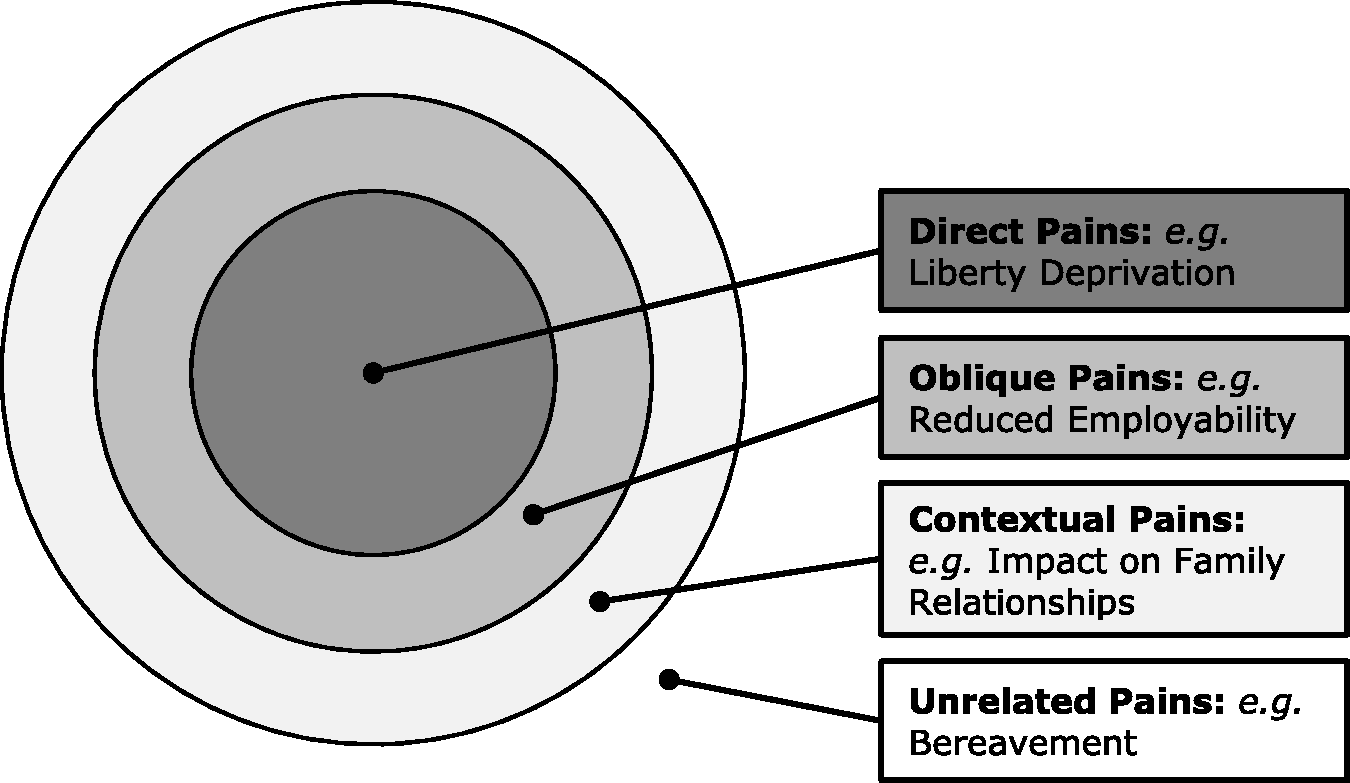
This distribution of pains enables us to revisit the question of which pains should be taken into account when determining the severity of sentences. We might take some or all of these groups of pains into account (with the exception of those which are wholly unrelated to punishment). Although this taxonomy still provides no immediate means of ranking pains of punishment against one another (compare ‘penal impact’ in Hayes (2016)), it does enable us to identify certain groups of pains that are more or less clearly associated with the infliction of punishment, notwithstanding their lack of (penal State) intentionality.
Before discussing these categories in more detail, I should make two observations about the model. First, Figure 1 is not (necessarily) to scale. One penal subject may suffer numerous contextual pains, for instance, and another virtually none. Second, there is no reason to assume that more direct pains necessarily contribute more to the severity of individual sentences. Indeed, several pains that are routinely highlighted as particularly severe by penal subjects, such as the interruption of family relationships, may be wholly contextual, whereas direct pains, such as liberty deprivation, may be comparatively less severe (Hayes, 2015: 91–98; Sexton, 2015: 125–128).
Overview of the proximity model
Subject to those reservations, I now turn to the four categories of pains in more detail. Direct pains are relatively straightforward. They are those pains arising from explicitly intended penal State activities. The obvious examples of this sort of pain are those associated with the deprivation of liberty. When an authority sentences a penal subject to a particular punishment, they intend her to lose some of her freedoms of choice and self-direction, whether through incarceration, or the more partial restrictions of choice arising out of community penalties (Durnescu, 2011: 534–536; Sykes, 1958: 65–78). These deprivations are explicit components of what the sentencing authority wants to happen to the penal subject, and so are easy to identify from either the sentence itself, or the fundamental nature of the modes of punishment it deploys (compare Duff, 2001: 143–155).
Unrelated pains are equally straightforward: they are unintended by the penal State (although they may be intended by other branches of government) and are neither caused nor exacerbated by the conviction and punishment of the penal subject. Thus, they cannot be said to have any proximity to penal State actions at all. The example in Figure 1 is personal bereavement. Suppose I am sentenced to a community order, and thereafter a beloved relative suddenly and unexpectedly dies. One would expect this to hurt me profoundly, but that suffering could not reasonably be linked to the acts of the penal State.
However, it is very easy for initially unrelated pains to become affected by State punishment. Suppose that my relative was terminally ill and my sentence prevented me from visiting him in his final days. Here, the separation of the pains of my bereavement from my punishment becomes trickier. To what extent, if at all, should my personal loss now be considered as part of my punishment’s severity? The two remaining groups of pains, the oblique and the contextual, attempt to resolve some of these definitional issues. Let us discuss each in turn.
Oblique intent and the penal State: An analogy with criminal law
Oblique pains are a relatively narrow class of negative outcomes that the State can be said to indirectly intend. They enable compromise between pure penal objectivism and subjectivism, because they engage with empirical experiences, whilst remaining compatible with the orthodox (Flew–Benn–Hart) definition’s ‘intentionality’ requirement. It does so via an analogy to the concept of ‘intention’ in English criminal law.
The definition of ‘intention’ has consistently confounded criminal lawyers, resulting in a relatively complex definition in the substantive law. To paraphrase the classic example (see generally Pedain, 2003): I ship cargo on a transatlantic flight and secretly hide a bomb on board with the aim of destroying the cargo in order to claim on a lucrative insurance policy I have against it. I have no specific desire to kill the craft’s crew, and whilst I know they will be endangered, I hope that they survive. My only aim is the destruction of the cargo. However, when the bomb detonates, it destroys the aircraft, killing everyone on board.
While it is easy to say that I intend the destruction of the cargo when I detonate the bomb, it is harder to show that I ‘intend’ the aeroplane’s crew’s deaths. Nevertheless, the position of English law is that I may be taken to have intended those deaths, provided that I: (a) accurately foresee the consequence (the death of the crew) as a ‘virtual certainty’ of my actions; and (b) undertake those actions anyway (R v Woollin [1999] 1 AC 82).
It is important to recognise that the substantive law’s use of the concept of ‘intention’ is slightly different to that of the orthodox definition of punishment. The substantive doctrine of oblique intent is a means of deciding whether the subject is culpable enough to be held criminally responsible. In the penal context, by contrast, we are asking whether the pains in question are sufficiently proximate to State agents’ intentions to allow us to take them into account when determining penal severity. But responsibility and severity of impact are not the same thing: the former does not affect the latter, especially if we accept that subjective experience is what constitutes penal severity. We must be cautious, therefore, about taking the legal test out of its conceptual and purposive context, despite the intuitive appeal of holding the State to the same standards to which it holds its citizens.
Nevertheless, oblique State intent is a useful heuristic. It allows us to take some subjective experiences into account when calculating penal severity, without sacrificing our ability to meaningfully define punishment. Specifically, oblique intent contains two relatively narrow classes of pains: general and specific oblique pains.
General oblique pains are those which are virtually certain consequences of criminal conviction and punishment in all cases, but which are not directly intended by the sentencing judge. A good example would be the diminished employability that routinely accompanies a criminal conviction. Internationally, criminological research suggests that convicts will spend an average of two more years than non-convicted job seekers searching for employment, because of the stigma associated with the status of being an (ex-)offender (e.g. Graffam et al., 2008). In other words, all forms of criminal conviction carry an unintended, community-caused effect that is likely to occur (and cause at least some pain) in almost every case.
Accepting general obliquely intended pains into our analysis of penal severity should not mean that we must assume that every (jobless) convict will face exactly 24 months of additional job seeking ahead of them. Some penal subjects will face longer or shorter periods of unemployment, and in any event, each individual will be pained by that unemployment in different ways and to different extents (compare Kolber, 2009b: 1567–1568). The point is that some account can be made of it at sentence – for instance, via a general reduction in the duration and onerousness of sentences by policy-makers, calculated with reference to research findings around the duration and effects of post-conviction joblessness.
This is not really subjectivism, in that it assumes consequences in an individual’s (inherently unpredictable) future on the basis of prior cases. Rather, this category compromises between subjective and objective viewpoints. It allows us to alter our understanding of differences in (highly probable) impact over time, as the relationship between conviction and pain-causing factors changes. This would be difficult and research intensive, undoubtedly, but by no means impossible. The more that phenomena such as reduced employability are explored (and made accessible to sentencing authorities) by social research, the easier it will be to accurately predict the duration and subjective impact of reduced employability in specific cases to a greater extent than is presently attempted.
By contrast, specific oblique pains are those which are virtually certain to arise in the particular case of the sentenced person. It is possible to interrogate the subject’s circumstances much more directly here, using, for instance, pre-sentence reports, which are already a highly influential source of information for Anglo-Welsh sentencing authorities (Nash, 2011).
A good example of specific oblique pains would be those attending upon the loss of one’s home as a result of being imprisoned. These outcomes may be predictable from information available to the court – for instance, where, under the terms of the penal subject’s housing arrangements, conviction results in automatic eviction. The sentencing authority can be virtually certain of the consequence, however much it may not desire it. By recognising the virtual certainty for that person, the possibility of recognising and accounting for the pains that this outcome is liable to cause opens up at the sentencing stage. Again, the enquiry into which pains connect to particular consequences of punishment in particular classes of offenders’ contexts can be explored through social research and its potential to mitigate State punishments set within limits assigned by penal policy-makers.
Thus, oblique State intention allows us to account for a range of subjective factors that are relatively constrained, and which, although they tend to originate outside of the State, are sufficiently proximate to its decision-making that they can be analysed at the point of sentence. They provide an opportunity to substantially moderate the painfulness of penal State interventions, by better accounting for the different circumstances of particular subjects, whether as individuals or as classes. However, it should be recognised that they do ‘objectivise’ individual pains to at least some extent, making them only a partial tool for confronting the challenge posed by differences in impact to the accurate measurement of penal severity.
Contextual pains and State responsibility: Beyond the analogy with criminal law
Contextual pains, by contrast, consist of a much wider array of potential causes and effects. The example in Figure 1 is of the cluster of pains that potentially attend the interruption of family relationships by punishment. This might be relatively total, as with the loss of (direct) contact, outside of visitation, that attends imprisonment (e.g. Crewe, 2011: 511–512). But it might involve suffering arising out of more indirect interference with the freedom to spend time with parents, children, spouses, and other family members. Pains of separation, absence from key developmental moments, or emotionally resonant events can be numerous, chimerical, and yet deeply significant in terms of their impact upon the penal subject’s life (Hayes, 2015: 94–95; Sexton, 2015: 125). In other words, accounting for these pains would achieve a greater deal of fidelity to social reality when measuring penal severity, but doing so would require extremely fine detail on individual convicts’ (predicted) circumstances.
Whilst my analogy with oblique intent was constructed around pains that are (or could be) foreseen as virtually certain at the point of sentence, contextual pains are less predictable. They cover a wide variety of actions and reactions by groups formally unconnected to the penal State, including but not limited to: other public organisations, such as the welfare State and social services, charities and other third-sector organisations, private companies, community forces, friends and family, and indeed penal subjects themselves.
Most significantly, however, these actors cannot influence the sentencing authority, in that they may not be foreseeable, let alone virtually certain, sources of pain at the point of sentence. However, unlike unrelated pains, contextual pains bear an indirect connection to the subject’s conviction and punishment. Pains that already existed in the penal subject’s life could be affected (positively or negatively) by the sentence, and new pains may be caused by the reactions of wider social actors to it. In both cases we can say that, whilst not necessarily foreseen or even foreseeable by sentencing authorities, these sources of pain are still proximate to the State in that pains are caused by penal intervention.
I use causation here in a broader sense than the substantive law. Essentially, the law first identifies a broad range of factors that the outcome could not have occurred without (R v White [1910] 2 KB 124), before narrowing down those factors to those which ought to render the relevant actor legally responsible (e.g. R v Kennedy (No. 2) [2007] UKHL 38, [2008] 1 AC 269; for an influential theorisation of this approach, see Hart and Honoré, 1985: 109–129). But again, we are not concerned here with the State’s responsibility for the pains of punishment. Rather our focus is the impact that those pains have on that punishment’s severity. In other words, our field of enquiry is broader here than in the legal determination of guilt, and so a broader definition of causation is appropriate.
However, there is reason for caution when incorporating contextual pains into the measurement of penal severity. At its most extreme, this category could encompass virtually any suffering experienced over a period starting before, during, or long after formal punishment is imposed. Moreover, since social experiences are rarely, if ever, the results of isolated causes, pains are likely to overlap in unpredictable ways. Where one subject might well distinguish between particular pains (‘X hurts, and so does Y’), another may not (‘I am in pain’). Arbitrarily separating out different categories of pains in the latter case risks both researcher bias and the very ignorance of difference that the model is intended to avoid. In short, distinguishing contextual and unrelated pains, and recognising their experienced impact, requires careful, critical, and work-intensive empirical study.
Despite these difficulties, however, there are compelling reasons to take at least some account of contextual pains: first, because of the particular need to recognise the impact of external actors upon the experienced pains of punishment; and second, because of the general inaccessibility of contextual pains to sentencing authorities.
The role that non-State actors play in criminal justice is inevitably controversial. The State’s monopoly over criminal justice is an entrenched political value in England and Wales (and in much of the Global West), in part because of that system’s emergence as a means of replacement for destabilising private revenge. State punishment derives its legitimacy in part from the belief that it has ‘civilised’ the brutality of feudal retaliation by channelling it through impartial, dispassionate institutions (e.g. Beccaria, 1764; Elias, 1994; compare Ignatieff, 1981). The intrusion of non-State actors is therefore a significant disturbance of the State’s traditional role in attributing guilt and punishment.
Moreover, if the State is not a monopolist of punishment, it cannot guarantee that the suffering it imposes is constrained by any principle of proportionality, parsimony, or penal minimalism. It is compelled: either to attempt to stop third parties from paining the penal subject without explicit State permission; or to accept that it plays only a partial role in punishing the individual, and mediate its own actions accordingly. All else is a retreat back towards the unsatisfyingly shallow accounts of pure objectivism.
Even if we might want to achieve something like an abstract liberal vision of the punished individual in relation to their punishing society, in which punishment is abstract deprivation of political liberty, under the full control of the State (see, e.g., Markel and Flanders, 2010), we need to recognise that it does not describe modern criminal justice, certainly not in contemporary England and Wales. This is particularly the case in an era marked by a ‘dispersal of discipline’, in which punishment is increasingly inflicted alongside the subject’s everyday life, and where it therefore interacts with a wide range of social actors who might influence the experienced pains of punishment (Cohen, 1985). We must recognise the impact that agents beyond the penal State can have upon punishment’s subjective experience, despite the difficulties, because it is increasingly harder to separate out the penal from the wider social experience of the penal subject. If we are to meaningfully evaluate punishment, we must confront the institution as it is, and not as we would wish it to be (Tonry, 2014).
A further reason for taking some account of contextual pains is their very inaccessibility to sentencing authorities, and therefore to formal evaluations of expected penal severity. By definition, contextual pains are insufficiently foreseeable to be accounted for accurately in determining likely penal severity. They cannot be ‘objectivised’ in the way that oblique pains can, since it is much harder to accurately identify the factors that cause them, both in individual cases and in general. Thus, a sentencing authority seems compelled either to ignore these factors (and the differences in impact they may cause), or to make rough estimates of their likely impact, at a cost to legal certainty.
However, there is another option: penal policy, informed by social research, can take greater account of contextual pains of punishment. Over time, policy-makers could build up mechanisms for (a) recognising the factors that affect their incidence, such that they can be foreseen as virtual certainties (transforming contextual pains into general or specific oblique pains); and (b) reforming guidelines for and constraints of judicial decision-making, to recognise patterns in penal subjects’ experiences. Both approaches can play a role in providing a wider account of how specific contextual pains affect the experienced severity of the penal subject’s sentence, without fully surrendering the ability to separate punishment from its surrounding contexts. A proximity-based account of penal severity can therefore assist in the development of a more socially accurate criminal justice system that is more capable of doing justice in context.
The proximity model in penal policy and practice
This overview of the different levels of proximity of the pains of a given punishment to the penal State has been necessarily brief. It is not intended as a complete or even partial basis for public policy reform, but more as the first step towards setting a research (and policy) agenda. However, even this brief sketch enables us to identify some implications for criminal justice policy and practice. In this final section, I therefore explore different ways in which penal policy-makers and sentencing authorities might utilise a proximity model to close the gap between what we think we do as punishing communities, and what we actually do.
Before doing so, however, it is important to think about the different ways that a system might approach severity, penal moderation, and the impact of subjective experience. In particular, one should avoid confusing normative attempts to prescribe how severe a prospective punishment should be with the evaluative, retrospective analysis of how severe a particular punishment actually was (compare Duff and Green, 2011). At the prescriptive level, where sentencing decision-making occurs, any engagement with subjective experience must tread a very fine line.
First, even allowing for modern improvements of social science’s reach and scope, one can never predict the subjective experience of an individual subject. The experience of any punishment is unique, coloured by the subject’s context, attitudes, experiences, preconceptions, and surroundings during and after punishment, including but by no means limited to the site/s of the punishment/s imposed (Liebling, 2004).
Second, using previous experience to construct guidance for prospective judgements about an individual’s prescribed experience of penal severity is inherently fraught with difficulty. Especially when information about subjective experience is almost exclusively acquired through small-scale qualitative social research projects (e.g. Durnescu, 2011; Hayes, 2015; Sexton, 2015), there is a danger of overgeneralisation. For instance, whilst it might be possible to say that the rich suffer a greater reduction of their living standards in comparison to a poorer person through imprisonment, it does not follow that all wealthy penal subjects are affected equally as badly, or that we can precisely map levels on subjective suffering to net income (Beccaria, 1764: 51–52; Kolber, 2009a: 230–235). If sentencing authorities are to take the subjective experience of punishment into account when calculating penal severity, then they require highly tailored guidance that is as accurate as possible about how and to what extent specific circumstances are liable to increase or decrease the severity of the sentence.
Without wishing to downplay the difficulty of that task, it can at least be ameliorated by the evaluative measurement of penal severity. By examining how severely punishments have affected the lives of their subjects, one can build up a picture which is, if not predictive of future outcomes, at least capable of approximating it more closely, increasing the level of fidelity between legal norms and social experience. Doing so, however, requires an appreciation of the varying ability of different actors to identify pains in practice.
Who can foresee indirect pains?
Foreseeability of pains at the sentencing and policy levels
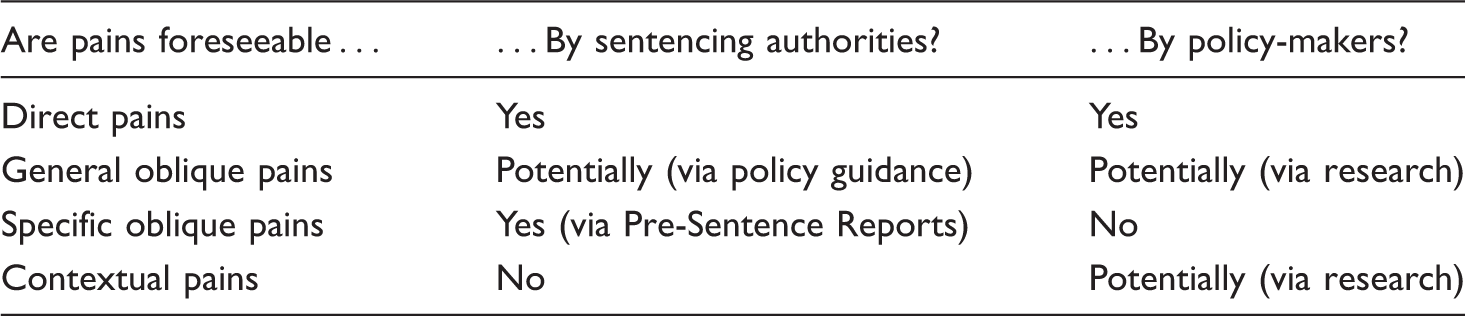
Any account of all categories within the proximity model, in other words, requires dialogue between the sentencing and policy levels. Several implications arise for both sets of decision-makers when using more proximity-based conceptions of penal severity. These are discussed below.
Implications for sentencing practice
A proximity-based approach to penal severity need not mean any significant alteration of the role of the judiciary. After all, subjectivism has always been a (limited) reality of Anglo-Welsh sentencing practice, due to the role played by judicial discretion and pre-sentence reports (Nash, 2011). Rather, it would mean more formal recognition of the existing role that these subjective factors play, the protection of sources of information about them, and a more structured approach to ensuring that as full a range of pains as possible can be taken into account.
In particular, a proximity model would neither oppose nor support the existing Anglo-Welsh practice of using aggravating and mitigating factors in Sentencing Council guidelines to ‘fine-tune’ a sentence after guilt has been determined. However, it is important to note that the present use of sentencing guidelines, and particularly of personally mitigating circumstances as they currently stand (Jacobson and Hough, 2011) can only partially contribute to this process.
In fact, the presently recognised range of personally mitigating factors does not do much for the intersubjective gauging of penal severity. They provide classes of contextual factors, leaving the judge with a wide discretion but little guidance as to how much weight to accord to each. This can allow judges to recognise subjective differences between subjects (Jacobson and Hough, 2011: 161–162), but formal guidance is still restricted to observations about classes of people, which, as discussed above, is a crude measure of difference at best. Present systems of personal mitigation would at least need to be fine-tuned to deliver proximity-relevant material, particularly as regards the weighting of individual factors.
Moreover, the role of aggravation and mitigation in present sentencing guidelines focuses heavily upon criminal acts, rather than convicts’ circumstances. Whilst there are many factors that speak to the likely prospective impact of the order on the penal subject (and third parties), these must wait until after an initial judgement as to the factors that indicate the harm and culpability for the crime itself. It is only at this latter point, when the range of potential sentences has been more or less decisively laid down (Padfield, 2011), that mitigation or aggravation based on the penal subject’s contexts can take place. This limits the ability of personal mitigation to affect overall penal severity and places more emphasis on the role of policy-makers in guiding judgements at the sentencing stage.
In short, personal mitigation is not enough by itself to serve as a vehicle for proximity-based severity judgements. Courts would need to take a more holistic perspective on sentencing, looking at the subject’s conduct in comparison with the pains that the sentence is likely to inflict on the specific individual in her unique contexts, insofar as the court is aware of them. Achieving this would not necessarily require new tools but rather a different approach to how they are used in practice.
Although that perceptual shift need not require considerable institutional reform, it would nevertheless profoundly affect sentencing practice. In particular, one impact of adopting a proximity model of penal severity would be the realignment of judicial attitudes towards alternative punishments to imprisonment. When approaching punishment as an abstract liberty deprivation, rather than a series of subjective experiences or ‘pains of punishment’, empirical evidence suggests that it is easier for judges to aggravate an onerous community penalty into a custodial sentence than to mitigate imprisonment into a non-custodial sentence (Hough et al., 2003; Padfield, 2011). However, on a pains-based account, liberty deprivation is only one potential source of punishment. Community-based punishments are not so much less punitive, therefore, but punitive in different ways, and suited to different individuals as well as different offences. Recognising the pains of all types of punishments, and indeed the pains inherent in criminal conviction itself, would provide one route towards improving the perceived legitimacy of non-custodial sentences (McNeill, 2011; Robinson et al., 2013).
It is important to remember that the capacity of social scientific advances in the retrospective recognition of contextual and oblique pains to assist predictive sentencing will always, inevitably, be partial. The objective of the proximity model at the point of sentence cannot and should not therefore be to set up the judiciary as prophets, capable of accurately predicting social experiences. To do so would create a judicial interest in monitoring the precise level of pain experienced by the penal subject, encouraging the State towards behaviour ‘dangerously approaching sadism’ (Markel and Flanders, 2010: 915). Instead, we should aim to close the gap between the predictions of penal severity that objectivised sentencing already makes and the social reality experienced after sentence has been passed. To do so, however, requires access to retrospective information unavailable to sentencing authorities. The involvement of penal policy-makers would thus be vital, both to guide sentencing decisions and to avoid increasingly punitive sentencing practice.
Implications for penal policy
Whilst the implications for sentencing practice are confined more to a change of perspective than of practices, the transition to a proximity-based account of penal severity would imply a more significant shift at the level of penal policy. Since penal policy-makers are able to access research findings on general oblique and contextual pains that sentencing authorities cannot consider, the proximity model would require them to engage with as wide a range of pains as possible, and build them into existing laws, guidance, and judicial education in a way that enables judges to pre-empt subjective experiences with greater (virtual) certainty.
Overall, then, the task for penal policy would be to reform the law to better recognise the impact punishments have when calculating penal severity; to commission and engage with research to identify the circumstances in which particular pains attend certain penal interventions, so that they can be incorporated into judicial decision-making as oblique pains of punishment; and to address the influence of external sources of contextual pains in determining penal severity.
This latter task, in particular, is one of deciding which contextual pains are unavoidable, and which can be minimised through wider policy interventions. It is one of deciding to what extent it is appropriate (and desirable) for communities and other external forces to partially determine the experienced severity of punishment. Any recognition of punishment as a social phenomenon implies that the State must recognise at least some ability of wider social context to affect penal severity, but beyond that, the precise level of recognition that contextual pains are an inevitable feature of punishment remains debatable.
This is, if nothing else, an opportunity for further research and refinement of the proximity model, which has, after all, been presented in a very broad-brush, abstract manner. Examining which factors affect subjective experience of pains in general is a good start, but exploring the structuring impact of factors such as age, ethnicity, gender, and socioeconomic class will help to refine and clarify how pain is currently distributed amongst penal subjects. This will allow us to identify the distance between what is and what should be (at the level of policy, but also of political ethics) with more precision, providing targets for more specific and wide-ranging policy (inside and out of the penal State) in future.
However, it should be noted that concern with fine-tuning penal severity has not been at the top of the recent penal political-economic agenda of England and Wales, which has been characterised for much of the last 40 years by a ‘law and order arms race’ (Lacey, 2008: 173–185). The prospects of a proximity model actually influencing current penal policy are therefore bleak, and one ought not to prematurely assume that the present shift away from explicit punitiveness towards managerialism in penal politics will make it any easier to encourage policy developments in this direction.
Under these conditions, the researcher must be an advocate for policy consistent with their work, by contributing to public discourses (and therefore, democratic decision-making) through a robust, honest, and unbiased account of their findings. In other words, the proximity model is not much use unless any academic proponents take seriously the public, and inherently political, nature of social research in democratic societies (Loader and Sparks, 2011; Noaks and Wincup, 2004: 19–35).
Conclusion: Proximity, pain, and the justice of punishment
The orthodox definition of punishment is a descriptively unsatisfactory account of contemporary sentencing practice, forced by an historical and ongoing dilemma between objective clarity and expeditiousness, and subjective detail. It is possible to at least partially escape this dilemma by providing for at least some acceptance that the severity of a punishment is constituted by its social experience, that is by the subjective pains it actually engenders.
We can typify the relationship between pains in terms of their proximity to the formal State punishment imposed. They may be pains that are directly intended by the sentencing authority; obliquely intended pains arising from either the general consequences of conviction or punishment, or the specific known circumstances of the penal subject; contextual pains that arise out of the multiple contexts of the punishment in question, which react to and intersect with the penal intervention; or wholly unrelated pains coincidental to penal processes. All but the latter have a part to play in measuring penal severity subjectively.
The proximity model is far from a perfect solution to the problem of doing just deserts in an unjust world, and whilst it is given here in a relatively broad and abstract form. Nevertheless, it provides a way of thinking about measuring penal severity that could increase the fidelity between the punishments that the State believes itself to be imposing in criminal sentences, and the pains actually experienced as a result. Adopting such an approach would improve the accuracy of our measurement of penal severity, and so our ability to evaluate the extent to which criminal justice is done in practice. However, formal adoption of a proximity-based approach to sentencing would mean concerted shifts in both sentencing practice and penal policy, which will only be practicable through academic contribution to public discourse. This, in turn, requires further academic research into the precise proximities of the pains of punishment to the imposing State.
Footnotes
Acknowledgements
This article draws upon doctoral research undertaken at The University of Nottingham, which was supervised by Dirk van Zyl Smit and Candida Saunders and examined by Fergus McNeill and Paul Roberts. I am also indebted to Gwen Robinson, Joanna Shapland, and Stephen Farrall for comments on earlier drafts of this paper. Finally, thanks are due to the editor and anonymous reviewers for their extremely helpful critique of this paper, from which it has benefitted immensely.