




Abstract

EDITORIAL
Be it our dreary or unexpectedly hot summers (this last one is a perfect example) or our drizzly or unexpectedly snowy winters, the most recent record-setting weather event is quick to be a conversation starter. The last few years however might leave one with the feeling that a world with less conversationally interesting weather would be a better one; that feeling can only be solidified after watching the Southeastern US brace for multiple hurricanes and suffer devastating losses in the face of yet more unparalleled weather.
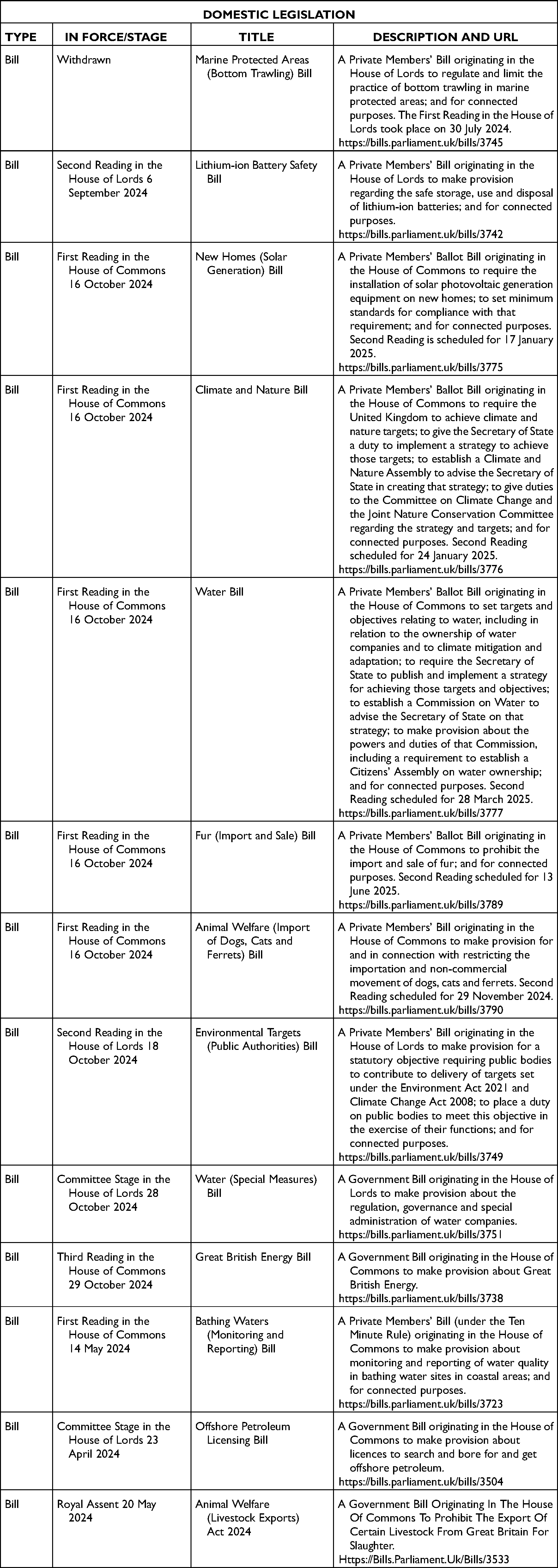
No doubt in the face of such concerning weather trends many are hopeful change is coming, as is often the case after a change in government. Unsurprisingly, the first 100 days of a new government involves a flurry of activity. There was an abundance of new Bills focussing on climate change, the environment and issues arising from forward movement. For example, we saw the Second Reading of a Lithium-ion Battery Safety Bill in September which focussed on increasing safety around an important tool for energy efficiency. Other interesting Bills include the New Homes (Solar Generation) Bill and the Environmental Target (Public Authorities) Bill.
In September, Friends of the Earth succeeded in quashing the previous Secretary of State's decision to grant permission for a new coal mine in Whitehaven, Cumbria. The High Court found there had been a failure even to assess the impact of the inevitable consequences of extracting coal. A string of injunctions was granted in response to anticipated activist activities/protests: injunctions were granted for both known and unknown activists associated with Animal Rising, Just Stop Oil, Reclaim the Power, Axe Drax, Extinction Rebellion and other environmental activists. On a related note, in R v Smith (Joshua), the Court of Appeal found when considering s78 of the Police, Crime, Sentencing and Courts Act 2022 that whilst “serious harm to a section of the public” could not be interpreted as a single individual, there was no minimum number of people and thus even a small group could fairly be described as a section of the public.
Read on for more updates.
Update
Anna McClean
Verity LJ Adams, Thomas Langley and Sophie Johnstone
EU LEGISLATION AND TEXTS
Commission Notice on phasing out financial incentives for stand-alone boilers powered by fossil fuels under the recast Energy Performance of Buildings Directive C/2024/7161
The recast Energy Performance of Buildings Directive (‘recast EPBD’) sets out how the European Union (EU) can achieve a fully decarbonised building stock by 2050 via a range of measures that will help EU governments structurally boost the energy performance of buildings, with a specific focus on renovating the worst-performing buildings.
https://eur-lex.europa.eu/legal-content/EN/TXT/?uri=CELEX%3A52024XC06206&qid=1729529152419
COMMISSION DELEGATED REGULATION (EU) …/… of 18 October 2024 amending Regulation (EU) 2024/1157 as regards changes on shipments of electrical and electronic waste agreed under the Basel Convention C/2024/7199 final
The Union and its Member States are Parties to the Basel Convention on the control of transboundary movements of hazardous wastes and their disposal (‘the Basel Convention’), which was adopted on 22 March 1989 and entered into force in 1992 1. The Basel Convention has 191 Parties. The Conference of the Parties of the Basel Convention decided at its fifteenth meeting on 17 June 2022 to include all electrical and electronic waste under the control mechanisms of the Convention (Decision BC-15/18). These types of waste will be included in Annexes II and VIII of the Basel Convention. The current entries for such waste in Annexes VIII and IX will be replaced by the new entries. These changes will improve controls of transboundary shipments of electrical and electronic waste, thereby encouraging their environmentally sound management and contributing to curb illegal cross-border movement of waste. These changes will become effective on 1 January 2025. The new entries in the Basel Convention concerning electrical and electronic waste will become effective as of 1 January 2025 on a global level.
https://eur-lex.europa.eu/legal-content/EN/TXT/?uri=PI_COM%3AC%282024%297199&qid=1729529152419
DOMESTIC CASE LAW
Administrative law
Loveluck v Natural England [2024] EWHC 2404 (admin)
The claimant sought permission for judicial review of the decision by Natural England to confirm notification of land in Cornwall as a Site of Special Scientific Interest under s. 28 Countryside Act 1981. The court found that although some surveys were old and some surveys were desktop surveys, other surveys were carried out more recently. Whilst it was acknowledged that more surveys could have been carried out, it was for Natural England with its expertise to weigh up the evidence before it. The fact that the claimant disagreed with many parts of the evidence did not render Natural England's decision irrational. The court also dismissed the claimant's argument that Natural England's decision was unlawful because it took into account matters on which there was no evidence, such as climate change and biodiversity decline. It held that the purpose of Natural England is nature conservation and it was entitled to use its expertise in such matters as climate change. The court held that none of the grounds were arguable and refused permission.
R (on the application of Fighting Dirty Ltd) v Environment Agency [2024] EWHC 2029 (admin)
The claimant applied for judicial review of the Environment Agency's decision to remove the target date for implementing its sludge strategy without identifying a replacement target date. It had been agreed that the target date of 2023 had become unachievable as there was insufficient time for implementation by exercise of the Environment Secretary's powers. The claimant argued that the failure to include a replacement target date was incompatible with the EA's public law duty to act reasonably. The court rejected this argument and refused the application. It found that the EA had publicly recognised the need for regulatory change and had a commitment to progress this objective and held that there could never be a commitment to legislative action by the Environment Secretary. The legislative powers resided with the government and the target date was therefore necessarily aspirational. It was not an environmental emergency, and the use of sludge was not unregulated, so it was not an assessed temporal imperative and the action of not including a target date in the strategy was not outside the range of reasonable responses open to the decision-maker.
Environmental assessment
Friends of the Earth Ltd v secretary of state for levelling up, housing and communities [2024] EWHC 2349 (admin)
The claimants applied under s. 288 Town and Country Planning Act 1990 to quash the secretary of state's decision to grant planning permission for a new coal mine. The court found that the burning of coal from the mine was an inevitable consequence of its extraction and the GHG emissions from that combustion were a significant, likely indirect effects of the project (R (oao Finch) v Surrey CC [2024] UKSC 20 followed) that must be assessed under the Town and Country Planning (Environmental Impact Assessment) Regulations 2011. It held that the failure to assess these impacts was a freestanding reason for the decision to be quashed, irrespective of the developer's argument that the coal from the new coal mine would replace more expensive coal from US coal mines and there would therefore be a perfect or virtually perfect substitution and no net increase in emissions. The court held that in order to succeed with the substitution argument, the developer had to show that there was a very high degree of substitution and that there would be no other demand for US coal substituted by coal from the new mine. The court found that the environmental statement did not address either of these points and its claim that there would be no net increase in GHG emissions was a matter of assertion that was not assessed and held that these omissions on a subject of fundamental importance to the EIA of the proposed development met the test of unlawfulness.
Planning law
Bain v Secretary of State for Transport [2024] EWHC 2216 (admin)
The claimant applied under s. 118(1) Planning Act 2008 for judicial review of the A38 Derby Junctions Development Consent Order 2023 which granted consent for the construction of replacement roundabouts. The claimant argued that the secretary of state had acted unlawfully in relying on an economic assessment of the development carried out in 2019 which was out of date by the time of the August 2023 decision to make the Order. The court held that the secretary of state had not misinterpreted para. 4.5 National Policy Statement for National Networks when concluding that National Highways was not required to submit an updated economic assessment. Para. 4.5 did not require the economic assessment to be revised and recalculated by reference to updated guidance. It also held that the secretary of state had reached a reasoned conclusion for the purpose of reg. 21(1)(b) and reg. 21(2) Infrastructure Planning (Environmental Impact Assessment) Regulations 2017 on the basis that he was satisfied that he had addressed the likely significant effects of the development on the environment.
R (on the application) of Jones v Cornwall Council [2024] EWHC 2198 (admin)
The claimant sought judicial review of Cornwall Council's decision to grant outline planning permission for 5 dwellings to include affordable housing on the edge of the Cornwall AONB on the grounds that the Council did not give adequate reasons for its decision. The court held that the reasons given, although briefly stated, were adequate. It was not necessary to set out in great detail the level of harm to the landscape and AONB and it was sufficient to say that such harm was not significant. It found that great weight had been accorded to the urgent need for affordable housing, which in policy terms was described as a crisis. It also held that the claimant had not been genuinely and substantially prejudiced by the level of reasoning.
R (on the application of Boswell) v Secretary of State for Energy Security and Net Zero [2024] EWHC 2128 (admin)
The claimant applied for judicial review of the secretary of state's decision to grant planning permission for a new gas-fired electricity-generating station with post-combustion carbon capture. The secretary of state's decision letter found that the cumulative whole-life greenhouse gas emissions were a significant adverse effect carrying significant negative weight in the planning balance but ultimately concluded that the development would help to deliver the government's net zero commitment. The claimant argued that the decision letter did not give legally adequate reasons for the conclusion that the development would help deliver the government's net zero commitment and had assessed the greenhouse gas emissions for the purpose of the Infrastructure Planning (Environmental Impact Assessment) Regulations 2017 by reference to guidance published by the Institute of Environmental Management and Assessment rather than by reference to national policy statement EN-1. The court held that although the secretary of state had used the IEMA guidance, when the decision letter was read sensibly and as a whole it was clear that the secretary of state was not relying on the IEMA guidance for her conclusion on significance. It further held that the secretary of state's reasons made perfect sense if they were read in such a way that she was applying the more absolute analysis at the environmental impact assessment stage and then weighing that against the broader policy context of transition to net zero at the substantive stage. It found that the appellant clearly disagreed with the secretary of state's support for the development and was seeking to use the case as a way of challenging the policy support for the development by trying to find an inconsistency in her analysis where none actually existed.
Weiss Development Co Ltd v Scottish Ministers [2024] CSIH 23
A developer appealed the decision by a reporter appointed by the Scottish Ministers to refuse an appeal against the inclusion of a building on the list of buildings of historic or architectural interest. The court held that the reporter had taken too narrow a view of her role by only considering whether the building was of architectural or historic interest and taking the approach that the appellant's concerns about the transparency and fairness of the listing process were not relevant to the appeal. The court held that whilst the reporter was not to embark on a frolic of her own by seeking out and founding upon information not placed before her, it should have been obvious to the reporter in this case that the appellant entertained profound concerns about the fairness, transparency and legality of the process that had been followed, particularly in light of the reversal of Historic England's original decision not to list the buildings in circumstances where nothing of any material relevance had changed in the interval between the decisions.
https://www.bailii.org/scot/cases/ScotCS/2024/2024csih23.html
Rae v Glasgow City Council [2024] CSOH 74
A resident living near to 4 high rise blocks petitioned for judicial review of the planning authority's adoption of a screening opinion under reg. 7 Town and Country Planning (Environmental Impact Assessment) (Scotland) Regulations 2017 that an environmental impact assessment was not required for the demolition of the blocks. The court held that the precautionary principle set out in the preamble of the EIA Directive made it clear that if the local authority was left in material doubt as to whether an EIA was required, it should require one. However, the material doubt had to be one that appeared in the mind of the local authority or that it was irrational not to entertain. The court did however find that the in assessing the relevant criteria informing its decision on its screening opinion, the local authority had applied the wrong test, asking itself whether the proposed development was likely to have a significant adverse effect on the environment whereas the proper test was whether it was likely to have a significant effect of any kind on the environment. The court found that this error was an error of law but exercised its discretion to refuse to reduce the adoption of the screening opinion.
https://www.bailii.org/scot/cases/ScotCS/2024/2024csoh74.html
Ward v Secretary of State for Housing, Communities and Local Government [2024] EWHC 1780 (admin)
The claimants applied to quash a planning inspector's decision (on behalf of the secretary of state) to uphold the refusal of planning permission for a mobile home and stable block. The claimants, who were travellers, had their application for planning permission refused by the local authority and their appeal was delayed by the COVID-19 pandemic and was still pending in 2020 when they moved their mobile home onto the land stating that personal circumstances left them with nowhere else to go. The tribunal held that the inspector had understood and explained the claimant's argument that because they were already occupying the site when Natural England's guidance in water neutrality was issued, there was no increase in water usage to account for. It held that the inspector was entitled to find that the cases the claimant's relied on were factually distinguishable and to ground his approach in the specific circumstances of the claimant's case, and that his approach was consistent with Natural England guidance and represented a lawful approach under reg. 63(5) Conservation of Habitats and Species Regulations 2017.
R (on the application of Save Stonehenge World Heritage Site Ltd) v Secretary of State for Transport [2024] EWCA CIV 1227
The appellant appealed the High Court's decision to refuse its application for judicial review of the respondent's decision to grant development consent for road improvement works that involved the replacement of the existing single-carriageway road with a dual carriageway of 13 km in length. The court held that although it now seemed unlikely that the proposed development would be constructed, the development consent remained extant and the appeal was therefore not merely academic. The Court dismissed the appeal on the majority of grounds but allowed the appeal on the ground that the judge was wrong for not treating the interpretation of the World Heritage Convention as a matter for the court and for holding the secretary of state's view on compliance with it was tenable.
Environmental information
Bristol City Council v Information Commissioner [2024] UKFTT 812 (GRC)
The appellant appealed under s. 57 Freedom of Information Act 2000 against the defendant's decision that the Council was not entitled to rely in reg. 12(4)(b) Environmental Information Regulations 2004 (manifestly unreasonable) to refuse a community group representative's request for copies of correspondence and notes of discussions regarding the condition of the walkways around the perimeter of playing fields. The tribunal found that a large number of related, very similar requests had been submitted to the Council within a relatively short space of time. Whilst the purpose of the community group's campaign was not to harass the Council, the volume of requests, the nature of content of the requests, and the breadth and volume of the date requested amounted to an oppressive burden on the Council. The tribunal found that there was a degree of public interest in the disclosure of the information requested if the requests had been considered individually and in isolation. However, the limited public interest and aggregate burden of dealing with all the requests meant that the public interest in maintaining the exception in reg. 12(4)(b) outweighed the public interest in disclosure.
Naylor v Information Commissioner [2024] UKFTT 803 (GRC)
The appellant appealed the Information Commissioner's decision to uphold Pembrokeshire County Council's decision to refuse to disclose a report in relation to the development of South Quay in reliance of reg. 12(4)(e) (internal communications) and reg. 12(5)(f) (adverse effect on the interests of the information provider) Environmental Information Regulations 2004. The tribunal considered that if the report requested had been a draft report then it is likely that the internal communications exception would have to apply as it is important that whilst the report was being prepared there was a ‘safe space’ where ideas could be discusses. However, the document requested was a final report prepared by professional and qualified auditors and had been disclosed to an external agency, Audit Wales. In response to the Council's argument that the disclosure would inhibit policy making, the tribunal noted that the report was not a policy and there was no connection between the disclosure of it with any internal discussion in relation to policy. The tribunal also found that reg. 12(5)(f) had not been engaged as it could not identify any individual who had been named other than by reference to their position within the Council, all of whom would have been under a legal obligation by virtue of their position to provide the content of the report.
Tristram v Information Commissioner [2024] UKFTT 802 (GRC)
The appellant appealed the Information Commissioner's decision that National Highways was entitled to rely on reg.12(4) Environmental Information Regulations 2004 to refuse to disclose the percentage figure of those who when responding to a consultation about a road scheme objected to it. National Highways did not have this percentage but did have raw data from which it may have been possible to calculate the percentage. However, there was no question which specifically asked whether the consultation respondent objected to the scheme and to find this out National Highways would have to read each response and then make a subjective decision whether they read as objecting. National Highways would therefore have to manipulate the raw data to such an extent that the Information Commissioner was correct to find that it did not hold the information. It also found that the public interest balance fell against requiring National Highways to analyse the raw data so as to hold the information sought.
Mooney v Information Commissioner [2024] UKFTT 620 (GRC)
The appellant appealed against the Information Commissioner's decision that Lincolnshire County Council was entitled to rely on reg. 12(4)(d) (material in the course of completion) and reg. 12(4)(a) (does not hold the information) Environmental Information Regulations 2004 to refuse the appellant's request for information relating to its Mineral and Waste Local Plan. The tribunal found that although the deadline for the document had been extended, this was due to the large number of comments and site nominations received and did not suggest that active work on the document had stopped. It therefore held that the request did relate to material in the course of completion and that the public interest favoured maintaining the exception. The tribunal dismissed the appeal.
Mooney v Information Commissioner [2024] UKFTT 738 (GRC)
The appellant appealed the Information Commissioner's decision that Lincolnshire County Council was entitled to rely on reg. 12(4)(a) Environmental Information Regulations 2004 (does not hold the information) to refuse the appellant's request for information relating to its Mineral and Waste Local Plan. The information requested related to decisions and action taken by the Council in its position as landowner. The tribunal accepted that the Council had conducted appropriate searches and the appellant had failed to properly demonstrate any material error either of law or in the exercise of his discretion by the Information Commissioner and dismissed the appeal.
Nuisance
R v Smith (Joshua) [2024] EWCA CRIM 1040
The appellants appealed against their convictions for the offence of causing a public nuisance contrary to s. 78 Police, Crime, Sentencing and Courts Act 2022. The appellants had taken part in a pre-arranged ‘Just Stop Oil’ protest at the British Grand Prix in 2022, during which they climbed over fences and sat down on the racetrack. They were charged under s. 78 on the basis that their actions created a risk of serious harm to a section of the public. At their trial, the appellants made submissions of no case to answer. The prosecution's case had been on the basis that the persons at risk had been 2 racing drivers and the appellants’ case had been that the drivers were individuals rather than a section of the public. In this case, the appellants argued the judge in the first instance had been wrong to refuse their submissions of no case to answer, in particular because he should have held that no jury, properly directed, could find that the appellants had created a risk of serious harm to a section of the public. The court dismissed the appeal. It held there was whilst risk of harm to a single person would not amount to a risk to a section of the public, there was no minimum number of people that had to be placed at risk. It would be a question of fact whether a small group could fairly be described as a section of the public. The court further held that the judge had wrongly focused on the risk which was created when the appellants reached the track but that this error was one that worked to the appellants’ advantage and did not render their convictions unsafe.
Arla Foods Ltd v Persons Unknown [2024] EWHC 1952 (Ch)
The claimants, a major UK dairy producer, sought an injunction against 6 identified and 6 categories of persons unknown to restrain future acts of protest by animal rights activists associated with Animal Rising at 4 of its production and distribution sites. The claimant had been previously targeted by animal rights protestors and in August 2022 became aware of a large-scale plan to disrupt the dairy supply in the UK in September. They obtained interim and without notice relief against persons unknown to restrain apprehended unlawful acts of protest. The court granted the application. It held that art. 10 and art. 11 European Convention on Human Rights did not provide a defence to what would otherwise constitute a trespass. It found that there was a strong probability that the named defendant would act in breach of the claimant's rights unless restrained by an injunction and that there was a real and imminent risk of further direct action by the persons unknown if an injunction was not granted.
Drax Power Ltd v Persons Unknown [2024] EWHC 2224 (Kb)
The claimant applied for a without-notice injunction against persons unknown to protect a power station from trespass and nuisance by persons connected with the environmental groups Reclaim the Power and Axe Drax. The court granted the application. It held that the injunction was justified but its wording had to be considered carefully. It held that there was a real and imminent threat of direct action which could have very serious consequences (disruption of the power station would threaten continuity of power supply in the UK) and the protestors had no real defence. The claimant had set up a protest area where the protestors could carry out lawful protests. Alternative remedies were not sufficient.
Manchester Airport Plc v Persons Unknown [2024] EWHC 2247 (Kb)
The claimants applied without notice for an injunction restraining persons unknown from trespassing on airport land. The protest group, Just Stop Oil, had indicated on the internet that it intended to carry out protests at UK airports in summer 2024 as part of its campaign of disruption against the use of fossil fuels. The court granted the application. It held that there was clear evidence of an intention to target airports in a disruptive way and that threat was real and imminent. Security was also paramount at airports and such protests could be a mask for terrorist incidents. Alternative remedies were only enforceable after the action had taken place and would not prevent the action or threat in the first place. Any interference with protestors’ rights under art. 10 and art. 11 European Convention on Human Rights due to the inclusion of public highways within the injunction was outweighed by the compelling need for an injunction. The injunction was granted and would be reviewed in 12 months.
Leeds Bradford Airport Ltd v Persons Unknown [2024] EWHC 2274 (Kb)
The claimants applied for an ex parte injunction against persons unknown to exclude them from 3 UK airports (Leeds Bradford, Luton, and Newcastle). The claim was for a quia timet injunction preventing trespass, public nuisance and private nuisance and related to various threats by environmental organisations (Just Stop Oil and Extinction Rebellion). The court granted the application. It held that the evidence showed a risk of trespass and private/public nuisance and there was no defence. It held the test for an ex parte injunction against persons unknown was not the balance of convenience but whether there was a compelling justification for granting the injunction. The court had to consider the threats made by JSO, which had a history of seeing its threats through, and direct activity which had taken place at other UK airports. It took account of the particular sensitivity of airports to disruption by unlawful protests, the human rights of passengers and risk of significant disruption during the summer season, and the knock-on effect on employment and business in the airport. There was therefore compelling justification for granting the injunction and damages were not an adequate remedy.
Re McAleenon's Application for Judicial Review [2024] UKSC 31
The appellant lived near a landfill site and claimed to have suffered physical symptoms as a result of inhaling noxious emissions from the site. She had previously applied to the High Court for judicial review of the local authority, Northern Ireland Environment Agency, and the Department of Agriculture, Environment and Rural Affair's responses to her complaints. She argued that the local authority had failed to conduct proper investigations into her complaints in breach of the Clean Neighbourhoods and Environment Act (Northern Ireland) 2011, and that NIEA and DAERA had not met their responsibilities under the Pollution Prevention and Control (Industrial Emissions) Regulations (Northern Ireland) 2013 relating to fixing guidelines and standards. In this instance, the appellant appealed against the Court of Appeal's decision to uphold the High Court's decision to refuse her application for judicial review. The court allowed the appeal and held that the Court of Appeal had erred in dismissing the appeal on the basis of the availability of a suitable alternative remedy. It should have considered whether the appellant had good grounds of appeal against the High Court's decision on the merits.
Heathrow Airport Ltd v Persons Unknown [2024] EWHC 2599 (Kb)
The applicants applied without notice for a precautionary injunction to restrain anticipated protests at Heathrow Airport by environmental campaigners. The court granted the injunction. It found that there was a clear risk that would-be protesters would trespass upon the Airport before the application was heard if the defendants were notified of it. It further held that as the Airport is private land, the European Convention on Human Rights was not engaged and the position was therefore different from injunctions and laws restricting assembly and protest on the highway or public land. The court was satisfied that there was an imminent and real risk of harm, including serious injury and death, financial harm, and unquantifiable inconvenience. It held that the act complained of would constitute both private and public nuisance and there was no realistic defence.
Thurrock Council v Adams [2024] EWHC 2576 (Kb)
The applicant applied for the continuation of an injunction against 7 categories of persons unknown granted in April 2022 to restrain obstruction of the highway and trespass by climate change activists. The court held that for a persons unknown injunction there had to be a civil cause of action identified in the claim and sufficient evidence to prove the claim. That meant more than the traditional ‘serious issue to be tried’ test and required the court to consider the ingredients of the pleaded tort and evidence and decide whether the claim had sufficiently strong prospects of success. The court found that by committing trespass and nuisance, the respondents risked obstructing supplies of fuel that were vital to the economy and causing the unnecessary expenditure of large sums of public money and held that the aim pursued by the applicants was sufficiently important to justify interference with the respondents’ rights under art. 10 and art. 11 European Convention on Human Rights. It held that there were no less restrictive alternative means available to achieve the applicant's aim of preventing the disruption to the delivery of fuel and granted the continuation.
EU CASE LAW
Judgment of the court (seventh chamber) of 20 June 2024
European Commission v Republic of Bulgaria
The Court noted that pursuant to Article 6(1) of the Habitats Directive, for every special area of conservation the Member States must establish the necessary conservation measures which correspond to the ecological requirements of the natural habitat types listed in Annex I to that directive and the species listed in Annex II present on the site concerned. The conservation measures referred to in Article 6(1) of the Habitats Directive cannot, in principle, be limited to measures intended to avoid external man-caused impairment and disturbance and should include, if necessary, positive proactive measures to maintain the site or restore it to a state of conservation. In light of the evidence submitted by the Republic of Bulgaria, in particular the examples of national provisions imposing an obligation on the Bulgarian authorities to establish conservation measures, including proactive measures, the Commission has not demonstrated to the requisite legal standard that Bulgarian legislation does not make it possible to ensure that the obligations of the Republic of Bulgaria under Article 6(1) of the Habitats Directive have actually been fulfilled. It was also held that the Republic of Bulgaria failed to fulfil its obligations under Article 4(4) of the Habitats Directive by failing to designate as special areas of conservation, as soon as possible and within six years at most, 194 of the 229 sites of Community importance at issue. The remainder of the action was dismissed.
https://eur-lex.europa.eu/legal-content/EN/TXT/?uri=CELEX%3A62022CJ0085&qid=1721136294708
Judgment of the court (seventh chamber) of 17 October 2024, case C-461/23
Umweltforum Osnabrücker land e. V. v Landkreis Osnabrück
Article 3(2)(b) of Directive 2001/42/EC of the European Parliament and of the Council of 27 June 2001 on the assessment of the effects of certain plans and programmes on the environment, read in conjunction with Article 6(3) of Council Directive 92/43/EEC of 21 May 1992 on the conservation of natural habitats and of wild fauna and flora, must be interpreted as meaning that a legislative act by which the Member State concerned designates a site as a special area of conservation, under Directive 92/43, and which lists the human activities which are prohibited on that site, subject to the exceptions which that legislative act also lays down, is not covered by the concept of ‘plans and programmes’, within the meaning of Directive 2001/42, in respect of which an environmental assessment is required.
https://eur-lex.europa.eu/legal-content/EN/TXT/?uri=CELEX%3A62023CJ0461&qid=1729529152419
Judgment of the court (second chamber) of 4 October 2024, case C-727/22
Friends of the Irish Environment CLG v Government of Ireland and others
Ruling on a request for a preliminary ruling from the Supreme Court (Ireland), the Court of Justice clarified the concept of ‘plans and programmes’ that an environmental assessment must undergo by virtue of Directive 2001/42. As part of Project Ireland 2040, which aims to create a unified and coherent plan for land use and development within Ireland, the Irish Government adopted the National Planning Framework (‘the NPF’) and the National Development Plan (‘the NDP’) by decision of 16 February 2018.
Friends of the Irish Environment, an environmental non-governmental organisation, brought an action against that decision, which was dismissed by the High Court (Ireland) at first instance and by the Court of Appeal (Ireland) by two decisions on appeal. Friends of the Irish Environment then brought an appeal before the referring court against the decisions of the Court of Appeal, by which it is challenging the validity of the NPF and the NDP in the light of the requirements of Directive 2001/42.
https://eur-lex.europa.eu/legal-content/EN/TXT/?uri=CELEX%3A62022CJ0727
Judgment of the court (first chamber) of 12 September 2024, case C-66/23
Elliniki Ornithologiki Etaireia and others v Ypourgos Esoterikon and others
The Court found Member States are required to establish, for each special protection area (SPA), individual conservation objectives and conservation measures for all the protected species and their habitat. In establishing the conservation objectives of a site, account must be taken not only of the species listed in Annex I to the Birds Directive and for regularly occurring migratory species not listed in that annex, for both of which an SPA was designated, but also other species of birds which must be protected under Article 4 of the Birds Directive and which are present in a significant manner in the SPA concerned, without that site having been designated as an SPA for those other species. A contrary interpretation cannot confer on protected species the specifically targeted and reinforced protection regime required for all those species by Article 4 of the Birds Directive. In that context, Member States are responsible for defining priorities according to the significance of measures that could be envisaged in order to achieve conservation objectives in respect of all those species. To that effect, although the species and habitats for which a site has been designated as an SPA enjoy, naturally, priority status regarding special conservation measures that must be adopted and implemented on that site, the adoption of such conservation measures in respect of other vulnerable species present, such as rare bird species and bird species living naturally in an isolated manner on the site concerned, may prove useful or necessary to attain the relevant conservation objectives.
https://eur-lex.europa.eu/legal-content/EN/SUM/?uri=CELEX%3A62023CJ0066_RES&qid=1729709039863
CONSULTATIONS


NEWS AND MISCELLANEOUS
“‘A complete fabrication’: Government denies claims Ed Miliband has banned new North Sea oil licences”, CityAM, 11th July 2024
In the aftermath of this summer's general election, the Department for Energy Security and Net Zero denied a report in the Daily Telegraph that Ed Miliband had forbidden the issuing of outstanding drilling and exploration licenses. The Department stated that the new government would implement its promise to ban the exploitation of new fields.
‘A complete fabrication’: Government denies claims Ed Miliband has banned new North Sea oil licences (cityam.com)
“2024 progress report to parliament”, climate change committee, 18th July 2024
The CCC acknowledged that significant steps had been taken towards reducing greenhouse gas emissions, with the UK meeting its 2018-2022 carbon budget. However, the CCC noted that urgent action would be necessary to attain net zero by 2030. In particular, it highlighted the need for (i) heat pumps to heat 10% of houses (vs 1% currently) (ii) electric cars to comprise close to 100% of those driven (vs 16.5% currently) (iii) significant increases in wind and solar generation.
https://www.theccc.org.uk/publication/progress-in-reducing-emissions-2024-report-to-parliament/
“Government launches rapid review to meet Environment Act targets”, UK government press release, 30th July 2024
The Labour administration announced a review in the above terms, which will address the UK's progress toward “cleaning up our waterways, reducing waste across the economy, planting millions more trees, improving air quality and halting the decline in species by 2030”. The review comes in the context of the publication of the 2023-2024 Environmental Improvement Plan Progress Report.
https://www.gov.uk/government/news/government-launches-rapid-review-to-meet-environment-act-targets
“New study reveals pharmaceuticals are polluting England's National Parks”, University of York, 1st August 2024
New research from the University of York and the Rivers Trust suggests widespread contamination of rivers in 52/54 locations monitored in UK national parks. Contamination was generally lower than in UK cities, though not universally. There are further concerns that the proliferation of such drugs will contribute to antimicrobial resistance issues.
https://www.york.ac.uk/news-and-events/news/2024/research/pharmaceuticals-polluting-parks/
“Water firms to be punished for years of sewage leaks”, BBC News, 6th August 2024
Ofwat proposed fines of £104 million for Thames Water, £47 million for Yorkshire Water, and £17 million for Northumbrian Water. The fines are in respect of what the regulator characterised as a catalogue of failures to handle sewage spills. The proposed fine to Thames Water is the largest in the regulator's history.
“Effectiveness of 1,500 global climate policies ranked for first time”, University of Oxford, 23rd August 2024
Academics suggested that analysing some 63 cases of effective policy shows (i) a combination of measures is more effective than any single measure (ii) regulation is comparatively more effective in developing countries with carbon pricing comparatively more effective in developed countries (iii) the Paris emissions gap can still be closed if effective policies are adopted.
https://www.ox.ac.uk/news/2024-08-23-effectiveness-1500-global-climate-policies-ranked-first-time
“New study highlights expansion of drylands amidst impact of climate change”, University of Bristol, 30th August 2024
According to a Bristol University study, around 45% of the world's land surface is now covered by deserts, shrublands, grasslands, and savanna woodlands. The expansion of these areas is apparently accelerating as more areas become dryland.
https://www.bristol.ac.uk/cabot/news/2024/drylands-expansion.html
“Replacement crop treatment not safe for important pollinator, experts say”, University of Bristol, 6th September 2024
Hopes that flupyradifurone might succeed neocotinoid pesticides have received a setback. Researchers’ results suggest that flupyradifurone has a number of deleterious effects on bees, whose declining numbers have prompted the search for newer pesticides.
https://www.bristol.ac.uk/cabot/news/2024/crop-treatment.html
“UK farming's ‘net zero’ climate target in doubt”, BBC News, 11th September 2024
The National Farmers’ Union has warned that achieving net zero in farming by the UK's target date of 2040 may not be achievable, citing a lack of government investment and support.
“Climate a more fundamental threat than terror – Lammy”, BBC News, 17th September 2024
Foreign Secretary David Lammy laid out his agenda in his maiden speech. Mr Lammy stated that tackling climate change would form a central feature of his time in office, contrasting the systemic threat of climatic alteration with imperialism or terrorism.
“Labour appoints climate envoy with links to biggest donor”, Daily Telegraph, 26th September 2024
Ed Miliband's appointment of Rachel Kyte as special representative to the UN has attracted some controversy. According to the Telegraph Ms Kyte sits on the advisory board of an organisation set up by the Labour Party's largest donor, Quadrature Capital.