



Abstract
This study examines four interactional episodes between two sisters (aged 20 and 10) in a Chinese-Australian family, where one takes action to guan – to intervene in and manage – the other’s (mis)behaviour in the absence of their parents. Drawing on interactional pragmatics and membership categorisation analysis, this paper investigates (1) how the two sisters actively participate in guan sequences and (2) how their ongoing orientation to entitlements with respect to guan is displayed and negotiated in interaction. The analysis focuses on two relational accounting practices, through which the sisters attempt to legitimise either their guan practices or perceived problematic behaviour: (i) showing care for each other’s well-being and (ii) referring to the absent mother. In doing so, they (re)frame the behaviour intervention and management as driven by affection or as (dis)aligning with parental expectations, invoking affective entitlement or higher authority to solicit compliance or concession, although this does not always succeed.
Keywords
Introduction
Family talk, including that between siblings, provides a prime site for children to be socialised into fully-fledged members of society. One way to achieve this is to intervene in and manage children’s ongoing (mis)behaviour, which involves various practices of telling children what (not) to do. In addition to parents, siblings also engage in such practices, teaching, guiding, and policing each other to behave in a culturally and family-appropriate way – thus acting as socialisation agents, caregivers, or authority figures (Goodwin and Cekaite, 2018). However, while much interactional research has examined how parents regulate, constrain, and modify children’s (mis)behaviour in everyday family life (e.g. Gan, 2023; Küttner et al., 2022; Waring, 2020), comparatively less attention has been devoted to the contributions siblings make in this domain.
Previous studies have shown that relationships between family members, including the deontic dimension (e.g. the entitlement to direct another’s action and obligation to act), are in fact negotiable, shaped by how participants engage in locally situated interaction through language use (Obana and Haugh, 2023). Focusing on sibling talk enables an investigation into how siblings index their own agency not only to ensure that each other’s actions align with local expectations, but also to negotiate relationships and orders within the family. This paper aims to address these two aspects by examining siblings’ talk-in-interaction to illustrate the strategies they use to manage each other’s behaviour and to reveal how their entitlement to do so is negotiated. The following section reviews the literature on behaviour management in family talk, with a note on the Chinese emic notion of guan (管). This is followed by an overview of the data and methodology.
Managing children’s (mis)behaviour in family life
Family plays a crucial role in shaping children’s socialisation, (physical and mental) well-being, and personal development. Efforts are made in daily family activities to not only foster children’s awareness of the moral, social, and relational (in)appropriateness of their behaviour but also create and sustain an environment of love and security (Goodwin and Cekaite, 2018).
Studies of family discourse have long focused on efforts devoted by parents to achieve such goals, revealing (sequential) trajectories of parental intervention or control over children’s (mis)behaviour (e.g. Gan, 2023; Goodwin, 2006; Keel, 2016; Küttner et al., 2022; see also Kim and Fitzgerald, 2026; Sinkeviciute, 2026). Directives constitute one of the most powerful interactional tools for parental involvement and interference. While getting children to engage in routine household activities (Goodwin, 2006; Goodwin and Cekaite, 2018; Henderson, 2020), a given directive also functions to mark the problematicity of children’s (in)action, prompting their remedial responses (Hepburn, 2020). Alternatively, practices such as warning, admonishing, shaming, as well as account-giving (on behalf of children) have been documented as socialising and behaviour-managing techniques employed to enforce parents’ perspectives and establish children’s accountability, thereby regulating and constraining children’s autonomy (Aronsson and Cekaite, 2011; Hepburn and Potter, 2011; Potter and Hepburn, 2020; Sterponi, 2009). Parents may also invoke (family) rules, as part of their behaviour modification attempts, to upgrade the need for action, orienting to the moral and social order to solicit children’s compliance (Aronsson and Cekaite, 2011; Kim and Fitzgerald, 2026; Küttner et al., 2022). Clearly, parents’ behaviour management practices are often designed to “achiev[e] an immediate cessation of whatever in the child’s current doings has been identified and is targeted as untoward” (Küttner et al., 2022: 799), often explicitly indexing entitlement claims to deontic authority (Stevanovic and Peräkylä, 2014) over children (e.g. Gan et al., 2025).
Learning about behaviour (in)appropriateness is not limited to parent-child talk but also takes place in interactions between siblings (Goodwin and Cekaite, 2018), where the older one is often (culturally) perceived as responsible for looking after the younger one and having the authority to assess right and wrong. Yet, empirical evidence suggests behaviour management is a bidirectional flow between siblings in interaction and not necessarily a consequence of birth order (e.g. Friedland and Mahon, 2018; Hester and Hester, 2010). Practices such as directives, mockery, and justifications are used by siblings to intervene in each other’s conduct during activities, for example, sibling play (Declercq, 2021), mealtime (Hester and Hester, 2010), and home study time (Liu, 2023), regardless of whether their parents are present. Negotiations over the appropriateness of their behaviour modification attempts often unfold in sibling talk, reflecting their moment-by-moment understanding of each other’s rights and obligations in the matter and revealing an ongoing process of deontic positioning (see Hester and Hester, 2010). Notably, the existing literature on this has largely focused on interactions between siblings with a small age gap. In a situation where a huge age difference exists between siblings, how they, especially the younger one, engage in mutual behaviour management has not received much attention in interactional research, which this paper aims to contribute to.
A note on guan (管) in Chinese family discourse
In the context of Chinese families, the management of children’s daily behaviour is closely associated with the concept of guan. According to Hanyu Da Cidian (the Grand Chinese Dictionary) (Hanyu Da Cidian Bianzuan Chu, 2011), it refers to limiting one’s activities in check so as not to go beyond the rules and boundaries. That is, the one practising guan monitors, intervenes in, and “governs” (Chao, 1994) another’s actions to ensure alignment with the order indexed by the initiator. In the family setting, guan has been widely examined as a parenting construct, which reflects parental control over different aspects of children’s life. Previous studies have shown that parents often frame this “control” move as a practice of expressing their affection and consideration (see Gan, 2023; Stewart et al., 2002). Through guan, parents seemingly not only assert their deontic authority to impose certain restrictions or regulations but also (tacitly) orient to “very involved care and concern” (Chao, 1994: 1113). Thus, guan – behaviour intervention and management in Chinese families – appears to entail an intrinsic interplay of power and affection.
In this study, guan is not merely viewed as a parental socialisation practice but rather as a form of behaviour intervention and management initiated by any family member toward another, including between siblings, to maintain an expected (familial) order. As an intervention into another’s personal domain, guan makes the negotiation of who holds the entitlement to tell how behaviour ought to be enacted and what counts as locally appropriate particularly relevant. How do family members interactionally engage in guan in everyday family life? How are their guan attempts constructed, interpreted, and made/held accountable? Drawing on moments of sibling behaviour intervention, this paper focuses on guan between siblings by examining it as both an interactional and relational phenomenon. While exploring the various social practices siblings use to launch, challenge, and negotiate certain behavioural demands, the analysis also seeks to show how the qualities of their ongoing relationships are simultaneously shaped, with particular attention to the deontic dimension.
Data and method
Extracts in this paper come from a dataset of approximately 15 hours of naturally-occurring family talk in a Chinese-Australian family. All interactions were audio recorded by the adult participants during various family activities over 2 weeks (for details, see Liu, 2023). The collection consists of two types of talk: multi-party (mother-children) and dyadic (mother-child and sibling-sibling). With a specific interest in guan practices between siblings without parental involvement, this study focuses solely on the dyadic sibling talk (80 episodes).
The participating family (henceforward, Family Zhang) had immigrated from China to Australia 7 years prior to data collection. The older daughter (Amber) is a young adult who moved out of the parental household. During data collection, she stayed with her parents and younger sister (Joyce) for 2 weeks. In the dataset, both Chinese and English are the spoken languages in interactions between Amber and Joyce (see Table 1).
Overview of the participants.
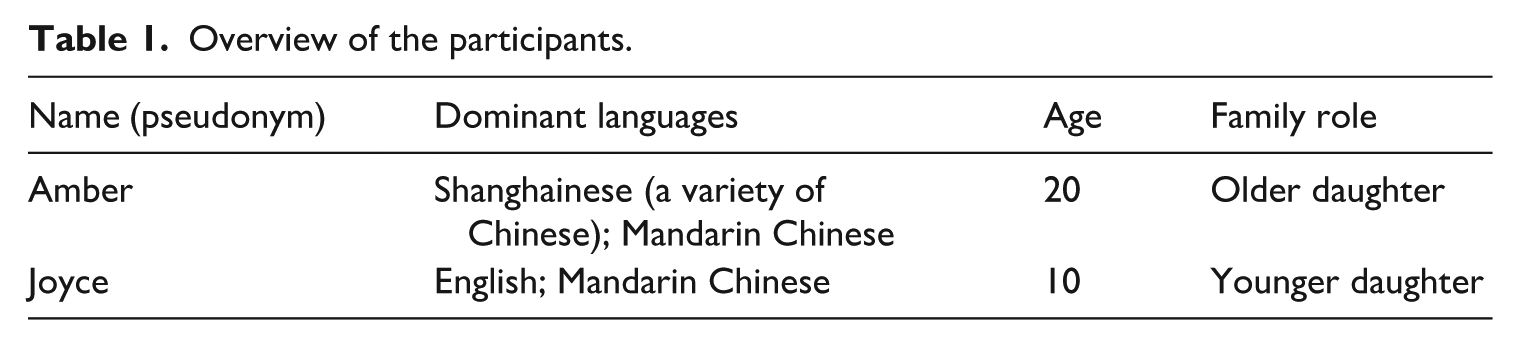
In the dyadic sibling talk, 18 episodes involve moments when either the older sister (Amber; N = 15) or the younger one (Joyce; N = 3) initiates guan to manage the other’s (future) behaviour. In most cases (N = 12), it is accomplished via one’s (the initiator’s) directive-making, followed by another’s (the target’s) overt compliance. In a small number of cases (N = 6), the two sisters devote more effort to guan-ing and enforcing specific behaviour expectations. In these instances, both the initiator and the target engage in offering reasons or accounts for either undertaking or not undertaking the target activity (e.g. washing hands before eating), following a directive or a series of directives. This paper specifically draws on such guan sequences – four involving Amber guan-ing Joyce and two involving Joyce guan-ing Amber 1 – to examine how the two sisters specify who ought to do what, what counts as appropriate, and who has the (deontic) entitlement in the matter at hand.
The analytical approach adopted here is interactional pragmatics (Haugh, 2012) in combination with some relevant aspects of membership categorisation analysis (MCA; Hester and Eglin, 1997; Sacks, 1992). Drawing on interactional pragmatics, the analysis investigates the emergence of relational practices and entitlement orientations in negotiating constraints and rules in interaction, which are viewed as situated not only in the here-and-now but also in the historical, social, relational, and cultural premises brought by the participants through their talk (Haugh, 2012). MCA offers a tool to explore how participants categorise themselves in relation to others to make sense of their activities in interaction and trace their understanding of what is appropriate behaviour for being a member of society or the local family. The use of category labels and orientation to associated expectations, rights, and obligations is examined to reveal how the siblings organise their (shared) knowledge to accomplish and negotiate (relational) entitlements in localised behaviour management sequences.
The data are transcribed using a simplified version of the conventions developed by Jefferson (2004). Code-switching is marked with the symbol % to indicate its beginning and end. Chinese data are presented in a three-line format: transliterations via the pinyin system without tone marks, morpheme-by-morpheme glosses, and idiomatic English translations (in italics). All transcription conventions appear in the first line, which presents the original talk in bold.
Analysis
This section presents a detailed analysis of how the two sisters actively engage in four guan sequences. These typically involve three steps: problematising what has been done or claimed, directing the guan-target what to do next, and explaining why. During this process, two relational devices are deployed by Amber and Joyce to overcome potential disalignment from each other and legitimise their own actions: (1) displaying a caring stance through formulating possible undesirable consequences and (2) referring to a third party with higher authority – here, the absent mother. The selected episodes document how the two relational devices are invoked, used, and addressed in the ongoing interaction, demonstrating participant orientation to who has the (higher) entitlement to tell what (is appropriate) to do.
Constructing behaviour intervention as sibling care
Caring implies other-directed practices with affective involvement, aiming to enhance or sustain the well-being of the recipient and respond to their (potential) needs (Noddings, 2013), which plays a significant role in family life. While doing caring can construct, maintain, and repair the intimacy between family members (Goodwin and Cekaite, 2018), the following three extracts elucidate how it is used as grounds for regulating and constraining another’s behaviour. Extract (1) comes from an interaction occurring when Amber and Joyce are taking a walk outside.
Extract (1) FZ-36_ “Car” [16:28-16:38]
Noticing Joyce running away, Amber launches an imperative negative directive (line 02), where she explicitly indexes the problematicity of Joyce’s behaviour by labelling it as xia pao (“run wild”). Nearly shouting, Amber marks the extreme urgency of the directed action (i.e. stop running) to be accomplished by the recipient. In this way, Amber not simply tells Joyce what to do next but also admonishes Joyce for her misconduct. This is further evident in Amber’s subsequent reason-giving (lines 05–06), which in fact takes the form of a warning (Aronsson and Cekaite, 2011): running wild can cause a life-threatening outcome, that is, Joyce might get hit by a car. Moreover, by asserting the potential danger as part of Joyce’s epistemic territory (ni ziji zhidao “you know that”; line 05), this aimless running behaviour is constructed as a “knowable wrongdoing” (Küttner et al., 2022: 804). In other words, Joyce had committed an act recognisable to herself as a transgression. This thus makes her an accountable party, who is also a justifiable target of Amber’s admonishment (see also Goodwin and Cekaite, 2018: 108–109). More importantly, with this account, Amber indicates her coercion to stop Joyce from running wild as rooted in her concern for Joyce’s safety, that is, imposing the prohibition to ensure that Joyce remains out of danger. In this episode, Amber’s directive receives immediate compliance from Joyce.
Extract (2) provides another example of Amber framing her behaviour intervention as an act of care, yet Joyce’s compliance is withheld. This excerpt comes from a sibling argument about whether Joyce should wear shoes at home. The interaction happens when Joyce returns to the room where Amber is watching TV after taking a shower. It is worth noting that Mother Zhang allows Joyce to be at home without wearing shoes, and Amber knows this.
Extract (2) FZ-19_ “Shoes” [00:00-00:12]
2
By issuing an other-initiation of repair (Schegloff, 2000) in the form of a what-question (line 01), Amber indicates something problematic in whatever Joyce said in the prior turn, prompting Joyce to modify it in some way. A “don’t-wear-shoes” claim is then asserted by Joyce in response (line 02). Here, the use of the present tense (“don’t”) presents the action of not wearing shoes as customary for Joyce (see also Extract (5)). Also, by stressing the verb “wear,” Joyce tacitly conveys a sense of resistance to changing the not-wearing-shoes stance. A short silence occurs in line 03, which may signal Amber’s “as-yet-unstated disagreement” (Pomerantz, 1984: 65). This disagreeing stance becomes more salient when she issues a directive in the declarative construction in line 04, where a counter-opinion on the matter is delivered in response to Joyce’s prior claim. Here, with the use of the deontic modal (“have to”), the action of wearing shoes is indexed as obligatory for Joyce, treating Joyce’s current barefoot behaviour as problematic and her prior claim as inappropriate. A self-corrective action to wear shoes – perhaps not only now but also in the future – is made relevant next. Additionally, the prosodically marked use of “have to” further conveys the non-negotiability on this matter (Waring, 2020), which indexes a high entitlement to tell Joyce what should be done.
In lines 06–07, a reason for the necessity of wearing shoes is offered, reflecting Amber’s interpretation of the 2 seconds silence in line 05 as Joyce’s indication of refusal. With the use of the modal verb hui (“will”), Amber brings to the forefront the definitive future consequence (Zhao, 2024) of not wearing shoes – having an undesirable foot shape: hen ping (“very flat”) and hen da (“very big”). 3 Notably, Amber’s reason-giving is initiated with the pronoun ni (“you [singular]”). In doing so, she specifies Joyce as the agent responsible for this outcome rather than constructing it as a generic consequence. This makes the account hearable as a warning: if Joyce resists correcting her not-wearing-shoes behaviour, her feet will become unpleasant-looking. To close off the turn, Amber invites Joyce to confirm her understanding of the consequence being stated with the expression ni zhidao ma (“you got it”). It also orients to “a strong preference for a yes-answer” (Koole, 2012: 1909), through which Amber attempts to solicit Joyce’s compliance.
By offering the explanation in the form of a warning followed by a confirmation-seeking question (lines 06–07), a strong sense of certainty that the mentioned consequence will occur is conveyed. Amber’s claim to epistemic primacy (Heritage and Raymond, 2005) on the matter is displayed, invoking an epistemic asymmetry between herself and Joyce. More specifically, with the question ni zhidao ma, Amber positions Joyce as not aware of the negative upshot, which may further tacitly invoke the stage-of-life difference between them – she, as an adult, has more life experience and first-hand knowledge than a pre-teen child. In this way, she indexes the legitimacy to problematise Joyce’s not-wearing-shoes habit and orients to the potential knowledge imbalance to prompt Joyce’s self-correction.
On the other hand, this post-directive account also grounds Amber’s intervening move in her affection for Joyce. Similar to Extract (1), Amber uses a problem-illustrating account to indicate that complying with her directive can actually benefit Joyce (see also Sorjonen et al., 2017). This frames Amber’s chuan-xie-zi directive as rooted in her concern for Joyce’s well-being, rather than her own desire to control Joyce’s doing. In other words, unlike issuing a threat of punishment to secure compliance (e.g. “no shoes, no TV watching” in Extract (5)), warning Joyce here delivers a sense of helping her avoid an undesired outcome, which makes Amber’s directive to intervene in Joyce’s wrongdoing hearable as a tangible expression of care. Through such care-invoking account work, the strategy adopted by Amber to manage Joyce’s behaviour at this stage reflects “that of persuasion, rather than coercion” (Aronsson and Cekaite, 2011: 144).
In line 08, Joyce produces the response token “alright,” which, rather than signalling compliance, functions primarily as an acknowledgement of the “new” information provided. This formulation treats Amber’s prior turn as merely informational. In doing so, Joyce may also be prompting a closing of the sequence, which can be interpreted as an indirect display of her resistance to Amber’s directive and a tacit assertion of her own autonomy in deciding what to do after knowing the disadvantage. This creates an environment for Amber to upgrade her earlier directive in the remainder of the interaction to continue her pursuit, for example, in line 10, where a coercive directive is issued to manage Joyce’s non-compliance (see more in the continuation in Extract (5)).
Extract (3a) documents an extended guan sequence, where it is Joyce (the younger sister) who takes action to manage Amber’s attempt to violate the family rule of washing hands before eating. Before the interaction, the two sisters appear to have played with a squishy toy together, as evident by Joyce’s reference to nage (“that”) squishy in line 34. The following interaction occurs after Joyce leaves the room and then returns, starting with her checking whether Amber wants to have some cream puffs (lines 01–19).
Extract (3a) FZ-41_ “Puff” [00:00-00:59]
Joyce’s polar question (line 01) prompts Amber’s questioning of the need to “pick” puffs (i.e. the why-question in line 12). This leads to Joyce’s reformulation of her previous turn into a do-you-want question (lines 14–15), prefaced by a repair-initiating component (“no”) and repair marker wo jiushi shuo (“I mean”; see Schegloff, 1992). Facing Amber’s non-response (line 16), Joyce then issues a directive to solicit a firm answer from Amber (line 17). Here, the chronological time marker xian (“first”) not only highlights the immediate necessity of a proper answer but may also signal a forthcoming action, for example, an offer from Joyce or a demand for Amber to act.
A delayed answer is ultimately produced by Amber in an I-want statement (line 19). Interestingly, after this, initiated by the discourse marker dan (“but”), Amber announces that she will not wash her hands in line 22. As noted by Wang (2005), using dan can mark an explicit contrast between the speaker’s proposition and the localised expectation, which is grounded in the “background knowledge about the world” (p. 482) shared by interactants – in this case, that Amber should wash her hands. In fact, washing hands before eating is one of the family rules set by their parents. 4 Amber’s announcement here clearly reflects her awareness of the rule. However, while showing her respect for it, Amber positions herself as someone who does not need to always follow the parental regulation, orienting to her autonomy in deciding not to wash hands this time. Further, by saying “I (am) not (going to) wash (my) hands,” Amber appears to pre-emptively block the possibility of being asked to do so.
After a 1.2 seconds silence, starting with na ni (“then you”) in line 24, Joyce alters that her upcoming utterance is built on the prior turn and projects a sense of disalignment/disaffiliation with Amber regarding the matter at hand (Yang, 2023), though it is abandoned. After a short gap, a directive in a conditional grammatical structure is issued (lines 24–25), offering Amber an alternative way to eat the puffs. On the one hand, this reflects Joyce’s tacit acceptance of Amber’s refusal to wash her hands; on the other hand, it also displays Joyce’s orientation to (in)appropriateness in the current situation. With the modal construction ni zhi keyi (“you are only allowed to . . .”), followed by a mimicry of a biting sound, Joyce directly imposes a restriction on Amber’s eating behaviour – if Amber insists on not washing her hands, she will only be allowed to eat puffs by biting rather than using her hands to eat. Through this, Joyce positions herself as entitled to set the conditions and terms for Amber here and now.
In line 27, with the response token dui (lit. “correct”), Amber shows her alignment, establishing an agreement on how she will eat this time. 5 Then, the discourse marker na jiu hao (“that’s good”) following an acknowledgement token (“okay”) is produced by Joyce (line 30), signalling her satisfaction with Amber’s response, probably also working as a sequence closure cue. In line 32, Amber repeats Joyce’s utterance in a smile voice, ending it with the question particle ma to mark it as an interrogative that conveys an inquiring stance about Joyce’s prior turn (Norrick, 1987). This is interpreted by Joyce as a request for clarification, who responds to it with the prosodically marked confirmation token “yeah,” followed by an extreme case-formulated explanation of what counts as hao (“good”; lines 34–35). In line 35, she provides an explicitly negative assessment of the squishy toy that Amber had seemingly played with earlier, labelling it as extremely dangerous (i.e. “hum hum hum hum hum deadly venomous”). A sense that the squishy toy carries something potentially detrimental to health is conveyed, implying that playing with it and then directly using the same hand to eat puffs is potentially dangerous. Thereby, Joyce’s reason-giving here further serves to warn Amber not to do that.
Subsequently, a 1.2 seconds silence (line 36), followed by Amber’s repair initiation (line 37) signals Joyce’s utterance – especially her use of “venomous” – as a trouble-resource requiring clarification. In lines 38–39, Joyce revises her assessment by describing the act of eating with unwashed hands as “poisonous,” flagging it as health-damaging (and even life-threatening). Through this account, in addition to explaining her prior satisfaction, Joyce also justifies her restricting Amber to only biting. On the one hand, it indexes Joyce’s entitlement to tell Amber what to do next to avoid unhygienic behaviour. On the other hand, the account also delivers a message that Joyce’s intervention is in Amber’s best interest, specifically to prevent Amber from falling ill. Thus, similar to the prior two examples, Joyce’s guan toward Amber in this sequence can be viewed as grounded in her care for Amber’s well-being.
In line 41, a soft hao de (“okay”) is produced by Amber, which ostensibly signals her acceptance of Joyce’s reason-giving as well as a tacit acknowledgement of Joyce’s care, though its delayed and soft articulation suggests reluctance and even disbelief.
6
Satisfied with Amber’s hao de, Joyce then makes a verbal announcement, informing Amber what she is about to do, along with moving away from Amber (line 42). Later, since the way that Amber wants to eat the puffs (perhaps eating in bed with unwashed hands) is not permitted by Mother Zhang, Joyce proposes to feed Amber. This is subsequently accepted by Amber (see Extract (3b)) Extract (3b) FZ-42_ “Don’t touch it” [01:40-01:57]
As shown in line 09, when feeding Amber with one more puff, Joyce repeatedly issues a new imperative directive to prevent Amber from using her unwashed hands to touch the puff. This directive repetition, indeed, highlights the urgent need for the nominated action to be accomplished (e.g. fast tempo and loud volume). Simultaneously, this urgent intervention also displays Joyce’s concern for Amber while indexing a strong sense of entitlement to regulate Amber’s eating behaviour, ensuring its alignment with what is deemed appropriate. Thus, here, Joyce’s guan practice appears to be motivated by (1) the urgency of the issue, as Amber appears to be reaching for the puff, (2) her care for Amber to prevent unhygienic behaviour, and perhaps also (3) her interactional role as an offerer, which grants her local authority to determine how to eat the cream puffs.
This section has shown how the two sisters construct their behaviour modification attempts as driven by their care for each other’s well-being and as a way of expressing affection. More specifically, by providing accounts that reference potential risks linked to the targeted behaviours and working to ward them off, Amber and Joyce not only mitigate the implication that the given directives are built on their personal will but also mark the behaviour regulation as highly beneficial to the recipient.
Referring to the absent mother in guan sequences
Another relational device is referencing the absent mother (compared with children’s invoking of the “parent” category in Sinkeviciute, 2026). The analysis shows that invoking such an authority figure and making the corresponding category (pair) relevant is used by the two sisters not only to strengthen their guan actions (Extract (4)) but also to challenge each other’s standpoint of what should be done (Extract (5), see also invoking a third party in parent-child talk in Bova, 2015). In addition, it also opens space for siblings to negotiate the familial order, the appropriateness of their actions, and their rights to influence one another’s behaviour at home.
Extract (4) documents an example of the older sister’s reference to mama (“mother”) in sanctioning and restricting the younger sister’s behaviour (cf. Extracts (2) and (5)). Before the interaction, Joyce sought permission from Mother Zhang to have some snacks before mealtime. Mother Zhang approved the request, gave the snacks to Joyce, and instructed Joyce to eat with Amber. Yet, a restriction on how the two sisters can eat was set – specifically, saying nimen bu yao zai chuang shang chi (“you don’t eat on the bed”) and immediately reformulating it into bu neng zai chuang shang chi (“[you] can’t eat on the bed”). From bu-yao (“don’t”) to bu-neng (“can’t”), Mother Zhang constructs the act of eating in bed not merely as dispreferred but more importantly as not allowed, through which an implied message can be hearable, that is, making the bed dirty with food crumbs is prohibited. Extract (4) occurs midway through the recording, starting when Amber notices Joyce attempting to break the snack in bed.
Extract (4) FZ-21_ “Snack” [06:30-06:44 & 09:55-10:04]
This guan sequence starts with a bald-on-record negative directive (line 01), by which Amber problematises Joyce’s current conduct (labelled by Amber as bai (lit. “break something apart”)) and signals the directed action – stopping immediately – as highly relevant here and now. By saying zai zheli (“here”), Amber highlights that what Joyce should not do is to break snacks on the bed where they are sitting – an act that, as she subsequently explains, is highly likely to result in dropping crumbs and making the bed dirty (line 01). This constitutes a locally accountable transgression (Küttner et al., 2022), which will lead to another negative outcome: being scolded (ma) by the mother (line 02). Here, initiating the explanation with the pronoun ni (“you [singular]”; see also Extract (2)), Amber projects accountability onto Joyce for the predictable negative consequences of her action. Tying the negative predicate ma to mama (“mother”) in line 02, Amber also points out the risk that Joyce will trap herself in an unpleasant situation, that is, being admonished by the mother. 7 By doing so, a warning is issued as part of Amber’s guan toward Joyce, prompting an immediate remedial action. Similar to the warnings in Extracts (1) and (2), this one also appears to express Amber’s care, as it is presented as a tool to prevent an undesirable outcome for Joyce. Furthermore, as the adult sister, Amber can be expected to enforce parental expectations and modify her younger sister’s misbehaviour in the absence of parents. Thus, Amber’s intervention here works not only to secure Joyce’s alignment with the mother’s rule but also to minimise the possibility of being held accountable for failing to do so (see also lines 11–15).
In denying Amber’s inference of her act as that of bai, Joyce claims it as a preparation for sibling play (lines 4, 7–8), which is hearable as an implicit invitation to Amber (line 10). In the next 3 minutes, the interactional agenda transitions from the management of Joyce’s potentially problematic behaviour to flavour-guessing play. After the game ends, Joyce begins eating snacks in bed.
In line 11, a soft-voiced ni (“you”) is produced by Amber, implying an impending action directed at Joyce, though Amber withdraws from completing it. After a pause, Amber resumes her talk with a negative imperative and ends it with the turn-final particle ou, which makes her action hearable as a warning reminder (Li and Thompson, 1981). This time, instead of directly stopping Joyce from eating in bed, Amber marks the possible unpleasant outcome – dropping crumbs on the quilt – as inappropriate, which should be avoided. This seemingly departs from Mother Zhang’s eating rule. However, warning Joyce to be careful with eating, namely, not to leave any evidence of eating in bed and mess it up, is hearable as Amber enforcing Mother Zhang’s constraint in a different way. This, indeed, allows Joyce to continue eating in bed while simultaneously maintaining the mother’s expectation to avoid the consequence of dirtying the bed with food. With this conditional allowance, Amber’s self-positioning at that moment as merely an enforcer of the mother’s rule, lacking the authority to discard it, remains evident (cf. her establishment and imposition of her own “rule” in Extracts (2) and (5)).
However, after a 1.1 seconds silence (line 12), Amber initiates a new turn with the prosodically marked attention-directing ni kan (“you look”; Long et al., 2019), signalling a moment of noticing. This is followed by an assertion of what she has noticed (line 13), again starting with ni (see line 01), thereby marking, from Amber’s perspective, Joyce as the one responsible for dropping crumbs on the feet, who makes the bed potentially dirty. In this way, the high-pitched, fast-articulated assertion not only delivers Amber’s evaluation of what she has noticed as highly problematic (Schegloff, 1988) but, more importantly, functions as an admonishing move rather than merely informing Joyce about her observation.
Joyce does not respond, and this leads to a 3 seconds silence (line 14), which somehow implies her acknowledgement of having caused something problematic. Starting with a “tsk” sound to signal her annoyance, Amber issues another prohibition (line 15). This time, rather than bai (“break”) or nong (“leave”), the act that Amber problematises is zai chuang shang chi (“eating in bed”), as a punishment for Joyce, who has made the bed dirty. Interestingly, this turn is not completed with this directive action. Rather, an additional component is added by Amber at the end: mama shuo de (“Mum said”). In doing so, Amber reframes the don’t-do directive as an act of backtracking on Mother Zhang’s earlier prohibition and portrays herself as merely its animator (Goffman, 1981), attempting to enforce the mother’s perspective. Through referring to the mother here, Amber indicates her orientation to Joyce’s membership as a “child,” thus making the associated expectation of being compliant relevant – in this case, following rather than violating the rule set by the mother. This imperative directive, thus, holds Joyce accountable for failing to comply (Kent and Kendrick, 2016), further serving as a verbal correction of Joyce’s behaviour.
Unlike Extracts (1) and (2), here, Amber mobilises the mother’s authority to ground her guan action and prompt Joyce to correct the inappropriate behaviour immediately. By initiating prohibitions throughout this episode, Amber clearly positions herself as a rule enforcer with greater responsibility for upholding Mother Zhang’s expectation – though primarily interpreted by her as not messing the bed with food – and assumes the role of policing the younger sister’s behaviour to ensure compliance.
The final example, Extract (5), that is, the continuation of Extract (2), involves Joyce’s reference to the absent mother in response to Amber’s guan action. As illustrated in Extract (2), Joyce’s “alright” (line 08) displays non-compliance with wearing shoes. This leads Amber to devote more effort to achieving the desired outcome of getting Joyce to do that in the following part of the sequence.
Extract (5) FZ-19_ “Mum doesn’t” [00:12-00:40]
Unlike Extract (2), a bald-on-record directive with no mitigation is implemented in line 10: chuan xiezi (“wear shoes”). Such an imperative format, on the one hand, indexes an immediate need for the nominated action to be accomplished (similar to Extracts (1) and (4)) and, on the other hand, shows insufficient consideration of Joyce’s willingness or capacity to perform it. With such a high-entitlement/low-contingency directive (Craven and Potter, 2010) issued to solicit Joyce’s compliance, Amber’s strategy to guan Joyce’s problematic behaviour begins to shift into that of coercion.
Starting with the discourse marker but to indicate disalignment, Joyce expresses refusal to carry out the directed action through an account, asserting “I don’t” in a low voice (line 12). In this way, Joyce indexes her autonomy over her personal affairs – here, having the right to decide not to wear shoes at home. Also, the use of the present tense (“don’t”) again conveys that not wearing shoes at home is a habitual action for Joyce (see Extract (2)), as opposed to the problematic behaviour framed by Amber. 8 This enables Joyce’s non-compliance to be heard as adherence to her personal preference, which also challenges Amber’s deontic ground in problematising her habit and demanding her to change it. However, in line 14, Amber reiterates the imperative directive (“wear shoes”), showing her non-acceptance of Joyce’s account. While no prosodic modulation is applied to the reissued directive to upgrade the control attempt, Amber’s response shows her dismissal of Joyce’s claim of autonomy and manifests her strong desire to get Joyce to wear shoes (see also lines 18 and 20).
In the face of Amber’s persistence, a second account, now with the reference to “mum,” is produced by Joyce in line 16. Starting with the change-of-state token oh frames what Joyce is about to say as something just-now remembered (Bolden, 2006) – perhaps her sudden realisation that Amber, who no longer lives in this household, may not be aware of what she is allowed to do at home. This is immediately followed by the invocation of “mum,” pointing out Mother Zhang’s connection to the matter at hand. By claiming “mum doesn’t” (where the habitual present tense is used again), an impending message that Mother Zhang normally does not require Joyce to wear shoes indoors is conveyed. 9 Thus, an agreement-based right to not wear shoes is oriented to by Joyce to express refusal of Amber’s directive. Further, with the mentioning of “mum” here, it seems that Joyce not only draws on the status of the absent mother as the mother of her and Amber (like Extract (4)) but also tacitly invokes another layer of the “mother” category – that is, as the mother of the household, who has the ultimate authority to maintain orders and make rules of the domestic space where Joyce and Amber are staying. In this way, the relationship between Mother Zhang and Amber is mapped onto not only a “mother-child” category pair but also that of “family head-temporary resident.” Thus, unlike in line 12, where Joyce orients to her personal preference and autonomy, here, Mother Zhang’s authority over her children’s actions and family rules is mobilised by Joyce to challenge Amber’s entitlement to direct her to wear shoes here and now. Simultaneously, an inconsistency between the behaviour regulation implemented by Amber and the family contract is indicated to challenge the appropriateness of Amber’s actions.
However, this does not stop Amber’s continuous pursuit of the nominated action to be accomplished. After another directive (line 18), a threat is posed by Amber in line 20, where a “noxious” outcome contingent on Joyce continuing the “bad” behaviour (Hepburn and Potter, 2011) is delivered. That is, if Joyce insists on not wearing shoes, it will trigger Amber’s sanctioning move, that is, to deprive Joyce of her right to watch TV. Unlike in Extract (4), where Amber invokes the mother to manage Joyce’s wrongdoing, here, by issuing this threat to assert her control over Joyce’s punishment, Amber positions herself as highly entitled to constrain Joyce’s behaviour and direct Joyce to change her behaviour. No verbal response appears in line 21. Joyce’s defiance of the threat, or at least her unwillingness to start the directed action, can be heard from the remarkably long silence. With the particle en (“mm”) to probably confirm Joyce’s lack of compliance, a don’t-stay-here directive is issued as a form of punishment (line 22). Although she verbally challenges Amber’s right to do so (line 24), Joyce nevertheless leaves the room. In the subsequent recording, Joyce puts on her shoes and returns. In this way, wearing shoes is co-constructed by Joyce as a necessary situational condition for continuing to watch TV.
Throughout this sequence, while Amber reformulates her strategy to manage Joyce’s “bad” behaviour from persuasion (Extract (2)) to coercion (Extract (5)), Joyce’s accounting work invokes different types of right to resist Amber’s guan, from her autonomy to the license given by the higher authority, here, their mother. Unlike Extract (4), the reference to Mother Zhang does not help Joyce achieve the interactional goal.
Conclusion
Using interactional pragmatics and membership categorisation analysis, this paper has explored how guan is interactionally initiated, performed, and concluded in daily interactions between two sisters with a big age difference (aged 20 and 10) in a Chinese-Australian family. Particular attention has been paid to moments in which two relational devices are employed to negotiate the need for action. The analysis uncovers how such devices of invoking a caring stance and referencing the mother serve as accounts in sibling talk to enforce their guan actions (cf. parental behaviour management in Gan, 2023) or justify whatever in their own conduct is assessed as problematic. For example, the analysis shows that invoking potential undesirable consequences that can be caused by the targeted problem behaviour indexes a(n) (urgent) need for a remedial action to be carried out so as to maintain the recipient’s well-being (as illustrated in Extracts (1), (2), and (3a)). In this way, local behaviour restrictions are framed as being implemented in the best interest of the recipient. When the absent mother is mentioned, not only directives and approvals made by the mother but also associated category pairs (e.g. mother-child) are made relevant in the interaction. The “mother” is invoked by siblings as a warrant to cancel the problematicity of their own behaviour while simultaneously positioning the other party as a “child” or “temporary resident” who has failed to follow instructions on appropriate behaviour given by the authority figure of the household (as shown in Extracts (4) and (5)). The analysis also demonstrates that such relational accounting work (see Rodriguez, 2026) does not always successfully prompt compliance or concession in response, which can be disapproved and/or open space for another negotiation of the necessity of the nominated action to be done (Extract (5)).
With interest in the deontic dimension of relationships shaped within the unfolding of guan in sibling talk, the analysis displays that the ways in which siblings position themselves in relation to others regarding their entitlement over different matters are negotiable and inherently dynamic in family life. The locally situated, emergent orientations to entitlement do not always align with the culturally expected power hierarchy within sibling relationships. While the data involves most cases where the older sister claims (deontic) entitlements to manage the younger sister’s (mis)conduct (Extracts (1), (2), (4), and (5)), it is noticeable that the younger sister also actively engages in monitoring and regulating the older sister in the absence of their parents (Extracts (3a) and (3b)). Throughout the above examples, using the two relational devices allows siblings to assert their affective entitlement or a third party’s authority to license their actions. This extends behaviour intervention beyond acts of control, making it as rooted in affection (Extracts (1), (2), and (3a); see also Gan et al., 2025) or reinforcing the family’s deontic order (Extract (4); see also Extract (5)). Moreover, the findings reveal that siblings draw not only on deontic and affective grounds as sources of authority, but also strategically mobilise epistemic (a)symmetries to question and regulate each other’s behaviour in pursuit of a desired outcome (see also Endo, 2026). An interplay between the deontic, affective/emotional, and epistemic orders (Stevanovic and Peräkylä, 2014) is observable in sibling behaviour management, which is worthy of further investigation.
In conclusion, this study contributes to the underexplored topic of sibling behaviour management in family life. As Goodwin and Cekaite (2018) note, a home environment of affection and love should be preserved when family members socialise children into behaving appropriately. The micro-level analysis provides insight into how this is achieved in sibling talk in Chinese family discourse. As this study has shown, guan is ultimately concerned with behaviour modification and thus constitutes a form of “control” in family life. However, it can be made accountable as an expression of care, grounded in affection among family members, or even as an action driven by external sources of authority, such as parental rules. Across the examined occasions, guan appears to function as a dialectical device in shaping relationships between siblings: on the one hand, it opens a space for constructing and negotiating entitlement asymmetries within the family; on the other, it highlights and maintains affective connections between the siblings. However, given the limited scope of the focal episodes, this study offers only preliminary insights into the field. It, therefore, calls for further research on guan, or behaviour management in Chinese family discourse, examining how the various methods are employed by different members to engage in and with each other’s guan attempts to negotiate or maintain norms and orders while enhancing the relational connection of the family.
Footnotes
Acknowledgements
I would like to express my gratitude to the two guest editors of this Special Issue, Dr Valeria Sinkeviciute and Andrea Rodriguez, and Dr Wei-Lin Melody Chang for their helpful comments on earlier versions of this article. I also appreciate all the valuable suggestions given by the two anonymous reviewers. Any remaining errors are entirely my own.

Ethical considerations
Ethical approval was granted by HASS LNR, The University of Queensland. All participants provided informed consent to participate and for publication.
Funding
The author received no financial support for the research, authorship, and/or publication of this article.
Declaration of conflicting interests
The author declared no potential conflicts of interest with respect to the research, authorship, and/or publication of this article.