




Abstract
Drawing on a combination of the analytical tools from interactional pragmatics and membership categorisation analysis, this paper explores a specific type of everyday family life – a sibling dispute, and how the ‘parent’ category is used as an interactional resource by parents and children during oppositional talk over sharing. The data comes from spontaneous video-recorded conversations in a Russian-speaking family living in Australia that includes two siblings, aged 2;10 and 5;7. The findings demonstrate how (1) children exploit the ‘parent’ category to mobilise support or denounce the other’s reportable transgression, and (2) parents intervene in the dispute and socialise children into sharing, gradually moving from suggestions and directives to a threat. This study contributes to our understanding of how sibling disputes unfold and how siblings construct their relationships.
Keywords
Introduction
In the last few decades, with a rise of interaction studies, it has been well-documented that, in and through family conversations, children are socialised into and show their understanding of the social order through their enactment of pragmatic and normative behaviours as members of society (e.g. Minks, 2010; see overviews in Cekaite, 2013; Keel, 2016; Kyratzis and Cook-Gumperz, 2015; see also Gordon and Lance, 2026). For instance, such orientation to the social order can manifest itself through the use of more direct or indirect forms, depending on the interactants’ status and power relationships (e.g. Ochs and Taylor, 1995; Watts, 1991), or in showing concern, care and responsibility as part of ‘doing family’ (e.g. Aronsson and Cekaite, 2011; Sterponi, 2003). Apart from the focus on linguistic and pragmatic resources, more recently, multimodal interaction studies have emphasised the role of embodied actions such as gaze, posture, gestures, emotional displays in children’s accomplishment of interactional and relational goals, including during oppositional talk (e.g. Cekaite, 2010; Goico, 2025; Goodwin and Cekaite, 2018; Goodwin et al., 2012; Morita, 2021).
This paper aims to further contribute to the multimodal exploration of family talk, particularly focussing on the ways in which young siblings engage in disputes related to sharing practices and how they deal with the expectations and resistance thereof. I will start by providing an overview of existing interaction studies on sibling disputes, before presenting the data and the methodological approaches used in this case study – interactional pragmatics and membership categorisation analysis. The analysis will consist of three sections, illustrating the role of the ‘parent’ category and its interactional accomplishment by children and parents themselves. Concluding remarks will discuss how the sibling dispute unfolds at different stages, the ways in which the ‘parent’ category is invoked and exploited by the family members, and how such everyday activities contribute to the accomplishment of the local familial order.
Interaction studies on sibling disputes
While considerable attention has been paid to children disputes in peer talk and peer pretend play (e.g. Church, 2016; Corsaro and Rizzo, 1990; Cromdal, 2004; Goodwin, 1990; Goodwin and Goodwin, 1990; Maynard, 1985b; Theobald, 2013; Zadunaisky Ehrlich and Blum-Kulka, 2010), noticeably, to date, fewer studies have explored the co-construction and ongoing unfolding of oppositional talk among siblings. Since peer and sibling interactions vary because of different social relations between children in terms of family hierarchical roles, age, power, interests, etc. (see Goodwin, 2017; Phinney, 1986), sibling disputes can be considered as a distinct interactional and relational context, where local social and moral orders are accomplished and negotiated (e.g. Busch, 2012; Morita, 2021).
While only some conflicts have been examined among adult siblings (see García-Gomez, 2018; Vuchinich, 1990), most of the existing studies of sibling disputes focus on younger children from one to 15 years of age in their dyadic (e.g. Friedland and Mahon, 2018; Hester and Hester, 2010, 2012; Liu, 2023; Morita, 2021) or multi-sibling (Busch, 2012; Goico, 2025; Rogers and Fasulo, 2022) disputes during pretend play (Friedland and Mahon, 2018), free play (Morita, 2021; Rogers and Fasulo, 2022) or mealtimes (Busch, 2012; Hester and Hester, 2010, 2012; Rogers and Fasulo, 2022). In such contexts, it has been explored how (1) older siblings construct asymmetrical relations and position themselves as ‘a proxy parent’, (2) younger siblings challenge their older siblings and (3) parents intervene in oppositional talk. Most work has been done on English-speaking siblings, with some exceptions of sibling disputes in Spanish (García-Gomez, 2018; Goico, 2025), Japanese (Morita, 2021), Chinese (Liu, 2023, 2026) and sign language (Goico, 2025).
One of the interactional practices found in the disputes analysed is the way that older siblings highlight asymmetrical relationships with their younger brothers or sisters. For instance, such asymmetrical categories as ‘commander-commandee’, ‘rule-enforcer-offender’ or ‘offender-victim’ can be invoked, where the older sibling would position him/herself as more dominant and powerful (e.g. Hester and Hester, 2010, 2012). This can be constructed through the use of directives (Busch, 2012), format tying (Rogers and Fasulo, 2022) or limiting the younger sibling’s access to something (Morita, 2021). In (extended) disputes over an object (e.g. a toy), older siblings have been seen to engage in sabotage in order to ‘get the upper hand’ in the dispute (Zotevska et al., 2021) as well as in negative assessment of the younger sibling’s abilities or characteristics (Morita, 2021), for example, through the use of derogatory terms (Hester and Hester, 2010; Rogers and Fasulo, 2022). Similarly, older siblings are often seen constructing themselves as ‘a proxy parent’, where they issue parent-like directives to their younger siblings on behalf of their parents (Hester and Hester, 2010; Liu, 2023) as well as use the ‘parent’ category to maintain their authority and threaten their younger siblings, thus ensuring their compliance (Goico, 2025).
The parental rules, however, are not only used by older siblings. Younger siblings can also invoke rules in order to resist their older brothers and sisters (Busch, 2012; Hester and Hester, 2010) and challenge them (Friedland and Mahon, 2018). Interactionally, they can use matching intonation to that in their older siblings’ turns, thus counter-attacking them as the sole rule-enforcers (Hester and Hester, 2010). In order to maintain their authority, older siblings tend to respond to such challenges, either by rejecting them, invoking their epistemic authority as a more experienced member, or distracting their younger siblings by inserting extended turns (of fantasy scenarios), thus distancing themselves from the problematic aspects that triggered the challenge in the first place (Friedland and Mahon, 2018). This could more likely happen in cases where a more elaborate counter-attack (e.g. pursuit of an account) was produced, as opposed to a simple counter-assertion (see Phinney, 1986).
Finally, a number of disputes also include an intervention of a powerful third-party – a parent or an elder sibling – who has the ultimate right to ‘issue normative statements’ (Maynard, 1985b: 216), for instance, in relation to sharing (see Busch, 2012; Kim and Fitzgerald, 2026; Morita, 2021). While parents can enter sibling oppositional talk on their own in order to stop its escalation by threatening the ‘offender’ (Busch, 2012) and, mostly, taking the younger sibling’s (‘victim’s’) side (Hester and Hester, 2010, 2012; Morita 2021), they can also be recruited through children’s verbal and embodied action. For example, the younger sibling can direct their complaint at the mother (Hester and Hester, 2012) or show their emotional affect, through snorts, to summon the mother’s attention (Busch, 2012).
This study aims to contribute to the under-researched area of sibling interactions and, more specifically, the construction of sibling relationships, by exploring an extended sequence of a sibling dispute in a Russian-speaking family living in Australia. The primarily focus of this analysis is on the categorial work and, in particular, on the multiple ways in which the ‘parent’ category is invoked and oriented to by children and parents in the unfolding of the dispute.
Data and methodology
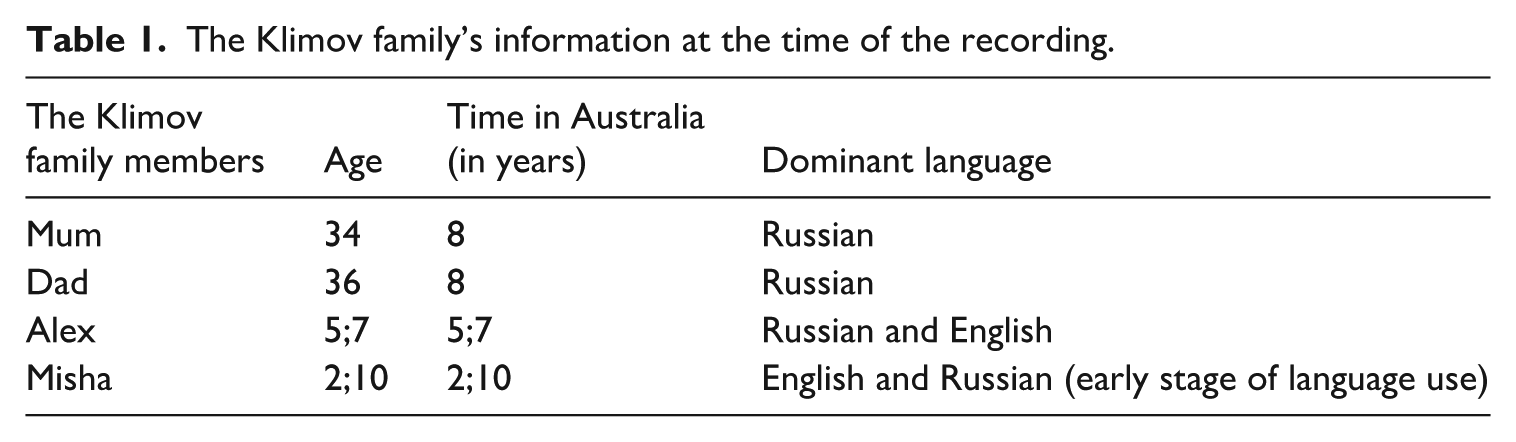
The data in this study is part of a larger research project on multilingual family talk in Australia. 1 Analysis in this study explores extracts that come from a 16-minute sequence from video-recordings of daily conversations in a Russian-speaking family living in Australia. The parents immigrated to Australia 8 years prior to the data collection and both children were born in Australia. As will be seen in the extracts, the language used at home is Russian with some code-switching produced by both children (for more information, see Table 1).
The Klimov family’s information at the time of the recording.
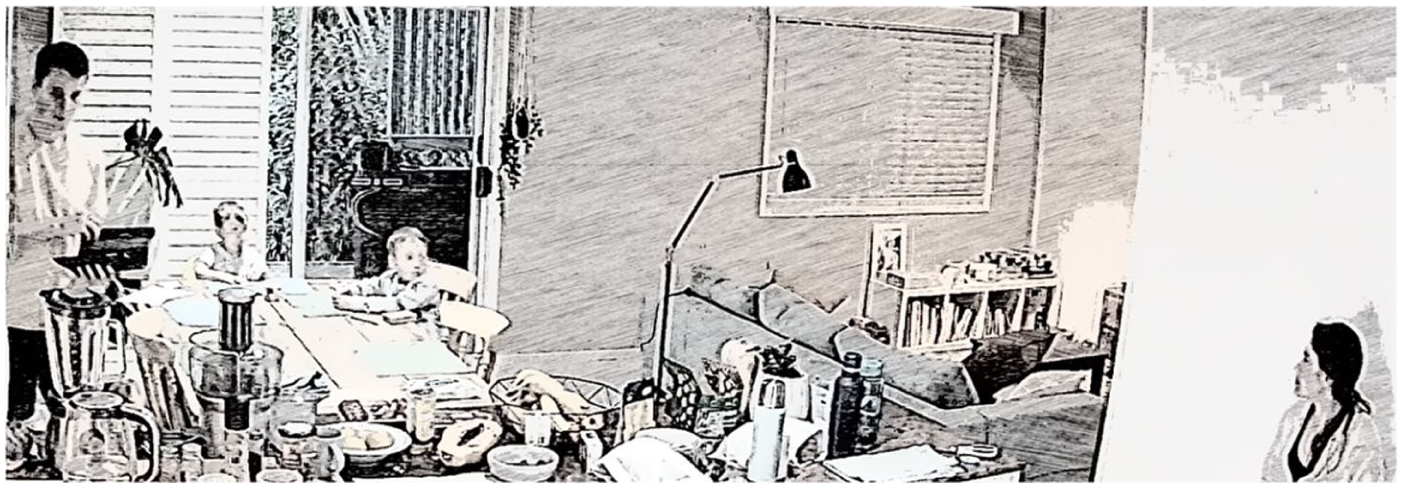
Using two cameras, during one week, this family’s interactions were video-recorded in a common open-plan area, namely the kitchen, dining room and living room. The data is transcribed using simplified Jefferson’s transcription conventions (Hepburn and Bolden, 2017) with the indication of relevant embodied action in double brackets and stills. The original talk in Russian with some code-switching to English is in bold, while the idiomatic English translation is in italics.
The sequence analysed in this study is from the first day of the data collection. It starts when Mum opens the bag left by the research team that has documents, a notepad and a set of markers. Mum unwraps all of them. First, Alex – the older sibling – is given the notepad to keep and then Mum announces the availability of markers (line 1 in Extract 1), and both children multimodally show their interest in them (lines 2–9; Figure 1): Extract 1 [16:39:35-16:39:55]
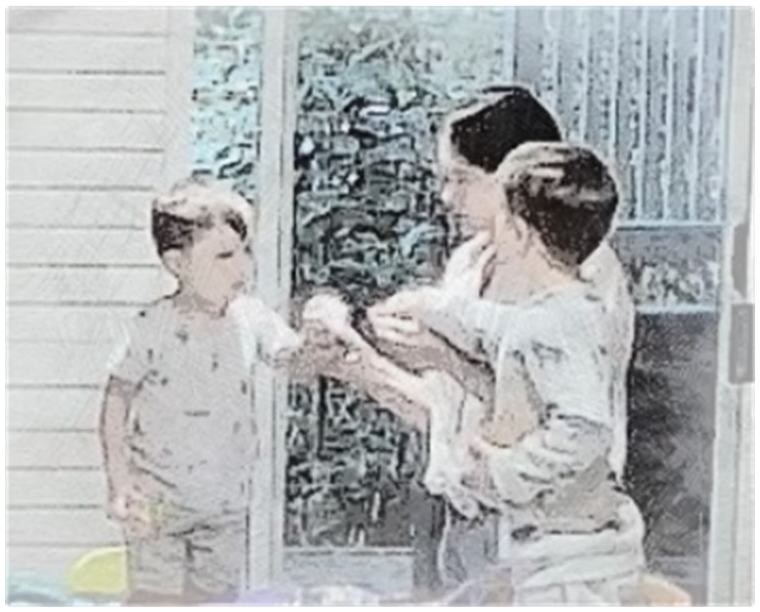
Extract 1, lines 7–9.
In order to examine how sibling disputes and family relationships are co-constructed in social interaction, the analysis in this study draws on a combination of analytical tools from interactional pragmatics (Haugh, 2012) and membership categorisation analysis (Fitzgerald and Housley, 2015; Hester and Eglin, 1997; Sacks, 1995; see also Rodriguez and Sinkeviciute, 2025; Sinkeviciute, 2024). Emphasising both emergence (here and now) and situatedness (context, histories, roles) of and in interactional practices, interactional pragmatics allows for a detailed exploration of pragmatic phenomena, such as (in)appropriate behaviours, relationships or morality, in talk (Chang, 2016; Haugh, 2012). This is complemented by relevant aspects of membership categorisation analysis (MCA), particularly focussing on expectations, responsibilities and obligations linked to categorisation practices through explicit category mentions (‘mum’), category-bound activities (‘cooking’), category predicates (‘being caring’) and category-implicative actions (‘providing a permission’; see Hester and Hester, 2012; Sinkeviciute, 2024; Stokoe, 2012). By virtue of such (multimodal) actions and language use in interaction, people can be recognised as members in certain categories and category collections (e.g. family), as well as their interactional behaviours can be ‘generated’ by their category memberships (see Hester and Hester, 2010). Crucially, categorial work is locally produced as a discursive achievement, which means that the relationship between categories and actions is not pre-determined, but becomes hearable as emergent in a particular interactional setting. In other words, a distinction needs to be drawn between ‘possibly correct’ and ‘interactionally relevant’ categories (see Sacks, 1966 and Coulter, 1991 in Hester and Hester, 2012: 4). This means that, while for children relating to each other ‘siblings’ can be the ‘correct’ category, this relational category might not necessarily be relevant to the interactional accomplishment of disputes as much as other categories such as ‘offender’ or ‘victim’ (see Hester and Hester, 2012). Through the micro-level analysis of social actions and categorial work in interaction, this paper will shed light into how family members organise their social knowledge and orient to familial and social orderliness (Hester and Francis, 2004).
Analysis
The analysis in this study focusses on selected chronological moments from the 16-minute dispute (16:39–16:55) between two siblings – Alex (5;7) and Misha (2;10) – over sharing markers and a notepad. Specific attention is paid to the moments when the ‘parent’ category becomes salient and interactionally indexed and oriented to throughout the dispute.
Children’s negotiation of the desired object and parents as third-party participants
In this section, I explore two extracts and the different ways in which the ‘parent’ category is invoked and employed in the initial stage of the dispute, including through the father’s use of category-implicative actions and an older sibling’s explicit use of category labels. Extract 2a happens when the two siblings are exploring the markers, with Misha opening them, but not being sure what to do with them. Prior to that, Alex has mentioned that the markers can dry out. All the family members are present, Mum is busy in the kitchen and Dad is walking around, from time to time paying attention to the children.
Extract 2a [16:41:34-16:41:40]
In line 1, after observing the children for some time from a distance, Dad is entering the siblings’ interactional (but not physical) space with a suggestion that Misha should give one marker to Alex who will then be able to show how to use them. Starting his turn with ну так (the particle ну and ‘so’), Dad is orienting to himself as a ratified third-party (see also Busch, 2012), since the particle ну in a sequence-initiating actions, while linked to the ongoing interaction (here that between the siblings), displays a launch of a new course of action (changing the children’s conduct), thus having a potentially disjunctive function (see Bolden, 2016). Such turn-initiation contributes to the meaning of the social action in the whole turn, which, even though constructed with an imperative, is hearable as a suggestion rather than a directive. This category-implicative action then indexes Dad’s somewhat limited participation rights, but at the same time displays his powerful interactional and relational position. Doing so, Dad points to a potential problem that Misha has – he does not know what to do with the markers – and provides a solution to the problem. Therefore, he places Alex – the older sibling – in the knowledgeable position (see Heritage, 2013), that is, through Alex’s prior experience with markers, indexing his epistemic authority over Misha’s. While functioning as an account for the suggestion and selecting Alex to perform the helping action (vs volunteering his own help), it also serves as a mobilising turn for Alex to offer his help to Misha, which he immediately does in line 3. Given that the siblings have already established that both of them want to have the markers, Dad’s turn can be seen as attempting to unify the children and socialise them into sharing as part of doing ‘being siblings’, that is, Misha will share the markers with Alex so that the latter could share his knowledge with the former. During the silence in line 4, Misha is choosing which marker to give to Alex, still holding the markers close to himself, thus orienting to them as his possession and himself as a decision maker. In line 5, uttering вот (‘here’), he extends his hand holding one marker towards Alex, this way providing the conditionally relevant response not only to Dad’s suggestion, but also to Alex’s offer, thereby accepting his less experienced category.
During the following couple of minutes, both parents leave the kitchen and the living room, Alex is busy painting something on one piece of paper from the notepad, Misha climbs down from this chair, goes around Alex, takes the notepad (that at the very beginning of the sequence Mum told Alex could have), comes back to his chair and starts arranging his ‘workspace’. Alex continues to use the marker until the moment that he declares that Misha has too much paper (for a similar example, see Busch, 2012) and climbs on the table. We enter the conversation, when Misha takes the marker Alex was using and starts putting it in the marker base (all markers have one base and not individual caps).
Extract 2b [16:43:25-16:43:56]
As a response to Misha’s taking the only marker that Alex had, Alex tries to stop Misha both verbally, by protesting in a loud voice with a claim that Misha is putting the marker not in its slot, and through the embodied action, leaning over the table, thus entering Misha’s ‘territory’. Line 2 functions as sanctioning Misha for Alex’s loss of partial ownership of the markers, while also positioning Misha in the ‘inadequate owner’ category through pointing out Misha’s inappropriate treatment of the markers (see also Morita, 2021). Interestingly, once Misha hides the markers under the table, Alex withdraws, takes a piece of paper, scrunches it and then straightens it up. This type of temporary withdrawal from the conflict and engagement in the other activity can be seen as disguising the real interest (see Zotevska et al., 2021). This does work, as Misha who has been watching Alex, now seems not to see the ‘danger’ and puts his hands on the table in line 5, thus not hiding the markers anymore. Alex is taking this opportunity to grab the marker, using the imperative that grammatically is in synch with the embodied action – a ‘give me and grab’ strategy (Dixon, 2015). Thus, his actions in lines 3–7 are in line with the sabotage practice (Zotevska et al., 2021), employed to deceive the other sibling until being able to have access to the desired object. While the two physically fight over the marker (Figure 2), Misha starts crying.
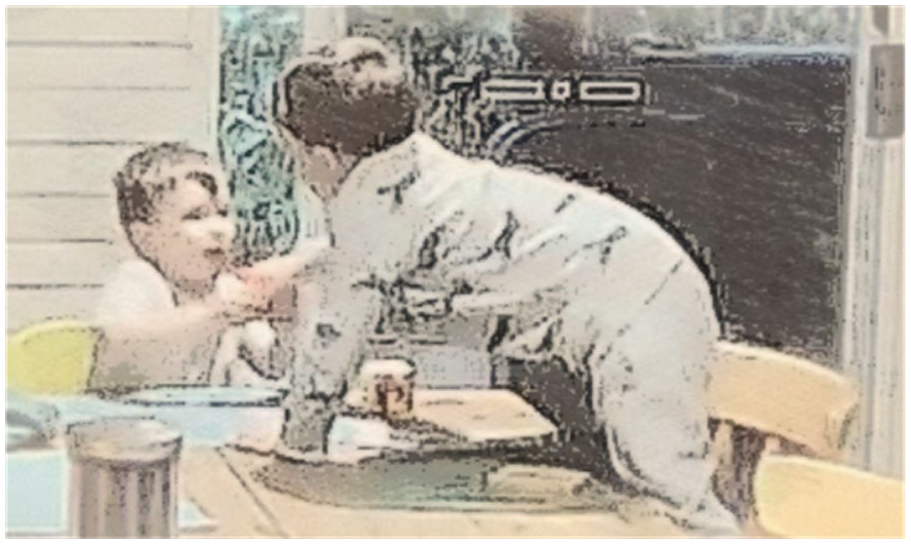
Extract 2b, lines 7–10.
This seems to make Alex release his hand, but he still achieves his goal, that is, he has taken away one of the markers from Misha. Possibly due to this physical conflict and Misha’s crying reaction, Alex immediately invokes the ‘parent’ category, first starting with the elongated МА (‘mum’) and then the diminutive use of the ‘father’ category ПАПочк[а] (‘daddy’). It is important to note that he starts looking around when referring to Dad who the last time he saw him was behind Alex in the living room. The moment that Alex realises that Dad is not physically present to provide him with possible support, he reduces the volume, cuts off the end of his summons and starts turning back to Misha. Essentially, Alex does not give up on his interactional project, as he, in a very loud voice, presents the problem – that this particular marker has dried out. Doing so, Alex shows his understanding of the link between the volume of his voice and possible results – the absent parents could hear him, which then would accomplish his denunciation. This has implications for non-accountability of his own actions and Misha’s fault, as Alex has previously warned Misha that the markers can dry out and now, due to Misha having them, this has actually happened. Interestingly, while exploring the marker, he realises that it still paints, which is visible through the change-of-state and surprise token ‘oh’ (Heritage, 1984) in line 15. Now, Alex needs to navigate the situation, in which his denunciation of Misha’s wrongdoing does not present any proof. Essentially, while having more than one option (e.g. keeping the marker), Alex, nevertheless, shows his priority towards the ‘health’ of the marker. This leaves Alex with only one, however undesirable, option: since Misha is the one who has the base that can ‘save’ the marker, Alex, while mumbling something and not looking pleased, gives the marker to Misha.
Mobilising parents’ help and children’s socialisation into sharing and pragmatic practices
With the continuation of the dispute, the ways in which the children orient to the parents’ presence and how the ‘parent’ category is (explicitly) invoked by children and parents are further expanded. These include crying and embodied action as well as the use of directives, relational ‘parent-child’ category and various socialisation practices.
Prior to Extract 3a, Alex, who has been holding onto the markers for over a minute, now announces that he will use the markers for an unspecified activity and instructs Misha not to look, while moving away from the table towards the kitchen. Importantly, he monitors Misha’s reaction to his leaving, thereby showing his understanding of the possible consequences thereof. At this moment, Misha, likely realising that he will be losing the physical and visual access to the markers, starts crying and looks at Dad who is putting down the blinds in the living room, thus indexing the ability to help as a predicate of the ‘father’ category in this interactional context.
Extract 3a [16:46:10-16:46:39]
While Misha is already crying, in line 2, Alex is repeating the announcement of an upcoming additional activity with the markers. 3 Given the situation – Misha crying – this announcement can also be heard as an account for Alex’s leaving and, as a result, Misha’s being upset. Mobilised through Misha’s crying and gaze that serve as soliciting a remedial action (see Butler and Edwards, 2018; Kidwell, 2013), in lines 3–4, Dad intervenes in overlap with Alex’s turn (cf. Extract 2a), thereby positioning his intervention as necessary and legitimate. His turn begins with a summons, after which Alex starts moving back to the table as if pre-empting that this would be required from him to remedy the interactional and relational trouble. The turn-initial address makes Alex an explicit recipient, and the categorial label – малыш (‘little child’) – places Alex into the ‘very young age’ category (but not primarily in the ‘son’ category). Such a category reference indexes Alex’s lower degree of responsibility for not sharing the markers and makes what is upcoming heard less as sanctioning as a result of the breach of a rule or moral transgression and a mere request for action (cf. Craven and Potter, 2010; Busch, 2012), but more as socialising Alex into sharing practices. Importantly, the way Dad is constructing his directive for sharing also features the politeness marker – пожалуйста (‘please’). This politeness marker is much more rarely used in Russian than in English (see Avramenko and Meir, 2024; Mills, 1992) and, while it is employed in the directive imperative turns with unacquainted parties or those who hold a higher interactional and relational status, it is not necessary when used towards children by someone with a higher status (see Moore, 2013), in this case, a parent, where bald imperatives can be considered ‘unmarked for politeness’ (Blum-Kulka, 1990; see Extract 3b). The use of пожалуйста (‘please’), therefore, can perform a number of functions in this interactional context: (1) a mitigation of the imperative construction and the overall directive that requires Alex to change his current behaviour, (2) the children’s socialisation into politeness practices (see also Burdelski, 2013) and (3) placed right after the verb, 4 strengthening the necessity of compliance. The directive is further mitigated by a choice provided to Alex to give Misha ‘any marker’ (similar to Extract 2a), thus allowing Alex to make an independent, even though relatively restricted, choice.
After resuming his position at the table, in line 6, Alex offers one marker to Misha. By doing this, he is orienting to Dad’s directive as not optional and, indeed, requiring compliance, thereby treating Dad as a more powerful family member (cf. Busch, 2012). At the same time, through providing an offer, Alex is also invoking his more powerful status as the owner of the markers and the decision-maker, at least in terms of how the sharing proceeds. After a 0.6 silence, Misha provides a dispreferred response, rejecting the offer with the volition account (Church, 2016), stating that he ‘want[s] rainbow’, which stands for all the markers. He also projects his being upset through the embodied action, namely gazing down. Since it is not in Alex’s interest to satisfy Misha’s request to give him all the markers, thus losing the incumbency in the current ‘owner’ category, Alex immediately provides an implicit inability and necessity account (Church, 2016) that he himself is going to ‘make a rainbow now’, that is, he needs all the markers, so they will be in use (for a similar example, see Busch, 2012). In line 11, Misha shows his dissatisfaction with Alex’s non-compliance through momentarily engaging with another object (pushing away the paper in front of him) and, in a louder voice, pursuing his directive. Interestingly, at this stage in the sequence, Misha is not orienting to Dad to mobilise his help. In turn, Alex provides another account, starting it in English with ‘yeah but’ (also Church, 2016: 91–92), thus showing intersubjectivity in relation to Misha wanting the markers. Then he adds a crucial element that upgrades the account compared to the previous account in line 9, that is, he is going to make the ‘rainbow’ for Mum. This way, he is invoking relational category pair ‘child-parent’ (see also Liu, 2026) that is relevant not only to Alex, but should also be to Misha. The latter, however, does not show categorial intersubjectivity and that of relational expectations (see Rodriguez, 2026), and does not accept it as a valid account for not having the markers. At this point, he starts whinging, even more, when Mum enters the kitchen, where Extract 3b starts.
Extract 3b [16:46:59-16:47:15]
Misha’s louder whinging when he sees Mum enter the kitchen (while Dad is still in the same space) shows his orientation to the ongoing trouble and Mum as a (highly) powerful family member to remedy it. Such a distribution of mobilising support across the ‘parent’ category (first Dad in Extract 3a and now Mum) indicates Misha’s understanding of who makes the familial rules (thereby indexing category-tied rights and expectations) and who can (likely based on previous experiences) provide support for his wishes. As a response to Misha’s crying, in line 19, Mum is first asking what has happened, which serves to understand the precipitating event (see Cekaite and Burdelski, 2021) and then is soliciting an account for it. Mum is likely aware of the sibling dispute that has been ongoing for 10 minutes now, but, at this stage, there is no physical fight between the two siblings, which might warrant Misha’s crying. Thus, soliciting an account shows her orientation to socialising Misha into developing his pragmatic competence of ‘using his words’ (see Kyratzis and Köymen, 2020). Also, this socialises the child into being accountable for his emotions rather than just using them as a mobilising resource (see Bateman, 2021; Butler and Edwards, 2018; Sterponi, 2009). Of a primary importance here, however, is that, in overlap with Mum’s turn, Alex, who has not been addressed, provides an account for Misha’s being upset. The construction of the account displays Alex’s understanding of his own involvement and responsibility for Misha’s negative emotions, and thus his orientation to the local moral order (Sterponi, 2003). In his account, he is referring to himself through я хочу (‘I want to’) rather than, for example, using the third-person pronoun (‘he wants’) referring to Misha, which he has done several times in the sequence, when denouncing Misha’s wrongdoings. This interactional move, however, does not work for Alex, as now Dad joins the conversation, recycling his directive from Extract 3a for Alex to share. This time, Dad does not use the politeness marker пожалуйста (‘please’) or the explicit category mention малыш (‘the little child’), thereby orienting to the necessary resolution of the ongoing dispute rather than primarily socialising Alex into polite behaviour. Alex’s response in line 25 is particularly interesting (see Figure 3).
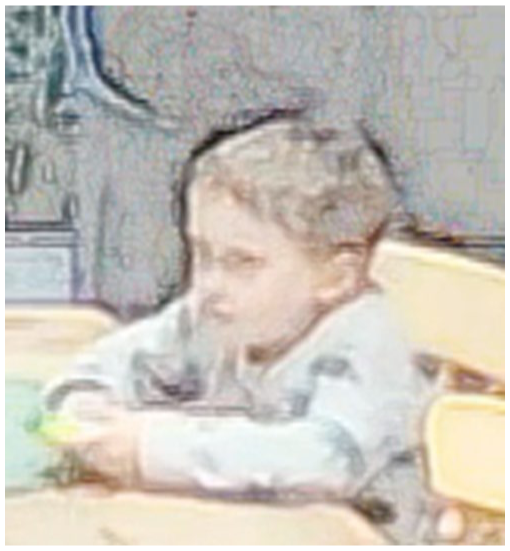
Extract 3b, line 25.
Contrary to his compliance after an almost identical directive in Extract 3a, here Alex shows his embodied dissatisfaction (a loud scream and frowning in lines 23 and 25; see also Zotevska et al., 2021) to the now unmitigated pursuit-to-comply. This could be explained by the fact that in lines 20–21 he has shown partial responsibility through the necessity account, but has not received the expected outcome and now anticipates the upcoming inevitable compliance. This also shows Alex’s orientation to the deontic rights of the ‘father’ category to provide a strong directive for compliance. Meanwhile, Misha, after both parents have directed Alex to share, in lines 25 and 27, continues with his pursuit of getting not just one marker, as suggested by the parents, but all the markers as per his own interactional project, treating it as supported by the parents (see Busch, 2012).
Extract 3c is a continuation of Extract 3b. The importance of these unfolding moments at this stage of the dispute is that, unlike earlier (e.g. Extract 3a), where the parents’ engagement was more to attend to the capability or desires of the recipient (the children), here their involvement is more prominent through ‘telling’ rather than ‘asking’ (see Craven and Potter, 2010), as they continuously co-construct their directive for sharing.
Extract 3c [16:47:15-16:47:25]
In line 28, Mum starts a pursuit of the directive to share, which is particularly visible through the cajoling token давайте (‘come on [pl]’) that shows both the growing impatience and the need for immediate compliance (see Craven and Potter, 2010). In this turn, she constructs sharing as the responsibility of the ‘children’ category (both the younger and older siblings), which is indexed through the grammatical means, that is, the plural verb forms (e.g. поделитесь ‘share [pl]’). An important shift happens in line 30, where Mum modifies her directive, in the beginning of the turn using the multi-functional particle же that here indexes the opposition with what is going on – dispute over sharing – as well as adds an emphasis to the candidate course of action (see McCoy, 2003). Then she provides a candidate sharing scenario, where she makes a change from the plural ‘you’ (вы indexed through the verb forms) to the singular ‘you’ (ты) that is directed at Alex. Two points can be made here: (1) through the candidate scenario, Mum is constructing both siblings as less knowledgeable in the management of such situations, thus needing the parental guidance and (2) even though Misha is also mentioned in the scenario, being referred to in the third person by name, Alex is hearably constructed as the sibling who has the maturity to understand the parents’ directive, thereby orienting to Alex as a more mature (older) brother to take the appropriate action.
In lines 29–34, both parents in overlap co-construct the need for sharing and their pursuit thereof. Mum finishes her turn with a three-part directive in lines 35–36. Here, once again, addressing it to Alex and highlighting his higher responsibility that can be hearable as tied to his ‘older brother’ category, she (1) appeals to the common sense (see also Extract 4a) when referring to the inability to use multiple markers at the same time, strengthening it with the particle же that adds an element of ‘an indisputable and irrefutable argument’ (McCoy, 2003: 132), (2) answers her own question through the assertion не можешь (‘you [sg] can’t’) and (3) produces a bald directive as a local conclusion that sharing is inevitable, thereby invoking a rule regarding expected behaviour for the ‘sibling’ category (see also Kim and Fitzgerald, 2026). Mum does, however, mitigate the imperative by gazing away, which softens Alex’s overall accountability for not behaving as a more mature sibling. After this, Misha, looking at Mum, continues his pursuit, which results in her approaching the table and serving as a mediator not only verbally as up until now, but also through the embodied action, that is, placing the markers and the notepad in the middle of the two siblings’ sitting arrangements. After Mum’s intervention, Alex goes to his bedroom and Misha takes everything to himself (see also Busch, 2012).
Child’s blocking of the activity that presupposes sharing and a parent’s threat
The final two extracts illustrate not only Dad’s continuous pursuit of compliance to share and the emergence of a threat sequence by Mum, but also children’s socialisation into correct/false reasoning in the use of their accounts for non-compliance. This way, what is observed at this stage is how rights and responsibilities as related to the ‘parent’ category are predominantly exploited by the parents, rather than the children.
Right before Extract 4a, Alex warns Misha not to touch anything, takes the markers to himself and announces теперь это будет моё (‘now this will be mine’), thus indicating his rights to ownership both through the embodied action and metapragmatically. This attracts the gaze of both parents, Mum who is sitting in the kitchen browsing on her phone and Dad who is tidying up the dining area, next to the children.
Extract 4a [16:49:29-16:50:00]
While Dad continues with the sharing directive in lines 1, 7, 9, 11–12, in lines 2–5, once again the siblings start a physical fight over the markers. Of importance here is that, unlike in Extract 2b, this physical dispute is observed by Dad from very close. While Alex ‘wins’ the battle and has the markers, he immediately proposes the cancellation of the ongoing activity давай не будем рисовать (‘let’s not paint’). This is done with the turn-initial ‘ok’ that can mark the orientation to transition to another activity, thus resolving the dispute (see also Mondada and Sorjonen, 2021). Even though it might be seen as a compromise, by proposing the sudden abandonment of the activity linked to the desired object (the markers), while having them in his possession, Alex is positioning himself as the decision-maker, where the decision will benefit him, that is, he will keep the markers (even if he will not be using them immediately). As a response to what has happened, losing the battle over the markers and the proposal to stop using them altogether, in line 8, Misha produces a roaring sound. Alex and Dad in overlap are trying to accomplish their interactional agendas, the former repeating the proposal in lines 10 and 13 and the latter his directive in lines 9, 11–12. Misha’s previous emotional reaction has not received the desired outcome, as Alex is not sharing the markers. This makes Misha, in overlap with Alex’s proposal in line 13, scream loudly and start whining, while gazing at Dad, thus enlisting him to support his interactional project once again (see Hester and Hester, 2012).
In line 14, however, Dad starts his turn by sanctioning Misha for screaming and, somewhat similar to Mum in Extract 3c, presents the evidence for the lack of a problem that would warrant such a behaviour, that is, Misha is painting after all, which can function as socialisation into reasoning and appropriate behaviour. At the same time, Dad is providing a candidate vicarious account (Sterponi, 2009) for Misha’s emotional outburst, enquiring in line 15 whether he would like to have another colour and, similar to Mum, provides the logical response in such a scenario поменяйтесь цветами (‘swap [pl] colours’). Interestingly, while Dad addresses the directive to both siblings (unlike Mum in Extract 3c), in line 17, Alex self-selects as the relevant recipient, rather sharply declaring that he does ‘not want any colour’. This can function as an account for protest, non-compliance as well as for his earlier proposal not to paint, since, if he does not paint, there is no reciprocal need to share or adhere to the parental rule. Dad matches Alex’s tone of voice in lines 18–20, discrediting Alex’s account as invalid, since Misha still wants to paint, which means Alex would not be able to keep all the markers to himself, which points towards Alex’s false reasoning (see also Extract 3c). At this stage, Mum, who has been busy on the phone and, only occasionally directing her gaze at the children, has been a silent observer of how the disputes unfolds, joins in, where Extract 4b starts.
Extract 4b [16:50:00-16:50:21]
For the first and the only time in this 16-minute dispute, Mum, in a very calm voice and manner, uses a different approach, that is, she starts a threat sequence in lines 23–25 through an if/then conditional construction (see Flint and Rhys, 2023; Hepburn and Potter, 2011). She begins constructing her threat with the generic endearing term ребятки (‘children’) towards young children, making it clear that both siblings are recipient, but not necessarily tying the upcoming social action to the ‘children-in-family’ category and, thus, the family collection (see Extract 3a; see also Hester and Hester, 2012). Then she metapragmatically labels the children’s behaviour as an argument (спорить ‘to argue’), thus pointing to their inappropriate conduct, and threatens to take away/put away the desired objects, as a result of which, the things over which they fight will become her possession, which she strengthens with a slight turn-final nod. This way, she is echoing the children’s behaviour in the dispute, where both, at some point, explicitly and implicitly have referred to the markers and/or the notepad as theirs, thereby indexing the ‘parent-as-a-child’ category (for an adult sibling doing ‘being a child’, see Liu, 2023). It is also crucial to mention here that, by issuing a threat designed in such a way, Mum positions herself as someone who has rights to do it and highlights the asymmetry in entitlement in the parent-child relationships (see Craven and Potter, 2010; Küttner et al., 2022), which is also observable through the children’s reaction. The moment Mum starts speaking, both children gaze at her, which is particularly visible with Alex who did not face her before, thus he has to shift his body position to do so (Figure 4). Such embodied action constructs the children’s orientation to the ‘mother’ category as having a higher authority and a stronger deontic status/stance in the ‘family’ collection (see Hiramoto and Hayashi, 2022) and to the ‘children’ category as having obligation to pay careful attention to what Mum is saying.
Extract 4b, lines 23–25.
As a response to the threat to the ownership shifting from the siblings to Mum, in line 26, Alex’s body sharply returns to his usual position at the table, indexing his negative embodied assessment of such a possible scenario. In line 27, Mum upgrades the threat now starting with либо (‘either’) that pre-empts that the recipients will not be left with much choice. After hearing the first part, Alex’s accomplished intersubjectivity in relation to Mum’s interactional project and upcoming inevitable sharing compliance is visible in line 28, where he, resisting the invoked parental rule (see also Busch, 2012; Kent, 2012; Kim and Fitzgerald, 2026; Küttner et al., 2022), multimodally declares the ownership of the notepad, holding it close to his chest and gazing at Mum. This is likely used to appeal to her own permission, since she, when unwrapping the gifts (right before Extract 1), told Alex that he could keep the notepad.
Unfortunately, Alex’s appeal does not work this time either, as, in line 29, Mum immediately blocks an attempt to derail her threat trajectory (see Flint and Rhys, 2023) and proceeds with her strong threat in lines 29–33, placing the worse alternative last, thereby making it more salient (либо [. . .] либо ‘either [. . .] or’; see Antaki and Kent, 2015). While she is constructing her turn in plural, given that Alex was addressed prior to it and that he is the one having the markers at the moment, the threat can be hearable as primarily directed at him, thereby making him a decision-maker (similar to Extract 3c). What is also essential to note is that in line 30, now Mum invokes the ‘family’ collection when she provides an account for sharing, blocking Alex’s sole ownership and, by extension, for her claiming the ownership in line 28 – это принесли нам всем (‘it was brought to all of us’). Then she finally voices the likely course of action that will be performed by both parents, as she shifts ‘I’ in line 24 to ‘we’ (мы забираем ‘we [will] take it away’). The choice of the tense is also crucial is that, while the future tense can be used (as in line 24), in line 31, Mum constructs the threat using the present tense, which considerably strengthens the commitment to the social action, that is, the immediate implementation should be expected. Here, she not only specifies that no one will be able to touch the markers and the notepad that will be placed ‘on a shelf’, but also, in line 32, metapragmatically mentions the reason thereof – not knowing how to share. Once she finishes her turn, she gazes down at her mobile phone, as if treating her intervention as a side sequence in her main activity. The orientation to the rights of the ‘mother’ category and the obligations of the ‘children’ category are visible in Alex’s response after a 2.5 second silence. In line 35, he, through a similar construction as in Extract 3a, offers Misha another colour – something that Alex was reluctant to do prior to Mum’s intervention. After this, the dispute becomes manageable and five minutes later the siblings seem to lose interest in the markers.
Concluding remarks
This article has explored the interactional accomplishment of a sharing dispute between two siblings in a Russian-speaking family living in Australia. Drawing on the tools from interactional pragmatics and membership categorisation analysis, the study highlighted different aspects of oppositional talk between siblings in a home setting and the family members’ roles therein: (1) children’s negotiation of the desired object and parents as third-party participants, (2) mobilising parents’ help and children’s socialisation into sharing and pragmatic practices and (3) child’s blocking of the activity that presupposes sharing and a parent’s threat. Interestingly, these aspects display how the family members navigate the whole dispute through the three broad stages – initial, middle and closing – also identified in arguments and conflict talk (e.g. see Haugh and Sinkeviciute, 2018; García-Gomez, 2018; Maynard, 1985a; Vuchinich, 1990).
In the initial stage (Extracts 2a and 2b), it is visible how the siblings (largely independently) explore the desired objects – markers and a notepad – and start negotiation of their use. The parents’ involvement is seen in terms of their participation status as a third-party, either through observation and mitigated suggestions for a smoother ongoing activity of painting or through the older brother’s denunciation of the younger brother’s transgression – making the marker dry out – to the absent parents.
The middle stage (Extracts 3a–3c) is more clearly marked by the younger sibling’s embodied mobilisation of help from the parents against the older brother’s more dominant position. This is largely done through different types of crying and gaze that successfully enlist both parents’ more active involvement in the dispute. Unlike in the initial stage, where the parents’ involvement was minimal and the children were largely navigating the sharing on their own, here the parents start invoking the rule of sharing, either more implicitly, through a mitigated request (as in Extract 3a), or explicitly, through a bald imperative (as in Extract 3c). They, however, do not merely instruct the older brother to share the markers and the notepad with his younger brother, but socialise both children, though primarily the older brother, into sharing and pragmatic practices, such as politeness.
Finally, in the closing stage (Extracts 4a and 4b), we can see a very distinct shift in the interactional trajectory of the sibling dispute. First, this shift is marked by the older sibling – Alex – who proposes the cancellation of the painting activity as linked to the sharing of the markers and the notepad. Alex’s persistence of the abandonment of this activity not only shows his orientation to the dispute as problematic, but also indexes his understanding of the trouble source and how it could be solved. It also indicates a prime importance of the ownership of the desired object rather than its usage. Interactionally, while the siblings’ multimodal behaviour is more prominently sanctioned by Dad, it is Mum who displays more involvement rights tied to the ‘parent’ category through the introduction of the new social action – a threat. This marks the closing stage of the 16-minute dispute, with the older sibling now taking responsibility for the implementation of sharing, repeatedly referring to Mum’s directive to share (data not shown).
Having explored in detail how the sibling dispute unfolds in an extended sequence, this paper contributes to the under-researched area of sibling interaction. The analysis has also shown how the orientation to and accomplishment of categorial practices by the family members can shed more light into how sibling and family relationships as well as the familial order are co-constructed as part of culture-in-action. As Sacks (1995: 318–331) holds, different social actions – offer, request, warning, threat – are not just ‘a series of different things, but [. . .] sequential versions of a something’ (p. 331) such as ‘a changing of operative identities’ (p. 327). Here, that ‘something’ stands for the interactional accomplishment of doing ‘being parents’, doing ‘being siblings’ and ‘doing family’.
Footnotes
Acknowledgements
I would like to express my enormous gratitude to the family whose conversations this study analyses. Also, I would like to thank Natalja Naumova who assisted with data collection and draft transcriptions, as well as the UQ HASS research support for this purpose. I also appreciate all the useful comments and suggestions made by the two reviewers.

Funding
The author received no financial support for the research, authorship, and/or publication of this article.
Declaration of conflicting interests
The author declared no potential conflicts of interest with respect to the research, authorship, and/or publication of this article.