




Abstract
This paper explores how accounting practices involving holding-self-accountable and holding-other-accountable foreground tacit relational expectations contingent upon the affordances and constraints of “doing-family-at-a-distance.” Drawing on interactional pragmatics and membership categorisation analysis (MCA), I examine how accounting practices surface the interlocutors’ multimodal evaluations of conduct (in)appropriateness vis-à-vis their relational expectations, entitlements and responsibilities, thereby implicitly operationalising membership in relational categories, including parent–migrant-adult-child and husband–wife. Through micro analyses of interactions between Spanish-speaking family members, I illustrate how interlocutors implicitly foreground and negotiate relational expectations tied to “doing transnational family,” such as visiting children overseas and “doing family transnationally” by pursuing aligning stances, thereby orienting to the relational relevance of sustaining stability within their relationships. The findings highlight accounting as a category-implicative action and a window into implied relational expectations consequential for how we interactionally accomplish “family” at a distance.
Keywords
Introduction
Accounting practices (i.e. holding-self and holding-other(s) accountable) encompass various reflexive, interactional devices. Accounting practices allow interlocutors to (implicitly) evaluate the appropriateness of their own and others’ conduct, take a (moral) stance (see Du Bois, 2007), and remediate (potential) breaches, thereby also rendering visible their “seen-but-unnoticed” (Garfinkel, 1967: 41) interpersonal and sociocultural expectations. In other words, through accounts, members of social communities orient to bridging the gap between actions and unfulfilled expectations (Scott and Lyman, 1968: 46) at various layers of relevance. From a talk-in-interaction perspective, there has been a predominant focus on accounting for breaches of structures of reasoning linked to the sequential logic of action(s) (see Heritage, 1990; Robinson, 2016). Accounting is often subordinated to the principles of “conditional relevance” (i.e. given a first pair part, a second-pair part is expectable – Schegloff, 1968) and “preference” (i.e. systematically recurrent forms of conduct favoured over others for promoting social solidarity as an interactional outcome – Robinson and Bolden, 2010). Following this view, accounts have been mainly framed as markers of dispreference for sensitive: (1) format designs (see Mandelbaum, 2016; Maynard, 2016), (2) sequence initiating actions such as requests (Liu, 2020) and advice giving (Waring, 2007), and (3) sequence responding actions such as non-compliance (Kent, 2012), rejections (Morris et al., 1994), or denials. Nonetheless, it has been suggested in passing that accounting constitutes a highly complex and multilayered phenomenon that lies at the intersection of multiple relevancies, beyond sequential implicativeness (Robinson, 2016), yet to be explored.
This paper examines accounting practices as a vehicle through which family members surface tacit relational expectations, thereby orienting to their shared relational histories and the relational relevance of accounting (i.e. who is entitled to an account and why). Transnational families, whose members are geographically separated and gather digitally to maintain the quality of their relationships at a distance, constitute an ideal locus for this analysis. As documented in some studies, transnational family members often face the challenges of online parenting (Madianou, 2017), transnational caregiving (Baldassar, 2014), and digital displays of emotion and belonging (Wilding et al., 2020). As the members navigate contingencies of physical separation and growing sociocultural differences, the complex expectations involved in sustaining their relational systems may become noticeably relevant in interaction. However, most of our current knowledge about how transnational families operate comes from ethnographic interviews. Very few studies (see Gan, 2023; Gan and deSouza, 2022) have offered a discursive account of how transnational family and familial order are interactionally accomplished.
To illustrate the importance of how contextual contingencies are oriented to as relationally relevant by transnational family members through accounting practices, consider Extract 1. In this fragment, Carolina and Ron, a married couple who recently moved to Australia, are talking over a video call to Carolina’s mother and aunt, who live together in Colombia. Carolina notices that her aunt, Gabriela, is slouching and reminds her to sit up straight.
Como que no salgo | Like I don’t appear
Carolina’s directive “Gabis, ponte recta” (“Gabis, sit up straight”) overlaps with Gabriela’s turn, hindering her ability to hear and deliver an immediate response. However, upon noticing that her physically co-present sister, Paulina corrects her posture in line 10, Gabriela mirrors the embodied compliance, orienting to progressivity. When the sequence seems complete, Gabriela volunteers the account “es que yo siento como que no salgo” (“[I’m doing it] because I feel like I don’t appear”), justifying her slouching. Unlike other directive sequences where accounts often come in second position with noncompliance, marking dispreference (see Goodwin and Loyd, 2018), Gabriela’s account in third position after embodied compliance does not seem to be addressing issues of conditional relevance or displaying dispreference of the responding action (see Kent, 2012). This begs the question of why an account is volunteered there and then.
Gabriela’s account displays her orientation to the “talking heads arrangement” (Licoppe and Morel, 2012) as the expected default mode of video-mediated interaction by expressing concern about her face not being visible on-screen. Exploiting this contextual contingency as a responsibility of members in the category collection “parties-to-a-video-call” (see Rintel, 2015), Gabriela reframes the appropriateness of her previous posture. More importantly, by prioritising the constraints of digitally mediated interaction upon keeping a healthy body posture, Gabriela also claims independent reasoning from her niece, thereby partially resisting 1 the need for Carolina’s reminder, implying that she knows what she is doing. This way, accounting practices implicitly surface and manage the relational expectation that Carolina respects Gabriela’s right to independent action, thereby indexing and sustaining the stability of the members’ relational system.
Considering the contingencies of transnationality, this paper examines the emergence of the members’ tacit relational expectations through their accounting practices in ordinary video-mediated conversations. In what follows, I first provide an overview of prior research on accounting practices in family talk. Thereafter, I present the data and method, followed by the analysis of how family members surface and negotiate their relational expectations in: (1) “doing transnational family” (e.g. visiting children overseas) and (2) “doing family transnationally” (e.g. maintaining aligning stances). Finally, I offer some concluding remarks.
Accounting practices in family talk
Families are a complex and primordial social institution wherein members learn the folk logic of the practical and normative courses of action for which they are accountable. In family talk, what is normative is largely available through the relational identities invoked, enacted, and ascribed as members solicit, offer, accept, or discredit an account (see Scott and Lyman, 1968; Hester and Hester, 2010). Thus, the understanding of what is socially and relationally expected from family members has translated into the exploration of three main functions of accounting practices in family talk: (1) self-presentation, (2) social control, and (3) relationship management (see Buttny, 1993).
Research on accounting for the management of self-presentation (see Goffman, 1959) has mainly focused on individual family identities (e.g. parent) in settings where non-family participants are likely to evaluate the family member’s behaviour. These include, for example, television shows (see Gordon, 2011) and family therapy (see Hutchby and O’Reilly, 2010), where parents offer accounts to restore their compromised self-image as “good parents.” Such studies demonstrate how interactants use the socio-culturally available knowledge of category-bound responsibilities (e.g. looking after children and acting in their best interest) to hold members accountable for their breaches (see Márquez-Reiter and Haugh, 2019; O’Reilly and Kiyimba, 2021). In blocking ascriptions of negative social identities (e.g. a bad parent) derived from children’s misbehaviour, it has also been noticed that parents often volunteer pre-emptive accounts, for instance, displaying embarrassment (see Gordon, 2007), or responding to questions addressed at their children in therapy (Hutchby and O’Reilly, 2010), therein constructing the image of a fair or responsible parent.
Studies examining the “social control” function of accounts focus primarily on how family members deploy accounting practices as a socialisation process (Goodwin, 2006) wherein moral principles and responsibilities are inculcated (see Sinkeviciute, 2026). Most of these studies analyse how parents foster children’s accountability for their promises, commitments, and behaviour mainly through “directives” (Goodwin, 2006; Kent, 2012) and account solicitations (see Sterponi, 2003). This way, parents and older siblings guiding the socialisation process categorise younger children as moral agents, making explanations, compliance, and/or accounts for non-compliance relevant (see Aronsson and Gottzén, 2011: 416). An important aspect of sensitising children to the normativity of social behaviour involves modelling appropriate accounts, which tends to occur through parents’ displays of affectivity (Goodwin and Cekaite, 2018), vicarious accounts (i.e. accounts on behalf of the accountable party; see Sterponi, 2009), and accounts for their negative assessments of children’s behaviour (Caronia and Colla, 2023). Hence, parents may (based on their cultural understandings) establish a hierarchy of acceptable excuses where, for example, “fatigue accounts” stand at a higher level of appropriateness over “distaste accounts” when declining food (Aronsson and Gottzén, 2011; Sterponi, 2009). These contrast with accounts that parents may use to pursue compliance such as “the love with which the food was prepared” or the child’s ungratefulness for “not recognising the parents’ efforts.” Similarly, when suspending or abandoning a course of action initiated by a child in the context of co-relevant courses of action, parents’ accounts also socialise children into recognising their co-participants’ ongoing action trajectories (Vatanen and Haddington, 2023). This “sense of the other” is also fostered by parents’ accounts contrasting a child’s individual preferences to those of others (e.g. siblings) in managing local tasks (Galatolo and Caronia, 2018). While accounting practices for socialisation often emerge in adult families, for instance, with in-laws, fewer studies have addressed this gap (but see Endo, 2026).
Finally, studies addressing the relationship management function of accounting are concerned with how members indicate breached expectations and modulate consequences for the relationship rather than individual identities only. In the context of family talk, where relationships tend to be taken for granted, fewer studies have focused on how accounting accomplishes “relating” (see Arundale, 2020). A case in point is Drew and Chilton’s (2000) study of habituated weekly calls between mother-adult daughter. They argue that accounts during call openings index the participants’ orientation to departures from their expected routine (e.g. unusual call timing) while indicating that the call is still routinary to keep in touch. While less research has focused on how accounts bridge relational gaps specifically, examples are available through analyses of the pursuit of relational agendas (see Beach, 1996; Liu, 2026) and blame-implicative actions involving various or updated relational categories. For instance, interactants negotiate and update their entitlements and responsibilities through accounts offered for incongruous expectations vis-à-vis the “parent-child” versus “parent-adult child” category (see Johnson, 2018). More complex cases involve managing membership in multiple relational categories, for instance, in the context of third-party complaints. In these cases, accounting demonstrates not only the interactants’ expectations of affiliation and emotional support but also their management of conflicting relational-category-bound responsibilities towards a complainant (e.g. grandmother-granddaughter) and complainee (e.g. mother-son), which may occasion disaffiliative vicarious accounts that potentially threaten the interactants’ relational category (see Rodriguez and Sinkeviciute, 2025). Thus, tapping into the relational import of accounting practices, underscoring the contingencies of doing adult family at a distance, and drawing on naturally occurring interactions between Spanish-speaking family members, this paper explores how accounting practices foreground evaluations of self- and other-conduct vis-à-vis their relational expectations, entitlements and responsibilities, thereby surfacing implicit relational expectations that ultimately allow reconstituting stability and familial order.
Method and data
This study combines interactional pragmatics and the analytic mentality of membership categorisation analysis (MCA; Watson, 2015) to explore inference-rich relational phenomena (see Elder and Haugh, 2023). Following the theoretical and empirical commitments of interactional pragmatics, the analysis draws on conversation analysis tools (see Schegloff, 2007) to examine how accounting emerges within particular sequential environments here-and-now. More importantly, it adderesses sociopragmatic, situated, contextual contingencies (see Haugh, 2012; Haugh et al., 2015), including transnationality, digital settings, and the members’ relational histories to support context-based inferable explanations of why accounting happens in a specific interpersonal way. Where relevant, the analysis draws on findings from multimodal studies to make sense of how embodied constructions convey or strengthen (ongoing) social actions (see Márquez-Reiter and Manrique, 2024). Screenshots of gaze and gestures with their progressive transformation are introduced to illustrate and facilitate complex nonverbal behaviour.
The MCA analytic mentality supports this analysis considering the multilayered, contingent, and consequential categorisation practices that members orient to in making sense of and co-constructing their moral, social, and relational world (see Housley and Fitzgerald, 2015). MCA resources such as category mentions (e.g. mum), category-implicative actions (e.g. a mother sanctioning misbehaviour), and omnirelevance (Sacks, 1995) serve as a window into the inferential processes available to interlocutors, unveiling the knowledge packed within categorisations. In this paper, accounting is considered a category-implicative action through which members enact and maintain incumbency by casting their actions as (un)expected for members in a relational category (see Pomerantz and Mandelbaum, 2005; Rossi and Stivers, 2021).
The analysis builds on 6 hours of naturally occurring video-mediated interactions between members of two Spanish-speaking transnational families. The families consist of two married couples residing in Australia who video call their adult family members living in other countries (see Table 1).
Participants’ pseudonyms, age, relationship, occupation, and location (time overseas).
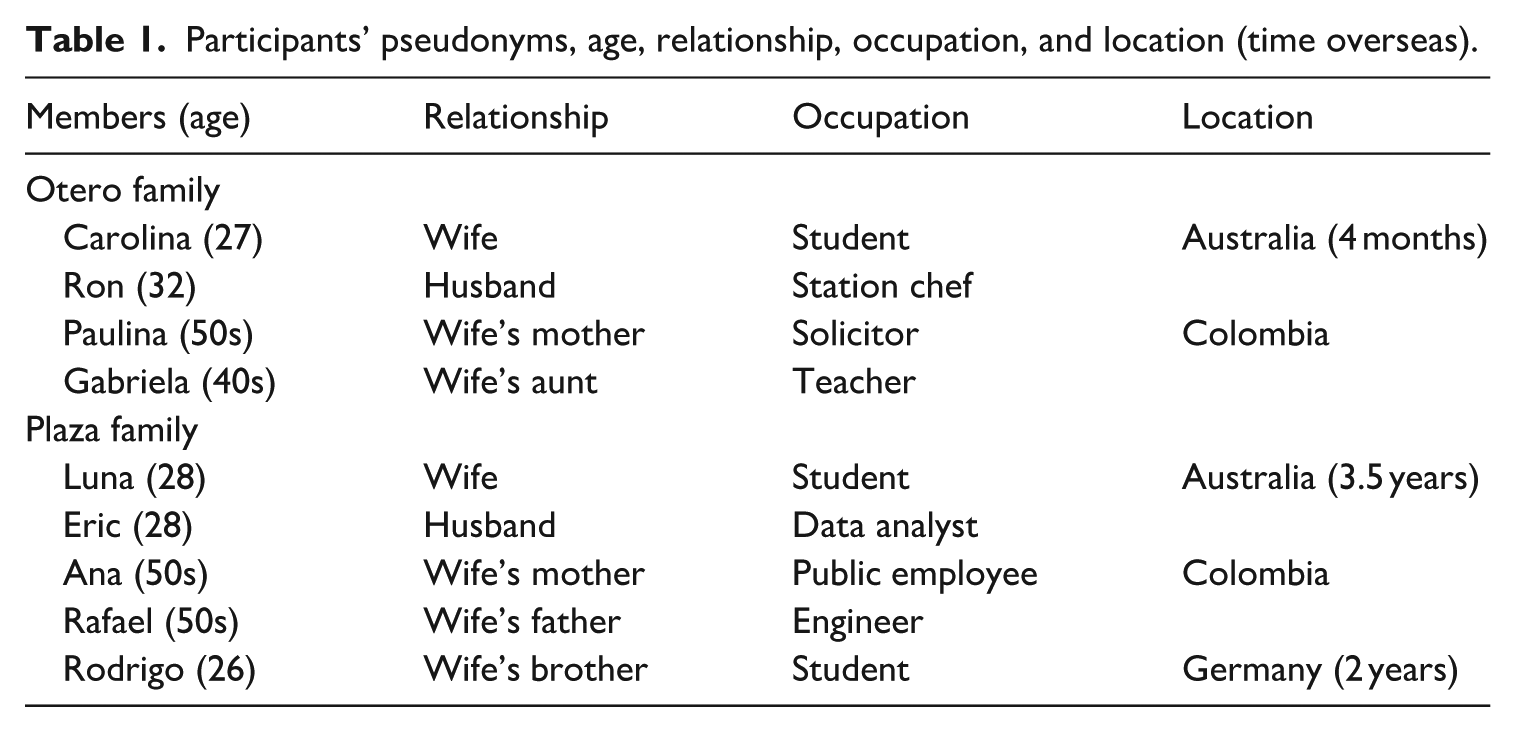
The conversations were video recorded on Zoom, and two additional cameras were installed to simultaneously capture the married couples’ face-to-face interaction during online breakdowns. The data comes from a larger project on accountability in family talk, for which 416 episodes involving accounting practices (i.e. holding-self- and holding-other-accountable) were identified. The collection was narrowed down to 94 instances where the accounting practices show the members’ orientation to the relational layer of relevance by prioritising the conjoint (re)creation of stability in their family system (see Arundale, 2020) vis-à-vis their entitlements, responsibilities, and obligations towards each other. These orientations were operationalised through explicit relational-category mentions (see Extract 3), relational-category descriptions (see Extract 4), and implicit relational categorisations through relational-category-implicative actions and inferences (see Extracts 1, 2, 5). This collection of what I refer to as “relational accounting” (see also Liu, 2026) was transcribed using Jeffersonian (Jefferson, 2004) and simplified Mondadian conventions (Mondada, 2018). As shown in Table 2, instances were further subclassified considering who initiates the holding-accountable practice: (1) “holding-self-accountable” (i.e. when the accountable party volunteers pre-emptive accounts in third position; see Extract 2) and (2) “holding-other-accountable” (i.e. when an interactant makes an account by another participant relevant). The latter differentiates instances of accounts provided by the targeted member from those provided by a non-targeted member as “vicarious accounting” (see Extracts 3, 5).
Instances of relational accounting in the collection by dataset.
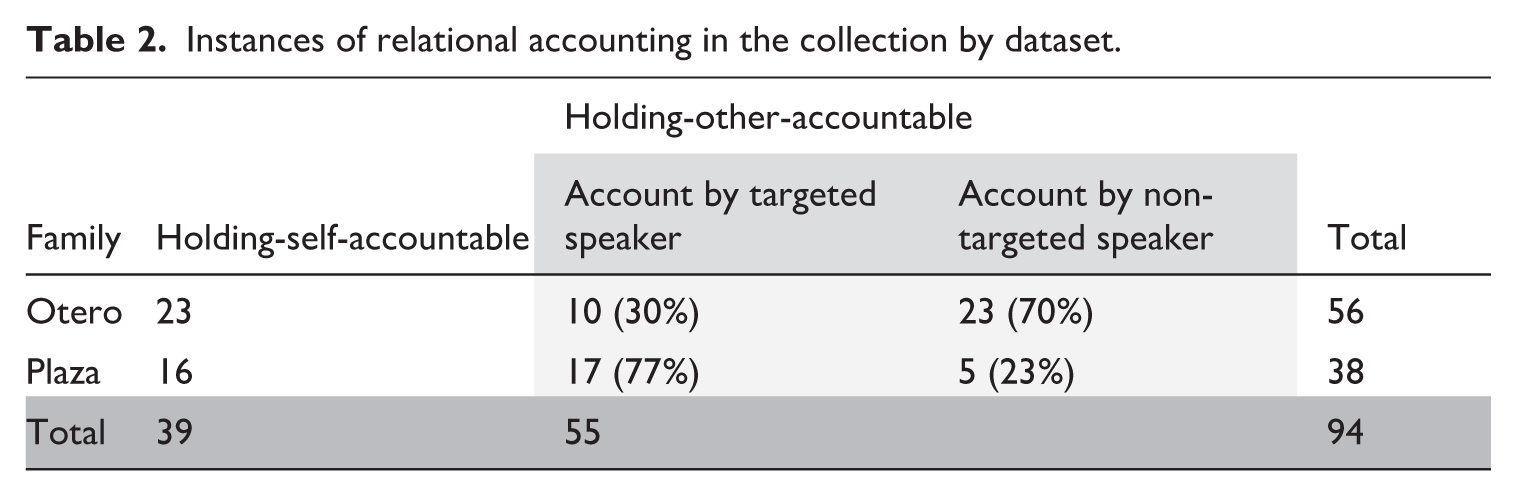
These sequential features were used as a departure point for exploring the sociopragmatic practices of (1) “doing transnational family” and (2) “doing family transnationally” illustrated below. Importantly, the following analysis assumes that accounting accomplishes categorisation work by foregrounding deviations from mutual expectations linked to the rights, obligations, and responsibilities shared by incumbents of a relational category.
Analysis
This collection of accounting practices, where members foreground relational matters, features two ways in which interlocutors implicitly surface (potentially) breached relational expectations. In doing transnational family, the members’ relational expectations regarding entitlements, obligations, and responsibilities towards one another draw on the assumption that transnationality alters how “family” should be accomplished (Extracts 2–3). In doing family transnationally, the members’ relational expectations tied to “doing family” are assumed to remain unaltered despite the constraints of transnationality (Extracts 4–5). The examples below illustrate how relational expectations emerge as members engage in these forms of accomplishing family.
Accounting in doing transnational family
Doing transnational family encompasses interactional practices wherein members orient to and co-construct transnationality as an integral feature of their relational system. Thus, relational expectations (i.e. mutual entitlements, responsibilities, and obligations) adjust and operate in tandem with contingencies of transnationality. This section examines “visiting migrant children overseas” as a co-constituted expectation of moral responsibility tied to the members’ relational category in transnational settings. In what follows, we consider how the particiant who initiates the holding-accountable practice surfaces the parents’ implicit breach of this relational expectation.
Extract 2 from the Otero family illustrates a case where the parent self-initiates the holding-accountable practice. In this occasion, Carolina is talking to her mother, Paulina, and her aunt, Gabriela about moving to and settling in Canada. Before this fragment, Paulina and Gabriela were jocularly fantasising about going to Australia on foot to avoid the acute criminal episodes in Colombia. Proposing a return to the serious frame, Carolina formulates a hopeful future projection where Paulina and Gabriela come over to Canada, stay for a little while, and are then persuaded to stay there permanently.
Es que Australia es muy lejos | It’s just that Australia is very far away
Carolina’s future projection (Georgakopoulou, 2003), where she conveys her desire for her family to visit when she moves to Canada and stay for a while to then persuade them to relocate there as well, is multimodally co-constructed as sensitive. Paulina’s silence and turn-initial laughter (see Gavioli, 1995) in line 12 and Gabriela’s tense smile and gaze withdrawal in line 11 appear to project a dispreferred response (Kendrick and Holler, 2017). While Paulina’s promise to go there seemingly aligns with her daughter’s hypothetical future story, by foregrounding the condition “cuando estén en Canada” (“when you move to Canada”) in line 13, she limits her commitment to Canada only. This condition is reinforced in line 15 through prosodic emphasis on the marker “sí” (lit. “yes,” “definitely”) and the emphasised deictic “allá” (“there”). Together in “yo sí voy allá” (“I will definitely go there”), they establish a contrast between Canada and Carolina’s current location (see Rodriguez, 2022), implying that Paulina will not visit her daughter in Australia. Despite other potential inferences (e.g. Paulina is unwilling to engage with her daughter’s current circumstances as a migrant), Carolina does not orient to this as problematic.
In line 17, Carolina treats Paulina’s assertion in line 15 as a taken-for-granted “sí claro” (“of course”) and contemplates the possibility that her mother and aunt feel so comfortable that they decide to move to Canada. Following her daughter’s silence in line 16, however, in overlap with Carolina, Paulina rushes to volunteer a preemptive account, holding herself accountable. With the turn-initial es que, a specialised device for repairing inferential gaps (see Delahunty and Gatzkiewics, 2000), Paulina exposes the previously implied meaning, confirming that she will not visit Australia and indexes the relevance of accounting. By topicalising the inference, Paulina recognises her stance as potentially unexpected, implicitly constructing it as a breach of the moral responsibility to ensure that her daughter is doing well overseas. The subsequent account, thus, serves as a category-implicative action, operationalising their membership in the relational category “transnational parent-child” and surfacing the relational expectation that parents should visit children overseas. Importantly, by invoking the constraints of geographic distance, “Australia es muy lejos” (“Australia is very far away”), Paulina conveys a not-at-fault excuse, appealing to limitations inherent to transnationality and beyond her control as shared, valid situational reasoning. In using “inability” as a more acceptable account (Buttny, 1993), Paulina forestalls negative conclusions (e.g. Paulina is a bad transnational mother), blocking “unwanted inferences” (Elder and Haugh, 2023) with adverse relational repercussions. Notice that Paulina’s account is accompanied by an embodied emotional stance of sadness and hopelessness conveyed through a head shake with inner eyebrows raised (Ekman and Friesen, 2003) and co-constructed by Gabriela with a mouth shrug in line 19 (Figure 1). In short, Paulina holds herself situationally but not relationally committed or responsible for the consequences of what she might be taken to be implicating (see Haugh, 2015).
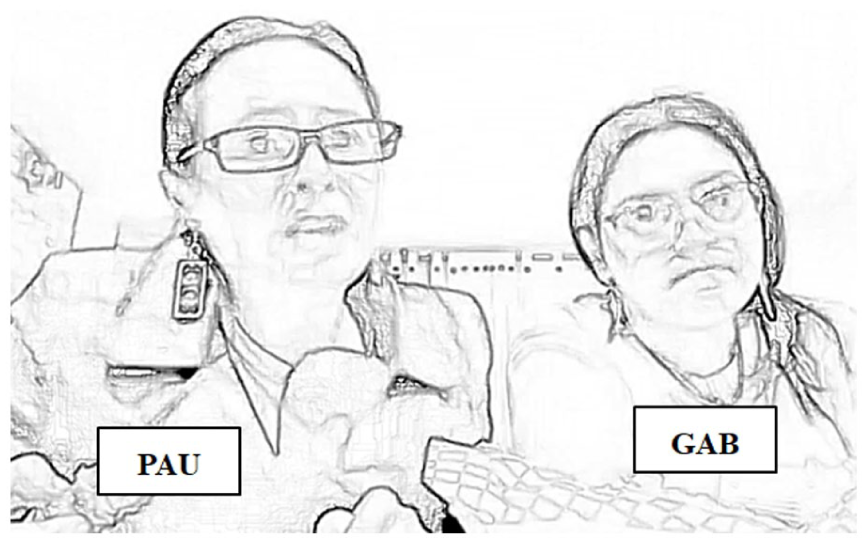
Embodied construction of hopelessness: inner eyebrows raised (PAU), mouth shrug (GAB).
Extract 3 from the Plaza family illustrates a more complex case where the holding-accountable practice and the vicarious accounting are other-initiated by the daughter on behalf of her parents. In this fragment, after discussing restaurants where Luna would like to take her parents when they visit her in Australia for the first time, Luna asks her mother, Ana, for an update on her decision regarding the holidays. It is thus contextually inferable that the decision might involve visiting Australia during the holidays, a topic that Ana orients to as sensitive through delays and various other mitigation devices.
Está difícil | It’s difficult
Luna’s pursuit of the decision regarding the holidays is explicitly addressed at her mother through the category label “mami” (“mum”), thereby constructing her as the only relevant decision-maker in the “parties to travel” collection. This displays Luna’s orientation to her mother’s constraints as a public employee who, different from her father, is entitled to only 15 days of leave per year and needs to make arrangements to notify her office. With the expression “al fin qué” (“in the end what”), Luna constructs the holiday topic as an incipient matter that has been discussed before and warrants the pursuit of a response. This way, Luna potentially holds her mother accountable for an overdue response. The 2.8 seconds silence, where Ana averts her gaze and rubs her neck with a palm-to-back-of-neck gesture (Figure 2), cast the upcoming turn as dispreferred (Kendrick and Holler, 2017), preempting the uncomfortable unresolved issue that needs to be verbalised (White and Givens, 2025). Notably, Luna co-constructs this multimodal discomfort after the first 1.2 seconds of silence, leaning back and scratching her forehead.
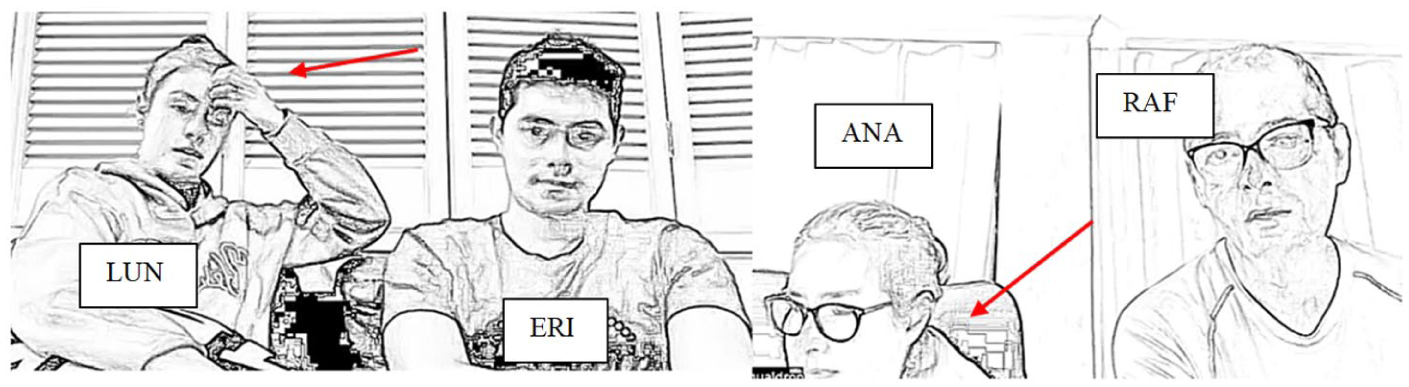
Mirrored embodied discomfort via self-touch: palm-to-back-of-neck (ANA) and forehead scratching (LUN).
Verbalising this embodied sensitivity, in line 3, Ana projects a non-straightforward response with a “pues” (“well”) prefaced turn (Raymond, 2018), followed by the prosodically slower account “no hemos decidido todavía” (“we haven’t decided yet”). This account not only delays and mitigates the incipient decision but also casts Ana as unable rather than unwilling to provide Luna with a response (Clayman, 2002). More importantly, Ana’s verb inflection “hemos” (“[plural] have”) updates the “decision-maker” to include Rafael, her husband, thereby operationalising the relational category “parents-daughter” as relevant for the sensitive matter. In line 5, Luna responds to Ana’s turn as a preparatory disclaimer rather than a final response, making her mother’s continuation relevant through the continuer “uh hum” produced with increased pitch and final rising intonation. Through her pursed lips in lines 4–6 (Figure 3(a)), Luna appears to be pre-empting bad news. What is delicate about the decision begins to surface with Rodrigo’s sudden gaze withdrawal (Figure 3(b)) and Rafael’s change of gaze direction from his daughter to his son, indexing Rodrigo’s involvement in the situation and his relevance as the next speaker earlier in line 3.
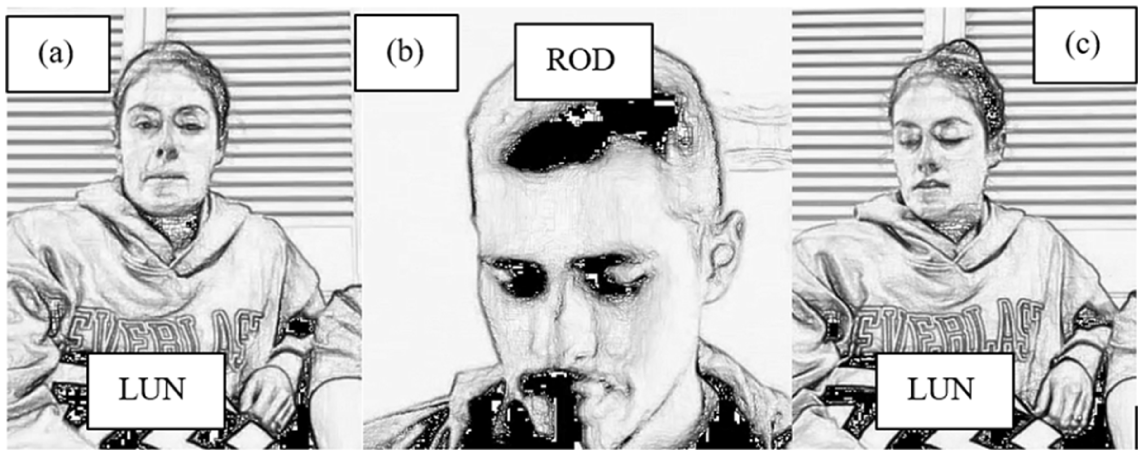
Embodied disappointment and avoidance through (a) lip-pursing (LUN) and (b–c) gaze aversion (ROD, LUN).
Considering that both adult children in this transnational family live in countries that are oceans apart (i.e. Germany and Australia), Ana’s pre-emptive actions might indicate their inability to fulfil the moral responsibility as “parents-of-migrant-children” to visit both within the same holiday period. Consequently, Luna’s assessment “está difícil” (“it is difficult” – where “it” refers to the decision) not only indexes these constraints of being a transnational family but also serves as a vicarious account on behalf of her parents. The construction “estar + adjective” in Spanish is pragmatically marked when contrasted with the form “ser + adjective” and conveys a sense of immediacy and independent access (Brown and Cortés-Torres, 2012). Thus, as a vicarious account, it: (1) excuses Ana for not being able to provide a straightforward response given the immediacy of the sequential constraints “here-and-now”, (2) projects sympathy by casting her parents’ decision as understandable from her independent view (i.e. “I find it difficult, myself”), and (3) invokes a shared stance regarding what “difficult” means in relation to the decision and the family. While what is “difficult” remains unarticulated, it is inferable through the members’ orientation to the assumption that transnationality affects their joint accomplishment of family. In this context, Ana and Rafael’s holiday decision involves choosing a destination, and consequentially, one of their two migrant children. Thus, Luna’s account operationalises the collection of relational categories “parents-of-migrant-children” where Ana and Rafael have equal responsibilities towards their son and daughter. While Luna’s reduced volume and gaze aversion (Figure 3(c)) seemingly convey disappointment, pre-empting the breach of her relational expectation to be chosen over her brother, her account ultimately serves as a go-ahead, inviting her mother to deliver the bad news by projecting understanding.
Following other signs of interactional trouble in lines 8–10, Ana finally expresses her wish to attend Rodrigo’s graduation “a mí me gustaría ir al grado de Rodri” (“I would like to attend Rodri’s graduation”) in line 11, thereby implying that she may not choose to visit Luna. Mitigating the sensitivity of this relational breach towards her daughter, Ana frames her likely decision to spend the holidays in Germany as an additional category-bound responsibility, that is, accompanying her younger child during an important event in his life. This relational responsibility towards Rodrigo is ultimately presented as a contingent priority by emphasising time constraints “que es ya próximo” (“which is coming soon”). This way, Ana constructs her decision as situationally needed rather than relationally preferred, thereby blocking unwanted relationally sensitive inferences and foregrounding the constraints of being a transnational family.
As evidenced in this section, accounting mobilised as part of “doing transnational family” is instrumental in: (1) surfacing the members’ awareness of unstated expectations tied to the structure of transnational families, and (2) blocking unwanted relationally sensitive inferences by invoking constraints inherent to transnationality (e.g. inability to visit countries located oceans apart). Noticeably, in both cases where transnational parents imply that they will breach the relational expectation of visiting their children overseas, children do not orient to their self-indexed accountability (Extract 2) or vicariously account for it, thereby exonerating their parents (Extract 3).
Accounting in doing family transnationally
“Doing family transnationally” encompasses interactional practices where members orient to their social memory in interactionally reconstructing and engaging previously successful resources (see Arundale, 2020) to accomplish family. In so doing, the members’ expectations operate under the assumption that such resources (e.g. co-constructing aligning stances), and thereby “doing family,” should remain unaltered despite the constraints of transnationality. In this section, we explore relational expectations surfacing through the interface between “transnationality” and (1) “doing family with in-laws” (Extract 4) and (2) “doing family across time” (Extract 5).
Extract 4 shows an example where the holding accountable is other-initiated through a complaint about a present party, indexing a breach of relational expectations tied to “doing family.” Before this fragment, Luna and her husband, Eric, were talking to Luna’s parents and brother about animals in Australia. In this sequential context, Eric starts telling about a time when he “placed down” a spider that had been in their balcony for a long time. His description of the event is then challenged by Luna who reformulates “placing down” as “killing.” La mató | He killed it
The fragment starts with Eric framing the extended time that the spider lived on their balcony as a warrant for his reported behaviour “yo la bajé” (“I placed it down”) in line 3. The 1 second silence, where Eric and Luna avert their gaze in opposite directions (Figure 4), projects dispreference and potential oppositional stances. Luna’s slightly raised eyebrow and soft prosody convey a negative multimodal stance whose object is verbalised in line 6 through other-repair “la mató” (“he/you killed it”), where she clarifies the indeterminacy of Eric’s “placed down” as a euphemism for “killing.”
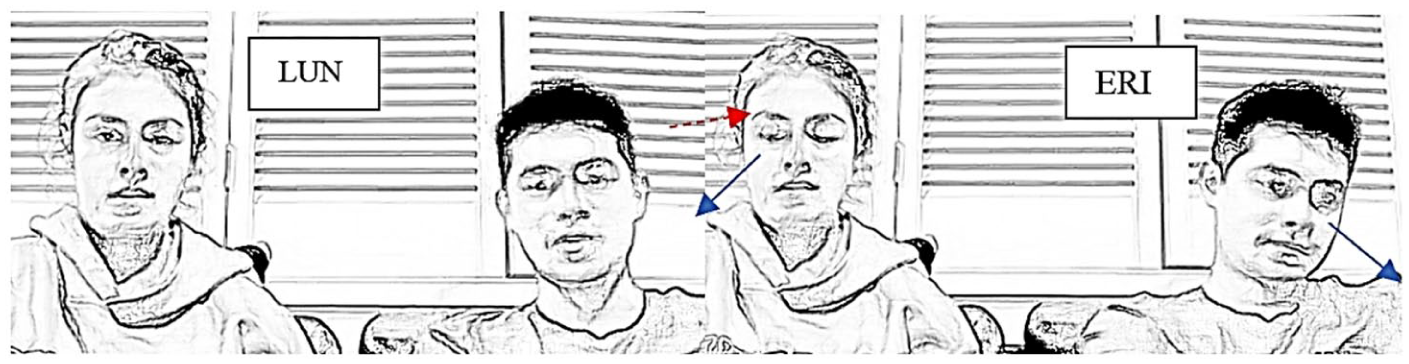
Transition to oppositional stances through gaze aversion. LUN’s slightly raised eyebrow.
Latching with Luna’s turn, Rafael proffers the same candidate interpretation in line 6, attributing agency to Eric for the spider’s death. Rafael’s request for confirmation is followed by a long blink (Figure 5(b)), a growing mouth shrug with corners of the lips down, and slight eye narrowing (Figure 5(b) and (c)) conveying a negative evaluation and disapproval of the killing through a facial expression mixing mild anger and disappointment (Ekman and Friesen, 2003). Ana’s smirk in line 4 and her half-mouth shrug with a slight frown in line 8 (Figure 5(a) and (c)) also display her understanding of the implied meaning and her negatively valenced stance (Selting, 2012). This embodied alignment between Luna and her parents suggests a shared moral stance towards killing living things.
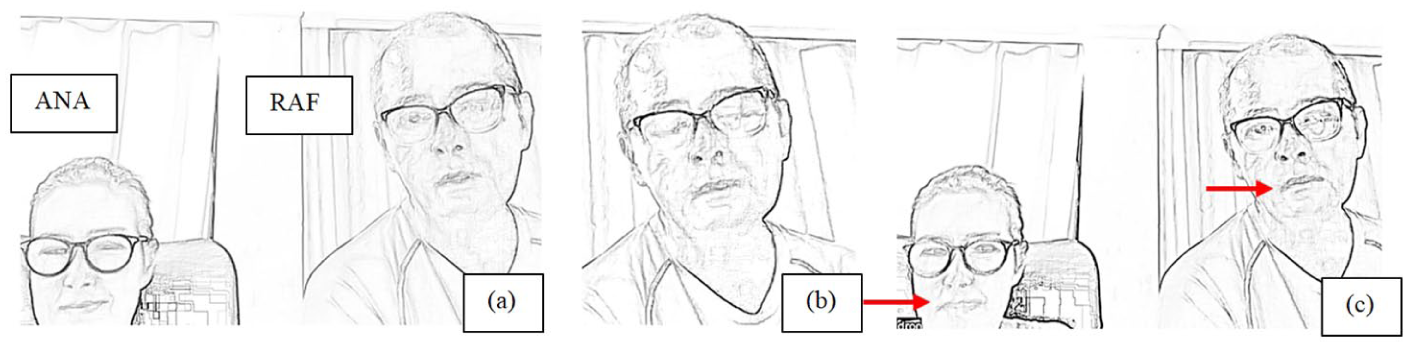
Embodied negative assessment through (a) smirk (PAU), (b) long blink, mouth shrug, and (c) eye-narrowing and mouth shrug (RAF, ANA).
Considering that this shared stance is known to Luna, her repair initiation may be hearable as a complaint or accusation projecting at least two relational expectations: (1) for her parents to affiliate with her and co-construct the negative stance as a way of “doing family,” thereby holding Eric accountable for his actions (Buttny, 1993), and (2) for Eric to admit fault and potentially provide remedial action, also engaging in “doing family” with her. Evidence of the latter expectation emerges through the 0.8 seconds silence where Luna gives Eric the chance to respond to Rafael’s confirmation request, even though the verb conjugation “la mató” (“he/you killed it”) can be hearable as addressed to Luna (i.e. in relation to Eric as the third person). Nonetheless, Eric rejects the agency ascribed to him while still acknowledging that the spider died through the reflexive structure “se murió” (“it died”). Luna (line 10) and Rafael (line 13) receipt Eric’s denial with laughter particles interpolated in the change-of-state token ay, marking surprise and stressing her negative evaluation (Vázquez-Carranza, 2016). In overlap, Eric then volunteers the increment “cuando la bajé” (“when I placed it down”) that links the events “placing down” and “dying” as two unrelated events, thereby skilfully blocking the relation of causation as a case of non-agentive accountability (see Márquez-Reiter, 2022). While Eric’s denial of responsibility is treated as jocular by Luna and her family through laugher in lines 14–16, Rafael implicitly aligns with Luna’s complaint. Rafael’s escalation of Eric’s account in line 17, claiming that the spider surely died “de pena moral” (“of a broken heart”) not only mocks Eric’s reasoning but also conveys his stance towards accountability through implied criticism (see Haugh, 2016).
Returning to the serious frame, Eric claims having had no intention to kill the spider “yo no quería que muriera” [“I didn’t want it to die”], projecting embodied honesty through the hand-over-chest gesture (see Leng and Wu, 2019; Figure 6). The account in line 19, then casts the death as an unfortunate accident that he could not prevent because “era muy débil” (“it was very weak”). In shifting from outright denial to a heartfelt not-at-fault excuse, Eric engages in “doing family with in-laws” by claiming a similar stance.
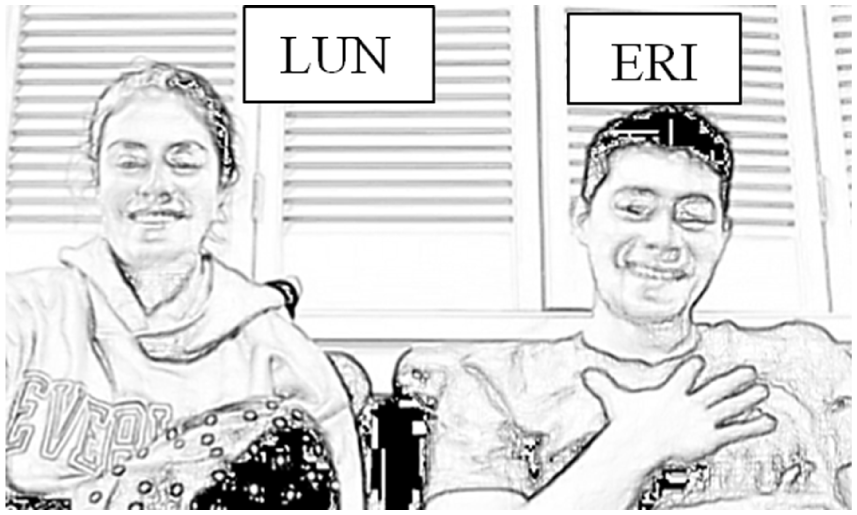
Hand-over-chest gesture as an embodied display of honesty.
Failing to receive affiliation from the family, Eric pursues the not-at-fault excuse with a o sea- prefaced self-repair (see Vázquez-Carranza, 2012), this time invoking contingencies of their transnationality as a warrant for deviating from the family’s moral stance in relation to not killing living things. By clarifying that his priority was removing the spider hanging next to the door that one opens to go out onto the balcony in lines 21–23, Eric implicitly invokes the family’s knowledge of spiders in Australia as a potential health threat. While Eric’s account is still disapproved of by Luna who after a 1 second silence continues signalling a negative affective stance with the tut “tch” mitigated with a smile, Rafael provides some alignment in relation to the context. As a last resource, Eric reframes his breach of the relational expectation of engaging in “doing family with in-laws” through shared moral stances, by foregrounding the importance of protecting his wife, Ana and Rafael’s daughter, from environmental threats. Eric’s pues-prefaced account, then resists the presupposition (Raymond, 2018) that killing the spider was unreasonable. By arguing that he was “preventing the spider from falling on Luna when she went out on the balcony” in lines 28–29, Eric justifies the killing as acting in a way that is consistent with his incumbency in the relational category “husband-wife” (Pomerantz and Mandelbaum, 2005). Such an account ultimately surfaces a misalignment of relational expectations where he prioritises the contingencies of transnationality (i.e. potentially poisonous animals) over “doing family” (i.e. aligning with Luna’s moral stance regardless of the context). With the turn-final “pero no” (“but not”) in line 29, Eric turns the tables on Luna, holding her accountable for not appreciating his doing “being caring” in the transnational context.
Finally, Extract 5 illustrates how third-party intervention through vicarious accounting in response to holding-other-accountable foregrounds implicitly breached relational expectations underlying others explicitly invoked breaches. Before this extract, Paulina had issued an embodied sanctioning of her daughter’s nail-biting behaviour by slapping the back of her own hand, thereby prioritising doing “being mother” and showing care despite the constraints of digitally mediated interaction. Even though no words were uttered, Paulina’s turn overlapped with her younger sister’s (Gabiela) troubles telling, leading eventually to Gabriela’s abandonment of her course of action. We join the interaction as Carolina explicitly holds her mother accountable for interrupting her aunt, Gabis, through an accusation.
Es que imagínate | It’s just that imagine
Paulina’s overlapping implementation of the embodied sanctioning is consequential for her relationships with her younger sister – whom she interrupted – and her adult daughter – whom she sanctioned like a child. Carolina’s accusation in line 14 foregrounds the former, holding Paulina accountable for violating Gabriela’s speaker rights and halting the progressivity of the sequence, thereby prompting a remedial action. Carolina’s explicit category mentions “mami” (“Mum”) and “Gabis” (an endearing form for Gabriela) in the accusation prosodically emphasise the affected party. Thus, the turn-initial address term not only allocates Paulina as the relevant next speaker but may also strengthen the accusation (see Lerner, 2003) by invoking the breached interactional expectations as potentially relevant to the “sister-sister” relational category as well. Carolina’s embodied negative stance seems overloaded with a frowning facial expression that conveys annoyance and a backhand swipe (Figure 7(a)) followed by an arm slap (Figure 7(b)), as if responding to repeated instances of the same transgression. Given that this is the only instance where Paulina “interrupts” Gabriela in the collection, Carolina is likely to be using the availability of this interactional breach to implicitly complain about a different relational matter, potentially related to her non-compliance with her mother’s previous directive. While Carolina partially modulates this stance with a slight smile, she continues to convey anger through a startle eyeblink characterised by greater blink inhibition (Amodio and Harmon-Jones, 2011; Figure 7(c)) in the form of slow blinking, and head shaking (Figure 7(d)).
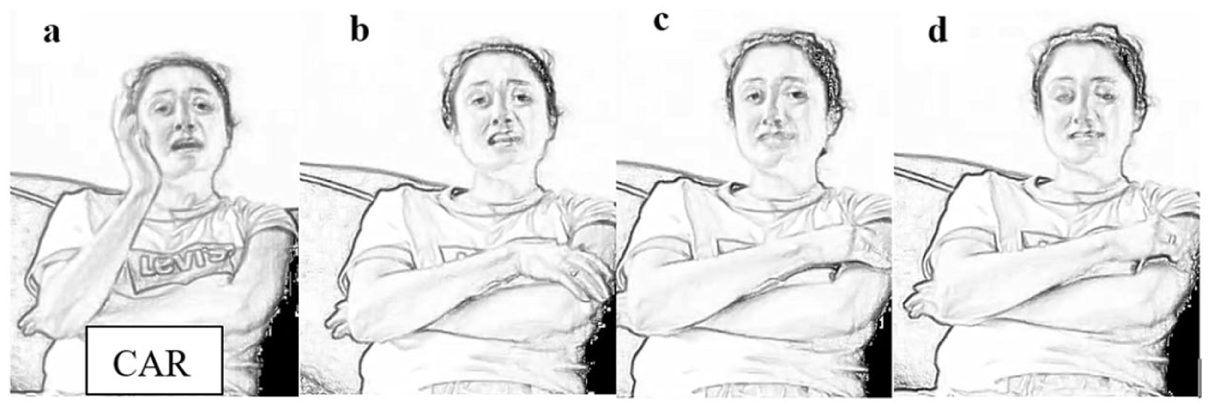
Embodied construction of negative affect in accusation (a) backhand swipe, (b) arm slap, (c) startle eyeblink, smile (d) head shake.
After a 0.4 seconds silence, Gabriela turns to Paulina and, slightly tilting her head forward, gazes at her with narrowed eyes and an open-mouth smile, pursuing Paulina’s remedial action. This continues until, Paulina turns to Gabriela in line 16, shaking her head with inner eyebrows raised, displaying surprise (Ekman and Friesen, 2003) and utters an elongated denial “no” marked by a higher pitch and increasing intensity (Didoni and Combei, 2024), thereby projecting innocence (Figure 8).
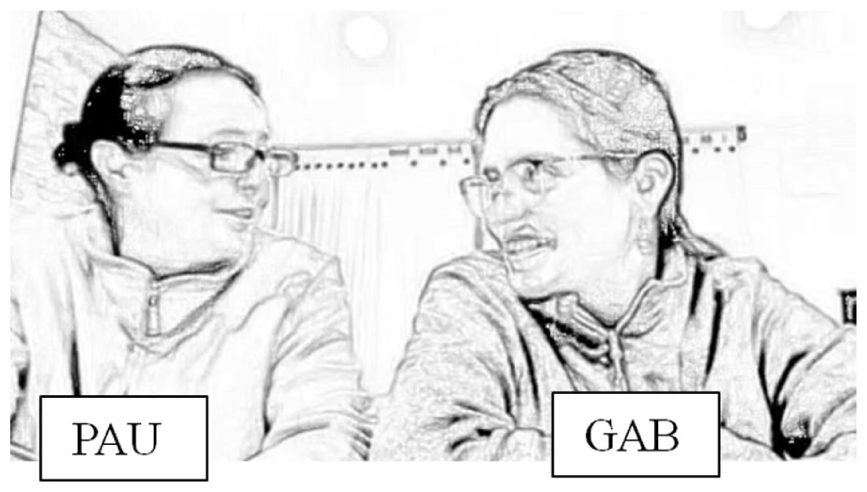
Embodied jocular accusation through gaze.
At this point, Gabriela latches her turn to acknowledge the transgression “sí” (“yes”) but immediately affiliates with Paulina, providing a vicarious account (Sterponi, 2009) for her in line 17. Gabriela’s es que-prefaced account not only justifies Paulina’s prioritising doing “being mother” but also excuses Paulina’s breach of the relational expectations tied to the “mother-adult daughter” category. In indexing time constraints “hacía cuánto” (“how long”) and inability “no te podía decir” (“she wasn’t able to tell you”), Gabriela invokes the contingencies of transnational communication as situated valid reasoning for giving primacy to doing “being mother.” Since the family mostly communicate via short, purposeful phone calls, the absence of video input might have restricted Paulina’s visual access to her daughter’s habits, limiting her opportunities to enact her entitlement to correct and look after Carolina. Gabriela’s recycling of the embodied sanctioning while reporting Paulina’s directive “que no hagas eso” (“don’t do that”) reframes the offence ascribed to Paulina’s overlapping action as a recognisable socialisation practice expected from an incumbent in the category “mother” (see Goodwin, 2006). More importantly, in problematising Paulina’s temporal inability to correct Carolina, Gabriela indexes the practice as a routinary one in Paulina and Carolina’s past relational history (see Drew and Chilton, 2000), which might explain Carolina’s overloaded negative stance. In this sense, Gabriela becomes a mediator between mother and daughter, affiliating with Paulina’s orientation to her moral responsibility and entitlement to look after her daughter. This affiliative move evidences Gabriela’s relational epistemic access (Rodriguez and Sinkeviciute, 2025) to Paulina, with whom she lives, and prioritises the relational work with Carolina, who lives overseas.
Concerning Carolina, Gabriela’s account can be hearable as potentially mobilising her niece’s compliance with the directive by asking her “imagínate” (“imagine”) to be more empathetic towards her mother. However, by invoking the context to excuse Paulina, Gabriela might also be acknowledging a degree of inappropriateness in the mother’s claimed entitlement to sanction her, now, adult daughter. While this deontic asymmetry (see Stevanovic, 2018) is not necessarily problematic for incumbents in the mother-young child category (see Goodwin and Cekaite, 2018), updates caused by changes in the stage of life collection unavoidably transform relational expectations. Thus, despite Gabriela’s modulation of the sensitive breaches through turn-final laughter, which partially alleviates the tension between the parties (Shaw et al., 2013), Carolina rejects the vicarious account with a headshake and resists Paulina’s claimed entitlement to correct her through non-compliance (see Goodwin and Loyd, 2018; Johnson, 2018).
As Carolina defends her independence by resuming the nail biting while gazing away in an attempt to bring the sequence to a closure in line 18, she rejects her mother’s display of intimacy and concern for her well-being (see Beach, 1996). This is visibly oriented to as an accountable relational breach of her mother’s expectations by all the family members, who stare at her as if expecting her remediation in line 19. Following non-compliance, Ron engages in doing “family with in-laws” by aligning with Paulina and Gabriela’s stance through his directive in line 20 “no hagas eso” (“don’t do that”). This way, he enforces the family’s relational expectation of compliance by grabbing Carolina’s hand, tilting the deontic gradient towards himself and enacting his entitlement to physically stop his wife on behalf of her mother. This ultimately facilitates “doing family transnationally” despite physical distance. Extract 5 thus illustrates how accounts surface breached relational expectations arising from divergent orientation to “doing family transnationally” and “doing family across lifespan,” considering updated relational entitlements.
This section demonstrated how members of transnational families operate under the assumption that “doing family” should remain unaltered despite the constraints of transnationality. By (not)engaging in practices of preserving a shared moral stance (Extract 4) and maintaining the same entitlements (Extract 5), accounting practices became relevant, with transnationality emerging as an implicit device for negotiation. In these examples, accounting (1) surfaces awareness of unstated expectations tied to “doing family” and (2) foregrounds environmental contingencies (e.g. environmental threats and absence of physical co-presence) as justifications for departures from expected ways of “doing family.” Importantly, in both cases invoking “transnationality” to excuse or justify “not doing family” is implicitly rejected by the recipients.
Discussion and conclusions
This paper explored how Spanish-speaking adult family members deploy accounting practices as relevant to “doing-family-at-a-distance,” thereby surfacing their tacit relational expectations. Drawing on 6 hours of ordinary videocalls between Spanish-speaking adult members of two transnational families and through an interactional pragmatic lens combined with the analytic mentality of MCA, I examined cases from a collection of what I call “relational accounting.” That is, accounting practices through which members orient to the relational layer of relevance (i.e. who is entitled to an account and why) by prioritising the conjoint (re)creation of stability in their social systems (see Arundale, 2020) vis-à-vis their entitlements, responsibilities, and obligations towards each other. The analysis was structured around the micro-sequential implications of who initiates the holding-accountable practice and how this contributes to the surfacing of implicit relational expectations. The examples illustrated instances of (1) holding-self-accountable where accounting blocks unwanted inferences, claiming no commitment to inferable relational threats (Extract 2), (2) holding-other-accountable where accounting reframes the indexed breach, tying the accountable matter as a responsibility of an incumbent in the relational category (Extracts 4, and 5), and (3) vicarious accounting, where accounting accomplishes exoneration through affiliation (Extracts 3, 5). Considering that members often invoked transnationality as context to control meaning (see Rintel, 2015), it was noticed that the families’ assumptions about transnationality affected how they accomplish “family.” Thus, accounting in “doing transnational family” was differentiated from accounting in “doing family transnationally.”
As summarised in Figure 9, accounting in doing transnational family becomes relevant through the members’ assumption that transnationality alters how “doing family” is accomplished. In this sense, relational expectations are tied to transnationality (e.g. visiting children overseas) as an integral family feature, so when transnationality is invoked in accounting, it determines and remediates relational breaches as evidenced by the members’ acceptance (Extracts 2–3). Accounting in doing family transnationally becomes relevant through the members’ assumption that “doing family” should remain unaltered despite the constraints of transnationality. Thus, relational expectations are tied to the members’ social memory of the resources consistently and jointly recreated in “doing family” (e.g. co-constructing aligning stances). When transnationality is invoked in accounting to excuse or justify the members’ breaches of relational expectations tied to “doing family,” accounts tend to be rejected (Extracts 4–5).
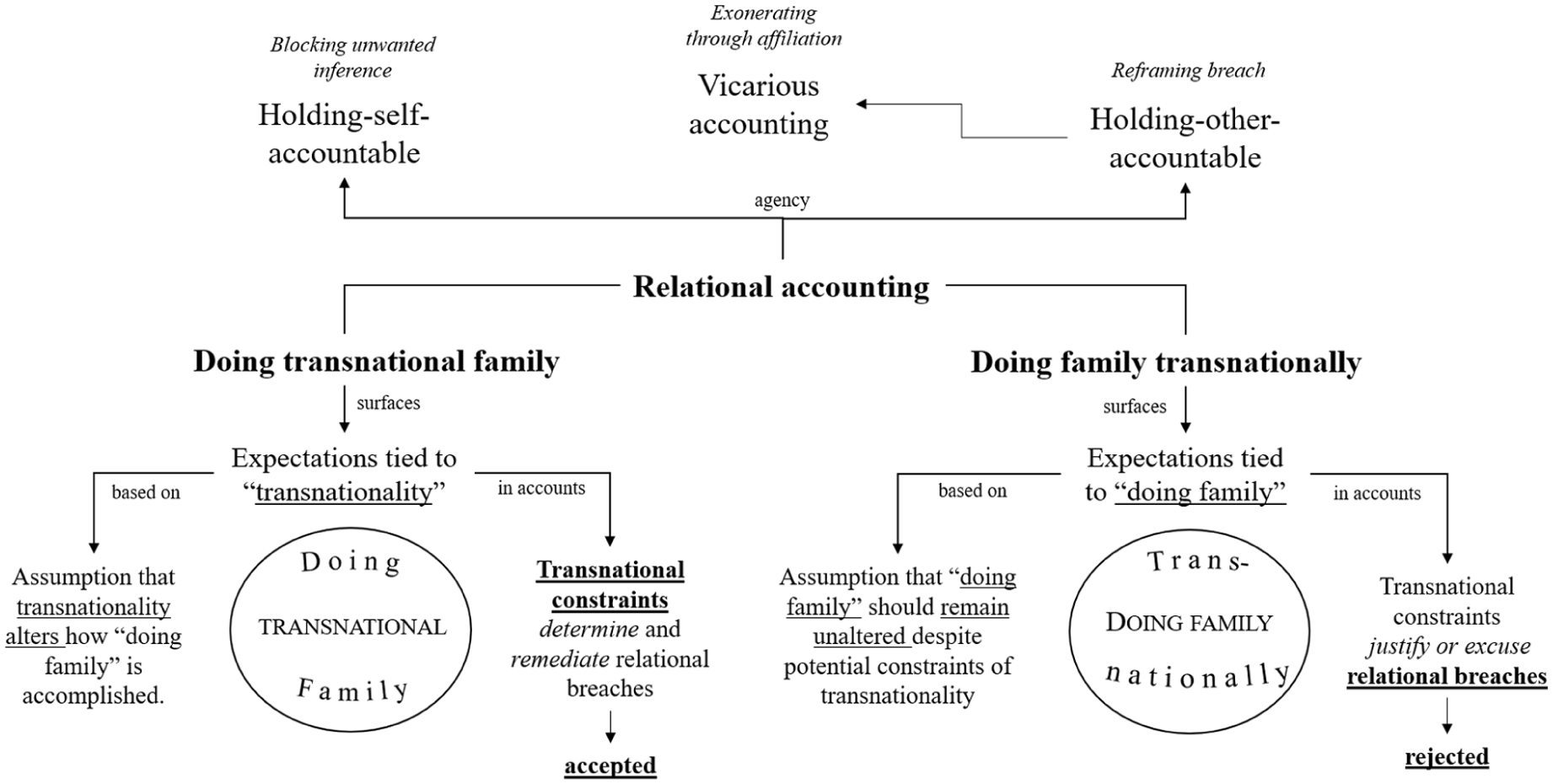
Relational accounting vis-à-vis the relational practice of “doing family.”
This paper shows that the evaluative nature of accounting makes accounts category-implicative actions, that is, retroactively implicative of relational breaches and the categorisation that conditions the relational expectation. Thus, by exploring accounting as a way in which participants “expose, as well as avoid exposing, unwanted inferences [. . .], secondary meanings become analytically tractable” (Elder and Haugh, 2023: 117). While there are limitations in surfacing what speakers implicitly orient to, particularly when recipients do not explicitly do so within the current sequence, contextual evidence emerging from the overall collection may warrant particular inferences. These findings may contribute to a more nuanced understanding of how members of transnational families (see also Bolaños-Carpio et al., 2026 on migrant Latina mothers) engage in accounting practices to reconstitute stability and familial order. More importantly, it opens avenues for future exploration of how relationships, particularly those with in-laws (see Endo, 2026), afford and constrain social actions, particularly accounting.
Footnotes
Acknowledgements
I would like to express my most sincere gratitude to the families who volunteered for this study. I also thank the two reviewers for their useful comments and suggestions.

Funding
The author received no financial support for the research, authorship, and/or publication of this article.
Declaration of conflicting interests
The author declared no potential conflicts of interest with respect to the research, authorship, and/or publication of this article.