



Abstract
This article investigates how age categorisation and prejudicial use of age are mobilised in talk by job applicants during job interviews and how recruiters affiliate with these. The institutional goal of recruitment is to ensure an unbiased process and evaluation, nevertheless, ageism against older workers emerges as unchallenged and culturally acceptable in authentic job interviews. In line with the discursive psychology (DP) approach, the analysis focuses on -isms as discursively constructed and categories as resources to accomplish social actions. A case study is conducted based on video recordings of 24 real job interviews held at an Italian staffing agency and analysed through membership categorisation and conversation analysis. The analysis provides evidence of how job applicants resort to age co-membership with recruiters to achieve affiliation – or remedy misalignment – by complaining about older workers. The study contributes to DP’s re-specification of prejudices as interactional practices and links microanalysis to macro phenomena, such as ageism, through categorisation practices.
Keywords
Introduction
Combating ageism has been defined as one of the policy targets to be reached by 2030 during the United Nations (UN) Decade of Healthy Ageing (2021–2030) (World Health Organization, 2021). The World Health Organization (WHO) has called for more research addressing the phenomenon of ageism, which is considered one of the key obstacles to a society for all ages. The ageing of the global population is acknowledged as the biggest demographic change in our century, and an inclusive society can be achieved only by ensuring that age is not a discriminant in institutional practices. Work life is a topic of interest here because the highest level of perceived age discrimination has been reported in this context. For example, ‘being too old or too young’ is considered the most disadvantageous criterion of discernment in recruitment, even when job applicants have equal skills (Special Eurobarometer 2019, 493).
In their latest global report, WHO refers to ageism as ‘the stereotypes (how we think), prejudice (how we feel) and discrimination (how we act) directed towards people based on their age’ (World Health Organization, 2021: XV). This definition stems from a cognitive psychological tradition and an Allportian conceptualisation of prejudices, which are understood as an aversion to a group/category based on an incorrect and rigid generalisation of its negative features (Allport, 1954). In this theoretical tradition, there is a causal link between perception (stereotypes), belief (prejudices) and behaviour (discrimination). Research in psychology has explored this link by proving its causality in experimental settings where category-based perceptions could be accurately manipulated. Consequently, stereotypes are examined as detached from their social and professional environments and the specific social and institutional relations therein. Extant studies on age stereotypes and recruitment have analysed the impact of job applicants’ age on recruiters’ decisions by evaluating resumes where only the age variable was changed (Ahmed et al., 2012; Zaniboni et al., 2019). However, these studies often include non-professional recruiters and analyse the practice strapped from their social context.
In this paper, we re-contextualise the study of age dynamics and ageism in hiring processes by analysing them as social practices constructed in and through social interactions. By analysing prejudices as discursively accomplished in social interaction, this research contributes to the agenda of discursive psychology (DP) and the enterprise of analysing psychological phenomena in their social setting and carried out in, through and for social interactions (Wiggins, 2017). The analytical focus is on the interactional dynamics surrounding the mobilisation of possible ageist utterances towards absent older third parties by job applicants and the consequential recruiter’s (mis)affiliation. The results will show how prejudicial use of age towards older parties is discursively accomplished and warranted when interactants construct co-membership on (younger) age in situ. Moreover, age is a resource, or interactional currency, to overcome misalignments caused by other category-based practices, in our case study, gender. The study adds ageism to the literature of -isms as discursively accomplished, which concerns predominantly sexism and racism (Weatherall, 2015; Whitehead, 2018). In discussing equality in the hiring process, we show that, despite the endorsement of inclusive policies, everyday ageism goes unnoticed in work-related settings and (younger) job applicants can use ageism to maintain a favourable impression and build solidarity with (younger) recruiters.
The paper is structured as follows. First, we review relevant literature around DP and -isms, as well as co-membership and solidarity in job interviews, showing the existing gap about ageism and age as a relevant category. Second, the data and method of the case study are presented. The data are video recordings of authentic job interviews collected in an Italian recruitment centre; this data is innovatively used to analyse ageism in recruitment. The implications of this institutional settings for the practice of hiring are thereafter discussed. Third, we present the results: four extracts that show different degrees of possible ageist prejudices, from more explicit to less, and the role of discursively establishing co-membership on age. Fourth, we conclude that this study empirically shows that ageism is still culturally accepted and co-membership on age is relevant to warrant prejudicial use of age, as well as, to construct affiliation and ‘save face’ in difficult interactions. In the conclusive discussion, we emphasise that, as shown by other researchers before (e.g. Rivera, 2012), exploring similarities in recruitment, besides surveys and experiments, provides new information to advance equality and diversity in hiring practices.
Discursive psychology and social categories
Discursive psychology (DP) proposes a re-specification of psychological concepts as ‘shaped for the functions they serve, in and for the nexus of social practices in which we use languages’ (Edwards, 2012: 427). DP has established an alternative approach to studying attitudes and stereotypes by situating them in discourse practices (Huma et al., 2020; Potter and Wetherell, 1987; Wiggins and Potter, 2003), and to understanding the moral accountability of -isms in discourse and conversation (Stokoe, 2020). The re-theorisation of attitudes is a foundational string of research in DP and stems from the idea that stances towards groups, and the related prejudicial attitudes, are shaped by the sequentiality of conversation and cannot be analysed as separate from it.
The re-specification of stereotypes and prejudicial attitudes is linked to the discursive study of identity, social categories and categorisation practices. The overall positioning of DP is that language is a tool for achieving social actions and that ‘categories are for talking’ (Edwards, 1991: 515). Categorisation in talk – the process of assigning a member to a category – is a discursive practice and is motivated by an interactional purpose at a particular time and with certain stakes (Fitzgerald and Rintel, 2016). Furthermore, DP questions the concept that categories are merely labels attached to objects because of our cognitive need to ease the perception of the social world. According to Billig (1987), people can not only generalise but also particularise; hence, categorisation is not independent of situations. In DP, categories are flexible, even fuzzy, and thus need to be analysed in naturally occurring situated cases to understand how members make use of them and what social action they accomplish. Compared with other psychological traditions, DP allows for an investigation of how people negotiate membership to social categories in situ and how they flexibly assign or reject membership to categories depending on the ongoing social actions.
In the context of the workforce, research has shown that shared cultural notions about age in the labour market allow for certain attributes and predicates to be heard as coherent with certain age groups (Ainsworth and Hardy, 2007; McVittie et al., 2003; Previtali and Spedale, 2021). The consequences that the interactional use of age norms, and related stereotypes, might have on exclusion and inclusion and on making institutional practices ageist have received scant attention; to our knowledge, no studies focused on age have been performed on real encounters in the workplace. Ageism has not been extensively addressed as an interactional practice (Heinrichsmeier, 2018, 2019), although ethnomethodologically and conversation-analytically informed research has highlighted how -isms are done and managed in interaction (Whitehead and Stokoe, 2015), including sexism (Stokoe, 2010, 2015; Stokoe and Edwards, 2009; Weatherall, 2015) and racism (Durrheim et al., 2015; Whitehead, 2015, 2018). To bridge this research gap, the current article studies the systematic, recurrent, familiar practices of age categorisation and how they are related to warranting age stereotypes and ageism in talk through the analysis of video-recorded job interviews.
This article contributes to DP’s agenda; it focuses on negotiation and membership categorisation of age by job applicants and recruiters during real, or ‘naturally occurring’, job interviews. In exploring how members make sense of this categorisation, the study addresses how prejudicial attitudes towards age categories are mobilised, how participants sequentially take a stance towards these assessments and whether they are held morally accountable for warranting possible -isms in interaction. This study breaks new ground by investigating age stereotypes as discursive practices in job interviews and ageism as socially accomplished instead of considering them as possible causes or outcomes of unfair recruitment practices. Simultaneously, the focus of the analysis shifts from what happens before and after the job interview to what happens during this institutional interaction. Furthermore, the participants’ categorisation practices are prioritised over the analysts’ predefined schemas. In the results section, we show that co-membership in a young(er) age category, which is an always-available resource because of the face validity of age (Jayyusi, 1984), warrants the use of older age as grounds to complain about an absent third party. Recruiters show affiliative stances towards this stereotypical topic of complaint. The interpretative power of age in the context of work makes it a relevant interactional currency that job applicants can spend in their favour if they share a similar stage of life (SOL) category with the recruiter.
Looking at age and social categories in job interviews through co-membership
Discursive research has investigated how age as a social category is mobilised, achieved, rejected, and negotiated in interaction and thus has consequences for situated identities (Nikander, 2009; for a review, see Previtali et al., 2022]). Discursively, age is more than the mere revelation of one’s date of birth. Age-related categorisations include all SOL categories – for example, child, teenager, adult and senior as well as group labelling as old or young people – that are ordered along the chronologically organised life course. The normative element rooted in the expectations related to each SOL category can be used in interaction to construct social practices. The dynamics of age categorisation have been studied in diverse settings, such as helpline calls (Cromdal et al., 2018; Tennent, 2020; Thell and Jacobsson, 2016), customer service (Flinkfeldt et al., 2021), health care (Näslund, 2017), reality shows (Poulios, 2009) and research interviews (Nikander, 2009; Ylänne and Nikander, 2019). For example, studies have shown how SOL is used as an interpretative device by professionals to make sense of help-seeking by clients and decide whether to provide the desired help (Cromdal et al., 2018; Tennent, 2020; Thell and Jacobsson, 2016). Our article focuses, first, on age as an interpretative resource and, second, age prejudices as culturally shared notions available to interactants for managing positive self-presentation in job interviews.
The analysis of categorisation practices during job interviews is especially interesting owing to the inference-rich feature of job interviews (Sacks, 1992; Schegloff, 2007) and how they invoke cultural norms that embed certain behaviours. Analysing how SOL categories are used, assembled, deployed, negotiated and managed during job interviews by recruiters and job applicants is a medium to understand their notions of age-related expectations and warranted mobilisation of culturally accepted stereotypes about age. Recruitment practices are especially appropriate for the investigation of categorisation and related prescriptions and proscriptions of attributes because job applicants are engaged in the action of impression management (Goffman, 1959).
Various analytical studies focusing on institutional interactions have demonstrated that impression management is the interactional work in which job applicants engage throughout the interview to negotiate identities that fit with recruiters’ presumed expectations in terms of personality, professional skills and competence (Lipovsky, 2010; Van De Mieroop, 2019; Van De Mieroop et al., 2019; Van De Mieroop and Schnurr, 2018). This identity work is moulded into the agenda set by the recruiters (Button, 1987), which ensures that they achieve the institutional goal: selecting the best job applicant for the position. According to Goffman (1959), each social interaction involves the staging of characters and actively managing their positive impression by the interactants. Our analysis shows how during job interviews, the staging of ‘being a good employee’ by job applicants can be discredited by the challenging questions by recruiters. This makes relevant the need to remedy the staging. Van De Mieroop et al. (2019) showed that negative remarks about a third party are more effective in job interviews than common sense. Job applicants can start complaining after having discursively renegotiated the rules of the interview game. We expand on the use of negative remarks in job interviews, focusing on complaints about non-present third parties (see, e.g. Ruusuvuori et al., (2019) on complaining about others at work). Complaining is a possible source of dissonance that can endanger the goal of making a good impression as a future employee (Goffman, 1959); hence, investigating complaint episodes allows us to analyse the sequential managing of good impression by job applicants and the (re)negotiation of co-membership on age to sustain it.
Within DP and according to Sacks (1992), categorisation is understood as a regular action mobilised by members to achieve social organisation and display local sense-making to each other. As previously described, categorisation, or how people categorise and describe themselves or others, is always occasioned; moreover, the display of one alternative over others is based on the ongoing action and orientation. In our analysis, we focus on co-membership as a resource to manage and mend the rupture in staging a good impression. We see building co-membership with other participants as a technique that creates trust and prevents the damage caused by possible disruptions (Lipovsky, 2010; Van De Mieroop, 2019). Co-membership during job interviews is defined by Erickson and Schultz (1982: 17) as ‘an aspect of performed social identity that involves particularistic attributes of status shared by interviewers and job applicants’. They showed that in counselling sessions between students and counsellors, shared demographic features, common interests or shared experiences are used to highlight co-membership and can smooth social encounters and interactions.
Our study broadens the investigation on co-membership by looking at age as a social identity feature and by unfolding how prejudices about age discursively function to create co-membership. Certain social categories are always perceptually available categories to the members of interactions because of their face value (they can be identified by looking at the person) (Jayyusi, 1984). In our study, age (showing normatively old or young persons’ features) and gender (showing normatively female or male features) categories are available resources for job applicants to construct co-membership with the recruiters based on their situational identities, regardless of their identification with the age and gender categories that might be relevant outside the interview room.
We present three different extracts where the prejudicial use of age, towards older third parties, is employed in descending explicit manner to unfold how age functions as an interpretative resource and ageism is tolerated in hidden ways. Thereafter, we show how an applicant, identifying as female, uses age to remedy co-membership with a male recruiter after reference to the male group as a complainable matter. In line with the DP perspective, categories are made relevant and established in talking, and through them, social identities are asserted or resisted and shared membership can be negotiated. The flexibility of categorisation allows to resort to different social group memberships according to the interactional goal and to resolve possible cross-membership (belonging to the opposite group) by re-negotiating identities in situ.
Materials and methods
The current article presents a case study based on a corpus of 40 hours of video-recorded real job interviews at an Italian staffing agency. The job interviews were recorded between June 2019 and February 2020 and were conducted in Italian. All the job applicants featured in the excerpts were headhunted and, hence, called by the recruiters for open positions in different companies The data extracts in the current study were transcribed using detailed conversation analytical conventions (Hepburn and Bolden, 2017). For more, see the transcription keys in the . The study received approval from approval from the Humanities Ethics Committee of the Tampere Region (statement 31/2019), and all the participants consented to their conversations being recorded and used for scientific purposes.
The staffing agency sells its recruitment services to external companies to secure for them the selection of job applicants for open job positions and, due to the dynamics of job markets, often they headhunt candidates instead of waiting for candidate to apply voluntarily. The role of the selected recruitment centre is to publish the open job positions, collect and screen candidates to be interviewed, interview the selected candidates (one or more times depending on the need) and propose to the client company a short list of candidates. The recruiters have previously discussed with the client company the job positions, the profiles and the skills and requirements of the ‘ideal’ candidates. The job interviews held at the selected recruitment centre are in line with the job interviews usually held by employers or internal recruiters in private companies because they include the presentation of the job applicants’ experiences and a set of pre-defined questions about hard and soft silks, which the employer listed. Recruitment centre represents, but are not, the employers. Therefore, although recruiters have been briefed, they do not have a deep knowledge of employers’ culture and climate.
We inductively approach data and look at how members make use of their age categories in talk, how they construct co-membership based on categorisation practices and how they account for and warrant the prejudicial and occasioned use of categories. The analysis of the prejudicial use of categories in talk can address possible -isms in interaction. Possible -isms can be oriented to and constructed in and through the ‘content’ of talk, such as references to and descriptions of social groups (Durrheim et al., 2015), or the ‘machinery’ of interaction, such as turn-taking or recipient design (Flinkfeldt et al., 2021; Heinrichsmeier, 2019). In this study, we focus on references to and the description of age categories and social groups to explore possible ageism in interaction and how solidarity, co-membership and moral accountability are oriented to.
The full corpus of 24 interviews was explored through membership categorisation analysis (MCA) and conversation analysis (CA) for the occurrence of SOL categorisation. Two recruiters participated in the recordings: a 29-year-old male and a 40-year-old female (self-identified). Instances of SOL categorisation occurred in approximately 14 interviews, providing 17 relevant extracts. In this study, we focus on the use of SOL categories in complaining about older workers, which occurred in 6 out of the 17 retrieved instances of SOL categorisation and in the interactions with the male recruiter. Thus, given the presence of only one institutional setting and one recruiter in the available data, we consider this a case study.
Membership categories are descriptors that are organised in systematic collections or membership categorisation devices (MCDs) such as SOL (Sacks, 1992). Within each device, certain practices and activities are heard as coherent to a membership category, even when they are not explicitly mentioned. Such elements are called category-bound adjectives or predicates, and they are powerful resources in talk because their mention may suffice to infer the proper MCD (Jayyusi, 1984). The mobilisation of category-bound adjectives and predicates infers culturally shared norms affording a prejudiced orientation to certain groups or individuals (Stokoe, 2015). In the case of age, revealing age in talk invokes inferences about what someone belonging to a certain age should look like.
We draw on CA and MCA to examine the interactional trajectories that follow SOL categorisation here in the context of answering the recruiters’ challenging questions by mobilising a complaint about colleagues or employers. In addition, we examine how the recruiters received these answers. Analysis results describe how job applicants resorted to SOL categorisation for constructing co-membership in situations where the staging of ‘a good employee’ was threatened. Analysis results indicate the dynamics through which constructing co-membership is a joint activity, with a focus on the endorsement of the job applicant ‘s perspective or affiliation by the recruiter that warrants certain stereotypes; hence, certain social categorisations become the basis for shared social identity. By exploring the interactional trajectories that follow SOL categorisation in this setting, we also show how using gender categorisation as grounds for a complaint in a similar situation functions differently.
Analysis
In this section, we examine how job applicants answer a recruiter’s challenging question by mobilising a complaint about their colleagues or employers. The following analysis, which comprises three examples, presents how by referring to absent parties’ older age, the applicants suggest co-membership with the recruiter by building on the incumbency of SOL categories. Thus, the applicants mobilise SOL categorisation as acceptable grounds to complain and conceal personal shortcomings. Thereafter, an additional example is presented where a job applicant first mobilises a gender categorisation and then uses a SOL categorisation as grounds for a complaint about her workplace. As previously mentioned, all extracts feature a 29-year-old male recruiter named Saverio (pseudonym). The job applicants in the first three examples are younger males, whereas the one in the last example is a younger female.
Complaining about older workers: Age categorisation to build co-membership and manage a favourable impression
We provide three examples from interviews wherein the applicants employed SOL categorisation to answer critical questions by the recruiter, who asked the job applicant to give a negative evaluation of their present workplace and then explain their role in mending the criticised situation. The job applicants used a SOL category to respond, complaining that their current employers’ older age is the main obstacle to organisational improvement.
In Extract 1, Saverio asks Giorgio, a 21-year-old male job applicant, the question: ‘What do you dislike in your workplace?’ This question is part of the interview agenda and is asked to all job applicants employed at the time of the interview. The topic is delicate because it implies complaining about their current workplace and, as such, may endanger the applicant’s ability to make a good impression. Here, the job applicant is entitled to start a complaint (Ruusuvuori et al., 2019). Giorgio answers that he does not like the disorganisation in current workplace because it causes moments of haste followed by instances when employees have nothing to do and ‘stay still’. The recruiter challenges Giorgio by recycling the ‘stay still’ assessment and asks what his active contribution is towards fixing this disorganisation. Here, the following interaction starts (Figure 1).
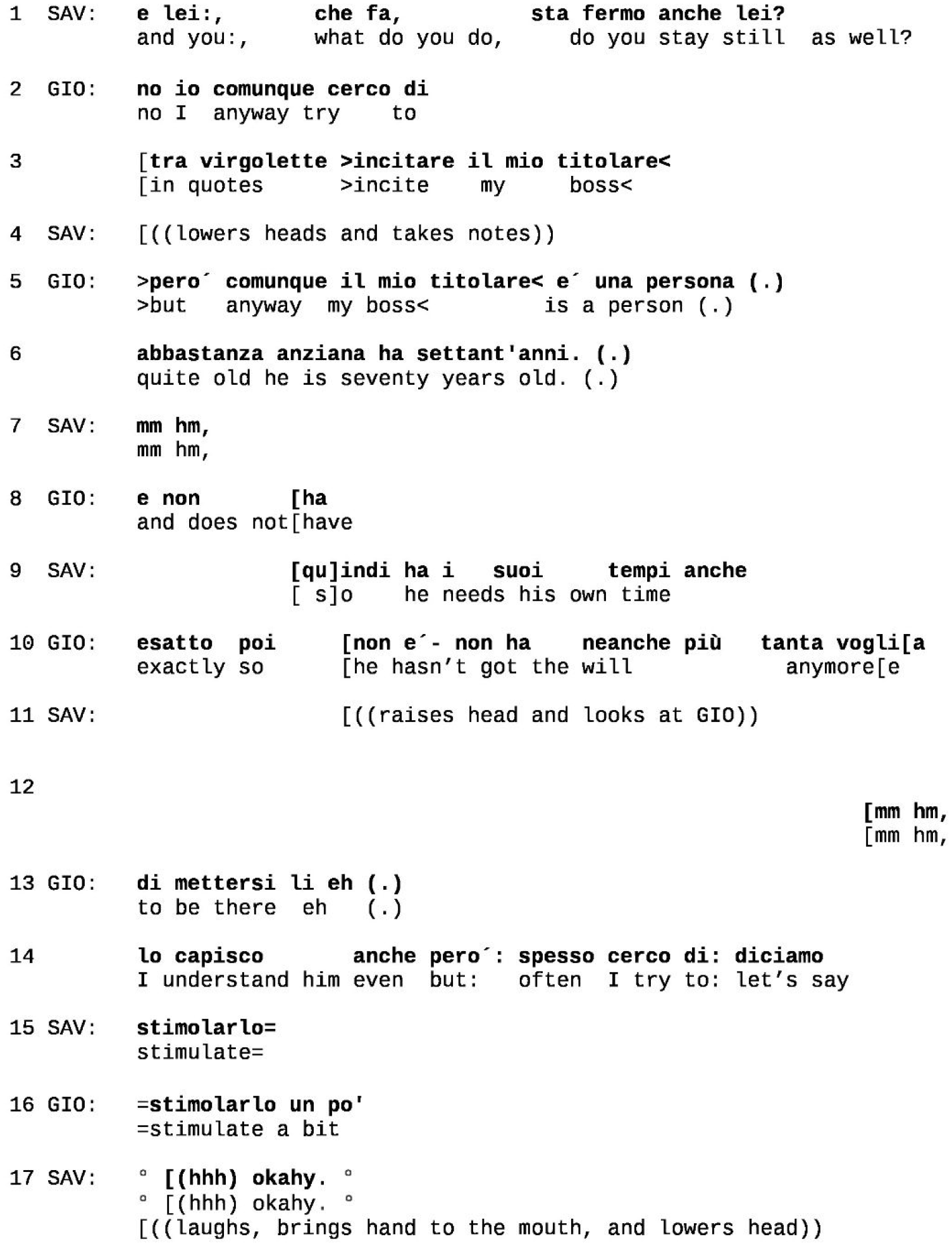
Extract 1.
The recruiter formulates a question challenging the job applicant and asking about the applicant’s input in dealing with the situation regarding his complaint (line 1). In the context of a job interview, the job applicant is most likely expected to make a good impression on the recruiter, and Giorgio does this by claiming that he tries to improve the disorganisation by ‘in quotes’ inciting his boss (lines 2 and 3).
The recruiter does not take a stance towards the applicant’s complaint but lowers his head and starts to take notes. At this point, the applicant mobilises a SOL category in lines 5–6 by saying ‘but however my boss is a person quite old, (he) is 70 years old’, he is ascribing his employer to the SOL category in which neither the recruiter nor himself belongs. This ascription of the employer into an old age category uses old age depicts old age as a warrant for being inefficient at work.
The recruiter’s continuer ‘mm hm’ (line 30) makes relevant the applicant’s continuation. However, when the applicant starts a new turn of talk, the recruiter formulates an interpretation of the mobilised SOL categorisation through an upshot (Heritage and Watson, 1979) in line 9. In the upshot with an early onset in overlap, the recruiter spells out the relationship between the employer’s age and his slowness or sloppiness (line 9, ‘so he needs his own time’). According to Heritage and Watson (1979), the introduction of a formulation as an upshot enables co-participants to settle on one of many possible interpretations of what they have been speaking. Here, the recruiter volunteers the interpretation that older age is the cause of the employer’s disorganisation, which overlaps with Giorgio’s turn onset (lines 8–9). By making this connection between old age and slowness, Saverio can also be heard as distancing himself from the complainable older age – as expressing that he does not belong to that category. Giorgio starts his next turn by agreeing with Saverio’s upshot and upgrades his complaint about his employer, stating that ‘he hasn’t got the will anymore’ (line 10). At the end of the extract, Giorgio restates that he understands his employer’s difficulties: ‘I understand him even’; he continues by stating that ‘I often try to. . .’ (line 14). Here, the recruiter completes the applicant’s utterance with the verb ‘stimulate’ (line 15), which echoes the verb ‘incite’ that was mobilised by the applicant earlier (line 1). Collaborative completion is an analytical cue of affiliation with the previous speaker’s stance (Lerner, 2004). Saverio supports Giorgio’s argumentation and, like Giorgio, can be heard as treating the category of old age as something he does not belong to and as a category that entails inefficiency at work. Giorgio accepts Saverio’s completion and softens his account, managing the subjective side of the complaint. Saverio’s laughter token in line 40 ends the sequence with an additional affiliative cue (Glenn and Holt, 2013). With his ‘okay’ (line 17), which is uttered with a finishing intonation, he shows that he has received a satisfactory answer and can move on to the following question (Beach, 1995). Thus, ascribing a third party (the employer of Giorgio) to the older age group through SOL categorisation functions as a warrant for complaining about him. Furthermore, the SOL MCD provides a viable ground for building a favourable impression and providing an answer about why Giorgio cannot resolve the disorganised company. The complaint makes it relevant for the recruiter to take a stance towards the complainable matter: old age. Hence, the recruiter shows affiliation with the applicant’s mobilisation of older age as a complainable matter, and as a way of opposition, he ascribes himself to the category of younger workers, together with the job applicant.
We can rely on Stokoe’s (2015) work to show that categorisation work can be heard as stereotypical in complaints about absent third parties. The interactional cues include the use of a category as a basis for generalisation to enhance the complainability of the problem (Potter and Wetherell, 1987) and the use of a disclaimer (Edwards, 2005). Disclaimers routinely precede talk that is heard as prejudicial and can help in managing the hearability of a complaint from the subject side so that it is heard as non-prejudicial. Both discursive resources mentioned can be found in the first extract: first, the use of SOL categorisation to enhance the complainability about the employer and, second, the disclaimer in line 14, where Giorgio claims his understanding of the employer (‘I even understand him’) while mobilising a prejudicial attribution of him as old and slow.
The next case (Extract 2, Figure 2.1 and Figure 2.2) shows the use of the SOL categorisation device in answering the same question by Saverio: ‘What do you dislike in your workplace?’ The extract features Andrea (AND), a 40-year-old male job applicant who was headhunted for the position of a mechanical designer. Similar to Giorgio in the previous extract, Andrea replies that he does not like the disorganisation of his company, although the two job applicant applicants were employed by different companies. We join the conversation when the recruiter challenges him by asking what he does to improve the issue.
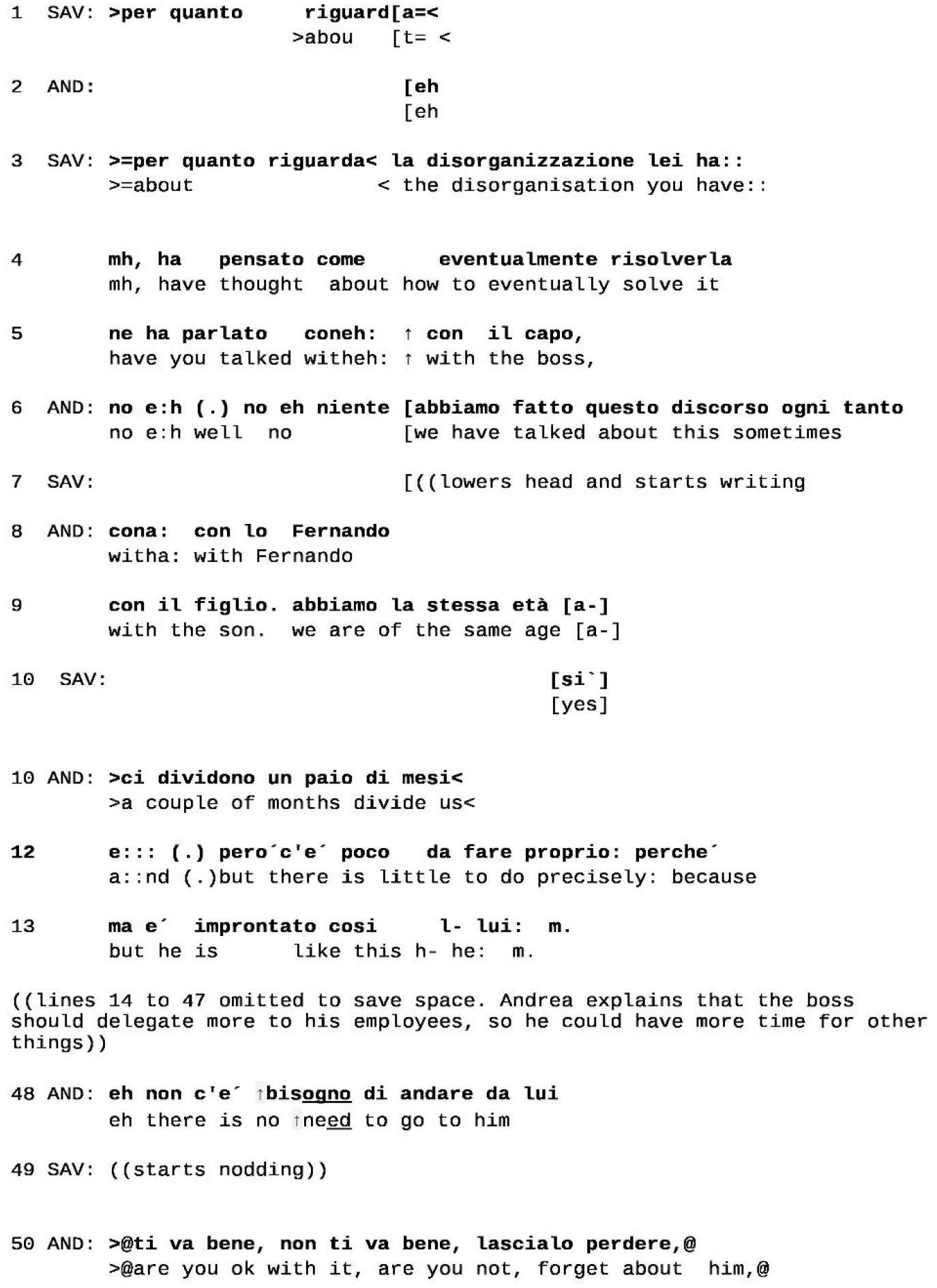
Extract 2, part one.
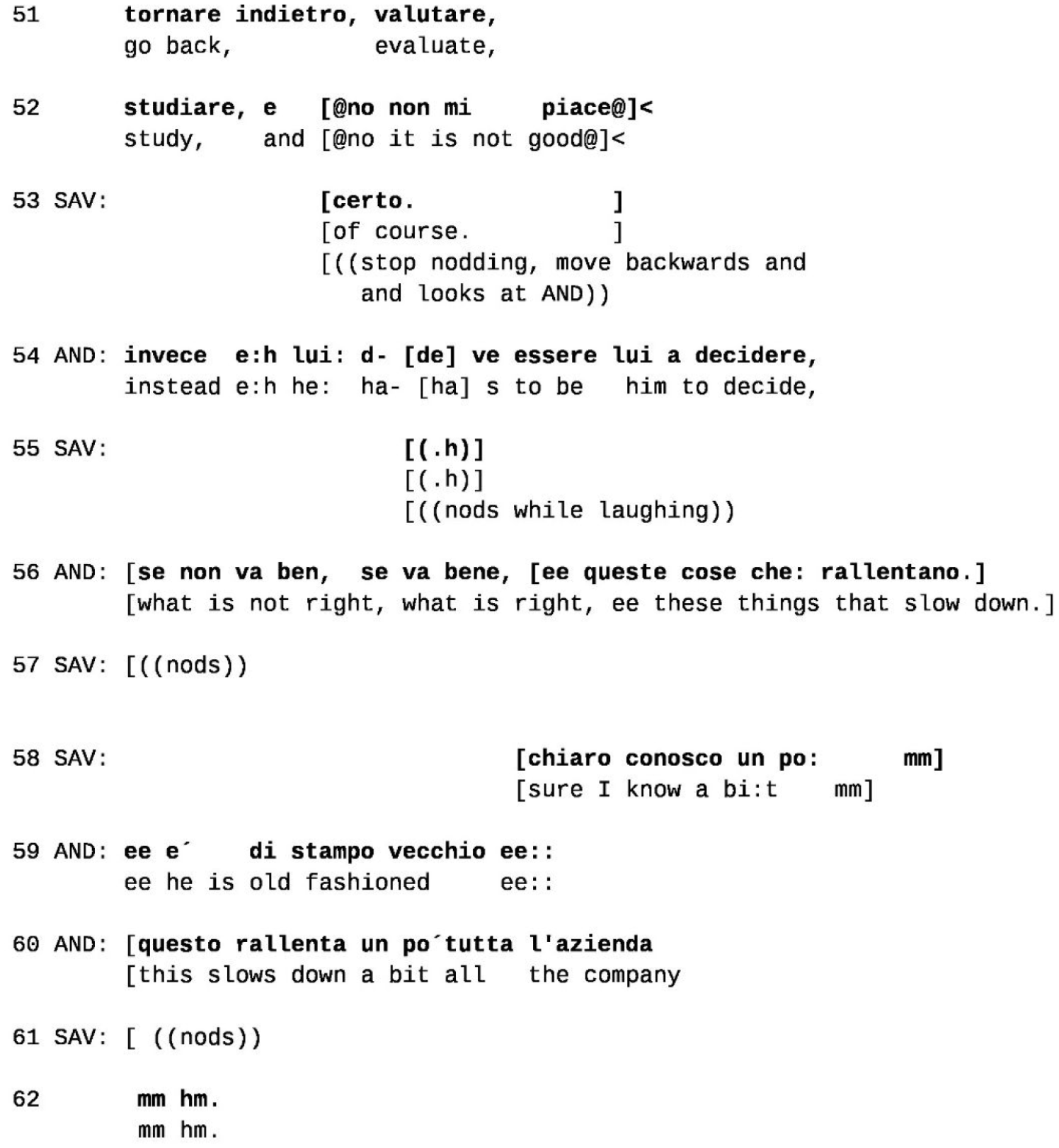
Extract 2, part two.
Similar to Extract 1, in Extract 2, old age is used as a basis to warrant a complaint about Andrea’s employer and avoid another possible topic to be accounted for. The job applicant takes some time to build his account (55 lines), which shows the delicacy of the interaction. First, he evokes an SOL categorisation by saying that he is not able to talk to the boss about the disorganisation and can only to the boss’s son, who is as old as Andrea. At this point, it already becomes explicit that the boss is assigned to a different SOL category than Andrea and the boss’s son. Thus, the category ‘old’ is implicitly evoked by the chronologically ordered device of father and son. Nevertheless, here, the chronological relevance of the categorisation, instead of family lines, is underlined by the remark ‘we are of the same age’ in line 9. Through this categorisation work, Andrea starts to build the employer’s character; in fact, he says, ‘there is little to do’ and ‘he is like this’ (lines 12–23). The description of the employer as a fixed character who is unable to listen, compared with the son, is why Andrea cannot do something about the disorganisation.
Thereafter, starting from line 48, the applicant upgrades the complaint and continues building the character in ways that infer that the employer is stubborn and inefficient by employing inference-rich actions that can be seen as coherent with the ‘older’ boss’s character. Andrea mentions a long list of actions, also through reported speech (lines 50 and 52), that have the interactional function of building a caricature. The recruiter shows affiliation with this caricature by claiming to understand (‘of course’, line 53) and by laughing (line 55), thus taking the description as comical. Accordingly, in line 58, the recruiter acknowledges the employer’s caricature by stating that surely ‘he knows the type’, which explicitly shows that they partner up in the recognition of a stereotypical typology and shared knowledge of it.
As in the previous extract, the job applicant engages in the interactional work of characterising his employer in a stereotypical way, which is concluded by the upshot in line 59 that categorises the boss through an explicit SOL attribute: ‘he is old fashioned’. Saverio displays growing affiliation to the topic of the complaint – the older employer – throughout the sequence (nodding, lines 49 and 61; agreement, lines 53 and 58; laughter, line 55). Further, as in the previous extract but less explicitly, the interactants co-construct a stereotypical characterisation and warrant the use of age as grounds to sustain a complaint, which supports the maintenance of a favourable impression by the job applicant. They also negotiate in situ their co-membership with the younger worker group in contrast to a complainable, old-fashioned and absent third party.
The next case (Extract 3, Figure 3) features the same question by Saverio: ‘What do you dislike about your workplace?’ Thereby, the same action is expected by the job applicant: he is entitled to start a complaint about his workplace and maintain a good impression. Pietro (PIE) is a 32-year-old male job applicant. He was headhunted for the job position of a mechanical designer like the previous job applicants, but he currently works at a different company. Before Extract 3 starts, Piero has said that he does not like the location of the company, which is too far from his home. We join the conversation when Saverio asks for further elements that the applicant does not like, thus making it possible to complain more.
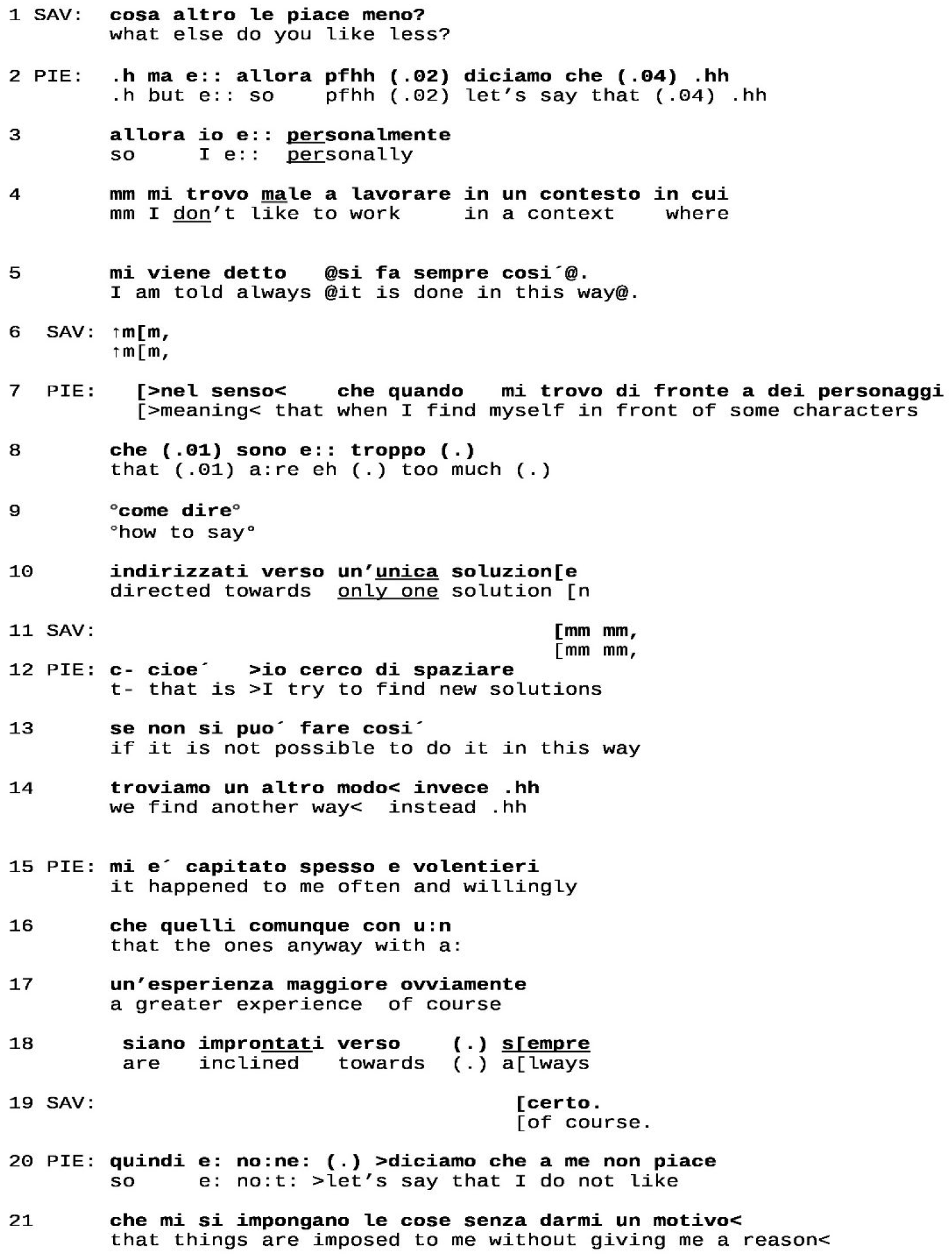
Extract 3.
Lines 2–5 feature the second part of Pietro’s answer to Saverio’s question. The hedging in lines 2 and 3 (extended vowels, expirations, pauses and circumlocution) once again shows the delicacy of complaining about the workplace while maintaining a good impression. The topic of the complaint is featured in lines 4 and 5: ‘I don’t like. . .to work. . .where I am told always ‘it is done this way”’. Saverio leaves the floor to Pietro to continue the complaint, with a continuer in line 6 showing interest in hearing more. Consequently, Pietro elaborates and clarifies that he does not like to follow the directions given by certain ‘characters’. The labelling of ‘some characters’ constructs a group of people subjected to stereotypical characterisation (Jayyusi, 1984). Through this expansion, Piero manages his positive impression as an employee by restricting the types of people from whom he does not accept receiving instruction. He manages his side of the complaint in lines 12–14 by underlining that he tries to find a solution, thus restating his positive identity as an employee. This expansion also works as a disclaimer towards the prejudicial characterisation coming up. Pietro concludes the description of these ‘characters’ by ascribing them to older age and mobilising a SOL attribution ‘the ones with a greater experience’. The previously cited characters are now explicitly ascribed to the older age category. This ascription is presented by Pietro as obvious (‘of course’, line 17), and the previous descriptors can be seen as coherent with the assigned age group. The recruiter shows an affiliative stance towards the characterisation with an ‘of course’ (line 19), as we saw in Extract 2. This agreement overlaps with Pietro’s turn; thus, the interactants display shared knowledge of these older ‘characters’, and Pietro does not need to elaborate further and proceeds with closing (‘so’, line 20) his complaint.
Pietro uses SOL categorisation as a basis for grounding and enhancing the complainability of the problem. The recruiter warrants this use and affiliates himself with the topic of the complaint, hence expressing a shared notion of older workers and their traits, who here are shown as resistant to change. The prejudicial use of the older third-party characterisation produces a stereotypical image of a ‘man of a certain experience’, as we have seen in Extract 2. Also, in this case, the participants build a co-membership as younger workers in opposition to the complainable absent older colleagues.
The three extracts show how in a delicate situation where the recruiter (who identifies himself as a young male) has asked the applicants to criticise their present workplace, job applicants use SOL categories to warrant the delicate business of complaining about their employer or colleagues. In this extract the mobilisation of possible -isms and age categorisation are less explicit. In the case presented, age categorisation ranges from ‘he is 70 years old’ (extract 1) to ‘he is old fashioned’ (extract 2) and, lastly, ‘the ones with great experience’ (extract 3). To concurrently warrant the complaint and make a good impression, they rely on the stereotypical attributes attached to older workers. Based on this shared knowledge, the recruiter shows affiliation and joins in the construction of stereotypical characterisations. SOL categorisation sustains the construction of co-membership by making it relevant that both the job applicant and recruiter are younger than the complainable third party. This co-membership supports the interactional dynamics, allowing the job applicants to maintain a positive identity while complaining about their workplace or employer.
Re-establishing co-membership: The use of age categorisation to remedy impression
In this section, we show how SOL as an MCD is used to remedy a difficult case of impression management. Compared with the previous extracts, here the job applicant initiates a complaint about her work on the grounds of gender categorisation and, only at a later stage, on the grounds of SOL categories. In this additional case, a 21-year-old female job applicant, Carmela (CAR), is being interviewed by Saverio, the recruiter. She was headhunted for a position in internal sales. This position is an office job that does not entail active involvement in product manufacturing. In Italy, this job is mostly performed by women, which feeds the stereotype that women are more fitted for administrative and assistant positions than men.
Immediately before the extract begins (Figure 4.1), Saverio asked Carmela what she liked about her job. Carmela answered that she liked the variety of tasks. We join the conversation at a point where Saverio invites her to list other positive aspects, and she volunteers a complaint about her workplace. Although she starts the complaint without being asked to, in a job interview setting where the job applicants are headhunted, they may be expected to report negative remarks about the workplace that they are interested in leaving. Similar to the job applicants in the previous extracts, she is in the position of maintaining a favourable impression while complaining and of preserving a trusting relationship with the recruiter. To help the readership better understand this analysis, the extract is shown in two parts (Extract 4.1, Figures 4.1a, 4.1b and Extract 4.2, Figures 4.2a and 4.2b).
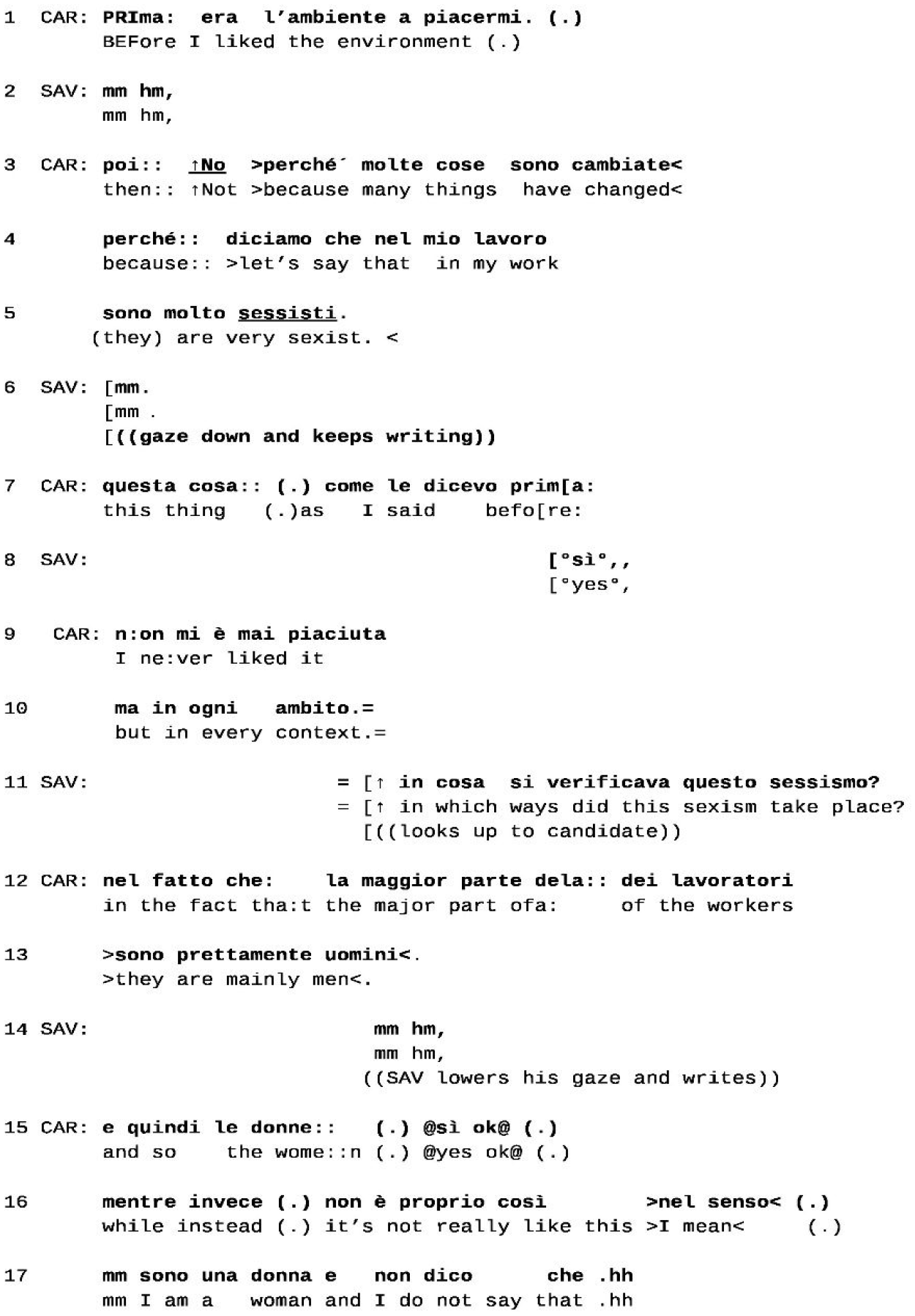
Extract 4.1., part one.
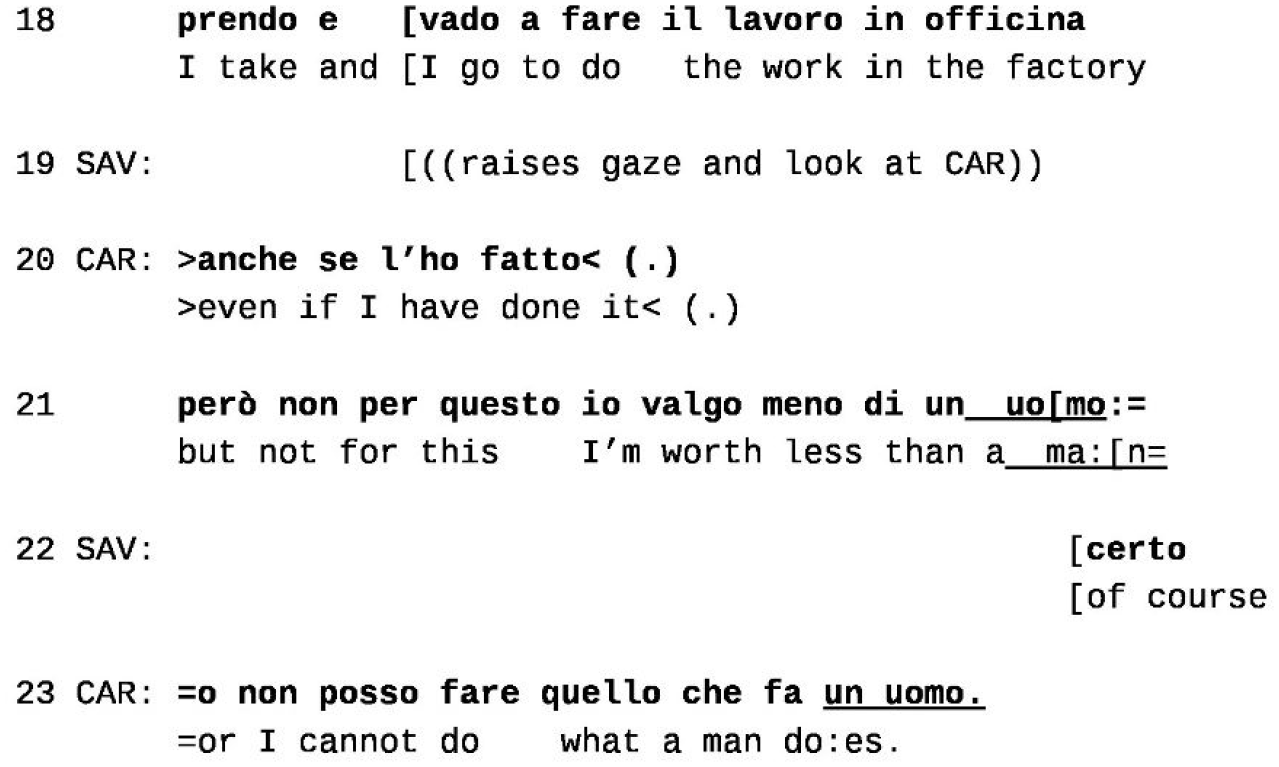
Extract 4.1, part two.
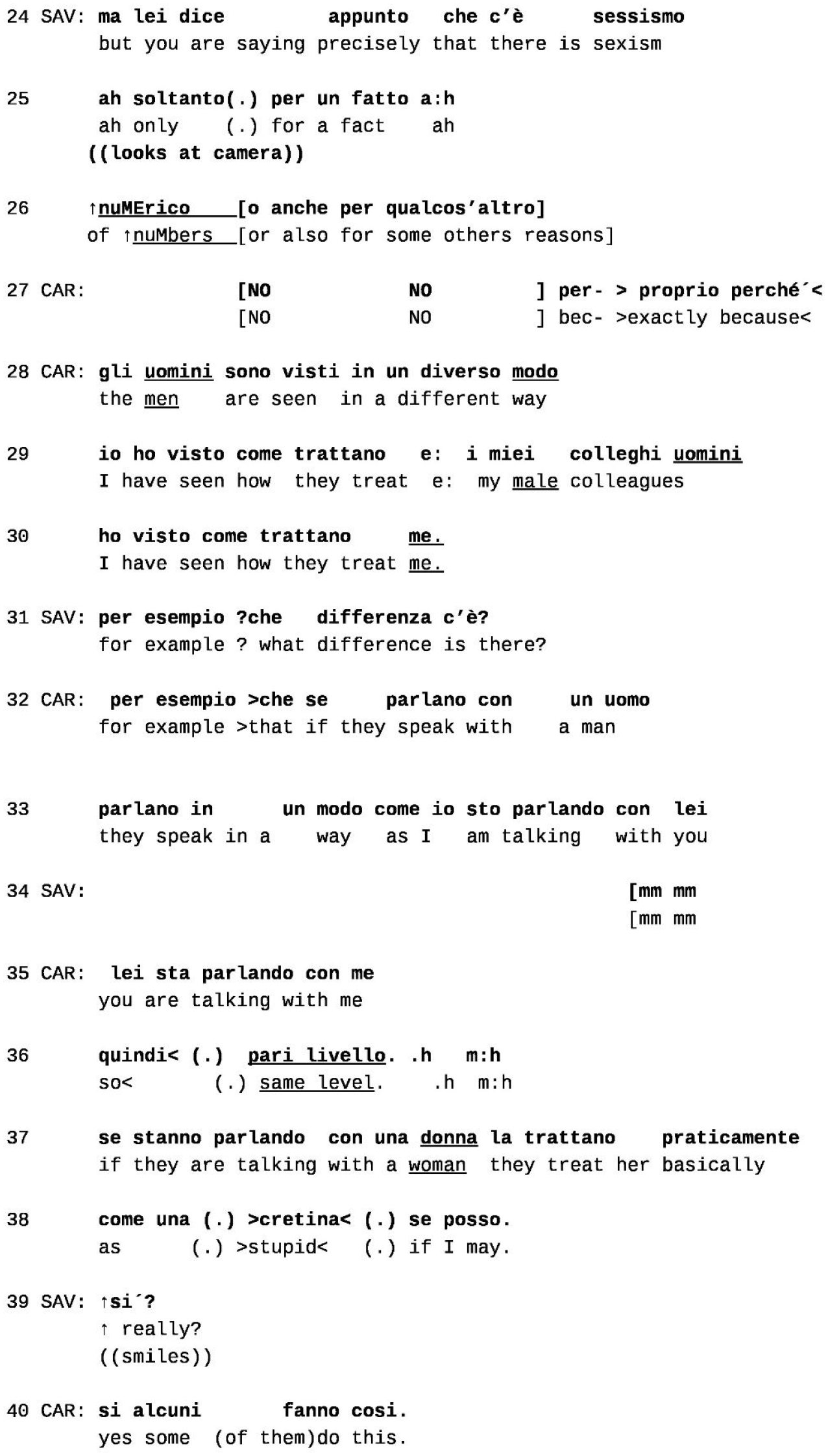
Extract 4.2, part one.
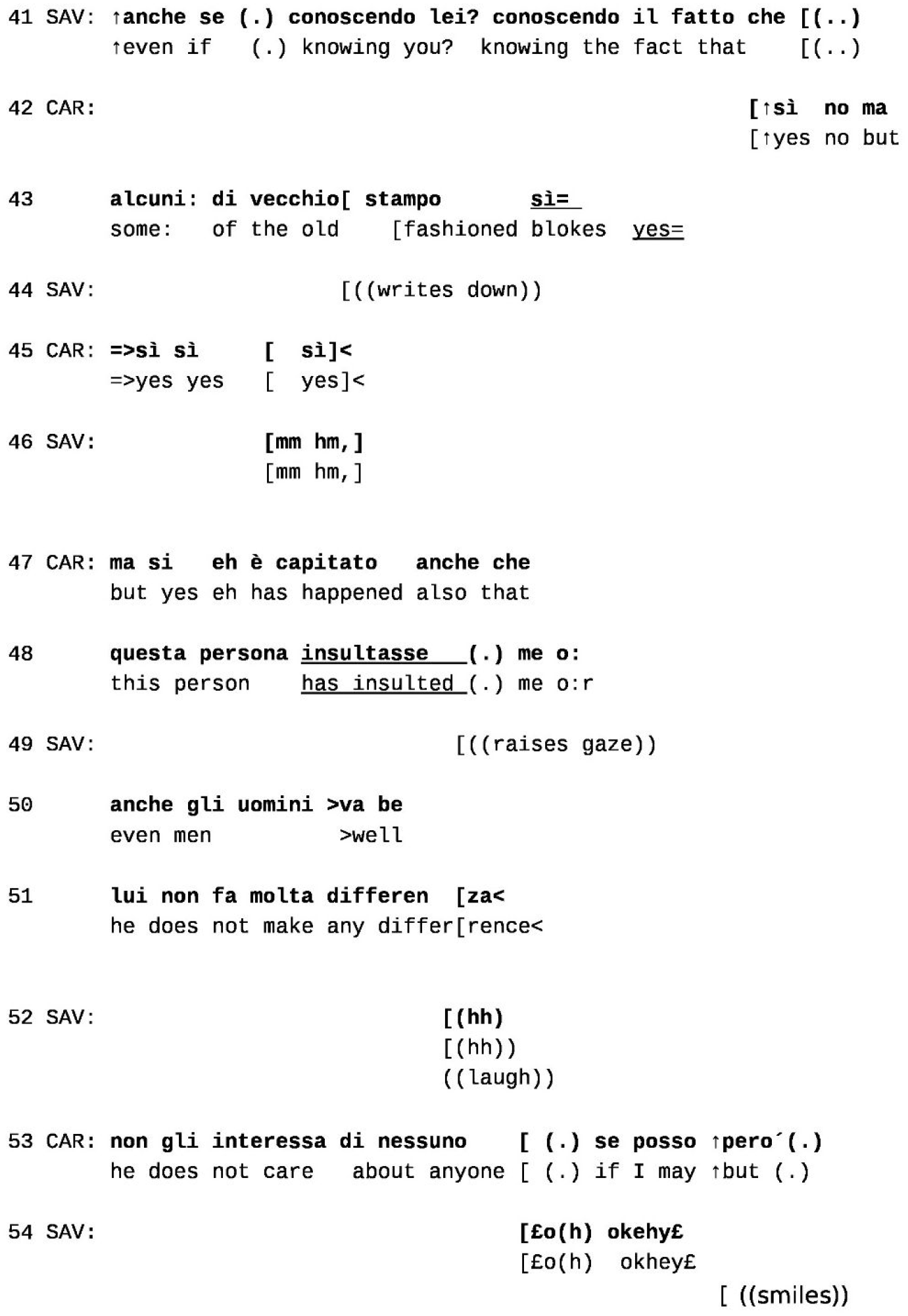
Extract 4.2, part two.
The extract starts with Carmela stating that she used to like ‘the environment’ (line 1) but not anymore; without any prompt by the recruiter, she volunteers a complaint about her workplace being sexist (line 5). The link between complaint and affiliation has been studied in performance appraisal interviews: employees volunteering a complaint anticipate a non-affiliation by the superior (see Ruusuvuori et al., 2021). Here, the importance of receiving affiliation when mobilising a complaint becomes clear; in the beginning, Saverio does not immediately take a stance towards this complaint and leaves her the floor to continue by providing vocal continuers in lines 6 and 8. As previously stated, complaining is a delicate activity and complaining about one’s workplace in a job interview further increases this delicacy because it may damage the positive image of the job applicant as a trustable future employee. Complaining about sexism may notably be an even more delicate business because it is a condemnable topic and it makes relevant the gender identity of the interactants. In this case, the complaint may even be heard as an accusation because sexism refers to discrimination and the complainant has identified as female, whereas the recruiter represents the opposite gender category (Edwards, 2005). Saverio challenges Carmela to give concrete examples of this discrimination (line 11); his question latches onto the previous turn, leading Carmela back to the proposed topic of complaint – ‘in my workplace (they) are very sexist’ – while she was elaborating on the comment to show that she is against inequalities in every context (line 10). Carmela answers by providing an explanation grounded on quantification – ‘the majority of the workers they are mainly men’ (lines 12 and 13) – and through this, she explicitly mobilises the gender category for the first time.
As described in the previously, gender, much like SOL, is always a perceptually available category to speakers; therefore, when Carmela labels the number of males as the reason for sexism, she makes gender membership relevant for Saverio. Saverio lets Carmela continue (line 14) without taking a stance. In line 16, Carmela starts a reformulation of her account (‘I mean’). In her reformulation, Carmela first restates her membership in the female category (‘I am a woman’, line 17); she gives a concrete example of why she is valued less than a man is (she does not do production work, line 18) and then provides new grounds for the complaint based on personal worth (line 21). At this stage, Saverio first displays affiliation towards the assessment about her value (assessment in line 21; affiliation with ‘of course’, line 22). Carmela’s categorisation work did not successfully conclude the interaction. Compared with the first three extracts that employed SOL categorisation, in this extract, Saverio continues his line of questioning (four questions) on the topic of the complaint. This underlines that the mobilisation of gender does not sustain impression management and does not create a shared understanding of the topic of the complaint between the interactants. The second challenging question by Saverio is at the start of Extract 4.2 (Figures 4.2a and 4.2b) which is the direct continuation of the previous conversation.
Here, the analytical focus is on the use of categories and on building categorical consistency between job applicants and recruiters. The delicacy of talking about sexism in a job interview surfaces, and instead of accepting the account, Saverio continues his questioning, showing that the account will not be accepted as grounds for a complaint and that further evidence needs to be produced. Saverio challenges the account provided by Carmela three times (in lines 24, 31, 39 and 41), showing that he does not share the notions provided in support of the complaint.
Pushed by the tight questioning, Carmela narrows down the complainable category from ‘men’ in general to ‘some’ of them (line 40) and then to ‘some of the old-fashioned blokes’ (line 43). The SOL categorisation of the complainable third party as older (line 43) is the final interpretative resource that Carmela employs to manage her side of the complaint and to save the relationship with the recruiter, who might have been under accusation as part of the sexist male group. After the SOL categorisation, the recruiter does not engage in affiliative stances but rather gives a minimal response and leaves the floor to Carmela, who continues with her explanation after line 54. The last means through which Carmela narrows down the topic of her complaint is by attributing it to only one person (‘this person’, line 48) and by including men in the group that is insulted by this old-fashioned person. This demonstrates that, as argued by Billig (1987), people can generalise as well as particularise depending on the interactional situation and goal. This progressive narrowing of the complainable category and the related categorisation negotiation between gender and SOL leads to the conclusion of the sequence in line 54 (for ‘okay’ as a closing sequence, see Beach, 1995]). The recruiter leaves the complaint about sexism unaddressed, and the job applicant who faced discrimination is emotionally unsupported. Moreover, the recruiter affiliates the topic of the complaint with laughter in line 52, when the complaint is attributed to one person who does not care about anyone. This shows some shared understanding of this characterisation.
As we have seen earlier, Carmela employs negative remarks about a third party, presumably in the service of impression management. Like the ones before, this case is built on complaining about, strictly speaking, an old-fashioned colleague and hence uses SOL as a form of warrant. Carmela constructs a character in contrast to herself and ascribes him to a specific SOL membership category. The categorisation is heard as prejudicial because Carmela brings her personal experience as objective evidence. The SOL categorisation, in contrast, implicitly creates a co-membership between the job applicant and recruiter as part of the younger group. Previously, Carmela had already separated Saverio from the sexiest and old-fashioned men (lines 33–36), making the first effort to establish a co-membership with him. This discursive negotiation excludes the recruiter, as a younger man, from the accused group and might function as a resource to restore the trust between the two. The cultural idea mobilised is that older men are not respectful towards both women and men (lines 50 and 53).
In our case study, we have shown that the construction of good employee identity and impression management through identity categorisation and co-membership is an established practice employed by job applicants. Furthermore, we suggest that gender and SOL categorisation require different interactional work to warrant a complaint and are not equally morally accepted.
Discussion
In the current article, we have shown how job applicants mobilise prejudicial age categorisation and establish co-membership with recruiters as grounds to maintain a favourable impression in challenging job interview sequences. In line with the DP approach, this study shows that mobilising possible ageist remarks is not the goal of the interactants but rather something they do to achieve the interactional business at hand: making a favourable impression. Moreover, we showed how specific discursive dynamics sustain the mobilisation of possible ageism in interaction: prejudicial notions about older third parties, often discreetly mobilised, are tolerated in practice and do not hinder solidarity or favourable impression in job interviews. Our analysis suggests that in situations where recruiters and job applicants share membership in a SOL category (younger age), job applicants may resort to age categorisation as a resource to achieve support from recruiters and save face in delicate situations.
A clear strong point of our analysis is that is has been performed on video recordings of real job interviews. These provide a live social context to the dynamics of biases, similarity and solidarity and show how age and ageist notions influence and surface in recruitment practices. As shown from previous research, similarity is a key element in job interviews and it is interactionally relevant (Rivera, 2012, 2015). Here, we have shown that discursively constructing similarity on age not only warrants mobilisation of everyday ageism, but also, sustains the remedy of impression management. Moreover, the affiliation, or lack of rejection, showed by the recruiter confirms that age prejudices towards older workers are shared notions in work-related settings.
In contrast to dominant social psychological approaches about age stereotypes in recruitment that focus on the cognitive component of ageism stripped of any social context, we have examined age membership in a minute-by-minute unfolding in real interactions between job applicants and recruiters. We have provided evidence of how job applicants decide which social identity category to use to make and sustain a good impression. MCDs, such as SOL, have the property of partitioning members and establishing co-membership in talk (Sacks, 1992). In our data, the SOL categorisation of a complainable absent third party (older employer) establishes a constant partitioning between the job applicant and recruiter. As stated by Schegloff (2007), the negotiation of partition constancy and inconstancy on MCDs, such as SOL, serves as a resource to move from one set of categories to another at the members’ convenience. We have shown this possibility of moving between different categories in Extract 4, where a female job applicant resorts to establishing age co-membership – as opposed to gender cross-membership – while looking for the recruiter’s affiliation with her mobilised complaint.
For job applicants and recruiters, age prejudices are interactional resources that they can draw upon in producing social actions, such as complaining. Van De Mieroop et al. (2019) have demonstrated that complaints about absent third parties do not disrupt the job applicant’s good impression if they are performed in a small talk frame. In contrast to these findings, our analysis has demonstrated that complaints about absent third parties, if grounded on older age, do not need to be made within a small talk frame and do not compromise the institutional role of the interactants when participants share a membership in the category ‘young age’. We might argue that older age is an accepted complainable matter and that the recruiter can display affiliation towards it without endangering his role as an unbiased interviewer. This warrantability of mobilising complaints about older parties reveals the taken-for-granted age stereotypes about older workers in the cultural settings of our case study. The acceptability of complaining about old age – here considering the recruiter’s young age – reveals the subtle dynamics that place older workers at a disadvantage in job interviews.
Future research avenue is the moral accountability of mobilising stereotypical categorisation considering the institutional goal of the interaction during recruitment processes. The institutional goal of recruitment practices is to find the best-fitting job applicant; nevertheless, different recruitment centres and employers endorse inclusion and diversity as an organisational value. In a study on job interviews, although not on -ism and age, Van De Mieroop and Schnurr (2018) showed that an interactional possibility for recruiters is to invoke their institutional identity and orient to the moral accountability of the category practice invoked by a job applicant while not disrupting the interaction. More studies are needed to understand how categorisation practices based on demographics (such as age, gender and ethnicity) are made relevant in interaction and whether these practices are targeted as morally accountable by participants, considering the institutional goal and the building of co-membership.
The limitations of the presented case study need to be addressed. The small number of job interviews recorded in only one recruitment agency does not allow us to argue further on co-membership dynamics. Nevertheless, the phenomenon described reoccurred in our data, shedding new light on the construction of co-membership. We suggest continuing this promising line of research by investigating these dynamics in data collected from different countries, cultures and diverse participants. In line with the literature (Flinkfeldt et al., 2021; Heinrichsmeier, 2019), we argue that the application of MCA and CA on a wider database reveal how less explicit conversation patterns are a manifestation of stereotypes and how these micro-level interactions can be linked to the macro-level reproduction of inequalities and ageism.
The presented discursive approach to stereotypes has important practical implications for everyday recruitment practices. Our data show that age co-membership supports affiliation towards age-based complaints, endangering the institutional goal of unbiased applicant selection. A practical application of our study concerns the training of recruiters. Using examples from actual conversational dynamics may reveal how stereotypes unfold in talk and how participants could prevent this from happening by adhering to their institutional role.
Footnotes
Appendix
Transcription symbols (Jefferson, 2004).
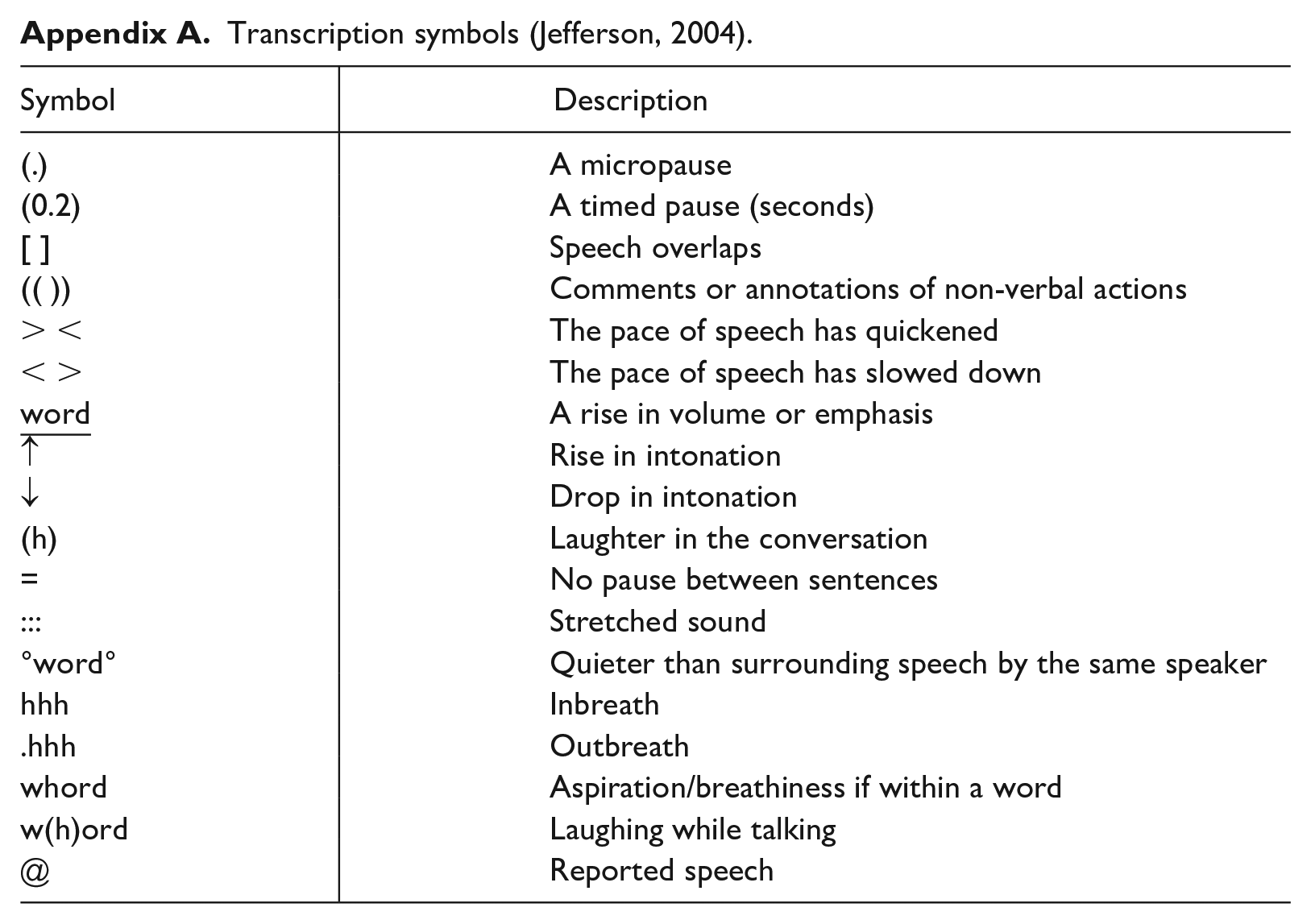
| Symbol | Description |
|---|---|
| (.) | A micropause |
| (0.2) | A timed pause (seconds) |
| [ ] | Speech overlaps |
| (( )) | Comments or annotations of non-verbal actions |
| > < | The pace of speech has quickened |
| < > | The pace of speech has slowed down |
|
|
A rise in volume or emphasis |
| ↑ | Rise in intonation |
| ↓ | Drop in intonation |
| (h) | Laughter in the conversation |
| = | No pause between sentences |
| ::: | Stretched sound |
| °word° | Quieter than surrounding speech by the same speaker |
| hhh | Inbreath |
| .hhh | Outbreath |
| whord | Aspiration/breathiness if within a word |
| w(h)ord | Laughing while talking |
| @ | Reported speech |
Acknowledgements
The authors want to thank the participants in the Social Psychology PhD Seminar and data sessions at Tampere University for their precious contributions and ideas in the analysis of the data. Conversation analysis is a joint analytical process.
Data availability statement
Due to the nature of this research, participants of this study did not agree for their data to be shared publicly, so supporting data is not available.
Declaration of conflicting interests
The author(s) declared no potential conflicts of interest with respect to the research, authorship, and/or publication of this article.
Funding
The author(s) disclosed receipt of the following financial support for the research, authorship, and/or publication of this article: This project has received funding from the European Union’s Horizon 2020 research and innovation programme under the Marie Skłodowska-Curie grant agreement No. 764632.