




Abstract
With an increased interest on how heritage languages might be supported in educational contexts globally we suggest here that translanguaging offers one potential practical solution. Originating in Wales, translanguaging is positioned as an intentional pedagogical practice endorsed by the Welsh government, and explored in situ here. Focusing on the beginning of a storytelling activity about the Welsh collection of stories – The Mabinogion – in a new entrant classroom in Mid-Wales, we reveal the translanguaging practices that are embedded in a rich multimodal environment that creates a sense of belonging and identity. The aim of this article is to demonstrate the systematics of translanguaging as fluid, multimodal practices of meaning making co-produced between children and teacher during the Welsh traditional storytelling activity.
Keywords
Introduction
Teaching and learning heritage languages (henceforth HL) have become increasingly wide-spread, and with it, sociolinguistic research on these issues (Leeman and Showstack, 2022). For example, research on the intertwinement of HL use and identity construction and negotiation has explored how HL speakers are positioned by others with respect to predominant language ideologies including the monolingualism and one nation/one language ideology (Helmer, 2020; Showstack, 2012, 2015). Multilingual speakers regularly and systematically combine features of different languages in creative ways, such as switching between them or even mixing them (Auer, 1995, 2022). Such heteroglossic language practices often go against official language ideologies that predominantly regard monolingualism as the norm, and monolingual practices as the unquestioned standard for professional and academic settings (Leeman and Showstack, 2022). Because language ideologies often translate into language policies on macro and meso (institutional) levels of communities, educational policies usually reflect them by setting (written) monolingual practices as the norm for both oral and written forms of language use (Leeman and Showstack, 2022). They also have an impact on the linguistic choices and practices of HL speakers by effectively restricting multilingual speech in classrooms (Lynch and Avineri, 2021). Most approaches are therefore still based on ideologies of monolingualism and aim to push back linguistic variation to private and informal communicative situations, thus strongly suggesting that there is no or little place for multilingualism in the public sphere (Leeman and Serafini, 2016). Other monolingual linguistic concepts like ‘academic language’ or ‘appropriateness of language choice’ are also ideological constructs through which dominant linguistic varieties and practices are placed above others (Leeman and Showstack, 2022).
Despite the continuing predominance of monolingualism in ideologies and education policies in most countries, multilingualism has gained increased attention in educational research. In recent years, the notion of translanguaging has specifically gained increasing popularity, as it represents an attempt to change attitudes about the assumed inferiority of multilingual practices to monolingual speech and has recently been used to re-name multilingual practices. As such, translanguaging can offer an answer to the problem of how education settings might teach HL in culturally responsive, meaningful and creative ways. It is argued here that Wales is a particularly relevant context to explore translanguaging as a means for supporting HL, as the concept of translanguaging originated in Wales (Baker, 2019; Williams, 2022).
In 2017 the Welsh government introduced legislation to increase the number of Welsh language speakers to one million by 2050 (Welsh Government, 2017). Numbers of Welsh speakers have risen, from a steady increase of 582,400 in 2001 to current figures of ‘891,800 Welsh speakers living in Wales in the year ending 30 September 2023’ (Welsh Government, 2023b). The education system in Wales has been targeted as fundamental in achieving language revitalisation, with particular emphasis on Welsh-medium immersion education (Hodges, 2024). Wales has a long-standing Welsh immersion education provision, beginning in early childhood through education provision in Cylch Meithrin, to Welsh being compulsory throughout primary and secondary school. However, it is important to acknowledge opposition to Welsh-medium education settings where only Welsh is spoken too. Wales is recognised ‘as being complex as language, nationhood and various forms of collective identity exist simultaneously’ where tensions have arisen ‘between Welsh-medium schools and their local neighbourhoods in terms of class, locality and Welsh identity when attempting to facilitate Welsh language revitalisation’ (Hodges, 2024: 312).
Linguistic approaches to multilingualism: Translanguaging and code-switching
With the birth of Translanguaging originating in Wales (Baker, 2019; Williams, 2022), there has been a recent resurgence in the concept through Welsh Government commissioned research that is published as teacher guidance on ‘Translanguaging in the classroom’ (Thomas et al., 2022). The document offers definitions of the term translanguaging, from its original conceptualisation through to its current. The following chart is given, where the full document offers contextual information for the original translanguaging related to ‘Definition 1’, ‘The prefix trans- (in English) in translanguaging means “across”, as does traws- in the Welsh trawsieithu’:
Source: Thomas et al. (2022: 18).
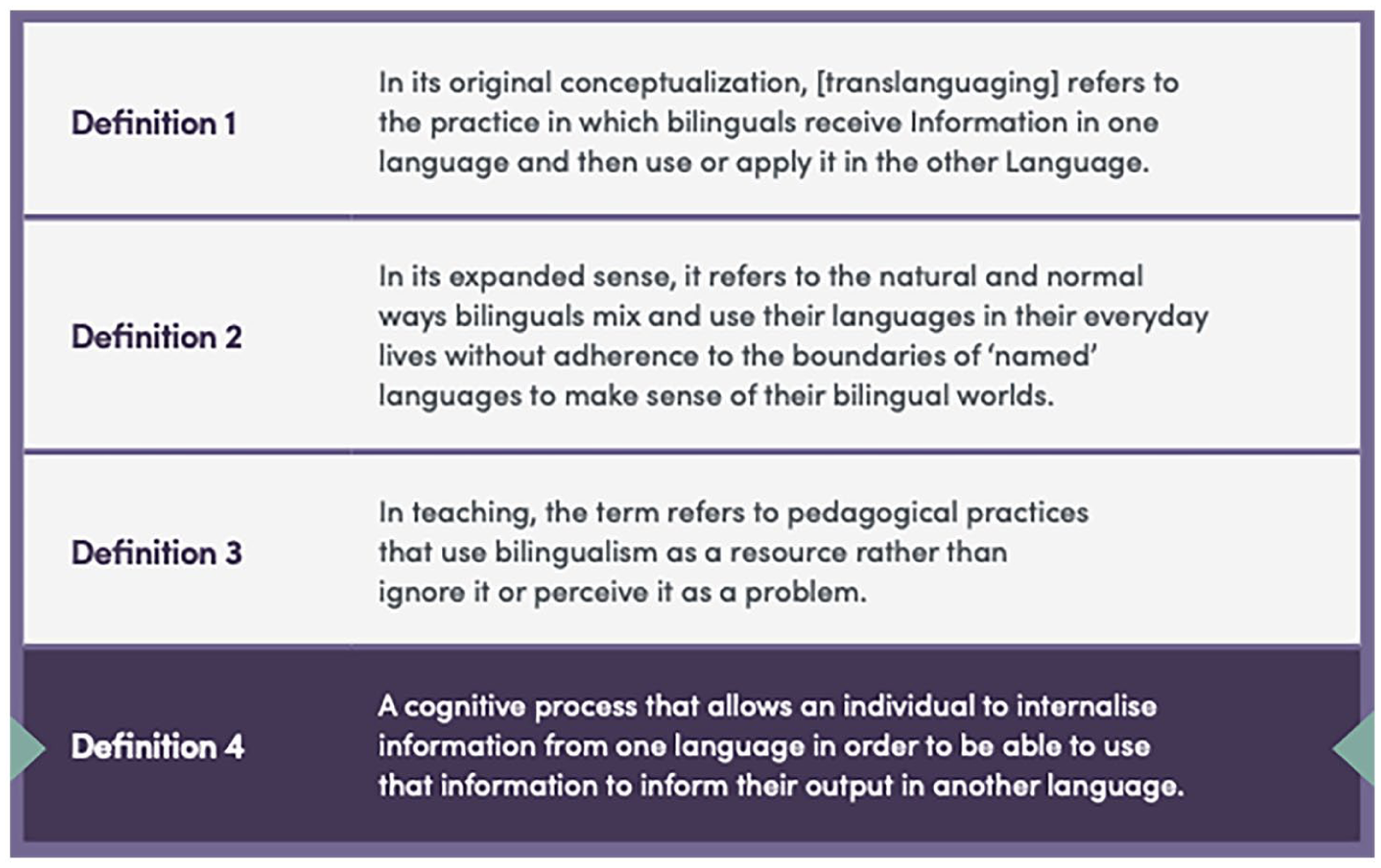
While the table considers translanguaging from both a cognitive and a social perspective, we would like to draw particular attention to definitions 2 and 3, as they both relate to interactive aspects relevant to this paper. Definition 2 of translanguaging relates to findings on code-switching and -mixing that demonstrate compellingly how multilingual speakers use their languages in ordered and systematic ways. There is a long tradition in sociolinguistics studying incidents of code-switching as meaningful practices in interaction (cf., e.g. Gumperz, 1982 or the articles in Kyratzis et al.’s (2010) Special Issue), showing the different purposes people pursue in interaction when switching between linguistic codes. Research has also shown that multilingual speakers follow syntactical and morphological rules, thereby testifying (meta-)grammatical competence in two (or more) languages (Auer, 1995; Wei, 2018). Code-switching may also entail switching between oral and written mode and between written linguistic codes, thus engaging in multiliteracy (Wei, 2011b). In this way, speakers demonstrate their creativity as well as their ‘criticality’, that is ‘the ability to assess the situation systematically and insightfully, to question and problematize received wisdom, and to articulate views and opinions in a reasoned way’ (Wei, 2011b: 382).
The third definition presents an approach to bilingualism in classroom interaction that understands it as a resource rather than a hindrance, with the goal to exploit it for educational purposes. Both definitions promote a practice-oriented approach to bilingualism which we will adopt for our analysis to address practices of translanguaging in Welsh classrooms and thereby explore their potential for supporting Welsh as a Heritage Language.
The foreword by the founder of the concept of translanguaging, Cen Williams, also adds additional contextual information regarding the evolution of translanguaging, referring to the work of Ofelia Garcia, a prominent translanguaging academic. Williams explains: She mentions it as a method of developing the second language almost from the beginning, but my interpretation of translanguaging was as a strategy for children who had a fair grasp of one language and a fairly good oral grasp of the other. It was also a strategy to maintain and develop bilingualism rather than transmitting a second language to children from the beginning. (Williams, 2022: 6)
Although originating in Wales, Ofelia Garcia is acknowledged as taking translanguaging to international audiences where it has continued to progress (Baker, 2019). By focussing on the flexible, dynamic and creative use of linguistic repertoires as semiotic resources, it aims to overcome the concept of languages as discrete entities (García and Lin, 2016). Indeed, borders between languages are not as clear-cut as assumed at first glance and are often drawn for political reasons rather than based on linguistic considerations (Makoni and Pennycook, 2006). Consequently, concepts such as native, foreign, indigenous or minority languages are constantly being reassessed and challenged (Wei, 2018). However, Auer (2022) argues that it is the speakers themselves who orient to different linguistic codes – that by no means have to coincide with national or standard languages – when switching between them. In other words, it is precisely the speakers’ orientation towards different codes that establishes them as different codes, and for situated, context-dependent discursive purposes. The codes thus become social facts that are constructed by the linguistic practices of the people using them in interaction.
Applied in classrooms, translanguaging can be seen as an attempt to normalise heteroglossia in education by labelling it as a practice common in multilingual environments, rather than a deficit of an individual speaker. It is thus linked to the hope that it will help to overcome linguistic norms based on ideologies of monolingualism by providing multilinguals a social space in which they can draw freely from their expertise in more than one language, through the creative use of which they construct their identities (Wei, 2011a). It is also argued that the concept shifts the focus from languages as discrete codes to speakers’ agency when communicating to the creativity of their use (Creese and Blackledge, 2015; Wei, 2011b). However, Jaspers (2018: 3) claims that the benefits of translanguaging promising ‘to result in new subjectivities, to give back voice, transform cognitive structures, raise well-being and attainment levels, and eventually to transform an unequal society into a more just world’, are unsubstantiated and overstated. More specifically, Jaspers (2018) questions whether education strategies do have the ability to impact on transforming society, where policies enforcing translanguaging may be limited to impacting just the language use in each specific classroom. Furthermore, Auer (2022) argues against using translanguaging as an umbrella term because this would conceal important structural and functional differences between different types of language switching.
In our paper, we will follow Jasper’s and Auer’s arguments in principle, taking care not to overload the term ‘translanguaging’. Building on their arguments, we will offer a socio-cultural approach to understanding language use in the Welsh socio-cultural education system. We argue that, as each school is made up of unique participants with their own ideologies (linguistic and otherwise), it is perhaps more insightful to add to the discussion through detailed analysis of the use of language in situ. As translanguaging was born in Wales, it is markedly embedded in Welsh culture and history, and so an important feature of educational practices, supported by Welsh government policy in the Curriculum for Wales. As such, we argue here that this is not the only way of teaching in a multilingual classroom, but one way that is culturally relevant to the participants.
We return to the place of origin of translanguaging in Wales to explore how translanguaging is co-produced as a collaborative achievement by children and their teacher in situ. By using the term ‘translanguaging’, we also adopt the viewpoint that speakers orient to different linguistic codes in their multilingual language practices for a variety of purposes, and that they do so by making use of different modalities (Wei, 2011b). Furthermore, approaching bilingual classroom interaction through the notion of translanguaging provides us with the opportunity to describe multilingual practices as culturally responsive, meaningful and pragmatic ways to promote language and cultural learning.
The Welsh context
The importance of understanding historical cultural connections to land and teaching of cultural histories and identity is imperative in the new Curriculum for Wales to support children’s holistic wellbeing and positive national identity. Storytelling about traditional Welsh legends in early years classrooms can support such issues and is explored here in relation to the use of the Welsh collection of stories – The Mabinogion – in a new entrant classroom in Mid-Wales. The Curriculum for Wales (Welsh Government, 2021) is a new curriculum framework that stretches across all years of compulsory education, from when children start school at the age of 5 years to when they leave at age 16. As a framework, guidance is given to teachers on how to implement its core values and principles in their local context, where explicit reference to the Welsh concept of Cynefin is embedded throughout. Cynefin has no direct English translation but can be understood as habitat, belonging or haunting connected to a place (Berger and Johnston, 2015). Welsh government teacher guidance defines Cynefin as: The place where we feel we belong, where the people and landscapes around us are familiar, and the sights and sounds are reassuringly recognisable. Though often translated as ‘habitat’, cynefin is not just a place in a physical or geographical sense: it is the historic, cultural and social place which is shaped and continues to shape the community which inhabits it. (Welsh Government, 2023a)
Underpinned by the concept of Cynefin, this research aimed to explore how the cultural histories of Wales are currently being taught through traditional stories linked to place in early childhood education. The importance of understanding historical cultural connections to land through Welsh storytelling can offer an essential resource in supporting and extending children’s sense of belonging and national Welsh cultural identity. As culture, language and identity are inextricably linked (Rameka, 2018), we are interested in how the re-telling of traditional Welsh legends, that are often anchored in geographical areas across Wales, might be used in contextualised ways to support young children to develop a sense of national identity and belonging in alignment with national policies. Our interest is in the joint practices of using Welsh language for wider social and identity classroom-related learning where, through the detailed analysis of the teacher-child interactions around the storytelling, broader issues of translanguaging (Williams, 2022) have become apparent and are discussed here.
Data and methods
An ethnomethodological paradigm highlights how a teacher and her class of 5-year-old children make sense of their world in terms of a storytelling activity. Video data totalling 2 hours and 8 minutes were collected over 2 days in a Welsh medium new entrant classroom in mid-Wales when The Mabinogion was explored. Specific moments of interest were transcribed and analysed using a multimodal conversation analysis approach (Goodwin, 2000, 2018a, 2018b; Mondada, 2019; Sacks et al., 1974) in order to reveal in-depth micro-analysis of the language structure and semiotic resources employed in occurrences of storytelling.
One primary school in Mid-Wales was recruited to participate in the project, with a specific focus on the new entrant (first year of school) class where the teacher of this class was the deputy head teacher of the school and head of Welsh language. Approximately 30 children aged 5 years old attended this class and were a mix of English and Welsh speakers with the majority coming from English first language households, as the school was located near to the Welsh/English boarder. Families often place their English speaking children into Welsh language classrooms in primary school to engage in a Welsh language immersive environment. The school’s language ideology is to be inclusive of all children and families within its local community. The Welsh national curriculum emphasis on teaching a localised curriculum that encompasses national strategies for learning about Welsh history and culture are often supported through traditional stories such as the Mabinogion, as demonstrated here. As Welsh is embedded in all Welsh school curricula as a compulsory subject, all children of Wales are exposed to Welsh, where the language often permeates into the playground.
The study data collection commenced for 1 week in June 2021 following ethical approval from the University of Waikato, New Zealand where the researcher was affiliated. During this time, Covid 19 restrictions remained in place, limiting researcher access to the primary school where the research was conducted. Therefore, the handheld video recorder and wireless microphone were handed to the class teacher outside of school hours, and the teacher and her classroom assistant recorded the story-telling interactions.
Once the recording was complete, the data was reviewed and discussed with the class teacher, and sequences were selected for further analysis where translanguaging during the storytelling activities was a prominent occurrence, and so selected as worthy of exploring further. The selected sequences were transcribed according to Jefferson’s (2004) transcription system, with interlineal translations as an adaption to the multilingual data, and additional information about accompanying gesture where it was regarded relevant for the analytical interest (see Appendix for conventions used in this article). Building on conversation-analytically inspired multimodal analysis (Goodwin, 2000, 2018a, 2018b; Mondada, 2019) and interactional linguistics (Kern and Selting, 2020), the in-depth micro-analysis then concentrated on incidents of translanguaging to identify regularities and underlying structure of the use of the two languages in the classroom activity of storytelling.
Following our interest in how Welsh traditional stories can offer an essential resource in supporting and extending children’s sense of belonging and national Welsh cultural identity, we focus on translanguaging practices found during the preparation for a story-telling activity. The research questions were:
1) Given national policy promoting translanguaging in educational settings throughout Wales, what practices of translanguaging are evident in traditional storytelling in Welsh classrooms and what kind of language learning environment is created through them? (1a) How does the teacher set up an interactive environment in which the Welsh linguistic and cultural heritage is promoted? (1b) How are translanguaging practices embedded in a rich cultural environment by use of multimodal resources?
The video recordings presented footage of the class teacher introducing and exploring The Mabinogion – a collection of medieval Welsh tales from the White Book of Rhydderch (c. 1350) and the Red Book of Hergest (c. 1410). The book combining the ‘four branches’ of The Mabinogion tells about strong Welsh characters and makes connections between these characters to places in Wales. Although traditionally oral stories that have been passed down through generations, child-friendly books have been written with the intention of using these as teaching resources; the teacher here has copies of these books nearby and refers to them throughout the interaction.
The following analysis explores the research questions in more detail, offering a discussion of how Welsh and English are intertwined throughout the teacher-child interaction that prepare for the storytelling. Specifically, we focus on the beginning of the storytelling activity, where the teacher contextualises their location using a large map of Wales and moveable globe. Other environmental resources used included printed words of ‘cwedlau’ (Welsh for legends) and ‘cwedl’ (Welsh for legend). This ‘set up’ for the telling of the stories took significant time and was oriented to as an important prelude to the telling by the participants.
Through our careful unpacking of one interaction, we do not suggest that translanguaging practices are the answer to social inequality (Jaspers, 2018); rather, we pay close attention to what translanguaging means for the participants themselves and what kind of language learning environment is created through it. For this purpose, we find it useful to adhere to the notion of code-switching as well, as it acknowledges that participants do orient themselves towards different linguistic codes ‘for all practical purposes’ (Garfinkel and Sacks, 1970). We draw attention to real-life occurrences of linguistic structures and employment of semiotic resources for maximising intersubjectivity and creating an interesting environment that promotes children’s disposition to engage in learning.
Data transcripts and analysis
We will first set out the interaction in its entirety, then draw out analysis of specific aspects of this interaction later in this section:
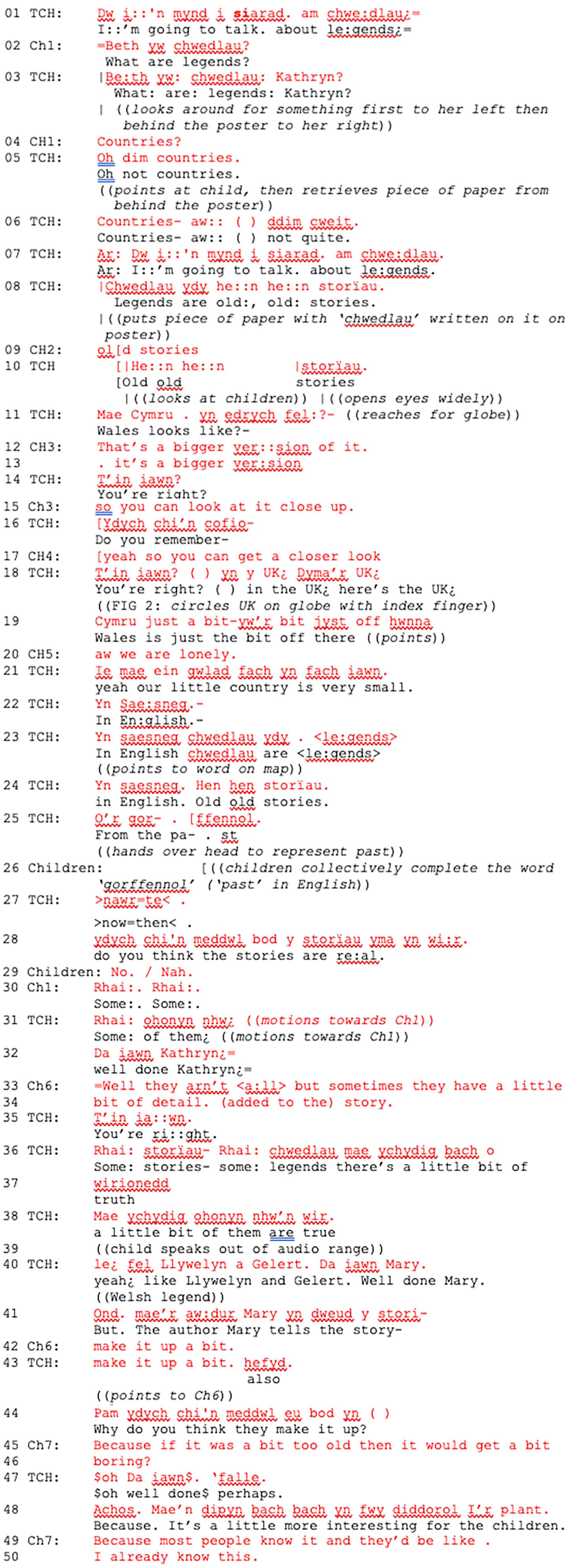
The following interaction occurs within the Welsh medium new entrants classroom in Mid-Wales with children aged 4–5 years and their teacher (TCH). The teacher begins the discussion on Welsh legends – part of the school curriculum to help support early literacy, history, national heritage and a sense of identity and belonging. Noticeable here is the teacher speaking Welsh, the children mostly answering in English, and the teacher’s orientation to what words and phrases are across both languages.
Code:
Translanguaging practices in a Welsh classroom
As we elaborated above, the notion of translanguaging presents a new way of looking at multilingual practices in the classroom and beyond in its attempt to overcome longstanding ideologies on monolingualism and normative views on the appropriateness of linguistic practices. Translanguaging as presented here demonstrates a practical way to preserve and celebrate each language – Welsh and English – where it is useful to treat the two languages as different linguistic codes in order to get a better grasp of the systematics and regularities of language use in the classroom. Indeed, the translanguaging practices that we found in our data display a specific linguistic pattern typical for a classroom-related language learning environment, pertinent to the original intention of translanguaging as a way of supporting bilingual Welsh-English learning in situ (Williams, 2022). In this sense, they are also compelling examples of simple code-switching, demonstrating the participants’ orientation towards the two different linguistic codes in the classroom.
In the sequences presented here, we initially explore teacher-child translanguaging with a focus on how the teacher makes a visible and hearable effort to set up an environment in which Welsh cultural and linguistic heritage is the key focus, where children’s use of English is responded to by the teacher in Welsh. We then build on these linguistic practices to reveal how translanguaging is multimodally reproduced, where the translanguaging practices occurring in the classroom are deeply embedded in a rich multimodal environment with employment of semiotic resources.
Initially we explore how, during the storytelling, the teacher predominantly speaks in Welsh while the children regularly answer in English. This systematic distribution of the two linguistic codes represents a co-production of translanguaging practice between the children and teacher. Within this general frame which is set up by the teacher, including props she has sourced, there are a few incidents in which the (mostly Welsh speaking) teacher employs English when talking to the children, as well as some incidents in which the (mostly English speaking) children use Welsh.
Teacher-child co-production of translanguaging
The teacher makes explicit reference to English and Welsh throughout the interaction that sets up the exploration of the Welsh legends through the Mabinogion. Such a pedagogical approach can be observable as ‘recipient design’ (Sacks et al., 1974) where the speaker shapes their talk in a way that is specifically sensitive to the recipient. In bilingual talk, speakers can demonstrate this sensitivity to the recipient through language choice, where young children begin to understand their identity as a bilingual speaker (Filipi, 2015). In order to gain intersubjectivity with the children, knowing that the majority of children in the classroom are from English speaking families, there is a necessity for the teacher to interact in both English (to ensure the children understand in their home language) and Welsh (to fulfil Welsh school policy and school language learning agenda). The children contribute to this co-production of translanguaging activity, and their right to select which language they choose to speak in, through producing either an English or Welsh turn at talk, as observed in the following examples.
A closer look reveals that this category of translanguaging can be divided further into two subcategories. Some cases occurred in a variation of classic IRE-sequences (initiation – Reply – Evaluation, cf. Mehan, 1979), such as in example 1. These are often embedded in a larger introductory sequence in which the teacher focusses on clarifying Welsh key words to secure understanding on the side of the children, as is demonstrated here: Example 1: Repetition and correction
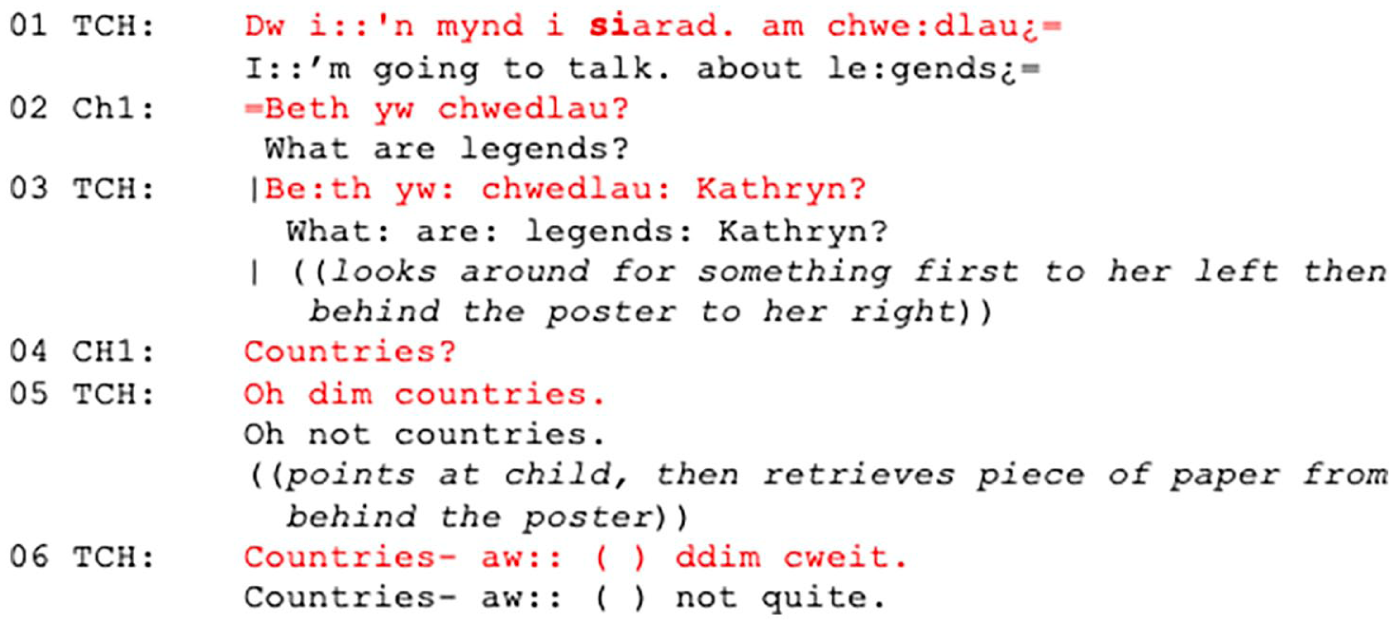
This sequence presents a type of IRE-sequence, beginning with the teacher presenting the possibly new word ‘chwedlau’ (‘legends’ in English) to the children (line 01). In the opening of the discussion of legends here, the teacher initially introduces the new word ‘chwedlau’ with prosodic emphasis (line 01), ‘suggesting its availability as a topic in its own right’ (Goodwin, 2007b: 99). In response, one of the children immediately asks what ‘chwedlau’ are (line 02) demonstrating the newness of this word, the need for its further exploration and the child’s interest in finding out more. Here, the child responds in Welsh to the question that has been posed by the teacher also in Welsh. Such epistemic alignment with the line of enquiry shows a cooperative stance to the ongoing topic (Goodwin, 2007a).
Prompted by the child’s question and demonstrable interest, the teacher returns the question to the child (line 03), again through the medium of Welsh, and in doing so sets up the ‘initiation’ of the sequence that involves the mobilised word. Interestingly, the teacher does not explicitly ask for a translation of the word ‘chwedlau’, but rather a definition. In response, the child does, however, offer an (incorrect) English translation of the word by suggesting ‘countries’ and thereby attempts to provide a second pair part ‘response’ to the teacher’s question. Repeating the incorrect English translation proffered by the child, the teacher carries out the ‘evaluation’ of the child’s response, and its rejection as a correct translation. Additionally, it demonstrates one of the basic functions of code-switching, that is ‘the socially and/or discursively meaningful juxtaposition of two codes within an interactional episode’ (Auer, 1995: 116), here clearly for the purpose of language learning.
Similarly, Example 2 demonstrates the teacher’s repeat of the child’s English contribution again in the ‘evaluation’ turn, but this time with an affirmation of the contribution being correct.
Example 2: Repetition and affirmation
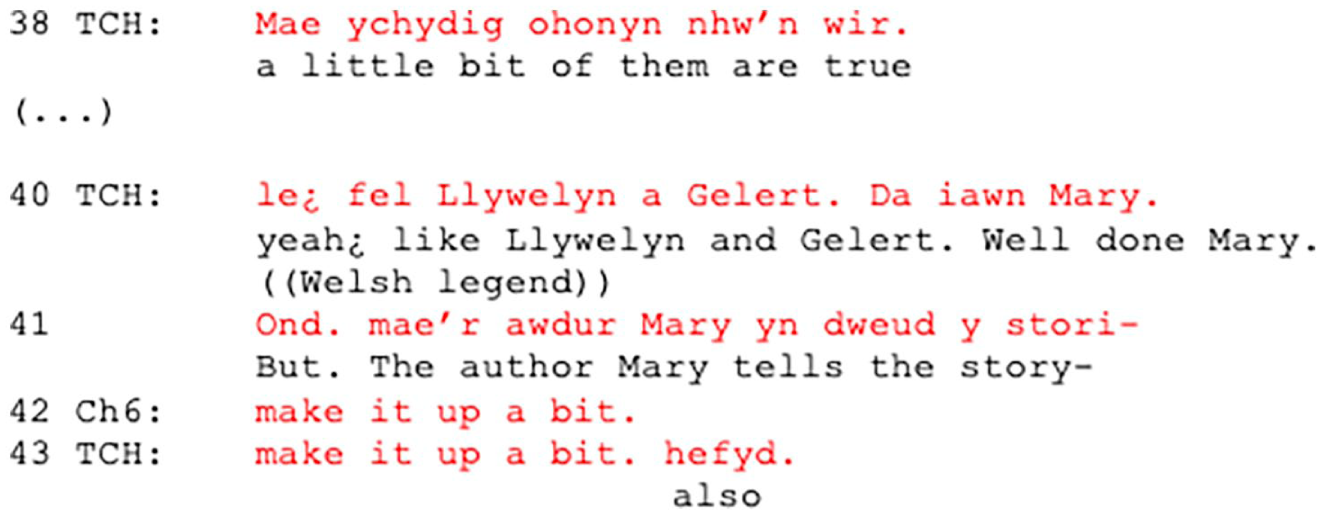
In this discussion about whether the children think that the legends of the Mabinogion are true or not, the teacher explains that there is some truth in the stories. This prompts one of the children to offer her knowledge by reference to the well-known Welsh legend of Prince Llywelyn and his dog Gelert – thought to be true as there is a location in Wales, ‘Beddgelert’ which was named after the legend and houses the grave of Gelert. The teacher uses Welsh to affirm this response as correct (lines 40–41) quickly followed by another child completing the teacher’s sentence in English (line 42). This time, the teacher uses English to affirm the child’s contribution as she copies their utterance ‘make it up a bit’. In a similar way to Cekaite and Aronsson’s (2004) playful repetitions in L2 classrooms, the repetition here ‘secured their [children’s] attention and created numerous occasions for informal conversations’ (p. 388), creating opportunity for meaningful understandings of the topic being discussed. In addition to the English repeat, the teacher adds the Welsh addition ‘hefyd’ (‘also’ in English). Again, the two linguistic codes English and Welsh are juxtaposed in the teacher’s evaluative turn. As such, the teacher draws on linguistic resources to aid intersubjectivity in her teaching interactions for these English L1 children, as promoted in Welsh Government policy on translanguaging since a large number of pupils in Welsh-medium schools across Wales acquire the Welsh language in school rather than in the home, and acquire educational information also chiefly through the medium of Welsh, it is important to understand the possible assistive role of L1. (Thomas et al., 2022: 29)
In both cases here, the rejection (Example 1) and affirmation (Example 2) relate to the teacher’s orientation (and evaluation) of the meaning of the word /utterance in the process of understanding aspects of storytelling, not the word form, where the children’s preference for contributing in English is clearly visible. Additionally, the examples demonstrate how the two linguistic codes are oriented towards and become important tools for promoting an understanding of Welsh lexical items and concepts for the predominantly English speaking children. Furthermore, the turn structure in both examples is similar: The repeated English word is embedded in evaluative terms in Welsh that deliver the assessment of the child’s previous turn. The specific turn structure thus represents special cases of fluid translanguaging for the purpose of language learning.
In the following third example, an English word is again inserted into a Welsh clausal structure. It shows a case in which the teacher provides a translation of the Welsh word for ‘legend’ after the class has not come up with a correct answer. This, in contrast to the previous examples, presents an explicit language learning practice: A new word is defined for the children.
Example 3: Providing translations
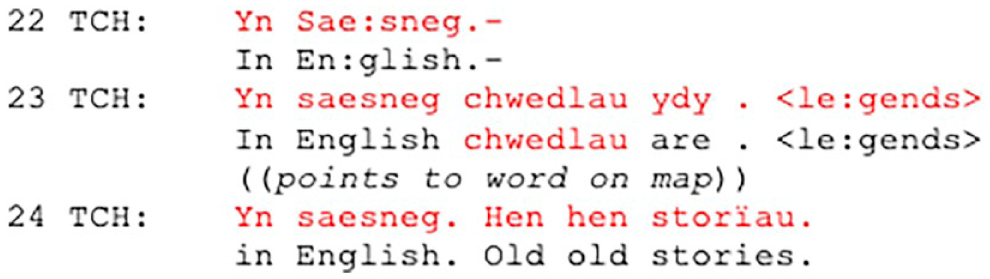
In sum, although the context is a Welsh medium classroom where the teacher speaks mainly through the medium of Welsh, there are instances of orientation to the English version of words or phrases used throughout the data. As the transcripts so far have demonstrated children’s contributions in English, the teacher’s utterances here demonstrate how translanguaging is mobilised by her in recipient designed ways for the English L1 child interlocutors, marking her sensitivity to the specific context of her class and her tailor-made support for children’s learning about new concepts such as ‘legends’. Not only do the children learn about legends here, but the teaching is also anchored in rich Welsh language heritage.
Encouragement and affirmation of children’s use of Welsh as a translanguaging practice
Within this short interaction, we can also observe two incidents where the children speak Welsh. The first is explored in Example 4 when the children complete an utterance initiated by the teacher, particularly interesting as its smooth performance indicates that such co-productions are routinised practices. In this first example, the teacher begins producing the word ‘gorffennol’ (‘past’ in English) and then prompts the children to complete it by gesturing to them.
Example 4: Gorffennol = past
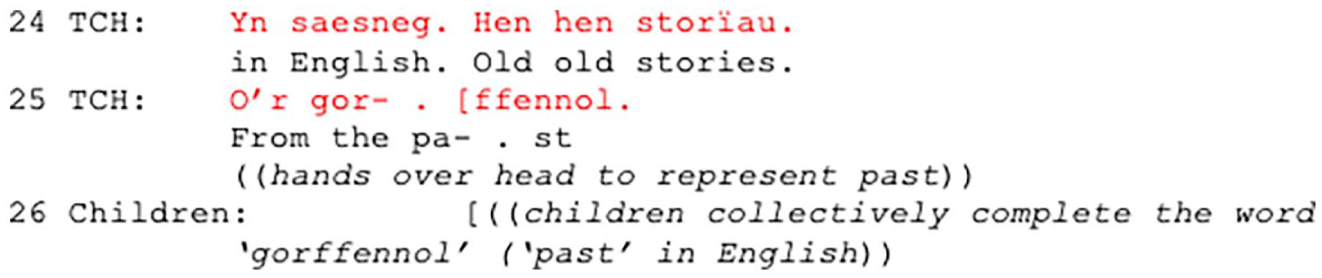
The way in which this teacher’s turn is delivered is as a ‘designedly incomplete utterance’, often used in teacher-child interactions as a way to elicit knowledge displays (Koshik, 2002). What is being accomplished here is an English explanation of chwedlau through the medium of Welsh. The complex delivery thus attends to the English as an intersubjective means of teaching a new concept, whilst upholding the HL of Welsh. As this is indeed a complex matter for 4/5-year-olds who have a diverse grasp on each language, the teacher’s designedly incomplete utterance requires the children to contribute in Welsh, therefore providing opportunity to orally practice pronunciation in collaborative ways. This linguistic structure, often employed by school-teachers, allows the children to ‘join in’ with the recital of the Welsh word, demonstrating both their Welsh language competencies and also their knowledge of education strategies that require their participation (Ervin-Tripp, 1986, 1991).
The next example shows one of the few incidents in the data in which some of the children answer the teacher’s question in Welsh.
Example 5: Rhai = Some
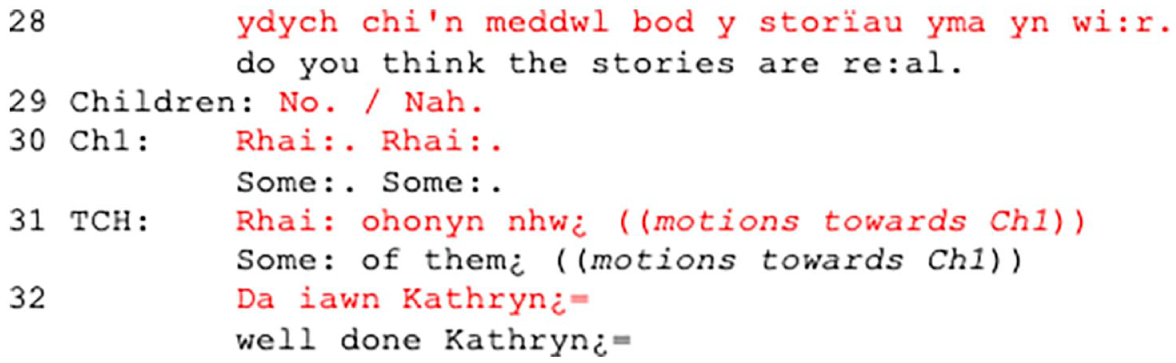
The teacher begins this sequence by eliciting the children’s opinions on whether they think that the legends are real. The replies are positioned in a collective response that is a mix of the English ‘no’ and its Welsh counterpart ‘nah’ (line 29). One child though, responds independently of this collective shared stance, suggesting that she thinks some legends are true (line 30), asserting her opinion in Welsh ‘rhai’ (‘some’ in English). The teacher repeats the word employed by the child ‘some’ (line 31), embedding it in a phrase ‘some of them’ in her next turn, followed by praising the girl (line 32). Although it is not clear whether the praise refers to the content of the child’s answer (that some legends are real), or whether she is being praised due to her use of Welsh, or perhaps both, such feedback supports the child’s attempt to employ Welsh in the classroom.
Multimodal resources in translanguaging practices
Building on the prior section, here we are interested in drawing out how translanguaging is embedded in multimodal ways, including through recruitment of environmental resources. During the interactions, the teacher facilitated talk with environmental resources such as a globe, map of Wales, a copy of the Mabinogion book and printed versions of the words ‘chwedlau’ (legends) and ‘chwedl’ (legend). These were oriented to by the teacher within the talk to help support intersubjectivity when explaining these new concepts to the children, where her actions on the tangible resources helped to bridge the English/Welsh divide. Described by Goodwin (2007a) as environmentally coupled gestures, here we see a similar intertwining of language (2 languages here), gesture, gaze and recruitment of environmental objects ‘to create a whole that is different from, and greater than, any of its constituent parts’ (p. 55).
Example 6: Chwedlau in written form
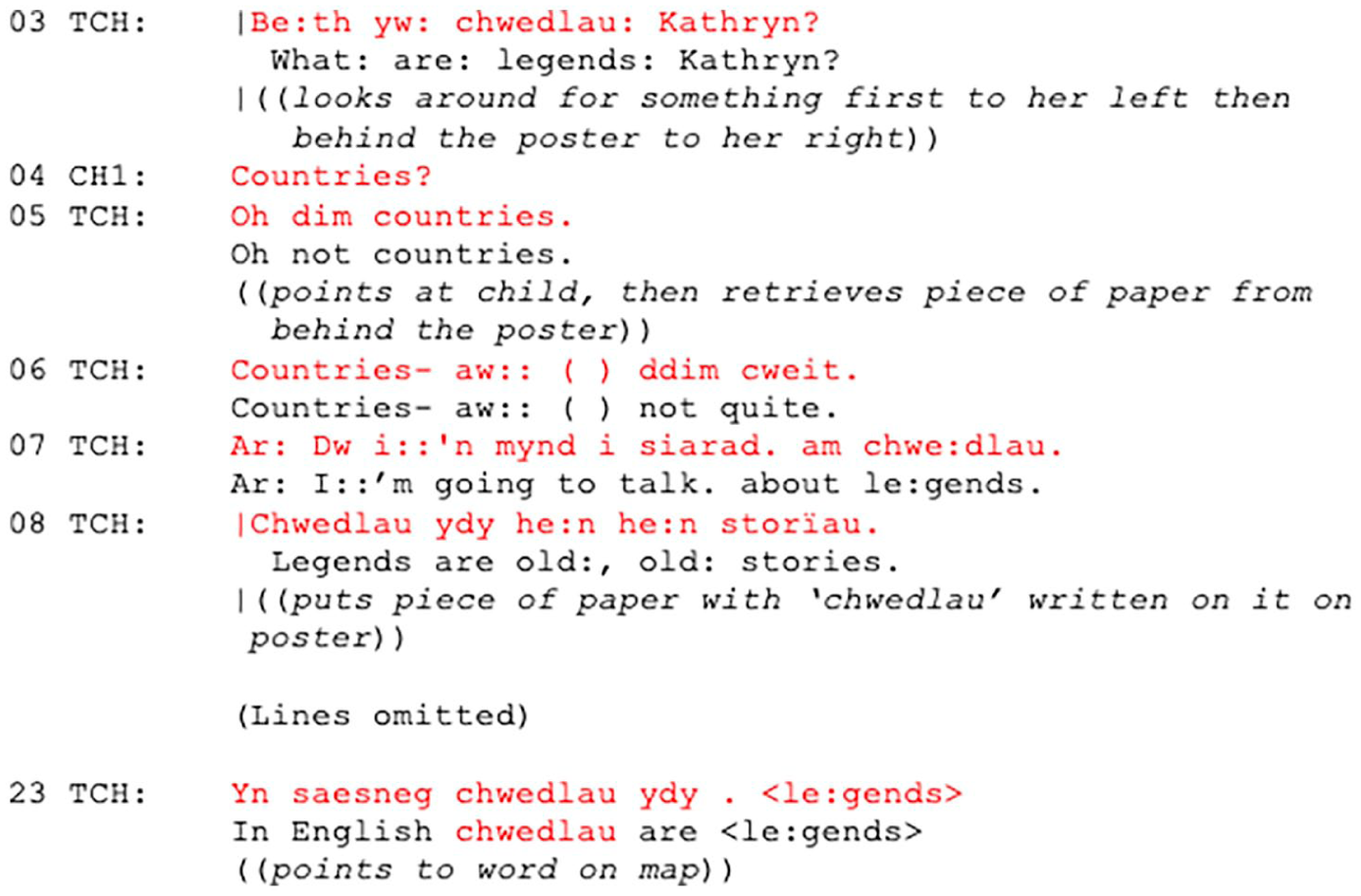
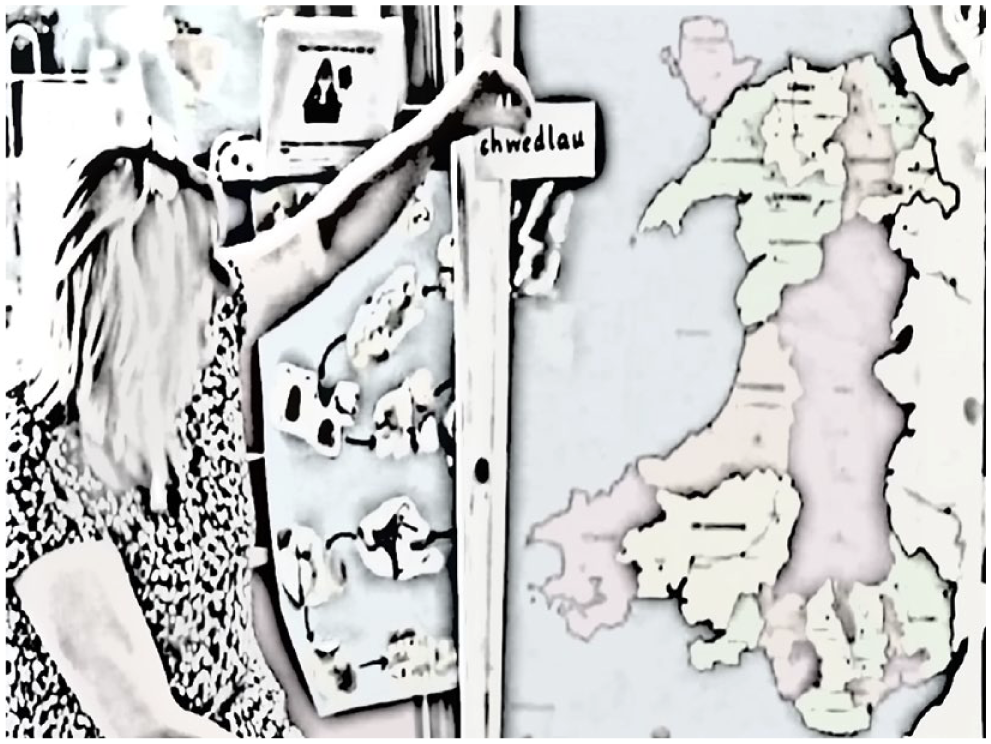
Responding to the incorrect contribution from one of the children (line 04), the teacher repeats the new word ‘chwedlau’, she does so whilst retrieving a printed version of it (line 05). Once retrieved, the printed word is placed onto the map so that it is in direct view of the child audience (figure given in Example 6) and used as a reference point later in the interaction when a direct English translation is explicitly given (line 23). Together, these actions offer an audible prosodic sound structure of the new word along with a definition and a visual representation of what the word looks like in its written form.
Example 7: Geographical location of Wales Following the introduction of the word ‘chwedlau’, the teacher moves on to situate these in geographical context, as they are primarily legends associated with, and embedded in Welsh culture and history (see prior reference to the legend of Prince Llewelyn and Gelert). To do so, she reaches for another environmental resource that is close to hand, a globe of the world.
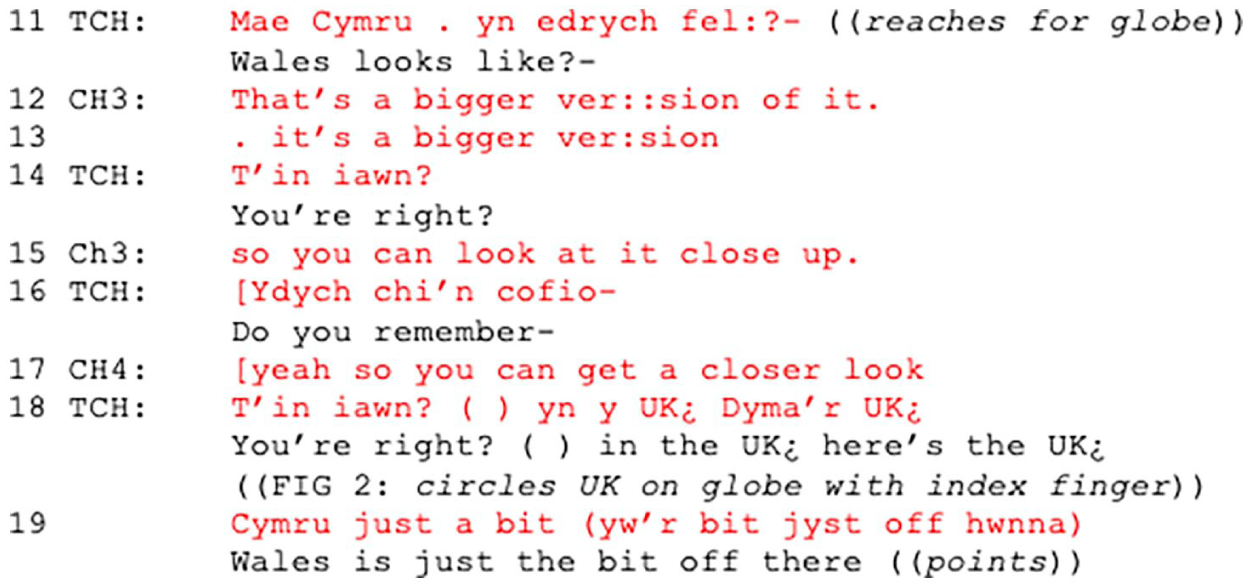
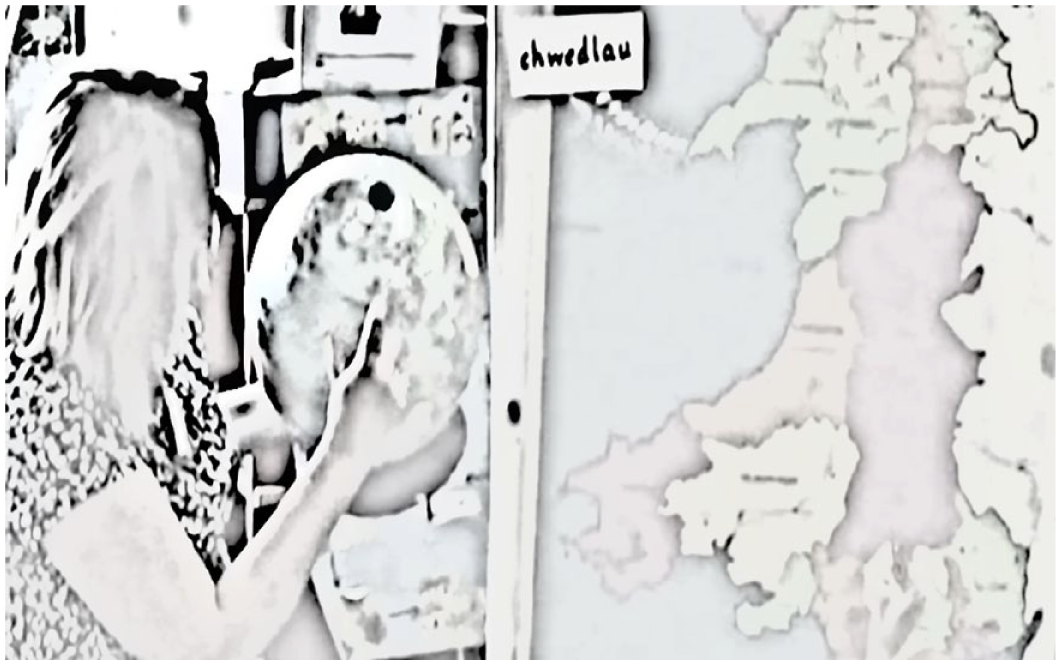
Here, the turns are organised through the teacher speaking Welsh and children speaking English, co-producing a translanguaging interaction that supports knowledge exchange. As place is so integral to The Mabinogion stories, visible effort is put in to understanding where Wales is geographically positioned in the world prior to moving on with the storytelling. By recruiting the globe, the teacher layers her talk onto the tangible object to specifically show the children where Wales is located, in relation to the globe, and more specifically within the United Kingdom (lines 18–19). In response to the teachers’ verbal and physical employment of the globe (line 11), the children orient to its usefulness as ‘a bigger version’ (lines 12–13) of the map to enable a closer look (lines 15 & 17) at where Wales is in relation to the world. Importantly, orientation to the map and globe is co-produced through English and Welsh, where the tangible resources are used creatively to afford endless linguistic possibilities for knowledge exchange. As such, we argue that translanguaging also involves these semiotic non-linguistic resources in a creative manner to produce a rich language learning environment, and to add to meaning-making between members.
Summary
Translanguaging takes place in multiple, creative forms in this bilingual classroom. The teacher, an expert in Welsh, linguistically provides models of Welsh for the children, leaving it to them to decide when they are ready to speak Welsh. Rather than insisting on a monolingual classroom where the children are limited to speaking just Welsh, the teacher accepts their use of English, and models Welsh language items for them in her responsive turns. The teacher thus acknowledges the children’s partial command of Welsh as a visible (and hearable) effort to learn the language. At the same time, the children are encouraged to use Welsh, not least by the teacher’s encouragement and affirmation. The analysis shows how the use of different linguistic codes is transformed into translanguaging practices, thereby transcending the borders between the two languages in creative ways and normalising multilingual language practices as a pedagogical practice.
Furthermore, the translanguaging taking place in this Welsh-medium classroom is not only observable as a pedagogical practice for supporting language learning, but also a co-creation of a language practice that aligns with the temporal socio-cultural connect. As such, translanguaging can be seen not only as a particular language-learning practice in a bilingual classroom (García, 2009), but also as fluid, multimodal practices of cultural and historical meaning-making (Bonacina-Pugh et al., 2021) for young children during the traditional Welsh storytelling activity. Due to the historical Welsh context being ‘the birthplace of translanguaging’ (Baker, 2019: 179) translanguaging could also be seen as, in itself, a creative cultural and historical pedagogical practice embedded in Welsh education culture.
Conclusion: Translanguaging as a pedagogical practice in the Welsh context
Traditional story-telling in classrooms is an important device to support not only the learning of heritage languages (HL) but also to promote rich cultural heritage and identities linked to it (Bateman and Davies, 2021). The rich multimodal environment provides teacher and children with a setting in which the Welsh language is situated in and connected with the wider cultural, historical and linguistic heritage. The examples in this paper illustrate how the teacher leads in establishing an orientation to Welsh language and culture in her talk by speaking predominantly in Welsh and discussing an entity, ‘chwedlau’, or legends, that are tied to Welshness and to the place of Wales. The teacher establishes an orientation to Welsh language in alignment with cultural ideologies and children’s learning of this language, demonstrating the management of smooth co-constructions of heteroglossic language practices with the children in her practice (García, 2009). Heteroglossia is demonstrably performed in situ here, both through the teacher accepting the children’s responses to her Welsh-framed questions in English, so that there is frequent code-switching turn-by-turn, as well as through her own within-sentence translingual translation, mentioning ‘English’ by name, and tying the central concept ‘chwedlau’ to the English word ‘legend’. Also notable in her practice is that it is transmodal as well as translingual. Since the important task in heritage language learning is to connect the language to place, the teacher in these examples makes this connection visible in an embodied display – by juxtaposing the central word ‘chwedlau’ written out on a card, with the map showing how Wales is situated within the UK so that the word is visually situated within the map.
Furthermore, the practice-oriented approach to multilingualism in classroom we have proposed in reference to Thomas et al. (2022) has revealed how teacher and children co-construct translanguaging in systematic yet creative ways, characterised by the following: (1) the teacher’s regular focus on English/Welsh translation, oriented to as significant for everybody to know both English and Welsh; (2) children’s routine use of English, especially when providing candidate answers to the teacher’s questions; (3) the teacher’s environmentally coupled gestures woven throughout the interaction in order to illustrate and explain the concepts of Welsh legends by embedding them in a culturally rich environment. With regard to (1), it was argued that these incidents are also cases of code-switching that reveal an orientation to the two languages as distinct linguistic codes. The way the teacher builds her turns with English words integrated into Welsh sentential structure demonstrate her effort to establish multilingual language-learning practices, as they are often found in bilingual classrooms (García, 2009). The routine of such practices – that is that they are well-established and shared with the children – can be also seen in the habitual ways the children use Welsh in the classroom. This creates an interactional environment in which the two linguistic codes become intertwined to be brought together in genuine translanguaging practices shared by all members of the classroom.
Exploring the potential of translanguaging for language and cultural learning in classroom interaction, the examples from a Welsh medium children’s classroom in Mid-Wales show translanguaging in interaction, where the stories of The Mabinogion are told by the teacher in Welsh heritage language intertwined with English, mostly from the children. While the teacher makes efforts to set up an environment in which Welsh cultural and linguistic heritage can be multimodally reproduced to create a sense of belonging and identity (Bateman and Davies, 2021), several cases of translanguaging practices (Garcia and Wei, 2016) occur. These translanguaging practices appear to be supportive of children’s emergent multilingual, social, cultural and linguistic competences that stretch the boundaries of dominant monolingual ideologies (Kyratzis et al., 2010). They are thus part of a larger language socialisation process in which belonging and identity as well as language learning is supported through traditional stories in a rich multimodal environment. Indeed, this essential skill in translanguaging pedagogies evident here help to support home-school connections (García and Leiva, 2016) with children who mostly come from English-speaking homes. Through the turn taking that co-produces this context we see demonstrations of heritage language competencies built around traditional Welsh legends connected to place and identity, supporting efforts for language revitalisation in ways that are key to the holistic development of the child, particularly for belonging and identity (Bateman and Davies, 2021).
Through the translanguaging practices observed in this brief interaction analysed here, supported by the exploration of the Mabinogion, connections can be made to Welsh government education policy: When embedding local, national and international contexts, practitioners should look for opportunities to support learners to: develop an authentic sense of cynefin, building knowledge of different cultures and histories, allowing them to develop a strong sense of individual identity and understanding how this is connected to and shaped by wider influences. (Welsh Government, 2023a)
As such, the teacher can be observed implementing The Curriculum for Wales ‘four purposes’ with specific emphasis on supporting children to be ‘Ethical, informed citizens who are ready to be citizens of Wales and the world’. In terms of debates around translanguaging and monolingualism (e.g. Auer, 2022; Jaspers, 2018), this article brings translanguaging back to Wales, its place of origin, where we end with a careful reminder of the importance of studying cultural concepts within the context in which they originated.
Footnotes
Appendix
Acknowledgements
This paper is dedicated to the inspirational teacher who participated in this project, Michelle Davies. What joy you bought to the lives of so many children, families and colleagues Michelle. It has been a pleasure to work with you and learn from you over the years. Diolch yn fawr iawn x.

Ethical considerations
This research was approved by Waikato University Human Research Ethics Committee, approval code FEDU036/21.
Consent to participate
Written consent was obtained from the participating teacher and children’s participation was obtained from their parents and the children.
Consent for publication
Consent for publication was obtained within the consent. The participating teacher requested identification in this publication – all children’s names are pseudonyms.
Funding
The authors received no financial support for the research, authorship, and/or publication of this article.
Declaration of conflicting interests
The authors declared no potential conflicts of interest with respect to the research, authorship, and/or publication of this article.
Data availability statement
All data are confidential and cannot be shared.