



Abstract
This study uses Bakhtin’s dialogical approach to heteroglossia for examining the diverse linguistic practices and norms multilingual (Swedish-Kurdish-Turkish-Arabic) children exploit in performing identities and negotiating relationships in social media environments. The study combines ethnography with multimodal conversation analysis, examining multilingual boys’ (i) chat-communication and (ii) co-present interactions around the screen. The analysis demonstrates how the boys use a hybrid mixture of (i) textspeak (abbreviations, typos, emoticons), blended with (ii) urban youth style, (ii) heritage language forms, and (iii) monolingual standard orthography for achieving status and peer group sociality. At other moments group members enact voices of adult authority staging corrective practices around Swedish orthography and online rules for proper language use to display expertise and elicit laughter. The findings highlight multilingual children’s playful juxtaposition of diverse voices, styles and ways of speaking/writing indexical of normative tensions between (i) diversity and heteroglossic forms and (ii) standardization and monolingual norms, for negotiating belonging in transcultural peer cultures.
Keywords
Introduction
Sociolinguistic researchers have illustrated how young people with multilingual backgrounds engage in often innovative heteroglossic practices to create forms of togetherness while performing identities across linguistic and ethnic boundaries (cf. Madsen et al., 2010; Rampton, 1995/2005). Particularly Rampton (1995/2005) demonstrates in his classical work how youths in multi-ethnic communities develop a specific urban speaking style (or register) characterized by “crossing,” by which the languages in contact are mixed to such an extent that new, innovative styles and hybrid ethnicities emerge. More recent research has shown the importance of exploring how young people’s social media communication provides contexts for new hybrid language forms, identities, and social relationships (cf. Androutsopoulos and Jufferman, 2014; Nørreby and Møller, 2015; Stæhr, 2024). Still, little is known about how young school children’s media literacy practices within multilingual communities may afford innovative language practices and performances of hybrid identities and social relationships.
In this study, Bakhtin’s (1986) dialogical approach to heteroglossia is used as a framework for exploring how children in multilingual peer group settings playfully appropriate the varieties of codes, styles, and semiotic resources available in a social media environment. The data draw on video-ethnographic research among multilingual peer groups of children (aged 9 years) in an afterschool setting located in an ethnically heterogeneous low-income area of Sweden. In the afterschool setting a monolingual ideology was the unspoken educational norm, while the children’s social languages in on- and offline spaces differed from the institutional expectations for proper/standard language use. The children engaged daily in a social media environment, named Momio, chatting, communicating and playing with peers, while they negotiated belonging in their peer culture (cf. Evaldsson and Melander Bowden, 2024). This study focuses on a particular case involving (i) chat-messages sent and received by a particular boy here named Baris (of Swedish-Kurdish backgrounds). The analysis of Baris’ chat-messages is combined with (ii) video recordings of the same boy’s metalinguistic activities around the screen. By combining different data sets, I will show how children’s social engagement with social media is interrelated to their experiences, social relationships, and language repertoires in their everyday life (cf. Evaldsson and Melander Bowden, 2024; Stæhr, 2014: 15). Of particular interest here is how multilingual children in chatting and interacting with peers in a social media environment creatively appropriate, exploit and play with heterogeneous resources, and language varieties from various normative contexts (peer-group, social media, school, family) in “socializing one another to and through heteroglossic discourse practices” (Kyratzis et al., 2010: 458; see also Evaldsson and Kyratzis, 2025).
Bakhtin’s dialogical approach to “heteroglossia” is used to explore the diverse modalities, voices, styles, and language varieties multilingual children appropriate and exploit as they negotiate identities and social relationships, and the sociocultural meanings and normative tension these varieties index (cf. Bailey, 2007; Blackledge and Creese, 2014). One strength with the Bakhtinian approach is that it highlights the dynamic and variable nature of linguistic forms and signs, at the same time it underscores that language practices are characterized by a force that aims at unification. In Bakhtin’s (1981: 272) analysis heteroglossia involve tensions between opposing forces: the centripetal, imposing a “unitary language” of standardization and correctness, and the centrifugal moving towards diversity and language plurality. Thus, in order to understand the dynamics of heteroglossia, we need to explore how multilingual children navigate tensions towards normativity and uniformity as part of their languaging.
In this study Bakhtin’s approach to heteroglossia is integrated with language socialization theory (Ochs and Schieffelin, 2011) with its focus on linguistic and cultural reproduction, and “the agency of language learners – their capacity for creativity, resistance, and even subversion” (Garrett, 2007: 235). Peer language socialization studies show for example how children doing heteroglossia in multilingual settings navigate tensions between “centrifugal” and “centripetal” forces (Evaldsson and Cekaite, 2010; Kyratzis et al., 2010). This study adds to prior research by exploring multilingual children’s heteroglossia and language creativity in a social media environment. It focuses on a particular case with a multilingual boy with high media skills, who in his chat-communication exploit diverse socio-linguistic varieties, styles, and voices in performing identities and social relationships (cf. Kyratzis, 2025). But who in other peer-contexts around the screen, corrects his peers’ use of bad language and spelling, indexing standardized forms for displaying expertise and achieving status in the peer group. Thus, in examining the case of Baris, I will consider how multi-lingual children in socializing with peers navigate social tensions between diversification and standardization (Bakhtin, 1981; 1986), as they appropriate the available socio-linguistic forms and voices, forming their own associations between linguistic codes, social values, identities, and ideologies (cf. Bailey, 2007; Kyratzis et al., 2010). The findings will lead to a broader understanding of children’s heteroglossic practices and the dynamic role of language creativity and normativity in multilingual peer group communities such as the one I investigate here.
Before we turn to the analysis, I will first provide a research background that links to Bakhtin’s conceptual tools on heteroglossia and language creativity. The empirical part provides ethnographic information about the afterschool setting and the children in the multilingual peer group and the social media space they are engaged in. This is followed by a method section that presents the video-ethnographic design and multimodal interactional approach taken to explore children’s heteroglossic practices in a social media environment
Research on multilingual youth’s and children’s language practices
A considerable body of research concerns multilingual teenagers’ and adolescents’ language practices in culturally diverse urban settings in schools and leisure activities (cf. Jaspers, 2011; Jørgensen, 2008; Madsen, 2014; Madsen et al., 2010; Rampton, 1995/2005, 2011; Tetreault, 2018), and more recently in social media (cf. Androutsopoulos, 2021; Stæhr, 2024). A pioneering study is Rampton’s (1995/2005) work on “crossing” among multi-ethnic adolescents of Anglo, Asian, and Caribbean descent in the UK. Rampton (1999: 421) shows how the youth engaged in playful styling and stylizations of others’ styles and languages “to appropriate, explore, reproduce or challenge influential images and stereotypes of groups that they don’t themselves (straightforwardly) belong to” Jørgensen (2008: 143) and colleagues (Madsen et al., 2010), have documented polylanguaging and heteroglossia among youths of Turkish family background, showing how a polylingual norm is applied to maximize cultural heterogeneity. Other researchers have shown how youths in urban multilingual settings perform heteroglossia and stylization to contest and challenge ethnic boundaries and monolingual power structures (cf. Jaspers, 2015; Madsen, 2014; Rampton, 2011; Tetreault, 2018).
In addition, researchers using a language socialization approach have demonstrated how school-aged children appropriate and play with language forms and social conventions for majority language use (cf. Goodwin and Kyratzis, 2011). For example, Evaldsson and Cekaite (2010) found that joking and mimicking someone’s limited knowledge of Swedish served as practices for establishing social status in the multilingual peer group, simultaneously rendering commentaries on, and reproducing the dominant monolingual ideology. Language play as Cekaite and Aronsson (2014) demonstrate in their research among newly arrived immigrant children served the functions of entertainment and sociality in the peer group (see also Cekaite and Evaldsson, 2008; Kyratzis, 2025; Nasi, 2025).
However, a gap exists in research on multilingual children’s digitally mediated language practices. The processes of (re)constructing new norms for language use is particularly visible in studies of youth’s creative appropriation of social media, which involves new modes of language use (cf. Androutsopoulos, 2021; Leppänen et. al., 2015). For example, Stæhr (2014) shows how Danish youths with multiethnic backgrounds develop hybrid orthographic conventions in their texting on Facebook. Other researchers demonstrate how multilingual youth’s digitally mediated interaction deviates from standard forms in ways that are crucial for local identity performances (Nørreby and Møller, 2015). Digitally mediated interaction connects multilingual youth to both local and global processes trough new modes of language use characterized by a plurality of norms and behaviors (cf. Androutsopoulos, 2021; Leppänen et. al., 2015). Social media practices, engage young people with often competing normative patterns for language use, within school, families, and peer groups along with popular and subcultures (cf. Stæhr, 2014). Blommaert (2010) describes such an organization of normativity as polycentric.
So far socio-linguistic research has mainly shown social media communication among multilingual youth and adults are characterized by plurality and polycentricity of semiotic and linguistic resources and normativity (Blommaert, 2010; Stæhr, 2014). This study adds to prior research by exploring the social dynamics of heteroglossia and normativity in a social media environment where language creativity and performativity are key components in multilingual children’s social interaction and peer group sociality. It will be shown how the children do heteroglossia as part of a specially marked artful performance which “puts the act of speaking on display” – “and opens it to scrutiny by an audience” (Bauman and Briggs, 1990: 73).
Ethnographic setting, participants, and social media environment
The present study is part of a larger project on “Talking and texting in the move: exploring children’s media literacy practices in peer groups” based on video recordings in school, afterschool, and home settings among children (aged 8–9 years), exploring children’s communicative practices and multimodal engagements (including talking, texting, web searching, etc.) in everyday peer group interactions in Sweden (MAW, 2014:0057).
The selected data draw from vide-ethnographic fieldwork during 6 months in an afterschool setting located in an ethnically heterogeneous low-income suburban area. Most of the children were born in Sweden to families with migration histories and diverse linguistic backgrounds (mainly Turkish, Arabic, and Kurdish, but also Polish, Latin American, and Somalian). The afterschool center offered leisure-time space for children to socialize with their peers after school. In this culturally heterogeneous setting a monolingual policy was the unspoken educational norm, while many of the children spoke a non-standard vernacular form of Swedish, that has been associated with an urban youth style, incorporating various features from mainly Arabic and Turkish into their communication (cf. Milani and Jonsson, 2012).
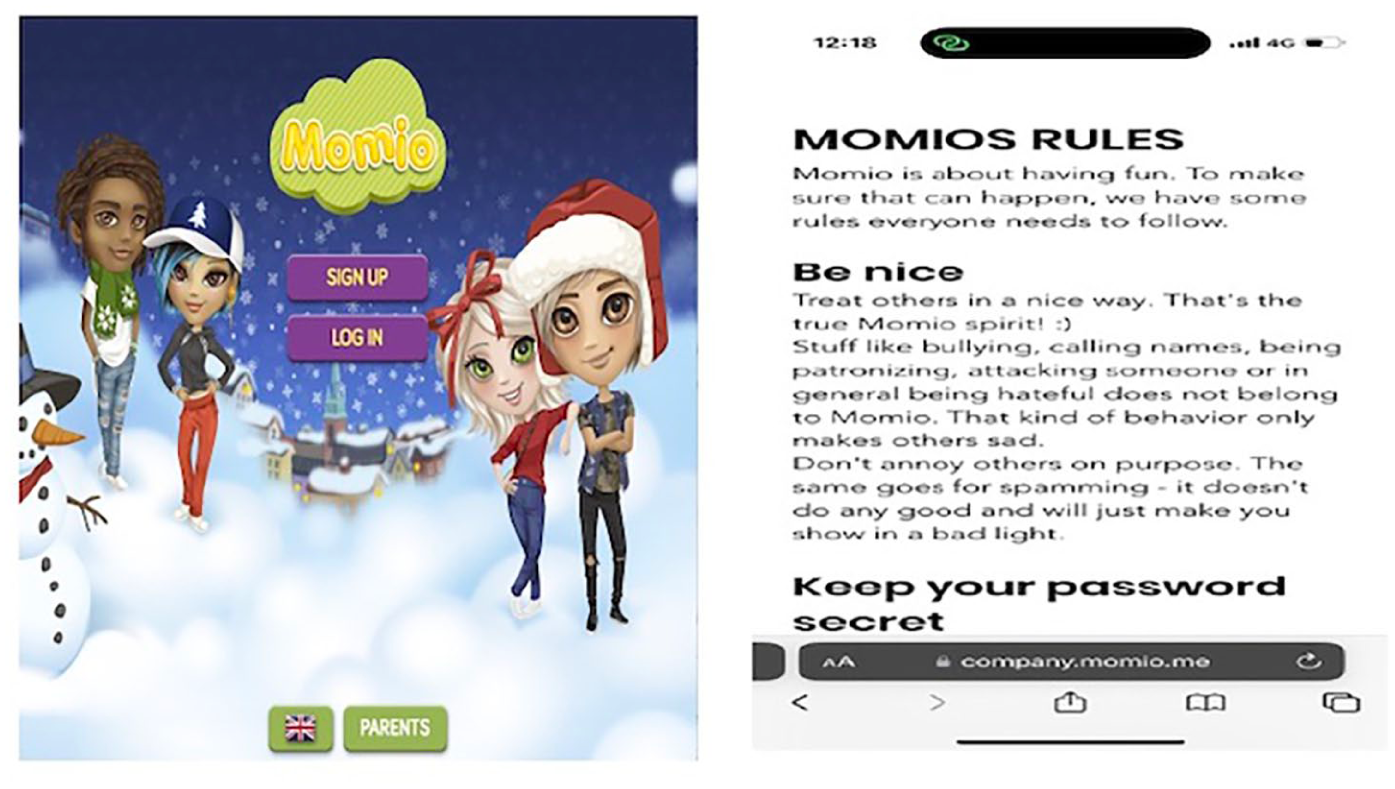
At the center the children were free to engage in leisure activities, involving entertainment and communication on- and offline. Most popular among the children was a social media space called Momio, that was used daily by the children to socialize and communicate with peers in on- and offline spaces (Evaldsson and Melander Bowden, 2024) (Figure 1).
Momio login (https://www.momio.me/).
The Momio network was designed for chatting with peers, presenting oneself online, making new friends, and playing games. Momio had its own rules for safeguarding the children, involving social and linguistic rules for how to act toward others online (Figure 1). The rules were addressed to both parents (in English) and children (in their language, here Swedish) as they logged into the site. The children were encouraged to report problematic online conduct to a particular person/avatar (named Lucas) and that breaking the rules had consequences (cf. Evaldsson and Melander Bowden, 2024). The online rules largely mirrored the rules advocated by the teachers at school regarding proper/correct standard language and how to interact with peers.
This protective intent highlights a complex normative aspect of proper/standard language, that children have to deal with in social media contexts when socializing with peers. The analysis will show how children in their social media engagements navigate tensions between different norms for language use that involve indexical associations with different authorities (including school, social media, family and the peer group) (cf. Stæhr, 2014).
Method: Video-ethnography and multimodal conversation analysis
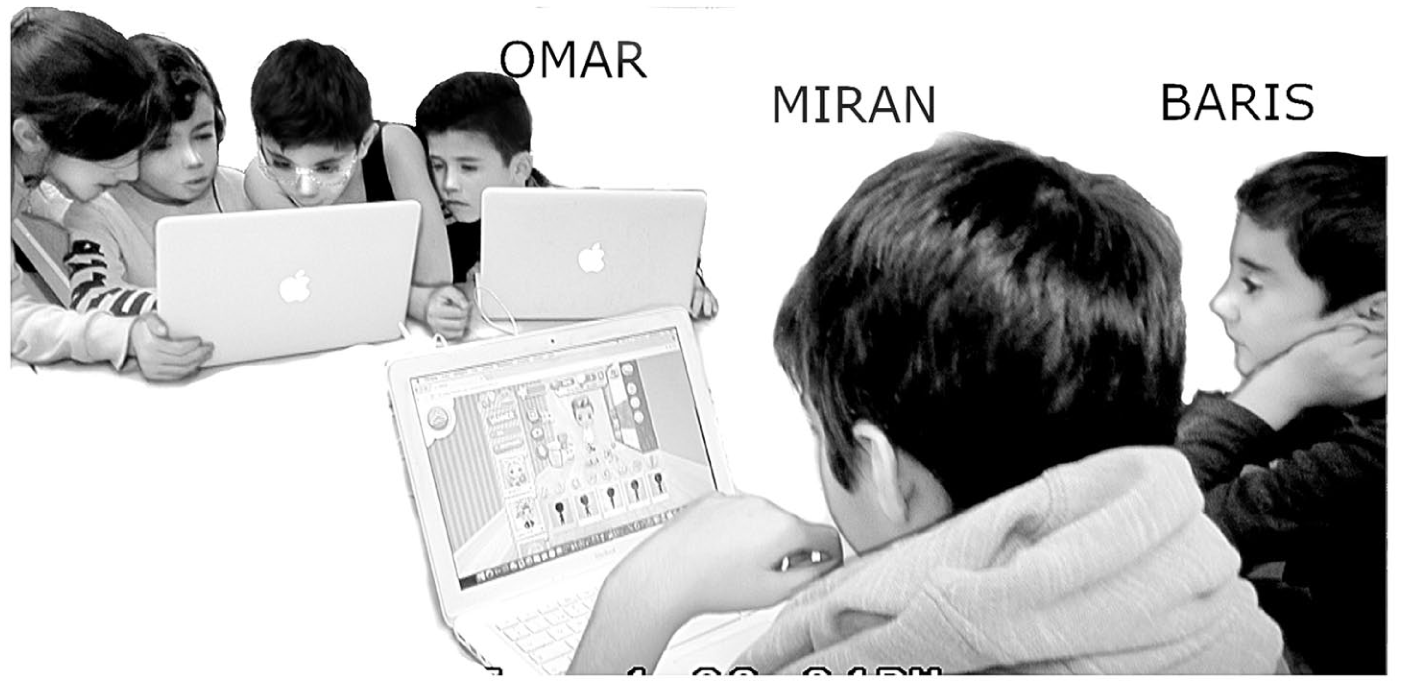
The ethnographic fieldwork provided access for producing video-recorded data (50h of video, including field notes) of reoccurring peer play activities and language practices in the children’s peer cultures at the afterschool setting. The fieldwork was conducted by the author and a research assistant, using two video cameras that ran continuously to capture the children’s peer interaction and engagements with social media. The children usually organized themselves into same-sex groupings of six with one computer each, seated around a table centrally located in one room, where their communication on Momio, chatting, playing, and texting and around the screen could easily be video-documented (Figure 2).
The peer groups seated around the table, busy communicating on Momio.
In this study particular attention is on the social media practices of one particular boy, here named Baris, who has a high level of media literacy skills. Baris, who has a Swedish-Kurdish background, spend most of his leisure time at the center socializing and chatting with peers on Momio. For the analysis, two ethnographic data sets are used, (1) screenshots of Baris’s chat-messages with his peers and (2) video recordings of his co-present peer interactions around the screen. The two data sets represent reoccurring language practices in on/offline spaces among the children within their peer cultures in the ethnographic material.
The ethnographic analysis makes a case for combining screenshots of children’s chat communication with video recordings of their face-to-face interactions around the screen as valid objects for studying multilingual children’s social engagements with social media as interrelated to their everyday life with peers (Evaldsson and Melander Bowden, 2024; Stæhr, 2014: 15). I use a language socialization approach (Ochs and Schieffelin, 2011) and multimodal conversation analysis (Goodwin, 2018), both of which consider children’s agency and the contextual embedding of children’s peer language practices. The advantage of combining these ethnographic interactional approaches is that they treat spoken and written language as situated practices, and not as completely different but rather as (re)constituting each other. In the analysis, both Baris and his peers’ spoken and texted interactions are subject to close sequential analysis, which is typically reserved for face-to-face interaction. More specifically I use a multimodal conversation analytic approach (Goodwin, 2018) building on Goffman’s (1981) work on footing and participation, to explore how children in sequential, and situated multimodal activities use assembling resources (eg. talk, gestures, texting, and other symbolic and cultural resources) to organize their participation in peer group contexts (cf. Goodwin and Kyratzis, 2011). The video excerpts are transcribed following conventions within CA (Goodwin, 2018; Jefferson, 2004) for analyzing both texted and spoken (embodied) interaction (see Appendix for the symbols). All the names in the transcribed data are pseudonyms and black-white filters are applied to all images, and in the screenshots the real names are blurred, to protect the children’s identities.
Analysis
Heteroglossia and language creativity in children’s peer media engagements
The analysis is separated into two sections (Parts 1 and 2) that focus on how heteroglossia, language creativity and normativity are performed in multilingual peer groups’ (1) chat-communication and (2) co-present peer interactions around the screen.
The first data set focuses on how, Baris when chatting and socializing with peers online, appropriates linguistic features from varies language varieties and styles, exploiting boundaries and norms for written and spoken language associated with divergent norms for language use, providing a context for playful innovations and creations of hybrid gendered ethnicities
The second data set explores Baris’s in-present peer interactions around the screen with two other boys (Miran and Omar), with multilingual backgrounds (Swedish-Turkish) but with lower media literacy skills. It examines an unfolding trajectory, where the tree boys playfully comment upon the linguistic format of one another’s chat-messages. Such corrective practices are turned into public performances, where, expertise, and knowledge of norms for proper standard language use are playfully exploited and re-accentuated.
Part 1: Heteroglossia: Online chatting practices and identity performances
The first excerpt examines Baris’s (alias Magnus) chat-communication with a girl in class named Afer, who also has a Swedish-Kurdish background. On Momio, Baris is known ′as “Magnus,” with a typical Swedish name for his avatar, that has light brown hair, colored skin, and a sporty look. In addition, Baris has also a female avatar, which he often uses. The shifting visual outfits indicate that Baris plays around with his ethnic and gendered identity online (cf. Nørreby and Møller, 2015). The chat communication starts with that Afer has sent a chat-message to Magnus, where she presents herself with her real name using a standard written form ending with an emoticon ☺, that expresses a positive emotional stance (Maybin and Swann, 2007). In contrast to Baris, Afer presents her avatar with her authentic name as “afer the best” (blurred in the screenshot). The text is accompanied with visual signs of a nice-looking avatar with brown hair and girlish look, indicating that Afer plays with her gendered identity.
The analysis will show how heteroglossia is performed in the children’s chat-communication through stylized manipulations of standard writing conventions containing a hybrid variety of “textspeak” including abbreviations, emoticons, and typos (Blommaert and Velghe, 2014), blended with features from urban youth style (Nørreby and Møller 2015).
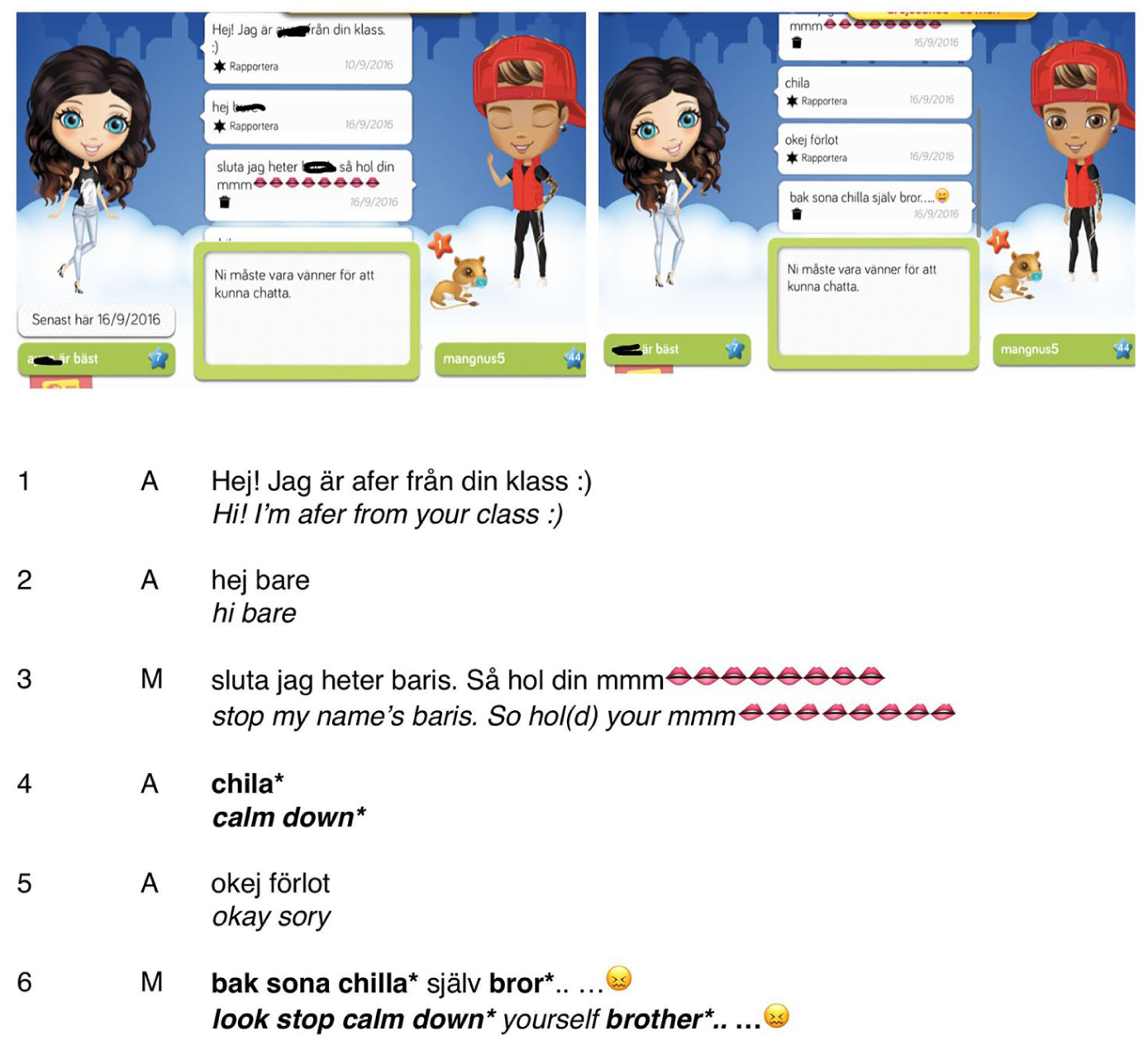
Afer’s respelling of Baris real name into a nickname in her greeting, “hi bare” (line 2), uses an informal non-standad variety of textspeak indexing an intimate emotional stance. Of interest here is how the informal stance projects an upgrading in which diverse semiotic resources and modalities are used to position the two children in relation to one another. To start with, M/Baris responds with an upgraded directive “stop my name’s baris” (line 3). By using his complete (authentic) name, Baris shifts into a more formal, standard written style that distances him from Afer. He then rapidly shifts back into a more informal mocking style of textspeak, “so hol(d) your mmm  ” in a playful assertive manner (line 3). The playful mocking style includes a series of emojis along with deliberate typos that signal a playful shift in footing into a bad language. The texted insult reuses the format of the Swedish insult “håll käften” (Eng. “shut up”), respelled and transformed into a lighter version, “så hol din mmm.” The most offensive word, “käften,” is here substituted with emojis of eight mouths with red lips: “så hol din mmm ,” The playful multimodal insult, demonstrates Baris’ metalinguistic knowledge of that using a bad language is against the norms for proper language use in the social network. By using visual signs, Baris manages to use a bad language without transgressing the norms online simultaneously he manages to maintain a powerful position, of toughness and assertiveness.
Afer responds to the texted insult with a mitigator,
In what follows M/Baris’ uses a variety of “textspeak” that can be described as hybrid forms of speech and writing (cf. Blommaert and Velghe, 2014). Baris’ upgraded response in line 6,
Playful stylization and peer group affiliations in chat-communication
The next Excerpt 1b will also show how Baris presents himself through a stylized performances using a tough and assertive manner in his chat-communication. Baris now socializes with a boy, named Alim, in his class. Similar to Baris, Alim plays with his authentic identity using a fictive name and a creative dressing style for his avatar. The analysis will show how Baris creatively mixes and switches between different styles, blending elements from textspeak, with an urban youth style and the orthographic standard to display an attitude of toughness in creating inter-ethnic peer group affiliations.
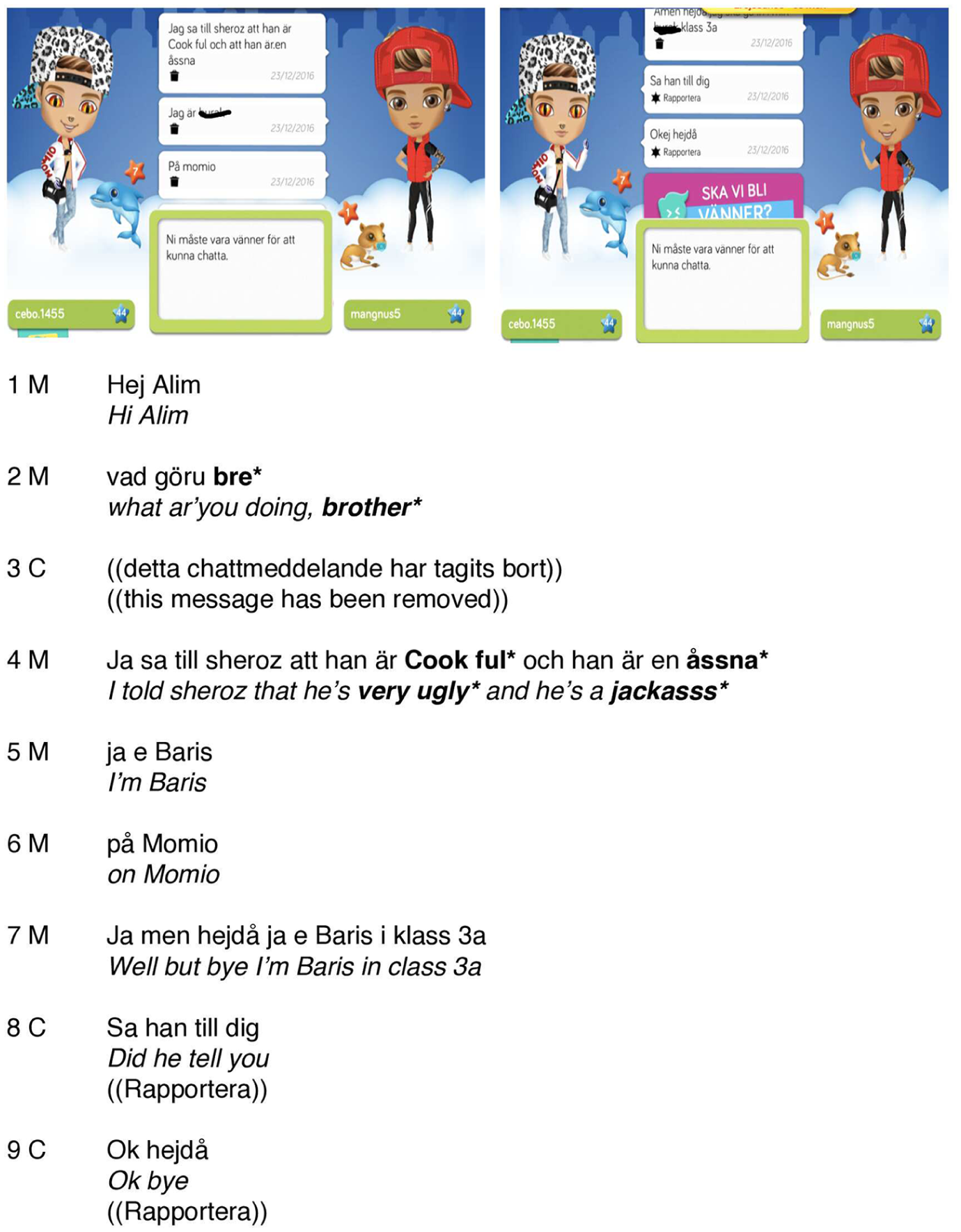
The texted exchange starts with Baris using an informal style of textspeak, including abbreviations and non-standard spelling mixed with features from urban youth register: “What ar’ you doing,
Interestingly, when M/Baris gets no uptake from Alim he immediately closes the exchange and code-switches into a correct written standard Swedish form, “Well bye I’m Baris in class 3a” (line 7) presenting himself with his authentic name and school class, The rapid style shift indicates that Baris, actively perform a good student identity and can easily opt out of a bad language into a more polite form in the standard (an option that is only available to children with high media literacy skills, like Baris.
Named languages and hybrid ethnic identities in chat-messaging
The last excerpt in this section will show how heteroglossia is performed in the boy’s chat-messages by manipulating standard writing conventions also in instances in which boundaries between language varieties are at play (Bailey, 2007). The following exchange starts with that Baris, in his chat with a girl named Evrim, brings up the choice of language: “we’ll speak Kurdish with each other” (line 1). The explicit naming “topicalizes” the ideological construction of languages as distinct entities (Evaldsson and Sahlström, 2014). Such meta-sociolinguistic stances not only make inferences regarding linguistic competencies and language ideologies but are, as will be shown, used to categorize others as either monolingual, bilingual, or polylingual (and in which languages) (Cekaite and Evaldsson, 2008: 180).
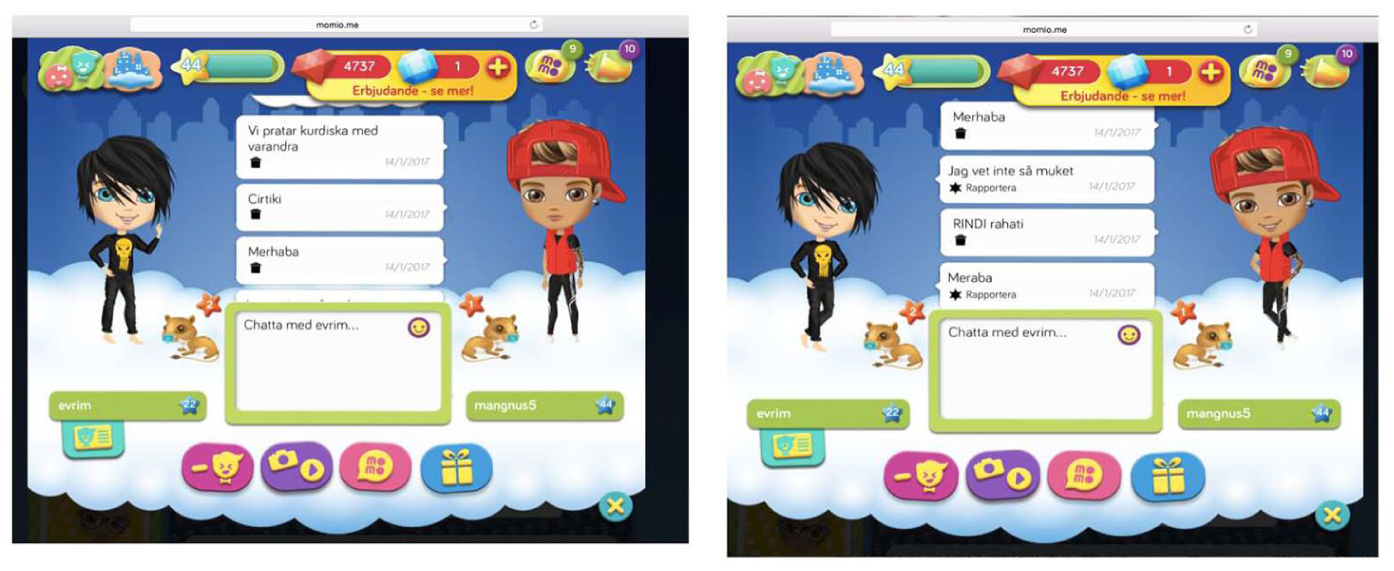
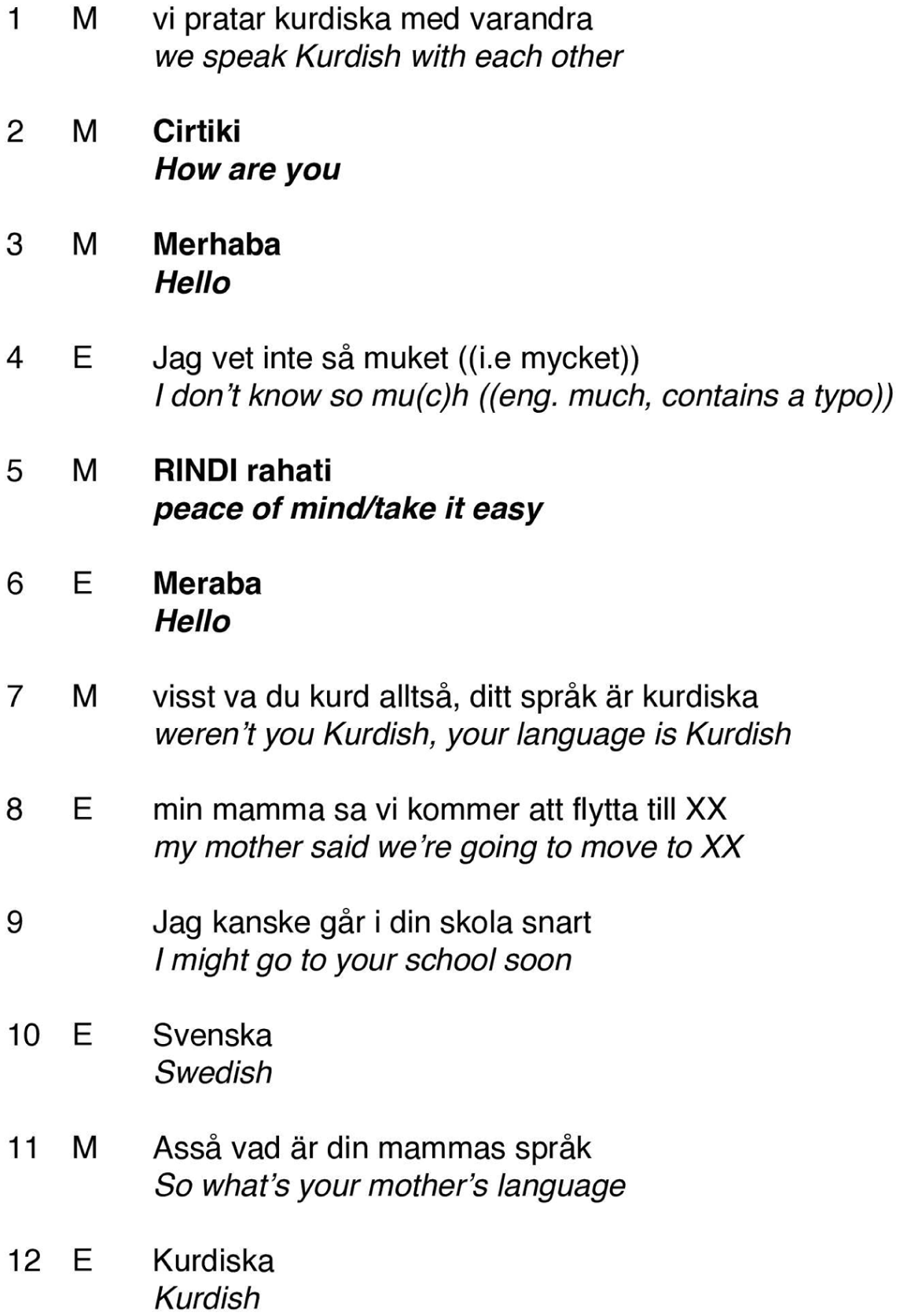
In what follows, M/Baris code-switches to Kurdish, which is the heritage language he uses at home and among some peers. He then addresses Evrim with an abbreviated typed messaging of the Kurdish greeting
In line 4 Evrim explicitly accounts for her lack of competence in the preferred language, “I don’t know so muh” (Eng. much) (line 4), thereby treating Baris’s code-switching between Swedish and Kurdish as a marked choice. It is not clear why M/Baris continues to use Kurdish at this point. The use of an idiomatic Kurdish expression –
The analysis of Baris’s chat communication shows how he uses a hybrid stylized variety of textspeak including abbreviations, emoji use, and typos, blended with linguistic features from an urban language style in socializing with peers. Here, the orthographic standard and boundaries between different language varieties, styles, and registers are intentionally transgressed and blurred in ways that create new socio-pragmatic meanings and hybrid ethnic and gendered identities. Yet it can be argued that such heteroglossic literacy practices presuppose an understanding of the indexical values and different status of the varieties, including “the standard,” which a boy like Baris (with multilingual, educational and media literacy skills) deliberately does not follow (cf. Auer, 2022: 140).
Part 2: Improvised verbal performances of corrective practices
We will now turn to the second data set, that is based on video-recordings of the children’s co-present interaction around the screen. The analysis focuses on an unfolding trajectory of improvised verbal performances that involve Baris and two other boys (Miran and Emir) in the multilingual peer group while they playfully comment upon and evaluate one another’s chat-messages (Excerpt 2a–c). The analysis explores a series of unfolding instances of playful corrective practices and metapragmatic commentaries (Evaldsson, 2005; Evaldsson and Cekaite, 2010), that becomes transformed into language play (Cekaite and Aronsson, 2014; Cekaite and Evaldsson, 2019) and an informal “language lesson” (Cekaite and Aronsson, 2005: 169).
When the first event starts Baris circulates around the table monitoring and overhearing Miran’s and Omer’s communication around the chat (see Excerpt 2a, Figure 1). Miran has earlier on sent a series of playful insults, “monkey,” “koko,” “donkey,” and “pig” (see Excerpt 2a, Figure 1) to Omar. He now in a playful manner announces a new message “I sent something to you” (Figure 2, line 1), that turns the boys’ online communication into a public performance and “opens it to scrutiny by an audience” (Bauman and Briggs, 1990: 73).
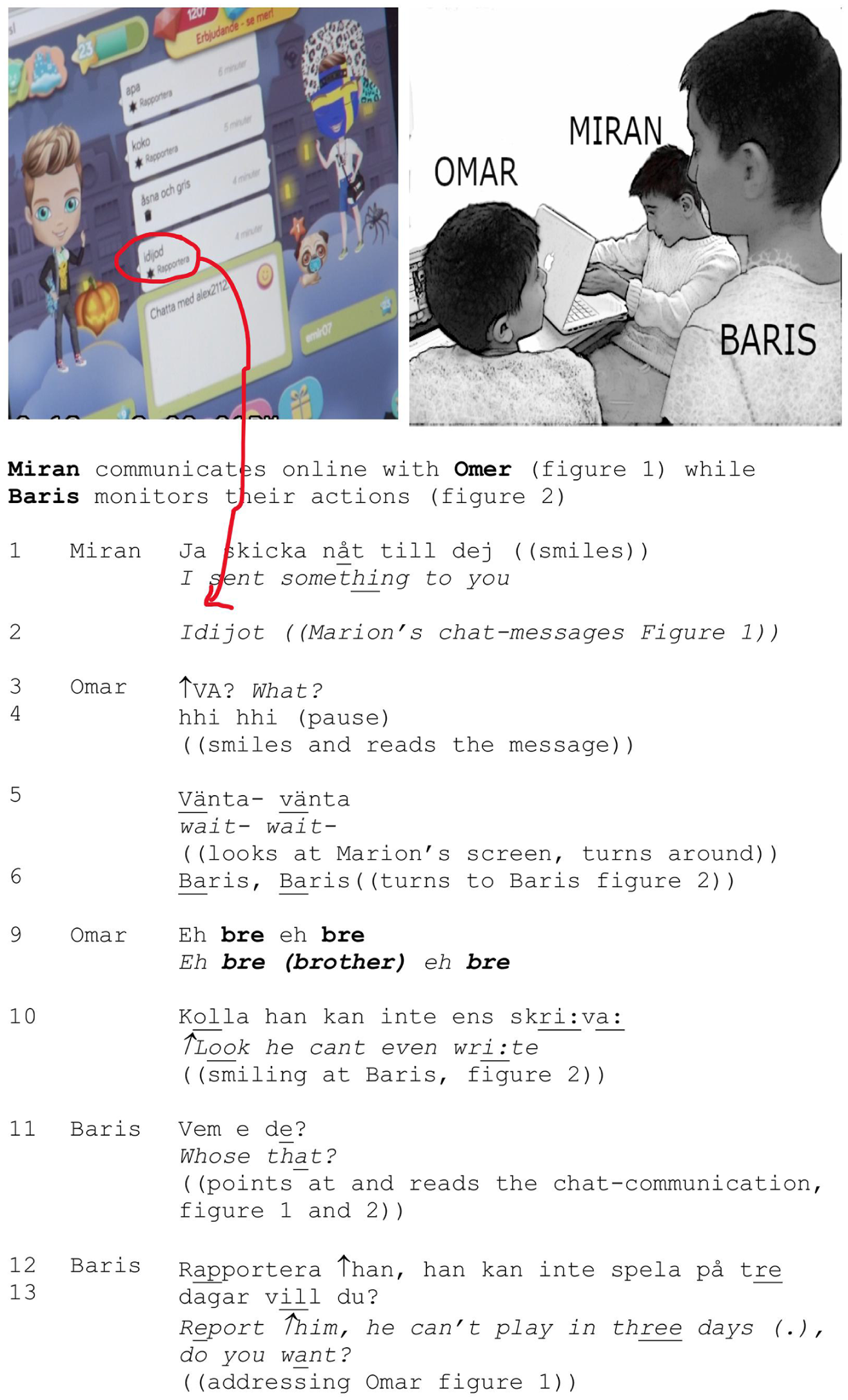
To start with Omar responds to the new chat-message, with a smile and joint laughter. He then reads the message, “Idijod” and reacts immediately by gazing around and calling the audience attention (Figure 1, line 10). The polylingual address term “eh
Stylized language corrections and language play
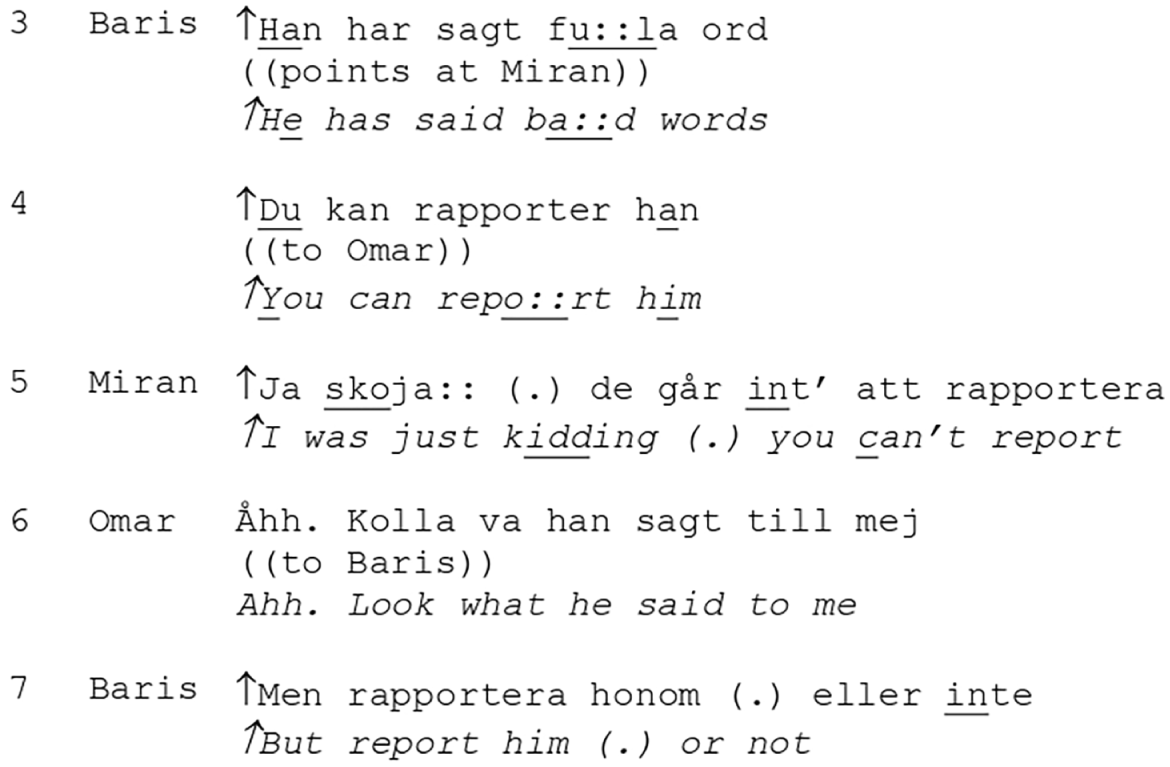
In the ensuing interaction (Excerpt 2b and c), the participation framework shifts into two against one as Baris aligns with Omar and upgrades his critical/evaluative stance of the linguistic format of Miran’s chat-messages: “↑He has said ba::d words” (line 3); “↑You can repo::rt him” (line 4). Baris now makes direct references to the format of Miran’ text-message, he thereby positions himself as guardian of the orthographic standard, but also of the norms on social media. However metalinguistic activities serve not only to police norms (in social media and school) for language use, but transform also the associations with the languages through using them in language play where the interaction is keyed as entertaining (cf. Anatoli and Cekaite, 2025; Cekaite and Evaldsson, 2019; Nasi, 2025).
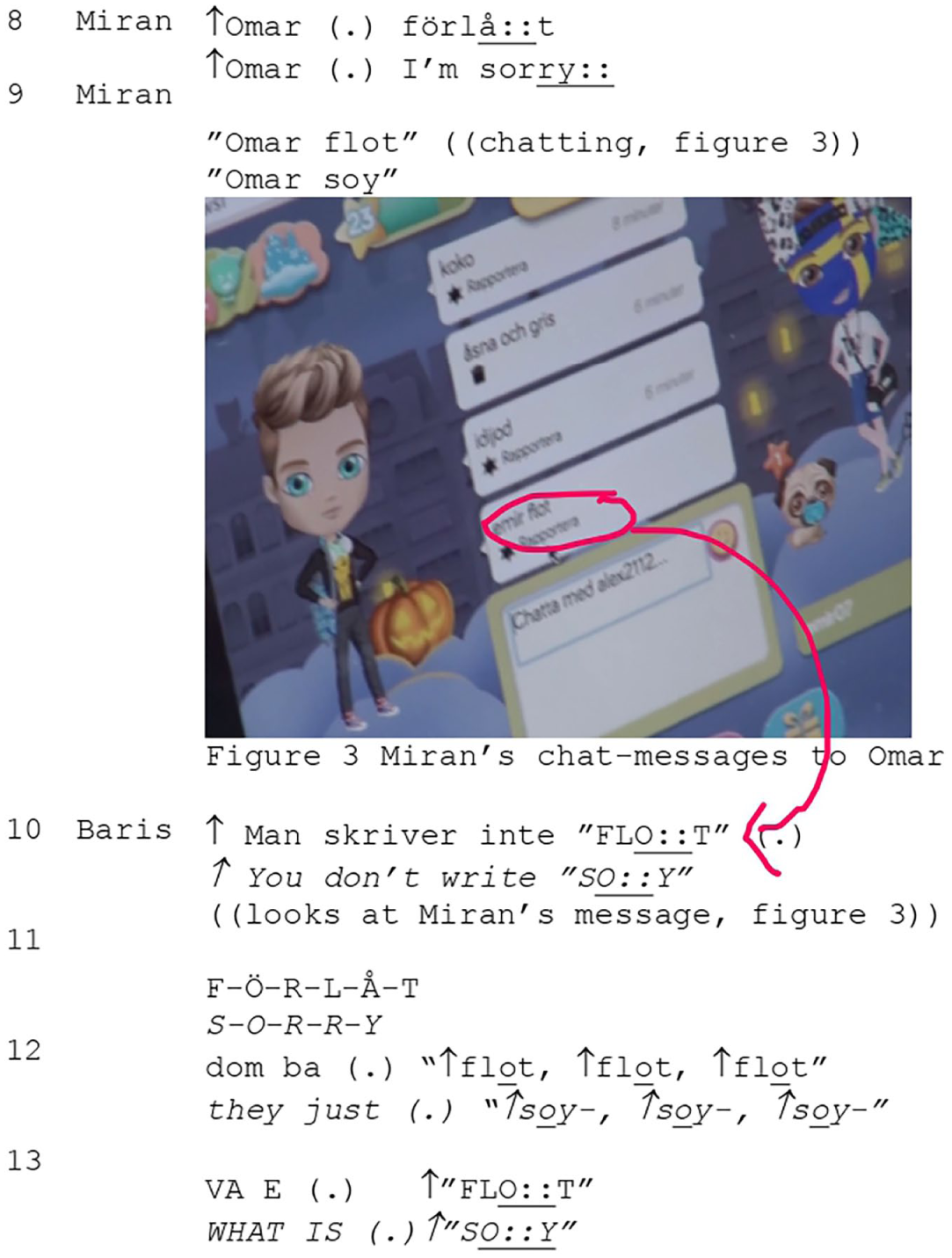
Baris’s threat of reporting Miran for using bad language is followed by an improvised verbal performance (lines 8 and 9) that shift modalities from an spoken apology, “Förlåt” (“Sorry”) (line 8) into a texted message “flot” (“soy”) (line 9) addressed to Omar. Miran’s textual apology indicates a metalinguistic competence and knowledge of that using bad language is against the rules of conduct and that being reported can limit his online use. However, Miran’s apology includes a typo that is immediately commented upon and corrected by Baris: “You don’t write ‘SOY’” (line 10) in a playful jokingly manner. In the ensuing interaction, the critical/corrective stance is keyed as entertaining in an interchange that positions Baris as an expert and invites his peers into a playful language lesson sequence.
Baris now engages in a stylized performance where he playfully comments on the textual format of the word “soy”, loudly exaggerating the correct spelling: “F-Ö-R-L-Å-T” (Eng. “S-O-R-R-Y”) (line 11). The incorrect spelling is now turned into a word play – “they just (.) “↑ soy-, ↑ soy-, ↑ soy-”” (line 12) – repeating structural elements and using parodic imitations (Cekaite and Aronsson, 2005, see also Nasi, 2025). The language-play includes a form of double voice discourse (or parody) in a Bakhtinian sense (1981: 324), where the repetition of another’s voice, here Miran’s spelling of “sorry,” is treated as linguistically incorrect and turned into an artful performance. The exaggerated pronunciation of “soy” is combined with sound play using pitch, volume, and voice, to intensify the linguistic incongruities to provide the talk with greater interest (Cekaite and Evaldsson, 2019). The playful stylization reaches a climax as Baris stages an affectively charged metapragmatic commentary in the form of a rhetorical question “what is (.) SO::Y” (line 13) (cf. Nasi, 2025). Baris questions not only Miran’s linguistic competence in spelling but also his understanding of Swedish idiom as a socially valued monolingual standard register. Through such stylized practices children display their sensitivity to the status of different language varieties while they form their own associations between standard language, and school authorities versus peer group status and power (Evaldsson and Cekaite, 2010: 601). Simultaneously, the language play provides resources for creating hierarchical relations and an entertaining performance where others’ lack of equivalent literacy competencies become played with.
Socializing norms for standard language use
In the last Excerpt 2c Baris further takes on the role of an authority using a teacher voice to display his social status, linguistic expertise, and power in the peer group. Baris now exploits his higher media literacy competence including knowledge of the norms of online conduct and writing skills in standardized language, in a playful “language lesson” (Cekaite and Aronsson, 2005: 169).
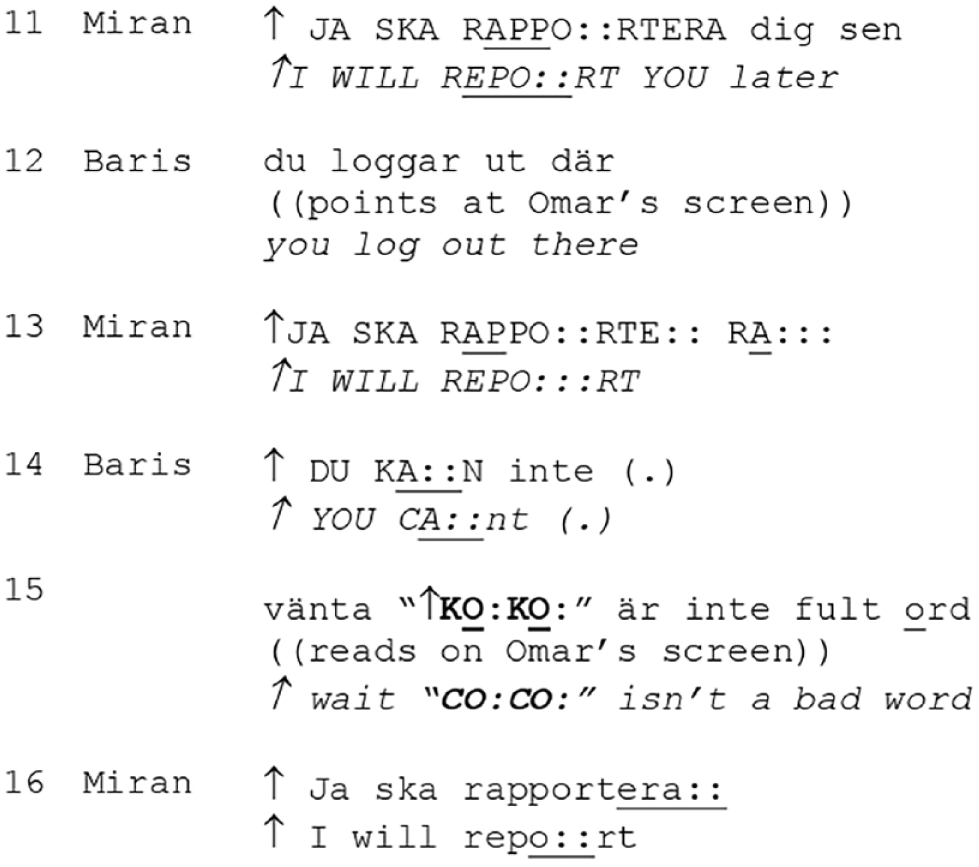
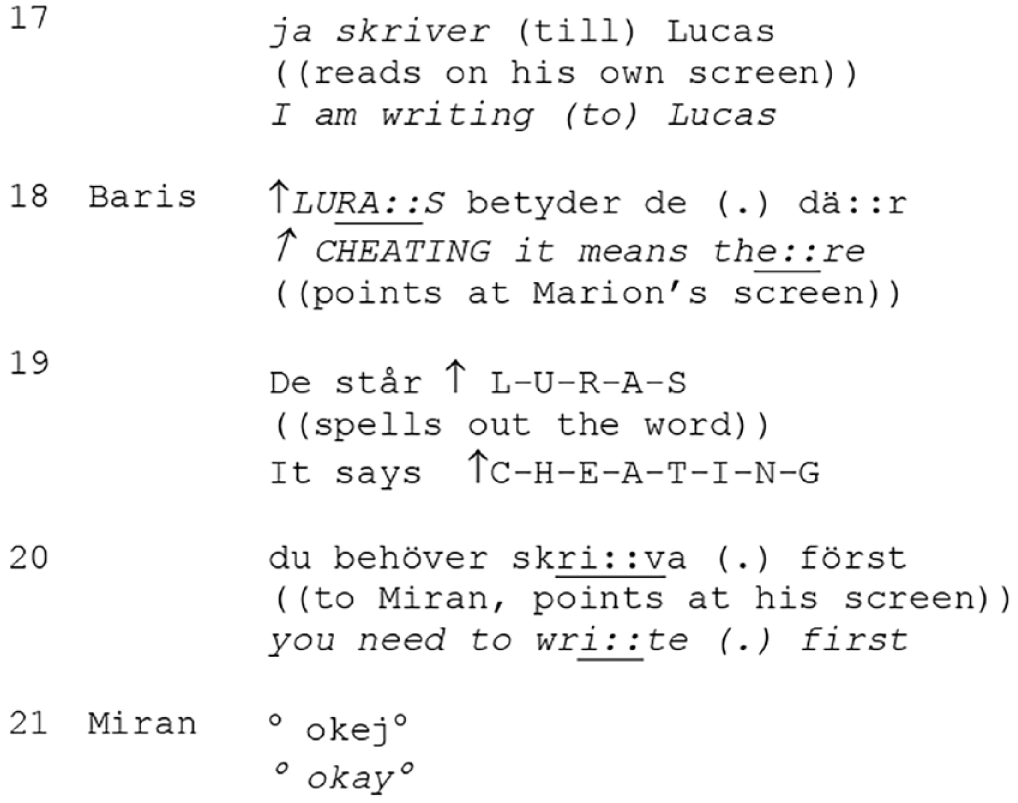
The excerpt starts with Miran recycling his threat three times to emphasize that he will report Omar for his use of bad language: ↑ I WILL REPO::RT (lines 11, 13, 16). In his response Baris questions the correctness of the reportable action: “↑CO:CO: isn’t a bad word” (line 15). The language correction indexes an epistemic and disaffiliative stance toward Miran, who is thereby cast as an inexperienced user. In response Miran tries to display his competence by figuring out how to report misconduct online: “↑I will repo::rt you:: I am writing (to) Lucas.” He here refers to that he will report the bad language to Lucas, the avatar that act as a safeguard on Momio. However, Miran makes a grammatical error, saying “writing Lucas” instead of “writing to Lucas.” The language error is immediately commented upon by Baris who interpret the name “lucas” is as a misreading of “luras” (Eng. “cheating”) (line 18), which is a reportable action online. In a series of corrective practices Baris orients Miran to the language format of the correct word “cheating” (“luras”) and to its’ meaning, “Cheating it means there (.) it says ↑C-H-E-A-T-I-N-G (line 19).” In a playful manner he repeats and spells out the word in a loud voice, paying close attention to the correct spelling and the language format as such. In a final step Baris instructs his peer in how to correctly report a reportable action online: “You need to wri::te first” (line 20).
The improvised other-directed language corrections signal a serious keying and trigger a peer-run language instruction (Cekaite and Aronsson, 2005). Such corrective practices also maintain regimented domain-language patterning, which strengthen Baris’ authority as a guardian of linguistic correctness but also as an expert on reportable online actions. Simultaneously, the improvised corrective practices generate important learning opportunities for peers, who do not have similar expertise in social media or the required literacy skills.
Concluding discussion
The findings highlight the heteroglossia and multivoicedness of the multilingual boys’ chat-communication and their language creativity. Applying Bakhtin’s (1981, 1986) heteroglossic approach demonstrates how an individual boy’s peer engagement with social media, as realized in (i) his chat-communication and (ii) co-present interaction with peers, is subject to improvised performances displayed through a hybrid variety of of spoken and written communication, characterized by a plurality of norms, styles, and social identities (Blommaert, 2010).
The local processes of performing heteroglossia are particularly visible in Baris’s appropriation of non-standard orthographic conventions in his chat-messages (Excerpt 1a–d). In socializing with friends online, Baris strategically and rather freely plays with and appropriates a hybrid linguistic variety of textspeak including texted abbreviations, emojis, typos, etc. drawing on the affordances from social media (cf. Blommaert and Velghe, 2014). The heteroglossic style of textspeak is blended with sociolinguistic features from an urban language style (cf. Nørreby and Møller, 2015). In socializing online Baris and his peers appropriate and reuses semiotic resources both from social media and their multilingual experiences while they create new innovative styles and hybrid cultural identities. The social media environment provides also a context for the children to transgress norms for orthographic standards, linguistic correctness and boundaries between language varieties, styles, and registers, for negotiating social relationships, status, and issues of belonging.
A linguistically innovative space for (re)constructing and transgressing ethnic and linguistic boundaries while creating new norms for writing in online spaces has so far been mainly associated with adolescents’ social media practices (cf. Androutsopoulos, 2021; Stæhr, 2024). This study also adds to prior research by showing how children are also sensitive to social regulations and norms in online spaces and that they do not treat linguistic standard norms for correct and proper language use as irrelevant in their everyday life. The analyses highlight the importance of looking at both children’s chat communications and their peer interactions around the screen. By combining ethnographic data from multilingual children’s digitally mediated communication and their interactions around the screen, I was able to show how children develop and playfully exploit hybrid varieties of speaking and writing in socializing with peers. It was found that the same boy had developed an hybrid non-standard style of textspeak in his chat-communication (Excerpt 1a–d), but that he around the screen frequently policed and corrected his peers for not mastering or understanding Swedish idiom (Excerpt 2b, “What’s SO::Y”). The more the peers’ writing style online was keyed as incorrect, the more they became vulnerable to playful evaluations and stylized teacher talk. In policing the linguistic format of his peers’ chat-communication, Baris predominantly oriented to monolingual (standard) orthographic conventions for linguistic correctness. In so doing he displayed his expertise and peer group status, while creating distinctions between group-members based on their access to the orthographic standard (Excerpt 2a–c). The findings demonstrate the evaluative potentials of creative language (Maybin and Swann, 2007: 502) and how heteroglossia and language creativity (including artfulness, stylized performances, double-voicing and language play) is a key component in children’s emergent performativity and peer group sociality (cf. Anatoli and Cekaite, 2025; Kyratzis, 2025; Nasi, 2025), but also in their critique of others’ linguistic competencies.
The findings show how Bakhtin’s perspective on heteroglossia and language creativity allows for a focus on multilingual children’s agency in socializing one another into local forms of heteroglossic practices involving playful innovative linguistic repertoires and hybrid cultural identities associated with divergent norms and voices of authorities (peers, teachers, parents, social media, etc). In this sense, situating research in the context of heteroglossia and social media shows multilingual children’s creative ability to navigate normative tensions between monolingual standard forms (centripetal forces) and diverse language forms, identities and social relationships that move away from the standard (centrifugal forces), as they negotiate their belonging as members of a transcultural peer culture.
Footnotes
Appendix
Transcription conventions adapted from Jefferson (2004).
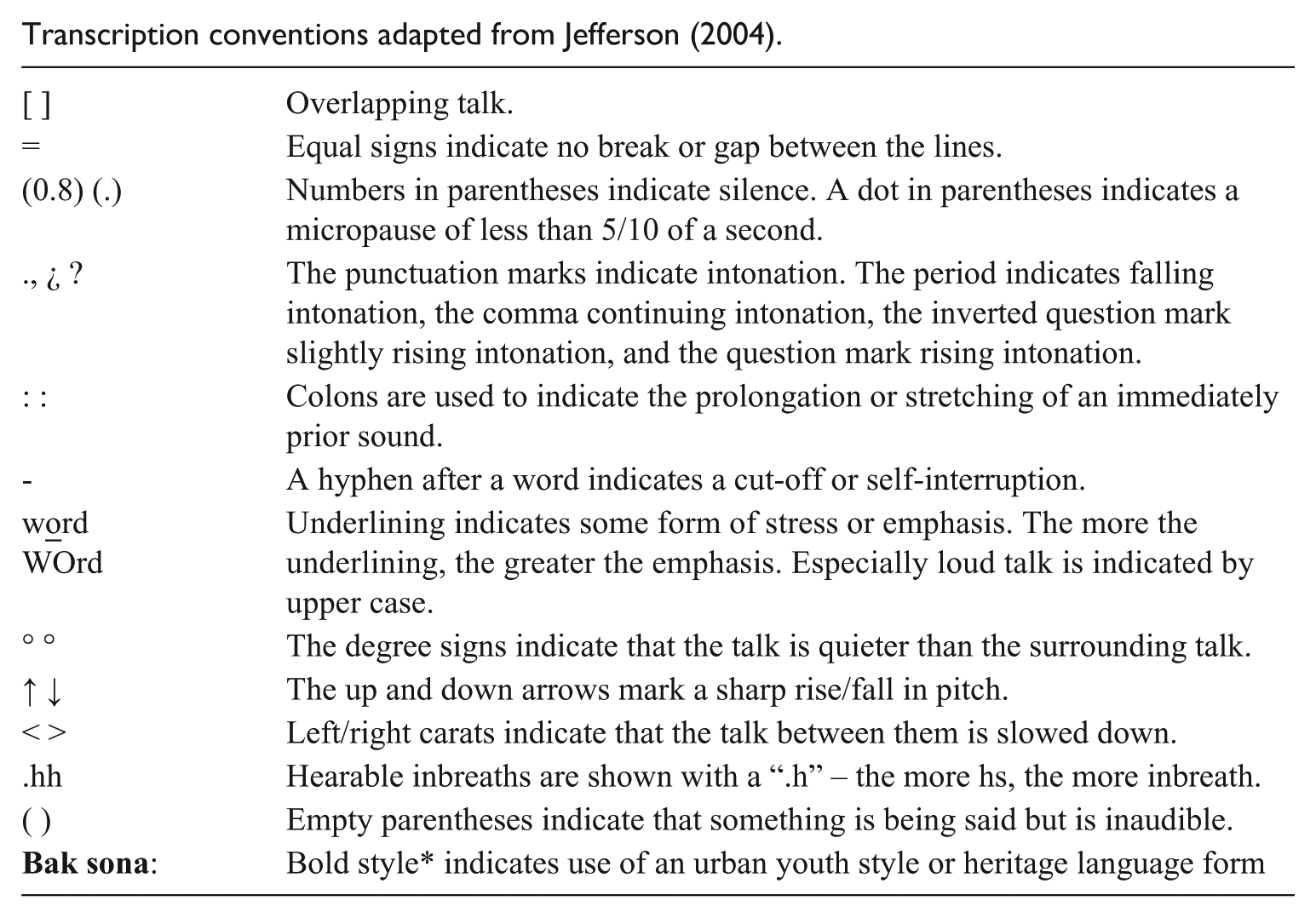
| [ ] | Overlapping talk. |
| = | Equal signs indicate no break or gap between the lines. |
| (0.8) (.) | Numbers in parentheses indicate silence. A dot in parentheses indicates a micropause of less than 5/10 of a second. |
| ., ¿ ? | The punctuation marks indicate intonation. The period indicates falling intonation, the comma continuing intonation, the inverted question mark slightly rising intonation, and the question mark rising intonation. |
| : : | Colons are used to indicate the prolongation or stretching of an immediately prior sound. |
| - | A hyphen after a word indicates a cut-off or self-interruption. |
| w WOrd |
Underlining indicates some form of stress or emphasis. The more the underlining, the greater the emphasis. Especially loud talk is indicated by upper case. |
| ° ° | The degree signs indicate that the talk is quieter than the surrounding talk. |
| ↑ ↓ | The up and down arrows mark a sharp rise/fall in pitch. |
| < > | Left/right carats indicate that the talk between them is slowed down. |
Acknowledgements
I would like to express our appreciation to the research participants and the anonymous reviewers for providing constructive feedback and suggestions for improving the paper.

Ethical considerations
The study has received ethical approval from the Swedish Ethical Review Authority (Dnr 2015/113).
Consent to participate
Written consent forms were collected from participants and children’s guardians. Children and teachers were informed about the research process and their right to exit participation. During the fieldwork, the recording was stopped whenever the children or teachers displayed unwillingness to be recorded.
Consent for publication
Consent for publication was obtained within the consent for participation. The data are anonymized. All names are pseudonyms. Line drawings are used to preserve the participants’ confidentiality.
Funding
The author disclosed receipt of the following financial support for the research, authorship, and/or publication of this article: The study is part of a larger project on “Talking and texting in the move: exploring children’s media literacy practices in peer groups,” that received funding from Marcus and Amalia Wallenberg Foundation (MAW, 2014:0057).
Declaration of conflicting interests
The author declared no potential conflicts of interest with respect to the research, authorship, and/or publication of this article.
Data availability statement
All data are confidential and cannot be shared.