




Abstract
Repetition has often been argued to be a semiotic device that iconically signifies ‘more content’, such as intensity and plurality. However, through multimodal interaction analysis of materials in English, Estonian, and Swedish, this paper demonstrates how self-repetition is used to coordinate actions across participants and temporally organize the ongoing activity. The data are taken from infant mealtimes, pilates classes, dance training, boardgames, rock climbing, and opera rehearsals. Repetition of both lexical and non-lexical tokens can prolong, postpone, and generally organize segments of action as well as co-create rhythms and moves in a moment-by-moment reflexive relationship with other (non-vocalizing) participants. A crucial feature of repetitions is that they can be flexibly extended to fit the other’s public performance, its launching, continuation, and projectable completion. We argue that the iconicity of repetition emerges through its indexical relationship to other bodies, as a real-time jointly achieved phenomenon.
Keywords
Introduction
Self-repetition has typically been treated as a semiotic tool that iconically denotes meanings of extension or continuation, such as man behöver öva öva öva ‘you need to practice practice practice’ in Swedish (Lindström, 1999: 24) or zhdala zhdala ’waited and waited’ in Russian (Israeli, 1997: 591), both expressing extended actions. In linguistic research, repetition has often been argued to be a grammatical and semiotic device that signifies ‘more content’, such as intensity and plurality (Haiman, 1980; Lakoff and Johnson, 1980). In this paper, we offer an alternative stance on repetition: rather than determining only semantics, we demonstrate how repetition’s meaning emerges through joint action between speakers as part of the unfolding interaction. Using data from real-life settings, we show that repetition is deployed to arrange movements in space or manage the timing of actions, such as delaying the next piece of talk, urging someone to keep going with their current action (as also shown by Mondada (2017) & Simone and Galatolo (2021)), or stopping it. Lexical as well as non-lexical items can be repeated to achieve these effects and we scrutinize examples of both to highlight the role of repetition specifically, regardless of the often-posed analytic boundary between language and non-language. By restricting ourselves to a formally defined pattern of repetition and studying it across activities, we are building on the linguistic tradition of departing from clearly specified forms, but we aim to show that repetition is a participants’ resource to achieve specific temporal tasks in social interaction and thus emerges as an epiphenomenon of solving interactional needs.
In this paper, we target the kind of repetition where the same speaker repeatedly and consecutively utters a phonologically and semantically (near-)identical item that may feature differences in phonetic and prosodic realization. For example, lip-smacks can vary with regard to loudness and how ‘squelchy’ they are, and a word such as kaugusesse ‘into the distance’ may be uttered with different pitch movements while encouraging the same (repeated) physical action. The operationalization of sameness in actual vocal behavior is not necessarily straightforward, as the situation evolves moment-by-moment and participants orient differently to, for example, beginning an exercise versus approaching completion during an instructor’s repetitive talk. The term repetition, therefore, does not imply an exact copy of the sound item, but rather the recurrence of a recognizably and accountably similar form by the same speaker within a short time period.
Here is an example of what this may look like, during an infant mealtime (excerpt 1; see Wiggins and Keevallik, 2021). Although the parent is not themself currently eating, they utter a chain of rhythmical lip-smacks while the infant has food in their mouth. The two are in a close physical formation gazing at each other (Figure 1).
(1) Infant eating (English)
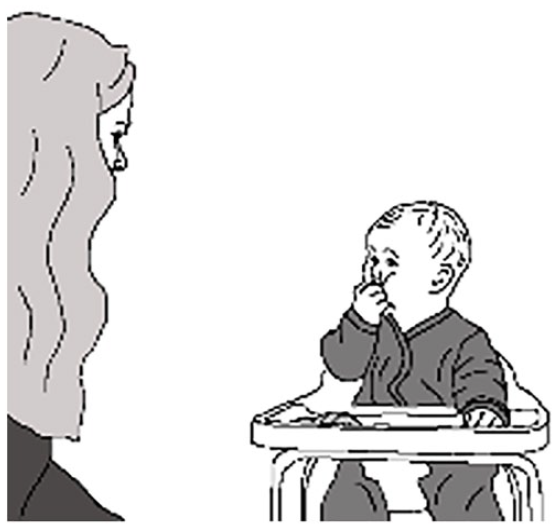
The repetition of parental lip-smacks, echoing a sequence of the infant’s repetitive jaw movements associated with mastication, comes to an end when the infant also opens their lips and produces a responsive lip-smack. As an instance in which one person sounds on behalf of another (Keevallik et al., 2023), this amounts to a joint accomplishment of eating moves in which the parent is finely tuned to the infant’s body as they jointly negotiate the length of the engagement with food. Crucially, all the cases of repetition in our collection managed interactional time in one way or another, either by achieving repeated moves, encouraging extension of an ongoing move, managing conversational delay, or achieving a goal in real time. We will proceed to illustrate these patterns after we have presented the state of the art in repetition research and our database.
Repetition in linguistics and interaction research
Different terms have been employed to describe slightly different processes of repeating linguistic material. Repetition is an all-encompassing term that includes every type of repetition in language, including when people repeat each other’s words and utterances. Accordingly, research on repetition has dealt with diverse phenomena ranging from textual cohesion (Halliday and Hasan, 1976) to repair initiation in next turn (Curl et al., 2006). Reduplication is a slightly more specific linguistic term that implies that a single token, such as a morpheme or word, is produced under the same intonation contour, and often merely twice (Israeli, 1997; Keevallik, 2010). The overall functions of repetition have been discussed extensively across the domain of linguistics. Structural approaches have studied repetition as a semiotic device (Brown, 1999) and in isolation from situational features, such as in the repetition of the Italian word neri ‘black’ in neri neri meaning a more intense black color (Wierzbicka, 1986: 288). Several studies have argued that repetition and reduplication are iconic in nature, where more form signifies more content, such as plurality, distributivity, or intensification (Haiman, 1980: 530; Lakoff and Johnson, 1980; Mattes, 2018) or duration (Akita and Dingemanse, 2019: 8), also in French sign language (Kuhn and Valentina, 2017). In documenting universal features of reduplication, Moravcsik (1978: 317) noted that reduplication recurrently denotes emphasis and increased quantity. Similarly, it has been shown to express quantity, intensification, and duration in Estonian and Finnish (Erelt, 2008; Erelt and Punttila, 1999). Studying Afrikaans, Botha (1988: 97, 115–117) argued that there is an abstract unit of semantic content labeled ‘increased’ in reduplicative units, which may reflect emphasis as well as intensity. In an account on reduplication in Hindi, Abbi (1980) likewise documents intensification. There has thus been a general cross-linguistic agreement that reduplication reflects increased duration, intensity, frequency, emphasis, or quantity (though this standpoint has been nuanced, as repetition can also work as a diminutive; e.g., Kiyomi, 1995).
Linguistic analyses of reduplication and repetition mostly target their semantics as an isolated structure separate from the context of the sentence and only a few studies have considered it from a pragmatic viewpoint. Israeli (1997: 607) argues that Russian reduplication requests or promises a higher degree of cooperation, and Lindström (1999: 59, 64–65) shows how Swedish reduplication displays increased social engagement. These are social functions that go beyond abstract iconicity. In this paper, we will target the repetition of individual tokens (thus comparable to patterns of reduplication). We exclude multi-word structures to avoid excessive formal (and potentially pragmatic) variation and to provide an adequate foundation for comparison with non-lexical vocalizations. This limitation allows us to highlight the effects of repetition without involving conventionalized word semantics.
Discourse-based studies have analyzed repetition in a broad sense in everyday conversation, where a distinction has arisen between self-repetition and other-repetition (allo-repetition), and a temporal scale that ranges from immediate to delayed repetition (Tannen, 1987, 1989). Repetition of lexical, phrasal, and clausal units have been shown to broadly serve functions such as: gearing up to answer; persuasion; stalling; getting or keeping the floor; showing listenership; savoring and showing appreciation of a good line or a good joke; or ratifying another’s contributions (Tannen, 1987: 61). Brown and Levinson (1987) furthermore argued that other-repetition is deployed to accomplish politeness by stressing emotional agreement. All the above witnesses the plurality of formal and functional accounts of repetition, and suggests that a narrower focus, such as merely targeting same-turn single item repetition, is warranted for a more precise understanding of its different uses.
Conversation analytic (CA) research has dug deeper into the particular social actions that can be accomplished by same-turn self-repetition of various materials, and how it features in various praxeological contexts. Self-repair may entail a repetition of a word, but these words are never entirely contiguous (see e.g., Schegloff et al., 1977: 376). Word repetitions in responsive turns in everyday talk-in-interaction have been described by Stivers (2004) as ‘multiple sayings’. These include repetitions produced as a single turn-constructional unit and under a single intonation contour, which are treated as performing a single action. Such repetitions function to propose the course of action to be halted or alternatively, to initiate third-position repair. These findings are extended by Keevallik (2010), who studies ‘syntactic reduplication’ as one form of self-repetition, which functions to urge someone to do the nominated action, challenge a prior action, reinforce an answer to a polar question, or assert rights to a claim produced by another speaker. In addition, the actions accomplished by repeated lexical items, such as a no no in English (Goodwin, 1995) or jaja ‘yes yes’ in German (Golato and Fagyal, 2008) have been shown to depend on distinctions in prosodic production. We have thus some knowledge on how self-repetition of lexical and phrasal material features in sequences of conversational action. Repetitions of non-lexical vocalizations have, however, only received limited attention. Repeated clicks establish a rhythm that can display alignment when they are isochronic (Ogden, 2020) and repeated lip-smacks during infant mealtimes are parental tools for temporally achieving and maintaining mutual visual orientation (Wiggins and Keevallik, 2021). In short, the variety of formats considered for repetition in CA research has been broader than in linguistics. Adjacent research on repeated gestures has likewise underlined their cohesive function, emphasizing a theme (Hauser, 2019; McNeill, 1992), or differentiating between old and new segments (Streeck, 2008). We will therefore not presuppose an a priori distinction between lexical items and other vocalizations (see Dingemanse (2020) for an insightful discussion), and include analysis of embodied co-occurring events, in order to understand the workings of repetition more holistically.
Repetitions have been described most prominently in CA within directive and instructive actions, where they are embedded in courses of action. Here, they convey the urgency of the requested embodied action (Deppermann, 2018; Mondada, 2013, 2017, 2018) and guide the concurrently operating action (Keevallik, 2020; Mondada, 2017; Okada, 2018; Simone and Galatolo, 2021). Okada (2023) has shown how boxing coaches co-construct critical moves and jointly experience the opponent’s punches by fitting repeated tokens with the boxer’s body positioning and tactile opportunities. The prosodically marked repetitions serve, among other things, to encourage repeated action. Repetitions also indicate incompleteness of, or non-compliance with, the requested action (Deppermann, 2018; Mondada, 2014, 2018; Okada, 2018). The latter function has also been described by Goodwin and Cekaite (2013) for next-turn repetitions (which they call ‘recycled directives’) in parent-child interaction. Similar actions, employed after an absence of, or inadequate, response have been called ‘response pursuits’ in institutional interaction, such as broadcast interviews (Romaniuk, 2013), citizen participation discussions (Sjögren, 2021), classroom interaction (Duran and Jacknick, 2020) and crisis negotiation (Sikveland, 2019). Upgraded response pursuits have been discussed by Hoey et al. (2021), where expletive insertion is used when the requested action has not been (adequately) responded to. In the non-instructive setting of playing videogames, repetitions have also been shown to have an encouraging rather than an instructive function (Baldauf-Quilliatre and de Carvajal, 2020; though see also Mondada, 2013). From these studies, it is clear that repetitive directives are designed to handle both verbal and embodied courses of action. In the current study, we focus on how progressivity of joint action is handled through vocal repetition in a range of human activities. We explore the affordances of self-repetition in interaction that centrally involves moving and sensing bodies, showing how repetition emerges indexically as an epiphenomenon of real-time interaction rather than denoting iconic meaning in the abstract.
Methods and data
The study deploys multimodal interaction analysis to reveal systematicity in participants’ behaviors and show how they orient to it as accountable. The method relies on video-recordings, which affords close examination of the mutual coordination of real-time practices, including both language and other embodied resources (Broth and Keevallik, 2020; Goodwin, 2018; Mondada, 2019). We document participants’ publicly available sense-making of each other’s behaviors, which reveals how they ongoingly organize interactional events.
To disclose the affordances of repetition with regard to time, the data for this study are taken from a variety of activities: infant mealtimes in the home, pilates classes, dance lessons, rock climbing, phone calls, board games, and opera rehearsals.
▪ The infant data comprise 77 mealtimes video-recorded in Scotland and Sweden (20 hours) in families with 6- to 9-month-old infants where the parents were all white and spoke English as their first language. They were given cameras to record meals with the infants and all of them gave consent for disguised images to be used in research publications.
▪ The pilates data consist of video-recordings of four classes in Estonian (4 hours). All class participants agreed to the recordings being used for research purposes, while the teacher consented to appear without anonymization in research output.
▪ The dance class data were recorded in Estonia and Sweden and comprise 38 hours of video-recordings. Three of the 17 teachers speak Estonian (9 hours), six Swedish (13 hours), and ten English (15 hours). All of them signed a consent form approving that the recordings will be used for research purposes; the students were informed orally and with written signs at the beginning of every class.
▪ The rock-climbing data was collected with adult non-professional climbers (some novices, some long experienced) in both indoor and outdoor climbing areas in North America (20.5 hours) and Sweden (1.5 hours). The participants were informed of the research, gave consent for their videos to be used in research, and had the opportunity to withdraw.
▪ The phone calls were recorded at homes and workplaces in Estonia and contained 11 hours of data, recorded with participants’ consent.
▪ The boardgame data come from two corpora; one corpus is comprised of hobbyist gamers recorded in Canada and the UK (26 hours), the other of adult students playing games as part of class activities (17 hours). Informed consent was discussed verbally (and written, for students) and players could withdraw at any time.
▪ The opera corpus consists of 20 hours of video recorded scenic rehearsals in English and Swedish, during which the ensemble decides on what the performers should do on stage to portray their characters. The participants gave informed consent to video-record for research purposes and for disguised images to appear in research publications.
From these materials in three languages, Estonian, Swedish, and English, we have opportunistically collected instances of a large variety repetitions within and across speaker turns, with the final collection focusing on the repetition of single lexical items and non-lexical vocalizations, to maintain formal coherence and comparability across the traditional boundaries of language. Examples of both will be presented in each analytical subsection. No functions were determined in advance, but we excluded depictive vocalizations that represented remote events, such as someone saying beep beep beep to represent a car horn in a narrative because we are targeting action in the here and now. At the same time, and unlike most linguistic accounts that typically consider doublets or triplets (Haiman, 1980, Lindström, 1999), we did not impose any limits regarding the number of repetitions.
Analysis: Repetition and embodied activities
One of the basic principles of human interaction is progressivity: participants’ orientations to producing next matters adjacently (Schegloff, 2007: 14-16). Repetition seems to work against this principle, as every repeated item defies producing a relevantly different next and thus withholds forward movement in, for example, conversation. Similarly, repetition seemingly defies Gricean maxims to only produce newly informative communication (Grice, 1975). However, as we will show, there are activities where extended engagement in a single (type of) action is the very goal of the activity, such as eating and strenuous physical exercise. Repetition incrementally encourages or makes relevant the continuation of an already-started activity or motion, thus accomplishing a different interaction order. We will demonstrate in multiple contexts that the repetition serves to produce the activity as not-yet-accomplished. This occurs even in contexts where the initiated activity is, in fact, a delay or an abandonment of a previous activity. Among other things, repetition is particularly useful in situations in which the ongoing activity or movement is one that may not have been otherwise continued, such as when training muscle strain. However, there are variations in how repetitions emerge as goal-oriented in concrete contexts: some repetitions appear to encourage, achieve, or display continued engagement in the same embodied activity (e.g., repeating an exercise, continuing to chew, extending a delay) while others urge participants toward accomplishing a task (i.e., achieving a goal, finishing, and thus changing the activity in some way). The distinction between these two pragmatic effects is performed through variable pacing, pausing, sound extension, and turn design. The number of iterations is an epiphenomenon of joint acting in the world.
To begin, we demonstrate how repetitions encourage continuation of an already-initiated activity, either through rhythmical repeats of a particular move, or by prosodic markers to extend the activity, and how this is intertwined with the concurrent bodily actions by others. We then move on to argue that even delays of the next relevant action and speeding up are accomplished through repetition, and finally, show how repetition is deployed to instruct temporalities for others’ bodies. A participant will repeat an item to accompany the ongoing activity (be it movement, delay, or activity transition), ratifying that the activity is occurring and can, should, or will continue, as well as helping to coordinate the participants and project when the activity will end.
Adding similar moves
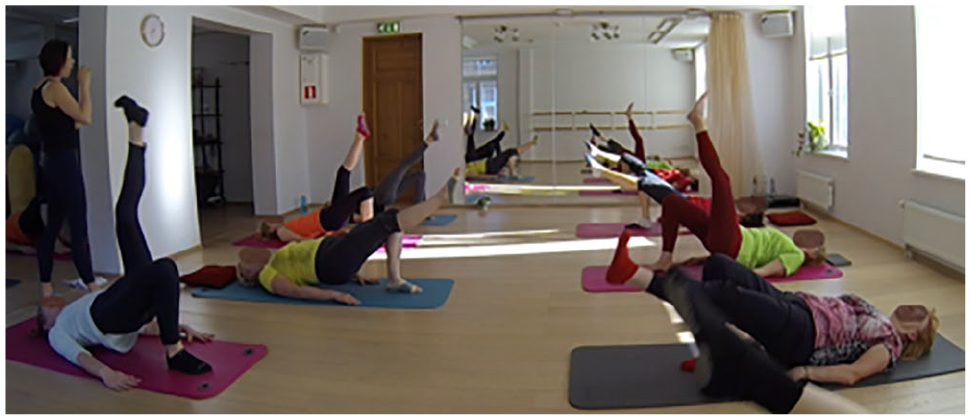
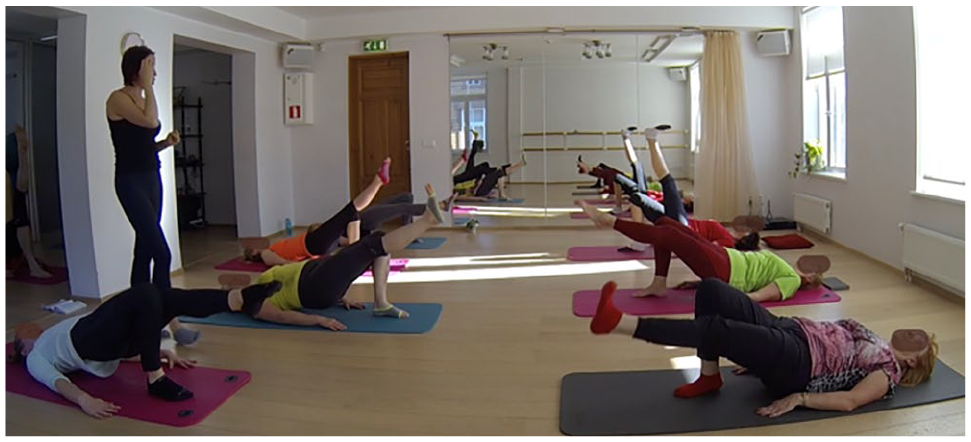
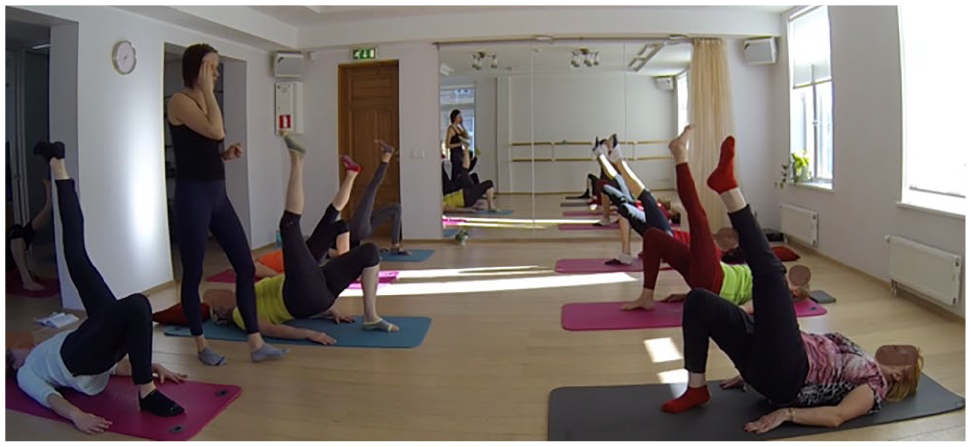
In various exercise classes, the instructor can repeat a word to accompany and reinforce a repetitive movement. For example, repetitive pilates exercises are accompanied by instructor repetitions of ‘formula’ words, established through semantically fuller first instructions (Keevallik, 2020). The repetition itself, however, achieves synchronization of the class activities, whereby both the instructor and the students orient to being together in the moves (Hofstetter and Keevallik, 2023). In excerpt (2), the instructor is rhythmically producing the word kaugusesse ‘into the distance’ every time the participants are supposed to lower their legs and bring them back up. Every iteration accompanies one move down and up, while the students are establishing their own timing with alignments at different syllables (Figure 2 shows a variety). Everybody in the video ends up doing at least three repetitions of the exercise with this leg, with the lowest and highest points increasingly coordinated across the class (Figures 3 and 4); the instructor’s voice jointly achieves the exercise with the students’ bodies, and they become increasingly synchronized.
(2) A stange 2, Pilates instruction (Estonian)
Similar repetitive use of lexicon has been described by Mondada (2014) in instructing a surgical assistant to successively coagulate the cut, and by Okada (2023) for a boxing student to accomplish consecutive punches. While their examples feature verbs and variable temporal relations to the instructed moves, our case shows a noun and its repetition rhythmically together with the others’ moving bodies in an activity where the repetition by itself is the goal of the activity (instead of, e.g., preparing the cut for surgery, or punching the opponent to win a round). Across these instances we can see how repetition of a lexical word (often an imperative) is occasioned by the joint activity, rather than referring to iteration in the abstract realm of symbolic signs. When one person participates with primarily lexical and vocal resources and others through body movements, they bring about action and accomplish its temporal organization together. The repeated items in pilates classes can be longer and consist of several words, such as inga sisse ‘breathe in’ and ja siruta ‘and stretch’, as the instructor establishes those ‘formula’ locally with every exercise (Keevallik, 2020). In this study, however, we target yet another group of vocal items that are deployed to achieve repeated moves, namely non-lexical vocalizations.
In a similar context where the movement trajectory has already been established, a dance teacher can utter identical syllables, such as qa:: qa:: qa::, to accompany and organize students’ practice. In excerpt (3) the couples learning a Lindy Hop routine are supposed to take three steps backward with longer holds that cover two beats each (Keevallik, 2021: 6–7). There is no music playing, just the teacher standing in the middle of the circle of students vocalizing in a manner where the extended vowels coincide with the holds, as shown in Figures 5 to 7. Thus, the vocalizations are not a straightforward replacement for music but rather tied to the dancing bodies (Keevallik, 2021). Beat numbers, as danced, are transcribed above the vocal production.
(3) Dance instruction (English)
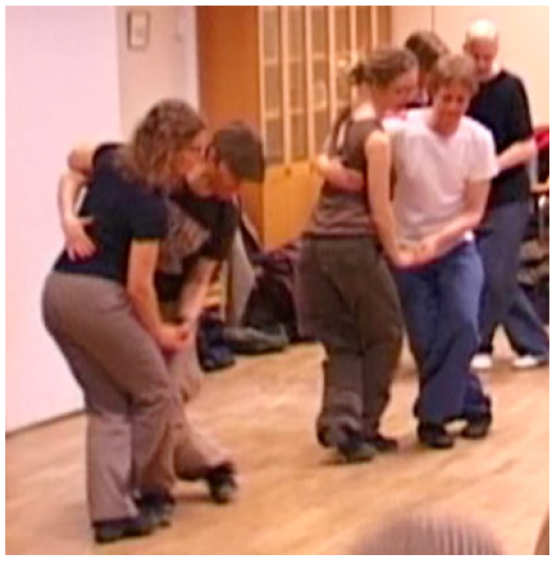
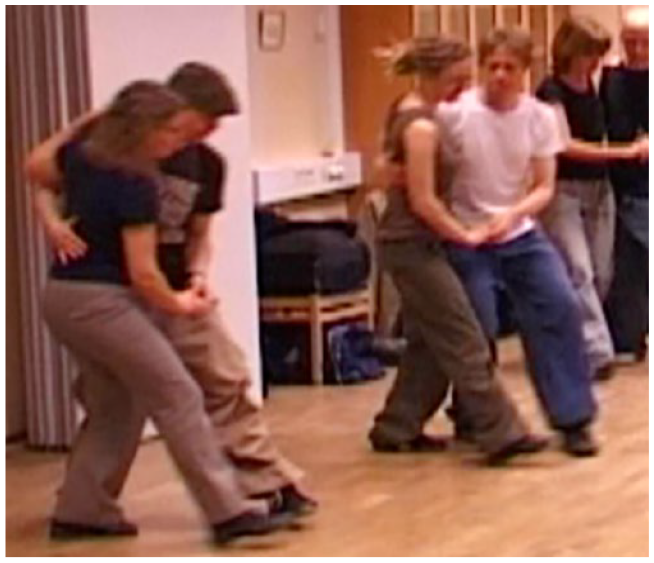
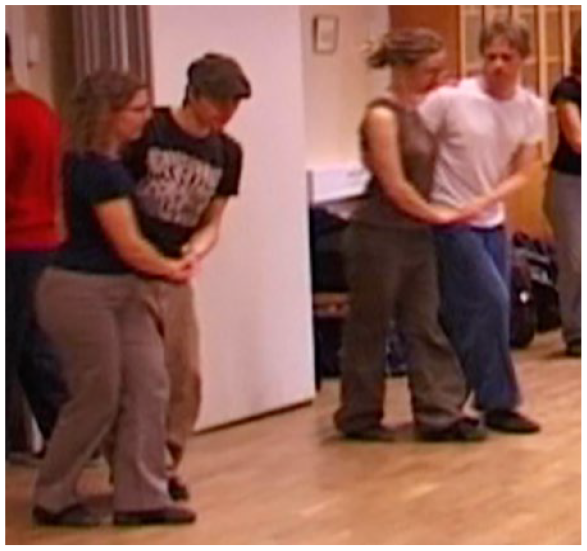
More so than in pilates training, where individuals do not have to coordinate exact trajectories with peers, dance students are supposed to perform steps on the beat, which is reflected in the minute synchronization of the vocalizations with the danced beats. Characteristically, these repetitions co-create the rhythms of the body; their length and prosodies are determined by the limitations of the exercising bodies, such as what tempo the students can handle (Lindy Hop music can then have a variety of tempos, from 120 to 180 beats per minute). When the quality of the movement changes, vocalizations can change too (such as at the end of line 1, where HEY coincides with a kick), effectively ending the repetition. What we have thus seen is that the production of repetition, its quality and precise tempo, are an outcome of the collaborative body-focused activity, partly determined by the students’ physical capacities. The items are produced with separate repetitive prosodic contours to mark and achieve adding moves of the same type to an already ongoing activity trajectory. Overall, the iconicity of verbal repetition emerges in immediate relation to repeated bodily events in the world.
Encouraging extension
Relatedly, in various kinds of training, repetitions are used for prolongation of an embodied activity, mostly to do with increasing exertion or extended holds, thus not repeated body movements. In excerpt (4), a lexical item, the imperative håll ‘hold’, is used to ‘incite’ (Reynolds, 2021) continued effort. A climber, Luca (LUC), is currently undertaking a difficult climbing route. It is bouldering, meaning he is low to the ground, and the onlookers are right behind him, ‘spotting’, or using their hands to ensure he will not hit anything dangerous if he falls. Their close position makes it easy to comment on the ongoing climb. At line 2, Luca has just successfully made one of the two hardest moves in the climb and must hold onto a small piece of rock while adjusting his feet to make the next move. The onlookers at first celebrate (lines 3–5) the successful grab and then quickly switch to further urging Luca not to lose his grip (line 6).
(4) SU Swedish Stallion 0.0.30; Rock climbing (Swedish)
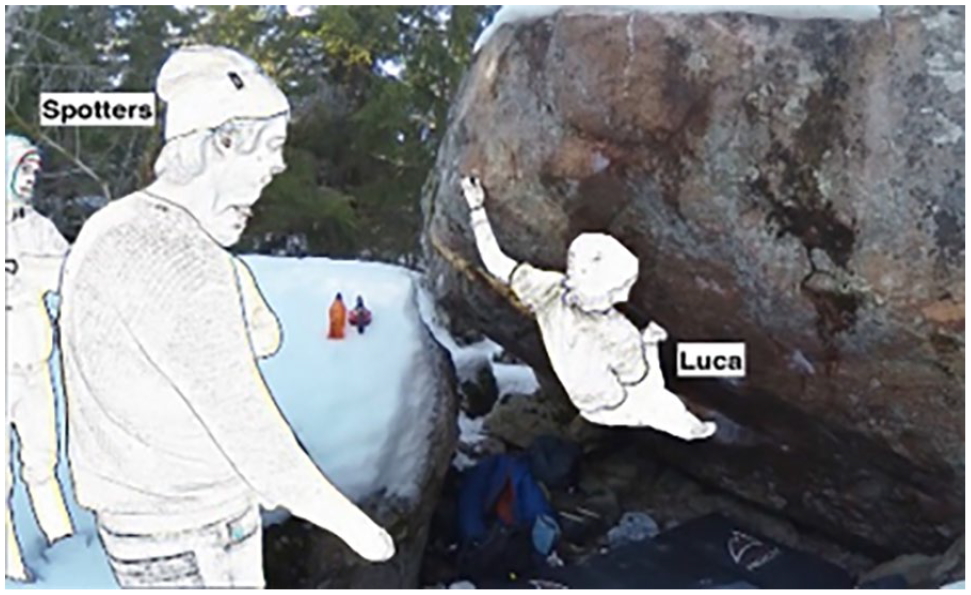
The incitements to continue holding the rock begin as Luca adjusts his position. In pulling himself toward the rock, it may appear that he is about to give up or fail, as he is readjusting his hands (Figure 8) which is often a precursor to trouble. Spotter 4 (SP4) at this point begins repeating håll ‘hold’ (line 6), and Spotter 2 (SP2) håll i ‘hold on’ (line 7), which continue until it is certain that Luca is not going to fall. The repeated incitements align temporally with Luca’s bodily changes, accompanying Luca’s hand hold until Luca begins to move onto the next rock (see the bodily preparation at the end of line 7). The extension of the hold is mirrored in the repetitions of the incitement. The reflexively emerging, simultaneous production of the utterance and the bodily adjustments makes it ambiguous as to whether one makes the other relevant (or vice versa), and thereby the participants treat the configuration of resources as both instructive (or, at least, encouraging) and responsive at the same time. The participants accomplish extending the hold together, with the resources they can each contribute. Repetition here both aligns the vocal contribution temporally with the bodily trajectory of the climber, as well as continually renews the relevance of the directive.
We saw a parallel example of encouraging, featuring non-lexical vocalizations, in excerpt (1) with an infant eating. In this context, the aim is to achieve eating as a social event, as well as, preferably, its continuation. In excerpt (5, extended from 1), while watching the Infant who has food in their mouth, Mum utters strings of lip-smacks on lines 3 and 12, both produced with coherent prosodic contours. The infant produces their lip-smacks intermittently and at a different tempo (lines 2, 9, 11).
(5) Infant_Reilly009 (English)
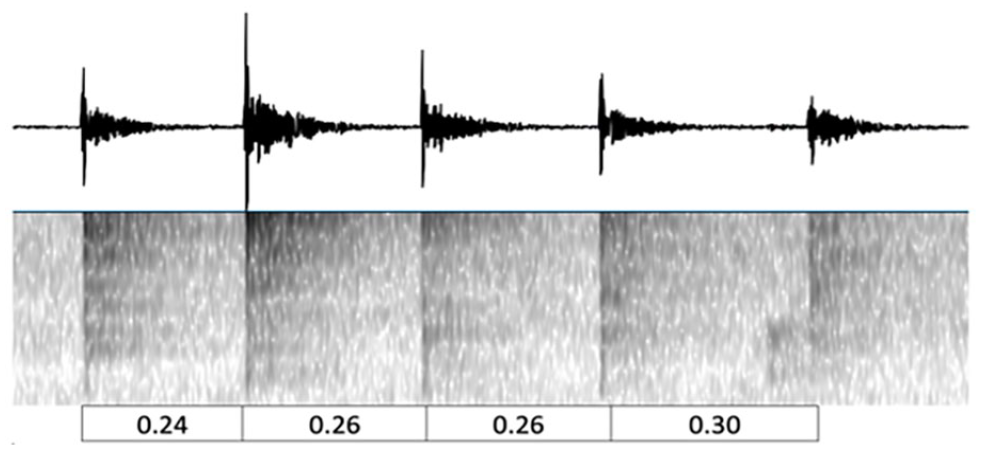
Mum’s use of repeated non-lexical vocalizations here enables her not only to engage in the Infant’s eating practices, but also to encourage the mouth movements of the Infant to continue (Wiggins and Keevallik, 2021). The repeated vocalizations are deployed in the service of co-constructing the eating event as a shared occasion, in which Mum’s actions are as relevant as the Infant’s. The tempo of lip-smack chains is highly adjustable to the ongoing activity, occasionally even tied to the emerging jaw movements or sounds by the infants. The infant chews and lip-smacks at a slow pace (line 2), and in her response Mum gradually slows her own pace of lip-smacking (line 3, intervals in milliseconds) until her final lip-smack ends in synchrony with the infant’s mouth opening and a lip-smack (line 4). Mum then reacts with a statement about her being able to hear the eating, thus the success of the event. On the one hand, Mum joins in the Infant’s chewing movements, as much encouraging as instructing their continuation, iconically representing extension through increased form (e.g., Haiman, 1980). The extension-encouraging repetitions in excerpts 4 and 5 are furthermore characterized by coherent prosodic production rather than repetitive contours, as in excerpts 2 and 3, that featured repetitive moves. Crucially, however, even this repetition garners its meaning in the here-and-now context of climbing or eating activity, and the relevance of continuing a specific hold or motion at this very moment. It manages someone else’s embodied events in real time. Likewise, in all the above cases the person uttering words or vocalizations tunes in to the other’s embodied concerns, such as the Infant moving their jaw, the students moving their bodies in the established tempo of an exercise, and the climber struggling to hold on. The number of repetitions is in reflexive relationship to those concerns.
Extending delay
Another way that participants use repetition to extend activities is to manage the timing of delay in the progressivity of, for example, a conversational turn. As with earlier cases, the number and style of repetitions is anchored in the actual passing of time. In this situation, participants are not repeating movements or extending activities, but putting co-participants on hold for some projected trajectory, before the next due item (even though they might then attend to a side activity). Producing vocal material during delays demonstrates that the participant is aware of the relevance of a next action, and forecasts that one is forthcoming, while also mitigating the possibility that the delay is treated as an indication of dispreference or sequence abandonment. A case of quite extensive delay in a phone-call conversation is presented in excerpt (6). In line 1 Pille (PIL) suggests that Teivo (TEI), who studies art, would paint her. A long pause (1.5 seconds) follows and Pille continues the pursuit with nõus? ‘agreed?’ in line 3. Instead of producing a response, Teivo launches a statement in line 5 (ot fakt on ot ‘the thing is’, the ot being a shorter version of ‘wait’, (Keevallik, 2003: 130)). He then utters three more tokens of oota ‘wait’ with separate tone contours, with pauses between them, and then an account of why he is postponing the next due item (ma mõtlen ‘I’m thinking’).
(6) P3B1; phone call (Estonian)
After several restarts in line and a realization token (aa), Teivo finally recaptures the abandoned statement, claiming to never have used any models in his paintings. This is a disaligning response to Pille’s suggestion for her to be painted. It was postponed, among other things, by Teivo’s repeating the pleas for Pille to wait. The word repetition here serves to index the ongoing delay, marking the passing of time while the co-participant is assigned to the position of waiting and withholding speech. The repetitions are produced with pauses in between, with the resulting rhythm further accomplishing a delay, in comparison with surrounding talk that flows at a regular speech rhythm without pauses.
Embodied delays can also be achieved by repeating non-lexical vocalizations. One activity that regularly requires that co-participants wait for opportunities to act is in board games. When players take their turn to play, at times they choose to ‘think’ further about their options, sometimes for many minutes, and other players must wait until they have completed their game turn. The thinking players engage in displays to demonstrate their active efforts toward progress (Hofstetter, 2020). This can take the shape of a variety of turn designs, including singing (see also Stevanovic, 2013), requests to hold off action, ‘thinking out loud’, and non-lexical tokens. Excerpt (7) demonstrates one design for displaying this ‘thinking’ process, that is, for indicating to co-participants that there is a delay occurring, and it is being extended. Here a player is singing a tune with non-lexical hum tokens (line 2, Figure 9) while looking at the game board and deciding on their move.
(7) Board game (English)
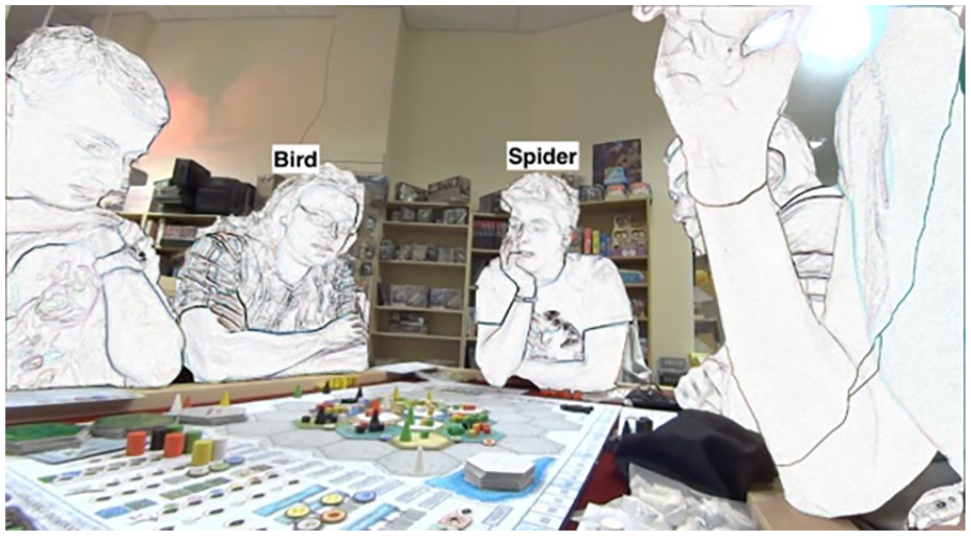
Spider (SP) begins marking a delay with uhm, typically used as a turn-holding device (Goodwin and Goodwin, 1986), but such a token also suggests that the conclusion of a current delay will be imminently forthcoming (Schegloff, 2010). Spider then switches to a sing-song production of hm, which lacks this relevance for an imminent end to the delay. As the tune is not a specific known melody (as far as either the participants orient to or the researchers can hear), and as the hms are repeatable and extendable without needing to adhere to word conventions, Spider is relatively free to extend the vocalizations as they choose. The tokens help to fill some of the delay silence and thereby indicate Spider’s attention to the game turn, as well as project that there is not an imminent solution to Spider’s turn occurring. It thus also accounts for the long pause that ensues.
In this section, we have shown how temporal coordination is achieved, among other things, through publicly marked delay segments containing repetitive words or non-lexical vocalizations. Extended sounds and sound stretches are often combined with repetitive items and pauses when doing the work of indicating prolongation of the (ostensible thinking) activity. The number of iterations does not express ‘muchness’ in the abstract (indeed, this section has shown an extension of absence) but achieves a concrete hold in real time, thus being an epiphenomenon of the interactional need to account for why the next relevant action is not yet forthcoming.
Reaching a goal in real time
As noticed in earlier interactional studies, repetition can be an instructor’s device of guiding toward a specific goal, such as reaching handholds in a climb (Simone and Galatolo, 2020, 2021), adequately zooming the camera (Mondada, 2014), following instructions at a driving class (Deppermann, 2018: 276–280), and ‘inciting’ athletes (Reynolds, 2021). These are all yet another way of managing the temporality of embodied action by others. While Stivers (2004) argued that repetitions may indicate that sequences of verbal action have been sufficiently pursued, in embodied activity contexts, the stakes are quite different. Excerpt (8) comes from an opera rehearsal and shows how repetition is part of the substantial interactional work it takes to stop an ongoing performance. In the excerpt, a baritone (BAR) and soprano (SOP) are performing a scene on the floor accompanied by piano (PIA). The director (DIR) and assistant director (ASD) are seated as spectators (Löfgren, 2023). The director attempts to stop the performance from line 4 with a tack ‘thank you’. Song is indicated in the transcript using ♪.
(8) Opera rehearsal (Swedish)
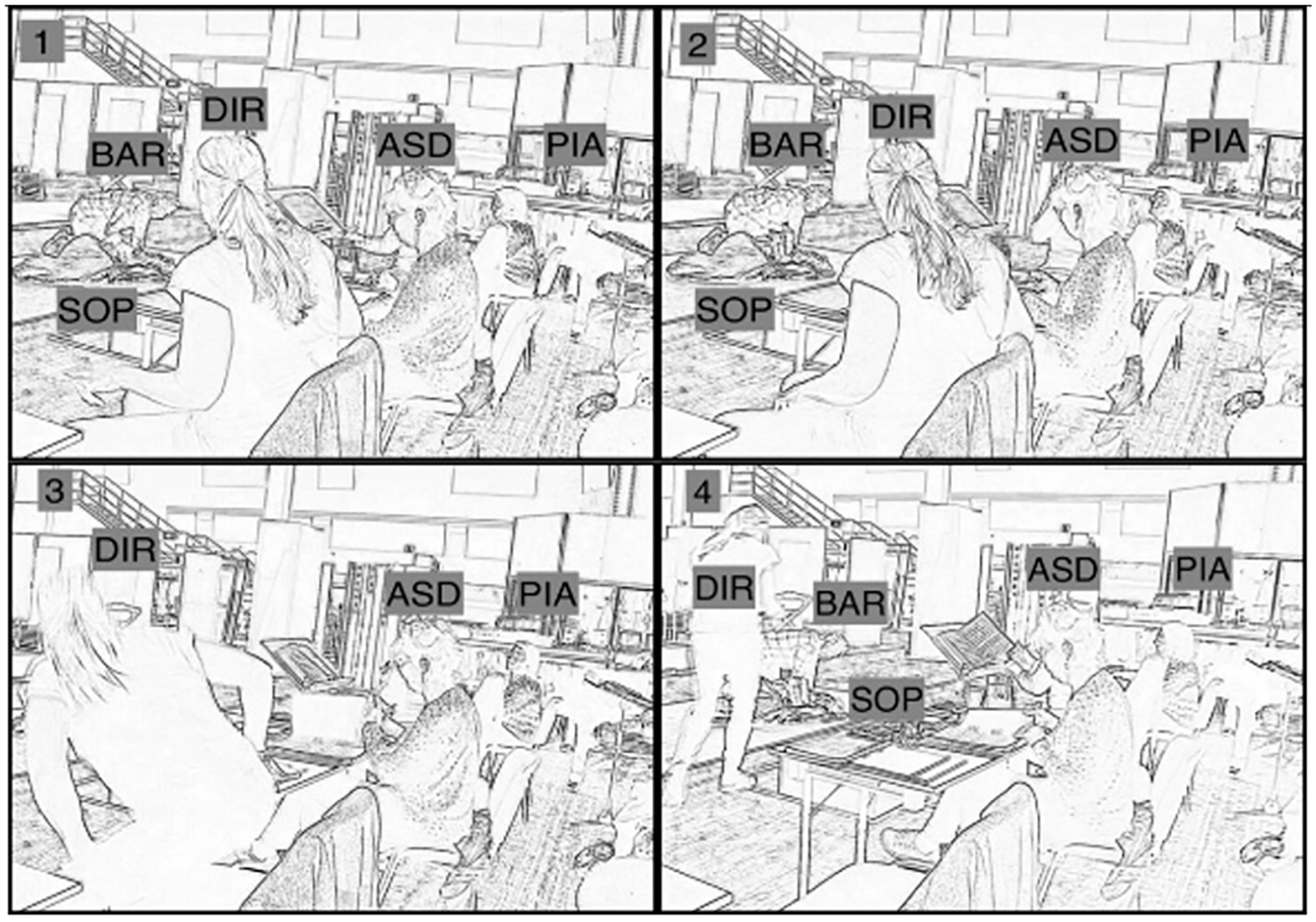
As the director utters the first tack ‘thank you’ (line 4, Figure 10), the soprano cuts off the sung word cielo ‘heaven’ (line 3) and the baritone raises his head slightly toward the director (lines 4–5), showing orientation to the here-and-now rather than to the dying scene that they are depicting. The pianist, however, continues to play the piano and the assistant director then also says tack (line 6) while the director pursues the termination through four further repetitions of tack in rapid sequence with a single rising pitch contour (lines 6, 7) and turns toward the rehearsal assistant (Figure 11). Thanking is a regular albeit implicit way of accomplishing closure in some activity types (Raymond and Zimmerman, 2016; Schegloff and Sacks, 1973: 318). The director continues to then repeat fint ‘nice’ three times in a new high pitch level intonation curve while rising from the chair (Figure 12). The latter achieves both the pursuit of a halt and assessment of the performance, which she continues to comment on in line 9, while approaching the singers (Figure 13). Assessments are yet another device for bringing a sequence to a closure (Antaki et al., 2000; Lindström et al., 2019). The performance is thus brought to a halt in a stepwise manner through various participant re-orientations: the soprano stops to sing, the baritone raises his head and then gazes toward the director; and last, after an elaborate pursuit, the pianist stops to play the piano. The rapidly articulated repetition thus insists on the halting and continues until everybody’s cooperation has been secured and the rehearsal can progress to a different activity, showing how repetition, once again, accomplishes temporal organization.
Similarly, non-lexical vocalizations can be deployed to achieve a goal in real time. In excerpt (9) a dance teacher is instructing how a movement should be paced so that the dancer would not arrive in outer extended position too quickly. The goal is to continue moving with smaller steps. She first counts in the class in line 1 and then accompanies their dance practice with vocalizations in line 2 (see Keevallik, 2021, for their design). The mutual accomplishment of synchrony is represented in the transcript through the marking of danced beats above speaker lines. In lines 3 and 4, the teacher continues repeating the couplet duu daa to mark for a specific dancer that she is moving out too quickly. The teacher (in yellow) is also rushing toward the student (Figure 10) and in line 4 she even takes hold of her body (Figure 11).
(9) Dance instruction (Swedish)
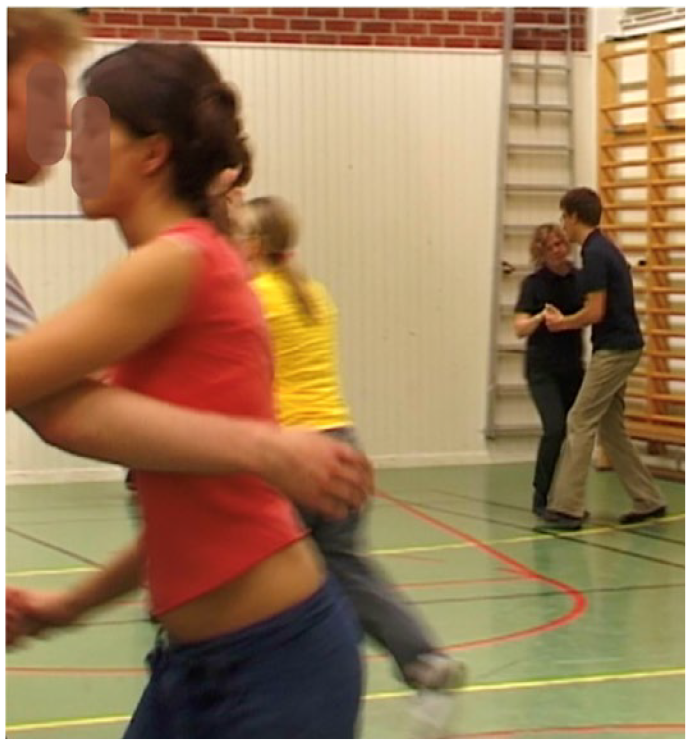
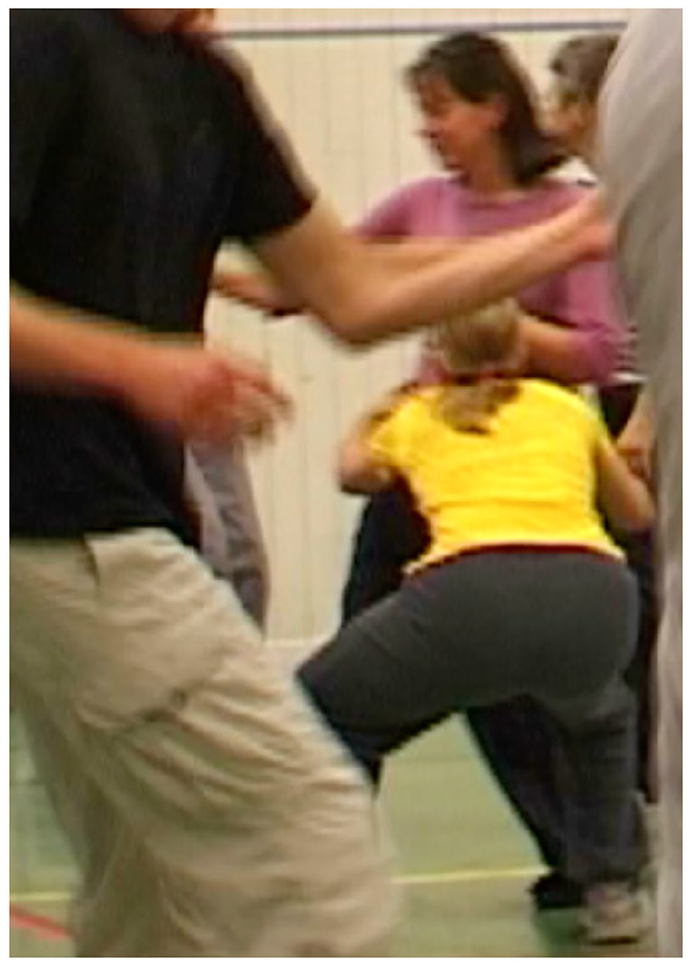
By repeating the combination vocalization duu daa, the teacher is co-performing the move as dragging on rather than coming to an end point in its trajectory. Her pitch stays high in her pitch range, between 450 and 500, almost level, throughout the three repetitions of the vocalizations. Through increasing loudness in line 3 and sound stretches on all items she is likewise instructing ‘continue moving without a rush’ and alerting for something to be not quite right. While still providing the rhythm for the class, she vocalizes alongside all the steps that are rushed and need to be taken slower. Toward the end of the 8-beat pattern, when slowing down is still an option, she is almost physically holding back the targeted dancer. After the step pattern is done and the instruction can no longer be complied with, she explains to the student that she was moving out too early (line 6). The goal to remedy the problem stretch was here sounded in real time, indicating the not-yet-achieved-quality of the dance move in the louder voice and raised pitch. Provided the beat-structure of the dance, there is clear urgency here to improve the steps before it is too late, even though its marking is also pedagogically useful for subsequent attempts.
Summary of the results
Throughout the analysis section, we have shown how speakers do not necessarily use new or different words to produce next relevant actions, as has been described by Grice (1975) and Schegloff (2007), but instead repeat items already in play. While the repetitions do halt the progressivity of speaker turns, we have demonstrated how repetition is a key practice to manage the temporalities and real-time coordination of embodied activities. Repetitions can both encourage or make relevant the extension of an activity or motion, as well as urge action toward a completion point or state. Here, each next repetition takes as its impetus the fact that the formulated action or quality is still missing (not all the rehearsal participants have stopped, the dancers are still rushing), thus necessitating an adjustment. In the recent section, we showed how repetition of either lexical or non-lexical items is used not only to reach a specific goal of an extended position but to insist on the (improved) qualities and temporal coordination across multiple bodies in a class or at a rehearsal. The projection of completion is mostly to be determined by the sounder, who also maintains the responsibility and entitlement to decide when the goal has been achieved considering local contingencies. Repetitions are an easily adjustable resource for this purpose, allowing the sounder to coordinate a stopping point or sufficient point with the co-participants' bodies.
The urging quality is also achieved through prosody. The repetitions are tied together uttered with increasing speed and/or volume and/or pitch. Not only do these features of repetition make relevant ‘do more now’ (Deppermann, 2018; Mondada, 2017: 87; Okada, 2018: 72, 2023; Reynolds, 2021), but they also ratify the micro-history (Löfgren, frth) of efforts-so-far as ongoing though not enough.
Conclusion
In this study we considered the speakers’ self-repetition of words and non-lexical vocalizations in various human activities. While from the abstract semantic and semiotic perspective this kind of repetition has been considered an iconic device referring to repetitive, intensified, or extended phenomena not embodied in the local context, we showed how it emerges indexically as a means of temporal coordination in real life contexts and is regularly used alongside others’ ongoing moves, experiences, or practice. In our embodied activity contexts, iconicity and indexicality are intertwined. Repetition of vocal material can prolong, postpone, and generally organize segments of embodied action as well as co-create rhythms and moves in a moment-by-moment reflexive relationship with other (non-vocalizing) participants. The mum would not have continued without the infant’s attention, the dance teacher only vocalized alongside the entire problematic stretch of the student’s step pattern, and the opera director only continued to repeat words until all participants displayed readiness for a transition from performance to discussion. This illustrates a fine attunement of the participants to each other, be they using vocal or embodied resources, and repetition emerges as an epiphenomenon of these collective activities, with the exact number of repetitions being a direct outcome of others’ ongoing behavior.
We demonstrated that lexical as well as non-lexical tokens could be repeated to achieve essentially the same aims, including being vehicles for extreme loudness and pitch variations to perform coordination tasks. While lexical items were descriptive of body moves or mindful of social concerns, such as making someone else wait or showing appreciation of a performance, non-lexical vocalizations such as lip-smacks and ‘thinking’ sounds perform senses and minds as if working to make themselves accessible to interlocutors. The choice between lexical and non-lexical may be driven by participants layering these additional purposes, as both enable simultaneous participation and co-production of action by the one who sounds and the one who moves.
With this study, we contribute to the respecification of linguistic and marginally linguistic resources in their lived reality as emergent structures for organizing embodied activities and participation, contributing to the general field of grammar in interaction (Couper-Kuhlen and Selting, 2018; Ochs et al., 1996). Repetition solves issues of time management, co-producing actions, urging ahead, or postponing next due items. By looking at interactionally situated language use we can thus also expand the overall range of functions that grammar can have. We were able to show how a resource such as repetition can have different usages depending on the current participation framework, as it can be used alongside another person acting, joining in that action, or oneself doing something that necessitates renegotiating the temporal organization of ongoing engagement. Depending on the activity context, prosodic design, and mutual participant rights, repetitions make relevant the continuation or achieving a goal here and now. The former features production that is rhythmically paced and includes separate prosodic contours, while the latter is characterized by extreme loudness and pitch movements together with rushed articulation under coherent prosodic contours. The specifics of repetitive patterns, such as number of repeats, pacing, and other prosodic details, appear indexically in collaboration across participants and through their concrete activities. The iconic meaning of extension and continuation can thus arise from indexical purposes.
Footnotes
Acknowledgements
The authors are indebted to Sofie van der Meij for help with the literature review.
Declaration of conflicting interests
The author(s) declared no potential conflicts of interest with respect to the research, authorship, and/or publication of this article.
Funding
The author disclosed receipt of the following financial support for the research, authorship, and/orpublication of this article: This study was funded by the Swedish Research Council grant 2016-00827, ”Vocal coordination of human action” and grant P21-0447. “Sounding for others: Distributed agency in action” by Riksbankens Jubileumsfond.