



Abstract
The current study elaborates on one mechanism through which teasing is accomplished in Hebrew interaction. Investigating naturally occurring casual conversation from the Haifa Multimodal Corpus of Spoken Hebrew, and employing the methodologies of Interactional Linguistics and Multimodal Interaction Analysis, we explore a recurrent and recognizable practice used by Hebrew speakers – the deployment of lo ‘no’ followed by a ki ‘because’-prefaced ironic utterance. We suggest that the [lo, ki + ironic utterance] structure is a fixed format that encapsulates a practice of providing a teasing comment as a responsive action. We propose that via the use of this structure, speakers convey a negative stance of inappropriacy toward the previous action by appealing to knowledge that the recipient is obliged to know, while simultaneously mocking the recipient responsible for the inappropriacy and indirectly reproaching them for disregarding this knowledge, whether by failing to take it into account, or by a deliberate choice to ignore it.
Keywords
Introduction
Teasing has been the subject of an increasing number of studies in anthropology, social psychology, and linguistics (for a review, see Haugh, 2017). It has been claimed to be designed to deliberately provoke another person (the target of the tease) by drawing attention to certain deviant actions or characteristics of that person and to be framed as playful (e.g. Drew, 1987; Haugh, 2014; Keltner et al., 2001). Notable features of teasing are that it often conveys a mixed array of messages and involves a range of different practices, thus constituting a heterogeneous category of behavior (Haugh, 2017). In this paper, we discuss one mechanism whereby teasing is accomplished in Hebrew interaction, exploring a recurrent and recognizable practice used by speakers, namely, the deployment of the [lo, ki ‘no, because’ + ironic utterance] structure as a responsive action. By focusing on sequential patterns in which this structure is positioned and discussing social actions that can be ascribed to each of its components, we suggest that this fixed format encapsulates a practice of producing a teasing comment.
The first component of the structure is the Hebrew negator lo ‘no’, which occurs in turn-initial position. In this position, speakers usually display the way their contribution is related to other participants’ actions prior to the current turn (e.g. Heritage, 2002). Negator-prefacing (e.g. Ford, 2001; Ford et al., 2004; Keevallik, 2012) can be used to display a strong oppositional stance and may involve the ‘rejection of an immediately prior proposition or the rejection and shifting away from a topic or sequence’ (Ford, 2001: 60). It can also be used to initiate a change in the trajectory of an action (Keevallik, 2012). We will show that the structure in question is deployed in response to an action which is deemed by the speaker as inconsistent with common sense or as involving some non-normative characteristics or behavior on the part of the recipient. We suggest that, as a component of the structure, the negator lo-preface, which often accomplishes disaffiliative moves in Hebrew (e.g. Ben-Moshe and Maschler, in press a; Maschler, 1994, 1997; Shor, 2020) conveys a negative stance of inappropriacy toward the previous action.
As accounts have been shown to be regular components of disaffiliative sequences (e.g. Diessel and Hetterle, 2011; Ford and Mori, 1994; Sacks, 1987 for English and Japanese; Inbar and Maschler, 2023 for Hebrew), the negator lo ‘no’ is followed by the causal conjunction ki ‘because’, which is often used to project an account (e.g. Inbar and Maschler, 2023; Livnat and Yatziv, 2003; Maschler, 1994). Prefaced by ki, the speaker accounts for taking a negative stance toward the inappropriacy by appealing to knowledge that the recipient is obliged to know (cf. Clark, 1996; Inbar and Maschler 2023; Pomerantz, 1980; Stivers et al., 2011), thus implying that the performance of the inappropriate action was caused by disregarding this knowledge, whether by failing to take the knowledge into account, or by a deliberate choice to ignore it.
In the case of the structure in focus, the speaker appeals to the shared knowledge in an ironic fashion, that is, one involving a contrast between the content of the utterance and the actual state of affairs to which it refers. Irony has been studied from a variety of approaches, and studies of spontaneous conversation have suggested that the effect of irony is an interactional achievement (e.g. Haugh, 2010, 2014). These studies have documented the vast functional potential of irony, ranging from overt criticism to mere jocularity and bonding among friends (e.g. Boxer and Cortés-Conde, 1997; Clift, 1999; Gibbs, 2000; Kotthoff, 2003; Livnat, 2022). We propose that, due to involving a contrast between the content of the utterance and the state of affairs to which it refers, the incorporation of irony conveys the speaker’s expectation that the interlocutor should possess the background knowledge concerning this state of affairs. However, since the speaker’s expectation is not fulfilled, urging the recipient to recognize the inappropriacy, and appealing to their obligation to possess this knowledge, amount to reproaching them (e.g. Albelda Marco, 2023; Bousfield, 2008, 2013; Grimshaw, 1990).
Since the addressee is portrayed as deviant and as being compelled to recognize their responsibilities regarding certain background knowledge, the deployment of the [lo, ki + ironic utterance] structure can be seen as a form of criticism. Other-criticism has been regarded as a face-threatening act that constructs impoliteness and offensiveness (Bousfield, 2008; Culpeper, 2011; Mitchell and Haugh, 2015; Spencer-Oatey and Kádár, 2021). The offensiveness of other-criticisms depends on the recipients’ interpretations (Mitchell and Haugh, 2015) which, in turn, could be affected by the form of the criticism (e.g. Culpeper, 2011; Haugh and Bousfield, 2012; cf. Gumperz, 1982, 1992; Tannen, 1981, 1984). The present study shows that deployment of the [lo, ki + ironic utterance] structure is cued as non-serious or laughable (cf. Chafe, 2007) by various linguistic and embodied means that are co-produced with the structure. Accomplished within a non-serious frame (cf. Goffman, 1981), a teasing comment, as an instance of jocular mockery (Haugh, 2010), is a way of providing criticism that does not need to destroy the spirit of the interaction or to be acknowledged as criticism. In fact, as we illustrate below, examining participants’ responses to a teasing comment shows that it can be ignored, elaborated on as mockery, or countered.
The [lo, ki + ironic utterance] structure can be observed in various genres, such as casual conversation, televised interview shows, as well as other media genres. Nevertheless, this practice has been understudied so far. To fill this gap, the present study aims to explore the structure as it is used in casual face-to-face talk-in-interaction, the natural habitat of language, its primordial site (Schegloff, 1993, 1996a, 1996b). To do so, we provide a detailed interactional analysis of teasing episodes in which the [lo, ki + ironic utterance] structure was employed in casual Hebrew conversation.
Following description of our data and methodology (Section 2), we move to analysis of three teasing episodes in which the [lo, ki + ironic utterance] structure was deployed in casual face-to-face talk-in-interaction, analyzing sequential environments yielding employment of the structure and accompanying embodied behavior, and exploring the actions the structure accomplishes in Hebrew talk-in-interaction. In Section 4 we present a discussion and our conclusions.
Data and methodology
Our examples are drawn from the Haifa Multimodal Corpus of Spoken Hebrew (Maschler et al., 2023a), which consists of naturally occurring casual conversations among friends and relatives that were video-recorded from 2016 through 2023, approximately 18 hours in total among 82 speakers. The corpus is segmented into intonation units (Chafe, 1994) that were transcribed following Du Bois (unpublished manuscript, 2012) as adapted for Hebrew (Maschler, 2017; see Appendix). Transcription of embodied conduct follows Mondada (2019). Interactional Linguistic methodology (Couper-Kuhlen and Selting, 2018) was applied to study the ways in which grammatical resources were deployed in naturally occurring interaction to produce socially relevant actions. To study the ways in which turns at talk are ordered and combined to allow these actions to occur in conversation (Sacks, 1992; Sacks et al., 1974; Schegloff, 2007), and to capture the multimodal context in which they occurred, we employed Multimodal Interaction Analysis, revealing an intricate process of interaction in which participants’ actions are aligned and negotiated through the simultaneous use of multiple communicative modalities that mutually elaborate one another (e.g. Goodwin, 2000; Mondada, 2006; Streeck et al., 2011).
The corpus was searched manually and manifested altogether four tokens of the structure. Thus, in this genre of talk among friends and relatives, the structure is not very commonly used, perhaps because of the reproach which it encompasses. Moreover, we estimate that the [lo, ki + ironic utterance] structure is a fairly new development in this genre of casual Hebrew conversation, arisen probably over the past 15 years or so. Our earliest tokens come from recordings made in 2018. In our earlier, audio-recorded corpus (Maschler et al., 2023b), consisting of talk among friends and relatives of the same genre as the video corpus, recorded throughout the years 1993–2017 1 among 774 speakers, not a single token of the construction was found in the roughly 12 hours comprising the corpus, which spans over 24 years. However, the video corpus, spanning only 7 years, recorded among only 82 speakers, manifests 4 tokens. The numbers are too small, of course, to confirm our estimation, yet they do not contradict it either, and so further study is needed. Nevertheless, we argue that nowadays the [lo, ki + ironic utterance] structure is a recurrent and recognized practice employed by Hebrew speakers.
Interactional analysis of the [lo, ki + ironic utterance] structure
Our first example is taken from a conversation between two students, Dan and Yuval, which revolves around rare words for water sources, one of which is the Hebrew word yama. This word (marked by a final -t in its construct form) is sometimes used in collocation with kineret (prefaced by the definite article ha-), thus forming yamat ha-kineret, which is commonly translated into English as ‘The Sea of Galilee’, a small lake in Northern Israel. The excerpt begins as Dan asks what other bodies of water could be called a yama (lines 1–2) 2 :
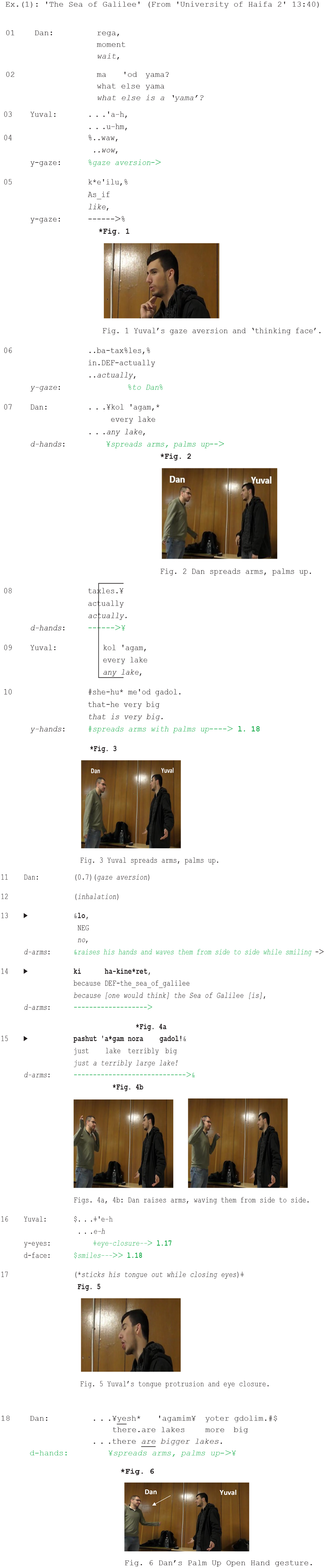
In line 1, Dan suspends the discourse by uttering rega (lit. ‘moment’; Bardenstein and Shor, 2019) and asks what else besides the kineret ‘The Sea of Galilee’ could be called a yama (line 2). Yuval responds with a sequence of discourse markers: He hesitates by using ‘a–h (line 3), followed by waw ‘wow’ (line 4) expressing amazement (Maschler, 2002a), perhaps at the unexpectedness of the question. The cognitive process involved in figuring out how to answer this question is reflected in employment of ke’ilu ‘like’ (line 5; e.g. Maschler, 2001, 2002b) and Yuval’s gaze aversion displaying a ‘thinking face’ (Figure 1; lines 4–5; e.g. Bavelas and Chovil, 2018; Goodwin and Goodwin, 1986). Yuval then produces another discourse marker, ba-taxles, somewhat equivalent to ‘actually’, in continuing intonation, turning his gaze back to Dan (line 6). At this point, Dan takes the turn offering a completion of Yuval’s utterance: kol 'agam, taxles ‘any lake, actually’ (lines 7–8). Thus, according to Dan, any lake could be termed a yama. The utterance is coordinated with Dan’s spreading his arms with the palms of his hands facing upwards (Figure 2). Overlapping the end of Dan’s utterance (line 9), Yuval proceeds with an other-repair (Schegloff et al., 1977) of the definition offered by Dan: He repeats Dan’s kol 'agam ‘any lake’, restricting it with the relative clause she-hu me'od gadol ‘that is very big’ (lines 9–10). Co-produced with this other-repair, Yuval repeats Dan’s gesture of spreading his arms (Figure 3); this gestural repetition may be interpreted to convey affiliation despite the correction (e.g. Holler and Wilkin, 2011; Yasui, 2013). The implication of lines 9–10 is that the kineret ‘the Sea of Galilee’, by virtue of being a yama, is a very big lake.
After a relatively long pause (1.6 seconds), during which Dan averts his gaze displaying a ‘thinking face’ (line 11) and inhales (line 12) in preparation for speaking (Schegloff, 1996a), he produces the negator lo ‘no’ (line 13), in continuing intonation, followed by the causal conjunction ki ‘because’ (line 14). Prefaced by ki, Dan utters ha-kineret pashut ‘agam nora gadol! ‘[One would think] the Sea of Galilee is just a terribly large lake!’ (lines 14–15). The Sea of Galilee is described as being extremely big via the use of nora ‘terribly’, and the description is prefaced by pashut ‘just’, which is often used to reject inferences beyond the literal meaning of the subsequent expression (Ziv, 2001), implying intensification (cf. Inbar and Shor, 2019). However, as implied in this extreme case formulation (Edwards, 2000; Pomerantz, 1986), Dan does not consider the kineret to be a very large lake. Moreover, he later explicitly states that ‘there
By using the [lo, ki + ironic utterance] structure (lines 13–15), Dan responds to the mismatch between Yuval’s definition of a yama as being a very big lake (lines 9–10) and his own evaluation of the kineret, which is a yama, as
By using the negator lo ‘no’ (line 13), Dan conveys opposition, and he follows it with a ki-prefaced utterance (lines 14–15). The ironic content of the utterance, which is provided as an account, assists in ascribing the precise action to Dan’s disaffiliative move, namely, taking a negative stance of inappropriacy regarding the previous formulation of the definition of a yama: This definition is inappropriate because the Sea of Galilee is not that big.
Dan’s gesture of raising his hands and waving them from side to side while smiling (Figure 4a and b), co-produced with the [lo, ki + ironic utterance] structure (lines 13–15), could be interpreted as an embodied display by which an action is framed as a laughable (cf. Ford and Fox, 2010). Smiling in conversation can have various reasons, one of which is signaling humorous intent (e.g. Gironzetti et al., 2019), and as such can be used in this context to frame Dan’s utterance as being humorous.
Thus, Dan’s response – drawing attention to Yuval’s having suggested an inappropriate definition, while framing the response as playful or humorous – can be considered a teasing comment whereby Dan mocks Yuval for such conversational transgression (cf. Drew, 1987). Yet, while Yuval’s suggested definition was indexed as laughable, Yuval treats Dan’s teasing comment as a challenge. Indeed, as was shown by Drew (1987), recipients of teases recurrently respond quite seriously to the teasing proposal, they usually deny or correct the tease, and in only a small minority of cases they play along with it. Yuval responds with the hesitation marker ‘e–h (line 16), likely prefacing some dispreferred response (Pomerantz, 1984), followed by tongue protrusion occurring with an open mouth (line 17; Figure 5). Smith et al. (1974) suggested that the common feature of all the contexts in which the phenomenon of tongue showing (among humans and other primate species) occurs is reducing, cutting off, or forestalling involvement with others. These are coordinated with eye-closure which, as a self-protective reflex (Darwin, 1872/2009; Fridlund, 1994; Hunyor, 1994), can be utilized to convey disalignment (Shor, in press). Indeed, in the following intonation units (data not shown), Yuval will argue that Lake Michigan, undoubtedly a very large lake, would be termed a yama in Hebrew, implying that his definition for a yama holds.
In response to Yuval’s opposition begun at line 16, Dan elaborates and reinforces his account (lines 14–15) uttering
Furthermore, as interactants treat each other as responsible for knowing what is in the common ground (e.g. Clark, 1996), and the disregard for this necessary background information has resulted in the recipient’s performance of the inappropriate action, a reminder of such knowledge can be considered a reproach (e.g. Albelda Marco, 2023; Bousfield, 2008, 2013; Grimshaw, 1990). By urging the addressee to recognize the inappropriacy and by pointing out that he has an obligation to know that yamat ha-kineret is not a very large lake, the speaker positions himself as morally and deontically superior to him. It may therefore not be surprising that this teasing move is countered by the recipient.
Unlike the case of Excerpt 1, in Excerpt 2 the speaker’s teasing move is ignored. The following interaction is taken from a conversation among six friends, in which three of them – Iliya, Maxim, and Gadi – are reminiscing about their mutual visits to fear rooms. In this example, a teasing comment is produced by a participant who is not directly addressed.
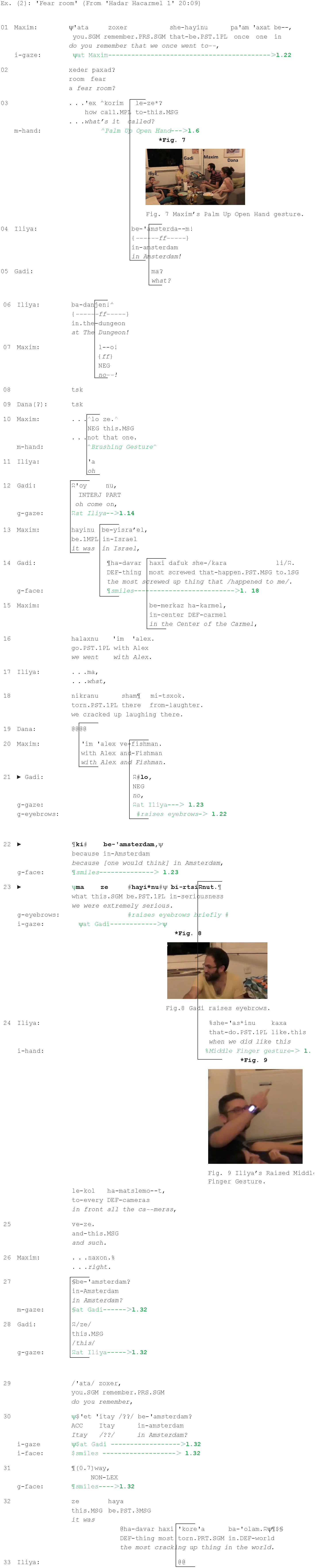
Maxim invites Iliya to reminisce with him about a fear room they had once visited (lines 1–2). He then indicates that he is looking for assistance with locating the name of that place: He induces a joint word search by 'ex korim le-ze? ‘what’s it called?’ (line 3; Geva, 2023), co-produced with the Palm Up Open Hand gesture (e.g. Cooperrider et al., 2018; Müller, 2004; Figure 7). Displaying an empty hand can be interpreted as asking for an abstract entity (e.g. Müller, 2004), in this case, the name of the fear room to which Maxim refers.
Iliya enthusiastically, in loud volume, provides a candidate answer proffering that it was a fear room called ‘The Dungeon’ they had visited in Amsterdam (lines 4, 6). Maxim strongly disconfirms by producing a loud protracted lo–! ‘no–!’ (line 7) in final exclamatory intonation, followed by a click (line 8) functioning as a disconfirming response token (Ben-Moshe and Maschler, in press a) as well as expressing negative stance (Ben-Moshe and Maschler, in press b). Co-produced with a Brushing Away gesture (e.g. Inbar and Shor, 2019), Maxim then rejects the place Iliya mentioned via lo ze ‘not that one’ (line 10), thus implying that he is referring to another fear room. Iliya displays understanding via the Hebrew change of state token (Heritage, 1984a) 'a ‘oh’ (line 11; Maschler, 1997). At this point, Gadi turns his gaze toward Iliya (line 12) and, in overlap with Maxim, produces the interjection 'oy (line 12), functioning in Hebrew as a change of state token with negative tones (cf. Maschler, 1997), followed by the discourse marker nu (line 12), which can color the utterance with a tone anywhere between joking or humorously mocking the addressee to ridiculing and belittling them (e.g. Maschler and Dori-Hacohen, 2016). A very rough English translation of this 'oy nu cluster might be ‘oh, come on’. Gadi then indirectly criticizes Iliya for being so enthusiastic about The Dungeon, evaluating it as ‘the most screwed up thing that happened to him’ (line 14). 3 To assist Iliya in identifying the place whose name Maxim is trying to recall, Maxim adds a list of specifying features: The fear room was in Israel (line 13), in the Center of the Carmel neighborhood of Haifa (line 15), and they had gone there with Alex (line 16). Iliya responds with nikra'nu sham mi-tsxok ‘we cracked up laughing there’ (line 18), thus revealing that he has finally identified the place whose name Maxim attempted to remember. However, at this moment in the interaction – within a sequence of various characteristics that are listed to help identify the place and to differentiate it from the fear room in Amsterdam (see line 4) – Iliya’s response, namely, ‘we cracked up laughing there’ (line 18), can be interpreted as an additional differentiating characteristic of the Israeli fear room. This is not the case since visiting the fear room in Amsterdam was also not a very ‘serious’ experience, as apparent in the ensuing discourse (lines 29–32). In overlap with Maxim’s self-repair that they were there with Alex and also with Fishman (line 20), Gadi utters lo, ki be-'amsterdam ma ze hayinu bi-rtsinut ‘no, because [one would think] in Amsterdam we were extremely serious’ (lines 21–23), responding to this sequential inappropriacy, namely, including ‘cracking up’ in the sequence of characteristics differentiating between the fear room in Israel and the one in Amsterdam. Gadi’s utterance is ironic, since all three participants share the knowledge that visiting the fear room in Amsterdam was also not a solemn event by any means, as evident in lines 29–32, where Gadi invites Iliya to reminisce about some ‘cracking up’ experience they had had in the Amsterdam fear room with a fourth friend of theirs, Itay.
We suggest that, similarly to the previous example, by using the [lo, ki + ironic utterance] structure, the speaker responds to some kind of conversational transgression. In this case, Gadi uses the negator lo ‘no’ (line 21) to oppose Iliya, even though Iliya’s response is consistent with the ongoing activity of identification of the fear room whose name Maxim was trying to remember. Gadi then accounts for his opposition by reminding the others that the visit to Amsterdam was also not a very ‘serious’ experience (lines 22–23). The deployment of this account assists in ascribing the precise action to Gadi’s disaffiliative move, namely, taking a negative stance of inappropriacy regarding including the evaluation of visiting the fear room in Israel as being a ‘cracking up’ experience in this particular sequential position: At this moment in the interaction, this evaluation could be regarded as a feature distinguishing the visit to the fear room in Israel from the one in Amsterdam.
Nevertheless, Gadi’s criticism is framed as being playful and humorous by his smiling (lines 22–23; e.g. Gironzetti et al., 2019) and raising both eyebrows. Raised eyebrows have been argued to mark the shift from serious to non-serious discourse or to signal irony (e.g. Attardo et al., 2003; De Vries et al., 2021; Tabacaru, 2020; Tabacaru and Lemmens, 2014). Gadi raises his eyebrows at the beginning of his turn while he utters lo, ki (lines 21–22); once Iliya turns his gaze toward Gadi, Gadi raises his eyebrows again (line 23; Figure 8). Gadi’s turn is also cued as non-serious by an extreme case formulation whereby Gadi describes visiting the fear room in Amsterdam as ‘extremely serious’, employing the Hebrew intensifier ma ze. Thus, drawing attention to this conversational transgression, indexed as laughable, can be considered a teasing comment whereby Gadi mocks Iliya for including ‘cracking up’ in the sequence of differentiating characteristics between the fear room in Israel and the one in Amsterdam.
In this case, the account builds on knowledge shared by participants by virtue of their prior mutual acquaintance. By employing the first-person plural hayinu ‘we were’ (line 23), Gadi appeals to knowledge concerning the mutual experience of visiting the fear room in Amsterdam. People have particular responsibilities with respect to knowledge (Stivers et al., 2011), and, in particular, one has an obligation to know such things as what one has done (e.g. Pomerantz, 1980). Therefore, a reminder of such knowledge, within the circumstances in which disregarding it has caused the recipient to perform an inappropriate action, can be considered a reproach: The recipient should know that visiting both fear rooms was funny, and therefore should not to include ‘cracking up’ in the sequence of characteristics differentiating between the fear room in Israel and the one in Amsterdam. However, Iliya ignores Gadi’s comment, probably partly because it was produced by an unaddressed participant as a side comment. Overlapping the end of Gadi’s utterance (line 23), Iliya proceeds with illustrating his previous assessment of ‘cracking up laughing’ with a specific example of something they had done in the fear room in Israel, namely, they ‘flipped the bird’ at all the cameras there (line 24; Figure 9). Iliya adds a general extender ve-ze ‘and such’ (line 25) to refer to the speakers’ shared knowledge concerning the other activities in which they had engaged there (Inbar, 2020, 2021), and Maxim responds to these reminiscences, confirming with naxon ‘right’ (line 26; Maschler and Miller Shapiro, 2016; Miller, 2012).
Unlike the cases of the two preceding excerpts, in Excerpt 3, the teasing comment is elaborated on as jocular mockery by one of the participants. During a dinner party among six close friends that took place at Inbal and Omri’s apartment, Inbal, Omri’s partner, shows Omri a hair that she has found in the salad.
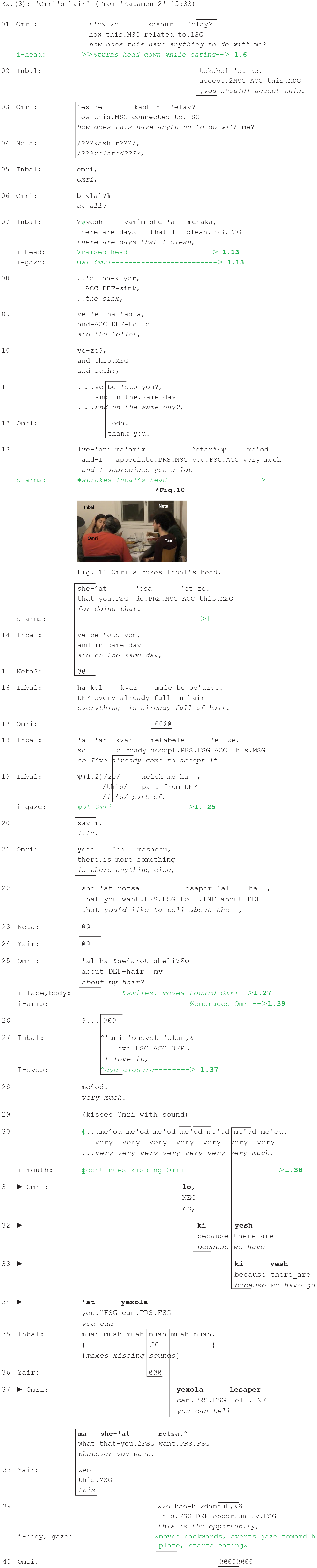
Omri denies any connection to the hair that was found in the salad by asking 'ex ze kashur 'elay? ‘How does this have anything to do with me?’ (line 1). In response, Inbal tells him that he should accept ‘this’ (line 2), that is, the situation of his hair spread all over the house, as evidenced in the following utterances. Omri reproduces his repudiation by repeating his question (line 3). After Inbal addresses Omri by name (line 5), Omri upgrades his prior action (Bilmes, 2019; Pomerantz, 1984) by adding bixlal ‘at all’ (line 6) as a ‘post-other-talk’ increment (Schegloff, 1996a: 253). Inbal continues the turn that she began at line 5, saying that she sometimes cleans the sink and toilet (lines 7–9), adding the general extender ve-ze ‘and such’ (line 10) to mark the previously mentioned activities as representative examples of the intended ad hoc category (Inbar, 2021), probably ‘the cleaning of unpleasant places’. The general extender ve-ze is produced in continuing appeal intonation (Du Bois, unpublished manuscript, 2012, 5.3), (also characterized as ‘try-marked’ intonation (Sacks and Schegloff, 1979)), an intonation contour which, in Hebrew, is designed to seek a (minimal) response from the listener while projecting ‘more to come’. Inbal continues with ve-be-'oto yom?, ‘and on the same day?’, (line 11), also produced in continuing appeal intonation, while Omri, almost simultaneously with Inbal, responds by expressing his gratitude via toda ‘thank you’ (line 12). Inbal’s adverbial phrase in line 11 projects continuation, most likely some predication. Thus, at this point, the transition to a next speaker is not properly relevant. However, Omri cuts in, adding that he really appreciates Inbal’s cleaning the bathroom (line 13), which is co-produced with stroking Inbal’s head (Figure 10). In experimentally set up situations, such haptic acts were characterized as concurrent with the expression of prosocial emotions such as love, gratitude, and sympathy (Weiss and Niemann, 2011: 246). Indeed, this affectionate contact follows Omri’s expressing gratitude to Inbal verbally (line 12) and is coordinated with Omri’s positive assessment of her (line 13). Omri’s response is consistent with closing the adjacency pair by responding to Inbal’s action of informing, in this case, regarding some outstanding behavior on her part which is expected to be acknowledged. However, closure is clearly not appropriate at this point, since the description was only put forward by Inbal as background, projecting more to come, both syntactically and prosodically (see line 16 below). Therefore, Omri’s expression of gratitude and appreciation could be considered a strategy for keying the interaction as playful (Goffman, 1986). Furthermore, converting one conversational action-in-progress into another may amount to a recognized threat to face (cf. Lerner, 1996). Thus, Omri’s response not only disrupts Inbal’s turn but is possibly intended also to prevent her from further developing her point.
After repeating the adverbial phrase ve-be-'oto yom ‘and on the same day’ (line 14) overlapping Omri’s expression of gratitude (line 13), Inbal completes the clause: ha-kol kvar male be-se'arot ‘everything is already full of hair’ (line 16). Inbal portrays the situation using extreme case formulations (‘everything’ and ‘full of’) which, in this case, may imply a complaint (Pomerantz, 1986). She then mitigates her complaint by concluding that she has already come to accept this situation (line 18), and after a pause of 1.2 seconds, during which Inbal is gazing at Omri, she accounts for her previous statement adding that this is ‘part of life’ (lines 19–20). Inbal’s move may be twofold: Not only does she provide a personal example of ‘accepting the situation’, encouraging Omri to accept it as well (cf. line 2), but her description also reveals that it is plausible that the hair found in the salad belongs to Omri. Yet, revealing intimate details in front of guests might embarrass Omri. Indeed, in overlap with the end of Inbal’s utterance (line 20), Omri opposes this face-threatening act (Brown and Levinson, 1987) by reproaching Inbal for revealing intimate details about him, using a rhetorical question (cf. Albelda Marco, 2023). Despite its grammatical form, Omri’s question, whether there is anything else Inbal would like to tell their guests about his hair (lines 21–22, 25), does not request information from the addressee but implies criticism: Inbal should not talk about Omri’s hair. Nevertheless, Neta and Yair find it laughable (lines 23–24), and Inbal, continuing keying the interaction as playful, smiles (line 25–27) and answers this rhetorical question saying that she loves Omri’s hair very much (lines 27–28), displaying affection and intimacy. Moreover, she moves over to Omri (lines 25–27), closes her eyes (lines 27–37), embraces Omri (lines 25–39), and begins kissing him profusely (lines 29–38). Her embracing forms an ‘ecological huddle’ (Goffman, 1964: 135), which creates a shared, public focus of attention and leaves other people in the room outside momentarily (Goodwin, 2007: 57). Such intercorporeal intertwinings publicly embody the intensity and intimacy of social relations, both toward Omri, the recipient of the physical contact, and toward the other participants observing such a moment (cf. Cekaite and Holm Kvist, 2017). This intimate bodily contact can serve for reconciliation (e.g. Goodwin, 2017: 76).
Following this public act of reconciliation, during which Inbal kisses Omri and repeats the adverb me'od ‘very much’, closing her previous assertion 'ani 'ohevet 'otan, me'od ‘I love it, very much’ (lines 27–28) seven times (line 30), Omri proceeds with another act of reproach, this time in another manner: He teases Inbal using the [lo, ki + ironic utterance] structure. He conveys opposition via lo ‘no’ (line 31) followed by the ki ‘because’-prefaced account ki yesh ki yesh 'orxim, 'at yexola yexola lesaper ma she-'at rotsa ‘because we have because we have guests, you can you can tell whatever you want’ (lines 32–34, 37), pointing out the presence of guests as a circumstance determining Inbal’s behavior as unacceptable. Omri stutters because Inbal makes it difficult for him to speak by kissing him. At the moment in which Omri’s turn reaches a point of recognizability, after the negative stance of inappropriacy is projected via lo, ki (lines 31–32) and its nature can be inferred through pointing to the presence of guests (line 33), overlapping Omri, Inbal begins to make kissing sounds in loud volume (line 35), perhaps in an attempt to block the continuation of Omri’s criticism.
In this example, Omri’s account trades on shared knowledge pertaining to general social conduct, ‘common sense knowledge of social structures, and of practical sociological reasoning’ (Garfinkel, 1967: vii), which Inbal has ignored. Since it is not socially acceptable to embarrass a person in front of guests, Omri’s 'at yexola yexola lesaper ma she-'at rotsa ‘you can you can tell whatever you want’ (lines 34, 37) is ironic. The irony is marked by the extreme case formulation ma she-'at rotsa ‘whatever you want’ (lines 37). The implication is that Inbal cannot in fact, according to Omri, say whatever she wants in front of the guests, and therefore her behavior is inappropriate.
Thus, in this interaction keyed as playful almost from the beginning, pointing to the presence of guests as a circumstance determining revealing intimate facts as unacceptable can be considered a teasing comment whereby Omri mocks Inbal for such inappropriate behavior. Partly overlapping Omri, the mockery is elaborated on by another participant, Yair, who is not the target of the teasing in this instance. Yair upgrades Omri’s account referring to such circumstances – being in front of guests – for revealing intimate facts as an ‘opportunity’ (lines 38–39). Through continuation of the jocular frame, Yair displays interpretation of the mockery as jocular and affiliates with Omri (cf. Haugh, 2014). Omri displays appreciation of Yair’s move through laughter (line 40).
Discussion and conclusions
Our study explored one interactional mechanism whereby teasing is accomplished in Hebrew casual face-to-face interaction. We showed that the [lo, ki + ironic utterance] structure is a fixed format that encapsulates a practice of providing a teasing comment. The teasing comment is a responsive action in which the ‘comment’ pertains to a particular action performed by the target of the teasing, and involves conveying a negative stance regarding the inappropriacy of that action. In the examples discussed in this paper, although the action performed by the target of the teasing was appropriate regarding one aspect of the interaction, it was inappropriate with regard to some other aspect: In Excerpt 1, since one of the speakers wanted to know what could fall within the category of a yama (except for the kineret), providing a definition of this term was an appropriate action. However, in the recipient’s opinion, the definition provided did not match the previously discussed exemplar of that category, and was inappropriate in this sense. In Excerpt 2, the information provided, namely, that the participants were convulsed with laughter in a particular fear room was correct, and providing this information was relevant to the on-going activity of the identification of that fear room. However, including this information within a sequence of various characteristics that were listed to differentiate that fear room from another one, was inappropriate, since visiting both fear rooms involved ‘cracking up’ experiences. In Excerpt 3, asserting that Omri’s hair was spread all over the house was appropriate in that it served the speaker’s purpose of substantiating her claim that the hair found in the salad belonged to Omri. Nonetheless, revealing this information in front of guests was inappropriate because it might have embarrassed Omri (her partner).
This particular practice of making a teasing comment consists of multiple components: the negator lo, a ki-prefaced account, the use of irony, and an appeal to shared knowledge. The negator lo is used to indicate opposition, the nature of which appears to be borne out in the current analysis: Since the reference in the utterance provided as an account for the opposition is only relevant as a reason that the previous action was inappropriate, we suggest that the speaker conveyed a negative stance toward the inappropriacy of that previous action.
Prefaced by ki ‘because’, the speaker accounts for their disaffiliative move via an appeal to shared knowledge: The account in Excerpt 1 builds on common sense and on the general knowledge that is assumed to be shared by all speakers belonging to the speech community (cf. Gumperz, 1968) (‘the kineret is not a terribly large lake’). In Excerpt 2, the account relies on knowledge that is shared by the participants by virtue of their prior mutual acquaintance (‘the Amsterdam fear room experience was not a solemn one either’). In Excerpt 3, the account is based on shared knowledge pertaining to general social conduct (Garfinkel, 1967) (‘it is not socially acceptable to embarrass a person in front of guests’).
The appeal to shared knowledge is often linked to managing problems and potential disagreement in talk, and has been shown to be a resource for establishing shared understanding and affiliation (e.g. Asmuß, 2011; Clayman and Raymond, 2021; Inbar and Maschler, 2023; Maschler, 2012). However, we suggest that, in this case, the appeal to shared knowledge was twofold: It was used not only to achieve affiliation, but also to indicate from the outset some inappropriate behavior as an outcome of disregarding the information that the interlocutor was expected to know, such as common knowledge regarding the size of the kineret, what the participants were doing in Amsterdam, and social norms. Had the targets of the teasing paid attention to this knowledge when making their moves, they would not have performed these inappropriate actions. This provides an interesting implication regarding the use of irony. In order to interpret the irony involving a contrast between the content of the utterance and particular facts, these facts should be known by the addressee. Thus, irony was used as a device to convey the speaker’s expectation that the information that was provided was shared. Accordingly, the use of irony formats the speaker’s turn as a challenge, making the possession of particular information an accountable matter (cf. Garfinkel, 1967). Therefore, the speaker’s move can be perceived as reproaching the recipient for disregarding the necessary background information that resulted in them performing an inappropriate action. Nevertheless, the reproach can be seen as indirect, since it is implied from the speaker’s account for their disaffiliative move.
As the target of the tease is portrayed as deviant, both by drawing attention to certain inappropriate actions and by reproaches regarding obligations that constitute the local social organization of knowledge, the deployment of a teasing comment constitutes a form of criticism. However, the teases were cued as non-serious by various means, including laughter, particular manual gestures, facial expressions (smiling and raising the eyebrows), prosodic cues, and extreme case formulations. Thus, the deployment of the [lo, ki + ironic utterance] structure involves jocular mockery (e.g. Haugh, 2010) of the one responsible for the inappropriacy. While direct criticism tends to provoke arguments and defensiveness, the recipients of a teasing comment may choose to treat it as a challenge, to ignore it, or to laugh along with the teaser and leave it at that (cf. Drew, 1987). While the teasing comment was unattended in one of the examples (Excerpt 2), in the other two examples the participants extended the sequences through countering (Excerpt 1) or elaboration (Excerpt 3) of the mockery. Hence, close examination of the responses to the teasing comments by other participants validates that, by being framed as playful, teasing is a way of expressing criticism that gives the person being criticized a way of saving face (Goffman, 1967), shedding light on the sequential nature of face-work (cf. Holtgraves, 1992).
Moreover, our study showed that the [lo, ki + ironic utterance] structure, responding to deviations, such as conversational transgressions or misconduct, and constituting a form of criticism, serves as a means of maintaining social order (e.g. Drew, 1987; Tholander and Aronsson, 2002). Accordingly, the current study validates that shared socio-cognitive constructs are sustained through practices of interaction (e.g. Clark, 1996; Garfinkel, 1967; Heritage, 1984b; Schütz, 1962). Finally, by studying a particular teasing practice used by Hebrew speakers, we hope to further our understanding of the dynamics of teasing in interaction in different languages and cultures and to contribute to the attempts to theorize this phenomenon.
Footnotes
Appendix
Declaration of conflicting interests
The author(s) declared no potential conflicts of interest with respect to the research, authorship, and/or publication of this article.
Funding
The author(s) disclosed receipt of the following financial support for the research, authorship, and/or publication of this article: This research was generously supported by the Israel Science Foundation, grant no. 941/20 to Yael Maschler..