



Abstract
The shift to service and gig economy and increasing polymediality have created communicative contexts where the workers have to construct varying social relations in different kinds of digital and text-based interaction environments. This article examines how transprofessional collaboration is managed in such contexts in the field of applied arts. Based on email and mobile messaging data, we study a project where an artist creates an installation artwork for the use of an organisation. By applying the methods of conversation analysis, we investigate text-based requests and news delivery sequences related to applying for external project funding. Our results show how the participants negotiate the aspects of knowledge, power and emotion within these sequences, and by doing so, maintain mutual professional relationships and display various levels of commitment to the continuation of the project. The article illuminates the facets of transprofessional collaboration in digital professional communication and in atypical work.
Keywords
Introduction
In contemporary working life, employment opportunities often arise from different specialist and human services that operate on a short-term and project-by-project basis (Ilsøe et al., 2019; Prassl, 2018; Woodcock and Graham, 2020). From the viewpoint of professional communication, the shift to service and gig economy and their atypical work arrangements have created new kinds of communicative contexts with new interactional challenges. This is because the workers earning their income through service provision have to seek and maintain several concurrent work contacts and tailor their services to different customer groups. Consequently, they have to adapt to varying social situations and roles whose rights, responsibilities and mutual relations are under constant negotiation due to transient working arrangements and fuzzy boundaries between work and non-work (see Nissi et al., 2023). The complexity of these new contexts is further reinforced by the fact that professional communication is increasingly ‘polymedial’ (Androutsopoulos, 2021; Lexander, forthcoming; see also Darics, 2015) in nature, namely, it utilises several different channels and platforms, which requires knowledge of new types of digital and text-based interaction environments with their specific technological affordances. The field of arts and culture is a typical example of this new precarious service work. In present-day working life where creativity and innovation are often considered an asset, many artists have been able to build a second career as creative professionals providing specialist services where artistic approaches and interventions are used for solving specific communal or organisational problems (Berthoin Antal et al., 2016; Martikainen et al., 2021). The expanding professionalism has also meant renewed interactional demands, as the daily work of artists is characterised by complex social networks and transprofessional collaboration (Lehikoinen et al., 2021).
In this article, we investigate how such collaboration is interactionally accomplished by examining the case of a project-based work in the field of applied arts. More specifically, we focus on relational work and analyse the ways in which professional relationships are constructed across the joint work project in order to maintain and advance collaboration between the parties who have different concerns and interests in the project. Our data originate from a collaborative project between an artist and a third sector organisation in the field of health and social welfare. During the project, the artist created an installation artwork for the organisation to use, but in order to do it, he had to find external funding to cover his salary and needed the organisation’s help to apply for it. This required extensive relational work between the project stakeholders, that is, continual communication where the planning of future actions and maintenance of social relations intertwined. We especially examine how this relational work is managed in digital, interaction as the parties of the project communicated largely through, text-based channels. Although relational work is often particularly perceivable in face-to-face settings, it is also a central aspect of text-based workplace interaction as shown, for example, by Darics (2020) who explores how team leaders balance between transactional and relational goals in instant messaging with their team members, and Hössjer (2013) who investigates organisational email communication and the manner in which it utilises two types of frames, the work frame and the non-work frame. Further, Lexander (forthcoming) looks at multilingual relational work in text-based interactions between labour migrants and their employers. While these studies focus on organisational settings with conventional, stable employer-employee relationships, other studies have further shown how relational work becomes particularly complex in the context of ‘sole traders’ and project-based work where the project members do not necessarily even know each other beforehand and need to establish, develop and negotiate their mutual relations over time (see, Marsden, 2020).
We will analyse relational work in two interactional contexts where collaboration can be seen to be especially at stake: text-based requests and news delivery sequences related to project funding. ‘Requests’ are social actions where the co-participant is asked to perform some action that can be either concrete or abstract as well as immediate or delayed (Drew and Couper-Kuhlen, 2014). In addition, requests also vary depending on the speaker’s perceived entitlement to make a request, contingency of the requested action as well as the ownership and benefactivity of the action, namely, whether the intended action is bilateral and related to some already established and jointly committed project between the participants or whether it can be seen to benefit only the speaker – these all affect the ways in which requests are formatted and responded to (ibid.). ‘News deliveries’, for their part, have the core function of disclosing a piece of information to co-participants who in turn receive the news by producing a response to the first speaker’s news announcement (see Maynard, 2003). Typically, the unfolding of news delivery varies depending on the valence of the news. Therefore, good news is often delivered in an exposed manner whereas bad news can be veiled and the activity closed with specific exit strategies, such as ‘remedy announcements’, ‘bright-side sequences’ and ‘optimistic projections’ (Ibid.).
Although the earlier research on requests and news deliveries has largely focused on spoken interaction, their resources and practices have also been examined in text-based interactional environments. Importantly, this line of research has been careful in looking at text-based phenomena from a clean slate, that is, without relying on a priori concepts specific to talk-in-interaction. For example, Sliedrecht et al. (2022) examine news sequences in instant messaging as ‘updates’ to highlight the profound differences in the text-based accomplishment of the activity. Unlike in talk-in-interaction, text-based news deliveries are produced in ‘packages’ consisting of multiple units such as news announcement, the news itself and a closing. Moreover, the news is routinely delivered in text-based settings by sending images to serve quasi-direct visual access to the event (Ibid.). In a similar fashion, Licoppe et al. (2014) have studied request sequences in instant messaging in professional settings. Specifically, they have looked at what they call ‘quick question’ sequences that are accomplished between members of two highly connected workplace organisations. This emerging activity type enables ‘the collaborative accomplishment of complex, knowledge-intensive tasks by recruiting colleagues constituted as experts capable of quickly answering information requests related to ongoing tasks’ (ibid. 488). As regards professional email interaction, it has been shown that the conditional relevance of receiving a response varies in relation to the specific type of request (Skovholt and Svennevig, 2013). For instance, in requests to correct or comment on proposals, a response was observed conditionally relevant only if the recipients disapprove or have corrections to make (ibid.). 1
Importantly, both requests and news deliveries deal directly with the issue of collaboration by invoking the participants’ negotiation on their mutual epistemic, deontic and emotional order that, according to Stevanovic and Peräkylä (2014), lay a foundation to all human social relations. The epistemic order has to do with knowledge, namely, what the participants are expected to know vis-à-vis each other whereas the deontic order is related to power, agency and the possibility to steer each other’s actions, and the emotional order to the ways in which the participants are expected to express emotions and affect in a given type of situation. These orders can be viewed as inherent to all human interaction. At the same time, they can also be institutionally defined and particularly pertinent in workplace settings where the whole realm of work with its distinct system of knowledge, power and emotion is constituted through them within the ‘momentary relationship of the participants’ (Stevanovic and Peräkylä, 2014: 186; see also Ekström and Stevanovic, 2023; Salomaa and Lehtinen, 2023; Nissi and Lehtinen, 2023). Therefore, in requests, the participants need to, for example, negotiate the legitimacy and reasonableness of the request and the level of commitment to the proposed action in the light of all knowledge that is available on the matter. In news deliveries, the participants need to negotiate the newsworthiness and the essential valence of the news – for who it is good or bad news and why – and what is the expected type and degree of emotion related to that valence. 2
In the contexts of our data, this negotiation is particularly salient in requests and news deliveries related to project funding due to the atypical nature of the artist’s employment position: the relation between the artist and the organisation does not comply with any recognised employment relationships. Therefore, while it is not an employer-employee-relation with the employer’s right of management, it is not a customer relationship either as the organisation does not actually pay any remuneration to the artist for his services. Instead, the artist has to find an external funder who provides a working grant for him in order for the project to take place. We study how this complexity of the project stakeholders’ professional relationship is managed 1) in requests where the artist asks permission to submit a joint application for external project funding and 2) in news deliveries where the artist provides information on the funding decisions. We focus on the formatting of the first post as well as its responses and analyse how the participants orient to the aspects of knowledge, power and emotion within these sequences, and by doing so, organise their mutual professional relations as they display various levels of commitment to the continuation of the shared project. By ‘commitment’, we refer to social commitments in which an obligation towards others is taken in relation to a simple course of action or a larger project (see, Zinken and Deppermann, 2017: 29). Our article thus contributes to previous research by illuminating the facets of relational work and transprofessional collaboration in digital professional communication and in atypical work contexts.
Data and methods
The data for the study was collected from a 3-year long collaborative project where an artist created an installation artwork for the use of a third-sector organisation providing health and social services. The artist and the organisation had no previous collaboration and thus had to start building their professional relationships from the beginning. Although the project also included face-to-face meetings, the main communication channels between the artist and the organisation were digital and asynchronous. Due to the central role of text-based communication throughout the collaborative project, the study focuses on digital channels, comprising all emails and WhatsApp messages for the whole 3-year period as its data (see Table 1). 3 The language used in the data is Finnish.
Digital, text-based communication during the collaborative project.

During the initial analysis of the data, we observed that while the topics of the messages varied, many were related to financial resources. The centrality of finances was also supported by ethnographic knowledge acquired during the research project: we knew that the organisation did not directly employ the artist who instead had to apply to external funding sources for his work to facilitate the whole collaborative project. This put considerable pressure on financial issues and led to a number of finance-related messages between the artist and the organisation. We selected all these messages for closer inspection and analysed their sequential action – the function and formulation of the initial message as well as the responses it received. We discovered that 1) the finance-related messages were always initiated by the artist, 2) they utilised both text-based channels and 3) were materialised as either request or news delivery sequences that accentuated the issues of collaboration and commitment. This led us to analyse in more detail how the participants advanced the shared project by constructing and negotiating their mutual relations and displaying various levels of commitment to the project through these sequences. Subsequently, we also investigated the ways in which the messages occurred within the longitudinal process and could see that they were connected to specific stages of the project. This, in turn, led us to examine how the participants’ relations shifted across the temporal unfolding of the project and how the shared project was thus discursively constituted through the messages (see Figure 1).
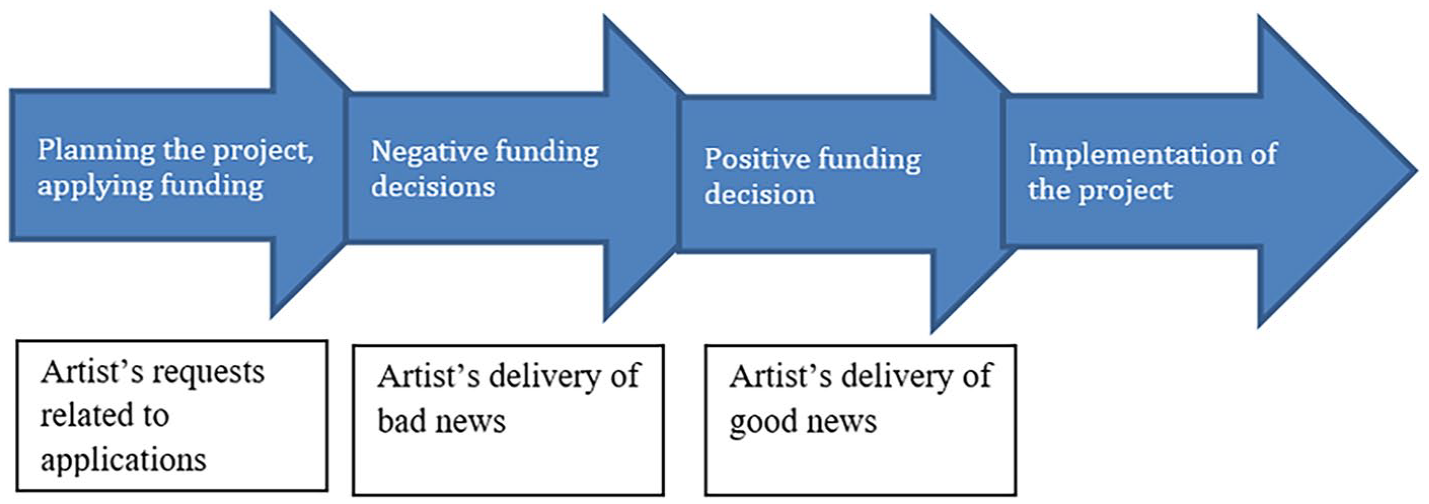
The stages of the project.
Methodologically, we draw on ethnomethodological conversation analysis that examines the sequential organisation of social action in different interactional contexts and settings (e.g., Sacks et al., 1974). In recent years, the CA approach has also been applied to text-based and other technology-mediated forms of interaction (see, Giles et al., 2015; Meredith et al., 2021). In this digital CA, the special focus is on the ways in which technologies and media are ‒ and can be shown to be ‒ relevant for the participants themselves and consequential for the organisation of social interaction (Arminen et al., 2016).. Indeed, prior digital CA studies have shown that text-based interaction diverges in many respects from the ways in which talk-in-interaction is organised. The differences pertain to sequence organisation, turn-taking as well as repair (for overviews, see Meredith, 2019; Koivisto et al., 2023). One of the key reasons for the profound differences lies in the non-synchronous nature of text-based interaction, which means that while in talk-in-interaction turns are produced in real time, in text-based interaction the turn – or more appropriately, the post – is observable to the recipient(s) only upon its posting as a finished product (e.g., Meredith, 2019: 243–245). Despite these differences, the essence of the CA approach – the analysis of composition and position – remains crucial (Koivisto et al., 2023: 8). In our study, we utilise digital CA to analyse the accomplishment of text-based request and news delivery sequences in two kinds of mediated interactional environments.
Analysis: Accomplishing transprofessional collaboration around a grant-funded project
In this section, we investigate how the two parties in our data ‒ the artist and his contacts in the collaborating organisation (CO) ‒ secure, (re)negotiate and endorse collaboration in a project that requires external, grant-based funding for one project member, the artist. First, we analyse how collaboration is initially secured through a request sequence where the artist asks the collaborators for permission to begin writing a funding application. In the two other sub-sections, we examine news delivery sequences that deal with funding decisions. In the first of them, we look at how collaboration is re-negotiated when bad news is involved (no funding). In the other, we focus on how collaboration is endorsed in terms of the opposite situation of good news (funding is granted).
Securing collaboration: Requesting permission for applying funding
In text-based communication between the parties, the question of collaboration is initially made relevant and a salient aspect of interaction in an email request in which the artist (Tommi Lahti in data extracts) 4 asks his collaborators for permission to write and later submit a grant proposal for the project. We argue that this request is implemented as a ‘double barrelled’ action (Schegloff, 2007: 76) in the sense that it also requires, as its prerequisite, that the respondents display a binding commitment to collaborate. In other words, the case combines immediate and remote aspects of requesting (see, Drew and Couper-Kuhlen, 2014). At the same time, it also lays the ground to response practices through which the respondents negotiate either their personal commitment to the project or that of their organisation.
The interactional context for the case at hand is that three days before posting the email presented as Extract 1, the artist had already made inquiries with the collaborators regarding the issue without receiving responses. As a consequence, the artist begins to pursue missing responses, and thus makes the responses ‘noticeably absent’ (see, Sacks, 1992).
Extract 1 Subject: Re: Hakemus Re: Application From: Tommi Lahti Date: 22.9.2016 klo 10.49 To: Kaarina Ruusunen, Eero Kivelä CC: Kari Tyrkkö, Liisa Paldanius
The artist begins the email in Extract 1 by apologising that he is about to ‘grill’ the recipients, that is, to pressure them to provide a pending response (line 2). He can thus be seen as reflexively enforcing the accountability of his conduct: he displays that he is about to accomplish a socially delicate action (see Sidnell, 2017). In lines 2-3, he continues by displaying his empathic awareness of the likely high contingencies that might have prevented the recipients from responding earlier (such as being overwhelmed with more pressing matters; on ‘contingencies’, see Curl and Drew, 2008). As a vehicle for pursuing a response, the artist then announces that he will be more brief this time in formulating his inquiry (lines 3‒4). Together, the two sentences in lines 2‒4 serve as a preamble that orients to the joint project as ‘extra work’ for the collaborators.
The second paragraph (lines 8‒14) is initiated by the particle eli ‘so’, which projects the reformulation of the artist’s prior ‘question’ as a pending action (see, Bolden, 2009). Accordingly, eli prefaces a request for permission. This request asks for a go-ahead to begin writing a grant proposal for the project and is formulated as a yes/no interrogative (YNI) making relevant a ‘quick’, straightforward answer: either confirmation or disconfirmation (see also, Licoppe et al., 2014). Importantly, as Raymond (2003: 963) argues, ‘the YNI’s preference for type-conforming responses suggests that the normative organisation embodied in its grammatical form is systematically biased in favor of promoting alignment in courses of action’. In Extract 1, this means that the YNI promotes a binding, on-record display of commitment for collaboration. In the following sentence in lines 9‒11, a ‘yes’ answer is further promoted by emphasising that the CO would be presented in the less demanding role of collaborator as opposed to that of co-applicant.
Perhaps most importantly for our concerns, this request contains a ‘prospective indexical’ which refers to something that ‘is not yet available to recipients but is instead something that has to be discovered subsequently as the interaction proceeds’ (Goodwin, 1996: 384). Specifically, the prospective element alla luetellut ‘listed below’ requires considering the upcoming elaborations before granting or withholding permission (lines 8‒9: ‘So, is it OK if I prepare [. . .] an application, which consists of phases
The final paragraph (lines 33‒38) returns to the activity of pursuing a response by using a conditional construction (‘if‒then’) to accomplish a plea (cf. Nissi, 2016): the artist cannot write the application without the collaborators’ permission and binding commitment to the project. Response relevance is further heightened by appealing to the imminent deadline of the funding call.
Let us now consider the collaborators’ responses. Following CA’s next-turn proof procedure (see Sacks et al., 1974), our departure point is that a response displays the responder’s orientation to the prior turn or post. As the artist’s email is a complex, multi-unit post, the responses are unavoidably selective as to which aspects of collaboration they acknowledge and make relevant. Indeed, our analyses reveal that the collaborators respond to the email in noticeably different ways; some responses are exceedingly task-oriented, while others focus more on the relational aspects.
We begin our analysis with the first response (Extract 2), which is sent the next morning from the specialist Tyrkkö. The artist had addressed him in the cc field of the email and thus assigned him the role of a side-participant (see, Skovholt and Svennevig, 2006: 48). 5 Tyrkkö’s response is characterised by its organisational orientation. In other words, his post focuses more on the organisational aspects of the suggested collaboration and less on his personal involvement.
Extract 2 Subject: VS: Hakemus RE: Application Date: Fri, 23 Sep 2016 8:38 From: Kari Tyrkkö To: Tommi Lahti, Kaarina Ruusunen, Eero Kivelä CC: Liisa Paldanius, Anneli Kallavuo
Extract 2 begins by announcing that the respondent has had a chat with the head of training (Kallavuo) regarding CO’s partnership in the project (lines 2‒4). That is, the announcement orients to the request as a matter of organisational decision-making. 6 The ensuing response is type-fitted in the sense that it takes into account, at least partly, the three areas of cooperation suggested in the artist’s email and grants permission based on them. The areas are discussed in terms of ‘enablement’ (Enfield, 2013: 58‒60), that is, in relation to the organisation’s capability or readiness for the requested tasks: the CO is represented as being capable of utilising the artwork in its operations (lines 4‒5), but incapable of providing financial support (lines 6‒7). The strong focus on the enablements presents the CO as willing to collaborate – to the extent the contingencies allow, thus downplaying the agency of the individual decision-makers. Importantly, the inability to provide any financial support is not considered a barrier for the collaboration (lines 6‒7: ‘Financially, it is currently impossible to be involved, but [we are] very happy to collaborate’). This means that the respondent subtly exercises his organisational deontic authority by unilaterally deviating from the artist-initiated terms of collaboration and, more specifically, from the terms of responding as formulated in the YNI-based inquiry (see, Raymond, 2003). The ‘sincerity’ of the displayed willingness to collaborate is demonstrated with an voluntary and detailed offer for help on behalf of the organisation, that is, by nominating a contact person with whom the artist can make further arrangements (see lines 11–13; on displaying sincerity, see Houtkoop, 1987: 129–130).
Overall, Extract 2 orients to the suggested collaboration mainly as a matter of organisational decision-making and less as a matter of personal commitment. The extract’s sole display of subjective or emotional commitment adopts a formulaic design and conveys a generalised collective stance, perhaps as a compensation for the previously declining financial support (lines 6‒7: ‘but [we are] very happy to collaborate’).
After the early morning response from Tyrkkö (Extract 2), additional responses arrive by noon. Extract 3 is a response from the line manager Ruusunen, who was marked as one of the two primary addressees in the artist’s email. In the signature line, Ruusunen displays that she is also responding on behalf of the other primary addressee, line manager Eero Kivelä. While Extract 2 emphasised the organisation’s commitment to collaboration, Extract 3 highlights a personal orientation to collaboration. This orientation manifests in the ways in which the project is made personally significant through the repeated use of first person forms, and help is offered personally. The initial use of these forms (line 2: ‘my and Eero’s stance is [. . .]’) can also be read as acknowledging and continuing on the previous response by the specialist Tyrkkö (see Extract 2).
Extract 3 Subject: RE: Hakemus RE: Application Date: Fri, 23 Sep 2016 12:08 From: Kaarina Ruusunen To: Tommi Lahti, Kari Tyrkkö CC: Eero Kivelä, Liisa Paldanius, Anneli Kallavuo
Extract 3 begins with Ruusunen presenting herself and Kivelä as a unified party by announcing that their joint stance is ‘clear’ (line 2; see also the joint signature in line 12). She continues to express their personal commitment to collaboration by portraying the realisation of the project as their joint wish (lines 2‒3). This commitment is further strengthened by using an ‘extreme case formulation’ (Pomerantz, 1986) concerning the scope of the project’s realisation (‘to its full extent’). As a demonstration of “sincerity” (see, Extract 2), Ruusunen volunteers joint offers of personal help (lines 4‒7). Again, the use of an extreme case formulation emphasises their unfaltering commitment (‘You can ask help for [. . .] and for
All in all, our analysis shows how the artist and his collaborators in the CO negotiate and establish their joint commitment to the artist-initiated project. We demonstrated how the artist’s request to write and submit a grant proposal was implemented as a ‘double barrelled’ action that also required the recipients to display a binding commitment to the project, thus making relevant both the immediate and remote aspects of requesting. In their responses the contacts oriented to two kinds of response options through which collaboration was conceptualised: organisational and personal. In the former, the response was presented as an outcome of an organisational decision-making process in which the collaboration is negotiated based on the interests and resources of the organisation. In the personal orientation, by contrast, collaboration was made relevant on an interpersonal level and the design of the response displayed personal commitment by treating the proposed collaboration as mutually desirable and by volunteering offers of personal help.
Re-negotiating collaboration: The case of bad news
We now shift our focus to how collaboration is further made relevant, negotiated and advanced in the text-based NDS. We begin by examining how the artist delivers information to his collaborators on a negative grant decision. As we shall see, the news delivery urges the participants to jointly figure out the newsworthiness and the valence of the news, and by so doing, also makes relevant the re-negotiation of the parties’ commitment to collaborate after an unsuccessful first try. The grant call is the same as in the previous section, and the interaction in the extracts occurs approximately four months later. We first look in detail how the bad news is delivered (Extract 4) and then consider its reception (Extracts 5 and 6).
Extract 4 Subject: kuulumisia catching up Date: Fri, 27 Jan 2017 13:09:21 +0200 From: Tommi Lahti To: Eero Kivelä, Kaarina Ruusunen
Extract 4 has the delivery of news already projected in the subject field of the email (kuulumisia ‘catching up’; see also line 3). Even so, the valence of the news is not ‘forecasted’ (Maynard, 2003: 38–40), that is, no advance indication is offered of the bad news to come. Rather, the title projects a news delivery in a rather casual frame and as an act of maintaining the interpersonal relation. The news regarding a negative funding decision is then revealed in lines 3‒4, and a negative valence is established by assessing the news as ‘unfortunate’. The impersonal design of the bad news seems to refute personal accountability regarding the outcome (lines 3–4: ‘the application [. . .] didn’t unfortunately succeed’).
The news announcement is followed by an elaboration that accounts for the reason for the outcome (lines 5‒7). The epistemic elements varmasti ‘surely’ and lienivät ‘were probably’ present the explanation as likely, without knowing, but nevertheless as reducing the weight of the rejection; the primary reason for the setback is connected to the high number of applications submitted to the call, described as ‘an avalanche’. Thus, the bad news is placed in a normalising frame; the quality and relevance of their collaborative application is neither questioned nor doubted.
In the second paragraph (lines 9‒17), the news is elaborated on by informing the collaborators of the next steps. The conditional ‘if‒then’ format (see Nissi, 2016) is used consecutively to consider alternative trajectories and, thus, to depict applying for grants as a continuous and routine-like process (e.g. ‘
A closure to the news delivery is accomplished by displaying perseverance and hopefulness (lines 27‒28: ‘Oh well, hold your head high and wait for the next decisions :)’). This closure resembles an exit strategy type that Maynard (2003: 180‒182) refers to as ‘optimistic projection’. The final paragraph (lines 30‒34) presents an interest in collaboration even in case the project does not succeed ‒ it can be read as an indirect request. In a way, the unfunded project ‘disappears’ from the stage in this last part of the email and the relevance of collaboration beyond this specific project is highlighted. This change of gears is a telling example of gig economy and the precariousness of collaboration in project work.
We now turn to consider how (and to what extent) commitment to collaboration is re-negotiated in responses from the two collaborators working in the CO. The first response is from Ruusunen (Extract 5). For some reason, she responds only to the artist and drops the other contact (Kivelä) from the recipient list.
Extract 5 Subject: VS: kuulumisia Re: catching up Date: Fri, 27 Jan 2017 21:14:13 From: Kaarina Ruusunen To: Tommi Lahti
In Extract 5, the news is taken up in its original framing, as a thankable ‘catch up’ (line 1). The negative valence of the news is then ratified in lines 1‒2 by portraying one’s initial wish for hearing positive news as unfulfilled (‘they [the news] could have been brighter☺’). The design of the assessment however suggests that the intensity of the valence (see Maynard, 2003: 171) is not extreme: the news is not taken up as crushing. This orientation continues in the final sentence of the post (line 3), which expresses hopefulness towards another funding decision that is still pending. The use of the impersonal passive (toivotaan hope-PASS ‘let’s hope’) promotes joint optimism; the format is used in colloquial Finnish as a variant for the first person plural form. Finally, it can be argued that the relative brevity of the response also suggests that the news is not considered exceptionally bad. In fact, the response resembles talk-in-interaction news receipts in the sense that it reflects a retrospective orientation to the news. Thus, the response ‘primarily acknowledges an announcement as news while discouraging development of the news’ (Maynard, 1997: 107). For example, the response neither advances a critical discussion of the funding policies nor responds to the artist’s request for permission to seek funding from other sources in the remote future.
To summarise, Extract 5 first and foremost makes relevant the emotional dimension of commitment: the respondent displays that she shares the slight feeling of disappointment with the artist while she simultaneously promotes a shared feeling of hopefulness towards the success of the collaborative project. In the next response (Extract 6) from the other collaborator, also other aspects of collaborative commitment are made relevant.
Extract 6 Subject: RE: kuulumisia RE: catching up Date: Sun, 29 Jan 2017 19:38:01 From: Eero Kivelä To: Tommi Lahti, Kaarina Ruusunen
In Extract 6, following the reciprocation of the opening greetings, the negative valence of the news is ratified with an affiliative display of disappointment (line 2: ‘too bad the [Foundation] didn’t go with it’). An interesting development is that the affiliative assessment is then elaborated by rejecting the newsworthiness of the funding decision: the respondent and the other collaborators in the CO (referenced as ‘we’) knew the news already. This is achieved by claiming prior knowledge (lines 3‒4: ‘Believe me, we were also eager to see the results right away’; see, Maynard, 2003: 99). This rejection of newsworthiness is an important display of commitment on an epistemic level as it reveals that the collaborators have had more interest in the funding process than what the artist had presumed.
In lines 4–6, steady, unfaltering commitment to collaboration is displayed by orienting to future decision-making as a joint task (‘Let’s wait and see the decisions [in another call] and then ponder the next move’). This sentence can be read as a response to the artist’s hypothetical proposals of future collaboration, both related and unrelated to the current project (see, Extract 4). Importantly, the responsive design displays commitment to collaboration but refrains from taking a stand on its specific form(s). This means that the collaborator is not displaying as much or as specified commitment as the artist’s initial post would have afforded. Finally, the collaborator displays his emotional commitment to collaboration by affiliating with the artist’s stance towards the project as being deserved to ‘to move forwards’ (lines 6‒7). Affiliation is particularly displayed with the particle kyllä ‘really, surely, indeed’.
In the second paragraph of the post, the contact exits the news delivery sequence by offering an invitation to a non-work related event: to have a sauna at his home (line 9). In Finnish working life, a public sauna is commonly used as an informal environment for bonding and having a relaxed discussion. Moreover, offering someone an invitation to one’s sauna at home indexes a greater valuation of an interpersonal relationship than, say, a suggestion to go for lunch. In the sequential context of Extract 6, the invitation appears to promote and maintain the parties’ interpersonal relationship regardless of how successful the project is. As the non-work roles are also made relevant, hybridity is brought into the role-relationship (see also, Lexander, forthcoming). A further index of an existing non-work relational connection is the item taas ‘again’ in the invitation (‘Come for a sauna
Overall, our analysis suggests that the delivery of bad news makes relevant the re-negotiation of collaboration, and in this way, also calls for reassuring displays of emotional-ideological commitment to the joint project and, even, to a non-work relational connection. Furthermore, we also showed how the announcement of bad news can instigate slightly different aspects of relational work in different parties. As demonstrated, the artist expressed an apologetic stance towards the news he delivered and thus displayed accountability in relation to the setback. An announcement of the forthcoming funding options was employed as an exit from bad news and as a display of commitment to carry on. In the reception of the bad news, the collaborators expressed a steady, unfaltering commitment to continuing collaboration by orienting to the bad news as moderate and tolerable and by promoting joint optimism towards the project’s future. Further aspects of commitment were established through the displays of independent interest towards the funding news and through the foregrounding of the participants’ shared agency in decision-making concerning the next steps.
Endorsing collaboration: The case of good news
In this final analysis section, we continue to examine how collaboration is negotiated in the delivery and reception of news, but we shift our focus from bad to good news. We also concentrate on an NDS that is accomplished on a mobile messaging platform and consider the meaning of media choice with regard to the creation of different temporalities and affectionate closeness in the news delivery. In studies of text-based workplace interaction, it has been observed that instant messaging (IM) is often used in more informal interaction than it is in email (see e.g., Darics, 2020). Furthermore, as IM is designed for (quasi)synchronous interaction, it can make relevant different norms than emailing, such as those related to the timing of messages and response time (Darics, 2015: 201‒202).
Extract 7 takes place approximately six months later than the previous case of bad news; the project has now been awarded grant funding and the artist delivers this news in the form of a WhatsApp post. It is important to note that he posts the message to only one of the collaborators, the line manager Kivelä. The remaining collaborators are informed via email at a much later time ‒ two months later. Against this context, we argue that by delivering the news via IM rather than by email, the artist can be seen as doing relational work as he invites a particular individual to share a special moment with him right away. This ‘now-relevance’ is established in the manner that the news is both delivered and responded to, and as such, it particularly constructs the collaborative relationship between the two participants.
Extract 7


In the opening message of Extract 7, the design of the greeting itself already orients to the immediate reception of the message by referring to the current time of the day (huomenta ‘[good] morning’). To compare, time-related greetings did not occur in the email initiations. The news in the next sentence is delivered in a straightforward manner, which is typical for the delivery of good news (see, Maynard, 2003). However, similar to the delivery of bad news (Extract 4), the event is portrayed as an unforeseen and surprising ‘happening’ that does not involve an intentional agent (paukahti rahoitus ‘a funding popped up’). Furthermore, even the positive news delivery disregards the display of emotions in a rather ‘stoic’ fashion.
The news is then elaborated in the remaining three sentences of message 1. First, brief details of the funding is provided (omitted in the extract). Then, importantly for our concerns, the news is oriented to as decisive and finalising: it binds the parties to collaborate. This stance is established by initiating a proposal for joint activity (‘So let’s do the project’) and by prefacing the action with the particle eli ‘so’, which orients to the preceding news delivery as a warrant for the action. The proposal uses the Finnish impersonal passive format, which, similar to the English let’s format, proposes a joint activity ‘in contexts where there is already strong ongoing support for that proposed joint activity’ (Thompson et al., 2021: 146) and, further, orients to deontic symmetry between the participants (ibid.; see also Stevanovic, 2013). In the final sentence, the positive valence of the news is finally made relevant by using the exclamation mark to display excitement towards the secured collaboration.
As is evident from the timestamps, the line manager (Kivelä) does not respond to the artist’s message, which was sent in the morning, until after office hours. The response consists of two consecutive messages (messages 2‒3). In the first one, Kivelä assesses the piece of news and attributes it an overly positive valence (Mahtavaa ‘awesome’). He also congratulates the artist and thus acknowledges the significance of the news for the deliverer. He continues by making an assessment that displays personal and emotional commitment to the collaboration (‘It’s great to getaround [sic!] this’). As a result, the assessment also ratifies the decisiveness of the news: the collaboration is now jointly considered to be confirmed and binding.
During his second message, the contact makes relevant the timing of his response by providing an account for why he did not respond earlier (message 3: ‘I checked my cell phone only now when I got home’). In particular, the temporal framing vasta nyt ‘only now’ treats the response as delayed and acknowledges the chronemic norms of messaging interaction. As Walter and Tidwell (1995: 362) emphasise, the delayed response time in text-based interaction can be understood as an indication of withdrawal or as conveying the other person’s unimportance. This is particularly so in non-intimate relationships (ibid.). In message 3, this orientation is further emphasised in the second sentence in which the respondent restates his positive assessment and expresses reassurance of his excitement of the confirmed collaboration (‘This is really a cool thing’). Reassurance is signalled by the item tosiaan ‘indeed’. The restatement suggests that late responding is considered to weaken the impression of sincerity concerning his affiliative work. Finally, the good news is given further collaborative significance by announcing that the collaborator shall forward it to the other line manager (‘I’ll let Kaarina know, too’).
In message 4, the artist begins with a third position response (jup ‘yep’) that registers the prior post as understood and agreed on. He continues by announcing that he will also send an email that is addressed to all later on (‘when I have time’). This announcement suggests that IM as a media choice was used to make ‘kairos’ an important aspect of social activity. The notion of kairos refers to a phenomenological conception of time ‒ a ‘meaningful moment’, the ‘right time’ ‒ as opposed to the uniform or standard time that can be measured purely quantitatively, as in clock time (see Au-Yeung and Fitzgerald, 2022). In the example, both participants used various means to display their orientation to the ‘unofficial’, advance delivery of news in IM as being particularly relevant during its delivery and as promoting a moment of quasi-synchronous celebration of collaborative success.
In the above, we have shown how collaboration is negotiated in the case of good news. Our analysis demonstrated that the delivery of good news can be employed as a vehicle to finalise the binding decision on the actualisation of the joint project. In this way, it can also be seen to pave way to the negotiation of the parties’ practical commitment to a joint project and move the project to the next step. Therefore, while displaying shared emotional commitment was important during the earlier phases that were characterised by insecurity of funding, the current phase foregrounds the importance of negotiating mutual readiness to put ideas concretely into action and begin the actual work now that it has become possible. We also showed that the utilisation of IM as a medium can highlight and promote specific relational aspects related to good news, thus concurring with the Androutsopoulos (2021: 715) argument of how ‘the choice of one channel over another can be understood as an intentional act that carries social and/or emotional meaning’. In particular, our analysis revealed how IM as a media choice can make kairos a relevant aspect of the news delivery by attaching to the news specific ‘now’-relevance.
Discussion
In this article, we have examined the dimensions of transprofessional collaboration in the context of atypical work in the field of applied arts. The main objective was to investigate how professional relationships are constructed across the joint project in order to maintain and advance collaboration between the stakeholders who nevertheless have different concerns and interests in the project. Our data originated from a collaborative project where the artist created an installation artwork for the organisation to use, but had to find an external working grant for himself and needed the organisation’s help to apply for it. The whole materialisation of the project thus required extensive relational work, namely, both the planning of future actions and the maintenance of social relations – that were undertaken predominantly through email and instant messaging.
In our analysis, we focused on two interactional contexts where collaboration could be seen to be especially at stake: text-based requests and news delivery sequences where the artist first asks permission to submit a joint application for external project funding and then provides information on the funding decisions whose outcome forms a basis for the negotiation about the next steps. We studied both the formatting of the first post and its responses in order to show how the participants orient to the aspects of knowledge, power and emotion within these sequences, and by doing so, organise their mutual professional relations as they display various levels of commitment to the continuation of the shared project.
Our study contributes to previous research on new forms of work in the digital gig and service economy by turning the spotlight on the discursive and interactional practices through which the changing conditions and contexts of work are de facto constructed. Although the position of precarious workforce – including new kinds of creative professionals – has been increasingly discussed in multidisciplinary working life studies (see e.g. Ilsøe et al., 2019; Lehikoinen et al., 2021; Prassl, 2018; Woodcock and Graham, 2020), research focusing on their actual, situated professional practices is still scarce.
In the framework of discourse studies and conversation analysis, our article advances prior knowledge particularly in three ways. First, it expands the current understanding about the formation and ascription of social actions prone to the display and negotiation of collaboration in the context of professional communication, that is, requests and news deliveries. Prior research on these actions has examined mainly talk-in-interaction while the few studies using text-based interaction as their data have focused on exploring the distinct design and interactional trajectory of text-based news deliveries and requests in instant messaging or email environments (see Licoppe et al., 2014; Skovholt and Svennevig, 2013; Sliedrecht et al., 2022). However, contemporary professional communication is especially characterised by polymediality that stresses the intertwinedness and division of labour between different channels and platforms in accomplishing social action (Lexander, forthcoming; see also Salomaa and Lehtinen, 2023). Our study thus particularly enhances the understanding of relational work in text-based interaction by revealing the packaging of news deliveries and requests in two kinds of media but also showing how media choice creates specific affordances for varying temporalities and participation frameworks, and by doing so, constructs different types of social-emotional practices.
Second, our study broadens the knowledge about the ways in which social actions and activities constitute broader projects that can be viewed as sites of joint commitment. In previous research, commitment has been approached as social commitments in which an obligation towards others is taken in relation to a simple course of action or a larger project (see e.g., Zinken and Deppermann, 2017). However, we further show how such commitments shift and are negotiated across time as part of different activity contexts that are mobilised during the project. Our analysis demonstrates how the double-barrelled action of the request initially secures collaboration by instigating the recipients’ binding commitment to the project, but at the same time also holds the artist accountable for the news, making the re-negotiation of collaboration and commitment to the project relevant later on. Our article thus reveals the interactional constitution of a shared work project: it is fundamentally a discursive construction that is created step-by-step in and through interaction, unfolding over time. Although the future phases of the project are still non-existent, they can be projected on the level of discourse and oriented to as ‘finalised’ to various degrees. This is why the displays of commitment are crucial for the materialisation of the project: they not only connect the participants to the shared goals and tasks but also serve as a bridge between the here-and-now world and the anticipated future (see also Nissi, 2016).
Third, our study broadens the understanding about professional practices in the contemporary economy that is increasingly characterised by various kinds of short-term work and precarious service industries. Previous research on professional communication has mainly focused on workplace settings with conventional organisational roles, but as shown by our case, in present-day working life, professional relationships can be a lot more diverse and transient. Our study demonstrates how the participants with different professional, organisational, and labour market positions negotiate their work-related rights, responsibilities and commitments in situated ways across the joint work project. In this way, it also contributes to recent discussions on the manifestations of power in social interaction in the context of atypical work. In social theory, the notion of power has been notoriously referred to as power-over and power-to (see e.g. Pansardi and Bindi, 2021) that can be viewed as the ‘participants’ capacities to act in virtue of social relations in sequences of social interaction’ (Ekström and Stevanovic, 2023). In this way, power-over materialises, for instance, as various kinds of directive speech acts that constraint the actions of others whereas power-to has to do with the individuals’ possibility to act on their own. It becomes visible, for example, in the ability to execute powerful actions as well as to deal with the constraints imposed on them (Ibid.). By showing how these dimensions of power intertwine and also change across the work project, our study brings new knowledge about the situated practices for constructing and deconstructing social divisions and hierarchies under the current conditions of work.
While helping to obtain a fuller picture of the interactional dynamics of contemporary professional communication, our study also has limitations related to, especially, its data. In future studies, it would be important to gather data sets comprising even more diverse sets of communication technologies, face-to-face interactions as well as human and non-human actors in order to examine new kinds of polymedial practices in different fields of gig work.
Footnotes
Declaration of conflicting interests
The author(s) declared no potential conflicts of interest with respect to the research, authorship, and/or publication of this article.
Funding
The author(s) disclosed receipt of the following financial support for the research, authorship, and/or publication of this article: The study was funded by Kone Foundation.