




Abstract
While it is recognized that instruction between co-workers is a central component of everyday workplace interaction and learning, this study investigates the ways in which such instructional events are practically initiated in interaction. We analyse recordings of everyday work at a radio station, where journalists prepare and broadcast local news. In our data, a distinction can be made between two interactional contexts from which instructional interactions emerge: searches, where one party is looking for a suitable helper; and established interactions, where the initiation of instruction is prefigured by immediate prior interaction. A further finding is that these two contexts are associated with two different ways of initiating instruction. Direct requests are used in established interactions. In searches, we instead find questions regarding the other person’s procedural knowledge – what we term know-how questions. We finally discuss the ways in which instructional configurations are assembled without reference to institutionally defined instructor/instructed roles.
Introduction
It is well documented that assistance and instruction between co-workers is a recurring and central component of everyday workplace interaction and learning (e.g. Billett, 2002; Illeris, 2011; Lave and Wenger, 1991; Wenger, 1998). Less attention has been paid to the interactional details of such encounters, including the ways in which they emerge from the ongoing flow of work. In this study, we draw on conversation analysis to address the question of how instructional interactions between co-workers are initiated. In a set of video recordings of journalistic work, we looked for cases where one colleague, in an informal everyday manner, instructs another in some work-relevant procedure or task, excluding cases where instruction might be considered ‘normal’, such as with interns and new employees. We then examined the upstream events, guided by the initial question: how was this configuration established? The cases that we found fell into two main categories. Not surprisingly perhaps, one way in which instruction is initiated is through an explicit request, as in ‘can you show me how to …’. Other cases instead involve inquiring into the recipient’s procedural knowledge about some aspect of work, as in ‘do you know how to …’, what we will refer to as know-how questions. We will develop and discuss two further findings: First, the two practices appear to be mutually exclusive; in sequences where there is an explicit request, there is no know-how question, and vice versa. Second, the two main categories seem to occur in two quite different sequential environments. Know-how questions occur in situations where there is no prior interaction between the two parties. They appear as parts of opening sequences, sometimes as the very first turn that is spoken to a colleague. Explicit requests to ‘show’, by contrast, occur when the parties are already involved in an interaction of some sort. These findings contribute to understanding some of the interactional mechanisms underlying workplace learning and also elaborate extant conversation analytic conceptualizations of requests for assistance. Prior research has mainly focused on the recruitment and provision of practical assistance in everyday interactions, whereas workplace interactions, in particular those implicating orientations to knowledge, skill and instruction, remain relatively unexamined. Instructional initiations, on the other hand, has for the most part been analysed in educational contexts, where the categories, or situated identities (Zimmerman, 1998) of instructor and instructed are institutionally conditioned, and in a sense ‘pre-established’. A central question for this study is thus how instructional configurations are assembled in the absence of corresponding institutionally ratified workplace identities.
Requesting assistance
Requesting has been identified as one of the most basic acts in social interaction (Drew and Couper-Kuhlen, 2014). Requests, however, are typically not formulated in an explicit or direct way. Consequently, a recurring issue in studies of requests has been various facets of indirectness, for which politeness theory (Brown and Levinson, 1987) has served as an influential explanatory framework. In conversation analysis, indirectness has been approached with an interest in how speakers avoid dispreferred responses (Curl and Drew, 2008). Manifestations of this orientation are, for instance, the offering of subsequent altered versions of requests in the face of indications of upcoming rejection (Davidson, 1984) and the use of pre-requests (Fox, 2015; Rossi, 2012; Schegloff, 2007). The latter are often designed as inquiries into preconditions (Levinson, 1983) for granting responses (e.g. ability, willingness or availability). A negative answer to the pre-request allows the abortion of the sequence, without overt rejection by the recipient (see Sacks, 1995: 685 et passim). Often, however, a ‘pre-request’ is followed directly by a granting response, and could therefore be described as itself a form of request. Fox (2015) suggests the notion ‘initial request utterance’, allowing both for cases where further specification (e.g. an explicit request) is elicited, and those where an ostensive indirection ‘may serve as the delivery of the entire requesting activity’ (p. 57).
Curl and Drew (2008) show how the design of request utterances reflect the speaker’s orientation to their entitlement to request, as well as to the contingencies that may impact on the possibility of granting, with requests tending to emphasize one or the other. Orientations to entitlement and/or contingency are very much in evidence in prior work on requests for assistance, including studies of tech-support calls (Baker et al., 2001), home-assistance (Lindström, 2005), and everyday interaction (Baranova and Dingemanse, 2016; Kendrick and Drew, 2016). Lindström (2005) suggests that syntactic choice indicates orientations to degrees of entitlement, from imperatives (high grade of entitlement), to questions (lower grade of entitlement) and statements (request or not is a negotiated matter). Kendrick and Drew (2016) relatedly show how methods of recruiting assistance can be placed along a continuum, from self-initiated implicit requests to other-initiated offers. Assistance may thus be realized through a variety of methods and sequences, wherein explicit requests may or may not occur. Even where explicit requests are produced, it should be noted, requesting may be an extended activity wherein an initial request is specified over a sequence of turns; ‘the nature and content of a request are the object of collaborative interactional work’ (Lee, 2009: 1248).
Requests are routinely accompanied by accounts. For instance, Baker et al. (2001) identify how callers to tech-support services regularly offer a narrative explication of the reason for their call. In healthcare settings, patients need to present themselves as reasonably seeking care (Halkowski, 2006; Heritage and Robinson, 2006), and their concerns are actively presented as ‘doctorable’ problems (Heritage and Robinson, 2006: 57ff). Lindström (2005) briefly discusses how accounts ‘are used to articulate the grounds for the request’ (p. 223). Relatedly, Baranova and Dingemanse (2016) demonstrate how the occurrence of reasons in request sequences ‘address […] the potential underspecification of requests in three broad domains: […] information, social relation, and action’ (p. 30). The provision of reasons is thus tied to sequential and contextual considerations, such as problematic uptake, perceived imposition or ancillary actions being performed through the request (such as joking or rebuking). In relation to accounts and reasons, it is important to point out the relevance of the professional context, and the collegial nature of the interactions. Consider for instance the question of how the grounds for a request are articulated when there is no clear client–professional relation to rely on. How co-workers orient to perceived imposition, moreover, is likely to be conditioned by their monitoring of the request recipients’ current work activities, and so on. For instance, as demonstrated by Licoppe et al. (2014) in relation to ‘quick questions’ in organizations, there is an ‘orientation to minimality’ whereby the expected effort of the recipient is minimized.
Most studies of requests for assistance examine situations where the assistance in question is purely practical, not making knowledge or skill focal. Settings where knowledge is made relevant include studies of calls to tech-support lines, which have shown how callers regularly provide formulations of their level of knowledge in accounting for the call. Call-takers on their end engage in ‘calibration for competence’, gauging the caller’s knowledge and previous experience before engaging in instruction (Baker et al., 2001). Education is another context where knowledge is a central aspect of requests for help (Åberg, 2017; St. John and Cromdal, 2016). Educational and support settings have some obvious connections to our current interests in that they make issues of knowledge and instruction relevant. However, in education and support, unlike collegial interactions, requests for guidance and instructional assistance can be thought of as routine, legitimate category-bound actions, which make ‘issues of entitlement relatively settled’ (Mondada and Sorjonen, 2016: 735), which is also reflected in the prevalent volunteering of instruction on the basis of instructors’ monitoring of student activities (Lindwall and Ekström, 2012). How instructional interactions are accomplished when their component actions are category-bound in this way can usefully be understood with the aid of Sacks’ (1972) notion of standard relational pairs and the distinction between situated and discourse identities (Zimmerman, 1998). The designation of two speakers as members of a relational pair provides grounds for assigning rights and obligations, and for understanding individual social actions as instantiating those rights and obligations. According to Sacks, a particularly salient instantiation of a relational pair is a situation where a speaker has some basis for referring to another person trough a possessive pronoun, such as ‘my mother’ (Sacks, 1995: 327). Identifications like these can also be generated within particular institutional settings – such that a person can, for instance, be referred to as someone else’s ‘instructor’. Requesting instruction from a teacher in an educational setting can thus be understood as the realization of already established category incumbencies, and requires no independent warrant. The distinction between situated and discourse identities provides a way of relating particular social actions to the categories of speakers they make relevant (Zimmerman, 1998). Discourse identities are particular in-the-moment positions achieved through talk, such as instruction–provider and instruction–recipient. These may be fleeting and momentary, or they may be systematically deployed in the achievement of particular situated identities (Zimmerman, 1998). Situated identities are more durable and relate to locally relevant facets of social structure – such as institutional roles to which certain expectancies, rights and obligations are tied. Situated identities often form relational pairs in that they can be oriented towards as the capacity in which individuals act when particular paired discourse identities are systematically assumed.
In the workplace setting that we examine, there are several forms of discourse identities that can be understood as related to particular situated identities. Issuing directives, for instance, can be systematically connected to the instantiation of manager–subordinate relational pairs, and yet others may be tied to particular interdependent occupational positions (reporter, news-presenter, etc.). The discourse identities assumed in receiving and providing instruction, however, has for the most part no immediate basis in recognizable relational pairs – they are typically not describable as the realization of situated workplace identities. Thus, in examining the initiation of instruction in workplace interaction, we shed light on the ways in which members deal with the momentary assembly of particular paired discourse identities when no corresponding configuration of situated identities is available.
Data and setting
The data in this study are episodes extracted from video recordings (in total 168 hours) of everyday work at four different local radio stations in Sweden. The selected sequences are part of a larger material including extensive ethnographic fieldwork, reported in Risberg (2014). Observations and recordings were made primarily at the ‘news desk’, where journalists prepare items (pictures, sound clips and texts) to be broadcast live on FM radio or published on the Internet. As the daily tasks in the news room were always accomplished in a teamwork setting (including different roles and responsibilities but also a shared interest and a shared membership in the news section), verbal interaction in general were frequently about coordinating work (who will do what, how long will a certain task take etc.) and offering or requesting assistance regarding content – for example, who is who in a picture, how is Spraxkya pronounced (see Licoppe et al. (2014) for an analysis of such ‘quick questions’). In other instances, which is our focus here, co-workers elicited instructional guidance on how to practically proceed with a task. These situations, with few exceptions, involved digital technologies (computers, software, mobile phones and broadcasting equipment). One reason for this may be that even though journalists in one sense were assigned to a particular position (e.g. field reporter or news reader) for a certain period, they often rotated between roles. A certain general knowledge and symmetry in knowledge regarding procedures and equipment were therefore expected. However, as technologies were frequently updated, even experienced members of the newsroom could sometimes find themselves working with an unfamiliar set of tools. The core set of instances is quite small. In the corpus, 10 clear cases could be identified. Far from detracting from their analytic relevance, however, this rarity invites a consideration in some detail of the individual instances for how they came to be. Talk has been transcribed according to standard conversation analysis (CA) conventions, while multimodal details are transcribed based on Mondada (2001).
Analysis
The following discussion of instructional initiations is organized in two sections, corresponding to the finding that there are two general forms of instructional initiations in our data: First, searches and know-how questions; and second, established interactions and direct requests. The first section examines initiations with no immediate previous engagement between the parties. In the second section, we present an analysis of initiations made from within established interactions, an aspect of interactional context that has been shown in previous studies to be relevant for the design of requests (Rossi, 2012; Zinken and Rossi, 2016), and which seems to be the case here too. In each of these sections, we consider three fragments.
Searches and know-how questions
One immediate issue when coming upon a task that one is unable to solve is who to turn to for help. In interactional terms, the issue of ‘who to turn to’ may be rephrased as “how does a help seeker accountably provide for the relevance of this prospective helper?” Our first fragment makes the notion of search particularly evident. The background is that the reporter, Tim, has shot a few pictures of the scene of a robbery with a cell phone. Back at the office, he has been struggling with exporting the image files. Just before the following extract, Tim leaves his desk and walks up to Anders, a colleague sitting nearby, saying, ‘Anders, just a quick question’. We do not hear the completion of the question, nor the answer, but shortly after, Tim leaves Anders’ desk and runs into another colleague, Per:
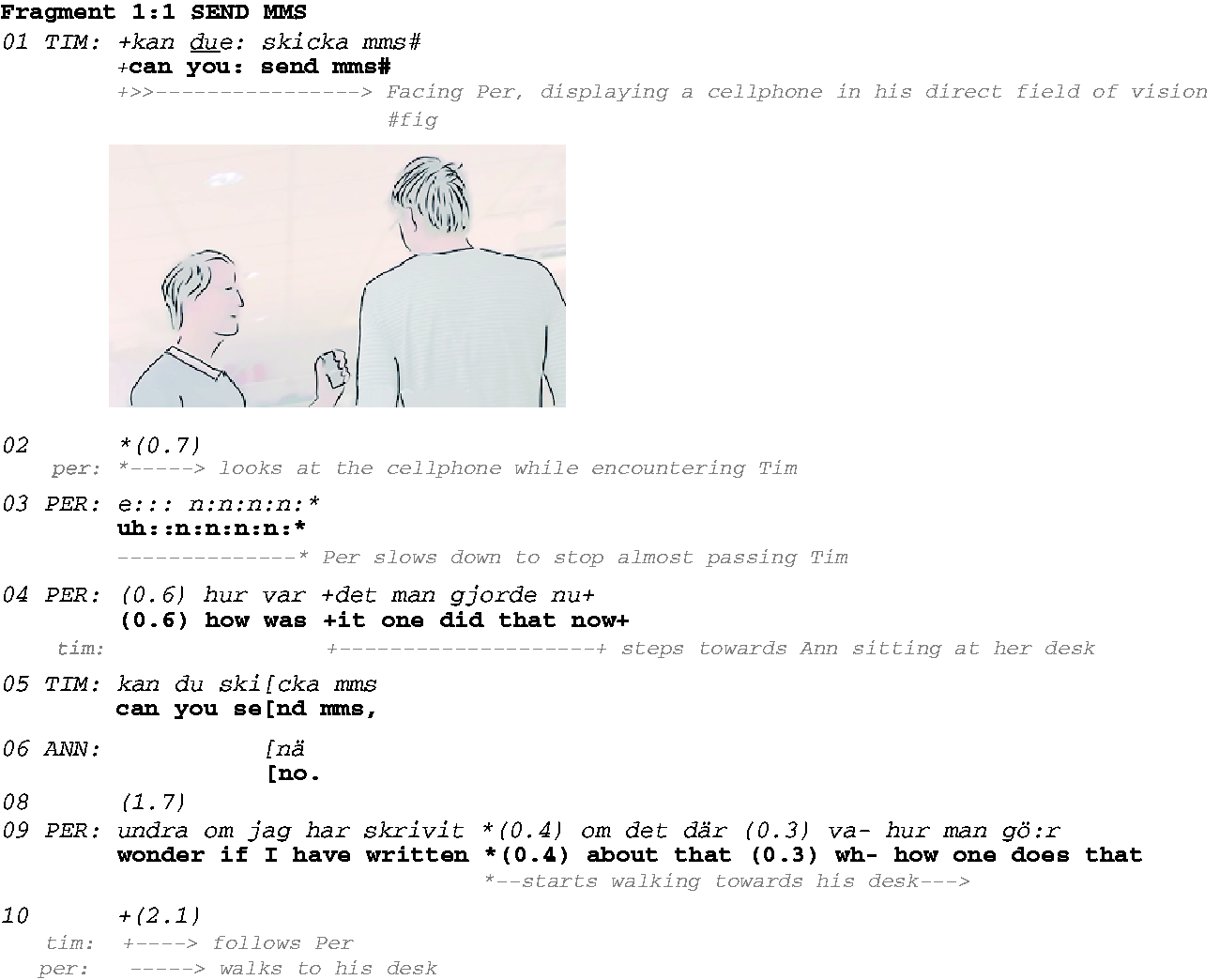
When Tim encounters Per, he issues a kind of a pre-request: asking if Per knows how to ‘send mms’, displaying the cell phone in Per’s field of vision (line 01). Tim’s orientation to the knowledge of the recipient is a way of addressing contingencies that may impact on the possibility of granting (Curl and Drew, 2008). Per’s knowing is treated as a precondition (Levinson, 1983) for his being able to grant the implied request. Even though Per slows down in walking speed, he almost passes Tim while responding verbally, with hesitation (line 03), starting with an ‘uh::’ followed by a repeated ‘n:’, as in no (Sw. nej). After a short 0.6-second pause, he then starts to think out loud: ‘how was it one did now’ (line 04). Notwithstanding this partial recovery from the projected negative response, Tim now turns to Ann’s desk instead (line 04), asking her the same question (line 05). Ann gives her response in overlap with the pre-request, a more obvious rejection, ‘no’ (line 06).
It is noteworthy how Tim’s efforts at finding a possible helper in the editorial room is done as a kind of proximate search. After his initial failure to procure Anders’ help, Tim issues his ‘can you send mms’ inquiry to two consecutive nearby colleagues. At this point, it appears that Tim has failed to find someone who can help. Per, however, re-engages, indicating that he might have relevant written instructions. He walks towards his desk, and Tim tags along. The sequence thus far provides an interesting case which might illuminate how a know-how question might function both as a pre-request in the traditional sense, and as an ‘initial request utterance that serves to deliver the entire activity of requesting’ (Fox, 2015). On the one hand, ‘can you send mms’ is readily answered with a ‘no’. No request utterance has been produced, and one might say that a dispreferred response has successfully been avoided. On the other hand, it is obvious from Per’s engagement that no further specification is needed for a granting response. Although Tim’s initial queries were bereft of accounts, he now expands (lines 13–14):
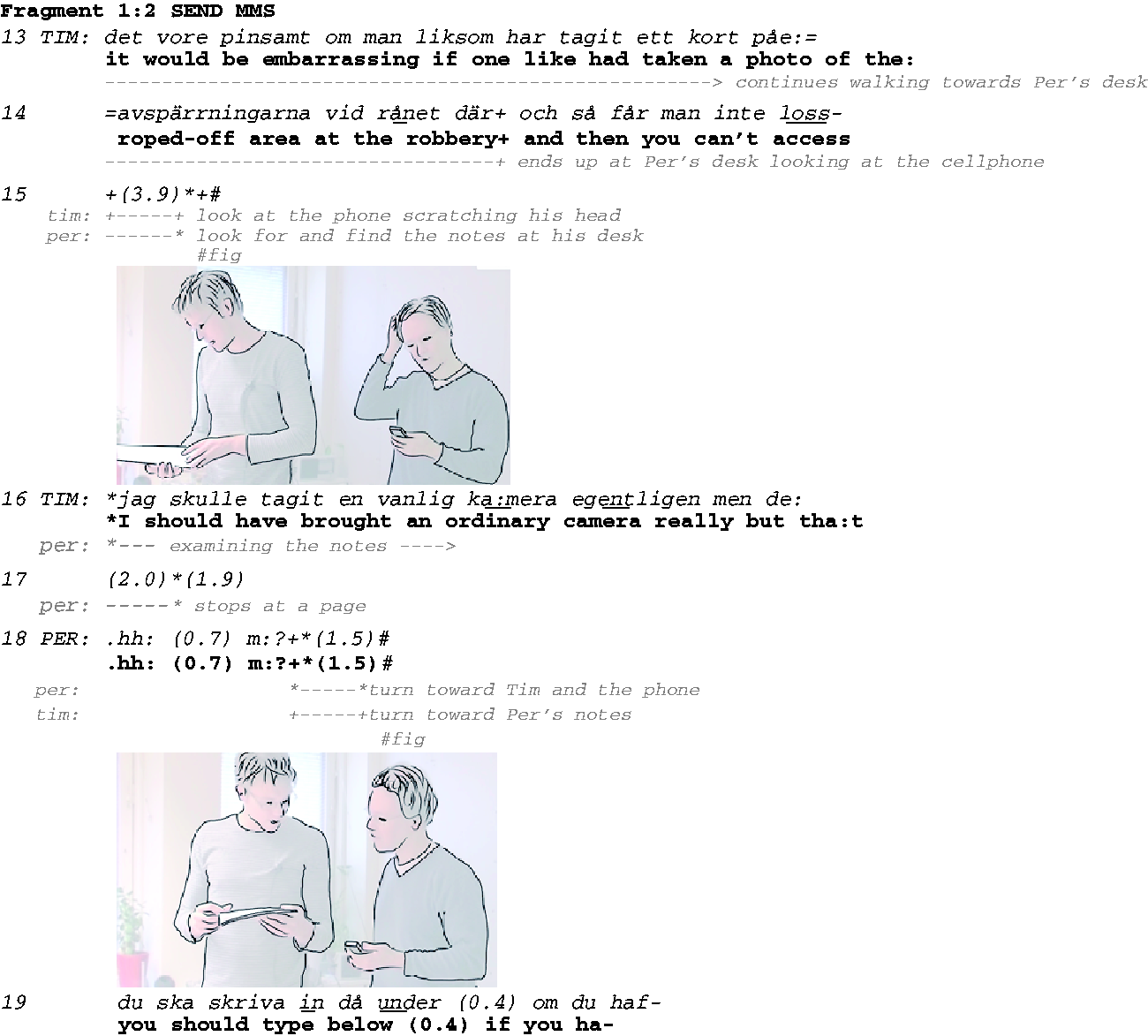
While Per looks for his notes (line 15), Tim continues the account, saying he should have brought an ordinary camera to the site, thereby taking on some responsibility for the situation. He ends with a disjunctive phrase ‘but tha:t’ (line 16) which projects an account for the omission. This account, however, is withheld, and so is any attempt at moderating his assumed responsibility. On the other hand, the definitive reference to the robbery treats the news item he is covering as something known-in-common, and the procurement of the images as relevant for the news section as a whole (to which Per also belongs). This concern with establishing legitimacy can be usefully compared with similar practices in other settings; patients presenting their problems as ‘doctorable’ (Heritage and Robinson, 2006), 911 callers presenting theirs as ‘policeable’ (Meehan, 1989) and so on. Whereas doctor–patient and citizen–police interactions centrally involve category-bound rights and obligations that are asymmetrically organized, Tim instead appeals to a shared project. Rather than orienting to the ways in which the trouble fits certain professional jurisdictions (e.g. the doctorable status of a patient’s concerns), the problem is here presented as collegial – this is ‘our’ problem. However, Tim must also account for his own inability to solve the problem; while its relevance is shared, the task is also one that normally does not require a team effort. We can understand Tim’s reference to not using an ordinary camera as addressing the aforementioned issue; these are somewhat unusual circumstances. The accountability of requesting assistance is thus addressed with reference to the shared collegial nature of the project to which the stalled task contributes, in combination with an account implying that it is not entirely obvious that Tim ‘should’ be able to solve the problem on his own. Of course, the fact that an account is provided shows that Tim does not take for granted his entitlement to assistance. The extent of Per’s engagement provides additional warrant for an account, since the provision of reasons can reflect perceived imposition (Baranova and Dingemanse, 2016). We could also note how Tim initially framed his request as a ‘quick question’, indicating an expectation that the issue might be swiftly resolved (see Licoppe et al., 2014), an expectation to which Per’s current efforts stand in some contrast. In the end, Per finds the relevant notes (line 18) and begins to engage in instruction (line 19).
Our next fragment has a more elaborate design; instead of a bare ‘can you send MMS’ type of utterance, the request is built in a step-wise fashion:
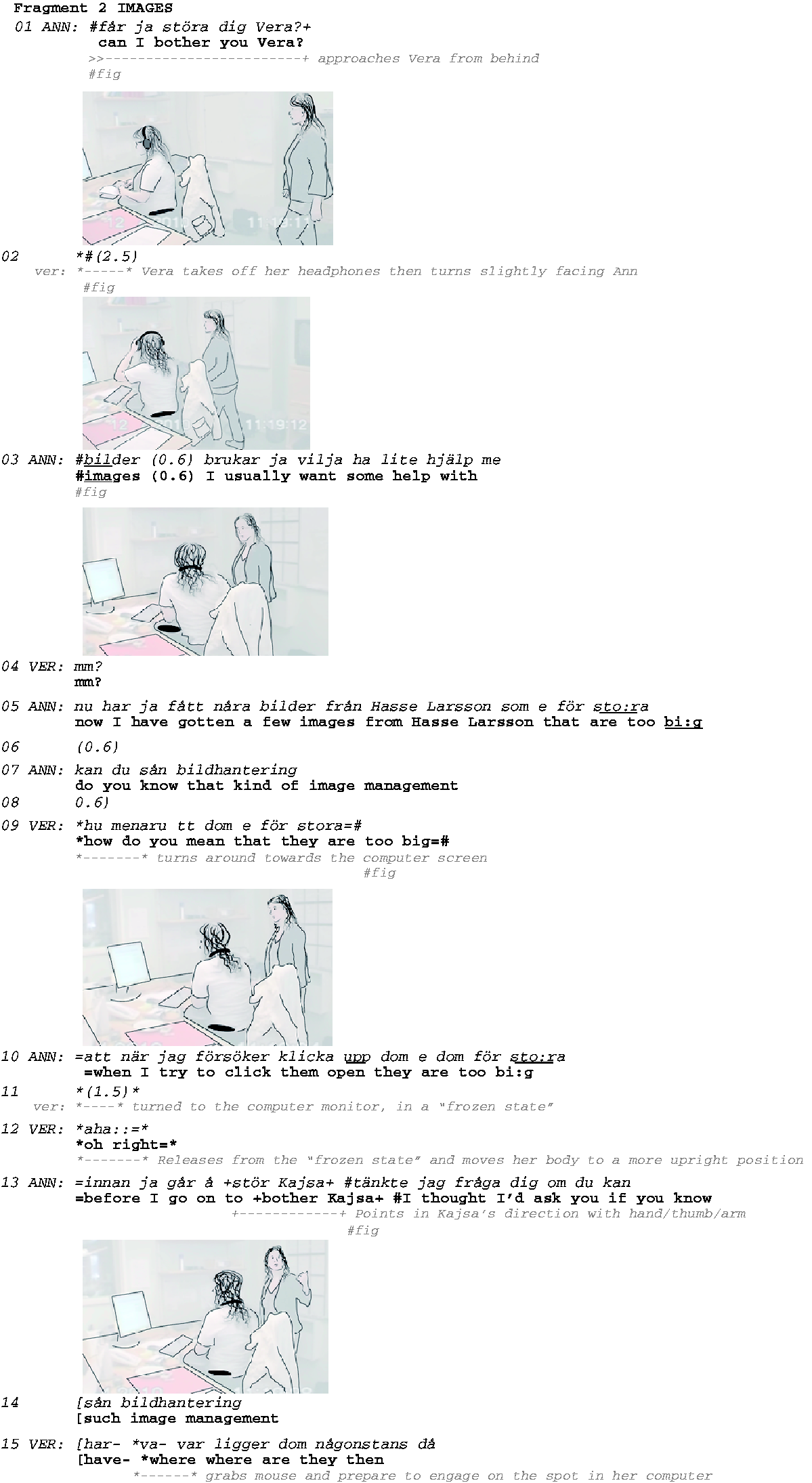
Walking up to the news desk, approaching Vera (who is wearing headphones) from behind, Ann says ‘can I bother you Vera?’ (line 01), which is received by an embodied go-ahead (Vera takes off her headphones and half turns towards Ann). By including the term ‘störa’ [bother] the request for availability is framed as a potentially complainable matter. Vera’s dismantling her current activity and turning towards Ann is at least taken as a permission to continue; at the establishment of eye contact, Ann begins to articulate a reason for the provisionally accepted disturbance. She refers to a recurrent (indicated with ‘usually’) need of help with images (line 03), and to the fact that she ‘now’ has received a set of images that are described as ‘too big’. Interestingly, through the shift from ‘usually’ (line 03) to ‘now’ (line 05), the present situation comes off as an instance of a recurrent type of situation, an observation to which we will return. The whole sequence thus far, lines 01–05, can be seen as comprising an extended pre-sequence to what turns out to be an instance of what we call a know-how question: ‘do you know that kind of image management’.
Despite its elaborate design, the sequence is not quite enough for Vera to immediately acknowledge (0.6-second pause at line 06) nor verbally answer (0.6-second pause at line 08). However, showing at least some preparedness to engage, Vera turns back to the computer screen while inquiring further into what Ann means (line 09). After a clarification and a pause (lines 10–11), Vera exclaims ‘aha::’ (line 12). Latching on to Vera’s expression of recognition, Ann produces an account, which can be tied to our question of how the relevance of the prospective helper is established. She places her current attempt to find help in the context of a hypothetical recruitment of another person ( ‘Kajsa’), the disturbing of whom is treated as somehow problematic. Thereby, Ann alludes to a kind of ‘proper sequence’ (Sacks, 1972: 41) organizing the search for help. The motivation for her presence at Vera’s workstation is, tying back to her earlier question, formulated as her being there to, ‘ask if [Vera] know[s] that kind of image processing’. Returning to the notion of reasons for requests (Baranova and Dingemanse, 2016), Ann here addresses an underspecification in the (pre)request with regard to social relations (Baranova and Dingemanse, 2016), that is, why Vera in particular is approached. In indicating her turning to Vera as a first attempt in a potential series, Ann highlights that finding a helper is done against the background of not knowing exactly who has the requisite knowledge. There is an explicit acknowledgement that a search is going on, a search which is also conditioned by an orientation to perceived imposition and proper sequencing.
Paying no explicit notice to, and overlapping Ann’s account, Vera begins to deepen her engagement in the task. Still turned to her work station, she asks about the specific location of the pictures, while grabbing the computer mouse (line 15). Granting of a request, inferable from the initial request utterance (cf. Fox, 2015) and the accompanying accounts, is thus underway.
Our final fragment in this section, where what we have termed searches are examined, has a slightly different design. Here, Bo is instructing a new member of the news team about the portable transmitters (HF/High Frequency) arranged near the News desk. At one point, Bo turns to Eva who is situated at the news desk:
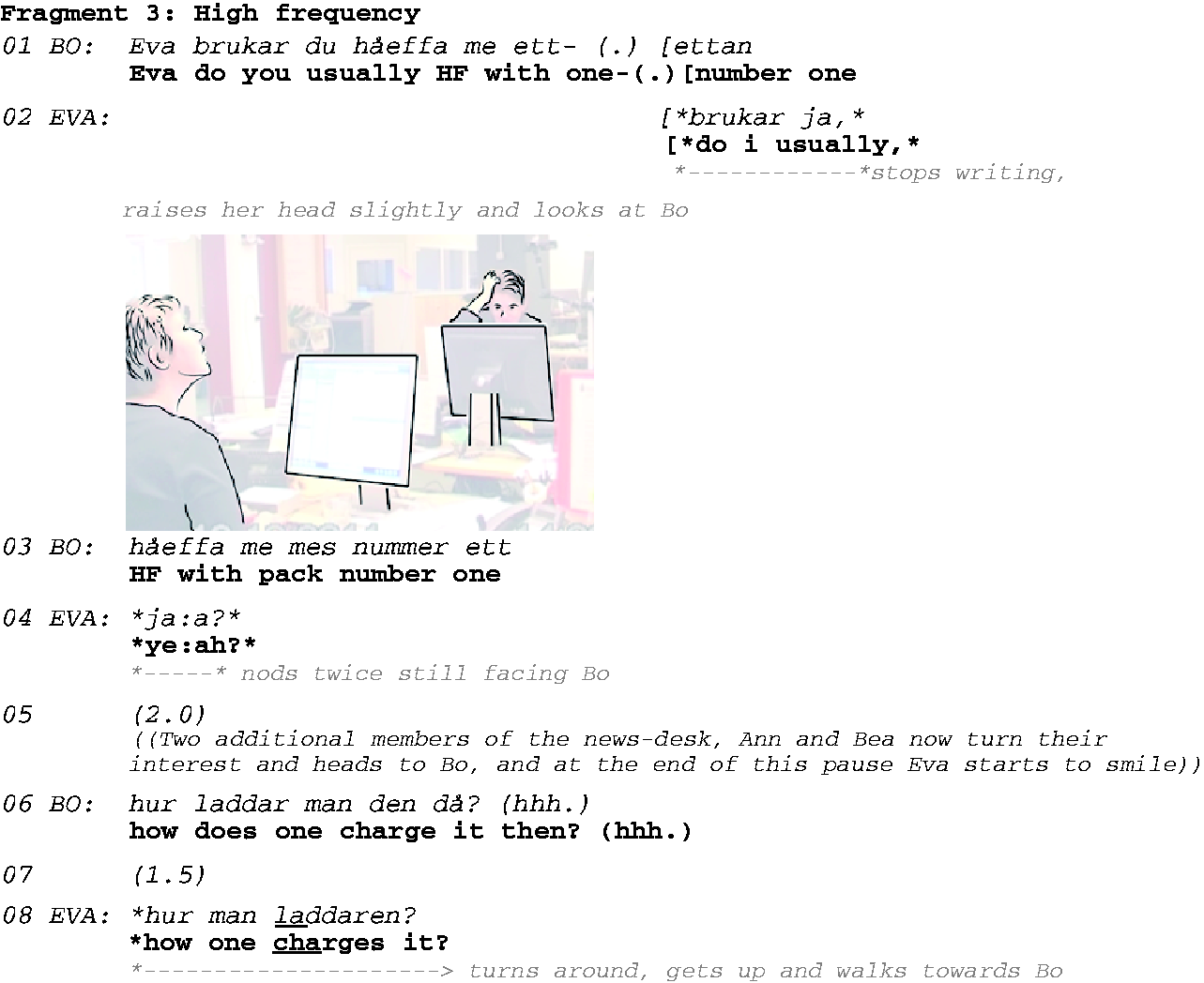
While it appears common in initiations with no prior immediate engagement that the knowledge of the recipient is explicitly probed, Fragment 3 is more indirect, in that Bo asks whether or not Eva is a regular user of a particular piece of equipment. After a brief repair sequence (lines 02–03), Eva replies. Interestingly, Eva does not treat this inquiry as a way of issuing a request (as in our previous fragments). Rather, she produces a somewhat hesitant type-conforming positive reply ‘yea:h?’ (line 04), and thereby puts Bo in a position where an articulation of the relevance and practical import of his question is made relevant. Eva’s reply is thus not only retrospectively oriented to the first-pair part represented by the question, but prospectively provides for a continuation foreshadowed by the initial question; turn 1–3 is explicitly treated as a preliminary to something else, as yet unknown. This uptake warrants a basic pre-request analysis of Bo’s initial request utterance (cf. Fox, 2015); the sequence does not progress to granting directly but instead to further articulations of Bo’s project. Although the video does not display what Bo is up to during the following 2 seconds, two other colleagues at the desk momentarily suspend their current engagements, and turn to look in Bo’s direction (line 05).
When it finally appears, the projected question – ‘how does one charge it then’ – is produced with a brief laughter token (line 06). Again, there is a pause, after which Eva smilingly repeats the question and gets up from her chair. Three observations can be made. First, Bo does not ask the question to everyone in the room but calls on Eva in particular. We cannot tell exactly why Bo turns to Eva; it might be some prior knowledge regarding her particular expertise or just the fact that she is facing in Bo’s direction. Regardless, Bo does not indicate an assumption that she knows, or that she is familiar with backpack number one. Thereby, the piece of knowledge that he apparently lacks is not treated as expectedly everyone’s possession. Second, turn 06 is formulated as a question rather than a request; ‘how does one charge it’, indicating the trouble that stalled Bo to be potentially resolvable swiftly and verbally. Nevertheless, it is treated by Eva as a request, rather than as an elicitation of a verbal description. Third, it is notable that the trouble is marked as a laughable, and as somewhat problematic, both in the delayed and breathy production of the question and in Eva’s somewhat amused response (with the repeat also marking the question as a trouble source).
We can now summarize some observations from our analyses of the current section, dealing with searches and know-how questions. First, all fragments begin with, or otherwise involve, some form of pre-request or initial request utterance (cf. Fox, 2015). This pre-request is typically a polar interrogative (e.g. ‘can you send MMS?’), which makes possible swift abortion of the sequence in case of a negative answer (illustrated by Tim’s consecutive questions in Fragment 1:1), and also dealing with the dispreferred nature of non-granting responses to requests (Drew and Couper-Kuhlen, 2014). In addition, the pre-request centrally involves an inquiry into the recipient’s competence or familiarity with a certain technology or technique – a know-how question. When the request explicitly indexes the recipient’s competence, the nature of the projected request appears to be inferred on the basis of the pre-request alone.
Established interactions and direct requests
The previous examples all show how journalists seek help with troubles encountered as part of their individual ongoing work. The issue of who to turn to, or in interactional terms, how to provide for the relevance of the person approached, is manifest in the design of the help seeker’s actions. Sometimes, however, the trouble is encountered in a context where there is some prior engagement with another person. Consider the following fragment:
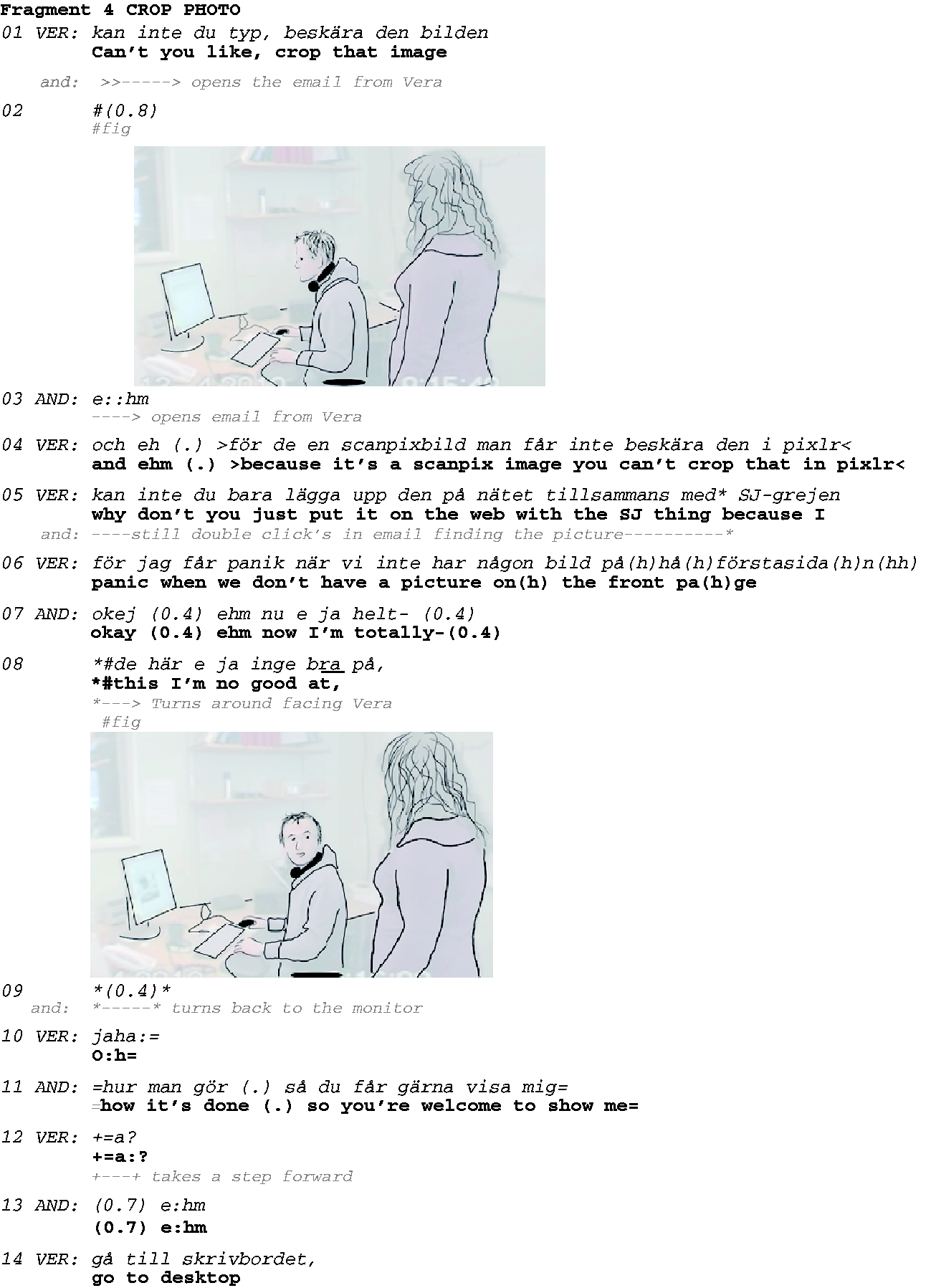
Prior to this sequence, Vera has approached Anders, reminding him of an email sent previously. As the email appears on screen, Vera produces the request ‘can't you like, crop that image’ (line 01). After an inserted account (line 04), she adds a further element to the request (line 05). As Urbanik and Svennevig (2019) have noted in a Norwegian context, ‘by selecting can-interrogatives of the pattern Kan ikke PRON (‘Can’t PRON’), speakers mark that they have reasons to believe that the indicated action can willingly be performed by their addressees’ (p. 114). There is nothing out of the ordinary with this kind of request, and Anders does respond with a word of acceptance, ‘okay’ (line 07). This is thus a point where the current encounter could relevantly dissolve. The ‘okay’ in line 07, however, is quite flat in tone and just 0.4 seconds later Anders continues, ‘now I’m totally’. This formulation is aborted. Instead, turning around, Anders delivers a specified indication of lacking competence: ‘this’, he is ‘no good at’ (line 08). Anders’ admission is received by Vera with an expression of mild surprise.
Anders’ explicit indication of lacking skill also casts light on the previous markers of hesitation, such as the ‘ehm’ on line 03. After a micro-pause (line 11), Anders continues with ‘so’, articulating what follows as a consequence of the prior indication of lacking skill: Anders produces an explicit request that Vera show him how it is done (line 11). Anders displays an embodied preparedness and orientation to the task at hand. Vera accepts promptly (line 12), after which Anders produces an ‘e:hm’ indicating this as a first point where he will be needing directions. Vera takes a step forward and provides an initial instruction (line 14).
The example above indicates that here is a slot for requesting assistance from someone right after that person has given you a task (there are at least two additional episodes with this structure in the data). There are, however, other forms of prior engagement that may shape how requests for assistance are done. The following extract (Fragment 5) is preceded by a sequence where the reporter Ann approaches the news presenter Sofia and asks her if she is in need of help, adding ‘because it’s soon you are going in’. This offer – apart from being prompted by Sofia’s unexpectedly not being in the studio at this time – can be further understood in relation to Sofia’s being a relatively inexperienced and temporary employee, while Ann is an experienced member of the news room. Rather than replying directly to Ann’s offer, however, Sofia begins to describe her current situation; the ostensive offer is thus proximally taken as an inquiry into why Sofia is not in the studio. While too lengthy to include here, Sofia’s explanation involves her having asked another colleague, Magnus, to record a voice piece in the studio. At the moment, she says, she is waiting for him to finish, and hoping he will finish on time. Line 01 is Ann’s immediate response:
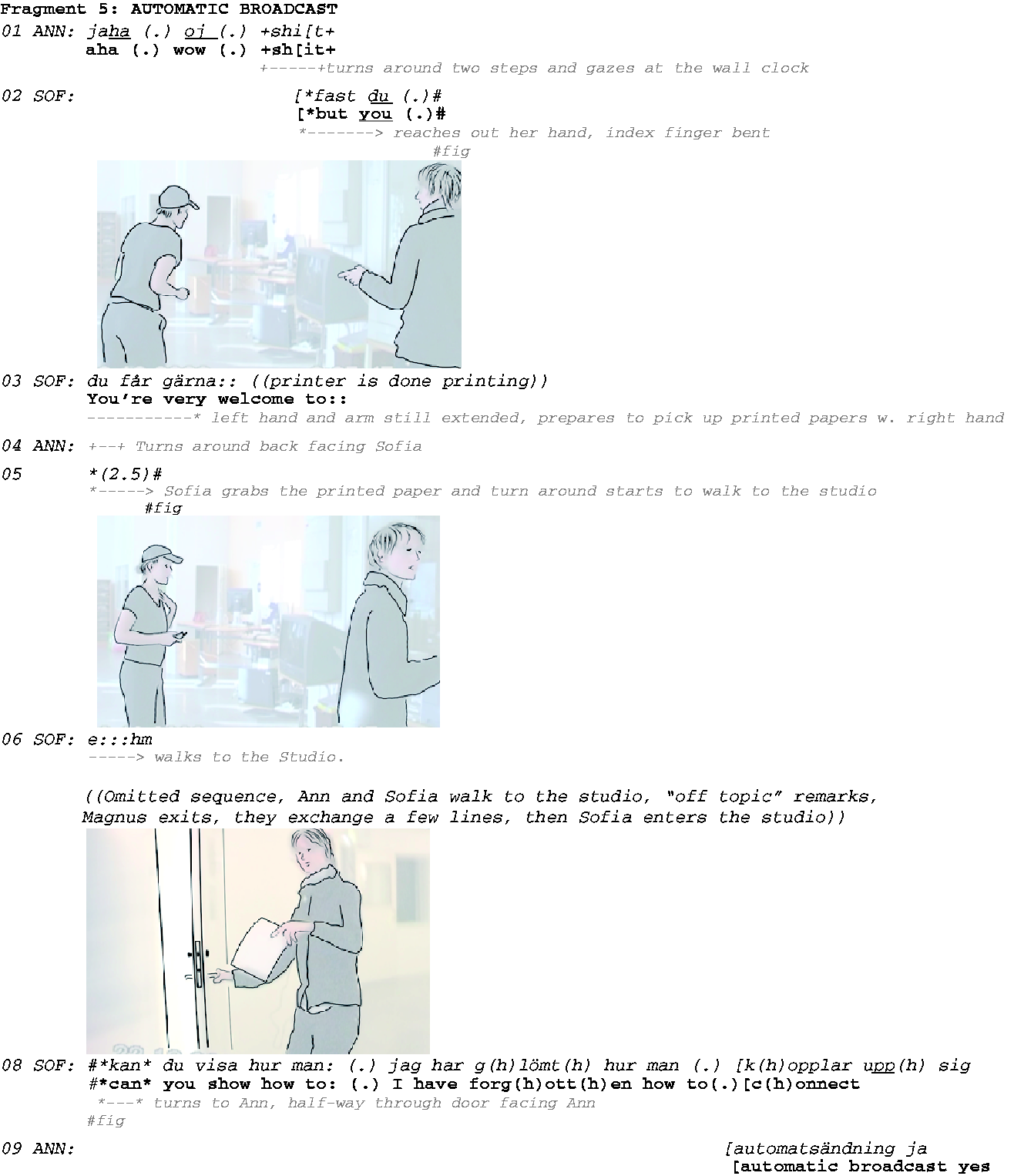
The assessment on line 01 establishes that the two colleagues have moved into a shared orientation towards and appreciation of Sofia’s situation, but there has as yet been no practical involvement of Ann in Sofia’s work. However, at line 02, Sofia launches a new topic, ‘but
A granting response follows without delay. Ann first produces, in overlap with the end of Sofia’s request, a label for the procedure which Sofia has trouble with, thus making explicit that she recognizes and understands the problematic situation. Then she begins providing verbal instructions, simultaneously performing some of the relevant actions herself. The time pressure is palpable in this situation, Ann needs to address not only Sofia’s not knowing, but also the task itself, one for which time is quickly running out.
The next, and final, fragment serves to illustrate how the eventual forms of involvement by the request recipient may be a negotiated and ‘repaired’ matter. The reporter Cecilia has called her colleague Eva over from the news desk. When Eva arrives at Cecilia’s desk Cecilia begins showing her a set of images on screen, which she says that she might use as a reporter for a programme. Cecilia also suggests to Eva that some of the images might be useful for the news desk as well, which brings to mind the ways in which a shared collegial relevance was indicated in Fragment 1:2. Then Cecilia introduces what seems to be her main objective and, as it turns out, her problem; how to make one of the pictures look ‘less grey’ (line 01):
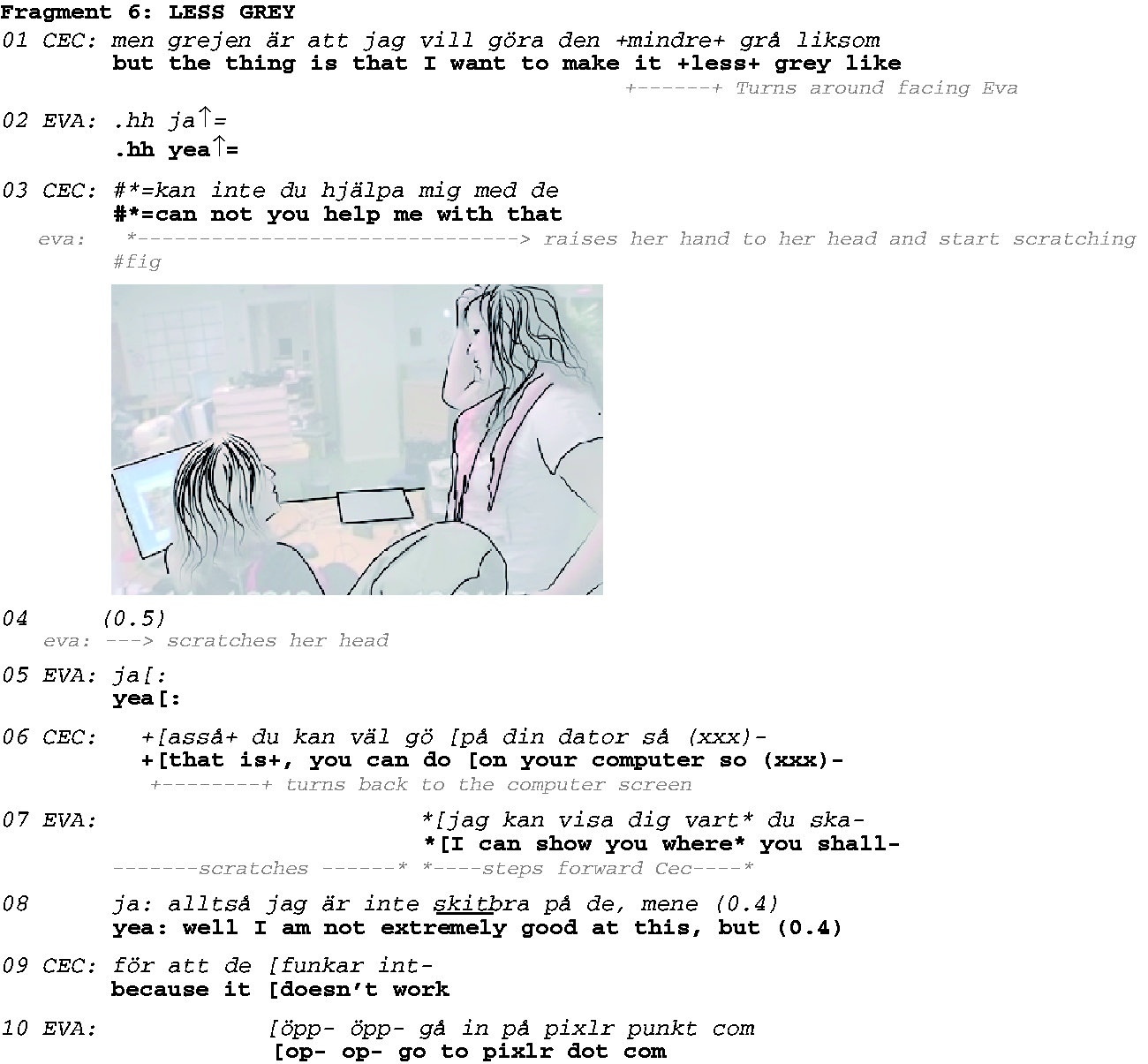
In line 02, Eva responds with a short ‘yes’, rising in intonation, hearable as a signal of recognition. In the next turn, Cecilia issues a request in a negative interrogative form (line 03). Such a form has in previous research been associated with a high degree of entitlement (Heinemann, 2006; Urbanik and Svennevig, 2019), that is, that the speaker has reasons to believe granting of the request will be forthcoming and unproblematic. There is no orientation to possible relevant contingencies, such as Eva’s knowledge, availability or willingness. Cecilia simply asks Eva to ‘help’ her. However, it is quite unclear what exactly Cecilia is asking Eva to do, apart from somehow being instrumental in making the images ‘less grey’. Unlike the majority of the instances we have analysed, Cecilia has not indicated any lack of skill or knowledge, neither pointed to any specific troubles, nor provided any other work-relevant accounts (time pressure, work load etc.), which would clarify what kind of assistance she expects. Perhaps reflecting these circumstances, Eva’s response (‘yeah’, scratching her head) is delayed and stretched, compared to the previous one, production features that display hesitation or reluctance to provide what is requested. In addition, ‘ja’ (yeah) is what Pomerantz (1984) terms a ‘sequentially weak agreement form’, that may be disagreement-implicative. Indeed, treating Eva’s response as a repair initiation, Cecilia produces a subsequent version of the request, dealing with the projected prospect of rejection (cf. Davidson, 1984). Beginning with the Swedish discourse particle alltså (that is/I mean), which signals clarification, she asks Eva instead to ‘do it on your computer …’. This attempted clarification, however, is pre-empted, as the concluding part of Cecilia’s utterance is overlapped by Eva’s response. Rather than simply complying, Eva says: I can show where. The interjacent onset (Jefferson, 1986) of this formulation is notable. What has been produced in the clear at the point of onset is ‘asså du kan gö-’ (I mean you can do), which does not specify the amount of effort required by Eva. Eva thus cuts short any further development of the request. This way of responding positions her ensuing assistance not so much as the straightforward granting of a request, but as an independent formulation of what she is prepared to do, in a sense treating Cecilia as having requested ‘too much’ when first asking Eva to help.
Interestingly, just before engaging in instruction at line 10, Eva adds a reference to skill (that she is not very good at it). We have observed that the interactional build-up of the instructional interactions we have examined include some topicalization of knowledge or competence; here, we have the initiation of an activity categorized as ‘showing’ which is not preceded by such indications. The accountability of instruction as an activity appears to make relevant some topicalization of the parties’ competencies. In particular, offering to show, or accepting such a request, implies a claim of knowledge with regards to the procedure in question. Here, Vera downplays that implication.
A final contribution by Cecilia provides a further increment to the request sequence. A reason for the request is offered: ‘because it doesn’t work-’ (line 09). Here, one could note that this reason-formulation is produced in the context of the recipient’s already apparent reluctance to assist on the requester’s terms; a reluctance which makes relevant further accounts and explanations by the requesting party. However, given the fact that an independently formulated offer of assistance has been provided, it is perhaps symptomatic that Eva pays no attention to the reason that Cecilia attempts to communicate. Eva produces her next turn, a first instruction, partly overlapping and cutting short Cecilia’s explanation.
Discussion
Our analyses indicate that a distinction can be made between two sequential environments: those characterized by search, with the help seeker looking for someone who could provide assistance, and those where a common orientation to the task at hand prefigures the request sequence. These two categories also seem to correlate with two different designs of requesting activities; know-how questions occur in searches, while direct requests (e.g. to show) occur in contexts of an established common orientation.
In searches, the interactions proceed to instruction without the need for an explicit request form. As Fox (2015) observes, ‘by virtue of the work they do in checking preconditions, pre-requests may get immediate granting of the desired action, without an overt request being produced’ (p. 42). The use of know-how questions can be understood in relation to the need for an opening; it is not only instruction that needs to be initiated, but also a focused interaction in the first place. Moreover, the relevance of the particular addressee (‘why you’) needs to be established. The know-how question thus constitutes an economical way of simultaneously initiating an interaction, addressing the accountability of intrusion and indicating what the upcoming interaction might involve.
The second sequential environment we identified was already established interactions. This environment was associated with a different practice compared to searches: direct requests to show. How can we understand the use of direct requests in situations of established mutual engagement? We said that the know-how question works in searches as part of an opening sequence. This means that the request can be done in an indirect way, as part of an action that also achieves the opening itself. No similar possibility to ‘package’ the request implicitly as part of an opening is available in situations of established mutual engagement. But the shift into an instructional interaction must still be achieved, and this in a context where other activities may be underway, and other next actions are projected. The action of requesting instruction must thus in these situations be responsive to particular conditional relevancies, rather than figuring as a sequence-initiating ‘first action’. This might account for the heightened directness of requests in these circumstances. In the Crop Photo fragment, for instance, a request has been issued (‘can't you like crop that image’), and a response to the request is therefore a relevant next action. The indication of lacking skill and the direct request to show thus serve to account for a non-granting response to a prior request, and suggests a new trajectory of the activity.
We also said that the know-how question is a way of establishing the relevance of the particular addressee. With already interacting parties, no such establishment is needed. The same goes in a sense for the accountability of intrusion; in the cases we examine, the preceding interactions have already established a joint attentiveness to a particular task. The work of pre-sequences in communicating the nature of the situation is not required either, and there is typically some prior display of familiarity or knowledge concerning the task or situation in question, alleviating the relevance of checking preconditions. In conclusion, established common engagement yields a relaxation of some of the requirements of indirection that engenders the sequential trajectories of searches. However, an ongoing interaction also means that some of the possibilities for indirection offered by the relative freedom of an opening sequence are not available to the requesting party. Crop Photo could serve as an illustration of the latter, while Automatic Broadcast (as detailed in the analysis) bears marks of the former.
We noted previously that research on requests for assistance has tended to focus on practical tasks, or alternatively, where knowledge is made relevant, on educational and support settings. The workplace setting can be said to be distinct in that the instructional interactions are assembled in the midst of ongoing work, which is often time-critical. It is therefore important to consider how participants deal with the relation between the practical task and the epistemic character of the trouble. One could say that requesting or otherwise indicating a need for assistance involves two crucial components: (1) a project and (2) a source of trouble. On the one hand, a person must communicate what it is that they are attempting to accomplish; on the other hand, in order for assistance to be provided, the cause of the trouble must be indicated. Together, these two components specify relevant granting responses. A particular granting action displays an understanding of the project, as well as of the cause. ‘Not knowing how’ is then a particular version of a trouble source that produces two remediables, as it were; a practical one, and an epistemic one. Granting responses can then either remedy the practical problem, or the epistemic cause of the problem, or both. Only remedying the epistemic trouble source, however, is usually not an option, because in workplace situations, there is no time out from the progression of work. By addressing epistemic causes of trouble through guided action or demonstration, one might achieve two things at once: remedying trouble in the interest of work progressivity and (potentially at least) remedying an epistemic trouble source, a generator of future disruptions.
One central question for this study is how instructional interactions are assembled in the absence of situated identities within which being instructed and providing instruction are legitimate category-bound discourse identities. A first gross observation is that initiating instructional interactions requires some interactional work and that various resources are drawn upon in this work; know-how questions in the case of searches, and requests to show with established interactions, but also indications of lacking skill, claims of having forgotten and various forms of more or less extended accounts. We could also turn to some details in the design of request utterances and the accompanying accounts. One observation is that the person requesting assistance recurrently makes some effort to particularize and delimit the problem, and the discourse identity of instruction–recipient that their request makes relevant. In Send MMS, for instance, the problem is framed as stemming from unusual circumstances (an unfamiliar type of technology). Having ‘forgotten’ indicates, in Automatic Broadcast, a momentary lapse resolvable through something like ‘being reminded’. In HF, the question concerns ‘back pack number one’, which is not even a category, but a particular item. Subtle perhaps, but in the Crop Photo fragment, the gap in the person’s competence is framed by a demonstrative particularizing reference to ‘this’ (de här) – as in ‘this I am no good at’ – which precedes the request to show. In Automatic Broadcast, the participants collaboratively construe the situation as being of a particular type; an ‘automatic broadcast’, and not a regular one. In various ways, these design features and accounts embody a recognition that the request is accountable, and thereby serve to shield off any potential implication that ‘being instructed’ is treated by the person as normal and as somehow category-bound. The Images fragment is an interesting divergent case in that an attempt is made to normalize a need for help. Crucially, however, it is at the same time stressed that the area where help could be considered normal is something in particular, namely ‘images’. In the final fragment, Less Grey, we noted that there were some indications of problematic uptake – hesitance and a reluctance to help on the requester’s terms. In light of the current discussion, we can understand this problematic uptake as prompted by the absence of any efforts at defining the limits of the proffered discourse identities of help recipient and help provider. In conclusion, an important element of the initiation of instruction in the absence of a corresponding standard relational pair appears to be particularizing and delimiting the problem. Thereby, instructional configurations are assembled as accountably momentary occurrences, and not as instantiations of recognizable situated workplace identities.
Footnotes
Declaration of conflicting interests
The author(s) declared no potential conflicts of interest with respect to the research, authorship and/or publication of this article.
Funding
The author(s) received no financial support for the research, authorship and/or publication of this article.