



Abstract
Applying conservation analysis, this article explicates the specific ways in which interruptions are strategized to adjust power relations in arbitration discourse. By analyzing the transcriptions of 18 authentic recordings of arbitration cases in Chinese mainland, this article ascertains the frequency and classification of interruptions, and further explains the discursive features of interruptions related to power. The analyses reveal that arbitrators in Chinese arbitral tribunals alternatively adopt the conflicting, conciliatory and emotional interruptions with/without discourse markers to represent variant degrees of arbitral power, satisfy the pragmatic needs of communication, and promote the arbitration proceedings. Discourse markers function as signals of interruptions and regulators of arbitral power, which are jointly adopted with interruptions by arbitrators to convey different communicative intentions. This study puts forward a new model of arbitrators’ interruptions and power which can be applied in the further studies of other professional domains, and the findings may have some important implications for arbitration discourse study in terms of the relationship between language and power.
Introduction
Considering the high costs, large time-consumption and complex procedures related to litigation, the proliferation of alternative dispute resolution (ADR) continues to erode the presumption that courts are the principal forum for dispute resolution in the past several decades (Alrasheed et al., 2023; Lee and Pak, 2020; McGregor, 2015). As one of the main forms of ADR, arbitration enjoys popularity in many countries including China which has been witnessing the increasing growth in the acceptance of arbitration as a method of domestic dispute settlement. In the arbitration process, the disputed parties voluntarily reach an agreement under a neutral third party’s adjudication rather than resorting to litigation (Wang, 2002). With the features of cost-effectiveness, high efficiency, and flexibility (Alrasheed et al., 2023), the arbitration contributes to resolving disputes, reaching an agreement and protecting disputants’ benefits to the utmost extent through the tripartite consultation. Therefore, in the context of ‘advancing law-based governance’ (依法治国) in China, arbitration has become a central element in the Reform of Diversified Dispute Resolution Mechanism (多元化纠纷解决机制改革). 1
Since ancient times, China has been greatly influenced by the Confucian conception that ‘harmony is precious’(以和为贵), and Chinese people would solve disputes through discursive intervention or negotiation by a prestigious third party (Ke, 2022). Thus, in Chinese arbitral tribunals (CATs), disputed parties are encouraged to accept a mediation before adjudication instead of resorting to court. The Chinese arbitration combined with mediation, known as ‘Oriental experience and wisdom’, deserves scrutiny, as it achieves a soft landing for dispute settlement and reflects the traditional Chinese culture of harmony and litigation-termination.
Arbitration is not only a legal activity but also a linguistic practice because it is proceeded, promoted, and finished via language, where arbitrators usually adopt multiple linguistic resources in different stages of arbitration to realize distinct communicative intentions. Undoubtedly, the appropriateness of the language used by arbitrators in practice will directly influence the efficiency of arbitration and quality of adjudication (Jiang, 2015). In general, as one of the discursive strategies frequently used by arbitrators in CATs, interruption has been proved to satisfy communicative goals in the professional discourse and adjust the power relations between the professional and participants (Lv, 2011; Ren, 2015), which is worthy of a special study. To this end, this study takes arbitrators’ interruptions as examples and aims to explore how arbitrators exercise power through interruptions to influence the parties involved in the desired direction in the context of CATs.
Literature review
Professional discourse studies
Professional discourse is defined as any semiotic forms constituted by and constitutive of social and domain-specific contexts, and used by professionals with special training in order to achieve transactional and interactional, as well as socialization and normative functions (Kong, 2014). Varied research has been conducted in a wide range of professional domains such as litigation, therapy, media, education, etc. (e.g. Grossi and Gurney, 2020; Hansson and Page, 2022; Ke and Zou, 2023; Li, 2022). In all these works, interaction is the focus examined for how specific practices of talk embody or connect with specific identities and institutional tasks (Heritage and Clayman, 2010). For example, by focusing on the turn-taking mechanism, how the tasks and substance of court business are transacted through interaction was analyzed (Atkinson and Drew, 1979). Similarly, the place of interaction among doctors in defining the construction of medical knowledge in the course of daily work in clinical settings was explored (Atkinson, 1995). Furthermore, how social meaning is discursively conveyed and inferred in particular interactions of workplaces was investigated (Holmes and Stubbe, 2015). These above studies illustrate the interaction patterns manifested in various professional verbal communications, and provide examples of the analytical method for future studies extending to new domains.
In particular, interruption has been largely investigated from different aspects in the research of professional interaction. For instance, some research has attempted to reveal the power asymmetries among judges, lawyers, and parties by examining the interruptions performed in courtroom trials (e.g. Gibbons, 2003; Goldberg, 1990; Liao, 2003; Liao and Gong, 2015; Lv, 2006; O’Barr, 1982). Other studies have differentiated the specific types of interruptions in doctor–patient communications, and further analyzed the factors influencing interruptions, such as gender, social status, culture, etc. (e.g. Li, 2001; Menz and Al-Roubaie, 2008; Stratfor, 1998; Yang and Li, 2019). Additionally, special attention has been paid to the research of interruptions occurred in political discourse which demonstrates how interruptions are deployed by politicians as communicative tactics to influence interactions and construct political identities (e.g. Baffy, 2020; Jacobsen, 2019; Timbay, 2021).
Although the professional discourse has been proved a fruitful area in which interruption has become a repeatedly discussed topic, little attention has focused on the domain of arbitration discourse and no recent studies analyzing arbitrators’ interruptions have been conducted.
Arbitration discourse studies
The existing studies of arbitration discourse have mainly focused on arbitral written discourse, that is, arbitration award. With particular focus on the international commercial arbitration, Bhatia et al. (2008, 2010, 2012) identified generic features of arbitration awards and argued that arbitration award is a complex discursive artifact with an increasingly conventionalized and codified genre. Following Bhatia’s serial studies, a number of scholars have examined arbitral texts in their own countries from different perspectives (e.g. Breeze 2016; Dhanania, 2008; Gotti, 2011; Malanczuk, 2008; Sato, 2008). Noteworthily, a few studies concerning arbitration awards in the Chinese context have been very promising. For instance, the generic analysis has been conducted to Chinese arbitration awards, which were proved to be highly standardized, rigorous, and fixed in terms of the rhetorical structure, and stylized but widely-recognized in the linguistic expression (Han and Li, 2011; Jiang et al., 2014). Subsequently, further exploration on this topic found that the reasoning process of arbitration award can be achieved by means of cohesive devices, including explicit cohesive devices (e.g. substitution, continuity, and supposition) and implicit cohesive devices (e.g. the continuous thematic-progression pattern, the same theme pattern) (Jiang and Yang, 2016), and the author’s identity in arbitration award can be constructed by the formulaic language (e.g. the organizational identity is realized by the collocation with verbs, while the social identity is realized by phrasal structures) (Jiang and Li, 2017).
Although the written arbitral texts are analyzed worldwide, it remains unclear how the verbal languages function in arbitral tribunals. In the Chinese context, arbitrators’ discourses convey their intentions of resolving disputes more explicitly than arbitration awards, and reflect even better the traditional cultural concept that ‘harmony is precious’ rooted deeply in the minds of the Chinese people. Therefore, a pressing challenge for the arbitration discourse research in China consists in thorough investigation of arbitrators’ discourses that manifest distinctive regional language and cultural differences.
Therefore, this study attempts to bridge the gaps among previous studies by using conversation analysis (CA) to examine arbitrators’ interruptions in CATs. Specifically, this study aims to answer the following research questions:
(1) What are the characteristics of arbitrators’ interruptions in CATs?
(2) How do these interruptions reflect arbitrators’ power in CATs?
(3) How do the signals of interruptions-discourse markers help arbitrators to interrupt successfully and manifest their arbitral power?
Analytical framework
Interruption as a speech act
The definition of interruption proposed from CA perspective is widely accepted as an invasion of the current speaker for stopping him/her finishing the conversation turn naturally (Alvarez and Coiera, 2005; Liao, 2003; Lv, 2011). However, informed by Speech Act theory, this study views interruption as a speech act. Austin (1962: 108) proposed the Speech Act theory by distinguishing three aspects of one speech act: the locutionary act (the performance of an utterance), the illocutionary act (expressing intention of the utterance), and the perlocutionary act (the actual effect of utterance to listener). According to the illocutionary force, Austin (1962: 150–156) further distinguished speech acts into five general classes among which exercitives are the exercising of powers, rights, or influence. In this way, the interruption can be regarded as an exercitive act which contains the locutionary act, the illocutionary act, and the perlocutionary act at the same time. To be specific, the interrupter invades the current speaker’s utterances by uttering a certain sentence with a certain sense and reference, hereupon the locutionary act is completed. The interrupter’s utterances do have a certain (conventional) force to manifest his/her intention, such as informing, ordering, warning, etc., sequentially realizing the illocutionary act of the interruption. Meanwhile, the perlocutionary act of the interruption is triggered for the interrupter to achieve a certain effect to the listener, such as convincing, persuading, misleading, etc. By using interruptions as exercitives, interrupters can ‘compel’ or ‘allow’ or ‘not allow’ others to do certain acts (Austin, 1962: 154). The notions of exercitives with three kinds of speech acts provide a new perspective for us to examine interruptions. Thus, this study takes the interruption as one kind of speech act and attempts to examine the illocutionary force of it.
Traditional interpretations of interruptions have associated them with the exertion of power, control, or domination by the interrupter over the interruptee (Ferguson, 1977; Goldberg, 1990; Jacob, 1974; Mishler and Waxler, 1968). Zimmerman and West (1975) even proposed that all interruptions are universally considered as power displays. However, a number of researchers have questioned the one-sided interpretation of interruptions, believing that the nature and impact of an interruption would be influenced by various factors, such as the interactants’ rights and obligation (Edelsky, 1981; Goldberg, 1990; Murray, 1985), culture (Li, 2001; Zupnik, 2000), gender (Stratfor, 1998), etc. Besides functioning as power devices, some interruptions may convey interrupter’s rapport, cooperation, or solidarity with the interruptee. Thus, researchers have put forth a more balanced view on interruptions and categorized them into two main categories with different terms (Li, 2001). For example, Bennett (1981) distinguished interruptions as conflicting and less conflicting, while Kennedy and Camden (1983) characterized them as disconfirming and confirming. Goldberg (1990) preferred the terms power and non-power, Murata (1994) favored intrusive and cooperative, whereas Ng et al. (1995) adopted disruptive and supportive. In general, all interruptions have the potential to be disruptive in form, but some of them are supportive in essence. Depending on their functions assumed in the context, interruptions may be power-related or non-power-related (Dunne and Ng, 1994).
Inspired and informed by these studies, we divide arbitrators’ interruptions in CATs into three categories: conflicting interruptions, conciliatory interruptions, and emotional interruptions (see Section ‘The model developed in this study’.).
The correlation of interruption with power and DMs
Power is multi-faceted with many different forms (Thornborrow, 2002). This study follows the conceptualization of power in institutional interaction proposed by Ren (2015, 2018) who views power as a dynamic relationship among interactants driven by the pragmatic needs of communication and constructed through discourse, including institutional power and personal power. The former relates to the ‘rights’ and ‘obligations’ given and expected by institutions for the participants to have (Thornborrow, 2002), while the latter relates to ‘personal attributes and capabilities’ of participants (Rogers, 1977). Personal power enables arbitrators to act professionally whereas institutional power authorizes arbitrators to act professionally upon the other participants (Chiang, 2009).
The interruption has been confirmed as an indicator of power relations between speakers (Zimmerman and West, 1975) and regarded as one way of power construction (Paramasivam, 2007). Within the context of CATs, arbitral power is ‘relational, dynamic and contestable’ (Locher, 2004). On one hand, arbitrators possess high arbitral power by default due to the ascribed ‘institutional power resources (positions, professional expertise, etc.)’ they have (van Dijk, 1993). Interruptions thereby can be seen as legitimate for them but not for other participants in CATs. On the other, to meet certain communication needs, the operation of interruptions will transform the arbitrators’ ‘default power’ into ‘variant power’ (Ren, 2015, 2018). 2 Therefore, interruption is always both power shaping and power shaped in some degree.
Notably, this study takes discourse markers (DMs) as essential parts of interruptions. The discourse marker is the sequentially dependent element which brackets unites of talk (Schiffrin, 1987: 31), often being used to make utterance coherent, imply speakers’ affect and attitude, and help listeners understand the context and obtain the information (Ran, 2000: 8–14). As noted in previous studies (He, 2012; Xu, 2009; Zhang, 2006), DMs conveying the intention or meta-pragmatic awareness of ‘interruption’ are used to terminate others’ discourses and display power. Drawing on these opinions, we find that arbitrators in CATs also interrupt others with trigger signals presented as DMs verbally, aiming at calling participants’ attention and paving the way for interruptions (Zhang, 2006). Therefore, the involvement of DMs as part of interruptions in CATs will facilitate the illumination of arbitrators’ interruptions and power.
The model developed in this study
Adopting a CA approach, this study focuses on arbitrators’ interruptions and power in CATs and builds a model involving interruptions, power and DMs as the analytical framework, shedding light on the arbitration discourse study (see Figure 1).
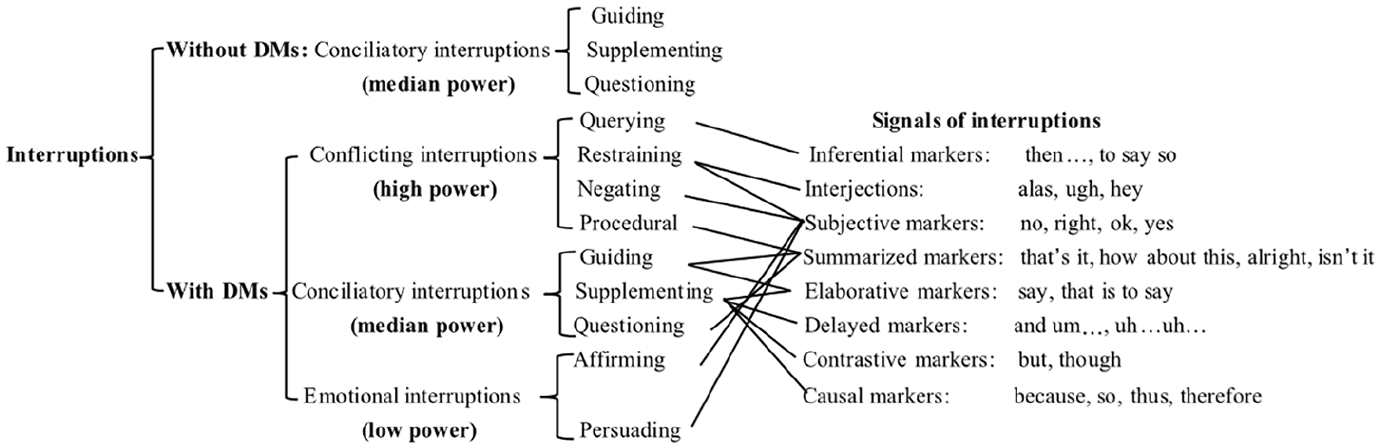
The model of arbitrators’ interruptions and power in CATs.
As mentioned in Section ‘Interruption as a speech act’, three categories of arbitrators’ interruptions in CATs are identified: conflicting interruptions, conciliatory interruptions, and emotional interruptions. Each category of interruptions constructs and adjusts the power exerted by arbitrators (indicated in bold). Given the multifunctional nature of interruptions, we must be able to distinguish between those interruptions seemingly motivated by the interactional rights and obligations of the moment, and those seemingly produced to satisfy personal or interactional wants or needs (Goldberg 1990). Therefore, three categories into nine sub-categories of interruptions are further specified to make explicit the pragmatic functions. Moreover, since DMs are the signals of interruptions and starting interruptions with DMs is the dynamic adaptation to Chinese arbitral context, thereby we summarize eight types of DMs related to interruptions in our data. However, arbitrators sometimes interrupt directly without DMs, and these interruptions are mainly conciliatory interruptions.
Methodology
Data collection
Few studies on arbitration discourse have been conducted in linguistics, partially because the first-hand resources are rarely accessible due to the confidentiality of arbitration procedure. Fortunately, this study has been strongly supported by the Arbitration Committee of Chongqing, China. With all the participants’ consent, we collected the recordings of eighteen authentic civil and commercial arbitration cases during the last 3 years. Since the language used in arbitral tribunals was Chongqing dialect, we invited five local scholars majored in linguistics to make preliminary transcription and complete proofreading a week later. It is noticeable that some private information mentioned in arbitral tribunals, such as the names of participants and companies involved or the details of address, were replaced by the marker ‘X’ at the time of transcription in order to protect individual privacy and rights. Then we constructed a mini spoken corpus with 158,992 Chinese characters for further analysis.
Data analysis
This study applies mixed method combining qualitative and quantitative methods. We first used the software UAM corpus tool (version 3.3) to construct a tree diagram of interruptions with/without DMs used by arbitrators in CATs, and then manually annotated each category and sub-category of interruptions and DMs by triangulation. Next, three different degrees of power (high, median, and low) were respectively tagged to each category of interruptions in the same way. At last, the software ANTCONC (version 3.2) was used to extract these annotated data, and then SPSS (version 26.0) was used to calculate the frequency of them. The results of quantitative analysis provided mass data and linguistic facts for qualitative analysis to figure out the specific features of interruptions with/without DMs, and further explained the discrepancies of different interruptions represented by variant degrees of power.
Analysis
In the context of CATs, three categories of interruptions used mostly by arbitrators are summarized and presented in Figure 1 (see Section ‘The correlation of interruption with power and DMs’), namely conflicting interruptions, conciliatory interruptions, and emotional interruptions. In order to present each category of arbitrators’ interruptions clearly with power and DMs, we calculated the frequencies and produced the results in Figure 2. The following section elaborates each category of interruptions with examples. All the examples involved are translated from Chinese into English.
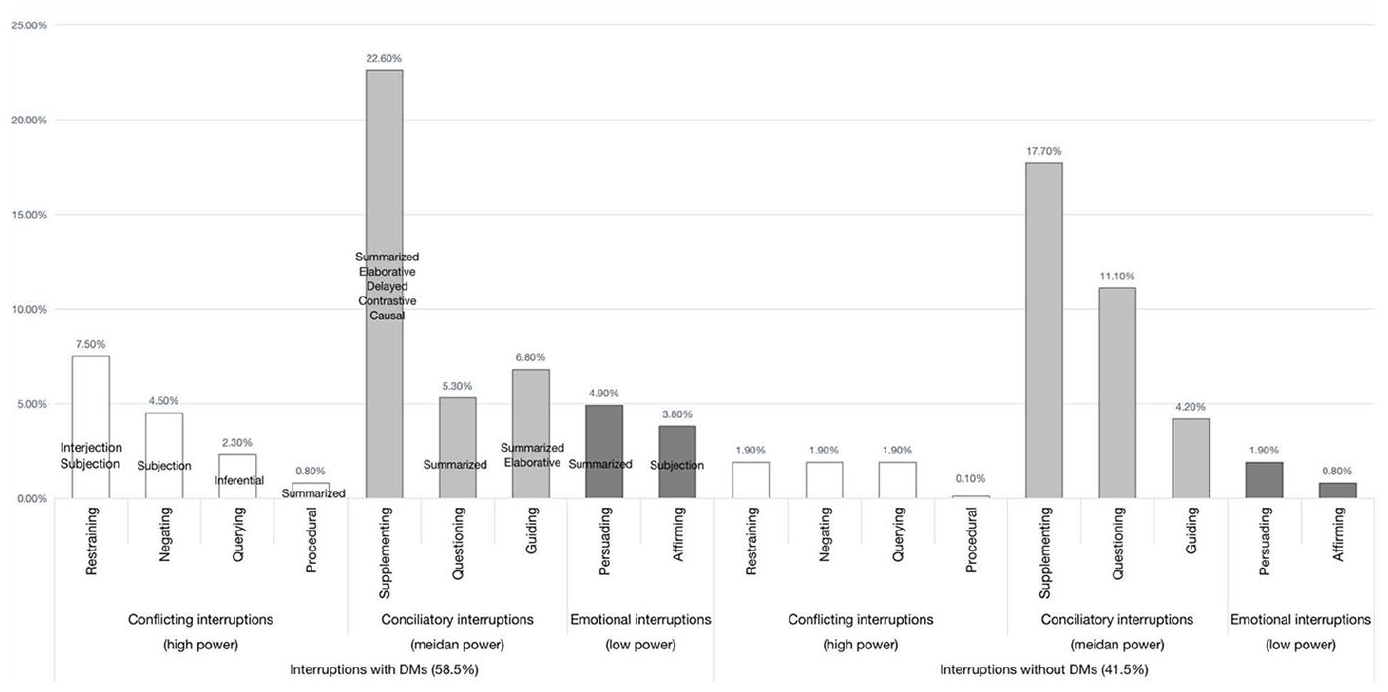
Frequencies and percentages of arbitrators’ interruptions in CATs.
Interruptions without DMs
In a few cases, arbitrators adopted interruption without any DMs, which is short but powerful, undoubtedly usurping the current speakers’ turn and control the discourse.
In Figure 2, the percentage of arbitrators’ interruptions without DMs in CATs is 41.5%, mainly concentrating on the conciliatory interruptions of median power. Among them, the supplementing interruptions without DMs remain the most popular ones (17.7%), followed by questioning interruptions (11.1%) and guiding interruptions (4.2%). The statistical results show that arbitrators often disrupt the current speaker’s ongoing turn and express their views directly without giving any hints of DMs. The previous study has confirmed that DMs have the functions of introducing and justifying interruptions (Waltereit, 2002). However, arbitrators apply interruptions without DMs in some cases, indicating that they have presupposed the justification of these interruptions and have used them strategically to further control the direction of discourse and dominate the substantive conversation. Therefore, interruptions without DMs can be seen as the opportunities for arbitrators to display their high arbitral power and authority in CATs. For example:
As can be seen in extract (1) above, the arbitrator interrupted the plaintiff twice by questions without any DMs. First, the arbitrator used an open question to require the plaintiff to provide the specific amount of project funds. Second, the arbitrator used a close question to ask whether migrant workers accused him to superior authorities or not. The rhetorical question ‘Haven’t yet?’ followed indicates that the plaintiff’s answer has already been presupposed by the arbitrator; thereby, his discourse has been controlled. Consequently, arbitrators’ interruptions without DMs carry a direct and tough tone and are clear-cut yet powerful, which limit the content of disputants’ utterance successfully and guide the directions of discourse while revealing arbitrators’ institutional and personal power in CATs.
Interruptions with DMs
In most cases, arbitrators employ interruptions with DMs to initiate a conversation for the purpose of capturing disputants’ attentions while realizing the coherence of discourse. As shown in Figure 2, the interruptions with DMs (58.5%) include conflicting interruptions, conciliatory interruptions, and emotional interruptions which may vary with respect to the relative power of arbitrators and disputants. Considering the numerous types of DMs in Chinese with multiple variants, we retain the Chinese forms of DMs with the English translations in the following discussions.
Conflicting interruptions of high power: direct expression, tough tone, high coerciveness, and face-threat
Conflicting interruptions in CATs are forced invasions of disputants’ turn for refuting their views urgently, which are thereby treated as acts of conflict, competition, or non-involvement (Lv, 2005: 22–26). Generally, perceived as impolite, intrusive, and inappropriate, these interruptions convey the arbitrators’ antipathy, aggression, dislike, apathy, and impatience toward the disputants and/or the talk at hand, and demonstrate their negative rapport with disputants (Goldberg, 1990). Such seemingly illegitimate interruptions, however, could be justified as well-planned discursive strategies to control the conversational process and/or content due to arbitrators’ great power endowed by arbitral tribunals. As a result, the disharmonious communications caused by these interruptions might be exactly avoided.
According to Figure 2, this category of interruptions occupies 15.1%, including restraining interruptions (7.5%), negating interruptions (4.5%), querying interruptions (2.3%), and procedural interruptions (0.8%), with which the DMs involved are interjections, subjective markers, inferential markers, and summarized markers. Among these sub-categories, restraining interruptions and procedural interruptions are designed by arbitrators to wrest the discourse by gaining control of the arbitral process, to identify their authoritative role, and to show strong institutional power. Here is an example:
Extract (2) happened at the end of dispute-debate stage when the arbitrator asked the defendant about his mediation willingness. In this occasion, the defendant failed to reply directly, but repeated the known information instead. Thus, the arbitrator was institutionally authorized to give a restraining interruption for stopping the defendant striking up the same old tune. By using these restraining interruptions, an arbitrator defines his/her institutional power that underlines his/her institutional obligations in CATs. Meanwhile, the interjection ‘ugh’(哎呀) is expressive, demonstrating both the textual function as topic denial and the interpersonal function as attitude expression (Kuang and Cao, 2022: 69). It elicits the upcoming negative discourse ‘please don’t say “but” anymore’ and intensifies the arbitrator’s impatient attitude conveyed by the interruption.
Sometimes, arbitrators initiate procedural interruptions to prevent disputants’ procedure rule-breaking and improve the efficiency of the arbitration. As reflected in extract (3), the intense debate does not cease with the dispute-debate stage ending, which violates the established procedure and causes adverse effects to alleviate the disputes as well. Taking responsibility for controlling arbitration process, the arbitrator interrupted disputants’ ill-timed debate with summarized markers ‘alright’ (好了) for reiterating the arbitration procedure and maintaining the arbitration rules. The discourse marker ‘alright’ (好了) in this extract functions as an end tag (Zhang, 2012: 66), indicating the arbitrator’s negative attitude toward disputants’ debate and eliciting the dissuasion to them ‘you two stop debating’. In institutional interaction, speakers orient to, and produce the various rights and responsibilities associated with their institutional roles (Heritage and Clayman, 2010). Therefore, procedural interruptions highlight arbitrators’ institutional roles and responsibilities by which arbitrators exercise strong institutional power to manage the proper progression of the arbitration and maintain their authorities in CATs.
Admittedly, the interruption is a practice for doing disagreements and arguments (Hutchby, 1992). As such, arbitrators adopt negating interruptions and querying interruptions to deny the contents of disputants’ utterances, present opposite arguments, raise doubts, or bring into question the disputants’ opinions or assertions (Gnisci et al., 2012). Usually, the DMs accompanied with these two sub-categories of interruptions are subjective markers with negative words and inferential markers, such as ‘then. . .’ (那. . .), ‘to say so’(这么说). For examples:
In extract (4), the plaintiff moved the conversation on to irrelevant topics all the time rather than offer sufficient information required by the arbitrator. Thus the arbitrator interrupted her utterance twice with the subjective marker ‘no’(不) which strengthened the arbitrator’s negative attitude toward the plaintiff’s responses. By doing so, the arbitrator constrained both the direction and substance of the discourse, and further gave explanations as professional obligation to help the plaintiff avoid unnecessary misunderstandings and unwanted responses. From this, the arbitrator clearly defined his personal power as legal expert in CATs.
In extract (5), the arbitrator raised doubt about the value the plaintiff putting on the public house, and thereby disrupted the plaintiff’s discourse with a querying interruption which implied his skeptical attitude toward the reliability and credibility of testimonies. The inferential marker ‘then. . .’ (那. . .) is the logic inference based on the preceding discourse (usually the discourse of opposite side) (Yu and Wu, 2013), eliciting the real discourse content in doubt ‘the public house even older would not be so worthless’. The arbitrator’s querying interruption is derived from his personal belief and knowledge. Thus he could question others without being questioned in CATs, and justify his querying interruption as required in order to ascertain the dispute-facts and discern the truth in a limited time. In this sense, what is crucial for the operation of querying interruption is the arbitrator’s personal knowledge that informs his personal power.
Admittedly, conflicting interruptions are intrusive, aiming at discourse control, floor-taking, disagreement, or doubt-raising, thus threatening the ‘territory’ of the speaker (Murata, 1994). With DMs, they are usually expressed with a tough tone, demonstrating high coerciveness and face-threat. However, the implement of this category interruption stems from the high arbitral power ascribed by arbitrators, consisting of the high institutional power authorized by the institutional rights and obligations, and the high personal power manifested through the professional expertise and knowledge. Arbitrators represent their institutions that grant them the arbitral power to perform conflicting interruptions upon disputants. Therefore, conflicting interruptions in CATs are legitimated as carefully designed strategies for arbitrators to control discourse and maintain arbitrating order, which are received submissively by disputants as taken-for-granted authority.
Conciliatory interruptions of median power: euphemistic tone, moderate coerciveness, and face-threat
Conciliatory interruptions are viewed as acts of collaboration, cooperation, and/or mutual orientation, which take place when arbitrators join the disputant’s utterance by filling in information gaps, elaborating on the disputants’ topic or theme and supplying a word or a phrase for which disputants are searching, or even completing it for them (Goldberg, 1990; Murata, 1994). By applying this category interruption to realize above pragmatic functions, arbitrators exhibit their professional qualities and capacities that inform their personal power. Compared with the ‘conflicting’ or ‘intrusive’ nature of conflicting interruptions, conciliatory interruptions appear to be more ‘cooperative’ and are characteristically less coercive and face-threatening (Murata, 1994; Yang and Li, 2019). From Figure 2, the proportion of this category takes up 34.7% in all interruptions, with supplementing interruptions (22.6%), questioning interruptions (5.3%), and guiding interruptions (6.8%).
Supplementing interruptions apparently become the most dominant sub-category in CATs with which DMs are varied, mainly including elaborative markers ‘that is to say’ (就是说), summarized markers ‘how about this’ (这样吧), delayed markers ‘uh. . .uh. . .’ (这个. . .这个. . .), contrastive markers ‘but’ (但是) and causal markers ‘because’ (因为), ‘so’ (所以). Here is an example:
In extract (6), probably because of his poor language competence, the defendant cannot make his statement understood fully by the arbitrator in a short time, the arbitrator thereby interrupted him twice with the same elaborative marker ‘that is to say’ (就是说) to supplement the missing information and summarize important points. Generally, participants in speech conversation who mutually maintain each other’s face for politeness, tend to use self-repair instead of other-repair (Schegloff et al., 1977). But in this instance, the arbitrator triggered other-repair by the elaborative marker ‘that is to say’(就是说) to underscore his personal power in CATs and more or less threaten the defendant’s face.
In some cases, the disputants with low literacy may usually make the mistake of giving irrelevant answers (Lv, 2011), as reflected in extract (7). The arbitrator required the plaintiff to provide more evidences, but the plaintiff gave an irrelevant answer and repeatedly stressed ‘the contract’, consequently being interrupted by the arbitrator with an elaborative marker ‘say’(就是). The guiding interruption was to display the arbitrator’s personal concern about the ‘detailed list’ and directed the plaintiff’s topic away from ‘the contract’ to the ‘detailed list’. Instead of directly asking a question, the arbitrator prefaced the ‘detailed list’ with elaborative marker ‘say’ (就是) to correct the plaintiff’s deviated topic, and prompted the conversation back to the point. By these above discursive strategies, the arbitrator informs his professional actions upon the plaintiff and defines his personal power.
After analyzing the data, we also find some examples pointing toward arbitrators’ questioning interruptions – interruptions marked by interrogative sentences to seek clarification – when miscommunication happens between the arbitrator and disputants. For example:
In this extract, the arbitrator adopted a tag question with a DM ‘aren’t you’ (another variant of 是吧) at the end of the sentence to summarize the defendant’s discourse and put forward his personal opinions ‘You two are widely different on this issue’. The arbitrator’s tag question has already presupposed the answer without leaving much discourse space for the defendant. Thus, the defendant in this extract was totally passive and adaptive to the arbitrator’s tag question with response ‘I guess so’. This shows that the arbitrator sometimes may tend to highlight his professional action and personal power by performing questioning interruptions. However, it is noteworthy that the face-threat (and power orientation) may be mitigated simply because questioning interruptions return the floor to the disputants (Lv, 2011: 106).
To sum up, conciliatory interruptions are characterized of median arbitral power for either expressing the euphemistic tone and moderate coerciveness with DMs, or presenting arbitrators and disputants’ mutual, shared goal orientations in CATs. By using conciliatory interruptions in CATs, arbitrators’ arbitral power is more embodied as personal power, while the institutional power is comparatively lower. That is because arbitrators adopt more discursive strategies and communicative skills, such as clarification, formulation, explanation, etc. to illustrate the ‘cooperative’ nature of conciliatory interruptions, and strengthen their professional capabilities as well. Accordingly, arbitrators’ personal power is manifested by their professional capabilities, by which they untangle the complex dispute-facts and urge the arbitrating procedure in CATs.
Emotional interruptions of low power: gentle tone, low coerciveness, low face-threat, and more personal emotions
Emotional interruptions are generally understood as acts showing open empathy, affection, solidarity, interest, concern, etc., which are meant to demonstrate involvement and sustain the previous conversant (Goldberg, 1990; Makri-Tsilipakou, 1994; Murata, 1994). To build positive rapport with disputants, arouse their resonance and ease the tension in CATs, arbitrators tend to use this category interruption by degrading their institutional power and expressing agreement or support to disputants. In Figure 2, the proportion of this category is the minimum of all (8.7%), including persuading interruptions (4.9%) and affirming interruptions (3.8%), with which the DMs used mostly are summarized markers and subjective markers.
Generally, it is hard for two opposite disputants to reach an agreement easily in the arbitration without arbitrators’ discursive interventions as mediators. In this situation, arbitrators’ persuading interruptions are formulated to deal with disputants who stubbornly stick to their own viewpoints and refuse to make any necessary concessions, as seen in the following.
In extract (9), the defendant seemed extremely hesitant about the arbitrator’s suggested solution, and even attempted to refute. Then the arbitrator interrupted the defendant’s discourse with a summarized marker ‘how about this’ (这样吧) which brought another advice ‘we make a compromise’ in the sequent discourse. It is noticeable that the strategic use of an inclusive ‘we. . .’ in the advice indicates that the arbitrator deliberately lowered his institutional power and declared an ‘in-group membership’ with the defendant (Scollon and Scollon, 1995), so enlarging the negotiating space. By jointly employing the above discursive strategies, an arbitrator enhances the rapport with disputed parties by taking care of their interactional goal of reaching a solution (Shi and Dou, 2022).
Contrary to negating interruptions, affirming interruptions are initiated by arbitrators to agree or support disputants’ speech, and often strive to bolster disputants’ positive face (Gnisci et al., 2012; Goldberg, 1990). Meanwhile, these interruptions usually encourage and contribute to the development of disputants’ talk by inserting informative or evaluative comments, as exemplified in extract (10). The arbitrator’s affirming interruption served as a ‘rapport-enhancing act’ to manage the plaintiff’s face sensitivities by emphasizing on his accurate legal behavior and strong legal awareness (Chen and Jin, 2022; Ho, 2014). The arbitrator’s positive attitude was reinforced by the subjective marker ‘yes’, which in turn made the interruption full of encouragement and praise. Thus, it is reasonable to assume that the purpose of the interruption here is to support the plaintiff and build rapport, which ultimately creates a friendly interaction rather than exert power (Mohajer, 2018). In this way, the arbitrator realizes his role-change as persuader with relatively low institutional power.
To summarize, emotional interruptions contain a gentle tone, low coerciveness, and face-threat, demonstrating arbitrators and disputants’ ‘mutual attentiveness’ that ultimately lead to enhancing their rapport (Fogarty et al., 2013). In fact, the emotional interruptions denote a collective effort to create in-group power that emphasizes rapport and solidarity among the participants in CATs (Mohajer, 2018). However, from the lowest frequency of emotional interruptions, we can assume that arbitrators rarely adopt this category, because they have to undermine both their institutional power and personal power by using these interruptions. Furthermore, these interruptions apparently represent their personal emotions which are unfavorable for them to build objective and neutral images and may even weaken their arbitral power.
Discussion
The close analysis of the arbitration interaction demonstrates the specific manners in which arbitral power is formed and performed through certain speech acts – interruptions. The arbitration discourse is a special type of the professional discourse in which interruptions regularly used have characteristics that are different from those in other domains. By flexibly using various categories of interruptions in different situational contexts, Chinese arbitrators impose either institutional power or personal power to satisfy the communicative needs, and maintain the arbitrating order as well as achieve the effective arbitration.
Generally, arbitrators have the default power of high institutional and personal power due to the authorized obligations and the ascribed professional expertise, which grant their conflicting interruptions intrusive and aggressive to show discourse control and convey negative meanings. While they adopt conciliatory and emotional interruptions, as well as strategically adjust power relations from the default power to the variant power (e.g. median/low institutional power and median/low personal power) to ‘show the involvement and solidarity in conversations’ and meet various pragmatic intentions and communicative needs (Murata, 1994). Therefore, the exercise of arbitral power is both contingent on the selective uses of interruptions and consequential with regard to the arbitrator’s self-positioning and their intended power relations with the parties (Chiang, 2009). In addition, DMs serving as not only signals of interruptions but kinds of discourse resources and power regulators, are adopted jointly with interruptions by arbitrators to convey different communicative intentions in CATs. To be more specific, DMs with a tough tone make interruptions more intensive and coercive, while those with a gentle tone are better suited to ease the conflicts between the disputants and narrow their distances. Even so, the interruptions without DMs are short but powerful, directly depriving disputants’ turn with irrefutable authority.
In institutional interaction, institutional subjects formulate their own talk as interruptive as a means to accomplish the rights and responsibilities associated with their institutional roles (Weatherall and Edmonds, 2018: 22). In the same vein, arbitrators in CATs use different categories of interruptions to realize their right and obligations to promote the progression of arbitration and further exert power to determine the trajectory of arbitral interaction. Meanwhile, the dynamic changes of interruptions indicate that arbitrators realize multiple institutional roles-switching in Chinese arbitral settings. The conciliatory interruptions used mostly help arbitrators establish the roles of professional experts or neutral mediators, while the conflicting interruptions show arbitrators’ roles as people in power or mandators. As for the emotional interruptions, they shape arbitrators’ role of persuaders or peacemakers with sincere words and earnest wishes. Arbitrators switch different roles timely with alternative use of interruptions, contributing to the dynamic adaptation to arbitral context and the improvement of arbitration efficiency.
Conclusion
This article explores how arbitrators exercise power through interruptions to influence the participants in the desired direction in CATs. The findings of this study contribute to the arbitration linguistics and put forward a new analytical model of interruptions based on the Speech Act theory. The analysis of arbitrators’ interruptions with power allows for a better understanding of the authentic language used in CATs. Our results show that a DM is a crucial element in arbitrators’ interruptions as well as a linguistic phenomenon that has not previously been investigated in institutional discourse. Thus, we may note here that this study is unique in discourse analysis on interruptions and power in providing a new perspective of DMs. In addition, to its practical contribution, this article offers some insights into arbitrators’ linguistic improvement in the Chinese arbitration practice and the Reform of Diversified Dispute Resolution Mechanism.
Admittedly, the present article represents a preliminary attempt to explore arbitrators’ interruptions as a case study based on a small size of corpus, which hardly cover all the linguistic features that arbitrators demonstrate in CATs. Therefore, an urgent need for future studies is required to scrutinize Chinese arbitration discourse either by extending a wider corpus collection or examining other aspects of the participants’ utterances from multiple dimensions. For example, future studies can explore how discursive resources of different linguistic strata demonstrate and change power relations among participants, and to what extent these discursive resources are employed to reveal the unbalanced power distribution in different arbitration stages. Thus, a better and comprehensive understanding of Chinese arbitration discourse will be achieved, which will provide reliable implications for the ongoing legal reforms in China and beyond.
Footnotes
Acknowledgements
We would like to express our sincere gratitude to Pro. Yuanpeng Zou, Shangran Jin, anonymous reviewers and editors for their valuable suggestions and comments on this article. Any shortcomings which remain are entirely our own.
Declaration of conflicting interests
The author(s) declared no potential conflicts of interest with respect to the research, authorship, and/or publication of this article.
Funding
The author(s) disclosed receipt of the following financial support for the research, authorship, and/or publication of this article: This study was funded by National Social Science Fund of China (22BYY073), Chongqing Social Sciences Planning Project (2021NDYB149), Graduate Scientific Research and Innovation Foundation of Chongqing (CYB23008), and Fundamental Research Funds for the Central Universities (2018CDJSK04XK09).