



Abstract
Infidelity in intimate relationships is widely perceived as “wrong” and related to relationship problems. At the same time, dedicated dating platforms are explicitly aimed at enabling and facilitating infidelity or affairs. Against this background, this study explores how five such platforms discursively legitimize infidelity. Based on a discourse analysis, I argue that infidelity is presented as a technology of (1) self-care, (2) relationship care, (3) belonging, (4) honesty, and (5) progressiveness. Through these framings, the platforms both draw upon and dissolve structural tensions of contemporary romantic love, intimacy, and relationships that individuals must navigate. By examining infidelity as a particularly contested object, I explore how the platform economy offers strategies for the legitimization and commodification of non-normative forms of intimacy and what these discursive formations reveal about the current intimacy zeitgeist.
Introduction
In Western contexts, infidelity in intimate relationships is often perceived as (morally) wrong (Morgan, [2004]2014). For example, in the 2022 British Social Attitudes survey, 84% of respondents stated that extramarital sex is “always” or “mostly” wrong (Clery, 2023). 1 Similarly, 91% of respondents of a 2009 US Gallup study said that it is morally wrong to have an extramarital affair—the highest “morally wrong” score among all measured items in this study (Newport and Himelfarb, 2013). Infidelity is associated with lying to or betraying your partner, negative emotional outcomes (Schneider 2025b; Weiser et al., 2014), as well as relationship dissatisfaction (Bozoyan and Schmiedeberg, 2020) and dissolution (Fincham and May, 2017). Infidelity does not form part of the “charmed circle” (Rubin, 1999: 160) but remains a stigmatized practice (Morgan, [2004]2014).
Nonetheless, a significant number of people do engage in infidelity (for estimates, see e.g. Warach et al., 2024; YouGov, 2022). What is more, dedicated dating platforms geared toward affairs and “cheating” seek to facilitate and enable infidelity. Platforms such as Ashley Madison have built their business model around “extramarital” or extradyadic dating with punchy advertisement lines such as “Life is short. Have an affair” (Ashley Madison, 2024). Such dating platforms have faced public scrutiny and criticism for their aim of generating revenue from infidelity. Ashley Madison was hacked in 2015, with private user data being publicly released (Gauthier, 2017). 2 Another example is the French dating platform Gleeden, which was (unsuccessfully) taken to court by a Catholic association over its public advertising (Bilefsky, 2015). These cases illustrate the moral battleground in which these platforms are located. The commodification of infidelity is both a source of moral outrage and condemnation, but also fascination and gossip (Morgan, 2004[2014]: 23), illustrated, for instance, by the 2024 four-part Netflix documentary about Ashley Madison (Ashley Madison, 2024) and its data hack.
But how do these dating platforms legitimize infidelity in a context in which such practices are widely disapproved? By treating digital representations of infidelity as discourse, we can ask what “[. . .] ways of talking about, forms of knowledge and conduct associated with [. . .]” (Hall, 1997: 6) infidelity are put forward by the dating platforms. This question is important because media representations as discourse do not only represent or signify, but “[. . .] systematically form the objects of which they speak” (Foucault, [1969] 2002: 54). On their websites, dating platforms offer discursive constructions which ascribe meaning to and ways of understanding infidelity itself (Hall, 1992: 155).
Against this background, this study examines, based on a discourse analysis, how dating platforms explicitly geared toward infidelity discursively legitimize this practice. I look at five platforms: Ashley Madison, Gleeden, Illicit Encounters, Second Love, and Victoria Milan. Based on my analysis, I put forward five discursive legitimizations: Infidelity as a technology of (1) self-care, (2) relationship care, (3) belonging, (4) honesty, and (5) progressiveness.
I argue that the conjunction of these legitimizations both illustrates and discursively resolves the inherent contradictions of contemporary love and intimate relationships. Platforms address paradigms of self-fulfillment as well as relationship commitment. They also cater to pervasive relationship values of honesty and communication, which are usually understood as contradicting infidelity (e.g. Van Hooff, 2017). These findings illustrate how economic actors offer discursive strategies to render an ostensibly stigmatized practice fit for the market. Moreover, infidelity serves as an example of how the structural challenges of contemporary intimate life are taken up and commodified within the platform economy.
In the next section, I introduce dating platforms geared toward infidelity, before presenting this study’s methodology. In my results section, I outline five discursive strategies of legitimization and theorize my analysis by drawing on literature on contemporary intimacy and love, as well as scholarship on infidelity and consensual non-monogamy (CNM). The article concludes with a critical discussion of the legitimization strategies.
Dating platforms geared toward infidelity
Scholarship on dating platforms examines the nexus of digital technologies, the platform economy, and intimate life (e.g. Bergström, 2022; Broeker, 2023). The platforms that are at the focus of this study are distinct in that they are predominantly aimed at facilitating and enabling non-consensual non-monogamy (NCNM), often also referred to as infidelity, affairs, or cheating (Beasley et al., 2017: 96). To put it bluntly, these platforms address people in relationships looking for extramarital or extradyadic intimacy—primarily without consent or knowledge of their primary partner—and those interested in dating this target group. On all five platforms examined in this study, users can sign up for free. However, payment is commonly required for, in some cases, quite basic functions, such as interacting with other users. As of April 2024, Ashley Madison, Gleeden, and Illicit Encounter have policies that effectively allow women to use the sites for free, whereas men have to pay.
It is difficult to find reliable user data for the respective dating platforms (Harrison, 2019). For instance, Ashley Madison (2024) claims to have over 70 million users, but there is little evidence to verify such numbers. Reporting high user numbers may also be a strategy to attract more (paying) users (Chohaney and Panozzo, 2018). For instance, researchers examining the hacked Ashley Madison data estimated that the actual number of users in the US was significantly lower than the platform previously claimed (Chohaney and Panozzo, 2018: 74–75). The gender ratio on such platforms is also disputed. An analysis of leaked Ashley Madison data suggested that the large majority of users were men, though Ashley Madison claimed the ratio to be 1.2 (men) vs 1 (women) (BBC News, 2015). Allegedly, dating platforms also employ bots that imitate female users to attract or entertain (paying) male users—for example, on Ashley Madison (2024).
In terms of scholarly analyses, Harrison (2019: 1078) studied how four such platforms (Ashley Madison, Illicit Encounters, Gleeden, and Victoria Milan) “are changing the cultural script of infidelity.” Based on a multimodal analysis, Harrison argued that these platforms give visibility to a formerly stigmatized practice and (seek to) normalize infidelity by incorporating it into more normative forms of intimacy. However, as Harrison collected data in 2015–2016, I was curious to explore what an analysis conducted nearly a decade later would reveal. In addition, I aimed to connect the analysis more closely to recent literature on infidelity and CNM to explore how these platforms legitimize infidelity in the present conjuncture, drawing on distinct cultural repertoires.
Similarly, Beasley et al. (2017) examined the platform Victoria Milan, while Rambukkana (2015) investigated Ashley Madison in order to analyze public representations of non-monogamy. Both analyses point to the potential contradictions of such platforms. Beasley et al. suggested that platforms such as Victoria Milan entail potential for heterodox sexualities by facilitating non-normative intimacy. At the same time, the authors emphasized that such platforms also invoke the institution of marriage, draw heavily on heteronormativity, and are riddled with dominant gender, racial, or body norms. Rambukkana argued that Ashley Madison uses feminist and sex-positive frames to legitimize infidelity. However, the author critically considers the limitations of such framing, arguing that it foregrounds individual freedom rather than structural change or critique. Pursuing a different methodological approach, Walker (2017, 2020) conducted email interviews with Ashley Madison users in the US, focusing on the experiences and views of the users regarding their affairs, rather than media representations. Throughout my analysis, I highlight both similarities and differences between these previous studies and my findings.
To conclude, although infidelity is widely considered to be “wrong”, a significant number of people engage in it. In this context, dating platforms geared toward infidelity must manage a delicate balance. Their business model centers around facilitating and enabling infidelity—in a context in which dominant discourses suggest that it is wrong to cheat on your partner in the first place. This tension is at the core of this study, which asks: How do dating platforms geared at NCNM discursively legitimize (engaging in) infidelity?
Methodology
My interest in this question arose when I visited the dating platform Ashley Madison out of curiosity, having previously studied infidelity as a topic of sociological inquiry. I knew of the existence of dating platforms geared toward affairs through the 2015 data hack of Ashley Madison and its subsequent media coverage, but I had not previously taken a closer look at them. Upon visiting Ashley Madison, I was intrigued by how the platform framed—and, in doing so, legitimized—infidelity. This initial encounter sparked my interest and led me to search for academic work on such platforms. I came across Harrison’s (2019) research, which I discussed in the previous section. Harrison presented important insights; however, their research, conducted nearly a decade ago, did not account for more recent legitimizations of infidelity, which I found both prominently placed and theoretically insightful for understanding contemporary paradigms of intimacy and the self as well as their relation to the platform economy. Driven by an abductive approach in my work (Timmermans and Tavory, 2022), I sought to explore what I understood as “surprising” elements—an aspect I explain further in the discussion of my positionality—and decided to conduct a discourse analysis of the aforementioned platforms.
I chose a discourse analysis approach as I was particularly interested in the “hidden” dimensions (Foucault, [1969]2002) of how these platforms discursively legitimize infidelity. More specifically, I sought to explore how legitimizations of infidelity—understood as discourse—relate to dominant norms around intimacy and the self in contemporary times. My practical approach to discourse analysis was informed by the Sociology of Knowledge (Keller, 2011, 2012), and I outline my sampling and data analysis rationale in the following paragraphs.
Sampling
Building on Harrison’s work (2019), I included Ashley Madison, Illicit Encounters, Gleeden, and Victoria Milan in my sample. I added Second Love as a fifth dating platform due to its visibility and popularity in the Netherlands. Like Harrison, I aimed for diversity in my sample: The platforms are prominent in different countries (e.g. Illicit Encounters in the UK and Second Love in the Netherlands). While some aim at a broader audience (e.g. Ashley Madison), others are geared toward a more specific demographic (e.g. Gleeden, designed by/for women). I included Second Love after having already started my analysis: I wanted to increase the scope of my study and see if my results matched with the other platforms. I had been told about Second Love when discussing this study with colleagues and decided to include it as well to refine and develop my analysis further. With this approach, I sought to account for both breadth and comparability in my study (Keller, 2012): Breadth, by examining several dating platforms, and comparability, by focusing on several platforms, rather than on different genres.
For Ashley Madison, Gleeden, Illicit Encounters, and Victoria Milan, I examined the English-language versions and retrieved the data from the websites in April 2024. Second Love does not offer an English version, so I analyzed a translated version of the Dutch-language website, retrieving the data in March 2025. I translated the Second Love pages into English using DeepL Pro and backchecked the translations. Examples I provide throughout the results section from Second Love have been translated into English with DeepL Pro and not edited post-translation; I also include the Dutch original excerpts in footnotes.
The websites use various terms such as “extramarital,” “affair,” or “cheating.” I use these terms interchangeably to refer to NCNM throughout this article, reflecting the diverse terminology in the analyzed material. In the results section, I give examples from the five pages to show how my results apply across the different websites.
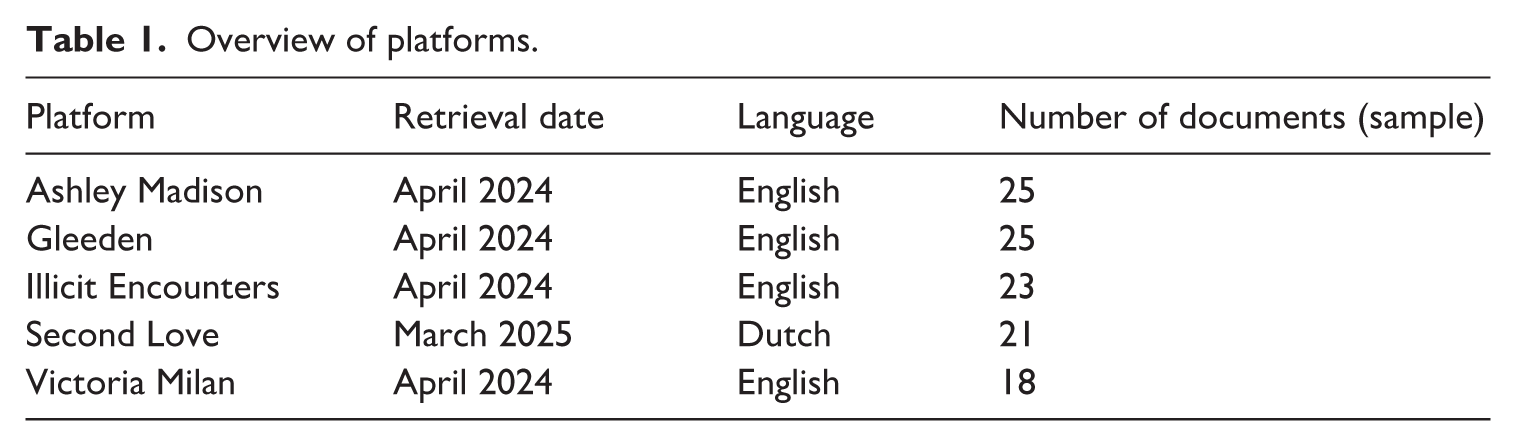
In discourse analysis, sampling is commonly driven by the overarching research question (Keller, 2012). Documents are sampled based on whether they provide answers to the respective research question. In this way, I employed a form of theoretical sampling (Keller, 2012), as my sampling process was driven by the question of whether a page entailed legitimizations of infidelity. I initially examined the publicly accessible (sub)pages of the dating platforms. To ensure I include all relevant material, I sampled very broadly, including, among others, landing pages, (alleged) “user reviews,” FAQ sections, dating advice, privacy statements, terms of service, and company descriptions. Exploring this variety of content was important because it provided context and further information on the dating platforms and their offered services, for example, how platforms discuss privacy and anonymity. The number and length of subpages varied across platforms. Where platforms offered an app, I also included the app store description in my analysis. I only studied publicly accessible material, and no behind-login material was used. Next, I focused on all pages that related to or spoke about infidelity legitimizations (inclusion/exclusion principle)—meaning, infidelity as, in one way or another, valid, justified, good, beneficial, desirable, or appropriate. Table 1 provides an overview of the platforms analyzed in this study.
Overview of platforms.
As is common practice in discourse analysis, my data analysis was also guided by my overarching research question—how dating platforms legitimize infidelity—and entailed a two-level coding process (Keller, 2012). Initially, I uploaded all documents to Atlas.ti. I then read through the entire material and assigned open codes on a thematic, content-related level—the phenomenal structure (Keller, 2012). This first coding round served to understand the central components of the text, of what happens in the material (Keller, 2012). Therefore, my codes stayed close to the text itself and were descriptive, such as “CNM,” “non-monogamy,” or “honesty.”
In the second coding round, I re-read the material, this time focusing on the narrative, interpretative structure, and looking for recurrent patterns (Keller, 2012). In this step, I linked and grouped previously assigned codes into larger themes. For instance, I grouped “being honest with yourself” and “being honest with others” under the overall theme “honesty.” In this step, I developed the five central themes—self-care, relationship care, belonging, honesty, and progressiveness—which I explore in-depth in the following sections. To increase the trustworthiness of this study, I draw my analysis together with earlier work on dating platforms (Beasley et al., 2017; Harrison, 2019; Rambukkana, 2015). Throughout the results section, I highlight how my study aligns with and diverges from previous work.
The configurations of the platforms warrant a discussion of the potential manipulation of analyzed content. All five platforms present “user testimonials” on their websites. Such testimonials may be staged by platform companies themselves, for instance, for marketing and advertising purposes. Alternatively, they may be “genuine” testimonials from “real” users. It is outside the scope of this study to assess this question. However, all platforms have explicitly included the respective “testimonials” on their websites, whether they are platform- or user-generated. Against this background, I treat these testimonial utterances as part of the larger discursive platform formation that I examine in my analysis, rather than taking the testimonials at “face value.” Hence, my analysis does not infer user experiences from these excerpts.
Positionality
To conclude my methodology, I discuss my positionality—on what perspectives I bring, and how these may have informed the research. Before this study, my knowledge of the respective dating platforms was quite limited. I had not used any of the platforms myself, and I did not know anyone in my social networks who had done so. However, I had come across media coverage of these platforms, and I was aware of Walker’s (2017, 2020) interviews with Ashley Madison users, which centered on affairs.
This context shaped the research project. As I associated the platforms with infidelity, I did not expect them to discuss CNM on their pages or explicitly address people engaging in or looking for CNM. Through a literature review of previous research, I also came to realize that for some users, their primary partner had consented to their use of, e.g. Ashley Madison (Thompson et al., 2021). I was surprised by this fact: Whenever I had spoken to people pursuing different forms of CNM, in both private contexts and as part of research projects, they had been very explicit about distinguishing CNM from infidelity. None of them had used any of the websites examined in this study, and, if anything, they expressed negative views toward them precisely because they associated them with affairs rather than CNM. Given this background, I did not expect the platforms to refer to CNM explicitly. This “surprising” element (Timmermans and Tavory, 2022) inspired me to conduct this study and to focus on the discursive legitimizations of infidelity.
Results
In this section, I present the results of my analysis of how dating platforms legitimize infidelity. In doing so, I build on Foucault’s concept of “technologies of the self,” which refers to how individuals act or work on themselves to form their behavior, bodies, and identities (Foucault, 1988). In Foucault’s (1988: 18) words, these technologies “[. . .] permit individuals to effect by their own means or with the help of others a certain number of operations on their own bodies and souls, thoughts, conduct, and way of being, so as to transform themselves in order to attain a certain state of happiness, purity, wisdom, perfection, or immortality.”
I draw on Foucault’s concept in my results section by speaking of “technologies” in terms of infidelity legitimizations to illustrate how dating platforms put forward narratives of transformation: how people can work upon themselves and their relationships through engaging in infidelity.
Infidelity as a technology of self-care
First and foremost, dating platforms present infidelity as a technology of self-care. In this light, an affair or extradyadic encounter is portrayed as a means for finding and enhancing personal happiness and pleasure—and, in doing so, caring for yourself. For example, (alleged) “user reviews” on the dating platforms state: I’ve had 10+ affairs since joining Ashley Madison and the sex is amazing. I’m happy again and I don’t feel any guilt for stepping outside my marriage because it’s satisfying me in ways my husband no longer could. I would recommend Ashley Madison to anyone who wants sex with none of the attachment and all of the passion and fun – that’s why I am still on it. (Ashley Madison) Thank goodness for IE [Illicit Encounters]. You’ve given me the tools to enhance my life and I’m having a ball. (Illicit Encounters) I’ve been on Gleeden for quite a while now and I’ve never been disappointed. I’m in full bloom thanks to the affairs I have. I’m having a blast and I’m happy!! (Gleeden) But the fact is that you deserve to have your needs met. You deserve passion and excitement. You deserve to be happy. (Victoria Milan)
Infidelity is also illustrated as a tool to gain sexual fulfillment, passion, and desire—supposedly because one’s primary relationship or marriage is either entirely sexless or does not provide “genuine” sexual fulfillment. As also pointed out by Harrison (2019: 1086), however, the platforms do not speak solely of sex and physical pleasure in terms of affairs but also emphasize mutual connections and companionship—possibly also to set symbolic boundaries to sex work. At the same time, these “connections” appear less like an end in themselves but rather as a tool to satisfy one’s “needs.”
Infidelity as a technology of self-care also appears as a gendered legitimization. In many cases, this framing is explicitly addressed to women, foregrounding paradigms of empowerment, self-fulfillment, and (gendered) pleasure. Consider the example of Gleeden: Gleeden.com is operated by women for women, empowering their peers with ultra-discreet encounters. (Gleeden)
Also, Ashley Madison explicitly speaks about how women gain “freedom” through infidelity: Many women were seeking more freedom to live their lives the way they chose, and an affair with another man (or a woman) was that step to freedom and excitement. (Ashley Madison)
This finding resembles Rambukkana’s (2015) claim that Ashley Madison invokes a feminist twist in its framing of infidelity. Within this legitimization, infidelity is coined as empowerment, which enables women to pursue the sexual pleasure and fulfillment that they have been historically deprived of and/or stigmatized for. This notion also echoes earlier work on infidelity, which has suggested that infidelity can be read as a feminist act of liberation or resistance against heteropatriarchal oppression (Kipnis, 1998), as well as a means of achieving sexual pleasure that “ordinary” intimate relationships may deny women (Richardson, 1988).
According to this legitimization, infidelity serves to pursue individual aims and wants that one’s primary relationship does not cater to. Platforms also incorporate elements of therapeutic discourse when they speak of “needs” that infidelity is fulfilling. In therapy-oriented discourse or research, infidelity is often framed negatively; as destructive behavior that harms relationships and is indicative of a “faulty” attachment style or troubled self that needs to be worked on (e.g. Fish et al., 2012; McNulty and Widman, 2014). I argue that this idea is turned upside down on the platforms: “needs” signal legitimacy and, in doing so, transform infidelity into a (legitimate) means to care for yourself. In this vein, infidelity can also be understood as the “outsourcing” of “needs” and the labor required to fulfill them (Walker, 2020). For example, based on interviews with male Ashley Madison users, Walker (2020) argued that these men gain validation and attention through their affairs. According to Walker, this is a form of relational labor that the men claim is lacking in their primary relationships.
This legitimization of infidelity resembles Harrison’s (2019: 1089) results: the author describes how dating platforms geared at affairs frame infidelity as a “lifestyle choice.” This notion mirrors postfeminist and neoliberal paradigms of intimacy: (individualized) happiness, sexual fulfillment, and self-care are portrayed as desirable and legitimate, and as obtainable through consumption (Barker et al., 2018). Postfeminism interpellates in particular feminine subjectivities, presenting women as desiring agents in charge of their sexuality (Gill, 2007). Against this background, it comes as no surprise that infidelity as a technology of self-care is entangled with gender, framing infidelity as a tool for women’s empowerment and freedom.
Infidelity as a technology of relationship care
Infidelity as a technology of self-care mirrors paradigms of individualized self-fulfillment as pillars of subjectivity in late modernity, echoing Lawson’s (1989) emphasis on “the myth of me” in an earlier study on “adultery” in Britain. At the same time, infidelity as a technology of self-care also points to the discursive limitations of this legitimization. With its strong focus on individual needs and happiness, it does not “honor” coupledom and the “sacredness” of intimate relationships (Morgan, [2004]2014: 30)—an issue that none of the previous studies on these platforms explored. How do platforms address this tension? I argue that they do so by framing infidelity not only as a technology of self-care but also of relationship care. More specifically, infidelity is portrayed as a tool to maintain or even improve one’s relationship or marriage. Again, this theme is illustrated through (alleged) “user reviews”: It’s definitely saved my marriage. I’d be lost without the lovely guys I’ve met on here. (Illicit Encounters) I would describe myself as happily married. I love my husband – he’s a great person, a great friend, but he’s essentially my roommate. I’m not looking to change my situation because I love my family, but my marriage lacks any deep emotion or chemistry. I need passion, attention, and excitement. I joined Ashley Madison over a year ago and it took time to find someone I wanted to start an outside relationship with. Eventually, I found a man who I was with for nine months, and I am now currently searching for someone new. While my marriage hasn’t entirely changed since I joined, I have become more patient, more understanding, and I feel like I’m a better wife to my husband. (Ashley Madison) To be honest, after 14 years my marriage had become a bit of a mess. I found out about Second Love through a friend and it has given my marriage a second chance.
3
(Second Love) In long-term, committed relationships, passion all too often fades away. While you may love and care for your partner, familiarity often extinguishes that vital spark – leaving one or both partners frustrated. This lack of physical intimacy tends to inspire resentment, heartbreak and even separation. For couples with children or financial strife, a split may well have a devastating effect. This is where affairs prove to be a genuine lifeline: cheating on your spouse or partner may well actually save your relationship. (Victoria Milan)
In academic research and public discourse, infidelity is often related to relationship dissatisfaction and dissolution (e.g. Bozoyan and Schmiedeberg, 2020; Fincham and May, 2017). Platforms turn this idea on its head by framing infidelity as a relationship or marriage’s savior that can prevent a divorce or separation. This twist alludes to the widespread idea that it is desirable to maintain a long-term relationship or marriage and that break-ups or divorces are undesirable and/or represent failure (Illouz, 2021). The platforms emphasize the importance or value of pursuing one’s primary relationship, for instance, due to pragmatic (e.g. financial, childcare) or emotional (e.g. attachment, love) reasons.
Moreover, rather than just preventing a break-up, infidelity can—according to the platforms—also improve one’s relationship. For example, an affair might revive passion or increase overall well-being, which could allow a person to maintain or once again “enjoy” their primary relationship. However, this narrative of care is linked to paid affordances and revenue models (e.g. gendered paywalls), shedding light on how care is turned into a commodified service. The way platforms discursively legitimize infidelity also resembles how users might talk about their affairs: Walker (2017) illustrated, based on interviews with female Ashley Madison users, that for these women, affairs enabled them to maintain primary relationships that fall short of earlier hopes or expectations. While it is beyond the scope of this article to explore how users of dating platforms geared at infidelity engage with or ascribe meaning to the legitimizations of infidelity put forward in the digital realm, future research would benefit from studying this “decoding” (Hall, 1997: 167).
Infidelity, as a technology of self-care and relationship care, is also intertwined. By engaging in infidelity to care for oneself, platforms suggest that individuals can become more fulfilled or happier. This self-care can then facilitate relationship care, for instance, through becoming a better partner or being able to endure a primary relationship.
Relationship care is a theme that previous studies on these platforms do not touch upon, but I argue that the narratives of self and relationship care illustrate fundamental and contrasting imperatives of intimate life. Seminal literature on intimacy and the family highlights the inherent contradictions of contemporary love and relationships (Beck and Beck-Gernsheim, 1990; Berlant, 2011; Illouz, 2012, 2021). Paradigms of self-fulfillment, autonomy, and (personal) choice contradict ideas around relationship and family fulfillment, as well as commitment to a lasting romantic relationship (Illouz, 2012; Morgan, [2004]2014).
Intimate and sexual practices and relationships are framed as a choice, and contemporary subjectivities focus on the entrepreneurial self, including in the realms of intimacy and sexuality (Barker et al., 2018; Illouz, 2021). And yet, how dating platforms portray infidelity simultaneously as a technology of self- and relationship care underscores the ongoing “sacredness” (Durkheim, 1912) of romantic love and relationships. This finding emphasizes the limitations of a neoliberal entrepreneur in the realms of intimacy and the deep-rooted discursive contradictions between infidelity and relationship commitment. By simultaneously addressing paradigms of the self and relationships, platforms discursively cater to their seemingly contradictory demands.
This legitimization is particularly poignant given that infidelity has been associated with mental distress, a variety of negative emotions such as humiliation, sadness, and anger, and a risk of STI transmission for those who have been cheated on (Fincham and May, 2017). Arguably, from the perspective of those on the “receiving” end, infidelity may rather be perceived as a form of disrespect that challenges their sense of self and ontological security rather than as an ostensible form of care. However, precisely because infidelity is widely understood as a form of betrayal that evokes negative emotions (Weiser et al., 2014), this legitimization may appear all the more potent because it offers a discursive workaround to what is commonly understood as hurting, betraying, and deceiving one’s partner. Through this legitimization, platforms offer a symbolic deflection of the “negative” aspects commonly associated with infidelity.
However, both legitimizations contain—even when combined—further limitations. Openness, honesty, trust, and communication are core values of contemporary intimate relationships (Morgan, [2004]2014; Van Hooff, 2017). In contrast, infidelity is associated with secrecy and deception (Weiser et al., 2014). How do the dating platforms resolve this contradiction? I argue that they do so through framing infidelity further as a technology of honesty.
Infidelity as a technology of honesty
Dating platforms focused on infidelity offer different affordances to facilitate anonymity and help users keep their affairs secret (see also Harrison, 2019: 1089). For example, a “panic button” instantaneously closes the dating app, while filters blur or hide (parts) of users’ photos.
4
And yet, despite secrecy-facilitating affordances, the dating platforms simultaneously frame infidelity as a technology of honesty. What might appear counterintuitive at first is invoked through a redirection of honesty. Instead of being directed at the relationship partner, honesty is constructed in relation to oneself and to potential affair partners: International studies show that 30% of all members registered on traditional sites for singles are not telling the truth about whether or not they are married or live in a relationship. Victoria Milan is a dating site specifically created for married and attached men and women seeking an extramarital affair, so there is no reason to hide or lie about your relationship status. (Victoria Milan) Gleeden was born from one simple fact: on the internet, many people in a relationship don’t have the freedom to be honest about their marital status. [. . .] Gleeden’s mission is to respond to the needs of these people. (Gleeden) On other dating sites I feel a fraud of sorts as I cannot offer all that someone may expect, but with IE I am free to be honest and it is understood and accepted. (Illicit Encounters) Therefore, Ashley Madison was created as the first website that was open and honest about what you could find: like-minded people looking for married dating. (Ashley Madison)
First, infidelity serves as a technology of honesty in relation to the “other” person. Because these platforms are explicitly geared toward infidelity, users are (supposedly) more honest by openly acknowledging that they are in a relationship and seeking an affair. Platforms suggest that through their services, users do not hide their relationship status or convey false intentions to potential affair partners. They contrast this form of honesty with people seeking an affair through “conventional” dating platforms. The assumption put forward is that such individuals will not disclose their actual relationship status and, instead, pretend to be single.
Second, I argue that infidelity is portrayed as a technology for honesty because it allegedly allows users to pursue their deeper desires and “needs” instead of ignoring or suppressing them. Through engaging in infidelity, users are ostensibly honest with themselves: They acknowledge that their primary relationship does not meet their “needs” and “care” for themselves through infidelity. Again, it is precisely because one’s “needs” are legitimized through dominant therapeutic discourses that infidelity can operate as a technology of honesty.
On these dating platforms, honesty, transparency, and open communication are no longer tied to one’s primary partner but are redirected toward “other” people and the self. This framing underscores the importance of honesty and communication as key contemporary values. Instead of completely negating these, platforms integrate such values into the practice of infidelity itself: engaging in infidelity through the respective dating platform is portrayed as more “honest” and transparent.
From a philosophical perspective, infidelity can, among others, be understood as “wrong” because it violates an agreement or commitment to sexual exclusivity, whether implicit or explicit, and often involves deception (McKeever, 2020). Simmel (1906) emphasized that secrecy involves an asymmetry of not only knowledge and information, but also power and agency. Against this background, infidelity as a technology of honesty constitutes, first and foremost, a discursive legitimization of infidelity, as well as, in a Goffmanian sense (Goffman, 1959), a moral performance of the self. Infidelity as a technology of honesty is hence a discursive, rather than an interpersonal resolution. The redirection of honesty does not alter a potential power imbalance between those engaging in infidelity and their primary partners. Instead, it offers a framing that positions the individual engaging in infidelity as “respectable,” in line with dominant norms of honesty and transparency—even though infidelity can certainly involve some form of secrecy or deception.
In their work on non-monogamies, Klesse and van Hooff (2024) challenge the commonly drawn dichotomy between (non)consensual non-monogamy based on secrecy and transparency. The authors underline the limitations of using secrecy or transparency as (conceptual) boundaries between CNM (e.g. open relationships, polyamory) and NCNM (e.g. infidelity). Building on their work, my study illustrates the relationality and contextual nature of secrecy by showcasing how platforms discursively attribute qualities such as honesty and transparency to certain forms of infidelity, particularly those facilitated through their (monetized) affordances. The conceptual limitations of clear-cut distinctions between infidelity and CNM are an issue that is also invoked by the respective dating platforms in the next technology I examine: progressiveness.
Infidelity as a technology of progressiveness
Platforms legitimize infidelity by presenting it as a technology of progressiveness. In this realm, stigma toward infidelity is framed as outdated and old-fashioned, while infidelity itself is discursively linked to CNM.
The platforms criticize the societal stigmatization of infidelity, describing monogamous constraints and obsolete taboos as restricting one’s sexuality: Gleeden wants to give its people the freedom to live their life as they see fit and pursue happiness by offering a friendly community where people can express themselves freely without worrying about societal criticism by providing a discrete and non-judgmental platform. (Gleeden) By agreeing to these terms, you are becoming an Ashley Madison member and joining a community of millions of like-minded people who have come to see the constraints of monogamy as too restrictive and have found solace in the sexual opportunity that membership provides. (Ashley Madison)
This finding resembles that of Rambukkana (2015), who argued that Ashley Madison draws upon critiques of monogamy and patriarchy on its website. Rambukkana also suggested that Ashley Madison conflates “adultery” with the broader concept of “non-monogamy” at large. However, my analysis goes further: I suggest that platforms place infidelity in close relation to CNM, such as polyamory, open relationships, and swinging. They do this in two ways. First, the platforms present themselves as, among others, directed at the CNM community, suggesting that this group forms part of their user base. Second, the platforms create symbolic proximity between CNM and infidelity by placing both under the umbrella term “non-monogamy.” In doing so, they suggest that CNM and infidelity are, in fact, quite similar, as both are forms of non-monogamy. For instance, the platforms include blog posts and guidance about CNM: Our members are attached and seeking a connection. Many are attached and seeking something like-minded or polyamory. (Ashley Madison) The truth is that a lot of people cheat in relationships. Whether that’s down to unhappiness, a loss of sexual connection, or maybe even something that’s agreed between partners (like an open relationship, although this would be considered “ethical cheating”). (Illicit Encounters) More and more couples are considering an open relationship as an alternative to monogamy. Whereas cheating used to be a major taboo, nowadays more people are consciously choosing a relationship in which freedom and honesty are central.
5
(Second Love)
Compared with previous studies on the respective platforms (Beasley et al., 2017; Harrison, 2019; Rambukkana, 2015), it appears that more recently, the dating platforms also seek to invoke or address people interested in or engaging in CNM. I argue that this discursive linking of infidelity and CNM represents not solely a strategy to widen the platform’s target group but, beyond that, provides a legitimization of infidelity. In consensual or ethical non-monogamy, extradyadic engagement is usually discussed with and/or agreed upon by one’s partner (e.g. Schneider, 2025a).
Historically, CNM has been marginalized and stigmatized in opposition to (desirable) monogamy, and prejudice against CNM remains (Balzarini and Muise, 2020). At the same time, attitudes toward CNM appear more favorable than toward infidelity (Grunt-Mejer and Campbell, 2016; Rye, 2024). Due to its focus on openness, honesty, and transparency, it is commonly conceptualized as ethical or consensual, whereas infidelity is conceived as (morally) wrong and non-consensual.
I argue that by framing infidelity as a technology of progressiveness and explicitly linking it to CNM, the platforms discursively bridge the previously described tensions between individualized self-fulfillment and relationship commitment. While CNM honors relationship values of openness and honesty, it also caters to subjectivities concerned with self-fulfillment and individual “needs.” In this discursive construction, CNM appears as a means to resolve deep-seated tensions between self-fulfillment, personal needs, and the sacredness of relationships—all while catering to dominant societal values of e.g. honesty. In this context, platforms can be interpreted as capitalizing on the “positive” aspects of CNM to market the product they were initially geared at—infidelity. Especially because the boundaries of CNM appear less stable and fixed (Frank and DeLamater, 2010; Stewart et al., 2021), CNM can serve as a canvas for dating platforms in legitimizing infidelity—for example, when talking about “ethical cheating.”
Scholars have suggested conceptualizing monogamy and CNM as a spectrum rather than forming a binary (Moors et al., 2013); and Klesse and Van Hooff (2024) make a related argument about the relation between NCNM and CNM. At the same time, the CNM community has historically sought to distinguish itself from both mononormativity and ongoing conflation (and stigmatization) with infidelity. For instance, legal, public, and earlier academic discourses have often equated infidelity with CNM and denied legitimization for the latter (Rhode, 2016). Furthermore, recent studies suggest that people engaging in CNM either reject the term “infidelity” due to its mononormativity (Wosick-Correa, 2010) or explicitly distinguish between CNM and infidelity on a discursive level (Schneider, 2025a). Hence, while conceptually, non/consensual non-monogamy can be understood as a spectrum, (symbolic) distinctions between the two appear important for the historically stigmatized CNM community.
It is beyond the scope of this article to examine to what extent those engaging in CNM do (not) make use of or do (not) welcome the integration of CNM into dating platforms (formerly) geared toward infidelity. 6 Instead, I argue that the theme of infidelity as a technology of progressiveness illustrates a shift in the moral economy regarding what relationships are perceived as “desirable” and legitimate. With CNM catering to dominant relationship values, dating platforms (initially) geared toward infidelity invoke CNM as a canvas to legitimize infidelity discursively. However, CNM is not the only way in which these platforms invoke sensibilities of marginalized groups, as I demonstrate in the next section.
Infidelity as a technology of belonging
Questions of belonging and recognition have been of utmost significance for many marginalized or stigmatized groups (e.g. Ahmed, 2014; Lamont, 2018). This notion is reflected in the fifth legitimization of infidelity put forward by dating platforms, which I term infidelity as a technology of belonging. In this narrative, rather than being portrayed as “deviant,” infidelity is presented as an ordinary and common practice that unites people from all different kinds of backgrounds. Second, a “community” of users, all engaging in infidelity or other forms of non-monogamy, is evoked: They [users] are students, lonely housewives and married men, singles, office workers, tradespeople, entrepreneurs, retirees, and everyone in between. (Ashley Madison) Our members are united in a desire to seek out real, discreet connections and Ashley Madison gives you a platform to search for what’s missing. (Ashley Madison) Married, attached, looking to explore, or just curious to discover what’s out there – Ashley Madison is the leading discreet, like-minded dating community in the world. (Ashley Madison) Web users who browse on Gleeden are driven by a sense of belonging to the married community. (Gleeden) The truth is that a lot of people cheat in relationships. (Illicit Encounters) You think you are the only one in the world who feels tied down, but you are not.
7
(Second Love)
As illustrated in these examples, the platforms invoke a community of those engaging in infidelity who are “like-minded”—a finding also illustrated by Harrison (2019: 1087). By referring to the concept of “community,” infidelity offers a form of belonging—being truthful to oneself and being recognized and accepted by others rather than judged or singled out. If infidelity is something that others also engage in, the practice ostensibly loses its stigma and becomes normalized. What is more, using these dating platforms and engaging in infidelity (supposedly) enables belonging—a concept commonly used in reference to marginalized and stigmatized groups. Thus, the platforms invoke a combination of both normalization (“a lot of people cheat”) and affective interpellations (belonging) in their legitimization of infidelity.
Conclusion
This article has explored how dating platforms geared toward NCNM discursively legitimize infidelity. Based on a discourse analysis, I have identified five dominant legitimizations: infidelity as a technology of (1) self-care, (2) relationship care, (3) honesty, (4) progressiveness, and (5) belonging. In this conclusion, I discuss how my work contributes to previous literature on critiques of normativity, neoliberal subjectivities, and the digital mediation and commodification of intimacy within the platform economy.
First, the study contributes to the literature on how the platform economy can serve to maintain and reinforce social hierarchies and normativities, rather than challenging them. In the result section, I illustrated how the analyzed platforms invoke critiques of monogamy and patriarchy. However, as Rambukkana (2015) also pointed out, these critiques have been stripped of their “critical” and political core. Instead of challenging and seeking to change the norms they critique, the platforms offer an individualized and monetized “workaround” for contemporary challenges of intimate life. This approach echoes a postfeminist sensibility (Gill, 2007), where consumerist, individualized “solutions” for structural challenges come to the fore, rather than collective, political action (see also Berlant, 2011). Arguably, then, these platforms ultimately maintain and profit from the very system they ostensibly seem to critique.
As Berlant (1998, 2011) argued, romantic love poses a form of cruel optimism: it exerts a lasting enchantment and promise of happiness (Ahmed, 2014) that people aspire to—but which remains ultimately out of reach. This idea is reflected in the legitimizations of these dating platforms, which frame (primary) relationships as inherent sources of disappointment and struggle. And yet, the platforms do not offer a sustained repudiation of dominant norms, nor do they envision sustained alternative forms of (intimate) relating and belonging. Instead, infidelity appears as a quick “fix” for the structural challenges of contemporary intimacy.
Second, the study contributes to the work on neoliberal subjectivities and postfeminism in relation to intimate practices and relationships (e.g. Amundsen, 2019; Barker et al., 2018) by examining how such sensibilities are taken up and incorporated in the digital economy. Based on my analysis, I suggest that key features of neoliberal paradigms, such as self-care, choice, freedom, and personal happiness, play a central role in infidelity legitimizations (McRobbie, 2007). At the same time, the presented legitimizations also highlight the limitations of neoliberal entrepreneurism with regard to intimate relationships and practices. This conjunction points to the competing demands placed on individuals in late modernity. Rather than rejecting the values of (relationship) care or honesty, the platforms incorporate such notions into their legitimizations—as I have suggested, in ways with which those affected by infidelity might disagree or disapprove.
Third, the research contributes to the scholarship of how intimate relationships and practices are incorporated and monetized within the platform economy. In this economy, intimate and sexual practices are at the core of many business models, including practices which remain stigmatized and marginalized, such as, e.g. sex work. While companies profit from non-normative intimacies, they often shift risks and responsibilities onto individual workers or users (e.g. Schneider and Velthuis, 2025; Stegeman, 2024). In some cases, they may even reinforce the stigmatization of the very practice from which they profit. For example, they may publicly distance themselves from it, as described by Easterbrook-Smith (2023) with regard to OnlyFans. I have outlined how the platforms examined in this study emphasize belonging and community in their discursive legitimizations of infidelity. At the same time, the risks and responsibilities of using their services fall on the user, as illustrated by less prominently placed statements underlining that platforms are not to be held responsible for potential negative consequences. The platforms provide “tools” for navigating the competing demands of intimate life, but within the confines of a market logic underpinned by user responsibility and accountability.
This point is particularly pertinent in the context of surveillance capitalism (Zuboff, 2019), whereby user data is collected, stored, and sold for profit. The risks of this form of value extraction are exemplified by the 2015 Ashley Madison data breach, in which it was revealed that users had paid the company to delete their data, but this was never done. Recent data breaches, such as that affecting the dating safety app Tea (Edwards, 2025), highlight the ongoing risks of violations of data privacy and anonymity in the digital realm, particularly with regard to the commodification of non-normative intimacies.
Footnotes
Ethical approval
Ethical approval was not required, as no primary data were collected and no human participants involved.
Consent to participate
Not applicable.
Data availability
The textual data analyzed in this study were obtained from publicly available websites and analyzed under fair use for scholarly research. Because the material is subject to copyright, the full dataset cannot be shared.
Declaration of conflicting interest
The author declared no potential conflicts of interest with respect to the research, authorship, and/or publication of this article.
Funding
The author disclosed receipt of the following financial support for the research, authorship, and/or publication of this article: This work was supported through a graduate scholarship from the Friedrich Ebert Foundation.
