




Abstract
Anti-democratic counterpublic news media frequently open up participatory spaces, inviting their audiences to partake in the discussion of their content. However, research on how commenters engage in such participatory spaces opened up and overseen by anti-democratic actors is scarce. In order to fill this gap, we present in this article a case study of the 250 most active commenters on RT German’s Facebook page in a 6-month period at the height of the Covid-19 pandemic in 2021. Using a mixed-methods approach combining large-scale data scraping with quantitative and qualitative content analysis, we find that the majority of these highly active commenters constituted an anti-democratic counterpublic. However, we also observed a smaller collective of commenters, whom we theorize as “disruptive public” as they vigorously sought to challenge the activities of the anti-democratic counterpublic. We discuss the benefits and risks of various strategies of disrupting anti-democratic counterpublics and consequences for democratic debate.
Keywords
In democratic media landscapes around the globe, a large number of media outlets have established themselves who follow a self-proclaimed mission to offer an alternative to, what they call, mainstream media. In the academic literature, these media are often referred to as alternative media, describing outlets that oppose established narratives and attempt to provide a different perspective on issues (Holt et al., 2019). On closer inspection, however, the term “alternative media” seems euphemistic, as many of these outlets disseminate primarily content that is harmful for democratic discourse. Many of the media organizations that self-identify as “alternative media,” for instance, consistently promote hate against minorities or extremist ideologies (Freudenthaler, 2020; Mayerhöffer et al., 2024), amplify conspiracy myths and mis- or disinformation (e.g. Staender et al., 2024), or cultivate ties with anti-liberal authoritarian regimes who aim to subvert democracies (Beseler and Toepfl, 2024). A prominent example fulfilling all three of these aspects is the outlet whose participatory space is under scrutiny in the following pages: RT (formerly Russia Today) German, a state-sponsored foreign media outlet controlled by the Kremlin (Crilley et al., 2022; Elswah and Howard, 2020; Glazunova et al., 2022; Gulenko, 2024). For the reasons laid out in this paragraph, we will refer to RT in the following not as an “alternative,” but an anti-democratic media outlet.
From a second theoretical perspective, anti-democratic (“alternative”) media and their audiences have been analyzed in the academic literature through the lens of Nancy Fraser’s (1992) theory of counterpublics (e.g. Leung and Lee, 2014; Mayerhöffer et al., 2024; Xu, 2020). Fraser (1992) defines counterpublics as “parallel discursive arenas where members of subordinated social groups invent and circulate counterdiscourses” (67). Adopting counterpublic theory as a theoretical lens (for a critical discussion of this approach, see next section), we conceive of RT and its audiences as an anti-democratic counterpublic sponsored by a resource-rich authoritarian government.
A small number of studies have specifically investigated the content of the participatory spaces opened up by anti-democratic news organizations (e.g. Crilley and Chatterje-Doody, 2020; Glazunova, 2025; Hellmueller et al., 2021). This thin strand of research has, however, not scrutinized the discursive activities of their active audiences through the lens of counterpublic theory. Vice versa, virtually all studies that analyze the commenting activities on news websites through the lens of counterpublic theory have focused on legacy news media (Bright et al., 2020; Lien, 2024; Toepfl and Piwoni, 2015, 2018). In order to fill the gap at the intersection of these two strands of research, this study raises the overarching research question: What discursive activities can be observed in the Facebook comment section of RT German, being a participatory space opened up and overseen by an anti-democratic counterpublic media organization?
Taking a first step toward answering this question, our study presents an analysis of the discursive activities of the 250 commenters who published the most comments on RT German’s Facebook page in the first half of the year 2021. This period was selected because it was marked by intense political conflict over measures to curb the spread of Covid-19. As our empirical analysis shows, during this half-year period, RT German published 6391 Facebook posts, which attracted 1,819,374 comments from 222,510 unique commenters. The 250 most active commenters – which we refer to in the following as “highly active commenters” – published 155,705 comments. While these highly active commenters thus represented only 0.11% of all unique commenters, they posted 8.56% of all comments. Adopting a mixed-methods approach, our study identifies two starkly opposing groups of commenters, vying for discursive dominance: an anti-democratic counterpublic supporting and amplifying RT’s narratives, and a group that we theorize as a disruptive public, who opposed, provoked, or challenged the anti-democratic counterpublic. While counterpublic commenters are in the vast majority (179 of 250 highly active commenters, 72%), the disruptive public makes up for a significantly smaller fraction of highly active commenters (33 of 250, 13%) but showed much higher engagement. The four most active commenters in our data set, for instance, all belonged to the disruptive public. In order to detail these findings and discuss their implications, we will first provide background on key aspects of counterpublic theory, anti-democratic media, and Russia’s foreign communication.
Counterpublics engaging in participatory spaces opened up by anti-democratic media
In her foundational essay on public spheres, Nancy Fraser (1992) introduces the notion of counterpublics. She describes counterpublic spaces as “parallel discursive arenas where members of subordinated social groups invent and circulate counterdiscourses, which in turn permit them to formulate oppositional interpretations of their identities, interests, and needs” (67). Counterpublics are thus understood as subaltern spaces which “stand in a contestatory relationship to dominant publics” (Fraser, 1992: 70; for further elaborations of the concept, see Asen, 2000; Warner, 2002). In recent years, Fraser’s theoretical lens has been adopted in the academic literature to investigate the activities of two starkly distinct types of groups: On the one hand, counterpublic theory has been used to describe marginalized minority groups online, such as Muslim communities in dominantly Western societies (Eckert and Chadha, 2013; Eckert et al., 2021; Lien, 2024; Lowenstein-Barkai, 2024). On the other hand, it has also been applied to analyze (far or extremist) right-wing groups who likewise portray themselves as marginalized in the dominant (democratic) discourse, while simultaneously calling for the exclusion of other minorities (Freudenthaler, 2020; Mayerhöffer et al., 2024; Reijven et al., 2020). This Janus-faced character of counterpublics has already been thoroughly problematized in the academic literature. Fraser (1992) herself stated in her original essay that she did “not mean to suggest that subaltern counterpublics are always necessarily virtuous; some of them, alas, are explicitly anti-democratic and anti-egalitarian” (67). Following this approach, Kaiser and Rauchfleisch (2019) have argued that the term counterpublics can also be applied to “problematic or ‘unruly’ publics that, for example, reject basic democratic principles” (244). In order to draw a clear line between progressive and regressive counterpublics, other scholars have proposed terms such as “imitated counterpublics” (Jasser, 2021) or “anti-woke publics” (Asen, 2024) for self-victimizing or anti-democratic groups. In a similar vein, Henriksen (2024) has suggested the term “anti-systemic counterpublics” for counterpublics whose goal is to undermine or threaten the established democratic system, specifically mentioning RT as an example for such a counterpublic. Due to RT’s identification as a counterpublic space aiming to destabilize Western democracies, we shall refer to this outlet and its supportive audiences likewise as an anti-systemic or anti-democratic counterpublic.
If we consider the producers of RT, its published content, and the outlet’s supportive audience as constituting an anti-democratic counterpublic, the follow-up question is: How do we conceive of the discourses in the comment sections opened up by RT? Classically, Fraser (1992) has argued that counterpublics can have two types of discursive goals (see also Toepfl and Piwoni, 2015). First, counterpublics can pursue inward-oriented goals, such as identity formation and discursive exchange with like-minded people. Second, they can pursue outward-oriented goals, such as engaging with audiences outside of the counterpublic, ideally to change the consensus within dominant publics. According to Fraser (1992), the first type of goal is typically pursued in inward-oriented spaces, which “function as spaces of withdrawal and regroupment” as well as “bases and training grounds for agitational activities directed toward wider publics” (68). By contrast, outward-oriented goals are pursued in spaces attended by mass audiences, such as comment sections of legacy news websites (Toepfl and Piwoni, 2015, 2018). Taking a closer look at the literature on anti-democratic counterpublics, a key gap becomes evident. None of the extant studies on participatory spaces opened up by anti-democratic media (e.g. Crilley and Chatterje-Doody, 2020; Glazunova, 2025; Hellmueller et al., 2021) has thus far looked at the discourses that emerge in these spaces through the lens of counterpublic theory. It thus remains an open question whether participatory spaces opened up by anti-democratic media organizations function rather as inward- or as outward-oriented communication spaces – or possibly as a hybrid between the two types, following an entirely different logic. As Lowenstein-Barkai (2024) has found in a study of an Israeli-Arab online community, counterpublic discourse in open participatory spaces can indeed be “infiltrated” by users representing the hegemonic public. However, her study scrutinizes the activities of a minority counterpublic in an online discussion forum, and not a participatory space opened up and supervised by an anti-democratic media organization.
Russia’s foreign communication outlet RT and its audiences
The Kremlin has a variety of foreign communication tools at its disposal. RT is the flagship of the Kremlin’s foreign propaganda apparatus. It operates various websites and channels in multiple languages all across the globe (Gulenko, 2024). These Kremlin-controlled media outlets often assimilate themselves in the niche media landscapes of democratic host countries, with their opposing perspectives toward the democratic “mainstream” and their self-proclaimed goal of offering “alternative viewpoints” (e.g. Glazunova et al., 2022; Holt et al., 2019; Wagnsson et al., 2024). In this article, we will focus specifically on RT’s German-language outlet, RT German. As a major European power, Germany has long been one of the key targets of the Kremlin’s informational influence efforts (Decker, 2021). At the time of research in 2021, RT German was one of the leading outlets in the German-language anti-democratic media landscape, with over 5 million monthly website visits and more than 350,000 followers on Facebook (e.g. Schwaiger, 2022; Staender et al., 2024). We draw on data collected prior to the EU-wide sanctions against the outlet after Russia’s full-scale invasion of Ukraine. Nonetheless, the findings of this article are still relevant for multiple reasons: First, the ban has not been entirely successful, with some websites and social media accounts of RT still being available online throughout the European Union (Glazunova et al., 2023). As Spahn (2024) claims, RT German kept its leading role in the national landscape of anti-democratic media even two years after Russia’s full-scale invasion of Ukraine in February 2022 by constantly cloning its website using new URLs, making it continuously accessible. Furthermore, outside of the EU, RT’s content is still widely accessible.
While the media content published by RT has been widely scrutinized in the academic literature, only few academic articles have focused on the (active) audiences of Russia’s foreign communication outlets. As extant research shows, audiences of Russia’s foreign propaganda media tend to support narratives that seek to undermine trust in democratic institutions, particularly in democratic legacy media (Glazunova et al., 2022; Hall, 2022; Wagnsson, 2023). A common theme for RT’s audiences seems to be “individuals’ disaffection with domestic media and politics” (Hall, 2022: 1), with them showing a slightly higher affinity for disseminating media content online and in real life compared to non-consumers of RT (Wagnsson, 2023). This characteristic might be beneficial to the Kremlin concerning its propaganda dissemination and thus, Russia’s informational influence abroad, as both Hall (2022) and Wagnsson (2023) emphasize.
Nonetheless, as Crilley et al. (2022) highlight, RT’s international audiences are a rather heterogeneous group and should not be immediately generalized as politically extreme. Frequenting RT (particularly passively, by following the page) might just serve as a way to expand one’s media repertoire (Crilley et al., 2022; Schwarzenegger, 2021). In a similar vein, consumers of RT might not consume it due to ideological conformity but rather to “keep an eye on the enemy” (Wagnsson et al., 2024). While some of these studies analyzed user participation such as sharing of RT’s content (e.g. Glazunova et al., 2022) or commenting underneath RT’s videos on YouTube (Crilley and Chatterje-Doody, 2020; Glazunova, 2025), no study on Russia’s foreign communication has thus far scrutinized the discursive behavior of RT’s active audiences through the lens of counterpublic theory. This is precisely the gap that this study aims to fill.
Developing RQs: highly active commenters engaging in RT’s comment sections
In order to work toward this goal, this study presents a case study of the 250 most active commenters in the half-year time period under investigation. As extant research on audience participation through commenting has shown, only a small number of online users are actively participating in the form of commenting and even fewer are highly engaged in this practice (Weeks et al., 2017). Taking a closer look at highly active commenters appears crucial when taking into considerations two factors: First, practices such as commenting might be able to shape the public discourse, for example, by mediating democratic debate (Ruiz et al., 2011) or even influencing the perception of public opinion (Neubaum and Krämer, 2017; Soffer, 2019; Soffer and Gordoni, 2018). Second, highly active commenters play a pivotal part in this phenomenon due to their high activity in comment sections (Papakyriakopoulos et al., 2020). In counterpublic spaces, where users come together to regroup and develop narratives opposing the (democratic) mainstream (see Fraser, 1992), the role of highly active commenters as potential opinion leaders (Weeks et al., 2017) becomes even more significant.
Still, most of the research on these highly active commenters has thus far predominantly taken legacy media into consideration–in Fraser’s (1992) words, the “dominant” (70) public sphere. Hellmueller et al. (2021), who conducted one of the few studies looking at highly active users in non-mainstream media settings, compared US-American and German legacy and anti-democratic media outlets. However, they did not utilize Fraser’s (1992) concept of counterpublics to theorize their findings, and they did not include RT or comparable foreign communication outlets in their analysis. Thus, we focus in this study on the discursive behavior of highly active commenters posting to a participatory online space opened up by an anti-democratic media outlet.
In their study, Hellmueller et al. (2021) observed that highly active commenters in anti-democratic media are a homogeneous group, mostly engaging in non-deliberative interactions, with only a few commenters opposing them. In addition, the extant research on counterpublics has identified various discursive practices which are prevalent in either discursively building or maintaining a counterpublic space. Toepfl and Piwoni (2015) defined the following central discursive practices for constituting counterpublic discourse: (1) argumentative countering, by challenging mainstream narratives, (2) strengthening identity by referring to a collective identity or identifying with the collective, and (3) deconstructing power relationships, by pointing to and distancing themselves from dominant mainstream narratives (471). Concerning the strengthening of identity and the active separation from the mainstream, a strong us versus them mentality can be observed in counterpublic discourses (Freudenthaler, 2020). In light of these findings and the lack of knowledge on the discursive dynamic between the counterpublic and its opposition in a participatory space opened up by anti-democratic media, we formulate two research questions:
RQ1: How were RT German’s highly active Facebook commenters composed in regards to their counterpublic stance?
RQ2: How did discursive activities differ between commenters belonging to the counterpublic and the disruptive public?
Methodological approach
Justification of case selection and time frame
For this article, we analyzed the participatory space opened up by RT German on Facebook as a case of a participatory space created and supervised by a state-sponsored, anti-democratic media outlet. Analyzing the discursive activities of highly active commenters in this participatory space is a relevant case for two reasons. First, Germany has long been a key target of Russia’s informational influence (Decker, 2021; Spahn, 2024). The reasons are, among others, Germany’s leadership role in the European Union and the manifold historical and economic connections between Russia and Germany. Second, the active audiences might play a vital role in enhancing Russia’s informational influence, meaning that the active audiences (un)knowingly become curators, amplifiers and disseminators of Kremlin-aligned narratives. The time period was chosen for analysis because it was characterized by intense political conflict: The first half-year of 2021 was majorly affected by the Covid-19 pandemic in terms of media coverage and societal dissatisfactions due to measures to curb the spread of the virus. With RT’s goal of sowing discord abroad, it is likely that RT German fanned the flames of disenchantment even further, which could have resulted in particularly fierce and heated discussions in the comment section.
Furthermore, studies on the social media behavior during the Covid-19 pandemic indicate a general increase of social media use (Haddad et al., 2021), in some cases even to an addictive extent (Brailovskaia and Margraf, 2024). While lockdowns, social distancing, and other pandemic-related restrictions hampered social interaction in the offline world, online interactions were used to mitigate feelings of loneliness or depression (see e.g. Yue et al., 2023). Thus, this study’s selected time frame represents a unique situation marked by increased use of and interaction on social media, potentially intensifying discourse in Facebook comment sections.
Data collection and descriptive statistics of the data set
In July 2021, we retrospectively scraped all publicly available comments left on RT German’s Facebook page beneath posts published in the first 6 months of the year 2021. To do so, in the first step, we utilized Facebook’s own API endpoint for researchers (“CrowdTangle”) to collect the URLs of all posts published by RT German as well as the full text of these posts. We then employed a Python script to collect via screen scraping all comments underneath these posts, including the commenters’ names (which we subsequently anonymized) as well as metadata, including the date and time of posting. This procedure obtained ethical approval by the Ethics Committee at the University of Passau.
Between January and June 2021, RT German published 6391 Facebook posts, which attracted 1,819,374 comments from 222,510 unique commenters. To identify the most active commenters in the data set, we sorted the list of unique commenters by their commenting frequency. In addition, to determine the threshold between highly active and moderate commenting behavior, we assessed the distribution of comments and decided to stipulate the threshold close to the knee of the curve (see Figure 1). At this point of the curve, commenter engagement began to stagnate severely. Thus, we narrowed our analysis to the number of 250 highly active commenters, stipulating as a cut-off score the number of 374 comments. Figure 2 shows the commenting intensity of the 250 selected commenters. In total, these 250 most active commenters published 155,705 comments in the 6-month time span. While they represented only 0.11% of all unique commenters, they posted 8.56% of all comments.
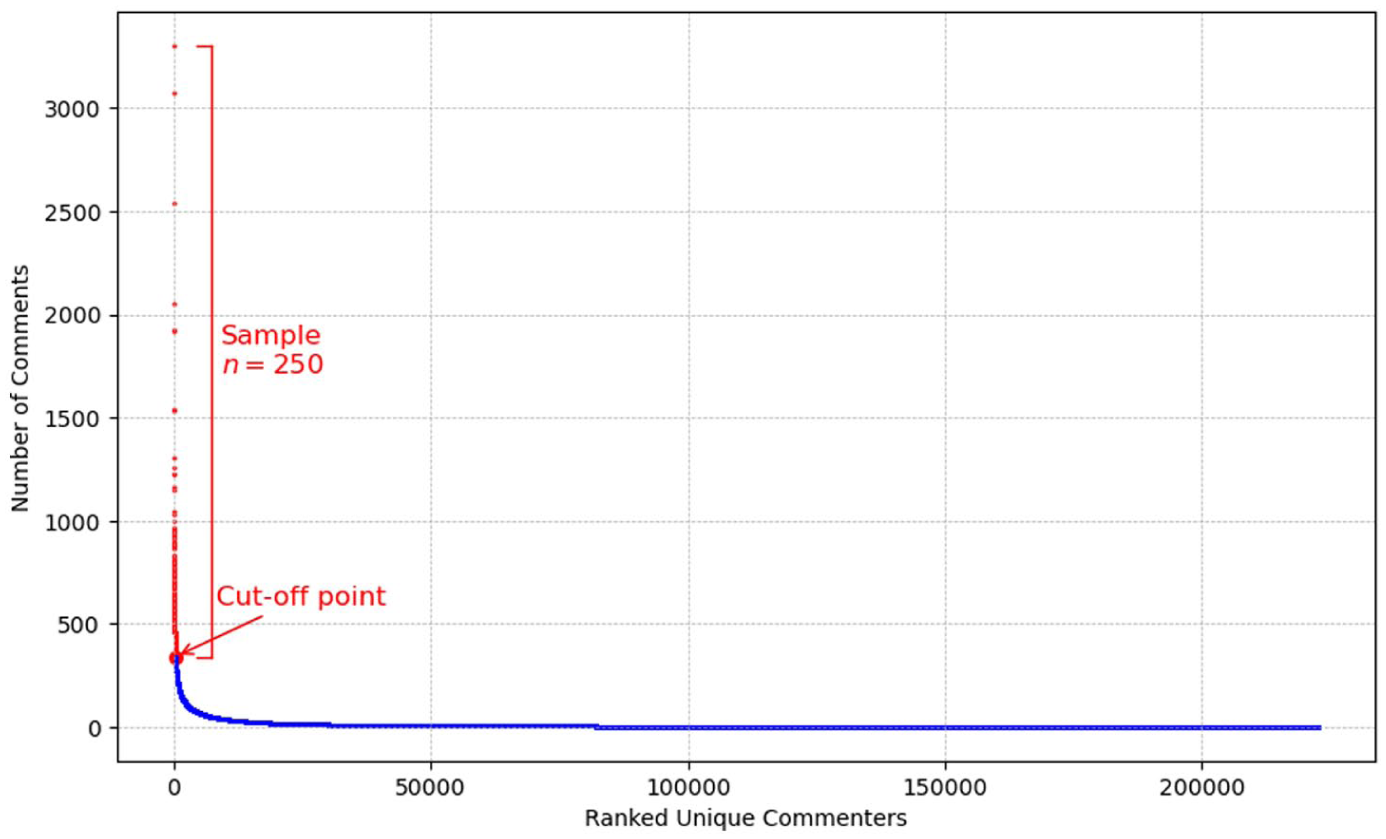
Number of comments posted to RT German’s Facebook page by unique commenters.
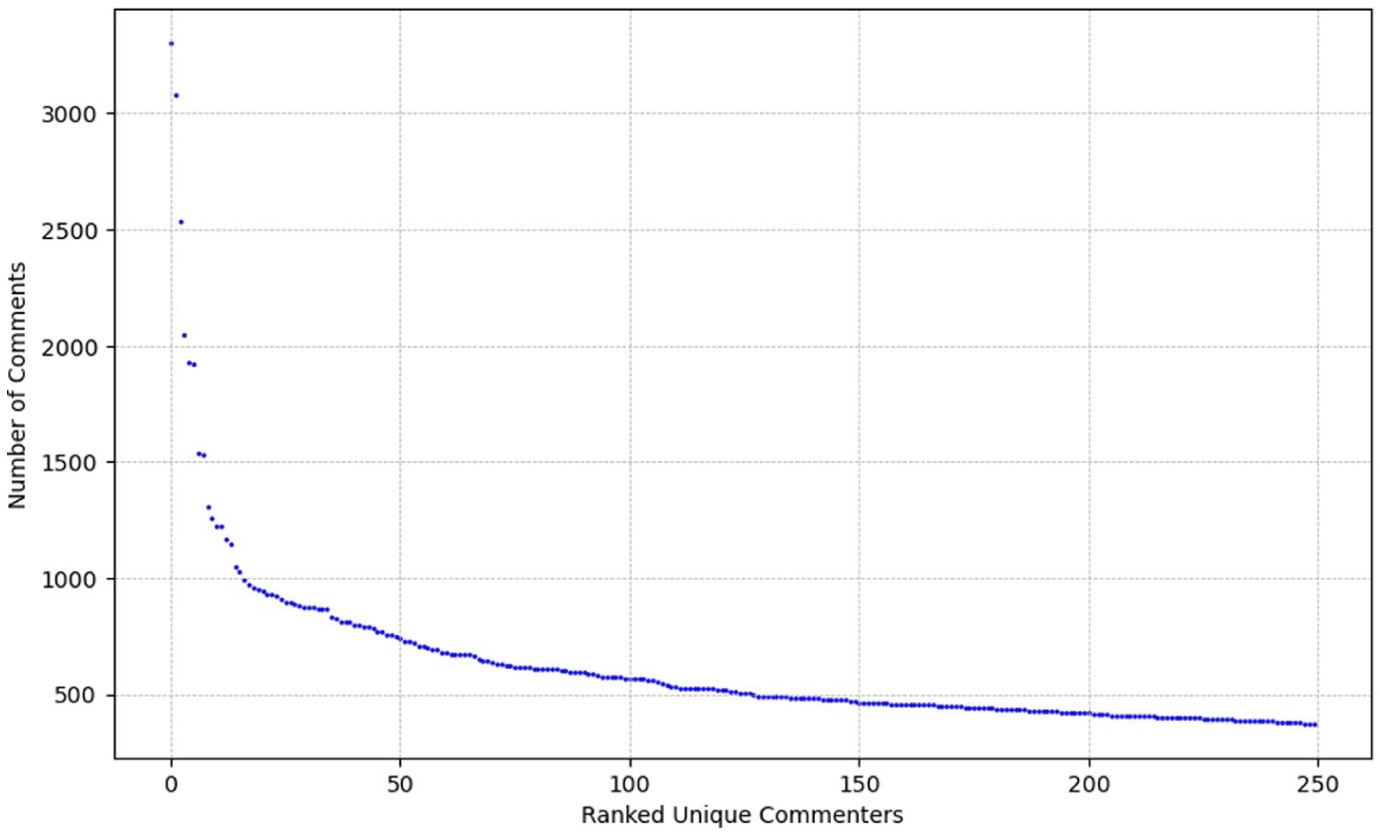
Number of comments posted by the 250 selected highly active commenters.
Quantitative analysis of commenting activities of highly active commenters
In the first part of the analysis, we conducted a manual quantitative content analysis that identified the counterpublic stance of the 250 highly active commenters in our data set. In a codebook (see online supplementary file), we compiled common characteristics and statements reflecting counterpublic and counterpublic-opposing positions as examples. These included, for the counterpublic stance (code = 1), general support for RT and its anti-establishment character such as dissatisfaction with politics and legacy media as well as feelings of exclusion from the dominant discourse. For example, a commenter belonging to this group remarked that “this leftist scum is like a cancer spreading throughout the world” and called democratically elected politicians “corrupt political criminals.” In contrast, the counterpublic-opposing stance (code = 2) reflected the opposite of these aforementioned attributes, such as open critique toward RT and the Kremlin as well as support toward the democratic political system and legacy media. As such, one commenter belonging to this group critically stated: “These are Russian interrogation methods: first, a confession is extracted through torture, and then an investigation is conducted to determine whether there is any truth to the confession at all.” In addition, the coding scheme contained a third option for ambivalent and unclear commenters who could not be clearly allocated (code = 3).
The coding procedure followed a standardized approach; for each commenter, we compiled a list of 20 randomly selected comments. Each of these comments was assessed based on whether the statement of the comment showed counterpublic(-opposing) positioning or was ambiguous. If the distinct majority (e.g. 14:6) of the comments by one commenter reflected, for example, a counterpublic positioning, the commenter was coded as belonging to the counterpublic. If a commenter posted conflicting statements and did not show consistent positioning, the person was deemed an ambivalent commenter.
To secure coding quality, we conducted an intercoder reliability test for the distinction between commenter types with two test coders. Both were communication scholars familiar with RT and its content as well as native German speakers (all analyzed comments were written in German). The overall test coding included 70 commenters, of whom we coded 20 randomly selected comments each according to the coding scheme and using a commenter as a unit of analysis. In the first round of test coding, including 50 commenters, we reached an intercoder reliability result of Krippendorff’s α = .66. We revised the examples in the codebook and coding instructions, and in the second round of test coding (n = 70 commenters, including the re-coding of the 50 commenters of the first round), we achieved a highly-satisfactory intercoder reliability result of Krippendorff’s α = .97. Based on the revised coding instructions, one coder then quantitatively analyzed the counterpublic stance of the 250 highly active commenters. As a result, the 250 highly active commenters were assigned to one of the following three groups: (1) belonging to the counterpublic, (2) belonging to the disruptive public opposing the counterpublic, or (3) not distinctly belonging to either group.
Qualitative data analysis
Subsequently, a qualitative content analysis according to Mayring (2019) was conducted as a second step of the mixed-methods approach. The goal of the qualitative data analysis was to further analyze the discursive practices of the 250 highly active commenters. Here, we relied on sensitizing concepts mentioned in the literature on counterpublics, namely, their discursive interaction, such as the use of ingroup and outgroup rhetoric as well as their argumentative strategies (see e.g. Fraser, 1992; Freudenthaler, 2020; Toepfl and Piwoni, 2015). Using the previous quantitative coding for identifying various groups of commenters, one researcher conducted an in-depth reading of comments by counterpublic and disruptive public commenters based on the sensitizing concepts. Ambivalent commenters were excluded from the qualitative analysis due to the lack of informative value in their comments. For the qualitative analysis, we used at least 20 comments by each commenter as observational units. Comments by various commenters belonging to the two groups were analyzed until we reached theoretical saturation (Lindlof and Taylor, 2017) with regard to the discursive patterns described in the findings section.
Findings
The counterpublic stance of the 250 highly active commenters
To answer the first research question, we quantitatively analyzed the counterpublic stance of the 250 highly active commenters. Out of the 250 analyzed commenters, we coded 179 commenters (71.6%) as siding with the anti-democratic counterpublic position cultivated by the editorial content of RT. In their comments, these anti-democratic counterpublic commenters were consistently highly critical toward democratic institutions, while promoting authoritarian leaders and autocratic governance. For example, regarding the German government and legacy media, Commenter 53 (C53) lamented that “the [German] media are partly to blame for this propaganda, as they are also paid handsomely for it by the state,” and another one remarked similarly: “The [German public broadcasting] belongs in the garbage can [.] It’s just state television and propaganda from the government and the media” (C63; all cited comments were translated by the authors from German to English). Furthermore, these counterpublic commenters showed strong support for the anti-vaccine movement and Russia’s autocratic leader Vladimir Putin. They referred to Putin as “a sensible person and a great president” (C54) or stated: “Russia is one of the few countries that is still sovereign, thanks to Putin” (C227). The style in which this anti-establishment position was formulated by counterpublic commenters ranged from mild, constructive criticism to heavy antipathy, sarcasm, emotional outbursts, and incivil language. Commenter 6 summarizes this sentiment fairly well in their comment: “Leave the church, trade unions and political parties, stop paying GEZ [mandatory fee for Germany’s public broadcasting service], take off your mask, don’t get vaccinated and just do the bare minimum at work!.” Such antagonistic opinions were also articulated toward Germany’s political leadership: “The government can kiss my hump. I won’t be blackmailed, especially not by criminals. I’m turning the tables now and not letting the vaccinated infect me” (C27).
Moreover, we identified in our coding efforts a smaller group of 33 of the 250 analyzed commenters (13.2%) who consistently opposed the anti-democratic counterpublic. We refer to this group as a disruptive public. In their comments, these commenters persistently criticized RT German, Russia, Putin, conspiracy myths, anti-vaccination sentiment, right-wing populism and, in general, the anti-establishment sentiments voiced by the counterpublic commenters. More than once, these commenters referred to Putin as a “war criminal” (e.g. C4) and spoke out against the propagated notion that Germany was turning into a “dictatorship”: “If you think you’re living in a dictatorship here, you don’t have to live here. And if you don’t feel comfortable here, then do yourself and us a favor and just get out!” (C3). With regard to policy issues, due to the time of data collection, many posts and comments centered on the Covid-19 virus, measures against the spread of the disease, and vaccines. In these debates, several commenters of the disruptive public openly stated that they were voluntarily vaccinated and supported the government’s measures to curb Covid-19. Commenter 1, for example, wrote: “But what if the vaccinated, like me, are meandering through the world again in a few months and the vaccine damage does not occur?.”
As a third group, we identified 38 of 250 commenters (15.2%) whom we could not assign to one of the two groups. This was because either (1) their comments did not offer enough rational, comprehensible substance to categorize them or (2) because they articulated conflicting positions across their comments. Due to the lack of meaning in those comments, we did not further analyze them.
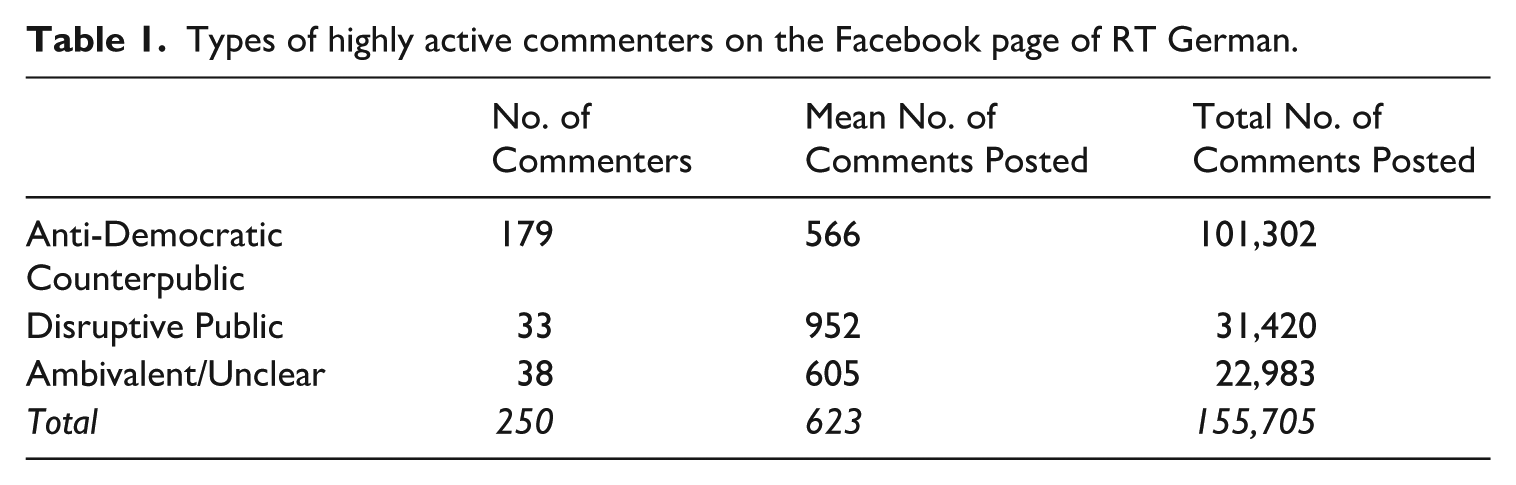
To summarize, our sample of RT German’s highly active commenters was made up of large anti-democratic counterpublic, which was challenged by a smaller fraction of disruptive public commenters. With regard to intensity of commenting, commenters of the disruptive public were much more productive than their anti-democratic opponents. On average, disruptive public commenters posted 952 comments (SD = 762, Min = 384, Max = 3305), while counterpublic commenters posted only 566 comments (SD = 218, Min = 374, Max = 1927). Statistically, a t-test revealed a significant difference between the frequency of commenting, t(33) = −2.89, p = .007, with the disruptive public (n = 33) posting significantly more comments (M = 952.12; SD = 761.54) than the counterpublic (n = 179; M = 565.93; SD = 217.46). Notably, the top four commenters, who jointly accumulated almost 11,000 comments in 6 months, all belonged to the disruptive public. Table 1 provides an overview of the results of the quantitative analysis.
Types of highly active commenters on the Facebook page of RT German.
How discursive strategies differed between counterpublic and disruptive public commenters
The second research question asks how the discursive activities of counterpublic and disruptive public commenters differed in the communication space under investigation. To answer this question, we will focus on the findings of the qualitative analysis.
Identity formation and discursive struggle
As mentioned in the literature review of this article, counterpublic discourse often serves as a way to strengthen the identity of the group and its users as well as distance themselves from the dominant public. We, too, observed this tendency in the analysis; particularly the counterpublic commenters frequently used inclusive rhetoric toward their own ingroup (us) and exclusionary rhetoric toward the outgroup (them), while the commenters of the disruptive public mostly just resorted to exclusionary language toward the counterpublic in order to undermine them, starkly illustrating the polarization between the two groups.
Commenters of the disruptive public, for instance, referred to their counterparts frequently as “RT disciples” (C136) or “empty thinkers” (C65; German: Leerdenker) when engaging with their opposition. In a similar vein, after a commenter showed support for the German right-wing party AfD (Alternative für Deutschland, English: Alternative for Germany), a disruptive public commenter responded: “You’re pretty smart. That’s more than I usually expect from an AfD fanboy” (C3).
Taking a look at the counterpublic commenters, similar sentiments of demarcation can be observed: “In my eyes, the SUPPORTERS [of the Covid-19 measures] are intolerable for a healthy, free society!!! In the future, I will avoid these people in my private environment” (C103). Particularly the counterpublic commenters demonstrated a strong drive toward in-group formation by conversing with like-minded users and including their peers in their statements. For example, one commenter remarked: “Good that we are dissenters. . .” (C48). The counterpublic commenters seemed to transfer their own fears and worries onto their peers, particularly regarding the vaccinations against Covid-19, as can be seen in the following example: “One can only call you an idiot; isn’t it bad enough that we are all being driven to vaccination despite the fear of death? I hope it doesn’t affect you. 850 people who could still be alive” (C50). In comparison, the counterpublic commenters seemed more interested in forming an ingroup and building a community than those belonging to the disruptive public. Furthermore, the previous quotes exemplify the strong hostility between counterpublic and disruptive public commenters. They are frequently insulting or belittling each other, often toeing the line between freedom of expression and hateful speech.
Use of arguments versus emotional language
The reasoning in the comments plays an important role in the argumentative countering in counterpublic spaces. Nonetheless, our analysis revealed a distinct lack of arguments within most comments, especially within the group of counterpublic commenters. Very few of the analyzed counterpublic commenters actually used (reasonable) arguments or justifications, while some comments were severely deficient in coherence. Instead of having a fact-based and neutral discussion, the counterpublic commenters reverted to emotional assertions or rebuttals and provided factually unsubstantiated claims. As previously mentioned, they also insulted or discredited their adversaries in their comments. Typical derogatory exclamations by counterpublic commenters included phrases such as “cucumber troop” (C53, German: Gurkentruppe) or “Top politicians? Rather top failures!” (C68). Nonetheless, some counterpublic commenters exhibited a much more elaborate writing style. For example, one commenter criticized the government’s Covid-19 policies as follows: “Well, this ‘government’ constructs correlations in order to be able to impose more and more repressions and to push its own obsession with power, which can hardly be surpassed in terms of ridiculousness and absurdity” (C39).
Looking at the disruptive public commenters, we also observed stark contrasts between the users; there are those who mainly provoke the counterpublic, and those who try to engage in a more constructive type of discourse by debunking false claims. The provoking commenters often refer to the partiality of RT, such as “You’re just parroting RT, Putin’s state broadcaster” (C142), as well as the counterpublic’s close ties to conspiracy myths, as mentioned here: “Cute, you conspiracy theorists” (C9).
The disruptive public commenters who are trying to debunk false claims, either those spread by RT or by the commenters, use varying tactics. Sometimes, they ask (somewhat provocative) questions to demonstrate the falseness of a claim, such as: “How do you know about the negative effects of the vaccine when there are no long-term studies?” (C136). In other instances, they offer more elaborate explanations as to why a claim might be false or misleading. For example, in response to a video posted by RT German about the Coronavirus, a person replied, Please inform yourselves! This is complete nonsense! The video lasts about 20 minutes, you have to watch it completely, there is a German translation, with not a single syllable, not even a mini second, mentioning that the Coronavirus is a lie and if it were, why doesn’t the world know it yet? (C7)
In addition, we observed the use of additional sources in both groups. Counterpublic commenters posted links to other anti-democratic media outlets or similar sources in order to substantiate their claims, while disruptive public commenters used links to legacy media outlets for the same purpose.
Another central characteristic is the counterpublic commenters’ strong proclivity toward conspiracy myths, especially those concerning Covid-19. Frequently mentioned conspiracy myths centered around the so-called plandemic (the notion that the pandemic was planned, or rather, staged), and the alleged lethality of Covid-19 vaccinations. One counterpublic commenter, for example, ruminated: “A politically orchestrated pandemic, with the help of the annual influenza. . .” (C207). We observed similar claims across various commenters, some of them being even more explicit: “And the funny thing is: the organizers of the [World Economic Forum], based in Davos, admit [the orchestration] in public! THE GREAT RESET” (C193). Another counterpublic commenter heavily criticized the vaccination with the following statement: “The vaccine is a ticking time bomb that has not been researched. The vaccine alters the genes in the body, making it almost impossible to calculate the long-term consequences” (C202). Notedly, most of these statements did not offer any (reliable) sources to substantiate the claims.
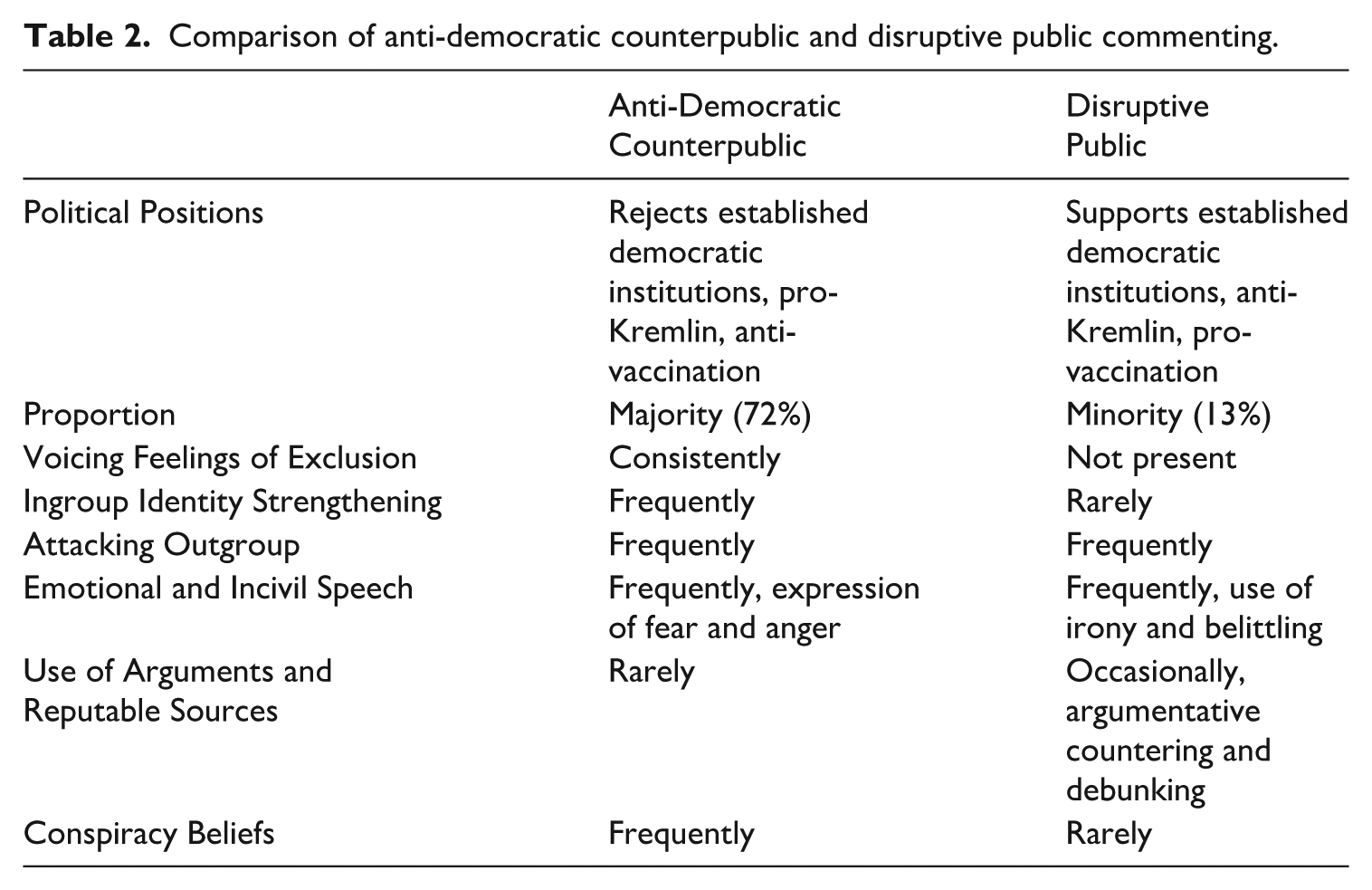
All in all, the discourse in the analyzed comments lacked plausible reasoning and instead, commenters reverted to emotional rebuttals (fear and anger being expressed the most), verbal mudslinging or incoherent statements. This applies, to some degree, to both the counterpublic and disruptive public commenters (see Table 2). While some commenters, particularly those of the disruptive public, try to engage in a fact-based, source-substantiated, and mostly civil conversation, most commenters participate in verbal mudslinging.
Comparison of anti-democratic counterpublic and disruptive public commenting.
Discussion
The discursive practices of the counterpublic and the disruptive public in comparison
In this article, we scrutinized the active audience engaging in a communicative space opened up by an anti-democratic counterpublic media outlet sponsored by an authoritarian state. We quantitatively and qualitatively analyzed the 250 most active commenters of RT German’s Facebook page in the first 6 months of 2021. In our analysis, we identified not only a collective of anti-democratic counterpublic commenters but also a group of commenters that vigorously challenged and opposed them. We refer to this group of commenters as a disruptive public. While the counterpublic commenters represented the majority of commenters, the disruptive public commenters posted with a much higher frequency. Illustratively, the four most active commenters in our data set were all part of the disruptive public. Thus, we uncovered similar tendencies of highly active commenters in anti-democratic spaces as Hellmueller et al. (2021) who found that, while most of the commenters formed a homogeneous group supportive of the anti-democratic content, some outliers actively challenged this majority by aggravating them.
Regarding the discursive patterns and argumentative strategies of the anti-democratic counterpublic and the disruptive public, we observed several characteristic differences. An obvious difference concerned the content of the arguments of the two types of publics. While the counterpublic advocated for anti-democratic and pro-authoritarian positions, the disruptive public defended democratic institutions and chastised authoritarian practices. However, we observed differences between the two groups of commenters not only in their arguments but at more abstract levels. For instance, we identified a high proclivity for ingroup formation in the counterpublic, while invoking a common identity was rare among disruptive public commenters. Moreover, while the counterpublic commenters voiced feelings of exclusion (even though they were in the majority in the space under investigation), the disruptive public commenters did not do so. Furthermore, the anti-democratic counterpublic disseminated conspiracy myths and rarely used arguments or reliable sources, while commenters of the disruptive public sometimes engaged in more constructive behavior such as fact-checking and debunking. Then again, the two groups also showed some commonalities; commenters of the counterpublic and the disruptive public were both highly engaged in othering the opposition and both frequently showed insulting commenting behavior.
Comment sections opened up by anti-democratic news media as hybrid spaces
A particularly relevant aspect of this article is the disruptive public and the discursive dynamic between counterpublic and disruptive public in the participatory space of an anti-democratic media outlet, such as RT’s comment section. As has been argued in the literature on counterpublics, these online spaces could serve for inward-oriented communication between like-minded individuals in order to form a group identity (see Fraser, 1992; Toepfl and Piwoni, 2015). However, in the case of RT German’s Facebook comment section, we observed the presence of a disruptive public in this space. As our findings show, a minority of highly active commenters sought to disrupt the counterpublic discourse, provocatively engaging with the counterpublic and positioning this discursive space in-between inward- and outward-oriented communication. The behavior of the disruptive public’s commenters ranged from debunking and informing to enraging their adversary, venting their own dissatisfactions. Looking at our findings, we can see that some disruptive public commenters tried to austerely discuss and exchange knowledge, while other commenters merely mocked the counterpublic and, for example, tried to claim intellectual superiority.
Disruptive publics: dissuading or invigorating anti-democratic counterpublics?
Another pressing question is whether or not the activities of the disruptive public as we observed them are, normatively speaking, helpful and desirable. RT German, with its Kremlin-supportive and anti-Western agenda, arguably does not serve as a place for democratic discourse. This is reflected in the comment section, where the counterpublic exchanges sometimes crude conspiracy myths, hateful sentiment and questionable sources, highlighting the inward-oriented purpose of counterpublic spaces in a distinctly anti-democratic setting. However, generalizing all counterpublic commenters as dangerous and deranged individuals who should be belittled and insulted to “put them in their place,” as it seems to be done frequently by the disruptive public, would do more harm than good. Conceiving (at least some of) the counterpublic commenters as “alarmed citizens” (Thorbjørnsrud and Figenschou, 2022), it is reasonable to say that they express their own fears and worries, with RT providing a dedicated gathering place for these individuals. Confronting their fears with ridicule and disdain does not facilitate a helpful, healthy discourse. Instead, we can observe a major rift and heavy polarization between the counterpublic and disruptive public, which is probably only intensified (in both directions) by the verbal mudslinging in the comment section. Particularly when looking at highly active commenters as potential opinion leaders (Weeks et al., 2017), this behavior emerges as highly problematic.
Furthermore, the observed othering and incivil language in the comment section raises additional concerns. First, the polarization can be described as a success for anti-democratic counterpublic media outlets who seek to strengthen anti-democratic sentiment. Considering RT’s goal of destabilizing Western societies abroad, our findings indicate a relative success of the Kremlin’s narratives, namely, fanning the flames of dissatisfaction in Western societies and deepening the polarization of groups with differing viewpoints. Furthermore, as Zelenkauskaite (2022) notes in her book on Kremlin-affiliated trolls in online comment sections, their primary aim is to create chaos and uncertainty. Our findings reveal similar tendencies with comparable potential effects. While the commenters might not deliberately pursue such goals, RT German fosters an online environment which encourages such behavior.
Second, in our data set, we found a plethora of comments that can be categorized as hate speech (such as insults, Holocaust relativization, and calls for violence) which should have been removed by moderators on RT German’s Facebook page. Since it is difficult to track moderation in comment sections, our insights into the lack of moderation are limited but it seems that–wittingly or unwittingly–some of the hateful comments slipped through the cracks of moderation. It can either be a sign for RT German’s malign intentions of deepening conflict by intentionally leaving some provocative comments unmoderated or it can serve as an example of Facebook’s insufficient platform regulation. The important role of moderating (hostile) online environments appears as a personal choice for some of the analyzed commenters; as previously mentioned, the top four highly active commenters in our data set all belonged to the disruptive public and served, in a mostly civil way, as “debunkers.” We can only speculate about these individuals’ apparent personal feelings of responsibility to counter mis-/disinformation. However, it is important to emphasize that the counter-resistance in anti-democratic online environments cannot be put solely in the hands of individual laypeople. Instead, social media platforms such as Facebook must also take responsibility in tackling growing polarization; however, as their algorithms seem to favor polarizing content and might even promote it (Guess et al., 2023), readiness for action remains questionable.
Limitations and promising pathways for future research
Of course, this article is not without its limitations. First of all, due to the qualitative nature of some of our findings, we cannot make claims regarding the relative frequencies of these occurrences. Given the fact that the originally collected data set comprises over 1 million comments, a subsequent quantitative or computational analysis might substantiate our observations even further. Nonetheless, our qualitative findings give us in-depth insights into the dynamics between the counterpublic and disruptive public, a yet unstudied phenomenon. Furthermore, since Covid-19 was such a dominating topic at the time of data collection, it might have influenced the discussion behavior or could reflect an atypical situation. However, using RT German as an exemplary case for fostering an anti-democratic counterpublic, the findings can be applied to other time frames, platforms, websites, and countries to qualitatively and quantitatively identify patterns of user engagement, since comment sections are a common occurrence across various anti-democratic media outlets. In addition, since other authoritarian countries such as China or Iran might adopt similar strategies of foreign interference as Russia, RT’s comment section gives us first insights into an anti-democratic counterpublic discursive space facilitated by authoritarian states. As Roberts (2014) states, the Chinese government is employing covert measures to control the online information environment such as making government-critical information hard to find or flooding public discourse with state-aligned messaging. Studying how highly active commenters enhance or hinder these tactics is the next step to further understand propaganda measures in authoritarian contexts.
Our study highlights the need for further research into the influence of highly active commenters on the spread of anti-democratic and propagandistic content. Major concerns are the negative backlash effects of problematic types of disruptive online behavior, such as verbal mudslinging. It may rather instigate than dissuade anti-democratic counterpublic audiences and thus may contribute not to inclusion but to further alienation of anti-democratic individuals.
Supplemental Material
sj-docx-1-nms-10.1177_14614448251413136 – Supplemental material for Disrupting or invigorating an anti-democratic counterpublic? How highly active commenters engage on RT German’s Facebook page
Supplemental material, sj-docx-1-nms-10.1177_14614448251413136 for Disrupting or invigorating an anti-democratic counterpublic? How highly active commenters engage on RT German’s Facebook page by Arista Beseler, Florian Toepfl, Daria Kravets and Julia Kling in New Media & Society
Footnotes
Author’s Note
Daria Kravets is now affiliated to affiliated to Bavarian Research Institute for Digital Transformation, Germany.
Ethical approval
Funding
The authors disclosed receipt of the following financial support for the research, authorship, and/or publication of this article: This article has received funding from the European Research Council (ERC) under the European Union’s Horizon 2020 research and innovation program (Grant agreement No. 819025). It is part of the ERC consolidator project on “The Consequences of the Internet for Russia’s Informational Influence Abroad” ( ).
).
Supplemental material
Supplemental material for this article is available online.