




Abstract
Repetitive online communication is often labelled a ‘bot problem’ by platforms, policymakers and users. However, repetitive posting does not exclusively indicate automation; humans also engage in bot-like posting for various purposes. We adopt the term ‘botting’ to describe repetitive posting enacted through manual, semi-automated, or fully automated means. While emerging research has linked manual botting practices to commercial or fame-seeking motivations, we extend this scholarship by examining botting on Reddit – a pseudonymous platform that lacks the affordances typically associated with monetisation or personal branding. Through a mixed-methods analysis, we examine a case study in which mass-scale, repetitive posting of the mushroom emoji emerged as ‘in-group’ behaviour within Reddit’s participatory culture, prompting a performative counterpublic response. Our findings challenge the binary between human and automated posting, and underscore the importance of situating research on AI-generated and automated content within the cultural and contextual frameworks that shape its production and reception.
Introduction
In 1993, Peter Steiner captioned a cartoon of two dogs behind a computer with the now-iconic phrase, ‘On the Internet, no one knows you’re a dog’ (Fleishman, 2000). This adage quickly became emblematic of online anonymity. More than three decades later, the question of who – or what – is behind the screen remains just as poignant, yet increasingly obfuscated (Carlon, 2025a). This ambiguity is especially pronounced on social media, where debates over whether accounts are operated by humans or bots have shaped terms of use, platform norms, and perceptions of ‘valid’ and ‘authentic’ users (Hallinan et al., 2022). Across platforms, assessments of acceptable use often hinge on whether content is posted by humans, generated by AI, or automated (Carlon, 2025a). This paper interrogates the binary framing of human versus machine-generated content, exploring how users intentionally blur these boundaries by emulating bot-like posting patterns. In doing so, we challenge the utility of dichotomous labels such as ‘authentic’ versus ‘inauthentic’ or ‘real’ versus ‘fake’, and critically examine what the term ‘bot’ signifies in both public discourse and platform vernacular.
Bots – broadly defined as software applications that operate autonomously or semi-autonomously to perform tasks within networked environments – play diverse and essential roles online (Gorwa and Guilbeault, 2020). For the purposes of this study, we focus on bots that function as user accounts or post content within social media platforms. These bots have attracted scrutiny for their ability to mimic human behaviour at scale, and have been extensively studied for their roles in disrupting democratic processes, amplifying polarisation, spreading low-quality or spam content, and automating fame and parasocial relations. 1 Due to their automated capabilities, bots feature prominently in discussions about social media manipulation and inauthentic content, although they also play a valuable but overlooked role in enriching platform cultures and functionalities (Carlon et al., 2025). While the capacity of bots to imitate human behaviour is well established, far less is known about emerging practices whereby humans imitate bots.
The term ‘bot’ typically refers to activity that is automated, semi-automated, AI-generated, or scheduled via software. It also implies a sense of frequency and repetitiveness (Assenmacher et al., 2024), although these traits are not exclusive to automated formats. In the context of social media, Schäfer (2024) uses the term ‘botting’ to describe a form of repetitive posting as a visibility enhancement strategy. Schäfer (2024: 89) frames botting on Instagram as ‘the use of fame-enhancing bots’, examining it through the lens of transgressive play and ludification of culture. While Schäfer’s focus is on automated bot services, the paper crucially identifies botting as a cultural practice embedded within platform visibility games, rather than merely a technical problem. Building on this conceptualisation, but extending it beyond pure automation, we propose that ‘botting’ can encompass repetitive posting practices regardless of the mode of execution, thus including generated, automated, semi-automated, or manually enacted activity. This expanded definition is necessary because, as Varol et al. (2017) demonstrate, bot detection involves analysing multiple behavioural dimensions – user profiles, network patterns, temporal features, content and sentiment – with repetitive posting being only one surface-level indicator. Furthermore, the concept of ‘cyborgs’ set out by Chu et al. (2010) and Pozzana and Ferrara (2020) – namely, accounts that are part human-controlled and part automated – already challenges the binary distinction between bots and humans. By treating botting as a spectrum of practices and a socio-technical accomplishment rather than a binary category, we can better understand how humans strategically adopt bot-like behaviours as what Gibbs et al. (2015) term ‘platform vernacular’, that is, the shared communicative conventions that emerge from interactions between platform affordances and user appropriations.
While the use of bots is a well-documented strategy for visibility enhancement, the practices and motivations behind manual botting remain underexplored, with existing research predominately focused on commercial, fame-enhancement, or political contexts. For instance, Matamoros-Fernández et al. (2024) have examined how YouTube creators engage in repetitive, bot-like behaviours to cultivate positive online engagement, challenging the assumption that such tactics are exclusive to automated systems. Similarly, Kasianenko (2025) explores non-automated, repetitive posting as a visibility strategy within political and activist spheres. While more is known about both bots and botting practices on platforms such as Instagram, Twitter/X and YouTube, that allow for ‘real-name’ self-promotion (Matamoros-Fernández et al., 2024; Schäfer, 2024), our study extends this scholarship by examining how humans engage in and react to botting on the pseudonymous platform, Reddit.
Reddit is structured around user-created and user-moderated communities, called subreddits, each governed by its own norms and rules. Its decentralised, community-driven architecture, combined with a voting system that ranks content through peer evaluation (Graham & Rodriguez, 2021), cultivates a participatory culture distinct from other social media platforms. Moreover, Reddit does not exhibit the same fame-enhancement or commercial affordances as other mainstream platforms. Unlike many environments that restrict user-created bots, Reddit permits them, allowing them to serve both functional roles, for instance in moderation and content curation, and playful roles in everyday engagement (Massanari, 2015). This permissive – and at times celebratory – attitude towards automation (Carlon, 2025a) raises a critical question: why would human users manually perform bot-like posting in a setting that already embraces automation? Given Reddit’s pseudonymity and limited commercial affordances, manual botting cannot be easily explained by fame-seeking or monetisation logics.
Accordingly, we investigate how botting is situated within Reddit’s participatory culture (Jenkins, 2006), where users actively produce content and negotiate norms around acceptability – particularly through in-group behaviours and reactions. This paper contributes to emerging scholarship on repetitive posting by examining botting on Reddit, a platform whose affordances, features and attitudes towards bots differ significantly from those of more frequently studied platforms such as YouTube, Twitter/X, or Instagram. Through this platform-specific lens, our analysis explores how botting functions as a socially embedded and often playful form of engagement shaped by community dynamics. By expanding our focus beyond automation alone, we challenge the values and assumptions underpinning binary distinctions between human and machine actions. In doing so, we offer broader insights into how acceptable content is evaluated within an increasingly hybrid online ecosystem – where AI-generated, automated and human-authored content converge in complex and often indistinguishable ways.
Introduction to the Fungi case study
To understand botting as more than a technical problem, we situate our analysis within contemporary theories of participatory culture that account for platform-specific dynamics. While Jenkins’ (2006) foundational work on participatory culture emphasised how digital media enables fans and users to actively produce and circulate content, subsequent scholarship has complicated this optimistic vision. Van Dijck et al. (2018) platform society framework demonstrates how participatory culture has been reshaped by ‘programmable digital architectures’ that penetrate societies through datafication, commodification and selection mechanisms. Within this framework, what appears as participation may actually be what they term ‘hybrid participatory culture’ – user practices that have been commodified and resold within platform capitalism.
This platform-centric update to participatory culture theory is particularly relevant for understanding Reddit. As Massanari (2015, 2017) has shown, Reddit’s specific affordances – its karma system, voting mechanisms and subreddit structures – create a participatory culture characterised by playfulness, performance and meta-commentary, but also by gaming behaviours like ‘karmawhoring’ where users strategically post content to maximise karma without original or normatively acceptable contribution. Liang and Ye’s (2025) concept of ‘algorithmic pedagogy’ further adds to our understanding of how platforms shape user behaviours by teaching normative practices through their recommendation and ranking systems. They argue that platforms interpellate users as ‘entrepreneurial, resilient and self-optimising subjects’, promoting authenticity while simultaneously prescribing optimisation routines. Within this framework, bot-like behaviours can be understood as users at once learning and exploiting these pedagogical systems.
Central to our analysis here is Warner’s (2002: 50) theory of publics and counterpublics, which conceptualises publics as ‘self-organised’ social spaces ‘created by the reflexive circulation of discourse’. For Warner, counterpublics are publics ‘aware of their subordinate status’, which possess poetic world-making capacity through alternative discourse circulation. Reddit’s structure – with its thousands of subreddits, each with distinct norms and governance – exemplifies how digital counterpublics form through what Warner calls ‘stranger sociability’, where participants address unknown audiences through shared discourse. As will discuss further in the next section, when copycat accounts on Reddit started posted mushroom emojis across the platform, they engendered what is evidently a counterpublic formation – a community constituted through repetitive, transgressive posting that challenged platform norms about authentic participation, while also being deeply shaped by Reddit’s platform logics and vernacular.
The playful and ironic dimensions of this counterpublic formation align with recent scholarship on memes and digital culture. Milner (2016) theorises memes as ‘quintessential participatory artifacts’ that require both technical accessibility and subcultural knowledge, creating what they term ‘transformative competence’. This dual requirement – of being technically able to participate while needing cultural insider knowledge – is crucial for understanding Reddit’s ‘fungi’ mushroom emoji phenomenon that we focus on in this paper. So too is the Reddit fungi phenomenon instructive more broadly for our understanding of the relationship – indeed the difference – between what counts as human versus non-human participation online, and whether that difference is traceable, resolvable, or even whether it matters. As Shifman (2014) argues, memetic activity serves as an index of digital culture, measuring cultural participation through imitation and remix. The fungi accounts’ repetitive posting can thus be understood not as mindless automation, but as a form of memetic participation that, through its very repetitiveness, comments on the nature of authentic engagement on Reddit, irrespective of whether it originates from a piece of Python code controlling the Reddit API or a human interfacing physically with the platform UI.
Finally, our theoretical framework must account for what Haimson et al. (2021) identify as the ‘online authenticity paradox’ – the notion that authenticity online is ‘often unreachable or achievable only at great personal cost’, particularly for marginalised groups. If humans cannot achieve ‘authentic’ presentation online due to platform constraints and social pressures, then the distinction between ‘authentic’ human participation and ‘inauthentic’ automated participation becomes increasingly unstable and unintelligible as a conceptual frame. As Taylor (2022) argues in their analysis of authenticity as performativity on social media, authenticity itself has become commodified within neoliberal platform cultures. This critical perspective on authenticity is essential for understanding why manual botting – humans deliberately performing machine-like behaviours – might function as a form of commentary on or resistance to platform demands for authentic self-presentation.
Manual botting in practice: the case of Reddit’s ‘fungi’ accounts
To examine botting as a form of participatory culture, we analyse an infamous and distinctly ‘Reddit’ case study involving a phenomenon known as Reddit’s fungi accounts and their repetitive posting of the mushroom emoji ( ). In August 2020, a user on the social media platform Reddit named ‘Anus_-___Fungi’ started posting mushroom emoji () comments in seemingly random subreddits across the platform. This account would reply to other users in comment threads with a single emoji and no other text, as shown in Figure 1. Within weeks, hundreds of copycat Anus Fungi accounts (herein referred to as ‘fungi accounts’) appeared on the platform, posting mushroom emojis and attracting both criticism and adulation. These accounts adopted a similar username vernacular with a combination of underscores and hyphens dividing the capitalised words Anus and Fungi.
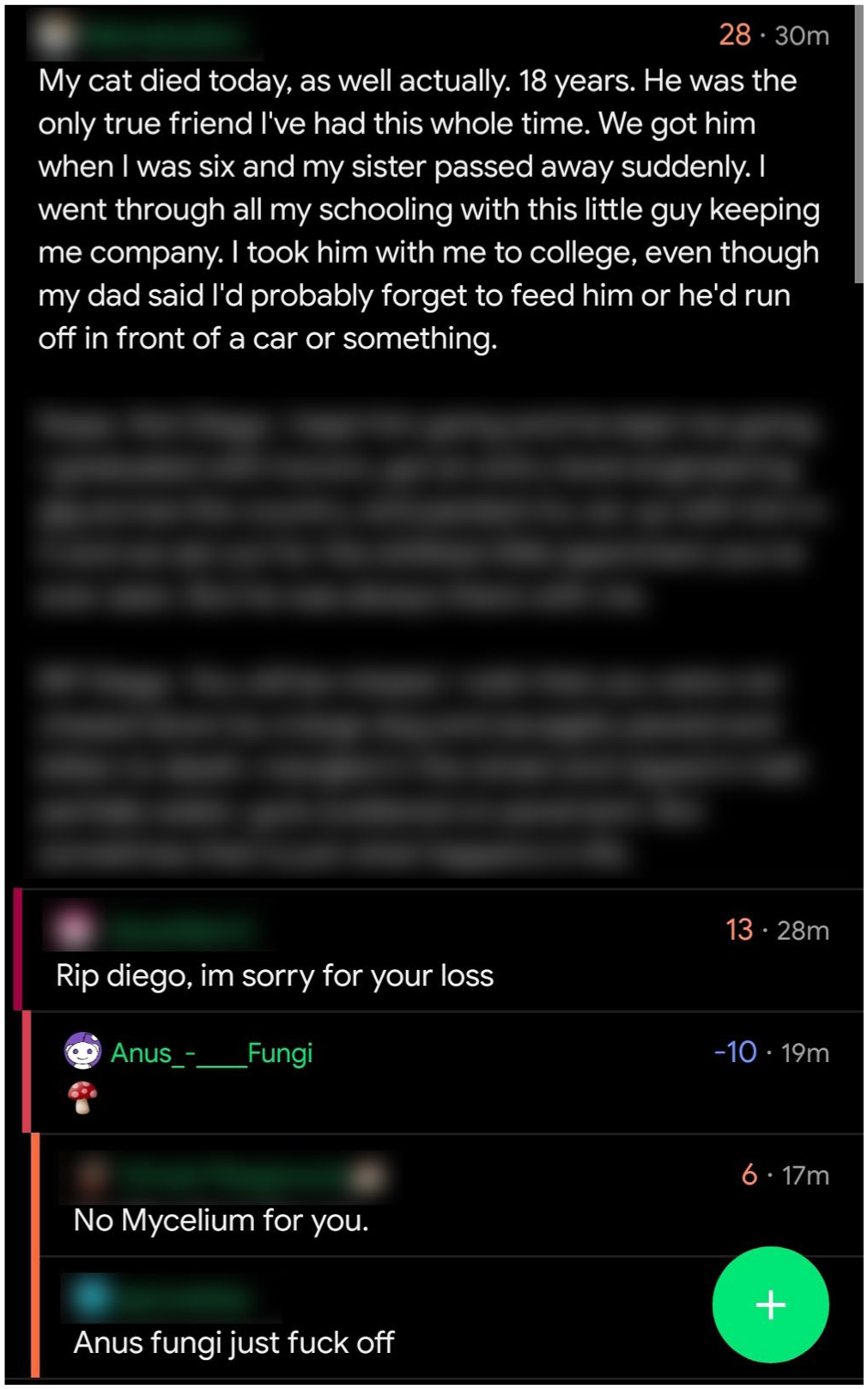
Example comment thread where the original ‘fungi’ account replied with a mushroom emoji.
The proliferation of copycat fungi accounts led to the rapid proliferation of the mushroom emoji across Reddit. The mushrooms had a polarising effect on the platform with Redditors mobilising the platform affordances to express both praise and critique towards them. Anecdotally, the fungi accounts were constituted as a ‘bot problem’, with the assumption the accounts were automated using the Reddit Application Programming Interface (API). However, upon closer examination, it is unclear whether these accounts were truly bots or humans engaged in botting.
Through a mixed method analysis tracing the rise and fall of the fungi accounts, their posting patterns, and the sentiment towards them, we explore what it means to be labelled as a ‘bot’ in Reddit’s platform vernacular. To examine how botting is managed within Reddit’s multi-layered governance setting, we examine the life cycle of the Reddit fungi accounts, including their activities and the community’s response. Drawing on theories of participatory culture, platform vernaculars and counterpublics, we theorise botting as a culturally embedded practice that challenges binary distinctions between human and automated participation. Unlike platforms that rely on top-down enforcement, Reddit’s provenance-agnostic, participatory moderation model enables subreddit communities to collectively negotiate the boundaries of acceptable content – regardless of whether it is human or machine-generated (Carlon, 2025b). Accordingly, rather than simply mapping the spread of the mushroom emoji phenomenon or cataloguing user responses in a descriptivist manner, our investigation is framed around three theoretically grounded research questions that interrogate the stakes of authenticity, governance and participatory culture within a distinctly community-driven platform environment:
RQ1 moves beyond technical detection to examine how platform architectures and community practices construct categories of ‘authentic’ versus ‘inauthentic’ participation. Given the documented limitations of bot detection methods showing 40–90% error rates (Rauchfleisch and Kaiser, 2020) and the existence of human-bot hybrids or cyborgs (Chu et al., 2010), we investigate whether the human/bot distinction remains analytically useful or obscures more complex participation dynamics:
Building on Warner’s (2002) theory of counterpublics and recent work on platform governance (Chandrasekharan et al., 2018), the second research question examines how communities determine the legitimacy of repetitive posting through norm enforcement rather than technical categorisation. We explore how the fungi phenomenon created a counterpublic that challenged established governance structures across Reddit’s multi-layered ecosystem.
Extending Jenkins’ (2006) participatory culture framework through Van Dijck et al.’s (2018) platform society lens and Liang and Ye’s (2025) concept of algorithmic pedagogy, RQ3 examines botting as a platform vernacular (Gibbs et al., 2015) that emerges from the interaction between user creativity and platform constraints. We investigate whether manual botting represents a form of tactical resistance to platform optimisation logics or a playful engagement with Reddit’s gamified participation structures.
These questions collectively challenge the utility of authentic/inauthentic binaries in understanding contemporary digital participation, where AI-generated, automated and human-authored content increasingly converge in complex and often indistinguishable ways. The remainder of this paper is structured as follows. First, we outline the tensions and presumptions underpinning our understanding of bots in social media spaces, and the importance of considering platform-specifics regarding bots and botting practices. Using the Reddit Fungi accounts as a case study, we explore the blurred lines between humans and bots, scrutinising whether automated versus manual posting has any influence on perceived quality of content. Guided by the research questions and using data collected from the Reddit API, we undertake a mixed-methods analysis of 9,728 Reddit comments containing a single mushroom emoji between 1 January 2020 and 31 March 2023. To understand the sentiment and activities within the anti-fungi communities, we conduct a thematic analysis of the 25 most upvoted posts and threads within the counter-fungi subreddit, r/stopanusfungi. Our analysis prompts questions about whether automated posting patterns are discernible on a platform like Reddit, why people might act like a bot, and what the term ‘bot’ signifies in the public and platform vernacular. The paper concludes with a reflection on the key findings and the importance of developing platform-specific understandings about automated versus human generated content and the need to reconsider dichotomous understandings around permitted content.
Bots and botting
Platforms and the trajectory of bots as ‘inauthentic’ actors
Bots predate social media; however, the emergence of ‘platforms’ reshaped both the motivations behind bot creation and the ways audiences encountered and perceived them (AUTHORS, 2026b). Rather than operating independently on websites or bulletin board systems, bots became embedded in everyday online experiences by leveraging the affordances of platform environments (Flores, 2021; Leistert, 2017). Social media platforms created the conditions whereby bots could appeal to, target, manipulate, or enhance the diverse interests and motivations of platform users and stakeholders. As a result, an extensive assortment of bots emerged fulfilling various purposes within the parameters of the platform’s architecture and culture, capitalising on the conditions and user base of their networked environment (Leistert, 2017).
Leistert (2017: 168) notes that bots are just one of many entities navigating the ‘vast machine of noise’ that is the Internet. Within social media settings, bots are often equated with malicious intent or low-quality content. However, this perception does not accurately reflect all bots, nor is it the case across all platforms. As Carlon (2025b) outline, bots on platforms such as Twitter/X have historically played a wide range of roles – including improving accessibility, engaging in social and political activism, serving as educational and informational tools for institutions like museums and emergency services, and contributing to creative and novelty-driven content creation. Similarly, scholars such as Tsvetkova et al. (2017), Geiger and Ribes (2010) and Zheng et al. (2019) have documented the multifaceted roles of bots in knowledge production and curation on Wikipedia. These studies underscore the importance of situating bots within the platform environments in which they operate. Given that each platform is shaped by distinct governance structures, community norms, rules and attitudes towards automated content, it is essential to contextualise the purposes bots serve, and reactions to their presence, within their situated environment rather than drawing upon more generalised assumptions.
While platform-sanctioned bots are generally accepted as part of the ecosystem, user-created or third-party bots often face resistance. Platforms like Instagram, Facebook and X typically frame externally created bots as violations of rules around authentic content and legitimate use, casting them as deceptive or disruptive agents (Carlon, 2025b; Leistert, 2017). Accordingly, extensive scholarly work has focused on bots’ role in spreading spam, malware, or harmful content, especially on Twitter/X, Facebook and Instagram, where they are seen as unauthorised actors breaching ‘real name web’ standards for authentic use (Bastos and Mercea, 2019; Bessi and Ferrara, 2016; Boshmaf et al., 2011; Ferrara, 2019; Livingstone, 2021). By contrast, there is significantly less understanding of how bots are contested or embraced on platforms like Reddit, where bots as a whole are widely accepted, valued and treated as legitimate – although sometimes contested – participants in the platform culture (Massanari, 2015).
Bots on Reddit developed on a different trajectory to other platforms because they were never, by virtue of their automated and non-human status alone, viewed as a threat to platform values or rules (Carlon, 2025a). On Reddit, bots are set up as regular user accounts and are expected to follow site-wide rules and norms, just like human users. Registration to Reddit is free and requires no verification of identity, meaning that it is easy for users to create multiple accounts, including bot accounts. As we explore in this study, this affordance can lead to copycat accounts appearing that adopt similar names and posting activity, but do not contribute original content on their own.
Reddit provides a uniquely fertile environment for users to experiment with and develop bots across a wide spectrum of purposes. Unlike many other platforms, bots on Reddit are deeply embedded in user-led initiatives and community-driven dynamics, with their roles and perceptions shaped by participatory culture and platform-specific values (Massanari, 2015). Beyond their utilitarian functions, Reddit bots are also integral to the platform’s cultural fabric. They participate in content creation by automating novelty jokes, emojis, and digital art, and often spark playful interactions among users (Carlon, 2025a; Massanari, 2015, 2016). These bots contribute to Reddit’s broader atmosphere of ‘carnival’ and ‘play’, as described by Massanari (2015).
Reddit is a multi-layered platform where both human and bot-generated content is evaluated by the community, and behavioural norms are co-negotiated by users, moderators and administrators (Carlon, 2025a; Massanari, 2015). This process involves a constant negotiation about the type of content that adds value which in turn is rewarded with heightened visibility through design features such as Reddit’s up- and down-voting ranking system (Carlon, 2025b; Gilbert, 2013; Squirrell, 2019). As we explore in this paper, these dynamics are visible in discussions surrounding the fungi emoji posters, where platform affordances are used to express support or dissent, creating counterpublics around their presence. The permissive stance on bot creation, coupled with peer-driven evaluation on Reddit offers a compelling context to explore why human users would impersonate bots.
‘Bots’ in public vernacular
The term ‘bot’ carries connotations that extend beyond platform policies and technical definitions; it has become embedded in public vernacular, particularly within Internet discourse. Increasingly, the term is used as an insult, where accounts perceived as repetitive, disliked, or ideologically opposed are often accused of being bots, even without evidence of automation (Assenmacher et al., 2024). This phenomenon raises critical questions about the role of public imaginaries in shaping what it means to ‘be a bot’ (Natale, 2019, 2021), and whether the technical distinction between automated and manual posting holds any real social significance.
Public perceptions of bots are fluid and context-dependent (Gehl and Bakardjieva, 2016; Gorwa and Guilbeault, 2020). Assenmacher et al. (2024) trace how accusations of being a bot on Twitter have evolved – from describing scripted, repetitive behaviour pre-2017 to becoming a politicised and dehumanising term in the wake of the 2016 US election. Their study reveals that the term now reflects broader social symbolism and values, rather than strictly technical attributes. Our paper extends this inquiry by examining bot accusations on Reddit – a markedly different platform where user-created bots are not only tolerated but often celebrated as part of the site’s architecture and culture.
Accusations of being a ‘bot’ are not merely semantic; they signal deeper concerns around dehumanisation, blurred authorship, and the erosion of content integrity and provenance. These issues are increasingly salient in an AI-infused media landscape, where accusations of being AI or a bot appear frequently in comment sections. Yet the rationale and underlying motivations behind such accusations remain underexplored. Our paper contributes new insight into this phenomenon by examining how and why content is accused or presumed to be automated on a platform where value is assessed through perceived quality, rather than determined by the human or machine status of its author.
Botting: when the ‘bot’ isn’t a bot
Repetitive posting at speed and scale is frequently associated with bot activity, however it is not always clear whether such behaviour stems from automation or human-driven ‘content farms’. As Matamoros-Fernández et al. (2024) note, creators may also mimic bot-like practices to boost visibility and build personal or professional brands in environments where attention is essential for success. Distinguishing whether social media accounts are automated or manually curated is not always clear, and sometimes they may exhibit a combination, being either a ‘bot-assisted human or human-assisted bot’ (Gorwa and Guilbeault, 2020: 233).
The concept of ‘botting’ has been examined by Schäfer (2024: 89) as strategy in the ‘visibility game’ where users rely on algorithmic visibility rankings as a precondition to effectively communicate with their intended audiences. On Instagram, Schäfer (2024) proposes that botting emerges as a form of transgressive and competitive play. It often involves using automated tools such as fame enhancement bots (Leistert, 2017) to artificially boost visibility and engagement metrics by automating interactions such as liking, posting and commenting. As Schäfer (2024) points out, botting is intentionally obfuscated and difficult to detect, and extends beyond the realm of influencers to regular users seeking to simulate the false appearance pf popularity and high engagement metrics. It is notable that botting arises from human-driven motivations and attempts to navigate platform power dynamics, illustrating the layers of entanglement between ‘authentic’ and ‘non-human’ content (Haimson and Hoffmann, 2016 ; Matamoros-Fernández et al., 2024; Schäfer, 2024) Building on Schäfer’s (2024) work, we follow the understanding that botting encompasses repetitive posting practices aimed at increasing visibility, however we suggest it can be executed through automated, semi-automated, as well as manual means.
On Reddit, like other social media platforms, it is not always apparent if an account is automated or run manually by a human. However, unlike platforms such as Instagram or X, this distinction does not hold major significance according to Reddit’s rules. guidelines, or culture. As we explore in more detail in the remainder of the paper, the fungi accounts in our case study elicited polarising reactions among users. Some found them entertaining, while others saw them as disruptive. This phenomenon highlights the challenges Reddit communities face in managing use-driven initiatives on a platform comprised of multiple layers of self-governance, values and norms. It also raises the question of whether the perceived quality of content on Reddit is influenced by its method of production, or if this is determined by the content itself, irrespective of whether it is automated or manual.
Data collection and methods
We employed a mixed-methods research design to examine practices of ‘botting’ as a form of participatory culture on Reddit, with a specific case study focus on the ‘fungi accounts’ and their use of the mushroom emoji (). This approach was selected to provide exploration of both the scale and patterns of online activity around the fungi phenomenon using computational methods, as well as providing deeper qualitative insights into the Reddit community’s perception of and interactions with these ‘botting’ accounts. By integrating computational analysis with qualitative interpretation, our methodological approach aimed to elicit a robust understanding of how botting practices emerge, are performed, and negotiated alongside the specific platform affordances and vernaculars that co-shape them.
Data collection
To address the research questions, data were collected from the Reddit platform via three main phases. First, the data set for the computational analysis involved collecting all comments on Reddit posted between 1 January 2020 and 31 March 2023 that contained a single mushroom emoji. To do this, we queried the Pushshift Reddit data set (Baumgartner et al., 2020) using Google BigQuery to filter the comments data set for comments containing a single emoji, using the regular expression ‘ ’. Duplicates were removed based the unique identifier field, resulting in a final data set of 9,728 distinct single mushroom emoji comments for analysis. This initial collection via the Pushshift data set (herein the ‘mushroom comments data set’) was supplemented and double-checked for quality by using the official Reddit Application Programming Interface (API) to ensure the data set included all the mushroom emoji comments – particularly the most recent ones that may have been submitted after the Pushshift collection had completed. This also enabled us to collect additional contextual information, such as the latest comment scores and author information for the mushroom comments data set, as well as the IDs of the posts to which the comments were submitted. The supplementary API collection did not identify further mushroom emoji comments, indicating that the mushroom comments data set was as complete as possible.
The second phase of data collection aimed to build a more complete empirical map of the fungi phenomenon and to capture accounts that may have been suspended or removed from Reddit – and therefore absent from our mushroom comments data set. Critically, we needed to distinguish between ‘fungi accounts’ (those deliberately participating in the Anus_Fungi phenomenon by posting mushroom emojis) and ordinary Reddit users who coincidentally posted mushroom emojis for unrelated reasons. To establish this distinction, we employed four identification criteria. First, we assessed account naming patterns. True fungi accounts followed a specific naming convention combining ‘Anus’ and ‘Fungi’ with various combinations of underscores and hyphens (e.g. Anus_-_Fungi, Anus Fungi, Anus____Fungi). This distinctive pattern served as our primary identification marker. Second, we analysed posting patterns to identify accounts that (a) exclusively or predominantly posted single mushroom emojis as comments, (b) exhibited cross-subreddit posting patterns consistent with the original Anus_-_Fungi account and (c) showed temporal clustering around the phenomenon’s peak period (August 2020–March 2021). Third, we cross-referenced suspected accounts with those explicitly named in anti-fungi subreddits (r/stopanusfungi) and moderation ban lists, providing community-validated identification. Finally, for ambiguous cases where accounts posted mushroom emojis but did not clearly match the naming convention, we manually reviewed posting histories to determine if they were participating in the fungi phenomenon or using the emoji for unrelated purposes (e.g. discussions about cooking, nature, or psychedelics). To address potential classification errors, this process was independently conducted by both authors of the paper and discussed with a working group of colleagues within the research centre where the study was conducted.
With that said, we emphasise that the deliberate ambiguity between fungi accounts and users mimicking one another repetitively is itself a significant finding rather than a methodological limitation. This blurriness reflects what our theoretical framework identifies as the central issue: the instability of human/bot distinctions in contemporary digital participation. Following Howard’s (2008) concept of the ‘vernacular web’ where institutional and vernacular texts blur together, and Schäfer’s (2024) framing of botting as cultural practice rather than technical category, we treat this classification ambiguity as analytically productive. The difficulty in definitively categorising accounts as ‘fungi’ automatons versus ‘regular users posting mushrooms’ demonstrates how manual botting operates as a spectrum of participation rather than a binary state. This methodological challenge in this way becomes part of our theoretical contribution: showing how bot-like behaviours are performed, appraised and contested through community interpretation rather than technical detection.
We triangulated the data set by systematically inspecting the publicly available ban lists maintained by user-led moderation subreddits – specifically r/BotDefense and r/BotTerminator. We searched these subreddits for usernames matching the ‘Anus_Fungi’ naming convention and compared them with the 155 accounts already in our data set. This search identified 62 additional fungi accounts, raising the upper-bound total to 217. Although we could not retrieve comment data for the extra accounts because they were deleted or suspended from the platform, including them in the descriptive analysis helps us estimate the true scale of the phenomenon and provides a validity check on our data set’s completeness. Nevertheless, we acknowledge that our identification methods may have missed fungi accounts using non-standard naming conventions or may have incorrectly classified some accounts. Following best practices for social media bot research (Martini et al., 2021), we report these limitations transparently and focus our analysis on accounts with the highest confidence classifications.
The third phase of data collection was in service to the qualitative aspects of the study, which aimed to examine community sentiment and interactions with the fungi accounts. For this collection, data were purposively sampled from subreddits that formed in direct response to this phenomenon on Reddit. Specifically, we focused on the prominent counter-fungi subreddit, r/stopanusfungi. Data collection from this subreddit involved retrieving all submissions and their associated comments posted within our study’s timeframe. From this collection, a purposive sampling strategy was employed for in-depth thematic analysis, whereby the 25 most upvoted original posts, along with their complete associated comment threads, were selected. This approach was chosen to capture the most salient and community-endorsed discussions related to the fungi account phenomenon.
Data analysis
Computational analysis was primarily focussed on investigating the broader patterns of activity and characteristics of the fungi accounts, particularly to assess indicators of automation (Research Question 1). This involved several procedures conducted using the Python programming language and various data analysis libraries. First, we conducted an analysis of activity volume and account creation patterns, examining the posting frequency of identified fungi accounts over the study period. This included calculating the number of comments per account and mapping the rate of new fungi account creation weekly (estimated from the timestamp of each account’s first recorded post within our data set). This temporal analysis provided insights into the scale, duration and lifecycle of the phenomenon. Second, a network analysis was performed using the NetworkX library (Hagberg et al., 2008) in Python to map the spread of mushroom emoji comments across different subreddits. An activity network graph was constructed, visualising the connections between fungi accounts and the subreddits in which they posted. This network was weighted by the frequency of posts, and node size was used to represent the in-degree for subreddits (indicating how many fungi accounts targeted them). Community detection was subsequently performed on this network using the modularity optimization algorithm within Gephi (Bastian et al., 2009), which is based on the principles of community structure outlined by Newman and Girvan (2004), to identify potential clusters of activity. The community detection procedure helped us to understand whether the emoji posting was a coordinated campaign or a more dispersed, imitative and/or individualised behaviour.
Qualitative analysis was utilised in the study to understand how different stakeholders on Reddit perceived, interpreted and responded to the fungi accounts (Research Question 2) and to explore how botting, in this context, manifested as a form of participatory culture (Research Question 3). The primary method for this was a thematic analysis of the sampled top 25 posts and associated comment threads from the r/stopanusfungi subreddit. As a method, thematic analysis was employed due to its versality and depth, allowing us to identify, interpret and analyse patterns of meaning (or themes) from the data and situate this in connection to the platform culture, affordances and norms of engagement (Braun and Clarke, 2016). The coding process was primarily inductive, allowing themes to emerge directly from the textual data, while also being guided by the study’s research questions and existing scholarship on online communities, platform vernaculars and user-generated content. The flexibility, as per the thematic analysis approach, to identify what constitutes a theme was particularly well suited to capture meaning within Reddit’s distinctive norms and often ironic style of communication.
An initial codebook was collaboratively developed by both researchers through discussion and an initial review of the data. One researcher then systematically applied this coding frame to the entire qualitative data set. To ensure reliability and consistency, the second researcher subsequently cross-checked and validated the coded data, with any discrepancies discussed and resolved by both researchers. The coding focused on identifying and categorising recurring patterns of meaning related to: the reporting and discussion of the mushroom emoji’s spread across Reddit and other platforms; instances of users themselves propagating the mushroom emoji or related memes, even within this ostensibly counter-fungi space; diverse expressions of sentiment (ranging from genuine annoyance and critique to ironic appreciation and performative outrage) towards the fungi accounts; and community members’ explanations, speculations and debates regarding the nature of the phenomenon, including discussions about whether the accounts were automated bots or human users. Throughout the qualitative analysis, particular attention was paid to the use of platform-specific vernacular, humour, memes and in-jokes, characteristic of Reddit’s participatory culture. Original posts were assigned a dominant sub-theme reflecting their primary message, while the more extensive comment threads were often assigned multiple sub-themes to capture the richness and diversity of the discussions.
The Fungi accounts as a case study on participatory botting
The initial spread of the mushroom
Browsing Reddit in 2020, one might have the impression of an impending mushroom invasion. As one researcher posted on Twitter, ‘In. . . unusual . . . troll operations news, today I learned of Reddit’s “an*s fungi” phenomenon. Mysteriously, copycat accounts with variations of “an*s fungi” usernames are spamming the emoji in comment threads, and it’s a growing problem’ (Graham, 2020). Yet while the fungi phenomenon gained considerable attention and participation on the platform, the data shows that it was nowhere near as widespread as users’ imaginaries of it.
In our data set between 1 January 2020 and 31 March 2023, we find 9728 comments with a single mushroom emoji. Of these, 1453 of the comments were sent by 155 unique mushroom emoji copycat accounts, with the other comments representing unclear or non-related use of the mushroom emoji. The histogram in Figure 2 provides a visual representation of the distribution of the number of mushroom comments made by fungi accounts in the data set. Most fungi accounts only commented a few times, with a small fraction of accounts commenting over 100 times. Figure 3 shows the number of comments per week sent by fungi accounts, deleted accounts and all other accounts. The average number of comments for fungi accounts is 9.4 and the median is 3. We find that 83.2% of accounts (n = 129) commented 10 times or less and only 8.4% (n = 13) of accounts commented more than 20 times. There were two accounts that commented more than 200 times each.
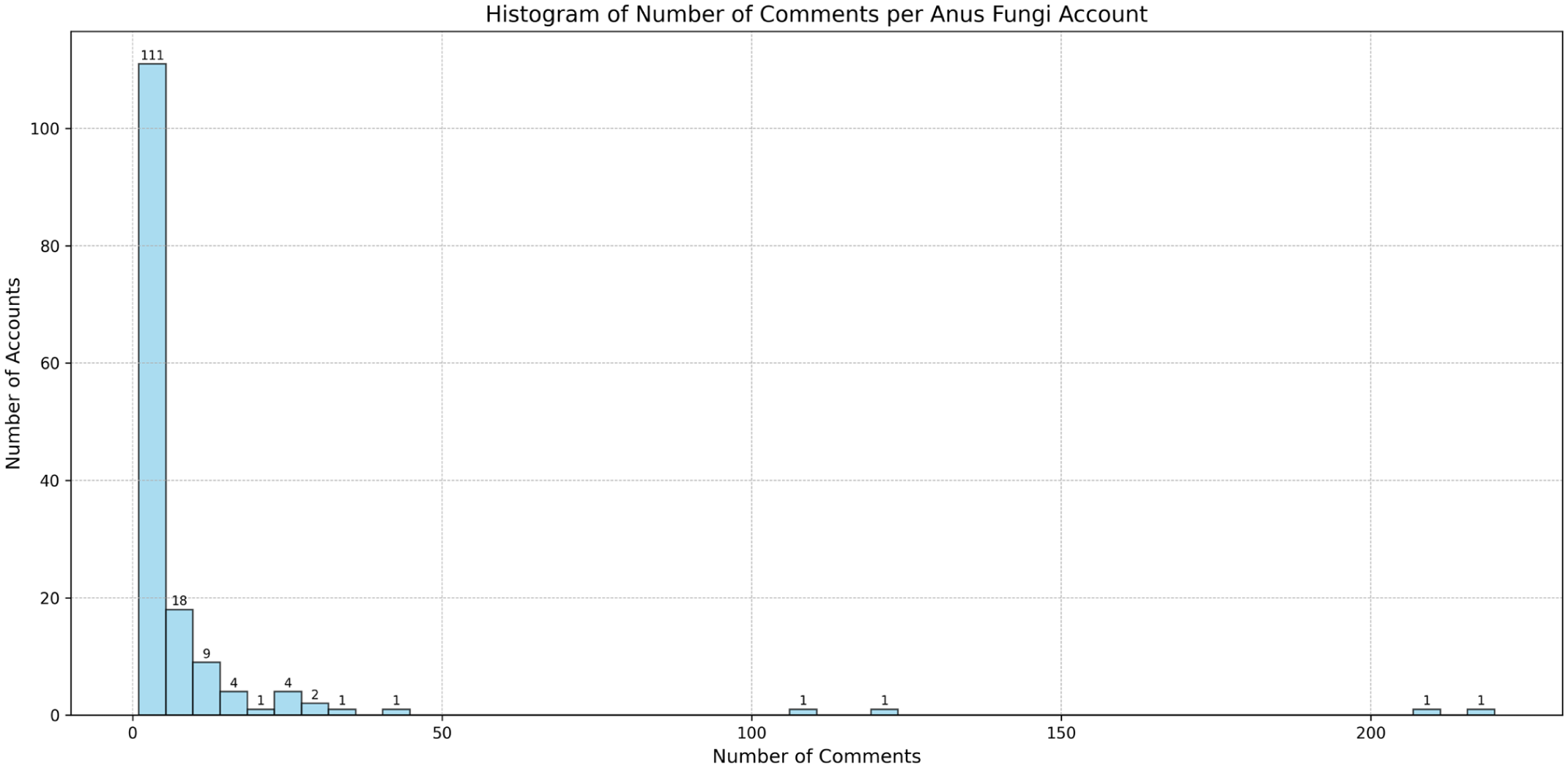
Most ‘fungi’ accounts sent less than 10 mushroom emoji comments in total.
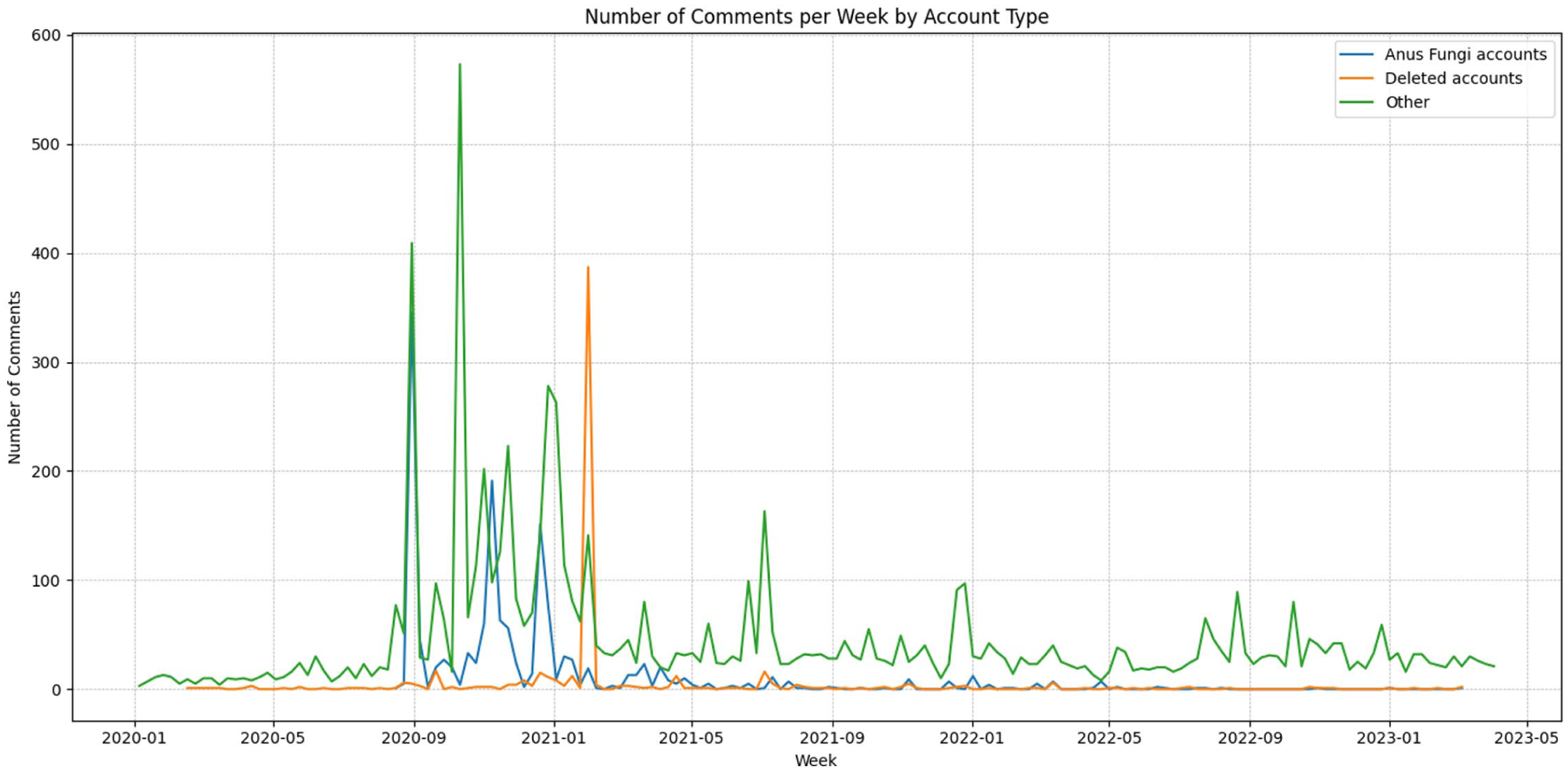
Number of comments per week sent by ‘fungi’ accounts in our data set.
Analysis of the account creation dates for fungi accounts reveals several insights. Figure 4 shows the number of accounts created per week over time. We observe an influx of copycat accounts spawned from September 2020 to April 2021, after which the creation of new fungi accounts trails off. The highest spawning period was February to March 2021. Although our mushroom comments data set contains 155 unique accounts, as discussed in the methods section we recognise the possibility that fungi profiles were deleted by their owners or suspended by the platforms, and are therefore absent. Therefore, to get a better estimate of how many mushroom accounts may have been active at the height of the outbreak, we triangulated our data collection with the list of banned accounts on r/BotDefense and r/BotTerminator. r/BotDefense is a user-led moderation initiative to combat spam bots and accounts on Reddit, and is active in moderating some of the largest subreddit communities. Users submit bots for review by the moderation team and the user u/BotDefense can be invited to subreddits as a moderator with privileges to ban unwanted bots that are on the list of banned accounts, with nearly 145,000 accounts making the ban list by mid-2023. Similarly, r/BotTerminator is a similar subreddit that performs bot moderation. Searching these two subreddits we find 217 fungi accounts listed – 62 more than appear in our comments data set – suggesting that the actual number of fungi accounts could not have been much more than a few hundred.
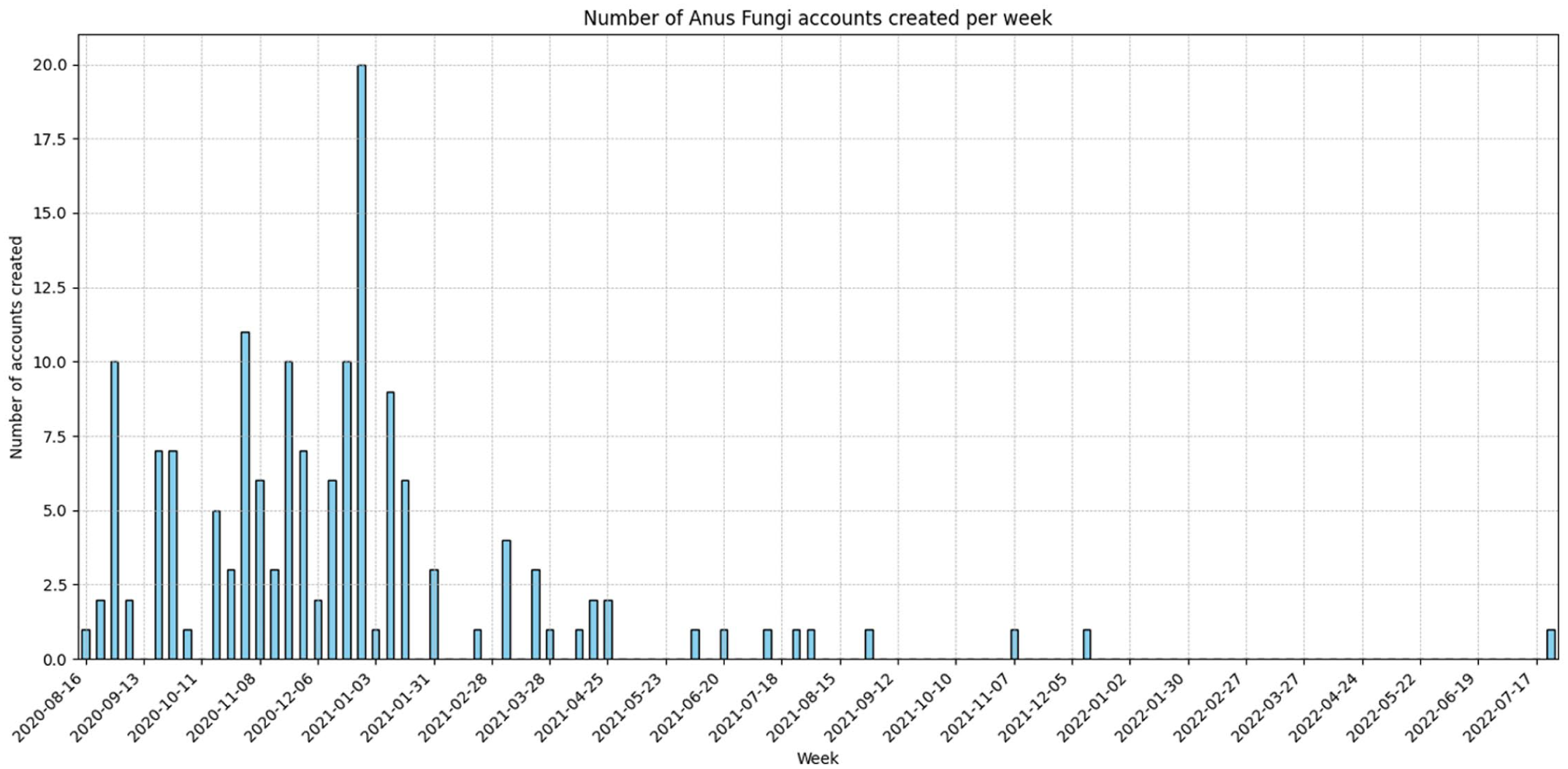
Number of fungi accounts created per week over time.
Where did the mushroom spread?
We turn attention to the activity of the fungi accounts, with an analysis of the subreddits that were targeted with emoji comments. Figure 5 shows an activity network showing which subreddits the fungi accounts commented on. This is a weighted and directed network consisting of 883 nodes and 1005 edges. The nodes have two types: fungi accounts and subreddits. The edges show the number of times that a given account posted a mushroom comment on each subreddit, denoted by the edge weight. The nodes are sized by in-degree, revealing the subreddits that were targeted the most by fungi accounts as well as the structure of their activity. The colour of the nodes reflects the ‘community’ that each node belongs to, calculated using the modularity algorithm.
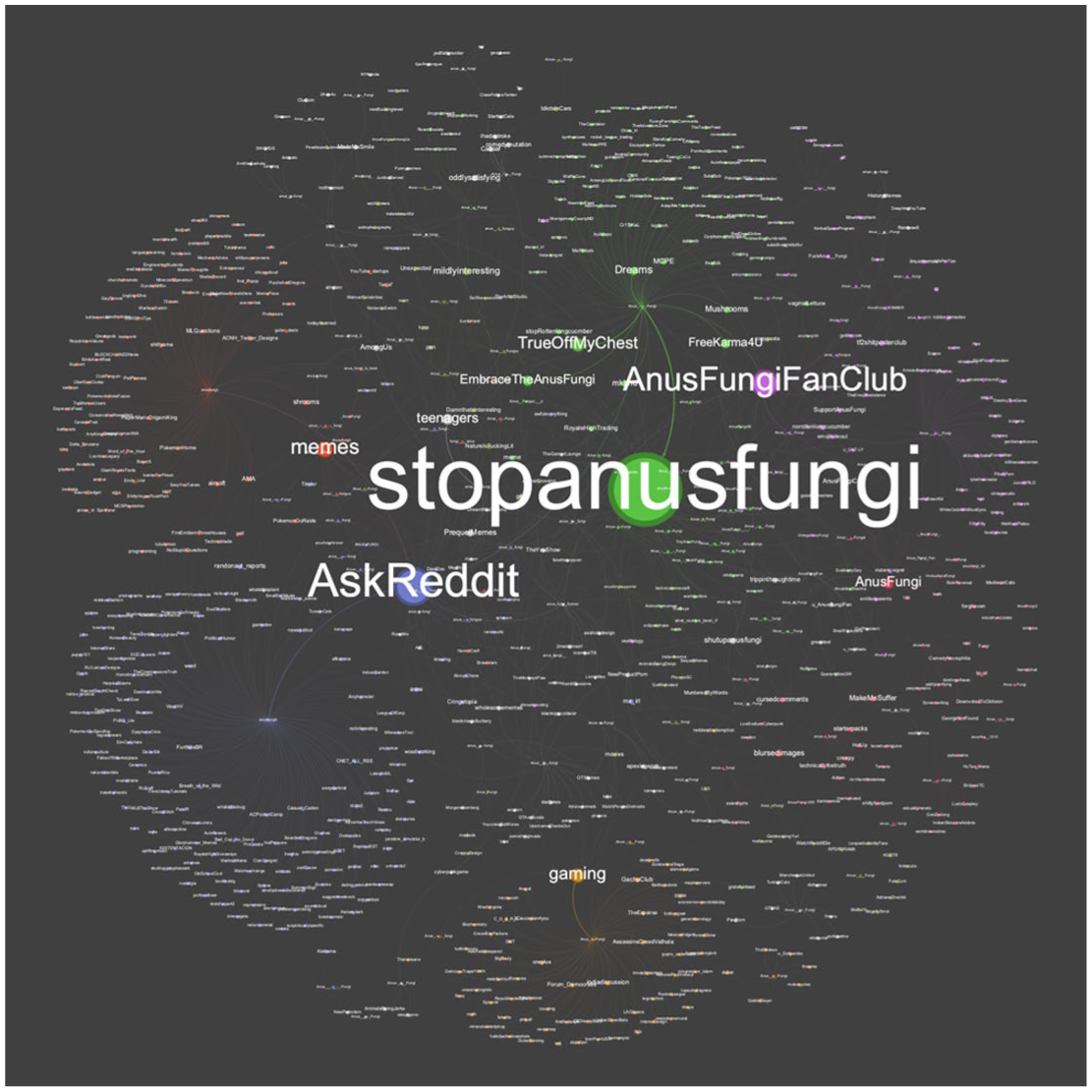
Activity network showing the structure of ‘fungi’ account participation on Reddit.
Broadly, we observe that most fungi accounts have their own set of subreddits that they comment on, presumably because they are already subscribed and active on those subreddits. These are the ‘spoke’ structures in the network where one account is connected to multiple subreddits. However, we also observe that a number of subreddits were targeted by multiple fungi accounts, as shown in the centre of the network. These central subreddits are connected to multiple different fungi accounts who were active on them.
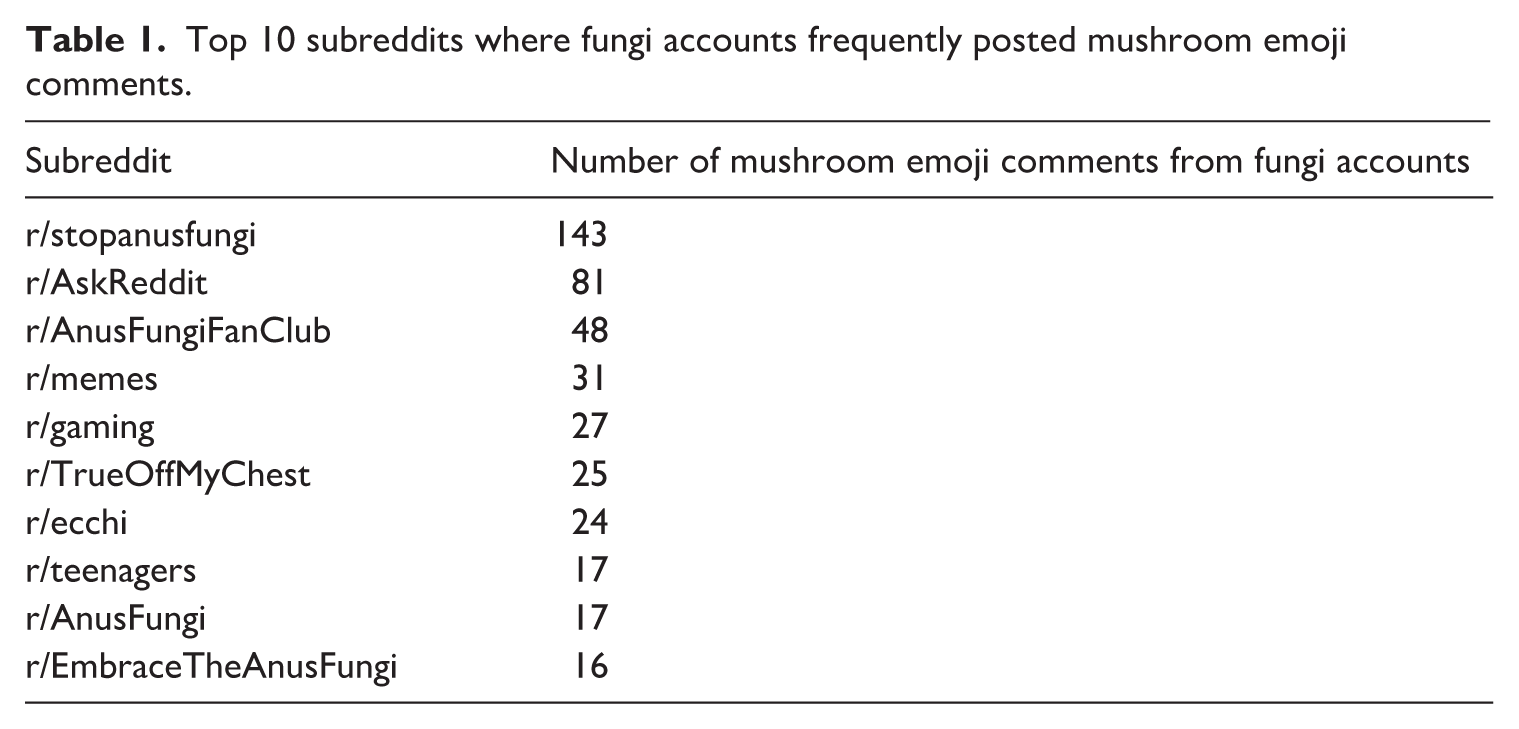
Table 1 provides a list of the most frequently targeted subreddits where fungi accounts posted mushroom emoji comments. Within the top 10 most frequently targeted subreddits, three of these are specifically related to the fungi phenomenon. The subreddit r/stopanusfungi received the most mushroom emoji comments. This is a notable occurrence given it is a subreddit dedicated to eradicating the ‘mushroom emoji spam’ phenomenon, which we examine closer later in this paper. The two pro-fungi subreddits, r/AnusFungiFanClub and r/EmbraceTheAnusFungi, are #3 and #10 respectively by mushroom volume. We suggest that r/AskReddit which received the second highest volume of mushrooms, was likely the turning point for backlash against the fungi outbreak.
Top 10 subreddits where fungi accounts frequently posted mushroom emoji comments.
Performative polarisation and counterpublic subreddits
Following the initial wave of fungi account activities, Redditors began to create entire subreddits in opposition to and support of the fungi accounts. Leading the opposition wave, the subreddit r/StopAnusFungi was created which amassed 9.4k members and became in the top 6% of subreddits by member size. This subreddit had a pinned post, ‘Report comments that are spam’, with instructions for how to report the fungi accounts to get them banned. Likewise, r/ShutupAnusFungi has 1.5k members and the following description: ‘Dedicated to bringing awareness for any and all strains of Anus fungi. Too many people are unaware of the shrooms growing in the dark and we must educate them’.
Parallel to this, subreddits in support of fungi accounts also began to emerge. Notably, this included r/AnusFungiFanClub (852 members) and r/AnusFungiCult (208 members). The description of r/AnusFungiFanClub was simply: ‘ ’.
’.
The pro-Fungi subreddits primarily consisted of Redditors posting mushroom emojis, praising the fungi accounts (which they referred to as simply one account), as well as confused Redditors seeking guidance about what was happening and how to interpret it. These pro-Fungi subreddits also included posts by anti-Fungi advocates appealing for the accounts to stop posting and creating copycats, whereas the anti-Fungi subreddits expressly prohibited the use of the mushroom emoji and any praise.
To understand the emergence and logic of these pro-Fungi spaces, we draw on Warner (2002, 2005) theory of counterpublics, which positions publics not as stable or given, but as performative and reflexively manifested through discourse. In Warner’s conception, counterpublics come into being through circulating texts and vernacular styles that distinguish them from, and in contest with, a dominant public. While digital spaces – and Reddit in particular – differ significantly from the types of counterpublics Warner originally examined, we observe similar kinds of stylised, recursive performances of marginal or alternative sensibilities. These do not emerge from institutional exclusion per se, but from shared affect, platform-specific vernaculars, and the performative pleasure and social value of resisting dominant framings – even if only ironically or ambivalently.
While the anti-Fungi spaces engaged in playful irony and humour as a way to both engage with and, ostensibly at least, disarm the spam problem, the pro-Fungi subreddits have different dynamics but are still very ‘Reddit’. For instance, we observe how the mushroom emoji drives the ‘visual vernacular’ (Danesi, 2017) of the pro-Fungi subreddits, forming a simple yet powerful symbolic marker of in-group / out-group boundary work. In this way, the pro-Fungi subreddits formed a shared identity around the mushroom emoji and a cult-like championing of the phenomenon. These symbolic and stylistic practices echo what Warner (2002) described as the recursive circulation of discourse that calls a counterpublic into being. Likewise, this logic resonates with Papacharissi’s (2015) notion of affective publics, that is, networked formations that cohere not through rational debate but through shared feelings, aesthetic expression, and performative sentiment. The mushroom emoji thus became a central symbol around which such expressive, affective participation coalesced. In one sense these pro-Fungi communities formed a counter-narrative (Jenkins et al., 2013) in opposition to the prevailing ‘mainstream’ view on Reddit that it is a form of spam. Mushrooms connote a multiplicity of cultural meanings and biological processes: growth and fertility, abundance and fecundity, but also decay, waste, and poison. Thus, for some Redditors the mushroom emoji became a cultural symbol whereby the growth and abundance of the mushroom emoji, like mycelial growth, is a way of creating and reinforcing community identity. For others, it was a negatively valenced symbol with connotations of disease, poison, and deterioration. Yet, many Redditors appeared to be unsure what to make of the mushroom emoji activity. As one commenter wrote (Figure 6), the fungi accounts left them ‘conflicted’, where they didn’t like seeing the emojis but also enjoyed engaging with the ‘odd’ phenomenon.
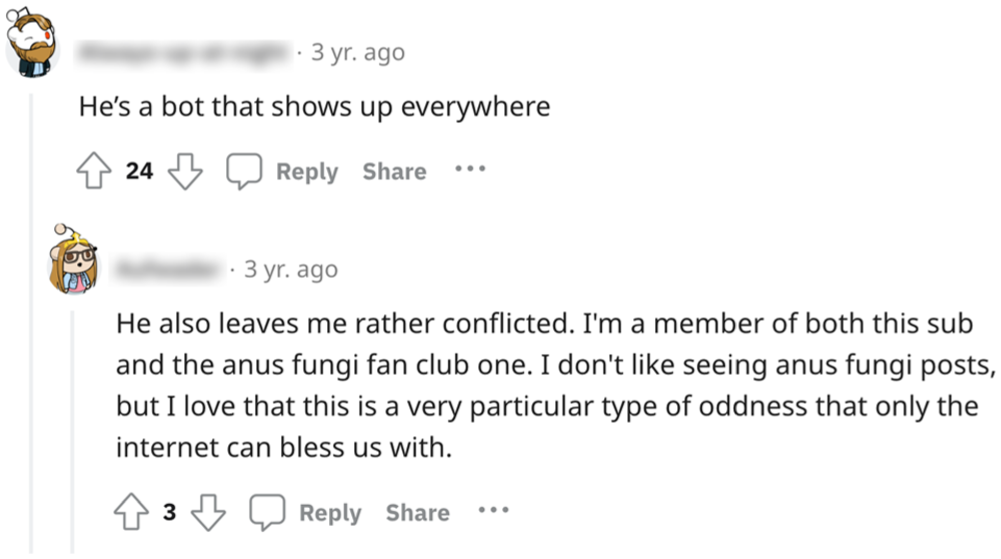
Redditors who are conflicted about the fungi accounts.
Sentiment and participatory culture within the counter-mushroom subreddit
As outlined in the previous section, the r/stopanusfungi subreddit attracted a large following, but also, somewhat paradoxically, the highest amount of mushroom emojis. To uncover a deeper understanding of why the counter-mushroom subreddit features such as high presence of mushroom posting warranted a closer analysis of the type and nature of the participatory culture within that subreddit. To do this, we conducted a thematic analysis of the top 25 upvoted original posts along with a parallel analysis of the comments and replies in the threads where the original post was situated.
While this subreddit ostensibly positions itself in opposition to the fungi accounts, its participatory culture tells a more complex story – one in which critique, irony, and expression are entangled. Here, Warner’s (2002) theory of counterpublics offers another lever, explaining how r/stopanusfungi functions less as a straightforward enforcement space and more as a performative counterpublic. In Warner’s terms, a counterpublic comes into being through circulating discourse and stylised acts of address, often marked by a reflexive awareness of its marginality or opposition to the mainstream. Although r/stopanusfungi overtly mimics the language and terminology of moderation and Reddit’s rules and community guidelines, it performs this stance with a layer of irony that undermines any clear boundary between rejection and amplification. This recursive ambiguity – both resisting and enjoying the mushroom phenomenon – is not a flaw or ‘disorder’ in the community’s logic, but a key part of how it defines itself, and in turn a reflection of how, on Reddit, the distinction between bot and human often matters less than the capacity to participate in platform vernaculars, produce, promote, and contest recognisable signs, and contribute to the social game of meaning-making and in-group/out-group boundary work.
As such, the subreddit does not simply function as a space of protest or content regulation – although it may look that way from the outside. Rather, it enacts a kind of counterpublic performance: ironic, ambivalent, and thoroughly shaped by Reddit’s broader platform vernacular (Massanari, 2015; Phillips and Milner, 2018). By examining the affective and stylistic practices that circulate within the subreddit – memes, emoji play, exaggerated sentiment, and recursive in-jokes – we gain insight into how participants negotiate platform norms and form and assert social identity markers through layered, sometimes contradictory forms of engagement.
The majority of original posts in the subreddit consisted of screenshots or commentary from other parts of Reddit, highlighting the expectedly self-referential nature of the subreddit’s focus and purpose. Three original posts showcased the spread of the fungi accounts to YouTube, while one featured a photograph of street art of a mushroom, showcasing that the mushroom spread had breached the platform boundaries. Of the 25 original posts, 8 (including 4 of the 5 most upvoted posts) were memes about seeing fungi accounts everywhere, highlighting the popularity of memes as a form of participatory culture and commentary within the platform culture. The appearance of the memes prompted moderators to announce that mushroom memes would be deleted from the subreddit. Ironically, the announcement itself featured a collection of these very memes, bringing even more attention to their presence within the subreddit, as can be seen in Figure 7.
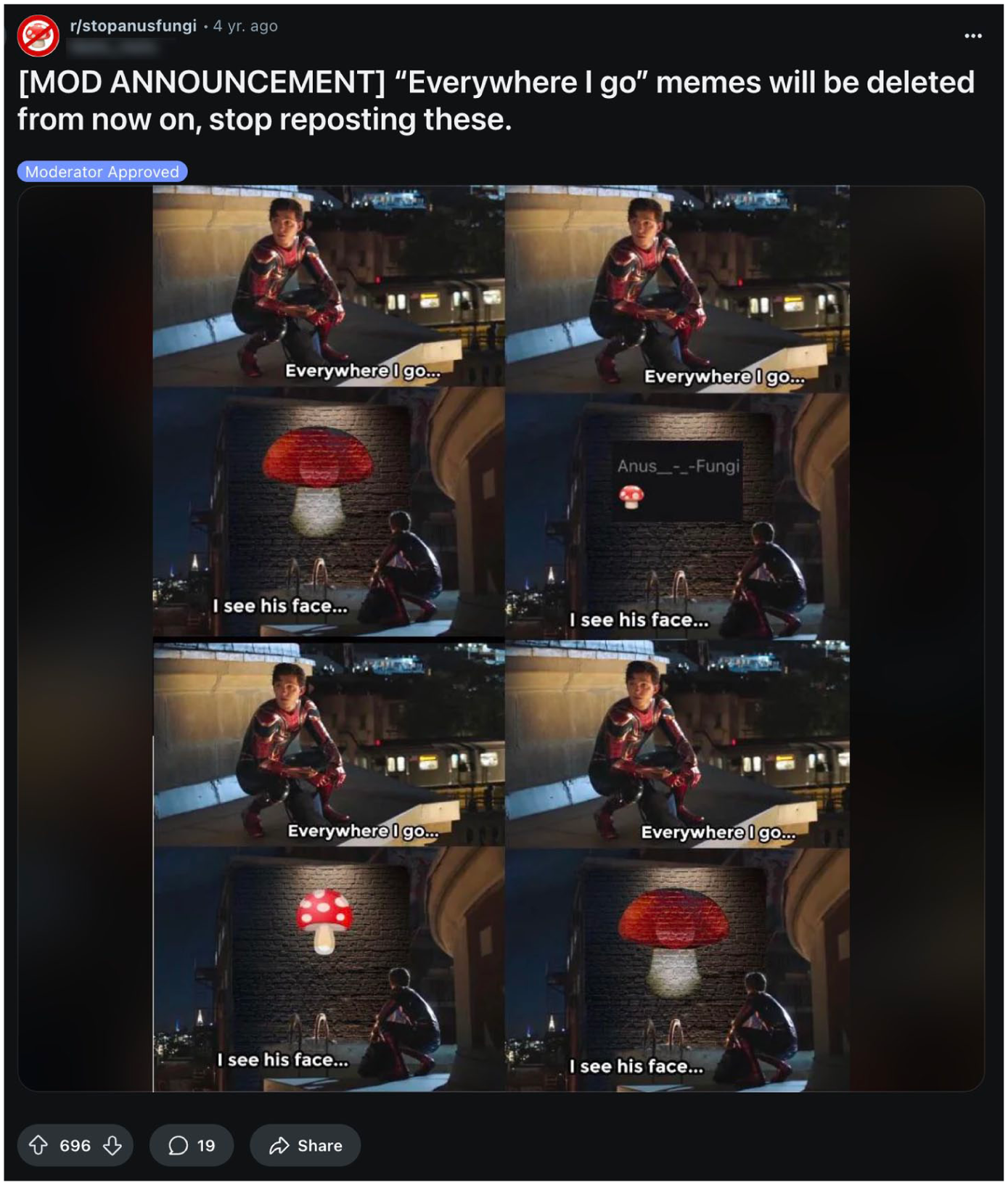
Moderators further propagating awareness of the mushroom through memes.
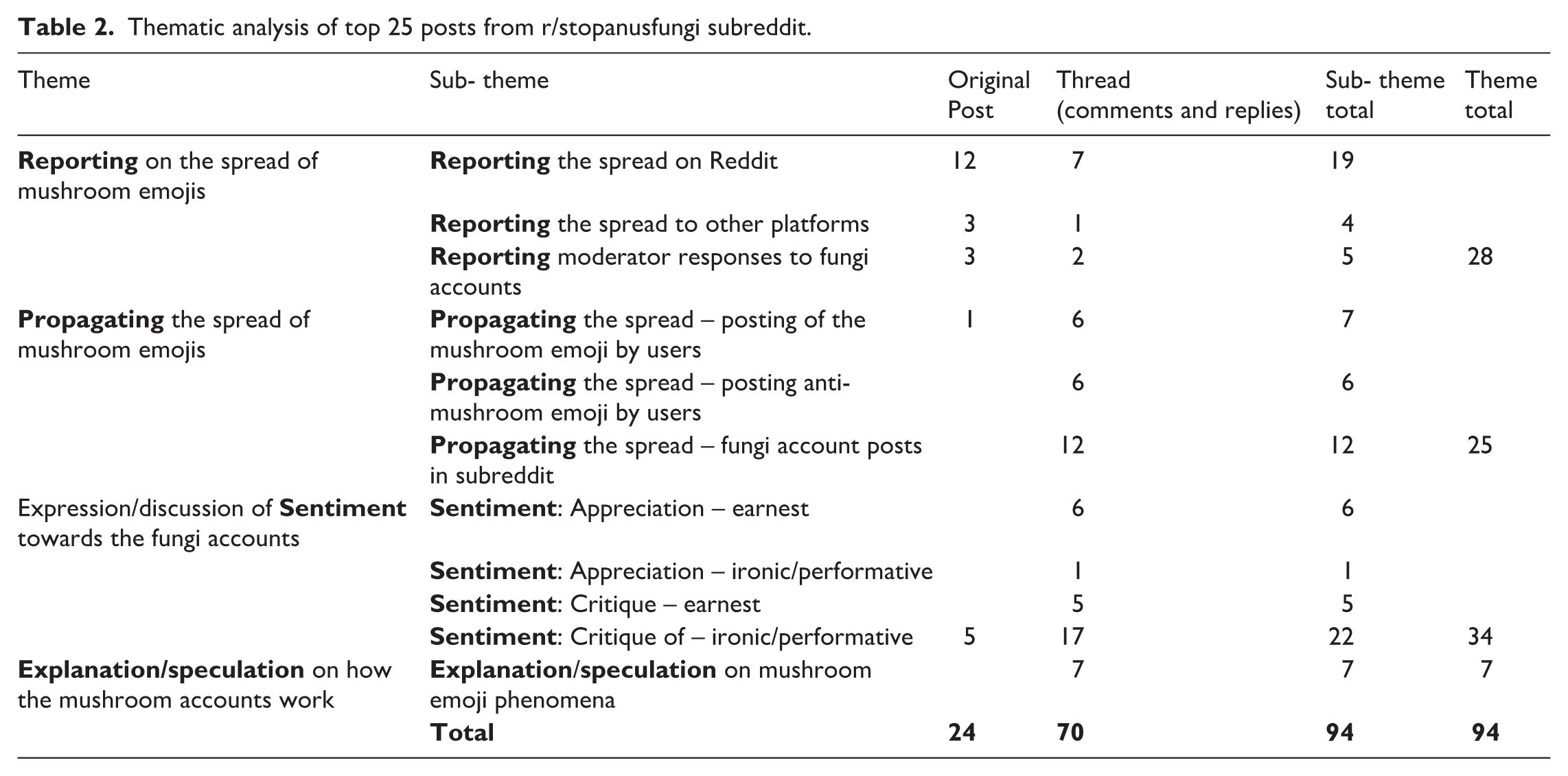
From an analysis of the original posts and associated threads, four broad thematic categories of discussion were identified in the subreddit: reporting the spread of mushroom emojis, propagating the mushroom, discussion and expression of sentiment towards the mushroom accounts, and explanations and speculation of what the phenomenon is. Each theme contained various sub-themes, which can be seen in Table 2. The original posts were assigned one sub-theme that reflected the dominant message, and the threads were assigned multiple sub-themes to capture the diversity of topics in the comments and replies. One original post had been deleted by the user and was kept in the data set for analysis of the thread only (bringing the total of original posts to 24).
Thematic analysis of top 25 posts from r/stopanusfungi subreddit.
Reporting
Most of the original posts in the r/stopanusfungi were focused on reporting the spread of the mushroom phenomenon, with 18 out of 24 posts falling under this category. Within this general theme, three sub-themes emerged. The most prevalent involved reporting on the spread of the mushrooms specifically within Reddit. Another less common topic was discussing its presence on other platforms, primarily YouTube. There were also discussions about how moderators were handling the situation. While it is not surprising that reporting the spread was a major topic in this subreddit, it did not include discussion about proactive measures being taken to moderate or contain it. In fact, no thematic topics related to proactive moderation were identified at all, indicating that the main purpose of r/stopanusfungi was to raise awareness about the phenomenon rather than actively addressing or stopping its spread.
Propagating
While reporting of the mushroom phenomenon was by nature spreading its infamy, another common theme in the threads is the deliberate propagation of the mushroom. Deliberate propagation of the mushroom took place through three distinct methods. The first included initiatives where standard Reddit users (ie not Fungi accounts) posted the mushroom emoji which occurred six times in the threaded comments and once in the original posts. An important point to consider here is that the r/stopanusfungi features one solitary rule, that ‘any comment or post with the use of the mushroom emoji will be removed’. It is therefore recognised that many propagation attempts would likely have been deleted by moderators and were not captured in the data, and therefore the extent of the propagation of the mushroom by standard users was likely much higher. In terms of responses to the presence of the mushroom emoji, it is notable that only one mushroom comment was downvoted (score of -1), whereas 4 were upvoted (total score of + 5) and one received zero votes. The lack of downvoting suggests the appearance of the mushroom emoji was not unwelcome in the subreddit.
In addition to regular users posting the mushroom, the fungi accounts themselves also appeared 12 times in the 25 threaded conversations. Given the name and purpose of r/stopanusfungi, it is very noteworthy that fungi accounts were rarely downvoted. Only one mushroom emoji comment by an account with ‘Anus Fungi’ in the name was downvoted (received a - 1 score), whereas 6 comments were upvoted (received a total of + 8), and 6 comments received no voting reaction at all. The seemingly unchallenged presence of mushroom accounts in the ostensibly anti-fungi account subreddit is suggestive of a broader performative outrage, and that in practice the community was playfully indulging the behaviour they claimed to object to.
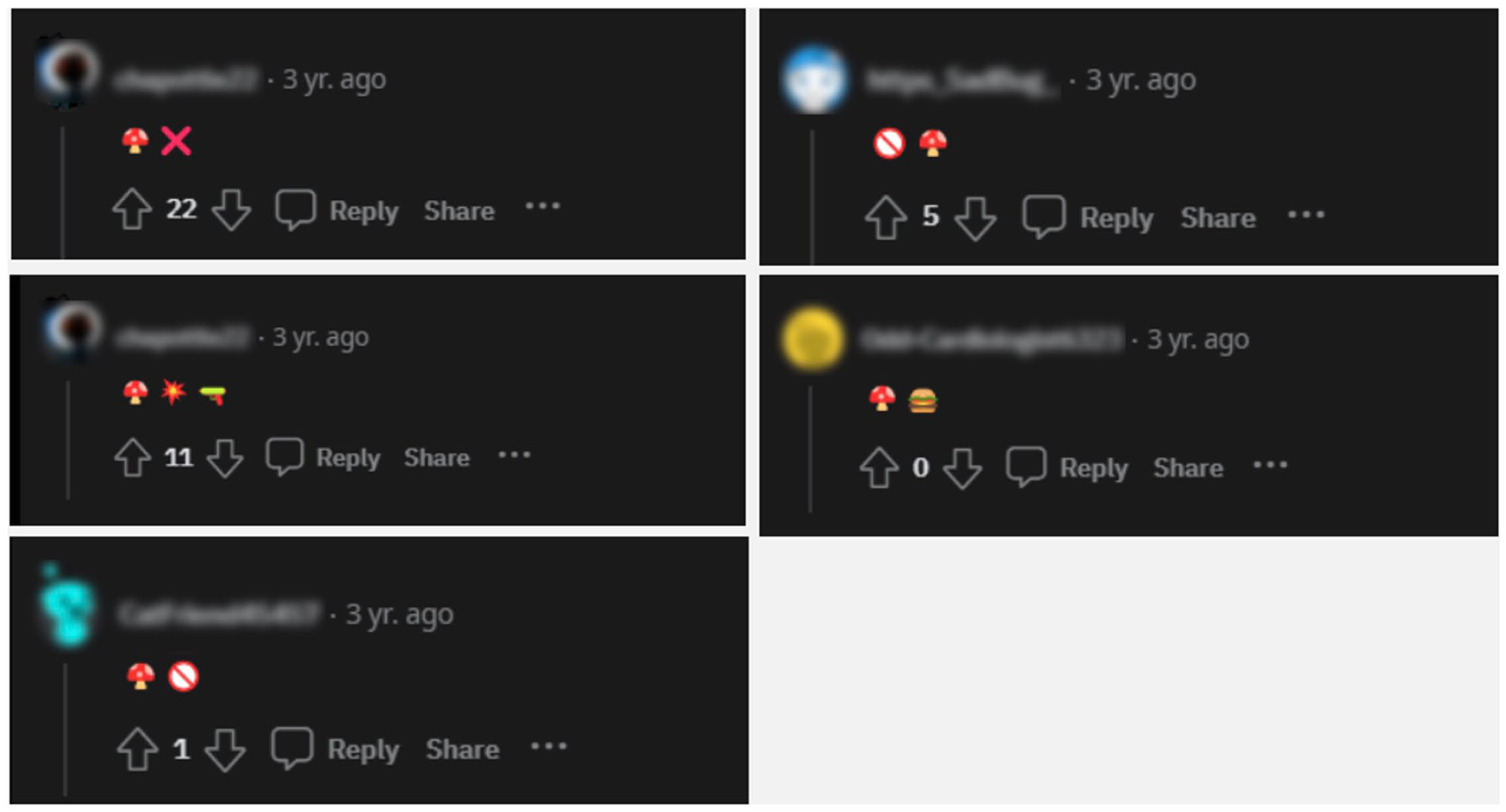
A third type of propagation of the mushroom involved a more unusual occurrence where users were posting anti-mushroom emojis (using emojis associated with stop or kill next to the mushroom) and other variants such as the mushroom with alternative emojis such as the burger (which was made in reference to a burger account engaging in the same type of phenomena). Anti-mushroom emoji appeared five times, across 3 of the threads and can be seen in Figure 8. The use of emoji to counter emoji spam can be viewed as a form of ironic and playful counterpublics that simultaneously attacked the mushroom emoji while perpetuating the spread of emoji spam. Out of all propagation of the mushroom, this behaviour was the most praised, with one post receiving an upvote of 22 and another of 11.
Examples of anti-fungi emoji as playful counter publics.
Across the threaded conversations, deliberate propagation of the mushroom was common, and this practice did not face backlash. Rather, it appeared to even be rewarded as indicated through upvoting. This tendency towards propagation appeared to be acknowledged within the subreddit, with some Redditors speculating that the original fungi account creator was actually in their midst. The subreddit’s own role in propagating the mushroom phenomenon appeared to also be widely recognised and accepted. One Redditor for instance summarised the issues stating that giving the account this much attention only ‘fed him’ and there was no dispute or serious discussion around this point.
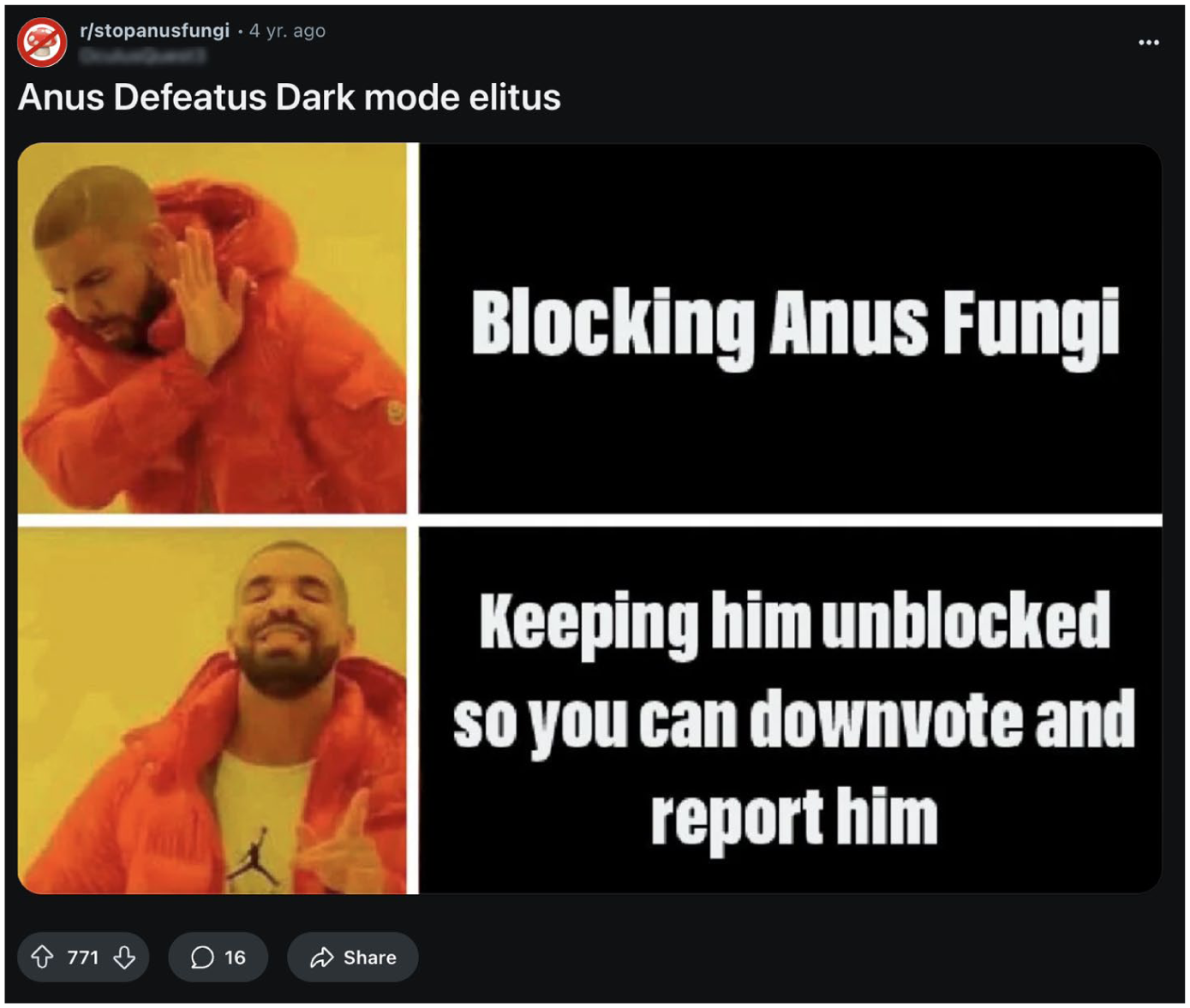
The discussions surrounding sentiment further support the notion that many Redditors take delight in participating in a light-hearted practice of contestation. This sentiment is also reflected in one of the original posts, a meme, which hints at this attitude being prevalent on the subreddit. The meme, shown in Figure 9, features stills from Drake’s music video Hotline Bling and presents two options: either ‘blocking Anus Fungi’ or the more favourable option of ‘keeping him unblocked so you can downvote and report him’. This display of self-awareness implies that Redditors enjoy playfully contesting fungi accounts and are fully cognisant of the irony that their actions just perpetuate the cycle. They are almost certainly likely to have known that one individual was not operating all the accounts, even as they referred to it as a singular actor and ascribed them a gendered pronoun (‘him’). This behaviour is in line with Phillips and Milner’s (2018) observation that online communities often employ humour and mischief to attract participation, fostering a form of connectivity through their light-hearted but not meaningless engagement with the issue.
Ironic meme recognising the playful irony of the counter-fungi subreddit.
Sentiment
The most common subject of discussion found in the threads was the expression of sentiment towards the mushroom phenomenon. The broad theme of sentiment captured four sub-themes including the appreciation and critique of mushroom accounts that was earnest, and appreciation and critique that was performative or ironic in nature. While it is impossible to ascertain the true feelings of a Reddit user from their comments, for the purpose of this analysis, ironic or performative critique or appreciation were recognised by the use of hyperbole, overly dramatic statements and reference to broader popular cultural moments. For example, comments such as ‘Anus fungi took everything from me’ is classified as an ironic and performative critique due to its exaggerated nature. By contrast, users who expressed that they found the mushroom accounts amusing, or didn’t understand why the mushroom accounts were so hated when they were not hurting or harassing anyone were considered earnest expressions of appreciation.
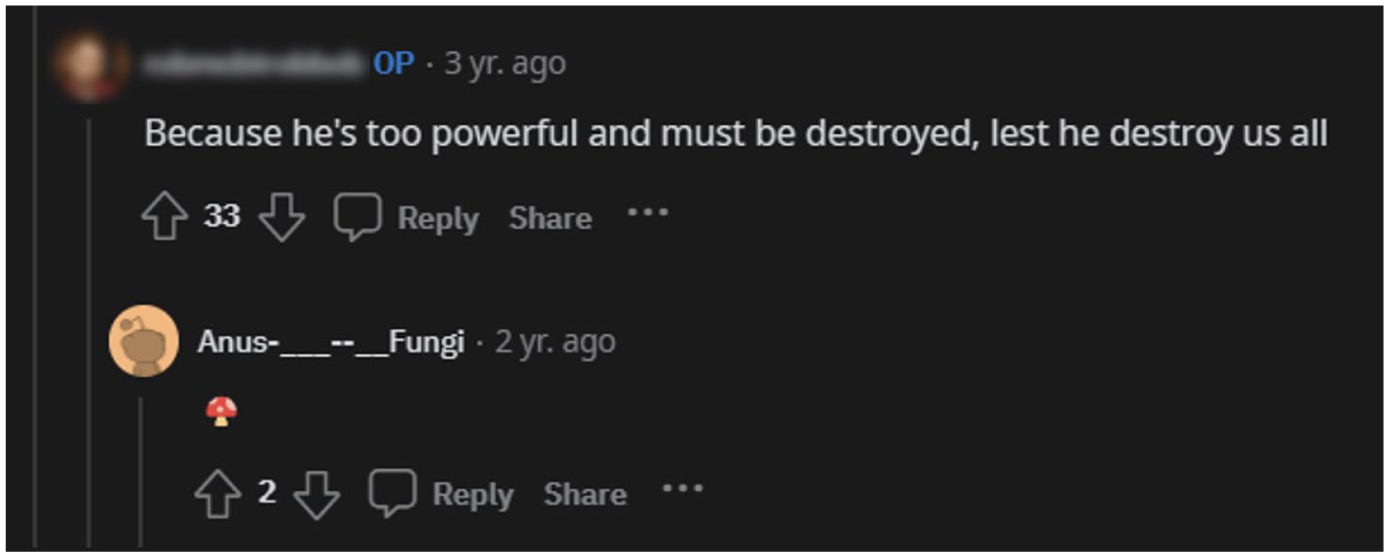
Performative and ironic critique of mushroom accounts was identified in 17 of the 25 threads, including in five of the original posts. In the example below, ‘Anus Fungi’ was critiqued as being’ too powerful’ and must be destroyed ‘lest he destroy us all’ (see Figure 10). Ironically, one of the mushroom account copycats responded and was upvoted twice, suggesting that these types of interactions were appreciated in the counter-fungi subreddit.
Example of Performative and ironic critique of Fungi accounts.
Expressions of earnest appreciation were often intertwined with performative and ironic critiques, or in response to reports of surprising parts of Reddit where mushroom accounts had posted. For instance, one of the original posts was titled ‘Anus fungi is distributing drugs among the masses. We must stop him!’. In response, two Redditors expressed appreciation for the humour and irony of a mushroom appearing amid a conversation on drugs, as seen in Figure 11.
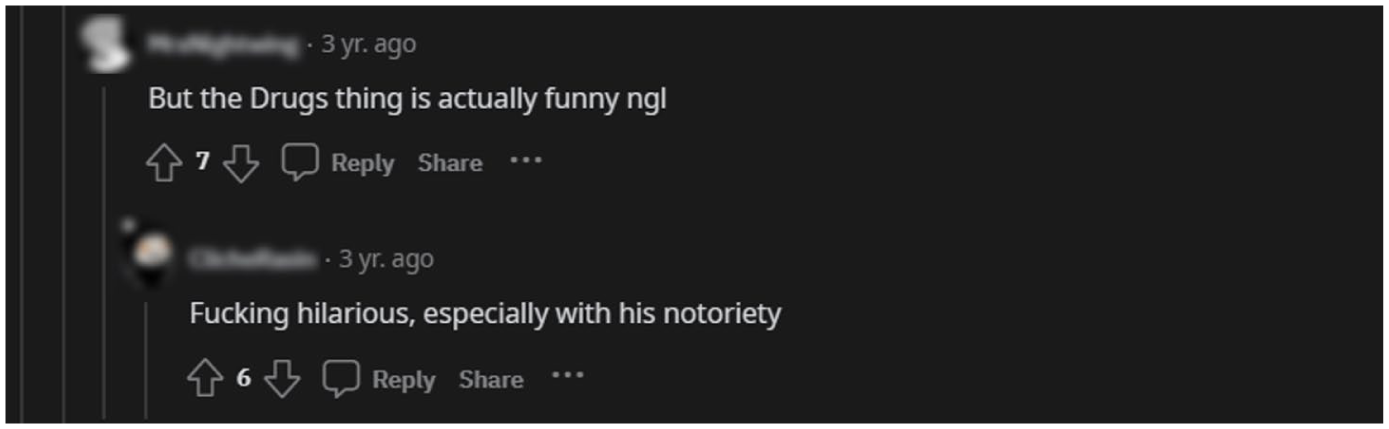
Users expressing earnest appreciation of Fungi accounts.
Genuine critique towards mushroom accounts tended to focus on them being annoying or outdated, reflected through comments such as ‘It used to be funny, but now it’s just old and grating’. These types of comments offer insight into the broader navigation that takes place on Reddit regarding quality content contributions. The commentary suggests that the mushroom may have started off as something unique, quirky, and surprising, but once it became mainstream, overused, and went on too long, it lost its charm. In short, the meme got old.
As noted earlier, discussion about the mushroom phenomenon did not typically contain any practical or actionable advice on moderating or limiting the accounts, suggesting that stopping them was not the actual purpose of r/stopanusfungi. Rather, discussion about the phenomenon was the predominant focus, particularly through ironic and exaggerated claims about the threat of the mushroom taking over Reddit and beyond. While there were examples of more genuine appreciation and critique of the account, r/stopanusfungi appears to be shrouded with irony, playfully making fun of the dated nature of the mushroom account activity as well as the subreddit’s own self-proclaimed mission. The subreddit appears to be a form of navigation of what is accepted on the platform that is highly tinged with Reddit’s playful platform vernacular and values.
Education and speculation
In contrast to the themes of reporting, propagating, and sentiment, discussions relating to education and speculation of what the mushroom phenomenon is were generally more serious and earnest in nature. Seven of the threads contained explanations and conjecture about the phenomenon, often responding to questions from Redditors trying to understand the mushroom posts. The fact that these inquiries were frequently met with genuine responses demonstrates the altruistic type of communication often found on Reddit, especially when new members are educated by the more seasoned ‘in-group’ (Massanari, 2017; Phillips and Milner, 2018). Along with these explanations, there were also debates about whether the mushroom accounts belonged to bots or real people. Some believed it was ‘surely a bot’ while others argued that it was operated by an individual. An example of the varied speculation about the mushroom phenomenon’s ontological status can be seen in the example below (Figure 12) with some speculating that it is ‘surely a bot’ due to its posting trends, whereas others maintain it’s a ‘guy’. Despite the focus on the mushroom accounts and occasional discussion about whether they were bots, it is notable that r/stopanusfungi did not seem to have a consensus or a serious investigative interest regarding the ontological status of the accounts.
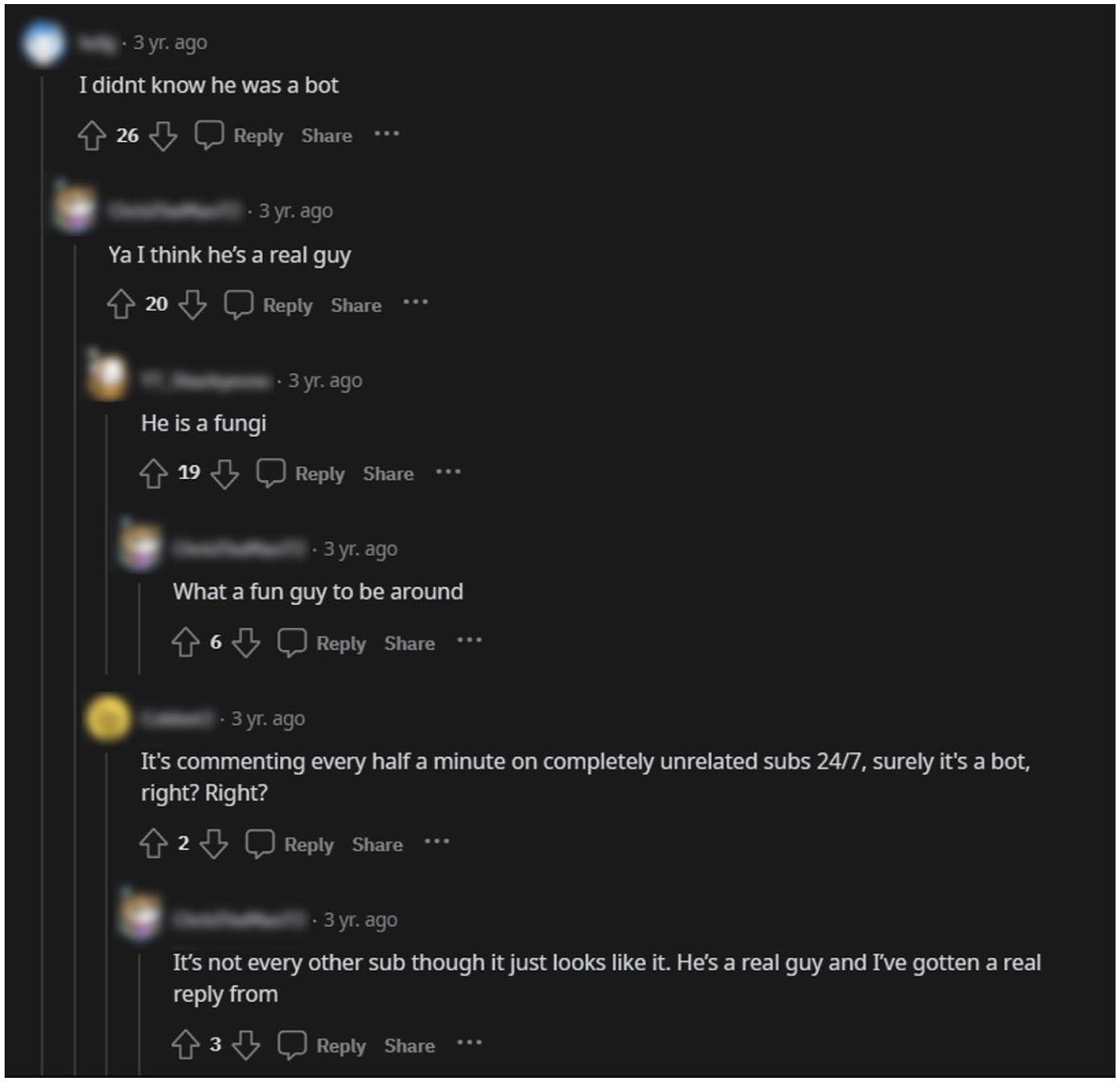
Light-hearted speculation and sensemaking about whether fungi accounts are bots or people.
Among the educational responses there was also a recognition that there were likely hundreds of mushroom accounts. However, the subreddit was not centred upon investigative work into how the accounts operated or who was running them, and it did not appear to have a serious interest in the ontological question of whether the accounts were bots or humans. This, along with the largely performative and ironic tone of the subreddit and its focus on reporting and propagating the mushroom suggest that r/stopanusfungi was not a genuine attempt to understand the workings of or to stop the mushroom accounts. Nonetheless, the subreddit did depict a type of genuine critique about dated content that does not add value to the platform, while at the same time playing with the irony of the very existence of the subreddit itself. In this sense, subreddits like r/stopanusfungi can be seen to operate as performative counterpublics that parody the very ‘problem’ they claim to oppose, enacting forms of reflexive participation, community signalling, and vernacular play that have also been identified in more identity-focused counterpublic formations (Lee, 2023; Renninger, 2015).
To summarise, the r/stopanusfungi subreddit had a purpose, but this was not to coordinate a serious take down of the accounts or to brainstorm approaches to moderate their presence. Instead, the subreddit appears to be a participatory commentary about quality of content that was heavily tinged with Reddit’s playful vernacular and ‘in-group’ dynamics (Phillips and Milner, 2018). While the subreddit did feature speculation about the ontological status of the accounts (the dualism of bot versus human), whether the accounts were automated or manually operated seemed secondary to the overall message: what was once a quirky appearance of a mushroom on Reddit had spread too far, and the meme had outgrown its cultural moment.
Discussion
From bot problem to botting phenomenon
The fungi accounts on Reddit defy easy classification as bots and highlight the limitations of binary human-bot distinctions in contemporary online spaces. While users frequently referred to the fungi accounts as bots, our analysis reveals a more layered picture: most accounts exhibited low-volume posting and showed little evidence of automation. Yet collectively, they were perceived as being bots. This paradox – human accounts being read as bots while performing bot-like behaviours – illuminates what Haimson et al. (2021) identify as the ‘online authenticity paradox’, where authentic self-presentation online is often unreachable or achievable only at great personal cost. If humans struggle to appear authentically human online, then the distinction between authentic human participation and inauthentic automated participation becomes analytically fraught. It raises the deeper question of what, if anything, is irreducibly human, particularly in an online digital context. At the very least it highlights that authenticity and automation are far from mutually exclusive, contrary to popular and indeed many scholarly perceptions of bots.
Despite the attention they provoked, 83.2% of accounts (n = 129) commented 10 times or fewer, and only 8.4% (n = 13) commented more than 20 times. Just two accounts exceeded 200 comments. This suggests the fungi account invasion was less a bot problem, and more a human copycat phenomenon. It involved a form of imitative, low-volume behaviour that mimicked bot-like repetition – suggesting the mushroom emoji was predominantly posted manually, potentially supported by small-scale automation. This accords with what Chu et al. (2010) categorise as cyborg accounts – entities that blur the human-bot boundary through hybrid control mechanisms. The fungi phenomenon extends this concept, demonstrating how humans can voluntarily perform cyborg-like behaviours without any automation at all, embodying what Pozzana and Ferrara (2020) describe as the increasingly indistinguishable spectrum between human and bot behavioural dynamics.
The fungi accounts, while visually and seemingly similar, were driven by human engagement in imitation play. This complicates received definitions of bots as accounts that post repetitive content at scale. As Carlon (2023) asks: ‘Where do people who act like bots fit into this understanding, and does the distinction matter?’ (para. 5). Individually, these accounts lacked bot-like repetition; collectively, they resembled bots due to their near-identical names and posting patterns. Their effect, however, was the same regardless of whether they were automated or not. It is for this reason why botting offers a valuable lens to expand our understanding of the role and impact of repetitive posting beyond binary distinction based on its mode of communication. Botting is not reducible to technical function; it is a form of digital practices for visibility that are in turn shaped by platform affordances, participatory cultures, and is indicative of an increasingly hybrid mode of human and machine communication. As Taylor (2022) argues in their analysis of authenticity as performativity, authenticity itself becomes a cultural construct that is performed rather than inherent. The fungi accounts’ manual performance of automated behaviours reveals authenticity not as an essential quality of human versus machine authorship, but as a negotiated cultural value determined through community evaluation and platform-specific norms.
Authenticity as cultural performance rather than technical category
The fungi phenomenon reveals fundamental limitations in using authenticity as a criterion for evaluating online content. Building on Jago et al.’s (2022) experimental findings that highlighting human origins generates perceptions of authenticity in automated work, the fungi accounts demonstrate the inverse: humans performing machine-like behaviours were perceived as inauthentic despite their human authorship. This suggests that authenticity online is not determined by the technical mode of production but by adherence to platform-specific cultural norms and expectations. The community’s response to the fungi accounts illustrates what Gibbs et al. (2015) term ‘platform vernacular’ – the shared communicative conventions emerging from interactions between platform affordances and user practices. Within Reddit’s vernacular, repetitive posting violated norms not because it was automated but because it disrupted expectations of contextual relevance and conversational contribution. The mushroom emoji became ‘inauthentic’ not through technical detection but through community consensus that it had exceeded its cultural moment. In turn, this aligns with Warner’s (2002) theory of counterpublics, where legitimacy is established through discourse circulation rather than essential qualities of speakers.
Furthermore, the manual performance of bot-like behaviours can be understood as what Milner (2016) calls ‘transformative competence’ – the ability to participate in digital culture through both technical accessibility and subcultural knowledge. The fungi participants demonstrated this competence by manually performing automation, creating what appears to be a commentary on the nature of authentic participation itself. Their actions suggest that in environments saturated with optimisation logics and algorithmic pedagogy (Liang and Ye, 2025), performing like a bot becomes a form of cultural critique or resistance to demands for authentic self-presentation. This has profound implications for how platforms approach content moderation and community governance. Rather than investing in increasingly sophisticated technical detection methods that, as Rauchfleisch and Kaiser (2020) demonstrate, suffer from 40-90% error rates, platforms might focus on supporting community-based evaluation systems that can assess cultural relevance and contextual appropriateness. The fungi phenomenon demonstrates how communities are capable of sophisticated negotiations around content value that transcend simple human/bot categorisations, something which is enabled and afforded in practice through Reddit’s participatory model of moderation As Carlon (2025b: 13) points out, such models ‘resist the impulse to assign provenance detection as a proxy for value’, and instead offer a more adaptive response that attends to the ‘contextual and situated dynamics of use, reception, and harm, recognising that meaning emerges through perception, interaction, and cultural interpretation’.
While botting is more commonly associated with visibility strategies – driven by commercial, political, or fame-seeking motives (Kasianenko, 2025; Matamoros-Fernández et al., 2024; Schäfer, 2024) – our findings also demonstrate botting can be playful, ironic, and community-driven, emerging as a form of in-group signalling, entertainment, or simply done ‘for the lulz’, or the amusement. While our focus was Reddit, similar instances have surfaced elsewhere. For instance, the Twitter bot @Horse_ebooks Originally created in 2010 by Russian web developer Alexei Kouznetsov as an automated spam bot to promote horse-themed e-book sales through affiliate marketing links (Chen, 2012), the account initially operated as genuine automation that scraped text fragments from various sources to evade Twitter’s spam filters. However, from 2010-2013, this account was celebrated as producing ‘strangely poetic’ content (Chen, 2012) and ‘cryptic missives that read like Zen koans’ (Flatley, 2012), despite posting simple text excerpts from horse-related eBooks. The account energised a participatory culture around it, inspiring fan art, merchandise and even being named one of the best Twitter feeds by Time magazine in 2011. Yet, when it was revealed in 2013 that artist Jacob Bakkila had been operating the account manually since purchasing it from the original Russian spammer in 2011 – with no change in posting behaviour or type of content – its followers felt ‘disappointed and betrayed’ and the account rapidly lost its cultural moment and relevance (Paul, 2024)
On Reddit, however, it is far less clear whether it matters if users knew the accounts were manual or automated. This is partly due to platform-specific affordances: Reddit users subscribe to subreddit communities, not individual accounts. In Reddit’s fungi moment, the issue was not whether the fungi accounts were bots, but the cultural saturation of the phenomenon. Ultimately, whether these accounts were ever a ‘problem’ at all is a more complex question that must be understood in relation to Reddit’s unique platform culture and participatory dynamics.
Platform-specific dynamics of botting
Reddit’s unique architecture and culture fundamentally shaped how botting emerged and was contested within the fungi phenomenon. Unlike platforms that emphasise individual identity and personal branding, Reddit’s pseudonymous, community-centred structure created conditions where manual botting could flourish as a form of participatory play rather than visibility strategy. The platform’s comparatively permissive stance towards bots – where automated accounts are welcomed as legitimate participants rather than threats to authenticity – created an environment where being called a ‘bot’ carried different connotations than on other platforms. Rather than, for example, serving as a dehumanising accusation as theorised on platforms such as X and formerly Twitter (Assenmacher et al., 2024), ‘bot’ on Reddit functioned more as an umbrella vernacular for repetitive, contextually inappropriate behaviour that had outstayed its cultural welcome.
This platform specificity extends to how botting was managed and contested. The emergence of counterpublic subreddits like r/stopanusfungi demonstrates how Reddit’s affordances – particularly its capacity for community creation and voting-based evaluation of content – shaped performative opposition that simultaneously critiqued and amplified the phenomenon. These spaces operated as what we term ‘performative counterpublics’, where resistance became a form of entertainment that ultimately, and in some respects ironically, amplified and evolved what it claimed to oppose.
Performative counterculture
Our findings extend current understanding of botting beyond commercial and political motivations to encompass playful, community-driven practices. While existing research has primarily examined botting as a visibility strategy for fame or profit (Matamoros-Fernández et al., 2024; Schäfer, 2024), the fungi phenomenon demonstrates how botting can emerge from and contribute to participatory culture.
The mushroom emoji became a cultural symbol that enabled in-group signalling, boundary work, and collective identity formation. Participants engaged with the phenomenon not for personal gain but for entertainment, ironic commentary, and the pleasure of participating in a shared cultural moment. This aligns with Reddit’s broader culture of ‘carnival’ and ‘play’ (Massanari, 2015) while extending our understanding of how users appropriate bot-like behaviours for social rather than strategic purposes.
The phenomenon also reveals how digital communities navigate questions of content quality and cultural value. The fungi accounts were ultimately contested not for their authenticity but for their staleness – they had become repetitive without remaining entertaining. This suggests that in environments where content is evaluated through peer judgement rather than algorithmic promotion, community standards around novelty and cultural relevance may matter more than technical provenance.
Implications for understanding automation practices and content
The fungi case study has broader implications for how we understand and respond to automated content in an increasingly hybrid digital ecosystem. As AI-generated content becomes more prevalent and in some cases indistinguishable from human-authored content, the technical question of authorship may become less significant than community-based assessments of value and appropriateness. Our findings suggest that effective content evaluation may depend more on cultural and contextual factors – timing, relevance, community standards, and social function – than on forensic detection of automation. The fungi accounts generated meaningful community response not because they were technically sophisticated, but because they participated in the unfolding of culture on the platform and provided opportunities for collective meaning-making and play.
This has implications for platform governance and content moderation. Rather than focusing exclusively on detecting and removing automated content, platforms might benefit from understanding how communities evaluate and contest different forms of repetitive posting. The fungi phenomenon shows how user-led responses can be more nuanced and contextually appropriate than top-down enforcement, even when they appear paradoxical or contradictory.
Conclusion
The Reddit fungi phenomenon shines a light on the complexity and messiness of contemporary digital communication, where the boundaries between human and machine authorship are increasingly blurred and contextually negotiated. Rather than representing a clear ‘bot problem’, the mushroom emoji invasion emerged as a form of distributed participatory culture that challenged binary distinctions between authentic and inauthentic content.
Our analysis demonstrates that ‘botting’ – encompassing manual, semi-automated, and fully automated repetitive posting – offers a more nuanced framework for understanding these practices than traditional bot detection approaches. The cultural and social functions of repetitive posting often matter more than their technical implementation, particularly in environments where communities actively negotiate standards of normatively ‘acceptable’ participation.
The fungi accounts ultimately gained attention and relevance not because they were technically sophisticated, but because they became a resource for and engine of participatory culture. Even the opposition they generated became a form of participatory play that sustained rather than eliminated the phenomenon. Rather than seeking to eliminate or strictly categorise all forms of repetitive or automated content, platforms and researchers might focus on understanding how communities assess value, relevance, and appropriateness in their specific cultural contexts. The mushroom emoji invasion was ultimately a human story – one of play, imitation, community formation, and cultural negotiation – that happened to involve bot-like behaviours. Such community-driven meaning-making processes may be our most valuable resource for navigating digital spaces where participation matters more than provenance.
Footnotes
Acknowledgements
The authors thank Daniel Whelan-Shamy and Professor Jean Burgess for research assistance during the scoping stage of the project and Dr Ariadna Matamoros-Fernández for providing valuable feedback on an earlier version of the paper. The authors are also grateful to Professor Nic Suzor for assistance with data storage and collection, along with Mat Bettinson from the QUT Digital Observatory for assistance with data collection.
Funding
The authors disclosed receipt of the following financial support for the research, authorship, and/or publication of this article: This article reports on research that was supported by the ARC Centre of Excellence for Automated Decision-Making and Society (ADM + S) and partially funded by the Australian Government through the Australian Research Council (project number CE200100005). The research was also supported by an ARC Discovery Early Career Research Award grant (DE220101435).
