




Abstract
This article examines the visual securitising discourse of Sweden Democrats (SD) through a qualitatively centred analysis of the party’s 2024 European Union (EU) election campaign and its official election slogan ‘My Europe Builds Walls: Against Immigration, Against Criminal Gangs, Against Islamists’. Through a comparative, cross-platform multimodal critical discourse analysis (MCDA) of SD’s posts on Facebook, X and TikTok, this article explores the differences in campaign content across platforms, and analyses how these differences provide insights into the party’s understanding of its audiences and the platforms’ respective functionalities. The analysis shows how SD leveraged platform functionalities to balance textual and visual features, repost content, and incorporate hyperlinks on Facebook and X. Using these features, the party posted text-laden, argumentative and seemingly informative posts, which are likely to appeal not only to the customary format of content on the platforms but also to its respective audiences. Yet, although SD had larger followings and much more well-established accounts on both Facebook and X, the party posted the majority of its campaign material on TikTok, primarily in the form of memes. These memes tended to include securitising clips of non-white men engaging in violent protests, vandalism and violence directed towards the local community and law enforcement. We discuss the role these memes play in the SD election campaign and the potential implications such content might have.
Keywords
Introduction
The advent of social media has transformed the way in which authoritarian populist 1 actors communicate – not only with the public, but also with one another and towards their political opponents and potential supporters. Previous studies have demonstrated how social media platforms are strategically used to affordably produce and circulate populist content (Engesser et al., 2017; Krämer, 2017). Notably, authoritarian populist parties and politicians have often taken to social media to frame an anti-immigration stance as a matter of national security that requires extraordinary measures (Bouchafra, 2024).
This ‘securitisation’ (Buzan et al., 1998) of the immigration discourse has been prominently expressed online by authoritarian populist party leaders such as Marine Le Pen, Geert Wilders and Nigel Farage, who have all employed social media to portray immigration as an existential threat to national homogeneity and security in Europe (Hameleers and Schmuck, 2017; Hart and Winter, 2022; Klein, 2024; Mozolevska, 2024). On the other side of the Atlantic, Donald Trump has, since the 2016 election campaign, been using Twitter (now X) – and more recently his own alt-tech platform Truth Social – to craft similar threats in the US context (Kreis, 2017; Zhang et al., 2025).
Visuals – images, symbols and videos – are often used to exaggerate these threats and create a perceived national crisis (Chouliaraki and Stolic, 2017). The securitising potential of visuals is related to their ability to evoke visceral reactions and communicate complex ideas more effectively than through text alone. Although visuals have grown increasingly important in authoritarian populist appeals since the emergence of social media (Albertazzi and Bonansinga, 2024; Bast, 2024; Gimenez and Schwarz, 2016; Moffitt, 2022), there remains a lack of knowledge about how securitisation is constructed and framed in the visual digital communication of authoritarian populist parties and politicians. Specifically, there is limited research into how populist parties understand and adapt to the prerequisites of different digital settings to convey their messages visually.
Given that the functionalities of social media platforms – the distinct architectural features that mould discourse in these different online environments – shape not only what political ideas can be expressed, but also how they are expressed, there is a need to analyse visual expressions across social media settings (Bossetta, 2018; see also Åkerlund, 2022a). This is particularly relevant given that the architectures of digital platforms have previously been shown to influence strategic choices during political campaigning (Haßler et al., 2023; Kreiss et al., 2017). Furthermore, although an emerging body of research based on cross-platform analyses has provided insights into how populist actors use social media to craft and disseminate emotionally charged narratives (Jacobs et al., 2020; Loner et al., 2024; Schwartz et al., 2023; Zhang and Schroeder, 2024), little attention has been paid to the way in which authoritarian populist parties employ cross-platform strategies to deliberately construct and communicate securitising messages.
To address these gaps, this article aims to investigate authoritarian populist actors’ uses of platform architectures in visual campaign strategies by analysing the interplay between functionalities across three social media platforms, and the construction and circulation of visual securitising discourse therein. Specifically, the current study focuses on the Sweden Democrats’ (SD) 2024 European Union (EU) election campaign and the party’s official election slogan ‘My Europe Builds Walls: Against Immigration, Against Criminal Gangs, Against Islamists’. Through a comparative, cross-platform qualitatively centred analysis of SD’s posts on Facebook, X and TikTok, this article addresses the following research questions:
RQ1: What issues and formats does SD focus on in its EU election campaign and how does its content differ between social media platforms?
RQ2: What do these strategies say about the party’s understanding of its audiences and the platforms’ functionalities?
We begin by introducing the theoretical arguments within populist and security studies and present a conceptual framework derived from digital politics literature. Thereafter, we introduce our data and methodological approach. Then, we analyse our findings for each of the research questions, and finally we conclude with a discussion of the social and political implications of our findings.
Social media as an authoritarian populism catalyst
The discourse of authoritarian populist actors often includes nationalist rhetoric, anti-establishment discourse and heavy reliance on manufacturing existential threats to reinforce crises that only the politics of the authoritarian actors themselves can solve (Bouchafra, 2025; Morelock, 2018; Rowland, 2021; Wodak, 2021). This framing of political issues as existential threats that justify extraordinary measures has been termed ‘securitisation’ by the Copenhagen School (Buzan et al., 1998). Traditionally, political elites and the mass media played key roles in ‘securitising’ political issues. However, the advent of social media has decentralised these processes (Umansky, 2024).
The current global rise in authoritarian populism has been closely linked to the evolution of digital communication technologies, particularly social media (Krämer, 2017; Moffitt, 2016; Wodak and Krzyżanowski, 2017). Social media platforms offer quick, cheap and relatively effortless diffusion potential to populist narratives (Åkerlund, 2022b; Ernst et al., 2019; Matamoros-Fernández, 2017; Nikunen et al., 2021), with minimal gatekeeping (de Vreese et al., 2018). The online success of authoritarian populist actors derives in part from their use of emotionally charged language, which algorithms have also been shown to favour (Gerbaudo et al., 2023; see also Munn, 2020). These preconditions allow authoritarian populist parties and their leaders greater opportunities to reach, persuade and build connections with the public than would otherwise ever be possible (Blassnig et al., 2019; Ekman, 2019) – what Paolo Gerbaudo (2018: 746) has described as ‘elective affinity’ – particularly in light of their limited success in mainstream media (Gounari, 2018, 2022; Groshek and Koc-Michalska, 2017; Hrynyshyn, 2019).
With this, scholarship has increasingly come to focus on how securitising discourse manifests across the communication of authoritarian populist parties. Research by Caiani and Kröll (2015) and Krämer (2017) highlights how authoritarian populist actors construct dual crises – both cultural and security-based – to mobilise support on digital platforms. For instance, the French party Rassemblement National frequently used Twitter to frame immigration and Islam as the main sources of external threats to cultural security (Abdeslam, 2021). Similarly, the Italian party Lega Nord and its leader Matteo Salvini have relied on social media platforms such as Facebook to disseminate exclusionary discourse with strong securitisation themes by criminalising migrants, refugees and whoever comes to their aid (Berti, 2021). The Hungarian Fidesz has gone further, institutionalising securitisation rhetoric in digital state-supported propaganda (Bradford and Cullen, 2021). Similarly, in the United States (US), Trump’s securitising discourse in his first presidential term, blended anti-immigration rhetoric with populist attacks on the news media and political establishment on Twitter (Ott, 2017). The ‘build the wall’ narrative that Trump continues to push in the US exemplifies securitisation as a performative act tied to nationalism and racialised fear (Demata, 2017; Rivers and Ross, 2020; Wallace and Zepeda-Millán, 2020).
Finally, to make securitising discourse more accessible and viral, authoritarian populist actors often rely on visual formats, including memes, videos and stylised imagery, to portray migrants as faceless masses and glorify militarised border control (Askanius, 2021; Doerr, 2017), and position themselves as defenders of ‘the people’ against imagined enemies (Merrill, 2020; Merrill and Åkerlund, 2018). In fact, images can transcend linguistic boundaries while simultaneously functioning as potent instruments of securitisation (Hansen, 2011). They possess a particular efficacy in communicating affective responses such as fear and perceptions of threat (Altheide, 2019). Consequently, visuals enhance the securitising potential of populist messages by making threats more tangible and emotionally salient (Pakai-Stecina et al., 2023). The ability of visual media to articulate and disseminate notions of (in)security has consequently prompted a growing body of scholarship within security studies, and scholars have increasingly called for sustained attention to the ways in which images articulate security discourses and produce meaning within broader processes of threat construction and political communication (Andersen et al., 2015; Hansen, 2011; O’Halloran, 2008; Williams, 2003). However, there is still limited research into how authoritarian populist parties convey securitising visual messages across different digital settings.
Platform functionalities: comparing Facebook, X and TikTok
A key way that platforms work to promote authoritarian populist – or any other – discourse is through their ‘discourse architecture’; a concept first introduced by scholars in the field of information systems to describe the ‘technology base and features that help structure discourses’ (Jones and Rafaeli, 2000: 218 cited in Bossetta, 2019). Later, the term gained popularity in the field of media and communication under the name ‘digital architecture’. Unlike the commonly used ‘affordances’ concept, which centres on the interplay and reciprocal relationship between users and platforms in shaping opportunities and constraints for action (Bucher and Helmond, 2018; Nagy and Neff, 2015), the notion of ‘digital architecture’ denotes a more top-down perspective on user action. It developed into an analytical approach for understanding how structural features and technological tools shape the way political discussions are conducted online (Freelon, 2015; Wright and Street, 2007), and more recently, how social media platforms can impact political discourse and campaigning (Bossetta, 2018, 2023; Haßler et al., 2023). Specifically, this article adopts Bossetta’s (2018) conceptualisation of digital architecture as ‘technical protocols that enable, constrain, and shape user behavior in a virtual space’ (p. 473) and which lays out a four-dimensional framework incorporating network structure, algorithmic filtering, datafication and functionality. In this article, we focus specifically on the latter – functionality – as it is concerned with content production and online dissemination across platforms.
In their theorisation of the functionality feature of digital architecture, Bossetta (2018) distinguishes between five dimensions that determine how social media content is communicated, accessed and delivered. The first aspect of functionality concerns hardware-specific features (e.g. mobile, tablet, desktop) and their direct implications for content creation on platforms; the second component of functionality concerns what supported media (text, images, video, GIFs, etc.) can be incorporated into content on a given platform; the third aspect of functionality is cross-platform integration – that is, users’ capacities to (re)post the same content across different platforms concurrently. The two final categories – broadcast feed and the Graphical User Interface (GUI) – both affect the ways in which users can see and access media content within a platform. We use these five dimensions (see Table 1) to explore how SD’s content differs between platforms (cf. RQ1).
Functionalities of Facebook, X and TikTok.
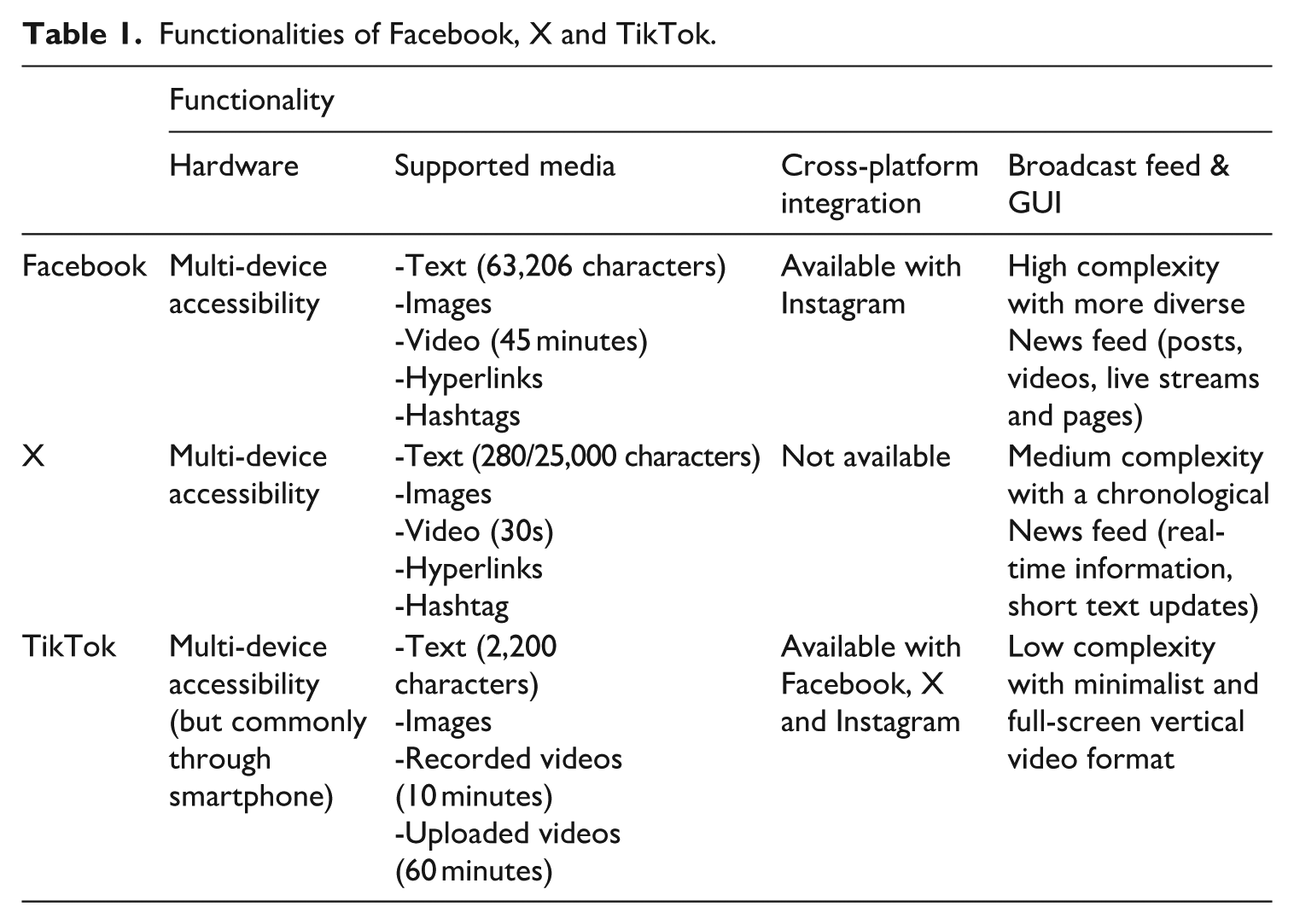
Each social media platform is characterised by its own architecture and set-up of these five functionalities. Facebook, for instance, offers opportunities for long-form posts, allowing more detailed narratives, in contrast to X, which prioritises brevity and immediacy, and promotes the use of hashtags for searchability and virality (Alhabash and Ma, 2017; Waterloo et al., 2018). TikTok, on the other hand, emphasises visually engaging content, such as memes and short clips (Abidin, 2021). To gain comprehensive insights into how the five different functionalities outlined above shape political discourse, the current study draws on parts of operationalisation of the ‘digital architectures’ framework specifically relating to functionality, as seen in Table 1, inspired and adapted from Bossetta (2018: 482), to explore Facebook, X and TikTok.
As seen in Table 1, all three platforms can be accessed from different types of hardware, including desktop computers, tablets, smartphones and smartwatches, although TikTok is most commonly accessed through a mobile phone app. The types of devices from which a platform can be accessed impact how content is created and produced. Multi-device accessibility provides users with the ability to ‘upload edited content at scheduled, strategic time points’ and therefore supports the publication of more polished and filtered messages (Bossetta, 2018: 482). In the same vein, the kinds of media formats that are supported affect the kind of content to be displayed on each digital platform. While all three platforms allow the incorporation of texts, images, videos, hyperlinks and hashtags as seen in Table 1, they apply various limitations regarding the lengths and sizes of these multimedia formats. Facebook is defined by high hypertextuality, meaning that content is interconnected and easily accessible through clickable links, and the platform provides similar opportunities for users to post textual and visual content (Hase et al., 2023). On Facebook, the length of video content can reach as much as 45 minutes, and the text limit is a comprehensive ~63,000 characters. Similarly, X affords high hypertextuality, and the platform provides comparable opportunities for users to post textual and visual content, although both are substantially less far-reaching. Texts can be a maximum of 280 characters (premium accounts, however, are granted up to 25,000 characters) and only videos are limited to 30 seconds or less. Compared with Facebook and X, TikTok is a visually centred platform revolving predominantly around video content of varying durations. While the videos created or recorded on the digital platform itself can be up to 10 minutes long, the ones that are uploaded from an external source can reach up to 1 hour. TikTok allows captions for images and videos to reach up to 2200 characters. It does, however, provide less hypertextuality in contrast to Facebook and X, limiting users’ opportunities to link to other content (Hase et al., 2023).
Relatedly, cross-platform integration differs between the three social media platforms. The possibility to post the same content across other platforms is neither supported on Facebook nor X; it is, however, well integrated with TikTok. As noted by Bossetta (2023: 10), ‘the vertical video format popularized by TikTok is highly interoperable with other platforms’. The platform enables users to easily share content across Instagram, X and Facebook. Facebook even allows the posting of TikTok videos on its own platform as ‘reels’. TikTok, Facebook and X all provide broadcast feeds, but they differ significantly in types of content patterns of user engagement, and algorithmic priorities. For X, the centralised feed prioritises real-time information and short text updates, often focusing on news and public discourse, with a more chronological approach to content presentation (Bossetta, 2018). Facebook, in contrast, offers a diverse and complex feed, including posts, videos and live streams from friends, groups and pages, with a blend of personal updates and professional content (Bossetta, 2018). Finally, TikTok, being inherently video-centred, primarily features short video clips as the primary content (Abidin, 2021), and its user interface is characterised by a minimalist, full-screen vertical video format (Umansky and Pipal, 2023).
These technological opportunities and constraints – relating to hardware, supported media, cross-platform integration and the broadcast feed and GUI – governing each digital platform set the boundaries for how users can create content. Alongside these, platform rules and their enforcement (Gillespie, 2018) contribute to the development of different norms and cultures within each setting where some content and ideas are accepted while others are not (Åkerlund, 2025; Gerodimos, 2019). Beyond that, platforms host different demographics. In Sweden, Facebook is used widely – about 60% of Swedes use Facebook weekly – but is especially favoured by retirees; X on the other hand has many fewer users – around 11% – and is most popular among people aged 25–35 years, and while TikTok is only used by 17% of Swedes on a weekly basis, over 60% of high schoolers use it every day (Swedish Internet Foundation, 2023, 2024).
SD has historically been effective in their uses of social media, and the party continuously ranks among Sweden’s most powerful social media presences (Maktbarometern, 2024). Their Facebook account, which dates back to December 2014, is the largest of the three studied with around 350,000 followers around the EU election. Their X account is older, launched back in 2009, with around 140,000 followers around the same time. Finally, SD posted its first TikTok just a month before the EU election, but by this time the account had already accumulated around 50,000 followers.
Drawing on the findings of RQ1 and these demographic insights, we analyse what SD’s choices in communication say about its platform savviness and the party’s understanding of its audiences (cf. RQ2). The article addresses a gap in research wherein little attention has been paid to the ways in which authoritarian populist parties employ cross-platform strategies to deliberately construct and disseminate securitising messages. By focusing on Facebook, X and TikTok, we provide new insights into how authoritarian populist parties understand and adapt to the functionalities of different digital settings and audiences to convey these messages visually.
The case
The current study focuses on the SD who have been categorised as an authoritarian populist party (Norris and Inglehart, 2019). 2 More specifically, this article analyses the party’s campaign during the 2024 EU election, and its official slogan ‘My Europe Builds Walls: Against Immigration, Against Criminal Gangs, Against Islamists’. The slogan brings to mind Trump’s persistent calls for a wall on the US–Mexico border (Rivers and Ross, 2020; Wallace and Zepeda-Millán, 2020), but it is also a play on a speech delivered 9 years prior by then-Swedish Prime Minister and Social Democrat leader Stefan Löfven, amid the so-called ‘refugee crisis’ of 2015, where he proclaimed: ‘My Europe takes in refugees. My Europe does not build walls!’ (Fernández, 2020).
SD’s EU campaign slogan was launched in April 2024 and was promoted mainly online through anti-immigrant and anti-elitist messages. The party is notorious for its opposition to immigrants and its representation of non-European, particularly Muslim, immigrant men, as a security threat to Swedish society and culture (Bouchafra, 2024; Elgenius and Rydgren, 2019; Mulinari and Neergaard, 2014). SD has successfully promoted these ideas through social media. Although SD has grown increasingly influential, now ranks as the second-largest parliamentary party in Sweden and holds a kingmaker position in the current right-wing Moderate-led government, it has historically had difficulties in attracting its generally EU-sceptic constituents to vote in the EU elections. In light of this, its EU election campaigns are all the more important for the party.
Data and method
We began the data collection process by sampling social media posts from the three official SD party accounts on Facebook, X and TikTok, respectively. We collected data manually by going through all published posts over the six-week period leading up to the election date – from 25 April when the campaign was first officially launched, until 9 June 2024, when the election was held (see Svahn and Haglund, 2024). We manually downloaded all posts that mentioned ‘EU’ or ‘Europe’ and ‘election’, or the ‘My Europe Builds Walls’ slogan in the posts themselves or in their captions. Images, videos, text and captions were collected alongside metadata regarding posting date and time, source and post URL. A total of 293 posts were collected: 78 of these were gathered from Facebook, 92 from X and 123 from TikTok.
Building on prior research on visual online communication and political campaigning (Bossetta, 2018; Bossetta and Schmøkel, 2023; Haßler et al., 2023), we undertook a comparative examination of the affordances and functionalities of Facebook, X and TikTok, using the features outlined in Table 1 as our analytical point of reference. This comparison unfolded across multiple phases. Initially, we approached the dataset holistically, identifying analytically salient categories and mapping their distribution in terms of frequency, volume and the relative prominence of recurring patterns. In operationalising the concept of platform functionality, we drew on Bossetta’s (2018) framework and adapted it into four interconnected analytical dimensions: (1) media type, (2) slogan-integrated references, (3) content origin and (4) platform temporal integration.
The media type category – including memes, videos, still images and text – is dictated by the platform’s supported media formats. TikTok’s video-centric architecture encourages short, memetic audiovisual content, whereas Facebook and X provide greater flexibility, allowing combinations of text, images and video. The available media types thus directly influence how messages are communicated on digital platforms. Second, the integration of campaign slogans into visual or textual content is contingent upon the platform’s broadcast feed and graphical user interface (GUI). On TikTok, the feed prioritises vertical video with minimal text, necessitating that slogans appear within captions or embedded visuals. In contrast, Facebook and X allow captions, overlays and post descriptions to accompany visuals, facilitating more elaborated deployments of campaign slogans. Third, the origin of content, whether original or re-shared, interacts with the platform’s capacity for cross-platform integration and resharing. X supports the reposting of links, news items and other users’ content, enabling amplified argumentation, while TikTok’s remix features, such as duets and templates, allow original content to be adapted, circulated and recontextualised, shaping perceptions of authenticity and virality. Finally, temporal dynamics, including the timing and sequencing of posts, are influenced by hardware capabilities and the platform’s feed architecture. TikTok’s algorithmically curated feed incentivises early posting to maximise reach, whereas Facebook and X emphasise chronological and engagement-based distribution, affecting how quickly securitising messages are disseminated and received by audiences. Table 2 explains and summarises the link between the four categories and Bossetta’s (2018) five functionality dimensions as seen in Table 1.
The link between the categories and Bossetta’s (2018) functionalities.
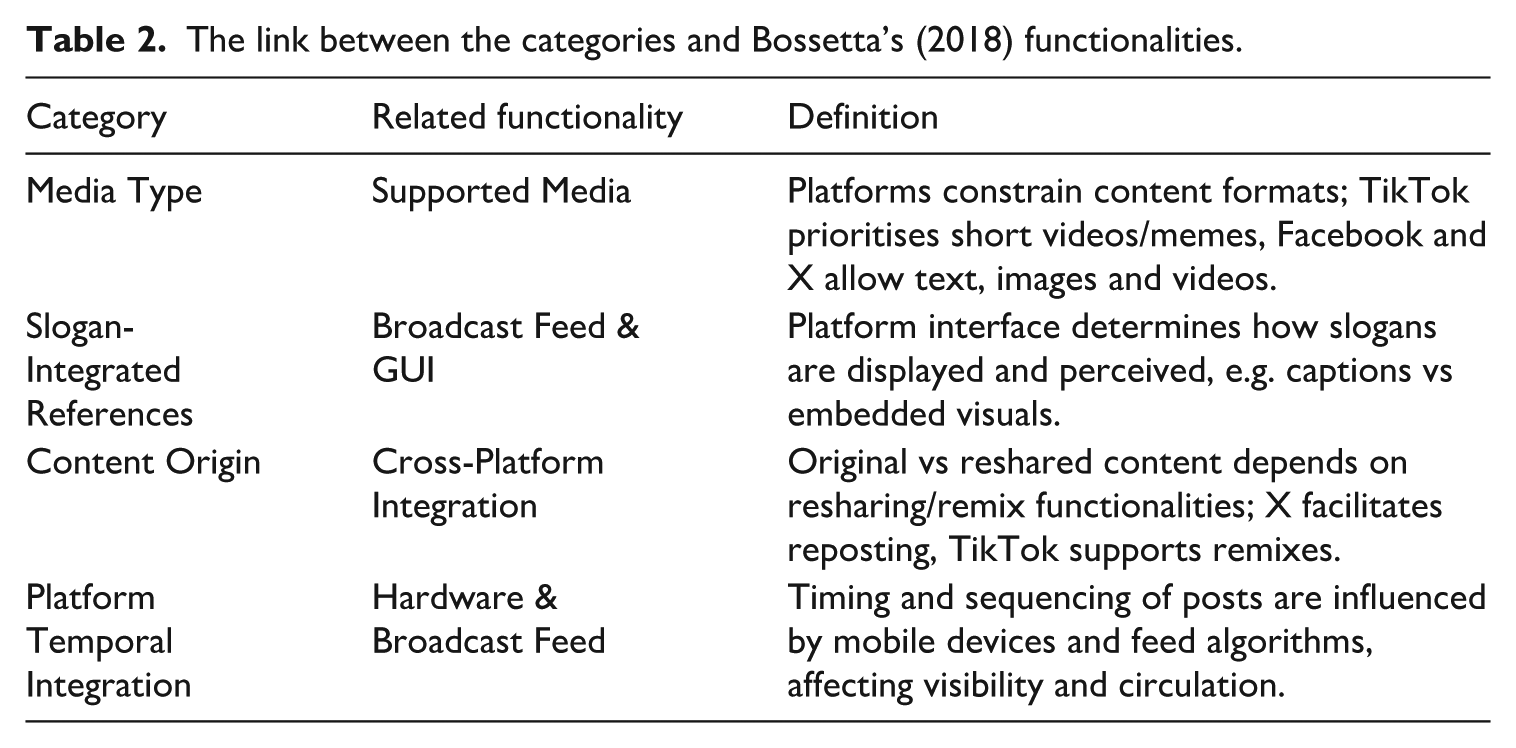
To analyse the first category, we inductively identified the dominant media type of each post and subsequently classified these in accordance with typologies established in previous research (Bouchafra, 2024; Farkas et al., 2022). Posts were grouped into six categories: memes, videos, text-only posts, images, image compilations and images with text overlays. The category of ‘meme’ was conceptualised as multimodal content that may combine image, text and, in some instances, video, and that typically mobilises humour, satire, irony, or parody to engage with and comment upon, social, political or cultural phenomena (Schmid, 2025; Shifman, 2013). The ‘text-only’ category referred to purely textual content, devoid of any visual elements – a format that is not supported on TikTok. The ‘image’ category comprised static visual content without any superimposed text.
For the category of ‘slogan-integrated references’, we coded any explicit or implicit references to ‘the wall’ when these appeared in the textual modality, the visual modality, or across both. With respect to ‘content origin’, posts were coded binarily to distinguish between content that was originally produced by SD’s official accounts and content that had been reposted by the party. Finally, under ‘platform temporal integration’, we assessed whether identical or substantively similar content had been cross-posted by SD’s accounts across the other two platforms. The coding was carried out collaboratively by the authors, with each post being assigned a single value for each analytical category.
As part of our approach, we complemented this first phase of inquiry with multimodal critical discourse analysis (MCDA). MCDA provides a unique framework for analysing multimodal forms of communication. It builds on the tradition of critical discourse studies and expands the analysis to explore the semiotic devices employed across multiple communicative modes (e.g. images, videos, graphics, audio) and the ideological meanings behind them (Machin, 2013). For the study at hand, MCDA helped us identify the focus of the securitising discourse of the SD on each social media platform and uncover the party’s digital campaigning strategies (cf. RQ1), and provide context for how these inform the party’s understanding of its audiences and platforms’ functionalities (cf. RQ2). As MCDA extends critical discourse analysis (CDA), it therefore incorporates key aspects of the latter, such as referential and argumentative strategies.
For this phase, we examined the posts from each platform using the analytical toolkit developed by Machin and Mayr (2012). This framework combines principles from CDA with Kress and van Leeuwen’s (1996, 2020) visual grammar. This stage of analysis consisted of examining, in each post, the representation of the social actors and actions in the visual and textual components by investigating different discursive strategies employed by SD such as referential or nomination strategies – techniques centred around biological and cultural categorisation; predicational strategies used to depict negatively or positively social actors; and finally argumentation strategies employed to justify and legitimise the negative and positive attributions (Wodak and Reisigl, 2001). We also analysed the interactive dimension between actors and the viewer in terms of contact, social distance and point of view. Finally, we looked at the composition of the visual in terms of salience and framing. We concluded our analysis by incorporating an inquiry into the inter-semiotic relation between the image and text following Martinec and Salway’s approach (2005), which involves identifying the relative status of verbal and visual elements – whether independent or complementary. It also included investigating their logico-semantic relationship, that is, how the meaning of a text is related to the meaning of an image in a multimodal message, for instance, whether one elaborates, enhances or extends the other (Martinec and Salway, 2005).
Results and analysis
In the following sections, we draw first on descriptive statistics of our full dataset of 293 posts in the six-week period leading up to the election date, to describe the main foci of the SD’s EU election campaign and how it differs across Facebook, X and TikTok (cf. RQ1). Then, using MCDA, we analyse what these strategies say about the party’s understanding of its audiences on these platforms and its perceptions of the functionalities of Facebook, X and TikTok (cf. RQ2).
Campaign focus and content differences
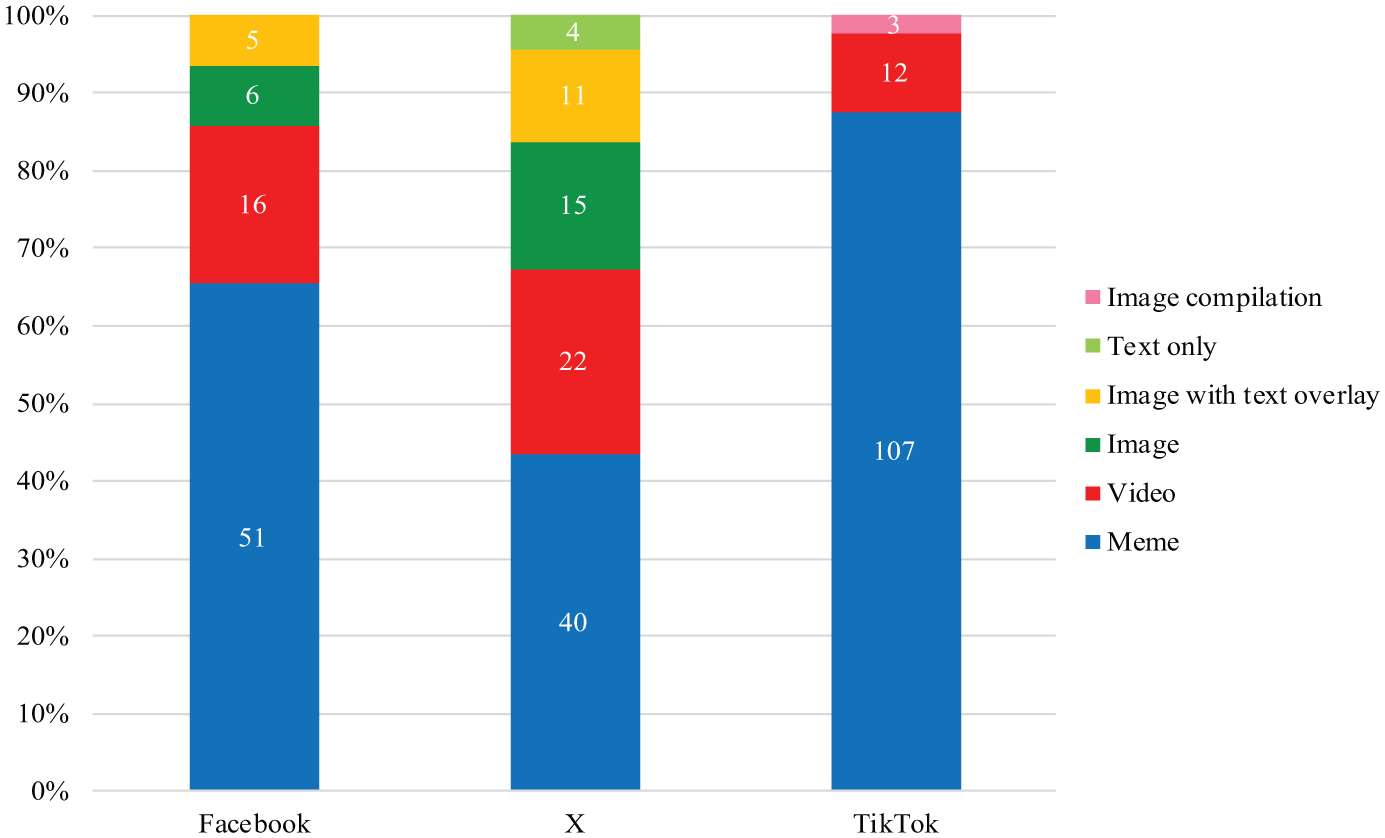
We find that by a large margin, SD’s election campaign content consists of memes (67.5%). These memes, in turn, all share the same key building blocks: first, a short clip of around 10 seconds, then the gradual appearance of a wall of cartoon bricks. The second most commonly used multimedia format in the collected posts is videos (17%). Typically, these were mainstream news media interview clips of SD’s EU parliament candidates or snippets from party leader Jimmie Åkesson’s election campaign tour across Sweden. The remaining multimedia formats used by SD in its campaign are different forms of image-centred content: with (5.5%) and without (7%) text overlay, and in the form of image compilations (1%), mostly displaying ‘the wall’ slogan on campaign flyers and posters. Finally, only four posts, 1.3%, are text-only posts.
Looking at the distribution of the above-mentioned media types across the three digital platforms, SD not only posted most content overall on TikTok but also notably dedicated a considerable proportion of its campaign memes to this site (see Figure 1). The posts published by SD on Facebook and X are, on the contrary, characterised by a slightly less disproportionate distribution of videos and images considering the moderate levels of visuality offered by both platforms. In addition, the majority of still pictures found in the collected material are posted on Facebook and X – on TikTok, SD only posted still images as part of compilations. Finally, the few text-only posts are all published on X. Although TikTok does not allow text-only posts, this finding shows its use also of Facebook as a visual platform.
Percentage distribution of media types across Facebook, X and TikTok.
Furthermore, we find that SD, throughout its campaign, prioritises original content. In fact, 91% of the posts published by the party during the electoral campaign are its own content. The rest (9%) are reposted from SD MPs, mainly its EU parliamentary candidates’ accounts, and almost exclusively on X. Relatedly, this illustrates differences in posting patterns between the party and the accounts it reposts. First, despite the platforms’ opportunities for hypertextuality, we identify only 19 posts incorporating hyperlinks throughout the whole dataset. These are exclusively published on X and Facebook, most commonly SD linked to mainstream news articles. Most of SD’s hyperlinks (15) are found on X; however, the majority of these (9) are included in content they had shared from other accounts.
Relatedly, hashtags appear in 45% of all campaign content, mainly #Sverige [#Sweden] (166 times), #Sverigedemokraterna [#SwedenDemocrats] (97 times) and #EUval [#EUelection] (48 times). Notably, there are only 10 instances when hashtags are used on Facebook or X, and in all these instances they are part of re-shared content. Thus, SD does not use hashtags in any of its original campaign content on these sites. In contrast, all content that SD posted on TikTok contains hashtags. On TikTok, SD also employs #fördig [#foryou], which is commonly used when seeking virality (Hendrickx, 2025).
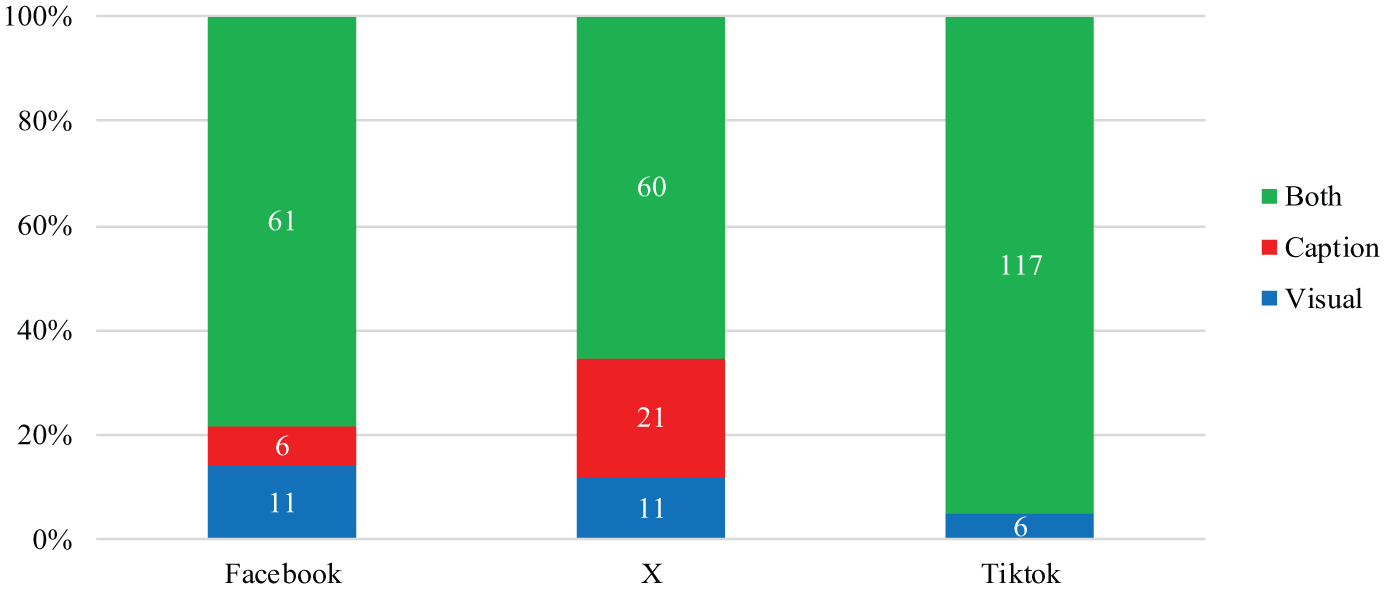
Turning to SD’s references to its campaign slogan ‘My Europe builds walls’, there are no references to the US or Trump. Our findings reveal that the party embraces multimodality on Facebook, X and TikTok. As demonstrated in Figure 2, the campaign slogan is most often mentioned in both visual and textual elements of posts (82%). However, there are notable differences between its uses of the three digital platforms. On TikTok, there are no instances where the slogan appears only in text, on X and Facebook, SD sometimes introduces the slogan exclusively in the caption.
Distribution of slogan-integrated references across Facebook, X and TikTok.
When it comes to cross-posting the main content of the electoral campaign – that is, the memes – the results show that 24% of these are unique to TikTok and do not appear on either Facebook or X. As for the memes that are posted on all three platforms, 10% of them appear first on TikTok, 8.5% on X and 8% on Facebook. This finding is scarcely surprising as TikTok’s functionalities allow a more integrated cross-posting feature compared with the other two digital platforms.
Looking at the text-image relations, we find that visual and verbal elements are interconnected differently across the platforms. On X and Facebook, image and text often communicate different but complementary content. This is often referred to as a ‘relay relation’ in which both elements are dependent on each other to be fully assimilated and comprehended (Barthes, 1977). In addition, our analysis of the logico-semantic level reveals that textual elements work as extensions – adding new related information that cannot be seen visually – and enhancements, including additional contextual information (Martinec and Salway, 2005).
A typical example of this is presented on the left-hand side in Figure 3, where a caption is used to add contextual information – specifically updates about the campaign tour – and where the imagery shows the party leader at rallies. In a different example (see right-hand side of Figure 4), the text-image relation is a ‘projection’ (van Leeuwen, 2005) where the verbal elements are represented in parts through a quote from the party leader Jimmie Åkesson, pictured.
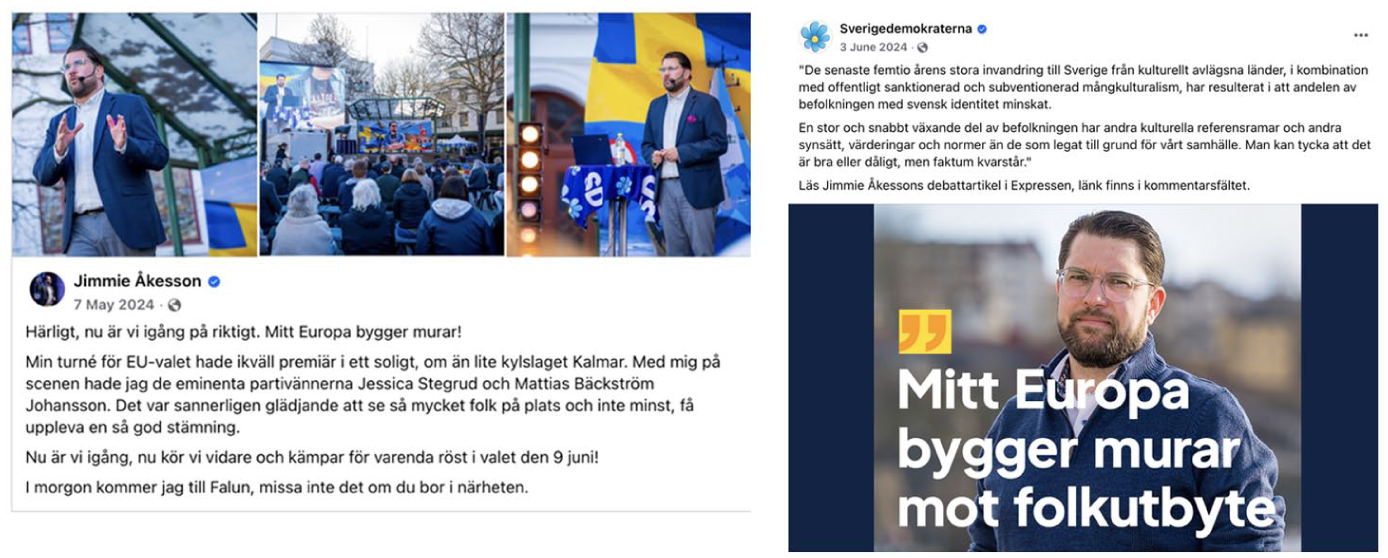
Screenshots of Facebook election campaign posts. 3
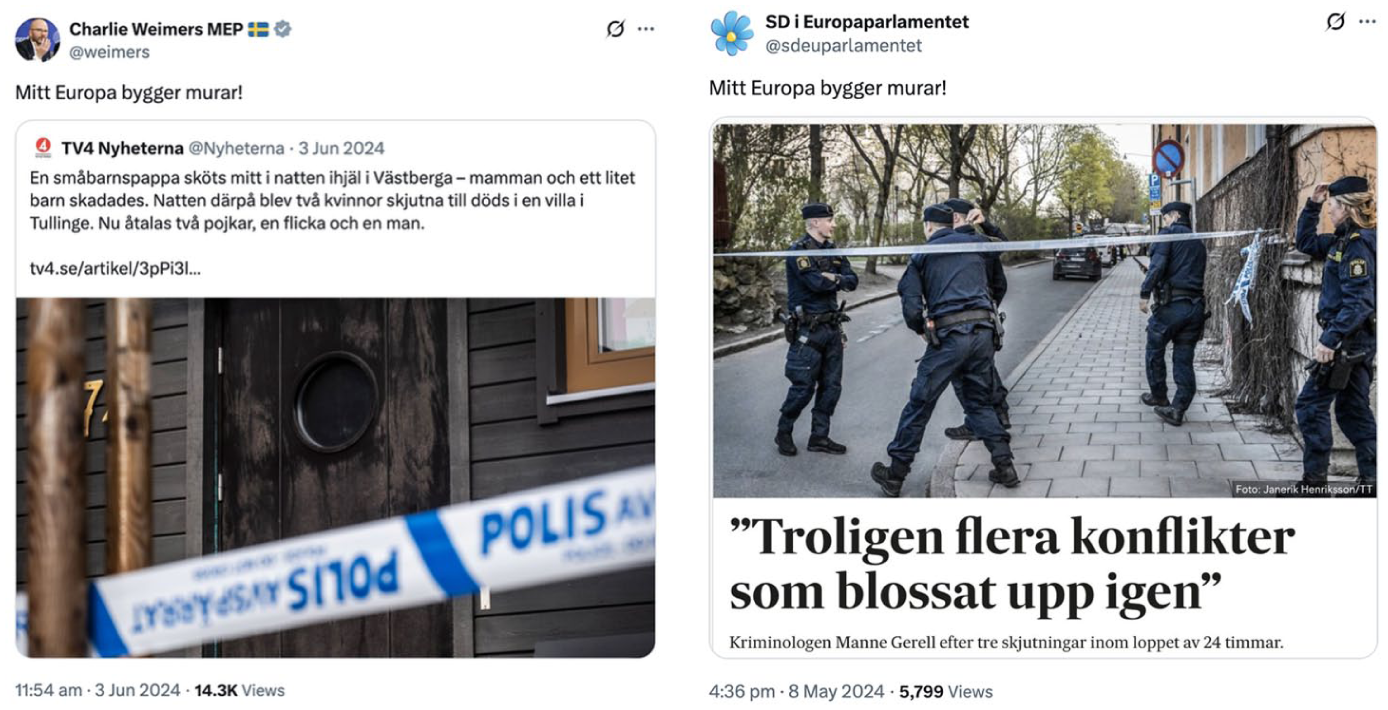
Screenshots of reposted news article commentary by SD’s EU parliament candidate Charlie Weimers (left) and SD’s EU parliament-specific account (right), both on X. 4
In sum, we found similarities regarding what SD focuses on in its EU election campaign across the three studied social media platforms, but we also identified several key differences between what SD focuses on across Facebook, X and TikTok. Most notably, although most research has focused on political parties’ uses of YouTube, Facebook, Twitter/X and Instagram, both in Sweden and internationally (e.g. Bast, 2024; Bossetta and Schmøkel, 2023; Bouchafra, 2024, 2025; Gerbaudo et al., 2023; Haßler et al., 2023 but see Hase et al., 2023), we illustrate a preference for TikTok – both in terms of quantity, where content is first posted, and its uses of virality features. This implies that the party is specifically targeting younger audiences in its election campaign (Medina Serrano et al., 2020).
Understandings of audiences and functionalities
Using MCDA, we analyse what SD’s differing strategies on Facebook, X and TikTok say about the party’s perceptions of its audiences and the functionalities of the respective platforms.
On Facebook and X, we identify that SD’s securitising campaign efforts are centred around strategies of identification and argumentation – seeking to characterise and position the party’s enemies around biological and cultural categorisations and attempts to justify and legitimise these representations (Wodak and Reisigl, 2001). These discursive devices are mainly incorporated in texts, captions and hyperlinks. As illustrated in the compilation in Figure 4, SD relies, in its argumentative approaches, on mainstream and alternative news stories to support its securitising claims that immigrants are a source of criminality and therefore represent a threat to Sweden and its ‘legitimate’ people (Åkerlund, 2022b). This skewed use of external links to news media on X leverages the platform’s focus on real-time information and news updates (Bossetta, 2018) but it also indicates an attempt to approach a wider and perhaps more sceptical audience through (pseudo-)rational argumentation (Merrill and Åkerlund, 2018).
We find that SD used Facebook and X to communicate more elaborated and detailed anti-elitist rhetoric compared with its meme-centred communication on TikTok. In doing so, SD leverages the more mature audiences on these sites and the textuality available, in particular on Facebook, to develop and substantiate the party’s arguments against its primary political opponents – the Social Democrats, which it presents as a proxy for the political establishment responsible for the current (dystopic) state of Sweden and Europe (Elgenius and Rydgren, 2019; Merrill, 2020).
TikTok is intrinsically visual and offers disproportionate opportunities for posting videos/images compared with text, and SD’s posts on the platform make use of this feature. On TikTok, SD uses captions to convey short and general content – mostly just the slogan of the campaign – leading to a text-image relation of ‘exemplification’ (Martinec and Salway, 2005; see also Figure 5). Specifically, it focuses on visual representations of threat and insecurity (van Leeuwen, 2013). Notably, SD’s TikTok-based campaign efforts as seen in Figure 1 consist of 87% of memes. In fact, memes constitute two-thirds of all campaign posts overall. These are exclusively centred around strategies of identification – characterising the party’s enemies around biological and cultural categorisations. As noted, the memes are exclusively combinations of short clips followed by the gradual appearance of cartoon brick walls (see Figure 5). Sometimes the clips portray political opponents, mainly Social Democrats making statements about the importance of open borders. However, most often, the clips depict non-white individuals engaging in violent protests, vandalism and violence directed towards the local community and law enforcement.
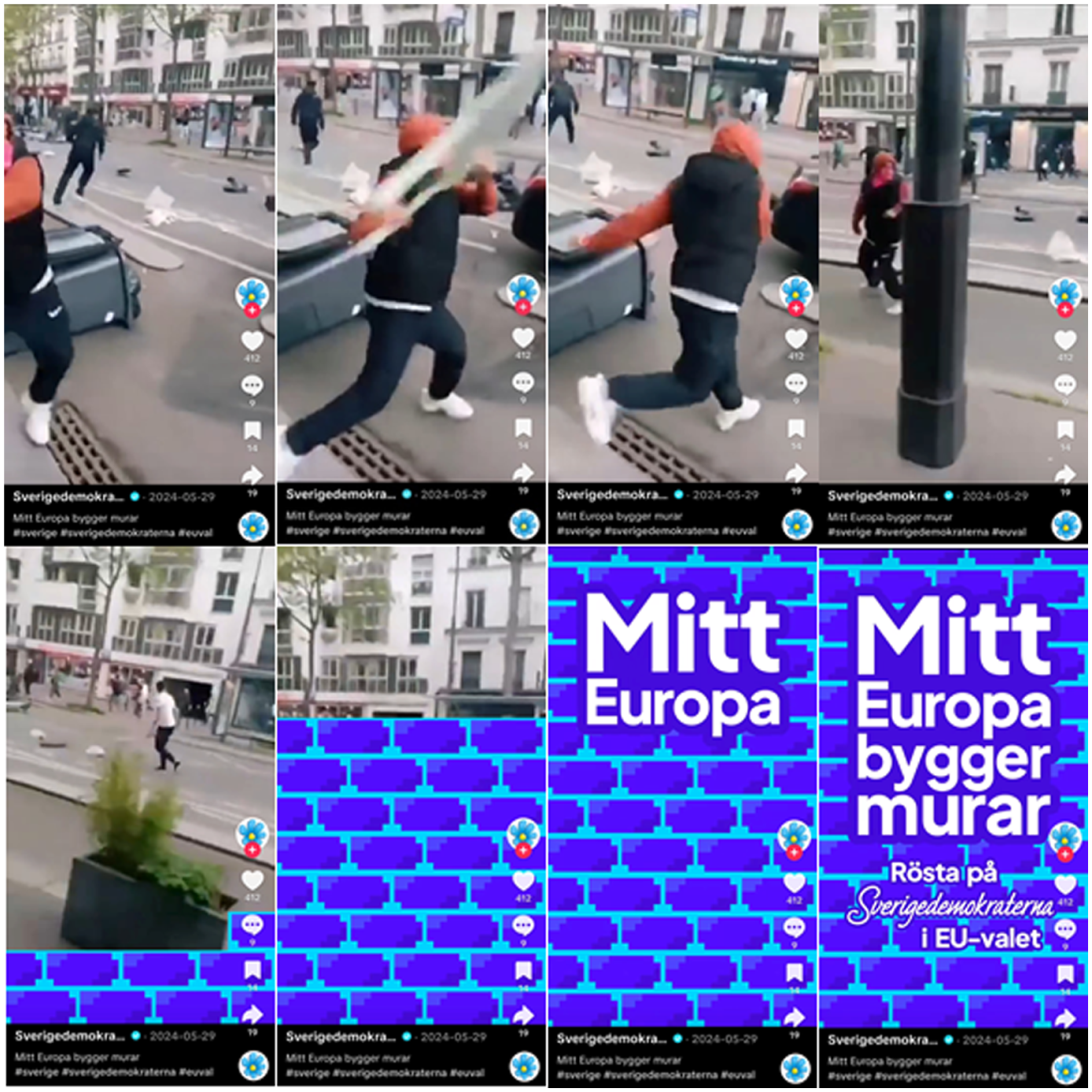
Screenshot compilation of campaign meme on TikTok.
The gradual building-up of the cartoon wall in these memes refers to SD’s intended closure of European borders, and implicitly that building this wall would not only stop immigration but also curb the types of activities shown in the videos. However, although #Sweden is tagged with most of these posts (on TikTok), reverse video searches reveal that the memes often depict international events, including from France, Germany, Spain and Ireland. This can of course be explained by the campaign’s European election focus. However, the other national contexts used in the memes are not flagged through hashtags, nor through pinned locations. What is more interesting still is that SD uses footage of immigrant-perpetrated protests, vandalism and violence also from England, which by then was no longer part of the EU. It is possible that SD has to draw on materials from elsewhere because the party cannot find enough real and relevant examples, thus attempting to manufacture a problem and scope which has no basis in reality. It also indicates that SD is less concerned with portraying facts and actual Swedish or EU conditions to its meme audiences, but instead seek to illustrate a sense of crisis and threat that is both quick to understand and digest for the potential young audiences, and leverages the short impactful visual format that TikTok has become known for.
In sum, in this section we showed how SD’s uses of the platforms showcase active understandings and targeting to different audiences and seek to make the best use of Facebook, X and TikTok’s functionalities. Importantly, we show how Facebook and X are used for conveying seemingly rational arguments, while TikTok is leveraged in exclusionary and misinformative ways through short visual snapshots.
Discussion
Through a comparative overview of its uses of multiple social media platforms, this article sought to analyse the authoritarian populist party SD’s election campaign efforts online. In doing so, it responds to calls to extend research on political communication to cross- and multi-platform settings to better address the roles that different, and especially emerging, digital platforms might play in electoral campaigning (Bode and Vraga, 2018; Larsson et al., 2025). Specifically, our multimodal, cross-platform analysis illustrates how SD used Facebook, X and TikTok during its 2024 EU election campaign to promote its securitising messages through the slogan ‘My Europe builds walls’.
The article reveals both similarities and differences in the party’s uses of the platforms to display visual securitisation. These differences are a result of the technological restraints and opportunities afforded by Facebook, X and TikTok, respectively, but they are also due to SD’s desire to tailor its campaign content to the distinct technological advantages and intended audiences of each platform. Concretely, SD leveraged the technological abilities to balance textual and visual features, to repost and to incorporate hyperlinks on Facebook and X. Using these features, the party posted text-laden, argumentative and seemingly informative posts, which are likely to appeal not only to the customary format of content on the platforms but also to its older audiences. This pattern is lacking on TikTok owing to the centrality of the visual elements and absence of the hypertextuality feature.
Yet, although SD had larger followings and (much) more well-established accounts on both Facebook and X, the party posted the majority of its campaign material on TikTok, primarily in the form of memes. Although there remains a lack of research into political party uses of TikTok in Sweden, this finding is in line with previous research showing that Swedish politicians quickly adjust their political campaigning strategies to emerging digital platforms (Larsson, 2016). More than this, it shows that SD is actively targeting younger audiences, and these efforts may be effective. Not only do recent years’ national mock middle- and high school elections show that SD is growing increasingly popular among young Swedes (The Swedish Agency for Youth and Civil Society, 2025), but the party increased its voter share among Swedish youth aged 18–24 years from 9% in 2019 to 15% in the 2024 EU election; despite SD reducing its overall share of EU votes from 15.34% in 2019 to 13.17% in 2024. 5
SD promotes a youthful and modern approach to politics in the 2024 EU election through its memes. We found that these were, furthermore, updated throughout the course of the election period and incorporated current events – including a confrontation between the party leader Åkesson and pro-Palestine protesters at one of the campaign rallies. Unlike other parties, SD is not afraid of losing control over its visual securitising narrative but instead promoted audience engagement. In fact, the party uploaded its meme template with instructions for others to create and spread their own versions, featuring the SD logo. 6 Here, the SD adopts a participatory communicative strategy by actively encouraging audience involvement. In securitisation, this approach is known as ‘audience agency’ (Balzacq, 2005; Balzacq et al., 2016), meaning that the audience actively participates in producing, modifying and disseminating securitising messages. This transforms securitisation into a co-produced rather than a top-down process. In fact, SD’s public dissemination of a meme template exemplified a decentralised mode of narrative formation, wherein processes of securitisation are collaboratively produced through digitally mediated interactions between the party and its online audiences.
In sum, this article highlights how the visual dimension of securitisation is inherently platform-dependent, shaped by both the functionalities of social media and the perceived characteristics of target audiences. The current study demonstrates that visuality functions differently across platforms, shaping how security narratives are produced, circulated and interpreted. While in Facebook and X, the SD combined visual materials with textual elaboration, hyperlinks and argumentative captions, producing a form of securitisation oriented towards persuasion and legitimisation, TikTok was rather employed almost exclusively for memetic, visually driven content – short, emotionally charged and easily digestible representations of threat. Here, visuality operates primarily as an affective and performative mechanism, leveraging virality and participatory culture to reach younger audiences. These differences reveal that visual securitisation is dynamically mediated by platform-specific architectures, audience engagement practices and the interplay between textual and visual modalities.
Finally, SD’s digital savviness is not incidental. It reflects a larger international pattern of authoritarian populist actors skilfully leveraging digital and social media opportunities, driving user engagement and adapting to the ever-evolving conditions of the web (Bast, 2024; Caiani and Kröll, 2015; Doerr, 2017; Ekman, 2019; Klein, 2024; Zhang et al., 2025). Yet, as we have also shown, the content that SD spread through its digital channels was not necessarily accurate or truthful. Most notably, SD drew from pre-recorded video content from outside the EU to depict conditions resulting from immigration within the EU. Such disinformation is likely only to be exacerbated when others are encouraged to ‘remix’ (Fielitz and Thurston, 2019) the party’s content without its supervision. On the contrary, this is not likely an oversight by SD. Albeit under the party banner, when others post potentially overtly racist or obviously deceiving or wrongful content, this can easily be dismissed as beyond the party’s control. The widespread dissemination of its campaign content, thus, risks intensifying affective polarisation and worsening ethnic relations in Sweden and beyond.
With the rise of artificial intelligence (AI) and its capacity to rapidly generate images and videos, authoritarian populist actors, such as SD, would be able to produce highly persuasive and emotionally charged content at scale, potentially manipulating public perception and amplifying mis- and disinformation. In turn, this potentially undermines informed deliberation and distorts political debate, thus posinf significant challenges to liberal democracies.
The current article focused on a limited period of time, and exclusively on Sweden. Future research would do well to explore authoritarian populist actors’ cross-platform uses on a wider range of emerging digital and social media settings, including on alt-tech platforms. Furthermore, given our findings, future research should analyse the increasing role that TikTok has come to have for authoritarian populist actors and parties internationally and investigate the role of TikTok in mis- and disinformation and fake news, including how it spreads and is understood by audiences, also outside of authoritarian populist election campaigns.
Footnotes
Declaration of conflicting interests
The authors declared no potential conflicts of interest with respect to the research, authorship and/or publication of this article.
Funding
The authors received no financial support for the research, authorship and/or publication of this article.
