




Abstract
The relationship between children’s digital play and well-being remains under-researched, with debates often polarised and limited by a lack of holistic studies in diverse global contexts. This article draws on empirical data from an ecoculturally informed study of children’s (6–12) digital play in the United Kingdom, South Africa, Australia and Cyprus to examine how individual and contextual circumstances influence children’s self-led digital play choices and practices. To do so, we theorise ‘contextualised digital play drivers’, understood as children’s own accounts, or adults’ interpretations, of the deep interests, needs and desires their play appears to fulfil. This approach moves beyond dominant lenses focused on individual autonomy, offering a more situated reading acknowledging the individual and contextual circumstances shaping digital play. Eleven contextualised digital play drivers are identified and discussed in relation to children’s well-being. The article concludes with implications for game designers, educators, families, policy and research methodology.
Introduction
Though children’s play is always a site of risk, it is widely recognised as vital to learning, physical and mental health, social connection, identity formation and emotional exploration. However, digital play remains subject to a peculiar double standard. Recent mainstream discourse shows increasing enthusiasm for its educational potential, including associations with intelligence (Sauce et al., 2022), digital skills (Marsh et al., 2021), subject knowledge (Ellison and Evans, 2016) and holistic skills (Marsh et al., 2020). Yet, such enthusiasm is often tied to instrumental educational goals, contrasting with the broader intrinsic value long associated with play. Digital play research often focuses on risks or developmental gains, with less attention paid to potential well-being benefits or wider functions. COVID-19 prompted renewed interest in this area, highlighting digital play’s role in fostering connection (Cowan et al., 2021) and providing comfort (Pearce et al., 2022). However, the relationship between children’s digital play and well-being remains under-researched, while debates around children’s media play remain polarised. The field lacks expansive, holistic studies in diverse global contexts. This article addresses these gaps through an in-depth, ethnographically informed study of 50 children’s digital play across four countries, with a focus on how it supports subjective well-being differently for different children.
Both ‘play’ and ‘digital play’ are complex phenomena, and definitions are much debated (Marsh et al., 2016). Play is a multifaceted and complex concept, difficult to define because of its inherent ambiguity (Sutton-Smith, 2001; Zosh et al., 2018). Our study adopted an expansive working definition, beginning with Eberle’s (2014) characteristics of play as freely chosen, autotelic, pleasurable (or ultimately satisfying) and governed by internal rules. Digital play types have been theorised by Marsh et al. (2016) in their classification of digital play, informed by Hughes’s (2002) playworker taxonomy. The term ‘play with digital technologies’ can sometimes refer to instances where individuals engage in such practices involving one or more digital devices. However, children’s digital play varies: children sometimes play directly with a device’s affordances (e.g. a game app), pretend to play a digital game or use a tablet to represent another object (such as a smartphone or non-digital book) in imaginative play. However, the present study was designed primarily to attend to children’s uses of digital and video games across various platforms. This included commercial video games, educational apps, creative platforms and casual mobile games. Acknowledging that children’s playful practices with digital technologies span far beyond digital and video games, we also paid attention to broader forms of play and digital play, knowledge which served to contextualise our understanding of children’s digital game play in each case study. Likewise, we viewed children’s subjective well-being as multifaceted and context-sensitive. We adopted an approach developed in discussion with the United Nations Children’s Fund (UNICEF) (2021), encompassing feelings about the self, feelings about relationships and feelings about environments. Though limited attention has been paid to how design features support or impede children’s well-being, the growing importance of digital environments in children’s lives presents an opportunity for policymakers and game designers to exert positive influence. To realise this potential, research must first establish how digital play relates to well-being and how diverse factors mediate the relationship between digital games, design features and well-being.
Despite their ubiquity, digital games are ‘placed resources’ (Prinsloo, 2005), their impacts mediated by myriad differences in children’s lives. A design feature beneficial to one child may not support another. A unique feature of our project was its global scope. Prinsloo’s concept highlighted how digital practices are shaped by the material, social and spatial contexts in which they occur. Two decades on, while digital technologies have continued to transform the terrains of playful experience, research is yet to fully reckon with the continued importance of context. We draw on Rogoff et al.’s (2018) conceptualisation of context as constituted by the dynamic interplay of social, cultural, material and temporal dimensions and Ang’s (1996) critique of audience research as inattentive to the ‘web of relationships and structures which constitute them’ (p. 41). Our study started from the assumption that we must examine both whether digital play supports well-being and how it may do so differently for different children. Much research has focused on the experiences of middle-class children in the Global North. There is a need for inclusive approaches that resist generalisation and deficit framings, taking an intersectional, assets-based approach to understanding complexity in children’s digital lives (Alper et al., 2016). Children’s life experiences, digital play and practices are not straightforwardly shaped by static cultural factors, but emerge from a web of multiple, intersecting influences (Scott et al., 2023a). Understanding how design features interact with these influences demands sustained, in-depth and cross-context attention.
We addressed this challenge using in-depth, qualitative methods, examining how individual and contextual circumstances shaped the self-led digital play choices and practices of a diverse cohort of children. We noticed that children’s digital play was driven by deep interests, needs and desires, the fulfilment of which appeared to support aspects of well-being. These ‘drivers’ of digital play are theorised in depth below, but, for the purposes of clarity, we conceptualise ‘contextualised digital play drivers’ as a child’s account and/or an adult’s interpretation of observed actions and accounts, of the deep interests, needs and desires a child’s digital play appears to fulfil in their life. Unlike existing models of ‘motivation’, which often infer internal psychological states or universal motives, our framework situates drivers as emergent from intersecting individual and contextual circumstances, foregrounding their fluidity, specificity and embeddedness in children’s lived ecologies. Our framework also explicitly connects children’s digital play drivers with their subjective well-being. This article draws on findings from our international study (2022–2023), conducted in the United Kingdom, South Africa, Australia and Cyprus. 1 While the larger project included many subtopics reported elsewhere (Scott et al., 2024), this article offers an alternative to theories of motivation to focus on the following questions:
How do diverse individual and contextual circumstances shape the self-directed digital play choices and practices of a diverse cohort of children across diverse cultural settings?
How do these findings contribute to reconceptualising digital play practices through the lens of ‘drivers’?
What do these conceptualisations reveal about digital play’s role in supporting, or failing to support, children’s subjective well-being?
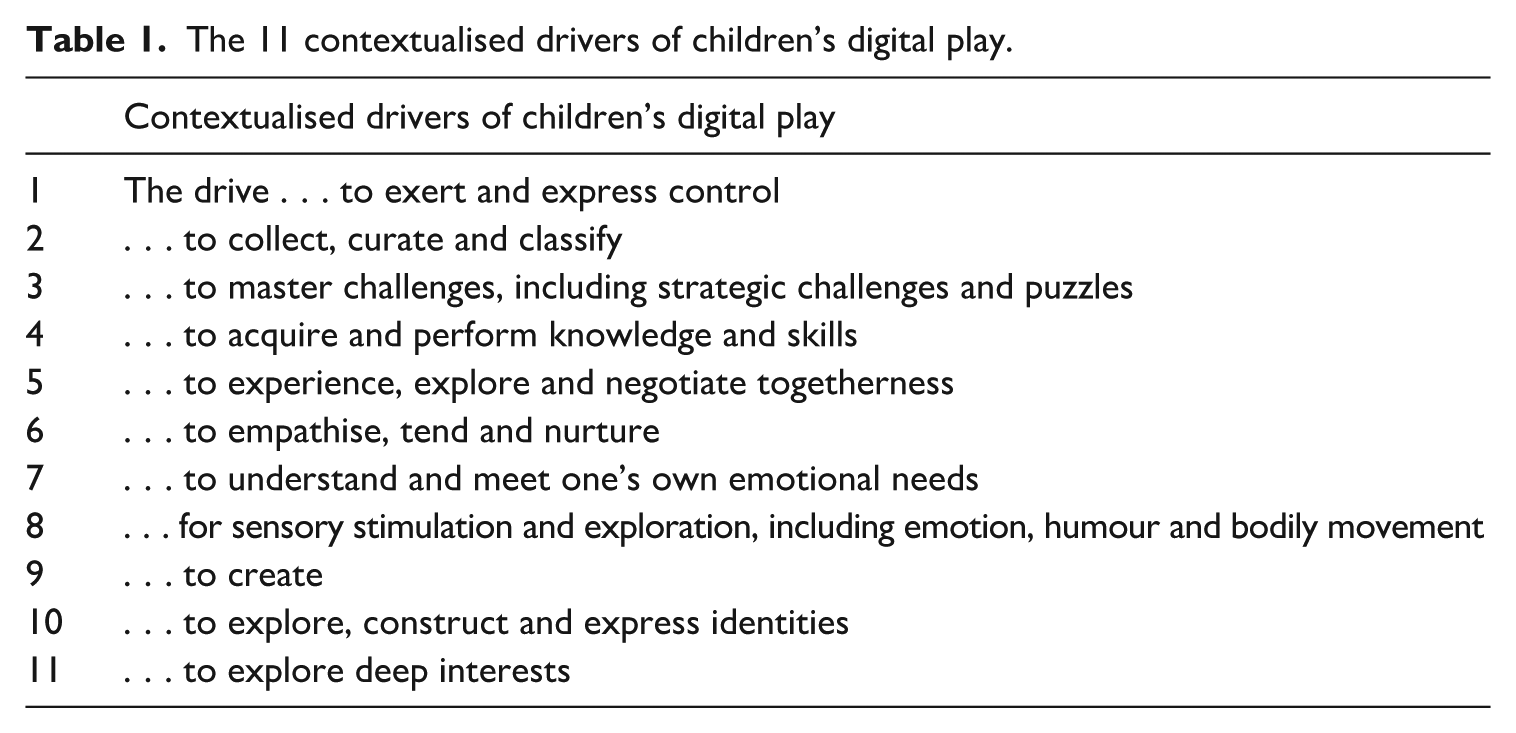
While existing attempts to theorise play choices and motivations often rest on more autonomous, individualised notions of children’s play, our approach foregrounds the contextual forces shaping how and why children play in particular ways, prompting the need for these specific questions at this specific moment. In adopting this approach, we offer a novel theoretical contribution to the field in addition to empirical contributions: a theorisation of the contextualised drivers of children’s digital play and their connection to subjective well-being. The 11 contextualised drivers of children’s digital play identified in the present study are presented in Table 1.
The 11 contextualised drivers of children’s digital play.
Theorising the contextualised ‘drivers’ of children’s digital play and their relation to well-being
In this section, we develop a theoretical framework for understanding the ‘drivers’ of children’s digital play. Our conceptualisation was inductively derived through an ethnographically informed, holistic and contextual study of children’s digital play. Grounded in our ecoculturally informed approach, we view children’s digital play as embedded within the intersecting social, material and cultural conditions of their lives. After outlining key theoretical traditions and discussing key gaps and limitations, we build on this premise to develop the concept of ‘digital play drivers’ and their relation to well-being. We selected theoretical references for inclusion by attending to the theoretical resources commonly employed by authors in our review of relevant literature (see below).
Framing the problem: connecting digital play, motivation and well-being
We adopted a socio-cultural lens, informed by activity theory and post-digital perspectives, to theorise children’s digital play drivers as dynamic, shifting and contextually embedded. To understand the role of digital play in supporting, or failing to support, children’s subjective well-being in diverse contexts (RQ3), it is necessary to consider how and why this relationship appears to be different for different children. This requires a detailed study of the individual and contextual circumstances within which children’s digital play takes place, as well as how they appear to connect with children’s self-directed digital play choices and practices (RQ1). It also requires appropriate theoretical frameworks for making sense of this relationship. However, research on digital play and well-being remains fragmented. Much work has examined the ‘effects’ or ‘outcomes’ of digital gameplay in terms of well-being – whether negative (e.g. aggression and addiction) or positive (e.g. social benefits and cognitive stimulation). Another strand has focused on the motivations for play, such as achievement, escapism or social connection. Rarely are these perspectives brought together. In particular, it is uncommon to find research explicitly connecting children’s well-being with motivations for playing (or not playing) specific digital games, or playing them in particular ways. Our study addresses this gap (RQ2) by introducing the concept of digital play drivers: the deep interests, needs and desires shaped within intersecting individual and contextual circumstances that, in turn, shape children’s self-directed play choices and practices. We theorise that the relative fulfilment – or lack thereof – of a digital play driver connects to the well-being trajectories of a given digital play activity for a particular child in a certain context at a particular time.
Existing theoretical approaches to motivation (and well-being) in digital play
Several disciplinary traditions provide useful, but partial, resources for understanding what ‘drives’ children’s play. Early childhood scholars have used Leontiev’s (1978) idea of ‘motive’ to theorise the ‘object’ of a child’s activity and the ‘need’ behind it (Hedegaard et al., 2011), including in digital play (Fleer, 2014). Leontiev’s (1978) concept of ‘motive’ is promising, since it focuses on the object of an activity in the context of a complex array of human needs, acknowledging the role of social context. Fleer (2014) showed how children’s experiences of the same digital activity can differ depending on their ‘motive’. Early childhood scholars have also considered how funds of identity (‘FOI’; Esteban-Guitart and Moll, 2014), arising from children’s participation in community and family practices, can motivate practices. Literacy scholars have drawn on Barton and Hamilton’s (2012) ‘ruling passions’ to reflect the deep interests, desires and affective experiences that drive digital literacy practices (Leander and Boldt, 2013). Psychologically, Self-Determination Theory (SDT) is often used to study motivation and well-being, while media scholars typically rely on uses and gratifications (U&G) approaches (Katz et al., 1973b). Many adult-focused studies using U&G approaches have theorised individual media responses in connection with positive ‘outcomes’ or ‘effects’. Though U&G approaches have typically been applied to adults, they are useful for theorising why certain game features may support well-being for some children but not others. Katz et al. (1973a) argued that complex factors mediate the relationship between media engagement and its effects: what a person ‘gets out of’ media depends on their reasons for engagement.
Together, these approaches highlight the scholarly importance of needs, motives and desires, but conceptualise them very differently. Fleer’s use of Leontiev’s theory embeds motives in socio-cultural contexts, but focuses on early childhood settings rather than self-directed digital play in the home, where Leontiev’s theory has rarely been applied. Activity theory also relies on discerning ‘true motive’ (Leontiev, 1978: 98), which may not, ultimately, be possible, especially when researching with young children. Identity and passions-based perspectives draw attention to deep affective investments, but do not draw out implications for well-being in a sustained way. Meanwhile, psychological and media frameworks link need fulfilment to outcomes, but frequently assume rational, individual choice while overlooking contextual embeddedness of media engagement.
For the purposes of the study, we viewed children’s subjective well-being as multifaceted and context-sensitive, adopting a framework developed in discussion with UNICEF (2021). The dimensions of well-being are described in module 4 of the coding framework (see Supplementary Materials). Our observations of how the reasons children play particular games (and the reasons they play them in particular ways) connect with their experiences of subjective well-being were empirically derived, as discussed in the Methods section.
Gaps and limitations
These limitations present challenges to the study of children’s digital play, motivation and well-being. First, frameworks tend to privilege either individual psychology or overarching cultural structures, rather than examining the complex interplay of individual and contextual factors. Second, and perhaps most pressingly, few directly address how children’s situated motives for play intersect with their subjective well-being. Some studies have adapted adult-oriented frameworks to theorise how and why children engage differently with the same games (Van Rooij et al., 2017). Others have developed specific models of children’s ‘motivations’ (Hamlen, 2011) or have researched children’s motivations with little theorisation (Olsen, 2010). Early U&G studies relied on qualitative, perception-based data. More recent work often applies existing ‘need’ categories to quantitative datasets. Neither approach is ideally suited to examining the complex interplay of individual and contextual circumstances framing children’s self-led play. There is a clear need for an empirically derived framework beginning with children’s own actions, experiences and accounts. Where previous frameworks isolate individual needs or cultural influences and motives, the concept of digital play drivers integrates these dimensions by situating children’s game play and motives within lived, post-digital ecologies.
Our conceptualisation: contextualised digital play ‘drivers’
We propose digital play drivers as an integrative concept. In our study, a digital play driver is a child’s account, and/or an adult’s interpretation of observed actions and accounts, of the deep interests, needs and desires a child’s digital play appears to fulfil in their life at that moment in time. Our framework explicitly connects children’s digital play drivers with their subjective well-being. We theorise that the relative fulfilment – or lack thereof – of a digital play driver connects to the well-being trajectories of a given digital play activity.
Our use of the term is distinct from previous conceptualisations of ‘need’, ‘motivation’ or ‘motive’. First, we position drivers as inextricably connected with individual and contextual circumstances. We do not claim insight into internal psychological states (King and Delfabbro, 2009) or into children’s ‘true motive’ (Leontiev, 1978: 98). Drivers are not fixed traits or innate characteristics. They are deeply interconnected with a range of contextual influences and individual differences and cannot be studied in isolation. This aligns with socio-cultural play theory (Rogoff et al., 2018) and Leontievian accounts of motive. Our ethnographically informed approach aimed to understand children’s digital play choices and practices as embedded in the socio-material conditions of their lives. Research on children’s play increasingly highlights the deep entanglement of digital and non-digital practices – a phenomenon often framed as post-digitality (Dixon et al., 2024). To support this, we also drew on Prinsloo’s (2005) notion of digital technologies as ‘placed resources’: digital practices, though seemingly global, are shaped by local ecologies. Similarly, Ang (1996) reminds us that individuals are always embedded in social, cultural and material relationships and structures that mediate their digital choices, actions and experiences. We do not understand children’s experiences as straightforward reflections of static cultural or socio-economic markers. Rather, we approach digital play as emerging from intersecting individual and contextual dynamics (Scott et al., 2023a).
Second, we propose drivers as dynamic. Since children themselves, as well as the contexts of their lives, are in constant flux, we consider digital play drivers to be dynamic and shifting. Since digital play and digital games serve as important contextual strands of childhood, drivers are themselves not immune to the influence of digital games. Finally, our model is empirically derived. Based on children’s and families’ statements, combined with sustained researcher observations, we use ‘drivers’ as a way of naming clusters of deep interests, needs and desires, within a complex array of factors, that appear to act as the catalysts for the digital games children voluntarily choose to play at a particular point in time, as well as how they play them. The term aligns with the definition of a ‘driver’ as ‘something that makes other things progress, develop, or grow stronger’ (‘Driver’, 2024). Our conceptualisation was inductively derived through an ethnographically informed, holistic and contextual study of children’s digital play.
Drivers thus extend existing theories. Though cognisant of relevant theoretical frameworks, we did not use them as an explicit lens; rather, this conceptualisation is grounded in empirical findings from our study. It relates specifically to the digital play choices and practices of a small but diverse cohort (50 children across four countries, aged 6–12, in 2022–2023). The drivers we present are not exhaustive or universal, though the framework may have broader applicability. Drivers share with activity theory a concern for motive, with identity perspectives an attention to passions and desires, and with psychological and media approaches a focus on need fulfilment and well-being. However, unlike these traditions, our conceptualisation of digital play drivers connects complex constellations of individual and contextual circumstances with children’s choices and practices through the study of deep interests, needs and desires without reducing culture or context to the level of static measures. The results section includes indicative examples, showing how particular digital play drivers intersect with these dynamics in children’s lives.
(Children’s) digital play motivations and well-being
We undertook a non-systematic 2 review of relevant literature focused on four interrelated concepts – digital games, motives for playing them, children and well-being. Searches combining alternative terms including ‘motivations’, ‘uses’, ‘digital play’ and so on were conducted via Web of Science and supplemented manually using similar Google Scholar searches. Given the limited literature connecting children’s digital play motivations to well-being, we include relevant work on adolescents and adults. Relevant research can be summarised within five strands.
First, numerous studies explore well-being ‘outcomes’ of digital gameplay (Peters et al., 2018). Negative impacts associated with children include aggression (Anderson et al., 2007), peer relationship issues (Kovess-Masfety et al., 2016) and so-called ‘addiction’ (Gentile, 2009). Research on the positive impacts of gameplay for children remains relatively scarce, but equivalent work with adults and adolescents is more common, identifying social (Wack and Tantleff-Dunn, 2009) and emotional benefits (Allahverdipour et al., 2010) and improved self-esteem (Durkin and Barber, 2002).
Second, studies consider motivations for playing digital games in children (Hamlen, 2011; Olsen, 2010) and adults (Przybylski et al., 2010). Geopolitical and other environmental factors are often quite invisible in this work, including the implications for the ‘global’ in ‘global research’ (Dixon et al., 2024). Researchers have adapted theoretical frameworks from adult-oriented media research to explore children’s gaming motives. Van Rooij et al. (2017), for example, integrated SDT, U&G and social cognitive theory. Katz et al.’s (1973b) U&G typology includes cognitive and confidence and status needs and needs for connection with others, affective experiences and escapism. SDT (Deci and Ryan, 1985) identifies autonomy, competence and relatedness as core drivers. Others (e.g. Fiş Erümit et al., 2021) have applied game industry frameworks such as Bartle’s (1996) player taxonomy (‘Killers’, ‘Achievers’, ‘Socializers’, ‘Explorers’), while Quantic Foundry’s ‘nine gamer types’ (Vigato and Babić, 2021) explored motivation without explicit attention to children under 13. Limited scholarship has proposed child-specific frameworks. For example, Hamlen’s (2011) ‘motivation matrix’ categorises psychological, visceral, cognitive, physical and game-characteristic motivations for 9- to 11-year-olds.
A third strand examines how motivations relate to game preferences and behaviour, though this work also focuses primarily on older players. Scharkow et al. (2015) found that adolescents and adults motivated by teamwork favoured genres like music, sports and racing games. Possler et al. (2023) linked eudaimonic motives such as striving for excellence or self-reflection with preferences for ‘meaningful content’. There is little empirical work on how children with diverse motives engage differently, although Fleer’s (2014) application of Leontiev’s concept of motive to early childhood digital activity suggests children’s experiences of similar activities differ markedly depending on their underlying ‘motives’.
The fourth strand connects gaming motivations to well-being ‘outcomes’ (e.g. Meriläinen et al., 2023). Again mainly focused on adults, this work proposes insights into how motives may support or hinder psychological well-being. Vuorre et al. (2022) found intrinsic motivation associated with higher well-being and extrinsic motivation with lower well-being. Escapist motives are frequently linked to lower well-being (Chang and Lin, 2019). Yang and Liu (2017) found that, for adult Pokémon Go players, motives related to fun and friendship supported well-being, while nostalgia and escapism motives showed negative correlations. These associations can be interpreted in multiple ways. Some (e.g. Kardefelt-Winther, 2014) argue that escapist play may reflect adaptive coping in high-stress contexts and thus, ultimately, plays a positive role in the lives of gamers. Others suggest it may reinforce existing difficulties. Snodgrass et al. (2019), however, argue that what appears to be addictive play may instead reflect intensive engagement that supports psychosocial well-being. Another theme within this strand concerns hedonic and eudaimonic well-being in relation to entertainment media (Possler et al., 2024). Rigby and Ryan (2016), for instance, caution that hedonic pleasures can distract from ‘valued pursuits’, likening them to ‘mental soft drinks’ – a value judgement that arguably overlooks the complex functions media can serve. Motivational intensity has also been linked to problematic use: Cheng (2019) found that higher motivation to play Pokémon Go among middle-schoolers correlated with Internet Gaming Disorder. Since high engagement itself is often a diagnostic criterion, such interpretations require caution.
A fifth strand investigates how individual and contextual circumstances shape gaming motivation. Cheng and Hsu (2019) found gender-based differences in gaming motivation. Rehbein and Baier (2013) observed that German 15-year-olds were more likely to engage in ‘excessive’ gaming if they reported low school well-being or weak social integration. Emiroğlu İlvan and Ceylan (2023) recently showed how preschoolers’ digital play was shaped by family context and parent–child relationships during COVID-19.
Broadly, many studies rely on quantitative methods focused on individual traits or ‘screen time’ metrics, with limited attention to holistic, contextualised motives. Some conceptualise ‘meaningful’ experiences as internal to a game, rather than arising from its embeddedness in a child’s broader life – something Daneels et al. (2020) begin to challenge. Research often focuses on older children and traditional gaming environments, overlooking younger players and mobile-based play. Some studies (Barr et al., 2020) infer motivation from social or demographic patterns rather than directly consulting children. Overall, the field remains underdeveloped in relation to children’s digital play and the complex, contextual drivers that shape it.
Methods
We employed a multi-method, ecoculturally informed (Weisner, 2002) family case study approach, drawing on ethnographic and longitudinal research traditions. The design (Figure 1) was guided by the study’s aims; combining multiple methods to support an expansive understanding across cases. Broadly interpretivist, the design recognised meaning as co-constructed and contextually situated. To this end, we designed the approach to generate data not just about every child’s digital play, but also about each child and family more broadly, including their understandings of well-being, any current issues intersecting with family well-being and broader hobbies and passions.
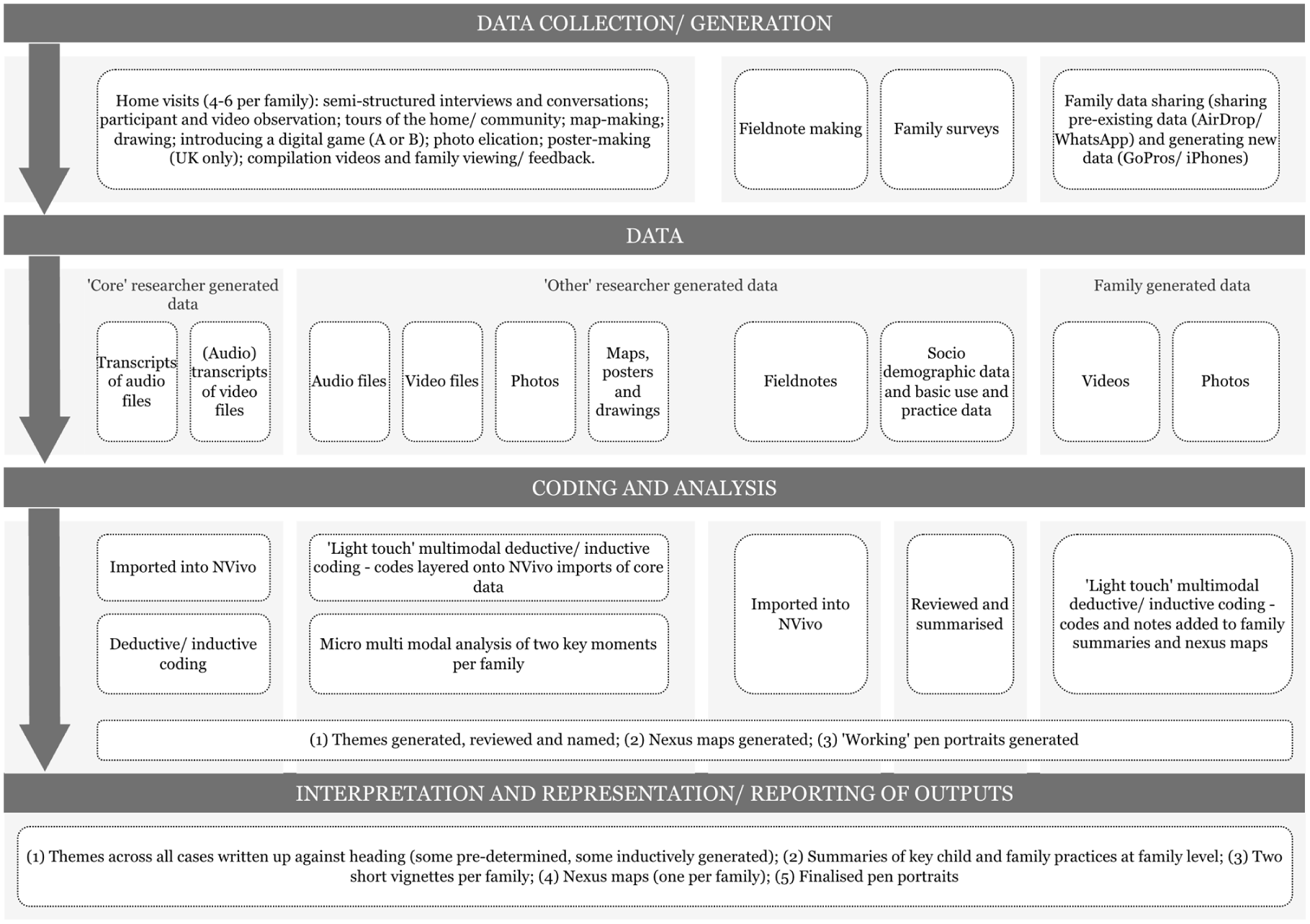
Overview of study approach, data and analysis.
We generated data about both children’s self-led digital play practices and their responses to one of two ‘focus games’ introduced partway through fieldwork. Stage A families were offered World of Goo (a physics-based puzzle game), and Stage B families were offered LEGO Builder’s Journey (a puzzle journey game). Each stage involved 25 families across four countries: the United Kingdom (10), South Africa (5), Australia (5) and Cyprus (5). Specifically, fieldwork was conducted in Sheffield, the Western Cape, the Perth area of Western Australia and various locations around Nicosia and Paphos in Cyprus. The selection of countries was guided by the need to balance contextual diversity with practical feasibility. Existing research networks were used to identify and invite international collaborators with relevant expertise in children’s digital play. Emphasis was placed on including locations that varied culturally, socially and economically, with the recruitment of country-specific research teams to enhance the feasibility and contextual appropriateness of the fieldwork. This reach, which is rare in studies of children’s digital play, supported an ability to crystallise context, in contrast to past work focused on autonomous models and one-size-fits-all approaches. Over 14 months, 240 visits were conducted – six with each UK family and four elsewhere (Figure 2). Research activities mainly focused, naturalistically, on children’s self-led digital play. Children were invited, but not required, to try their ‘focus game’ and were asked about it in subsequent visits. Although many engaged with focus games, some did not continue, and the study maintained attention to self-led digital play.
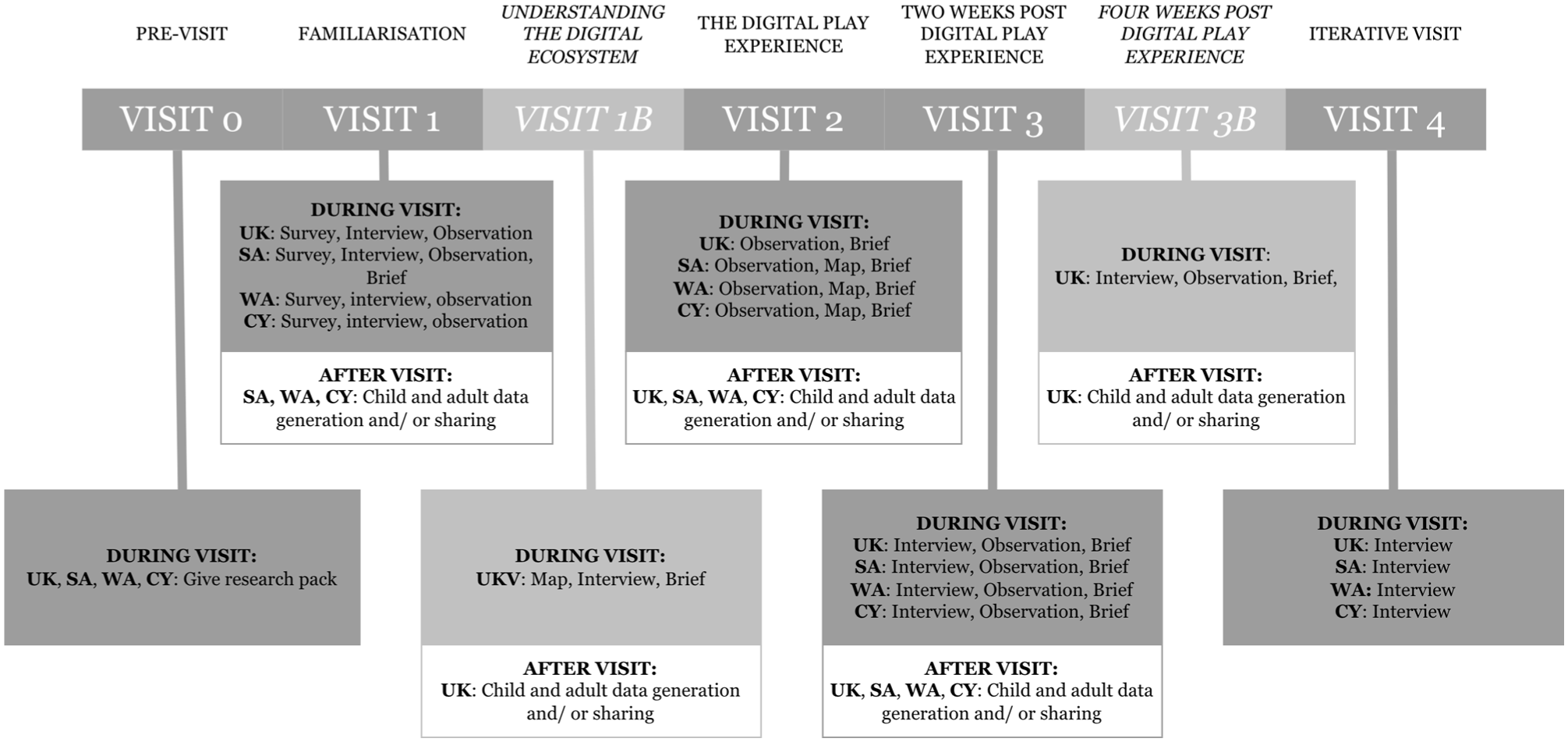
Research visits, timing, data generation and equipment.
While methods were broadly consistent across sites, researchers were encouraged to adapt them to reflect geopolitical differences and sensitivities and individual participant needs. A suggested set of research activities and tools was offered, but researchers were encouraged to change aspects of the methodology as part of ongoing reflexive practice. There were, therefore, particular differences in the approach, research tools and uses of technologies, both between and within countries. For example, in South Africa, families were given iPhones rather than iPads, as the latter were uncommon and risked attracting unwanted attention, therefore making families vulnerable to crime.
Recruitment strategies included outreach via school newsletters, community venues and snowball sampling. We prioritised intersectional diversity – racially, ethnically, linguistically, socioeconomically and in household composition – recruiting children across the full 6–12 age range (mean age: 9.1 years) with an even gender split (24 identifying as girls, 26 as boys). In South Africa, we deliberately cut across stereotyping in our selection, so in the second round, we had a white girl living in poverty (Stiletto Queen, SAF10) raised by her dad and a black boy in a middle-class, affluent setting (Kermit, SAF9). In total, 186 individuals were formal participants, though children’s accounts also referenced non-participating family and friends. A detailed participant overview is provided in the full report (Scott et al., 2024).
The study followed BERA (2018) and AoIR (2019) ethical guidelines, with a commitment to ongoing informed consent. All adult participants received information about the project in written and oral forms, were offered opportunities to ask questions and signed consent forms. In Cyprus, parents signed multiple consent forms as they were required to also sign the Cyprus National Bioethics Committee’s standard consent forms (for their participation and for their child’s). Depending on their age, children participating in the study were provided with either a bespoke, combined information and consent Booklet (6- to 8-year-olds) or a ‘Zine (9- to 12-year-olds). Though children were invited to sign these, children’s ongoing assent to participate in the research activities was judged through frequent invitations to engage (or not) and ongoing attention to bodily and facial expressions of (dis/)comfort (Dockett & Perry, 2011). If children appeared to be tired, then the interviews/video recording schedules were adjusted accordingly. All of the participants in the study have been assigned pseudonyms for the purposes of reporting. A detailed data management plan was devised and followed. In line with European General Data Protection Regulation (GDPR) and the project’s data controller and processor agreements, the lead university set up a secure shared drive for storage of sensitive and protected data. Formal ethical approval was obtained both overall via The University of Sheffield (UK)’s Ethics Review Procedure, as administered by the School of Education, and by local authorised entities in each country. The fieldwork taking place in South Africa was approved through relevant ethics committees at both The Centre for Creative Education (South Africa) and The University of Oulu (Finland). The fieldwork taking place in Australia was approved by through the ethics committee at Curtin University. The fieldwork taking place in Cyprus was approved through both the ethics committee at The University of Cyprus and Cyprus’s National Bioethics Committee. As a gesture of appreciation, families kept the digital device used during fieldwork – an iPad or an iPhone in South Africa. This decision was made to ensure all families could participate regardless of prior device access and to avoid withdrawing equipment that had become integrated into children’s play during the study. The approach was reviewed and approved by all relevant ethics committees and was considered appropriate compensation within the local contexts.
Figure 1 summarises study data and the analytical approach. Data were coded through a combined deductive–inductive process. The primary units of analysis were the accounts and verbal expressions of individual children and their family members and embodied movements, gestures and actions during game episodes and observed play sequences. These were always coded within the context of each child’s broader family and socio-material environment as part of an ongoing, iterative process. Transcripts of researcher-generated audio and video, plus fieldnotes, were imported into NVivo for coding; other data types (original videos, photos, maps and drawings) were coded and analysed in a model of ongoing cross-comparison. Deductive codes drew on a project-specific framework (see Supplementary Materials for the deductive codebook). Inductive codes were generated gradually through close reading across these units of analysis in relation to the deductive coding, with repeated team-based interpretive discussions across United Kingdom and local researchers ensuring reliability and contextual sensitivity. As these discussions progressed, recurring patterns across cases were identified, compared and refined into 11 digital play ‘drivers’, capturing deep interests, needs and desires evident in children’s play. The digital play ‘drivers’ discussed were therefore derived primarily from inductive analyses, though the deductive framework helped the team ‘notice’ patterns in children’s game choices and practices and their intersections with well-being. We observed considerable differences in children’s responses to the focus games. The study’s holistic design enabled interpretation of these responses in relation to each child’s broader play preferences, interests and context. As coding progressed, the team began to identify and theorise digital play ‘drivers’ inductively, cross-checking and applying the new inductive codes across all 50 cases. Illustrative examples of excerpts from the dataset can be found in the Supplementary Material. We have mapped these excerpts alongside some examples of the original deductive codes assigned to them and the additional inductive codes, which contributed to our theorisation of ‘digital play drivers’. Although our analyses are not generalisable, they are offered as transferable (Lincoln and Guba, 1985), supported by rich description and open-access materials, including research tools (Scott et al., 2025), to enable replication or adaptation.
Results
As reported elsewhere (Scott et al., 2024), and echoing established links between play and well-being in adults, our study found that well-designed 3 digital play can support eight aspects of children’s subjective well-being (Figure 3): identities, emotions, creativity, competence, relationships, autonomy, diversity, equity and inclusion and safety and security. However, children’s self-led digital play choices were shaped by intersecting circumstances including family practices, neurodiversity, physical or learning differences, geographies, emotional needs and home–school dynamics. Play was driven by deep interests, needs and desires – ‘digital play drivers’ – themselves entangled with individual and contextual circumstances. Different drivers were dominant for different children during the research. In most cases, several ‘core’ drivers were especially prominent. These are likely to change over time and appear interconnected. For example, the drive to exert and express control was often, but not always, connected with the drive to create. When digital play fulfilled these drivers, aspects of subjective well-being were supported. All 11 contextualised drivers are explained below. In the results presented below, abbreviations are used to denote families in the United Kingdom (‘UKF’), South Africa (‘SAF’), Western Australia (‘WAF’) and Cyprus (‘CYF’).
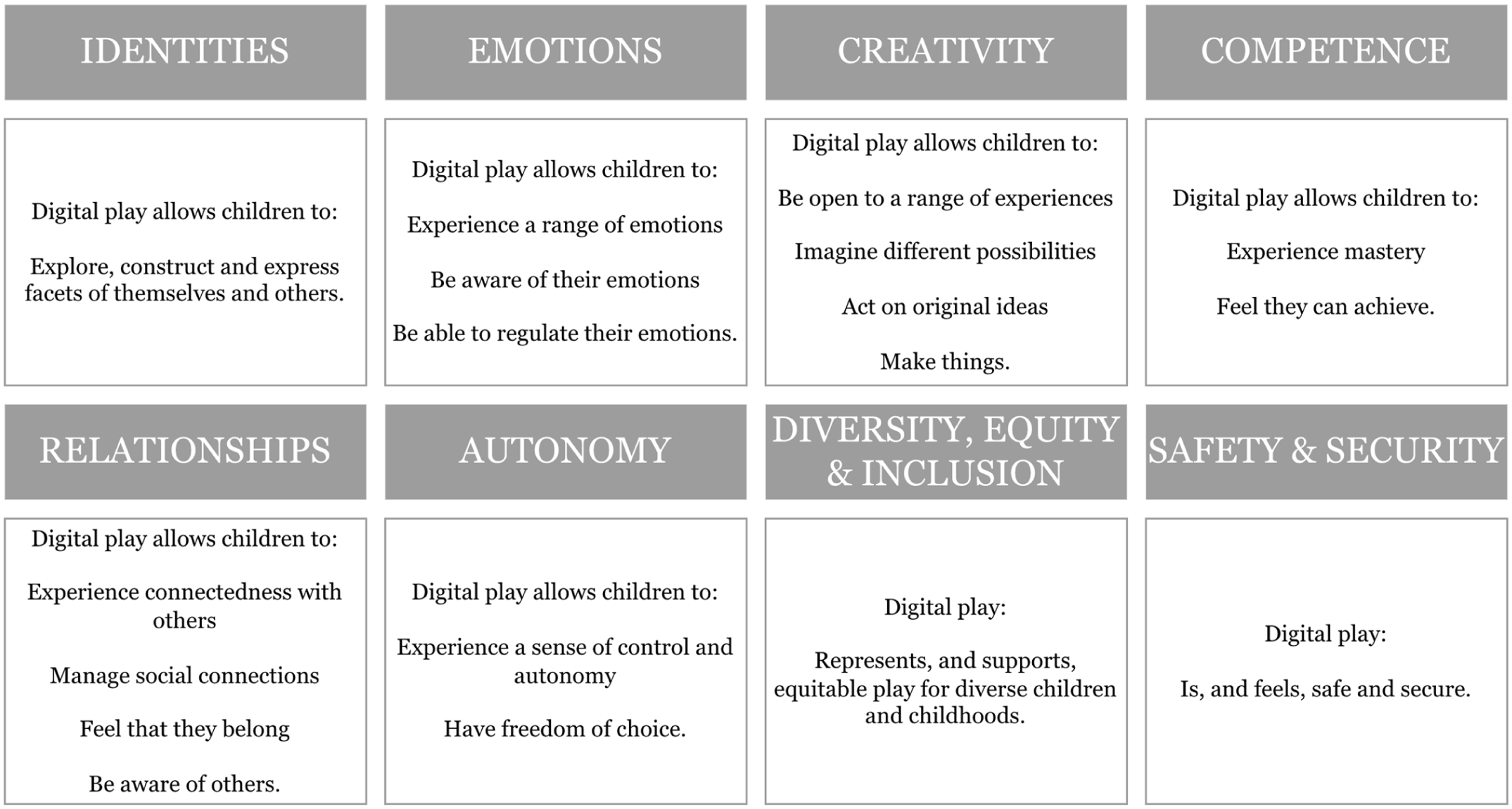
Eight aspects of subjective well-being that well-designed digital play can support.
The drive . . . to exert and express control
Many children’s game choices and practices appeared driven by a desire to experience control, resonating with established motivational accounts of ‘autonomy’ (SDT) and ‘confidence and status’ (U&G) needs. Specific design features afforded this in distinctive ways for some children, for example through avatar customisation, world-building and rule-setting. Ethan (WAF4) favoured Zelda: Tears of the Kingdom for its meaningful choices 4 ; Kudos (WAF10) preferred Minecraft for its open-ended creative building. 5 Children also prioritised control-oriented play, even when other ways to play were supported. Dylan (UKF5) enjoyed avatar customisation across multiple games, including Fortnite. 6 His dad said this was ‘because he can choose’. 7 Pinar (UKF6) valued social control, choosing when, and with whom, to play. 8
When digital play fulfilled this driver, children’s feelings of autonomy and competence were supported. For example, Stiletto Queen (SAF10) said making choices made her feel ‘very, very, very good’.
9
Conversely, Tinotenda (SAF4)’s Mum explained his disappointment with World of Goo as a lack of first-person play: he felt he was not ‘the one achieving these things’.
10
This driver connected with individual and contextual circumstances. For example, it was especially important for children who described experiencing a lack of control in other areas of life. Comparing digital play to difficult school friendships, Penny (UKF1), said:
‘It makes me feel free, finally it makes me feel like I’m just. . . I’m like Charlie [family dog] that’s just been let out of his cage after six hours. Freedom!!’
11
This driver intersected with others, such as togetherness (e.g. Pinar’s choice of play partners) and identity exploration (e.g. Dylan’s customisation play). Such overlaps highlight the drivers not as isolated categories but as interdependent dynamics, reflecting the complexity of children’s digital play and linking back to our broader research questions about well-being.
. . . to collect, curate and classify
Children’s game choices and digital play practices were driven by a desire to relate to, and impose order over, physical and symbolic things with personal meaning, partially intersecting with ‘affective’, ‘confidence and status’, ‘connection’ (U&G), ‘autonomy’ and ‘relatedness’ (SDT) needs, but extending them towards affective attachment and identity expression. Games with strong collecting mechanics, like Adopt Me! or Brawl Stars, afforded some children opportunities to curate symbolic possessions and express competence. Jemima
12
(UKF7), for example, invested years in building her Adopt Me! Collection, reflecting with pride (‘It’s from years of working’
13
) and emotional attachment:
‘I just got a lavender dragon back and that’s made me happy, because I was really sad when I traded my lavender dragon, because I really missed it’.
14
Such collecting practices supported feelings of autonomy, affective satisfaction, identity expression and competence and appeared particularly meaningful for some, in relation to complex individual and contextual circumstances. Jemima, who was experiencing significant personal challenges associated with control, in line with her diagnosis of Pathological Demand Avoidance, described herself as a ‘pushy collector’, 15 emphasising the serious efforts she invested in collecting pets, something she said made her feel ‘happy’. 16
John (CYF5) enjoyed unlocking characters in Brawl Stars and Stumble Guys, 17 echoing his non-digital collectable figures, which supported role-play and identity exploration. 18 For others, collecting practices appeared primarily driven by the drive to exert and express control. For example, Thomas (UKF11) loved unlocking characters with special powers, but this appeared primarily associated with control, as the ‘skins’ gave him more power in Brawl Stars: ‘freedom [. . .] I can do whatever I want’. 19 While parallels with non-digital collecting (e.g. John’s figures) suggest continuity with long-standing childhood practices, digital dimensions afforded particular forms of circulation, classification and affective intensity. The cross-country presence of games like Adopt Me! 20 underscores the status of collecting as a shared aspect of children’s contemporary digital cultures.
. . . to master challenges, including strategic challenges and puzzles
Children played to engage with and persist through challenges, towards mastery. This aligns with ‘competence’, ‘relatedness’ (SDT) ‘cognitive’ (U&G) needs, though here the challenge was often valued intrinsically. Children with this driver sought games requiring them to devise, test and adjust logic-based strategies to solve problems, motivated by the challenge itself. This differs from extrinsic motivations like earning points or progressing through levels, which many children also enjoyed (e.g. Kermit, SAF9 21 and Andriana, CYF6 22 ). Zain (UKF12) enjoyed online chess, 23 while Eshal (SAF1) preferred a word search game. 24 Fulfilling this driver supported feelings of competence and positive feelings about identities and relationships. For example, Romeo (UKF4) described World of Goo as ‘very hard’, but said figuring it out made him ‘happy’. 25 These examples highlight how, for some, challenging puzzle mechanics afforded opportunities to test persistence and feel competent.
The importance of mastering challenges varied depending on individual and contextual circumstances. Some children, highly engaged with academic or extracurricular challenges, such as Harriet (UKF19) 26 and Andriana (CYF6), 27 avoided games with steep challenges, favouring games oriented towards relaxation, humour or social interaction. Digital play appeared to serve as a counterbalance to the challenges in other areas of life.
. . . to acquire and perform knowledge and skills
Children played to acquire and perform personally meaningful knowledge and skills. While this overlaps with ‘the drive to master challenges’, children with this drive set their own goals or markers of esteem. This driver aligns with ‘competence’ (SDT), ‘cognitive’ and ‘connection’ (U&G) needs, but here competence was often tied more clearly to recognition within peer and cultural contexts. For many (e.g. Romeos, CYF9 28 or Dan, SAF7 29 ), this centred on developing football expertise, often through FIFA games. Others pursued different domains of expertise, such as subject knowledge (e.g. Lewis, UKF14 30 and Tinotenda, SAF4 31 ). Some were motivated by in-game rewards (e.g. Marios, CYF2 32 and John, CYF5 33 ), while others appeared driven by outperforming others (e.g. Malik, UKF16 34 ).
When digital play supported this drive, feelings of competence were fostered. For example, Romeos (CYF9) reflected on skill accumulation in FIFA:
‘Because when you play, the first day [. . .] in a week, you’ll get better if you practise [. . .] I’ll feel nice [. . .] Because I have something to get involved in, for a lot of time’.
35
This driver is also related to positive feelings about identities and relationships. Liana (CYF3)’s expert gamer status was important to forming strong bonds within her male friendship group, 36 where she transcended stereotypical gendered identities by playing games like FIFA, Fortnite and WNBA 37 (played because she aspired to become a WNBA player 38 ).
. . . to experience, explore and negotiate togetherness
Children played to safely connect with – and disconnect from – people, animals, communities and environments. This extends past notions of ‘relatedness’ (SDT) and ‘connection’ (U&G) needs, highlighting not only the need for connection, but also for disconnection and transgression. Children motivated by togetherness sought games with multiplayer or collaborative features: Minecraft and Roblox for George (WAF1) 39 and Fortnite for Henry (UKF9). 40 Togetherness was not limited to conventional multiplayer play. For example, Mount (SAF6) connected with his Dad and church community through Fantasy Football, taking turns on the same device. 41 Dan (SAF7) connected with his neighbours across the road through digital play because it was not safe to walk to them. 42 For Ethan (WAF4), shared enthusiasm around Zelda: Tears of the Kingdom generated connection through talk, even without co-play: ‘it’s something we can all talk to each other about’. 43 Some children, valuing togetherness, let others choose what to play for altruistic reasons (e.g. Logan, UKF8 44 ). Anna (SAF3), meanwhile, usually played with her cat, budgies and hamster nearby. 45
One iteration of this driver was social disconnection. For Hailey (UKF13), play offered a vital solo space apart from school and family conflicts: ‘there’s a lot going on and I need to rest my mind [. . .] I focus on the game and not anything else’. 46 Similarly, Taj (WAF9) valued time alone. 47 This driver appeared especially important for some. Pinar (UKF6) found school social interactions ‘confusing and quite mean’. 48 Minecraft offered a way to engage socially on her own terms. 49 When digital play fulfilled this driver, positive experiences of relationships, positive affective states and feelings of autonomy were supported, underscoring the nuanced ways digital play can support children’s needs to connect and disconnect.
. . . to empathise, tend and nurture
Children played to understand, care for and attend to others – people, animals, communities and environments. This resonates with ‘relatedness’ (SDT), ‘affective’ and ‘connection’ (U&G) needs, but extends them by emphasising empathy, caring and relational responsibility as important components of digital play. Many engaged in play practices linked to empathy, nurture and caring for imagined others, which were sometimes supported by role-play and caring mechanics. Anna (SAF3) chose a hotel role-play game centred on caring roles, which she described maternally: ‘it’s like you are the Mom of them’. 50 Others focused on taking care of animals or nature, such as Ria (WAF7) in Cat Snack Bar, 51 Jane (WAF8) tending to crops and animals in Pocket Build 52 and Ariadne (CYF1) caring for animals in Baby Panda: Dental Care. 53 Some prioritised others’ well-being through their play choices. Adaobi (UKF2) 54 and Kermit (SAF9) 55 selected games preferred by younger family members to actively support them. Talking about her younger step-brother, Aaliyah (UKF15) explained: ‘he picks a game and we just play it [. . .] I just don’t want him playing by himself all the time’. 56
When digital play experiences fulfilled this driver, relationships, emotions and identities were supported. Hailey (UKF13) emphasised endearing traits when caring for horses in Zelda: Breath of the Wild: ‘they’re just really sweet. Every time I take them to a village they go straight into the carrot patch’. 57 Nurture-driven play appeared particularly important for some. For example, Annie (UKF17), often taught by her older brother, particularly enjoyed adopting the opposite role 58 in supporting younger children’s play.
. . . to understand and meet one’s own emotional needs
Children’s digital play was driven by a need to identify, understand and regulate their own emotions, either independently or with support. This aligns partially with ‘affective’ and ‘escapism’ needs (U&G), but foregrounds the relational and contextual factors shaping emotional awareness and regulation. Children often choose games to meet emotional needs such as relaxation, stress relief or comfort. Tinotenda (SAF4) said he sometimes chose a ‘stress game’ like ‘Kick the Buddy’ to relieve stress. 59 Notably, Tinotenda’s choices were also associated with broader factors – he played games such as this one because he couldn’t afford any paid games, and this one was free. 60
This driver appeared to be particularly important for some children, in relation to individual and contextual circumstances. For example, Jane (WAF8) used Goat Simulator to calm herself after experiencing bullying: ‘I just go headbutt a tree or something’. 61 When digital play fulfilled this driver, positive affective states and a sense of emotional safety were supported. As Jane noted, ‘it makes me feel happy inside’. 62 The varying importance of this driver emphasises the ways in which digital play can serve as both a coping strategy and a contextually embedded space for self-regulation. Children appeared to seek out a range of design features to fulfil this driver, but particularly those supporting sensory experiences.
. . . for sensory stimulation and exploration, including emotion, humour and bodily movement
Children played to experience a broad range of emotions (both ‘positive’ and ‘negative’), sensory experiences, humour and bodily movement. Despite some overlap, we retained two distinct drivers in our framework: one focused on recovery from undesired emotional states and one on the active pursuit of sensory, emotional or physical stimulation. This driver extends ‘affective’ and ‘escapism’ needs (U&G) by foregrounding more visceral dimensions of affect (c.f. Scott et al., 2023b). Children sought games with mechanics supportive of specific affective or sensory states. Children played for joy, excitement and pleasure, but also pursued experiences of fear and risk, affective states typically considered ‘negative’. Kudos (WAF10) chose horror game, Granny, 63 while Penny (UKF1) played The Mimic and Piggy, recalling: ‘I was literally shaking, I could barely stand up [. . .] the piggy kept chasing me and I had like 16 seconds left to get to his doorʼ. 64
Others sought physical stimulation, like Elly (WAF2), who enjoyed games in Wii Sports Resort, 65 or flow states, like Kudos, who described Minecraft as a place to focus and relax: ‘you just relax and just build anything you wantʼ. 66 Game design features – such as multiplayer pacing, time pressure, motion controls and immersive environments – afforded particular sensory and affective states for some children. Fulfilment of this driver supported positive affective states. While all children are likely to be driven by a desire to experience sensory and affective states, it appeared particularly important for some. For instance, Elly (WAF2), recently diagnosed with attention-deficit/hyperactivity disorder (ADHD) and dyslexia, found that the physicality of Wii Sports Resort helped her maintain focus in ways school did not. 67
. . . to create
Children’s digital play was driven by a desire to actively contribute to the world, drawing on resources and experiences to generate something new. The drive to create is not well accounted for in existing models, but could be understood as inflected across multiple past ‘needs’, such as ‘autonomy’ and ‘competence’ (SDT). Children sought out games with design features particularly supportive of creation, such as drawing apps (Pinar, UKF6) 68 and GarageBand (Nkosinathi, SAF2). 69 They also played open-ended games in ways that prioritised creativity. Ollie (UKF18) created both an underwater roller coaster 70 and a ʻMansion Dog Houseʼ 71 in Minecraft, while Stiletto Queen (SAF10) engaged in significant space and avatar customisation and creation in games like Avakin Life and The Sims. 72 Others, such as Sally (CYF10), played creatively by generating ideas for her bedroom through platforms like Pinterest, 73 rather than digital games per se. When digital play experiences fulfilled children’s drive to create, feelings of autonomy, positive affect, positive feelings about identities and, of course, creativity were supported. This driver was closely connected with the drives to: exert and express control; and explore, construct and express identities.
. . . to explore, construct and express identities
Children played to safely explore, construct and express aspects of their evolving personal and collective identities. Aligning closely with identity-focused perspectives (e.g. FOI), it is not well accounted for in psychological motivation models (SDT; U&G). This driver is a notable extension to these models, foregrounding digital play as an important context for experimenting with evolving identities. Children sought games that supported role-play, customisation and creation. Ariadne (CYF1) favoured games that supported experimentation with physical identity, such as nail painting and panda dress-up simulation games. 74 Others used open-ended games for identity exploration. Willow (UKF10) used The Sims to imagine future versions of herself, creating an avatar with long blonde hair and becoming a vet: ‘you can make your ideal career and how you want to look when youʼre older, so you can pretend to live that life’. 75
This drive appeared especially important for some children in relation to individual and contextual circumstances. Penny (UKF1) was beginning to explore more ‘grown up’ identities and interests like cooking and paying attention to appearance. 76 While she expressed uncertainty and self-criticism in her offline life, 77 Roblox games like Brookhaven provided safer spaces to try out emerging identities. 78 When digital play fulfilled this drive, it supported feelings of autonomy, creativity and positive feelings about identities. Penny’s identity play in Brookhaven seemed particularly important for supporting feelings of autonomy and confidence in her evolving selfhood.
. . . to explore deep interests
Finally, children played to pursue personally meaningful interests (Chesworth and Hedges, 2024) and passions, including within and through their digital play. This somewhat aligns with U&G’s ‘cognitive’ needs, but places greater emphasis on the depth, continuity and context-dependence of children’s engagements with subjects and activities that matter to them. Children tended to seek out games that fulfilled specific deep interests, for example football games including FIFA, Soccer Champs and Fantasy Football League for football fans Romeos (CYF9), 79 Mount (SAF6) 80 and Dan (SAF7). 81 This driver affected how children played games. For example, Aaliyah (UKF15) and her mum both decided not to use walkthroughs to help them complete levels of games like Adventure Escape Mysteries, 82 because they were driven by a shared passion for mysteries, which spanned across contexts, for example to playing the board game, Cluedo. When digital play fulfilled this driver, positive feelings about individual and collective identities and feelings of competence emerged. Aaliyah’s mystery play supported a sense of close collective identity with her Mum. This driver appeared to be universally important, although the deep interests in question were different for different children.
Digital play drivers and children’s responses to ‘focus games’
The study explored children’s digital play choices and practices and their responses to one of two introduced puzzle-based games: World of Goo (WoG) or LEGO Builder’s Journey (LBJ). Children were encouraged, but not required, to engage with their assigned ‘focus game’. Both games emphasised logic and strategy, without open-ended elements or customisation. Findings revealed that (a) children responded variably to the same games and design features, and (b) their digital play drivers influenced those responses. Specific features supported well-being variably. For instance, skipping levels promoted competence for some but felt like failure to others. WoG’s multiple puzzle-solving options encouraged creativity for some, but others found it too rigid. Initial reactions to the focus games often differed from longer-term responses, with children demonstrating complex, varied play trajectories.
The cases of Penny (UKF1) and Ollie (UKF18) exemplify these dynamics. For nearly half the children who played WoG, the game supported well-being, particularly by fostering competence. However, more than half did not report such benefits and many of those held markedly different digital play drivers. Penny initially described WoG as ‘really fun’ 83 but later stopped playing, explaining, ‘it’s not really like my type of game [. . .] I like role-play games’ 84 and describing it as ‘stressful’. 85 Though initially intrigued by the challenge, Penny’s later reflections suggest WoG’s design did not align with her key digital play drivers – namely, the desire to exert control, seek sensory stimulation and explore identities. Similarly, Anna (SAF3) did not find that World of Goo connected with her in-the-flesh passions, noting how she liked the unexpected nature of physical cartwheels as opposed to the predictability of virtual bodies moving in games. 86
LBJ, meanwhile, supported well-being for just over half the children who played it, mostly by fostering competence. Ollie initially became frustrated: ‘I hate this game [. . .] I don’t even want to do it’. 87 Although he had spent little time with it by the next visit (2 weeks later), he later revealed he had returned to the game, ultimately completing it using various strategies. 88 In the end, LBJ appeared to align with Ollie’s digital play drivers, particularly his motivation to master challenges.
Discussion
Empirical contributions
Most research exploring why individuals engage with digital media and how that relates to what they get out of it has centred on adults and adolescents. While Katz et al.’s (1973b) influential U&G model acknowledges that complex circumstances mediate media effects, few studies have explored what those circumstances are and how they matter, especially for children. Our international study provides a rare in-depth examination of how children’s digital play choices, practices, motivations, well-being and diverse individual and contextual circumstances coalesce, showing that choices and practices are influenced by multiple, intersecting individual and contextual circumstances, such as family and peer dynamics and practices and geopolitical and socio-economic factors such as not having access to data, or living in spaces where children can only safely play inside a house or compound. For example, Tinotenda (SAF4) finished World of Goo quickly but couldn’t pay for the follow-up to the game. These choices and practices can be understood as associated with ‘digital play drivers’ – deep interests, needs and desires – themselves complexly intertwined with individual and contextual circumstances. Echoing studies with adults, we found that self-chosen and introduced digital play experiences fulfilling these drivers generally supported children’s subjective well-being. Games that didn’t fulfil a child’s digital play drivers did not, even when the same games and design features supported well-being for others. Children’s initial responses to focus games often differed from longer-term responses. These are substantial empirical contributions, given the limited research focused on this important aspect of children’s lives.
Theoretical contributions
Our framework for understanding the role of digital play in supporting, or failing to support, children’s subjective well-being in diverse contexts was inductively developed, emerging from empirical data, yet grounded in dialogue with existing motivational and socio-cultural theories. Hence, the study makes a theory-building contribution, aligning with qualitative inquiry traditions. We began with wanting to understand the role of digital play in supporting – or failing to support – children’s subjective well-being in diverse contexts (RQ3). Having noticed that some digital play experiences appeared to support certain dimensions of well-being for some children but not others, we wanted to understand how individual and contextual circumstances appeared to connect with children’s self-directed digital play choices and practices (RQ1) and, ultimately, their well-being. In theorising the concept of digital play drivers (RQ2), based on the empirical data, and in reference to previous theorisations of motivation, we began to understand how and why some digital play experiences appeared to support certain dimensions of well-being for some children but not others. Our study extends existing theory. U&G approaches support a consideration of why specific game design features might support well-being trajectories differentially for different children. However, our framework moves beyond rational, individualised models of choice, connecting complex individual and contextual circumstances with ‘drivers’. Unlike previous studies that apply existing frameworks to new contexts, our study derived its conceptual contribution from extensive qualitative work specific to children’s digital gameplay. We do not present ‘drivers’ as objective measures. Following Scott et al. (2023b), a digital play driver refers to a child’s own account and/or an adult’s interpretation of observed behaviours and accounts of the deep interests and needs fulfilled by digital play. These are not innate or purely individual; rather, they are shaped in a complex interplay of circumstances and cannot be understood in isolation. Sustained, ethnographically informed inquiry was vital. Following Alper et al.’s (2016) comments, we intentionally resisted generalisations and deficit approaches, taking an intersectional, assets-based approach to understanding complexity in children’s digital lives. Context was understood in each case in terms of a web of multiple, intersecting influences. In adopting this approach, we do not intend to ignore vitally important differences in children’s lives, such as the critical difference between the Global North and South in terms of equitable access to digital play resources. However, rather than generalising about how broad factors such as cultural or socio-economic differences relate to drivers, the results section provides examples of how specific individual and contextual circumstances, such as emotional and learning needs and the critical differences between the North and South in terms of access to digital play resources, relate to specific drivers in the lives of individual children in the present study. Our approach builds on recent work in critiquing entirely adult- or language-centric approaches. The 11 contextualised drivers are visualised in Figure 4. Although developed in response to a scarcity of similar work in the study of children’s play, the framework holds potential for application across the lifespan.
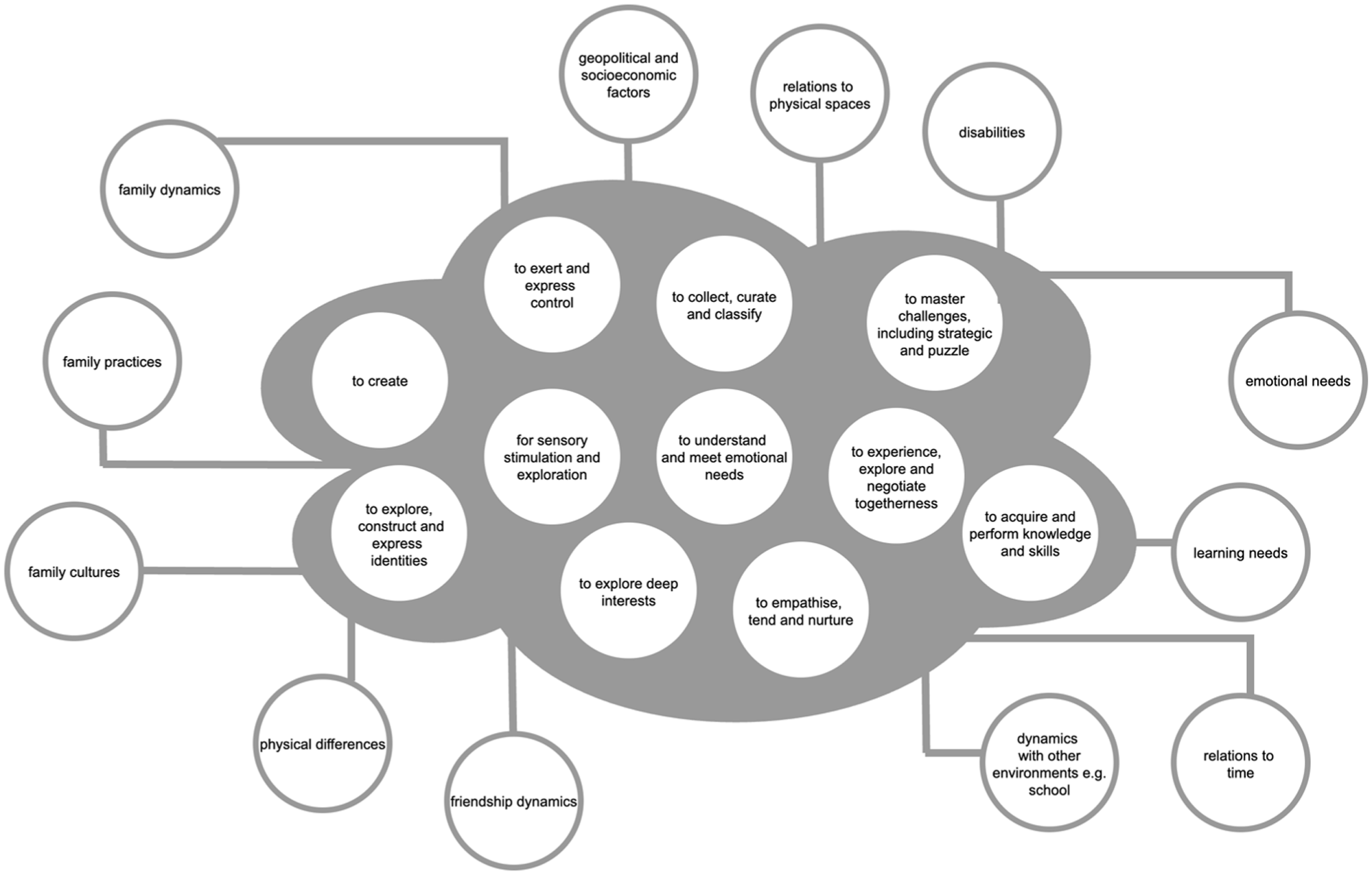
Eleven contextualised drivers of children’s digital play.
Figure 5 maps the drivers against existing models. Some align loosely with previous typologies. For instance, the drive to exert and express control links with SDT’s concept of autonomy (Deci and Ryan, 1985) and Katz et al.’s (1973b) category of confidence and status. Other drivers transcend previous models, offering novel contributions. The drive to collect, curate and classify partially intersects several previous ‘needs’. ‘Togetherness’ extends U&G’s category of ‘connections with others’, highlighting not just the need for connection, but also for disconnection and transgression. Similarly, the drives to create and to explore identities are not well accounted for in existing models, but could be understood as inflected across multiple past ‘needs’. The drive to explore deep interests somewhat aligns with U&G’s cognitive needs, but places greater emphasis on deeper understandings of childrenʼs interests in relation to their participation in socio-cultural practices, identity construction and fundamental enquiries about themselves and their worlds.
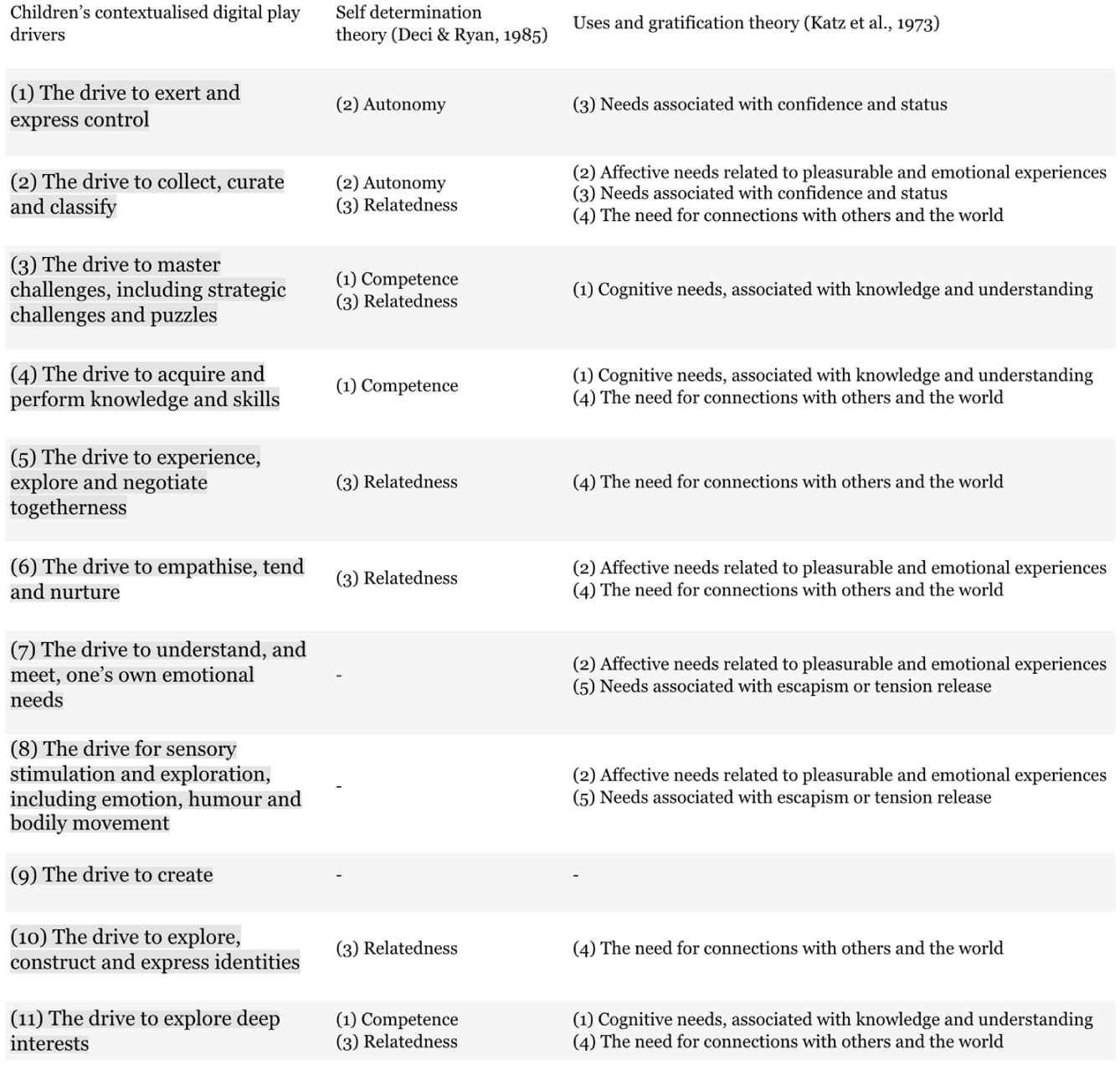
Mapping of children’s digital play drivers and past models of motivation.
Though our study attended to children and primarily to their play with digital and video games, the framework may have broader applicability to other aspects of children’s digital play and experiences, and to the study of aspects of adults’ digital play. For example, the theorisation of contextualised digital play drivers could complement work such as Balanzategui’s (2023) study on ‘disturbing’ children’s YouTube genres, offering a perspective on why children engage with such content and how the ‘why’ may relate to children’s well-being. Our theorisation also resonates with the accounts of some adult accounts, in Orme’s (2022) study, of the reasons they choose to spectate in, rather than play, video games.
Limitations
First, we offer our analyses and findings as transferable, but not generalisable, given that they are context-specific, rather than systematically comparable across countries. As this article focused on theorising the concept of digital play drivers, findings are presented as indicative insights into how digital play drivers are exhibited within and across diverse settings. Future work could expand the sample size and scope of the analysis to systematically make comparisons within and across contexts. Second, our study focused on home contexts, as the primary spaces where children engage in digital play. It would be useful for future work to consider how the identified drivers might vary depending on the social settings in which children engage in digital play, such as in school or third spaces. Finally, the study’s participants were largely situated in urban areas, and further work could usefully investigate similar topics in rural areas.
Implications for the game design industry
For game designers, the notion of ‘designing well’ for children’s well-being requires reflection. Two aspects of well-being identified in the framework are universally essential: good digital play experiences must always be designed to support children’s representation and equitable play, safety and security. It is important to emphasise that most games are not representative of brown or black bodies, nor their environmental and cultural markers, as highlighted in Kermit’s (SAF9) comments of the default (‘noob’) skins in Fortnite: ‘there’s another one that has the same hair as me [. . .] I’m not a girl that has blue eyes and has, like, peach hair and it’s like. . . it’s not the same as mine’. The remaining six well-being dimensions cannot be universally met in a single game for all children and often conflict. Many studies of adult gamers focus narrowly on ‘core gamers’ (Scharkow et al., 2015); often, competitive male players pursue action or shooter genres to meet competence needs. Beyond and within this group, many players pursue a wide range of games and modes of play that meet varied interests and needs. Using UNICEF Innocenti’s. ‘RITEC-8’. framework (2024), the games industry can better design for children’s well-being. However, an important approach within this would be to intentionally design with particular digital play drivers – and particular groups of children – in mind. Large-scale player data may reveal broad trends, for example that cooperative play supports social well-being, but a drivers-based lens makes explicit the ways in which the polar opposite may be true for sizable cohorts of children. For children like Hailey (UKF13), who experienced social overwhelm and conflict in school, solo digital play was a lifeline for well-being, associated with the opportunity to actively disconnect. Ethically oriented designers may design features to support a particular aspect of children’s well-being, but cannot expect, or claim, that their product will do so universally. At the level of policy and regulation for the games industry, it is clear that, to support the digital play needs of all children, a diverse range of carefully designed games must proliferate.
Implications for families and educators
Our findings have significant implications for families and educational practices. Digital play is more than a leisure activity, with the potential to contribute to children’s well-being across multiple dimensions. Our study emphasises the broader well-being benefits of children’s digital play, but also that these might look very different for different children. The findings thus present an invitation to families and educators to value the possible benefits of children’s digital play differently and differentially. It is often advised that certain, high-quality games, such as Minecraft, hold greater benefits for children than others, universally. While there is important evidence that particular games are associated with particular benefits for children, our findings emphasise that, rather than basing judgements about the value of children’s digital play on the nature and design features of games alone, it is important that families and educators also consider what appears to ‘drive’ the digital play choices and practices of individual children and, relatedly, what they appear to ‘get out of’ this play. One practical example of how educators might respond to this implication is through work to better understand and harness children’s deep interests and digital funds of knowledge and identity in the classroom, presenting opportunities for educators to draw on children’s cultural resources in formal education. Another example is how, in embracing rather than fearing children’s digital play passions, educators may find that knotty issues and debates associated with digital play are naturally surfaced as opportunities for children, when appropriately supported, to develop critical awareness of digital media, as described in Wohlwend’s (2015) account.
Implications for policymakers
Education policymakers might use the idea of contextualised play drivers to shape digital literacy and well-being frameworks that move beyond simplistic distinctions between ‘good’ and ‘bad’ games, recognising digital play as a site of self-expression, identity and social connection. For policymakers more broadly, our theorisation of the contextualised drivers of children’s digital play emphasises that ‘objective’ well-being metrics alone (for example, which games they play, on which platforms, for how long) are insufficient for understanding and measuring children’s well-being in – and in relation to – digital environments. The relationship between objective and subjective measures of children’s well-being is mediated by contextualised digital play drivers. The ways in which digital play activities impact on children’s well-being depend on why they do them – something which cannot be divorced from the broader social, cultural and material contexts within which such activities take place.
Methodological insights
The study contributes methodologically by highlighting the value of combining naturalistic home research with the introduction of ‘focus games’. This approach uncovered differences between children’s initial and sustained responses to digital games – subtleties likely to be missed in lab-based or short-term studies. Indeed, many important findings were associated with embodied, relational and affective dimensions of children’s play, subtle and often ephemeral phenomena, attunement to which requires both close attention to video data and ongoing revisiting of broader, more holistic child and family data. This methodological combination holds promise for future research. The cross-national collaboration was also important in helping the team notice how, despite the prevalence of particular games and associated play practices across countries, multiple, intersecting individual and contextual circumstances, including the geopolitical and socio-economic, still matter in shaping children’s play choices and practices. Given the study’s findings, future work should continue to explore how individual and contextual circumstances mediate the relationship between digital play and well-being. However, it is essential to resist blanket assumptions about certain ‘types’ of children or contexts. Such generalisations risk erasing the diverse, interwoven circumstances that shape digital play.
To conclude, children’s needs and interests are dynamic, contextual and change as they grow and as individual children engage in different games, with direct implications for the games they choose, how they play and how those experiences relate to well-being. The digital play drivers framework provides a compelling, though necessarily situated, lens for thinking and talking about diversity in children’s digital play and well-being.
Supplemental Material
sj-docx-1-nms-10.1177_14614448251406245 – Supplemental material for ‘I just go headbutt a tree or something’: Children’s contextualised digital play drivers and subjective well-being in the United Kingdom, South Africa, Australia and Cyprus
Supplemental material, sj-docx-1-nms-10.1177_14614448251406245 for ‘I just go headbutt a tree or something’: Children’s contextualised digital play drivers and subjective well-being in the United Kingdom, South Africa, Australia and Cyprus by Fiona Scott, Liz Chesworth, Stavroula Kontovourki, Karen Murcia, Karin Murris, Kim Balnaves, Cath Bannister, Anna Maria Christofi, Daniel Kuria, Kwakwadi Maditsi, Soern Finn Menning, Theoni Neokleous, Joanne Peers, Shabana Roscoe, Vanessa Samuels, Carole Scott, Giovanna Caetano-Silva, Anastasia Tsoukka, Yao Wang, Nadia Woodward and Cat Trzebiatowski in New Media & Society
Supplemental Material
sj-pdf-3-nms-10.1177_14614448251406245 – Supplemental material for ‘I just go headbutt a tree or something’: Children’s contextualised digital play drivers and subjective well-being in the United Kingdom, South Africa, Australia and Cyprus
Supplemental material, sj-pdf-3-nms-10.1177_14614448251406245 for ‘I just go headbutt a tree or something’: Children’s contextualised digital play drivers and subjective well-being in the United Kingdom, South Africa, Australia and Cyprus by Fiona Scott, Liz Chesworth, Stavroula Kontovourki, Karen Murcia, Karin Murris, Kim Balnaves, Cath Bannister, Anna Maria Christofi, Daniel Kuria, Kwakwadi Maditsi, Soern Finn Menning, Theoni Neokleous, Joanne Peers, Shabana Roscoe, Vanessa Samuels, Carole Scott, Giovanna Caetano-Silva, Anastasia Tsoukka, Yao Wang, Nadia Woodward and Cat Trzebiatowski in New Media & Society
Supplemental Material
sj-png-2-nms-10.1177_14614448251406245 – Supplemental material for ‘I just go headbutt a tree or something’: Children’s contextualised digital play drivers and subjective well-being in the United Kingdom, South Africa, Australia and Cyprus
Supplemental material, sj-png-2-nms-10.1177_14614448251406245 for ‘I just go headbutt a tree or something’: Children’s contextualised digital play drivers and subjective well-being in the United Kingdom, South Africa, Australia and Cyprus by Fiona Scott, Liz Chesworth, Stavroula Kontovourki, Karen Murcia, Karin Murris, Kim Balnaves, Cath Bannister, Anna Maria Christofi, Daniel Kuria, Kwakwadi Maditsi, Soern Finn Menning, Theoni Neokleous, Joanne Peers, Shabana Roscoe, Vanessa Samuels, Carole Scott, Giovanna Caetano-Silva, Anastasia Tsoukka, Yao Wang, Nadia Woodward and Cat Trzebiatowski in New Media & Society
Footnotes
Acknowledgements
First and foremost, we would like to thank the children and families who gave their time, attention and sustained thinking as participants in the research. This research was produced as part of the Responsible Innovation in Technology for Children (RITEC) project. This project was co-founded with the LEGO Group and funded by the LEGO Foundation. We would like to thank the LEGO Group and the LEGO Foundation for their support. We would also like to thank and acknowledge the support of University Librarian, Matt Cooper, at The University of Sheffield, for his support with our literature search.
Author contributions
Fiona Scott was the projectʼs Principal Investigator and a Researcher within the project. She provided leadership and oversight of the design, conduct, analysis and reporting of the research across the four countries, as well as undertaking fieldwork with families in the United Kingdom. Fiona led the writing of the present article.
Liz Chesworth was a Co-Investigator and Researcher within the project. She contributed to leadership and oversight of the design, conduct, analysis and reporting of the research across the four countries, as well as undertaking fieldwork with families in the United Kingdom. Liz contributed to team-based interpretive discussions and analysis that informed the article’s findings and supported the writing of the present article.
Stavroula Kontovourki was a Co-Investigator within the project. She led the case studies in Cyprus. Stavroula contributed to team-based interpretive discussions and analysis that informed the article’s findings and provided feedback on the first draft.
Karen Murcia was a Co-Investigator within the project. She led the case studies in Australia. Karen contributed to team-based interpretive discussions and analysis that informed the article’s findings and provided feedback on the first draft.
Karin Murris was a Co-Investigator and Researcher within the project. She led the research in South Africa, including data analysis and undertaking fieldwork with families in South Africa. Karin contributed to team-based interpretive discussions and analysis that informed the article’s findings and provided feedback on the first draft.
Kim Balnaves was a Researcher within the project. She played an important role in conducting fieldwork in Australia and has contributed to the analysis of Australian data. Kim contributed to team-based interpretive discussions and analysis that informed the article’s findings and provided feedback on the first draft.
Cath Bannister was a Researcher within the project. She played an important role in conducting fieldwork in the United Kingdom and in the analysis of UK data. Cath contributed to team-based interpretive discussions and analysis that informed the article’s findings and provided feedback on the first draft.
Anna Maria Christofi was a Researcher within the project. She played an important role in conducting fieldwork with families in Cyprus. Anna Maria contributed to team-based interpretive discussions and analysis that informed the article’s findings and provided feedback on the first draft.
Daniel Kuria was a Researcher within the project. He played an important role in conducting fieldwork in the United Kingdom and in the analysis of a range of data across multiple countries. Daniel contributed to team-based interpretive discussions and analysis that informed the article’s findings and provided feedback on the first draft.
Kwakwadi Maditsi was a Researcher within the project. She played an important role in conducting fieldwork in South Africa and in the analysis of South African data. Kwakwadi contributed to team-based interpretive discussions and analysis that informed the article’s findings and provided feedback on the first draft.
Soern Finn Menning was a Research Volunteer in the project. He played an important role in videography as part of the South African data collection and has contributed to the analysis of the South African data. Soern contributed to team-based interpretive discussions and analysis that informed the article’s findings.
Theoni Neokleous was a Researcher within the project; she has been involved in all aspects of data collection, analysis and writing in relation to the Cypriot case studies. Theoni contributed to team-based interpretive discussions and analysis that informed the article’s findings and provided feedback on the first draft.
Joanne Peers was a Researcher and Research Coordinator within the project. She played a key role in data management, conducting and coordinating the fieldwork in South Africa and data analysis. Joanne contributed to team-based interpretive discussions and analysis that informed the article’s findings and provided feedback on the first draft.
Shabana Roscoe was a Researcher within the project. She played an important role in conducting fieldwork in the United Kingdom and in the analysis of a range of data across multiple countries. Shabana contributed to team-based interpretive discussions and analysis that informed the article’s findings and provided feedback on the first draft.
Vanessa Samuels was a Researcher within the project. She played an important role in conducting fieldwork in South Africa and in the analysis of South African data. Vanessa contributed to team-based interpretive discussions and analysis that informed the article’s findings and provided feedback on the first draft.
Carole Scott was a Researcher within the project. She played an important role in conducting fieldwork in South Africa and in the analysis of South African data. Carole contributed to team-based interpretive discussions and analysis that informed the article’s findings and provided feedback on the first draft.
Giovanna Caetano-Silva was a Research Volunteer in the project. She has contributed to the analysis of the South African data. Giovanna contributed to team-based interpretive discussions and analysis that informed the article’s findings and provided feedback on the first draft.
Anastasia Tsoukka was a Researcher within the project. She played an important role in conducting fieldwork with families in Cyprus. Anastasia contributed to team-based interpretive discussions and analysis that informed the article’s findings and provided feedback on the first draft.
Yao Wang was a Researcher within the project. She played an important role in conducting fieldwork in the United Kingdom and in the analysis of a range of data across multiple countries. Yao contributed to team-based interpretive discussions and analysis that informed the article’s findings and provided feedback on the first draft.
Nadia Woodward was a Researcher within the project. She played an important role in conducting fieldwork in South Africa and in the analysis of South African data. Nadia contributed to team-based interpretive discussions and analysis that informed the article’s findings and provided feedback on the first draft.
Cat Trzebiatowski was the project’s Research Administrator. She has played a central role in supporting all aspects of the projectʼs everyday running across four countries.
Funding
The authors disclosed receipt of the following financial support for the research, authorship and/or publication of this article: The research was funded by the LEGO Foundation.
Ethical approval and informed consent statements
Ethical issues were addressed throughout the study, in line with the British Educational Research Associationʼs Ethical Guidelines for Educational Research (Fourth Edition, 2018), the Association of Internet Researchersʼ Internet Research Ethical Guidelines (Version 3.0, 2019) and the particular research ethics regulations of all universities involved. The overall project was ethically approved in line with The University of Sheffield’s ethics application system (reference number 044273). For research conducted beyond the United Kingdom, each local lead also received ethical approval from the relevant contracted institutions. For the research conducted in Cyprus, this was from the University of Cyprus and the CY National Bioethics Committee. For the research in Australia, this was Curtin University. For the research in South Africa, this was the University of Oulu (Finland) and the Centre for Creative Education (South Africa).
Adults participating in the study read an information sheet and signed a consent form. In Cyprus, parents signed multiple consent forms as they were required to also sign the CY National Bioethics Committee’s standard consent forms (for their participation and for their child’s). Depending on their age, children participating in the study were provided with either a bespoke, combined information and consent Booklet (6- to 8-year-olds) or ʻZine (9- to 12-year-olds). Though children were invited to sign these, childrenʼs ongoing assent to participate in the research activities was judged through frequent invitations to engage (or not) and ongoing attention to bodily and facial expressions of (dis/)comfort (Dockett & Perry, 2011). If children appeared to be tired, then the interviews/video recording schedules were adjusted accordingly. All of the participants in the study have been assigned pseudonyms for the purposes of reporting.
Our submission does not contain any data from an individual person (including individual details, images or videos).
Data availability statement
We are in the process of making anonymised transcripts available via ORDA. The suggested set of research activities and tools is currently available on ORDA:
Scott, F., Chesworth, L., Kontovourki, S., Murcia, K., Murris, K., Balnaves, K., Bannister, C., Christofi, A. M., Kuria, D., Maditsi, K., Menning, S. F., Neokleous, T., Peers, J., Roscoe, S., Samuels, V., Scott, C., Caetano-Silva, G., Tsoukka, A., Wang, Y., Woodward, N. and Hartley, C. (2025). Suggested set of research activities and tools for the RITEC (Children’s Digital Play and Well-being) research project. The University of Sheffield. Dataset.  .
.
ORCID iDs
Supplemental material
Supplemental material for this article is available online.
Notes
Author biographies
References
Supplementary Material
Please find the following supplemental material available below.
For Open Access articles published under a Creative Commons License, all supplemental material carries the same license as the article it is associated with.
For non-Open Access articles published, all supplemental material carries a non-exclusive license, and permission requests for re-use of supplemental material or any part of supplemental material shall be sent directly to the copyright owner as specified in the copyright notice associated with the article.

