




Abstract
Attachment theory postulates that three behavioral systems are central to optimal couple functioning: attachment, caregiving, and sex. However, few studies have examined the concurrent contribution of these systems to understand sexual well-being. This daily diary study examined the intermediary role of attachment- and caregiving-related sexual motives in the associations linking attachment insecurities and positive and negative emotions during sexual activity in 149 long-term mixed-gender/sex couples. Multilevel analyses revealed that individuals higher in attachment avoidance endorsed less caregiving sexual motives, which was associated with their own more negative emotional experience during sexual activity. Individuals higher in attachment anxiety endorsed more attachment sexual motives, which was associated with their own and their partner’s more negative emotional experience during sex. However, individuals higher in attachment anxiety also concurrently endorsed more caregiving sexual motives, which predicted their own and their partner’s more positive emotional experience during sex. Overall, the findings support the associations between the attachment, caregiving, and sexual behavioral systems and suggest that engaging in sex as a way to care for one’s partner might foster sexual well-being in long-term couples.
Introduction
Sexual and relationship well-being are strongly intertwined. It is thus crucial to consider how sexual and relational factors interact to foster positive sexual experiences. Attachment insecurity is one such relational factor that is associated with lower sexual well-being (Stefanou & McCabe, 2012). However, studies investigating the mechanisms underlying the association between attachment and sexual well-being have often used samples of individuals (e.g., Brassard et al., 2015; Lafortune et al., 2021) rather than couples, neglecting the dyadic nature of partnered sexual activity. They are also mostly cross-sectional, utilize single occasion measures of sexual well-being, and involve young individuals (e.g., Dang et al., 2018; Goldsmith et al., 2016), which limits our knowledge of how attachment contributes to partners’ emotional experiences during sexual activity in more established couples. Moreover, one core principle of attachment theory is that three behavioral systems are central to optimal couple functioning: attachment, caregiving, and sex (Shaver et al., 1988). However, most research has focused on attachment and sexuality exclusively, omitting the role of caregiving in couples’ sexual well-being. Yet, people can have sex to meet their own attachment needs (i.e., feeling closer to their partner), but also for a caregiving purpose (i.e., showing their partner love; Davis et al., 2004; Impett et al., 2008). Whether they engage in sex to boost their own sense of security in the relationship (i.e., attachment) or to nurture their partner (caregiving) might explain why individuals with attachment insecurities report lower sexual well-being, but to our knowledge
Attachment theory
Attachment theory (Bowlby, 1982) is a comprehensive framework for understanding relationship dynamics (Mikulincer & Shaver, 2016) and sexual well-being (Birnbaum & Reis, 2019). It states that attachment, caregiving, and sex are three innate behavioral systems that organize individuals’ behaviors in their relationship (Shaver et al., 1988). The attachment system is at the basis of the two other systems and non-optimal functioning of this system can lead to difficulties in both the caregiving and sexual systems (Hazan & Shaver, 1994).
Attachment system
During childhood, sensitivity to the child’s needs and consistency of care from attachment figures help the formation of positive mental representations of self and others (i.e., attachment security), while unresponsiveness and unavailability can lead to negative representations of self and/or others (i.e., attachment insecurities; Bowlby, 1982). These representations are integrated into relatively stable working models of self and others that follow into adulthood and that become the basis of emotional regulation, expectations, perceptions and behaviors in the context of romantic relationships (Hazan & Shaver, 1994; Mikulincer & Shaver, 2016). In adulthood, attachment insecurities are described through two continuums (Brennan et al., 1998). Attachment anxiety stems from a negative model of self and is associated with feelings of unworthiness and doubts about one’s lovability. Attachment avoidance involves a negative model of others and manifests itself through discomfort with relational closeness and excessive self-reliance.
The attachment system gets activated when individuals perceive a threat to their personal integrity or their relationship with their partner. In these instances, individuals with attachment insecurities tend to use less adaptive strategies to decrease their distress and restore a sense of attachment security (Mikulincer & Shaver, 2018). Hyperactivation is often used by individuals who are high in attachment anxiety and involves excessive attempts to get the partner, who is perceived as unresponsive, to provide love and reassurance. Deactivation of the attachment system is more often used by avoidant individuals and involves strategies to deny attachment needs and vulnerability and to maintain interpersonal distance through self-reliance. Given these less-than-adaptive regulatory strategies, individuals with attachment insecurities have more difficulties offering support to their partner and in relational contexts such as partnered sexual activity (Candel & Turliuc, 2019; Mikulincer & Shaver, 2016).
Sexual system
The sexual system encompasses behaviors, emotions, cognitions, and motives related to sexuality (Birnbaum et al., 2014). Sexual well-being has an important affective dimension (Lorimer et al., 2019) and we argue that how individuals feel during a specific sexual activity (i.e., positive and negative emotions during sex) is a crucial component of this dimension. Research has shown that attachment insecurities are associated with more negative feelings and lower feelings of being loved and cared for by the partner during sexual activity (Birnbaum, 2007; Birnbaum et al., 2006). Whereas a few cross-sectional studies have examined the mechanisms underlying the association between attachment insecurities and indicators of lower sexual well-being (e.g., Dang et al., 2018; Lafortune et al., 2021), very few of these studies have focused on emotions felt during sexual activity (for an exception, see Birnbaum et al., 2006).
Beyond the links with one’s own sexual well-being, some studies have shown that individuals’ attachment insecurities are also associated with the partner’s lower sexual well-being (Brassard et al., 2012; Butzer & Campbell, 2008; Conradi et al., 2017; Leclerc et al., 2015; Péloquin et al., 2014). Although these studies were cross-sectional and focused on general sexual satisfaction only, they highlight the need to consider both partners when examining the links between attachment and sexual well-being.
Caregiving system
The caregiving system is activated when the individuals witness distress in their partner (Mikulincer & Shaver, 2018). Whereas individuals with attachment security feel compassion when faced with their partner’s emotional needs or request for support, those with attachment insecurities tend to get distressed themselves or angry/annoyed (Collins & Ford, 2010; Collins et al., 2006; Mikulincer & Shaver, 2016). They also tend to be out of sync with their partner’s needs and are thus less likely to offer sensitive support (Collins et al., 2006; Feeney & Collins, 2019). Individuals high in avoidance tend to offer less support (Feeney & Collins, 2019; Péloquin et al., 2013, 2014), and when they do, it is often motivated by self-focused reasons (e.g., to avoid an adverse consequence or because they feel obligated; Feeney & Collins, 2019). Individuals high in anxiety often genuinely want to support their partner, but their attachment insecurity gets in the way of their capacity to provide adequate care. As such, their support is often intrusive and overinvolved (Collins & Ford, 2010; Feeney & Collins, 2019).
A few studies have shown that adequate caregiving is associated with positive sexual outcomes. For instance, being more sensitive to the partner’s needs and offering adequate caregiving is associated with higher sexual satisfaction in both partners (Péloquin et al., 2013, 2014). Longitudinal and daily diary studies have also shown that perceived partner responsiveness, in general and in the sexual context, is associated with greater sexual well-being in couples (e.g., Bergeron et al., 2021; Raposo & Muise, 2021; Vaillancourt-Morel et al., 2019). These studies support the idea that caring for one’s partner and feeling cared for are important ingredients for sexual well-being. They also suggest that individuals with attachment insecurities and their partner might report lower sexual well-being partly because these individuals have difficulty providing sensitive care. However, the few studies that have examined attachment, caregiving, and sexual well-being concurrently (Péloquin et al., 2013, 2014, 2022) were cross-sectional. As such, we know little about how these three systems together contribute to how both partners feel during sexual activity.
Sexual motives: Integrating attachment, caregiving, and sex
Engaging in sexual activity is a potent means to fulfill both attachment needs (e.g., intimacy, love, reassurance) and caregiving goals (e.g., to soothe and nurture the partner; Péloquin et al., 2013). In other words, a healthy approach to sexuality can promote intimacy in the relationship and enable partners to comfort each other. When individuals are low on attachment insecurities, their sexual motives usually represent a balance between asserting their own needs and being sensitive to the needs of their partner, which promotes the sexual well-being of both partners (Birnbaum & Reis, 2019).
However, attachment insecurities may taint sexual motives and the likelihood of endorsing attachment and caregiving sexual motives. Indeed, individuals with attachment avoidance are less likely to have sex to foster intimacy in the relationship (i.e., attachment sexual motives; Davis et al., 2004; Dixon et al., 2022; Impett et al., 2008; Schachner & Shaver, 2004), reflecting their tendency to deny their attachment needs and maintain an interpersonal distance (Mikulincer & Shaver, 2016). Consistent with their tendency to offer less support (Feeney & Collins, 2019), they are also less likely to endorse caregiving sexual motives such as using sex to reassure or value their partner (Davis et al., 2004; Péloquin et al., 2013; Schachner & Shaver, 2004).
Conversely, individuals high in attachment anxiety tend to endorse more attachment sexual motives: they use sex to feel closer to their partner, get reassured, and maintain their partner’s approval (Cooper et al., 2006; Davis et al., 2004; Impett et al., 2008; Schachner & Shaver, 2004). Regarding caregiving sex motives, whereas some studies suggest that these individuals sometimes endorse caregiving motives (e.g., to nurture or please the partner; Davis et al., 2004; Dixon et al., 2022; Impett et al., 2008), others show that they are less likely to endorse these sexual motives (Péloquin et al., 2013), or that attachment anxiety is unrelated to caregiving sexual motives (Schachner & Shaver, 2004). This might reflect the relational ambivalence that is often experienced by individuals high in anxiety: they want to care for their partner, but are often overwhelmed by their own distress and fear of being rejected, which interferes with their ability to attend to their partner’s needs (Mikulincer & Shaver, 2016; Mikulincer et al., 2010).
Findings regarding gender differences in the links between attachment and sexual well-being have been inconsistent in past literature. Indeed, some studies have shown that while attachment insecurities tend to be associated with similar sexual motives in men and women (e.g., Davis et al., 2006; Impett et al., 2005; Schachner & Shaver, 2004), a few studies have reported some differences (e.g., Cooper et al., 2006; Gewirtz-Meydan & Finzi-Dottan, 2018). For instance, in a sample of mixed-sex/gender couples, Impett et al. (2008) found that higher attachment anxiety was associated with having sex to please one’s partner in men only. They also found that women (but not men) higher in attachment avoidance were more likely to have sex to prevent their partner from losing interest in the relationship. To our knowledge, only one study included gender diverse couples and showed that the links between attachment insecurities and sexual satisfaction were the same regardless of gender identity (Mark et al., 2018). Research is therefore needed to reconcile these mixed results.
Attachment insecurities, sexual motives and sexual well-being
Studies suggest that individuals tend to endorse (or not) attachment and caregiving sexual motives in a way that is coherent with their attachment representations. However, we know very little about the role of attachment and caregiving sexual motives in couples’ sexual well-being. Studies examining sexual motives using theoretical approaches other than attachment theory may nonetheless provide indirect support for these associations. For instance, engaging in sexual activity to foster an emotional connection (Stephenson et al., 2011) and to meet the partner’s sexual needs (Impett et al., 2020) are linked to higher daily and long-term sexual satisfaction in both partners, suggesting that attachment and caregiving sexual motives might be linked to higher sexual well-being during sex in both partners (i.e., more positive emotions and less negative emotions). However, endorsing attachment and caregiving sexual motives might be associated with lower sexual well-being if attachment insecurity is driving these motives. That is, whereas having sex to promote closeness might be beneficial for the sex lives of individuals with secure attachment, this might not be the case for individuals with attachment anxiety, who crave intimacy with their partner. Similarly, because individuals high in avoidance are less likely to endorse both attachment and caregiving sexual motives, it might explain why these individuals and their partners report lower sexual well-being. Indeed, a study showed that sexual motives driven by insecurities (e.g., engaging in sexual activity to get reassurance about one’s value) partially explained the associations between attachment insecurities and lower sexual satisfaction in long-term couples (Gewirtz-Meydan & Finzi-Dottan, 2018). Péloquin et al. (2013) also found that individuals with attachment anxiety were less likely to engage in sexual activity to show their partner that they are valued (i.e., caregiving goal), which was then associated with lower sexual satisfaction. However, research is needed to understand how sexual encounters that are motivated by the attachment and caregiving systems are associated with both partners’ emotions during sex. More investigation is also warranted regarding potential gender differences in these associations. That is, some studies have shown that specific sexual motives generally are associated with the same sexual outcomes for men and women (e.g., Day et al., 2015; Péloquin et al., 2013), but other studies have suggested otherwise (e.g., Gewirtz-Meydan & Finzi-Dottan, 2018).
The present research
Using a 21-day daily diary design, we investigated the intermediary role of attachment and caregiving sexual motives in the associations among individuals’ own attachment insecurities and both partners’ positive and negative emotions during sexual activity. Hypotheses are shown in Figure 1. First, we hypothesized that individuals higher in attachment avoidance would endorse less attachment and caregiving sexual motives, which would be associated with their own (actor effects) and their partner’s (partner effects) lower positive and higher negative emotions during sexual activity. Second, we expected that individuals higher in attachment anxiety would endorse more attachment sexual motives, which would be associated with their own and their partner’s lower positive emotions and higher negative emotions during sexual activity. Third, we explored whether attachment anxiety would be associated with caregiving sexual motives, and if these motives would be associated with both partners’ positive or negative emotions during sexual activity. We did not propose an a priori hypothesis due to inconsistencies in past research. We explored possible gender differences in all hypothesized associations, but we did not make any predictions for lack of consistent gender effects in previous research. Hypothesized associations between attachment insecurities, daily sexual motives, and emotions during sexual activity in both partners. Note. Hypotheses are presented in two figures, one for each type of attachment insecurity, for clarity. Panel A represents the hypotheses regarding attachment avoidance. Panel B represents the hypotheses regarding attachment anxiety. Dashed lines represent exploratory research questions.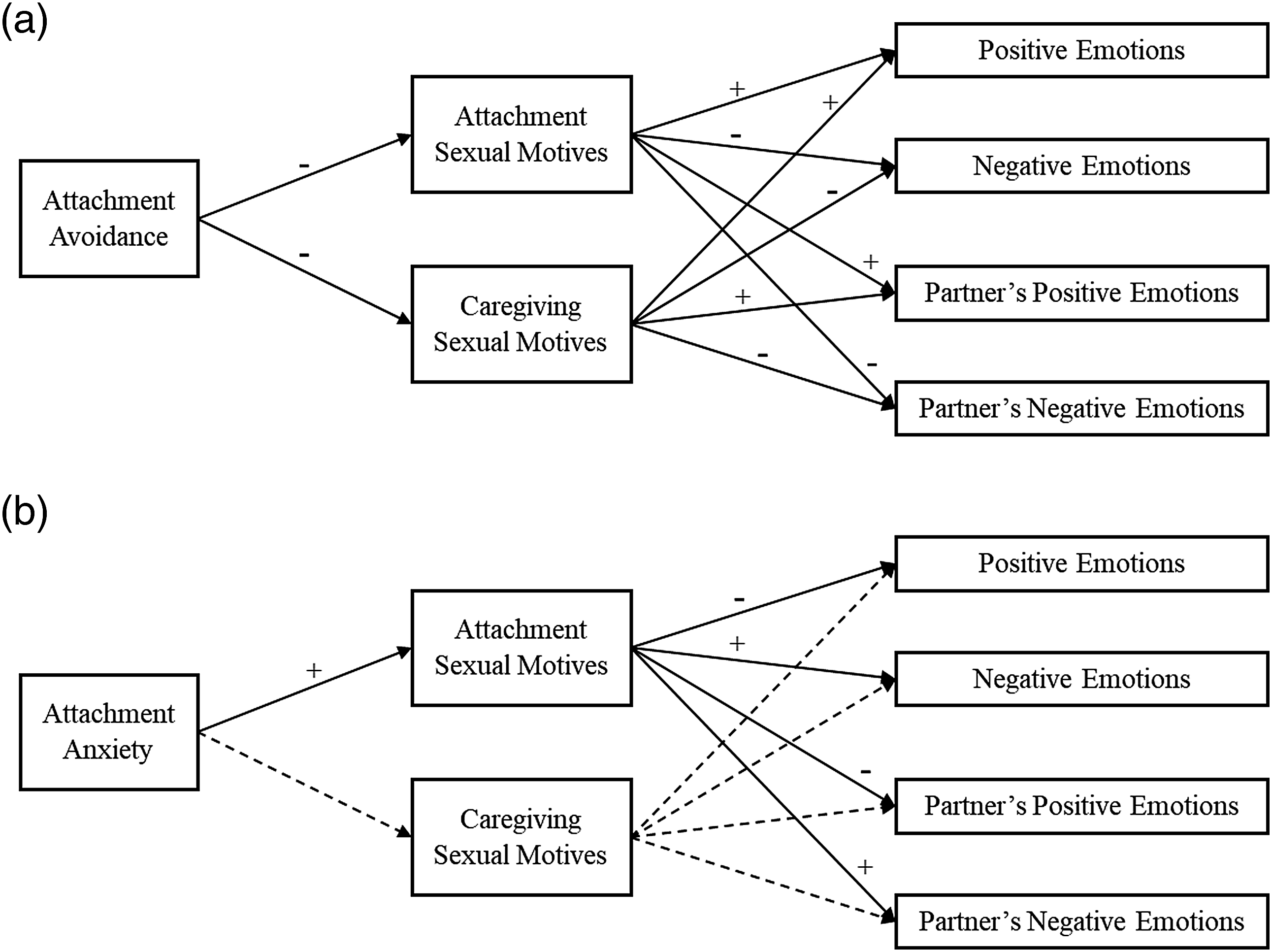
Method
Participants and procedure
A community sample of 149 Canadian mixed-gender/sex couples was recruited in two large eastern Canadian cities to participate in a study on relational and sexual well-being in long-term couples. To participate in the study, partners had to have been in their relationship for at least 5 years, to have been living together for at least 6 months, and to engage in partnered sexual activity at least once per month on average. Both partners were required to participate. Couples of all genders and sexual orientations were eligible to participate. Most participants were White (men = 94.63%; women = 93.96%), but some were Black (1.34%), Latino/Hispanic (3.69%), Asian (0.67%), Native American (1.34%), and Middle Eastern (1.34%). Most participants reported French as their first language (men = 87.84%; women = 88.51%), but other participants reported English (4.05%), Spanish (3.02%), or other (3.02%, e.g., German, Italian, Portuguese, Vietnamese). On average, women were 30.27 years old (SD = 6.76, range = 20–50) and men were 31.64 years old (SD = 7.36, range = 20–57). Most were highly educated (40.27% of men and 63.09% of women had a university degree) and about half of the sample had an annual income of CAN$40,000 or more (men = 57.14%; women = 38.26%). The majority was working full-time (men = 69.80%; women = 46.31%), but some participants were working part-time (9.06%), studying (25.17%), or had another occupational status (i.e., job searching, at home, retired; 7.72%). On average, the relationship duration was 9.13 years (SD = 4.78; Mdn = 7.00) and the cohabitation length was 6.80 years (SD = 5.64). About a third of the couples were married (28.86%) and had children together (34.90%).
Recruitment was done by posting printed posters on two university campuses and through Facebook and psychology research listservs. Interested couples were interviewed by phone by a research assistant to assess their eligibility, explain the study procedures, and obtain informed consent. Participants then received an email inviting them to complete a consent form and baseline questionnaires without their partner on a secure web platform. To reduce attrition, we sent up to three weekly email reminders for the questionnaires. Couples received a compensation of up to $100 in gift cards for completing the daily diaries. The institutional ethics board approved this study.
Daily diaries procedure
The daily diaries were completed after both partners completed the baseline questionnaires. For 21 days, at 5:00 p.m., couples received an email inviting them to complete a short diary. On days when participants reported having had a sexual activity with their partner (e.g., intercourse, caresses, foreplay, masturbation), they were queried about their sexual motives and emotions during the sexual activity. At 9:00 p.m., a reminder was sent to participants if they had not yet completed their diary. On average, partners reported 5.04 sexual activities during the 21 days (ranging from 1 to 15).
Measures
Attachment
At baseline, the brief version of the Experiences in Close Relationships scale (ECR-12; Lafontaine et al., 2016) assessed attachment insecurities with 12 items divided in two subscales: attachment avoidance (e.g., I don’t feel comfortable opening up to romantic partners) and attachment anxiety (e.g., I worry that romantic partners won’t care about me as much as I care about them). Items are rated on a seven-point scale ranging from Strongly disagree (1) to Strongly agree (7). Global scores are obtained by averaging relevant items on each subscale, with higher scores indicating higher attachment avoidance and anxiety. Lafontaine et al. (2016) have shown the ECR-12’s reliability and validity in community samples. Internal consistency was also adequate in this sample for both anxiety (women: α = .83; men: α = .84) and avoidance (women: α = .80; men: α = .84).
Sexual motives
During the daily diaries, on days when they reported a sexual activity, participants reported on their sexual motives for this specific sexual activity. Items taken from previous studies on sexual motives (Davis et al., 2004; Hill & Preston, 1996; Impett et al., 2005) were chosen to represent sexual motives in line with attachment theory. The Attachment sexual motives comprised four items representing motives for engaging in sexual activity to meet one’s own attachment needs. Sample items include: “to feel reassured about my relationship” and “to promote intimacy in my relationship”. The Caregiving sexual motives comprised four items representing motives for engaging in sexual activity to meet the partner’s needs and take care of them. Sample items include: “to express love for my partner” and “to please my partner”. Items were rated on a seven-point scale ranging from Not at all (1) to Extremely (7). The mean of the items was used to form each subscale. We used a multilevel confirmatory factor analysis to examine the reliability of the sexual motives subscales at the person level (between-persons). Geldhof et al. (2014) recommend using McDonald’s (1999) Omega (ω) as an estimate of reliability. ω is calculated as the ratio of “true score” variation (i.e., squared sum of factor loadings) over the total variation (i.e., squared sum of the factor loadings plus the sum of item residual variances). This ratio reflects the percentage of the total variability that is accounted for by the latent factor. This procedure revealed adequate between-person reliability for both attachment (women: ω = .82; men: ω = .83) and caregiving motives (women and men: ω = .92).
Emotions during sexual activity
On days when they reported a sexual activity, participants also completed six items to assess their emotions during sex (Birnbaum et al., 2006). Three items assessed positive emotions (e.g., I felt good during the sexual activity) and three items assessed negative emotions (e.g., during the sexual activity, I felt nervous or stressed). Participants rated the items on a seven-point scale ranging from Not at all (1) to Extremely (7). Total scores for positive and negative emotions were calculated by averaging the items. Past studies provided adequate psychometrics for this measure (Birnbaum et al., 2006; Rosen et al., 2018). Between-person reliability was also adequate for both positive (women: ω = .82; men: ω = .83) and negative emotions (women: ω = .91; men: ω = .85) in this sample.
Data analyses
To conduct the main analyses, we used the diary data for which at least one partner reported a sexual activity (N = 1678 diaries). Missing values (Baseline = 0.11%; Daily diaries = 13.59%) were handled using full information maximum likelihood (FIML). Hypotheses were tested using the Actor-Partner Interdependence Model (APIM; Kenny et al., 2006). We conducted multilevel (i.e., two-level) APIM in Mplus 8.4 (Muthén & Muthén, 1998-2017) and we used the maximum likelihood estimator with robust standard errors (MLR) to address the non-normality in the positive and negative emotion variables. Mplus performs an implicit decomposition of scores from daily diary measures into two latent parts: a daily score (within-person; i.e., the deviation of a daily diary score from the mean across all sexual activities) and person-level score (between-person; i.e., mean across all sexual activities). In our mediational model, attachment insecurities were the predictor variables; attachment and caregiving sexual motives were the intermediary variables; and positive and negative emotions during sex were the dependent variables. Given that the predictor variables had no variation at the within-person level (daily level), mediation involving these variables can occur only at the between-person level (Preacher et al., 2010). Therefore, at the between-person level, the dependent variables were regressed on the intermediary and predictor variables; simultaneously, the intermediary variables were regressed on the predictor variables. In other words, we tested whether differences among participants in their levels of endorsement of sexual motives across all sexual activities accounted for the association between attachment insecurities and positive and negative emotions during sex across all sexual activities. Indirect effects were estimated with Bayesian 95% credible intervals. Considering that past studies have shown partner effects between an individual’s attachment and their partner’s sexual motives (Cooper et al., 2006; Gewirtz-Meydan & Finzi-Dottan, 2018; Impett et al., 2008), we controlled for these effects to isolate the unique effect of an individual’s attachment on their own sexual motives. At the within-person level, we computed all the bivariate correlations among the daily scores of the predictor and intermediary variables.
We used a within-dyad test of distinguishability to determine whether dyad members were distinguishable on the basis of gender/sex (Kenny et al., 2006). We first compared an unconstrained model to a fully constrained model in which all the effects were constrained to be equal between women and men. A significant chi-square difference indicated significant gender/sex differences. Thus, we retained a semi-constrained model in which only the effects that differed significantly between men and women were left free to vary. This model did not differ significantly from the unconstrained model (Δχ2 (21) = 15.743, p = .725). The overall model fit was evaluated according to Kline’s (2015) recommendations: a non-significant chi-square, a Confirmatory Fit Index (CFI) ≥ .95, a Root Mean Square Approximation of Error (RMSEA) below .06, and a Standardized Root Mean Square Residual (SRMR) below .08. The fit of the final model was adequate (χ2 (21) = 15.745, p = .784; CFI = 1.000; RMSEA = .000; SRMR = .040).
Results
Descriptive Statistics and Bivariate Correlations among Attachment Insecurities, Sexual Motives, and Emotions during Sexual Activity.
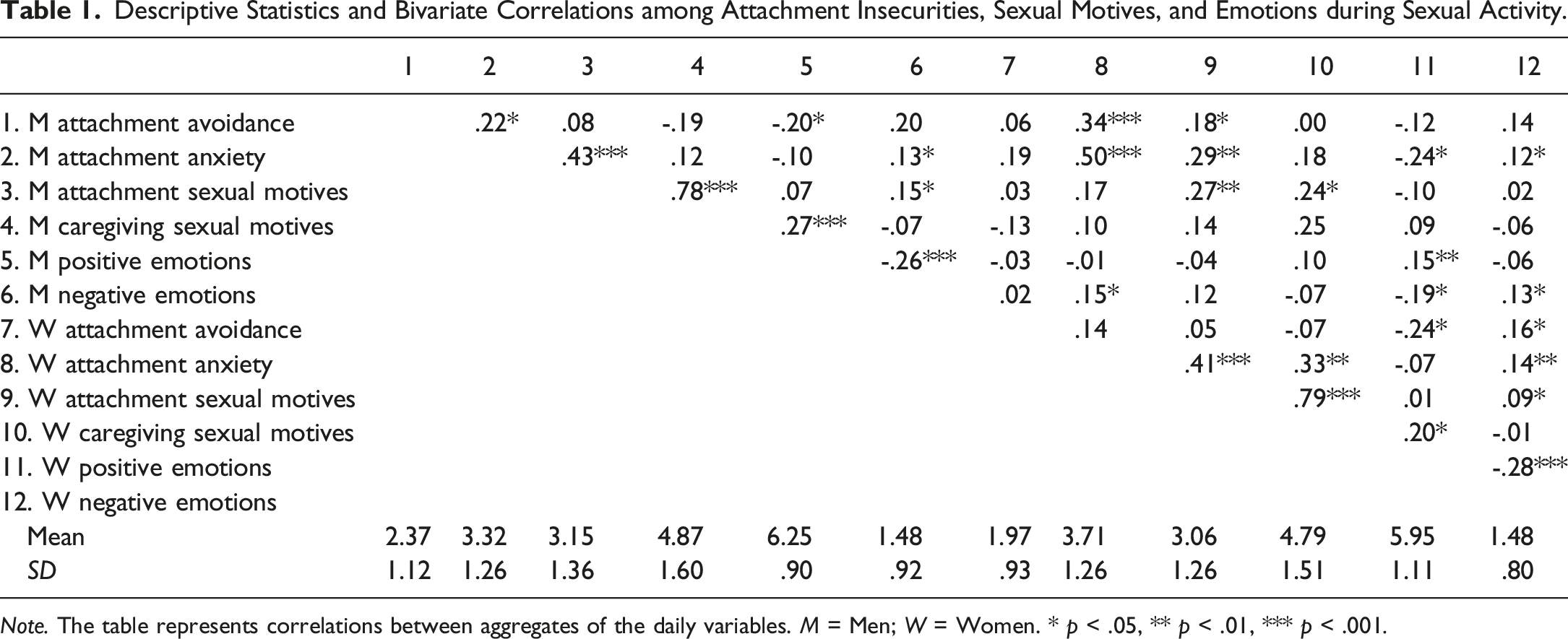
Note. The table represents correlations between aggregates of the daily variables. M = Men; W = Women. * p < .05, ** p < .01, *** p < .001.
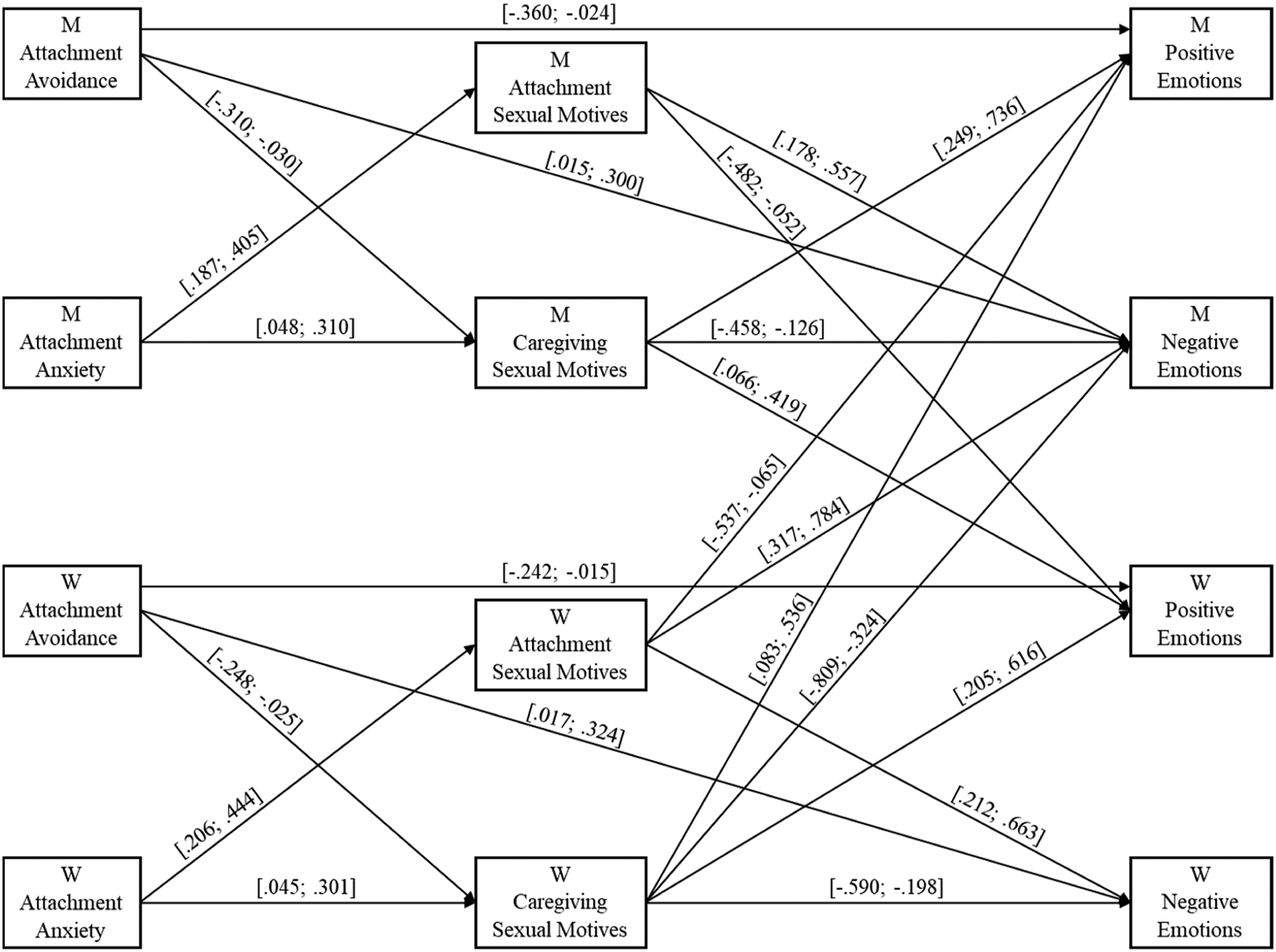
Associations between attachment insecurities, daily sexual motives, and emotions during sexual activity in both partners.Note. All possible direct paths were included in the statistical model, but only significant paths are shown. Correlations between variables and non-significant paths are not included in the figure to avoid overloading the figure. M = men; W = women.
Attachment avoidance, sexual motives and emotions during sexual activity
Contrary to our expectations, avoidance was not associated with attachment sexual motives. Hence, there was no indirect effect of avoidance on emotions via attachment motives. However, individuals with avoidance endorsed less caregiving sexual motives, which in turn was associated with their own higher negative emotions (indirect effect: β = .026, 95% CI [.002, .065]) and lower positive emotions (indirect effect: β = −.045, 95% CI [-.102, −.005]) during sex, but not with their partner’s emotions (non-significant indirect partner effects).
Attachment anxiety, sexual motives and emotions during sexual activity
As anticipated, individuals who were higher on anxiety tended to endorse more attachment sexual motives, which was then associated with their own higher negative emotions during sexual activity (β = .053, 95% CI [.019, .099]), but not with their own positive emotions. Moreover, as expected, individuals higher in attachment anxiety endorsed more attachment sexual motives, which was then associated with their partner’s lower positive emotions during sexual activity (β = −.047, 95% CI [-.100, −.007]). Women’s anxiety was also associated with their partner’s higher negative emotions through their own higher attachment sexual motives (β = .085, 95% CI [.034, .155]), but we did not find this effect in men.
With respect to caregiving motives, individuals higher in anxiety endorsed more caregiving motives, which was then associated with their own higher positive emotions (β =.042, 95% CI [.008, .092]) and lower negative emotions (β = −.024, 95% CI [-.058, −.003]), as well as their partner’s higher positive emotions during sex (β =.025, 95% CI [.002, .064]). Women’s higher anxiety and caregiving sexual motives were also linked to their partner’s lower negative emotions during sexual activity (β = −.046, 95% CI [-.100, −.009]).
Discussion
This study extends past research by examining the associations among attachment insecurities, attachment and caregiving sexual motives, and emotions felt during sex as indicators of sexual well-being. Our findings suggest that individuals higher in attachment avoidance report more negative emotional experiences during sex in part because they are less likely to use sex as a way to care for their partner. Individuals higher in attachment anxiety and their partner would experience both more positive and negative emotions during sex depending on whether they engage in sex for attachment or caregiving motives. Overall, these findings suggest that attachment insecurities may get in the way of individuals being able to engage fully in satisfying sexual encounters with their partner, since sexual motives driven by these insecurities (e.g., need for reassurance about the relationship, maintenance of interpersonal distance) are associated with more negative emotional experiences for both partners as they engage in sexual activity.
Attachment anxiety and emotions during sexual activity
Research has shown that attachment anxiety is associated with sexual and relational ambivalence, which often results in both positive and negative relational outcomes (Birnbaum et al., 2006; Mikulincer et al., 2010). Consistent with past research, we also found that individuals higher in attachment anxiety experienced both more positive emotions and more negative emotions when engaging in sex with their partner, but our findings suggest that whether they experience positive or negative emotions would depend on their motives for engaging in sex.
More specifically, as anticipated, we found that individuals higher in attachment anxiety tended to endorse more attachment sexual motives, which in turn was associated with their own and their partner’s more negative emotional experience during sexual activity. This is in line with past studies (Davis et al., 2004; Impett et al., 2008). Individuals higher in attachment anxiety may be more likely to engage in sex for attachment motives when they feel a threat to their relationship (i.e., when their attachment system is activated; Brassard et al., 2007) and this activation may prevent them from taking full advantage of the emotional connection that they are seeking from sex. For instance, these individuals tend to use sex as a “barometer” for their relationship (Birnbaum et al., 2006; Davis et al., 2006): sexual experiences can either reduce their attachment insecurities if the experience is gratifying, or exacerbate their sense of insecurity if the experience is disappointing or triggers worries about their partner’s love. Thus, this activation of their attachment system may keep their focus inward (e.g., on their attachment insecurities), rather than on the intimate moment they are sharing with their partner. This would concur with studies showing that individuals high in anxiety report more negative distracting thoughts during sex (for a review, see Dewitte, 2012).
This inward focus on insecurities could also explain another result of our study—that is, why the partners of individuals higher on attachment anxiety also reported more negative emotional experiences when these individuals endorsed more attachment sexual motives. Indeed, the partners of individuals with anxiety might feel neglected or less enthusiastic during the sexual activity when they perceive their partner to be distracted or preoccupied. This would be coherent with the results of a daily diary study on couples coping with genito-pelvic pain showing that when women engaged in sex for avoidance motives (e.g., to prevent the partner from becoming upset), both they and their partner focused more on negative thoughts and emotions during the sexual activity (Rosen et al., 2018).
Interestingly, we also found that individuals higher in attachment anxiety also endorsed more caregiving sexual motives, and these motives were associated with their own and their partner’s more positive emotional experience during sex. The fact that individuals higher in attachment anxiety are able to engage in sexual activity to show their love to their partner, nurture them, and comfort them (Davis et al., 2004; Péloquin et al., 2013) suggests that, in some instances, these individuals’ attachment system is not activated. Not being overly preoccupied with attachment concerns might therefore enable them to focus on the here-and-now and to be more attentive to their partner’s cues rather than on their innate state. Ergo, this favorable state of mind could explain why both the individual and their partner experienced higher sexual well-being during sexual activity. Other studies have also provided evidence for an association between caregiving sexual motives and higher sexual satisfaction in couples (Péloquin et al., 2013; Stephenson et al., 2011), as well as for a link between responsiveness and positive sexual outcomes for both partners, such as higher sexual satisfaction and lower sexual distress (Bergeron et al., 2021; Bois et al., 2016; Impett et al., 2019; Vaillancourt-Morel et al., 2019). Furthermore, whereas individuals high in anxiety can sometimes put their own sexual needs aside to focus on their partners’ (Davis et al., 2006; Dewitte, 2012), it seems that individuals higher in anxiety in our sample were able to find the balance between their own and their partners’ needs in order to reap the benefits of this balance (Birnbaum & Reis, 2019). Indeed, research on sexual communal strength (i.e., being responsive to a partner’s sexual needs and wanting to care for them) suggests that being motivated to take care of a partner’s sexual needs can be key to daily and long-term sexual satisfaction in both the individual who provides the care and the partner who receives the care (Impett et al., 2019, 2020). Taken together, these findings suggest that caregiving, whether in the overall relationship or in the specific context of sexuality, could benefit both partners.
Nevertheless, the fact that individuals higher in anxiety endorsed caregiving sexual motives might also be explained by our sample which comprised highly relationally satisfied long-term couples. As such, it is possible that these couples face relationship threats less often, limiting the triggers for activation of the attachment system in individuals high in anxiety. Indeed, a study showed that individuals high in anxiety perceived their relationship and its future more negatively on days during which they had a conflict with their partner, whereas their perceptions were more positive on days when they received support from their partner (Campbell et al., 2005). Future studies could thus examine if the relational context of the day (e.g., presence of conflicts) triggers the attachment system and interferes with the endorsement of caregiving-versus attachment sexual motives in individuals high in anxiety. Because our results suggest that these individuals endorse both types of motives, identifying moderators of these associations would propel this line of research further.
Attachment avoidance and emotions during sexual activity
Regarding avoidance, our hypotheses were only partially confirmed. As expected, individuals higher in avoidance endorsed less caregiving sexual motives, which was then associated with their own more negative emotional experience during sexual activity. However, avoidance was not associated with attachment sexual motives, and sexual motives did not explain the association between avoidance and the partner’s sexual well-being. The lack of association between avoidance and attachment sexual motives might seem surprising because individuals high in avoidance have been found to be less likely to engage in sex to meet their attachment needs (Davis et al., 2004; Impett et al., 2008; Schachner & Shaver, 2004). However, these studies have been conducted with young adults and couples, whereas our study focused on long-term couples. Moreover, the participants in our study reported relatively low levels of avoidance and engaged in frequent sexual activity (on average 5 times over 21 days), which may not represent all long-term couples (Brassard et al., 2007). Avoidance may also present itself differently in short-versus long-term relationships and may not be as high in long-term couples who report being very happy in their relationship. As such, it is possible that the active avoidance of sexual intimacy (e.g., low attachment sexual motives) occurs more typically in individuals with higher levels of attachment avoidance, but these individuals were rare in our sample.
The fact that avoidance and attachment sexual motives were not associated might also stem from the items that we used to measure these sexual motives. That is, some items were formulated as approach motives (e.g., to promote intimacy in my relationship) whereas others reflected avoidance motives (e.g., to prevent my partner from losing interest in me). Previous research has found that individuals high in attachment avoidance were more likely to endorse avoidance sexual motives and less likely to endorse approach sexual motives (Cooper et al., 2006; Gewirtz-Meydan & Finzi-Dottan, 2018; Impett et al., 2008). Thus, in our study it is possible that individuals higher in avoidance rated the avoidance and approach attachment motives differently (i.e., in opposite directions), which could have obscured a clear association between avoidance and attachment sexual motives.
With respect to caregiving motives, as hypothesized, individuals higher in avoidance endorsed less caregiving sexual motives, which was associated with their own more negative emotional experiences during sex. This concurs with past studies showing that these individuals tend to offer less support to their partner in general and to rarely use sex in such a way (Feeney & Collins, 2019; Péloquin et al., 2013, 2014). Indeed, they may still be uncomfortable with intimacy and try to maintain some interpersonal distance even if they have sex with their partner (Mikulincer & Shaver, 2016). As such, it is possible that they endorse sexual motives that do not foster intimacy with the partner or focus on the partner’s well-being (i.e., neither attachment nor caregiving motives). For instance, individuals higher in avoidance have been found to be more likely to engage in sex to avoid conflict with their partner or for egoistical reasons (e.g., stress relief, increase self-esteem, gain power over partner; Cooper et al., 2006; Davis et al., 2004; Dewitte, 2012; Impett et al., 2008). These self-serving motives, as well as the fact that these individuals report more negative feelings and cognitions regarding sex (Birnbaum et al., 2006) might explain why endorsing less caregiving sexual motives is associated with less positive and more negative emotions during sex.
Unexpectedly, the tendency of individuals higher in avoidance to endorse less caregiving sexual motives was not associated with their partner’s more negative emotional experience during sexual activity. Whereas engaging in sexual activity to care for one’s partner should technically be associated with higher responsiveness to the partner’s sexual needs and result in higher sexual well-being in the partner, having sex for other reasons than pleasing the partner (e.g., to avoid conflict with the partner, for stress release) might not necessarily mean that one is ignoring or neglecting the partner’s sexual needs. Furthermore, the association between an individual’s caregiving sexual motives (or lack of thereof) and their partner’s emotional experience during sex might also depend on their partner’s actual needs for comfort and reassurance (i.e., level of attachment insecurity). For instance, compared to individuals low in anxiety, individuals high in anxiety might be more likely to experience negative emotions during sex if they perceive that their (more avoidant) partner is not caring and sensitive to their needs. On the contrary, individuals who are high in avoidance might be comfortable in sexual situations that are devoid of intimacy and may not be as bothered if their partner is not expressly showing love and caring behaviors. Future studies examining such attachment pairings between partners could further our understanding of the associations between sexual motives and sexual well-being in couples.
Strengths and limitations
This study brings an important contribution to the field of adult attachment research. Indeed, it is one of the very few empirical studies to examine the three behavioral systems of romantic love concurrently (Péloquin et al., 2013, 2014, 2022) as conceptualized by attachment theory (Shaver et al., 1988). Also, whereas it has long been theorized that attachment, caregiving, and sex are three essential systems for optimal relationship functioning, our study underlines the importance of also considering these three systems for optimal couple sexuality.
This study also has limitations. For instance, our sample was comprised of couples with a high sexual frequency and satisfaction, which is not representative of all long-term couples and may have reduced variability in both attachment insecurities and sexual well-being. Also, participants included mixed-sex/gender couples only, were mostly White, and did not have the opportunity to report important information (e.g., gender identity, sexual orientation, disability, etc.) Future studies should therefore investigate the replicability of our findings in couples who are more diverse in terms of race/ethnicity and sex and gender identity. While a study revealed that the links between attachment insecurities and sexual satisfaction were the same regardless of sexual orientation or gender identity (Mark et al., 2018), a more diverse sample might present different patterns of attachment and sexual behaviors, for instance because of other factors/challenges (e.g., minority stress). Furthermore, the design of the study did not allow us to draw conclusions about causality. For instance, the emotions felt during the sexual activity might bias their perception of the reasons why they engaged in that activity. Studies have also shown that sexuality (frequency of sexual activity, sexual satisfaction and desire, perceived partner sexual responsiveness) could help reduce relational insecurities in partners and protect against relationship dissatisfaction in individuals with attachment insecurities (Little et al., 2010; Mizrahi et al., 2016; Raposo & Muise, 2021). This suggests that being sexually active and satisfied might play a role in explaining the sexual motives for subsequent sexual activities in individuals with attachment insecurities. Finally, participating in a study such as the present one (i.e., being asked specific questions about their sex life on a daily basis during 3 weeks) could have led participants to focus on their sexual motives and emotions more than usual, which could have influenced their subsequent perceptions or behaviors during sex.
Clinical implications
Studies have shown that sexual difficulties are often a source of concerns for couples seeking relationship therapy (Emond et al., 2021; Péloquin et al., 2019). Johnson and Zuccarini (2010) have suggested that therapy can help distressed couples reach a satisfying and healthy sexual relationship by addressing both attachment insecurity and sexual issues. The results of this study highlight that sexual motives are an important mechanism underlying the associations among attachment insecurity and couples’ emotional experiences during sex. As such, it might be a fruitful avenue for therapists to investigate motives for engaging in sex and to clarify whether attachment insecurities are driving these motives. Moreover, guiding the couple in an open conversation regarding each partners’ attachment needs and how these needs could be met in the relationship, whether at the relational or sexual level, might contribute to foster more positive emotional experiences during sexual activity.
Footnotes
Authors’ note
This paper was presented at the Canadian Sex Research Forum (CSRF) 2021 Conference.
Declaration of conflicting interests
The author(s) declared no potential conflicts of interest with respect to the research, authorship, and/or publication of this article.
Funding
The author(s) disclosed receipt of the following financial support for the research, authorship, and/or publication of this article: This work was supported by the Canadian Social Sciences and Humanities Research Council under Grant [number 435–2016-0314] awarded to Katherine Péloquin, Audrey Brassard, and Sophie Bergeron. Noémie Beaulieu is supported by a Joseph-Armand Bombardier Canada Graduate Scholarship from the Canadian Social Sciences and Humanities Research Council.
