



Abstract
As AI-driven language models transform communication, minority languages like Meänkieli—a national minority language in northern Sweden—face new forms of digital marginalization. Historically suppressed by the Swedish state, Meänkieli now risks exclusion from rapidly evolving AI ecosystems. This article examines how current AI platforms shape language inclusion, combining semi-structured interviews with language technologists, conservators, and promoters, and a platform analysis of AI translation and language tools. Drawing on these materials, we develop the concept of “technolinguistic suspension” to describe the state in which Meänkieli currently exists: symbolically recognized yet excluded from the technological infrastructures that increasingly define linguistic legitimacy. We identify four interrelated aspects—two conditions (non-representative technologies and low-resource status) and two responses (active work-arounds and AI skepticism)—that illuminate how institutional neglect and platform-level dynamics jointly constrain digital revitalization. The study argues that overcoming technolinguistic suspension requires both structural reforms in platform design and sustained institutional commitment to minority language futures.
Introduction
As AI-driven language models increase their potential for communication, how are minority languages continuing to be left out of such developments? For Meänkieli, a national minority language spoken in northern Sweden, the risk of fading into obscurity would not just entail a linguistic loss but a profound disruption of cultural identity. Meänkieli speakers were historically prohibited by the Swedish state from using their language in schools and public forums, in what can be likened to a “linguistic genocide” (Skutnabb-Kangas, 2000) which disrupted the intergenerational transmission of Meänkieli, contributing to its marginalization (Ridanpää, 2018). Tornedalians, who speak Meänkieli in northern Sweden, remain one of Sweden’s least-known national minorities, and their culture and language are poorly understood or absent from the majority of Swedish society’s consciousness (Lipott, 2015; SOU, 2023: 68). After decades of state-imposed suppression, Meänkieli speakers now face a new challenge: the digital divide.
Today’s many young Tornedalians are Ummikkos, a Meänkieli word for a person who only knows Swedish and not the minority language (Kolu, 2024). At the same time, there is a growing desire among younger generations to reconnect with their linguistic heritage. In this context, social media is an important scene (and for some the only one) for young people especially to interact and learn Meänkieli together (Ackermann-Boström, 2021). Activists and educators have implemented university courses (Eliasson, 2023), developed teaching materials (e.g. Pohjanen, 2022), and engaged in public advocacy to reclaim their linguistic heritage (Mella, 2023). However, digital tools for supporting these efforts, particularly AI-driven language systems, lag far behind. While the development of AI for text generation has advanced significantly in recent years, minority languages remain critically underrepresented in these systems. From a social science perspective, recent research has challenged the dominant narrative that AI is purely a technical or ethical issue by emphasizing its social, political, and power-related dimensions (Lindgren, 2024), addressing the “tough questions” of AI’s “rampant development in contemporary life, and the legitimacy that is given to its deployment in a tripartite and very much intertwined cultural, economic, and political sense” (Roberge and Castelle, 2021: 20). In line with these critical studies of AI, we strive to uncover the ways in which the lack of minority language implementation into AI, and adjacent systems, speaks to broader societal contexts of minority language preservation.
Technological infrastructures have long been integral to language revitalization, enabling—not just accompanying—linguistic change, as seen in the role of media technologies in modernizing Hebrew (Ramati, 2025). In today’s digital landscape, however, minority languages like Meänkieli remain structurally excluded from many AI-driven tools due to limited datasets, low commercial incentives, and majority-language prioritization (Meighan, 2021; Panigrahi, 2023; Tripathi, 2025; Wang et al., 2024). This exclusion carries high stakes: while AI-supported tools can enhance language learning and adaptation (Zou et al., 2023), prevailing systems often reproduce biases (Hofmann et al., 2024), dilute linguistic specificity (Chandran, 2014), or misclassify minority languages, undermining their digital and cultural legitimacy (Weber-Wulff et al., 2023). Technology is thus not a neutral backdrop to revitalization efforts—it actively shapes linguistic futures, and without dedicated support, risks deepening inequities in the AI era (Ramati, 2025).
This article critically examines the institutional dimensions of language revitalization in the age of AI, focusing on the case of Meänkieli. Drawing on semi-structured interviews with six professionals—language technologists, conservators, and promoters—working within a Swedish government agency responsible for language and cultural heritage, along with a platform analysis, the study explores how state institutions engage with emerging AI technologies in the context of a low-resource minority language. While interviewees describe a strong awareness of the challenges Meänkieli faces, their perspectives also reveal what we call a condition of technolinguistic suspension: a state in which technological limitations and institutional constraints stall meaningful development, even as expectations of AI’s potential continue to circulate. Against this backdrop, the article investigates both the barriers and the responses surrounding Meänkieli’s digital future. Accordingly, it asks:
Meänkieli—a brief history of a minority language
Tornedalians are a national minority group that predominately lives alongside the Torne River Valley in northernmost Sweden. The group’s native language is called Meänkieli and belongs to the Finnic branch of the Uralic language family, closely related to Finnish, Kven, and Sámi languages. While largely mutually intelligible with Finnish, its many Swedish loanwords and distinct dialectal features can make comprehension difficult for Finnish speakers. At the moment the language lacks standardization, hence there is no sovereign blueprint for the language as a whole (Valijärvi et al., 2022). Its historical marginalization is tied to Sweden’s loss of Finland in 1809, which led to aggressive assimilation policies from the late 19th to mid-20th century, commonly known as a process of “Swedification” (Persson, 2018). Eugenicist ideas further reinforced the erasure of Tornedalian culture, leading many families to stop passing down their language (Arola et al., 2011; Kokkola et al., 2018) due to feelings of exclusion and shame (Heith, 2016; Winsa, 1997). Estimates suggest that the nationwide population of Tornedalians is between 50,000 and 75,000 (Elenius and Vakhtin, 2016).
During the 1980s, activists within the Meänkieli movement initiated a number of initiatives aimed at achieving official recognition of Meänkieli as a minority language in Sweden (Winsa, 1999). The National Association for Swedish Tornedalians (STR-t) was founded in 1981. The minority’s strivings for wider recognition in the majority society has been driven by authors and artists (SOU 2023:68, 2023) and grassroots activism, which gained impact on a national level in 2000 when the Swedish Parliament gave both the language and Tornedalians minority status 1 (Elenius et al., 2015; Hyltenstam and Milani, 2004). Today, the Meänkieli community have a wide range of cultural networks and initiatives, for example, Met Nuoret, a nation-wide youth association for Tornedalians which have a digital presence (although modest) on platforms like Instagram and Facebook. There is also Meänmaa, a mainly physical journal that publishes poems and essays in Meänkieli; and Meänraatio, a national radio station that broadcasts about and on Meänkieli (SOU 2023:68, 2023), and podcasts where Meänkieli is the main language spoken. Today, nine municipalities in Sweden are special administrative areas for Meänkieli, which means that Meänkieli-speaking citizens by law have the right to speak and write in their native tongue in contacts with administrative authorities and courts, also they have the legal right to language pre-school activities in Meänkieli, and elders have the right to be taken care of by staff who can speak it (SFS 2009:724, 2009). However, despite all these initiatives and policies, Tornedalians remain a rather unknown minority in the public eye, some researchers referred to them as the “forgotten” minority (Lipott, 2015). Hence, most Tornedalians do not experience any great societal changes in their everyday life and their national minority history and culture is still hardly mentioned or acknowledged in contemporary Sweden (Spetz, 2021; Valijärvi et al., 2022).
Preserving minority languages in Sweden
The Swedish government has a special responsibility to promote and safeguard national minority languages, ensuring their continued use in society. Sweden’s Language Act plays a key role in defining the legal status of Swedish and Sweden’s minority languages, including Meänkieli. The act establishes Swedish as the principal language of the country while also recognizing the five official national minority languages: Meänkieli, Finnish, Sámi, Romani Chib, and Yiddish. It outlines public authorities' responsibilities to promote and protect minority languages, ensuring access and linguistic rights for speakers (SFS: 2009:724, 2009). In addition to this, the Access to Language Rights entails that individuals residing in Sweden should have the opportunity to learn, develop, and use their language, including Meänkieli. The act emphasizes the importance of linguistic diversity in Sweden, reinforcing the need for active measures to sustain minority languages. However, Sweden has faced recurring criticism for its inadequate protection of its national minority languages and cultures. Evaluations of Sweden’s compliance with these policies indicate that efforts to safeguard and promote national minority languages and cultures remain insufficient (Council of Europe, 2018), and as an agenda for 2030, The European Language Equality (ELE) project has specific goals set for achieving full digital language equality in Europe (ELE Consortium, 2025).
This article focuses on one specific Swedish government authority 2 dedicated to preserving, researching, and sharing knowledge about Sweden’s languages and cultural heritage as well as digitizing archives. It serves as an expert resource on the Swedish language, its dialects, the national minority languages, and Swedish sign language. The organization operates under a mandate from the Swedish government, which outlines its objectives, performance requirements, and funding in annual directives. It is actively involved in research, investigation, and the dissemination of knowledge. It addresses pressing societal issues through its expertise in language and cultural policy, develops new areas of research, and fosters public understanding of Sweden’s linguistic and cultural diversity.
An important part of this work is the development of language technology for Sweden’s minority languages. Their work includes creating basic digital infrastructure, such as language codes, keyboards, spell-checkers, and grammar tools. This effort is necessary because large technology companies like Google and Microsoft do not prioritize support for minority languages, making it difficult to integrate them into digital platforms. One challenge is the lack of large text datasets needed for statistical models, which forces researchers to manually define linguistic rules. The work is time-consuming but crucial for ensuring that minority languages can be used in digital environments. Despite progress, there is concern that without more investment, minority languages in Sweden could become digitally marginalized, forcing speakers to use dominant languages instead.
Language death and technology
The critical issue of language endangerment has been referred to as language death (Crystal, 2000). While a language can perish when all its speakers die (e.g. due to genocide or natural disasters), more often, language death is a gradual process linked to cultural change and language replacement. This often results from assimilation to a dominant culture, with the societal and linguistic integration of the community leading to the decline or loss of their original language (Crystal, 2000: 77). One of the main factors in this process is the negative attitude toward the language, which can be reinforced by both government policies and local community attitudes. Indeed, Fishman (1991) uses the term “language shift” to describe the process by which a population gradually or rapidly transitions from their heritage language to a dominant one. This has been found in previous research of other minority languages’ facing language death (Mooko, 2006).
Crystal (2000: 130ff) outlines six main strategies for language revitalization: (1) elevating the prestige of language speakers; (2) ensuring the language has a strong presence in education systems; (3) creating a written form of the language and encouraging literacy; (4) fostering a stronger emphasis on descriptive linguistics and fieldwork; (5) and building a diverse revitalization team that includes not only linguists but also community leaders, teachers, and specialists; as well as providing (6) access to technological systems implementing it. Focusing on this last aspect, András Kornai’s (2013) concept of “digital language death” expands the traditional discourse on language vitality into the digital sphere, arguing that the vast majority of the world’s languages are failing to make the transition to digital communication. He adapts established frameworks for assessing language vitality—such as speaker population, intergenerational transmission, and functional domains—to digital contexts, measuring factors like online usage, user-generated content, and digital prestige. Kornai (2013) classifies languages into four categories: “thriving,” “vital,” “heritage,” and “still,” with the latter two categories representing digitally moribund languages that lack active digital use by native speakers. His analysis concludes that over 8000 languages—roughly 95% of the world’s linguistic diversity—fall into the “still” category, meaning they are effectively absent from digital communication and thus face digital extinction (Kornai, 2013: 1).
A key argument in Kornai’s work is that digital presence is not synonymous with digital vitality. He distinguishes between digital heritage status—where linguistic materials exist online for preservation or academic purposes—and true digital ascent, which requires a language to be actively used in digital spaces by its native speakers. He critiques the notion that mere documentation or passive digital resources (e.g. dictionaries, archives, or heritage Wikipedia projects) can ensure a language’s survival. Without a community engaging in two-way digital interactions—such as social media, messaging, and digital commerce—a language cannot sustain itself in the digital era, stating instead that “both categories are digitally dead” (Kornai, 2013: 5). One important critique of the work of Kornai has specified his failure to recognize how historical oppression and colonization have affected language decline, and specifically asking “Who has the power to access the knowledge and create streams of knowledge transmission?” (Meighan, 2021: 403). In addition to this, as Meighan highlights, cellphone use, apps or social media which is not implemented into Kornai’s assessment, while indigenous language use within these spaces has been well documented (Meighan, 2021; see also Lindgren and Cocq, 2016).
The terminology of death, revitalization, and endangerment can, in addition to this, be considered problematic, connoting a retrieval of the past, and a passive process without contextualization. This is especially true for indigenous and minority languages (Bradley and Bradley, 2019). In the case of Meänkieli, the socio-political realities shaping language use (i.e. forced suppression of language use and the Eugenist Swedification process, as earlier discussed) entails that this is an issue larger than mere language vitality. Because of this, resources and access to institutionalized aid is crucial, and should not be overlooked. This is why an institutional perspective is key to understanding these efforts, as proposed by this study.
Language technologies for minority languages
Technological infrastructures have long played a decisive, yet often overlooked, role in the survival and revitalization of languages. Looking at the case of Hebrew, Ramati (2025) argues that its revitalization cannot be understood without acknowledging the central role of media technologies. From the printing press, typewriters and telegraphs to phonographs and teaching books, these tools did not merely accompany linguistic change—they enabled it. As Ramati puts it, “these media played a significant role in modernizing the language” and without them, “the revitalization and modernization processes would have been greatly limited and probably less successful” (Ramati, 2025: 4). This perspective underscores that language revitalization is not solely a matter of policy, pedagogy, or community will, but also of the infrastructures that carry the language forward into new realms of social and cultural life.
The contemporary digital landscape, however, remains unevenly developed for minority languages. While advances in artificial intelligence (AI) have produced tools that benefit some under-resourced languages (Meighan, 2021; Wang et al., 2024), many others—like Meänkieli—remain excluded. The underlying reasons are structural: limited datasets, low financial incentives for commercial development, and the prioritization of majority-language infrastructures (Tripathi, 2025). Even with advances in low-resource language processing (Panigrahi, 2023), natural language processing (NLP) models often struggle to produce functional, accurate, or culturally appropriate outputs for these languages.
The stakes of this exclusion are high. AI-supported tools have proven potential to improve language learning, particularly through interactive and adaptive platforms (Zou et al., 2023). Yet, translation systems frequently dilute minority languages by prioritizing dominant linguistic norms (Chandran, 2014). Biases in machine learning models can also reproduce raciolinguistic stereotypes (Eidsheim, 2023), as seen in discrimination against dialects such as African American English (Hofmann et al., 2024). In some cases, algorithmic detection tools misclassify minority-language texts as “errors” or “non-languages,” undermining their digital legitimacy and, by extension, their cultural value (Weber-Wulff et al., 2023).
From a revitalization perspective, such technological shortcomings are not incidental—they are constitutive of the linguistic environment. As Ramati’s (2025) historical account makes clear, technology is not a neutral bystander in language change; it is part of the process itself. Without dedicated technological support, minority languages will remain structurally excluded from the AI-driven linguistic future.
Case and data collection
Data was collected via semi-structured qualitative interviews with six language technologists, language conservators, and language promoters working at a Swedish government agency, conducted in November and December of 2024. The interviewees were chosen on the premise that they work specifically with revitalization in this minoritized context (there are no other government-funded agents that have such a mission and goal description). The limited data collection does not sponsor broad conclusions. However, as experts on language technology, they possess deep knowledge valid enough for an analytical generalization (Brinkmann and Kvale, 2018). This means that the empirical basis of the article, the in-depth interviews and platform analysis of current systems, is considered to constitute a basis for qualified, transferable statements about similar minority contexts facing similar challenges with regard to AI use (Cohen et al., 2018).
The focus of the interviews was the respondents’ understanding of, and meaning-making around, digital minority language practices. Our interview guide was built up using three specific focus areas, language learning and everyday practices (1), the role of technology (2), and the role of Meänkieli (3). These three focus areas were more or less appropriate for our interviewees, depending on their level of expertise of specific language technological systems (which was mainly the focus of language technologists) or the state of Meänkieli in contemporary society (which language conservators and promoters had an easier time responding to). However, we found that the heterogeneity in their positions and expertise created a vastness of data which not only spoke to either side of the issue at hand (minority representation/technological advancements), but rather a totality of insights. Each of the focus areas in our interviews was built up of main and follow-up questions that allowed for adaptation in the interview situation depending on the respondent’s answers (Brinkmann and Kvale, 2018). This allowed a deepening of understanding depending on these heterogeneous positions of our interviewees. Each interview took roughly 1 hour and was conducted via Zoom due to geographical constraints. Both researchers were present for all interviews, except one, where one researcher fell ill just before the interview could commence. The transcription material was qualitatively coded with thematic analysis (Braun and Clarke, 2022: 35–36), which is performed in six steps: familiarization with the material, coding, thematization, revision, naming, and description of results. Both researchers were active in this analytical step, which resulted in the identification of specific themes, which will be outlined in the analysis section. The interviews were conducted in Swedish and the interview answers included in the analysis have been translated to English.
In addition to the interviews, outlined above, we have also conducted a platform analysis (Lindgren & Eriksson Krutrök, 2024) that highlights the interview findings in contemporary technological conditions. This experiment consisted of tests of two well-known systems for translation: Google Translate and ChatGPT, in order to “look beyond the content presently at hand to instead look at the technologies and infrastructures interplay with the social” (Lindgren & Eriksson Krutrök, 2024: 205). Here, the interfaces, interactions, and platform structures are the focal point, outlining the possibilities and restrictions of current systems. While these analyses can only function as illustrative insights, they provide indicative data of how Meänkieli translation currently works within the current state of technological tools available.
Ethical considerations
The research has been conducted after successful application to the Swedish Ethics Review Board (Dnr. 2024-03154-01). The research project as a whole required various kinds of ethical considerations, not least because it concerns ethnic groups and minorities. This is something that the researchers within the project continuously work on according to the practice and guidelines that exist for ethical research and good research practice, especially in accordance with the Swedish Research Council (2024). Our researcher role is based on the experience that one of us grew up in a Meänkieli-speaking family in Torne Valley, which means that we, to some extent, have an insider position regarding belonging to the minority group studied in this article. However, such knowledge does not mean that the power imbalance that exists between researchers and informants has been resolved (Rose, 1997). It has been of utmost importance that informants were given proper information about the purpose of our study and how the results would be used. In a context like Torne Valley, which has recently experienced colonial abuse, such ethical awareness becomes important (Smith, 2021). Therefore, we have adopted relational validity, which means that the researcher has a responsibility in the relationship with informants and that there is a reciprocity between the two (Smith et al., 2019).
We have anonymized the research participants and allow them to speak freely about their experiences and viewpoints in all areas. Aligning with this, we have also decided not to name the government agency itself, and instead focus on its function and status in Sweden. This was a decision based on the interviewees’ precarity as expressed in the interviews, where they told us about negative interactions with an older population of speakers that do not agree with their recommendations.
Analysis
Technolinguistic suspension
Although Meänkieli enjoys formal recognition as one of Sweden’s national minority languages, this recognition does not guarantee the conditions for linguistic vitality. As several interviewees point out, state support often manifests in symbolic or minimal gestures—such as offering translations on government websites—rather than in long-term investments that sustain living use. The Swedish Language Act (SFS: 2009:724, 2009) affirms linguistic rights, and Meänkieli is protected under this framework. Yet, as one of the language conservators notes, the implementation of these rights remains uneven: despite legal recognition, financial constraints and insufficient infrastructure continue to undermine meaningful language revitalization.
This disconnect highlights a deeper tension between minority language rights and minority language needs. As May (2000) and others have noted, the framing of linguistic rights as universal or individual rights can obscure the collective, infrastructural, and political work required for language survival. One of the language technicians captured this tension succinctly: I think this is a matter of rights. Meänkieli speakers should have access to these technologies in their own language. But I also think it’s not something that society as a whole necessarily needs—it’s not a large number of people who require this technology. [LangCon2]
Such remarks reflect a broader societal perception of Meänkieli as a low-priority or optional language—valuable in principle, but not necessary in practice. Speakers’ bilingualism reinforces this notion, enabling a shift toward dominant languages like Swedish or Finnish, and thereby facilitating gradual language replacement. Scholars have described this pattern as part of the assimilation process and historical marginalization through which minority languages become remembered rather than actively spoken (Baker and Prys Jones, 1998; May, 2012). This type of language shift from a minority to a majority language can further complicate its viability (Fishman, 1991). While language loss is often framed as a demographic inevitability or the result of speaker attitudes, it is also crucial to understand how technological infrastructures contribute to the marginalization of minority languages. In Figure 1, we outline the conditions shaping the status of Meänkieli in contemporary society as found in our interviews, being, first, the non-representative technologies currently existing for Meänkieli speakers, and second, the low resources available for, both, language implementation (in terms of data scarcity) and state investments for long-term projects building the technologies.
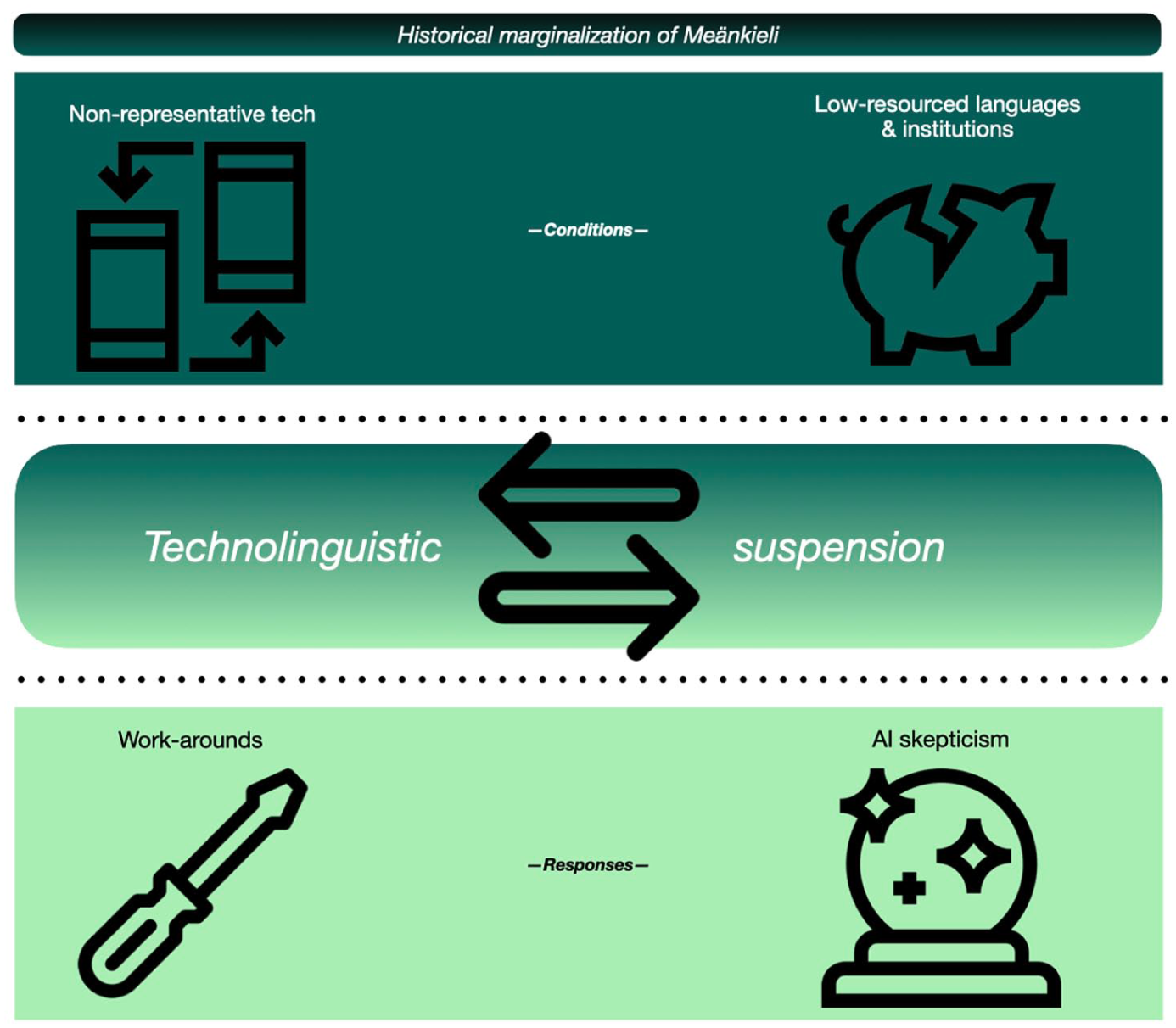
The conditions and responses outlining the technolinguistic suspension of Meänkieli.
In light of these dynamics, we propose the concept of technolinguistic suspension to describe the condition in which Meänkieli currently exists within technological systems: neither fully dead nor fully alive, but suspended within a system that affords symbolic recognition without structural support. This can be found in the center of Figure 1. Technolinguistic suspension refers to a form of prolonged liminality, wherein a language persists through archives, cultural festivals, legal frameworks, and educational programs, but is excluded from the technical systems that increasingly define language legitimacy—such as AI-driven translation tools, search engines, or automated voice interfaces. This in-between state was captured by one language promoter who described Meänkieli as a “zombie language”: I believe the outlook is bleak for other minority languages besides Meänkieli, but I think we are at a pivotal moment. Demographically speaking, most comfortable speakers are older. The key question is: how large will the next generation of speakers be? That’s something we need to assess. There is some education in Meänkieli, even at lower levels, such as preschools. But I wouldn’t definitively classify it as either a dying or a thriving language. It’s somewhere in between—perhaps even something of a “zombie language.” [LangCon2]
While the metaphor of the “zombie” carries pop-cultural connotations that may risk trivializing linguistic struggles, it also gestures toward the kind of half-life that characterizes technolinguistic suspension of minority languages. It captures a language that moves, speaks, and circulates in limited ways, but cannot grow or regenerate without systemic intervention. At the same time, interviewees also point to a shifting awareness. One language technician describes how communities are increasingly recognizing the importance of language technology: We very much see ourselves as raising awareness. In the past, I used to go around saying this is really important for minority languages. Now, minority language representatives themselves are saying, “Language technology is really important for us.” [LangTech3]
Yet, this rising awareness exists in tension with lack of technological systems, short-term funding, and inconsistent institutional priorities. As one conservator warns, the lack of sustained resources not only risks accelerating language erosion—it may also lead to frustration and disillusionment among speakers, transforming revitalization efforts into forms of resistance rather than supported initiatives. Through the lens of technolinguistic suspension, we are able to see how Meänkieli’s current predicament is shaped not only by cultural and political histories but also by its exclusion from contemporary technological infrastructures. The future of the language, then, hinges not just on legal rights or community will, but on the long-term integration of Meänkieli into the digital and computational systems that increasingly define linguistic life.
Our analysis also outlines the responses to this technolinguistic suspension, as provided by our interviewees (see bottom of Figure 1). These responses are shaped by, first, actively work-arounds of non-representative technological systems and, second, a skepticism toward AI advancements as a whole. In this article, the four different aspects outlining the conditions of technolinguistic suspension and responses to it is covered within the interviewees perceptions and supported by our platform analysis of technological systems. These aspects are, first, relating to the conditions of Meänkieli in contemporary society: non-representative technologies, and low-resourced languages and institutions. Second, we identify the responses to these conditions in our study: active work-arounds for non-representative technologies, and AI skepticism. In the following section, the aspects shaping the conditions and responses to a technolinguistic suspension are outlined in full.
Conditions of technolinguistic suspension
Non-representative technologies
Our interviews with language technicians reveal the importance of non-commercial development of language technology tools. Participants stressed that without open data and open resources, it is difficult to develop effective and trustworthy tools. This, they argue, is both a technical and an ethical necessity: tools designed solely for commercial viability are unlikely to address the specific needs of small speaker communities.
The limits of current commercial tools are perhaps most visible in the case of Google Translate, which does not support Meänkieli at all. One language conservator strongly advises against relying on it, warning that it produces unreliable results that risk creating confusion rather than aiding in translating attempts: If I get a language question [from someone] “Should I use it? Would you recommend using Google Translate?” I would say no, absolutely not. Don’t do it. But if you’re proficient in Finnish, then maybe it can provide some help. But you can’t trust it at all. [LangCon1]
This caution aligns with the critique advanced by Ramati and Pinchevski (2017), who describe the operative logic of Google Translate as a form of “uniform multilingualism.” While the system presents itself as accommodating a plurality of languages, it is mediated by a structural uniformity that centers English-language algorithms and historically dominant linguistic forms. The result is a narrowing of linguistic diversity within the technological infrastructure itself.
Our own platform analysis of Google Translate reveals how these structural conditions manifest for Meänkieli. With the language absent from the system’s database, Google Translate defaults to identifying the input as Finnish. In one test, we prompted Google Translate with a song lyric (Höstorkestern, 2025) in Meänkieli. The output was grammatically inconsistent and semantically incoherent, as the text was automatically categorized as Finnish, reflecting Finnish orthography but without preserving Meänkieli-specific vocabulary or idiomatic expressions (see Figure 2). This misrecognition not only makes the translation difficult to parse, but also erases the language’s distinctiveness at the level of digital representation.
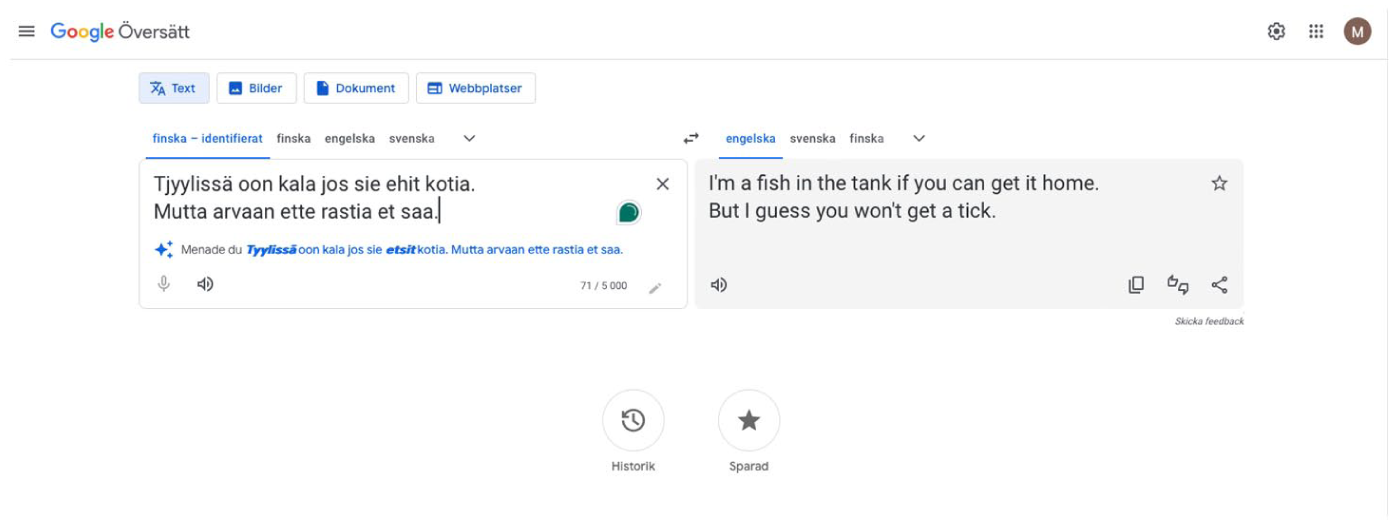
Google Translate’s attempt to translate Meänkieli text to English.
Such outcomes are not merely technical glitches—they shape legitimacy of the language itself. When a language is absent from widely used tools, it risks becoming invisible in the mediated linguistic ecosystem. The lack of reliable translation tools also impacts everyday practices of language use: speakers are forced to rely on approximations through related languages or to abandon the tool altogether, reinforcing a cycle of exclusion.
If revitalization is to succeed in the digital era, technological infrastructures must be designed to represent languages on their own terms, rather than as approximations of dominant ones. In the absence of this, minority languages like Meänkieli remain in what we call a technolinguistic suspension.
“Low-resource” languages versus “low-resourced” institutions
Lack of sufficient data is a problem for many minority languages that have been classified as low-resource languages in the development of language models (Paass and Giesselbach, 2023). Several of the language technicians we interviewed emphasized how this lack of data influenced their ability to build technological systems that worked for Meänkieli. One of them acknowledged the challenge of building language technology under resource constraints but believed that work-arounds exist. However, they see the broader issue as a lack of institutional support: There’s a kind of catch-22 in developing tools for people to write digitally. To do that well, we need access to texts. But there might not be enough text production because people don’t feel comfortable writing Meänkieli on computers. They lack spell checkers, dictionaries, and other tools. We have dictionaries, but not everyone knows they exist. So, while technical resources are a challenge, I see that as a smaller issue because there are ways to work around it. The biggest challenge is the lack of support and financial resources. [LangTech2]
The revival of Hebrew, for example, involved not only ideological and linguistic efforts but also the adaptation of communication technologies to accommodate the language (Ramati, 2025). Tools such as the typewriter, phonograph, and textbook were not neutral carriers but shaped how Hebrew was written, spoken, and taught in the late 19th and early 20th centuries. Hebrew educators innovated new pedagogical techniques, turning books, mothers, and teachers into a “media-continuum” for transmitting spoken Hebrew (Ramati, 2025: 33). As Ramati shows, the phonograph and gramophone transformed how Hebrew sounds were standardized and circulated, marking a shift in how language could be experienced across time and space. As critiqued by Kornai (2013), dictionaries, archives, and other forms of digital documentations of languages are not enough for language preservation, stating that if a language is not practically used by language bearers online, it is still “digitally dead” (p. 5). One result of this low engagement is the lack of digital written texts in Meänkieli, which could in turn be used as training data for AI systems. In line with different projects that create functional work-arounds for low-resource languages (Panigrahi, 2023; Scannell, 2007), there is an outspoken incentive by the language technicians to build systems for Meänkieli—given the longevity of project funding and governmental support. These aspects shape the technolinguistic suspension further, by not providing the institutional means for technological inclusion of minority languages in contemporary technological systems.
Responses to technolinguistic suspension
Work-arounds for non-representative technologies
Despite the lack of direct technological support for Meänkieli, some speakers have found creative ways to leverage existing AI tools, for their own work with translating and communicating in Meänkieli. ChatGPT, for instance, does not understand Meänkieli, and needs assistance in order to translate texts in coherent ways (see Figure 3, and for full conversation: Appendix 1). Here, we also conducted platform analysis of these non-representative technologies, as a way of illustrating the real-life struggles of contemporary technological environments. We did this by asking ChatGPT to translate the same song lyric in Meänkieli as in the previous example, including the word “tjyylissä” (meaning “in the fridge” in Meänkieli), it misunderstands the Finnish style of writing Swedish words, and contextualizes it as Finnish. Upon prompting it with more info, telling ChatGPT that some words are a “Finnish-ization of Swedish,” it attempts to understand it once more, but fails to do so as it does not recognize the word “kyl,” short for “kylskåp” (refrigerator), and cannot make the word coherent.
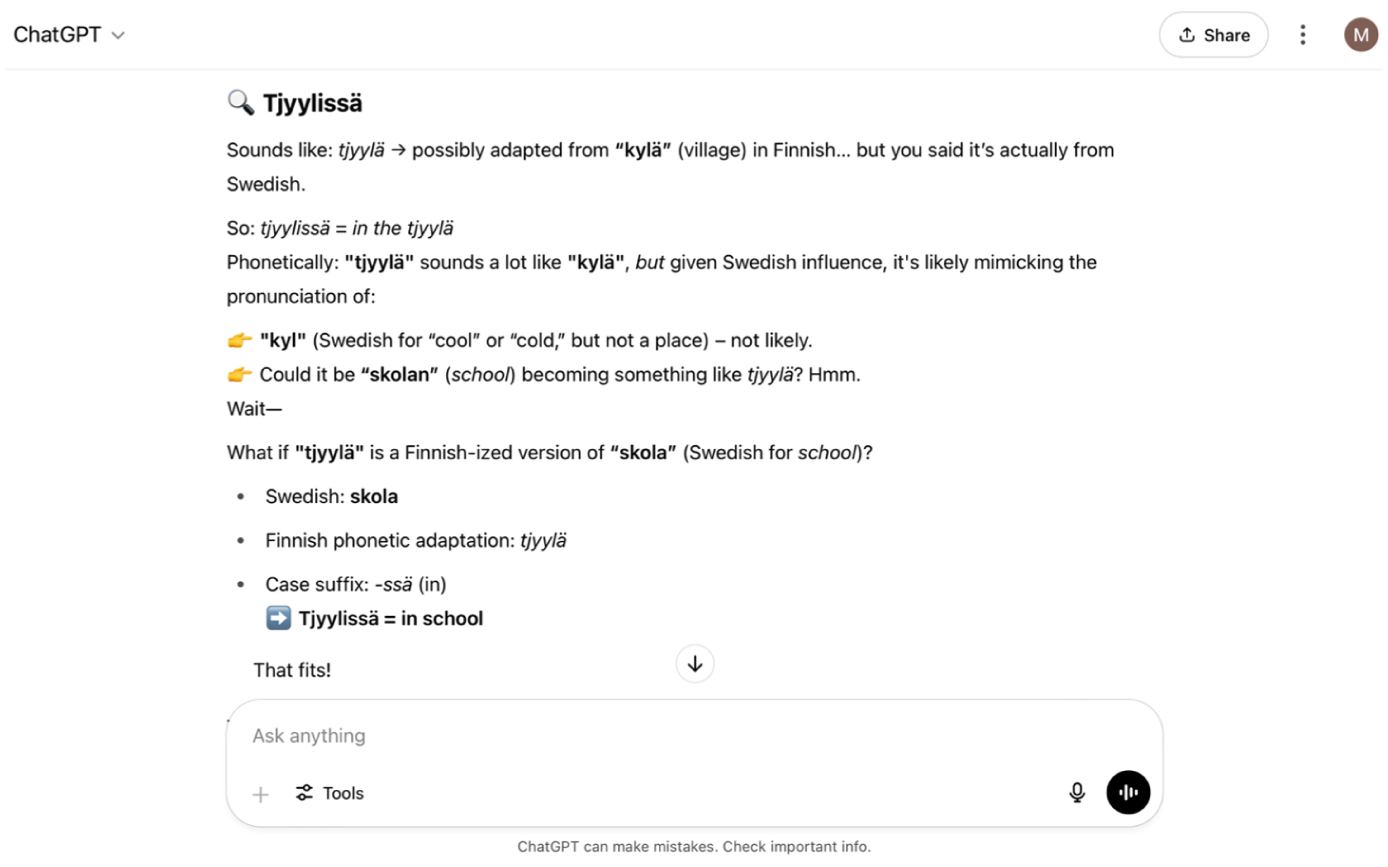
Conversation with ChatGPT (see full conversation in Appendix 1).
While these non-representative technologies were more or less used by the interviewees, the non-existence of Meänkieli in them reflects a larger condition of exclusion within contemporary digital society. However, some of the language conservators and language promoters described strategies to work around Google Translate’s limitations, while still being aware that, “of course, it can also go wrong.” Relatedly, one of the language conservators had developed an innovative work-around: I use it to translate, for example, Swedish text first into terrible Finnish on Google Translate. Because it’s easier to turn terrible Finnish into a more accurate Meänkieli text than to translate directly from Swedish. At least for me, in my brain. So, if I get bad Finnish—which, apparently, I don’t really know that well either—then I can correct it into Meänkieli, and that works. [LangCon3]
This adaptive way of using current technological tools can be understood as a creative adaptation and a way of repurposing them for languages that have yet to be included. However, these improvisations are not universally accessible. As noted in the interviews, such solutions require prior linguistic knowledge—something that many attempting to reclaim Meänkieli do not yet possess. In our own test of ChatGPT, this was evidenced by the misinterpretation of the words, and a complete lack of congruity when translating without our assistance. As a result, while experienced speakers may benefit from these work-arounds, they do little to support language learners without this prior knowledge. Responding to this, the same interviewee emphasized the complexities of writing and translating in Meänkieli: Yes, I can see that many struggle with this. But it’s difficult because Meänkieli differs so much from Swedish that—how are you even supposed to know? How the hell are you supposed to figure it out—can I swear here?—how to structure sentences, how . . . when you carry the melody of a language in your head, that’s not enough to know how to spell certain words or how to recognize their sound. And even among Meänkieli speakers, many older generations have spoken the language their entire lives but don’t know how to write it because it was originally an oral language. So there are many ways in which things can go wrong when it comes to spelling and language standardization. And there’s a lot of frustration. But also, people want to leave behind something more lasting than just an oral tradition that might be forgotten. They want to be able to write. [LangCon3]
These reflections highlight a deeper structural challenge: the legacy of Meänkieli’s oral tradition and its relatively recent efforts at standardization. While the language technologists in our study explain that audio recordings are used as incremental data for Meänkieli implementation into their systems, which was also the case for the revival of Hebrew (Ramati, 2025), the structural exclusions shaping the now available technologies, and their AI futures, mark a defaulted “white” speech norm (Eidsheim, 2023), for example, for accents and varieties of language use. Kornai (2013) argues that prestige and accessibility are key factors in digital ascent, and Meänkieli’s historical suppression and marginalization have left many speakers without formal literacy in the language. This aligns with his observation that languages with disrupted intergenerational transmission or a lack of standardized written forms struggle to establish themselves in digital spaces. The frustration expressed by the interviewee underscores this reality—while speakers wish to create a lasting, written record of their language, the absence of widespread literacy and formalized norms complicates these efforts. In digital terms, this means that even well-intentioned revitalization projects may falter if potential users find the language too difficult to engage with online.
AI skepticism
Within the condition of technolinguistic suspension, our interviews revealed two main responses. One was pragmatic: actors sought ways to work around technological limitations to keep Meänkieli digitally present (as described above). The other was more cautious, marked by skepticism toward AI’s promises and doubts about its relevance for the language’s survival. One of the language conservators questioned whether AI could ever produce something that genuinely qualifies as Meänkieli, cautioning that such systems may generate linguistic content that lacks authenticity. Moreover, she suggested that AI is not currently a pressing concern for those working directly with Meänkieli, given the more immediate challenges related to language transmission and education: I think this question will definitely grow in importance. But what kind of Meänkieli would such a system generate? Could we even call it Meänkieli, or would it be something so strange that it’s not even a language? [. . .] It’s not something that’s really present when working with Meänkieli, so it’s not a particularly relevant question. [LangCon1]
The quote above speaks to the ways in which technology may function in non-auspicious ways. Crystal (2000) speaks to the work of reclaiming a language through language preservation after a language has been pronounced dead, in similar terms, asking, “Can dead languages be revived in this way? And, if such efforts are made, might not a Frankenstein’s monster of a language be the result?” (pp. 161–162). When the language conservator above seems to question whether the implementation of Meänkieli into AI technologies would even be legitimate, calling it “something so strange” that it could not even be considered a language. While techno-solutionism (as criticized by Morozov (2011)), that is, the belief that complex social, political, and cultural problems can be solved primarily or entirely through technology, is being rejected in the above quote, it may rather seem that their stance is contrarily pessimist—that the technology will not solve the larger issues of language revitalization for this group. In line with critical AI studies, these findings reflect the contemporary societal ideas of technological development (Lindgren, 2024; Roberge and Castelle, 2021) in relation to minority issues, coming from the very individuals working to implement new technological circumstances for the minority speakers. One of the language promoters argued that before Meänkieli can meaningfully engage with AI, it first needs to achieve greater standardization. Without a well-established norm for spelling and grammar, the introduction of generative AI tools feels premature, stating, I also think, well, right now, we want Meänkieli—or at least I want it—to be standardized enough so that it can be taught more effectively. And before we reach that point, AI for Meänkieli or automatic translations just feels so far off. [LangCon1]
This perspective reflects broader concerns in the field of computational linguistics, where minority languages often struggle with technological representation due to a lack of structured linguistic data. While speaker populations may not, inherently, suffer from varieties and diversity in a language, this becomes an issue for the technologization of languages. Previously, print technologies that required standardization meant, also, that languages needed to be standardized (Anderson, 1983). Here, we find that language technologies and speaker customs become out of sync with ongoing technological advancements.
The lack of language use also becomes an important issue for the purpose of technological inclusion. As explained by Kornai (2013), when speakers of a language are primarily older, and young speakers do not perceive it as a language of which they want to speak in digital forms, there is a risk of digital stagnation, which may in turn lead to digital language death. In fact, even languages that have a diversity of speakers may fail to find relevance in an increasingly digital, and digitized, world. On the other hand, one of the language conservators sees promise in AI-driven language technologies but stresses that their success depends on the expertise and knowledge available to develop them: Yes, but that’s exactly what I was talking about earlier—about competence and the people needed to enable this kind of AI. Because you have to feed knowledge into the system to get knowledge out. And that’s a big part of what my colleague [name] is working on in terms of language technology. [LangCon3]
They highlight the importance of ensuring that any future AI trained on Meänkieli needs to be based on accurate linguistic data, requiring substantial investment in both research and digital infrastructure. While the language conservator remains hopeful that future advancements will benefit the language, they acknowledge that progress will be slow and contingent on political and financial support.
Discussion
This study examined (RQ1) the limitations and institutional conditions impacting the development of language technology and support for Meänkieli, and (RQ2) the responses of government actors to these conditions, including how they adapt to or resist technological promises. Our analysis identifies a specific state in which Meänkieli currently exists—technolinguistic suspension—and four interrelated aspects that illuminate both the constraints shaping this condition and the varied responses it generates.
Technolinguistic suspension describes a form of prolonged liminality: Meänkieli is legally recognized, culturally celebrated, and preserved in archives, yet excluded from the technical infrastructures—AI translation systems, automated speech recognition, search algorithms—that increasingly determine linguistic legitimacy and everyday usability. This position is maintained not by overt hostility toward the language, but by a structural mismatch between symbolic recognition and material support.
Two key conditions underpin Meänkieli’s technolinguistic suspension. First, non-representative technologies: current digital tools either exclude Meänkieli entirely or produce outputs so unreliable that they cannot support everyday communication. Our platform analysis of Google Translate and ChatGPT mirror interviewee observations, revealing systematic errors and inconsistencies. Second, low-resource status: both in terms of linguistic data scarcity and in state investment for long-term technological projects. Short-term, project-based funding does not produce the sustained development needed to integrate Meänkieli into AI and other high-impact digital systems. These conditions reinforce the language’s marginality, especially when compared to other Nordic minority languages, such as Sami, that have received targeted technological investment (Niemi, 2017; Paul et al., 2024).
Against these conditions, our interviewees described two main responses. First, active work-arounds: adapting existing tools in creative ways to make them serve Meänkieli users—repurposing functionalities, relying on bilingual intermediaries, or manually correcting outputs. These work-arounds demonstrate agency and resilience but also reveal the persistent absence of formal technological support. Second, AI skepticism: doubts about the utility and trustworthiness of AI solutions stem not only from poor performance but also from deeper mistrust linked to historical neglect of the language. In this sense, technological skepticism becomes a form of political critique, highlighting the structural nature of exclusion.
Taken together, the two conditions and two responses form a feedback loop that sustains technolinguistic suspension. Poor technological representation and low resourcing limit the language’s integration into digital infrastructures, prompting adaptive strategies that work around rather than resolve these gaps. Meanwhile, skepticism toward AI tools may slow adoption even if technological improvements become available. The result is a situation where Meänkieli is symbolically alive but remains digitally peripheral—a state that cannot be fully understood without considering both sociotechnical and institutional dimensions.
By articulating technolinguistic suspension through these four aspects, this study extends existing frameworks of language endangerment (Crystal, 2000; Kornai, 2013) into the AI era. Much like print capitalism once structured linguistic legitimacy (Anderson, 1983), today’s AI and digital infrastructures define which languages are “visible” and usable in everyday life. In sum, technolinguistic suspension highlights the paradoxical state in which minority languages like Meänkieli are increasingly visible within policy frameworks yet remain digitally marginalized. As an analytical lens, it extends established models of language endangerment into the technological domain, while also bridging linguistic research with studies of digital infrastructures and governance. The concept is not meant to serve as a universal measure of vitality but as a flexible tool for examining how institutional priorities and technological systems intersect in shaping the futures of minority languages. By foregrounding this intersection, technolinguistic suspension offers a way for researchers, policymakers, and communities to recognize how digital infrastructures both constrain and enable revitalization efforts, not only in Sweden but also in comparable contexts where low-resource languages face similar pressures.
The study’s focus on one government authority and a small set of interviewees limits the scope of institutional perspectives. Future research could compare Meänkieli’s position with other minority languages—both within Sweden and internationally—that have navigated technolinguistic suspension differently. Incorporating community surveys, grassroots perspectives, and longitudinal studies of technological integration could further illuminate how conditions and responses evolve over time. For policymakers, integrating technological development into minority language policy is essential to breaking technolinguistic suspension. For technologists, AI-based tools must prioritize accuracy, usability, and co-design with language communities. For educators and cultural actors, fostering digital environments where Meänkieli can be actively used will strengthen both vitality and intergenerational transmission. Ultimately, the sustainability of Meänkieli depends on aligning institutional support, technological infrastructure, and community engagement so that symbolic recognition is matched by material inclusion in the digital sphere.
Footnotes
Appendix 1: Conversation with ChatGPT
Authors’ Note
The authors have agreed to submission and the manuscript is not currently being considered for publication by any other print or electronic journal.
Funding
This work was supported by the TAIGA microproject funding at Umeå University.
