



Abstract
This article begins by conceptualizing Google Maps Review and its commenting apparatus as a distinct communication (sub)-platform (GMRsP) of Google Maps, which revolves around review sharing (writing and reading). Then, by combining structural and post-structural narratological frameworks, we describe GMRsP design and affordances, and conceptualize their potential for shaping emergent user activity and platform dynamics. The unpacking of meanings and possible implications of GMRsP’s affordances illuminates the intricate inter-relations between the platform socio-technical design and the contents of its reviews. This stresses the reviews’ evaluative narrative function and suggests a spiraling communication design, where the (sub)-platform’s narrative functions may alternately shape different points of entry for various Google Maps sites’ reviews and experiences. The study’s theoretical contribution includes informing future critical empirical and theoretical studies of reviewing/commenting platforms, stressing the types of participatory roles they provide and the effects they may have; and advancing platform studies by highlighting the emergent relations between sub-platforms and platforms.
Keywords
Introduction
Google Maps (GM) is an enhanced and interactive web-based map platform, which, with an estimated two billion regular users, is accepted as the “most popular world-map ever made” (Ström, 2020: 561), and the “most comprehensive and most widely accessible map that has ever existed” (Graham and Dittus, 2022: 43). It serves as the “de facto representation of the world” (Gekker, 2022: 193), not to mention it is a multibillion-dollar revenue, which builds on user data as basis for advertising (Ahn, 2024; McQuire, 2019).
One of the platform’s main participatory features is its review apparatus. The reviews shared on GM have captured some research attention in recent years, mainly focusing on their effects on online and offline environments, and on GM’s framing of users (for instance, Bhandari and Noone, 2023; Tarr and León, 2019). The research so far has not clearly distinguished Google Maps review from the GM platform itself, and therefore, while research examines GM as a platform (Graham and Dittus, 2022; McQuire, 2016; Noone, 2024; Plantin, 2018), its review apparatus has yet to be recognized as a distinct sub-platform on its own. The current study begins by describing and conceptualizing Google Maps review as a distinct digital entity, a sub-platform with unique design and affordances, and as a result, also with its own mechanism and user activity. As Google Maps review is rooted in GM, we begin by briefly discussing GM below and in the literature review, before moving to closely examine and discuss the Google Maps Review sub-Platform (GMRsP) through narrative lens.
GM was launched by Google as mobile website in 2005, which quickly included a variety of features, such as satellite imagery, street maps, route planning for traveling and more, to become the most popular global mapping service (Gekker, 2022; McQuire, 2019; Noone, 2024; Plantin, 2018). In 2007, Google introduced Google Maps Review for mobile devices, while growingly embedding Web 2.0 participatory capabilities. As McQuire (2019) points out, enthusiastically adapting the participatory turn was a strategic move on behalf of GM, which, in line with the co-emergence of Web 2.0, was one of the main reasons propelling its unprecedented popularity. GMRsP enabled users to publicly create and share quantitative and qualitative contributions regarding businesses, places of interest, and multiple other types of attractions GM indexes (Graham and Dittus, 2022). McQuire (2019) concludes that the “rapid growth of Google Maps has since become a textbook example of a participatory commercial strategy” (p. 152).
The lack of conceptual clarity of GMRsP, and relatedly its relation to GM, is in part a result of GM’s being “relatively under-examined” (Bhandari and Noone, 2023: 200), and of the mixture of terms used in both academic and non-academic literature. GMRsP is addressed alternatively as a “site,” “product,” “service,” “feature,” “interface,” “application,” “program,” and “functionality.” This terminological collage has resulted in, and in turn contributed to, a shortage of theorizing of this sub-platform’s user activity, and manifesting explorations of different dimensions without an overarching (“umbrella”) conceptualization. In the current study, we separate GM and GMRsP, and offer a holistic structural conceptualization of the latter, which focuses on its design and affordances and highlights its user-platform roles and dynamics. The conceptualization’s implication concern platform studies more generally, including the relations between platforms and sub-platforms.
Our research begins by conceptualizing GMRsP as a communication sub-platform with distinct review-centered characteristics, which significantly differs from GM and its multiple other products. Whereas GM is a web-mapping application, the “digital traces” (Alexander et al., 2018) users share on GMRsP are a consequence of the material fact of their travel to and visit at various destinations GM indexes. Therefore, this article does not address questions of mobile communication or locative media per se, which are prevalent in GM studies, nor is its focus on the effect the GMRsP and its reviews may carry on various fields (from gentrification to hyper-visibility, more on this below), but instead on the ways its design and affordances may shape users’ experiences and their sharing with others.
To do so, the illustrations we supply draw on a specific type of attraction: history museums. Museums illuminate the notion of visitation, and their study puts the concept of the “visit,” or the “ritual of the visit,” front and center (Noy, 2020). Hence, we argue that unlike GM, GMRsP concerns less the mechanics and informatics of travel and navigation, and more the public narrative articulation and sharing of personal impressions, memories, experiences, and arguably most importantly evaluations (dis/recommendations, critics) of places visited. Moreover, museums are primarily institutions of narration and mediation, which are typically public and non-profit institutions—which is helpful in highlighting the roles of GMRsP and its users also in terms of re-narration and re-mediation. Finally, in recent decades museums have emphasized audience participation and interaction (Simon, 2010), becoming models of audience reaction to, and engagement with narration, as institutionally managed and mediated. While we are not presently offering empirical analysis of museum reviews, these institutions nonetheless supply a fertile environment for studying the interaction between “big” stories (what Lyotard, 1984 termed “grand narratives”) and “small” stories. 1 This last issue points at critical dimensions regarding the relations between small and big stories, and the agents—from institutions and platforms to ordinary visitors/users—who possess both the rights and the resources to narrate them (Noy, 2021a, 2021b).
Because the articulation of visiting experiences (reviews) is nested in travel, we see their sharing on GMRsP, and arguably on other review platforms, as types of brief and partial (travel) narratives. We approach them as “small stories” (Georgakopoulou, 2023) that are produced online in multiple possible interactions: when reading reviews of the destination site on GMRsP (users-as-readers), then with the physical site that is visited and reviewed (presently, history museums), and later, when writing a review on GMRsP (users-as-writers). As such, small stories are hybrid onnline/offline socio-technical texts, which are elements within larger stories that may relate to questions of identity, collective memory, and the relations between institutions and individuals, on the one hand, and issues addressing travel and space/place, on the other hand. From de Certeau (1984) to recent studies of GM (Graham and Dittus, 2022), maps and travel have been recognized as closely linked to social relations and identities. Hence, the analysis we propose is informed by a combination of structural and post-structural narratological dimensions (more on this immediately). As a result, the article highlights unique user-platform dynamics that inter-shape reviews and experiences. Unlike the common use for which narrative analysis is employed, which is empirical, applying a narratological framework in a generative manner for a conceptual/theoretical aim, promotes a view of not only the review texts users write and read, but crucially also of the structural and interactional dimensions that underlie GMRsP.
In what follows, we begin by introducing several dimensions of narrative theory, to then turn to the literature on GM, as context to the study of GMRsP. This is followed by addressing GMRsP user-interface. We later supply several illustrations, which offer telling demonstrations of sites whose reviews can be seen as fragments of larger sociocultural and political stories. Such narrative fragments, presently drawn from history museums, can and do appear in various forms and in relation to different places where they reflect the presence of larger stories, yet we find the case of history museums to be most productive in theorizing these relations.
Structural and post-structural narrative frameworks
To examine and conceptualize GMRsP, we borrow concepts developed within narrative studies and employ them generatively. These concepts do not comprise a “method” for empirical analysis, but are instead tailored to offer a heuristic conceptual framework for analyzing GMRsP’s design and affordances, and how they may shape emergent platform dynamics. A few of these concepts originate in the pioneering structural works of Labov and Waletzy (1967) and Labov (1972), while others emerged later as part of the post-Labovian and post-structural turn in narrative studies (the “second narrative turn,” Georgakopoulou, 2007). The initial Labovian paradigm focused on stories of personal experience and propelled a tidal “narrative turn” across the humanities, social sciences, and beyond. These early works defined narrative as a “method of recapitulating past experience by matching a verbal sequence of clauses to the sequence of events” (Labov, 1972: 359–360), or later, a bit more broadly, as a way of “reporting past events that have entered into the biography of the narrator” (Labov, 2006: 37). They identified seminal narrative building blocks, and the functions they served, so that underlying individual and sociocultural meanings could be revealed (identity, belief, ideology, and so on). These building blocks include the abstract, where the story is prefaced and summarized; the orientation, which precedes the story and serves to “orient the listener in respect to person, place, time and behavioral situation” (Labov and Waletzky, 1967: 32); the complicating act or the narrated events that comprise the story’s plot; the resolution, whereby how the story has been resolved or “the result of a narrative” is conveyed (Labov and Waletzky, 1967: 39); and the coda, which is the story’s final segment, serving in “returning the verbal perspective to the present moment” (Labov and Waletzky, 1967: 39).
From the outset, the Labovian paradigm stressed stories’ evaluative function, which provides an assessment of the events from the teller’s (and/or audience’s) perspective. It is how meaning is reached and established, and as such it bears on the story’s telling, reception, and circulation. The evaluative function is special because it is not part of the narrated events themselves (plot), but a perspective or a stance in relation to them; a way to infuse meaning and emphasize personal import. Evaluative segments may appear anywhere in the story, yet they are often fused with the story’s ending or resolution, which “both emphasizes the importance of the result and states it” (Labov and Waletzky, 1967: 35). Labov and Waletzky (1967) stress that “narratives are usually told in answer to some stimulus from outside, and to establish some point of personal interest,” for which evaluation is crucial (p. 34). Furthermore, evaluation entails one of the two main functions narratives are designed to fulfill: supplying information about the world (referential function—the narrated events) and conveying significance (evaluation).
The Labovian paradigm has evolved and transfigured considerably, receiving due criticism (De Fina and Georgakopoulou, 2015; Johnstone, 2016). It has shifted from personal experience conveyed mostly in face-to-face interviews, to post-Labovian narrative studies that examine collective, institutional, and organizational narratives in naturally occurring (non-research) environments/interactions. Since the 2000s, digital storytelling practices have been increasingly examined (Georgakopoulou, 2021; Giaxoglou, 2021; Page, 2015, 2018; Sadler, 2018). A notable recent advance concerns the “small stories” perspective, where bits of interactions that do not comprise full-fledged narratives, and that have hitherto been overlooked, are re-considered for their narrative value and function (Georgakopoulou, 2007). This perspective rejects the traditional privileging of “long, relatively uninterrupted teller-led accounts of past events” (Georgakopoulou, 2017: 266), and expresses “anti-essentialist views, building on multiplicity, fragmentation, context-specificity, and performativity of communication practices . . . [which] are intimately linked with late/postmodern (viz. poststructuralist) theories” (Georgakopoulou, 2015: 257). It promotes a post-structural critic of the Labovian paradigm, avoiding “reducing the complex heterogeneity of a narrative” (Kraus, 2007: 125), where small stories are one of the post-structural “moves” in narrative studies (Andrews et al., 2025). In line with the present generative employment of narrative theory, we adopt the small stories perspective, while acknowledging that other approaches and concepts serve similar aims. From an organizational communication perspective, for instance, Boje’s (2001) “antenarrative” approach strikes a similar chord, indexing stories that are “rich with fragmentation and lacking in linearity . . . [offering] alternatives to the fiat of the single-voiced, single-authored narrative” (p. 9).
The developments we described reflect a tendency to bring together two separate views: contextual and interactional. The former redirects inquiry from narrative-as-text, or even text-in-context, to the multiplicity of contemporary contexts, and to the “technological, socio-cultural, and political embeddedness of narrative practices” (Giaxoglou, 2021: 218). Here are questions concerning where and how in these contexts narrative practices are afforded and performed. In a complementing manner, the interactional view stresses a practice-centered view of narrative, which approaches narration or storytelling as primarily processual practices (De Fina, 2021). The question here concerns how narrative practices are afforded and performed in varied contexts, by and for whom. This question concerns participation and engagement, users and audiences, and the different roles technology may play vis-à-vis storytelling (De Fina, 2021). These advances locate elements within the narratological framework we employ in post-structural terrain, and suggest it supports the analysis of GMRsP fittingly (while also echoing calls in communication geography for a similar shift, from examining “representation as a thing” to “representation-as-practice, [as] an ongoing process.” Adams, 2017: 371). Regardless of these advances, most studies use narrative concepts and tools empirically, to analyze small or big stories, hence we stress that we seek to employ this framework generatively to conceptualize and analyze the sub-platform itself, and possible user-platform dynamics.
Google Maps: between infrastructure and platform
The last decade has shown an impressive output of theoretically and critically informed research, that begins to address the awesome powers of GM (Graham and Dittus, 2022; Noone, 2024). Building on the unique power that maps and cartography have always held, studies turn to their digital iterations, where the breadth of available data, its accuracy, and the parties with vested interest in collecting, harvesting, and monetizing it, present an unprecedented source of privately owned power and knowledge (McQuire, 2016).
Nonetheless, research is still relatively thin in terms of a communication studies orientation, compared, for instance, with studies of other platforms (Bhandari and Noone, 2023: 200), or with the wealth of communication research on social networks sites (Stoycheff et al., 2017). Noteworthy exceptions include Graham and Dittus’ (2022) critical work, which offers a thorough empirical examination of GM platform, that illuminates multiple inequalities GM reflects and establishes on a global scope. The authors argue that, to be legible, “maps must always tell selective stories” (p. 13), and that GM is vast because of the “innumerable stories told about experiences [. . .] that are stored and organised in online maps” (p. 17).
A second notable exception is a line of research by Plantin and colleagues (Plantin, 2014, 2018; Plantin et al., 2018), and ensuing work, such as McQuire’s (2019). These studies inform our work directly because in a systematic theorization of GM, Plantin (2018) argues that it may be viewed as an infrastructure or a platform. These differing theoretical frameworks shed different light on GM, propelling divergent research questions, and allowing comparisons between seemingly dissimilar large-scale digital operations. The former, originating with infrastructure studies, emphasizes society’s essential dependence on GM, suggesting that because of its scale and multifunctionality it “provides a service without which contemporary societies could hardly function anymore, similar to infrastructures” (Plantin, 2018: 490). We agree and in fact push the point further: GM functions not only in a “similar” or analogous manner to traditional infrastructures, such as highways, but indeed precisely as one.
The platform view that Plantin (2018) describes, originates from platform studies, and emphasizes design that affords connection and data exchange. It is popular with media and communication scholars and has been productively employed for some time now (Gillespie, 2010; Helmond, 2015; Papacharissi, 2018), where examining user-generated content is specially sensitized to “multiple forms of participation from users” (Plantin, 2018: 490). Yet Plantin’s (2018) spanning work stops short of addressing the GMRsP (despite its being a clear illustration of GM’s “participatory strategy,” McQuire, 2019: 152), and how it could be viewed and conceptualized wholesomely.
Google Maps review as a sub-platform
Most research examining user-generated content on GMRsP (and similar sites and platforms such as TripAdvisor and Yelp), tends to be quantitative and focus on the effectiveness of online review for profit-based businesses, examining “specific challenges faced by companies attempting to monetize crowdsourced spatial data” (Payne, 2021: 1878), and analyzing their effects on readers’ attitude, their perceived credibility, and the judgment of their valence (Lim and Van Der Heide, 2015). In addition, some of the terminological mixture around GM mentioned earlier (resulting in part from the different technologies Google historically purchased and used. See Payne, 2021) reflects on and hinders studies on GMRsP.
Two interrelated lines of critical and research stand out. These address the vast unpaid labor users contribute to GM, on which Google capitalizes, and users’ identity, and the effects their reviews carry. Bhandari and Noone (2023) and Tarr and León (2019) extend the research on the platformization of place and digital mediation of locality, in addressing the Local Guides program. They show how reviews shape the desired sense of locality and authenticity, and that GM frames Local Guides as a gendered, racialized, and classed group (Bhandari and Noone, 2023: 201). In addition, while GM collects “objective” quantitative spatial data, it needs human users to add “subjective” qualitative data in the shape of stories, experiences, and evaluations (Tarr and León, 2019). Additional studies stress the need to research review platforms, which serve as “important mediators between global publics of consumers and local providers of cultural goods and services” (Zukin et al., 2017: 459). Examining reviewers on Yelp, Zukin and colleagues show how they engage in the process of (re)making place and accelerated gentrification.
These studies stress the need to further research review platforms, critically addressing GMRsP in relation to the construction of place and platforms’ effects. They also begin to address GMRsP’s specific interactional structure, such as the description of Local Guides sign up screen question (Bhandari and Noone, 2023: 203). Yet less systematic and holistic attention is given to the socio-technical and narrative affordances of the platforms themselves. Considering this, more can be gained by an up-close inspection and conceptualization of design and interactional affordances. Our related rationale for employing a narratological informed inquiry (rather than a fixed method such as “walk through” or CTDA) is precisely that our concern lies on conceptualizing the (sub-)platform’s structure/function and not on an empirical study of the reviews themselves and their consequences.
To pursue this goal, we follow Plantin’s-led work (Plantin, 2014, 2018; Plantin et al., 2018) and approach GM mainly as a platform, proposing that its review capabilities are most accurately conceptualized as a sub-platform. This conceptual move builds on earlier work that pursues a similar move in the context of social network sites (Navon and Noy, 2023a). This work shows that while online platforms include various features, tools, capabilities, and affordances, which can be shared across the main platform and/or its sub-platforms, a basic distinction should be made between different platforms/sub-platforms. Hence, the term sub-platform is reserved for addressing “distinct communication channels which, while operating under the roof of a single . . . platform, possess crucially different affordances, and as a result allow different social dynamics” (Navon and Noy, 2023a: 2899). Put simply, a sub-platform is conceptualized as such based on dimensions concerning quantity—its sheer size (traffic, activity, etc.), and quality—the type of activity taking place therein/thereby: differing significantly from the main platform’s activity. Presently, the emphasis is communicative and rests on approaching the GM’s review sub-platform as a distinct communication channel revolving around “reviews.” This highlights that while various tools, features and affordances may be employed across different platforms, and that while GM may present different sub-platforms (GMs itself is one of nearly 80 Google products), these do not intersect. Sub-platforms are best seen as huge, bounded channels of communication (Malhotra, 2023), which, like different “games,” have their own rules of “playing” and their specific media-logic (Navon and Noy, 2023b).
The “sub” prefix highlights the inter-relations between the sub-platform and its ecosystem, or presently between GM and GMRsP. To begin, the latter can be accessed only through the former, yet the former, GM, spatializes or “locates” online practices of reading and writing reviews, which would not have otherwise been necessarily connected to a site, place, or destination. The “sub” prefix also acknowledges the advanced state of web-platformization and platforms’ growing complexity, wherein miscellaneous elements and functions are incorporated. It promotes questions such as how issues that have been studied in relation to GM (such as affect, Leszczynski, 2019; Tarr and León, 2019), may also be central to, or play in, its sub-platform(s). With this, we move to offer an up-close examination of the GMRsP design and participatory affordances, narratively conceptualizing their function and effects on user activity, as both writers and readers of reviews.
GMRsP’s interface and features: a post-structural narratological conceptualization
GMRsP interface affords several types of distinct user activity, including different types of contributions (which we address below under the title of users-as-writers), and several types of operations concerning searching, accessing and reading reviews (which we address under the title of users-as-readers). These present a participatory design that entails affordances and roles in platform storytelling. The first of the available contributions, and the one that is most noticeable, is in fact quantitative: as part of GMRsP’s “rank-and-review” option (Tarr and León, 2019: 95) users must give a general star ranking. This is an overall grade of the “experience” (1–5 “score” in Google’s terms), and is a precondition for sharing a review. GMRsP interface design centrally includes these elements: (a) the map (with its various points of interest, streets, etc.); (b) the name of the indexed attraction, which is highlighted (for instance, presently, the Hiroshima Peace Memorial Museum, see Figure 1); (c) the figure of the site’s overall grading (presently, 4.7); (d) the overall number of reviews it has received (presently, 18,513); and (e) a horizontal bar graph indicating the distribution of the ranking scores. As seen in Figure 1, the visual apparatus of the star ranking, which is clearly perceptible in bright yellow, and the relatively large size of the average figure (in black), which is indicated numerically, make GMRsP overall “score” highly noticeable. In addition, near businesses with high scores, a small “top rated” mark appears on the map itself (it is also a GMRsP search filter). These characteristics emphasize the reviews’ underlying evaluative quality, which is quantified.
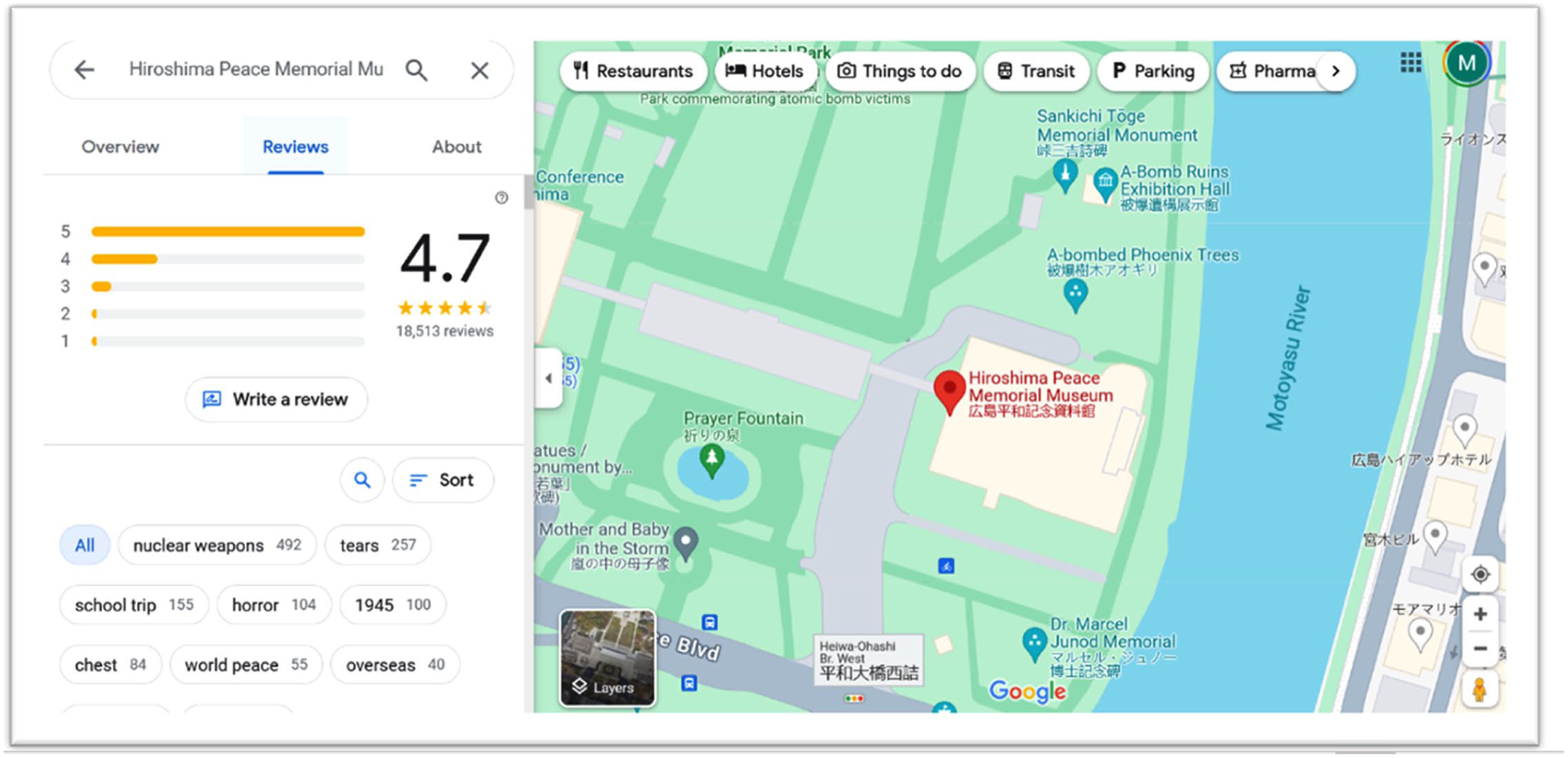
Hiroshima Peace Memorial Museum GMR web page.
As noted earlier, the evaluative function is a narratological hallmark, in part because it supplies subjective significance, and has come to be commonly appreciated as “the most significant part of Labov’s framework” (Johnstone, 2016: 555). Thus, the requests to “Rate and review” and “Share your experience to help others,” the quantification of the evaluations, and the highlighting of the attraction’s overall single numeric score, emphasize the evaluative nature of visitors’ experience. Thereby, the interface of GMRsP suggest an adaptation, or even co-optation, of the evaluative function of visitors’ “small stories” by and into the socio-technical space of the sub-platform design (Georgakopoulou, 2022, argues that social network sites enthusiastically co-opted personal narratives into their “Stories” feature). This also suggests that the overall score visitors supply concerns one evaluative element in the story, while the qualitative (verbal) part may address a different element.
The second type of contribution that the GMRsP affords, which is discussed below, is qualitative: users are invited to share a verbal review, as well as pictures and short video clips. GMRsP supplies a blank text box for free writing (4096-character limit), with a caption that directs users to “Share details of your own experience at this place” (Figure 2). 2
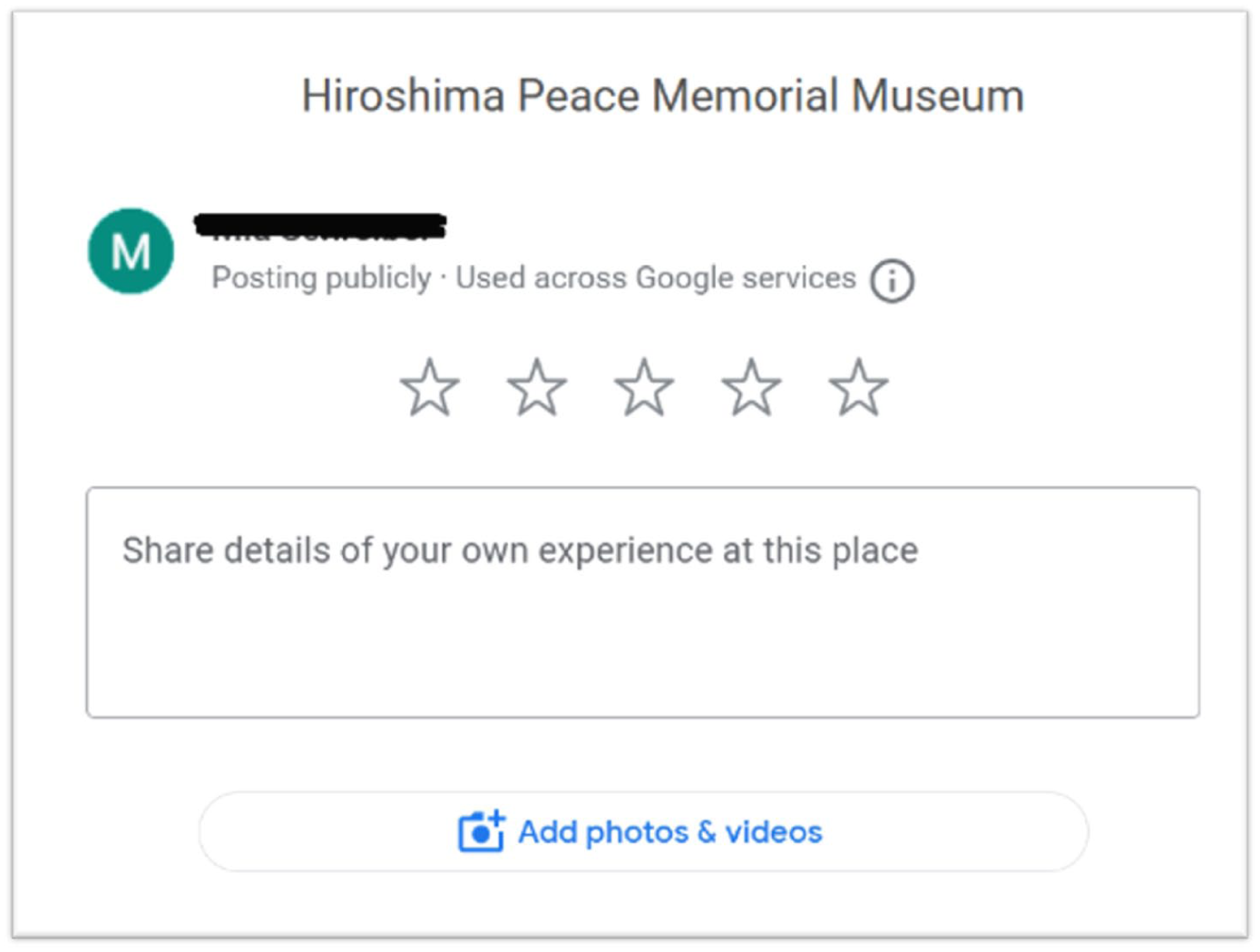
The review text box —Hiroshima Peace Memorial Museum.
In the next sub-section, we analyze the sub-platform’s design and affordances through narratological lens and concepts. We start by introducing the different types of narrative actions that users-as-writers can perform in the blank text box, after clicking the “Write a review” button, followed by a discussion of the “keywords” buttons, and their significant role for both users-as-writers and users-as-readers. We then move to discuss what the “Sort” button can afford users (users-as-readers). Employing the post-Labovian and post-structural narratological framework we developed (above), with its stress on both structure and changing participatory practices and roles, we seek to illuminate the meaning of GMRsP interface and its potential implications for its users.
The “write a review” button: narrative coda, resolution, and orientation
Right after the score ranking of the museum, appears the “Write a review” button (with a little pen/pencil icon. See Figure 1). Clicking on this button opens a different window, where users can rate the museum and write a review. While we mostly have in mind the verbal element of the review, other modes are available (images, for instance), which correspond with different communication channels: uploading an image versus writing a text. Importantly, the mode or the channel that the platform affords may not correspond with users’ type of participatory action. Consider for example the difference between posting an image of the iconic historic entrance to Auschwitz Concentration Camp, or posting a selfie (Dubrofsky, 2020). In terms of communication modes and channels, and in terms of platform technological affordances, these are identical forms of contributions, yet surely not so in terms of participation and type of engagement activity. The same holds for textual reviews written in the allocated space. Narratologically, there may be a variety of types of actions that users perform, and of positions, stances, and engagements that users take in terms of what they intend to accomplish by sharing written reviews. These are then not merely independent or decontextualized “textual actions” that users’ reviews accomplish, but actions shaped by the platform which in turn may shape platform dynamics.
In the case of users-as-writers, reviews on GMRsP can be seen as the narrative coda or resolution (Labov and Waletzky, 1967). Recall that the coda is the story’s closing segment, and acts in connecting past events to the present moment. Originating from the Latin “cauda” (meaning “tail”), the coda “serves as a bridge from the story world to the current time of telling” (Vásquez, 2012: 12). Two different times or timestamps are involved in GMRsP (and other digital platforms): the first concerns users-as-writers, and is the time of sharing the review (“current time of telling”), and the second, which will be discussed below, involves users-as-readers and the time of reading the reviews. In any case, it is noteworthy that all reviews as such function as coda inasmuch as they serve in bringing the visit’s evaluative storied experience to the platform’s time/timeline.
The narrative resolution refers to the segment that concludes the story, usually supplying a sense of closure, and is typically located before the coda. The term “resolution” does not necessarily indicate that the story has been resolved, or that it has been resolved satisfactorily. It rather points at the function that performs this point, its location within the overall structure, and that such a function is common (but not required) in narratives. For users-as-writers, the writing and posting of the reviews serves essentially (structurally) as a coda, while the content of the reviews can function as the narrative resolution element, as they often describe the conclusion of the visit—the articulation of the experience. Labov and Waletzky (1967) have pointed out that the resolution typically supplies a sense of completeness, so that the audience will not discredit or undervalue the story and ask, “so what is the point?” (p. 32). Here, the point concerns the visit-worthiness of the attraction and of the historical story it narrates. Furthermore, we note that when the GMRsP is approached by users-as-readers, who are searching for reviews, these texts serve as brief narrative orientation segments, which typically precede the narrated events and functions to briefly familiarize or orient the listener to the situation. From this viewpoint, the platform’s communication design is spiraling, where the coda of one (small) story serves as the orientation and beginning of another.
The keywords buttons
As seen in Figure 1, beneath the “Write a review” button, several buttons with keywords are displayed, along with the number of their occurrences (“horror 104,” for instance). These keywords can have both priming and framing effects on users’ reviews. In media research, priming refers to “the effects of the content of the media on people’s later behavior or judgments related to the content that was processed” (Roskos-Ewoldsen et al., 2009: 75). Narratively speaking, these words can serve as one-word narrative orientations, that is, as a scene-opening apparatus that is an amalgam of the platform and its users. Hence, for users-as-writers, the display of keywords on the museum’s GMRsP webpage may direct the writers, consciously or not, what to focus on when writing their review.
Furthermore, these keywords can also, potentially at least, effect and shape their evaluation of the site and in fact, its visit experience. For users-as-readers, the presence of keywords on the GMRsP webpage can be used to imply what is to come next. In the case of the Hiroshima Peace Memorial Museum, for example, one of the most prevalent keywords is “tears” (Figure 1). By clicking on this keyword button, as can be seen in the following examples, readers receive mostly emotional colored reviews which often include dramatic descriptions of the visit experience, and in some cases also extensive expressions of sadness, pain, and emotional flooding, alongside a visceral description of physical or embodied sense of tearing or crying during the visit 3 :
As a European that has also visited Auschwitz i have to day [say] both places are impressive in their own rights. While both were horrible events that should never happen again, this museum managed to make it so personal that it moved me to tears . . . Do be warned thought the content can be graphic and shocking. [October 2023]
The highlight of our trip to Hiroshima. The most powerful museum I’ve ever visited in my life. My advice, bring a pack of tissue inside because the horror will definitely bring you to tears. I literally couldn’t stop crying seeing all the heartbreaking stories of those affected by the bombing. [December 2021]
Go! Just go. For less than 2 USD, you will see exhibits that you’ll never forget. Most are painful and unsettling but there are a couple that restore your faith in humanity . . . I don’t have children and images of death don’t bother me but some of the exhibits brought me to tears. [December 2019]
The small stories (the average length of which is about 60 words) function as reviews that provide a narrative evaluation of the visit, in which emotional terms and descriptions serve as arguments in favor of the museum. In example 1, after establishing authorship (“has also visited Auschwitz i have to day [say]”) the review stresses it was the emotional experience that made this visit stand out in comparison with Auschwitz: “graphic and shocking” content and “moved me to tears”; in example 2, following a passionate positive evaluation (“The most powerful museum I’ve ever visited in my life”), the emotional effect/affect is described: “bring you to tears. I literally couldn’t stop crying . . . heartbreaking stories”); and in example 3, after opening with a succinct recommendation (“Go! Just go”) and reminding the reader of the clichéd duty of remembrance (“you’ll never forget”), the exhibits are described as “painful and unsettling . . . brought me to tears.” These emotional narrative evaluations attest to the visit’s success, and the emotional nature of the impression (and memory) it has left. However, when clicking on a different keyword button (not the “tears” button), quite a different type of evaluation may be displayed. Such as, for example, reviews that focus on the factual layer of the historic story the museum narrates, where questions of context and accuracy are centrally discussed by users (see elaboration in the next section).
That is, the availability of keywords in GMRsP’s narrative design can frame both the museum and its visiting experience to the users-as-readers before they begin reading the actual reviews. As studies that focus on the narrative function of headlines show (Dor, 2004; Molek-Kozakowska, 2013), the initial framing of headlines can impact and shape the reading that follows. In the case of GMRsP, the presence of keywords can influence the way in which the museum is perceived by readers, or put differently, GMRsP’s design choice to afford keywords in the museums’ webpage can affect users, whether as reviews writers or readers. We can also see how, by utilizing a digital narrative framework, insights into audiences’ “new ways of responding to [narratives] and of organizing participation around them” may emerge (De Fina, 2021: 53).
The “sort” button
Below the “Write a review” button (beneath the line, Figure 1), two additional icons are noticeable: one with a magnifying glass button and another with the caption “Sort.” By clicking on the magnifying glass icon, one can search reviews by typing specific search words, and by clicking the “Sort” button, one can choose to organize the reviews in one of the four options, in this order: Most relevant, Newest, Highest rating, Lowest rating (GMRsP’s default is “Most relevant”). The possibility of organizing the reviews layout using various indicators (temporal, numeric, textual) is consequential, and enables different paths for narrative readings of the reviews. As mentioned above, by deciding to click on a certain keyword, readers “enter” a certain path for understanding and narrativizing the museum experience and the resolution/coda of the story of the visit. However, by clicking on a different keyword, the path changes and readers receive a different resolution/coda, and the same holds for the temporal or numeric filtering options. That is, by choosing to organize the reviews from lowest to highest, one can receive a whole different story about the museum and the visit, rather than by choosing to filter the reviews from highest to lowest, or the “most relevant” option (in which the filtering algorithm is unclear, such as how GM decides what are the “most relevant” reviews for readers).
To demonstrate this claim, consider the following examples, retrieved from GMRsP of Hiroshima Peace Memorial Museum during December 2023. When choosing the Lowest rating filtering option, readers are exposed, among other things, to a specific criticism that mainly challenges the museum’s historical and factual narration:
4. The gruesome photographs and testimonies are important to convey the horrors of nuclear warfare. However, the museum offers little historic context to understand the reasons behind the US’s decision to annihilate Hiroshima and Nagasaki. Japan’s own responsibility is largely ignored . . . [the museum] presents a skewed version of history that seeks to present Japan in a positive light. This unwillingness to deal with Japan’s history undermines the message of peace that the Memorial Park is supposed to send. [August 2023]
5. White washed and completely ignores the atrocities japan committed during the war. See Nanking, unit 731, etc. War is terrible, but it’s even worse for them to be dishonest about the past just to “save face.” Avoid history from repeating itself by learning from it. [October 2023]
6. Awful. It pictures the Japanese people as the victim of a conflict in which they killed hundreds of thousands of innocent people and they don’t even mention that, which is precisely the cause of the bomb which puts a hard end to the conflict. This museum is pure propaganda to try to face wash the atrocities of a nation. Shame. [May 2023]
These small stories directly protest and challenge the museum’s narration of the dropping of the atomic bomb by the United States on the cities of Hiroshima and Nagasaki, because it is biased and lacks the broader context in which it occurred, including the Japanese aggression during WWII that preceded it. In this case, the visit’s negative narrative evaluation provides quite a different path for users-as-readers. In contrast to the reviews under the “tears” keyword category (see above), which praised the powerful and positive emotional experience the museum supplies, these small stories offer non-emotionally themed negative evaluations, that illuminate the experience of the visit in a different light: “little historic context” and “a skewed version of history” (example 4); the museum “White washed” Japan’s part in the war (example 5); and “pure propaganda to try to face wash the [Japanese] atrocities” (example 6). In this way, these small stories argue that the museum is deliberately mis-narrating history, which in fact “undermines the message of peace that the Memorial Park is supposed to send” (example 4).
It is noteworthy that due to the uploading of new reviews and GMRsP’s changing display algorithms, the search results change from time to time. However, at the time of writing, out of the first 20 reviews filtered through the Lowest rating sort option, 12 reviews criticized the museums’ historical perspective, arguing it presents US atomic bombing of Hiroshima and Nagasaki without its wider international and political contexts. In contrast, none of the first 20 reviews which were filtered through the “Sort” button of Most relevant included this type of criticism (various explanations may account for this). As in the case of the keywords buttons, the possibility to sort the reviews via different criteria enables users-as-readers different paths to evaluate the museum, using the experiences of others.
Numerous narrative “endings” may emerge that can leave a different impression of the museum visit and allow users to receive different stories in relation to the museum and its visiting experience. Hence also new narrative “beginnings” (or orientations). However, the answer to the question of whether users are indeed exposed to this variety of narrative stances and opinions, do they navigate between the various filtering options, or do they choose only one path or story to follow, remains open (Google does not publish statistics about how Maps is used. See Graham and Dittus, 2022: 167). And so are the algorithmic dynamics which shape what content users may access and read.
Conclusion: the narratological qualities of GMRsP
This article offers a conceptual contribution to the understanding of Google Maps Review, approaching it as a distinct (sub-)platform with specific design and affordances that revolve around review sharing—writing and reading reviews. Theorizing GMRsP from the perspective of media and communication studies, and narratively focusing on an up-close examination of platform design, participatory affordances, and activity, reveals how the reviews serve as meaning-making and value confirming (or contesting) small stories, that are shaped by techno-digital contexts, which they simultaneously also shape. This is valuable, we believe, considering emerging research on the consequences of this sub-platform, the mixture of terms which hinders a clearer holistic view, and broader advances in appreciating web-platformization, users’ online activity, user-platform dynamics, and platform-sub-platform relations.
The narratological framework the article promotes, bridges structural (Labovian) and post-structural concepts, and helps view the activities taking place on GMRsP as essentially building on travel to destinations which can then be reviewed and evaluated. For the GM platform, the addition of the option to contribute reviews (i.e. GMRsP) is a considerable extension. It augments it in terms of use (traffic) and types of engagements, and supplies it with a highly profitable and freely contributed qualities of narrative reliability and authenticity, which only users can both provide and appreciate (“A key part of what makes Google Maps a trusted resource . . . are reviews: written by users, for users,” as GM puts it; Kanakarajan, 2022; see also Bhandari and Noone, 2023; Polson, 2018). GM should be comprehended as a platform whose review sub-platform allows users to transfigure the map into an interactive guidebook or comment book, where they can narrate experiences, impressions, and evaluations (Alacovska, 2016; Buckley-Zistel and Williams, 2020). Especially so as recent critical studies have begun to problematize the consequences of this type of content, including accelerated gentrification, hyper-visibility of “marked” populations, platform urbanism, and more (Bhandari and Noone, 2023; Tarr and León, 2019).
The holistic narratological framework we offer helps examine the main elements and functions that shape practices of sharing reviews, mainly affordances and design features concerning writing and reading them. Studying these features up-close points at intricate inter-relations between design/affordances, on the one hand, and the reviews’ content and what they accomplish, on the other hand. The small stories that users-as-writers produce are displayed differentially by the sub-platform, which may allow for the shaping of different narrative paths or narrativizations for users-as-readers to follow. Conversely, these narrative paths may shape how readers may initially perceive the destination, and structure their experience once there and later when reviewing the site. Here is an interdependence between platform features and the content reviews share, which generates what we called the sub-platform’s emergent spiraling communication design. This spiraling creates a poly-narrative environment, where narrative functions (sometimes carried out by single keywords that the sub-platform algorithmically draws from the user-created reviews and displays), are intertwined to alternately shape different points of entry into the stories and different conclusions.
By analyzing the different small stories under the suggested keywords for specific sites, as well as the various stories accessed through the “sort” button, future studies focusing on the narrative evaluation reflected in GMRsP can further investigate the different types of narrative paths—be them emotional, factual, historical, moral, addressing sites’ material dimensions (“For less than 2 USD”), and more—that emerge from each evaluation. While the examples presented above demonstrate the narrative qualities of GMRsP, they also provide a glimpse into the different, and sometimes conflicting, narrative paths that users produce/receive using the sub-platform’s affordances: On the one hand, an emotional, enthusiastic, and supportive view of (presently) Hiroshima Peace Memorial Museum and its message for peace; and on the other hand, a harsh critical view, which challenges the museum’s historical and factual narration.
By pointing to the different small stories and their various connections to bigger stories, this post-structural perspective may highlight power-relations within the tripartite matrix of GMRsP, museums, and visitors/users. The various GMRsP affordances we discussed, such as sorting and filtering, serve in assembling and displaying multiple small stories, which may amount to larger collective (big) narratives, be them factual, emotional, critical, etc. Hence future studies can emphasize the sub-platform’s essential role as an arena of public articulation, contestation and meaning-making of memories, evaluations, and experiences of places visited. If GM helps people to cross spaces and reach places, GMRsP is a space onto itself, which may serve as a Bourdieusian evaluative (narrative) marketplace. In addition, research exploring the usage patterns of GMRsP could reveal how users actually engage with the sub-platform before and after their visit, and how they describe its impact on their on-site experience.
Related to this is the generative employment of a narrative framework as a context-sensitive and practice-centered approach. We found it illuminating in terms of the affordances of storytelling practices in digital environments (Georgakopoulou, 2022), and also, in a complementing fashion, in terms of how these small stories themselves may shape options and structures of participation (De Fina, 2021). Small stories can be approached as a digital genre, where the term is less concerned with structural elements and more with social (inter-) actions texts may afford (texts’ affordances. Alacovska, 2016; Bakhtin, 1986). Relatedly, we addressed calls in narrative studies for critical perspectives that can “pinpoint further the specifics of the technological, socio-cultural, and political embeddedness of narrative practices” (Giaxoglou, 2021: 218). By moving “backwards” from data to platform, our contribution seeks to highlight the opaque role that the platform performs as a narrative agent. A narratological view may also shed light on the inter-connections between digital practices of place-making and story-making.
The contribution offered by the narratological framework we developed extends beyond GM and GMRsP, and concerns platform studies more broadly. We noted that the “sub-” in the sub-platform conceptualization, highlights the inter-relations between ecosystems, presently how GM spatialized or “locates” online practices of reading and writing reviews, or that it displays data collected through GMRsP (when hovering over a site, the number of reviews and overall ranking is displayed, and users’ photos).
Yet the essential contribution of a narrative framework to platform studies is considerably wider: first, it is revealing in terms of identifying nuanced emergent structures of participation, and relatedly a rich mosaic of types of stories and evaluations. This is immediately relevant to commenting and reviewing platforms, but also, more broadly, to understanding participation and evolving social dynamics in a wide range of digital platforms, infrastructures and ecosystems. Second, light is shed on possible or potential relations between platforms and sub-platforms, importantly construing these relations as technologically undetermined. What happens on sub-platforms—presently, small evaluative stories on GMRsP—may shape user practices and eventually larger social dynamics in relation to platforms; or in other words, we cannot understand platform dynamics without looking up-close at sub-platform’s designs, affordances, algorithmic preferences, and emergent types and structures of participation. This is what the finding concerning the emergent spiraling communication design reveals: users may virtually travel between stories which may or may not shape how they make sense of places, and which destinations they may eventually visit. Furthermore, in the case of GM and GMRsP, the latter can be accessed only through the former, but the sub-platform concept suggests that whether these users wish to travel or have already traveled (using GM), is an open question: for some usesers, platform dynamics on GMRsP, stories and evaluations, may have little or nothing to do with actual travel (GM). This remains to be examined in future research.
Third, the emergent spiraling communication design can be appreciated in the context of “filter bubbles” (Pariser, 2011), where the (sub-)platform shapes the specific content certain users, and not others, may access. Here as well further empirical research may reveal how GMRsP’s algorithmic perosnalized preferences orchestrate evaluations, meanings, and memories, managing in this way the relations between small and big stories.
Footnotes
Acknowledgements
Eelier versions of this research were presented at the 75th Annual Conference of the International Communication Association in Denver, and at the Annual Association of Internet Researchers Conference, in Sheffield. The authors are deeply indebted to Sarit Navon for her insightful comments on earlier versions, as well as to the Journal’s anonymous reviews for their helpful and constructive suggestions, and to the Editor for managing the review process.
Correction (October 2025):
In the published version of this article, the citations “Noy, 2021a and Noy, 2021b” were inadvertently omitted from the text. These citations have now been inserted at the end of the second paragraph on page 3, and the corresponding reference details have been added to the reference section. The online version of the article has been updated to reflect these changes.
Funding
The authors disclosed receipt of the following financial support for the research, authorship, and/or publication of this article: This research was supported by the ISRAEL SCIENCE FOUNDATION (grant no. 2460/21): “Museum audience remediation of difficult pasts: Narrative analysis of user-generate content in relation to nine dark history museums”).
