




Abstract
New media platforms offer diverse modes of mediation of every day and tourist places and communities. Spatial social media now augment older forms of mediation, partly by enabling contributions from ‘ordinary’ users, who create and share spatial discourses. This study examines the discursive construction of peripheral places, produced through user-generated content. Employing qualitative methodology, we sample and analyze 1,053 texts, shared on Google Maps in southern regions of Israel. The key conclusions suggest that compared to traditional media discourses depicting peripheral spaces in Israel, the findings demonstrate a shift from homogeneous depictions to more diverse and multilayered ones. Digital affordances result in more actors and stakeholders partaking in discursive construction, including private and institutional local players, visitors and tourists. Theoretical contributions are offered to the field of digital placemaking, by considering the subjective, evaluative and ideological layers that augment geographical data digital maps provide (‘bottom-up’ perspective), and to the fields of study of marginalized peripheral and rural communities and tourism crisis in peripheral (post-Coronavirus) locations.
Keywords
Introduction
The spatial turn in the humanities and the social sciences (1960s–1970s) paved the way for dynamic, constructionist and critical approaches to socio-cultural and political dimensions of sites, place, and space. As objects of research, places and spaces have since ceased to be perceived as neutral, static, and physical entities, but as processual and performative junctions, which are the complex products of an array of forces, stakeholders and interests at a given historical period. The post-structural works of Lefebvre (1991) and Massey (2005) opened the door to fertile interdisciplinary research, highlighting the entanglement of aspects, influences, and consequences of spatial construction of life experiences and human movement to, and inside, sites, places, and spaces. These are witnesses in the spatial turn in media studies (El-Hibri, 2017; Jansson and Falkheimer, 2006), and in return, in the communicational turn in geography (more on this below), resulting in a view of places as ‘specific time-space configurations made up of the intersection of many encounters between “actants” (people and things)’ (Agnew, 2011: 325).
Despite these interdisciplinary ‘turns’, the relations between new communication interfaces and spatial construction and mediation, have been relatively under-researched in communication studies (Adams, 2009). The origins of this lacuna are unclear since, in the foundational works of Harrold Innis and Marshal McLuhan, discussions of the relations between communication means and processes, on the one hand, and dimensions of time and place/space, on the other hand, were central. Later, in his book No Sense of Place, Meyrowitz (1985) pointed to the far-reaching consequences electronic media had (mainly television broadcasts) on the creation of a ‘placeless culture’ (p. 8). Meyrowitz worriedly noted that media-oriented studies of place and space were becoming marginal in the discipline.
In a comprehensive review of the state of cultural geography, Adams (2018) stresses media’s foundational role in the production of place and space, and in constructing human experiences therein and thereof. He argues that ‘communication holds places together’ (Adams, 2009: 167), and that therefore, the dearth of media and communication studies on these topics, compared to nearby disciplines, is noticeable. Adams further points at approaches that can bring together geographical and communicational aspects under the same research roof, observing that they are ‘spiraling out from the conventional perspective of the representation as a thing, an object bearing meaning, to a newer sensibility of representation-as-practice, an ongoing process of making and remaking meaning’ (Adams, 2017: 371, emphasis in original here and hereafter). Likewise, Cante (2015: 5) emphasizes that ‘place and media are particularly interesting to think together. Through one, we understand the other better’. His viewpoint offers an organic interdisciplinary approach to the construction of spaces and places.
The notion of the construction of space first appeared in studies in cultural geography in the 1960s, and since 2015 had come to address the digital construction of space, mainly in media and communication studies (Basaraba, 2021). According to Halegoua and Polson (2021), ‘“digital placemaking” describes the use of digital media to create a sense of place for oneself and/or others’ (p. 575). The topic bears empirical and theoretical significance, due to the rapid pace of changes in digital media affordances, in users’ expectations concerning access to spatial-digital information (Barkhuus and Wohn, 2019), and in the enhanced mobilities in and in-between spaces. In a recent review, Basaraba (2021) investigates the sources and meanings of the construction of digital space and space-making across disciplines, noting that the topic has been widely studied in the contexts of sense of place, immigration, identity, and top-down construction. In her conclusions, Basaraba presents proposals for future communication-centered research, which include the study of bottom-up collaborative constructions of place, focusing on practices of construction of digital places and spaces as emerging in distant and rural locations.
Our study seeks to address the complex and emergent nature of spaces, the research lacuna Adams (2017) and Basaraba (2021) note, and the call for research they voice. It examines how user-generated content (UGC) contributes to the digital construction of space, and to the discursive mediation of peripheral places, specifically in Israel and on Google Maps (GM) application. We examine textual formulations that ‘ordinary people’ – tourists, visitors, and locals – formulate, upload, and share publicly. We take a qualitative approach to the study of the place-media nexus (Cante, 2015), and to the way in which new participants (actors) are involved (‘from below’) in online design and mediation of offline spaces.
The global tourism industry possesses unprecedented power in the material and symbolic (representational/mediational) construction of spaces (Baerenholdt et al., 2017; Saarinen and Wall-Reinius, 2021). The industry has also spearheaded the digital turn, through a quick and widespread utilization of online evaluation platforms. While tourism destinations are grounded in geo-material infrastructures, they are also intensely mediated, which is essential to the production of the much sought-after, site-dependent, and spatially anchored tourist experience (Campos et al., 2018; Munar, 2011). As Thurlow and Jaworski (2014) observe, tourism growingly ‘emerges as/through a series of mediated actions’ (p. 468). This is at the same time a practical concern and a theoretical issue, especially for peripherally located destinations and businesses that rely on tourism livelihood. Therefore, a study that qualitatively analyzes tourists’ and visitors’ reviews on a popular media platform, such as GM, may shed light on how ordinary people choose to describe spaces, specifically peripheral spaces, which established media (in Israel as elsewhere) has neglected to cover or has covered negatively.
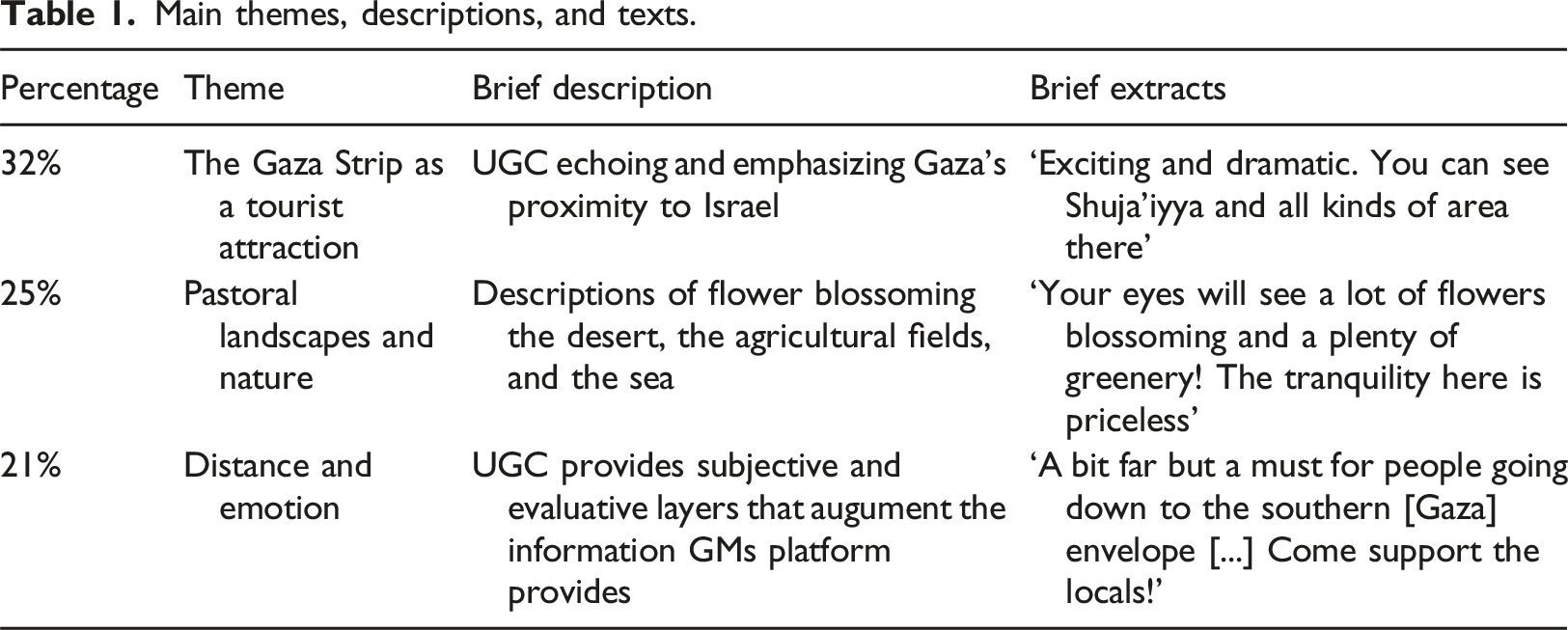
Bellow we briefly review several historical crossroads that touch on media coverage of peripheries in Israel, beginning with traditional media outlets. We then discuss digital mediation of the same, by briefly presenting the impacts that the tourist industry has had on the online framing of spaces and their spatial construction. After the methodological section, in the findings section, we present the three main themes that emerge from the UGC we analyzed: (1) the prominence of the Gaza Strip as a tourist attraction; (2) the pastoral landscapes and nature; and (3) issues of distance and emotion – ‘(physically) distant, but close (to the heart)’. In the Discussion and Conclusion section we summarize the findings, and point at several theoretical advancements, including how UGC servers in ‘bottom-up’ digital placemaking, and the ways users’ discursive work ‘completes’ the information digital maps provide by supplying subjective and evaluative knowledge layers. We then address several limitations and future research possibilities.
Mediated peripheries in Israel
Historically, the mediation of spaces, places and communities in Israel’s peripheries was pursued by traditional mainstream mass media outlets, and to a lesser degree, also by tourist brochures, postcards, etc. The research of mediation of peripheral spaces in print and broadcast media began in Israel in the early 1980s, and developed to a degree that it came to be one of the cornerstones of the field of Israeli media studies (Avraham, 2003). The studies mainly explored mass media that was concentrated in the geo-cultural and geo-political center of Israel, critically highlighting the dichotomous relations between the center and the periphery.
The research findings from that time showed that, for several decades, media coverage confirmed and strengthened the hierarchical and dichotomous division of center-periphery relations in Israel – mostly by providing little and partial coverage of the peripheries, which highlighted negative dimensions (Avraham and First, 2006). This included consistent use of stereotypes and generalizations, focusing on a narrow and superficial set of themes (Lahav and Avraham, 2008). The media served as a gatekeeper of information between the country’s center and its peripheries, performing ‘the power to block, reorganize, or rephrase this information’ (Avraham, 2003: 16). Reviewing four decades of media coverage of Israel’s peripheries (1960s–1990s), Avraham (2003) concluded that the coverage was negative and condescending, and that, moreover, over time it became increasingly sharper and more distinct. The negative framing included discourses of poor, dirty and dangerous cities and towns. When reports with a positive orientation were published, they tended to highlight folklorist dimensions, alongside exotic anecdotes that focused on Oriental communities (Avraham and First, 2006).
Since the mid-1990s, this type of mediation of peripheries has been challenged, becoming as a result more subtle and multilayered. Demographic and technological changes opened the way for local and sectorial channels of mediation, which were consumed – and to some degree also produced – in the peripheries (Tzfadia and Yacobi, 2011). At the same time, global advances in the study of the social construction of spaces and places witnessed increased complexity, in part due to the influence of post-structural and post-colonial thinking. Peripheries came to be perceived as more diverse – no longer as monolithic and homogeneous – and as existing within a network of interrelations and tensions between various socio-cultural, economic, religious, national, and other identifications (Caspi and Elias, 2011; Chaitin et al., 2022).
Studies on peripheries in Israel since the 2000s, discussed the environments new media afford. They highlighted the changing interests relating to news production and emphasized the need for accuracy when conceptualizing the notion of ‘the periphery’ (Manosevitch and Lev-On, 2014). These changes reflected a move toward critical approaches and more complex conceptualizations. A stronger emphasis was now placed on the essential role that media outlets fulfill in placemaking processes, in spatial experience, and their significance for a variety of communities and audiences.
Studies undertaken during the last decade in Israel, strive to historicize and connect the notion of space with a sense of place (Zambel and Sasson-Levi, 2021). While, historically, spaces in Israel were perceived by default as exclusively national places, lately, the use of the concept of place has come to assume fresh meanings that are interpreted based on local or regional sensory experience, social interaction, and the like (Yacobi, 2016). Studies further observe that a more precise understanding of the dynamic relationship between space and place requires an up-close qualitative examination of spatial discourses and constructions, while at the same time focusing on places as consumed and experienced. As a result, the notion of ‘place’ becomes more diverse, and has been viewed as a complex and ongoing social-material process, which includes ‘systems of symbols and values that people are the actors in content, collective memories and power relations’ (Shavit, 2013: 313).
Different actors – including residents, visitors, and tourists – experience, interpret and perform places in different ways. Actors take diverse spatial and place orientations (Frith and Richter, 2021), whereby the same landscape, street or memorial site raises distinct feelings among the different actors and affords different discursive constructions and modes of mediation.
Peripheries 2.0
The compound notion of ‘peripheries 2.0’ reflects the focus we put on mediation and social construction of space, as pursued via digital and participatory platforms. The dominance of digital interfaces, led by social media platforms such as GM, marks a transition from a one-way type of broadcast, characteristic of Web 1.0 and prior media outlets, to participatory and interactive communication practices, characteristic of Web 2.0 and beyond. The emergence of the Internet and later the introduction of Web 2.0 platforms in the first decade of the new millennium, dramatically altered global and local media landscapes. Accordingly, the modes of spatial mediation changed irreversibly. While, in the past, consumers, visitors, tourists and residents, enjoyed only limited access to resources for the collection and sharing of information and experience, in recent years online review platforms have become far more accessible. Users began basing the knowledge they draw on, on the information created by other users.
Everyday and tourist destinations are increasingly mediated by visitors, tourists and locals, who re-present and re-brand them in different review sites and according to different viewpoints. Review sites and platforms, such as GM and TripAdvisor, serve as vibrant and polyphonic public arenas of and for discourse of spatial knowledge and experience, which can be easily produced and shared in unprecedented scopes. Place-mediating discourses have been shaped anew (redesigned), by relying on new spatial practices (Bigne et al., 2021). Although new media in general, and online evaluation platforms in particular, have been identified as significant players who actively contribute to the construction of place (Hall and Page, 2014), most of the research in the field is quantitative and tends to examine businesses (mostly restaurants and hotels). Hence the contribution UGC makes to the construction of non-commercial sites, places and spaces remains elusive.
An additional central characteristic of Web 2.0 platforms concerns their affordances, which provide users with the ability to create, author, share and retain UGC – online content that is voluntarily produced by ‘ordinary’ users without financial profit, and may be characterized by verbal, visual, and quantitative information. UGC, Główczyński (2022) writes, ‘could be considered a mechanism of digital placemaking, whose role is to combine and augment material world experiences and imaginations about places within digital place representations’ (n.p.n.). Web 2.0 platforms play a part in the dramatic shift in the digital mediation of peripheral spaces, places and communities. Essentially, the latter’s physical (offline) existence is increasingly influenced by their online visibility and presence, and a closer than ever complex affinity is established between the two spheres. As Adams (2018) asserts in emphasizing the key role of digital media, ‘people are stitched together in space, place and time by acts of communication through spaces, places and times that simultaneously create spaces, places and times’ (p. 591). This fact is increasingly conspicuous due to the widespread use of online review platforms in tourist contexts.
Tourism 2.0
Global and domestic tourism industries are prominent players in the construction of sites, spaces, and places, as well as in their mediation and social framing. The former aspect concerns the fact that in addition to being a service industry, tourism is also tightly related to the business of real estate (hotels, resorts etc.), and the second aspect concerns the representational power of the industry (visual adds, verbal guides, etc.) (Chaitin et al., 2022; José and Milano, 2022). These industries have led the digital turn by their quick and widespread use of online review platforms (Moro et al., 2019), and have had a decisive impact on the definition of places as attractive or repulsive, safe, or dangerous. Tourist discourses are perceived as essential for the production of the desired tourist experience, which is dependent on, and anchored in, locations (Stoffelen, 2022; Vásquez, 2012). Tourist discourses concern activities that ‘management agencies, other mediating bodies, and individuals strategically and ordinarily engage in to purposely privilege particular dominant representations of peoples/places/pasts’ (Hollinshead, 2009: 643). Shavit (2013) adds that the tourist discourse, ‘presents the consumer with a kind of riddle in which a theory of place is hiding: an imagined construction of a tourist destination, as a place with a unique character that carries with it a unique atmosphere and provides a unique experience’ (p. 316).
Such constructions generate a desire for experience – for visiting the destination and perceiving it as ‘a place’. According to Sheller (2007), tourist sites and activities are complex entities, ‘which take shape through sets of practices and performances, as people, things, and information move around reassemble’ (p. 2). Crouch et al. (2005) add that places possess a component of leisure-time and recreation. They call for the serious study of visitors’ descriptions of their experiences in both local and touristic spaces.
It is important to note that during the period covered in this study, the peripheral areas we studied faced the peak of the global Coronavirus crisis (the spread of the Coronavirus in Israel in began February 2020). Among the steps taken to reduce the spread of the virus, were imposition of closures, bans on gatherings, closing the borders to foreign citizens, and more. As a result, tourism to the peripheries was severely damaged (The Ministry for the Development of the Periphery, the Negev, and the Galilee, 2022). This was exacerbated because of this tourism’s specific reliance on the growing trend of ‘participatory tourism’, whereby tourists are increasingly seeking authenticity and active engagement at rural and distant tourist destinations and with local folks. Examples include local culinary workshops, rural hospitality, cheese and wine production and tasting workshops, border tourism, and more (Inkson, 2019).
Online review platforms, such as GM, are perceived as especially relevant for users who seek tourist information about, and evaluation of, places and experiences (Borrego and Navarra, 2021). Discourses shared on such platforms are consumed before, during and after the trip (Li and Hecht, 2021), while in movement or at rest. UGC that tourists produce, and share serves as an electronic word-of-mouth, which lead the users to online review platforms for pursuing a place, a product, a service, a destination, or alternatively, for avoiding them (Nechoud et al., 2021). Both tourists and residents consistently affirm that UGC is viewed as more trustworthy than information provided by official sites, tourist agencies and mass media. E-word-of-mouth is seen as possessing the authentic and personal viewpoint, freeing the review of interest or profit (Varkaris and Neuhofer, 2017).
Methodology
The research site: Google Maps
The study examines UGC that was uploaded and shared on GM. GM is a network application of the type of social media (Stoycheff et al., 2017), and is the most common online spatial review site and search engine (Van Der Zee and Bertocchi, 2018). As Plantin (2018: 490) notes, when comparing GM to traditional infrastructures (highways, etc.), the platform ‘provides a service without which contemporary societies could hardly function anymore, similar to infrastructures’. To this we add that GM may be currently viewed as an infrastructure (and not anymore only ‘similar’ to one).
In 2007, Google became the world’s leading digital provider for maps, a status that has yet to be undermined (even though additional players have joined the field of mapping (Gibbs, 2015)). The history of the application demonstrates that it is constructed from complex specifications that developed at different speeds and that continue to develop (McQuire, 2016). It is technology on the move, without a final shape (Dalton, 2015). GM embodies the transition from media to geo-media, or to a state in which communications is omnipresent, space-sensitive, and affords feedback in real time (McQuire, 2019). While uploading UGC to GM requires opening a personal profile, accessing, and consuming UGC is available globally without such a profile.
Data collection and analysis
For this study, 1,053 units of UGC were collected. These were uploaded to GM between March 2018 and August 2021, and were collected from 16 listings of memorial sites located in Jewish cities and regional councils in Israel’s southern periphery (cities: Sderot, Netivot, Ofakim, Dimona, Yeroham, Arad; regional councils: Eshkol, Sha’ar Hanegev, S’dot Negev and Hof Ashkelon). The sampled sites were chosen based on the Peripherality and the Socio-economic Index (Israel Central Bureau of Statistics, 2015a, 2015b). To these, we added reports published by both governmental organizations and NGOs (Svirsky and Conor-Atias, 2019), that include levels of education, income, and health, among other factors. Our goal was to combine different measurements that reflect geographical and socio-economic dimensions.
The UGC that was collected includes profile name, the site’s location the overall ranking (1-5 stars), texts, photos, video clips, the number of shares and likes, and the date of publication. In the next stage, we focused solely on texts – to limit the scope of the research to verbal content. The 1,053 texts that were sampled were in Hebrew and English, and included a minimum of 10 words (with an average length of 23 words). They comprise 91% of all the texts in the profiles of the memorial sites on GM (Vásquez, 2012).
The thematic analysis included coding and qualitative data processing, with the aim of identifying repeating prominent themes (Bryne, 2022). The analysis was done manually and in an iterative manner: we read each text several times and identified and marked the central themes that it advanced, and returned to the data, and so on. The division of the themes was independently undertaken by each of the two authors. Later, we grouped together the themes we agreed on. In cases of disagreement, the texts were discussed further, to the point where we arrived at a joint decision. In this way, we identified and grouped together the texts according to generalized themes (categories and sub-categories), that represent various meanings emerging from the discursive construction of peripheral spaces.
Findings
Main themes, descriptions, and texts.
The prominence of the Gaza Strip as a tourist attraction
The first and most common theme to emerge from the analysis entails multiple references to the Gaza Strip. The Gaza Strip is a Hamas-governed Palestinian enclave on the eastern coast of the Mediterranean, enclosed by Egypt (north-western Sinai Peninsula) on the South, and Israel on the East and the North. Together with the West Bank, it is a sovereign territory of the Palestinian State. The relation between the Gaza Strip and Israel are hostile. This is why the fact that nearly a third of the texts mentioned it (32%), usually as the landscape seen from the memorial site, is both interesting and surprising. The texts included references to the Gaza Strip as a whole, and/or to specific cities and settlements therein (Gaza City, Rafah, Khan Yunis, Shuja’iyya, and more).
Here are several examples (translation in verbatim from Hebrew by the authors): 1.1 An impressive monument with a beautiful landscape of the environment. The city [Sderot] is near the Gaza Strip […] 1.2 […] an amazing monument, an interesting overlook on Khan Yunis and northern Gaza. 1.3 Exciting and dramatic. You can see Shuja’iyya and all kinds of areas there. 1.4 There’s a cool and really special overlook form here of the neighboring Gaza City […] 1.5 We were at the Red South [Festival],
1
it was really nice. It’s really close to the fence with Gaza (we heard shooting, which was probably from a wedding) 1.6 […] When looking southwards, you see the ruins of the city of Yamit, and west Rafah […] 1.7 It’s important to reach [here] and see how close the Gaza Strip is.
These texts convey the proximity of the Gaza Strip in two main ways: by explicitly relating to it via spatial proximal dixies, including such words as ‘near’, ‘really close by’, ‘just so… close’, or implicitly, by noting that the Gaza Strip can be observed from the site: ‘an interesting observation point on...’, and ‘you can see’. In any event, the Gaza Strip is made to be present in Israel’s digital space.
We wish to raise four general points concerning this theme. The first point relates to the fact that the multiple mentions of the Gaza Strip establish its proximity to Israel (or vice versa). Such references reflect, but also digitally reproduce and enact, a sense of geographical closeness, which corresponds with one of the unique geo-political characteristics of most of the southern peripheries in the corpus, namely their being frontier places that border neighboring countries. Compared to rural spaces in larger countries, peripheries in Israel are located in border regions (often actively hostile), such as near Lebanon and Syria, in the north, and the Gaza Strip and Egypt, in the south. This characteristic is reflected in the texts that relate to the monuments that are positioned in border areas, which have been recently conceptualized as ‘frontieriphery’ (a combination of qualities that characterize frontier and peripheral areas. See Gigi and Tzfadia, 2023). These monuments are described as situated ‘across from Gaza’, ‘next to Gaza’, or when not adjacent to the border – ‘in the area of Gaza’, and ‘not far from Gaza’. In the examples above, at times there is only a mention (‘an interesting overlook on Khan Yunis’, ‘you can see Shuja’iyya’) and, at other times, an explicit noting of proximity (‘near the Gaza Strip’, ‘very close to the fence with Gaza’). In the last text (1.7), the proximity to the Gaza Strip is the central topic, indeed the main motivation for visiting the area.
In his review of border tourism in Israel, Gelbman (2008) notes that border sites simultaneously express fear and hope: both the heart of the Israeli-Palestinian Conflict and a prayer for peace. In this way, the texts make it possible to feel the danger, while also gaining a close view of the Other and express aspiration for a better future. When relating to and discursively importing the spaces that lie beyond Israel’s border into GM, the texts create a kind of discursive map or, alternatively, a spatial discourse that embodies the tensions between the familiar and the foreign, the ‘us/ours’ and ‘their/theirs’. Perhaps more than that, these textual references reflect the strangeness and otherness of the peripheries themselves, which are close to the border with the Gaza Strip.
A second point that emerges from the frequent mention of the Gaza Strip, concerns the fact we sampled UGC in listings of specifically national memorial sites and military monuments. Despite this, the texts we examined neither provided a stage for narratives of national heroism and sacrifice, nor did they hint at the hegemony of militarism in Israel (Levy et al., 2007). They also did not express commemorative sentiments associated with the national narrative. This stands in opposition to evaluative discourses found in military-national memorial sites which are not located in the periphery, and where collective military-national history is narrativized (Noy, 2015). Instead, the thematic center of most of the texts includes areas nearby, and the view of the Gaza Strip. We further note that when texts do relate explicitly to national memorial themes, in most cases they nonetheless retain the mention of the Gaza Strip.
Textually ‘importing’ and presenc-ing the Gaza Strip into Israeli spatial discourse, is conspicuous also because, as a spatial platform, GM does not document perceived proximal geographical relations between places. Considering this absence, the above texts offer subjective evaluation of closeness or remoteness, thus performing the ‘discursive work’ that supplements the platform’s geo-cartographic information. These texts provide an evaluative discourse that complements the information supplied by the platform.
The third point we raise concerns users’ textual positioning. Most of the texts position their authors as acting in the time and place of the visit. Multiple spatial deictics are employed to point to closeness versus remoteness (‘here’, ‘there’), and to establish the spatio-temporal relations between the users, the platform, and the physical/offline site. As such, the texts are indexical: they function in tying the user to the place of the textual production. This is important because the indexical connection to the visit, and the participatory practice of writing on GM, are what provide the texts with an authentic quality and a sense of liveness (‘reporting from the field)’, thus endowing the texts with a sense of newsworthiness and reliability.
The indexical connection also grants participatory permission to the users: visitors to the site, and only them, may write about it and evaluate it. For example, text 1.4 positively describes the overlook of Gaza as an enjoyable and desirable tourist activity, which is undertaken from ‘here’. In this way, the online digital discourse is anchored in offline spaces and practices, and functions as a spatial marker, not unlike the touristic markers that MacCannell (2013) identified as essential semiotic components in the emergence of modern tourism.
The fourth and last point concerns the evaluative value attached to most of the texts manifesting this theme. In 87% of these texts, the Gaza Strip and its population are mentioned in a neutral manner (not negative or hostile), with only limited expression of negative emotion or attitude (fear, danger, etc.). This is neither a trivial nor an expected finding. Indeed, relating to the Gaza Strip as ‘cool and unique’, and describing Gaza City as ‘a neighbor’, bear positive connotations. This finding stands in clear opposition compared to the consistently negative representations that characterize traditional media coverage of the same (Avraham and First, 2006). Only a few texts formulate the closeness to the Gaza Strip in negative terms (13%), associating the sites in the southern periphery with unpleasant feelings. These texts echo the negative constructions of the peripheries as dangerous, as has been pursued for decades mainstream media outlets. 1.8 A bit deep into the terrain, close to the Gaza Strip. Their garbage dump spoils the air quality a bit […] 1.9 Unfortunately, instead of being a tourist place, it became a place with smoke that spills over from the fields burned by kites and balloons that carried explosives sent by the terrorist organization Hamas from Gaza.
This type of negative evaluation constructs the visited sites as dangerous, polluted, and as places that arouse fear. As a result, ‘attention’ (as one text puts it) is required. The threat, the fear and the suspicion may cause these sites to lose their tourist attractiveness. However, for most visitors, the attraction is actually derived from the very fact of the proximity to the Gaza Strip, and even the texts that negatively frame the sites note their closeness to Gaza.
The texts above, specifically the last two examples (1.8–1.9), also establish the fluidity or permeability of the geo-physical borders between Palestinian Gaza Strip and Israel. For example, the expression ‘close to the Gaza Strip’ builds on a palpable sense relating to the smell of garbage dumps that travels from Gaza. This is an indexical connection that points to the physical proximity between the smell (here) and the Gaza Strip (there). This is also true of the ‘kites and balloons […] from Gaza’ (1.9), which are weaponized and which cross borders and upset the sense of security of the residents and the impermeability of the (inter-)national border.
Likewise, in text 1.5, the proximity to the fence (‘really close to the fence with Gaza’) is discernible by relating to sounds originating from the other side of the border and heard at the memorial site (‘we heard shooting’). This text reinforces the assertion about the closeness to Gaza. It is also a testimony to the user’s imagination, who hypothesize about the source of the sound: while sounds of gunshots can signify danger and threat, the text offers that their source was ‘probably from a wedding’. This is an evident illustration of the tourist imagination, where visitors are faced with knowledge gaps about what is happening on the other side of the border; about the Other. Finally, text 1.6 relates not to imagination but to memory. It reviews what can be seen, to then mention – quite atypically – the name of the Israeli town that was located on the Gazaean side of the border (‘the ruins of the city of Yamit’). The Jewish-Israeli town of Yamit was evacuated in 1982, as part of the Egypt-Israel peace treaty (1979). The text, therefore, re-presents a Jewish settlement, which has not been in existence for decades, in digital space (see Noy, 2015).
Pastoral landscapes and nature
The second theme we discerned entails the portrayal of pastoral landscapes and nature, which appears in 25% of the texts. The theme includes four main topics or sub-themes: flower blossoming, the desert, the agricultural fields, and the sea. The way in which the peripheral settlements that we sampled are spread out makes it possible to have a diverse and distinctive experience of landscapes and nature. Indeed, this theme emphasizes the prominence of space by emphasizing diverse views and beauty, which are sometimes compared to the center of the country. The topic we identified constructs the depictions of flowering and green spaces: 2.1 An amazing place! No matter how and where you [plural] turn your head – your eyes will see a lot of flowers blossoming and plenty of greenery! The tranquility here is priceless. 2.2 […] in the area there’s spectacular blossoming of red anemones which of course are part of ‘Red South’ immersed in red anemones like red tongues of fire that cover the entire area of the nearby Be’eri settlement […].
A third of the texts in this theme describe the blooming of the region, sometimes explicitly mentioning the Red South Festival (2.2) or the blossoming of the anemones. We note that 40% of the texts also describe the ‘quiet’ and the ‘peaceful’ areas – a surprising fact given the geo-political proximity to the actively hostile border with the Gaza Strip.
As noted earlier, the UGC units we study were uploaded to GM between March 2018 and August 2021, during which time the Palestinian Gaza Border Protests took place. Since then, rounds of escalation and fighting in the area took place. Therefore, and as a direct continuation of the first theme that concerns the proximity to Gaza, the absence of any mention of mutual violence, firing, and hostility is all the more conspicuous. An opposite picture is promoted instead, one which reflects peacefulness, nature, diverse landscapes, and pastoral areas.
Mediating the area as a desert – the second topic – was evinced in 23% of the texts. For example: ‘The thing that negatively impacted our desert experience a bit was the big group of bar-mitzvah children […] as opposed to the promise of quiet and pleasure from the desert’. By pointing at what went wrong, the text expresses a touristic expectation for a quiet and leisurely desert experience. Relating to the desert, a few of the texts compared the area to the center of the country by employing such terms as ‘pastoral’, ‘calm’, ‘peaceful’, which highlight the advantages of distant peripheral spaces in comparison to ‘crowded’, ‘tumultuous’, and ‘noisy’, which were used contrastively to describe the center. These texts reflect, to a greater extent, images of rusticity more than peripherality.
The following examples focus on two additional topics presented in the texts, the agriculture fields and the sea (Mediterranean): 2.3 The Gaza Strip is not far from here. It’s right next to a very beautiful park, big, quiet. Clean, cared-for restrooms. We were alone. 2.4 The thing I liked the most here was the fields of potatoes, the greenhouses, the colorful flowering and mainly the quick. Nature at its best! 2.5 A place with a nice overlook of Gaza […] there’s an amazing breeze here from the sea and the unending spaces of agricultural fields and pasture.
 Not sure why. The air from the sea is really nice and fun. The kids played for hours.
Here we can identify topics that echo the first theme (proximity to the Gaza Strip), as well as additional aspects of nature, namely agricultural areas (21%) and proximity to the sea (15%). According to Shavit (2013), such textual descriptions reflect a process of commodification and touristification, whose goal is to attract visitors to the area. This tourist practice is present in the first and second themes, constructing Israel’s southern peripheries as a unique space in a way that hits at the consumerist-cultural mark of tourists and visitors. In this theme, the mention of the desert, the blooming, the open spaces, the sea, the agricultural fields, and the dairies that offer milk and cheeses reinforces the construction of a rural spaces and places, as described in the research literature in relation to wilderness areas in Europe and in the United States (Vepsalainen and Pitkanen, 2010). As a result, like the first theme, place construction pursued in and by this theme enhances the destinations’ uniqueness and attractiveness by highlighting nature and landscapes.
Distance and emotion: ‘(physically) distant but close (to the heart)’
The third and last theme we address, concerns the construction of peripheral spaces as distant and marginal; situated near Israel’s southern border (21% of the texts). Here we focus on the allusion to the term ‘Gaza envelope’ (Otef Aza in Hebrew), that appears in half of the texts in this theme (the texts that include this term were not included in the first theme). The term Gaza envelope is a lay and widely used spatial construct that designates the area near and along the Israeli border with the Gaza Strip. Local Israeli residents sometimes cynically replace the word ‘otef’ (wrap, envelope) with the word ‘chotef’ (getting hit), so as to stress that the space is not only a confrontational area adjacent to a hostile border, but also a neglected peripheral area that, over the years, has been coping with routine emergencies (Chaitin et al., 2022).
Half of the texts of this theme relates to the location of the sites in either a neutral or positive tone (with a ranking of three or more stars), with an emphasis on the benefits of their ‘far away’ location. These sites and spaces ‘allow quietness’, ‘provide peacefulness’, ‘are isolated’, ‘not crowded’, etc. 3.1 A very impressive monument in Otef Aza... [Gaza envelope] the place is indeed far away and close to the border, but worthwhile. 3.2 Amazing and exciting scenery there [wherefrom] you can you see Otef Aza [Gaza envelope] and the border and how close we are. And to know that there is someone watching over us that’s it a nutshell...
The first text (3.1) describes the site’s location from a subjective orientation: it is found within the geo-political spatial construct of the Gaza envelope, and is positioned via the use of contrasting spatial demonstrative pronouns. ‘The place’, as the user refers to it, is found in a ‘far away’ area, yet it is ‘close’ to the border with the Gaza Strip. Remoteness and proximity are presented as negative traits (‘but’). Note the construction of an imagined shared location wherefrom the orientation ‘far away’ is established. The text possesses a presupposition concerning the place of origin of the visitors/tourists, from which the Gaza envelope ‘is far away’.
In the second text (3.2) the spatial demonstrative pronouns ‘there’ and ‘how close we are’, serve to emphasize the contradiction: the area is located far away from an imagined origin/center and very close to Gaza. Furthermore, the pronoun: ‘there [wherefrom]’ positions the activity of writing the text as having taken place off site. This reflects the form of online participation and digital evaluation – it suggests an orientation, according to which writing marks the time of the visit at the site, and sometimes later points in time (Li and Hecht, 2021). Despite the distances from the periphery, which position the user as a visitor, the text employs first-person plural forms. The words ‘we’ and ‘us’ index solidarity and social cohesiveness, and emphasize the collective quality of the perceived danger from the direction of the Gaza Strip. It also performs a communicative entitlement (Noy, 2016), which is to say that the text speaks on behalf of an imagined national collective and not merely the author him/herself. The statement, ‘there is someone watching over us’, which likely refers to security forces (but possibly also to divine intervention), serves to diminish the anxiety associated with the proximity to the hostile border. In such cases, the discursive space that the platform affords is used to establish spatial relations of closeness/remoteness, as well as collective identity vis-à-vis the feared Other.
Along the lines of collective identity and social solidarity, we also identified in these texts a tendency to empower the residents and the local businesses. The southern peripheries, including the Gaza envelope, are presented as a geo-national attraction that needs to be supported, which makes visiting the area pregnant with an ideological, specifically patriotic, sentiment. This is pursued by sharing recommendations that explicitly encourage potential visitors to tour and shop in the area in order to show support despite its distant location. Nearly half (43%) of the texts in this theme frame the visit as a value-laden act, the goal of which is to bolster the moral of local communities and aid and encourage them. This can be described as political tourism with a local-patriotic hue. 3.3 A nice site, a bit far but a must for people going down to the southern [Gaza] envelope. There are also excellent cheeses in the city center [Sderot]. Come support the locals! Recommended! 3.4 It’s highly recommended to visit here and support. Zionism is not just a cliché. 3.5 Empowering the people of the Envelope by visiting here and in the rest of the Envelope. Make the effort in spite of the distance. 3.6 It’s a bit frightening here with all these cement shelters around. In any event I recommend [visiting] it in order to see how people live here in the Envelope.
In these texts, words such as ‘recommended’, ‘a must’, ‘empower’, ‘support’, ‘Zionism’, and ‘visit’ are frequently mentioned in relation to the spaces of the Gaza envelope. The texts describe the arrival at the southern peripheries and the Gaza envelope not merely as a leisurely tourist activity, but as a moral and patriotic (ideological) act. The texts construct the peripheries as a distant destination, yet not as a negative quality but rather as a weakness that requires expressions of support and sympathy on behalf of those who are non-local to the area. As one of the texts puts it somewhat poetically, the area is ‘(physically) distant but close (to the heart)’. These findings exemplify how, through producing UGC, users encourage potential visitors to choose a destination, or alternatively, to stay away from one, based on not only personal experience, but also on national ideology and a sense of patriotism (Nechoud et al., 2021).
In contrast to the neutral/positive construction that we saw above, nearly half of the texts (48%) in this theme offer negative constructions of spaces that are described as being ‘far away’. The average star ranking of the negative texts in this theme was relatively low (2 stars). Such texts mention ‘a long drive’ that was not worth the effort, as well as low quality of services provided at the site. Other texts described the sites as located in ‘a hole’, ‘at the end of the country’, ‘at the end of the world’, and ‘in the middle of nowhere’. These depictions support earlier findings with regards to the historical constructions of the peripheries by institutional media, where they were depicted negatively as isolated areas located far away from the center of the country (Lahav and Avraham, 2008). Users’ perspective returns here to the construction of ‘the center’ against which the peripheries are measured and evaluated (Mayer and Baumgartner, 2014).
Discussion and conclusion
Building on recent theorizing of the spatial turn, specifically within media and communication studies (El-Hibri, 2017; Główczyński, 2022; Jansson and Falkheimer, 2006), this study takes an interdisciplinary approach to address the spatio-digital constructions of sites and places, as performed through UGC uploaded to an online review platform (GM). We identified these constructions via thematic analysis of UGCs’ textual dimensions (mainly), which relate to Israel’s southern peripheries.
The research findings show that complex geographical spaces that, in the past, were adversely described and mediated by mainstream media as homogeneous and trouble-ridden, currently enjoy more diverse and positive depictions. These findings support the argument made by various contributions to a special issue of this journal (dedicated to ‘Exploring Digital Placemaking’), providing ample discussion and illustration of how digital construction of space is pursued by, and strategically serves, various actors and stakeholders in different contexts (Frith and Richter, 2021; Halegoua and Polson, 2021). In our study, the sub-themes concerning the Gaza Strip as a tourist attraction (mentioned in 32% of all the texts), the Red South Festival (30% of the texts in the second theme), and the expression of marvel concerning the spaces of nature and landscape, are all instances of users’ ‘participatory counternarratives’ (Frith and Richter, 2021). We view these counternarratives as alternative bottom-up performances, through which Israel’s peripheries are re-mediated and re-branded advantageously.
Simultaneously, the digital construction of these places as bordering with the Gaza Strip in a hostile border zone (theme 3), highlights their remote, isolated, and peripheral location. As a result, nearly half of the texts in this theme emphatically recommend visiting the area on ideological grounds – traveling to show support and sympathize with residents and businesses. Hence, security, moral value, and ideological considerations add to, and impact on, the significance of the everyday experiences of people living in the area or who come to visit destinations located peripherally.
These diverse and complex mediations exemplify changes in digital placemaking of peripheral places and spaces in Israel, which shifted from a homogeneous national-militarized construction, through a multitude of constructions that focus on different spatial qualities (Tzfadia, 2016; Yacobi, 2016), up to digital constructions in spatial online platforms that serve as nexuses of convergence of offline and online environments. We see that peripheral places are multilayered, as demonstrated by the large number of types of constructions that emerged from our data. Moreover, while past research on peripheries in Israel focused on mainstream media and took a ‘top-down’ approach (Avraham and First, 2006; Lahav and Avraham, 2008), our research adds to these earlier studies by approaching media construction through a ‘bottom-up’ approach.
An additional contribution to earlier research concerns the study of the platform. Despite the immense popularity of the GM app, little qualitative research in media and communication has examined UGC therein (but see Druker Shitrit and Noy 2023). Our study seeks to fill this lack by offering several related contributions. Theoretically, as described above, we first note the change of actors involved in mediated placemaking – when viewed historically – to conceptualize UGC as user-generated spatial counternarratives. Another aspect of users’ spatial counternarratives concerns the digital undermining of the impermeability of physical borders (presently national borders). The tourists’ gaze imports into Israeli online spaces views, sounds and smells, which traverse the international Israeli-Gaza border. Second, we note the ideological charge that users’ contributions to GM possess, which we view as ideologizing/politicizing the GM app.
These contributions are offered in response to Adams’s theoretical (2018) call for research of the missing, digital, and multi-varied layers, which only users can supply. Relatedly, they promote advances into how UGC servers in ‘bottom-up’ digital placemaking practices, as conceptualized by Basaraba (2021), among other multitude functionalities that the mammoth GM platform, as geo-spatial and geo-social media, affords. This appreciation is arrived at by examining the discursive work or discursive labor that users’ texts fulfill, which augments the data that the digital maps provide by adding subjective, evaluative and ideological orientations. It suggests a view of GM as a contemporary infrastructure to which UGC is organic. This contribution is especially timely because in post-Coronavirus era, digital mediation of places and spaces has become even more crucial.
The research promotes several practical implications, including highlighting the distinct advantages that peripheral and rural touristic spaces possess. This concerns rural tourism, and presently also border tourism. Challenges facing tourism to Israel’s southern peripheries – and to peripheral/rural destinations more broadly – are also underlined, especially considering the effects the Coronavirus epidemic had on tourism and specifically participatory tourism (Druker Shitrit and Noy 2023). Finally, more attention should be paid at the policy-planning and decision-making levels to UGC, as spontaneous, recent and ‘button up’ data, that supplies participatory counternarratives. These counternarratives re-mediate and re-brand the area favorably, specifically around the proximity to the Gaza Strip.
The study has several limitations. First, the UGC we studied was produced by users who chose to visit or live in peripheral areas, who might therefore be favorably biased when compared to non-visitors/residents. Relatedly, the analysis employed a specific qualitative analysis procedure. Second the UGC we examined relates solely to Jewish sites and destinations in spaces, which are in fact occupied by Jewish and non-Jewish communities alike. Future studies may address the first point by employing different types of methods and means to access different types of populations (tourists, visitors, inhabitants), such as questionnaires and face to face interviews. In a complementary manner, future research can incorporate the analysis of UGC in other spatial evaluation platforms (such as TripAdvisor) or alternatively, analyze UGC from other profiles from the same platform (GM). The second point can be addressed in future research that would examine non-Jewish peripheral spaces or frontierpheries (Gigi and Tzfadia, 2023; Tzfadia and Gigi, 2022), offering a much-needed view of multiple and intersecting marginalities, which addresses local and global complexities concerning different types of communities which GM indexes.
Adding to the existing theoretical framework, future research may employ quantitative or mixed methods, which should address both digital/online (such as visitor surveys) and offline (such as interviews with visitors). For instance, big data sentiment analysis can shed light on digital placemaking, spatial hierarchies, and satisfaction as expressed by both locals and visitors. This will additionally better our understanding of the motivations for visiting and experiencing peripheral destinations, and perceptions of local communities locally and globally.
Footnotes
Declaration of conflicting interests
The author(s) declared no potential conflicts of interest with respect to the research, authorship, and/or publication of this article.
Funding
The author(s) received no financial support for the research, authorship, and/or publication of this article.
