




Abstract
With the permeation of digital media into all spheres of life, individual-level efforts to manage information abundance and constant availability have become more common. To date, information on the prevalence of the motivations and strategies for such disconnection practices and how different sociodemographic groups experience digital disconnection is scarce. We surveyed a national sample of 1163 Swiss Internet users in November 2020. Thematic coding of open-text responses demonstrated people’s understandings of “balanced digital media use” as primarily concerned with subjectively appropriate amounts of use, purposeful use, social connections, non-addiction, and time for “real life.” Through principal components analysis, we provide a classification of the types of motivations people have for disconnecting and strategies people use to disconnect. Persistent age differences suggest that life-span approaches to studying digital disconnection are imperative. We formulate implications for disconnection research in the context of digital inequality and provide an outlook for evolving digital habits in future digital societies.
The omnipresence of digital media, and in particular of mobile technology, has led to a culture where many people are essentially always available, permanently connected, and continuously exposed to digital information and communication (Vorderer et al., 2017). While this “anytime, anyplace” connection brings many advantages (Vanden Abeele et al., 2018), the idea that we should “disconnect” from time to time to increase “digital well-being” is getting more popular in today’s digital societies, as evidenced by several self-help books (e.g. Goodin, 2021; Newport, 2019). However, to date, little is known about people’s understanding of digital well-being. Moreover, while previous qualitative research has mapped out people’s motivations for disconnection (e.g. Baumer et al., 2013; Morrison and Gomez, 2014; Rosenberg and Vogelman-Natan, 2022) and the strategies that they employ to manage their digital media use (e.g. Light and Cassidy, 2014; Mannell, 2019; Morrison and Gomez, 2014; Nguyen, 2021a), information about how prevalent these motivations and strategies are is scarce (with an exception being Vanden Abeele et al., 2020). Finally, previous research suggests that ideas of digital disconnection are more salient among the more socioeconomic privileged (e.g. Fast, 2021), but how novel inequalities around people’s disconnection experiences emerge across sociodemographic groups is yet to be studied.
The contributions of this article are threefold. Drawing on responses from a sample of 1163 Swiss Internet users surveyed in late 2020, this article first inductively explores what people define for themselves as a balanced digital media diet, or what may be called “digital well-being” from a user perspective. Switzerland is a relevant context to study people’s experiences of digital well-being and disconnection, because it has a strong digital infrastructure with 99% of households having access to the Internet (Eurostat, 2021) and 96% of the population using the Internet (Bundesambt für Statistik, 2021). As a second aim, we examine the prevalence of various motivations that people have for disconnecting as well as the strategies that people use to disconnect from digital media as one way to achieve a balance. By doing so, we provide a classification of the types of disconnection motivations and strategies, extending the current body of mostly qualitative scholarship in this domain (e.g. Baumer et al., 2013; Jorge, 2019; Light and Cassidy, 2014; Mannell, 2019; Morrison and Gomez, 2014; Nguyen, 2021b; Rosenberg and Vogelman-Natan, 2022). Third, inspired by digital inequality scholarship, we investigate how the motivations and strategies for disconnecting are distributed across various sociodemographic groups. Based on our findings, we finally discuss the theoretical implications for studying people’s digital media uses, disconnection, and experience of digital well-being in digital societies.
Disconnection practices in the context of digital well-being
The desire to use digital media and the Internet in moderation appears to have become quite common. We understand digital media as Internet-based communication technologies that facilitate social interaction, seeking and sharing information, entertainment, and commercial transactions in everyday life; these digital media include devices (e.g. smartphone) and applications (e.g. social media, messenger). Surveys reveal that non-trivial parts of the population have a strong motivation to reduce their use and temporarily disconnect. For example, an industry report based on Swiss digital media users showed that three in four adults occasionally take a break from digital media, with one in three managing to take a break every day (Comparis, 2018). However, one-third of respondents indicated that they would like to disconnect more often than they currently do (Comparis, 2018). Another industry report from the United Kingdom found that 41% of Internet users feel they spend too much time online (Ofcom, 2016). In a representative Swiss sample, 27% agreed with the statement that they spend more time online than they would like (Büchi et al., 2019). As a generalized phenomenon, this feeling of an imbalance has been referred to as digital overuse (Fasoli, 2021), or when measured as people’s experiences, as perceived digital overuse (Gui and Büchi, 2021). Crucially, overuse means that upon reflection people perceive their digital media use as “non-meaningful and dissatisfactory” (Fasoli, 2021: 2) and ultimately as a threat to their general well-being.
As an area of research, “digital well-being” 1 entails analyses of digital media’s impacts on people’s experiences and definitions of a good life (Burr and Floridi, 2020) and is closely connected to the notion of a digital media oversupply—it “concerns individuals’ affect (e.g. positive emotions), domain satisfaction (e.g. regarding one’s relationships or job), and overall life satisfaction in a social environment characterized by the constant abundance of digital media use options” (Büchi, 2021: 3 emphasis added). Within this general perspective, a specific focus on the individual experience is most conducive to the present purposes of eliciting respondents’ views on balanced digital media use in everyday life: “digital well-being is a subjective individual experience of optimal balance between the benefits and drawbacks obtained from mobile connectivity” (Vanden Abeele, 2020: 7). However, what digital media users define for themselves as having a balanced digital media diet has remained unclear thus far. To explore this, we pose the following research question:
RQ1. What do people perceive as having a balanced digital media diet?
People’s motivations and strategies for disconnection
To find a balance in one’s digital media use, people may employ various methods to manage their uses, or to “disconnect.” Previous research has already mapped people’s motivations for disconnection (e.g. Baumer et al., 2013; Morrison and Gomez, 2014; Rosenberg and Vogelman-Natan, 2022), as well as the strategies people use to manage their digital media uses (e.g. Light and Cassidy, 2014; Mannell, 2019; Morrison and Gomez, 2014; Nguyen, 2021a; Vanden Abeele et al., 2020). This work has predominantly been of a qualitative nature, and serves as a valuable base for further quantitative examination in this study, with the aim to add information about the prevalence of motivations and strategies.
People’s motivations to disconnect from social media can be related to the platform or device, social influences, and situational life context (Nguyen, 2021b). At the device and platform level, people might disconnect due to a disinterest or disliking of content (Baumer et al., 2013), because of anonymity and data privacy concerns (Baumer et al., 2013; Morrison and Gomez, 2014; Stieger et al., 2013), or due to perceptions of overload and overuse (Cao and Sun, 2018; Franks et al., 2018; Maier et al., 2015; Morrison and Gomez, 2014). Regarding social influences, disconnection might be driven by pressure from one’s social circle to use social media less (Luqman et al., 2018). Conversely, people might disconnect to avoid feeling pressured to respond immediately to messages and notifications (Nguyen, 2021b). Finally, disconnection can also be part of a lifestyle practice, where people disconnect to protect their work-life balance, health, and well-being (Nguyen, 2021b) or to resist digital media or “big tech” as a way of expressing one’s social identity (Morrison and Gomez, 2014; Portwood-Stacer, 2013). In their overview of motivations for disconnection, Morrison and Gomez (2014) highlighted that users’ “pushback” against connectivity was often emotionally loaded, rather than rationally motivated by frustrations with the operation or continuous learning of new digital media.
As for disconnection strategies, the literature reports on several ways in which people manage their digital media uses. First notions of “internet drop-outs,” which refers to people who had adopted the Internet but then decided to stop using it, were made by Katz and Aspden (1998). Disconnection can indeed be practiced as intentional non-consumption or refusal of digital technologies, and is different from non-use due to reasons that go beyond one’s control (Portwood-Stacer, 2013). Another strand of research focuses on digital detox interventions as a form of disconnection, which are “time-outs” from digital devices or online services such as social media (Radtke et al., 2022). However, as digital media becomes more integrated into various domains of people’s lives, explicit non-consumption or breaks from digital media might not be desirable as one would lose out on the many benefits it has to offer (Nguyen, 2021b).
Following this, recent work has conceptualized disconnective behaviors as a range of flexible strategies that people employ to selectively limit their connectivity (Light and Cassidy, 2014; Nguyen, 2021a), such as turning off notifications, using do-not-disturb functions, and adjusting privacy settings. In the context of the smartphone, Mannell (2019) has identified various affordances of mobile media that allow for such flexible disconnection, such as delaying communication, or modifying one’s availability to selected people. In a survey among Belgian mobile phone users, Vanden Abeele et al. (2020) distinguish between individual behavioral interventions (e.g. removing access to digital devices temporarily) and technological interventions (e.g. using screen time apps) to disconnect, as well as social rules (e.g. no screens during dinnertime) and organizational policies (e.g. no screens during meetings) around digital media use. The authors found that use of disconnection strategies was quite common, although the prevalence of various individual disconnection strategies, and social rules and policies ranged profoundly. With respect to individual technological interventions, for instance, 73% used the feature to put their phone on silent mode, while only 20% used a screen time monitoring app. Overall, disconnection can range from explicit nonuse of digital media, to digital detox interventions that reflect temporary breaks in digital media use, to more nuanced strategies to limit one’s connectivity.
Building on a body of mainly qualitative scholarship, the current study aims to give information on the prevalence of the different motivations that people have for disconnecting as well as the strategies that people use to do so. Moreover, we will investigate whether there are patterns in people’s disconnection experiences across a Swiss sample of digital media users, thereby offering a classification of disconnection motivations and strategies based on its prevalence. We pose the following research questions:
RQ2. How prevalent are different types of motivations (RQ2a) and strategies (RQ2b) that people have for disconnecting from digital media?
Different people, different disconnection experiences
As digital experiences differ across segments of the population (e.g. Brandtzæg et al., 2011; Büchi et al., 2015; Hargittai and Hsieh, 2010; Tsetsi and Rains, 2017), disconnection motivations and strategies may also be subject to socio-digital inequality. Whereas digital inequality research has traditionally dealt with digital media use as an initially scarce and now indispensable means of communication, widespread feelings of overuse among the online population potentially convert disconnection into a luxury good in the digital society (e.g. Jorge, 2019). Accordingly, lower status social groups who were structurally more likely to be excluded from taking advantage of digital media may now, ironically, be least able to afford to disconnect (Beattie and Cassidy, 2021; Gui and Büchi, 2021; Sutton, 2020). Therefore, it is important to examine how people’s disconnection practices are distributed across people with different sociodemographic backgrounds. This can give insight into the emergence of novel inequalities in the digital age—digital inequalities around disconnection.
So far, the research available indeed suggests that different social groups experience disconnection differently. Industry reports show that age may play a role and that younger adults, and in particular Millennials, are more likely to take a “digital detox” compared with people of other ages (GlobalWebIndex, 2018). Previous research suggests that younger and older adults have different motivations for limiting their connectivity, which may be attributed to their dependency on digital media for everyday life activities and life stage (Nguyen et al., 2021). While disconnection scholarship often highlights the struggles that many experience in finding a balance in digital media use (Aranda and Baig, 2018; Franks et al., 2018; Hesselberth, 2018), Nguyen et al. (2021) found that this is less prevalent among older users. The authors suggest that as older adults have adopted digital media in later stages of their lives, it is likely that they are less dependent on technology compared with younger generations who grew up with most current technologies. As such, older adults may experience less conflict between using digital media and their everyday activities and responsibilities (Nguyen et al., 2021). Scholars have therefore suggested considering generational differences when looking at people’s disconnection experiences (Ganito and Jorge, 2017; Nguyen et al., 2021).
Studies also highlight different disconnection experiences by gender. In an interview study with six participants, Franks et al. (2018) found that males and females described different reasons for disconnecting from Facebook, and prioritized different activities during their time offline. Where male participants enjoyed having more time for work and physical activity, female participants focused on connecting with their social environment in an offline setting. In an interview study with 30 participants who had taken a break from social media, Nguyen (2021b) found that disconnecting reduced feelings of online social pressure, but this was more often raised by females than males. Thus, gender may also play a role when examining people’s disconnection experiences.
Finally, people’s socioeconomic background, such as their level of education, is an important factor to consider when examining disconnection experiences. Industry reports reveal that people with postgraduate degrees as well as higher income are more likely to take a digital detox (GlobalWebIndex, 2018). Accordingly, perceptions of using digital media “too much” are more common among higher educated people (Syvertsen, 2020). Research on disconnection highlights that ideas of “digital detox” mostly concern knowledge workers, as these are typically the people who work with digital media in constantly connected workplaces (Fast, 2021). As ideas of disconnection are more likely to concern those with higher socioeconomic status, considering education level as a factor in examining disconnection experiences seems particularly relevant.
Given these findings on the role of sociodemographics in disconnection experiences, we aim to examine how existing socio-digital inequalities extend to the realm of digital disconnection. Specifically, we pose the following research question:
RQ3. How do sociodemographic groups (i.e. based on age, gender, education) differ in the prevalence of various types of motivations (RQ3a) and strategies used (RQ3b) for disconnecting from digital media?
Method
To answer the questions on people’s understanding of a balanced digital media diet (RQ1), their motivations and strategies to disconnect (RQ2), as well as sociodemographic differences in these aspects (RQ3), we surveyed 1163 Swiss residents from the German-speaking region aged 16 and above in November 2020. We contracted with the social and market research company Bilendi. Members of Bilendi’s research panel received an email invitation to participate in a survey on “digital media use in everyday life” in exchange for a financial compensation (2.00 CHF). We asked the research company to send out targeted invitations to ensure a nationally representative sample by age, gender, and education level. Ethical review for this study was waived by the authors’ university on the basis of an ethics checklist for research involving human beings, meaning that no separate review by a committee was needed.
Measures
Subjective meaning of balanced digital media use
To get at what people perceive as having a balanced digital media diet in ordinary life, we first asked participants to answer the following open question: “What does a balanced use of digital media in your everyday life mean for you?” On average, responses were 11 words in length with a maximum of 42 words. A typical response was, for example, “not spending too much time on my phone.”
Motivations to disconnect
To assess people’s motivations for disconnecting from digital media, we asked participants to what extent they agreed with statements about reasons to disconnect. We explained that digital media included devices with Internet access, such as a smartphone, laptop/computer, tablet, or smart TV. Given that there is a dearth of quantitative survey studies on digital disconnection, we relied on previous qualitative research to develop the 14 items for this study (Baumer et al., 2013; Nguyen, 2021b). Following the sentence “I sometimes take a break from digital media or try to reduce my use of digital media, because . . .,” we presented participants with items, in randomized order, such as: “I am not interested in the content on digital media” and “I spend too much time on digital media.” Answer options ranged from (1) “totally disagree” to (7) “totally agree.”
Digital disconnection strategies
We asked participants how often they used deliberate strategies to manage their digital media use. The items were based on previous digital disconnection studies (Nguyen, 2021a; Vanden Abeele et al., 2020). We presented participants with a list of 15 disconnection strategies in randomized order, such as: “I create ‘digital detox’ moments during which I consciously distance myself from digital media” and “I delete or deactivate accounts from websites and apps that I want to use less.” We also presented participants with the option to indicate whether they “reduce the time they spend on digital media without any special approach.” Answer options included: “never”; “rarely”; “sometimes”; “often”; and “constantly.”
Sociodemographics
We opted for age comparisons across generations as these are groups that have different experiences when it comes to the introduction and adoption of digital media into their lives (Taipale et al., 2017) and might also experience digital well-being and disconnection differently (GlobalWebIndex, 2018). Following definitions of generational cut-offs by the Pew Research Center (Dimock, 2019), we divided people based on their birth year into five categories: Generation Z (born 1997 and after; 23 years and younger), Millennials (born 1981–1996; 24–39 years), Generation X (born 1965–1980; 40–55 years), Baby Boomers (born 1946–1964; 56–74 years) and the Silent Generation (born 1945 or earlier; 75 years and older). We merged the two latter categories because only 4.5% of the sample consisted of people in the Silent Generation, thus we ended up with four generation categories. We included the gender options female, male, and other. For education level, we asked respondents to report their highest level of school completed out of 13 options ranging from not having completed primary education to having completed a university degree. We recoded education level into three categories reflecting lower (vocational training or less), middle (diploma school or technical school), and higher education level (university or university of applied sciences).
Sample characteristics
Table 1 displays the sample characteristics. The mean age of participants was 48.4 years, and just over half of the sample was female (53%). The sample included people with varying education levels, with 43% recoded as lower educated, 19% as middle-educated, and 38% as higher educated. A total of 96% of the sample were daily Internet users.
Sample characteristics.
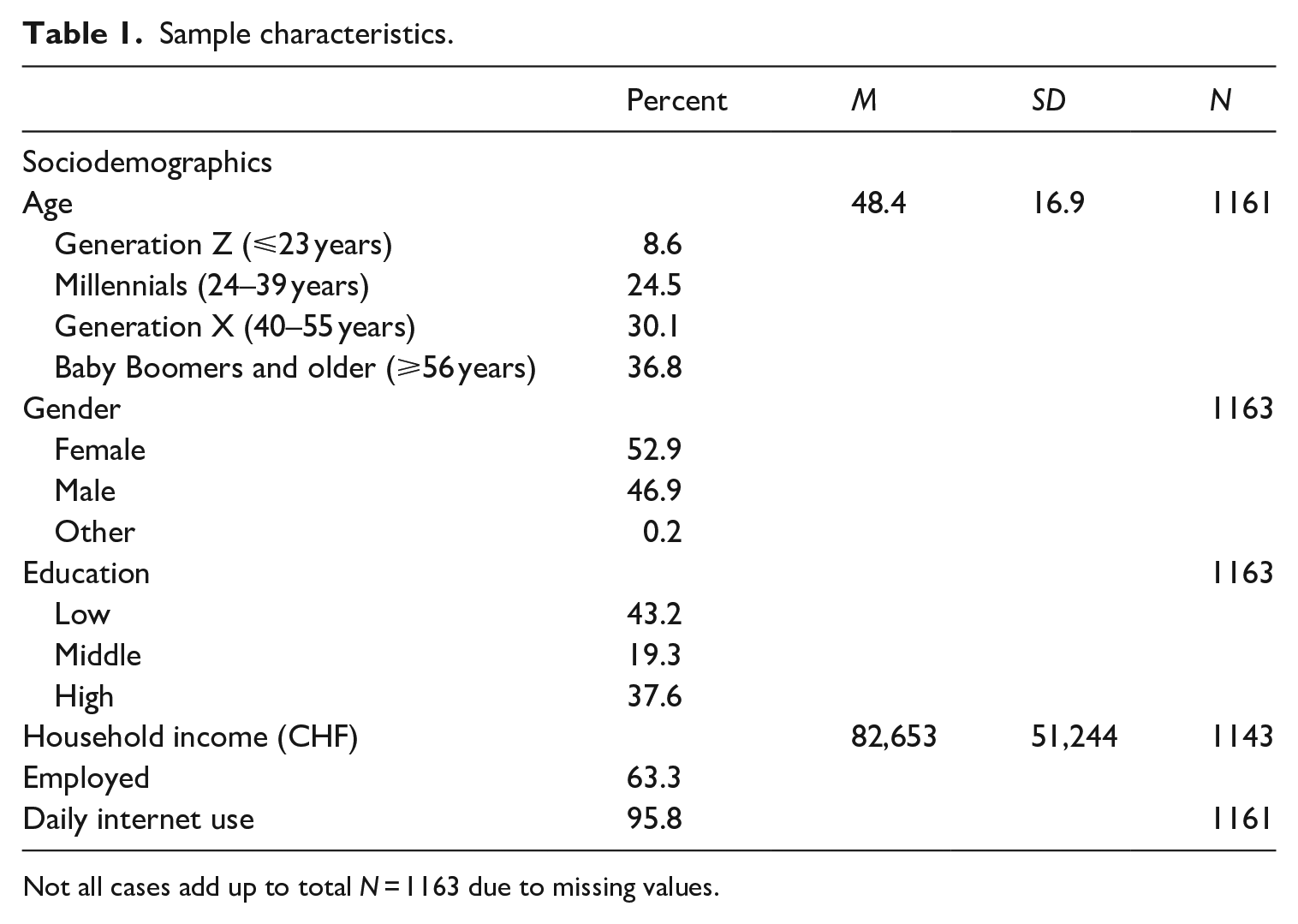
Not all cases add up to total N = 1163 due to missing values.
Analyses
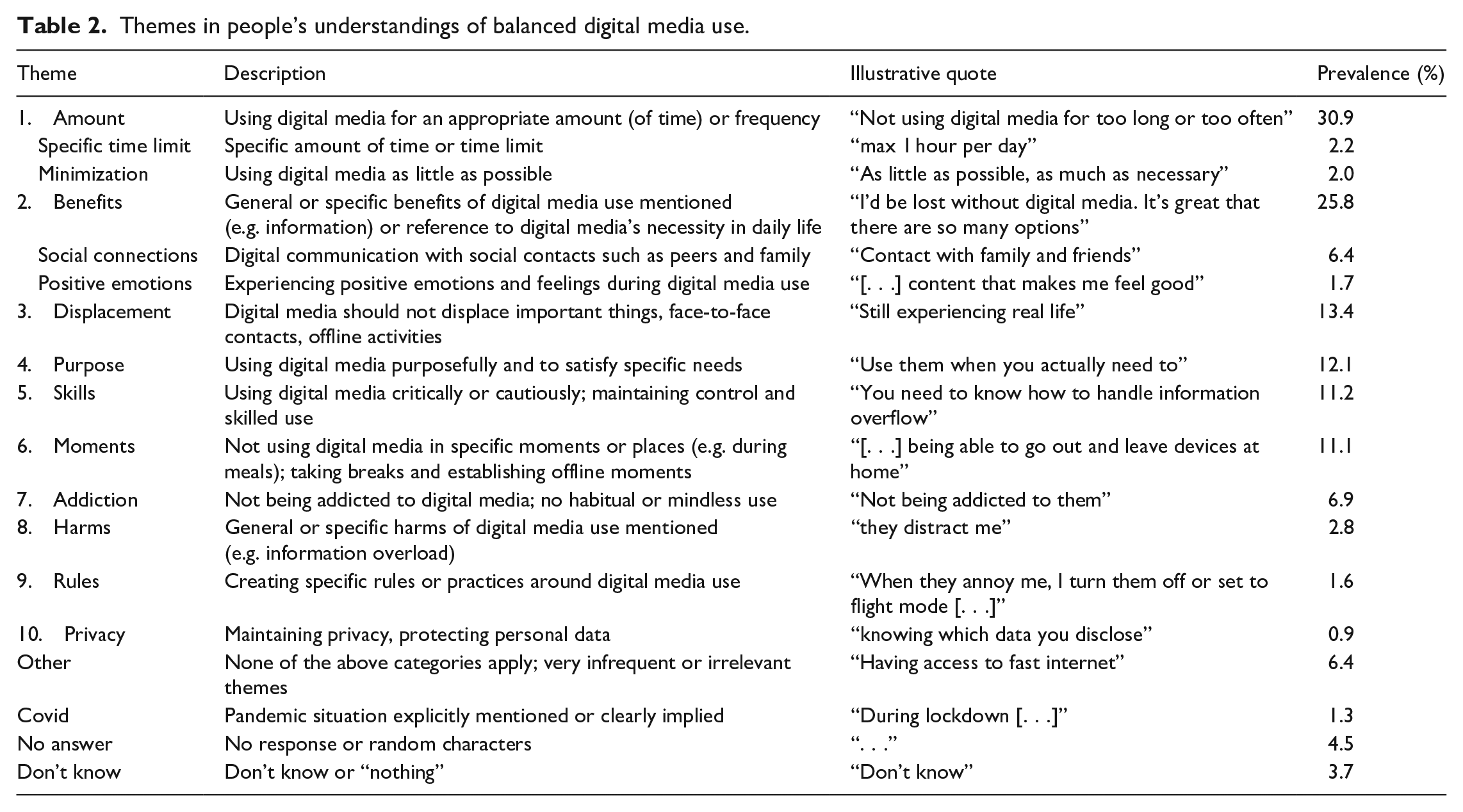
For RQ1, we conducted inductive thematic coding of what people consider as having a balanced digital media diet based on open-text answers (Table 2). Next, to address RQ2, we examined the motivations and strategies to disconnect and performed principal components analyses (PCA; with varimax rotation) on the item pool to identify overarching types of disconnection motivations and strategies (Tables 3 and 4). Finally, t tests and analyses of variance (ANOVA) examined whether different sociodemographic groups (i.e. based on age, gender, and education level) vary regarding the prevalence of different strategies and motivations for disconnecting from digital media (RQ3). We recoded gender into a binary variable (1 = female vs 0 = all others) for the comparisons across sociodemographic groups. We are aware that such a recoding comes with issues of inequity and underrepresentation of those who do not identify with the binary gender options (Bivens, 2017). However, as the “other” category had too few cases (n = 2) to be included as a comparison group on their own, we opted for this recoding so that we could preserve their data. The data and analysis code of the quantitative tests are shared on the Open Science Framework (https://osf.io/5862b/).
Themes in people’s understandings of balanced digital media use.
Motivations for disconnecting: descriptive statistics and loadings.
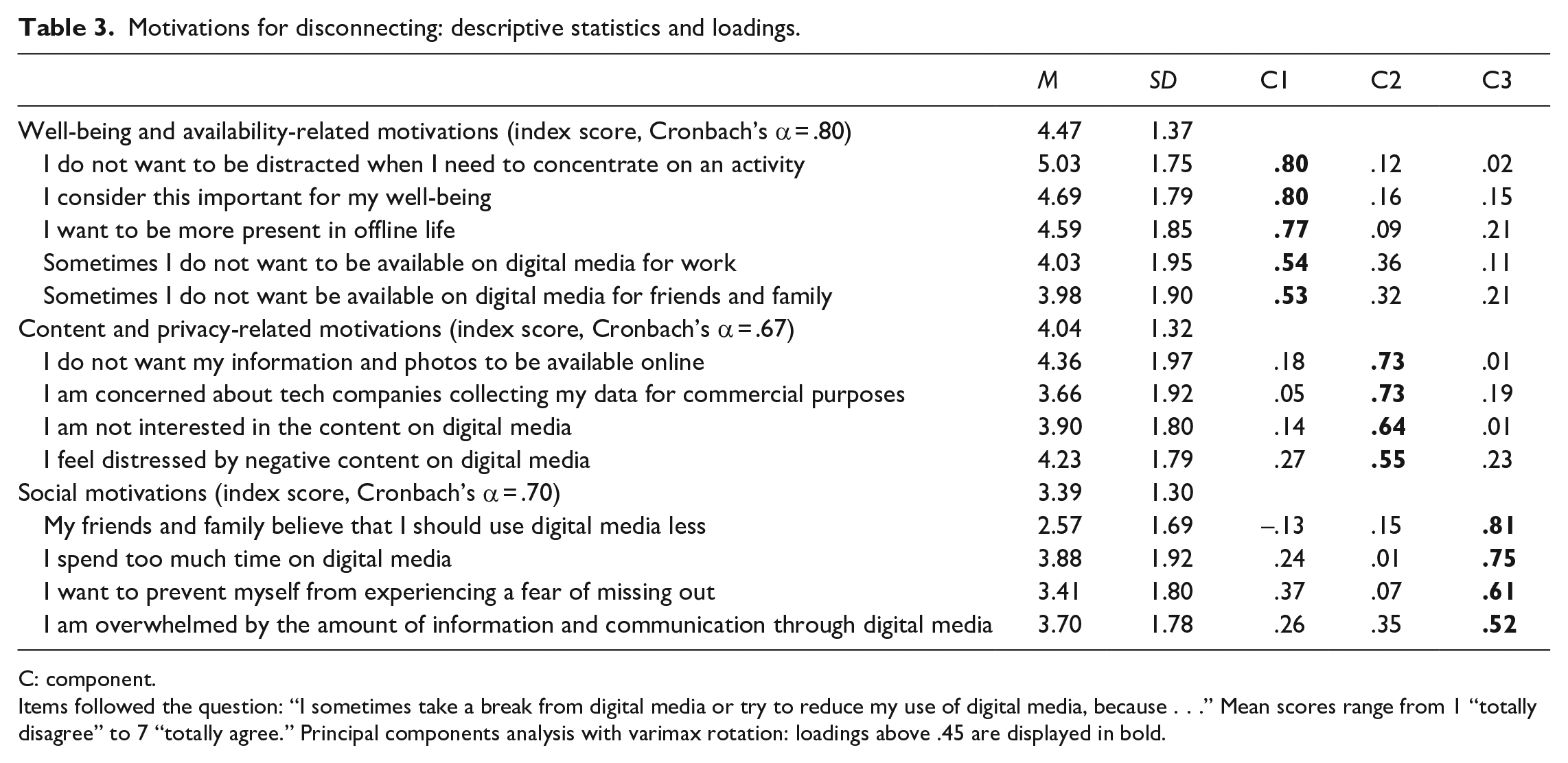
C: component.
Items followed the question: “I sometimes take a break from digital media or try to reduce my use of digital media, because . . .” Mean scores range from 1 “totally disagree” to 7 “totally agree.” Principal components analysis with varimax rotation: loadings above .45 are displayed in bold.
Disconnection strategies: descriptives and loadings.
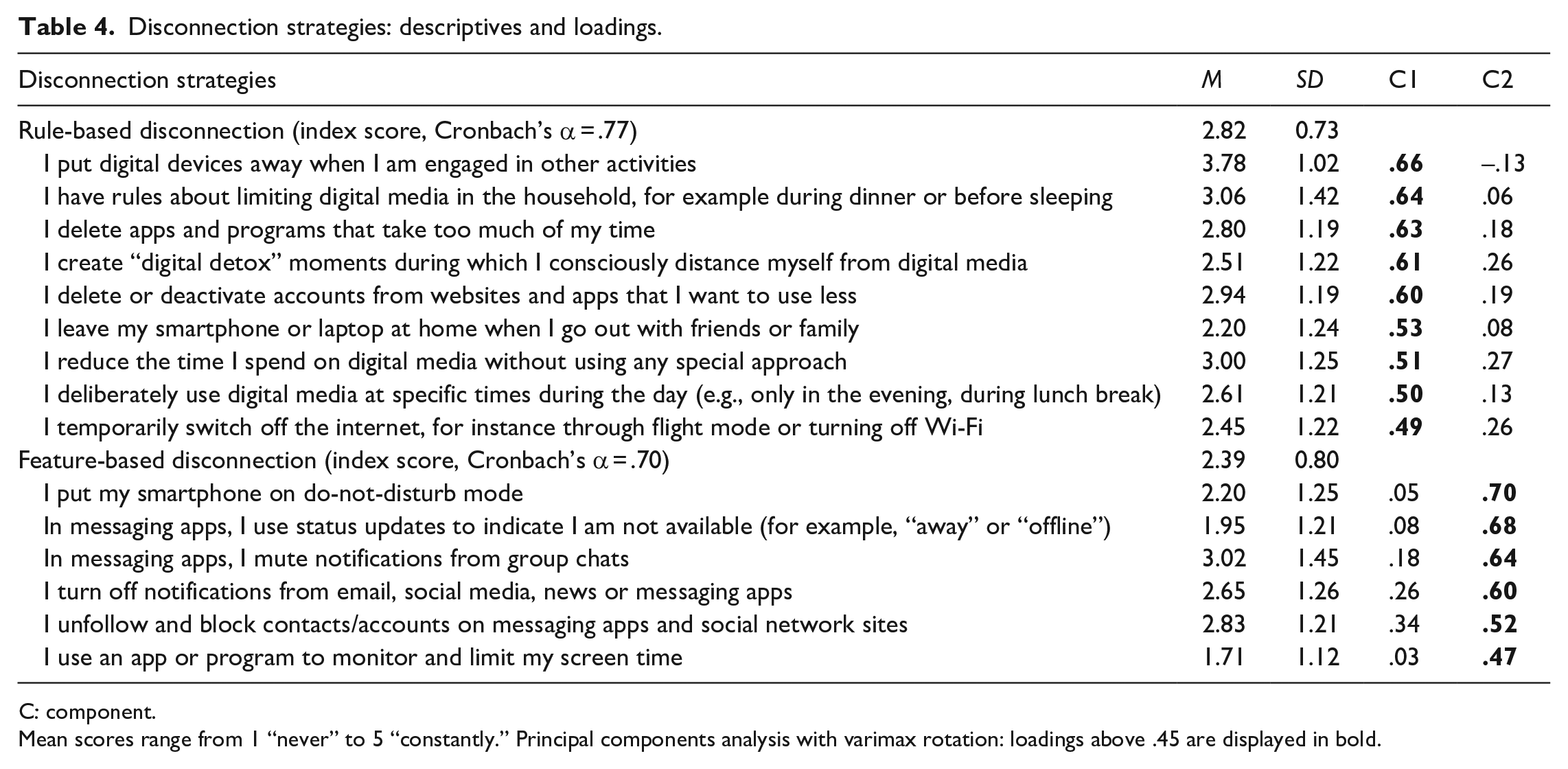
C: component.
Mean scores range from 1 “never” to 5 “constantly.” Principal components analysis with varimax rotation: loadings above .45 are displayed in bold.
Results
Subjective meaning of balanced digital media use (RQ1)
Inductive thematic coding of the responses produced 10 substantive themes that were able to cover 85% of responses (see Table 2). Most respondents mentioned a single theme (50%) but many also had two or more. An average of 1.3 themes applied to each response with 6% overall having a different theme (i.e. not one of the 10 that we induced) and another 8% were coded as “don’t know” or no answer. The two most prevalent themes were amount (31%)—responses referring to an appropriate amount of use in terms of time or frequency—and benefits (26%)—mentions of the indispensability and usefulness of digital media. For the amount theme, we additionally coded whether a specific time limit was mentioned and whether respondents indicated minimization of their use. Each of these subthemes accounted for only about 7% of the amount theme. For the benefits theme, we additionally coded when social connections (25% of benefits theme responses) or positive emotions (7%) were mentioned. Table 2 shows illustrative responses, that is, typical ways the theme manifested. Understanding a balanced use of digital media as avoiding displacement of “real life” moments or face-to-face encounters was also quite prevalent (13% of responses exhibited this theme). Finally, 7% reference not experiencing addiction as balanced use. Overall, however, additional mentions of general or specific harms were rare (3%).
Motivations for disconnecting (RQ2a)
Table 3 summarizes the scores for people’s motivations to disconnect from digital media. The motivations for disconnecting that people agreed most with were not wanting to be distracted when needing to concentrate on an activity (M = 5.03, SD = 1.75) and finding it important for their well-being (M = 4.69, SD = 1.79). The motivations for disconnecting that people agreed with the least were friends and family believing they should use digital media less (M = 2.57, SD = 1.69) and wanting to prevent a fear of missing out (M = 3.41, SD = 1.80).
Based on the PCA, we identified a three-dimensional solution representing three overarching motivations to disconnect (Table 3). The first component reflects motivations that relate to well-being and availability (e.g. wanting to be more present in offline life) and explained 40% of the variance, for which we averaged five items into one index score (M = 4.47, SD = 1.37, Cronbach’s α = .80). The second component represent content- and privacy-related motivations to disconnect (e.g. not being interested in content on digital media) and explained 31% of the variance, for which we averaged the four items into one index score (M = 4.04, SD = 1.32, Cronbach’s α = .67). Explaining 29% of the variance, the third component represents motivations that are related to people’s normative perceptions and experiences of overuse (e.g. spending too much time on digital media). We averaged the four items into one index score reflecting people’s social motivations to disconnect (M = 3.39, SD = 1.30, Cronbach’s α = .70). We excluded the item “I do not have enough time to spend on digital media” as it did not load on any of the components.
Group differences in motivations to disconnect (RQ3a)
Table 5 presents the differences across sociodemographic groups concerning people’s motivations to disconnect from digital media. Regarding well-being and availability-related motivations, we found no differences by generations. However, we found some generational differences regarding content and privacy-related motivations: Baby Boomers (⩾56 years), the oldest generation, were more likely to be motivated by these reasons to disconnect, compared to Generation X (40–55 years; p = .017), Millennials (24–39 years; p = .016), and Generation Z (
Differences in disconnection strategies and motivations.
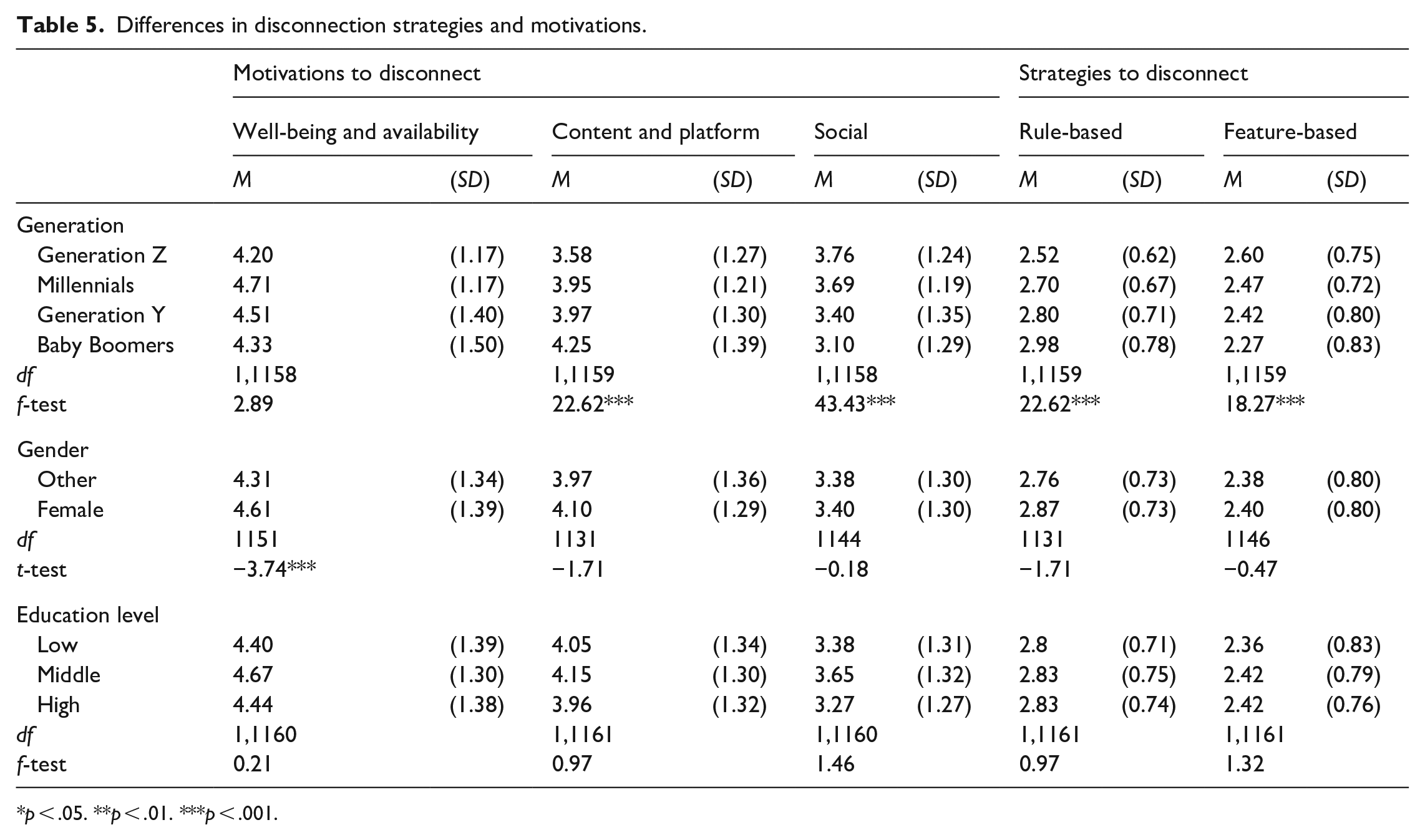
p < .05. **p < .01. ***p < .001.
Social motivations to disconnect played less of a prominent role for the oldest group of Baby Boomers, compared with the younger groups Generation X (p = .008) and Millennials (p < .001), as well as the youngest group, Generation Z (p < .001). Generation X was less likely to disconnect due to social motivations compared with younger Millennials (p = .029) and Generation Z (p = .082), although the latter was not significant. Overall, this suggests that higher age is related to greater motivations to disconnect from digital media due to content and privacy-related issues, while social motivations are more prominent among younger generations.
As for gender differences, we found that female participants were more likely to disconnect due to well-being and availability-related motivations compared with those identifying as male or other (p < .001), but there were no differences for the other type of motivations. There were no differences in disconnection motivations by education level.
Use of disconnection strategies (RQ2b)
Table 4 displays the frequency of disconnection strategies that people used to manage their own digital media use. Overall, it was quite common for people to disconnect from their digital devices or digital information and communication. The most popular strategies were putting digital devices away when engaged in other activities (M = 3.78, SD = 1.02), having rules about limiting digital media in the household (M = 3.06, SD = 1.42), and muting notifications from group chats (M = 3.02, SD = 1.45). Strategies that were less popular were using an app or program to monitor and limit screen time (M = 1.71, SD = 1.12), using status updates to indicate unavailability (M = 1.95, SD = 1.21), and putting the phone on do-not-disturb mode (M = 2.20, SD = 1.25).
Based on the PCA, we identified a two-dimensional solution representing two overarching disconnection strategies (Table 4). The first dimension explained 56% of the variance and reflects strategies that are based on behavioral rules to disconnect (e.g. putting digital devices away, leaving digital devices at home). We averaged the nine items into one index score representing the frequency that people used rule-based strategies to disconnect (M = 2.82, SD = 0.73, Cronbach’s α = .77). The second component explained 44% of the variance and combines six items representing strategies that involve the use of app/device features to disconnect (e.g. turning off notifications, muting chats). We averaged these into one index score representing the frequency that people use feature-based strategies that involve, for instance, app/device settings to disconnect (M = 2.39, SD = 0.80, Cronbach’s α = .70).
Group differences in disconnection strategies (RQ3b)
The prevalence of disconnection strategies varied across sociodemographic groups (Table 5). The oldest generation, the Baby Boomers (
Regarding gender differences, we found that female participants were more likely to use rule-based strategies to disconnect from digital media compared with those identifying as male or other (p = .015), but there were no differences with respect to feature-based strategies. Education level did not play a role in both types of disconnection strategies used.
Discussion and conclusion
Based on data from a sample of 1163 Swiss Internet users, this article contributes to current scholarship in three ways. First, it provides an understanding of what people perceive as having a balanced digital media diet, or “digital well-being.” Inductive coding of open-text responses suggests that balance is most often associated with achieving a subjectively appropriate amount of use. Furthermore, respondents frequently contrasted digital media with “real life” and stressed purposeful use and taking breaks. These perhaps more negative connotations of digital media were contrasted with frequent mentions of their usefulness, particularly for staying in touch with friends and family. The findings are interesting, given recent scholarly debates around studying “screen time,” where scholars have argued to focus not only on the amount of use, but also on how people engage in specific digital activities (Kaye et al., 2020; Meier and Reinecke, 2021). Overall, there seems to be an increasing sensitivity for digital well-being in society, as evidenced by the thematic breadth of responses in our study—where interestingly only few responses addressed specific harms. Given that research that statistically connects digital media use and well-being reveals only small, if any, effects (e.g. Meier and Reinecke, 2021; Orben and Przybylski, 2019), it could be that an “influence of presumed influence” mechanism is operating here (Gunther and Storey, 2003). That is, many assume that digital media use affects their own and other people’s well-being, which then motivates them to adapt their behavior. In the case of negative presumed influences of “too much” digital media use, this behavior may well be disconnection. We encourage future research to explore the influence of presumed influence in the context of digital media use and disconnection more thoroughly.
Second, our study identified larger patterns in people’s disconnection experiences, namely the type of motivations people have for disconnecting from digital media (i.e. well-being and availability-related motivations, content- and privacy-related motivations, and social motivations) and strategies people use for disconnecting (i.e. rule-based strategies and feature-based strategies). Overall, respondents’ open responses (which came first in the questionnaire) were in accordance with our closed items measuring motivations and strategies. Third, motivated by digital inequality scholarship, our study informs about how people across different sociodemographic groups experience and practice disconnection in their daily lives. Our results revealed few differences by gender and no differences by education level. The most important differences were found related to age, suggesting generational variance in how people perceive and cope with constant connectivity in the digital age. We discuss the study’s societal implications and its implications for digital media research next.
Differences in disconnection experiences across sociodemographic groups
Our results show that people’s disconnection experiences vary across different age groups, highlighting the importance of considering generational differences when examining digital media use and disconnection. Regarding strategies to disconnect, older generations more likely used rule-based strategies (e.g. having technology-free moments), while younger generations more likely reverted to device- and app-features to disconnect (e.g. turning off notifications). One possible explanation is that older adults experience less difficulty in self-regulating digital media use (Nguyen et al., 2021) and therefore do not need to rely on features of technology to disconnect. Conversely, younger people may find it challenging or undesirable to be unavailable and may thus prefer to maintain some connectivity, hence turning to tech features to selectively disconnect. A second explanation may be that younger generations grew up with digital media and may be more comfortable than older adults with using app- and device-settings, and using these to disconnect. Exceptions aside, in general older adults report having fewer Internet skills than younger people (Festic et al., 2021). Overall, and as proposed by other scholars as well (Ganito and Jorge, 2017; Nguyen et al., 2021), theory and empirical work on digital media use and disconnection should consider life-span approaches to understand how different generations interact with digital media in the context of their everyday needs.
While age showed to be a prominent factor in explaining differences in why and how people disconnect from digital media, we found no differences in people’s disconnection experiences by education level, which could be because of the widespread uptake of digital media across all socioeconomic strata in the German-language region of Switzerland (Festic et al., 2021) that is comparable to other European countries with high uptake rates such as the Netherlands and Norway (Eurostat, 2021). Another possibility is that disconnection practices are common across all socioeconomic strata, but that higher social status people more publicly use ideas of “digital detox” as a form of self-expression. Whether the age and gender differences in disconnection experiences originate from preferences or skills regarding digital media use remains to be further investigated. Scholars have suggested that as digital media become even more prominent in everyday life and society, digital skills may become a necessary personal resource to cope with information and communication overload (Gui et al., 2017; Hargittai and Micheli, 2019). In that sense, being able to disconnect may be considered a digital skill in itself. Furthermore, future research should investigate what the consequences of inequalities in disconnection experiences are for the benefits that people reap from digital media (e.g. for well-being, social connection, enjoyment of digital media).
Outlook for the future digital society
As disconnection experiences differ across generations, some changes may be expected in contemporary digital societies, driven by younger generations. In this regard, our findings might be understood as an outlook for the future of digital societies. For instance, the finding that younger generations are less likely to disconnect due to concerns that relate to content on digital platforms and privacy matters, indicate that concerns about personal data may become less important as a motivation to disconnect in the future. Young people might feel that a loss of privacy (e.g. data collection by tech companies) is part of a trade-off one needs to make to use online services (Nguyen, 2021b). At the same time, our findings indicate that social motivations are more important among younger generations and thus suggest that they will take a more central role in people’s disconnection behaviors. Furthermore, several themes that emerged in the responses referred specifically to limiting connectivity (i.e. using digital media less, creating technology-free moments, setting rules for technology use), which suggest that new norms around balanced digital media use might develop. Such disconnection norms may indicate that it becomes more prevalent and socially approved not to be constantly connected. Driven by normative influences within younger generations, such disconnection norms might become more established and induce behavioral change toward more balanced digital media use in the future digital society. As such, applying theories of normative influence and examining developing norms of digital media use and disconnection might be fruitful to gain a deeper understanding of people’s evolving relationship with technology.
We might expect similar changes in the digital society concerning the strategies to disconnect. We find that younger generations more likely use device- and app-features to disconnect, in contrast to older generations. Given that digital media become more intertwined with various domains in everyday life, it may be important for people to maintain some form of connectivity instead of going offline (temporarily). Indeed, complete disconnection may come with various practical, social, and societal repercussions (Nguyen, 2021b), which might explain the higher prevalence of feature-based disconnection among younger audiences. One implication of this for the future of digital societies is that tech companies need to continue to rethink their designs and include features that make it easier for people to disconnect. While current technologies already incorporate ample “digital well-being” features, such as “do-not-disturb” and “focus” functions on smartphones, and insight into one’s screen time activities on devices and platforms, such features might become even more relevant in the future. Making disconnection more accessible and manageable for larger audiences can assist users in navigating the digital media environment, thereby enabling users to use digital media in a way that benefits their everyday life. At the same time, we note that there is increasing critique on tech companies’ promotion of such digital well-being features. For one, such digital self-help tools place the responsibility and burden for attaining digital well-being on the shoulders of individual digital media users (Docherty, 2021; Syvertsen and Enli, 2020), and through their use allow tech companies to collect more data on people’s patterns of use and nonuse, promoting further datafication and surveillance (Jorge et al., 2022). Other scholars have argued that by framing their digital well-being tools as “social goods,” tech companies hope avoid future governmental regulation (Beattie and Daubs, 2020).
Limitations and future directions
This study also has limitations that need to be considered. First, the data were collected in the German-speaking part of Switzerland, which is characterized by high levels of digital media uptake with 96% of the population using the Internet (Bundesambt für Statistik, 2021). While the Internet uptake rates are comparable to many other European countries (Eurostat, 2021), generalization to regions with different digital infrastructures and cultures should be done with careful consideration. Future research on digital disconnection could focus on cross-national comparisons between countries with different digital infrastructures, to understand how this can impact the way people cope with different levels of information abundance in their everyday lives.
Second, while the survey items for the motivations and strategies for disconnecting are derived from previous research, the items included in our study may well not be exhaustive. Additional motivations that people have and strategies that people employ to disconnect may have been overlooked. Nonetheless, our study is currently one of the few to quantitatively examine people’s disconnection experiences, and can inform future research on digital well-being.
Finally, our study gives insight into people’s disconnection experiences at one particular point in time. As the digital landscape and people’s relationship with digital media is constantly evolving, it may also be that people’s motivations and strategies for disconnecting change over time. For instance, our results suggest that it is worthwhile to examine social norms related to disconnection behaviors in future research. While in the present study social motivations showed to be less important for people’s decision to disconnect compared with the other motivations, scholarship has shown that normative influences can play a crucial role in people’s digital media uses (Leuppert and Geber, 2020). Yet, norms that would protect against having to be constantly connected appear to be lagging behind quick technological developments and new everyday practices of digital media use (Gui and Büchi, 2021). Concretely, future studies might therefore examine how perceived disconnection norms, as well as generational differences in such norms, are related to one’s own disconnection practices. As digital societies continue to evolve rapidly, we encourage future research to continue investigating people’s disconnection experiences, such as their motivations and strategies to disconnect, as part of their digital media diets and its impact on their overall well-being.
Footnotes
Acknowledgements
The authors wish to thank Eszter Hargittai for her valuable feedback on the survey instruments.
Funding
The author(s) disclosed receipt of the following financial support for the research, authorship, and/or publication of this article: The data collection for this study was supported by the Department of Communication and Media Research (IKMZ) and the Digital Society Initiative at University of Zurich. Minh Hao Nguyen is funded by the European Union’s Horizon 2020 research and innovation programme under the Marie Skłodowska-Curie grant agreement “Disconnect2Reconnect” No. 891281.
