




Abstract
Using the 2022 Twitter to Mastodon migration as a case study, this article contributes a new understanding of social media migration (SMM). It begins with a review of existing studies of SMM, showing how migration is often understood as a combination of ‘push and pull factors’. We suggest a need to widen the conceptual scope for how we approach SMM in ways that more directly tie such movements to specific questions of power, agency and events that ripple through digital cultures. Drawing on social media account analysis, a survey of recently migrated Mastodon users, content from high-profile Twitter users and other media commentaries, we re-present the migration in order to detail our ‘eventful’ theory of migration. Eventful social media migration is comprised of five elements: an initial X factor; the emergence of a critical voice; a collective platform consciousness; an observable migration; and a wider terrain transformation.
Introduction
Migration is constitutive of social media. One way of reading the history of social media is, in fact, as a series of user migrations through ongoing evolutions of media forms. This longer view is helpful in unravelling the ‘platform realism’ of the last decade or so, where a small number of platforms have dominated the digital mediascape and imagining their total decline has become difficult. It is also useful in its casting users as central figures of social media history, whose presences, absences, and movements play a key role in shaping the contours of the global digital economy. While some degree of slow, low level, migration is a constant, there are times when a migration becomes more visible, when it surfaces as a matter of public concern. In these cases, we will contend, a social media migration has an eventfulness to it. The migration is part of an event, and it signals an event is taking place. While there is a pre-existing interdisciplinary literature on social media and ‘cyber’ migration, this article is the first to conceptualise the eventfulness of such migrations and to tie it to questions of power on social media platforms.
We begin with a review of the literature on social media migration (SMM). We divide the literature into three broad areas (push-pull factors, dynamics, and social theory) and interpret the contributions of each. We aim to build on the theoretical foundations of this literature, while also showing how one dominant approach – the so-called push-pull factors approach – has strongly shaped how SMMs have been understood in the past. Our contribution to this literature is to build upon the theoretical foundations of the push-pull factors approach, but to focus more explicitly on questions of power and events. We then revisit the concept of ‘event’ to provide a theoretical basis for our understanding of eventful migration, and to help explore its empirical unfolding. The empirical focus of our study is the 2022 acquisition of Twitter by Elon Musk and the subsequent Twitter to Mastodon migration. While similar migrations have occurred away from Twitter/X to other platforms such as BlueSky or Substack, we focus on Mastodon as it was the first migration event after Musk’s acquisition and hence was the motivation for the study. We reference other migrations, but the scope of our study is empirically limited to the Twitter-Mastodon migration. We draw on survey findings, social media account analysis, user tweets and broader commentary on the migration to inform our theory of eventful migration, which we divide into five components: (1) X factor; (2) critical voice; (3) collective platform consciousness; (4) migration; and (5) terrain transformation. We conclude by suggesting that eventful migration can be understood as a form of platform counter-power which we call ‘user-power’.
Social media migration
Though not a major theme of digital media and its cultures, there has been a small, steady flow of research to take on the topic of social media migration (SMM). There is a diversity of approaches in this area, though studies have often come from the fields of web science or informatics and tend to be quantitative (statistical) and descriptive in approach. These are contrasted and sometimes combined with approaches from media, sociology, anthropology and cultural studies. As we shall see, defining SMM is not straightforward. In the broadest sense, it refers to populations of users who move from one site, service, or platform to another. But what counts as ‘moving’, for example? Or how many need to migrate for there to be a ‘migration’? Beyond questions of definition are ones of interpretive frameworks and cultural significance. What is happening when a migration is happening?
Push-pull factors
One early influential study by Cheng Zengyan et al. (2009) coined the term ‘cyber migration’ to differentiate it from geographical migration. These authors approach cyber migration as an instance of user switching, which refers to ‘the action whereby users primarily participate in a new SNS [social networking site] instead of their previous site’ (Zengyan et al., 2009: 2). Through an online student survey, the study explored what motivates them to switch from one service to another and how much weight different ‘factors’, such as privacy concerns, site design, and peer pressure carry in that decision. This study is significant not so much for its specific findings, but for its general approach and subsequent influence on other studies of SMM. The study’s subtitle – ‘An empirical investigation on factors that affect users’ switch intentions in social networking sites’ – points to two interrelated concepts that have proven especially influential: factors and switching, and which the authors borrow directly from geographical migration studies and consumer behaviour and marketing studies, respectively. ‘Factors’ is a term drawn from what is generally known as the push-pull theory or push and pull factors theory of migration. It is worth offering a brief overview.
The push-pull factors theory is most strongly associated with Everett S. Lee’s (1966) A Theory of Migration. Lee (1966) was after what he called a ‘general schema’ of migration and wanted to identify a small number of ‘self-evident propositions’ within the ‘variety of spatial movements’ (p. 49). He writes: ‘In every area there are countless factors which act to hold people within the area or attract people to it, and there are others which tend to repel them’ (Lee, 1966: 50). Lee therefore conceptualised migration in terms of origin and destination factors, with each factor being either attractive (represented as a ‘+’), repulsive (‘-’) or neutral (‘0’). The journey between the origin and destination is also conceived as having ‘intervening obstacles’ which affect the feasibility and attractiveness of a possible migration. Finally, Lee added that it is not the actuality of factors, but individuals’ perception of them that drives migration. It is these factors (+, -, 0) that are now often thought of in terms of push and pull factors. More recent adaptations of Lee’s theory sometimes add the idea of ‘mooring’ (push-pull-mooring) – the difficulties of moving – which corresponds to Lee’s ‘intervening obstacles’.
‘Switching’ is a term used in marketing and refers to consumers who switch from one product to another. Importantly, Lee’s push-pull factors theory of migration has itself been used within marketing and consumer studies in relation to switching, where switching is understood in terms of a ‘migration’ between products influenced by push and pull factors (see Bansal et al., 2005; Sun et al., 2017). Studies influenced by the ‘cyber migration’ approach to SMM tend to inherit an understanding of migration in terms of push and pull factors, and a quasi-consumer marketing understanding of social media, where migration is at least partly conflated with switching between products.
Returning to the online environment, several studies broadly adopt this approach. Edward Newell et al. (2016) have adopted Lee’s push-pull model to analyse a Reddit user migration in 2015. By studying user comments on these platforms, they identified the key motivations (push factors) for leaving Reddit, while also concluding that despite the unrest Reddit’s ‘diversity of unique content’ remained a powerful pull factor (Newell et al., 2016: 287). More recently, Casey Fiesler and Brianna Dym (2020) have used the push-pull model for a longitudinal study of fan communities of roughly 30 years (1990–2018). Based on interviews and a survey, they show how fan communities have moved across media, from Usenet, email and Message boards, through sites including Fanfiction.net and Dreamwidth, and ending at AO3, Tumblr, LiveJournal and Twitter. Their findings show that fans leave for a mixture of reasons that include both platform (design, policy, technical) and community dimensions (such as a desire to leave an old community or join a new one). They further note that ‘policy and values based problems can be particularly important, but that these alone may not be enough to inspire a mass exodus’ and suggest that viable alternatives need to be present that ‘support both their technical and their community needs’ (Fiesler and Dym, 2020: 20). Yet another study, by Xiangyu Xiao and Nicholas Caporusso (2018), provides an overview of cyber migration and a reflection on the ongoing usefulness of the push-pull-mooring model. They note that use of social media has changed significantly since the earlier migration studies, pointing out, for example, that users are now more likely to actively maintain multiple a larger number of social media accounts, often switching between them but not necessarily migrating from one to the other (Xiao and Caporusso, 2018: 104). This recalls José van Dijck’s (2013) earlier critical history of social media, where she describes them as forming an ‘ecosystem of connective media with a few large and many smaller players’ (p. 4).
Dynamics of migration
If push-pull studies aim to answer the ‘why’ of SMM, another strand of research focuses on what could be understood as the dynamics of migration, aiming to understand the ‘how’ and ‘what’ of SMM. These studies tend to be quantitative, often rely on scraping techniques and seek to identify patterns. One early study by Shamanth Kumar et al. (2011) aims to identify ‘migration patterns’ across seven social media sites. To do so, they scrape data from blogs where users make public their accounts on other social media and then study activity across these blogs over time. While concluding that migration patterns can be identified, they make two further observations. First, they acknowledge the limitations of conflating different types of social media and express some reservations about their own study, which includes YouTube, Delicious, Twitter, and Flickr, among others. Second, the authors actively reflect on what counts as migration and how to study it. They come to distinguish between ‘site migration’, where a user may delete a profile or close an account, and ‘attention migration’, which is related to a user’s activity on a site or platform (Kumar et al., 2011: 1206). While activities such as lurking may fall outside their definition of attention, these authors acknowledge that what constitutes migration and how to evidence it is not straightforward.
Two studies of Reddit also explore the ‘how’ and ‘what’ dynamics of migration. Cai Davies et al. (2021) study what could be called intra-platform migration, analysing how users move between different subreddits. They differentiate between micro-scale migration, where individual users move between subreddits, and macro-scale migration, involving larger numbers of users over a longer period. They further differentiate between natural and forced migration, with forced migration covering things such as subreddits being banned or suspended, or users responding to threats, such as bullying. In ‘All Who Wander’, Chenhao Tan and Lillian Lee (2015) also use Reddit data to study intra-platform movement, and identify patterns across subreddits. They conclude, for example, that ‘while users continually post in new communities . . . as time goes on, they post increasingly evenly among a more diverse set of smaller communities’ (Tan and Lee, 2015: 1056). They further claim that users who leave one community are ‘destined to do so’ as they exhibit distinct ‘wandering patterns’ from the beginning (Tan and Lee, 2015: 1056). Finally, these authors seek to predict ‘user’s future level of activity’ by modelling these migration patterns.
Additional large scale, quantitative SMM studies have been conducted of users migrating off Twitter. In one study, Max Aliapoulios et al. analyse 2 years of post and user account data (183 million posts, 13.25 million profiles) from the far-right platform, Parler. These authors note that Parler experienced distinct moments of user influx, based around identifiable social media events. For example, one came in December 2018 when ‘conservative activist Candace Owens tweeted about it’ (Aliapoulios et al., 2021: 5). Another study in this vein is Haris Bin Zia et al.’s (2023) paper ‘Flocking to Mastodon: Tracking the Great Twitter Migration’. Addressing the same migration as our study, these authors tracked the movement of 136,009 Twitters users to, once again, find migratory patterns. The authors were interested in which instances users migrated to, what affected their decision to move (i.e. motivating factors) and what presence users maintained across the two platforms after migration. They found that new users tended to migrate to the larger Mastodon instances, thus creating a centralising effect on the otherwise decentralised architecture of Mastodon. That is, the influx of users ‘flocked’ to the largest instances making these even larger in comparison to the other instances (Zia et al., 2023: 5). They further found that very few users deleted their Twitter accounts (2.26%); that users active across both platforms generally didn’t post the same material (only 1.53% of material was considered identical); and that despite the larger instances attracting the most users, the most active new users on Mastodon took up residence on smaller instances (Zia et al., 2023: 11).
Social theory
In contrast to push-pull factors informed analyses and the more quantitative investigations of migratory dynamics, we turn to a consideration of Emory Edwards and Tom Boellstorff’s (2021) study of the 2018 ‘Tumblrpocalypse’. Taken on its own here, we consider it a unique and substantial contribution. However, it resonates with similar cultural studies of social media boycotts (Gillespie, 2018: 169) or even labour strikes (Gehl, 2014: 117). Edwards and Boellstorff (2021: 582) seek to place SMM within a ‘broader phenomenon of digital ‘leaving’ or exodus’, which also includes instances of ‘platform ‘non-use’’ as well as migration. The ‘Tumblrpocalypse’ began in late 2018, when CEO Jeff D’Onofrio introduced an adult content ban. Within this context, Edwards and Boellstorff discuss non-use as a kind of social act and they document how users approach non-use in a range of ways, from lessening time on the platform and making comments to deleting their accounts and archiving their content.
In their work, migration is introduced within this already politicised social media context, where users are actively disengaging from one platform as kind of socio-political act. Their discussion frames migration as ‘a shifting and reconfiguring of platform-specific social relations’ (Edwards and Boellstorff, 2021: 588) and is thus more attentive to the changing forms of sociality within platform environments as these are affected by migrations. In other words, a migration is always a transformation – of the origin platform, the destination, and the user-migrant. Finally, they argue against a straightforward understanding of migration as a singular act, noting that it ‘is an ongoing and often partial process wherein users practice breaking patterns of use (‘kick[ing] it for good’) and attempt to build a new social ‘home’ on the replacement platform’ (Edwards and Boellstorff, 2021: 588). By placing migration within this account of digital exodus, Edwards and Boellstorff are able to draw out different dimensions of SMM, where users struggle individually and collectively, showing an awareness of how platform decline corresponds to social decline and how moving is rarely a straightforward replacement. While Edwards and Boellstorff (2021) do offer a ‘unified analysis’ of non-use and migration (under exodus), do place ‘classic questions of social theory in conversation with platform sociality’ and do raise ‘fundamental questions of movement, selfhood, and power’ (p. 582), there is still much to explore in these areas. Most notably, we contend that such an approach and related questions can be explored through migration in its own right and through analysing the empirical unfolding of specific migrations.
While small, the pre-existing literature on SMM covers a lot of ground. Some authors offer basic definitions of migration, with others noting instances of migration are not like for like, that it might not be a singular act, or form (e.g. attention migration versus account migration) and, indeed, it might not be clear a migration has happened at all as users ‘switch’ between multiple platforms and services. Methods for approaching and evidencing a migration vary, including interviews, surveys, content analysis and participatory methods, as well as API and data scraping methods to collect data from blogs, user accounts or comments. These methodological choices are informed by the distinct norms of fields and disciplines and thus shape the resulting accounts of migration as an object of knowledge. Drawn from (geographical) migration studies, the push-pull model has been influential, and has often provided the overarching theoretical framework for studies in this area. This is likely due to the model’s wider influence, and its uptake in Zengyan et al.’s (2009) early paper on ‘cyber migration’. Indeed, the prevalence of this push-pull model and its adaptations (as product switching, for example) tends to encourage researchers into this way of viewing migration – as an empirical occurrence that needs to be explained in terms of numerous contributing ‘factors’, typically identified by asking people why they move. The more quantitative and data-driven work tends to focus on what we have called the dynamics of migration, where the motivating factors (‘why’) of migration take a backseat to an empirical investigation of migratory patterns (‘how’ and ‘what’) across and sometimes within sites and/or platforms. While some studies focus on explicitly political platforms (Aliapoulios et al., 2021) or note that migration may be ‘forced’ by regulatory changes, blocking or bullying (Davies et al., 2021), we singled out the work of Edwards and Boellstorff for situating migration within a larger social theory of digital exodus, relating movement to the self and power, and placing attention on the effects migration has on the origin and destination platforms within a wider platform ecology (Van Dijck, 2013). In what follows, we build on and contribute to this literature through our theory of eventful migration, which we develop through an analysis of the Twitter to Mastodon migration. We build on the theoretical framework of push-pull factors in that we see migration as playing out within a field of relations and possible destinations. We also draw in observations from across the wider literature as appropriate. However, our eventful theory of SMM marks a departure from push-pull factors in its emphasis on the significance of singular events and the need to understand the temporal unfolding of migrations. Before turning to the migration itself, a brief discussion of events will clarify how we approach them in our study.
Events
The concept of the event has been widely debated in philosophy, covering such fundamental questions as: What is an event? What is an event’s duration? How does an event relate to change? And are events rare or common? (Badiou, 2006, 2013; Faber et al., 2010; Žižek, 2014; Zourabichvili, 2012). While these fundamental debates over the nature of events are beyond meaningful consideration here, we can detail our approach to events within social media by combining philosophical insights with historical and media studies perspectives. We consider events to be relatively rare and, following Lombard (1975) and Mackie (2005) as occurrences that open possibilities for change. We are also influenced by Sewell (1996) who emphasises an event’s transformative power in history. Sewell conceptualises events not simply as change, but as ruptures that disrupt routines and reconfigure structures. Moreover, he highlights the sequential nature of events, arguing that an event unfolds as ‘a chain of occurrences’ (Sewell, 1996: 843). McKenzie Wark (1994) begins in a similar place in her early media theoretical work on ‘weird global media events’, where she describes events as ‘singular irruptions into the regular flow of media’ (p. vii). The key difference between Sewell’s and Wark’s accounts of events is Wark’s (1994) emphasis on mediation: her events are televised globally and their representations ‘start feeding back across global spaces and between radically different cultures’ (p. vii). In the media age of the 1990s, the location of an event was no longer obvious, as the global reporting and consumption of media became part of the event itself (hence, weird global media). From these authors we emphasise rupture, the disruption of routines and irruptions into regular flows of media, the placing of events within a historical timeline with a possibility of change, an event’s sequential unfolding, and an emphasis on events as partly constituted through their mediation.
On social media, the spatial and temporal happening of events is more fully woven into their mediation. Recall the Arab Spring being labelled as Facebook or Twitter revolutions (Christensen, 2011), or how #MeToo and #BlackLivesMatter became global social media events after being triggered by the Harvey Weinstein case and the murder of George Floyd, respectively (Austin et al., 2023; Edrington and Lee, 2018; Hillstrom, 2018; Tillery, 2019). Tony Sampson (2020: 21–28) has theorised how ‘shock events’ on social media perpetuate fake news under conditions of panic and rumour. He uses the 2017 Las Vegas mass shooting to show how shock events create vacuums of understanding that can be weaponised as they are filled by fake news or conspiracies. Sampson stresses that such events operate largely through affective registers and ultimately steer users away from more democratic and reflective modes of being. It is important to recognise these logics in social media, though our own account differs in important ways. As we show below, we are interested in events that not only unfold through social media but also have the potential to substantially transform these media. Our eventful migration is less concerned with truth dynamics than the chains of action events bring into being. In what follows, we aim to bring these theories of the event into dialogue with social media migration literature. First, we outline our research design and methodology.
Methodology
Our study was initially motivated by the desire to better understand the Twitter to Mastodon migration of 2022. As this migration was seemingly coming to an end, we conducted an exploratory survey of Mastodon users. We posted our survey on both Twitter and Mastodon, and asked several Mastodon’s instance administrators to help distribute it. In total, we received 820 responses from people located in 47 countries, and with roughly 90% coming from Mastodon. It’s important to note that out of these 820 responses, only a subset of 127 indicated they had migrated during the period under consideration. While we were anticipating most responses to come from recently migrated users, the actual distribution did enable us to compare the results of those who joined recently with a larger base of more established users (though the comparison does not significantly inform this article). The survey consisted of 42 exploratory and wide-ranging questions aimed at increasing our understanding of Mastodon’s users. A subset of these questions focused more specifically on learning more about users’ experiences of migrating, their reasons for migrating, the profile of the migrators, reasons for using Twitter and initial thoughts about Mastodon. In the discussion below, we limit our reporting to findings that directly speak to the migration, though the larger survey did help us to place these findings in context and to move beyond the ‘motivating factors’ research.
Alongside the survey, we conducted a social media account analysis of users who migrated from Twitter to Mastodon, using API queries to better understand the dynamics of the migration. Sometime after the acquisition, we noticed users were changing their Twitter handles to Mastodon usernames to publicise they were part of the migration. With this observation, we queried Twitter’s REST APIs (Kearney, 2019) for Mastodon usernames, beginning with a sample of 32,785 Twitter user accounts which were generated through random snowballing methods. Of this sample, we identified 1,286 Twitter users who indicated having a Mastodon account in their Twitter handle or profile. We then matched the two accounts, and queried Mastodon’s REST API (Schoch and Chan, 2023), which enabled basic account use comparison across the different social media. It is worth noting that we decided not to analyse and report on the specific content of any posts, or to report our findings in a way that could enable account identification. It is also important to note that while these methods inform the discussion below, they were exploratory and are thus drawn on selectively rather than presented systematically. 1 In what follows, we weave our empirical findings into a retelling of the Twitter-Mastodon migration, with help from other commentaries and celebrity Twitter accounts. The migration was widely reported on at the time, but we use the retelling as an opportunity to outline our theory of eventful social media migration.
Eventful migration
When Lee proposed his ‘Theory of Migration’ in the 1960s, he aimed to provide a coherent framework for understanding the diversity of empirical geographical migrations in the 19th and 20th Centuries. 2 He was responding to a perception that migration studies were largely a descriptive and statistics-heavy endeavour. This perception rings true for the SMM studies considered in the ‘dynamics’ section above, where many singular observations are made without attempting to draw more durable and general conclusions across migrations. As noted above, Lee’s theory has inspired many push-pull studies and been adapted to new areas, including SMM research. Its ready-made framework offers a straightforward way to analyse migration and to identify its underlying factors. Without denying the explanatory value of push-pull and motivating factors research, our theory of eventful migration attempts to carve out a distinct conceptual and empirical terrain. Within a social media ecosystem where low-level migration is constant, we argue that visible migrations, ones that spark public discourse or media coverage, are often best understood in the language of eventfulness. The theory of eventful migration contains five elements.
X Factor
An eventful migration is triggered by and participates in a significant social media event. These are not ‘external’ events represented, discussed or mobilised through the platform (such as wars or protests); the social media event happens to the platform itself. With regards to the Twitter-Mastodon migration of late 2022 and early 2023, we consider the Musk acquisition as a key factor, or X Factor, in this event. Commonly defined as ‘a variable in a given situation that could have the most significant impact on the outcome’, X Factor, in our SMM theory, points to the presence of a single factor that triggers the migration; it is the ‘most significant’ thing. The X Factor element builds on the tradition of factors research in that it recognises social media as an environment of forces that align, or not, with users’ desires and preferences. That is, an X Factor can be understood in terms of the tradition of push-pull factors research. However, an X Factor is not just one other factor among many others. Its force is such that it has a more direct relationship to the collective migration that follows. An event commences with an X Factor, and includes the totality of other factors, actions and transformations that stem from or are related to it. And rather than being understood primarily as a spatial distribution (as in Lee’s work) an X Factor needs to be understood through its temporality: it ‘happens’. Regarding the Twitter-Mastodon migration, the X Factor is the Musk acquisition. The acquisition had legal and financial timeframes, but Musk’s entry into Twitter headquarters on the 26 October 2022, marked the symbolic moment. Consistent with his meme fluent, shitposty persona, Musk entered the building carrying a sink, shortly after Tweeting: ‘Entering Twitter HQ – let that sink in!’ (https://x.com/elonmusk/status/1585341984679469056) (see Figure 1).
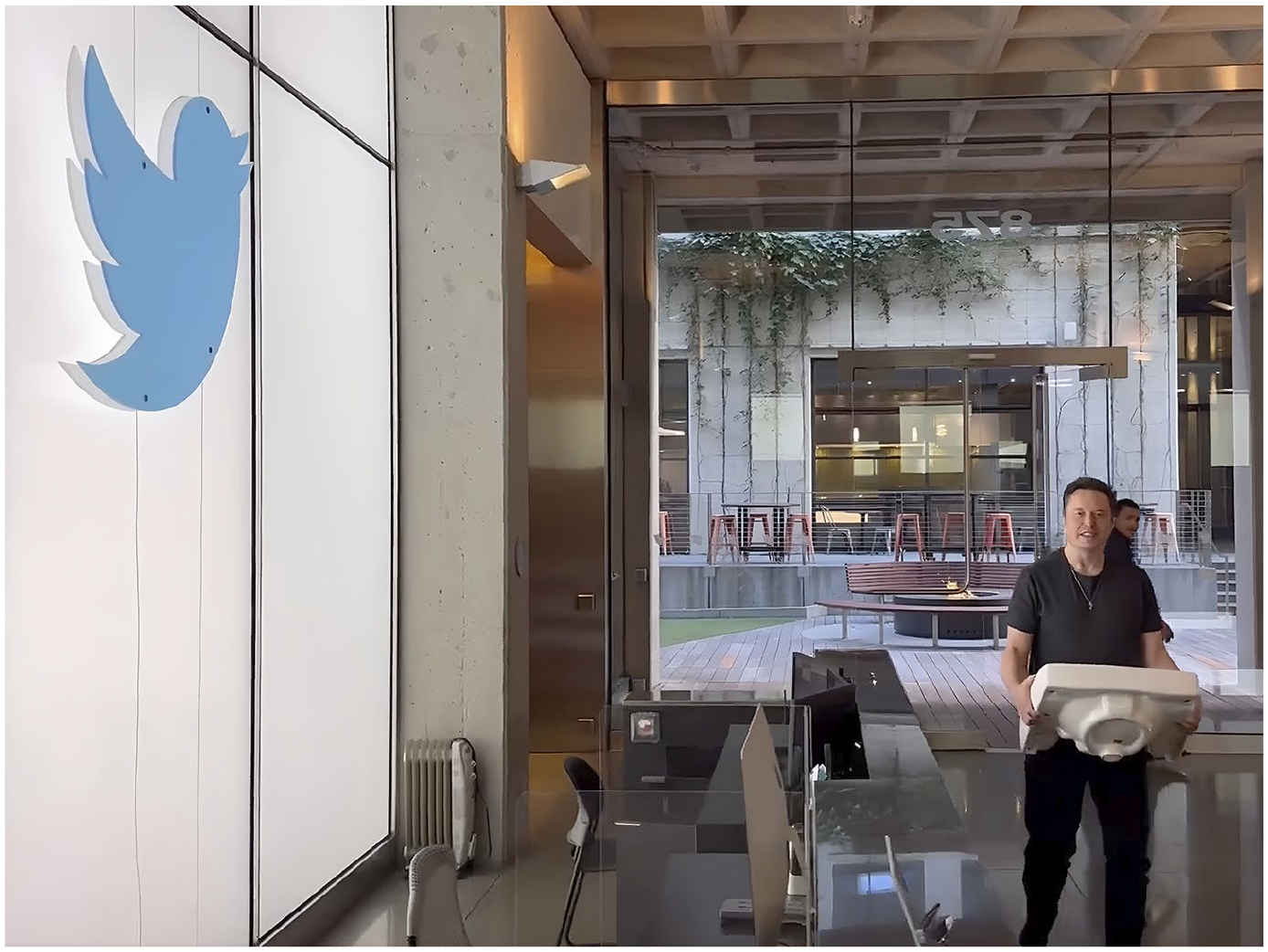
Musk arriving at Twitter headquarters.
What happened in the following days and weeks was well documented in the press and has since been meticulously reconstructed by others (Conger and Mac, 2024; Mezrich, 2024). To summarise, Musk took Twitter private, installed himself as CEO and fired most senior executives (Paul and Milmo, 2022). Shortly after, Musk dissolved the board and became sole Director (Al Jazeera, 2022). Musk then oversaw the firing of roughly half of Twitter’s then 7,500-odd workforce (Rushe et al., 2022), which triggered further resignations in protest. Moving into November, Musk announced a series of planned platform changes. The most notable involved changes to Twitter’s user verification system – Twitter Blue – to include paid subscriptions for verified accounts (see Mehta, 2022). While staff unrest continued, and backend changes to the platform began to be experienced by users, Musk issued an ultimatum letter to all remaining staff, which included a vision for ‘Twitter 2.0’ (see Figure 2).
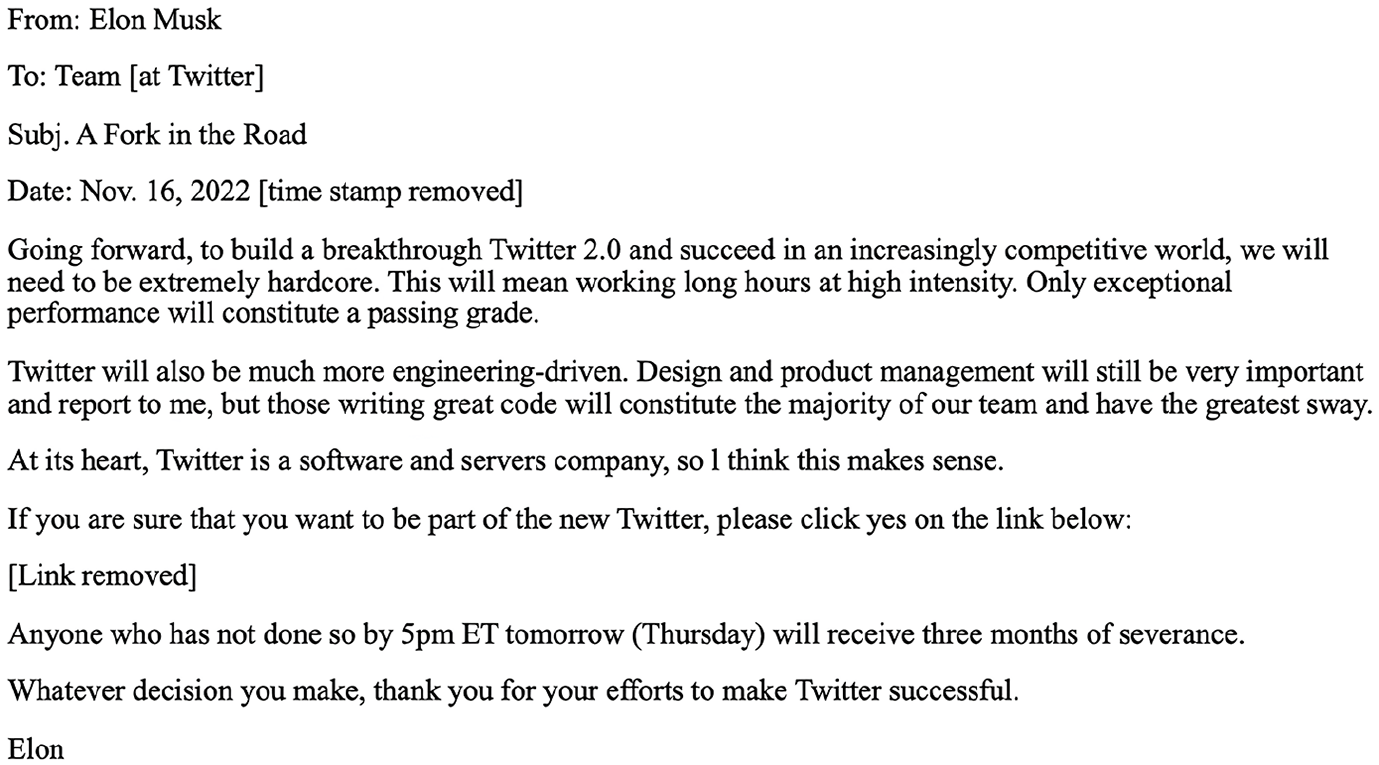
Email Elon Musk sent to Twitter employees (reproduced from Kolodny, 2022).
As Musk was attempting to transform Twitter to fit his new vision, companies began pulling their ads from the platform. According to reports, by the end of November Twitter had lost half of its top 100 advertisers, with other notable companies substantially reducing their spend (Duffy, 2023; Hubbard, 2022; Reimann, 2022). Finally, in early February 2023, Twitter announced the closure of its free API, which affected the operation of bots on the platform, third-party apps and also ended access to data relied upon by researchers (Barnes, 2023; Stokel-Walker, 2023). In the case of the Twitter-Mastodon migration, then, we observe the initial Musk acquisition as a triggering X Factor, together with a series of closely related factors that together constitute an unfolding event.
The presence of an X Factor, within an event-focused and temporally sensitive approach to social media migration, can be observed in other cases. In Edwards and Boellstorff’s (2021) study of the Tumblr migration, the adult content ban is the X Factor. Though not on the scale of the Twitter migration, we saw earlier how the Parler migration was similarly triggered by a positive endorsement from Candace Owens (Aliapoulios et al., 2021: 5). More recently, a smaller migration from Reddit was triggered by the proposed introduction of fees for third-party access to its API (Mehta, 2022), while a migration from Twitter/X, largely to Bluesky and Threads, was triggered by the banning of X in Brazil by the country’s supreme court (Phillips, 2024). Finally, another X migration to Bluesky took place after Musk became very active in final stages of the Trump election campaign and made further changes to user blocking features. While the scale of a migration may differ significantly as well as the nature of the triggering factor, the notion of an X Factor reorients researchers around a general eventfulness, where the temporality of a factor, and its differing force (i.e. ‘the most significant’) help to orientate understanding.
Critical voice
Following the triggering event and related experiential shifts, users begin to express dismay, anger, frustration, sadness, shock and other emotions in response to the X Factor and subsequent decline. For example, many high-profile Twitter users and celebrities expressed their concerns. Online writer, Tom Tapp (2022) documented some of the more notable tweets from US celebrities, which we reproduce in Figure 3.
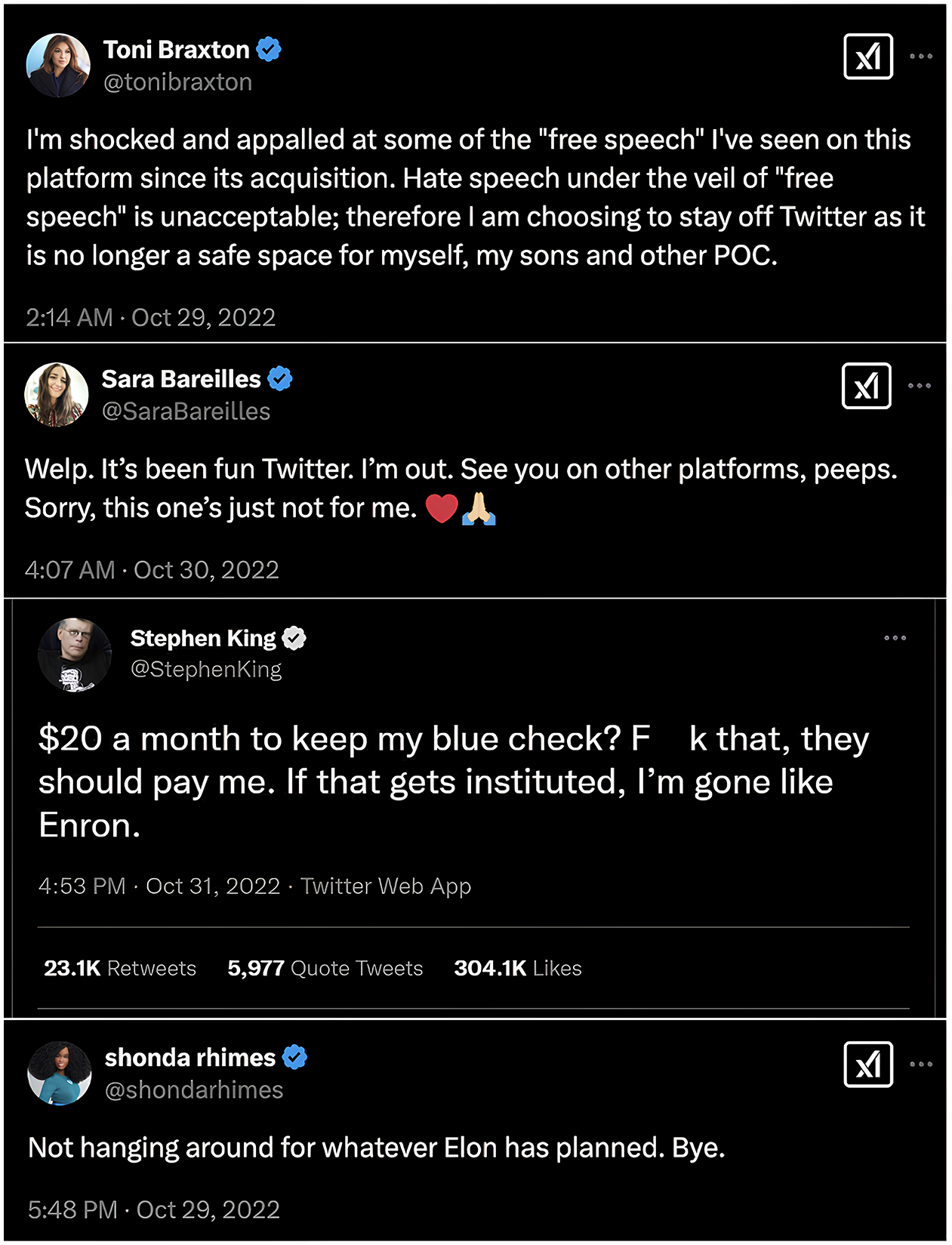
Tweets from US celebrities expressing their concerns.
Of course, similar sentiments were expressed by many less visible users, but even the handful of celebrity tweets can be seen to map on to either the Musk acquisition X Factor, or the other related factors. Author Stephen King objects to paid verification. Singer and actress Toni Braxton’s Tweet refers to the changing content she has observed; Television producer and screenwriter, Shonda Rhimes invokes Musk; and singer-songwriter Sara Bareilles has already announced her move to other platforms. All are using their voice, or a combination of voice and exit (or threat thereof) in ways that recall Albert O. Hirschman’s (1990) classic work, Exit, Voice and Loyalty. Hirschman suggests that when experiencing a decline in an organisation, people can either voice their concerns, or leave – the exit option. Hirschman was writing in a different media age, so work is needed to more fully translate his ideas. It is enough here, though, to point to this tradition of voice and to show how users make use of their voice in response to the perceived decline.
Voicing disapproval through tweets was the most obvious expression, but critical voice is not limited to the main content of tweets. Critical voice is communicative in the broadest sense and could include a wide range of discursive and representational acts. We include here not only the use of gifs, memes, emojis, like and retweets but also the use of metacommunicative expression in the form of hashtags and the act of Twitter users changing their user handles to Mastodon account addresses. What brings all these communicative acts into a shared coherency is they all express a critique of the unfolding event and its diverse experiential components.
Collective platform consciousness
Often concurrent with and inseparable from the second element, collective platform consciousness has two components: (1) Through shared experiences of the triggering event, perceived decline and critical voices, users come to see themselves as part of a collective that is distinct to their experience of ordinary platform or site use. They see themselves as connected to and affected by a larger event and as part of a shared response. (2) Their collective consciousness of the event, along with the specificity of critical responses, is associatively transferred to the platform or site as whole. While the X Factor is the initial trigger, as the larger event and subsequent factors unfold, the perceived problem is extended to encompass the platform/site in general. Tweets from rapper Soulja Boy capture this logic well: ‘Now u can just pay to be verified? Twitter has been destroyed’ (Coleman, 2022). Such a collective consciousness may not always be easy to observe before a migration occurs but nevertheless needs to be in place for a migration to occur. For example, there needs to be collective expression along the lines of ‘There is a problem with Twitter. We are leaving and migrating to Mastodon’, even if such an expression is never articulated in words. It is important to point to the existence of this collective, who emerge in an antagonistic relationship to the platform/site, because this collective actor defines the migration as a migration, as opposed to regular switching between social media (Matias, 2016). 3 They are the collective body that confirms the significance of the X Factor and, through their collective action, they give reality to the migration.
Migration
There is a movement of users from one site or platform to another. As noted in the review above, this can take many forms with different characteristics: technical actions, such as account setup or closure, content archiving, and so on. It may involve differing attention ratios and new forms of sociality, may not be a singular occurrence, and likely takes place within a multi-social media use environment. Whatever the differences across migrations, they must all involve a collective flow beyond the everyday switching and slow drift of users. In short, a migration needs a triggering factor and collective act if it is to count as a migration. A migration also needs the presence of an alternative. The alternative does not need to be identical, but the platform or site’s features and modes of interaction must be similar enough to support imagined future forms of sociality and the possibility of at least a partial reconstruction pre-migration sociality. While Mastodon is distinct to Twitter/X in fundamental ways, its ordinary scenarios of use are similar enough for it to serve as a viable possible alternative. If no such alternatives exist, exit rather than migration is the only option.
What were the characteristics of Twitter-Mastodon migration? Our account analysis identified an initial ‘technical’ migration (Edwards and Boellstorff, 2021: 585), which we determined as the date a Twitter user signed up for their Mastodon account. The technical migration provided us with a linear timeline of the migration (Figure 4). While our sample is small compared to the larger migration reported in news and online sources, it is broadly consistent with Mastodon’s overall growth pattern during this period (Chan, 2022; Griffin, 2022; Mastodon Analytics, 2025; Zia et al., 2023). It also empirically confirms users with Twitter accounts were actually creating Mastodon accounts. The migration is concentrated from late October 2022 to early December 2022 and aligns directly with key developments of Musk’s acquisition of Twitter. For our sample, the official acquisition announcement, the plans for Twitter Blue and the mass resignations align with the largest migration flows. However, we also see a smaller number of user migrations earlier in the year, coinciding with Twitter accepting Musk’s offer – perhaps a migratory ‘tremor’ indicating a larger event to come.
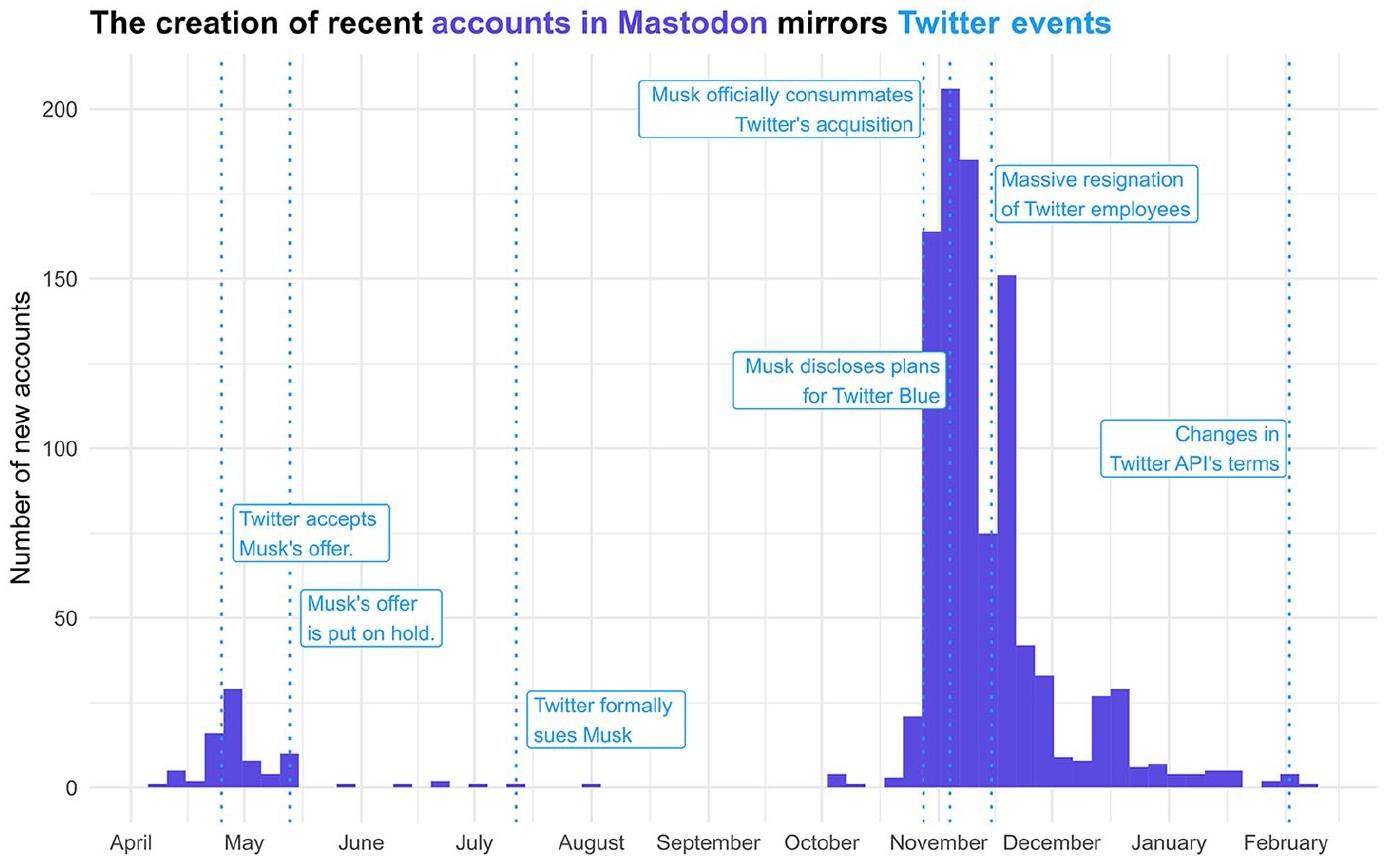
Histogram of recent Mastodon accounts (from 25 March 2022 to 13 February 2023).
Beyond this basic technical migration, we were also interested in how users engaged with both social media post-migration. Was the technical migration matched by a ‘social’ or ‘attention’ migration (Edwards and Boellstorff, 2021: 588; Kumar et al., 2011: 1206)? Figure 5 shows a distribution of user account activity across Twitter and Mastodon. The horizontal axis shows the difference between posts made by the same users on Twitter and Mastodon between 25 March 2022 and 13 February 2023, with ‘0’ meaning equal posting on both platforms (labelled as ‘undecided’ at the centre of the plot). Users more active on Twitter are positioned to the left on the horizontal axis. Overall, there are notable outliers on both sides, but the median and the Interquartile range (IQR) displayed on the boxplot on the top are slightly skewed towards Twitter. However, most users are clustered around the 0 axis, with over 215 users having no difference between posting activity. Of these, 72 did not post anything at all on either platform hence were lurkers. The remaining users clustered towards the middle tended to be slightly more active on one or the other. In total, we analysed 276,997 posts, with 137,081 posted on Twitter and 139,916 on Mastodon. The figure confirms that there was a social reality to the technical migration, with a notable number of users who favoured posting on Mastodon during the time under consideration. There are also caveats here, including that we didn’t look at other engagement metrics (favs, shares, etc.), plus the activity distribution measure is not able to capture the diversity of user actions or tell us anything about what users are doing, feeling or thinking when engaging with either platform. However, it does confirm that many new users at least attempted a social migration alongside their technical one, while also confirming that the migration was not straightforward, with most users continuing to use Twitter while they trialled Mastodon.
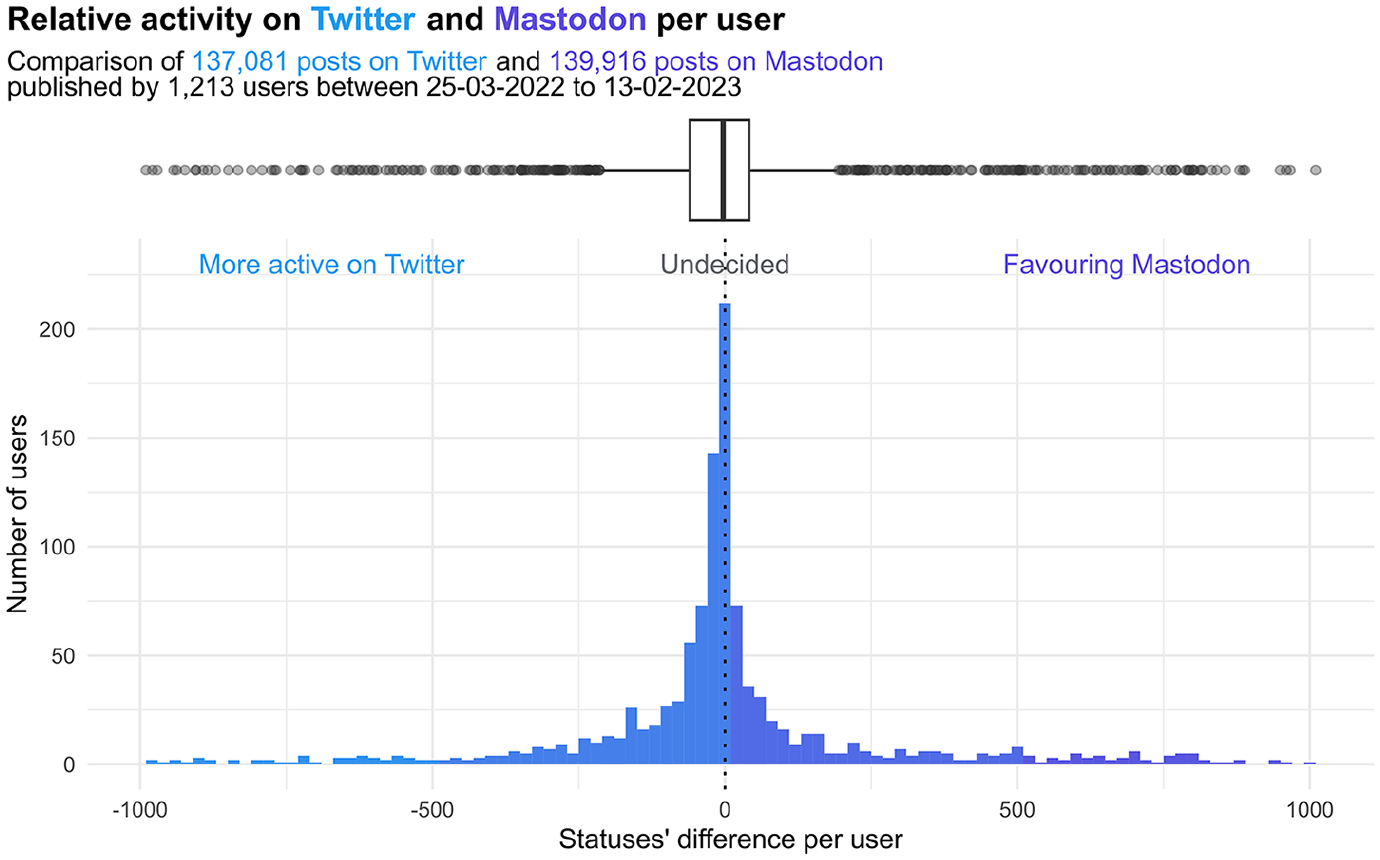
Distribution of account activity (by posts) across Twitter and Mastodon (from 25 March 2022 to 13 February 2023).
We used our survey data to further explore how users engaged with other social media, besides Mastodon. Most Mastodon migrants reported using other social media, with three being the most common number declared (approx. 42%) and the range between 1 and 10 social media platforms/sites (see Figure 6). The same figure shows that Twitter, Facebook and Instagram are the three most popular platforms, while only 2.4% of Mastodon users claimed to be only using Mastodon. These figures further indicate that Mastodon users are typically active across different social media and thus the migration occurred within the context of multi-platform/social media use. While not conclusive, this lends evidence to the importance of ‘attention’ migration (Kumar et al., 2011: 1206), and the suggestion that migration is not a single act of moving from one site/platform to another (Edwards and Boellstorff, 2021: 588).
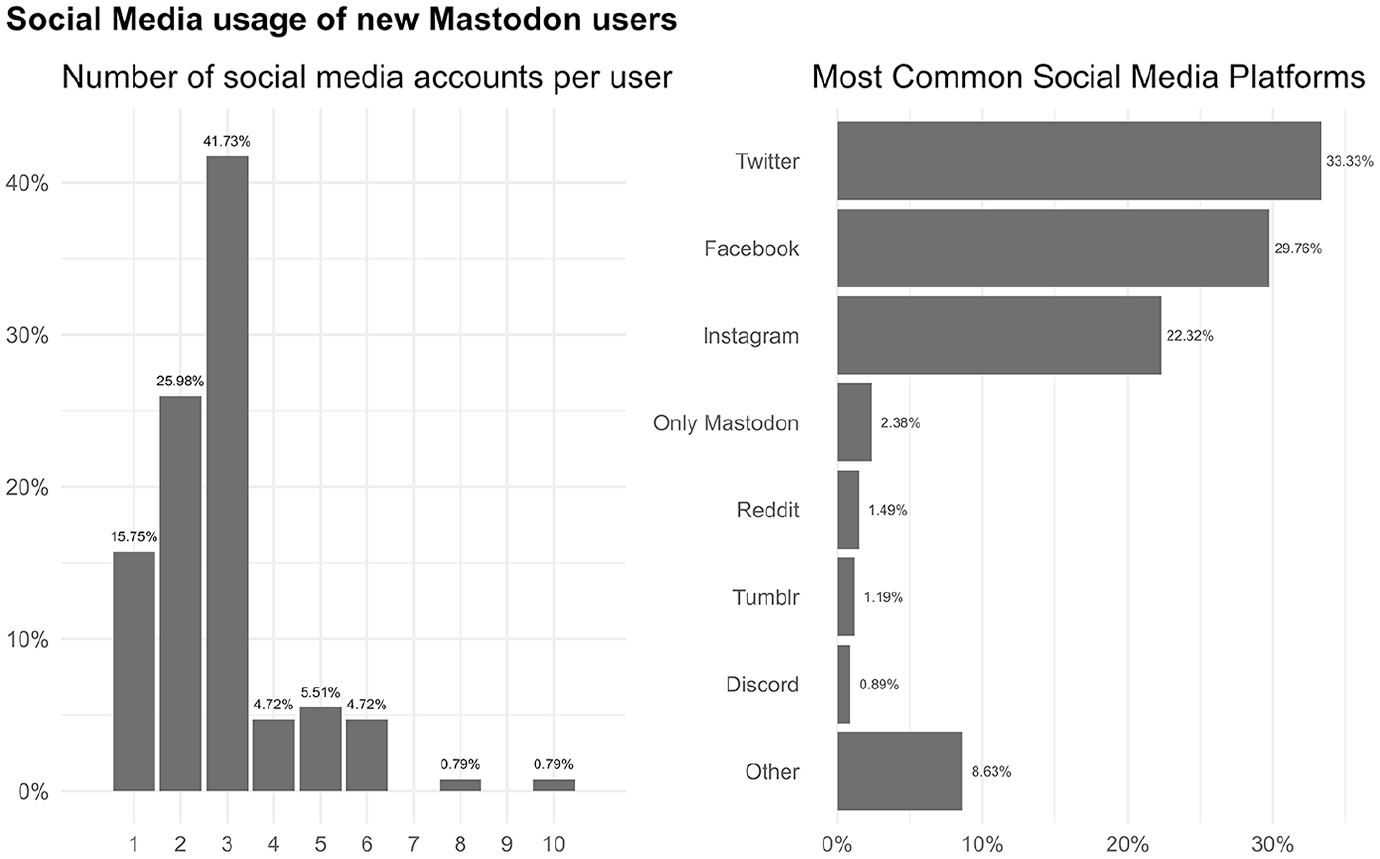
Use of social media besides Mastodon.
Despite this recognition that the migration existed within a multi-platform ecology, with much ambiguity around social and attention migration, when we asked those who had migrated directly about how often they used Mastodon (a phrasing broader than how often they ‘posted’), the majority reported that they used Mastodon daily, followed by those using it 4–6 times a week (Figure 7).
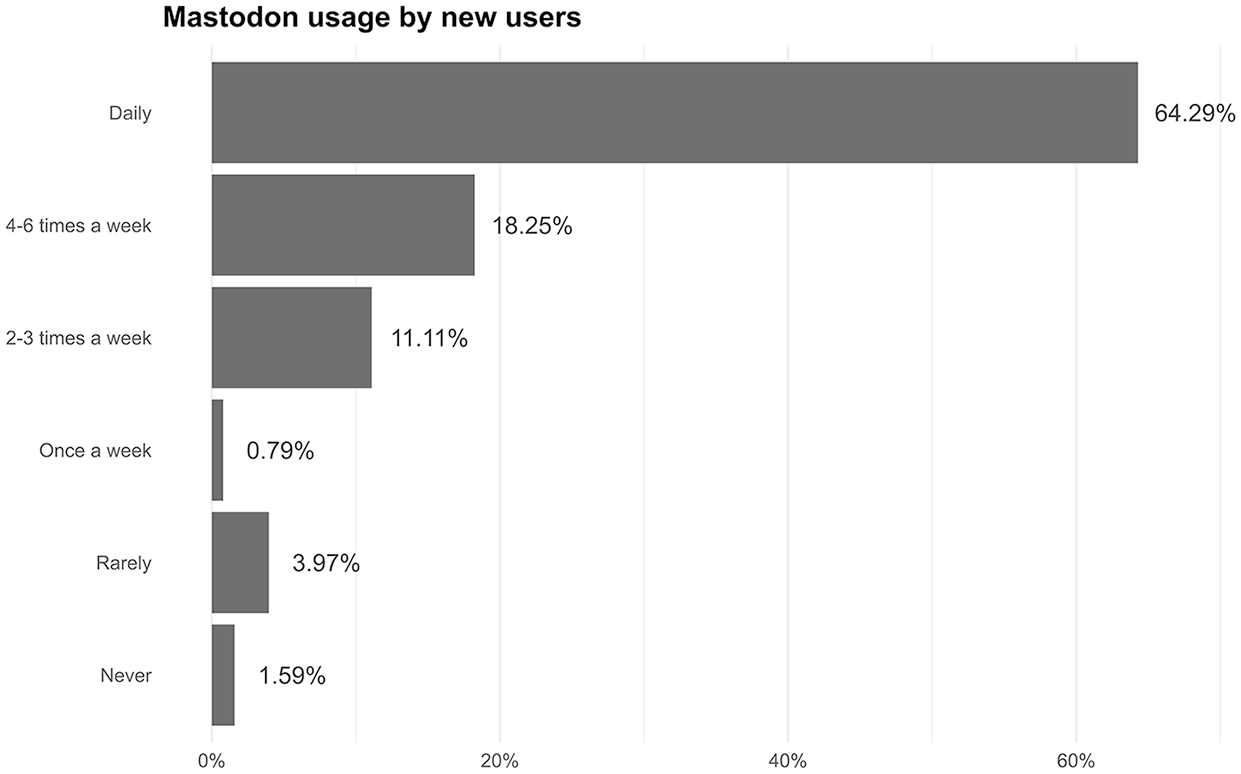
Mastodon usage.
Our social media account analysis confirms a technical migration occurred, although users’ posting activity varied significantly in post-migration. Only a small majority posted more on Mastodon during the migration period, and most did so within a context of multi-social media platform/site use. Despite this, the fact that most users reported using Mastodon regularly, together with the account post analysis, suggests there was an initial ‘attention’ migration, with some users exploring whether Mastodon could be a new social media home. With the benefit of hindsight, we know that of the roughly 2 million users that migrated, less than half remain as active users. Nevertheless, the active user count shows that Mastodon had almost 1 million more active users over a year after the migration occurred, which suggest a significant number of users did at least temporarily migrate (Mastodon Analytics, 2025).
Terrain transformation
As a final element, one can observe a material and discursive transformation resulting from the migratory act. This element is wide-ranging but can be broken into at least three components: host, destination, wider environment. In our case, post-migration Twitter is not the Twitter of old. Users who stay experience an altered platform, with less users, different content and a different perception about what the platform ‘is’ and what it values. As destination, Mastodon is equally transformed. Most obviously, the migration made it larger and more visible. Existing users wrote guidelines for newcomers and communicated how Mastodon works and how it differs to the commercial social media platforms. Some users expressed concern over the new users and worried Mastodon would become more toxic or more like Twitter. Finally, the wider social media environment was transformed. Whereas Twitter had seemed secure in its social media niche/s – news, political discourse, specific user communities, and so on – after the migration there was a general sense this was no longer the case. Shortly after the acquisition and migration, Meta rushed the release of Threads and the eventual release of Bluesky also aimed to capture something of Twitter’s legacy and userbase. It is difficult to see these developments unfolding as they did without the migratory event.
These five elements of our eventful theory of social media migration should not be considered as iron-clad laws, inflexible and unchanging in their details across all migrations. Instead, we see them as recurring elements that studies of specific migrations may use as a guide and initial interpretive framework. For example, while a triggering event typically happens first, there may be circumstances where the mere possibility of such an event means a critical voice and collective consciousness begins to emerge before the event itself, as users attempt to prevent the X Factor from happening. Thus, while the X Factor theory reorientates SMM research to the temporal unfolding of a migration, the sequence may change or even be difficult to plot in a linear way. In general, though, the eventful theory aims to draw out the event-response logic that characterises much SMM. It is a way to demarcate SMMs from the everyday flow of users across sites and platforms. The dynamic unfolding of a social media migration, its event-voice-consciousness-migration-transformation, also draws attention to the central position of users in the migratory event. Users aren’t isolated individuals running calculations on their own motivating factors. Rather, they co-produce migratory events and use their collective voice to rally against the site or platform itself. Eventful migrations may be one of the rare instances that users express real collective power directly at a site/platform provider – a power with the capacity to reshape the wider social media environment.
Conclusion: Eventful migration and user power
Through a case study analysis of the 2022 Twitter-Mastodon migration, this article has offered an ‘eventful’ theory of social media migration. We began with an overview of how others have approached SMM, which we separated into three categories: those drawing on the ‘push-pull factors’ tradition and interested in the ‘why’ of migration; those focused on the empirical ‘dynamics’ – the ‘how’ and/or ‘what’ of migration; and those interpreting migration as part of a social theory, where questions of ‘movement’ are placed alongside ‘selfhood and power’ (Edwards and Boellstorff, 2021: 582). Drawing on theories of event from philosophy, history and media studies, we then outlined the theoretical foundation for our approach to event in the context of social media.
Informed by this literature, we conducted our study of the Twitter-Mastodon migration, including an exploratory survey of Mastodon users and a comparative account analysis of users who indicated they had migrated. Our eventful theory of SMM offers an advancement on the tradition of push-pull factors research by drawing attention to the power of a single factor that we see driving many SMMs. In the social media environment, where the barriers to migrating are typically lower than in geographical migration, and where a migration is typically not a life altering event in the same way a geographical migration is, and where users may already be active on multiple sites and platforms, users may be more responsive to specific events. We have also built on several studies within the ‘dynamics’ category, analysing when and how users migrated from Twitter to Mastodon. Our migration theory urges researchers to approach migration as event-based and therefore temporal and social (as well as spatial), and we identified five recurring elements along these lines.
By placing users and collective consciousness as central to migration events, we draw out the social and political aspects of SMM and thus share much in common with Edwards and Boellstorff’s (2021) social theory of exodus. We too see migration within the dynamics of platform power (see Bonini and Treré, 2024: 13–19) – what we might refer to as an expression of user power, a kind of platform counter-power, where users step outside the everyday ‘social’ dynamics of social media and become historical and political actors in a shared collective consciousness brought into being through a kind of platform negation (Mouffe, 2005). While SMM is clearly related to exodus, there is value in paying attention to the specificity of migratory events, to its critical voices and emergent collective consciousness, and to the messy dynamics of the migrations. Doing so reveals that the flow of users is only one aspect of the migration-event, and the long-standing impact of such events is only partially captured through tracking movement between platforms. Our study brings this eventfulness back into focus, where SMM serves as evidence of a disruption to the social media settlement, where the sleeping power of users awakens, even briefly, and ripples through the social media environment. We do not suggest all migrations follow an exact logic or share identical qualities, but we have observed key overlapping elements that we have drawn out for further consideration, modification or refinement, acting a guide for researchers in future studies.
Footnotes
Acknowledgements
The authors thank Janna Joceli Omena and the Master’s students in the Centre for Interdisciplinary Methodologies at the University of Warwick (2022-23 cohort).
Data availability statement
Special consideration has been taken to make the survey dataset easily reusable both from a technical and legal standpoint. The anonymised data used in this survey, as well as its metadata describing variables and methods is published in a public repository accessible with its own DOI 10.17605/OSF.IO/734YW as Open Data under a Creative Commons CC BY-SA 4.0 Licence to favour scrutiny, shareability and reusability. A companion paper explaining methods used in the survey is currently under review at Data In Brief. It should be stressed that only aspects of this survey are relevant and drawn upon in this current submission.
Declaration of conflicting interests
The author(s) declared no potential conflicts of interest with respect to the research, authorship, and/or publication of this article.
Funding
The author(s) disclosed receipt of the following financial support for the research, authorship, and/or publication of this article: Research for this article was supported by the Research Development Fund at the University of Warwick, for the project ‘Researching Platform Migration: Twitter Decline and the Rise of Mastodon’, Jan 2023–July 2023.
Ethical approval and informed consent statements
Ethical approval for this project was granted by the University of Warwick’s Humanities and Social Sciences Research Ethics Committee (ref HSSREC 95/22-23). The article draws on the findings of a survey of Mastodon users who had migrated from Twitter. The survey contained details of the project and a consent form participants needed to accept to participate. The article also includes a comparative analysis of social media account activity. While all the data gathered was publicly available, the authors are sensitive to differing norms around the acceptable use of data across different social media sites and platforms. The authors decided not to use any identifiable content, or to analyse the content of any Mastodon posts. The authors include anonymous data of when users joined Mastodon and the number of posts they made on Twitter and Mastodon over the period of the study. This data is entirely anonymous and was necessarily to help established the reality of the migration.
