




Abstract
This article presents a detailed qualitative content analysis of eating disorder and recovery videos on TikTok which show young women who proclaim to raise awareness or depict the recovery process. We pay particular attention to aspects of form and content and TikTok's affordances in relation to them. We argue that allegedly showing what an eating disorder and recovery are ‘really like’ is in tension with an aestheticisation of the female body and eating disorders that is present in the videos. While TikTok has been described by scholars as a memetic and viral platform, this aestheticisation points to a tension of authentic self-expression, complexities around body image and memetic visibility. We conclude that the platform is characterised by repetition and imitation, but those aspects are secondary as they relate to struggles linked to eating disorders themselves and their representation rather than primary virality or the memetic.
Keywords
Introduction
Since its launch in 2018, TikTok has emerged as a prominent platform for user-generated short video content. Amidst a variety of videos, there has been some concern surrounding the representation of eating disorders (Ghaznavi and Taylor, 2015; Pryde and Prichard, 2022). While the platform's user guidelines prohibit content ‘depicting, promoting, normalizing, or glorifying activities that could lead to suicide, self-harm, or disordered eating’, TikTok allows users ‘sharing their personal experiences with these issues as a safe way to raise awareness and find community support’ (TikTok Community Guidelines, 2023). In this article, we present results from a qualitative content analysis of a sample of eating disorder videos, many of which proclaim to raise awareness or allegedly depict the recovery process. We pay particular attention to the manifest and latent aspects, what is explicitly and implicitly shown, of such representations and the role of affordances in shaping these videos. In this context, we follow Bucher and Helmond who define affordances as key material and virtual dimensions of platforms which constitute ‘socio-technological environments that draw different users together and which orchestrate the relations between different platform users’ (2018: 249–250). Affordances designate possibilities for platforms and users to affect each other. As we go on to discuss, TikTok's general affordances enable particular forms of self-representation and usage by those who upload eating disorder content.
Through its features of short videos, hashtags and background music (whereby any other video that uses the same audio can be displayed at the click of a button), the platform has been credited with perfecting the viral and memetic qualities which were already present on older social networks like Twitter or Instagram (Rogers and Giorgi, 2023). It has given rise to viral trends, customs, dance routines, notorious, and at times dangerous, challenges and fashions (Vizcaíno-Verdú and Abidin, 2022; Zeng and Abidin, 2021). It appears as a platform of imitation (Zulli and Zulli, 2022) where users either seek to create a new trend or jump onto an existing one in the hope of gaining visibility and followers (Brown et al., 2024; Darvin, 2022). Yet, as we show, eating disorders reveal a complex case where dynamics of repetition and imitation are present alongside the aestheticisation of unique and individual lived experiences not designed to be part of a trend or viral video. This is not only due to the seriousness of eating disorders or that such content may be routinely shadowbanned by TikTok, but because the videos analysed constitute examples of representations of individual struggles and the weaving of interpersonal connection and ‘algorithmic closeness’ (Divon and Eriksson Krutrök, 2023; Eriksson Krutrök, 2021) which are situated between the self, others and the platform's affordances.
Eating disorders (ED) ‘are characterized by a persistent disturbance of eating or eating-related behavior that results in the altered consumption or absorption of food and that significantly impairs physical health or psychosocial functioning’ (DSM-V, 2022: 372). Anorexia nervosa is ‘characterized by deliberate weight loss, induced and sustained by the patient. It occurs most commonly in adolescent girls and young women, but adolescent boys and young men may also be affected […]’ (ICD-10: F50.0). Bulimia nervosa is ‘characterized by repeated bouts of overeating and an excessive preoccupation with the control of body weight, leading to a pattern of overeating followed by vomiting or use of purgatives. This disorder shares many psychological features with anorexia nervosa, including an overconcern with body shape and weight’ (ICD-10: F50.0). In our research project, anorexia and bulimia were the most represented eating disorders on TikTok.
While there have been studies on the representation of eating disorders in fora and Instagram, few to date have taken TikTok as its object of study and none have produced a detailed, qualitative content analysis in conjunction with a focus on the platform's characteristics. The present study therefore contributes to scholarship on the representation of eating disorders in social media more generally and specifically on TikTok, to youth and platform studies as well as to scholarship on the relationship between platform affordances and content. The topic of eating disorders presents a cultural phenomenon which is being mediated on TikTok and, as we show, presented in novel and complex ways. We demonstrate through a detailed content analysis and discussion of TikTok's features how the two are related to each other. While TikTok is often defined in terms of virality and the memetic, we argue that the videos we analysed reveal a complex negotiation of those aspects and are only secondarily influenced by the memetic, repetition and imitation. The article further contributes to scholarship on TikTok more generally as we conclude by additionally pointing to similarities between eating disorders themselves and the platform. The study's aim was to investigate how eating disorders are presented through videos on TikTok. We focussed on the following sub-questions:
How are eating disorders represented through videos?
What is the relationship between manifest content and what is implicitly shown in the videos?
How are the videos shaped by TikTok's affordances?
The above questions situate the study as one that takes the manifest and implicit dimensions of the content as well as TikTok's unique features and characteristics into account. Rather than framing the project through a priori notions such as platform moderation, shadowbanning, or implicit assumptions about danger or empowerment which run through much of the literature discussed below, we adopted an open and exploratory stance with the aim of generating novel insights.
Social media and eating disorders
While there have been studies on ED content and users across social media more generally (Juarascio et al., 2010; Dias, 2013; Gavin et al., 2008; Ghaznavi and Taylor, 2015; Harshbarger et al., 2009; Pryde and Prichard, 2022; Tong et al., 2013)) and TikTok specifically (Herrick et al., 2021; Pruccoli et al., 2022; Rando-Cueto et al., 2023), few have provided a detailed analysis of content and their relationship to the affordances of a platform such as YouTube or TikTok. As an exception, Mikhaylova's study (2024) on the self-representation of women with anorexia on YouTube points to the ‘joint structural influences’ between the platform's affordances and the users ‘that shape storytelling’ (2024: 3235) and the visibility of such content. Given that since its launch in 2016 TikTok is still relatively new, little research so far has focussed on the representation of eating disorders (Herrick et al., 2021). In their qualitative content analysis of recovery-related ED content on TikTok, Herrick et al. (2021) found that most videos centred around raising awareness and recovery as well as funny videos about ED experiences. They also found videos that ‘delineated the fine line between recovery and pro-ED content’ (Herrick et al., 2021: 524). This speaks to the ambivalent character of videos when it comes to notions of recovery and documenting the ‘reality’ of eating disorders, something we discuss by providing a more detailed analysis of a small number of videos in relation to the platform's affordances.
Many studies have focussed on platform moderation of eating disorders and related problematic content. This can often involve the restriction of hashtag searches (Gerrard, 2018), the filtering and removing of content or shadowbanning its users (West, 2018). However, despite the platforms’ efforts, eating disorder content remains visible. To circumvent deletion or shadowbanning, many users use various evasive tactics, such as private accounts or obscuring the body in photos (Olszanowski, 2014). Users also use ‘algospeak’ and slightly modify particular terms, for instance using the hashtag “#edrec0very” instead of “#edrecovery”, adding or deleting characters in tags (“anorexiaa”), substituting letters (“thynsporation”), or deliberate misspellings (“an0rexic”). The text in profile biographies is often used to convey an eating disorder to the community in a coded manner. As a mainstream platform, TikTok can be seen as ‘a social media ecosystem in which pro-ana, anti-ana, and pro-recovery content coexist and are intertwined with one another’ (Greene and Brownstone, 2023: 510). In their studies of eating disorder videos on TikTok, Herrick et al. (2021) as well as Logrieco et al. (2021) argue that the boundaries between pro- and anti- or recovery-themed ED content have become blurred. In our sample, the term “recovery” was often used but we make no assumptions as to if someone was recovering, had recovered or not.
Indeed, ED communities are seen by some researchers as spaces for exploration of identities and fostering a sense of community (Dias, 2013; Giles, 2006; Kenny et al., 2020; Norris et al., 2006; Wooldridge, 2017). TikTok has acquired a particular status as a platform on which content in relation to mental health can be shared (Şot, 2022). Lavis (2018: 455) has argued that studies of eating disorders have paid too much attention to questions of body image alone and more research should ‘provide a critical lens onto what anorexia does for, as well as to, individuals living with the illness’ on an everyday and mundane level. We follow this call with our study which sought to provide a detailed and rich qualitative content analysis of a small sample of eating disorder videos on TikTok. Our focus here was specifically on analysing how eating disorders were represented as an everyday practice through video creation, which depicted for instance everyday eating habits or daily routines, and how such practices were shaped by TikTok's affordances.
Research approach and method
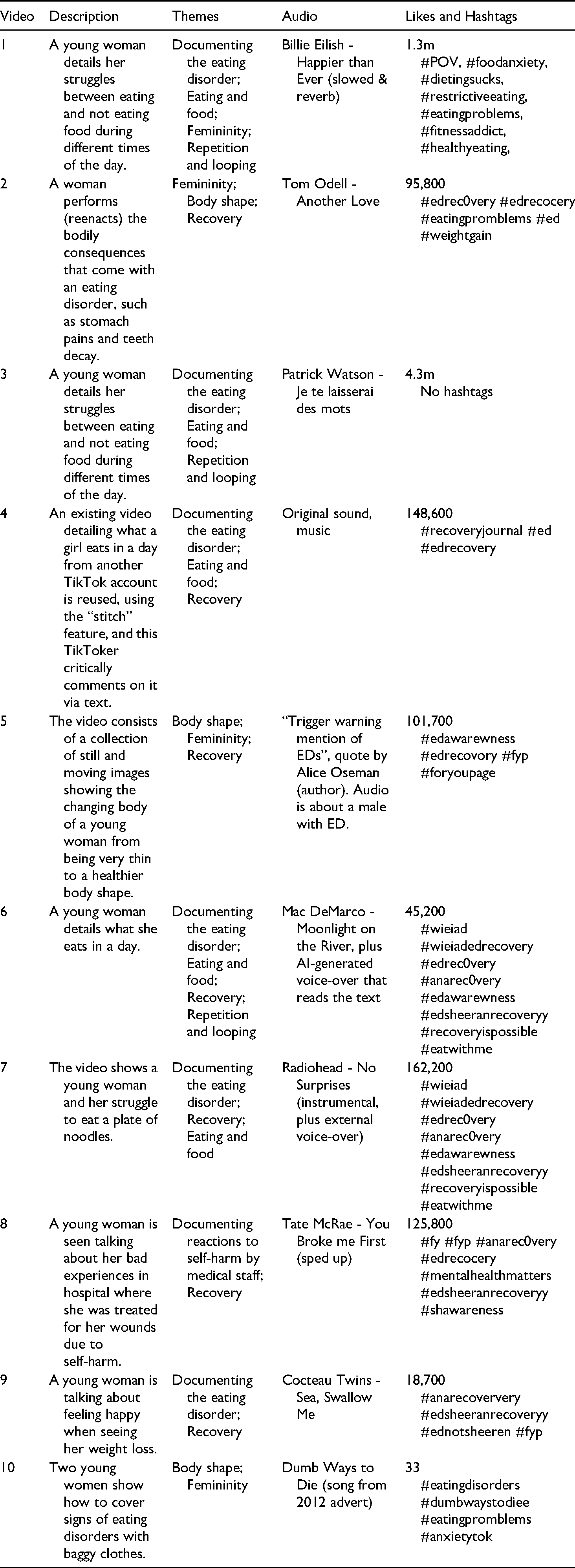
The methodology and the methodological approach follow grounded theory as a research strategy (Glaser and Strauss, 1967). The videos were selected from 01 February to 31 April 2023, a research assistant (RA) created a TikTok account and found videos related to eating disorders by using particular search terms like ‘ED’, ‘Eating’ and ‘Eating food’. Many of the accompanying hashtags included deliberately misspelt terms such as: #eatingpromblems or #edrec0very. Alongside this, users would incorporate different hashtags like #edawareness and #edrecoveryshare. Once the RA had begun gathering substantial data, eating disorder content subsequently appeared often on his For You Page (FYP; TikTok's recommendation page). Regarding the theoretical sampling strategy, after the first set of videos, further cases were selected according to minimum contrast and maximum contrast in order to guarantee a diversity of videos in terms of their content. The RA created a Word document with a table which included a total sample of 17 videos. The table comprised of a short description and link to each video. To provide a very detailed analysis of the videos, it was decided to use a relatively small sample of ten videos after they were grouped thematically (see Appendix). In order to analyse videos in depth, qualitative content analyses were pursued (Miltsov, 2022). The aim of the methodological procedure was to compare and contrast the content and form of the sequences within the videos and text in a detailed manner and focus on what they depict, as well as the setting and actions shown in each video. This procedure aimed at the reconstruction of represented and implicit meaning which goes beyond the manifest (Mey and Dietrich, 2016). Therefore, first, the single scenes of the respective videos were described in detail and common and differing themes were coded. The themes summarise the main thematic and aesthetic aspects of each video (e.g., recovery) as well as implicit (e.g., femininity) and structural aspects (e.g., looping). Secondly, the videos’ titles, audio information as well as all hashtags and number of likes were copied. After the analysis of the individual videos, they were compared and contrasted with each other. For the protection of the young women, we refrain from inserting the video links or providing screenshots. 1
Findings
Documenting the ‘reality’ of eating disorders
A common quality that the sampled videos shared is the public representation of usually shameful, tabooed and hidden aspects of eating disorders that are shown in private spaces, such as bedrooms, kitchens or living rooms. This may contribute to an alleged authenticity and intimacy of each video and mimics how micro-celebrities and influencers construct public identities by carefully sharing personal and at times intimate content on social media (Banet-Weiser, 2021; McRae, 2017; Raun, 2018). Seven videos display through their titles or overlaid text that they are explicitly about showing what eating disorders ‘are really like’, that the creator wishes to ‘raise awareness’ or document their eating disorder or recovery from an eating disorder. For example, one video begins with the text ‘TW DISORDERED EATING CAN LOOK LIKE THIS’, another starts with ‘EDs aren’t glamorous… here's what they don’t show you in films’, a third critically includes the text ‘please don’t glorify not eating □’ throughout. Video 3's text reads: What having a food DI$ORDER can look like Oversleeping 10:40am Over hydrating 1:00pm 5:00pm 1:00am Guilt
The above chronological times may represent the need to structure the day, control and track the body, yet also show a loss of control over the body, as shown by the terms ‘over hydrating’ and ‘oversleeping’, ultimately resulting in ‘guilt’ for having eaten something at the end of the day. Video 2 similarly documents through text in combination with performance how eating disorders may result in uncontrollable aspects of the body: Depression and isolation Stomach pains and ulcers Heartburn and heart palpitations Teeth decay Thinking about food 24/7
All videos purport to show the ‘really’ existing qualities, dynamics and consequences of eating disorders. This emphasis of raising awareness or recovery may have been shaped by TikTok's user guidelines which explicitly allow such content to exist on the platform (see Introduction). Yet, they constitute acts of representation, specifically aestheticisation and performing for the camera and an audience. This shows the tension between wanting to reveal something that is often hidden and the desire to make it visible. that Scholars have identified some similarities and differences with this tension when it comes to the careful portrayal of authenticity which always remains artificial (Banet-Weiser, 2021; Raun, 2018). Banet-Weiser has argued that being seen as authentic on social media requires performance which can be rewarded with visibility. Social media, particularly for women and girls, is ‘often positioned as a kind of open space, where one can be “oneself,” while at the same time it is also structurally designed as constantly manipulable’ (Banet-Weiser, 2021: 6). This focus has been pushed to new extremes on TikTok which is particularly used by women and girls. It specifically ‘invites and rewards’ (Kennedy, 2020: 1070) the production of content that makes girls’ traditionally private spaces, such as bedrooms, public and potentially turns them into a ‘viral spectacle’ (Kennedy, 2020: 1070). However, the types of videos we discuss in this article arguably challenge normative body image ideals and present the underside to polished and “perfect” portrayals one may find elsewhere on the platform. Banet-Weiser has argued that contemporary performances of authenticity often go hand in hand with disclosures of vulnerability such as mental health issues. This notion was also present in our data which showed the presentation of vulnerability and specifically eating disorders in a highly aestheticised and polished way by making use of TikTok‘s features. This tension of authenticity and performance can be further discussed through describing two other videos. Video 1 shows a young woman alone in the kitchen documenting her daily food intake. The first shot depicts her yawning and stretching her body, as if she just got up. She then reaches for her and rubs her tummy. In the next shot, she looks at a clock and drinks from a mug. This is followed by her squeezing lemon juice into a glass of water which she partially drinks. Her facial expression is one of being content. This scene is followed by her in sporty clothes and rubbing her tummy again. She ties up her hair and puts on a pair of trainers. She puts her earpods in and is seen leaving the flat. She returns, wipes her forehead and looks exhausted. The final scene shows her sitting down between cushions, stretching out her arms to grasp a range of snacks (pretzels and biscuits). She seems happy and smiles.
The first shot of Video 3 shows a close up of a girl's face as she looks into the camera. She wears earrings, a nose piercing and her hair is tied up in a ponytail. The next scene shows her head and arm resting on a pillow. She has a serious facial expression in both scenes. The scene cuts to a close-up of a smartphone, a finger tapping on the screen to reveal the time 16:56, day of the week and date. The next shot shows her opening a cupboard or fridge door to take out an object which is mostly invisible to the viewer. She places it back inside the cupboard or fridge and closes the door, leaving the screen black. The following shot shows a large fridge with an inbuilt water dispenser and her hand holding a large glass which is being filled with water. She is then seen sitting down, knees and feet raised up on the chair, with one arm stretching around them, the other holding the glass she is drinking from. Next, she is shown opening a small bag of crisps, pausing and then taking one crisp out. A close-up shot of the face is shown with the crisp being slowly moved towards the mouth, but ultimately not being eaten. Then, parts of a kitchen worktop, kitchen door in the background, and a pull-out bin pulled out from under the worktop are visible. The crisps packet is thrown in the bin, as she walks out of shot. The next shot shows her looking at the fridge or cupboard again, retrieving nothing and closing the door. The screen goes black and the same movements of opening and closing the door are repeated twice. She finally takes out a yoghurt pot and a large packet of baked goods. She is seen opening the packet and slowly eating one. A close-up of her face and fingers with fake nails are visible. The final scene shows her head and arm resting on a pillow, looking at the camera.
In the videos, showing what an eating disorder is ‘really’ like is expressed through the detailed documentation of the daily food intake and associated conflicts, something that is very present in individuals with eating disorders generally but remains mostly hidden. Both videos also show a staging of various conflicts: between bodily needs and self-imposed rules, ideals, demands and expectations which are primarily represented through overlaid text in Video 1: I’ll drink a coffee first before eating breakfast Lemon water in the morning bc it's healthy Wow I’m not hungry anymore…. Let's skip breakfast It's lunch time and I’m really hungry But I can’t eat before my run I will run first to burn some calories and after that I’m gonna eat Uff this was exhausting My appetite is completely gone now Later… I haven’t eaten anything today so now I’m allowed to treat myself Join me for help
A similar conflict is shown in Video 3 but in a more manifest manner as a struggle between eating and not eating and ultimately repressing bodily needs as the crisps are not eaten and the packet is thrown in the bin. Both conflicts are shown as being resolved and a reward in the form of types of food is shown at the end of each video. Such conflicts are normally experienced as internal conflicts by those with an eating disorder and are externalised on TikTok through them being performed, shown as text, through hashtags or video titles.
Representations of recovery
Videos regularly evoke or explicitly mention that the TikToker is trying to recover, is recovering or has recovered from an eating disorder. Video 6 makes use of the popular ‘What I eat in a day’ format and documents eating throughout the day. The video shows a young woman in a brown hoodie, holding up a smartphone. ‘what i eat in a day ed recovery day 9’ is overlaid as text on the screen. Her upper body is visible. She is seen adjusting her hair and touching her hoodie. We then see a closer shot of her face, her arm stretched out and the phone off camera, as if taking a selfie. She is seen adjusting her hair and cheekily opening and closing her mouth. Next, she is seen opening a glass jar, taking out a slip of paper, unfolding it and looking at the camera. The text ‘fear food for the day’ is shown. The scene is cut to a close-up of the slip of paper which reads ‘biscuits’ written in blue ballpoint pen on a black straight line. Her legs and the wooden floor are visible but blurry in the shot. In the next scene, ‘breakfast: overnight weetabix with pb [peanut butter] & banana’, as the text reads, a white bowl with bananas and syrup resting on a beige substance is shown. The camera zooms out of the bowl, followed by another close up of the same bowl, followed by a third close up shot. The girl is seen looking at the camera, her face and upper body in focus, holding a spoon with contents from the bowl placed on it. She slowly moves the spoon into her mouth. That scene is replayed (looped) two times. ‘deffo making this again’ is displayed. We see a close up of the bowl with some of the food gone, but the majority remaining inside. The girl is seen again moving the spoon with food to her mouth and taking it out, showing an empty spoon. A close up of a Nature Valley cereal bar is shown against the blurry wooden floor and hand: ‘snack: nature valley bar’. The next two scenes show her face as she eats pieces of the bar and then crumples up the wrapper. ‘Lunch: spicy tuna crispbread, pb & banana crispbread, quinoa crisps’ follows and a closeup of a plate with crisps, two crispbreads, one with tuna and two cucumber slices and one with honey or syrup and six banana slices, is shown. The next scenes show her face in quick succession as she eats two crisps, bites off a piece of the tuna and cucumber crispbread and a piece of the banana crispbread. Both bites are repeated and shown two times each. We then see a close up of a bowl with popcorn, chocolate balls and two large chocolate biscuits: ‘snack bowl with 2 hobnobs’, the viewer is informed. The following three shots show a close up of the woman's face eating a piece of popcorn, a chocolate ball and taking a bite from the biscuit. A close up of one large plate with food looking similar to sushi and a small plate with soy sauce are shown: ‘dinner: spicy tuna & smoked salmon “sushi” with soy sauce’. The camera lingers over the food. A close up of two fingers holding and dipping a piece of sushi into the soy sauce are then shown. This is followed by five quick scenes of the girl's face, eating four pieces of sushi. Then, a close up of a Ben & Jerry's ice cream tub Peanut Butter Cup flavour is shown, ‘night snack: half a tub of ben & jerrys!’, followed by a close up of the full open tub from the top with the ice cream visible. This is followed by two close up shots of the woman's face as she eats the ice cream, slowly putting the spoon into her mouth as the text ‘pb cups are superior’ is displayed. A hand tilts the ice cream tub to reveal it is now half empty. The final shot is an extreme close up of the woman's face and parts of her fingers, overlaid with ‘goodnight ✨’.
What is striking about the formal aspects of the video are its moments of key TikTok features which afford specific possibilities for action: looping (where the same scene is played back a second or third time) and repetition (where a movement is manually repeated two or three times). Video 1 also has elements of repetition but to a lesser extent. The video is strongly structured by moments of stagnation, technical loops and repetitions in relation to eating as a stylistic device. One could also differentiate between technical repetition (looping) and actual repetition (as, for instance, bites of the cereal bar are taken in an almost identical manner). The video makes use of a separate phone or camera in the first few shots, as the woman is seen holding her phone in her hand so it is therefore not being used to film the first scenes. All those formal aspects, along with the content, make the video very polished, highly staged and well made. In terms of its content, the daily food intake is chronologically presented in private spaces of the home. The young woman presents herself through immaculate hair, clean skin and in the opening scene is seen looking at herself / the camera in the bathroom, as if looking at a mirror. Those scenes may be seen as being aimed at the gaze of the other and rehearsing one's appearance and its effects on others. Her bodily movements, playing with her hair, opening and closing her mouth, smiling, are playful and sensual, but also child-like and cute. This is further reinforced through the childish handwriting of the ‘biscuits’ fear food on what looks like a scrap of paper torn from a school notepad. The sensual qualities are underscored through the slow, mechanical and repetitive shots of eating which are accompanied by a sensual facial expression. As a recovery video, the scenes also convey a sense of inspiration and giving up control of obligations (e.g., randomly picking a ‘fear food’ and eating it). Yet, this is contradicted by lots of different kinds of food being shown but not much food actually being consumed. The different types of food in the video are not shown as being entirely eaten (apart from the cereal bar) but only partially consumed in small bites and it remains unclear if they have been eaten at all or merely performed as being eaten for the video and for the purposes of stylistic looping. There are thus manifest moments of resistance, which may be seen as typical of a recovery journey, but the repetition and limited food consumption evoke a sense of stagnation and that no real change has taken place. The facial expression appears to change from one of cuteness, playfulness and sensuality when the Nature Valley bar is eaten as the only food that is shown as being entirely consumed, to one of both aggressive and narcissistic triumph of having eaten the bar and somewhat aggressively crumpling the wrapper while smiling and looking at the camera. We do not mean to criticise the video, its content or the performed dynamics, but wish to point to the stylistic and immanent characteristics. The video, similar to the many other recovery videos in our sample, is significant regarding the performance of recovery insofar as it depicts a change in the practice of eating and in the narrative about the eating disorder. It shows an awareness of the need to recover rather than just documenting the ‘reality’ of having an eating disorder without mentioning recovery and thereby remaining somewhat stagnant. The recovery video shows how this change is embodied and acted upon by documenting food intake throughout the day. The ambivalence between repetition, stagnation and progress towards recovery is inherent to eating disorders in general and the video in particular.
Discussion
TikTok's multimodal character and dynamics of variation, remixing, copying and repeating are significant in driving the establishment of viral trends and communities that may cluster around them. The platform, then, is somewhat diffusely but largely premised on the representation and aestheticisation of authentic experience, something which is often referred to as a shared ‘vibe’ by TikTok creators. A shared vibe rests on diffuse and perhaps fragile feelings of connection and common sensibilities which are expressed affectively, aesthetically and creatively through videos that feature moving and still images and often overlaid with music or voice-recording.
The affordances and functions of TikTok as a platform are significant in this context as they have enabled the popularity of trends, memes and virality. TikTok is unique in terms of its largely young demographic and ability to create trends and fashions that quickly spread on the platform and are reproduced by users. Zulli and Zulli (2022: 1873) argue that TikTok is largely characterised by imitation publics whereby ‘networks form through processes of imitation and replication, not interpersonal connections, expressions of sentiment, or lived experiences’. This is also because, unlike other platforms, TikTok ‘downplays interpersonal connection’ (Zulli and Zulli, 2022: 1873) in its embracing of the memetic and viral. Zulli and Zulli write that TikTok thereby heavily encourages imitation either by users directly replicating, copying, remixing content, or differently modifying an existing video both of which then may result in the famous TikTok trends and viral videos, or by generating original content in the hope that it may be copied and be the instigator of a trend or viral series of videos.
Yet, only situating eating disorder content at the level of the ‘platform vernacular’ (Gibbs et al., 2015) that is defined by imitation and the memetic would leave certain dynamics, which we have discussed in the previous sections, unexamined. Many scholars have identified the memetic as the primary and quintessential feature of TikTok (e.g., Brown et al., 2024; Cervi and Divon, 2023; Darvin, 2022; Rogers and Giorgi, 2023; Vizcaíno-Verdú and Abidin, 2022; Zeng and Abidin, 2021). The platform is marked by a ‘culture of imitation and competition’ (Cervi and Divon, 2023: 1). ‘TikTok champions virality’ and meme videos ‘have become one of the defining features of the platform’ (Zeng and Abidin, 2021: 2459), as Zeng and Abidin write. In addition to this point, which is further exemplified by Zulli and Zulli (2022), who argue that TikTok is largely characterised by imitation dynamics and publics, we argue that our analysis of eating disorder content shows that specific publics also form around a particular mental health condition. They form around intense lived experiences and representations of them which nonetheless reveal a complex ensemble of repetition and shared aesthetic qualities. Many TikTok creators may be defined ‘as a collection of people whose digital connectivity is constituted through the shared ritual of content imitation and replication’ (Zulli and Zulli, 2022: 1884) but this is not the only and probably not the initial impetus for someone to upload an eating disorder video. Yet, the mimetic character of the platform is an important feature that may secondarily inform such videos and especially how they spread on TikTok.
Instead of only an outward-facing imitation which would inspire other users to post eating disorder content and mimic existing styles and aesthetic regimes, the common themes of documenting, conflict, and recovery are marked by an inherent sense of imitation and repetition, which originates in the eating disorder condition itself and its associated dynamics of daily routines that revolve around food as well as being shaped by the aesthetic and platform characteristics. This sense of imitation gives form to an individual's eating disorder and hands them a structure around which they can create a video and make sense of themselves. This structure is both shaped by TikTok's affordances and common characteristics of the videos themselves, which we have discussed. Above all, it is premised on the repetition of the stated motivation to show what an eating disorder and recovery are ‘really like’ and this bears some similarities to the importance of authenticity on social media platforms generally and TikTok in particular. While this constitutes a paradox and somewhat impossible act, because it is already an act of representation which can never depict firsthand what something is really like, it may nonetheless be deeply meaningful for the creators. Eating disorders are characterised by a difficulty in mentalising the body experience; and we believe that this is one of the main reasons why these kinds of virtual communities emerge, where the conflict is played out on the body, which is shown, hidden and ‘disembodied’ in different ways. (Margherita and Gargiulo, 2018: 348)
It is important to repeat that the videos in the sample were not explicitly ‘pro’-eating disorders but instead sought to document the lived experience of having or recovering from an eating disorder. The performative character of the videos in that sense mirrors the performativity of eating disorders themselves. However, everyone can potentially discover the videos. This may appear paradoxical given that ED patients often recount intense feelings of loneliness and alienation beyond the internet (Wooldridge, 2017). In being on TikTok, some control over the self is thus lost. Such forms of self-representation therefore constitute acts of negotiation of collectivity and individuality and they come into being in the complex matrix of the self and other.
While the act of uploading such videos on TikTok is a social one, it may also be that the videos are uploaded first so that their creators can see themselves on an external platform and thereby externalise their feelings and make their bodies more visible. In their study on pro-ED content on Instagram and Tumblr, Greene and Brownstone (2023) argue that posts about ED were a means of self-tracking for the individuals. ‘Individuals produce the present by regularly tracking their weight and simultaneously map that present by situating it within a temporal trajectory of previous moments as well as future goals’ (Greene and Brownstone, 2023: 518). Such content is thus an attempt to achieve further self-control by way of externalising and representing the body, something which often remains very difficult for ED patients outside of social media (Margherita and Gargiulo, 2018). Such videos, therefore, are more than just another example of performative authenticity where an individual may have found a niche upon which to build a public profile. They are meaningful acts of self-presentation. Ultimately, the desire to know what an eating disorder is ‘really like’ is one that the young women may feel and seek to resolve for themselves first and for others second. This attempt presents a careful negotiation and performance of authenticity through established stylistic, memetic and affordance-based dimensions which are used in the videos. They constitute complex attempts at externalising and performing inner reality and embodiment which confront questions of temporality, body image and experiences of having or recovering from an eating disorder. Given that many with eating disorders often report ‘extreme dissatisfaction with their appearance’ and struggle ‘with authenticity and a search for identity’ (Maiese, 2023: 2), their repetitive, careful and cautious crafting of their self-representations on the platform may be seen as attempts at coming to terms with their bodies and externalising who they are and what they look like through videos which are for themselves and for everyone else to be publicly seen. The split between having a body and not feeling to have the ‘right’ body (image) is perhaps being addressed through such practices which constitute the arrival at a different sense of authenticity. ‘Authenticity would require that the subject listen and be attuned to the feelings and desires of the visceral body and own up to their bodily-affective feelings even if they are painful’ (Maiese, 2023: 16), Maiese writes about those with eating disorders. The videos may constitute such attempts of attunement, whether they are successful or ultimately healthy for the individuals could only be determined through personal interviews.
Conclusion
In this article, we presented a detailed analysis of eating disorder videos on TikTok with a specific focus on those that purport to show the process of recovering. The videos represent the inherent dynamics of an eating disorder, namely the struggle between eating and not eating or between repressing or giving in to bodily needs. While such struggles often remain hidden in everyday life and are confined to the private realm, they are externalised, negotiated and represented through the creation of TikTok content. This is allegedly done, as we have discussed, to show what an eating disorder ‘really’ looks or feels like for the individual. Yet, we have pointed to the tension between the manifestly stated motivations (often through text) and the latent representations of bodies, which constitutes an act of carefully curating an authentic representation rather than ‘reality’ as such. The article contributes to youth and social media studies through our discussion of authenticity and embodiment. We have shown that the creation of authentic content is a complex, repetitive process which involves performance and aestheticization as well as negotiations of arriving at a (new) body image.
While scholars have argued that interpersonal connection is less important on TikTok and that it is a memetic platform of viral imitation, we have shown that the analysed videos point to a complex social connection between the individual TikToker and their intended community as well as potentially everyone on the platform. Those who engage with the videos are made to bear witness to normally internal or intensely tabooed conflicts around eating and not eating, what and how to eat, bodily functions, or aspects of recovery. The use of hashtags, text, popular music tracks and other commonly used features underscore the complexities of ‘algorithmic closeness’ (Eriksson Krutrök, 2021) and a possible desire for recognition and similarity rather than merely being instances of memetic imitation. The videos therefore make for an affective network and establish a level of interpersonal interaction through acts of representation, as we have also discussed through the notion of the vibe. Further research could establish how the specific use of audio, hashtags and comments strengthen or weaken this connection.
At the same time, the videos conform to TikTok's general vibe-based and stylistic characteristics which always allude to virality and circulation of content, in our case through the careful use of repetition and looping, particularly in video 6, the foregrounding of the individual person and emphasis of their face and whole body, as well as the combination of text, music and moving images which creates a particular aesthetic experience for the viewer. They are, therefore, distinctly shaped by the platform's affordances. TikTok is not only a platform that prominently features content about mental health, but its short videos place an intense emphasis on representations of the authentic body and questions of comparing one's own body to those of others.
Furthermore, there are similarities between the platform and eating disorders themselves. Users constantly engage in forms of self-tracking, evaluation, and quantification through likes, followers, and interactions, mirroring the tendencies often associated with eating disorders and the tracking of food intake. They may be eager to keep their follower count as well as ideal weight, both of which are often seen as excessive to them or the outside world respectively.
The self-presentation on TikTok of individuals with eating disorders may be deeply meaningful to those struggling with them. It opens up new avenues for research, including studies that analyse content on a larger scale and qualitative interviews or focus groups, to further analyse the relationship between the self, the body and digital technologies.
Footnotes
Funding
The authors disclosed receipt of the following financial support for the research, authorship, and/or publication of this article: This work was supported by the St Mary's University / Enhancing Research Culture fund, (grant number 01).

Notes
Author biographies
Susanne Benzel, PhD in Education Science, Research Associate at the Sigmund Freud Institute, previously Adjunct Professor of Sociology and Psychoanalytic Psychology at the Institute of Sociology, Goethe University Frankfurt am Main. Her work focuses on adolescence, youth and family research, migration, generation and biography, and the psychosocial consequences of the digital, as well as qualitative research methods.
Jacob Johanssen is Associate Professor in Communications at St Mary's University in London. His research interests revolve around digital media and psychoanalysis. His most recent books are Media and Psychoanalysis: A Critical Introduction (with Steffen Krüger) and Fantasy, Online Misogyny and the Manosphere: Male Bodies of Dis/Inhibition.
Daniela Nadj is Senior Lecturer in Law at St Mary's University. Her research is in the area of international criminal law, human rights and gender. In 2018, she published her monograph International Criminal Law and Sexual Violence against Women: The Interpretation of Gender in the Contemporary International Criminal Trial with Routledge.
Nahiyan Rashid as a PhD student at St Mary's University. His research focuses on male fitness subcultures on social media from a psychoanalytic perspective.
Appendix
| Video | Description | Themes | Audio | Likes and Hashtags |
|---|---|---|---|---|
| 1 | A young woman details her struggles between eating and not eating food during different times of the day. | Documenting the eating disorder; Eating and food; Femininity; Repetition and looping |
Billie Eilish - Happier than Ever (slowed & reverb) | 1.3m #POV, #foodanxiety, #dietingsucks, #restrictiveeating, #eatingproblems, #fitnessaddict, #healthyeating, |
| 2 | A woman performs (reenacts) the bodily consequences that come with an eating disorder, such as stomach pains and teeth decay. | Femininity; Body shape; Recovery |
Tom Odell - Another Love | 95,800 #edrec0very #edrecocery #eatingpromblems #ed #weightgain |
| 3 | A young woman details her struggles between eating and not eating food during different times of the day. | Documenting the eating disorder; Eating and food; Repetition and looping |
Patrick Watson - Je te laisserai des mots | 4.3m No hashtags |
| 4 | An existing video detailing what a girl eats in a day from another TikTok account is reused, using the “stitch” feature, and this TikToker critically comments on it via text. | Documenting the eating disorder; Eating and food; Recovery |
Original sound, music | 148,600 #recoveryjournal #ed #edrecovery |
| 5 | The video consists of a collection of still and moving images showing the changing body of a young woman from being very thin to a healthier body shape. | Body shape; Femininity; Recovery |
“Trigger warning mention of EDs”, quote by Alice Oseman (author). Audio is about a male with ED. | 101,700 #edawarewness #edrecovory #fyp #foryoupage |
| 6 | A young woman details what she eats in a day. | Documenting the eating disorder; Eating and food; Recovery; Repetition and looping |
Mac DeMarco - Moonlight on the River, plus AI-generated voice-over that reads the text | 45,200 #wieiad #wieiadedrecovery #edrec0very #anarec0very #edawarewness #edsheeranrecoveryy #recoveryispossible #eatwithme |
| 7 | The video shows a young woman and her struggle to eat a plate of noodles. | Documenting the eating disorder; Recovery; Eating and food |
Radiohead - No Surprises (instrumental, plus external voice-over) | 162,200 #wieiad #wieiadedrecovery #edrec0very #anarec0very #edawarewness #edsheeranrecoveryy #recoveryispossible #eatwithme |
| 8 | A young woman is seen talking about her bad experiences in hospital where she was treated for her wounds due to self-harm. | Documenting reactions to self-harm by medical staff; Recovery |
Tate McRae - You Broke me First (sped up) | 125,800 #fy #fyp #anarec0very #edrecocery #mentalhealthmatters #edsheeranrecoveryy #shawareness |
| 9 | A young woman is talking about feeling happy when seeing her weight loss. | Documenting the eating disorder; Recovery |
Cocteau Twins - Sea, Swallow Me | 18,700 #anarecoververy #edsheeranrecoveryy #ednotsheeren #fyp |
| 10 | Two young women show how to cover signs of eating disorders with baggy clothes. | Body shape; Femininity |
Dumb Ways to Die (song from 2012 advert) | 33 #eatingdisorders #dumbwaystodiee #eatingpromblems #anxietytok |