




Abstract
The coronavirus pandemic disrupted established ways of doing democracy. This was particularly the case for citizens’ assemblies that have been increasingly commissioned by public authorities to help tackle complex policy problems. The social restrictions adopted in response to the coronavirus pandemic disrupted the ‘deliberative wave’, making the in-person participation of citizens’ assemblies unviable. It forced deliberative practitioners to rethink their standard mode of operation. In this paper, we adopt social practice theory to make sense of how the meanings, competencies and materials associated with the practice of deliberative mini-publics were challenged and, at times, reformulated as practitioners were forced to adapt to digital delivery. Our findings highlight that while aspects of deliberative practice such as inclusivity were rethought, the established identity and competencies of practitioners played a constraining role in the choices and applications of technology.
Keywords
Introduction
The Organisation for Economic Co-operation and Development (OECD, 2020, 2021) has heralded a ‘deliberative wave’ in which governments at all levels within highly industrialised nations have increasingly commissioned deliberative mini-publics to engage citizens in tackling complex policy problems. Such mini-publics are distinguished by two core characteristics: (1) inclusion – members are randomly selected and demographically stratified to be broadly representative of the population; and (2) deliberation – members go through a process of learning, deliberating and (in most cases) coming to collective recommendations (Setälä and Smith, 2018; Smith et al., 2021). A variety of designs realise these criteria, including citizens’ juries, citizens’ assemblies, consensus conferences, deliberative polls and planning cells. While deliberative mini-publics have been organised since 1979, the ‘wave’ intensified from 2010, with Ireland’ Citizens’ Assembly 2016–2018 contributing to the change in the constitutional status of abortion and the activist movement Extinction Rebellion advocating for citizen assemblies to address the climate crisis among key drivers. According to the OECD data (2021), public authorities in the United Kingdom have commissioned the second most mini-publics in Europe (German authorities lead the way in Europe given the longer-term application of planning cells) and fifth most across the world, the majority taking place within the last decade. Much of this activity has been at the local level and around climate (Shared Future, 2021; Smith, 2024), although UK parliamentary select committees have commissioned national assemblies on social care and climate and two national assemblies on the future of Scotland and climate have been commissioned by the Scottish Government.
Deliberative mini-publics are relatively complex processes to deliver – for example, to effectively implement a democratic lottery to recruit members and to design and facilitate the learning, deliberation and collaborative recommendation writing for a diverse group with very different social backgrounds. Thus, at the centre of this deliberative wave is a relatively small, increasingly professionalised group of practitioner organisations with the necessary expertise to deliver these participatory processes (see Bherer et al., 2017; Democracy R&D, n.d.; Escobar, 2015, 2019; Lee, 2015).
In 2020, at a pivotal moment in the development and maturation of these social technologies, the coronavirus pandemic hit and with it a series of social restrictions made the traditional face-to-face practice of deliberative engagement unviable. The deliberative practitioners coordinating the delivery of these processes were confronted with a series of decisions on how to respond: how to adapt their activities in light of the emerging constraints?
It is our focus on the experience of practitioners that distinguishes this paper from existing work on the effect of the pandemic on deliberative and participatory practices (and vice versa). This existing literature is characterised by (1) normative arguments for the value of participation and deliberation in response to the pandemic (e.g. Parry et al., 2021); (2) a few case studies of specific deliberative processes (usually experimental) organised online during the pandemic (e.g. Elstub et al., 2021); and (3) analysis of participation and deliberation in other parts of the democratic system, such as mutual aid groups, community organising and the role of public authorities in facilitating or undermining democratic action (e.g. Smith et al., 2021).
We adopt an innovative approach to exploring the response of deliberative practitioners to the pandemic, drawing on practice theory to highlight the extent to which the materials, competencies and meanings (Shove et al., 2012) that constitute the practice of deliberative engagement transformed by this crisis. Our analysis focuses particular attention on the two core features of deliberative mini-publics, investigating how the pandemic affected the realisation of inclusion and deliberation, how practitioners made sense of changes and their willingness to adapt and innovate. We find that while the pandemic was transformational to the practice of deliberative engagement, that transformation was constrained by the materials, competencies and meanings employed by practitioners.
Deliberative engagement as social practice
Social practice theory examines social and cultural phenomena by taking social practices as the unit of analysis. According to Schatzki’s (1996) much-quoted definition, a social practice is ‘a temporally and spatially dispersed nexus of doings and sayings’ (p. 89), or as Reckwitz (2002) suggests a routinized type of behaviour which consists of several elements, interconnected to one other: forms of bodily activities, forms of mental activities, “things” and their use, a background knowledge in the form of understanding, know-how, states of emotion and motivational knowledge. (p. 89)
Such an interpretation of social action is contrasted with accounts that focus purely on micro-level individual choices, or conversely on macro-level structural phenomena, such as material and economic factors.
The elements of social practices that construct, reproduce and sustain our actions vary across theoretical approaches. In this paper, we draw on Shove and colleagues’ synthetic account, which distinguishes between the elements of meanings, competencies and materials (Shove et al., 2012; see also Ariztía, 2017). Meanings captures a broad set of teleoaffective elements, ‘values and cultural repertoires on which the meaning and need of a practice for those who execute them are established’ (Ariztía, 2017: 225). This includes how actors participating in the practice make sense of what is taking place (norms, discourse, goals) and of themselves and their role in the practice (identity). Competencies refer to practical knowledge and skills: the ‘know how’ relevant to the practice, including technical and social skills. Materials denote the tools, resources, artefacts and infrastructure that constitute the practice. Materials make some practices feasible, while limiting the possibility of others.
Most empirical studies of social practice attend to fairly mundane sets of action, associated with, for example, eating breakfast, car driving, showering, comfort taking (Ariztía, 2017; Haslanger, 2018; Schatzki, 1996). We can equally consider deliberative mini-publics as a social practice – and deliberative practitioners as carriers of that practice, constructing, reproducing and sustaining forms of deliberative action. Such a practice perspective on those ‘tasked with turning participatory ideals into everyday practices’ (Escobar, 2015: 270) remains fairly rare within studies of democratic innovations such as mini-publics which tend to be dominated by ‘disembodied’ analysis of the democratic qualities of institutions (see, for example, classic studies such as Fung, 2003; Smith, 2009).
A particular set of meanings is attached to the social practice of deliberative practitioners, one that privileges ideas of inclusion and deliberation as core elements of the democratic enterprise. In being able to reproduce and sustain the practice, deliberative practitioners have developed specialist knowledge and skills: deliberative know-how. At its core, this knowledge and skill set enables them to facilitate groups of diverse individuals in learning, deliberating and crafting collective recommendations. Finally, the social practice relies on a set of materials, ranging from democratic lottery to select participants, the way in which rooms are arranged so that participants sit at small tables, each with a facilitator, through to the use of pens, post-its and flip charts to collate ideas (Escobar, 2019; Escobar et al., 2014; Molinengo and Stasiak, 2020). The practice of deliberative mini-publics has become so well established that it is codified – internationally by the OECD (2021) and to some extent in the UK by Involve (n.d.) – and a formal network that coordinates activities across practitioner organisations established (Democracy R&D, n.d.; Voß et al., 2022).
What does social practice theory tell us about adaptation? How might insights from social practice theory help us think about the likely impact of a crisis such as the coronavirus pandemic on the work of deliberative practitioners? The first insight is that social practices tend to be fairly stable and resistant to change: the interdependence of the elements and components of practices reinforce each other, reproducing and sustaining social actions. A second is that a key driver of transformation is typically external intervention. This can be intentional – for example, the way in which many unsustainable practices are being actively rethought in light of the climate crisis through various social, cultural, economic and political interventions (Schatzki, 2013; Shove et al., 2012; Strengers and Maller, 2014; see also Haslanger, 2015; Haslanger and Chambers, 2017 on the impact of social justice movements). The limited success of many of these interventions indicates the extent of resistance to change. But unintentional external crises – such as the pandemic – can force change as pressure is brought to bear on combinations of meanings, competencies and materials. Beyond social practice theory, such external shocks are key explanatory variables in the literature on policy change (Kelman, 2006; Kingdon, 1984; Umfreville and Sirr, 2020).
In the case of deliberative practices, the pandemic vividly brought into question the way in which practitioners understood deliberative engagement as a face-to-face practice in which a diverse group of participants is brought together in the same physical space, their know-how based on facilitating physically present bodies, and the tools and artefacts that co-construct the practice. Any move to a virtual environment would entail a different configuration of meaning, competencies and materials.
We might expect that at this moment of crisis, deliberative practitioners would reach out to colleagues who work in civic tech: an umbrella term for technology designed to support the public good within which we find efforts to use technology to support more participatory and deliberative forms of engagement (Aitamurto and Landemore, 2016; Bass, 2019). These include platforms designed to enable public input and deliberation on policy topics (Bass, 2022) and technologies intended to support specific functions within a deliberative process such as facilitation and moderation (Fortuna and Nunes, 2018; Wyss and Beste, 2017). Prior to the pandemic, deliberative practitioners and civic tech practitioners – as well as researchers in the respective fields – tended to develop their work independently of each other, with relatively little interaction.
Our research question then is simple: To what extent did deliberative practitioners adapt their practice in the face of the pandemic? Was it a transformational moment for deliberative mini-publics and those who design and deliver them? A range of potential responses were possible for actors involved in this practice. Practitioners may abandon their activity and determine that deliberative engagement is no longer possible, or they may adapt, transforming the meanings, competencies and materials involved in the practice of deliberative engagement. What social practice theory suggests is that deliberative practitioners – as with any carrier of an established practice – are likely to be resistant to change, but given the external conditions (the pandemic), then the combination of meanings, competencies and materials that make up their practice are going to have to reconfigure. From what we know of social practices, it is reasonable to predict that under the conditions of crisis, practitioners will adapt and innovate in so far as it is necessary to allow them to continue to work as practitioners, but the nature of that adaptation will be directed towards preserving the meanings, competencies and materials of their practice, with resistance to more radical forms of innovation and change that threaten the identity of their work. It is the reconfiguring of the practice of deliberative engagement in a time of crisis that is our focus of attention.
Method
Our study of adaptations focuses on the experiences and perspectives of practitioners responsible for delivering deliberative mini-publics and other forms of deliberative citizen engagement during the pandemic. Practitioners are a particularly valuable group to study in relation to questions of changing practice during the pandemic. In contrast to other groups of actors involved in this practice, such as commissioners and citizens, who are likely to be taking part in the deliberative process as a one-off event, practitioners are engaging in these processes regularly as part of their routine work and, crucially, they have experience of delivering these processes both prior to the pandemic and during the lockdown. Practitioners hold a position of expertise in the deliberative process and take responsibility for the delivery and integrity of the process. They also have unique insight into how the practice of deliberation was transformed by the pandemic.
We conducted semi-structured interviews during the spring of 2021 with 11 practitioners who work across seven different delivery organisations that have an established reputation in the field of deliberative engagement in the United Kingdom (see Table 1 for further details). The established design and delivery organisations in this relatively small professional field are mainly charities, although the for-profit sector has some presence and three practitioners from that sector were part of the sample. All interviewees had experience of delivering processes during the pandemic as facilitators, six had direct experience of process design and organisation. Most were directly employed by the participation organisations – a couple were independent facilitators who work across organisations. This is a common feature of the field and is one way that developments in practice flow between organisations.
Characteristics of interviewees.
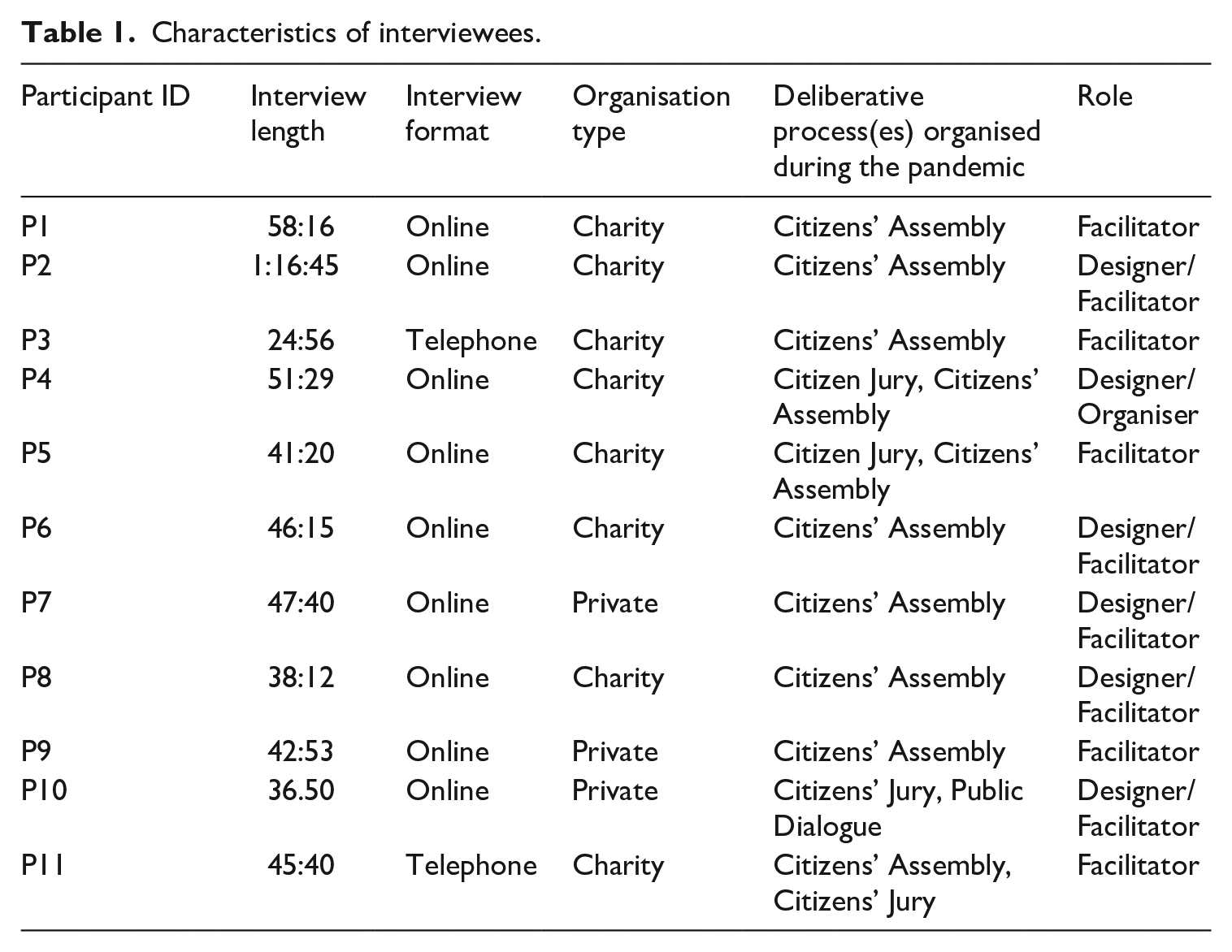
In some cases, the process they organised, designed and facilitated took place entirely online; in other cases, the process had to switch from face-to-face to online delivery in response to restrictions. Their experience covers national and local level deliberative mini-publics, mostly citizens’ assemblies and citizens’ juries, as well as other forms of deliberative workshops and public dialogue. Interviews were conducted online and typically lasted between 40 to 50 minutes, with the shortest 25 minutes and the longest 75 minutes. The use of qualitative interviews allowed for in-depth exploration of the particular perspectives and insights of practitioners across these different contexts. We invited participants to discuss their experiences in relation to the following areas: the commissioning of deliberative engagement processes; the impact of the pandemic and online delivery on inclusion and deliberative quality; choice of technology and tools; lessons and long-term impact on practice. We conducted a deductive thematic analysis on the transcripts of these interviews, grounding our analysis in the following categories identified within the literature on social practice theory: meanings and identities; skills and competencies; and materials.
Practice pre-pandemic
Before the pandemic practitioners described how ‘deliberation became more mainstream’ (P6). The increased profile of citizens’ assemblies generated significant interest from a much wider audience. Practitioners noted how they were increasingly in demand: ‘we’ve never had so many requests about deliberative processes before without a tender process’ (P7). But with this mainstreaming came new challenges. As carriers of the practice of deliberative engagement, practitioners felt the need to ensure a clear understanding and commitment to a level of quality. In some cases, the challenge was unambiguous, with practitioners describing how they had to turn down work from potential clients where there was ‘no real interest in delegating responsibility’ (P7). In almost all cases, however, the issue encountered was more nuanced: a genuine commitment to the idea of public engagement on the part of clients, but rarely a clear understanding of the advantages and disadvantages of different deliberative and non-deliberative methods, how the process would connect to their organisational work, and often overly optimistic expectations about the costs involved in delivery. As carriers of the practice, practitioners often discussed their role in terms of guiding or educating commissioners, working with them to develop a shared understanding of the process and to set expectations about what it would achieve and what resources would be required to deliver to a sufficient standard.
Responding to the pandemic
The arrival of the pandemic changed the context markedly. It signalled a move from a situation in which practitioners commanded domain expertise and commissioners sought guidance from practitioners, to one in which both practitioners and commissioners were in unfamiliar territory and had to rapidly learn about whether online deliberation was desirable and what it entailed in terms of their own skills and resources. There was no unified response from either practitioners or commissioners.
Among practitioners, a variety of responses emerged, with varying degrees of ambivalence and appetite for a transition to online delivery. For some, the immediate response to the lockdown was one of despair, ‘that’s us done, we’re a face-to-face organisation, what am I going to do with my life now?’ (P2). There was hesitancy around digital engagement, ‘I was very anti-digital engagement . . . what I was watching wasn’t engagement, it was very cold, it was comms and there was no real dialogue’ (P2). Quite clearly the pandemic context was a vivid challenge to the meanings ascribed to deliberative engagement – a face-to-face practice – and their identity as practitioners. At the same time, familiarity with technology raised questions of their skills and competencies.
Others with more experience or willingness to engage with technology saw things differently. Within a single organisation, one practitioner observed a difference between those ‘set in their ways’ (P1) and newer members of the team who were more willing to work outside of their comfort zone and were more familiar with digital technologies. Some practitioners described how they were already fairly comfortable with online engagement even if the lockdown demanded more of them in terms of the scale of delivery (P8).
Yet practitioners also reasoned that the pandemic presented increased need for engagement, ‘everybody needs to talk, we still need to build relationships and talk to each other, and what better time to talk than during a crisis’ (P2).
Practitioners describe different responses to the prospect of online delivery from commissioners. At one end, many commissioners shared with practitioners a preference for what they already knew – face-to-face delivery – believing lockdown would be a ‘short term blip’ (P2) after which established practice could be resumed. The preference was to wait rather than request a refund from practitioners or explore digital delivery. Once it became clear that lockdown would continue, they were open to digital options. One practitioner described how all but one of their clients opted to deliver the process online, the remaining client, who was described as ‘a bit luddite’ (P2), was still waiting to be able to deliver the process face-to-face at the time of the interviews!
Practitioners did have to spend time persuading some clients. For example, Scotland’s Climate Assembly had been planned and designed as a face-to-face endeavour. No one had tried to run a citizens’ assembly online at that scale: single sessions of the French Convention and CAUK had gone online, but in both cases, the majority of the assembly process had already taken place. Practitioners involved in the Scottish assembly described how they ‘had to convince the commissioning body that a high-quality deliberative process could be delivered online’ (P7). What practitioners found however was that commissioners held a misplaced belief that digital delivery could be done cheaper. They had to work hard to reassert their expertise in this altered context, arguing that costs of recruitment and onboarding were likely to be higher (particularly where technology and training needed to be given to participants) and costs associated with support staff for ensuring smooth delivery online.
Inclusion
As they moved to digital delivery, practitioners brought with them widely held concerns about how aspects of the digital divide may undermine inclusion. What they found in practice tended to challenge their previously held prejudices, opening up the possibility that digital delivery may enable more inclusive spaces. It is also meant that they had to develop complementary skills and competences in onboarding and provide materials such as equipment to ensure the realisation of inclusion.
Recruitment during the pandemic proved to be more difficult, but retention was higher: ‘We’ve seen some difficulty in getting people to sign-up, or they drop out before it starts . . . Once people are in the process however, the retention rate is much higher than face-to-face’ (P7).
While practitioners acknowledged the digital divide as a source of exclusion, a general consensus emerged that it had been overstated. Practitioners identified ‘two main sources of digital exclusion: those who don’t have access to technology and those who don’t think they can do it’. (P9) The barrier of access to technology was perceived to be relatively easy to fix, albeit requiring resources. In all cases, practitioners were able to persuade commissioners to provide participants with tablets and laptops to participate. One challenge a practitioner had found difficult to ameliorate was the bad Internet connection in rural areas (P3). The problem of confidence or skill with the technology was a more common challenge, but most practitioners reported that this was fairly easy to address. In most cases a ‘quick fix’ of familiarising people with technology was sufficient, while a few participants required a little bit more ‘time and support across the first few sessions’ (P5). The process of onboarding had been quite transformative for some participants, with people who had ‘never had email addresses, now using Zoom on their tablet to speak to grandkids’ (P11). Concern over access and confidence with technology did determine some of the choices around how the processes would be delivered as we discuss in a later section of the paper.
Practitioners were pleased to find that online engagement increased diversity in their processes. Social groups that they had found it difficult to engage were participating. One obvious explanation is furlough which meant that practitioners were able to reach people who they would have been otherwise unable to engage because of work commitments. But online delivery also broke through some of the barriers often seen in face-to-face processes to the extent that some practitioners began to consider the new processes as ‘far more inclusive’ (P7). Equally convenience of the process helped to highlight the limitations of accessibility in face-to-face processes. ‘If you do something in [a city], for some it’s a ten-minute walk, for others it’s travelling for two hours. I like how equalising online delivery is’ (P9), ‘it can fit within childcare, work, health problems’ (P1). ‘I know a lot of people talk about digital exclusion, but face-to-face events exclude a lot of people, they’re just different people’ (P9).
Practitioners recognised that while ‘there was an element of digital exclusion . . . the people you include who otherwise wouldn’t is far greater, and there are many more different types of inclusion’ (P6). Practitioners observed that online delivery enabled them to ‘engage those who wouldn’t ordinarily engage’ (P10). More than one practitioner reported participants saying they ‘wouldn’t have participated offline’ (P11) or ‘wouldn’t have bothered if it was face-to-face’ (P5). One practitioner identified age as a factor, noting that young participants told them they wouldn’t come if it was face-to-face, ‘they were quite happy doing it online, even if this process went back to face-to-face they wouldn’t attend’ (P9). For some participants, the thought of speaking in a public space was a barrier, yet when the environment of the public assembly was online, it didn’t produce the same reaction. ‘Someone with Asperger’s said they would never have joined, people with anxiety said they would never have done this’ (P8). Digital engagement offered an apparent ‘safety in it being in your own home, you are not exposing yourself in a public space like a town hall’. Leaving the house was a barrier for a variety of different people, ‘we’ve had bed-ridden people who would never have been able to participate in person’ (P11), ‘parents, time-poor, people who just would not just wouldn’t fancy it’ (P7), ‘people who could come for a weekend but wouldn’t want to, but three hours online suits them’ (P9).
In terms of inclusion, then, adaptation in skills (onboarding) and materials (technology) meant that while it was more difficult to persuade people to engage, once they were in the process, the degree of inclusiveness seemed to rise, which meant that practitioners were willing to readjust the meanings they had associated with digital delivery and were more willing to embrace this revised form of deliberative practice. But one practitioner cautioned that some of the positive observations regarding retention rate and interest in participating online might be the product of lockdown. In addition to the impact of furlough, they observed that we might not see similar enthusiasm for Zoom meetings when lockdown is initially lifted ‘and nobody wants to spend another hour on Zoom ever’, or over the long-term when the ‘weather is lovely, it’s the middle of summer and you aren’t in lockdown’ (P4).
Quality of deliberation
Just as preconceived ideas of the inclusivity of digital delivery were challenged, so too were understandings of the extent to which high-quality deliberation could be realised online. Practitioners distinguished impacts on different elements of the deliberative process: learning, deliberation and recommendation writing. They shared a positive perception of the gains that could be made in online learning but were generally sceptical of the quality of deliberation between participants (apart from one practitioner) and found recommendation writing difficult.
One element of the deliberative process which received almost universally positive responses was the way it enabled learning. This has a number of dimensions. First, being online meant that compared to face-to-face processes, practitioners were able to recruit high-quality speakers at short notice. This was particularly beneficial for those processes that offer participants the opportunity to determine what topics they wish to discuss, a practice which entails more time pressures in recruiting witnesses. One practitioner observed: ‘the range of speakers is incredible. One night we had someone from Sweden, from Brazil, from five different countries, pre-pandemic we wouldn’t have thought to invite them and wouldn’t have the budget for travel’ (P11). Another noted they ‘wouldn’t have a cat in hell’s chance of recruiting them, and at last minute notice’.(P4). Second, the format enabled practitioners to have more control over the way in which experts gave evidence, for example by reviewing and asking for re-recordings if the presentation was too technical and inaccessible. It was quite simple to create high-quality videos that could be watched numerous times by participants. Third, one practitioner noted the way in which the context of the pandemic affected pedagogy: almost everyone was much more comfortable with understanding graphs and data due to news coverage of the pandemic (P10).
Accounts of the impact of online delivery on the quality of deliberation were more complex and revealed different perspectives on the purpose of deliberation. Deliberation was impacted by both the context of the pandemic and online delivery. There was concern that the pandemic created a crisis mentality that ‘altered perceptions’ (P10) and ‘influenced people’s attitudes’ and that this would diminish the generalisability of the outcomes and provide only a ‘snapshot of 2021’ (P1). Practitioners described efforts to contextualise discussion and encourage participants to look beyond the pandemic.
Practitioners universally highlighted that online delivery made deliberation more awkward and facilitation more difficult. As one practitioner reflected, ‘It’s definitely different’ (P9). Deliberation was described as more ‘stilted’ (P1), and one practitioner observed that ‘conversations flow less easily online for sure’. (P5) Conversations tended to be directed through the facilitator rather than across the group, and facilitators described challenges in establishing a ‘self-facilitating group’ (P6). ‘When it is face-to-face you can be more hands-off, earlier in the process’ (P8). A further consequence of online delivery was that there was no social interaction between deliberative sessions, for example during lunch or breaks. Practitioners see these as periods when participants build relationships and where ‘lightbulb moments’ (P4) can happen that feed into and enrich deliberation.
For most, the dynamics of face-to-face communication were preferred and the more awkward or distant character of online communication was viewed negatively. Two practitioners offered a minority dissenting perspective. One experienced practitioner equivocated throughout the interview, stressing how much they missed in-person deliberation and in the next sentence saying that they would not go back to face-to-face practices. She realised that the pandemic was challenging her strongly held prejudices about the necessity of developing social bonds: ‘That connection is essential. Well sometimes, not all the time, and we probably need to push back a bit on that assumption. Why is it essential?’ (P2). The other practitioner was much happier to challenge the established view, suggesting that online deliberation created an environment for potentially more authentic deliberation. First, the online environment meant that deliberation took place in a context in which participants were embedded in their day-to-day lives rather than the ‘artificial’ setting of the town hall. Second, the nature of communication in the online environment and restricted opportunities for bonding had a disinhibiting effect allowing participants to express their views more candidly, especially more socially taboo views. For this interviewee, online citizens’ assemblies are more ‘embedded in [assembly members’] lives’, ‘people take part in their kitchens or living rooms’, the process is ‘broken up, you’re seeing your family and friends in between sessions’. This was contrasted with the ‘town hall effect’ of face-to-face assemblies, which creates a ‘certain mentality’: People talk about a ‘deliberative moment’ and I know it is a nice thing when it happens but I wonder if it is artificial . . . do they agree a week later? . . . They go to a town hall with 50 people, reach a conclusion and vote and think ‘brilliant, we’ve achieved something . . . People have thought one thing leaving a meeting and thought about it and come back with a different view.
As she pointedly argued: ‘One of my favourite things about deliberation is that it can change people’s minds. I don’t want them to say they’ve changed their minds when it isn’t true’. The practitioner was concerned that through face-to-face deliberation in a town hall people ‘bond too much’, they ‘have a lovely weekend and a deliberative moment’, but then return to their lives and there is a disconnect with that moment and their ‘authentic’ selves (P9).
For this practitioner, the disinhibiting effect of online environments, where social bonds are not so developed, may have advantages. ‘People are more honest . . . more comfortable to say the hard thing . . . People were not rude but there was less people pleasing’. This was particularly significant when addressing contentious, socially sensitive topics, for example who would receive medical treatment during diminished resources during a pandemic. ‘[Participants] don’t bond as much, but I’d question why we want them to. We want them to have empathy with each other, but it’s more important that they turn up and are honest’ (P9). Experiencing the more embedded and candid nature of engagement in online processes changed this practitioner’s perception face-to-face delivery – the meaning they associated with deliberation. Having previously placed great emphasis on connecting and bonding, they were now much more cautious. This was very much a minority perspective and may indicate the extent to which the meanings practitioners associate with the nature and quality of deliberation are strongly embedded.
A third area where we find universal agreement, is the challenge of collective preference formation – or recommendation writing. A consensus emerged among practitioners that this process was more difficult online. This was discussed in terms of the practical challenges presented in terms of limitations of technology (for more, see next section) but also the loss of the ‘energy’ that is generated in face-to-face meetings and the lack of bonding. One practitioner observed, where face to face is important is in the recommendation writing stage. It is more organic, you’d say ‘oh thingy over there is talking about that, talk to him’ or ‘I don’t think Brian has been talking about flying, maybe talk to him before putting the recommendation down’. (P4)
Practitioners missed the energy in the room that underpinned the creative process of recommendation writing, and found it difficult to coordinate collaboration and replicate that feeling online. ‘I’d always want to do final recommendation writing in person, there is a real energy, drive, and enthusiasm that hasn’t translated online. Those involved don’t necessarily know the difference, but it doesn’t feel the same online’ (P11).
Technology and tools
A key enabling – or limiting – factor in how deliberative practitioners acclimatised to the pandemic context was their technology choices. What we find is that a combination of the meaning they ascribe to what good deliberation looks like, concerns about the capacities of participants and the limits of their own skills and competencies in relation to technology shaped their decisions about which platforms to embrace.
While a wide range of civic technologies exist to support different aspects of deliberation and participation, practitioners joined the majority of the population in embracing Zoom as their central digital tool. Many practitioners emphasised the importance of simplicity over functionality when justifying their choice of technology. Their choices tended towards recreating the experience of face-to-face communication as faithfully as possible using a minimal number of tools that participants and practitioners were most likely already familiar with and were compatible with a range of different hardware. ‘Low tech is usually more accessible’ (P7), reducing barriers to entry. Tools needed to be easy to use on various devices, especially phones. All practitioners gravitated to Zoom, explaining that it was more user-friendly in design and adaptable to their needs than alternatives such as Teams. In addition, participants were most likely to already be familiar with Zoom, the breakout function allowed practitioners to recreate the smaller groups that are familiar with most deliberative processes, and the chat function enhanced the quality of deliberation as it was sometimes used by participants who were less comfortable about interrupting or talking in groups.
Zoom was typically complemented with tools such as Googledocs or Powerpoint to enable collaborative writing and Mentimetre to enable voting, as well as evaluation and reflection by participants on the deliberative process itself. In all cases, these are technologies that practitioners were familiar with prior to the pandemic, often used in face-to-face assemblies. Some practitioners made used of ideational platforms such as Miro and Jamboards. Very occasionally we found experimentation beyond this core toolbox. One practitioner spoke highly of the more bespoke tool Recollective: Zoom was used for workshops, with participants encouraged to use Recollective in their own time for asynchronous comments on films and audio. In another case, Pol.is, a crowdsourcing argument-visualisation platform, was used prior to the deliberative process to gather ideas that were then subject to deliberation by the mini-public. Other argument-visualisation platforms were not considered. One practitioner recognised the appeal of virtual reality tools that recreate a sense of physical space, mentioning an example of a ‘virtual hotel in which participants could enter different rooms’ (P10). They wanted to create a ‘sense of occasion’ (P10) and improve the experience of deliberation, but were very aware of the risk of excluding people less confident or comfortable with technology. Ultimately, cost and concerns about ease of implementation meant they did not use the technology. A common refrain on technology was ‘Keeping it as simple as possible is good’ (P3).
Decisions were primarily framed in terms of concern with the skills and confidence of participants. Accessibility for participants was a major concern to all practitioners and a barrier to experimenting with novel tools and platforms. The act of introducing multiple tools presented a risk in itself as ‘navigating between different platforms can be a problem and we never found an integrated system’ (P6). The more bespoke platforms were more likely to place demands on users and their hardware, generating barriers to entry especially for those less confident and comfortable with technology.
However, the skills and confidence of practitioners who were responsible for managing the use of the technology and onboarding participants must also be considered a factor. The appetite among practitioners to explore innovative forms of technology offered by the civic tech community and the field of online deliberation was mixed. While the practitioners we spoke to were often personally enthusiastic about experimenting with different approaches to online delivery they observed that not all of their colleagues felt the same. Even relatively conventional forms of online delivery such as videoconferencing could feel outside of practitioners’ comfort zone, presenting a barrier to further experimentation: You need to take your colleagues with you, and some of them are luddites. They think it needs to be face-to-face. They would say it is a preference based on principle, but underneath it I think they question whether they can do it. (P2)
Aside from their own and their colleagues’ competencies, practitioners identified a range of additional barriers and challenges to experimentation with civic tech and innovative approaches to delivering deliberation online. The pandemic generated an initial challenge of making sense of what was available and navigating the proliferation of tools and techniques that may support deliberative processes. One practitioner observed that ‘there are various, almost too many, lists of different techniques’ (P8) and attempts to consolidate the lists sometimes contributed to rather than alleviated the problem. ‘It would be great if there was a practitioner who knew their stuff, and systematically went through these platforms, reviewing their functionality, what skills were needed, pricing and options for paying. That would be solidly useful’. You could have a website, like a wiki, or a user-review site collecting practitioner reviews. It might say ‘we’ve used this tool for this process, it worked well but disable X feature because it is really irritating’. That would be very handy. (P8)
What this points to is the degree of differentiation between the fields of face-to-face deliberation and civic tech. The work had not been put in place before the pandemic for practitioners (and academics) in these fields to systematically review the extent to which deliberative practices could be supported by different technologies – or how technologies might embody other forms of desirable democratic engagement.
Equally, lack of resources including time and money for further experimentation was a significant factor. In some cases, even testing software involved costs, while one practitioner described how the costs accumulated through fees associated with the number of participants and length of time of the process prevented them from using their preferred platform. Practitioners needed to be able to experiment with a platform and familiarise themselves sufficiently with it to allow for training, onboarding and troubleshooting, in addition to any further fees associated with the platform. Practitioners noted that their organisations were often quite ‘time poor and money poor’ (P6) which reduced the capacity for effective experimentation and adoption of technology. These factors inhibited experimentation and uptake of more novel platforms.
Future deliberative practice
The COVID pandemic forced practitioners online and in so doing ‘revolutionised our practice’ (P10). Scepticism and even hostility towards online deliberative processes was replaced by a conversion experience, with more than one observing they would not ‘go back to face to face now’ (P2). This shift in perspective was driven by considerations of, for example, reduced barriers to entry for participation and improved access to expert speakers, but in more than one case personal convenience was also a factor. As one practitioner argued: ‘Selfishly, I’ve done years of traipsing around the country. I don’t want to be on trains anymore. I can go and get dinner without it being a Tesco sandwich’ (P2). But on further reflection, practitioners identified aspects of face-to-face practice that they missed. For example, the process of travelling to and from locations allowed time for reflection and broke up the work, something which they felt did not currently happen in their new working patterns where everyone was expected to be accessible via Zoom at any time. Practitioners missed the human connection and social bonding they experienced in their work prior to the lockdown, although they often reflected that this might be attributed to the more general restrictions on social interaction.
All interviewees expected that the experience of organising deliberative processes during the pandemic would result in permanent change to their practice – both in terms of continuation of online processes and potential hybrid formats. Much would depend on the scale of the process and the nature of the topic. One practitioner argued that there was a strong case for national processes to take place online, given travel costs and demands on participants that escalated as the geographical scope of the assembly expanded. Another potential advantage of online delivery is that it can be organised more quickly, so as not to lose momentum. Describing a rapidly organised citizens’ jury, one practitioner noted: ‘It was very fast paced, I wouldn’t do it for everything but . . . it felt okay to do it fast, you can move very quickly and get people and facilitators online’ (P10).
Hybrid or blended approaches that could realise the benefits of both online and offline delivery were an attractive option for a number of practitioners – and meetings were already taking place among practitioners to prepare ideas for post-pandemic practice. Hybrid approaches could take a number of forms. For example, sequential, with an initial face-to-face meeting to break the ice and promote bonding, and a final face-to-face recommendation writing session. Even the practitioner who felt that online delivery allowed for more authentically embedded participation argued along similar lines: there was something quite special about face-to-face deliberation that we are missing . . . ideally the first session should be face-to-face, followed by online delivery to ensure people are not put in this artificial space for agreeing with each other, but then with a final face-to-face session at the end of the process. (P9)
Another hybrid option is parallel design: ‘We should have at least one table group online, for those who couldn’t join physically’ (P6). One practitioner described a process they were running on genome sequencing in which they had recruited people who experience a genetic condition (either themselves or their families) who were ‘Zooming in from bed because they wouldn’t have been able to join’ (P10) otherwise. Practitioners recognised the potential for experimentation and innovation in which those online elements that had proved valuable during the pandemic would be integrated, for example allowing participants to benefit from pre-recorded speaker contributions, emailing questions to experts and using online voting to allow more time for reflection.
Practitioners recognised that implicit within these discussions was an assumption that hybrid methods would deliver a ‘best of both worlds’ scenario (P4). But there was also speculation that hybrid approaches could realise a ‘worst of both worlds’ situation in which the costs of face-to-face (e.g. travel costs, diet needs) and online delivery (e.g. onboarding, providing equipment) would be combined (P4, P5). Overly ambitious hybrid design could lead to significant practical and logistical challenges and the potential that staff would ‘keel over’ (P2).
Post-pandemic, the practitioners have taken advantage of their experience of digital design and delivery. While all organisations have returned to in-person working, this is now complemented by both online and hybrid processes. For example, the participation charity Involve delivered the first and last weekends of the 100-strong national People’s Assembly for Nature, commissioned by WWF, RSPB and National Trust (2023), as in-person meetings, with the two meetings in between taking place online. Similarly, the UK-wide Citizens’ Panel on Home Energy Decarbonisation, run for the Climate Change Committee and facilitated by Shared Future, combined face-to-face and online engagement (Lancaster University, 2022). Even at local level, practitioners are integrating online engagement: Shared Future (2022), for example, ran the Southwark Climate Change Citizens’ Jury as a combination of six online evening and two daytime sessions.
Discussion
What we know from studies of social practices is the carriers of those practices tend to be resistant to change. Practices are sticky. We also know that one of the drivers of transformation is external shocks that force change in one or more aspects of a practice. Such an external shock – the pandemic – hit deliberative practitioners hard. The social restrictions imposed in response to the pandemic forced practitioners to transition from face-to-face deliberation to remote, technology-supported online delivery. This change transformed the context of deliberative engagement: it presented a different environment and set of materials and resources to navigate; it placed different demands on actors in terms of competencies and skills; and it challenged the meanings and identities associated with deliberative engagement.
More than one practitioner described how the pandemic ‘revolutionised our practice’. Is that an accurate description of what happened? It certainly forced practitioners to do their work in a different way, but was the social practice of deliberative engagement ‘revolutionised’? Our findings suggest otherwise. Significant changes took place, but our data indicates that when the pandemic struck, practitioners in the main stayed as close to their original modes of ‘being and doing’ as possible.
The pandemic revolutionised practice in the sense that practitioners were now using different materials – no longer face-to-face technologies, but digital ones. But in that move to the online world, their inclination was to search for the digital tool that allowed them to reproduce as closely as possible their previous face-to-face experience. Zoom provided an easy-to-use technology to move from plenary to small group sessions, with the added bonus of a less formal chat function. The ubiquity of Zoom clearly played a role too – a significant proportion of UK residents were using the technology within weeks and months of the lockdown. What we did not see was experimentation with other platforms which would have radically changed the nature of synchronous engagement. The working assumption was that participants should see and engage with each other in real time in the same way as face-to-face practice.
While the move to Zoom required the development of new competencies and skills, not least the backroom support and more complex onboarding necessary for online engagement, the changes in facilitation practice were relatively marginal. Facilitation was more tiring online, both in terms of looking at a screen and the loss of direct social contact that enables a degree of group self-organisation, but a strong family resemblance to face-to-face facilitation remained.
Much of this continuity can be put down to the strong sense of meaning and identity shared by practitioners. Their prejudices about online engagement were tested and, in most cases, reshaped – for example, their preconceptions of the digital divide and the way in which online engagement often enabled the inclusion of people who would otherwise not participate. But the shared conception of what a deliberative process should look and feel like was rarely shaken. While practitioners were delighted with the way that digital engagement opened the possibility of better knowledge curation for participants, most were unhappy about the quality of online deliberation – the lack of social bonding that led to stilted conversations and the challenges associated with collaborative recommendation writing. Only two practitioners questioned this orthodoxy.
How confident can we be about the generalisability of our findings? After all, we interviewed a relatively small number of practitioners, asking them to self-report on transitions in their practices. It is unlikely that a wider sample would have generated much more diversity in responses, since the design, delivery and facilitation of deliberative processes is a small field of activity, and we included all the main organisations and many of its most experienced practitioners. The only way that we could have verified their interpretations of what happened during the pandemic and its ongoing reverberations would have been to engage in ethnographic research at the time. We can be fairly confident of the main insights though, given that most were common issues raised across the interviewees. Those few areas where some contention exists could be the object of further analysis, through for example focus groups or workshops where practitioners would be able to explore differences.
We can also draw confidence in our findings by comparing them with those of emerging studies on other social practices that were disrupted in profound ways by the pandemic, such as teaching and health care. While teachers and health professionals had no choice to adapt, like deliberative practitioners, they tended to do so only so far as was necessary, mimicking and keeping their practice as close as possible to pre-pandemic practice (Carlsson et al., 2023; Ng et al., 2021). Their tendency was to use those platforms and applications with which they were already familiar, although over time, their confidence in using technology increased (Papa et al., 2022). Some prejudices towards the affordances of technologies were challenged, for example the ways in which they enabled new dynamics of inclusion (Kolyvas and Nikiforos, 2023). But others, such as their inability to foster social interactions, were confirmed (Kovacs et al., 2021). While these studies are not explicitly framed by social practice theory, the findings have strong resonances with our analysis of the impact of the pandemic on deliberative practitioners.
Finally, some reflections on the use of social practice theory in this context. As we stated earlier, it is relatively rare within studies of democratic innovations to find much attention being paid to ‘who creates, enables, summons, facilitates and takes those processes forward’ (Escobar, 2015: 270). This is a significant oversight. It is vital that we complement existing studies that tend to analyse the various democratic qualities of deliberative mini-publics and other democratic innovations, with a deeper understanding of the motivations, capacities, identities, and activities of the cadre of practitioners who are responsible for designing and delivering these relatively novel institutions. As the carriers of these practices, their actions are critical to the realisation of the ideals of participatory and deliberative democracy. For social practice theory, the study shows the worth of applying this framework to less mundane sets of actions, to help us interrogate the conditions under which more complex social practices are shaped and can be reshaped.
Conclusion
The pandemic had a disruptive effect across most areas of social life. For deliberative practitioners familiar with and committed to working in face-to-face contexts, their world turned upside down. What we witness in their response is transformations in the practice of deliberative engagement but with the identity and competencies of deliberative practitioners playing a constraining role in choices and applications of technology. No doubt, the social practice of deliberative engagement now has a broader canvas, with new technologies and broader skills and competencies, but it is far from revolutionised.
Footnotes
Funding
The author(s) received no financial support for the research, authorship and/or publication of this article.
