




Abstract
Recent deliberative systems research has emphasized the need to “scale up” deliberative mini-publics by exploring connections between mini-publics and broader arenas of policymaking. Less is known, however, about how the policy environment in a state or region might itself influence a deliberative event. In this article, we set out to examine how the internal dynamics of mini-publics are affected by the scaling-up process of connecting to larger policymaking domains. To better understand how the external role of deliberation affects the internal dynamics, we analyze two notable cases of deliberative forums addressing public problems. In both cases, the 2017 Our Coastal Future Forum in South Carolina and the 2020 Oregon Citizens’ Assembly on coronavirus disease-19 recovery, citizen participants grappled with the challenge of scaling up to larger policy outcomes. We conduct a thematic analysis of transcripts from both events, focusing on how citizens discuss their role in influencing policy and talk about the potential for policy output from the mini-publics. The analysis reveals that the scaling-up process invites a pragmatic orientation within deliberation, centering on issues of efficiency, scope, and efficacy.
Deliberative democratic research, though sometimes critiqued as utopian or idealistic, is deeply concerned with the practical implementation of deliberative democratic principles in real-world settings. Unfortunately, much of what passes for deliberation in contemporary politics fails to live up to deliberative standards (e.g. Hughes, 2019; Knobloch, 2011). To better understand how deliberative democracy can be realized in practice, deliberation scholars have generated empirical research on the practices, processes, and outcomes of democratic innovations that re-imagine public deliberation with ordinary citizens. Operating with different small group processes has allowed practitioners to exert more control in designing a deliberative environment and to understand how deliberative democracy can be applied with real groups (see Kuyper, 2018; Nabatchi et al., 2012). A wide range of innovative deliberative processes, known as “deliberative mini-publics,” have already been used to inform policymaking, such as the citizens’ climate assemblies that have been held in France and the United Kingdom, the Citizens’ Initiative Review held in the United States, the citizen proposal evaluations of the City Observatory in Spain, or deliberative polls that have been run in several countries around the world.
The recent systemic turn in deliberation research (see Parkinson & Mansbridge, 2012) has led advocates of deliberative mini-publics to offer both conceptualizations and empirical analyses of how mini-publics can be “scaled up” to have more widespread impacts within the political system (Beauvais & Warren, 2019; Curato & Böker, 2016; Niemeyer & Jennstål, 2018). In other words, to avoid a myopic interest on individual forums and their internal workings, scholars in this area have shifted focus to the contexts in which mini-publics operate. This renewed focus on context is bolstered by research on deliberation’s external outcomes (Jacquet & van der Does, 2020) and pre-deliberation contexts that impact participants (Yan et al., 2016; Zheng, 2016).
It is a positive development for mini-publics to be placed within their broader policymaking contexts. As part of this work, we must recognize that the “scaling-up” relationship is not one-way. Deliberative mini-publics will themselves be affected by efforts among organizers and participants to make connections to policymaking. Just as recent scholarship has looked outward toward the impact that mini-publics have on the policymaking context, we must also look inward once again at mini-publics to see how “scaling up” impacts the internal dynamics of deliberation within these groups.
In this article, we analyze the internal dynamics of scaling-up efforts in two deliberative mini-public processes. We argue that scaling up deliberative mini-publics emphasizes a pragmatic orientation to the deliberative process. A pragmatic orientation means that participants in the mini-public adjust their deliberations to adapt to external ends, shifting deliberation from its typical deontological, process-focus to a more utilitarian, product-focus. This pragmatic orientation, while present in any deliberation, becomes more central when a deliberative mini-public considers its role within its policymaking context, particularly when that role includes the examination and recommendation of potential policies to address problems of public concern. In the analysis, we show how a pragmatic orientation foregrounds three key dynamics within the deliberation including efficiency, scope, and efficacy. Specifically, (1) efficiency refers to the use of time in the deliberation relative to the expected end product; (2) scope refers to the boundaries surrounding the topics to be discussed or the tasks to be completed; and (3) efficacy refers to the effectiveness of the proposed policy alternatives as well as their political feasibility within a particular political context. As we will explain, these dynamics are partially structural within the design elements of the deliberation, but they also gain presence within the communicative exchanges of participants and facilitators in their efforts to steer the deliberative process.
Our analysis proceeds as follows. First, we review research on deliberative mini-publics and literature on efforts to incorporate them into a broader policymaking system. We then outline our methods of qualitative communication analysis. The analysis relies on two case studies from the United States: the Oregon Citizens’ Assembly on coronavirus disease (COVID)-19 Recovery and the “Our Coastal Future” Forums in South Carolina. In the analysis section, we examine three dynamics that emerge when considering the internal workings of mini-publics from a systemic perspective. Finally, we conclude by considering the implications of a pragmatic orientation for mini-public deliberations.
Deliberative mini-publics in the political system
Two terms are key to understanding our contribution in this article: deliberation and deliberative mini-publics. To paraphrase Gastil and Black (2007), deliberation is the careful examination of a problem to arrive at a well-reasoned solution after a period of inclusive, respectful consideration of diverse points of view. Notably, this definition is narrower than some uses of “deliberation” that may refer to any public discussion or debate around a policy issue. Instead, deliberation is a group communication and decision-making process that is guided by both analytic and social norms (see also Burkhalter et al., 2002).
Deliberative mini-publics are small, representative groups of people who are able to deliberate on behalf of a larger public. Deliberation scholars often trace this idea back to Dahl (1989), who conceptualized a “minipopulus,” which could serve the interests of the broader population by taking the time and energy necessary to study and deliberate on a policy issue (p. 340). In deliberation, what counts as a “representative” group varies across designs (Steel et al., 2020). Some scholars emphasize the need for deliberation to represent all available discourses (Dryzek & Niemeyer, 2008) or social perspectives (Young, 2000). Most mini-public advocates stress the importance of demographically descriptive representation using a random sample of the population for mini-publics to constitute a counterfactual public opinion—that is, an approximate opinion of the public if it was given a chance to deliberate on an issue (Fishkin, 2018). Whether to use true random sampling or stratified random sampling is debated, but some form of random sampling is generally considered to be a defining feature of mini-publics (Ryan & Smith, 2014). However, it is important to note that even randomly selected mini-publics typically involve supporting roles for interest groups, stakeholders, experts, and other members of the public to provide testimony and input into the deliberations.
Mini-publics are attractive because they can bridge citizens with policymakers while circumventing the practical difficulties of getting the broader population to deliberate on an issue. Steel et al. (2020) explain that this allows mini-publics to “approximate the counterfactual public will,” or, in other words, to understand how the public would feel on an issue if it were given the time and resources to deliberate. Along similar lines, scholars argue that a deliberative process can signal what the public would think about an issue if given the proper structure to really consider the issue (Fishkin, 2018; Niemeyer & Jennstål, 2018). In this way, participants in a deliberative mini-public serve as functional stand-ins for the broader public (Warren & Gastil, 2015).
Deliberation scholarship in the last several years has become increasingly concerned with the role of deliberative mini-publics within the broader political system. Gastil et al. (2016) have called specifically for research to clarify the relationship between mini-publics and larger publics whom they try to represent. While scholars have managed to show positive impacts on participants in mini-publics and high-quality deliberation, they have generally not been shown to have a significant policy impact (Curato & Böker, 2016; Grönlund et al., 2014). The “systemic turn” animating deliberative democratic research and theory right now has motivated scholars to conceptualize and empirically study how mini-publics could be “scaled up” to have external impacts on political institutions, public debate, and policymaking.
This line of research treats mini-publics as only one important part of the deliberative system and not as a “magic bullet” solution to democracy’s problems. In what Curato et al. (2020) call “third generation minipublic thinking,” scholars have become more critical and cautious when endorsing mini-public designs. In particular, Lafont (2015, 2020) calls upon advocates of mini-publics to consider whether mini-publics problematically bypass democratic authorization and accountability by making decisions directly on policy, calling upon citizens to “blindly defer” to the advice of their randomly selected counterparts, or even serving to legitimize the existing preferences of policymakers. Indeed, there is some support in the literature that a mini-public design that bypasses democratic authorization or accountability would be seen as illegitimate, though this research is far from conclusive (Boswell et al., 2013; Niessen, 2019). Furthermore, even if a given mini-public is not guilty of these faults, Lafont (2015) suggests it may be an extraneous institution that does not add value to a participatory deliberative democratic system. However, Lafont (2020) also clarifies that this critique does not apply to all uses of mini-publics and that there could be uses of mini-publics that enhance deliberation within the public sphere. The key distinction for Lafont (2020) is not “thinking of micro-deliberation as an alternative to macro-deliberation” but instead “we should think of it as a resource for macro-deliberation” (p. 141).
Most deliberation advocates do not argue for mini-publics to directly make policy decisions as part of the scaling-up agenda (Beauvais & Warren, 2019; Niemeyer & Jennstål, 2018). While Lafont (2015) criticizes indirect means of mini-publics’ influence as well, this critique rests on mini-publics, even through the indirect route, replicating a form of deference to the judgment of the mini-public rather than promoting deliberation by the mass public. Nevertheless, scholars have identified several alternative avenues for mini-publics to have macro uptake in the broader political system without relying on a form of blind deference. Mini-publics may work in consultation with the mass public to put items on the agenda for a referendum by voters, such as the British Citizens’ Assembly on electoral reform in 2004. Mini-publics can also make recommendations to be considered directly by policymakers, as has been done, for instance, with Danish consensus conferences, citizens assemblies, and 21st Century Town Meetings (Einsiedel & Eastlick, 2000; Curato & Böker, 2016; Goodin & Dryzek, 2006; Jennstål, 2018; Ratner, 2004; Richards, 2018). Importantly, in both cases, recommendations are generally accompanied by a report outlining the reasoning of the mini-public for others to examine and weigh the issue themselves. In addition, mini-publics can be used to build participants’ political efficacy and mobilize publics on a policy issue (Goodin & Dryzek, 2006). They could even help “market test” policy proposals and arguments to show advocates and policymakers how the larger public may respond (Goodin & Dryzek, 2006).
While recent scholarship has turned attention to mini-publics’ reception and consequences in the political system (Boswell et al., 2013; Boulianne, 2019; Ingham & Levin, 2018; Knobloch et al., 2019; Niessen, 2019), we should consider that the scaling-up process will also impact the internal dynamics of the mini-public deliberations. As organizers design mini-publics to be further integrated into the deliberative system, we should expect the mini-public itself to be responsive to this change, not merely the broader system, and we should not treat the internal dynamics of mini-publics as a known, static feature.
As a case in point, consider who decides to participate in deliberation in the first place. Broadly speaking, the way deliberation is framed, whether it is by political actors or organizers, can invite or disinvite public engagement (Just, 2016). Strategic civil society actors may be more motivated to engage with mini-publics, either in advocate or in witness roles, if they perceive them to have more political impact (Hendriks, 2006). They may also try to co-opt the process if they perceive it as having important decision-making power (Beauvais & Warren, 2019). Participation by average citizens can also be impacted by the mini-public’s connection to policymaking. Jacquet (2017) explored the reasons non-participants gave for opting out of mini-publics. Along with reasons like scheduling conflicts and public meeting avoidance, this research showed that a common logic of nonparticipation entailed the mini-public’s lack of external impact. If some participants are opting out because they see no link between the mini-public and policymaking, then it is reasonable to speculate that some types of non-participants will become more engaged when mini-publics are scaled up.
Beyond who participates, deliberation within a mini-public can be impacted by participants’ consideration of external audiences. In the Citizens’ Initiative Review, for example, the figure of the “average voter” weighs heavily in the panel’s deliberations. As they prepare a “Citizens’ Statement” to help voters decide on a ballot measure, panelists often discuss how an “average voter” will read the statement, care about the different issues involved, and weigh the options (Gastil & Knobloch, 2019).
The way deliberators in mini-publics talk about the role of the mini-public and its connection to policymaking may significantly impact the deliberative work of the group. While this line of inquiry has not been explored in scholarship on deliberative mini-publics, it is an important counterpart to some of the receptional studies of deliberative mini-publics that examine how broader audiences frame, debate, and act upon the work of mini-publics (see Boswell et al., 2013; Boulianne, 2019; Gastil et al., 2016; Niessen, 2019). This study addresses this gap in the literature by asking the question, how does the external role of a deliberative mini-public shape the internal deliberations of participants? While receptional studies offer an outside perspective looking into the mini-public, we offer the reverse—the perspective of the mini-public looking outward.
Methods
We draw on two case studies to examine the internal dynamics of scaling up deliberative mini-publics. These cases represent two different design logics for scaling up deliberation. Given our concern for the internal dynamics of scaling up, we aimed for two cases that would provide distinct design logics on purpose, output, and connection to governing institutions.
Fung (2003) provides a useful categorization scheme of four different “visions” for mini-publics that captures their overall purpose and informs all other design decisions. These visions, as Fung explains, concern the question “what should a minipublic do?” (p. 340). An educative forum is aimed at participants in the forum to help them develop and refine their opinions on a specific policy issue through the deliberative process. A participatory advisory panel moves beyond refining individual opinions and calls upon participants to develop preferences or recommendations to send to policymakers for their consideration. Whereas the first two types of mini-publics are typically front-loaded with deliberation ending at the development of preferences or recommendations, participatory problem-solving collaboration involves a continuous relationship between a mini-public and policymakers for participants in the mini-public to continually provide feedback and monitor policymakers’ progress on an issue. Finally, participatory democratic governance envisions a mini-public that moves beyond recommendations and directly makes decisions on policy.
In actual practice, participatory problem-solving collaboration and participatory democratic governance are relatively rare. Many deliberative mini-publics not only convene a random (or near random) sample of citizens, but they also compensate them for their time to make the process more equitable. While some deliberative mini-publics, such as the Eugene Review Panel in Oregon, have managed to implement a participatory problem-solving collaboration, developing an iterative process between a mini-public and policymakers requires tremendous resources and can make the design cost-prohibitive (Healthy Democracy, 2022). Participatory democratic governance is not necessarily cost-prohibitive, but many conveners of mini-publics recognize the legitimacy problem raised by critics like Lafont (2015) that such a mini-public would have if it were to directly make decisions on behalf of the public. While there would be value in analyzing how participants in both of these types of mini-publics internally consider the scaling-up process, we focus on the two more common types of mini-publics envisioned by Fung (2003): the educative forum and the participatory advisory panel.
These two types of mini-publics differ significantly on their output. The output for an educative forum will typically not be a concrete product but individual preference formation, refinement, or change. For the participatory advisory panel, the output is almost always a concrete set of considerations or recommendations that are created and voted on by participants. This can be as short as a one-page summary, as with the Citizens’ Initiative Review (Gastil & Knobloch, 2019) or it can be an extensive report, as with many citizens’ assemblies, such as Climate Assembly UK (Elstub et al., 2021).
Finally, mini-publics differ widely in their connection to governing institutions. Setälä (2017), drawing on the language of Mansbridge et al. (2012), frames the connection between mini-publics and governing institutions as one of “coupling.” There exists a spectrum of how tightly or loosely mini-publics are coupled to governing institutions, with the most “tightly” coupled mini-publics being organized, funded, and given direction by policymakers, and with the most “decoupled” mini-publics on the other end that have no clear connection to any policymaking body.
The two cases used in this study represent two starkly different approaches to these three elements. The cases are described in detail below. Their core design differences, as they concern scaling up to the deliberative system, are summarized in Table 1.
Comparison of case study design features.
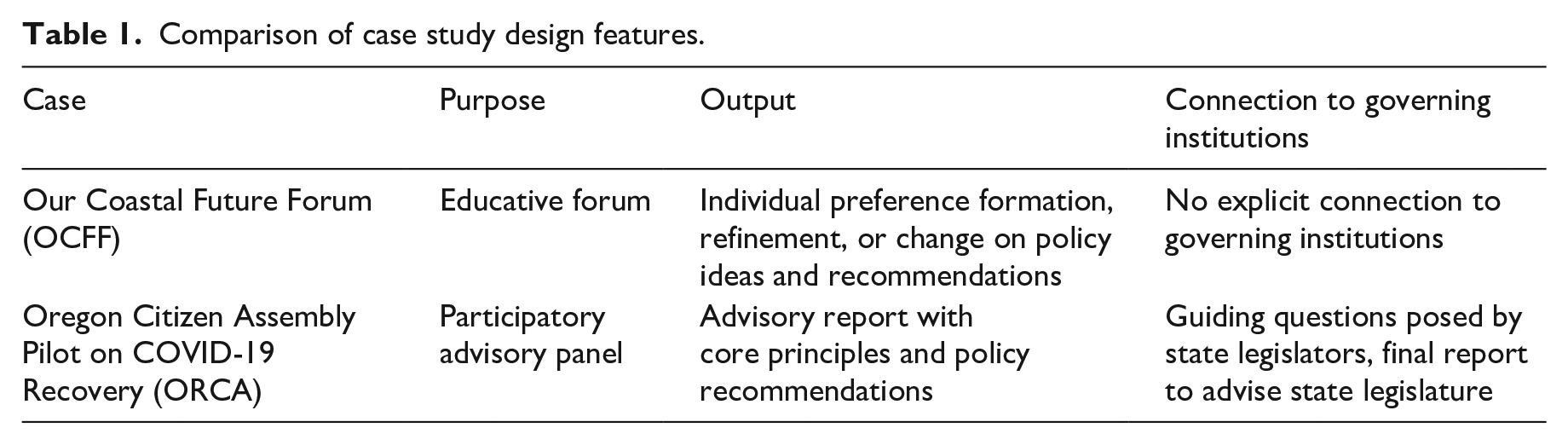
The first deliberative mini-public examined is an educative forum: the Our Coastal Future Forum (OCFF). The process was a deliberative discussion of 90 people from the coastal counties of South Carolina, meeting over 2 days in Charleston, SC, in October 2017 to hear from subject matter experts and discuss with their fellow citizens the consequences of climate change on the environmental security of the coast. Expert presentations and some discussion took place at the plenary level, and further discussion occurred in assigned groups of 8–12 people with a group facilitator. The forum was designed from the outset to provide space for participants to understand the climate-related issues facing their communities and develop ideas for management in the face of these risks. This output was an informal set of vetted ideas and recommendations to help participants form, refine, or even alter their policy preferences. The deliberations were not designed with an explicit connection to any governing institution.
Through a stratified random selection process, participants came from a wide variety of backgrounds including some skeptical of climate change, city planners, a former mayor, science teachers, concerned citizens, and relevant state agency workers. To facilitate these deliberations, participants were educated about each of the issues being discussed within the broad topic of climate change. Prior to attending the forum, participants were given briefing books which included a background on the various issues to be discussed as well as some potential ways in which those issues could be addressed. The initial plenary meeting, on a Friday evening, focused on weather, climate, and the impacts of climate change in South Carolina. Rules for deliberative participation were also explained to help keep conversation on topic, away from personal attacks, and focused on the need for understanding and perspective taking over argumentation and perceptions of winning. The next day, participants were briefed by a content expert on two areas of concern (Biodiversity and Living Marine Resources) before meeting in small groups to discuss those topics before repeating the process for the last two topics (Environmental Health, and Ocean Mineral and Energy Resources). Small groups then reported out the results of their discussions to the full plenary session, and there was some discussion at the plenary level. This forum was organized with a focus on deliberative groups with light moderation (Nabatchi et al., 2012) and was observed by experts to ensure the process met standards for robust deliberation.
The second deliberative mini-public examined is a participatory advisory panel: the Oregon Citizen Assembly Pilot on COVID-19 Recovery (ORCA), an online deliberation focused on the state’s recovery from the coronavirus pandemic. The event was run once per week over 7 weeks in July and August 2020. Thirty-six citizens from across Oregon worked together 2 hours a week to develop recommendations for a fair and equitable path forward beyond the coronavirus pandemic. The deliberations focused on a set of questions posed by three state legislators, and the panel chose one as its guiding question. Sessions were conducted online using video conferencing software; participants were encouraged to connect via video, and the overwhelming majority did so through the entirety of the Assembly. Individual sessions varied widely in format and included large sessions orienting participants to upcoming tasks, small group discussions with a reoccurring group, small group discussions with a new selection of participants, and meetings with content experts. Full panel sessions were streamed, recorded, and posted online while small group discussions were closed to the public. The output of the process was a set of recommendations for the state legislature offered by the panelists that was compiled in a final report and shared in an online presentation in late August 2020.
Participants were selected to reflect the state population in terms of age, gender, location of residence, race and ethnicity, political party, educational attainment, and level of political engagement. Participants who did not have access to reliable internet or video conferencing equipment were given access to those materials for the duration of the Assembly. The panelists chose to focus on recommendations related to housing and education. As with the OCFF the Assembly was organized with a focus on deliberative groups with light moderation.
While participatory problem-solving collaboration and participatory democratic governance may be justifiably critiqued for giving mini-public participants too much power and bypassing broader democratic participation (Lafont, 2020), the educative forum and participatory advisory panel need not suffer the same critiques and have the potential to enhance the deliberative system. For an educative forum, such as OCFF, the participants do not make decisions directly. They also do not come to a common set of recommendations, so there is nothing concrete that the public is being asked to defer to. An educative forum’s input into the deliberative system is better informed citizens who can use new understandings to more effectively participate and collaborate with others in such a system.
A participatory advisory panel, such as ORCA, would promote “blind deference” if all it produced was a set of recommendations with no context, as some mini-publics have done. However, this design can also be “deliberation-making” by providing reasoning to accompany the recommendations (Curato et al., 2020; Niemeyer, 2014). This reasoning can become the materials for further deliberation by those evaluating the panel’s recommendations. In ORCA, the process resulted in a set of recommendations, but those recommendations, while not all fully elaborated with justifications, were at least interspersed with reasons for supporting the recommendations. Lafont (2020) also indicates that the review of the work of a mini-public should be accompanied by an understanding of its internal workings. ORCA provides a uniquely good case to promote this understanding, as Oregon has experience with the Citizens’ Initiative Review (CIR) for a decade prior to ORCA. ORCA was developed in conjunction with state legislators who were already familiar with the CIR process after the legislature institutionalized it into state law in 2011 (Gastil & Knobloch, 2019).
We conducted a qualitative thematic analysis of video recordings (ORCA) and text transcripts (OCFF) of these two deliberative forums. Qualitative inquiry is a well-established method for exploring political behavior and can help scholars better understand overarching patterns of interest within segments of society and during political gatherings (Cramer, 2016; Gimpel et al., 2003; Knobloch et al., 2013; Neblo et al., 2018). Our analysis relied on a close examination of the transcripts and videos of the deliberative forums, with the content divided among the four authors. Ethics approval was sought and obtained for both cases. The authors also met multiple times during the analysis process to compare notes and initial findings and to iteratively refine our findings. During this process, we cataloged recurring themes that arose in the forums related to our research question (Lindlof & Taylor, 2011). More specifically, we looked for instances when there was meta-discussion about (1) the role of citizens in the forum and (2) the policy output of the forum (e.g. political feasibility, audience, etc.). Each author took notes during their examination and noted places in the videos or transcripts where notable instances of these two phenomena occurred. Once those instances were identified, each author looked for recurring themes that arose from those points in the deliberations. Last, we then collaboratively compared those themes across the research team to organize them into common themes (Lindlof & Taylor, 2011; Morgan, 1997), with a particular focus on how the external role of a mini-public shapes the internal deliberations. We shared examples from the transcripts and video that fit with each of these themes and discussed how each of the two forums embodied these key themes. Those common themes are the three key dynamics (efficiency, scope, and efficacy) that guided the rest of our analysis. The results of our combined analysis are presented in the next section.
Analysis
In this section, we examine the dynamics that occur within deliberations when participants discuss (1) the role of citizens in the forums and (2) policy output from the forums. By “dynamics,” we refer to the implicit and explicit considerations that shape the deliberations. As noted, we examined the deliberations for reoccurring themes and found that discussions of the role of the deliberative mini-public and its policy products leads to three key dynamics that in turn steer the deliberative process: efficiency, scope, and efficacy.
Efficiency. Efficiency is understood as the ratio of time and the result of the deliberative process. While a deliberative mini-public creates a process that allows a subsection of the public to spend more time considering an issue, we found that time constraints played a role in shaping the deliberative process.
Scope. Scope includes the boundaries that are constructed around both the topics that are being deliberated as well as the tasks that are to be completed. The boundaries of a deliberative process are co-created by the organizers and the participants; however, we found that when external influences are considered the scope of the process is narrowed.
Efficacy. Efficacy refers to the effectiveness of a policy approach to address a problem. A deliberative process creates the conditions for careful consideration of various policy alternatives. However, we found that when the results of a deliberative process are to be consumed by an external audience, participants also focus on political efficacy. In the deliberative context, political efficacy is the degree to which participants feel they can have an impact on the political process of policy selection, which we found leads participants to focus on the political feasibility of the policy alternative they were considering.
Together, these dynamics constitute a pragmatic orientation that arises within deliberations that consider the role and output of the process. Next, we discuss each of these dynamics in detail.
Efficiency
The first dynamic we address is efficiency. Efficiency refers to the way that the deliberation organizes time relative to an end product. Time can become a major challenge in a deliberative democratic process and has been recognized as a constraint in democratic participation (e.g. Goodin, 2003), which is one reason a deliberative systems approach emphasizes a “division of labor” among different complementary parts of the system (Parkinson & Mansbridge, 2012). One of the advantages of a deliberative mini-public is that its participants have more time to dedicate to investigating a policy issue than the broader public and can assume some of the labor of considering a policy problem and potential solutions (Warren & Gastil, 2015). Yet, deliberative mini-publics do not fully resolve this issue. Even in processes that last multiple days, participants regularly report that they want more time to investigate and weigh the issues at hand more fully. For example, evaluations done of the Citizens’ Initiative Review have repeatedly observed the tight time constraints of the process and made recommendations on how to manage those constraints (Gastil et al., 2015, 2017).
Time constraints will be present in any deliberative mini-public, but those in the deliberation can highlight or downplay those constraints, creating a co-constructed sense of the importance of efficiency for the process. Although the organizers of the ORCA did not want to rush panelists, they did make time constraints a regular presence in the discussion of the Assembly process, particularly as it related to the policy output of the Assembly and the role of citizens in the Assembly. With the OCFF, concerns about time constraints were not as salient. If time constraints arose at all in the OCFF it was from a desire to have time to consider multiple issues and not a result of the need for a specific output.
The introduction to a deliberative mini-public of a specific policy product meant to influence the deliberative system, such as an advisory report, can also foreground efficiency as an important consideration for participants. Because some mini-publics require a set of tasks to be completed—such as drafting, weighing, refining, and finalizing core principles—there will always be a tension between completing tasks in a timely manner and completing them through an analytically rigorous and socially inclusive deliberation. Time management starts as a structural decision in the design of a deliberation, but it impacts the framing of the process by facilitators and participants within the communications of a deliberation.
With ORCA, the organizers were often forced to choose between allowing a thorough deliberative process and efficiently completing tasks. The concern for efficiency became most apparent with the ever-changing schedule for the process. ORCA was divided into a series of smaller tasks to help participants jointly create two main products: (1) a set of core principles to guide policymaking and (2) a set of specific policy recommendations. The original schedule for the Assembly had the drafting of core principles being finalized on Week 3. Because the principles took longer than the organizers thought, their “due date” was consistently pushed back to give participants extra time until they were ultimately finished on Week 6. The shifting schedule made time constraints a frequent element in how organizers framed the ORCA deliberations. Organizers cautioned participants that “there’s only very limited time for this pilot,” but they also noted that participants had chosen two large topics to address. The following week, they again warned participants of a “packed agenda” that leaves “less time for transition” and may feel “a bit abrupt.” In the fourth week of ORCA, participants were asked to consider adding an extra deliberative session, and a couple of participants asked the organizers if they were running behind.
A key moment from ORCA helps illustrate the tension between efficiency and deliberation. In Week 5, the Assembly was still working on drafting “core principles” to guide decision-making on COVID recovery. As they were reporting out revisions to the principles from small groups, a participant raised the idea of combining two of the core principles into a single principle:
When I see these two together, I think they go together amazingly well. One says what they should be; one says what it shouldn’t be. And they’re really the . . . two sides of the same coin. So, I’d like to see them pulled together into a single concept, emphasizing the positive—and you can get the negative in there, but they’re both the same basic principle, which is, let’s do what the data, the facts, the system tells us we should be doing.
Let me—actually, that gives me an opportunity to clarify process here. If we had more time, we’d definitely take this further and help to sort of wordsmith and combine these sorts of things. We probably won’t have time to do quite that level, but they will end up there right on the report together, and you’ll have a chance to sort of weigh in on both of them, so they’ll still be there. But I’m not sure we’ll have time to combine these two meaty things together.
If I could just second [P1] though because I think 21 and 22 are really two sides of the same coin. And by presenting them as two different things, you end up just saying “Oh, well . . . ”—you make it so that each one gets half the votes, basically, and so they would be stronger as one point. They would have benefit.
Oh, I should clarify, actually, there won’t be a voting in-between things. You’ll be voting on each of these individually. You won’t have limited votes like last time, so that won’t be an issue. But I hear you there. Does (sic) other people have opinions about that?
The above exchange presents an important moment of tension in the deliberative process of ORCA. A participant (P1) offers a suggestion to make the principles stronger by combining them together. The Organizer initially rejects this option, citing the lack of time. After another participant (P2) presses the point, the Organizer relents and opens up the floor for considering a merger of the two principles. There are legitimate reasons for the Organizer to want to emphasize the need for efficiency and not let the participants get bogged down in merging and combining core principles. Even if organizers or facilitators do not express that they want the process to be efficient, its implicit value in a rushed process can coax participants into not adding their opinion or engaging in a less rigorous analysis of the issues at hand in an effort to not hold up the deliberation from achieving its tasks.
OCFF, by contrast, shows how efficiency becomes less central in a deliberation that is not as product-driven. Participants in OCFF were not expected to create a concrete product through their deliberations; rather, participants were asked to consider and discuss policy issues. They dealt with two issues in the morning session and two issues in the afternoon, and then someone from the group would report out highlights from their discussions. References to time constraints within the discussions were comparatively rare when the process is juxtaposed to ORCA. Any time constraints in the OCFF process were a result of the complexity of the issues and the relatively limited amount of time (roughly 2 hours to consider each complex issue), but any discussions of these time constraints were not accompanied by a foregrounded need for efficiency. These tensions were resolved, somewhat, by the facilitators attempting to keep participants on topic and encouraging them to move on to the next topic at the appropriate moment. The output was more open-ended, downplaying efficiency as a major concern.
In fact, some of the most frequent references to time in OCFF were in consideration of lay people outside of the forum who did not have sufficient time to learn about and address climate change. These moments constructed a division between participants deliberating within the forum and those external to the process. For example, one participant noted that not everyone has time to attend meetings such as OCFF: But the school-age kids. So, like, when my daughter comes home with a project where she talks about dog poop in the backyard. Or like recycling or whatever. That’s like the biggest educator for the school-age parents. Right? So, like, if she’s forced to do a project at school that connects some of these dots that you’re talking about. I think that can be a really major way to reach a segment of the population that you’re not going to catch otherwise. Because they just don’t have time to come to these town halls otherwise.
While this participant is not explicitly commenting on the process, there is an implicit framing for participants at the event. They are the ones who have time to research and discuss climate change extensively, while others cannot. Time is problematic for those outside the event.
In sum, efficiency emerges as a practical necessity in a mini-public deliberation that contains many discrete tasks and benchmarks to create a final product. The overriding concern for efficiency within a deliberation may be predetermined by the design—a tight schedule created by organizers will influence facilitators into cutting discussions short. Nevertheless, we have shown how design elements can give efficiency presence in the deliberation, making it a major consideration in discussions and urging participants to think pragmatically.
Scope
The second dynamic that is foregrounded through the scaling-up process is scope. Scope refers to the co-constructed boundaries of the deliberation. A boundary marks whether a discussion topic is pertinent to the policy issue under discussion (e.g. whether concerns about housing are relevant to environmental policy). Any deliberation will involve some collective sense of scope. However, a mini-public deliberation that has a clear connection to the policymaking system creates an incentive for scope to be more narrowly defined and regulated. Just as efficiency emerges as a foregrounded pressure in relation to a series of tasks, so too do the boundaries of a mini-public’s scope. In other words, a deliberation with a well-established end-product, a set of steps to achieve that product, and a strong concern with efficiency creates a greater burden for participants to stay “on track.”
Scope, like efficiency, is not merely established by organizers of a mini-public; it is jointly constructed through the communication of organizers, facilitators, and participants throughout a mini-public process. Through the communication of all actors in the mini-public, scope can be narrowly defined or broadly defined, clear or hazy. As we will show, scope itself becomes an area of discussion that guides the course of a deliberative process, particularly as it connects to the broader political system.
In ORCA, scope emerged most prominently when participants engaged in several agenda-setting tasks throughout the process. The Assembly was charged with discussing guiding principles and policy recommendations on COVID-19 relief and recovery. To narrow down their focus, participants reviewed and selected a “guiding question” out of 10 possible questions. These questions were written by state senators who expressed interest in the Assembly’s recommendations and feedback. In addition, the Assembly members chose two “focus areas” to further narrow the focus of discussions: education and housing. For the OCFF, scope was less about regulating focus areas and more about the nature of the problems themselves and at which level of government they should be addressed. Participants in the OCFF were cognizant of the need for action by local and state governments to address environmental issues.
ORCA participants in their deliberations both showed deference to the topical boundaries and even tried to strategically construct them. It is instructive to examine the moments where participants had the chance to set the agenda and to analyze the reasons they offered for their agenda choices to their fellow deliberators. While the reasons participants gave were usually that a topical issue was important, pragmatic reasons frequently filtered their way into the agenda-setting conversations. The need to stay focused on the prescribed scope of the Assembly became important for some participants in their agenda-setting tasks, as revealed by criticism of topics that seemed to veer from the Assembly’s purview. When choosing among potential guiding questions for the Assembly, one participant critiqued a question about taxation, saying “There’s no indication on the list what the corporate tax issue has to do with COVID. It seems like cutting corporate taxes is a go-to response for any situation. What does this have to do with COVID?” In addition, when a state senator suggested the panel focus on the racial inequities revealed by the pandemic, one participant complained that it was not relevant: “We are addressing COVID. We are not making recommendations for the racial strife that’s happening.”
Scope became a concern not only when policing the boundaries of ORCA but also for strategically circumscribing them. When picking the guiding question for the Assembly, a participant in one group repeatedly raised pragmatic concerns for choosing the agenda:
Okay, well I would go for number 7. Just so you know my . . .
Good job, [P1], way to take the lead. [laughter among the group]
Would you really go for number 7?
Well, go ahead [P3], which one would you . . .?
Okay, well I feel like 7 is like the least of a question, but like, it’s a request, it’s a tip for the panelists, but—I do think it’s important. It should be built into this, but it’s not like a question. So, I feel like if you just do that and you stop there, then we’re not like doing everything we could. So, I feel like number . . . hold on, there’s one that has like 10 questions in it. Six would probably be like the juiciest, most valuable one. But, um . . . I do think seven should be built in. I just think it would be like—it’s tough if you just answer that one thing, ’cause it’s kind of asking “please answer every single one of the other ones,” so it feels like . . . I don’t know.
[. . .]
I think 8 is really good because it sort of frames 1 too. If I had to pick one of the two, I would pick 8. It’s a little bit vaguer, but it does like give you some more wiggle room with answering it. ’Cause it’s like, here’s this example, and then the other question is very pointed being like, “Is this specific to mask wearing alone?”
[. . .]
I’m trying, I guess, to think about which question could we like do the most with. Like, what can you use as the biggest, like, umbrella question to put forth, like, a lot of recommendations as a group since you only get people together, you know. This is pretty rare; this is the first one this year. So, um . . . I guess I would try to do the most with the question.
In this segment of the deliberation, most of the members of the group discussed which questions they thought were “important,” while P3 repeatedly brings the discussion back to pragmatic reasons to pick one guiding question over another. In this instance, P3 argues that a broader question will serve as an “umbrella question” and provide them with “more wiggle room.” P3 tries to draw attention to the question that “has like ten questions in it” or other questions that are broader in scope. In these instances, the participant is trying to strategically construct wider topical boundaries for the Assembly in fulfilling its role. P3 directly ties in this concern with the task of the panel and their ability to speak to a wide range of recommendations.
In the OCFF, the scope of the discussion was often re-centered on the local and state levels. Participants noted the importance of state- and local-level initiatives on climate change issues, as the forum was held in the context of the Trump administration making federal action on climate unlikely. These comments led to some fatalist remarks about the difficulties of effecting change at all, but also often led to hopeful remarks about the ability to change minds and institute policy shifts at smaller scales. For instance, one OCFF breakout group talked about the problem of climate “deniers” at the highest level of government, but turned this into an opportunity to work on changing the minds of their neighbors in South Carolina:
So, how do you reach that portion of the population that refuses to believe in climate change?
You have to find that common element that people can agree on.
And what do you do when it goes up as high as it has gone up in our government?
Yes. That’s true.
There’s deniers of the most basic things that we’re talking about here. How do you correct that? How do you get through to the . . .
You work at the local level. I think that’s what we’re . . .
That’s about all we can do, I guess.
And at the state level.
One of the participants, P2 in the segment above, went on to talk frankly about how it can be overwhelming to focus on the problems at the federal level and encouraged everyone to stay positive about potential action on climate. “That’s the hard part is that you have to start somewhere,” she argued. “Local might be it. You don’t want to feel defeated before you even start.”
The focus on local solutions in the OCFF also arose because participants were aware of the scale of environmental problems. Issues like climate change are global and can’t be adequately addressed by one community or country. The following participant’s statement is illustrative of this point: there isn’t a whole lot we can do regarding global-scale climate change as far as a stressor on the environment. So, that one we kind of have to deal with. But there are local stressors that we can reduce. You know, limiting the amount—the type and the amount of pollution that enters the environment. And like those type of things might make your local shrimp more susceptible to a specific disease . . . And—and also where we develop our end and all that. So—so, selecting the stressors that we can reduce. It’s—it’s certainly something that we can—we can do on a local scale.
The focus on local action reflected the nature of the “wicked” problem of climate change as well as a pragmatic choice by participants to focus deliberative efforts where they might be most impactful to an external audience.
Overall, scope becomes a key dynamic within a pragmatic orientation to steer a mini-public deliberation. Much like efficiency, scope is partially defined by the structure of the deliberation, but it has communicative force as an appeal within discussions. Given a clear vision of the role of the mini-public process, deliberators will show deference to boundaries established in the deliberations. At times, this act of deference involves regulation about what should be discussed; at other times, it involves trying to strategically expand these boundaries to work within the system. In addition, in the context of the scope of complex problems, participants may seek to address the scale at which they feel solutions might be the most likely to be implemented.
Efficacy
One potential use of a deliberative mini-public is the development and consideration of possible policy alternatives by participants that are better informed on the issues than the average citizen. The results of the deliberative process can be used to inform decision-makers and/or shape the broader debate of the issues being considered. However, knowing the potential for external influence beyond the deliberation itself influences the internal deliberative process. In particular, the external focus incentivizes mini-public participants to take a pragmatic orientation with a focus on the efficacy, including both policy efficacy as well as political efficacy, of the particular ideas to address the problems being considered.
Policy efficacy refers to the perceived ability of the alternatives being considered to successfully address the problem. Deliberative mini-publics provide an opportunity for a thorough discussion of the potential policy efficacy of multiple policy alternatives. In addition, participants can weigh some of the trade-offs associated with the various alternative approaches—this is usually by design and considered a hallmark of a strong deliberative process (Gastil & Black, 2007). In the case of OCFF, the briefing materials suggested some potential approaches for participants to discuss. For example, preserving and expanding green spaces was one suggestion for addressing loss of biodiversity, and while generally a popular approach among participants there were some concerns raised about the efficacy of such an approach. Meanwhile, ORCA participants discussed the efficacy of potential policies to alleviate issues around housing and schools related to COVID, such as a moratorium on evictions or technology training programs for parents and students.
Apart from policy efficacy, participants seemed to be acutely attuned to political efficacy. Political efficacy refers to the ability of citizens to impact government decision-making. Participation in a deliberative mini-public can likely enhance feelings of political efficacy among the participants. Yet, the awareness of the potential external publics can shift the dynamics of the deliberation so that participants focus on ways to make the product of their deliberation more likely to influence broader policy debates. As a result, the deliberation becomes not just about the policy alternatives themselves, but also about how to see them enacted to create broader policy change.
In the case of the OCFF, participants were cognizant of the political climate in which the environmental issues were being considered and, as a result, often discussed not just the potential solutions but the ways in which support for the solution could be garnered in a region where those issues are politically polarized. The concern about the broader political context led to engagement and education efforts being seen as an over-arching approach that was needed for these issues to be addressed. The following exchange illustrates how each of the groups saw a need for a bottom-up push from the public to enact change, but for that to happen the public needs to be better informed:
Yeah. For me, that’s the ultimate end. That, by changing people’s views, it has some influence on the political process. Because if people’s views don’t change, people remain apathetic. Then the politicians continue to act in . . .
Yeah. They take the easy way.
Politicians—yeah.
On the interests of the corporate people—the corporations. So, I think if we change attitudes, and we get more people passionate about caring, then it will influence the political process to some extent.
With a deliberative mini-public like ORCA that drafts a set of policy recommendations, a different kind of political efficacy comes into play—the explicit consideration of audience. Participants in ORCA spent about as much time wordsmithing recommendations as they did considering them. Wordsmithing is not just a case of accuracy; instead, it provides Assembly participants a chance to adopt the perspective of an external reader. For instance, the following exchange occurred while a small group in ORCA was revising a recommendation to create a temporary tax to raise relief funds, and they had a stipulation in their recommendation that essential workers “shouldn’t be penalized by a temporary tax”:
Also in this area, I would like—we shouldn’t be talking about a tax as being a “penalty.” It is not; it’s an obligation. I think we should talk about health care workers, essential workers, “should be exempted from this temporary tax” rather than “[shouldn’t be] penalized.”
Yeah, I agree. Just a little semantics wording change.
Potato, potato.
Does anybody have any objections if I change that, “exempted” from “penalized”?
It should be “exempt,” yeah, instead of “shouldn’t be penalized.” I like that—
I agree.
that also runs a whole lot better and sounds more positive versus negative. It changes the whole tone of the sentence.
This type of audience-focused wordsmithing discussion was common during ORCA. This revision to the recommendation was not based on changing the nature of the recommendation but instead on how the recommendation would be received. P1 recommends changing the word choice to frame a new tax in a more positive light, not as a “penalty.” P2 agrees, and P3, while initially suggesting that it means the same thing and does not matter (“potato, potato”) ends up agreeing that the reword is a positive adjustment. P2 clarifies in the end that the reasoning behind the change is to make the recommendation sound “more positive versus negative.”
In general, considerations of efficacy become a key concern within a pragmatic orientation. Efficacy focuses on the effectiveness of either the policy approaches to address problems or the ability to influence decision-making. The knowledge that the mini-public may have some external impacts likely incentivizes a focus on the efficacy of the policy approaches being discussed. Awareness of potential impacts foregrounds a consideration of what approaches are likely to be most effective, most politically feasible, and well understood by the intended audience.
Conclusion
Research on deliberative processes is becoming increasingly interested in the ways in which deliberative mini-publics may influence broader political and policymaking systems. This interest has necessitated a shift from exploring the internal dynamics of mini-publics to ways that mini-publics might scale up and have external impacts. However, when mini-publics are designed with external impacts in mind, it might influence how mini-public participants engage in the deliberative process.
In this article, we analyzed two distinct mini-publics—the ORCA and the OCFF—to examine the impacts of scaling-up on the internal dynamics of the deliberation. Of note, we found that participants in both deliberations exhibited a shift toward a pragmatic orientation when considering the broader implications of their deliberations. In addition, as part of the pragmatic orientation, efficiency, scope, and efficacy dynamics became prominent when deliberators considered external political impacts and the role of the deliberations within the political system.
Our conceptualization of a pragmatic orientation builds on an assumption underlying deliberation scholarship that there exist different orientations to deliberation that impact the functioning of a deliberative process. This assumption harkens back to Habermas’ (1981/1984) distinction between strategic and communicative action; the former indicates an orientation to instrumentally achieve one’s own goals, the latter to consensually reach understanding by intersubjectively evaluating claims. While most deliberation scholarship does not explicitly take up Habermas’ conceptualization of these two orientations, it does seem to share two points with Habermas’ theory: (1) participants within a deliberative process should take up a deliberative orientation to their communication that is marked by specific communicative behaviors and (2) there exist alternative orientations to deliberation that can come into tension with a deliberative orientation.
On the first point, much of the scholarship on democratic deliberation has focused on how participants prescriptively should be oriented within deliberative processes to inclusive public reasoning. Although the specific details of this orientation vary across models, there is general agreement that it is achieved through a synthesis of structural design (see Fung, 2007) and discussion norms that guide the deliberation (see Mansbridge et al., 2006). Gastil and Black (2007), for example, offer a useful overarching framework to consider the range of behaviors that are marked as deliberative within this scholarship. They develop two categories of process concerns that should guide participants within a deliberation: analytic process about problem-solving (e.g. creating a strong information base) and social process about attending to relational and egalitarian concerns (e.g. maintaining respect for participants).
On the second point, scholars have recognized that some strategic orientations that are not themselves deliberative intersect with deliberation. Hendriks (2006, 2011) in particular has analyzed how interest advocacy interfaces with public deliberation. Hendriks (2006) revealed how these interest advocacy groups view public deliberation as achieving strategic purposes (e.g. eliciting public opinion or correcting misinformation), instead of deliberative purposes (e.g. reaching mutual understanding). This research recognizes that it is important to account not only for what positively constitutes a deliberative orientation but also for prominent orientations that are not deliberative and exist in tension with deliberative aims.
As we show in our analysis, much of what takes place in a deliberative process would not fall clearly under a deliberative or strategic orientation. Scaling up mini-publics, in particular, foregrounds a range of concerns that fall under the pragmatic orientation to deliberation. Unlike the strategic approach to deliberation outlined by Hendriks (2006), the pragmatic orientation is not defined by specific groups or roles that enter the deliberation with pragmatic intent. Rather, it reflects an approach that deliberative participants and organizers themselves take in the deliberations. Conceptualizing and analyzing a pragmatic orientation is important because it intersects and comes into tension with a deliberative orientation within these processes. Our analysis reveals these interplays and tensions along three considerations: efficiency, scope, and efficacy. We also find important differences between our two cases with respect to these three considerations that we believe have implications for future deliberative interventions.
Efficiency refers to the use of time relative to the output the deliberative process is expected to produce. Time constraints can foreground efficiency as a key value in a scaled-up deliberative process. The need to produce an end-product that may impact the broader policy debates produces pressure to complete the assigned tasks, so the limited time must be used wisely. The connection between time constraints and the prominence of efficiency talk becomes clear when comparing ORCA with OCFF. As we have shown, efficiency talk was more prominent in ORCA because participants were given more tasks to complete in smaller segments of time, whereas OCFF was more open-ended. ORCA demonstrates how efficiency is not only a structural feature of deliberation but part of the communicative dynamics of the event as well.
Unfortunately, efficiency as a value can run counter to a deliberative orientation, creating a tension of priorities within a deliberative space. For example, ensuring equal speaking opportunities or weighing the pros and cons of different options may be undermined by the focus on completing tasks or creating the end-product quickly. It should be noted, however, that a specific emphasis on efficiency does not necessarily follow from the expectation of developing a final product. Deliberative processes could be structured to allow more time for completion of tasks, or the number and types of tasks required could be limited. As with the structure of any deliberation, trade-offs between time and other practical constraints, such as forum logistics and costs, must be weighed against the goals of the deliberation including the depth of discussion desired or the type of output that is expected.
Considerations of scope include the discussion boundaries of the deliberative process. Scope, while a separate consideration from efficiency or efficacy, reveals how the different elements of a pragmatic orientation can influence each other. In ORCA, the perceived importance of efficiency also increased the importance of boundaries, whereas OCFF had the opposite result.
The collective discipline for people to be “on task” and focus on the end-goal of the mini-public is not necessarily a vice. On one hand, if a mini-public wants to have an impact, it needs some level of focus to achieve its purposes, therefore an emphasis on scope (e.g. ORCA’s focus on COVID-19 recovery, and further focus on housing and education) is not inherently problematic. In addition, scope can serve pragmatic ends, as in the case of the OCFF when discussions were narrowed to local concerns where participants felt that impacts were most likely. On the other hand, a restrictive scope can become problematic if it cuts off important deliberative discussion that is not obviously directed toward a specific task. If a deliberative mini-public is too focused on creating an end product, it may over-regulate the discussion. For example, storytelling has been shown to be an important way that participants engage in a deliberation (Black, 2008; Ryfe, 2006), but if the boundaries of a deliberation are tightly policed, participants may either self-censor or be steered away from finishing or elaborating on a story. Organizers should carefully consider the delicate balance between a focused, impactful forum and one that stifles the deliberative spirit by being too restrictive.
A final theme we found within the pragmatic orientation was a consideration of efficacy. In the context of scaling-up mini-publics efficacy can have multiple dimensions including policy efficacy, which concerns how effective particular policy approaches might be, and political efficacy, which concerns how effective citizens are in influencing the political process. Both types of efficacy were present in both forums we examined, though it should be noted the OCFF faced a greater challenge in this domain because of its focus on environmental issues in a conservative state that is generally anti-regulation (Anderson & Reedy, 2019). In practical terms, the potential to successfully scale up a mini-public depends on how effective it is perceived as being by both participants and decision-makers. Therefore, efficacy is an important consideration. Yet, a narrow focus on efficacy could limit the development of potentially new or creative policy approaches. In addition, a focus on political efficacy assumes that politics is static and negates the potential for mini-publics to change what is currently considered politically feasible. Organizers may need to consider both policy and political efficacy in deliberative design, such as a focus on local and regional policy in the OCFF case. But as both the OCFF and ORCA cases illustrate, participants seem keenly aware of efficacy issues; facilitators may want to encourage participants to consider bold ideas even if they seem less workable in the short term.
Similar to Hendriks’ (2011, p. 7) guidance on interest group advocacy, our takeaway is not that the pragmatic orientation needs to be “eclipsed” by a deliberative one. The point is that the pragmatic orientation is an important consideration that needs to be factored into deliberative research and practice. Future research should examine further how deliberative participants’ perceptions of their external role impacts their decision-making in deliberation. The role of audience, for example, is an understudied phenomenon in deliberation research that has implications for both the internal dynamics of deliberations and a deliberative body’s relationship with external publics. In addition, this analysis has shown that much of the communication that takes place within deliberative mini-publics is “meta” in that participants talk about how they should deliberate. More work should be done to conceptualize and evaluate the meta-discourse within democratic deliberation.
Footnotes
Acknowledgements
The authors would like to thank the other members of the larger research team who worked on collecting data from the Oregon Citizens’ Assembly, including John Gastil, Soo-Hye Han, Laura Black, Anna Wolfe, Chul Hyun Park, Robert Richards, and Stephanie Burkhalter. Kelsey Clements also provided valuable assistance cutting and organizing the videos from the Oregon Citizens’ Assembly. They are grateful to the organizers of the Assembly and the participants for supporting the research. In addition, the authors would also like to thank the organizers of the Our Coastal Futures Forum including Susan Lovelace, Lee Bundrick, Stacy Weinstock, Joey Holleman, Susan Ferris Hill, all with South Carolina Sea Grant as well the expert presenters, the advisory group, and facilitators, and participants for the event.
Funding
The author(s) disclosed receipt of the following financial support for the research, authorship, and/or publication of this article: Funding for data collection came from a grant from the Gulf Research Program of the National Academies of Sciences, Engineering, and Medicine under award number 20000735.
