




Abstract
The lockdown imposed in England in response to the COVID-19 pandemic involved an unprecedented ‘shift to digital’, including in relationships between non-cohabiting individuals. This article examines young people’s perspectives on and experiences of using networked communication technologies (NCTs) in romantic relationships during lockdown, based on 14 focus groups (n = 80) and interviews (n = 38) conducted with young people in England during 2021–2022. Using critical realist theory, we identify interplays between lockdown as a condition, NCT affordances and wider norms, meanings and expectations for relationships. Participants were ambivalent about interacting online during lockdown, with interlocking risks and opportunities specific to and transcending lockdown as a condition. Implications are discussed regarding meanings and experiences of post-digital relationships for young people, both during and post-pandemic.
Introduction
Lockdown restrictions imposed in England in response to the COVID-19 pandemic affected young people’s ability to interact in-person with other people beyond the home (Lindberg et al., 2020). There ensued an increased and intensified use of networked communication technologies (NCTs) within romantic relationships among non-cohabiting individuals. Applying critical realist theory (Clegg, 2006) to young people’s post-digital relationships (Livingstone et al., 2018), this article examines adolescents’ and young adults’ perspectives and experiences – recounted, respectively, in focus groups and interviews – of hosting their relationships via NCTs during lockdown.
Critical realism theorises ‘reality’ as existing beyond subjective experience, with Clegg (2006) explaining that ‘causal power’ of meaning and experience exists ‘at both the level of person and society’ (p. 317). From a critical realist perspective, properties and affordances of NCTs are real and exist beyond, while not determining, subjective experience, with Wood (2021) utilising critical realism to identify the multiplicity of ‘imbricated strata’ within which causal mechanisms of, in their case, technology-related harms reside but ‘remain latent until activated by human—technology interactions’ (p. 636), thus requiring an understanding of material and human agency as related rather than conflated. In this article, we use critical realism to identify how properties and affordances of NCTs intersected with personal, interpersonal and sociocultural meanings, norms and expectations regarding relationships specific to and transcending lockdown as a condition.
Participants’ accounts illuminate the ‘human-technology interactions’ (Wood, 2021; 636), shaping their use of NCTs in relationships, with lockdown adding a further layer of meaning and experience. While identifying the impacts of lockdown – and the ensuing shift to digital – on participants’ relationships, we examine how the dislocation from physical co-presence with non-cohabitating others made visible the interplays between affordances of NCTs and non-digital contextual considerations and dimensions of relationships. We address the impact and negotiation of lockdown as a condition and what these negotiations suggest about young people’s post-digital relationships. Specifically, we identify how, why, and with what effect participants used NCTs in relationships during lockdown and implications beyond lockdown as a condition.
Literature review
NCTs encompass various digital systems enabling information exchange between interconnected devices. These include the Internet, social media platforms, email and messaging platforms, all facilitating rapid and widespread synchronous and asynchronous communication (Rainie and Wellman, 2012). These systems have impacted romantic relationships through enabling constant connectivity and communication with existing and expanded networks of current and prospective partners (Handyside and Ringrose, 2017; MacIsaac et al., 2018; McGeeney and Hanson, 2017; Stonard et al., 2017). For example, relationship initiation has been affected by social networking sites (SNSs) and online dating sites, communication platforms (messaging, video/voice calls) have changed how partners interact when not physically co-present through enabling constant connectivity, and SNSs have affected break-ups, including through offering opportunities to monitor ex-partners (Toma, 2018).
Young people describe NCTs as beneficial for enhancing communication, fostering emotional closeness, and facilitating connectivity over geographical and temporal distance (Valkenburg and Peter, 2009). While there has been focus on the impacts of NCTs on face-to-face/in-person interaction (Gardner and Davis, 2014 [2013]; Throuvala et al., 2021; Turkle, 2017), Pettegrew and Day (2015) argue that most studies attest to how NCTs – in their case, smartphones – are typically used by young people to mediate relationships across contexts rather than as distinct from or acting in relation to non-digital interactions. They suggest the newness or difference of NCTs relates to the scope for continuous synchronous and asynchronous interaction across distance, with opportunities and risks experienced, given meaning and negotiated in relation to multi-contextual considerations, factors and circumstances. Young people’s relationships have, correspondingly, been conceptualised as post-digital to acknowledge the mutually constitutive nature of online and offline domains of meaning and experience (Livingstone et al., 2018; Nelson et al., 2020). From a post-digital perspective, risks and opportunities of NCTs for relationships are socially located and negotiated in terms of meanings and norms that shape what is perceived and experienced as rewarding or damaging to oneself, others and one’s relationships (e.g. Buckingham and Martínez-Rodríguez, 2013; Collier and Perry, 2023; Hodkinson, 2015). Opportunities and risks are interlocking, interdependent and managed, rather than avoided, by young people (Malvini Redden and Way, 2017).
Critical realism offers a framework for examining the opportunities and risks of NCTs for post-digital relationships and individual, interpersonal and social negotiation of these affordances. NCT affordances, which critical realism would position as ontologically real and significant beyond subjective experience (Clegg, 2006), create conditions for action and experience, dependent upon activation of their potentialities by human actors (see Wood, 2021). Examples of new norms and practices relate to the frequency and intimacy of mediated communication and modality shifting in relationships initiated online (Yang et al., 2014). Absence of physical co-presence and opportunities to plan and curate self-presentation and self-expression online may enable disinhibited self-disclosures in relationships and, therefore, support bonding but risk jeopardising authenticity and congruence across online and offline domains (Davis, 2011; Malvini Redden and Way, 2017; Pettegrew and Day, 2015). The benefits of NCT affordances are, therefore, realised or compromised depending on alignment of expectations and experiences within the dyad across online and offline domains, underscoring the ‘human-technology interactions’ (Wood, 2021: 636) at play.
Established partners may, for example, experience relationship conflict if expectations for interactions are mismatched or if interactions online are misleading or ambiguous. The opportunity for constant connectivity across collapsed geographical and temporal distance may facilitate bonding and intimacy between romantic partners while also engendering feelings of ‘overload’ and intensified scrutiny and accountability, misunderstandings and interpersonal conflict, boredom, or awkwardness (Cernikova et al., 2018; Edwards and Wang, 2018; Vanden Abeele, 2016). Reduced feelings of intimacy and increased conflict may, furthermore, arise if when physically co-present, partners engage in online interactions with third parties (Halpern and Katz, 2017).
Regarding online dating, Hobbs et al. (2017) found that goals and intentions for relationships may be pursued through dating apps as ‘intermediaries’, with scope for agency and control, yet pre-existing status hierarchies (e.g. regarding attractiveness) shape and constrain the realisation of these benefits. Their participants believed that dating apps commodify individuals, but Hobbs et al. (2017) argue that while shaped by platform affordances, online dating is not fully distinct from in-person dating, instead digitally mediating existing anxieties about dating. Yet, online dating creates a paradox of choice, whereby the expanded pool of potential partners risks engendering choice overload, increased fear of being single and decreased self-esteem (Thomas et al., 2022). Individuals may, furthermore, feel disappointed if the promise of a connection established online does not transfer offline and is, resultantly, interpreted as misleading (Davis, 2011).
NCTs create risks and opportunities regarding privacy across different stages of relationships and interpersonal conflict may arise due to collapsing boundaries between private and public online (Fox et al., 2014). For example, the widened pool of potential partners accessible via dating sites and SNSs is coupled with risks of privacy violations through ‘unwelcome interactions’ (Gómez-Urrutia and Tello-Navarro, 2021). Decisions regarding posting about new or established relationships to social media must be managed by partners amid increased opportunities for peer scrutiny of relationships (Fox et al., 2014; Rueda et al., 2015; Setty, 2023). The publicness of online profiles, notably on SNSs, also enables monitoring, surveillance, and scrutiny by and between partners (Fox and Warber, 2014), with potential insecurity, jealousy, harassment, and controlling behaviours during and after relationships (Rueda et al., 2015; Stonard et al., 2017; Utz et al., 2015; Vaterlaus et al., 2016). Individuals may, therefore, simultaneously feel more connected and more surveilled by partners and peers (Fox et al., 2014).
Adopting a post-digital framing, this article examines how lockdown affected young people’s relationships and their perspectives on and experiences of using NCTs in relationships during the period. Applying critical realist theory to examine the negotiation of affordances of NCTs amid lockdown conditions, we consider how lockdown compromised, even severed, the indissoluble connection between online and offline domains due to reduced opportunities for in-person interaction and increased dependence on online interactions. We examine what participants were striving for, deemed normative and ultimately experienced through interacting online and implications for post-digital relationships both during and beyond lockdown.
Methodology
This article discusses data generated through focus groups and interviews conducted in England with 118 young people aged 13 to 24 between November 2021 and May 2022. The authors conducted the study and data analysis, with no additional research team members. We investigated how young people’s romantic relationships (existing and prospective) were impacted by lockdown and their use of NCTs to initiate and sustain relationships over the period. Semi-structured focus groups and unstructured interviews involved participants identifying various potentialities and pitfalls of interacting via NCTs during and beyond lockdown. Sampling both adolescents and young adults enabled examination of perspectives and experiences across the developmental range. While varying by age and other factors (e.g. relationship status and history), all perspectives and experiences were considered meaningful.
Sample composition and recruitment
Focus groups comprising four to eight participants (average of six) were conducted with 80 young people recruited via schools and an LGBT + youth club. Most participants (n = 79) were 13 to 18 years old, with a 20-year-old participant in the youth club. Participants were mostly white (n = 67), with 38 males, 36 females and six non-binary participants. Around half were heterosexual (n = 46), 21 were LGB + and 13 did not disclose their sexual orientation. Gatekeepers were provided with information sheets and consent forms, which they shared with prospective participants. Participants signed a consent form, with parental consent also required for those aged under 16 years old (other than in the LGBT + youth club where the youth group leader attested to the competence of participants to consent without parental consent).
Interviews were conducted with 38 young people aged 18 to 24 years old, recruited via social media and university communication channels. Participants responded to an advert and were provided with an information sheet and consent form. More females (n = 26) than males participated. The sample was diverse regarding ethnicity (BAME: n = 21) and somewhat regarding sexual orientation (LGB + n = 10).
Focus group procedures
Focus groups lasted around one-hour and involved participants reflecting together about what happened in relationships during lockdown, with the aim of investigating group-level co-constructed norms and meanings about NCTs and relationships. They were held in-person in the schools and youth club and were sole-facilitated by one of the authors. Of the 14 groups, 11 were mixed gender and three comprised just females. With the first three groups (conducted in two schools), we followed a semi-structured focus group guide containing questions and prompts for participants to consider perspectives on NCTs and relationships during lockdown. Participants were asked an initial question about how relationships were affected by lockdown and how they used technology in relationships during the period, before exploring their perspectives on different online interactions. For example, we asked whether and for what purposes young people may send flirtatious or intimate messages to actual or desired partners and about posting content about relationships on social media.
In these first groups, any diversions from the guide were re-routed back to pre-conceived questions. However, during the group at the LGBT + youth club, participants spoke extensively about experiences with NCTs in relationships following the initial questions. This free-flowing discussion covered many anticipated questions, albeit in a non-linear direction that raised unanticipated further topics. In this and subsequent groups, we adopted a flexible approach that allowed youth-led unstructured discussion with general questioning and prompts to cover the key themes of interest within the guide.
Interview procedures
Interviews explored personal perspectives and experiences of using NCTs in relationships. Each lasted 30–60 minutes and was relatively unstructured, following a narrative format. Participants described their circumstances when lockdown was first imposed and were prompted to elaborate on their experiences. Questions included: were you in a relationship before and/or at any time during lockdown? What was the nature of that relationship (recent, casual, committed, long-distance, etc.)? Were there changes during or since lockdown? What was lockdown like for you and, if applicable, your relationship/s? Those not in relationships were asked about what they wanted regarding relationships before and during lockdown and the effects of lockdown (e.g. regarding dating). Participants were asked about their use of technology to interact with actual/prospective partners, interactions they experienced and feelings about these interactions. They were also asked for reflections on the period and the effects on them and their relationships.
Of the 38 participants, 34 participated in a one-to-one interview. Two participants participated as a couple and two as friends. The paired, or ‘dyadic’, interviews were held on request of these participants. While generating distinct data from one-to-one interviews because of the interaction within the dyad, the data offered insights into co-constructed experiences of relationships between partners and friends as they narrated respective romantic experiences, with one-to-one and dyadic interviews generating distinct but complementary and oftentimes overlapping data (e.g. Kvalsvik and Øgaard, 2021). Some interviews were held virtually on MS Teams (31 one-to-one interviews and one paired interview) and some in-person (one paired interview and three one-to-one interviews) in a private campus office depending on participant location and preference. Participating in-person or virtually did not noticeably affect the quality or length of the interviews.
Analysis
Discussions were audio-recorded and professionally transcribed by TypeOut Transcription Services. We analysed a small number of transcripts independently before discussing emergent codes and themes. We examined differences and commonalities within and across code categories and identified and resolved instances of coder disagreement. Coding was iterative and inductive as codes were refined with each transcript. Segments coded with the same code were compared to ensure they reflected the same concept. We grouped codes to form overarching themes. Focus group and interview transcripts were coded separately, with themes compared to identify expressions of the themes between and within each method. We considered coding finalised when no new concepts were identified, suggesting theoretical saturation had been achieved. We did not quantify meanings, perceptions or experiences, so cannot attest to prevalence of different perspectives and present the findings as illustrative of different meanings and experiences.
Critical realist analysis involved identifying the properties and affordances of NCTs, as perceived, experienced and negotiated by participants in terms of meanings, hopes for and vicarious and personal experiences of relationships. Narrative interview data was analysed within and across transcripts thematically rather than for the linear narrative, while themes regarding normative adolescent relationship cultures were identified from focus group data. We examined how lockdown was defined and experienced as a condition of participants’ post-digital relationships and the continuities and discontinuities with negotiations beyond lockdown, as recounted by participants. We captured and situated subjectivity within a wider context, considering age-related and method-related variability.
Identifying features in the data were anonymised. The data is presented alongside participants’ chosen pseudonyms and their age and gender. The research received ethical approval from our respective institutional boards.
Findings
Participants discussed using NCTs to interact with current, past and prospective partners via messaging, video, and voice calls, on social media and, among older uncoupled participants, ‘dating apps’. Perspectives related to interactions occurring during and beyond lockdown and varied between participants, including by age and relationship status and history. Interlocking risks and opportunities of interacting online existed prior to but were intensified during lockdown due to increased dependence on NCTs.
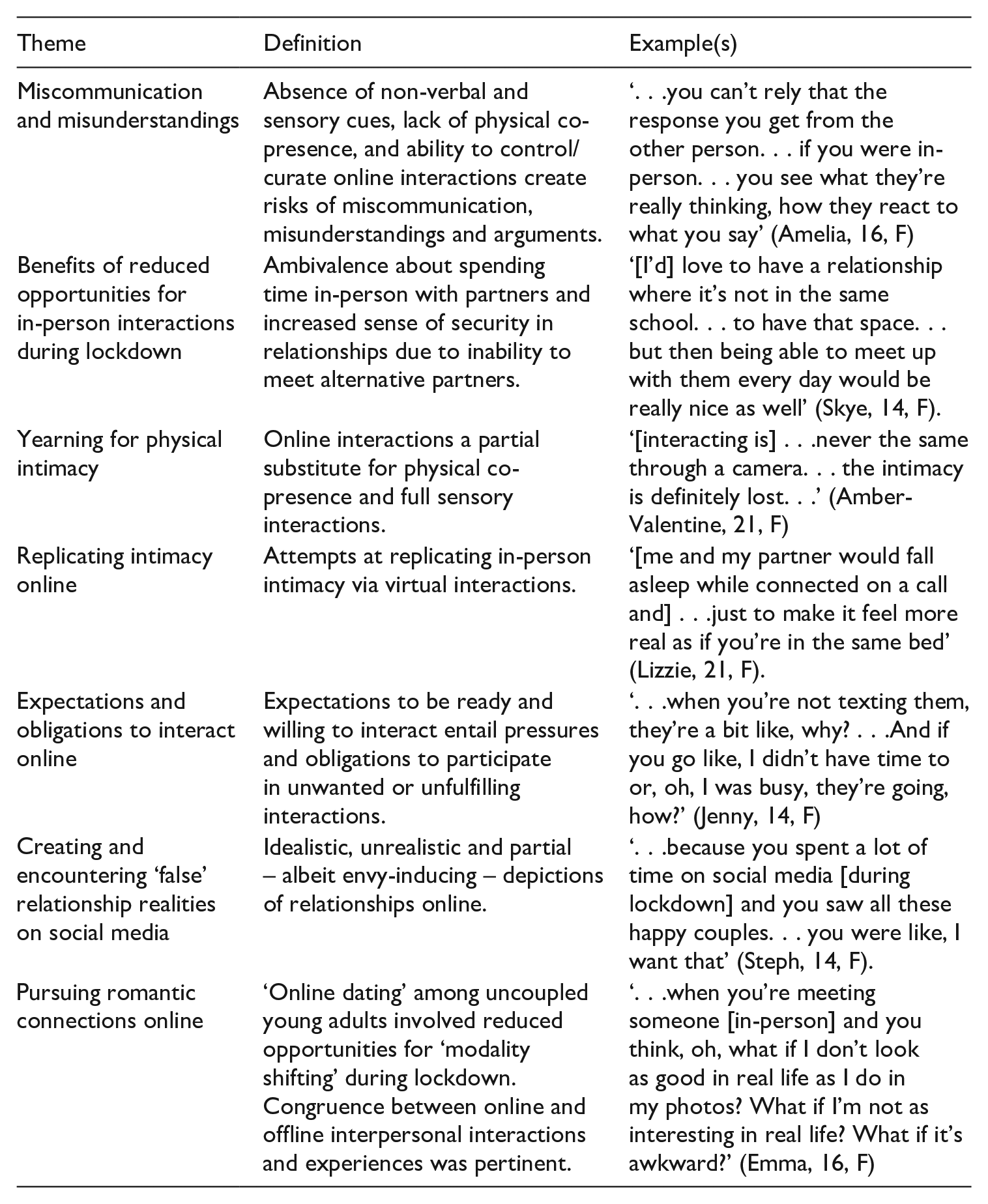
Miscommunications and misunderstandings
Particularly when engaging in asynchronous interactions (e.g. messaging), adolescent and young adult participants felt that the ability to plan, control and curate interactions is personally and interpersonally beneficial, but also risky when interactions are ambiguous, misleading or disingenuous. Conflict arising from miscommunication and misunderstandings was considered more difficult to resolve during lockdown due to reduced opportunities for in-person conflict resolution.
For example, speaking generally, Amelia (16, F) described interacting online as ‘less stressful’ because of the ability to exercise control over what is personally communicated, but: . . . you can’t rely that the response you get from the other person is their genuine feeling and not something that they’ve . . . been thinking up to reply . . . if you were in-person and it’s on the spot . . . you see what they’re really thinking, how they react to what you say.
Rihanna (14, F) similarly remarked: ‘when you read something [e.g. a text message] you don’t know how [in terms of tone of voice] they are saying it, so you might read it in the wrong way’, while Alyssa (24, F) compared it to ‘face-to-face, you can actually see the person’s emotions change . . . You can see the moment the face changes . . . But online, it’s like, are they upset? . . . are they happy?’. For Lily (24, F), ‘misconstrued meaning’ led to ‘arguments over calls and text’ with her partner, an experience recounted by other coupled young adults. Lily said these arguments went unresolved for relatively longer during lockdown due to the inability to meet in-person, because she and her partner would: ‘just hang up, rather than in you were in person . . . you can actually talk it out’. . . . Adolescents expressed similar perspectives, with Alice (13, F) stating that arguments went unresolved because ‘you don’t have any interaction in person to sort things out’. Warren (17, M) described it as ‘kind of bad’ how ‘if people were annoyed or upset . . . they’d . . . just disappear’ whereas ‘normally, if we spend every day together, then we just sort it out face-to-face’. While Charlie (17, non-binary) liked not having to deal with the ‘pressure’ of in-person conflict during lockdown, it meant they lost some relationships because of diminished contact.
Benefits of reduced opportunities for in-person interactions during lockdown
Benefits of reduced opportunities for in-person interaction during lockdown pertained to feeling more secure in relationships and, among younger adolescents, gaining space from partners. Existing relationships felt somewhat more secure because of reduced opportunities to meet alternative romantic interests. Francesca (23, F), for example, said: ‘he’s [her boyfriend] stuck at home, so who is he supposed to meet?’ William (17, M), likewise, felt ‘people didn’t feel the need to get jealous about [their partners] meeting up with other people or anything, because they couldn’t’.
Some participants – notably younger adolescents – were ambivalent about spending time in-person with partners and felt they benefitted from reduced opportunities for in-person interaction during lockdown. Skye (14, F), for instance, ‘would love to have a relationship where it’s not in the same school . . . to have that space . . . but then being able to meet up with them every day would be really nice as well’. There was a perceived intensity to relationships, with Rik (14, M) reflecting on his reliance on his previous girlfriend and enjoying his current relationship with someone who lives further away because they ‘do not see each other all the time’ and he likes having more time and space for himself and his friendships.
Yearning for physical intimacy
Several coupled young adults described a yearning for physical intimacy and in-person interaction during lockdown, for which online interactions were a partial substitute. Amber-Valentine (21, F), for example, said: [interacting is] never the same through a camera . . . we [her and her boyfriend] would say goodbye to each other; it wouldn’t be the same as rolling over to somebody, kissing them goodnight . . . the intimacy is definitely lost . . . no matter how high quality your camera.
Mikey (20, M) missed the full sensory experience with his partner: You just need to feel the air the other person is breathing . . . the perfume they are wearing, the clothes, the smile on their faces . . . The video calling and stuff . . . isn’t really real. But when you can feel their skin and the air around them . . . that is the best part.
Some participants referred to a lost ‘vibe’ or ‘aura’ when interacting virtually with partners. Gary (18, M) described a ‘gap . . . when you don’t see somebody face-to-face. It’s different’. Gordon (20, M) said ‘always talking on the phone feels awkward. She [his partner] physically wasn’t there. I really missed her a lot’. Others spoke of missing physical intimacy. Sonny (18, M), for example, said he ‘can’t do the things I want to do to her [his girlfriend] on the phone, that’s kind of bad, that’s impossible . . . you want to kiss her . . . I mean, I’d be kissing on the phone’. Kim (19, M) missed ‘the touch of [his partner’s] mouth and seeing her face’.
Lizzie (21, F) constructed physical touch and presence as a human need: ‘It’s probably our social . . . aspect of being human, needing people to physically be around you’. Cecilia (20, F), likewise, said it is ‘natural to miss the physical aspect . . . cuddling or like being in the same room as someone’. Ivy (21, F) felt the lack of physical co-presence and intimacy would make her and her boyfriend ‘just friends’. Grace (19, F) similarly believed ‘if you take the physical aspect out of a relationship, it’s kind of just like a friendship . . . it was like losing my relationship’. . . . Some participants experienced a relationship break-up during lockdown, which they attributed, somewhat, to the lack of in-person interaction. Gary (18, M), for example, said his girlfriend gradually stopped taking his calls and the relationship eventually ended, which, he felt, may not have happened if able to spend time together in-person, while Jimmy (20, M) felt the lack of in-person interaction meant ‘we [him and his girlfriend] weren’t as close as we were’ and they split up.
Generating intimacy online
Some coupled young adults described engendering intimacy through NCTs. These interactions included regular and lengthy voice/video calls. For example, Mikey (20, M) said he and his partner ‘spoke for hours, hours. Throughout the night, we kept talking’. . . . Some participants connected online while engaging in other activities, like university work or while asleep. Lizzie (21, F), for instance, said she and her partner would fall asleep while on a call and would ‘see if the call was still going in the morning and then say hello, just to make it feel more real as if you’re in the same bed’. Other examples included simultaneously watching movies or playing games or having ‘virtual dates’ where partners dressed more formally and ate a meal together while on video call. Amber-Valentine (21, F) described replicating physical touch online whereby her boyfriend said: . . . I wish I could hold your hand or just hold you, and I’d say, oh, that’s really sweet, I wish the same. And he then said, take a photo of your hand . . . and then he took a photo of his hand and photoshopped [us] holding [hands] together.
Some participants described virtual intimacy as ‘weird’ but as offering feelings of closeness, with John (23, M), describing it as ‘a halfway point, getting as close to the real thing as you could’.
Expectations and obligations for ‘constant interaction’
While participants were favourable to ‘any time, any moment’ (Kim, 19, M) online interactions, some described a pressure to be willing and available to interact, heightened during lockdown because, as stated by Reddy (21, M): ‘. . . we were pretty much free all the time, so all the more reason to [interact online]’. Jenny (14, F) said that during lockdown ‘you’re just sitting in your room’ and you’ve got nothing else to do’, which meant: . . . when you’re not texting them, they’re a bit like, why? What can they be doing that they don’t want to text me? And if you go like, I didn’t have time to or, oh, I was busy, they’re going, how?
Emma (16, F) said: ‘you can’t really say no [to an initiation of online interaction], because you don’t have an excuse, you’re not doing anything else’. Pressure to engage in unfulfilling or unwanted interactions online was troubling to participants. Some adolescents attributed the expectations and obligations to ‘boredom’. James (14, M), for example, said when he received a message, ‘I always wanted to message back as fast as possible . . . they’re obviously bored, so I’m going to talk to them, give them something to do’. Jay (14, M) added: ‘I felt like also you had to text them because you’re all sat there bored’.
Younger participants were concerned about the quality of these interactions. They felt there was little to do other than interact online during lockdown but also little to talk about. They referred to conversations becoming ‘dry’ when responses and contributions were short and uninspired. They experienced awkwardness because of silence, particularly on video or voice calls, where it felt difficult to terminate the call but also to think of something to say. Some regretted mishandling such situations. For example, Jemma (14, F) said she ‘would just blurt out random things because I didn’t know what to say and I felt like I had to say something in that moment or else we would just be silent’. For SD Winter (16, non-binary), neurodiversity exacerbated these challenges, because they struggle to call people; the only way I can really deal with being around people is by being with them in person because I don’t really know how to communicate via social media properly, so [lockdown] . . . made [relationships] a bit more difficult for me.
Coupled participants recounted how pressure to interact online created arguments because of the frequency of the interactions (i.e. more opportunities for disagreements to occur), mismatched desires for communication and the above-discussed issue of misinterpretations. William (17, M), for example, said he and his boyfriend argued during lockdown because ‘you . . . always had to be messaging’. Grace (19, F) described herself as becoming suspicious of and confrontational with her partner when her expectations were not met: ‘if he [her partner] hadn’t replied to my message . . . I’m like . . . Why can’t you reply to me?’.
Some coupled young adults framed the obligation to regularly interact in terms of the expectation that they should miss and want to replicate intimacy and connectedness with their partner. Francesca (23, F), for example, attributed her and her partner’s extensive video calls to how ‘. . . we missed each other so much it was like a given . . . it felt wrong to miss it [the calls], it became almost like an obligation’. Lucy (20, F) said her partner wanted to ‘fall asleep together on video call, but I didn’t like that . . . I felt obliged to do it because we’re . . . not seeing each other . . . So, I’d wait for him to fall asleep and then I’d hang up’.
Creating and encountering ‘false’ relationship realities on social media
Participants described social media content regarding relationships as false, misleading or partial, including, among some young adults, regarding their own or their partner’s posts. Among adolescents, social media content shaped perceived norms regarding relationships and engendered feelings of envy and pressure.
Some coupled young adults posted social media content about their relationships. Francesca (23, F), for example, said: ‘I like to shout it to the world that yes, I really am lucky to have this, like, really great relationship and I really love my partner’. Older participants mostly considered such posting as offering a partial insight into reality, with Alyssa (24, F), for example, describing it as to be expected that ‘people want to post their highlight reels’ including regarding relationships.
Social media content had, or was curated to have, specific effects among some young adults. Grace (19, F), who, as described above, experienced insecurity in her relationship during lockdown, said she was increasingly ‘. . . seeing things that he’d [her boyfriend] liked on social media . . . over analysing that and thinking, well, why has he liked that?’ Lily (24, F) recounted using social media to entice jealousy in her ex-partner: . . . I’d pop a story in, and I’d see if he’d seen it . . . It seems so petty . . . it’s like, are you putting up that story for him, so that he sees it and he sees what you’re doing, and he sees you’re having a great time?
Some younger participants were troubled by social media content pertaining to relationships. Lockdown intensified the desire to compare themselves and establish what is normative because less time was being spent with peers and social media became the main space to observe peers during the period. Amanda (14, F), for example, said: ‘because you spent a lot of time on social media [during lockdown] and you saw all these happy couples . . . you were like, I want that’. Steph (14, F) felt ‘a lot of pressure . . . you would see all these people going, I’ve got ‘Facetime Day’ with my girlfriend/boyfriend [whereby individuals claim to be spending the full day on a videocall with their partner during lockdown], and I would be like, why am I not doing that? . . . should I be?’.
Some older adolescents were troubled by the inability to pursue or achieve what was presented. William (17, M), for instance, said: . . . I got quite sad . . . during lockdown, because I couldn’t meet people . . . I couldn’t meet girls and I’d just see it on the TV . . . or . . . TikTok . . . it really made me feel like I’m missing out here . . . I want this, but I can’t have it almost.
Pursuing romantic connections online
Online dating (i.e. initiating and establishing new relationships via dating apps like Tinder and Hinge) was commonly mentioned by uncoupled young adults. They valued the opportunity to pursue relationships with greater confidence within the defined space of a dating app rather than in offline settings. Several used dating apps more often during lockdown to manage isolation. Alison (19, F), for example, felt ‘bored’ and used dating apps for ‘company’. Carolina (23, F) similarly described dating apps as the ‘best place to find new interaction’ during lockdown. Yet, both described becoming frustrated because of the inability to meet offline. For some young adults, lockdown exacerbated pre-existing problems with online dating, including related to inauthenticity, mismatched expectations and practices like ‘ghosting’, whereby people abruptly ‘disappear’ and stop interacting without explanation. They articulated a ‘love-hate’ relationship with dating apps, with Lexi (22, F) stating they involve ‘instant gratification’ and a ‘confidence boost’, followed, oftentimes, by rejection.
Online dating was not normative from the perspective of most adolescents. Skye (14, F) said adolescents may ‘text through Snapchat or Instagram’ with people already met offline but do not primarily initiate romantic relationships online. Kobe (14, M) considered it ‘weird’ to initiate online and Bob (14, M) said it is important to ‘know a bit about them and what you like [first] . . . so you can have an easier conversation’. The inability to interact in-person during lockdown meant budding relationships ‘fizzled out’ more quickly (Lily, 14, F), which, Kobe said, meant it was only after lockdown ‘eased off and people could see you in real life, then it kind of went back to normal and people started dating’.
Some adolescents, like Emily (14, F) felt people are more ‘confident’ and ‘bolder’ online which may disinhibit them when initiating relationships or interacting with existing romantic interests. There were, however, co-existing concerns about incongruence between online and offline interactions. Emma (16, F), for example, said: ‘when you’re meeting someone [in-person] and you think, oh, what if I don’t look as good in real life as I do in my photos? What if I’m not as interesting in real life? What if it’s awkward?’. Emma believed online interactions are ‘. . . more staged and you have to be prepared that when you meet in person, it’s highly unlikely that you’re going to get along as well’.
For participants at the LGBT + youth club, the lack of defined online spaces for dating was problematic during lockdown because they were otherwise unable to meet prospective partners. Charlie (17, non-binary), for instance, said: ‘. . . everyone’s relying on online ways of talking to new people . . . if a teenager wanted to explore dating it’s extremely difficult because there’s no like dating websites . . . for teenagers really’. Kai (17, M), who was gay, believed that some LGBT + ‘teens are flooding onto dating apps’, putting themselves and adults on the apps at risk (of sexual harm and legal censure respectively). Sarah (18, non-binary) said LGBT + young people are sharing personal information on SNSs like ‘general locations, sexuality, interests and dislikes’ to encourage potential partners to make contact, which SD Winter (16, non-binary) felt, is because they cannot ‘go out and meet people’. This tendency among LGBT + youth was, Kirk (20, M) suggested, ‘there before’, but was ‘exacerbated’ (Kai) and became ‘more mainstream’ (Sarah) during lockdown.
Discussion
Young people’s perspectives on and experiences of using NCTs in relationships during lockdown related to synchronous and asynchronous interactions via messaging, voice and video calling platforms, social media platforms and dating apps. Our critical realist analysis identified the lockdown conditions, NCT affordances and wider normative and experiential contexts shaping participants’ accounts. Specifically, we considered the ‘reality’ of both lockdown and NCTs as existing beyond subjective experience (Clegg, 2006) but as creating conditions for meaning and experience based on ‘human-technology interactions’ (Wood, 2021: 636), in our case the personal, interpersonal and sociocultural meanings, norms and expectations regarding relationships specific to and transcending lockdown as a condition for participants.
Reduced opportunities for in-person interaction seemed to have heightened participants’ awareness of and reflexivity regarding NCTs and relationships and the challenges and opportunities distinct from, but given meaning in terms of, offline contexts. Lockdown disrupted the fluid interconnections between online and offline contexts observed in pre-lockdown scholarship (e.g. Buckingham and Martínez-Rodríguez, 2013; Collier and Perry, 2023; Hodkinson, 2015; Nelson et al., 2020). As found by Malvini Redden and Way (2017), interacting via NCTs involved interlocking risks and opportunities, which, our data suggests, were specific to and transcended lockdown as a condition of participants’ lives.
Adolescent perspectives on interacting via NCTs during and beyond lockdown
As found by others (e.g. Valkenburg and Peter, 2009), NCTs offered opportunities to bridge geographical and temporal distance and exercise personal control over interactions, which may be relatively beneficial during adolescence when exploring and navigating new and different interpersonal experiences. The absence of physical co-presence enhanced confidence and openness, consistent with Trempte and Reinecke’s (2011) suggestion that online interactions enable disinhibited self-disclosure. Risks related, however, to miscommunication and misinterpretations. While identified in pre-lockdown scholarship (e.g. Vanden Abeele, 2016), lockdown conditions exacerbated the challenges due to the relative ease of interpersonal avoidance and, in turn, delayed or absent conflict resolution, with implications for young people’s interpersonal skill development given conflict resolution is an important relationship skill developed and practised during adolescence and young adulthood (Shulman and Connolly, 2013).
Adolescents were troubled by heightened expectations to interact online during lockdown, with some struggling to sustain meaningful interaction online and to cope with the dynamics of online exchanges, reflective of Pettegrew and Day’s (2015) description of ‘overload’ arising from enhanced opportunities for connectivity afforded by NCTs. These challenges were compounded by ambivalence, particularly among younger adolescents, about regular in-person contact with partners. The distance and space created by lockdown may, therefore, have been jeopardised by pressures and expectations to interact online. Interacting online was deemed to require socio-affective skills, with risks of interpersonal boredom or awkwardness identified by Cernikova et al. (2018) being of heightened concern because of limited latitude not to participate in unwanted or unfulfilling interactions during lockdown.
Lockdown entailed increased salience of social media. Even when deemed unrealistic, content pertaining to relationships impacted normative expectations and aspirations, which engendered envy or insecurity particularly among younger adolescents who were ambivalent about what they are and should be learning about and striving for regarding relationships based on the content. As found by Marks et al. (2020), the issue seemed less the identification of content as edited and overly idealistic, more the interpretation and internalisation of the ideals. For adolescents, content may be unrealistic but nevertheless aspirational; these social meanings, coupled with social media platform economies of likes and follows may, Papathomas et al. (2020) argue, perpetuate and normalise such content creation, sharing and consumption. While not new to lockdown, reduced autonomy, difficulties in establishing reality and absence of reassurance gained through physical co-presence potentially heightened these effects because all participants had was what was portrayed online.
The lack of defined online spaces or processes for adolescents to participate in dating and disinclination towards initiating intimate relationships online, coupled with the inability to shift the relationship to offline contexts meant dating/relationship initiation was disrupted or otherwise limited during lockdown from the perspective of most adolescents. They conceived of post-digital dating as an extension of interactions already commenced offline. Interacting online may entail disinhibited interactions that support intimate self-disclosure and interpersonal connection and may, therefore, be beneficial for relationships. However, new relationships seemed unlikely to be initiated online and online interactions need to be supported by congruent offline interactions. There were, therefore, aspects of experiential learning about relationships for which virtual contact was an insufficient replacement for adolescents during lockdown. As suggested by Orben et al. (2020), adolescents may benefit from fluid and serendipitous sociality and interpersonal and group interaction when physically co-present with others. For LGBT + young people, however, meeting partners through expanded networks online may be more normative, including through engaging with spaces not designed for their age group and through privacy disclosures, particularly during lockdown when opportunities to otherwise meet people were reduced further. Lockdown thus intersected with pre-existing marginalisation and inclination towards online dating among this demographic (e.g. Hatchel et al., 2021).
Young adult perspectives on interacting via NCTs during and beyond lockdown
Young adult perspectives on confining their interactions to online domains during lockdown varied by relationship status. Like adolescent participants, they were concerned about miscommunication and misinterpretations when interacting online, with coupled young adults recounting instances of conflict, consistent with adolescent participants’ perceptions regarding reduced opportunities for in-person conflict resolution. Coupled participants narrated the pain of being unable to see and interact with their partners in-person, while also trying to experience intimacy through online interactions. Difficulties sustaining relationships virtually perhaps related to the extra effort entailed when interacting without the cues, or ‘vibe’, present when in-person. In the absence of a full sensory experience, participants experienced diminished intimacy and had to work harder to understand what their partners were thinking and feeling, to convey these messages themselves and, ultimately, to experience a full intimate connection with their partners. While digital intimacies may be a normative feature of mediated relationships for young people (Bonilla et al., 2021; Scott et al., 2020), they may, therefore, be insufficient as a sole form of intimacy in the absence of in-person interactions and are experienced as enhancing, rather than supplanting, physical intimacy (Setty and Dobson, 2023).
For coupled young adults, physical co-presence with partners was normalised, wanted, reassuring and meaningful; relationships felt more fragile when interactions were only taking place online, akin to previous research regarding the naturalisation of intimacy in relationships and demarcation of ‘relationships’ from ‘friendships’ based on frequency and intensity of intimacy (Bonilla et al., 2021; Collins et al., 2009). As found by Juhasz and Bradford (2016), sustained and frequent online interaction, including of an intimate nature, was deemed expected and necessary for relationships regardless of whether it was personally pleasurable or rewarding. Meanings about relationships thus intersected with affordances of NCTs during lockdown to intensify norms and standards of practice for post-digital relationships (Toma, 2018; Yang et al., 2014). Participants’ accounts of scrutiny and monitoring of partners’ interactions during lockdown reflect previous research regarding enhanced connectedness co-existing alongside surveillance of and by partners (Fox and Warber, 2014; Rueda et al., 2015; Utz et al., 2015; Vaterlaus et al., 2016). Social media offered opportunities to entice jealousy in partners, including following a break-up, adding a further dimension to the scope for surveillance online with the opportunity to be surveilled exploited in this case.
Some uncoupled young adults used dating apps to meet new partners. Online dating during lockdown intensified the perceived norm of meeting potential partners online through providing a defined space to connect with people and an opportunity to relieve boredom and to pursue interpersonal connection. Yet as found by Zhao and Yan (2022), meaningful online dating required modality shifting, which was more difficult during lockdown, with exacerbated feelings of disappointment and frustration, including connected to time wasting, rejection, misaligned expectations, and ‘ghosting’ (Timmermans et al., 2021). As argued by Davis (2011), congruence between online and offline interactional domains was important to participants. While Hobbs et al. (2017) argue that online dating may reflect no more than a digital mediation of pre-existing dating anxieties, participants’ accounts suggest dating apps create new and evolving conditions and patterns of interactions which, as Thomas et al. (2022) found, may be experienced as potentially beneficial but damaging to the self and interpersonal relationships overall. The supposed new norm of online dating may, therefore, have become another form of what Hodkinson (2015) identified as compulsory online engagement but be frustrating for that reason, particularly if modality shifting is absent or entails incongruence. As Malvini Redden and Way (2017) argue, the tensions are not avoided but negotiated; during lockdown, the opportunity to relieve boredom and experience interpersonal connection may have increased the salience of online dating notwithstanding concerns about congruence and modality shifting because connecting with new people may have been sufficiently rewarding within these conditions.
Conclusion
While heterogeneous and shaped by age, method of participation and relationship status and history, participants’ accounts reveal a continuation and intensification of the digital mediation of relationality for adolescents and young adults (Ringrose and Harvey, 2015; Vanden Abeele, 2016). Potentialities and pitfalls related to interplays between NCT affordances and what was normative, desired and experienced personally and interpersonally across online–offline domains, as identified previously in post-digital scholarship (Livingstone et al., 2018; Malvini Redden and Way, 2017; Nelson et al., 2020). Lockdown upended the reciprocal flows of meaning and experience across these domains, with participants wanting to anchor their relationships, their learning about relationships and the development of their skills and confidence regarding relationships within and through physical co-presence with others.
Participants somewhat reproduced the conceptual dualism of ‘offline’ and ‘online’ (Livingstone et al., 2018), perhaps because, as critical realism suggests, NCT affordances are real and create new conditions for relationships. The delinking of online and in-person interactions during lockdown seemingly exacerbated uncertainties about authenticity and congruence. Online experiences were less ‘real’ because they were not made real, or otherwise meaningful, through physical co-presence. Participants did not want to confine their relationships to online domains; meanings of relationships and what was defined as beneficial and harmful, as well as motivations, expectations and experiences regarding relationships, existed in the ‘spaces in between’ offline and online (Nelson et al., 2020: 104), which were, ultimately, inaccessible during lockdown, with this inaccessibility making visible the importance of these interplays to young people’s post-digital relationships during adolescence and into young adulthood.
Limitations and avenues for future research
The qualitative findings cannot be generalised to all adolescents and young adults and are instead illuminative of nuanced meaning-making and experience among these participants. While the wide age range affected the overall coherence of the themes, it enabled us to inflect the findings by age and relationship status and history. Methodologically, interviews focused more on personal experiences and focus groups more on group-level norms and meanings, and, as a result, there was less data on adolescents’ personal experiences. We also could not verify the wider contexts or relational dynamics to which participants referred, nor access perspectives or experiences participants did not want to share. Future studies could incorporate dyadic data analysis of interdependent data points or observations from paired individuals within specific contexts or relationships.
Footnotes
Funding
The author(s) disclosed receipt of the following financial support for the research, authorship and/or publication of this article: They received funding to conduct this research via a British Academy Leverhulme Small Grant Award.
