



Abstract
While political communication scholarship has long underscored the importance of political talk—casual conversations about news and politics that occur in everyday situations—as a way for citizens to clarify their opinions and as a precursor for political engagement, much of this literature tends to depict political talk as uncomfortable and difficult for citizens. Yet, this focus on the challenging aspects of political talk has been informed predominantly by the US context. To what extent may a different picture emerge when looking across different cultural contexts? And how are these dynamics shaped by the affordances of the multi-platform social media environment? This paper explores these questions through a unique dataset of 122 qualitative interviews conducted between 2016 and 2019 with young people (ages 18–29) from five countries: Argentina, Finland, Israel, Japan, and the United States. Rather than solidifying the avoidance of controversial political talk as the key strategy at the disposal of young people, our findings point at a five-pronged typology of young people, with each type representing a different approach toward political talk. Our typology thus contributes to a more comprehensive and nuanced picture of various approaches towards political talk employed by young people across different countries and in relation to different digital media affordances.
Keywords
Political communication scholarship has long underscored the importance of political talk—casual conversations about news and politics that occur in everyday situations—as a way for citizens to clarify their opinions and translate them into political action (e.g. Eveland et al. 2011; Kim and Kim 2008). At the same time, much of this literature tends to depict political talk as “profoundly uncomfortable” for citizens (Schudson 1997: 299), particularly when it involves cross-cutting talk with those whose political positions differ from ours (Eliasoph 1998; Mutz 2006; Wells et al. 2017). Yet, this focus on the challenging aspects of political talk has been informed predominantly by the US context, questioning whether it may be rooted in specific cultural concerns. To what extent may a different picture emerge when looking across different cultural contexts? Moreover, while quantitative work has pointed at differences in the levels of political talk across countries (e.g., Barnidge et al. 2018; Nir 2012; Vaccari and Valeriani 2018), there is a paucity of qualitative work that examines the nuances of how youth perceive their relationship to political talk, across a variety of national contexts (though see Conover and Searing 2005, looking at the US and UK).
Further complicating matters is the question of how practices and norms around political talk are applied to digital contexts—a question that is particularly pertinent when focusing on young citizens, for whom social media is a key locus for political self-expression (e.g. Lane et al. 2019). Examining American youth, Thorson et al. (2015) found that they transferred offline social norms of political avoidance to online contexts, and thus saw Facebook as an inappropriate environment for contentious politics. Yet, while large social media platforms like Facebook are used around the globe, people in different cultures appropriate them in unique ways and assign different meanings to their use (Miller et al. 2016), including their appropriateness for discussing politics (Mor et al. 2015). Moreover, different digital platforms have varying affordances in terms of reaching imagined and actual audiences, which may shape youths’ decision on whether and how to employ them for political expression (Lane et al. 2018; Literat and Kligler-Vilenchik 2019).
Our inquiry thus brings together an in-depth understanding of two aspects: how young people across different cultures conceptualize the appropriateness and desirability of political talk and cross-cutting conversation, and how such perceptions are applied to the multi-platform social media environment, where much of their political self-expression occurs. To do so, we employed a unique dataset of 122 qualitative interviews conducted between 2016 and 2019 with young people (ages 18–29) from five countries: Argentina, Finland, Israel, Japan, and the US.
Rather than solidifying the avoidance of controversial political talk as the key strategy at the disposal of young people to address the challenges of political talk, our central finding points at a five-pronged typology of young people, with each type representing a different approach toward political talk, manifested in regards to face-to-face talk as well as to political expression in digital environments. All five types we identified surfaced across countries, though with some distinct ‘national flavors.’ Our typology thus contributes to a more comprehensive and nuanced picture of the various approaches towards political talk employed by young people across different countries and in relation to different digital media affordances—in which the avoidance of political talk is only one possible response among several.
Young People's Political Talk in the Contemporary Media Environment
The impetus to examine young people's relationship to political talk is rooted in the assumption that citizens “share an orientation to a public world where matters of shared concern are, or at least should be, addressed” (Couldry et al. 2007: 3). Indeed, young people occupy a complex position with regards to public connection. On the one hand, today's younger citizens often show lower levels of political engagement than their older counterparts (Andersen et al. 2021), a finding that has long concerned scholars. On the other hand, young people are often those most active and engaged in social media environments, which—at least potentially—can be spaces for vibrant political discussion (Lane et al. 2019). Precisely because of their reticence towards institutional political engagement, young people are also those who have the most to gain from exposure to political information (Andersen et al. 2021), e.g. by engaging in political talk. The question of young people's relation to political life has been investigated across a range of disciplines, including youth studies, cultural studies, sociology, and more. Here, we employ an approach informed primarily by work around political communication and political expression in the digital environment.
By political talk, we refer to the process through which citizens “freely interact with one another to understand mutually the self and others” (Kim and Kim 2008: 53). Such “everyday political talk” (Conover and Searing 2005) should be understood as distinct from rule-governed deliberation (e.g. Gastil 2008). The US-based research on political talk has been characterized by mixed evidence, with some finding citizens feeling free to talk about political topics (e.g., Wyatt et al. 2000) while others worry about the tendency of citizens to avoid political talk out of fear of disrupting social harmony (e.g. Eliasoph 1998; Wells et al. 2017). These discrepancies are partly due to different conceptualizations and operationalizations of political talk. Quantitative work on political talk (e.g., Nir 2012; Vaccari and Valeriani 2018) usually utilizes a-priori definitions, often conceptualizing political talk as relating to institutional or ‘big-P’ politics (though it may be unclear how survey respondents understand the term, see Eveland et al. 2011). Qualitative and ethnographic research on political talk (e.g., Conover and Searing 2005; Eliasoph 1998; Wells et al. 2017) often employs a more bottom-up approach, where part of the aim is to understand how citizens themselves understand and define ‘politics.’ Such approaches often rely on broader definitions of politics (and political talk), attempting to listen to citizens’ own reflections on the connections between politics and everyday lived experience (Couldry et al. 2007). Here, we similarly employ a qualitative, bottom-up approach, which seeks to understand how young people relate to political talk, as they understand it.
The communication-oriented literature on political talk has often poised a conundrum wherein, despite the recognized benefits of talking politics—e.g. for developing one's own view, understanding the views of others, and as an antecedent for political knowledge and political engagement (e.g. Nir 2012; Vaccari and Valeriani 2018)—it is an activity that citizens tend to feel uncomfortable with (Eliasoph 1998; Schudson 1997; Warren 1996). Much US-based research along these lines has focused on citizens’ perceived tendency of avoiding the disharmony of political talk (Eliasoph 1998; Vraga et al. 2015; Wells et al. 2017). This strand of scholarship identifies several challenges that political talk poises for citizens. Warren (1996) argues that political talk causes anxieties and uncertainty because of “social groundlessness”—an absence of known rules and standards. This applies particularly to cross-cutting political talk, with those whose views differ from ours (Mutz 2006). Building on Spiral of Silence theory (Noelle-Neumann 1974), Hayes and Matthes (2017) discuss the role of “social fears”—concern about the view of peers or of the community at large—which may lead individuals to self-censor, by either remaining silent or choosing other avoidance strategies. Indeed, the challenge of speaking out politically may well be exacerbated in an increasingly polarized political environment, where distinctions across partisan lines may feel insurmountable (Wells et al. 2017).
In the digital environment, political talk and sociability are intertwined as people use news (and politics) as a tool to connect to others, thus becoming “a communicative flow that helps facilitate social life” (Swart et al. 2017: 904). These connections between the social and the political, along with their expressive affordances, led to hopes about the ability of digital and social media to serve young people as a space for political self-expression and forging connections with like-minded others (e.g., Literat and Kligler-Vilenchik 2019), for being exposed to the views of others (e.g., Anspach 2017), or for leveraging interests—e.g., in popular culture—towards engagement with politics (e.g., Jenkins et al. 2016). At the same time, the entwinement of the social and political, coupled with other aspects of digital and social media, may also be creating a complex space for political discussion. For example, while in everyday contexts, people can target certain political messages at specific recipients, much social media communication is characterized by context collapse, as various imagined audiences merge (Marwick and boyd 2010). This may be particularly tricky when it comes to politics: Because users usually forge their digital connections based on sociality, often one is unaware of others’ views (Thorson et al. 2015; Vraga et al. 2015), and differences may only come to light after a jarring political interaction has already occurred (see, e.g. Mor et al. 2015).
Moreover, political expression on social media should be seen not as a uniform phenomenon, but rather as shaped by the norms, affordances and contents of different platforms—e.g., what are the perceived expression norms on each platform, and to what extent audiences are known and can be managed (see, e.g., Lane et al. 2018; Literat and Kligler-Vilenchik 2019; Thorson et al. 2015). Also, across different cultural contexts, different digital platforms are adopted, whose affordances have implications for the ability to discuss politics (see Matassi and Boczkowski 2021). For instance, chat groups on instant messaging platforms, which are extremely popular globally (Vaccari and Valeriani 2018) offer a more intimate environment to discuss news and politics (Tenenboim and Kligler-Vilenchik 2020).
Overall, it is clear that digital media has not offered a panacea for the challenges of political talk, but has not curbed it uniformly, either. Rather, in the context of a digital media environment offering myriad opportunities for individuals’ self-expression, the choice to engage in political talk—both off and online—is often a fraught one. What is less clear is to what extent our current understanding of young people's relationship to political talk—and particularly the focus on avoidance as the key response to controversial political talk—is applicable beyond the US-context, as well as to an ever-expanding digital communication environment with different affordances shaping political talk.
Quantitatively, cross-national survey research indicates moderate overall levels of political talk, with significant variation from country to country, both for face-to-face talk (Nir 2012) as well as through social media or instant messaging platforms (e.g. Barnidge et al. 2018; Vaccari and Valeriani 2018). Cross-national differences in levels of political talk are explained in these studies as an interplay between individual-level factors (gender, education) and macro-level factors (political system, freedom of expression, established vs. new democracies). While individual-level factors play an important role in these studies, we aim to go beyond the known effects of gender or education (see Nir 2012; Wolak 2020), and instead investigate possible variations in young people's relationship to political talk qualitatively, enabling a more holistic, nuanced understanding of the complex negotiations that may be involved in young people's perceptions about whether, when, how, with whom, and through which media, to talk politics. Moreover, the indication of possible cross-national variation serves as an impetus to move beyond solely US and European contexts, and to investigate political talk, both face-to-face and digitally mediated, across a more diverse set of countries and cultures, seeking to offer a more comprehensive picture of young people's approaches across different cultural contexts.
We thus ask: How do young people differ in their conceptualization of the appropriateness and desirability of political talk and cross-cutting conversation, and how are such perceptions applied to the multi-platform social media environment?
Method
To address this research question across a variety of cultural contexts, we employed a unique cross-national corpus of in-depth interviews. This study is part of a broader project aiming to understand people's perceptions and practices around consuming both news and entertainment in the current media environment across five countries: Argentina, Finland, Israel, Japan, and the US. These countries were selected to represent geographical (i.e., four continents), linguistic, and cultural diversity. The countries also share important similarities: they are all established democracies, and all have comparably high social media use.
Interviews were conducted between 2016–9 and included a broad range of participants (all-together, 488 interviews with participants aged 18–89). For the purposes of this study, we focus on a subset of 122 interviews conducted with young people ages 18–29 (see Table 1).
Demographic Information by Country.
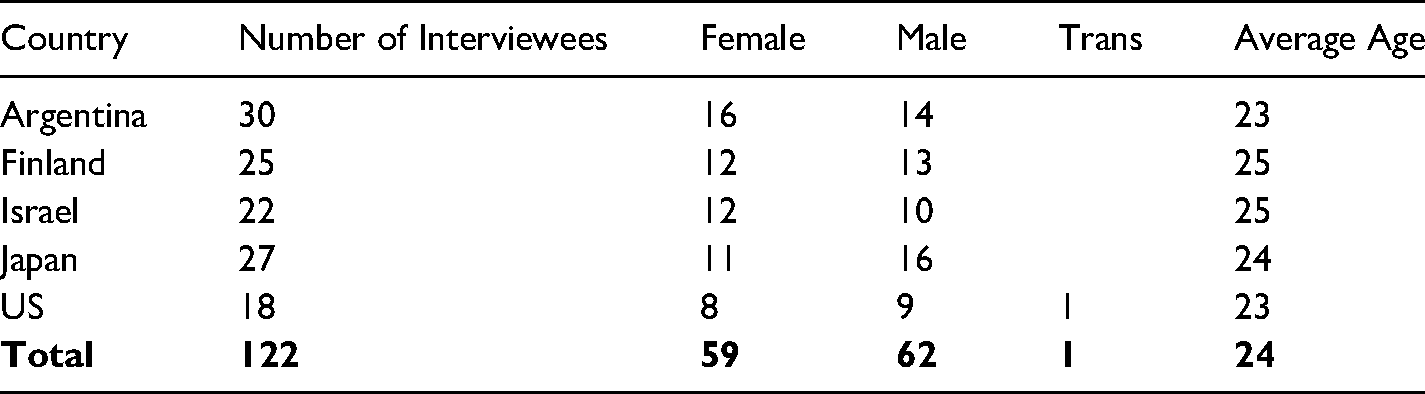
In each country, interviews were conducted by PIs and/or research assistants fluent in the native language and well-acquainted with the cultural context. Interviewees were recruited through snowball sampling. We sought diversity across gender, education, race/ethnicity, and geographic location—factors that may shape individuals’ sense of connection to public life (Couldry et al. 2007: 69). Interviewees were not selected based on prior interest in news/politics or social media use, and indeed vary significantly on these dimensions. Interviews, conducted in interviewees’ native languages, were conducted face-to-face in locations chosen by the interviewees (mostly homes, public locations, or cafés) and typically lasted 45–60 min.
The interview protocol, revolving around news and entertainment, with a section specifically devoted to political talk, was shared among the countries and slightly adapted to each national context. In contrast to quantitative research, which needs to provide a-priori definitions of political discussion that are sensitive to measurement validity (Eveland et al. 2011), open-ended interviews have the benefit of interrogating how people define politics (and political talk) in their lives. We asked participants whether they see themselves as people who like to talk about news and politics, who they talk to about news/politics, through which media they do so, and how they decide whether, when and how to post political content online.
Particularly when interviews address normatively-loaded topics such as politics, social desirability is a pertinent issue, as interviewees may provide the answers they believe interviewers are expecting. Moreover, people often draw on interpretative repertoires to justify their behaviors and positions based on what they see as established cultural ideals. In our study, an additional challenge was that the prominence of social desirability may vary across cultural contexts, depending on the relative salience of social hierarchies. Interviewers across all countries were instructed on possible techniques to minimize social desirability (e.g., explaining that there is no right or wrong answer, refraining from judgment) though, in our analysis, we must take into account that both social desirability and cultural repertoires are likely part of what shaped interviewees’ responses (see, for instance, the discussion below of the possible effect of social desirability in expressions of those uninterested in politics).
After the interviews were fully transcribed in the local languages, the team of PIs in each country surveyed the data with an open coding scheme and, after several rounds of discussion and refinement, agreed on a set of shared codes according to possible emerging thematic orientations, as per "code-oriented grounded theory” (Corbin and Strauss 1990; Reichertz 2019). Team members tested and further refined these codes using shared English-language data, before continuing to employ the qualitative content analysis software MAXQDA to systematically categorize the full corpus (in the original languages).
For this study, we included all interviews with young people (aged 18–29), focusing on all interview segments relating to political talk. These segments were identified by the PIs in each country, using the relevant codes from MAXQDA. To achieve additional nuance and context, we returned to the full interview transcript as needed, and consulted with interviewers in each country to verify our interpretations. The analysis process for this paper was guided by recent approaches to grounded theory (Reichertz 2019) which perceive the analysis process as not purely inductive, but rather as an interplay between existing theoretical frameworks and new categories that emerge during the coding and analysis.
In the first stage of analysis, we considered whether and how interviewees differ across three main aspects, derived from our theoretical lens: Their perception of norms around the general desirability of political expression, their willingness to engage in cross-cutting political talk, and the way these perceptions are applied to different social media contexts. Through this emergent analysis, we noticed that we were repeatedly encountering similar types of participants, with each type exhibiting a specific relationship to political talk, which cut across these three aspects. That is, each type seemed to have similar answers to the questions, how normatively desirable is it for one to engage in political expression? How willing are they to engage in cross-cutting political talk? And how do they apply these perceptions to their expression on social media?
In this stage of our analysis, we employed abductive inferencing (Reichertz 2019: 264): we attempted, based on our interpretation of the data, to account for a combination of features for which there was no appropriate explanation in the existing literature. Abduction seeks to explain these features through a “new order,” which “fits” the previously unexplained findings (Reichertz 2019: 267). At the same time, abductive inferencing always takes into account that such an order is never definitively complete, and is always undertaken provisionally. The result of our abductive process was our emergent five-pronged typology, representing young people's varying approaches toward political talk in both face-to-face and digital contexts.
Findings: A Typology of Young People's Approach Toward Political Talk
Our typology depicts a rather coherent set of types in relation to the willingness to engage in political talk. We constructed these types on the basis of patterns in our data which surfaced across all national contexts, albeit with some distinct national flavors. Once the types were identified, we found we were readily able to categorize interviewees, even based on limited remarks 1 .
The types we identified are:
The uninterested: Politics isn't interesting / relevant to me The quiet attentives: I’m interested in politics, but won't talk about it The face-to-facers: I’ll discuss politics, but only in-person The calculating expressers: I’ll discuss politics online, as adapted to the platform/topic The steadfast expressers: I’ll express my politics! (with little regard to norms)
While our aim is not quantification, it is important to note that these different types were
In what follows, we explore the typology in-depth.
Type 1: The Uninterested - Politics Isn't Interesting/Relevant to Me
Uninteresteds represent the stereotypical perception often held about young people: that they are apathetic towards politics, feel that it bears little significance to their lives, and thus have little motivation to engage with it:
“I am not particularly interested in politics. […] I vote in the election, but that's it.” (Tellervo, F, 24, Finland)
2
“The political things and what happens in the world is less interesting to me […] all the crap and the scandals going on in the Knesset [Israeli Parliament] are not relevant to me. I’m not saying they’re not important, specifically it doesn't interest me.” (Abigail, F, 23, Israel)
Yet despite the dominance of the apathetic-youth-stereotype, this category was in fact uncommon in our data. Both selection bias (uninteresteds may be less willing to partake in such interviews) and social desirability may play a role in this finding: Saying that one is uninterested in politics may go against good citizenship norms that stress informed citizenship (see Delli Carpini and Keeter 1996) or may be seen as catering to those stereotypes already attributed to young people.
Somewhat counterintuitively, among our interviewees, uninteresteds stood out more in those countries generally perceived to have vibrant cultures of political talk. In Israel, for instance, young people feel inundated with news and politics to the extent that they engage in conscious efforts to avoid them (see Aharoni et al. 2021). Similarly, in Argentina, Jorge, a 19-year-old university student, depicts his preference for being apolitical as unattainable: “I don't like the part of politics myself. I try to be as apolitical as possible, which is impossible but I treat it as a personal decision.” Such differences may also be the result of varying levels of social desirability among countries. For instance, these countries in our sample that are relatively open to political talk (Argentina, Israel) may also be ones that are less hierarchical (particularly compared to Japan), and so interviewees from these countries may feel more comfortable to openly identify with a certain social position even if it goes against perceived normative ideals.
Type 2: The Quiet Attentive - I’m Interested in Politics but Won't Talk About it
Quiet attentives say that they are interested in politics (or at least in news/current affairs), but they do not want to talk politics with others, either face-to-face or online. In our corpus, this category particularly stood out in Japan, where many interviewees follow the news to some extent but, like young restaurant employee Akane (F, 21), don't talk about news, “with anyone at all.” Kikue, a graduate student from Tokyo, explains further: “I think it's best not to talk about politics with my friends. Different friends have different opinions about whom they support […] I think there is no need to say what I’m thinking, so I don't do it.” (Kikue, F, 25, Japan)
Across the different countries, the motivation to avoid political talk is often related to a concern about the divergent views people may hold—like in Kikue's quote—but also reflects a preference to avoid negative emotions such as anger, discomfort or offense, or, alternatively, a sense that political talk is futile because people will not listen to others or change their minds.
“I speak less about my opinions […] it often comes to an uncomfortable place with people, you know?” (Nofar, F, 25, Israel)
“All these opinions like this … It hurts, it generates anger […] what do I know, people who think like this, it's very difficult to change their minds.” (Germán, M, 27, Argentina)
As previously discussed, avoiding political talk to maintain social harmony has often been stressed in the US-centered literature (see Eliasoph 1998). Our findings show that, far from unique to the US, quiet attentives—who will not talk politics at all due to social fears (Hayes and Matthes 2017)—appear in almost all cultural contexts. Yet, our typology shows that avoiding all political talk is only one possible approach among several.
Type 3: Face-to-Facers - I’ll Discuss Politics, but Only In-Person
Among our interviewees, face-to-facers were the most common type. Face-to-facers are—in principle—willing to discuss politics, but distinctly prefer doing this only in-person, and not online.
If the prototypical statement encapsulating the avoidance of political talk is the adage “don't talk politics or religion,” Adriana, a kindergarten teacher from the US (like many of the young Americans interviewed by Thorson et al. 2015), applies this to online contexts:
“I try not to put [online] anything that has to do with politics or religion so as not to cause any problems, because sometimes people get offended. I mean, I read it and everything but I keep it to myself, or I share it in-person so that no one can be offended or take it badly.” (Adriana, F, 24, US)
Why are face-to-facers willing to discuss politics in-person, but not online? The main motivations expressed for avoiding online political talk were similar to those expressed by quiet attentives in relation to political talk in general: the wish to avoid conflict and the sense that such talk is futile. However, face-to-facers applied these concerns only to online contexts, distinguishing them from face-to-face political talk which they say they do engage in, even if they do not necessarily enjoy it.
For example, Johannes, a 29-year-old teacher from Finland, does not consider himself as someone who likes to talk about news or politics, but is willing to do so “if the theme is something close to me and there are nice and close people around and it's a safe topic to talk about.” Online, he prefers to avoid it because “it usually leads to some kind of conflict, and I don't have the time or stamina for that right now.” Similarly, Asaf, a 27-year-old software engineer from Israel, explains: “In general I don't like to talk politics, and definitely not on Facebook. That is, face-to-face seems more OK to me, but [social] media is less appropriate.”
Concerns about the divisiveness of political talk seem exacerbated by online contexts. Hanna, a 23-year-old receptionist from Philadelphia, may talk to her friends about politics, especially “if something big happens, like during the election,” but online political talk stresses her out: “I like when people get along so when something that is so divisive as politics are, it makes me feel like uncomfortable, because people are gonna fight over it no matter what it is.”
While face-to-facers stress the in-person/online distinction in explaining their aversion, it seems that their deeper concern may revolve around discussions with those weaker—and more diverse—ties that characterize social media environments (see Barnidge et al. 2018). Two aspects indicate this: first, face-to-facers often say they are comfortable talking politics with close ties—family members, spouse, or close friends. Second, they are open to discuss politics with these strong-tie relations, even when it is technologically mediated, for example through instant messaging apps such as WhatsApp (in Israel, Argentina or Finland) or LINE (in Japan).
This point is exemplified by Juana, a 20-year-old university student from Argentina. Juana says she likes to discuss the news with family and friends, and is even open to disagreement among them: “I like it, it interests me, especially in the family environment to see what my parents think. Many times I agree and many times I do not.” However, she adamantly avoids the same practice on social media: “But never, never ever, on Facebook will I be commenting, posting things that generate controversy … such as football, politics, I keep that to myself because … it generates problems, generally.”
Some interviewees go further to claim that political talk online may have a serious emotional toll. In Finland, Edward, a 24-year-old student, who in the past was quite active in posting his political views, shared how he scaled down his participation:
“I was previously more active, but recently I have been suffering from pretty bad mental health problems, and I've found that I do not cope well with such [online] debates that include distressing attacks and trolling. I don't have reserves of strength for that.” (Edward, M, 24, Finland)
Some aspects of this category were country-specific. For instance, the Finnish context stood out as one where participants connected the avoidance of online political talk with concerns about privacy. Finns Linnea and Matias both say that they talk about politics in-person but refrain from it online, due to privacy considerations:
“I don't like to show anything to all people in public [..] I'm careful for others to know what stuff I read and what interests me, what my opinions are.” (Linnea, F, 21, Finland)
“I’m such a private person that I don't like to share any of my information anywhere, neither do I comment on others’ posts on social media.” (Matias, M, 29, Finland)
In contrast, in the US, a similar hesitancy about presenting political views online was connected to professional considerations, such as those presented by young attorney Alan:
“I don't post a whole lot on Facebook because I’m an attorney, you know, I do have to be careful about what I say, even if it's something I think is clever or funny, it could come back and make me look bad out of context.” (Alan, M, 28, US)
In some countries, expressing oneself politically online may be particularly daunting—if not outright risky—for some minority groups, such as Arabs in Israel. Gadir, a young teacher from Israel who is Arab Muslim, expressed actual fear about the possible ramifications of political expression online:
“I’m not looking for more trouble and we’ve already heard about people who paid a price for talking about politics, we saw people get arrested because of political posting.” (Gadir, F, 22, Israel)
In our data, Japan was the only country where face-to-facers were not the most common type. Those we did identify were often the more well-educated university students, who said they may discuss politics, but only with close ties, such as their parents, close friends or a spouse. The idea of risk around online political expression was also expressed in the Japanese context, though here the risk seems to be not a physical one, as in the Arab-Israeli example, but—resonating with Hayes and Matthes’ (2017) discussion of social fears—the risk of defying societal norms:
“When it comes to the dissemination of that [political views], when it comes to the unspecified number of people [online], I think it's quite risky to make one's principles, you know, public […] I'm refraining from doing that.” (Hajime, M, 23, Japan)
Type 4: The Calculating Expresser - I’ll Discuss Politics Online, as Adapted to the Platform/Topic
Calculating expressers are those who will discuss politics, including online, but will make considered choices around which platform (and its respective affordances) to use for which purpose, which topics to talk/not to talk about, and which expression practices to employ. For example, in Argentina, Estanislao, a 27-year-old working in accounting explains that “based on my taste I choose the social media that I use”. He elaborates: “On Twitter it is easy to express an opinion, it is very direct between one user and another, and it can be shared and spread very quickly. On Instagram it's more difficult. […] On Twitter, through a retweet, it can reach an innumerable number of people, so there it is more difficult to ignore it than on Instagram or Facebook.”
Calculating expressers are often more interested and active in politics than all their counterparts. Like face-to-facers, they are aware of the possible risks of online political expression, but they respond to this perceived risk differently: they are not willing to give up political expression online altogether, either because they enjoy it as part of their self-expression, or because they care strongly about sharing a political message. Thus, they carefully consider and strategically employ the various affordances of different platforms to reach target audiences with their messages (see similar findings about Israel by Mor et al. 2015) with the aim of mastering the art of political talk in the digital environment.
For example, in the US, graduate student Dinesh (M, 23) cares strongly about making meaningful political conversations. He finds that he can achieve this goal face-to-face, but he struggles with it online: “I don't know how effective sharing things on Facebook is anymore because there's like 10,000 things people get every day and a lot of it is just like click-bait.” His reaction is not to shy away from posting politics online, but rather to actively grapple with how to “break through the noise”: “Now there is just such an inundation of content, a lot of which I think is bad and not really good analysis […] And I, I used to do like amateur journalism […] so I think about this a little bit informed by that idea. But now I don't know how to break through the noise of what people are getting all the time.”
In countries where instant messaging apps are popular, they are often seen as a good alternative to mainstream social media for the purpose of more intimate political discussion, as this quote by Victor (M, 23) from Argentina exemplifies: “I have so many people on Facebook that […] I don't like people to know what I'm seeing, what I'm reading, what my interests are … but I prefer if I can share it with my friends, send it by WhatsApp to my friends in particular or whoever I want to see that news.”
Mainstream social media can also afford private-facing forums for news discussion, such as Facebook groups (see Tenenboim and Kligler-Vilenchik, 2020). Kaarina, a 28-year-old historian from Finland, has a Facebook group with her former co-workers for discussing the news: “It's a bit of a feminist group. It's a very equality-oriented way of discussing topics.” In contrast to some of the shallow political conversation happening in mainstream social media, she says, this “is clearly a group that discusses a little more in depth.”
Beyond considering the affordances of different platforms, calculating expressers may decide to post only around specific topics. In Japan, Toru, a 23-year-old sales representative, won't talk or share news about US politics, but takes a different stance on environmentalism: “I share quite a bit of news about the environment. I talk to people and share with them, and I'm very interested in it.” Unlike the politicization of climate change in the US, environmentalism is considered a consensual topic in Japan, and thus Toru's decision may be quite strategic.
Across several countries, calculating expressers shared narratives wherein they used to be more politically expressive online in the past, but grew tired of it and subsequently changed their behavior. An example is Josefiina (F, 24) from Finland who scaled back from posting political content on Facebook:
“I don't do that anymore these days […] No matter how carefully I argue, they wouldn't agree to start thinking differently. Only if the argument is something very close to me personally or makes me angry, then I would want to express my opposing viewpoint.”
Such responses may go as far as making participants “switch types.” Santiago, a 28-year-old system analyst from Argentina, was previously a calculating expresser: “I spent a lot of time posting, I spent a lot of time commenting.” Yet after receiving repeated insults and being unfriended by close friends, something changed: “I started to moderate myself a little bit until a moment came when I started to be a passive reader, and I stopped commenting and posting absolutely EVERYTHING.” He kept talking politics only in-person, but after an explosive “family asado” (traditional Argentinian family barbeque), Santiago now feels it is “not possible to talk about politics” at all—and thus he was categorized as a quiet attentive.
Type 5: The Steadfast Expresser - I’ll Express my Politics! (with Little Regard to Norms)
Steadfast expressers are those who renounce perceived norms around appropriate political expression, online or off. They will speak out on their politics with little regard to others’ reaction, and even enjoy stirring up a bit of a commotion. While steadfast expressers were relatively rare in our dataset, we found representatives in every country. For example, when Adalmiina, a 24-year-old student from Finland, is asked whether she likes to talk about news or politics, she replies: “Well, I always like to poke a little at people's ways of thinking. Especially when they have a strong opinion on something, I like to poke at it.” For instance, she gets annoyed by the consensus she sees around her about how terrible Trump is, and is eager to question people's assumptions on this. She admits she doesn't have a very strong contrary opinion—rather, she's “just trying to spark a debate.”
Similarly, in Japan, 28-year-old freelancer Daisuke (the only Japanese steadfast expresser we identified) says that he likes to stir things up by sharing controversial news on Facebook, whether in order to push others out of their comfort zone, or just for his amusement:
“I like to throw something in there to provoke them when they are getting too used to each other. For example, if I see someone in the media overseas saying something bad about Japan, I get so riled-up and mean, and deliberately share it with my friends who usually say ‘Japan is awesome, it's great’ …"
Interestingly, steadfast expressers are not necessarily those with the most adamant political views (calculating expressers often have more well-formed political opinions). Instead, they have a strong insistence that people (and they specifically) should be able to express different opinions, and that commonly-held political views should not be accepted without question or doubt.
Steadfast expressers may be those with an unpopular opinion among their circle of acquaintances. Such is the case with Fabián (M, 18), an American Latino high-school student, who sees himself “as a black sheep”—not only as a conservative and a Trump supporter, but as someone who seeks out political discussion with those holding different opinions: “When I argue people get offended […] I don't get offended at all… I have praise for their point of view, I actually want to hear it, but they don't like to hear my point of view. […] Your point of view politically is a religion nowadays…. It's like it makes you the person you are. You can be nice or mean - I'm nice, but I'm a nice conservative and you're liberal [so] I'm [seen as] mean to you.”
Steadfast expressers feel very strongly about protecting their ideals, even at the expense of offending others. Steadfast expressers seem to be drawn by conflict and are often actively seeking its perceived excitement and action (see Wolak 2020 on conflict-seeking). For example, Sabrina, a 21-year old Argentine, shares how she actively sought out an argument with an unknown online commenter around a piece about sexual harassment: “There was one [online commenter] who had said that women like to be catcalled. And I wrote to him […]: ‘If they are telling you in a video that they don't like it, what is it that is so difficult for you to understand?’ […] and I had like 90 likes, haha […] I find it entertaining, haha. […] I also like to comment so that it is not written there without anyone saying anything about it. [..] I like to defend things, like my ideals.”
Since steadfast expressers seem much less concerned than their counterparts about getting into conflicts, they are also much more open to cross-cutting exposure and dialogue, and even actively try to persuade others. When Meital, a 21-year-old student from Israel, is asked whether she has liked political pages on Facebook, the following conversation ensues:
I think I’ve [liked] everything because I like to see not
just one opinion. I like that there are many opinions.
You like to have a variety.
Yes. It gives you more options to get annoyed about things.
You like to get annoyed by the news?
I like to persuade people why their opinion is not 100%,
and to understand what's behind that.
And do you succeed?
Sometimes yes. Often yes. It's hard for me to express
myself sometimes but, eh, I try to explain to them. And to
be honest, I succeeded in converting some people.
Yet, while one may laud steadfast expressers’ willingness to engage in contentious conversation with others, it may be this same behavior that is driving away some of their more cautious counterparts from engaging in political discussion online.
Discussion: Promoting Youth Political Talk Across National Contexts
Emanating mostly from a US-based perspective, much existing research around political talk has presented it as an activity that is valuable, but challenging and uncomfortable for everyday citizens (e.g., Eliasoph 1998; Schudson 1997; Wells et al. 2017; Wolak 2020). Our study aimed to examine young people's approach towards political talk as it manifests across a variety of national contexts, and is applied to a multi-platform digital environment. Our findings, encapsulated through our five-pronged typology and recurrent across all participating countries, point at a range of possible stances which young people take towards political talk, both face-to-face and through digital media. Of these, political avoidance is only one, and not the most common, response.
Rather than depicting one overall tendency in relation to youth political talk, our typology highlights how differently varied young people approach this issue, illuminating the differing perceptions, motivations and considerations they employ. ‘Uninteresteds,’ who say that politics is not relevant or interesting to them, were the rarest category in our dataset—though social desirability and selection bias may also play a role here. ‘Quiet attentives’ encapsulate those who avoid talking politics due to social concerns (Hayes and Matthes 2017), and indeed, extending the applicability of concerns emanating from a US-focus (Eliasoph 1998; Wells et al. 2017; Wolak 2020), we heard such voices across all countries. At the same time, only in Japan were quiet attentives—among our interviewees—the most common category.
Across four of the five countries (Argentina, Finland, Israel, and the US), the most salient type among our interviewees is face-to-facers, those who are willing to talk politics in-person but not online, thus exhibiting a specific kind of avoidance of political talk. As our analysis showed, this preference may be less about technological mediation, and more about the heterogeneity that characterizes political talk on public-facing social media, where audiences are generally larger, unknown, and more diverse (Barnidge et al. 2018; Thorson et al. 2015) and where, consequently, political talk is more likely to get out-of-hand. In that sense—though participants don't say so themselves—the preference for in-person political talk may mask the (well-known) preference for conversation with like-minded others (see Mutz 2006).
Calculating expressers are keenly aware of the risks of online expression, but respond to them differently. Often the most politically knowledgeable and active of their counterparts, they make strategic calculations about which platforms to use, which topics to discuss, and which expression forms to employ. Steadfast expressers, finally, are those relatively rare but highly persistent individuals who will speak out on their politics with little regard for perceived social norms. They are not only willing to engage in contentious discussion but often actively seek it out—though this same behavior may be a force that dampens the expression of their more cautious peers.
Some important limitations of our study must be acknowledged. First, our samples of young people are not representative, but were based on snowball techniques. While the typology itself emerged forcefully from our abductive process, we only very cautiously point at trends in terms of the salience of each type (since, e.g., the bias of the sample towards more highly educated participants may skew the relative salience of the different types.) We believe that the typology is quite amenable to informing a measure which could be used in survey-based research with a generalizable sample of youth participants, to quantitatively examine the distribution of the different types.
Another empirical question is to what extent these types are applicable to older participants. In our larger research project, we found that younger participants show specific trends in relation to news consumption, e.g., a heightened tendency towards news avoidance (see Aharoni et al. 2021; Villi et al. 2021). Indeed, youth have certain attributes which may uniquely shape their relationship to political talk, such as their theorized proclivity towards social media self-expression (Lane et al. 2019). Moreover, the experiences and views of participants of different ages may be shaped by the main political events they lived through (Corning and Schuman 2015). Thus, to what extent these same five types will be found across older participants is an open empirical question, which we hope future research will take on.
From a civic education point-of-view, understanding the different types may help consider differential ways to promote political talk among different people. For uninteresteds, the main challenge is not engaging in political talk, but rather finding an interest in politics, and feeling sufficient self-efficacy to make engaging in political talk feel worthwhile. Being exposed to the political expression of their peers may help uninteresteds understand the relevance of politics to their own lives. In terms of quiet attentives and face-to-facers, civic educators could encourage these groups to speak out more on their politics, by both stressing the democratic importance of political talk (a point face-to-facers generally acknowledge) and offering strategies for navigating political expression both face-to-face and online, similar to those considerations employed by calculating expressers. Steadfast expressers, on the other hand, may benefit from understanding how their enthusiasm to engage in unapologetic contentious talk can be off-putting to others.
Considering the range of approaches encapsulated by the typology thus helps us understand, and work through, the possible benefits and challenges of each of these positions, as well as those that emerge when people belonging to these different types meet and talk to each other, both face-to-face and in the multiplatform social media environment.
Footnotes
Declaration of Conflicting Interests
The author(s) declared no potential conflicts of interest with respect to the research, authorship, and/or publication of this article.
Funding
The author(s) disclosed receipt of the following financial support for the research, authorship, and/or publication of this article: This work was supported by the Helsinging Sanomat Foundation, JSPS KAKENHI Grant Number 17H01833, and the Global Partnership Fund of the Buffett Institute for Global Studies at Northwestern University.
Notes
Author Biographies
 .
.