



Abstract
Digital skills are considered critical for functioning in contemporary society, yet there are differences between adolescents’ skills depending on demographic and socioeconomic variables. This study, utilising data from six EU countries (N = 6221; Mage = 14.5; SD = 1.4), takes a person-oriented approach to examine adolescents digital skill profiles and associations with socioeconomic, digital activity, and socioemotional antecedents. Using latent profile analyses with tests of similarity across countries, we identified five profiles: All-rounders, Informationists, Content Creators, Communicators, and No high skills. The All-rounders reported the highest proportions of skills at a high level (~77–87%) across all dimensions and performed best across digital knowledge items, but Communicators were the largest profile across countries which showed adept acquisition (~67%) of high skills only regarding communication and interaction skills. Among the most important antecedents predicting high digital skills were being male, using computers, and having strong self-efficacy.
Digital skills are considered critical for social integration in 21st-century knowledge societies (Gallardo-Echenique et al., 2015). For instance, it is assumed that digital skills could moderate the relationship between existing social and digital inequalities, as found in previous studies (Helsper and Eynon, 2013; Van Deursen and Van Dijk, 2014). For young people, being able to harvest on the possibilities of digital tools provided to pursue and cultivate their interests, and especially connect their sociodigital participation across contexts, is crucial (Hietajärvi, 2019; Ito et al., 2013). Yet, research on the antecedents and outcomes of digital skills among children and young people is still scarce, and results are inconsistent. In addition, previous variable-oriented studies have examined various aspects of digital media use and engagement, mainly in isolation. In a variable-oriented approach digital skill dimensions are treated separately, and scores are compared across different a priori groups (e.g. gender, social class). However, there are good reasons to expect that digital skills operate dynamically over participation in various contexts across the young peoples learning ecology (Barron, 2006). Thus, in a person-oriented approach the focus is on how digital skills (e.g. communication, navigation, technical) co-occur in individuals, that is, the latent configurations they form and the determinants of having a typical configuration or profile of skills. Employing latent profile analysis (LPA) we set out to identify profiles of digital skills among adolescents aged 12 to 15 in six European countries. Digital skills were measured with the four-dimensional Youth Digital Skills Indicator (yDSI) scale developed by Helsper et al. (2021). The scale taps into technical and operational skills, information-navigation and information-processing skills, communication and interaction skills, as well as content-creation and production skills. We also examined the associations of the profiles with the antecedent variables (gender, socioeconomic status [SES], online activities, self-efficacy, parental mediation and friends’ support) and with the outcome variable (digital knowledge).
Background literature
Digital skills have gained increasing prominence on the research and policy agendas when the digital inclusion debate shifted from the first to the second level digital divide (Hargittai, 2002). The first level digital divide was premised upon a binary understanding of digital inequalities as a clear-cut opposition between those who have access to the Internet and those who do not. The second level digital divide was theorised to compensate for the limitations of such binary definitions, and to account for persisting digital inequalities in spite of the steady diffusion of the Internet, at least in Western countries. More specifically, it soon became clear how the digital divide could not simply be bridged by providing everyone with an Internet-connected computer: rather, research showed how Internet access and use not only reproduce but also exacerbate pre-existing social inequalities (Van Deursen and Van Dijk, 2014). The key question has become how adolescents are able to make use of the digital tools provided in connecting learning and engagement across contexts (Ito et al., 2013).
In this scenario, digital skills play an important role, as they could, at least partially, moderate the relationship between social and digital inequalities, for example reducing or strengthening the effect of socioeconomic (SES) background and Internet use on digital inclusion (Helsper and Eynon, 2013) and help adolescents to pursue their interests (Barron, 2006). This is because inequalities in digital skills and digital engagement are associated with different beneficial or negative tangible outcomes of Internet use, as theorised in the third level digital divide (Van Deursen and Helsper, 2018 [2015]). Hence, the broader question regarding the distribution of digital skills is now whether and how inequalities in access, use and digital skills translate into diverse tangible outcomes of Internet use in terms of education, identity-building, sociality, occupation, wealth, health and well-being (Helsper, 2021; Mannerström et al., 2018; Van Deursen et al., 2017; Van Deursen and Helsper, 2018 [2015]). In this light, digital skills are now commonly defined as ‘the ability to use ICTs in ways that help individuals to achieve beneficial, high-quality outcomes in everyday life for themselves and others’ while also being able to ‘reduce potential harm associated with more negative aspects of digital engagement’ (International Telecommunication Union (ITU), 2018: 23) and the question of how such skill levels are acquired by adolescents is a crucial topic of investigation.
The antecedents of digital skills
Investigating a diverse range of antecedents for digital skills has become more important since systematic sociodigital inequalities have been shown to depend on entrenched inequalities in personal and social resources (Helsper, 2021). In fact, understanding the causes of the unequal distribution of digital skills in the population (second-level digital divide) is necessary in order to counter the amplification or the reproduction of pre-existing inequalities at the level of tangible outcomes (third-level digital divide) (Helsper, 2021). As shown in a recent systematic evidence review (Haddon et al., 2020), existing research on inequalities in children’s digital skills has typically examined the role of socio-demographics (age, gender and socioeconomic background), Internet-related variables (quality of Internet access, frequency and amount of Internet use) and other social (including parental, school and peer mediation) or individual (psychological characteristics, orientation to learning, attitudes towards technology) characteristics on digital skills’ acquisition.
A . In terms of demographic factors, age is both directly and indirectly correlated with digital skills, since older children use the Internet more, benefit from higher quality Internet access (i.e. go online from more devices and in different locations) and engage in more online activities, which, in turn, shapes the development of digital skills (Livingstone and Helsper, 2010). By contrast, evidence of the influence of gender on digital skills’ acquisition is mixed (Haddon et al., 2020). In fact, while some research has shown that boys go online more frequently than girls (Durndell and Haag, 2002), others have found that girls spend more time online and have more information-navigation skills (Aesaert et al., 2014; Hohlfeld et al., 2013). Livingstone and Helsper (2010) found a positive association between gender, quality of access, Internet use and digital skills; however, their path analysis showed no direct effect of gender on digital skills, thus countering the common-sense assumption that boys are more digitally skilled.
This leads us to examine the role of other social context variables as crucial components of the adolescents’ learning ecologies (Barron, 2006). Most research in the field has examined socioeconomic background as a predictor of digital skills, yet with mixed results (Haddon et al., 2020). More specifically, the findings depend on how SES is measured: when parents’ education is examined, a positive association between SES and digital skills, whereas using income as a predictor of digital skills generates mixed results (Haddon et al., 2020). For example, in Zilka’s (2019) study children from higher-income families scored higher on digital skills than their more disadvantaged peers. Conversely, Tondeur et al. (2011) found small or absent relationships between SES, children’s Internet use, attitudes towards computers and digital skills. Livingstone and Helsper (2007, 2010) found that, while children from higher-income families benefit from better quality of access, the effect of SES on digital skills is only indirect, mediated by access. In sum, findings on the impact of sociodemographic variables on digital skills are mixed.
Contrary to the initial expectations to bridge the access digital divide, inequalities in access still persist and are correlated with digital skills (Haddon et al., 2020). Of the various measures of ICT access, ‘autonomy of use’ defined as free, unrestricted access to the Internet ‘when and where one wants’ (Hargittai and Hinnant, 2008: 606), leading to ‘high quality, ubiquitous and autonomous use of ICTs’ (Helsper, 2021: 30) – is now commonly considered the most important predictor of access-based digital inclusion. In this regard, access to the Internet through smartphones increases children’s autonomy of use, expanding the contexts and times when children are online. Yet, prior research has shown how going online primarily from a smartphone is conducive to more but different online activities: mainly communication and entertainment activities, but less use of the Internet for schoolwork (Mascheroni and Ólafsson, 2016; Park, 2015). Therefore, at least an indirect relationship exists between type of device and digital skills, as mediated by online activities. While the link between quality of access and digital skills has been demonstrated, the evidence is more ambivalent regarding frequency of Internet use.
With respect to online activities, research has speculated whether online activities are equally conducive to digital skills. In fact, drawing on the usage gap theory, it is often assumed, quite normatively, that some Internet activities are more beneficial than others, both for the acquisition of digital skills and their translation into tangible positive outcomes (Van Deursen and Van Dijk, 2014). For example, a usage gap is expected between children and young people who only use the Internet for entertainment (e.g. gaming) and communication, and those who use digital media for schoolwork and other educational purposes. Taking this into the connected learning (Ito et al., 2013) and learning ecology (Barron, 2006) perspective using digital media in an interest-driven way may serve to cultivate a broader digital competence base for young people when they are able to connect self-regulated and interest-driven learning across formal and informal contexts. Regarding Internet and digital media activities these theories assume that more sophisticated practices of digital engagement (e.g. technical and creative) when young people are able to engage with digital technologies to connect various aspects of their interests, contribute to the building of higher-level digital competencies explaining differences observed with regards to different digital activities as predictors of digital skills. Generally speaking, however, also children who use the Internet more often and engage in a wider range of online activities tend to report higher digital skills (Livingstone and Helsper, 2007; Scherer et al., 2019). Furthermore, studies examining the influence of specific online activities have shown that both gaming and online communication are also associated with an increase in (at least some) digital skills (Haddon et al., 2020).
Among the personal resources that are linked to digital inclusion, self-efficacy (i.e. feeling in control of their lives; see Bandura et al., 1999) has been found to be an important psychological variable in children’s ability to balance risks and opportunities when using digital media (Livingstone et al., 2018). However, research is limited. One study examining the influence of self-efficacy found no correlation with digital skills (Helsper and Eynon, 2013). Beyond personal resources, a socioemotional resource whose influence on children’s online experiences in general, and on digital skills in particular, has been demonstrated is parental mediation, namely, the explicit norms or implicit conventions and strategies through which parents try to regulate their children’s use of digital media. Restrictive mediation – that is rules that limit time spent on the Internet or restrict certain online activities shows a negative correlation with digital skills, while also narrowing down the breadth of online activities taken up by children (Livingstone et al., 2017; Paus-Hasebrink et al., 2012). Most studies provide evidence supporting a positive relationship between digital skills and enabling mediation-encompassing practices that aim at encouraging children’s beneficial use of the Internet, such as co-use, talk, etc., although some research has found no relationship (Haddon et al., 2020). The influence of peers on children’s and young people’s digital skills acquisition has been investigated by a limited number of studies, which found a positive correlation between the two (Haddon et al., 2020).
The current study
Although there is a considerable body of research on various factors correlated with digital skills, the results are often inconsistent. More importantly, the existing research lacks a robust and comprehensive definition of digital skills, failing to address systematically their multidimensional nature (Haddon et al., 2020). To address this gap in the knowledge base, we distinguish four dimensions of digital literacy, all consisting of functional skills and critical knowledge, namely: technical and operational; information navigation and processing; communication and interaction; content-creation and production. All four dimensions are fundamental to achieving tangible outcomes and well-being in a digital society (Smahel et al., 2023). Hence, it is critical to understand if and how different kinds of digital skills latently co-occur in individuals, that is, what profiles they form, and how the likelihood to represent a certain profile is related to various external variables. Moreover, it is important to distinguish whether the digital skills as captured by the yDSI instrument (Helsper et al., 2021) reflect overall skillfullness with digital technologies (skill level) or do the dimensions form qualitatively different combinations (i.e. shape differences, Morin and Marsh, 2015). This information is imperative if we want to understand how different kinds of digital skills interact and are related to online activities, friend and family support, and parental mediation. In the person-oriented approach, individuals with similar configurations are combined into homogeneous groups, typically called profiles or classes (Bergman and Trost, 2006). In other words, the person-oriented approach reveals (a)typical digital skillsets within the data, that is, latent ‘subgroups’ that could otherwise go undetected. Another advantage of the person-oriented approach is that it allows the researcher to examine how and to what degree various profiles cut through a priori social groups such as gender, SES or ethnicity. In so doing, the approach also ‘deconstructs’ conventional/dichotomous views of social groups as homogeneous (i.e. in digital skills) and adds another perspective to analysis.
Therefore, we should turn our focus from isolated dimensions of digital skills to their interactions. The current study had two main objectives: (1) to examine digital skills with a person-oriented approach, that is, what latent profiles emerge from multiple dimensions of digital skills and whether we can distinguish shape vs level effects and (2) to analyse how the membership in these profiles can be predicted with several antecedent variables. As for country comparisons, the aim of this article was not to compare countries but to establish the degree of similarity between the samples from six European countries in the profiles of young peoples' digital skills and their relations to antecedents. The antecedents that have been shown to be closely linked with digital skills in earlier research include demographics, Internet access, online activities, self-efficacy, parental mediation, and friend and family support. The digital skills profiles were formed from the four-dimensional yDSI scale developed by Helsper et al. (2021) within the international Youth Skills (ySKILLS) project. Because no previous studies have examined profiles of digital skills (specifically), the study was exploratory in nature and no hypotheses were therefore formed. However, based on previous research, we expected to uncover at least profiles of low, medium and high overall skills, with some profiles showing more pronounced skill levels around ‘friendship driven’ dimensions such as communication skills and ‘interest-driven’ dimensions such as technical or content-creation skills, similarly to previous person-oriented studies regarding young people’s digital engagement (Eynon and Malmberg, 2011; Lahti et al., 2021). We also expected that the profiles would reflect similar differences across the knowledge items – for example, students scoring high on communication skills would be more likely to answer correctly to communication-related knowledge questions and thus also help validate the self-report-based profiles. Regarding the antecedents, we expected that in general the more skilled profiles would be best predicted by higher relative SES, better access to digital tools (especially using computers) and more active engagement in activities related to the skills dimensions as well as generally better socioemotional resources (including enabling parenting; see e.g. Haddon et al., 2020).
Method
Sampling and participants
This study uses data from the first wave of the longitudinal school-based survey of the EU-funded Youth Skills – project (ySKILLS), which aims to monitor digital media use, digital skills and well-being among adolescents (age 12–17) in six European countries over three consecutive years. The first wave was carried out in spring and autumn of 2021 in schools at the secondary level across Estonia, Finland, Germany, Italy, Poland and Portugal. The schools were recruited in a specific region (or regions) in each country, usually the city and the surrounding districts of the university partner in the project. We aimed at a purposive, non-probability sample (about n = 1000 per wave and country, N = 6221; Mage = 14.5; SD = 1.4) that would allow for a diverse and inclusive sample of respondents. The national sample sizes vary from N = 1249 to N = 739 (Estonia N = 1249; Finland N = 739; Germany N = 1086; Italy N = 965; Poland N = 1134; Portugal N = 1048). According to the funding regulations and since participation in our study was not compulsory for schools, the national researchers were responsible for the recruitment. As highlighted in previous school-based research, the recruitment of schools is a lengthy, challenging, and sensitive process (Bartlett et al., 2017; Madge et al., 2012) and even more so during the pandemic (Waechter et al., 2023). In most countries, researchers had to rely on prior collaborations with school principals or teachers. In addition to or as an alternative to prior collaborations, researchers pursued more institutional pathways, such as collaborating with school or local authorities. As a result, most schools were located in the city and its surrounding districts of the partner universities. In most countries, researchers contacted a higher number of schools than effectively participated in the studies. Non-response from schools was highest in Poland, Italy and Germany. In total, 99 schools were contacted in the first wave, and the final response rate was 54% (with great variations from 36% in Poland to 100% in Finland and Portugal) (Waechter et al., 2023). Since there is evidence that the prevalence of young people’s digital skills depends on their families’ socioeconomic status (SES) (Haddon et al., 2020; Paus-Hasebrink et al., 2019), we also aimed at collecting a diverse sample regarding SES In Italy, Poland, and Portugal schools were selected in different school districts characterised by varying degrees of urbanisation and wealth in the national context. In countries with a segregated school system (Germany and Italy), we also selected different types of schools representing different levels of SES. For Estonia and Finland, a meaningful distinction between schools based on SES was not possible.
Our basic population in the first wave was 12- to 15-year-old adolescents; however, since we sampled classes, not individual students, our sample also contains many students older than 15 and few 11-year-olds. Half of the sample were girls (50%), boys were somewhat fewer (48%) and 2% reported a non-binary gender. Almost two in three (60%) reported a family socioeconomic status of four on a scale of five (‘We live well’).
In each school, we sampled the classes by grades (in the first wave: classes with students aged 12 to 15) and availability (depending on the timetables, exams, etc.). In all countries, classes were sampled in four grades, and the grades were more or less equally distributed in each national sample (e.g. two classes in each of the four grades). Non-response in wave 1 turned out to be 39.2%, mainly due to eligible students without active parental consent. National differences in non-response (ranging from 20.6% in Germany to 61.9% in Finland) have been explained by national differences in the parental consent regulations and procedures (Waechter et al., 2023). Students filled in self-report measures and answered knowledge questions in an online questionnaire during school hours. Most of the students were surveyed in the classroom, but due to the pandemic situation and distance education, in some countries, some classes and students had to be surveyed at home. This applies most to Estonia (57 classes online, 15 classes hybrid, 8 classes in school) and to a lesser extent to Germany (14 classes online, 1 class hybrid, 55 classes in school) and Italy (6 classes online, 20 classes hybrid, 34 classes in school). In Finland and Portugal, all students were surveyed in the classroom. In Poland, only one class had to be surveyed in distance education. The setting, however, did not differ for the students in distance education. All data collection took place during regular teaching hours. Data collection always started with an introduction by the researchers who were present in the classroom as well as in the online meeting. In both settings, teachers and researchers stayed with the students during the whole data collection for answering questions and helping with technical issues.
The study received ethical approval in all countries involved. Furthermore, participation was based on informed consent from both students and their parents. For more detailed information on the data collection, see Waechter et al. (2023).
Measures
The questionnaire assessed the participant's digital skills, digital knowledge, frequency and type of online access, online activities, self-efficacy, parental mediation, family support and friend support. Information about gender (boy, girl or other), age (month and year of birth) and SES was also collected. All items (except for age and gender) included response options that participants could choose if they did not know the answer or preferred not to answer. Internal consistencies of multi-item measures, descriptives and correlations by country are presented in Supplemental File 1 (https://osf.io/4ge8z/). All multi-item measures showed acceptable internal consistencies (> .6).
Youth Digital Skills Indicator (yDSI)
Digital skills were assessed with the four-dimensional yDSI scale developed by Helsper et al. (2021). The yDSI measures technical and operational skills (e.g. ‘I know how to adjust privacy settings’), information-navigation and information-processing skills (e.g. ‘I know how to choose the best keywords for online searches’), communication and interaction skills (e.g. ‘I know which images and information of me it is OK to share online’), content-creation and production skills (e.g. ‘I know how to distinguish sponsored and non-sponsored content’) on a scale ranging from 1 (= Not true at all of me) to 5 (= Very true of me). Each dimension consists of both functional (e.g. ‘I know how to find a website I have visited before’) and critical aspects (e.g. ‘I know how to figure out if a website can be trusted’). The high skills coding was used as described in Helsper et al. (2021) which indicates the proportion (0% to 100%) of skills at a high level for each dimension.
Digital knowledge (items)
The participants were asked to assess the accuracy of six statements reflecting digital critical understanding and knowledge items. The items were designed to reflect knowledge within the information navigation and processing (e.g. ‘The first search result is always the best information source’), communication and interaction (e.g. ‘The first post I see on social media is the last thing that was posted by one of my contacts’) and content-creation and production dimensions (e.g. ‘Using hashtags (#) increases the visibility of a post’) (Helsper et al., 2021). Respondents were asked to indicate whether these six statements were ‘definitely true’ or ‘definitely not true’ (other response options included ‘I am not sure’ and ‘I do not understand what you mean by this’). The items were used as binary variables indicating correct answer.
Socioeconomic status
Adolescents assessed their family’s socioeconomic status with a child-friendly scale ranging from 1 to 5 (1 = We live very well, 2 = We live well, 3 = We get by ok, 4 = We live modestly, 5 = We struggle to get by). Each response option a child-friendly explanation (e.g. a rating 2 included ‘We have enough money to afford most things without having to save for them’).
Frequency and type of online access
Adolescents were asked how often they go online or use the Internet at school, at home or elsewhere using a (smart)phone, a desktop computer or laptop and a tablet, respectively, within the last year. For each item, participants indicated their usage on a scale from 1 to 7 (1 = never, 2 = a few times, 3 = at least every month, 4 = at least every week, 5 = daily or almost daily, 6 = several times each day, 7 = almost all the time).
Online activities
Adolescents were surveyed on how frequently they engaged in a number of online activities. We collected information with a proprietary scale regarding 11 activities related to information (e.g. ‘I used the Internet to search or follow news about local, social, environmental, or political issues’), communication (e.g. ‘I communicated with my friends (e.g. via Messenger, email, WhatsApp, Facebook, Instagram, etc.)’, entertainment (e.g. ‘I listened to music or watched videos or music clips online’), content production (‘I created and edited some digital content (e.g. music, videos, gifs, memes)’), and learning (e.g. ‘I used the Internet or phone to learn something new (e.g. by watching tutorials, searching for information about my interests)’). Adolescents responded with a scale ranging from 1 to 6 (1 = never, 2 = a few times, 3 = at least every week, 4 = daily or almost daily, 5 = several times each day, 6 = almost all the time). The items were adapted from various sources (GKO, 2016; Hou and Shim, 2010; Zlamal et al., 2020).
Self-efficacy
Self-efficacy was measured with a version of the General Self-Efficacy-Scale designed for general adult population (GSE-6; Schwarzer and Jerusalem, 1995) adapted for younger children. The scale included four items assessing adolescents’ perceived ability to cope in novel or challenging situations (e.g. ‘I can solve most problems if I try hard’) measured on a four-point Likert-type scale ranging from 1 = not true to 4 = very true.
Parental mediation
We considered two parental mediation strategies – restrictive mediation and enabling mediation. Restrictive mediation (adapted from Geržičáková et al., 2023) was assessed with three items (e.g. ‘My parent[s] sets rules about when you can use the Internet’). Adolescents were asked to indicate to what extent they agreed with the statements using a five-point Likert-type scale ranging from 1 = strongly disagree to 5 = strongly agree. Adolescents were asked how often their parent or carer engages in enabling mediation – measured with four items (e.g. ‘Talks to you about what you do on the Internet’; adapted from Zlamal et al., 2020) – and monitoring (i.e. ‘Checks/controls what you do on the Internet’). The participants assessed these items with a five-point Likert-type scale ranging from 1 = never to 5 = very often.
Family and friend support
We asked adolescents about the support they receive from their family and friends. Both family support (e.g. ‘My family really tries to help me’) and friend support (e.g. ‘I can count on my friends when things go wrong’) were measured with three items (Zlamal et al., 2020). Adolescents rated the extent to which these statements were true of their family and home, as well as for their friends, respectively, on a five-point Likert-type scale ranging from 1 = not true to 5 = very true.
Statistical analyses
To answer our research questions, we conducted LPA for each country and tested whether a model with similar profiles would fit the data in each of the countries as well as whether the profiles would show similar differences across outcomes and similar relations to predictors (Morin et al., 2016). This was done using a stepwise approach (see Supplemental Appendix A for a full description).
First, LPA were conducted separately for each country (Supplemental File 2).
Second, after deducting whether a similar number and shapes of profiles could be identified in each country, we proceeded to similarity tests (see Supplemental File 3). Based on the separate class enumeration process for each country (see Supplemental File 1 for details), we decided to test how a model with five profiles fits across countries and whether a model with equal means (structural), variances (dispersion) and proportions (distributions) could provide a more parsimonious yet well-fitting approximation of the data (Morin et al., 2016).
Third, we tested if the profiles would show similar relations to distal outcomes and predictors (outcome / predictive similarity, see Supplemental File 4) using the manual Bolk-Croon-Hagenaars (BCH) approach (Asparouhov and Muthén, 2021). As outcomes we used the digital knowledge items in order to further examine and validate the self-reported profiles. To examine the similarity and differences in the profiles’ relations to digital knowledge items, we tested whether the profile differences across the means of these binary outcomes varied between countries (see Supplemental File 4).
To learn more about the profiles, we utilised sociodemographic covariates (model 1), digital devices (model 2), digital activities (model 3) and socioemotional resources (model 4) as predictors in four separate multinomial logistic models using manual BCH. Regarding predictive similarity, we first tested if covariates (age, sex, low socioeconomic status) predicted profile membership similarly across countries and then if predictors (digital engagement, socioemotional resources) would predict membership similarly across countries (while adjusted for covariates). The sociodemographic covariates were included in all models. Analysis code and Supplemental Files 1–4 can be downloaded from: https://osf.io/4ge8z/
Results
Profiles of digital skills
Based on the examination of the separate LPAs (see Supplemental Material) we decided to move further with a five-profile solution for further analyses. Tests for similarity (see Table 1) showed that the model with equal means and variances across countries fit the data best as both Bayesian (BIC) and Consistent Akaike’s information criterion (CAIC) were lowest with the dispersion mixture restrictions, and the difference in sample size adjusted BIC (aBIC) between structural and dispersion models was negligible.
Information criteria: tests of latent profile similarity.
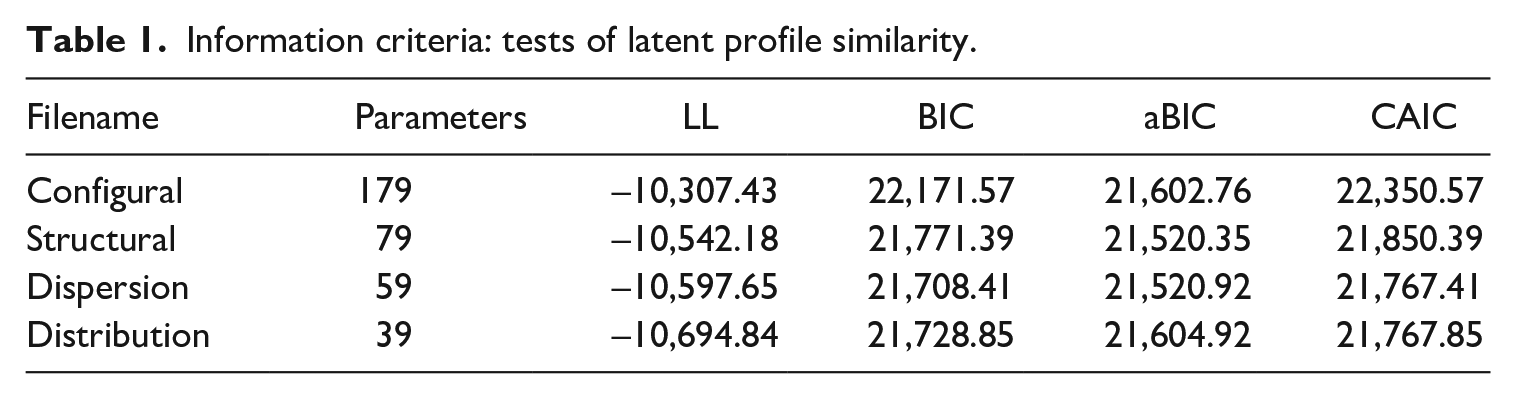
For the distribution model both BIC and aBIC increased substantially, indicating that the distribution of participants across the five profiles differed between countries. The five profiles are illustrated in Figure 1 showing the percentage of skills at a high level centred for the average skill level for each dimension. The profiles were labelled based on the shape of the yDSI dimensions most distinguished in each profile as (1) All-rounders, (2) Informationists, (3) Content Creators, (4) Communicators and (5) No high skills.
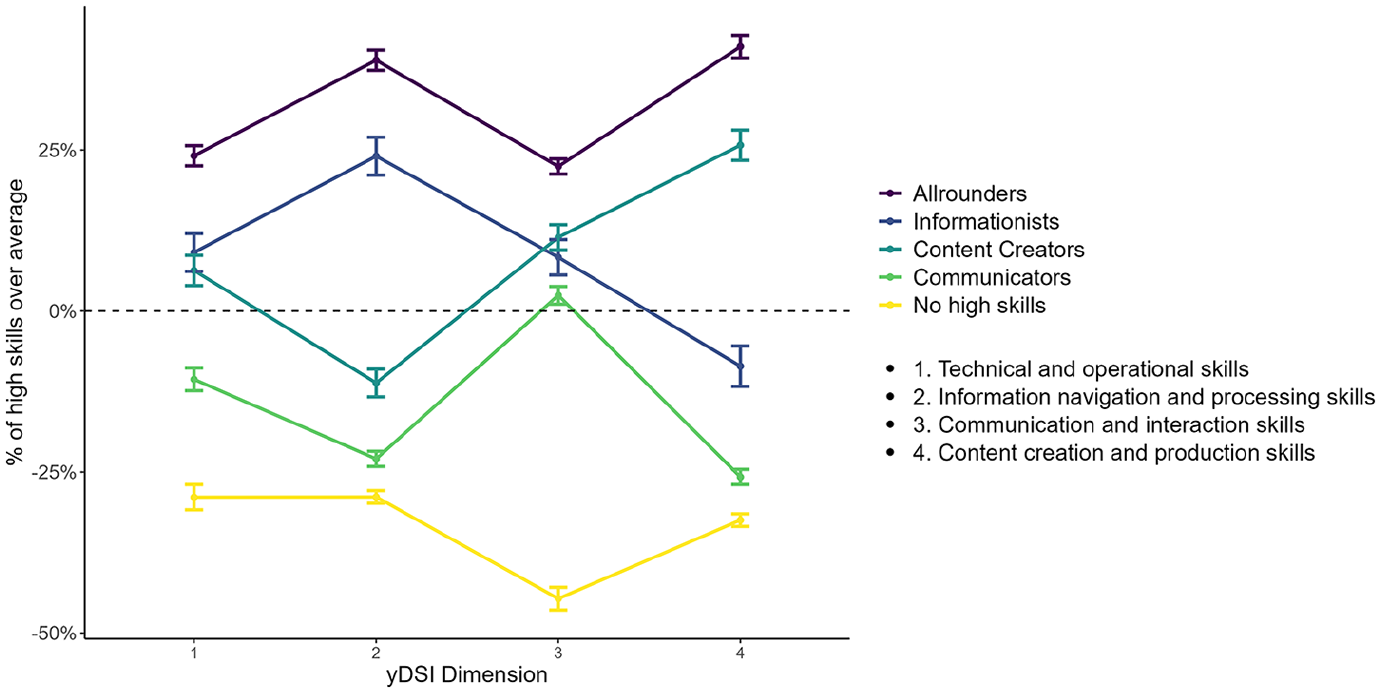
Profiles of digital skills.
The ‘All-rounders’ profile, as the name suggests, can be distinguished in terms of reporting the largest proportions (77%–87%) of high skills across all digital skill dimensions. The ‘Informationists’, in turn, reported higher than average proportions of high skills overall, except for content-creation and production digital skills in which they reported only 32% of skills at high level. What distinguished them, however, was their relatively larger proportion of high skills in information-navigation and information-processing digital skills (73%). The ‘Content Creators’ reported equally high technical and operational skills as well as communication and interaction digital skills as their peers belonging to the ‘Informationists’ profile (66% and 63 %; 73% and 76%, respectively), lower than average information-navigation and information-processing digital skills (27%), and were especially distinctive for their relatively larger proportion of high skills regarding content-creation and production (66%). The ‘Communicators’ reported lower than average proportions of skills at a high level regarding all dimensions except for communication and interaction digital skills (67%), which was close to the sample average. Finally, the adolescents reflecting a ‘No high skills’ profile reported well below average proportions of high skills across all dimensions (8%–28%).
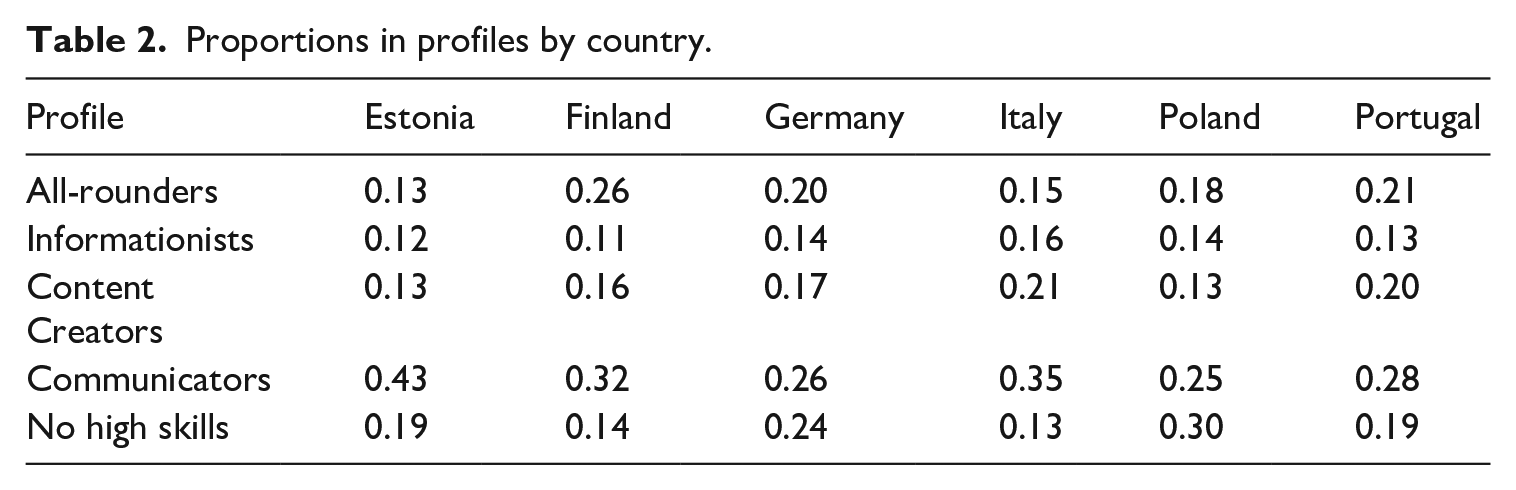
–In terms of differing distributions of participants across countries (see Table 2), it seems that there were more Communicators in Estonia (43%), more All-rounders in Finland (26%), more Content Creators in Italy (21%), and more students reporting no high skills in Poland (30%) compared to the other countries. These findings suggest that Finnish students are the most digitally skilled, closely followed by Portuguese students, whereas we can observe either few students generally skilled in Estonia, or many students generally not skilled in Poland and Germany. Italy has a large percentage of students who are mainly skilled in communication and interaction and content-creation and production skills (56%). In all countries, the communication-oriented profile is the most prevailing.
Proportions in profiles by country.
Differences across profiles in digital knowledge
After settling on the final profile solution and to aim to validate the self-reported profiles across digital knowledge, we examined outcome similarity. In other words, we tested whether the groups would show similar differences in probability to answer correctly to the specific digital knowledge items and whether these differences would reflect the profiles accordingly. Similarity was supported (see Supplemental File 4 for details), indicating that the profile differences in probability for correct answers were similar between countries. The results validated the profiles to some extent.
The biggest differences in knowledge items were estimated for items A (‘The first result is always the best information source’) and E (‘Using hashtags [#] increases the visibility of the post’), and while All-rounders were generally the highest scoring profile regarding items A and E with 61% and 76% probability of a correct answer, respectively, they were expectedly matched with the Informationists (57%) and regarding item E with the Content Creators (72%).
Specifically, regarding knowledge item A, the results showed (see Figure 2) that the groups differed significantly, χ2(4) = 101.55, p < .001, and specifically, the All-rounders were more likely to respond correctly compared to all other profiles except the Informationists, whereas students reporting No high skills were also least likely to provide a correct answer with a probability of 38%. For knowledge item B, ‘Everyone gets the same information when they search for things online’; χ2(4) = 56.65, p < .001, the All-rounders were more likely (57%) to provide a correct answer than Communicators (46%), or No high skills (42%). The Informationists (52%) were also more likely to be correct than No high skills whereas the Communicators and No high skills did not differ. For knowledge item C, ‘The first thing I see on social media was the last thing that was posted by one of my contacts’; χ2(4) = 29.45, p < .001, the All-rounders (33%) were again more likely to respond correctly compared to Communicators (24%) or No high skills (22%). Regarding knowledge item D, ‘Whether I like or share a post, can have a negative impact on others’; χ2(4) = 25.53, p < .001, the differences were in similar to item C with the exception that also Content Creators (37%) were more likely to correct than No high skills who were able to provide a correct answer with a probability of 32%. Regarding knowledge item E, χ2(4) = 134.24, p < .001, both All-rounders (76%) and Content Creators (72%) showed higher correct answer probability than all other groups (50%–62%). And, finally, for Knowledge item F, ‘Companies pay ordinary people to use their products in videos and content they create’; χ2(4) = 67.64, p < .001, All-rounders (75%) had a significantly higher probability for correct answer compared to all other profiles except the Informationists (67%), and the No high skills were the least likely to answer correctly with a probability of 55%.
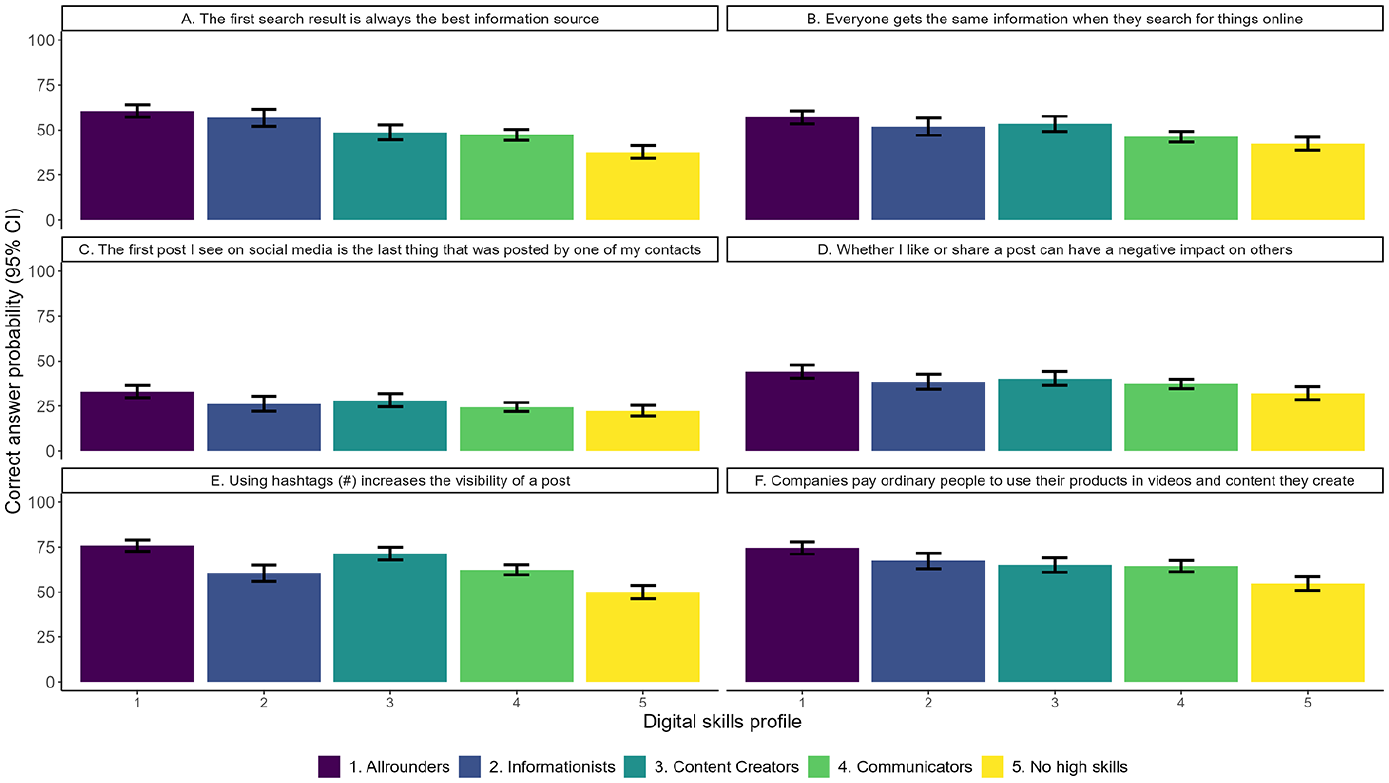
Differences between profiles in digital knowledge items.
To further analyse the shape vs level effects, the profiles were plotted to a two-dimensional space across the overall digital skills score and overall digital knowledge score (see Figure 3), which corroborated the interpretation of mixed level and shape effects regarding the yDSI with the profile All-rounders being on top and No high skills at the bottom, and Informationists and Content Creators within similar overall skill levels.
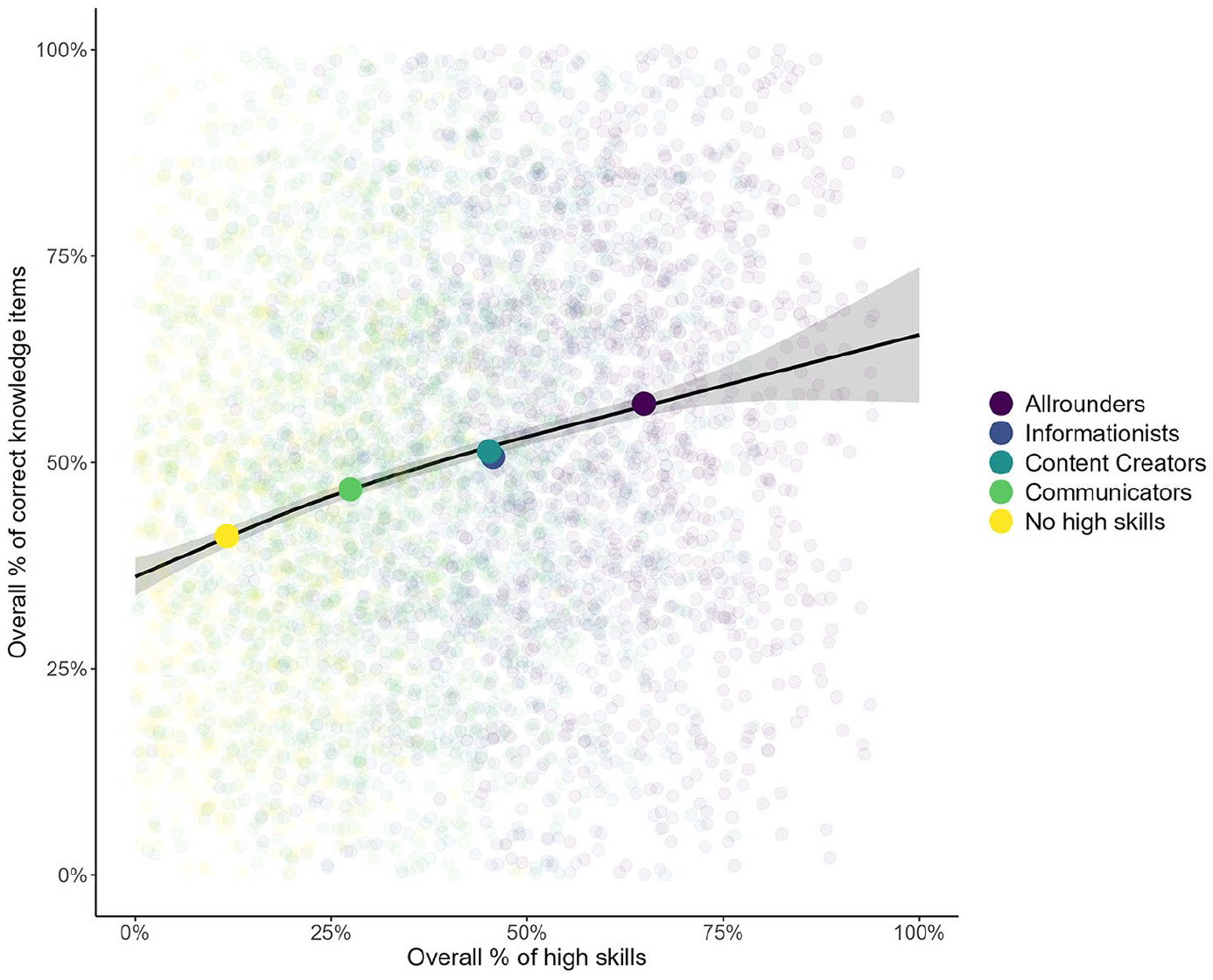
Profiles as a function of overall digital knowledge and high skills.
Predictive similarity
We then turned to examine predictive similarity, that is, if the relations from covariates and socioemotional antecedents to the profiles would be similar across the countries (see Supplemental File 4 for details). Predictive similarity was supported across all blocks of predictor variables holding the Communicators as the reference group. The Communicators were selected as the reference groups as reflecting a Communicator – profile was the most normative, i.e. the most common across countries. The relations between covariates and the profiles are presented in Figure 4 (all model coefficients in Supplementary Material).
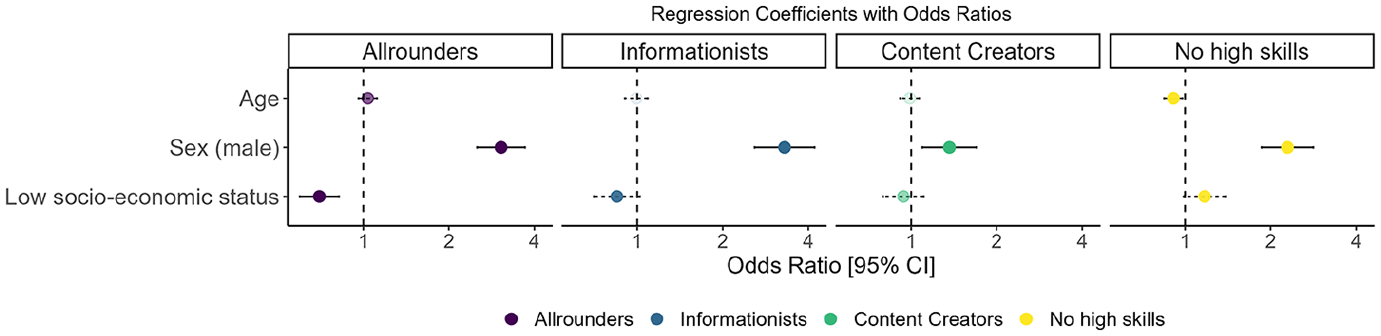
Age, sex and socioeconomic status in relation to the profiles.
The profiles were not clearly determined by sociodemographic background (see Figure 4), however, gender had the biggest impact male adolescents were over three times more likely than females to reflect any other profile than Communicators, especially Information-oriented (OR = 3.30, [2.59–4.21]) or All-rounders (OR = 3.06, [2.52–3.71]). Compared to the Communicators profile, older adolescents were slightly less likely reflect the No high skills –profile (OR = 0.91, [0.84–0.98]). Adolescents with a lower socioeconomic status were, in turn, less likely to reflect an All-rounders (OR = 0.70, [0.60–0.82]) than Communicator profile. In further predictive models the covariates were included for their possibility of confounding the relations observed between the other antecedents and the digital skill profiles, such as e.g. gender being able to cause variation in both digital activities and related skills. These relations were held similar in further models.
The use of different digital devices predicted the profiles (see Figure 5) so that using smartphone to go online predicted a lower likelihood to reflect Informationist (OR = 0.82, [0.74–0.91]) or No high skills –profiles (OR = 0.81, [0.74–0.89]) than Communicators. The biggest benefit seemed to come from using computers to go online, which was related to higher odds of showing an All-rounder (OR = 1.25, [1.18–1.33]), Informationist (OR = 1.15, [1.06–1.24]) or Content Creators –profiles (OR = 1.15, [1.08–1.23]). Using a tablet which was rather rare was not related to differences in profile membership probabilities.
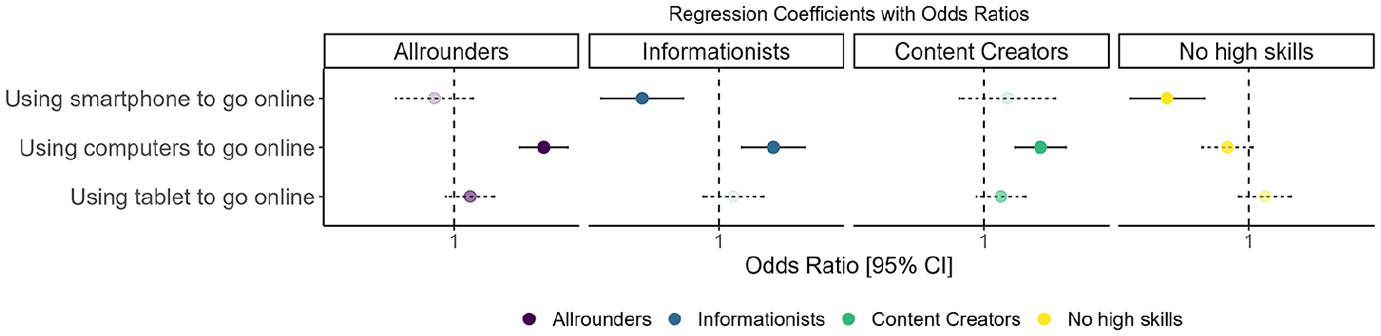
Self-reported frequency of digital device use in relation to the profiles.
Regarding online activities as predicting profile membership (Figure 6), again compared to the Communicators profile, adolescents reporting a higher frequency of following news online were less likely to show a Content Creator profile (OR = 0.87, [0.77–0.98]). Using digital media to purposefully learn things was, instead, associated with slightly higher odds of reflecting an All-rounder (OR = 1.19, [1.06–1.33]) or Informationist profile (OR = 1.23, [1.08–1.40]). Adolescents who were more frequently communicating with friends were less likely to reflect Informationist (OR = 0.85, [0.75–0.96]) or No high skills – profiles (OR = 0.73, [0.66–0.81]) – as compared to Communicators. Being active in content-creation was the most important activity. It was associated with higher odds of reflecting any other profile than Communicators, especially young people one step higher in content-creation were almost twice as likely to be Allounders (OR = 1.83, [1.67–2.00]) or Content Creators (OR = 1.72, [1.55–1.90]).
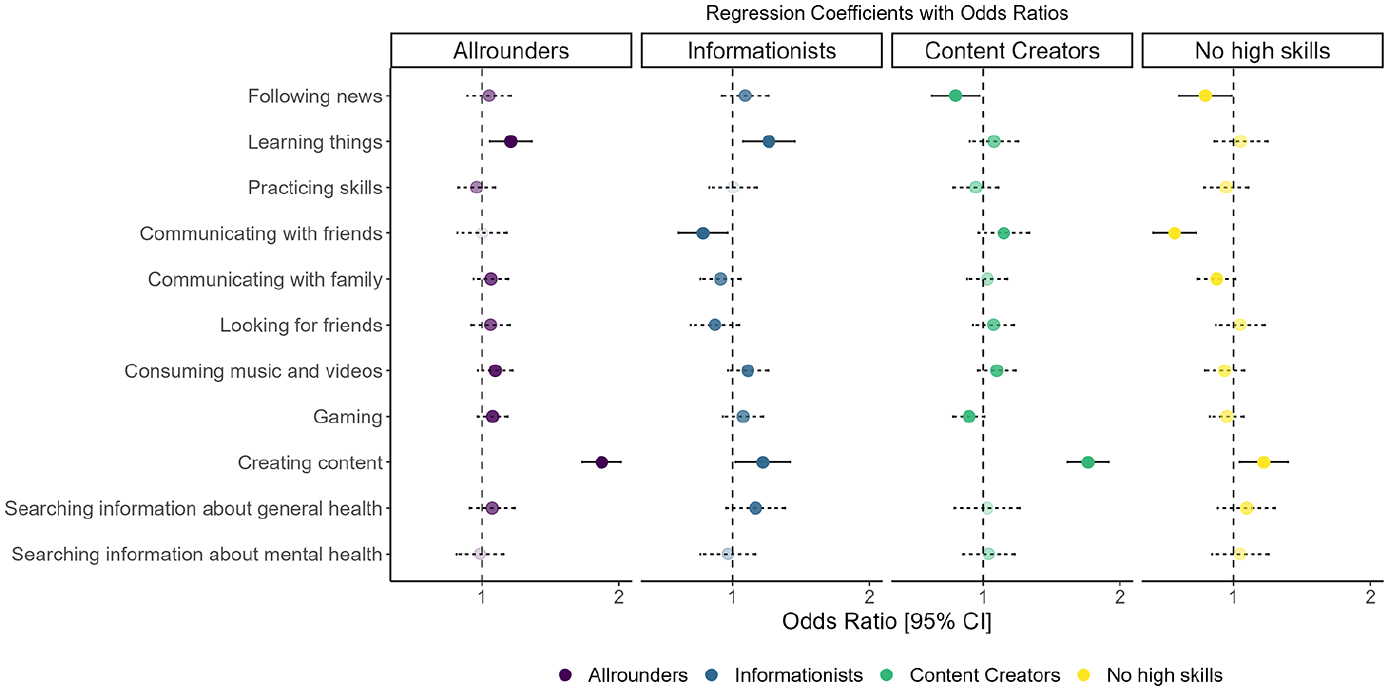
Self-reported frequency of online activities in relation to the profiles.
Regarding socioemotional resources (see Figure 7), self-efficacy seemed to be the most influential resource. Adolescents reporting higher digital self-efficacy were less likely to reflect No high skills – profile (OR = 0.71, [0.64 – 0.92]) and had higher odds of reflecting any other profile, especially All-rounders, with adolescents scoring one step higher in self-efficacy being over three times more likely to be in the All-rounder group (OR = 3.35, [2.72 – 4.13]) over Communicators. Restrictive parenting was associated with slightly lower odds of reflecting All-rounder (OR = 0.88, [0.80 – 0.98]) over Communicator profile. Family support was associated with lower odds of reflecting All-rounder (OR = 0.59, [0.48 – 0.74]), Content Creator (OR = 0.59, [0.48 – 0.73]) or No high skills (OR = 0.66, [0.54 – 0.81]) profile over Communicator profile, whereas friend support was associated with lower odds of reflecting No high skills –profile (OR = 0.75, [0.64 – 0.88]).
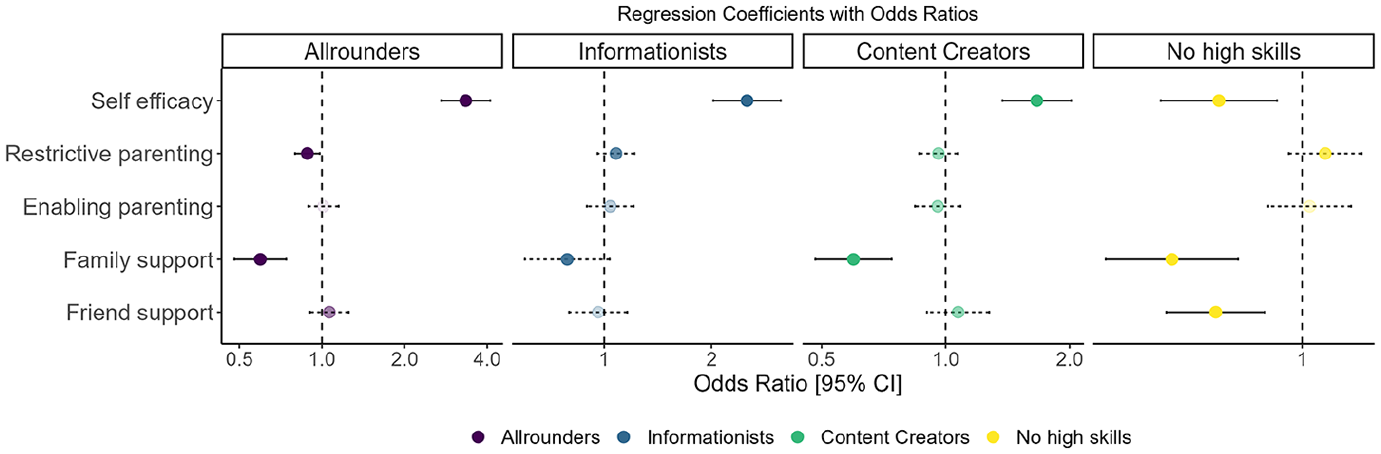
Socioemotional resources in relation to the profiles.
Discussion
Previous research on digital skills has examined different aspects of skills in isolation, adopting a variable-oriented approach, although there is reason to believe that they are dynamically interlinked. That is, although within similar overall digital skill levels, young people may show different types of skills as more pronounced than others – reflecting differential preferences of sociodigital activity and behaviour within the digital world (Hietajärvi, 2019). Therefore, the purpose of this study was to examine how various dimensions of self-reported high digital skills co-occur within individuals, that is, what latent profiles can be found, and how the likelihood of reflecting these profiles are associated with several antecedents across six European countries.
Our analysis landed on five profiles which we called All-rounders, Informationists, Content Creators, Communicators and No high skills. They are based on self-reported digital skills as measured by the yDSI instrument and spans over four dimensions (operational, information navigation, communication, content-creation). The profiles represent both a hierarchical ordering (level differences) as well as qualitative differences (shape differences), indicating that while the overall skill level was a powerful determinant of the profiles, some qualitative differences between the profiles were also interpreted. Thus, the profiles represent five types of students: (1) those (more or less) reporting high skill levels in all categories; (2) those who have mainly higher information-navigation but low content-creation skills; (3) those who score very low on information-navigation skills but high on content-creation skills; (4) those above all skilled in communication/interaction and (5) those not skilled in any category. It may be assumed that the profiles representing pronounced self-reported skills overall, or related to information and content-creating reflect students cultivating interest-driven practices with digital tools (Ito et al., 2013). In relation to the digital knowledge parallel to the self-reported high skills, the All-rounders had higher probability to provide correct answers to all knowledge items, followed by the Informationists and the Content Creators – who tied with the All-rounders in knowledge pertaining to their signature digital skill dimension.
Although the focus was not in comparing countries, between-country differences were found regarding the distributions of profiles within countries. The first type of student, generally skilled across all dimensions (All-rounders and Informationists), is most often found in Finland (37% of all students), followed by Germany and Portugal (34%), Poland (33%), Italy (31%) and finally Estonia (25%). Most ‘No high skills’ students were found in Poland (30%), followed by Germany (24%), Estonia and Portugal (19%), Finland (14%) and Italy (13%). The findings point to a consistent lack of digital skills in all six participating countries, where at least half of the respondents have relevant deficits regarding information-navigation and information-processing digital skills as well as content-creation and production skills. Moreover, between 13% (Italy) and 30% (Poland) reported to lack relevant digital skills in all dimensions. The country-level differences reflect SES to some extent (see Supplemental Appendix B), as for instance, Germany and Finland have the highest GDP/capita, and the students in the Polish sample seem to represent higher relative SES. However, the data cannot allow us to draw conclusions to ensure whether these country-level differences reflect genuine country differences or simply differences in the obtained samples. Nevertheless, these findings call for digital skills initiatives addressed at vulnerable adolescents in each country, as well as digital skills programmes specifically focused on information-navigation and information-processing skills.
In order to gain information on which groups of adolescents might need more support in developing digital skills, we looked into the influence of social characteristics such as age, gender, and relative SES (antecedent factors). Consistent with prior research (see Haddon et al., 2020), our results suggest that the odds of scoring high on at least some types of digital skills increase with age, although age in this sample was not a strong predictor of more versatile skill profiles. Moreover, we found significant results for gender and SES. Consistent with other studies using self-reported measures of digital skills (Haddon et al., 2020), in fact, we found that boys were more likely than girls to belong to those highly skilled in all categories, including information navigation and processing. However, our findings contradict previous studies that found that girls have more information-navigation skills than boys (Aesaert et al., 2014; Hohlfeld et al., 2013). Students with lower SES background were more likely than students with higher SES background to have a ‘No high skills’ profile. This finding is in line with prior research, where, however, the influence of socioeconomic background on digital skills acquisition depended on how SES was measured (parents’ education was a better predictor than income). On the other side, our findings are consistent with studies using indirect measures of SES such as ‘autonomy of use’ (Hargittai and Hinnant, 2008; Helsper, 2021). In fact, being able to go online from multiple devices (namely, using computers instead of only smartphones) is associated with a higher likelihood of belonging to the all-rounders profile. Overall, our findings show that adolescents from lower SES families have developed digital skills to a lesser degree and would benefit more from digital skills initiatives. We may conclude that already privileged adolescents (namely, boys and those from higher SES) are also advantaged in terms of the digital skills they possess.
We also investigated participation in various online activities as an antecedent. While online activities were not strong predictors of profile differences, some activities were clearly predictive of likelihood to represent the more skilled profiles (All-rounders, Informationists and Content Creators) over the Communicators. These were using digital media to purposefully learn something new and creating digital content in line with what would be expected in the connected learning perspective – following self-regulated and interest-driven practices with digital tools is beneficial (Ito et al., 2013). Accordingly, self-efficacy was a clear predictor, showing that higher self-efficacy was related to a higher likelihood to represent any other profile than the No high skills. From the learning ecologies perspective (Barron, 2006), the role of family seems rather small. Communicating with parents online does not show a clear effect on adolescents’ digital skills. Similarly to some previous studies (e.g. Haddon et al., 2020; Mascheroni et al., 2020), parental mediation was not strongly influential with respect to positive digital skills acquisition, and, interestingly, higher emotional family support was related to a lower likelihood to represent All-rounder or Content Creator profiles. The somewhat controversial result regarding family (emotional) support and digital skills may reflect a situation in which students receiving more emotional support at home are less likely to evade parental supervision to access and use digital media to engage with digital media to such an extent that they would create digital expertise, whereas, at the same time, they were also less likely to show very low digital skills. Thus, in a way, receiving higher emotional support from one's family seems to provide a platform for goldilocks type of development for digital skills. Conversely, adolescents who reported higher friend support were more likely to be in any other group than ‘No high skills’, indicating that adolescents with poor peer relations are also left out of crucial digital skill development. However, the causality of this cannot be concluded. Considering the role of digital media in today's peer communication it might also indicate that young people without adept digital skills can be lacking in finding and keeping up solid relationships with their peers. Nevertheless, peer support seems conducive to bridging gaps in digital skills.
Limitations
There are important limitations to the study that should be considered when interpreting the results. First, the sample was not a national representative sample: in each country, schools were recruited in specific regions, usually where the partner university in the project was located. Although each partner employed a combination of purposive sampling techniques to ensure diversity in terms of socioeconomic background, the sample was self-selected and therefore non-randomised. Moreover, the representativeness of the obtained sample in relation to the overall socioeconomic background of the participating schools or the countries in general is not known. Further, there was a high rate of parents who did not give their active consent to their children’s participation in the study (ranging from 20% in Germany to 62% in Finland), which may reflect differences in SES biasing our sample (Hussemann et al., 2016). Together with social desirability, the selection issue may also explain why the average SES of the sample (measured by the students’ self-assessment of their family’s financial situation) was high. Another possible limitation of the sample had appeared because data collection took place in 2021 during the COVID pandemic when many schools in Europe changed to distance education, and therefore, in three countries, data were also collected in a distance education setting.
Further, a systematic evidence review (Haddon et al., 2020) showed inconsistent findings among studies using self-report measures of digital skills and studies based on performance tests. In fact, children’s self-assessment of their own skills is biased by social desirability. For this reason, the second wave of our survey included a performance test for a sub-sample of students, which measured information-navigation and information-processing, communication and interaction, and content-creation and production digital skills. Third, this study used a cross-sectional sample which only gives a snapshot of associations between variables. Future studies with the ySKILLS data will use a longitudinal perspective to capture change and development.
Conclusion
To conclude, the results of this study point that while adolescents across different countries in Europe reflect similar profiles of digital skills as measured by the yDSI instrument, the distribution of young people differ across countries. Moreover, the profiles seem to indicate that overall digital skills explain much of the variation across different dimensions, but nevertheless, for some groups of slightly less overall skilled students certain dimensions are more pronounced. Regarding the antecedents affecting the formation of various skill profiles, we can conclude that different levels of vulnerability (age, gender, socioeconomic status, quality of Internet access, [lack of] peer support) interact and intersect in shaping the odds of belonging to distinct profiles. However, the most important antecedents for higher digital skills seemed to be being male, using computers and engaging in content-creation activities as well as having a strong self-efficacy, a combination possibly reflecting interest-driven sociodigital participation. This should be noted across efforts to bridge digital divides in current society in a situation where being able to harvest the benefits of digital technologies to one's benefit seems to gain more and more emphasis.
Supplemental Material
sj-docx-1-nms-10.1177_14614448241258704 – Supplemental material for Latent profiles of adolescents’ digital skills across six European countries
Supplemental material, sj-docx-1-nms-10.1177_14614448241258704 for Latent profiles of adolescents’ digital skills across six European countries by Lauri Hietajärvi, Giovanna Mascheroni, Natalia Waechter, Jussi Järvinen and Katariina Salmela-Aro in New Media & Society
Supplemental Material
sj-docx-2-nms-10.1177_14614448241258704 – Supplemental material for Latent profiles of adolescents’ digital skills across six European countries
Supplemental material, sj-docx-2-nms-10.1177_14614448241258704 for Latent profiles of adolescents’ digital skills across six European countries by Lauri Hietajärvi, Giovanna Mascheroni, Natalia Waechter, Jussi Järvinen and Katariina Salmela-Aro in New Media & Society
Footnotes
Funding
The author(s) disclosed receipt of the following financial support for the research, authorship, and/or publication of this article: Funding for ySKILLS is from the European Union’s Horizon 2020 Research & Innovation Programme under Grant Agreement no. 870612.

Author biographies
References
Supplementary Material
Please find the following supplemental material available below.
For Open Access articles published under a Creative Commons License, all supplemental material carries the same license as the article it is associated with.
For non-Open Access articles published, all supplemental material carries a non-exclusive license, and permission requests for re-use of supplemental material or any part of supplemental material shall be sent directly to the copyright owner as specified in the copyright notice associated with the article.
