



Abstract
Research typically considers corporate actors such as large tech companies or government agencies as drivers of deep mediatization, the increasing saturation of society by digital media and their infrastructures. This article aims to focus on another group of collective actors: pioneer communities, exemplified by the Maker, Hacks/Hackers, and Quantified Self movements. They are characterized by their experimental practices and their visions of media-related, digital futures. On the basis of published research, the article discusses their life cycle, starting with their formation, when they emerged from the context of social movements and technology-related communities, through their peak phase, during which they receive media attention, to their dispersion phase, a stage in their development characterized by their “becoming everyday” as their experimentation is absorbed into everyday practices. It is argued that the role pioneer communities play in processes of deep mediatization rests in their ability to curate experimentation and visions of digital futures.
Keywords
Introduction
When examining media- and technology-related transformations from an actors’ point of view, tech companies and state agencies are frequently given precedence. However, focusing solely on corporate actors provides a one-dimensional perspective. Over 30 years ago, Rob Kling and Suzanna Iacono (1988) pointed out that what they called “computerization movements” played a significant role in the emergence of digital technologies in the United States and beyond. Focusing on speculative ideas such as space colonies and nanotechnologies, Patrick McCray (2013) examined so-called “visioneers”: scientists and engineers who developed “broad and expansive visions of how the future could be made radically different through as-yet-undeveloped technologies” (p. 6). Using the example of synthetic biology, Stephen Hilgartner (2015) explored “sociotechnical vanguards,” that is, relatively small collectives of scientists “that formulate and act intentionally to realize particular sociotechnical visions of the future that have yet to be accepted by wider collectives, such as the nation” (p. 34).
With this article, I aim to highlight the presence of another critical group, distinct from collectives of scientists and social movements, that significantly shapes our perceptions of digital futures—I call this group of people pioneer communities. Pioneer communities can be described as figurations of people playing a forerunner role within a specific thematic area. However, these are not just groups of scientists, but “intermediaries” (Bourdieu, 2010: 151) who operate between different social domains (science, technology development, everyday use, technology journalism, politics, etc.). Despite an inclination to label themselves as such, they also do not fit the sociological definition of social movements due to their low level of politicization and close ties to business. What pioneer communities share with the aforementioned scientists and social movements, though, is that they engage in experimental practices while crafting visions for potential digital futures. One historical, first-generation example is the Whole Earth Network, which not only gave rise to Whole Earth ‘Lectronic Link (WELL), one of the first online platforms, but was also crucial for the emergence of Wired magazine, which shaped opinion in the technology sector over many years. Since then, a second generation of pioneer communities emerged, from which this article addresses three examples: the Hacks/Hackers movement, the Maker movement, and the Quantified Self movement. With Reboot and Zebras Unite, a third generation of pioneer communities is currently on the rise.
Pioneer communities play a crucial role in comprehending the genesis and persistence of “sociotechnical imaginaries” (Jasanoff, 2015: 24) of digital futures across societies. Hilgartner (2015) has rightly pointed out that the visions of “sociotechnical vanguards” (p. 34f.) do not perfectly align with overarching sociotechnical imaginaries within society, as the latter have a longer history and greater stability. As I would like to show, pioneer communities are the social figurations that mediate between the visions of vanguards and the imaginaries of societies in a curatorial way; 1 in short, they support particular visions of digital futures. The concept of digital futures is intended to encompass all those visions of the future that center on the idea of a society in which, first, digital media and their infrastructures are not only accorded a prominent role, but in which, second, they are also seen as a central instrument for the transformation of society. Such digital futures unfold a performative power by providing orientation for social practice through “techniques of futuring” and “dramaturgical regimes” (Oomen et al., 2022: 253, 261).
With this definition of digital futures, I position my argument in the tradition of critical social science research on constructions of the future. Arjun Appadurai (2013) has called for cultural anthropology to analyze the “future as a cultural fact.” He is concerned with making a systematic analysis of future-making the subject of research, analyzing the future as “imagination, anticipation, and aspiration” (Appadurai, 2013: 285). Jens Beckert (2016) has argued that decisions in the economy are determined by “fictional expectations” (p. 61). In other words, “[p]ower in the economy is exercised to the extent an actor can make his own imaginary of the future become influential and mobilize others to turn it into the future present” (Beckert, 2016: 85). John Urry (2016: 189) has emphasized that imaginations of the future are “performative,” that is, actors who can establish their “powerful” ideas of the future are also in a position to assert their interests—and thus help determine the future to come. He sees it as problematic that contemporary societies are dominated by “technological futures” that focus on the autonomous market and the endogenous development of technology, rather than “social futures” that emphasize human needs (Urry, 2016: 191). Against such a background, I am therefore interested in questioning the role of pioneer communities in the constructions of “technological futures” that are spreading in Western societies.
As I want to show, curation by pioneer communities is carried out over a particular life cycle. To elaborate, I would like to begin by providing a precise definition of these communities. Based on this clarification, I will then describe the three phases of their life cycle in more detail: pioneer communities’ formation, their peak, and their dispersion. To conclude, I will address the impact of pioneer communities have on the ongoing process of deep mediatization. More specifically, I will explore their role as curators of possible digital futures through societies’ increasing immersion in digital media and their infrastructures, and the consequential shifts in the societal fabric.
My analysis is a generalizing reflection that is grounded in extensive media-ethnographic research carried out in collaboration with colleagues: The life cycle argument has emerged from comparative research across a vast corpus of data gathered in Germany, the United Kingdom, and the United States between 2015 and 2023. Directed by theoretical sampling as part of a Grounded Theory approach (Charmaz, 2014; Glaser and Strauss, 1999; Morse et al., 2009), we interviewed 254 members of the organizational elite of certain pioneer communities as well as regular participants. We observed 12 major events, visited 30 workspaces and meetups, and analyzed key texts, 2 Twitter networks and media coverage. Several case studies have been published based on these data, addressing the origins and specificities these communities (Hepp, 2016; Hepp, 2018; Hepp, 2020b), the different curatorial models they implement (Hepp, 2020a), the role of spaces and labs for building these communities (Hepp and Schmitz, 2022; Hepp, 2023), the online-networking of their organizational elites (Schmitz et al., 2022), their relationships to innovation processes (Hepp and Loosen, 2022), and the media coverage they receive over time (Hepp et al. 2021a; Hepp et al., 2021b). In the broader theorizing of this article (Kelle, 2019; Hepp 2017), I will now argue that these different case studies come together to describe the life cycle of pioneer communities. To ground my theoretical assertions, I will repeatedly incorporate individual data from our previous studies. In the framework of this theoretical article, however, I am unable to present the entire corpus of detailed results from this research.
From pioneers to pioneer communities
The term “pioneer” is not unknown in the social sciences. If one excludes the founders of social sciences as its own pioneers (Boudon, 2011) or sociological descriptions of the pioneers of westward migration in the United States (Bogue, 1960), the “pioneer” is generally associated with being a forerunner in a certain area. It is remarkable that the term is generally used en passant and rarely theorized in any detail. Exceptions include those of the “time pioneers” (Hörning et al., 1995), referring to people who try to realize self-determined concepts of time in their work and everyday life. “Mobility pioneers” (Kesselring and Vogl, 2004) have been described as people who maintain a cosmopolitan, mobile lifestyle and are considered forerunners in the sense that they use the range of available (communication) technologies to maintain their itinerant social relations. The term “digital pioneers” (Kangas, 2011) has been used to describe those who approach the most contemporary media technologies experimentally. Although these studies may not constitute a unified theory, they converge on one fundamental argument: these pioneers possess a vision of possible futures that guides their current practices. We are therefore not simply dealing with “early adopters” as discussed in diffusion research (Rogers, 2003); the term pioneer emphasizes the ways in which these subjects contribute to the conditions required for technological developments and make use of media technologies in their attempts to create a particular future.
Historical studies demonstrate the extent to which pioneers play a special role in media-related transformations. However, this is not about the pioneer as an individual inventor—like Silicon Valley’s “genius aesthetic” (Daub, 2020: 70) suggests—but about certain groupings. As Fred Turner (2006) has shown, we cannot understand the development of the Internet without considering the Whole Earth Network, an “extraordinarily influential group of journalists and entrepreneurs from the San Francisco Bay Area” (p. 3). This network envisioned a world shaped by computers and digital technologies long before the latter became the norm. The name of this network refers to the Whole Earth Catalog, a publication edited by Stewart Brand and others between 1968 and 1972. The original aim of the catalog was to give the members of the US counterculture in the 1960s and 1970s the “tools” required for living in a rural community. It brought together scientific research, hippie products, military survival equipment, ecology, and mainstream consumer culture, creating something akin to a “network forum” (Turner, 2006: 5) of exchange and encounter. In the 1980s and 1990s, after the discontinuation of the Whole Earth Catalog, WELL was founded as an online network based in the San Francisco Bay Area, later reflected on by Howard Rheingold (1994)—one of its principal editors and moderators—in his book, the “Virtual Community.” It was joined by Wired magazine, launched in 1993, which was dominated by the idea of a deregulated, self-organizing Internet and which enthusiastically advanced visions of a new digital economy (Frau-Meigs, 2000).
We can understand the Whole Earth Network as a first-generation pioneer community. The influence this pioneer community is clear from the explicit references made by representatives of today’s leading technology companies to the Whole Earth Catalog or the Homebrew Computer Club meetings. Later, second-generation pioneer communities emerged. These include the Hacks/Hackers movement with its focus on experimental practices and visions of public discourse, the Maker movement with its orientation toward experimental practices and visions of manufacturing, and the Quantified Self movement with its emphasis on experimental practices and visions of self-development. A line of development can be discerned between both generations of pioneer communities. 3 As our own empirical research on Hacks/Hackers, Makers and Quantified Self shows, these groupings share six characteristics, which can be condensed into an “empirically grounded type” (Kluge, 2000: 3) of pioneer community as follows:
Pioneer communities construct their identity around a forerunner role. They see themselves as forerunners within a particular thematic area and are accepted as such by other members (but not necessarily all).
Pioneer communities are characterized by the experimental practices of their members, which play a special role in the (further) development of their thematic area, which is why they can be considered as specific types of “communities of practice” (Wenger, 1999).
Pioneer communities construct visions of possible digital futures, that is, ideas of how digital technologies could and should shape society. These visions relate to “sociotechnical imaginaries” (Jasanoff, 2015: 24) within societies and become partly incorporated into them.
With relation to their thematic core, pioneer communities act as “intermediaries” (Bourdieu, 2010: 151), bringing together actors from various social domains (science, technology development, everyday media use, politics, etc.)—often arguing for the need to operate beyond their original domain.
Members of pioneer communities share a sense of belonging, that is, “a subjective feeling [. . .] that they belong together” (Weber, 1978: 40). This extends beyond a situational gathering and is rooted in post-traditionality, that is, community structures that are not mediated by tradition but are created in a collaborative act (Giddens, 1991: 85; Knoblauch, 2008: 75–77).
Pioneer communities are led by an “organizational elite” (Hitzler and Niederbacher, 2010: 22) who maintain engagement with the wider membership, develop a detailed knowledge of the communities’ thematic core and are typically responsible for organizing community activities.
While their organizational elite likes to call them “movements”—the Hacks/Hackers movement, the Maker movement, the Quantified Self movement—in sociological terms, pioneer communities do not strictly embody the idea of a social movement. Social movements are “collective actors” (Dolata and Schrape, 2015: 3) with a shared agency that operate in conflictual relationships with clearly identified opponents (Porta and Diani, 2006; Rucht and Neidhart, 2002; Touraine, 2002). Media have long played an important part in the self-organization of social movements, and are also used to appeal to a wider public for their political aims (Cammaerts et al., 2013; Gamson and Wolfsfeld, 1993; Kavada, 2016). Like social movements, pioneer communities operate around informal networks, a collective identity, and common goals. They bounce up close to “technology and product-oriented movements” (Hess, 2005: 516), such as the open-source movement. However, the pioneer communities we investigated are not involved in conflictual political relationships with identifiable opponents, as is the case with social movements.
Furthermore, pioneer communities are much more open than social movements to new forms of entrepreneurship and policymaking, a point where certain parallels to think tanks can be identified. Pioneer communities share with think tanks the ability to produce ideas (Hart and Vromen, 2008: 136) and a drive to influence policy and the public (Pautz, 2010: 276). Moreover, another similarity between think tanks and pioneer communities is the way they digitally organize themselves (Hart and Vromen, 2008). The social change they try to promote is always more technically, and less politically, oriented. Pioneer communities thus form a very specific group of intermediaries. Previous scholarly discussion has pointed out that Bourdieu’s (2010) original understanding of cultural intermediaries as a certain “new petite bourgeoisie” (p. 360) working in so-called creative industries is too narrow and that a broader view of actors mediating between production and consumption is needed (Hutchinson, 2017: 1–17; Negus, 2002: 504f.). While recent work has focused in particular on the “framing,” “expertise,” and “impact” (Maguire and Matthews, 2012: 554) of cultural intermediaries in the domains of social marketing, audiovisual production, music, food and art, and more recent work has emphasized the role of digital platforms in processes of “digital intermediation” (Hutchinson, 2023), this article is more concerned with pioneer communities as intermediaries in relation to digital technologies and digital futures.
Against this background, pioneer communities such as Hacks/Hackers, Makers and Quantified Self can be characterized as a hybrid of social movement and think tank. They typically bring together scientists and developers with users, connecting research, politics, journalism, and industry. They represent a connective layer between different corporate actors such as established media and technology companies and government agencies. As intermediaries, pioneer communities are fundamental to the ongoing communicative construction of possible digital futures because they incorporate not only selected “vanguards” (Hilgartner, 2015) and “visioneers” (McCray, 2013) from the scientific community, but also people from various other social domains. It is in this way that Hacks/Hackers, Makers, and Quantified Self are able to establish connections to broader society.
Approaching the life cycle of pioneer communities
With the establishment of the Hacks/Hackers, the Maker, and the Quantified Self movements as second-generation pioneer communities, their operating patterns consolidate into a life cycle. Typically, three phases can be distinguished in the “life” of a pioneer community: the formative phase, the peak phase, and the dispersion phase. These three phases point to their existing dynamic and provisional nature: They are driven by visions of the future and experimental practices, which means that a notable number of their members lose interest in the community the moment they begin to find wider acceptance. This leads to a constant coming and going of pioneer communities. Accordingly, pioneer communities’ significance for processes of deep mediatization can only be adequately grasped by observing their overall dynamics.
This figure is to be read in such a way that the Y-axis represents the number of members of the respective community across its development, the X-axis the passage of time. The more detailed descriptions within the resulting quadrant serve to characterize the life cycle in terms of a social science typology: 4 All the pioneer communities investigated by us went through the phases of formation, peak, and dispersion in a time frame spanning about 15 years, although there are variations depending on the specifics of each. The pioneer communities also differ significantly in their absolute number of members, as the figures presented below show; what they do share, however, is the course of their membership numbers over time.
At this juncture, it is important to avoid conflating the life cycle of pioneer communities with the so-called “hype cycle,” as discussed in research on the dissemination of digital media technologies and which is increasingly criticized as “folk theory”: a “taken-for-grated-categorization and terminology” (Rip, 2006: 349). The “hype cycle,” originally attributed by the market research company Gartner Inc., assumes a wave-like progression where a new technology experiences a period of “hype,” reaching a peak of attention and visibility, followed by a valley of disillusionment. Subsequently, visibility stabilizes at a medium level where the technology is assessed more realistically. While this hypothesized pattern initially seems quite plausible, it cannot be systematically proven empirically; and different patterns of hype progression exist depending on the specifics of the technology (e.g. Bareis et al., 2023; Dedehayir and Steinert, 2016; van Lente et al., 2013).
While the assumption of one hype cycle is therefore problematic, the life cycle of pioneer communities is also aimed at something other than public visibility alone: it describes the typical patterns in the history of a pioneer community over time (X-axis) with reference to membership development (Y-axis). As part of this life cycle, media attention plays a role (Figure 1 with intensified media coverage at the peak phase). However, like the research quoted earlier, our own content analyses could not confirm the original pattern of the hype cycle within media coverage (Hepp et al., 2021a; Hepp et al. 2021b). Rather, our studies show similar patterns as other studies on the current “AI hype” (e.g. Züger et al., 2023): Media attention experiences fluctuations in highs and lows, with peaks often tied to extraordinary events (e.g. a large Quantified Self conference or Maker Faire) and technological novelties (e.g. 3D-printing, product presentation of new smart watches). During the pioneer community’s peak phase, these coverage highs tend to intensify and become more frequent.
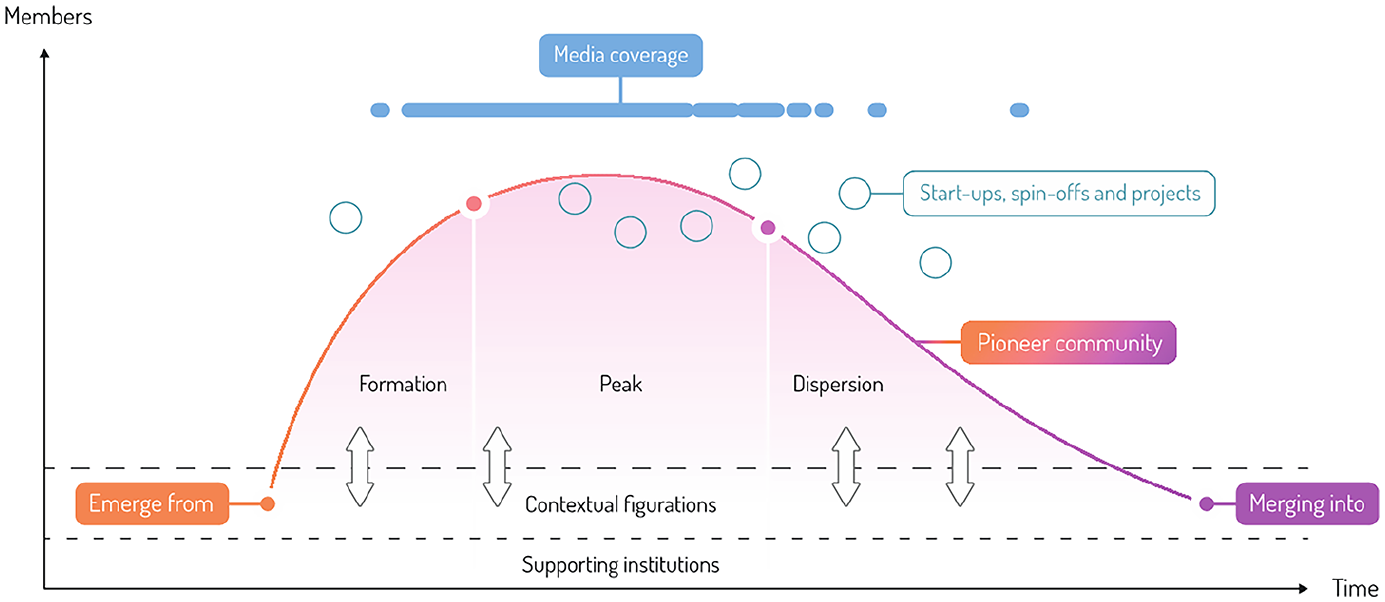
The typical life cycle of pioneer communities.
The formative phase
Pioneer communities emerge as a specific social figuration in relation to diverse contextual figurations. These can be existing pioneer communities, as already noted with regard to the Whole Earth Network (Turner, 2006). Other technology-related groups and movements can also be relevant, such as cyberpunks (Featherstone and Burrows, 1995; Hafner and Markoff, 1995), the open-source movement (Lewis and Usher, 2013; Schrape, 2019), or the open data movement (Baack, 2015; Milan, 2017), which, in many ways, relate to hacking (Coleman, 2013; Hunsinger and Schrock, 2016). The resulting proximity to technology-related social movements as contextual figurations is emphasized strategically by the pioneer communities’ organizational elites, as it gives these communities the special appeal of a grassroots movement. The concept of “hacking,” for instance, holds significance in the discourse surrounding Hacks/Hackers, Makers, and Quantified Self. 5 However, as previously discussed, it is a strategically presented proximity rather than a direct affiliation.
The formation of the pioneer communities investigated by us as well as further phases of their life cycle must be seen in relation to various supporting institutions. These can be, for example, publishers and magazines (e.g. O’Reilly and Wired), or universities and research departments (that provide support and venues for meetings). Especially important, however, are those institutions that deal with questions of digital futures. One can identify a certain proximity between futurology and the ideas of pioneer communities, since both operate under the assumption that it is, to a considerable extent, a matter of planning the future on the basis of utopian designs. 6 Described by Alvin Toffler (1970) as the “prototype of the futurist think tank” (p. 462), the Palo Alto-based Institute for the Future (IFTF) can be considered a prominent supporting institution that, since 1968, held workshops and meetings on topics similar to the ideas of pioneer communities. Meetings of both the Hacks/Hackers and the Quantified Self movements took place and reports on the societal role of, for example, the Maker movement were written and published by the institute. 7 Supporting institutions are also important in that they can secure the financial basis of these movements. The Knight Foundation was instrumental in the creation of Hacks/Hackers by funding a conference that brought together various stakeholders in the nascent pioneer community (and in doing so held an important meeting, again together, with the Institute for the Future) and a significant part of the Hacks/Hackers’ engagement was funded by a project related to the Google News Initiative. Both the Quantified Self and Maker movements gained support from tech publishers and when they were suffering financial difficulty, they participated in the “Building Bridges Salon” (organized by Lucy Caldwell in spring 2020), where technology-related communities and capital providers are offered a networking space. Supporting institutions have a dual function in the formative, as well as the subsequent, phases of pioneer communities: on one hand, they open up a broader intellectual horizon in which the engagement of pioneer communities is positioned; on the other hand, they help to secure some of the necessary resources.
In their formative phase, pioneer communities become distinguishable as an independent figuration, communal forms that are different to the totality of their contextual figurations. The emergence of pioneer communities is not a random occurrence, but the consequence of steps taken by their eventual organizational elite. The Quantified Self movement, for example, can be traced back to a meeting at Kevin Kelly’s house in 2007, which he set up together with another former Wired journalist, Gary Wolf, to bring together people in the Bay Area interested in the topic of self-measurement. 8 The naming of the Maker movement dates back to the founding of Make: magazine in 2005 by Dale Dougherty (formerly of O’Reilly Media), who claims to have coined the term Maker, bringing together loosely scattered groups of people with related interests. 9 The Hacks/Hackers were officially founded by Burt Herman, Rich Gordon, Aron Pilhofer and Chrys Wu in San Francisco in 2009, while Burt Herman wanted to build a startup after a fellowship at Stanford University. 10
From a social science perspective, one should always be cautious with the founding narratives of an organizational elite and the associated attribution of ideas to a few individuals. As the existence of further contextual figurations shows, pioneer communities are constituted in a set of wider relations to various social groupings. Their emergence is less an original invention, but, rather, a thematic centering that emerges from the general discourses of the contextual figurations around current, technology-related changes. In each case, a bundle of topics is singled out, becomes the shared point of reference for experimental practices and visions of the future, and subsequently the core concept of a pioneer community. It is through this thematic centering that Hacks/Hackers, Makers and Quantified Self obtain their identity and remain connected to other contextual figurations in many other ideas throughout their entire life cycle.
However, one should not confuse the formation of a pioneer community with the diagnosis of hyped media discourse. A pioneer community begins to emerge as soon as not only its name is proclaimed, but people also begin to meet locally in relation to it (for exchange, at conferences, fairs, etc.), and a discourse about the thematic core of the pioneer community develops through (online) media. Concrete networking then takes place through digital platforms such as Twitter, Meetup, or bespoke community platforms (Schmitz et al., 2022; Hepp 2023).
Pioneer communities typically integrate people from different social domains from the outset. Certain domains are conspicuous: (technology) journalism, (technology) development, science, politics, and business as well as everyday users who are enthusiastic about the subject in hand. Depending on the thematic orientation of the respective pioneer community—for example, self-measurement and self-development in the case of Quantified Self—other domains are added, in this case, that of health care. We are, therefore, not dealing with communities of experts from a single domain; pioneer communities develop their potential for growth from the fact that they bring together people from different backgrounds in a so-called “trading zone” (Galison, 1997: 781; Lewis and Usher, 2016: 543), developing a shared “we” through the common thematic orientation toward the core of the respective pioneer community—whether that be practices of public discourse (Hacks/Hackers), manufacturing (Makers) or self-development (Quantified Self).
Through this mingling of expertise, the emergence of a kind of proclaiming constitution is generated: The first texts of the Hacks/Hackers’, Makers’, and Quantified Self’s embryonic organizational elite serve less to report on its existence, rather, its creation. 11 During the initial stages of a pioneer community’s formation, in whatever way the public is made aware, people are typically invited to an event (meetup, conference, faire, etc.), brought together for the first time and then they will start to exchange online as well as offline, all supported by the organizational elite. When this happens, the formative phase moves on to a stage where a pioneer community is created. The proclaiming constitution—if it is successful—thus contains elements of a self-fulfilling prophecy.
We must be aware, however, that the majority of groups that are acclaimed as the next possible forerunners do not reach this point but stop at the level of founding calls and manifestos. Magazines like Wired or online platforms like Medium are full of such texts. Proclaiming a constitution means to create a dynamic of emergence that always refers to the zeitgeist. Groups who do not make it remain in the reservoir of contextual figurations—and possibly stimulate other ideas.
The peak phase
The peak phase signifies the stage in a community’s life cycle during which it receives attention far beyond the boundaries of its culturally specific milieu, becomes a topic of general media coverage, and recruits the largest number of members. At its peak, Hacks/Hackers had 123 local chapters and 75,000 registered meetup members (reference year 2016), Make Community had 1001 registered spaces and numerous fairs globally (reference year 2016), and Quantified Self had 101 local meetups and 4250 registered participants worldwide (reference year 2015). But even at their peak, pioneer communities do not lose touch with their contextual figurations. These remain a reservoir of new ideas and members. The flow from contextual figurations to the respective pioneer communities is justified by the appeal that the latter develop during their peak phase: They are seen as the hot new thing to participate in if one is to be ahead of the curve. 12
The peak phase initiates the moment in which the organizational elite positions the respective pioneer community as “grassroots,” making considerable use of social movement rhetoric that emphasizes inclusivity anchored in the local, opportunities for participation, and a shared commitment to societal transformation. 13 However, Hacks/Hackers, Makers, and Quantified Self all remained highly curated by their organizational elite. This curation is based on various instruments, with (online) publications and events being particularly important.
Based on Hacks/Hackers, Makers, and Quantified Self, three models of curation can be distinguished (Hepp, 2018; Hepp, 2020a). The Hacks/Hackers are based on a model of continuous connection, where a mailing list is established, events are organized, and the formation of local chapters is supported. The Maker movement uses a franchise model, to ensure brand consistency throughout the individual spaces, groups, and publishers that adopt the concept and name, all for a very small fee. Central to this was Make Media, now Make: Community, which produces and distributes the magazine and website, Make:, provides licenses for other countries, and provides guidance for the worldwide organization of Maker Faires. In the Quantified Self movement, curation is achieved by means of the “Quantified Self” branding, which is not legally enforced, but the use of which by others is taken as an occasion to enter into exchange with them. Whenever Quantified Self was referenced, at its peak, the Quantified Self Lab at Berkeley contacted appropriate groups to engage them in a collaborative exchange. 14 Each of these different models always point to the same basic principles of curation that have been sanctified since the Whole Earth Network: defining the community and its fundamental visions and practices; selecting people, topics, and practices that best represent the community and can speak for it accordingly; and arranging and presenting them to the audience and the community itself. So, on one hand, the curation aims to stimulate specific experimental practices. On the other hand, curation aims to support visions of possible digital futures in which media technologies play a prominent role. The technologies of data journalism and automated journalism in public discourse (Hacks/Hackers), the technologies of tinkering and sharing in manufacturing (Maker), and the technologies of digital data collection and analysis in self-development (Quantified Self).
Typically, the organizational elite is expanded beyond the circle of its original founders, while maintaining a close local connection to them. In all of our three cases, peak phases were characterized by the intensive networking of the organizational elites through online exchange (Schmitz et al., 2022). This is aided by the frequent events that take place during this phase which, on one hand, create opportunities to meet, but on the other hand, entail the need for intense exchange among participants in the run-up, completion, and aftermath. Individual networking opportunities are initiated directly by the organizational elite. Make: Media, for example, organized an annual meeting of the larger license holders and local organizers of the Maker Faires. 15 Similar moves were made by the Quantified Self movement, where unofficial meetings have taken place alongside the official program during the major European conferences in Amsterdam in 2013, 2015, and 2017. 16 In part, the networking of the organizational elite can be reconstructed on the basis of these events as well as their activities on Twitter (Hepp, 2020a; Schmitz et al., 2022). Different pioneer communities have different networking patterns as performed by their organizational elites, and these networks can be traced in their public, online communications. In the case of the Quantified Self movement, the Twitter network of its organizational elite is largely based on the personal accounts of the founders, the meetup organizers, and the conference speakers. In addition, references to the tech and startup scene become clear (Schmitz et al., 2022: 55–61). The Twitter network of the Maker organizational elite is characterized by the accounts of heterogeneous organizations such as technology companies, community platforms, journalistic outlets, larger Maker associations, and the country-specific or regional accounts of the Maker Faires (Schmitz et al., 2022: 61–66). In both cases, however, the networks share a clear orientation toward the organizational elite in the San Francisco Bay Area, wherein their transnational influence tends to be contained.
At their peak phase, pioneer communities are the subject of general media coverage that goes beyond the narrower confines of technology journalism. Peaks are events staged by pioneer communities, which attract the interest of reporters because of their progressive growth (Maker Faires, Quantified Self conferences). The way pioneer communities are classified in media coverage differs, sometimes considerably (Hepp et al., 2021a; Hepp et al., 2021b). While articles on the Maker movement in the United Kingdom and Germany, for example, emphasize its contribution to a utopian future full of possibilities for creative collaboration and new forms of economic activity, the Quantified Self movement tends to be dominated by a dystopian view of a negatively painted future, with surveillance and exploitation of individual data at the center of many stories. Beyond these differences in framing, however, two similarities can be discerned in the reporting on both communities: On one hand, the reporting “translates” their experimental practices and visions into a discourse that can be broadly and coherently connected to society, contributing to larger sociotechnical imaginaries. On the other hand, reporting reproduces the assumption of the society’s simple, technical designability. In this way, a horizon of imagination is constructed beyond the pioneers, in which audiences can then position their everyday with the appropriation of digital media and communication technologies.
It is in this media coverage that we begin to see the influence pioneer communities can wield over the processes of deep mediatization. While it often distorts and simplifies what the organizational elites communicate to the world, it is the avenue through which the communities’ visions of the future and their experimental practices can achieve broader visibility. For example, mainstream public discourse now asks, with a degree of familiarity, whether local Makerspaces can change the economy to a more decentralized or innovative one, whether new forms of education are possible, even if a next industrial revolution may be just over the horizon (Hepp and Schmitz, 2022). By publicly discussing whether or not self-tracking projects can address pandemics or stimulate the impending surveillance society, the societal possibilities of such technologies are negotiated. By publicly discussing new forms of journalism and the dangers of granular data collection, a society reflects on its own communicative forms. In all these cases, the visions of possible digital futures and the experimentation that takes place within pioneer communities are far more radical than the public discourse, which is why their members are repeatedly portrayed as extreme cases. But it is primarily through public discourse that their influence unfolds as possible digital futures and inspire others.
The peak phase of a pioneer community is the stage in their life cycle in which the most comprehensive emergence of startups, spin-offs, and projects achieves its greatest momentum, which is one more influence they have on deep mediatization. It is important here, though, to remain skeptical of the disruption narrative (Daub, 2020; Hogarth, 2017). Any linear perspective suggesting pioneer communities generate certain disruptive ideas that would then give rise to (economically successful) startups, is not sophisticated enough. It is, rather, worth revisiting the metaphor of the “trading zone” (Galison, 1997: 781): In pioneer communities, people from wide-ranging social domains come together around a specific, forward-looking topic and develop a common “we.” This opens up space for diverse phenomena: joint experimentation and testing through which new ideas emerge that, in individual cases, can also lead to a startup. Typically, however, individual and collective projects secure the costs of living for one or a few people dominate. Pioneer communities offer meeting places for these people or, in the case of Makerspaces, work opportunities for self-employed individuals (Hepp, 2023). The variety of dynamics that exist at this point barely differs from other co-working spaces (Vidaillet and Bousalham, 2020). However, it is important to keep in mind that time and again, experimentation in pioneer communities is far too radical to lead to sustainable company formation. As the pioneer journalism practiced by Hacks/Hackers shows (Hepp, 2020b: 37–38; Hepp and Loosen, 2021; Hepp and Loosen, 2022), the decisive factor for deep mediatization seems to be less the question of the extent to which projects result in commercial success, but rather, how they trigger further changes in, for example, established media organizations. It should not be ignored that pioneer communities also represent an advertising environment for already established startups. This can be seen in the organization of conferences like those of the Quantified Self movement, which attract startups such as the Finnish company, Oura Health Ltd, which marketed a tracking ring and used conferences to advertise their product. 17
The dispersion phase
The dispersion phase in the life cycle of a pioneer community is ambiguous: These communities do not simply “die.” After their peak phase, however, their state of aggregation is altered, the number of members shrinks, they move away from the public eye and become part of the deepening reservoir of contextual figurations. In this sense, they can be portrayed as slowly “fading out,” “evaporating” as a distinct group into a general visibility of their core. At the same time, these developments are also associated with the fact that the visions and practices of the pioneer community, originally of a forerunner character, are becoming more mundane and, in this sense, dispersed.
A central aspect of the dispersion phase is, in the Weberian sense, the Veralltäglichung—the becoming everyday—of a pioneer community’s thematic core. Veralltäglichung here does not mean that the experimental practices of the pioneer community (in their radicality) become commonplace or that their imagined digital futures become reality. Rather, Veralltäglichung means that the experimental practices and imagined futures become part of the horizon of everyday practice, including tech companies and state agencies.
This idea is most glaring in the example of the Quantified Self movement. During its emergence, topics of self-tracking in relation to self-development were highly experimental as were the measuring technologies on which they were based. The first devices came from comparatively small companies, such as the Pebble smartwatch, which started as a student project in 2009 and was developed as a startup by the incubator, Y Combinator in 2011, or the company Fitbit, which was originally called Healthy Metrics Research and still sold comparatively simple trackers in 2011. Many early members developed their own less sophisticated (hardware or software) tools for self-tracking or hacks that repurposed existing products. In the media coverage around the subject, these members were presented as irritating, but their practices were seen as forward-looking. Within a few years, the situation changed significantly: companies like Apple and Google (now Alphabet) recognized self-tracking as a potential market, which they quickly dominated with their own products such as the Apple Watch as a device or Android Wear (now Wear OS) as an operating system. Pebble went bankrupt in 2016, was largely taken over by Fitbit, and was since subsumed by Alphabet/Google in 2021. This reveals how most of the radical ideas of n = 1 experiments—that is, self-experimentation related to an individual (Greenfield, 2016)—were lost. Self-tracking became mainstream but in a much more limited form, and media coverage of the Quantified Self also became much more critical. Many members of the pioneer community turned to other groups, such as the biohacking community, in which they again found the experimental atmosphere they craved. 18 The organizational elite shrank significantly, most meetups have ceased, and the Quantified Self movement is now mostly maintained by its founder Gary Wolf and a small team of volunteers. 19 As a movement, Quantified Self became part of the reservoir of other technology-related collectives which, as contextual figurations, constitute the genetic source-code of potential, future pioneer communities.
As this example shows, in the dispersion phase pioneer communities shed their forerunner character. The experimental practices and visions of possible digital futures are eventually no longer forward-looking once they are taken for granted. This is not necessarily a sign of failure, but an arbiter of success. From the point of view of their organizational elite, however, the dispersion phase is also sensed as one of decline, as the entropy of its members, of its financial resources, and of the attention it craves. 20 The decision they then face is either to move on to the next emerging pioneer community (in the case of what may be called career pioneers), to leave the cosmos of comparable groupings altogether (a retreat into the professional and the private sphere, which can be found again and again), or to become a kind of caretaker for the now dispersing pioneer community, which means working to stabilize a small group of members who feel committed to the original ideas (a path often taken by people inhabiting the inner circle of the organizational elite). In the best-case scenario, the former pioneer community can become the starting point for new ideas that may lead to another, equally pioneering community. This is where a cycle can then unfold anew.
Conclusion: curators of possible digital futures
As the analysis up to this point has shown, the influence of pioneer communities over their entire life cycle consists most glaringly in their curatorial role: through their organizational elite, individuals from different domains are brought together and into a “trading zone,” experimental practices that are seen as promising are promoted, certain visions of the future are presented as probable or desirable. In this sense, the Hacks/Hackers, Makers, and Quantified Self movements can be understood as curators of possible digital futures. It is through this curation that these pioneer communities exert their influence on deep mediatization. The consequences of this curation can be seen in the spread of their visions. The data and automated journalism that the Hacks/Hackers propagated early on is now part of the general imaginaries of journalism’s future (Bounegru and Gray, 2021; Gray et al., 2012). In many major cities around the world, there are privately established or publicly funded makerspaces which is part of the imaginaries of future forms of innovation and manufacturing (Corsini et al., 2021; Davies, 2017). Self-measurement has become a widespread practice included in the imaginaries of future healthier societies (Jethani, 2021; Neff and Nafus, 2016). While these imaginaries cannot simply be causally attributed to the pioneer communities, the latter play a crucial role in this development through the curation of more radical experimental practices and visions of digital futures.
If we relate what has been said so far back to Hilgartner’s (2015) arguments on “sociotechnical vanguards,” we now get a clearer picture of the special role performed by pioneer communities in the construction of “sociotechnical imaginaries” (Jasanoff, 2015: 24) of digital futures: the pioneer communities described so far are not the avant-garde of scientists that Hilgartner had in mind, even if individual scientists are part of them. Pioneer communities are figurations with members from various social domains who as a “community of practice” (Wenger, 1999) share an interest in a particular thematic core around which they build their experimental practices and visions of digital futures. It is precisely because of this cross-domain character that they can form “trading zones” (Galison, 1997: 781). Pioneer communities are social figurations that facilitate the integration of more radical visions of digital futures into broader sociotechnical imaginaries of societies. While they may not be the originators of these visions, they serve as curators, contributing to their dissemination.
The influence of these pioneer communities should certainly be seen in its ambivalence, especially as they have either their roots or important nodes in the West Coast of the United States, and, in particular, in Silicon Valley. This entanglement is an important building block for understanding the spread of Silicon Valley’s “global imaginary” (Marwick, 2017: 321). In principle, we can also imagine pioneer communities emerging in other regions of the world, including the Global South (Arora, 2019). Various dynamics of the life cycle, such as the loss of the “pioneering spirit” in the success of Veralltäglichung, are a general nexus we might also expect with origins in other parts of the world. But, if we broaden our view to encompass the current third generation of pioneer communities, such as Reboot (focusing on AI tech optimism) or Zebras Unite (focusing on alternative tech ownership models), they remain closely intertwined with the US West Coast and especially the San Francisco Bay Area. It is remarkable, then, that they also begin to follow the patterns of the life cycle described so far. While Zebras Unite’s organizational elite is located in Portland, another city on the US West Coast, the group remains closely related to the San Francisco Bay Area when it comes to other members. Their practices of curation—publishing key texts, appearing at conferences, organizing events, forming local chapters—follow known patterns. Reboot has not yet progressed with the formation of various local groups and may not develop into a global pioneer community. Nevertheless, the Whole Earth Network serves as a blueprint for the group, and they have laid the groundwork for further curation with the second edition of the printed magazine Kernel, a website, and various events.
Both Zebras Unite and Kernel position themselves more critically than previous pioneer communities and take up various considerations of tech for good and critical academic research (e.g. Costanza-Chock, 2020). However, Reboot’s explicit advocacy of “taking back the future” and “techno-optimism” (Sun, 2024: 8) show that they occupy a conceptual locale adjacent to the “technosolutionism” (Morozov, 2013: 117) of previous pioneer communities. It is such a view of a primarily technically driven improvement of the world that characterizes established pioneer communities to this day. In essence, the significance of pioneer communities lies in their role as curators, repeatedly incorporating visions originating in Silicon Valley into future-oriented sociotechnical imaginaries across the globe (Hepp, 2023). It is this idea that is repeatedly adopted in the media coverage about these groups, which contributes to its Veralltäglichung. In the current Western discourse, this stance persists across various thematic orientations of different pioneer communities and generations. To be more explicit, it is through pioneer communities in particular that ideas of the future that follow this well-trodden path are consistently presented, a future in which digital technologies are presented as the primary solution to human problems.
Footnotes
Funding
The author disclosed receipt of the following financial support for the research, authorship, and/or publication of this article: this article is based on research conducted in the project ‘Pioneer Communities’ (funded by German Research Foundation, DFG HE 3025/13-1).
