




Abstract
Recent journalism research often argues that it is high time that we moved beyond the newsroom and begin asking who it is that is stimulating transformation and not what it is, as individual journalists, entrepreneurs, technology firms, and startups assume an increasingly critical role in the development of the field. This article introduces the concept of ‘pioneer journalism’ to provide just such an analysis across different organizational contexts. Pioneer journalism is understood as a particular group of journalists that incorporates new organizational forms and experimental practice in pursuit of redefining the field and its structural foundations. To introduce this concept, the article argues along three stages. First, it develops a theoretical basis on which to pin our understanding of pioneering practice by reviewing previous research into journalism’s transformation beyond the newsroom. Second, it extends the theoretical discussion into the empirical realm by looking at five extreme cases of pioneer journalists through an explorative interview analysis. Third, and to conclude, an integrated concept of pioneer journalism is outlined as a point of departure from which to further consider journalism’s re-figuration more generally.
Keywords
Introduction
Journalism research has had an enduring and at times fraught relationship with the idea of transformation. Research looking into journalism’s transformation has tended to focus on innovation, often using the newsroom as its starting point while attempting to grasp what it is that stimulates innovation in the field and what the outcomes of the innovation process are. In recent years, however, there has arisen a necessity to move beyond the newsroom and to begin asking who it is that is stimulating transformation as individual journalists, entrepreneurs, technology firms, and startups assume an increasingly critical role in the development of the field. This challenges researchers to broaden their conceptualization of transformation in general.
In realigning the starting point in this discussion to move beyond the newsroom, this article’s aim is to introduce pioneer journalism as one potential approach from which to broadly conceptualize journalism’s overall transformation. We understand pioneer journalists as a particular group of professionals who incorporate new organizational forms and experimental practice in pursuit of redefining the field and its structural foundations. Their interactions and interrelations define the social domain of pioneer journalism. It can include contributions from established media organizations, individual journalists and small startups, and organizations one might not typically associate with the journalistic field. These include tech companies and social movements as well as a variety of other corporate actors and collectives (Eldridge, 2017). Pioneer journalism is not only dedicated to the establishment of new forms of reporting but it is also heavily invested in efforts to shift the field’s organizational foundations. We refer to these efforts as a process of ‘re-figuration’ (Hepp and Hasebrink, 2017; Knoblauch and Löw, 2017) that seeks to transform journalism’s actor constellation at the structural level (i.e. through the introduction of previously excluded actors such as software engineers and network technicians), to realign or entangle journalistic practice with new media technologies (as evidenced in the increasing popularity of visualizing data in news stories), and to shift practitioners’ overall frames of relevance (e.g. journalists’ perception of themselves, as individuals and in terms of their social role).
From our point of view, there are several reasons why the sociological trope of the ‘pioneer’ is useful when discussing journalism’s re-figuration. The figure of the pioneer places emphasis on the forerunner role played by pioneering actors. This means that they can be typically described on the basis of their experimental practices and products. The type of change they engage in does not operate in the ‘diffusion of innovation’ sense of the term that refers to the ‘early adopters’ of particular technologies (Rogers, 2003; see also, Belair-Gagnon et al., 2017), rather, pioneers are themselves embedded within the development of new technology and novel practice, an involvement that brings them into contact with fields beyond their purview. When we observe journalism’s re-figuration through the lens of the pioneer, we are contemplating it in the context of an ongoing, recursive transformation, and not the more linear approach traditionally taken when analyzing innovation’s direction of travel. The recursive perspective allows us to more comprehensively understand the current changes that journalism is going through as transformational processes that occur within and cut across established media organizations, startups, and individual pioneers.
In what follows, we aim to paint a detailed picture of pioneer journalism and the consequences it may have for the field in general. First, we will develop a theoretical basis upon which to pin our understanding of pioneer journalism. Second, we will extend the theoretical discussion into the empirical realm by looking at five extreme cases of pioneer journalists. This discussion will be based on qualitative field research comprising 21 interviews with individual practitioners conducted in the San Francisco Bay Area (USA), Berlin (Germany), Lisbon (Portugal), and Perugia (Italy). Third, to conclude, we will establish an integrated concept of pioneer journalism and apply it as a point of departure from which to further consider journalism’s re-figuration more generally.
We understand this procedure as an empirically substantiated theory development. Our discussion is theoretical in that we aim to introduce the idea of pioneer journalism conceptually, while its empirical qualities lie in our use of extreme cases not to illustrate it in detail but to explore its theoretical depths. We wish to ‘sensitize’ the reader to the ideas under discussion here by following Herbert Blumer’s (1954) reflection that more emphasis should be placed on what he calls ‘sensitizing concepts’: concepts that ‘suggest directions along which to look’ when approaching empirical instances. Pioneer journalism is just such a ‘sensitizing concept’; it provides direction and waypoints for a more general analysis of journalism’s ongoing transformation.
In and beyond the newsroom: The organizational transformation of journalism
Journalism’s transformation is intimately connected to the transformation of the wider media environment, a reflexive bond that affects how journalism is produced, distributed, and used by audiences (Birkner, 2012; Boczkowski and Anderson, 2017). Since the 1990s, the major challenges confronting journalism – and research into it – have, in the main, been related to developments around the internet and the new communicative conditions that came with it (Loosen, 2015; Mitchelstein and Boczkowski, 2009). These circumstances are reflected in current and past journalism research and have become ‘materialized’ in the gamut of standard literature such as Digital Journalism (Witschge et al., 2016) and Digital Journalism Studies (Franklin and Eldridge, 2016). One dominant approach embraced by this variety of research is to investigate the ways in which journalism adapts to a changing media environment, how it expands into the online realm, and how it takes advantage of or is disrupted by technology-driven changes.
The majority of journalism research is almost exclusively based on investigations into established media organizations. The typical argument in favor of this approach is that legacy media organizations with traditional newsroom structures ‘are still producing most of the news we consume today’ (Domingo et al., 2008: 53). However, this ‘newsroom-centricity’ (Wahl-Jorgensen, 2009) leaves behind limited models for understanding how the production of news has changed (Anderson, 2009) in a time of deep mediatization, that is, the increasing entanglement of our social world with digital media (Couldry and Hepp, 2017: 16, 22). More conceptual contributions to journalism research argue for a move ‘beyond the newsroom’ (Deuze and Witschge, 2018). One reason for this is clearly visible in the field: while established media organizations are trying to adapt their organizational structures to a constantly changing media environment, an ever-increasing number of new actors are appearing on the landscape (Carlson and Usher, 2016; Eldridge, 2017). This is an indication of how recent changes in the media environment have stimulated an impulse to innovate journalism’s organizational models. Accordingly, a variety of new media ventures has emerged over the past decade in the shape of startups and individual actors – entrepreneurial journalists, for example.
Recent journalism research tends to understand the startup as a newly founded legal entity whose core business is journalism. Such entities do not necessarily have to be corporate bodies but can also be charities or other nonprofit organizations that operate independently of the news market while still producing, aggregating, or disseminating news (Bruno and Nielsen, 2012; Carlson and Usher 2016; Hess et al., 2014; Sirkkunen and Cook, 2012; Usher, 2016). The variety of institutional forms among these news startups is broad, ranging from (hyper-)local blogs produced by an individual journalist or a small team (Kerkhoven and Bakker, 2015; Ostertag and Tuchman, 2012), non-profits with a stated public mission such as the US-based ProPublica (Carvajal et al., 2012) or the German Correct!v ([sic] Lilienthal, 2017), through to rapidly growing companies that open up new audience and advertising markets such as The Huffington Post, Politico, or BuzzFeed (Carlson and Usher, 2016; Lowrey, 2015; Tandoc and Foo, 2017). In launching their operations, news startups have the capacity to fill the gaps or voids left vacant by mainstream news media (Boehmer et al., 2018) and challenge the established practices and ideologies of established media organizations (Wagemans et al., 2016). Research has so far been invested in questions of where these emerging actors depart from, adapt to, or replicate traditional journalism in terms of their divergent organizational structures (Naldi and Picard, 2012), technological innovations (Usher, 2017), newsroom cultures (Kramp and Loosen, 2017), or audience engagement strategies (Von Kramp and Weichert, 2017). Strong emphasis is often placed on new business models and funding structures as the defining factors in journalism innovation (Ciobanu, 2017).
This emerging startup culture has inspired research that questions the extent to which journalism is compatible with an entrepreneurial ideology particularly in the case of startups that are funded by a wide range of financial resources – whether that be investors, individual supporters (‘crowdfunding’), or foundations – that are funneled through varying programs with specific intentions. Conditions like these challenge the long-established separation between the editorial and commercial divisions of media organizations as well as the role perceptions of the journalists involved (Chadha, 2016). The concept of ‘entrepreneurial journalism’ has hitherto remained unclear and its consequences uncertain particularly with respect to the ‘impact of the embrace of entrepreneurialism by the world of journalism on the world of journalism’ (Rafter, 2016) that can lead to a conflation of the previously separate roles of publisher and journalist (Vos and Singer, 2016: 144). Due to the fact that contemporary journalism is contextually situated within many different forms of technology-driven practices, the number of ‘new’ actors involved in the production of journalism continues to grow. Nikki Usher (2016), for example, has shown that the emerging field of ‘interactive journalism’ includes contributors from the fields of design and technological development who would not consider themselves journalists at all (p. 25). Ananny and Crawford (2015) demonstrate similar professional incongruences in the field of news app design and the involvement of designers and programmers required in their development.
Pioneer journalism: An integrative approach across institutions
The research discussed in the previous section highlights the need for a broader perspective on journalism’s organizational foundations and a need to take the variety of different actors, corporate, or otherwise into account. But how can we then develop a more integrative perspective on journalism’s ongoing transformation? And how can we avoid the enduring limitations of focusing again only on ‘the new’ instead of conceptually relating research on new actors in the field of journalism to the transformation of established media organizations and newsrooms?
By way of responding to these questions, we want to introduce the notion of pioneer journalism. This concept will cast its eye across established media organizations, startups, and individual journalists. It is a fairly common sociological practice to begin with ‘pioneers’ if one wants to address changes occurring in the present. This term is associated with an approach to transformation that does not see it as diffusion of innovations, but as a multi-layered process of restructuring supported by certain actors with experimental practices. These pioneers are understood as people who, in a self-reflexive process, develop ‘new’ practices and techniques that may never flourish in their more extreme manifestations but which, as models or imaginaries of new possibilities, influence transformation as a whole. What is important here is that their practices and techniques become empirically tangible when they are examined as part of comprehensive ways of doing and as embedded in specific socio-cultural environments (e.g. Hörning et al., 1995: 5–7).
Previous sociological research has dealt with ‘time pioneers’ (pioneers of a lifestyle characterized by flexible working times; Hörning et al., 1995), ‘mobility pioneers’ (pioneers that demonstrate high levels of mobility in the world of work; Kesselring and Vogl, 2004), or ‘urban pioneers’ (pioneers of new forms of urban living; Christmann, 2014). Media (technologies) were also the subject of these investigations but were never their focus. In media and communication research, an increasing interest in the concept of the pioneer has emerged (i.e. Gaved and Mulholland, 2008; Kangas, 2011) but so far has not been developed extensively. In our own research, we have used the example of the Quantified Self and Maker movements to investigate various media-related pioneers beyond the journalistic field. This has enabled us to develop further the existing sociological concept with regard to media and communication (see Couldry and Hepp, 2017: 181–183; Hepp, 2016). On this basis, six general criteria for media-related professional pioneers can be identified:
Professional pioneers perceive themselves as forerunners within a certain profession and are accepted as such by other members of that profession (but not necessarily all);
Within their field, they act as intermediaries (Bourdieu, 2010: 151, 325, 359), they bring together often-disparate (professional) spheres, often advocating in favor of departures beyond their own field;
Professional pioneers are typically embedded within communities of practice (Wenger, 1999). Because of their orientation toward the future and change, we can understand these communities as pioneer communities;
Within these communities, selected professional pioneers take on the role of an organizational elite (Hitzler and Niederbacher, 2010: 22);
By virtue of their experimental practices, professional pioneers play a special role in the development of their profession (e.g. in the sense that they also act as trainers or consultants);
Professional pioneers typically embody imaginations of possible future scenarios which leads to them often becoming a topic in the media’s discourse on related change (e.g. in self-reflexive discourses on the future of journalism).
From this general definition, we can describe pioneer journalists as professional pioneers that operate within the journalistic field: Adopting the role of a ‘forerunner’ in this case basically means that pioneer journalists try – from their subjective point of view 1 – something ‘new’, a perception that is accepted by a reasonable group of other journalists. Pioneer journalists act as intermediaries between media development, journalistic work, and other social fields or movements (such as in the case of data journalism, the open data movement (see Baack, 2015), or in the case of digital platforms, data analytics, and tech professionals (see Belair-Gagnon and Holton, 2018; Kleis Nielsen and Ganter, 2018). Consider the hacks/hackers movement that brings together journalists and software engineers (Lewis and Usher, 2014; see also Ananny and Crawford, 2015); this network demonstrates how pioneer journalists do not strictly act on an individual level. In contrast, they build – typically across national borders – communities of practice that are dedicated to stimulating innovative journalistic forms. In media sociological terms, we can understand these communities as (media-related) pioneer communities (Hepp, 2016).
Journalistic pioneer communities are oriented toward the ‘doing’ and the ‘establishment’ of ‘new’ forms of journalistic practice, to, one way or another, ‘build’ an imagined future for journalism. With this orientation in mind, pioneer communities represent a hybrid of social movements (informal networks with a collective identity and shared aims) and think tanks (open to new forms of entrepreneurship and policy-making). If we take the example of the hacks/hackers movement once more, it is evident that prominent pioneer journalists establish themselves as the organizational elite of this community, meaning that they coordinate this network and its main events. These pioneers are not only characterized by their experimental practices when, for example, developing new journalistic tools (Ciobanu, 2017; Usher, 2016), they also invest a high amount of energy into developing imaginations of journalism’s possible futures such as dwelling on questions of how much and what kinds of journalism can be produced on the basis of data. The question is less about the extent to which these scenarios may become reality in the future; it is, rather, centered on the extent to which these imaginings orientate present journalistic practice. We can see this when established public service broadcasting organizations invest in experimental forms of sensor journalism or robot journalism (Carlson, 2015) to maintain an open-ended discourse on change within their own institutions. Pioneer journalists are developing a variety of new forms for the organization of news work beyond the traditional newsroom, often starting their own ventures without large, and less flexible, media companies behind them (Carlson and Usher, 2016; Lowrey, 2015; Siapera and Papadopoulou, 2016; Usher, 2016).
As the examples above demonstrate, believing that the impact of pioneer journalists, their projects, and their startups necessarily lead to successful products or companies would be too narrow an understanding of how the pioneer world operates – in fact, their ventures often fail. Nevertheless, pioneer journalism is crucial to journalism’s ongoing transformation process. First, the experimental nature of their endeavors opens up the space for new practices and technologies which have the potential to become appropriated more generally (Hepp, 2016). Second, pioneer journalists’ visions of the future of the field inspire ‘ideas’ for potential trajectories of change. Research has demonstrated that the translation of these kinds of ideas into organizational practice represents a critical moment in any organizational transformation (Fredriksson and Pallas, 2017).
That said, pioneer journalism is by no means the only approach worth taking when investigating the transformation of journalism from the actor’s point of view. Rogers’ concept of ‘early adopters’, originally posited in his discussion on the Diffusion of Innovations (2003), is commonly referred to. However, Rogers’ argument sets us on an alternative route. As previously emphasized, pioneers do not only ‘adopt’ new technologies and practices, they are part of their development. More fitting with our description of pioneer journalism is the idea of ‘interloper media’ (Eldridge, 2014, 2017) which places emphasis on journalistic forms that originate on the periphery of practice such as WikiLeaks, Gawker, or Breitbart. We cannot say with any certainty that to some degree pioneer journalists are ‘interloper journalists’, but we can be sure that they, to some extent, definitely are not as they operate partly within established (media) organizations. This can also be said for the idea of ‘entrepreneurial journalists’ (Rafter, 2016; Wagemans et al., 2016), the role of whom pioneer journalists can take on as well. Pioneer journalism affords the adoption of a variety of professional roles which meet at the crossroads of experimentation and future-oriented imagination.
To summarize, our approach to pioneer journalism aims to bridge currently existing concepts as a consequence of its sensitizing us to the role of experimental actors in a field the professional boundaries of which are becoming increasingly blurred. Researching pioneer journalism is an attempt to investigate pioneer journalists not only as individuals but to also understand them in their various organizational contexts and their involvement with the range of journalism’s pioneer communities.
The dynamics of pioneer journalism: Established media organizations, startups, and individual pioneers
Up to this point, we have outlined an initial understanding of pioneer journalism and explained why this concept offers a new, sensitizing approach to an analysis of the field. It sensitizes us to the fact that journalism’s current transformation is driven by a dynamic that operates across established media organizations, startups, and individual journalists. In what follows, we will discuss five cases from an explorative study into pioneer journalists in Europe and the United States to deepen our theoretical concepts. Between February and July 2017, we conducted a total of 21 interviews with journalists each from different fields and institutions (for more details, see Hepp and Loosen, 2018). 2 Being embedded in a variety of organizational settings, the selection of interviewees was based on the criterion that within their organization they were either explicitly responsible for innovation and its support (e.g. in an established media organization), they experiment with new, often technologically driven practices, or that they are part of or owner of a journalism startup. An international study on pioneer journalism so far does not exist apart from research on various sub-networks such as the Hacks/Hackers movement or startup networks (cf. Usher, 2016; Witschge and Harbers, 2018). We understand our investigation into the phenomenon as an initial, comprehensive step forward in gaining insight into this emerging field.
With reference to the idea of ‘theoretical sampling’ in Grounded Theory, we want to focus on five ‘extreme’ examples of practicing pioneer journalists to develop the theoretical reflections we have made so far. As Barney G Glaser and Anselm L Strauss (1999) put it, ‘maximizing differences’ when comparing different cases stimulates a dense development of categories, their integration, and the delimitation of a theory’s scope (p. 58). We do not assume that our approach to pioneer journalism has already attained the status of a ‘formal theory’ (Glaser, 2007), that is, a theory that conceptually captures a whole area of social research. More precisely, we are attempting to develop the foundations of just such a theory. That said, the principal reason for focusing on vastly different cases is to define the scope of our categories, an essential exercise especially at this sensitizing stage of theory development.
Our five cases are selected on the basis of the foremost lines of difference we could find in our interview data (see Figure 1). A basic line of difference is made up of the organizational contexts within which the respective pioneer journalists operate. At each end of the spectrum are established organizations, on the one hand, and individuals, on the other, with startups occupying the terrain in the center. 3 Typically, established organizations remain as media organizations, while other kinds of organizations like tech companies (Alphabet, Facebook, etc.) become increasingly active in the media space. Furthermore, differences are distinguished by areas of experimental practice which tend to address either experimental business models or experimental approaches to media technology. These are not necessarily mutually exclusive as they can both occur at the same time. However, based on our data, established media organizations tended to experiment with business models, yet when it came to new technologies, they tended to experiment with the sole aim of supporting the improvement of their business models. Pure experimentation with new technologies beyond any economic consideration we could only find with individual pioneers. Startups are positioned somewhere in-between. Therefore, in its more extreme manifestation, certain forms of pioneer journalism predominantly experiment with business models and have very little or no focus on technologies, while others are highly experimental with media technologies while neglecting issues of economic concern.
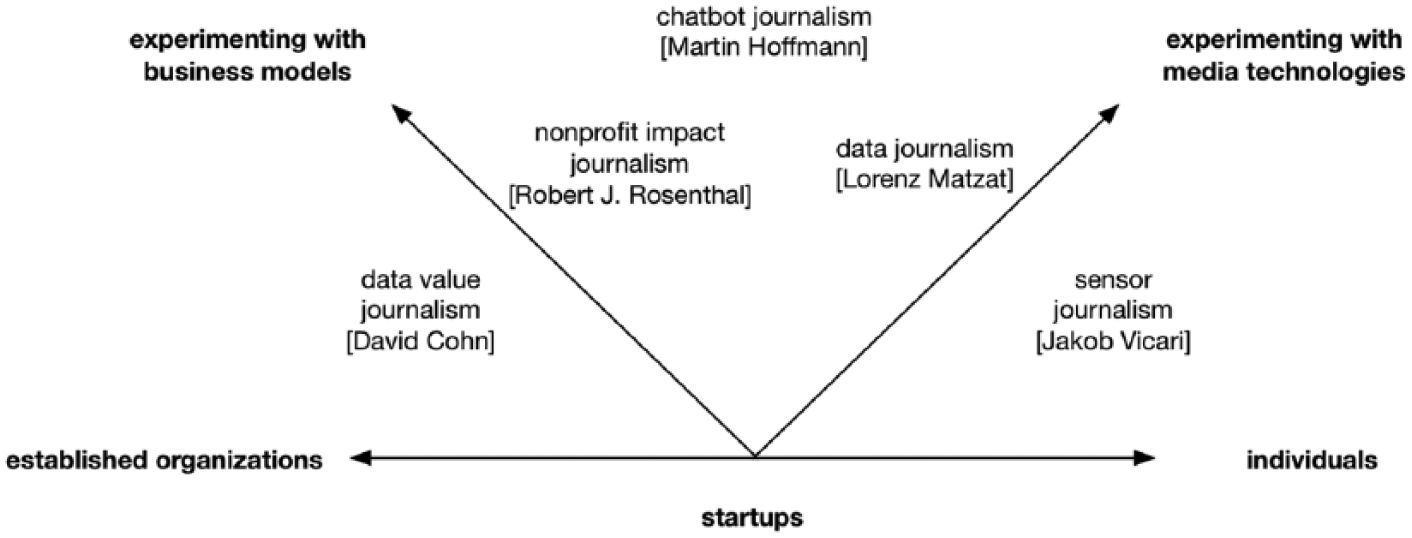
Extreme poles of pioneer journalism.
Based on these lines of difference, our data demonstrates five extreme cases of pioneer journalism by the following individuals that are of particular note:
David Cohn (Berkeley, USA) works as senior director of an innovation team at Advance Publications and has previously worked at AJ+ and Circa. Employed by an established media organization but having a background in startups, his experimental practices address what we can call data value journalism, a model that offers journalism a chance to benefit from the data value chain.
Robert J Rosenthal (Emeryville, USA) works as executive director for the Center for Investigative Reporting (CIR) and is a former journalist and managing editor at the New York Times, the Philadelphia Inquirer, and the San Francisco Chronicle. Coming from journalism in established media organizations, he is pioneering in the sense that, together with the CIR, he has developed a business model for nonprofit impact journalism financed by donations to fund investigative journalism that is then distributed free of charge.
Martin Hoffmann (Berlin, Germany), former Head of Social Media at news website WeltN24, Berlin, is CEO and founder of the startup RESI Media UG, developers of Resi, a now discontinued chatbot that delivers news through a messaging app. He is pioneering in media technology terms by virtue of his development of the app, while in terms of pioneering new business models, he has been experimenting with ways of financing his project by offering, through Resi, public relations opportunities.
Lorenz Matzat (Berlin, Germany) is the owner of a data journalism startup and occasionally works as a freelance journalist with a special interest in data journalism. He is currently experimenting with harnessing emerging technologies to produce data journalism and is paid on a project-to-project basis for his work.
Jakob Vicari (Lüneburg, Germany) is owner of a startup in the field of sensor journalism but mainly works as a freelance science journalist. Having developed and built the hardware necessary for the collection of sensor data for journalistic purposes, he represents the most experimental, technology-minded pioneer in our sample.
Our argument at this juncture is not that these cases and the forms of journalism they represent offer a typology of pioneer journalism in general, rather, these individual cases exemplify (compared to our overall empirical data) the extreme poles at which pioneer journalism is situated and subsequently provide an opportunity to discuss the various dynamics between established organizations, startups, and individual pioneers in developing our theoretical approach.
While having worked for more or less established media organizations, all five cases share a position we can also see in our interviews with other pioneer journalists when they criticize the lack of innovation in established media organizations. Robert J Rosenthal, for example, ‘was really frustrated about the lack of innovation on the business side to try new things: every time you […] wanted to do something different […] the first question was: what it will cost and what’s the revenue’. Jakob Vicari used to work for Wired, Germany. Looking back, he complains that even at Wired, ‘innovation was only possible within narrow limits’, which, according to him, were more precisely ‘limits of thinking in terms of traditional stories’. Martin Hoffmann discussed similar sentiments, stressing that he had a ‘relatively critical view of the German media landscape’ where ‘people talk a lot but do little’. Lorenz Matzat emphasized the specific problems established media organizations have in dealing with the latest technology. Journalists’ personal computers are ‘locked up’ for security reasons and ‘it becomes impossible for people to develop the self-initiative’ to experiment; there is no culture ‘in which you can try things’. However, working for an established media organization is considered ‘secure’. Moreover, what is considered as ‘innovative’ or ‘new’ in established organizations is always defined against the backdrop of already established practices or media products and not against the perspective of the broader field.
This became particularly clear during our interview with Martin Hoffmann who, through his startup, developed the Resi app. Resi provides a conversational type of journalism by delivering news via a chatbot in an instant messenger-like way. But, as he also mentioned, such openness brings with it the burden of high financial pressure. David Cohn describes the difference between what he calls ‘the dance that you do outside and the dance that you do inside’ an established media company as follows: ‘outside, you even have to dance just to get the conversation […] inside, but, it’s a different, you know, viewpoint, right. You don’t have to raise money the same way’. Other pioneers we interviewed, when reflecting on the financially precarious situation of working in a startup or as individual freelancers, argued that this precarious situation can also be a strong stimulus for innovation. Jakob Vicari, for example, says, ‘If you have to exploit yourself […] then the idea must be strong as well’.
The characteristics of established organizations, startups, and working as individual pioneers seem to be quite clear: established organizations are financially, and in terms of the security they provide, (still) the better places to work, but are, due to their less flexible organizational structures and established routines, considered to be far less capable of innovation and of little interest to pioneer journalists despite being able to reach larger audiences. Startups are much more interesting and innovative, but financially precarious and insecure, often producing news that is tailored for niche audiences.
However, seen from a more contextualized point of view, the roles played by and the relationship between individual pioneers, startups, and established organizations are much more complicated. More than one interviewee stated that they could all benefit from each other’s contributions. Martin Hoffmann stressed, for example, that large media organizations have the advantage when it comes to generating awareness for their own media products, whereas for startups it is often very difficult to become known at all. We could say that individual pioneers and startups operate in the context of highly experimental practice, where new ideas emerge, but also where idea making is partly outsourced by established media companies. Established organizations, in contrast, operate within a context of transferring experimental practices into business. That said, individuals and startups can fail, for example, when their ideas cannot be transposed to (financially) sustainable models. Established media organizations, on the other hand, can fail at being inventive when, for example, the core idea of an experimental project gets lost in the process of adapting it to a business model.
During their careers, pioneer journalists’ engagement typically takes place between the extremes of working in established organizations and as individuals. In this regard, our extreme cases demonstrate three lines of interrelation: through personal mobility, through organizational cooperation, and through pioneer communities.
Personal mobility
Flitting between individual freelance projects, working for startups, and being employed by established media organizations has become a fairly established career path for journalists in general and pioneer journalists in particular (Deuze, 2007; Edstrom and Ladendorf, 2012; Witschge and Harbers, 2018). The point we want to make here is that in their self-understanding, being personally mobile is crucial for pioneer journalists if they want to be a transformative force: individuals’ mobility across these different spheres of work is one of the main ways pioneer journalists, from their subjective point of view, transfer knowledge and initiate a ‘push’ in the field.
David Cohn’s situation is a perfect example of how personal mobility relates to pioneering practitioners’ transformative potency. He began his career working for startups and then moved into the innovation teams of established companies. He now works in ‘a unit within the company that innovates for existing brands’ and for him this mobility offers the chance to contribute the expertise he gained while working for fledging startups. This kind of personal mobility can best be understood as an attempt by established companies to ‘buy in’ innovation by hiring skilled personnel to assemble ‘intrapreneurial units’ (Boyles, 2016). However, personal mobility can operate inversely. Martin Hoffmann, for example, worked for an established media organization before he founded his own startup. For him, his negative experiences with established organizations pushed him to become a pioneer: he had to leave behind the stability they offered to develop truly experimental practices. A more extreme case, perhaps, is Robert J Rosenthal who started his career as a journalist at the New York Times, then at the Philadelphia Inquirer, and finally at the San Francisco Chronicle, which he left to become executive director of the Center for Investigative Reporting in 2008. For him, this brought with it the need to experiment with new funding models.
Organizational cooperation
Another way pioneer journalists see themselves as being engaged in journalism’s overall transformation is through organizational cooperation. This cooperation can take on various forms. In terms of our five extreme cases, one initial example is the Super Cow! sensor journalism project by Jakob Vicari that tells the story of three cows – one on an organic farm, one on a family farm, and one on an industrial farm – based on sensor data accumulated during the cows’ daily lives. From his point of view, Vicari could only develop his original idea through his startup but ran into funding problems. He was eventually able to realize the Super Cow! project through the support of the Media Innovation Center Babelsberg, 4 who connected Vicari with the public broadcaster WDR which, in turn, realized his idea as a sensor data–based, cross-media story. 5 This represents a form of temporary cooperation where an established media company – a public broadcaster in this case – acts as ‘host’ for an individual’s idea – which brings new practices into an established organization.
Organizational cooperation is particularly prevalent in the case of data journalism as data-driven projects are often realized with the help of external partners. A typical pioneer’s perceptive on this comes from Lorenz Matzat, who says technology is the area where established media companies cooperate with ‘external service providers’. His own career as a data journalist has thrived on the fact that he has provided a wealth of external services to established publishers in the fields of print, online, and broadcasting. Matzat understands this kind of cooperation as an essential characteristic of German data journalism. However, we are beginning to see established and well-resourced newsrooms begin to integrate dedicated data scientists into their own organizational ‘role mix’ to foster ‘intra-newsroom collaborations’ (Borges-Rey, 2016: 12) between journalists and technical personnel (Loosen et al., 2017). We notice once again in these examples the reciprocal relationship between the pioneers and the mainstream as startups bring innovative ideas to the table for which established media organizations provide the funding.
Pioneer communities
Maintained by pioneer journalists’ personal mobility, a network of pioneer journalists exists in an ongoing exchange of ideas and opportunities. Our five examples demonstrate the emergence of professional pioneer communities made up of individuals, small startups, and employees at established media organizations. In pioneer journalists’ subjective point of view, this is yet another way of engaging with the transformation of the whole field. Crossing professional borders and wandering between professional worlds plays a vital role in the construction of a pioneering practitioner. Rooted in experimental practice, our five extreme cases demonstrate that collectively, pioneer journalists represent – much like other translocal communities – what Benedict Anderson refers to as an ‘imagined community’. Imagined communities are not defined by their ‘falsity/genuineness, but by the style in which they are imagined’ (Anderson, 1983: 6). Style serves as the principal reference point for the imagination, what we may consider as a community’s frames of relevance.
Each of the pioneer journalists we interviewed made more or less explicit statements about their involvement in larger journalistic pioneer communities – even if they did not use the specific term ‘pioneer’ or think of their network as a community in the first place. Cohn told us that ‘there are […] people who I consider colleagues even though I’ve never worked with them, right, because I think [we are] […] kindred spirits’. These are ‘people who are attacking these problems [to do with journalism] and then trying to make a statement’. Ideas are exchanged via blogging, Twitter, and Facebook. Twitter was mentioned by many of our interviewees as an important platform that they use to connect with like-minded people and to monitor the latest trends in journalism and beyond. Cohn meets his contacts personally at networking events such as conferences, while others (like Matzat and Hoffmann) also discussed Hackathons as important meeting places for their specific pioneer communities. Jakob Vicari told us that while he was a ‘lone ranger’ when he started working with sensor journalism, he eventually became acquainted with other pioneers who shared his interests and was able to exchange work and ideas.
Data journalism owes a lot to the open source movement. The Open Knowledge Foundation (Baack, 2015), inspired by the ‘culture of software development’, promotes a culture of sharing to a much greater degree than traditional journalism, according to our interviewee Lorenz Matzat. The sharing he refers to takes place not only in the online realm but offline as well at certain events both on the periphery, such as at certain BarCamps, 6 and at more mainstream gatherings such as the ‘The European Investigative Journalism and Dataharvest Conference’. Data journalists maintain a sense of ‘loose’ cooperation through online communication, more often than not using Twitter and Slack channels where, according to Matzat, ‘everyone supports each other’.
These statements give us an initial insight into the variety of pioneer communities that may be more or less related to one another. Whether or not there exists one, highly differentiated and globalized journalistic pioneer community or whether there are, in fact, various pioneer communities oriented toward particular areas – and the extent to which they interrelate – are still questions looking for an answer. What they do have in common, however, is a shared orientation toward building a future for journalism that is strongly related to developments in (media) technology and various forms of ‘datafied journalism’ (Loosen, 2018: 3). Furthermore, these cases demonstrate the ‘post-traditional’ (Giddens, 1994: 56; Hitzler et al., 2008: 9–19) character of pioneer communities: their membership is not defined by tradition but is self-selected by the journalists involved. Pioneer communities are also ‘deterritorial’ (Hepp, 2015: 211), that is, they span national territories and cultural boundaries by virtue of the networking that takes place across the confines of national borders.
Conclusion: Pioneer journalism and the organizational re-figuration of journalism
The aim of this article was to develop a conceptualization of pioneer journalism as an approach to investigate the transformation of journalism in and beyond the newsroom. To achieve this, we argued along three steps: First, we discussed various strands of research related to professional practice in and beyond the newsroom. Second, we outlined our concept of pioneer journalism. Third, we have taken five extreme cases from an explorative study we conducted to further elaborate upon our conceptual work. In this conclusion, we want to integrate this into a more general reflection on how we might investigate pioneer journalism in the future.
As we already stated in the introduction, we want to do this from a figurational perspective. Referring back to the process sociology of Norbert Elias (1978), this means that we should shift the dynamics of social relations between humans – that is, figurations – and the processes of their construction into the foreground. We can describe these figurations according to their constellations of actors, their shared frames of relevance or orientation in practice, practices which in times of deep mediatization are entangled with contemporary media technologies (Couldry and Hepp, 2017: 66–68; Hepp and Hasebrink, 2017). This approach is particularly helpful for investigating pioneer journalism as it can be adapted just as well to established media organizations as it can for startups, individual pioneers, and entire pioneer communities. Following this argument and concluding from our discussion so far, we can conceptualize pioneer journalism and the role it plays in the re-figuration of journalism’s organizational foundations (see Figure 2).
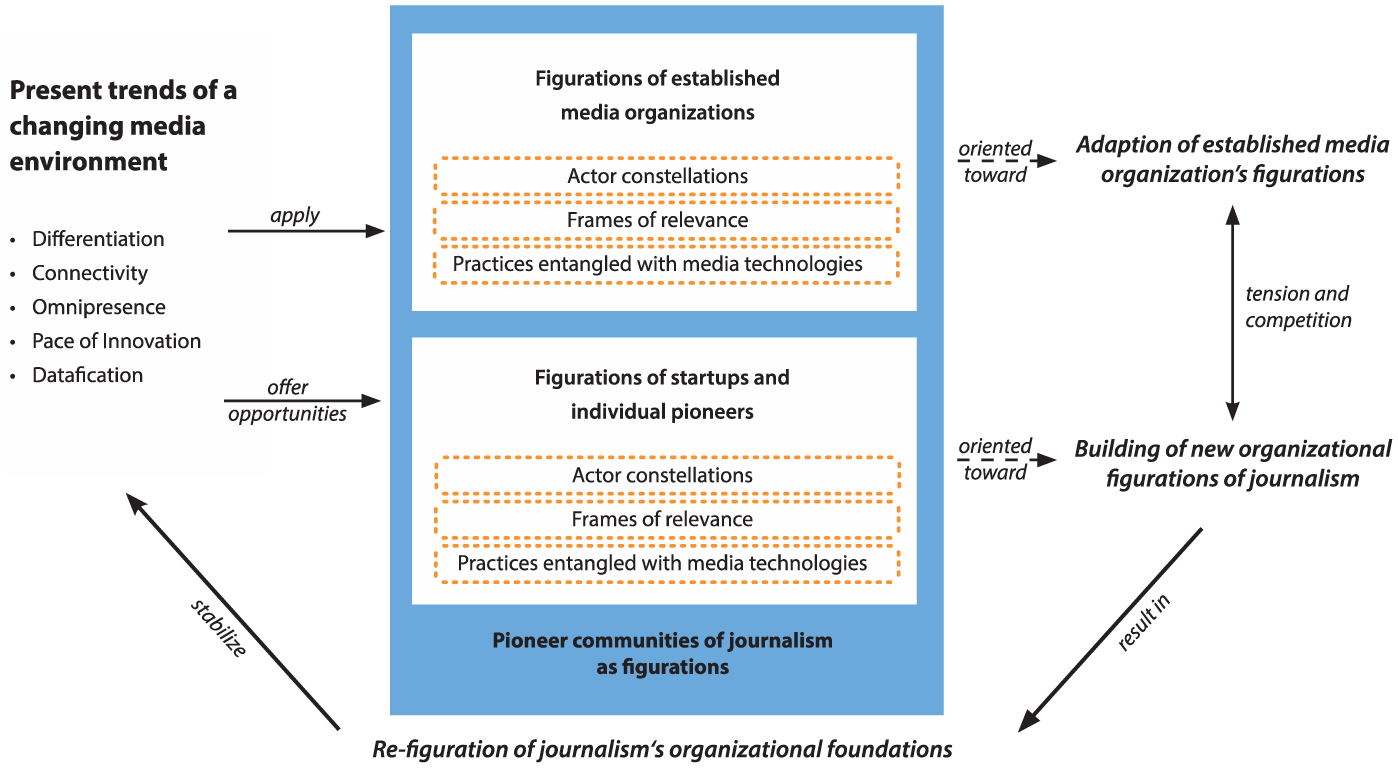
Approaching pioneer journalism from a figurational perspective.
We can understand media organizations, startups, and networks of individual pioneer journalists as specific figurations characterized by a certain actor constellation that is rooted in practice and defined by frames of relevance that orient these practices. In times of deep mediatization, established media organizations must adapt to the pressures of the changing media environment. The shifting media environment is characterized by the following five trends: a differentiation of media (digitalization did not result in one, discrete media device but a variety of very different media), their increasing connectivity (through the infrastructure of the internet these media are highly interconnected), omnipresence (through mobile communications, we have access to these media in nearly all situations), pace of innovation (the cycles of technological change have become accelerated), and datafication (being digital, these media are not just means of communication; they are increasingly used as means of data collection and analysis). Considering our theoretical reflections and our discussion of the five extreme cases, the typical reaction of established media organizations is to adapt their organizational figurations to media change. For example, innovation teams are established to support change from within, or cooperation is realized with external pioneer journalists to stimulate internal organizational change.
At the same time, the five trends of a changing media environment offer opportunities for startups and individual pioneers to establish new organizational figurations. Based on our extreme cases, we looked at some of these figurations: startups in data journalism operating outside established business models, a three-person startup producing a chatbot news app, and the figurations being established by an individual sensor journalist. Each of these cases share the particular characteristic of forming their organizational foundations beyond the ‘path dependencies’ (Beyer, 2005) afforded by large organizations.
Across established media organizations, startups, and individual journalists, a figuration of journalistic pioneer communities begins to emerge. Pioneer journalists exchange ideas that they are able to develop across various institutional and organizational contexts, even in the absence of formal cooperation or personal mobility. Furthermore, these pioneer communities maintain a shared construction of journalism’s possible futures. These dynamics within and between established media organizations, startups, and individual pioneers result in the re-figuration of journalism’s organizational foundations stabilizing the trends of a changing media environment.
This approach to pioneer journalism is clearly just one possible way to conceptualize journalism’s transformation, yet, its advantages are twofold. First, it relates the dynamics of the newsroom to alternative dynamics taking place beyond it with the analytical benefit of focusing on the dialectics of both. Second, it conceptualizes the related transformations in a recursive circle and not as a more one-dimensional diffusion of innovation. Both advantages are worth our consideration insofar as pioneer journalists act across various organizations and are intermediaries in processes of development.
Footnotes
Acknowledgements
We thank Marc Kushin for his thoughtful proof reading.
Funding
The author(s) disclosed receipt of the following financial support for the research, authorship, and/ or publication of this article: This research is published as part of the project “Pioneer Journalism: The re-figuration of journalism’s organizational foundations“, funded by the German Research Foundation (DFG) (HE 3025/15-1, LO 853/8-1) within the Research Network “Communicative Figurations“ ( ).
).